• Donate
  • Our Purpose
  • Contact Us
Executive Magazine
  • ISSUES
    • Current Issue
    • Past issues
  • BUSINESS
  • ECONOMICS & POLICY
  • OPINION
  • SPECIAL REPORTS
  • EXECUTIVE TALKS
  • MOVEMENTS
    • Change the image
    • Cannes lions
    • Transparency & accountability
    • ECONOMIC ROADMAP
    • Say No to Corruption
    • The Lebanon media development initiative
    • LPSN Policy Asks
    • Advocating the preservation of deposits
  • JOIN US
    • Join our movement
    • Attend our events
    • Receive updates
    • Connect with us
  • DONATE
Comment

Trailing the truth in Syria

by Moe Ali Nayel September 3, 2011
written by Moe Ali Nayel

Sitting in my West Beirut office at the end of July, pondering the Syrian revolution and the conflicting reports from state media and activists on the ground, I decided I ought to visit.

For three days I travelled around Damascus, visiting the suburbs reported to be places of protest — they were hard to miss given the army deployment in these areas — but I saw little of what I expected. Where there were protests, such as in Qaboun, they ended within 10 minutes and were male-only marches; women were asked to leave for their own safety. Seeing the situation in Damascus made it clear how the regime is dealing with protests through a choking military siege. Was it like this all over Syria?

The Homs bus station of my youth had been bustling with vehicles and travelers but when I arrived last month it was a ghost town. As I jumped off the bus I heard gunshots in the distance. Later that night my nostalgia of Homs as a place where sects co-existed peacefully vanished when my Christian waiter told me he was worried about the “conspiracy” — touted by Syrian state media — that the militant Islamists sought to foment “chaos”.

“We Christians are afraid,” he said. “We saw how Al Qaeda groups killed Christians in Iraq after the American invasion. We are a minority here, and if this regime falls we are in danger.”

The Alawite neighborhoods in Homs were guarded by tanks and mukhabarat (secret service) and there were few people in the streets — not so different from the rest of the city save the posters declaring “We love you Assad”. Here nearly everyone swore to me that the revolution was a conspiracy, an American and Saudi plot to separate Syria from the axis of resistance, distance it from Palestine and force it sign a peace treaty with Israel. The international media’s inflated reporting of the protests has compounded this sentiment, causing Syrians on the ground to lose respect for their accountability and playing directly into the regime’s claims of an international conspiracy against it.

Now, it was time to see the places of protests, from where the echoing gunshots were fired.

The Khaldeyh neighborhood after Friday prayers saw wave after wave of men arrive to form a sea of protest, a mass movement that brought with it a sense of unity and security. The safety I felt in Khaldeyh encouraged me to travel to Bab-Amr, Bab-Dreb, Bab-sbe’a and Hola, near Hama, where I saw people, mostly poor, protesting courageously for their freedom. No one had guns; I did see signs of people trying to protect their neighborhoods with sticks and stones, but this seems the least one can expect from those attacked and threatened by battalions of state security.

Worryingly, I also saw people drifting unknowingly towards extremism. Lacking strong opposition figures, many found guidance in the words of Sheikh Adnan al-Ar’our, a Syrian religious leader broadcast by satellite from exile in Saudi Arabia. His fiery rhetoric incites Sunnis to take back their country, and graffiti in protest epicenters testifies to his revered status. As much an indication of the religious coloring of the movement, Ar’our’s influence speaks to disillusionment within the largely secular opposition. Repeatedly I was told the opposition were “doing a great job meeting and planning, but they don’t represent us”. “We are here on the streets striking, protesting and facing Assad’s bullets with our bare chests,” people would say, while the opposition “hangs out in hotels”. These sentiments resonated on August 20 when a transitional council was formed in Turkey by outside Syrian opposition figures. On social media networks Syrian activists have questioned who these people are and who chose them.

The danger now lies in this revolution being hijacked by those who do not have the people’s interests at heart, those in “hotel rooms” far from the streets, those who are empowered by foreign countries that want to shape the revolution and sectarian divisions to serve their own ends. As an Arab youth myself I stand by the protestors: this is our time. The older Arab generation had their chance and they left us with dictators, oligarchs, widespread unemployment, illiteracy and poverty; but the old ways die hard. Selmeyeh (peacefully) is how the Syrian revolution started and selmeyeh is the way it must remain to bring about true change, rather than the old tyranny under a new name.

MOE ALI NAYEL is a Beirut-based freelance journalist


September 3, 2011 0 comments
0 FacebookTwitterPinterestEmail
Comment

Only one state left

by Ahmed Moor September 3, 2011
written by Ahmed Moor

Decades of fruitless, frustrating and ultimately self-defeating negotiations have yielded nothing meaningful for the Palestinians. For the Israelis, however, 20 years of the Oslo process have been immensely productive. During that period, the number of Israelis colonizing East Jerusalem and the West Bank swelled by several hundred thousand; today, there are more than half a million settlers in the Occupied Palestinian Territories.

But the putative Palestinian leadership — with Mahmoud Abbasat its head — has signaled that it recognizes the actual nature of the Oslofarce. September will see the Palestinians issue Oslo’s final dirge when a vote on Palestinian statehood is put to the United Nations. While helpful, the move will not impact the likeliest outcome of the conflict: The emergence of a single, non-Zionist, multinational state within Palestine/Israel. Mahmoud Abbas, the President of the Palestinian Authority, will be submitting an application for full membership in the United Nations in September. He will request that the West Bank, Gaza and East Jerusalem be henceforth recognized as Palestine, a state among equals. The move is expected to receive overwhelming support in the General Assembly, but it will require backing from the permanent members of the Security Council in order to be presented for a vote in the Assembly. The United States’ representative to the UN, however, will undoubtedly veto the measure, thereby ensuring that a Palestinian state is not recognized.

The American and Israeli leaders insist that by actively obstructing the Palestinian bid for statehood, they enhance the prospects for peace. According to them, a negotiated settlement is the only way to ensure that a strong and secure peace emerges in Palestine/Israel. In reality, Palestinian statehood would complicate Israeli efforts to continue colonizing Jerusalem and the West Bank; invading a fellow UN member state carries more international penalties than colonizing occupied territories. Over 40 years of colonization has ensured that no Palestinian state could come into existence in the occupied territories. More than 100 settlements and an equally large number of outposts (early-stage settlements) have rendered the West Bank non-contiguous for Palestinians. Moreover, a vast network of settler-only roads has worked to further geographically fragment the West Bank. Jerusalem too has been segregated from its Palestinian hinterlands by a ring of settlements.

Israel’s dependence on Palestinian water further increasesthe likelihood that a separate Palestinian state will not materialize. The mountain and coastal aquifers — which sit beneath the West Bank and Gaza, respectively — are important sources of freshwater for the Jewish state. In a region where the scarcity of potable water is a permanent feature of the conflict landscape, the Israelis cannot be expected to relinquish control of this vital Palestinian resource. Yet, the fact that the US and Israel have effectively aborted any Palestinian state does not mean that the UN vote is meaningless. Indeed, the vote will enable the Palestinians to highlight Israeli intransigence, thereby promoting its increased isolation and bolstering the global Boycott, Divestment and Sanctions (BDS) movement — which aims to defeat Israeli apartheid by adopting South African anti-apartheid strategies.

In this way, the UN vote on Palestinian statehood will promote the most likely outcome of the conflict; the emergence of a binational, single state with equal voting rights for all citizens, following the trajectory set by South Africa for contemporary colonial conflicts in a decolonizing world. 

While it may sound like a novel solution to a hitherto intractable conflict, the one-state solution was in fact a central goal of the Palestinian national movement for decades after the establishment of the state of Israel. The transition to the two-state process was only completed by Palestinian leaders in the past 20 years or so. Indeed, many activists, leaders and academics insist that the empirical reality of Palestine/Israel is already that of a single state — a deeply segregated state with apartheid and institutionalized racism, but a single state nonetheless. The vote on Palestinian statehood at the United Nations will not result in a state due to American and Israeli obstructionism. But it will aid the Palestinian quest for freedom by helping to further isolate Israel and its patron, the US. By empowering the BDS movement, the UN vote will further enhance the prospects for the establishment of a single, non-racist state in Palestine/Israel. At this stage, that is the only viable solution.

AHMED MOOR is a Master in Public Policy candidate at Harvard University’s Kennedy School of Government


September 3, 2011 0 comments
0 FacebookTwitterPinterestEmail
Comment

Little evidence at the end of the line

by Nicholas Blanford September 3, 2011
written by Nicholas Blanford

If Daniel Bellemare, the prosecutor for the Special Tribunal for Lebanon, is planning to base his case against the four Hezbollah members indicted for the assassination of Rafik Hariri solely on the telecommunications evidence contained within the indictment, the actual trials, should they occur, could be over in a very short time. As it is, the indictment acknowledged that the case against the accused is built “in large part on circumstantial evidence”. Indeed, at a certain level it must be tempting for Sayyed Hassan Nasrallah, Hezbollah’s secretary-general, to dispatch the four accused to the Netherlands with a good team of lawyers in the belief that they can beat the rap. After six years of investigations, we could be forgiven for expecting more than telecom analysis to support an indictment that has polarized Lebanese society more deeply than at any other time since the end of the civil war and still threatens further political turmoil. As it stands, the centerpieces of the indictment are five covert and overt mobile networks related to the assassination the prosecution says it discerned and color-coded from the millions of phone calls made each day in Lebanon.

It was widely expected that telecom analysis would play apart in the prosecution’s case; as long ago as October 2005 the cell phone networks used by the perpetrators of the assassination were made public in the first report of the United Nations commission charged with investigating the crime.

Regardless of whether Bellemare has more evidence to hand out or not, there are a couple of questions to ask regarding the contents of the indictment. First of all, the indictment acknowledges that the perpetrators were aware that at any given time their locations could be traced by the process of co-location — using mobile phone signals to triangulate the position of an individual. That, the indictment claims, is why the assassination team’s “red” network of color-coded phones was activated in Tripoli a month before the murder, an area where few Shiites live and home to Sunni Islamists on whom the accused planned to pin the blame for Hariri’s murder.

Yet, if the perpetrators were aware of this technological tracking system, why did they then continue to carry other color-coded phones along with their regular phones while going about their daily business? It was the proximity of their regular phones to the color-coded ones that apparently led to the identification of the alleged perpetrators. During the wave of assassinations of prominent anti-Syrian figures following Hariri’s death, people under potential threat routinely removed batteries and SIM cards from their cell phones before leaving home so that they could not be traced. Hezbollah’s signals intelligence and electronic warfare capabilities are highly advanced and its technicians thoroughly trained. It is inconceivable that the organization would have been unaware that a cell phone can still be tracked even when not in use.

The second, and more pressing, question is why Hezbollah would want Hariri dead in the first place. Certainly, Hezbollah and Hariri were poles apart politically, each having different visions of a future Lebanon. Hariri was a pragmatist, was well accustomed to the necessity for compromise and was not on a moral crusade to oust Syria from Lebanon or disarm Hezbollah. Hariri was willing to accept an armed Hezbollah and respect Syria’s interests in Lebanon so long as he was given free rein to run daily Lebanese affairs as prime minister.

In the months before his death, Hariri and Nasrallah struck up a close and secret friendship — one which even Hariri’s advisors still maintain was genuine — and they met at least once a week in secret. They had much in common, both being devout Muslims, originating from south Lebanon, sharing a strong sense of humor, and even both having lost their eldest sons.

Nasrallah must have not only realized that Hariri was not a threat to Hezbollah and Syria, but he could in fact be exploited as an asset. After all, Hariri’s friendship with Jacques Chirac, the then French president, helped keep Hezbollah’s name off the European Union list of terrorist organizations compiled in January 2005.

More importantly, Hezbollah did not possess the leeway to independently undertake an assassination of such strategic import. If there was Hezbollah involvement in the Hariri assassination, the orders came from elsewhere. That begs the question that if it has taken six years for the tribunal to accuse four men, two of whom supposedly played a minor, ancillary role, how much longer will it take for the tribunal to identify those whodecided that Hariri must go?

Nicholas Blanford is the Beirut-based correspondent for The Christian Science Monitor and The Times of London


September 3, 2011 0 comments
0 FacebookTwitterPinterestEmail
Society

Western media flaws only highlight our own

by Youmna el Asma, Zeina Loutfi & Ramsay G. Najjar September 3, 2011
written by Youmna el Asma, Zeina Loutfi & Ramsay G. Najjar

The attacks perpetrated by Anders Behring Breivik in Norway on July 22 had the unintended effect of unveiling bias and prejudice in the Western media, and sparked worldwide debates about the role and responsibility of the press. The incident also raises important questions about the lessons that we can extract in our bid to harness our regional media’s power as an agent of positive change and a reflection of the aspirations and values of the people.

In the hours immediately following the massacre, the false assumptions and speculation as to the perpetrator revealed a significant lack of rigor and objectivity by some major news outlets. When the truth was out — that the massacres were not carried out by Islamic terrorists but in fact by an anti-Islamic Norwegian one — Middle Eastern journalists were quick to pour scorn on the mistakes made by the foreign media, seizing the opportunity to point out all the faults in coverage. It would seem that they forgot for a moment that our own media industry still has a long way to go before being able to brag about values like objectivity and truthfulness.

Lazy assumptions

Some of the most influential broadcasters undoubtedly were too quick to jump to conclusions, favoring the Islamist and Al Qaeda route without any reliable facts. Looking back at the earliest hours after the attacks, most media directly assumed the terrorist attacks were linked to Islamic organizations and attempted to rationalize every new piece of information by integrating it into the Islamist hypothesis. For instance, an American commentator accounted for the fact that the killer was a “blonde Norwegian male” by deducing that Islamic terrorist organizations had probably moved to “a new level” by recruiting natives. Moreover, the foreign media’s choice of experts commenting on the event provided the grounds for erroneous interpretation; most specialized in researching Al Qaeda, Salafis and other Islamist extremists, thus automatically directing the media analysis towards the Islamist theory without any shred of evidence.

In fact, the Norway attacks could have been a chance for the international media to rectify the strong prejudice against Islam and Arabs that it has played a role in fostering since the 9/11 attacks in New York and Washington DC. Instead, it reinforced a false perception that continues to influence local and international politics around the world. In their reluctance to use the word “terrorist” once the man’s identity was discovered, the media helped perpetuate the idea that terrorism and Islam are often mutually inclusive, and to some extent interchangeable. The word terrorism, or its derivatives, was ubiquitously absent in the majority of the mainstream media’s coverage the day following the attacks, whereas some broadcasters used it only to reassure the audience that “it seems like this is not linked to any international terrorist organizations” and is “not Islamic-terror related”.

In addition, the media’s propensity for sensationalism, and its desire to fill airtime, was prevalent in the headlines used to cover the attacks. The headline that ran in the British tabloid The Sun — ‘Al Qaeda’ Massacre: Norway’s 9/11 — clearly has absolutely no relation to the reality but was immediately chosen as a convenient sound bite that would resonate with audiences, and a captivating branded product that could easily be “sold”.

Moreover, instead of focusing on the human aspect — the  young victims and their stories — the media chose to focus on the perpetrator and his ideology, inadvertently shifting the debate to the topic of immigration and integration, and thus somehow rationalize his horrendous act. The end result, while yet to fully unfold, seems to indicate that Breivik succeeded in what he set out to do,which was to sound the alarm bells over an issue that Europe has been grappling with for generations.

Our own failings

Returning to the media in the MENA region, which were given the rare opportunity to look down on their Western counterparts, the Norway attacks provide an opportunity to assess our own limitations. It is important to remember that our media is still far from performing its role effectively or living up to people’s expectations in terms of objectivity, editorial integrity and ‘fair and balanced’ reporting. The truth remains that, whereas many of the faults the foreign media committed in their coverage were caused by the race for the headline and the urge to fill the 24/7 airtime, the ones committed by our own media are mostly driven by the specific agendas of the media outlets ’financial backers.

One of the many examples is in the coverage of certain campaigns and elections in the region for which media entities are often quick, and more than willing, to announce winners even before official (if not credible) results are in. They often disseminate unfounded information, use sensationalism in their reporting through violent language and fear mongering, and reveal a clear lack of objectivity whether in the amount of airtime given to specific political parties or candidates, or in the partiality of the reporting of certain facts. Moreover, whenever there are security breaches or incidents, some of the media in the region are always ready to point fingers at specific parties, simply because it suits the agenda or interests of the government, politician, or “deep pocket” behind the media outlet.

And most recently the coverage of the Arab Spring has revealed the extent of the partiality in regional media outlets. Whether in the choice to cover, or to not cover, certain demonstrations and political events, or by taking sides between the opposition and the regime, media institutions have clearly failed to play their role as providers of unbiased information.The myth trumpeted by some media channels in the region that they abide by the highest industry standards when it comes to objectively showing both sides of the story, free from propaganda or self-serving interests has to a large degree been shattered in 2011.

For the media to truly reflect the high level of professionalism and integrity of many of its journalists, it should re-examine its practices and instate self-regulatory boundaries that prevent information from becoming a tool for public opinion manipulation. The media has a moral obligation to shun sensationalism that puts a shade on the human and social aspects of events and often directs the debate towards unconstructive dimensions. And it has a duty to avoid speculation and discriminatory discourse that further reinforces prejudices, as a step towards becoming a uniting, rather than a dividing, force.

Accepting responsibility

It is a fact that the media is no longer simply a medium to relay the news. It has a responsibility to use its reach and influence to educate and break down barriers enacted out of prejudice. Remaining faithful to these imperatives would most certainly set the media in the region on the right track; only then would it be in a position to criticize the western media for its shortcomings.

The western media’s coverage of the Norway attacks should serve as a lesson to MENA outlets on the power they have in shaping opinions and debates, and on their responsibility to not turn such power into propaganda. Then again, many would argue that putting the onus on the media, knowing the political climate and the industry’s dependence on advertising revenues and/or political and financial backing, is asking too much. Knowing this, what it all boils down to is that most regional media should free themselves from the shackles of political and financial servitude. Only with such freedom comes the ability to be objective and free of prejudice. Following the incredible societal achievements of the past months, one can only hope that the time has come for the media in the region to show some courage by looking closer into how they operate and re-examining their own system of values.

September 3, 2011 0 comments
0 FacebookTwitterPinterestEmail
Finance

Executive Insight – Value over quality

by Natacha Tannous September 3, 2011
written by Natacha Tannous

Fear and panic drove the markets through most of August causing more than $4 trillion in wealth destruction, while policymakers responded with “soft patches” and short-term solutions to what are structural and fundamental sovereign-debt problems on either side of the Atlantic.

During the week of August 8 the S&P500 — best single gauge of the United States equities market — went on a roller coaster ride, closing consecutively at -6.7 percent, +4.7 percent, -4.4 percent, +4.6percent, and +0.5 percent. While choppy and erratic, both American and European equity markets began a four-week downward near the end of July, with the heightened risk of a recession prompting investors to dump risky assets and seek safety in the Swissie (CHF), gold and in long-dated US Treasuries, in other words, there has been a general flight-to-quality.

Thus, the concern today is how to trade equity and foreign exchange markets, and hedge against potential event risks until the politicians and central bankers provide durable solutions to exit their debt conundrums and correct economic imbalances.

Approaches to equity and FX

Nouriel Roubini, also known as “Dr. Doom” for having predicted the 2008 financial crisis, recently told me that he assigned a “50 percent probability to a double-dip scenario… Or possibly more.”

For investors sharing this “doom and gloom” view, outright put options on US or European indices would make sense, if not shorting the indices directly. Since implied volatility hasn’t reached the 2008 and real crisis levels, protection is still cheap and below fair price if you calculate that the worst is yet to come. The put protection provides an attractive way to limit the downside, or potential losses, to the put premium if you happen to be wrong. If such structure is not affordable, an investor could play the correlation card — given that in times of global meltdown correlation tend stowards one, meaning the markets move in sync — and buy a best-of-put on a global basket where the index that will fall the least will still drop considerably in broad-based sell-offs.

Turmoil in the S&P

Turmoil in the S&P 500

Source: Standard & Poor’s

In the world of foreign exchange, investing in quality assets would protect from event risks, with possibilities including buying a barrier option for a targeted move in the USD-CHF rate, or play the Norwegian NOK if investors fear interventions from the Swiss National Bank (SNB) to control the appreciation of the Swissie.

The second group of investors — the bears — assign a lower probability of dramatic worsening of the sovereign crisis, but still believes that uncertainty will dominate markets. Even the fixed income markets in the Eurozone are pricing in a deeper debt crisis with Italian and Spanish 10-year yields flirting between 6 and 6.5 percent — that is until the European Central Bank decided to resume bond purchases — and more alarming, the Greek 2-year yield hitting 46.6 percent on August 25.

“Markets won’t give the benefit of the doubt [to theEurozone] until the results of policies to correct imbalances in public and private sector balance sheets as well as current accounts, and the new policy infrastructure, are visible,” highlights Mark Wall, managing director and co-head of European Economics at Deutsche Bank. “It is a ‘muddle through’ and as such markets don’t like it.” With this bearish view, buying (bear) put spreads on indices, for example, is a better alternative to outright puts —given the cheaper structure — as investors are willing to limit the upside, or potential gain, below the first strike.

A third and quite diverse group — the bulls — argues that the market has allegedly discounted the turmoil in the US or potential selective default in the Eurozone, with policymakers close to providing solutions; the more extreme ones even believe that ‘everything is a buy at current levels’. These investors are betting on this rally starting soon — and on a more inflationary world — and would rather buy call options on indices, for example, staking their money on the upside. Once again, this group covers a large spectrum and is quite hybrid, as being bullish does not necessarily entail being bullish on all markets.

If an investor bets on a faster resolution to economic imbalances in the US on the basis that the US has better fiscal tools at its disposal to solve the debt crisis, one could combine longs in the S&P 500 with shorts in E-STOXX50. This view can also be played through the FX market, and particularly the euro-dollar.

“As the ECB begins to aggressively accumulate Eurozone bonds— out of necessity — and overall risk appetite grows disappointed with any stimulus from the Fed, the euro-dollar is likely to make its way towards the $1.40 figure,” explains Ashraf Laidi, chief executive officer of Intermarket Strategy Ltd and author of Currency Trading & Intermarket Analysis. “The most important support remains $1.37, a break of which would flood the gates towards further downside.”

Last but not least, a growing group — the ‘risk off’ investors — would rather sit-and-wait. These investors do not wish to actively trade in these markets given the excessive uncertainty and irrationality; they prefer to dump investments across a spectrum of assets and sit on their cash, with the idea that “being flat is the new high.”

Taking a view

Looking at the divergence in trends between the end of July and what seems like a start of rally in equities and correction in quality assets during the last week of August heading into ‘Jackson Hole’ — the annual US Federal Reserve (Fed) symposium — it would seem that the irrationality of markets was more due to panic, a lack of liquidity (with many investors on holiday), day trading and market positioning, rather than to sensible trends. Either way, it seems that markets are largely untradeable, at least until we get more clarity from policymakers.

And yet, the investor has to do something, but what? Is ‘off risk’ the only logical option? The reality is, liquidity has been poor this summer and volatility high, so the investor can make the same amount of money with less notional than in a low volatility environment.

Thus in order to work out how much to put in, the real questions should be: What opportunity does the investor seek and how much does he want to make? Does the investor want a ‘high risk/high reward’ portfolio —investing in the banking sector like Warren Buffett’s recent $5 billion bet on Bank of America — or a portfolio with lower volatility, such as one with investments in the utilities sector?

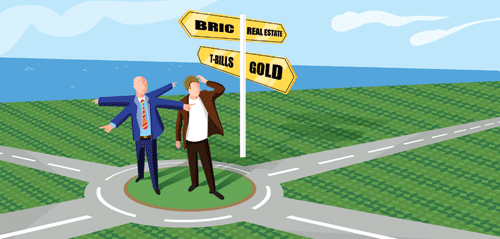
Whether a sector, single-stock or asset class approach, investors must take a view, but one in search of what has been oversold and depressed, or conversely overbought and overvalued,  rather than rushing into safe haven currencies, gold or US Treasuries. In short, it is more sensible to bet on assets trading under or above ‘fair value’ rather than invest blindly in ‘safety’ — value over quality.

NATACHA TANNOUS is EXECUTIVE’s financial correspondent

September 3, 2011 0 comments
0 FacebookTwitterPinterestEmail
Real Estate

Q&A – Fadi Antonios

by Rayya Salem September 3, 2011
written by Rayya Salem

Fadi Antonios presides over a network of industrial enterprises in the United Arab Emirates and has growing interests in Lebanese real estate. Through his development company, Antonios Projects, he is the sole owner and developer behind what will be Lebanon’s tallest tower, the 50-story Sama Beirut, currently under construction in Ashrafieh, where it will offer luxury retail space, offices and residences. Executive recently got the scoop on the project and on Antonios’ future plans for his home city.

Since the construction contract alone is well over $100 million for Sama Beirut, is it not risky to self-finance the entire project?

My father used to say, ‘In real estate, never take a partner; it’s like [having a] wife, you don’t take a partner.” [laughs] If you can realize your project without banking facilities it is better and less risky… Now we have a bridge loan [a guarantee from the bank in case of a financial shortfall]… but we don’t have any problems with financing. I always work by myself [without partners].

Besides that, I am working on a much bigger project. It will be a gated community, which will have close to 60 buildings in a prime location in Beirut and will have all internal facilities, security at the gates and a club for the families.

I am also starting an office building in Beirut, near Université Saint Joseph, where there is a need for “clever offices”. I bought the plot, which is close to 2,000 square meters, and we are now working on the drawings and architecture. Again, it is all being financed by myself.

To date, what is your total investment in Lebanon?

Quite a lot. I think investing in Lebanon in real estate is still the safest and most interesting place. Especially that we are Lebanese and we know the mentality, the people. It is much easier to navigate the construction field [in Lebanon] than anywhere else in the world.

The construction contract awarded to MAN Enterprise was more than $100 million whenannounced in June. Was this the original budget?  

Yes, but the construction budget has increased more than 50percent.

We didn’t expand floors but it is due to the improvements,choice of material, high technology and the devaluation of the US dollar.

How does Sama Beirut use solar water heating techniques?

We tried to use solar energy to produce basic electrical needs. Unfortunately the photovoltaic technology is still very expensive and it did not pay to invest in it. For the hot water, that is a much simpler technology and it’s enough to provide hot water for 24 hours without burning fuel… Fuel for boilers and maintenance of systems is getting more expensive. With solar, it’s a free system and maintenance is cheap.

In the UAE,developers have traditionally applied a mix of British and US fire safety standards, but the rules are currently being standardized, as some new residential buildings reach over 100 stories. What about in Sama Beirut?

Here we can use the service floors [every 10 floors] and we also have fire-proof elevators in addition to fire safety plans and installations. We are applying fire safety [techniques] that are a mix of the French and American systems.

Lebanese engineers are really the best, I would say. I enjoy working with these engineers and architects. I always use Gregory Gatzerelia for all my private residences… For Sama Beirut, we considered international contractors before choosing MAN Enterprise. [The deciding factor] was not price, it was experience in mastering Lebanese construction, rules and regulations — its name and its realizations are the best buildings in Beirut.

September 3, 2011 0 comments
0 FacebookTwitterPinterestEmail
Comment

Nokia’s got your number

by Paul Cochrane September 3, 2011
written by Paul Cochrane

Nokia’s brand image is of two hands — one a child’s and one adult — reaching towards each other with the slogan: “Connecting People”; a nice image for a mobile phone manufacturer and service provider. But in a dozen countries in the Middle East and North Africa (MENA), the Finnish mobile phonegiant’s joint subsidiary with the German company Siemens, Nokia Siemens Network (NSN), has been connecting people in a way that consumers were not expecting: with the mukhabarat, or secret police.

Dozens of pro-democracy activists arrested in Bahrain by mukhabarat following the uprising that began in February were presented with transcripts of text messages and phone calls that they had made. Detainees were puzzled as to how their communications had been intercepted and were being used as evidence against them. They were not aware of the monitoring systems that 12 countries in the MENA, according to a report by Bloomberg published last month, had bought software from NSN and its subsidiary, Trovicor, that enables governments to intercept phone calls, emails and text messages. Such surveillance software also allows the powers that be to create disinformation by changing the contents of written communications and to scan phone networks through voice-recognition and keyword-search software, in addition to remotely activating laptop webcams and microphones on mobile phones, according to Wired magazine.

The Bloomberg exposé of the usage of such technologies in Bahrain is a first during the MENA uprisings of this year. That websites were being monitored was well known, and people in Syria, Libya, Egypt, Yemen and elsewhere have long been wary of what they said on the phone in case of a third, unwanted listener. But the level of interception and its usage by secret police is a concern not only for activists, protesters and the like but also for the very privacy of all people.

Furthermore, it is not an issue confined to Bahrain or the MENA. This follows the phone hacking scandal in Britain in July that reached the highest echelons of the police force, the offices of the prime minister as well as dozens of print publications, and add to this the news of Google’s cozy relations with not only Washington DC but also Beijing. This all comes on top of the revelations over the last decade about the joint American-British global surveillance system Echelon.

Such phone hacking and monitoring is a growing concern reminiscent of George Orwell’s dystopian novel 1984, which depicts a society under the hyper-surveillance of “Big Brother”. The arguments given for such surveillance software in the hands of the state are acceptable when it comes to tracking terrorists, organized criminals and other deemed baddies, but, as always, it is how such technology is used, for what purpose and how you classify a “bad guy”. Inflicting human rights abuses on Bahraini activists for what they wrote and said via their mobile phone is not a shining example of what Trovicor calls in its website: “Making the world a safer place.” Safer for the Bahraini ruling elite perhaps, but not for its citizens.

Telling in the unveiling of Bahrain’s usage of Trovicor’s systems is the fact that it will most likely not cause the same outcry as when NSN was hauled over the coals in 2009 in the United States for providing the same technology to the Iranian government to snoop on protesters in the wake of the disputed presidential elections. What has become very clear this year in the region is that there are halal and haram revolutions, depending on the country’s relations with the US. Bahrain is of course in the latter category.

Conversely, Tehran’s usage of Trovicor’s systems and a “Noto Nokia” international boycott for its indirect role in human rights abuses resulted in NSN selling Trovicor to Germany’s Perusa Partners Fund in 2009, although management, staff and equipment have remained largely the same. Meanwhile, NSN sales teams have been instrumental in the continued roll out of the service in the MENA.

By connecting and informing protestors and by distributing news and video updates from the streets, technology and social media have been key components in the successes of some of the uprisings throughout the region. Unfortunately, these same mediums are being used as a tool of autocracy. Just as governments should be held accountable for repressing their people, so too should corporations who facilitate such brutality.

PAUL COCHRANE is the Middle East correspondent for International News Services


September 3, 2011 0 comments
0 FacebookTwitterPinterestEmail
Comment

In search of deus ex machina

by Peter Grimsditch September 3, 2011
written by Peter Grimsditch

If events in Syria are a tragedy, its monumental regional and international cast combines to weave an intriguing plot rivaling incomplexity the tales of Greek playwright Euripides. Their public utterances areas striking as some lines in, say, Medea, and never was the need for a Euripidean deus ex machina — an unlikely intervention by a higher power to resolve a conflict — more urgent. Some 2,500 years ago, the mythical Medea shocked audiences by slaughtering her children off stage. She justified the infanticide as retribution for her philandering husband’s unfaithfulness. Nowadays, it is the mother country torturing and mowing down its children in a remorseless fight against subversive minors.

Meanwhile, political actors on the global stage gravely offer advice that to many in the audience must sound like — well, Greek. Syria’s western neighbor dispatched its courier (many times) to urge an immediate end to the violence. “Our initiatives had positive results,” said Turkey’s prime minister, Recep Tayyip Erdogan, in an aside to that portion of the auditorium containing his supporters; “The important thing is that Damascus took the first step less than 24 hours after I visited the country,” added Ahmet Davutoglu, his trusty sidekick and main emissary to foreign lands. Yet even as the oppressors were promising to mend their ways and introduce democratic family counseling, their tanks were racing from Hama to continue target practice in another town. Syrian leader Bashar al-Assad put those “positive results” in a different light. “In general, we meet with officials from other countries, take advice, and discuss their experiences, especially countries whose societies resemble ours, but when it comes to a decision, we don’t allow any country, near or far, to interfere.”

Cue the passionate public pleas from myriad actors, none of whom seem to be listening to the others.

Iranian President Mahmoud Ahmadinejad said he was grateful to Erdogan for opposing, as the Iranian news agency IRNA reported, “the US-led Western alliance of NATO’s military invasions,” saying that “foreign meddling in regional matters only exacerbates the state of affairs.” The audience may have scratched its collective head at this. NATO has led aerial strikes in Libya while military action against Syria is an idea few have taken seriously. Turkey supplied the Libyan rebels with several hundred million dollars, all the while simultaneously trying to convince Muammar al-Qadhafi, to be more accommodating.

That policy of pragmatism was also demonstrated by Davutoglu’s pleas to Assad in Damascus being accompanied by two separate conferences on Turkish soil of the so-called Syrian opposition. Meanwhile, further complicating the twisted plot, as Ahmadinejad was expressing gratitude to Erdogan, the Ankara-based Center for Middle Eastern Strategic Studies (ORSAM) claimed Iran had been spreading anti-Turkish propaganda, accusing it of supplying arms to Syrian opposition groups. And the Tehran Times wondered how Erdogan could wag his finger at Syria for “attacking armed terrorist groups” when his own military forces had launched a massive operation against “a few attacks” by Kurdish insurgents. Enter the United States and Russia. After some considered indecision, President Barack Obama announced that Assad had to go and said he and Erdogan had agreed to “consult closely” over the ongoing violence; Erdogan’s people say in public they do not support denying Assad his right to rule, while a few admit in private that it may come to that. Meanwhile, Russia said that it vehemently opposes military action against Syria, while declining comment on the possibility of Turkish support for armed intervention. Ankara has never said openly it was considering using its army on Syrian soil, although it has done little to squash analysts’ publicly aired speculation on the various forms in which this could happen.  So how will the drama end? Euripides would have stuck a character in a crude crane on the corner of the stage and raised him aloft to explain, in some of the more unremarkable passages of Greek verse, how everything would be resolved.

The deus ex machina to provide a solution for Syria, and a good few other countries in the region, could well be an international conference to seek a comprehensive Middle East settlement. And if curbing human rights abuses and extending freedoms make the agenda as well, so much the better — indeed, these ideas seems almost as old as Euripides. But the convenient final scene in which all problems were resolved was one reason the author of Medea won very few prizes; I’d hold the cigars for the conference’s prospects as well.

PETER GRIMSDITCH is EXECUTIVE’s Turkey correspondent

September 3, 2011 0 comments
0 FacebookTwitterPinterestEmail
Comment

Rivalries wrack Yemen’s opposition

by Farea al-Muslimi September 3, 2011
written by Farea al-Muslimi

Embattled Yemeni President Ali Abdullah Saleh, still in Saudi Arabia recovering from a June bomb attack in Sanaa, has been delivering speeches to his supporters back home promising a swift return to Yemen. His messages have raised fears that his return will lead the country to a civil war— a justifiable concern. In reality, whether Saleh comes back or not is not Yemen’s biggest question today. Even if he returns and refuses to relinquishpower, the post-Saleh period is imminent.

With this is in mind, the country’s opposition groups have been piecing together differing frameworks for a transfer of power. On July 16, coalitions of Yemeni youth in “change square” in Sanaa — groups created amid months of daily protests and sit-ins against the Saleh regime — established a Transition Council of 17 national figures from various groups to rule the country and “[put] an end to Saleh’s regime”.

The youths’ measure was followed by the formation of a“National Council” a few days later by the Joint Meeting Parties (or JMP, established in 2006 by the main opposition political parties in the country), which declared that discussions were taking place between the JMP and other opposition actors to establish a comprehensive transition council representative of the different actors in the opposition and political movements from around the country.

Thus, “The National Council for Peaceful Revolution Forces” was formed after some debate and was originally comprised of 143 members from different political groups: the JMP, opposition actors abroad, al-Houthis, the Southern movement, and religious, military, tribal and civil society leaders. As comprehensive as its intentions may have been, the council quickly ran into discord. The Houthi movement declined to participate, citing a lack of representation, while 23 high-profile members from the South withdrew, namely because they wanted seats on the national transitional council to be split 50-50 between the southern and the northern provinces — this, despite the overwhelming population majority in the north. They also griped at having been named to the council without first being consulted, a common refrain indicative of the larger criticism of the opposition: the lack of strategic planning and coordination. The councils have put the opposition’s boot to Saleh’s neck and begun the process of transitional dialogue, but they have failed to put forward a viable plan for a transfer of power or to reconcile differences between opposition groups.

Since the establishment of the councils by the “youth”, and the JMP and its alliances, nothing has really changed on the ground. The regime still holds power, the security forces continue to attack protesters and the political and economic crises worsen by the day. More importantly, the councils do not enjoy any international recognition; at least not yet.

Whether an interim government will be in power for months, a year or longer, at some point elections will have to be held and new actors will come to power in Yemen. Of principal concern on this matter is the real chance that it would be the Islamists who emerge on top, and, if this does happen, what their makeup might be.

The Yemeni branch of the Muslim Brotherhood, the Islah Party, would be most likely to attract popular support, as the strongest political party in the country. But it is a divided congregation, with three groups making up its core: the Salafists, a smattering of tribes, and the Ikhwan, with the latter known to be the most pragmatic and least ideologically driven. The main concerns are regarding Salafists, led by Abdul Majeedal-Zandani, an extremist religious leader once classified as a “specially designated global terrorist” by the US Treasury Department. Zandani announced more than a month ago that he is pro-Islamic Caliphate, while declaring a“government by the people and for the people is a concept for infidels”. And in 2007, he opposed the appointing of a woman to the Shura Council.

The Islah party has been increasingly realizing that Zandaniis costing the party more than he is helping it, and had already begun minimizing his role, albeit unofficially, even before the uprisings started. The fear of Zandani’s role and the Islamists in general is more an exaggerated phobia than reality; it is anathema for Yemenis to accept a new dictatorship under any justification, even a religious one.

Still, without a better organized, more unified effort from opposition parties to replace Saleh via political means, the question will remain: a transition council to what?

FAREA AL-MUSLIMI is a Yemeni activist and writer for Almasdar

September 3, 2011 0 comments
0 FacebookTwitterPinterestEmail
Comment

At war without knowing why

by Adam Pletts September 3, 2011
written by Adam Pletts

Images of the World Trade Center buildings billowing smoke, as their final minutes counted down a decade ago this month, gave a very different symbolism to the already iconoclastic twin towers — one representing the change of an era and a new geo-political order. Later that afternoon of September 11, 2001, according to the confidential notes of his aides, Donald Rumsfeld, then United States Secretary of Defense, was to instruct: “Go massive. Sweep it all up. Things related and not”.  And thus followed the two prolonged and bloody wars in Afghanistan and Iraq.

On top of its tangible tragedy, 9/11 was also devastatingly aesthetic, a mixture which helped to sear the event into our collective memory, so much so that it has become one of those rare occasions for which most can remember where they were when they first saw the smouldering towers.

But what do Afghans who live in some of the places most affected by the fallout of 9/11 recall about that day?

Helmand Province in Southern Afghanistan has borne the brunt of the fighting between Taliban and US-led coalition forces. It is also home to Das Mohammad, a farmer who scrapes a living from subsistence crops and opium cultivation. With an expression of some confusion, Mohammad recently took a quick glance at a photograph I handed him of the two metal towers spewing clouds of smoke against the blue sky of that day. When asked whether he knew what it was he shook his head. A small group of locals gathered around him, all of whom examined the picture with curiosity but no sign of recognition. When asked whether they thought the events depicted in the image had any bearing on their own lives the group was unanimous in dismissing them as irrelevant.

From his reactions to the picture it was clear that Mohammad had no idea what 9/11 was, or for that matter why America and its allies originally sent their military forces to Afghanistan. He is not alone; a survey carried out in October 2010 by the International Council on Security and Development found that 92 percent of a sample of 1,000 men in Helmand and Kandahar provinces were “unaware of the events of 9/11 or that they triggered the current international presence”.

Given the extremely poor infrastructure, lack of media and high levels of illiteracy, not to mention 30 years of war and the fact that the Taliban banned television and radio, it should perhaps not be surprising that most Afghans in Helmand and Kandahar have little idea about 9/11.

It should, however, beg the question as to how effective the coalition campaign to win hearts and minds can really be when those very minds, through no fault of their own, cannot place the international military presence within any context. It is one thing to tell Afghans that the Taliban are the “bad guys” — many would willingly agree — but quite another for them to understand why this is the business of foreign military forces.

After the assassination of Osama Bin Laden there is a case to be made that 9/11 itself is no longer a factor in the war in Afghanistan, which has moved on to attempting to create a safe environment where reconstruction and development can take place. These efforts, though, have been painfully slow, and it is likely that, just as the international military forces will leave without a great many Afghans ever having known why they were there in the first place, they will also do so without having adequately paved the way to real stability.

At the end of the day, the lack of knowledge about 9/11 is symptomatic of a far broader failure in communication between the allied forces and Afghanis, be they civilian, political or military. There are of course exceptions, but at every level, from the humble military translator misinterpreting his officer’s questions to an Afghan president who frequently decries the actions of his own international allies, war and reconstruction in Afghanistan is too often a story lost in translation.

ADAM PLETTS is a freelance journalist based in Beirut who recently completed the documentary film “Have You Heard of 9/11?”

September 3, 2011 0 comments
0 FacebookTwitterPinterestEmail
  • 1
  • …
  • 364
  • 365
  • 366
  • 367
  • 368
  • …
  • 686

Latest Cover

About us

Since its first edition emerged on the newsstands in 1999, Executive Magazine has been dedicated to providing its readers with the most up-to-date local and regional business news. Executive is a monthly business magazine that offers readers in-depth analyses on the Lebanese world of commerce, covering all the major sectors – from banking, finance, and insurance to technology, tourism, hospitality, media, and retail.

  • Donate
  • Our Purpose
  • Contact Us

Sign up for our newsletter

    • Facebook
    • Twitter
    • Instagram
    • Linkedin
    • Youtube
    Executive Magazine
    • ISSUES
      • Current Issue
      • Past issues
    • BUSINESS
    • ECONOMICS & POLICY
    • OPINION
    • SPECIAL REPORTS
    • EXECUTIVE TALKS
    • MOVEMENTS
      • Change the image
      • Cannes lions
      • Transparency & accountability
      • ECONOMIC ROADMAP
      • Say No to Corruption
      • The Lebanon media development initiative
      • LPSN Policy Asks
      • Advocating the preservation of deposits
    • JOIN US
      • Join our movement
      • Attend our events
      • Receive updates
      • Connect with us
    • DONATE