• Donate
  • Our Purpose
  • Contact Us
Executive Magazine
  • ISSUES
    • Current Issue
    • Past issues
  • BUSINESS
  • ECONOMICS & POLICY
  • OPINION
  • SPECIAL REPORTS
  • EXECUTIVE TALKS
  • MOVEMENTS
    • Change the image
    • Cannes lions
    • Transparency & accountability
    • ECONOMIC ROADMAP
    • Say No to Corruption
    • The Lebanon media development initiative
    • LPSN Policy Asks
    • Advocating the preservation of deposits
  • JOIN US
    • Join our movement
    • Attend our events
    • Receive updates
    • Connect with us
  • DONATE
Banking & Finance

For your information

by Executive Editors July 10, 2011
written by Executive Editors

Capital inflows to MENA to slump

Net capital inflows to the Middle East and North Africa (MENA) region are forecast to drop 28 percent in 2011, from $80.6 billion in 2010 to $60.3 billion, according to an Institute of International Finance (IIF) report entitled “Capital Flows to Emerging Market Economies” issued earlier last month. Meanwhile, net capital outflows from the region are expected to rise to $221.5 billion for 2011 against the backdrop of political turmoil, a 74.55 percent increase from $126.9 billion in outflows a year earlier. The report said foreign direct investment (FDI) in the MENA region would rise by $8.2 billion this year, which would compensate for portfolio investment losses and the drop in inflows from banks and private creditors. While account surpluses have more than doubled for the United Arab Emirates and Saudi Arabia, buoyed by increases in oil prices, the report highlighted that some countries have suffered from large capital outflows and account deterioration, namely Egypt. Estimates for the country’s total outflows reached $16 billion, largely due to a slump in tourism activity, an $8 billion drop in reserves and a sharp fall in FDI. For Lebanon, the IIF projected the current account deficit to widen from 15.9 percent of gross domestic product in 2010 to 17.7 percent for 2011, and net private capital inflows to decline by 49.35 percent in 2011 to $3.9 billion, compared to $7.7 billion a year earlier, due to the country’s political situation.

BDL regulates money dealers

In an effort to deter money laundering and terrorism financing, Banque du Liban (BDL), Lebanon’s central bank, issued a set of circulars to regulate the operations of money dealers in the country. The directive includes mandatory training courses on anti- money laundering and terrorism financing for all persons involved in the direct or indirect management of money dealer institutions. The circular also prohibits them from opening accounts at any bank at which their partners, owners, shareholders, managers and members of the board of directors hold personal accounts and from depositing cash directly into their clients’ accounts or accepting to represent third parties. It also requires that money dealers notify the Banking Control Commission (BCC) of any bank with which they work. The circular also stipulates that money dealers appoint a compliance officer and exchange bureaus an internal auditor to make sure their operations are aligned with the regulations of BDL, BCC, and Lebanese central bank’s Special Investigation Commission (SIC). One of the circulars sets a minimum capital of 5 billion Lebanese lira [$3,333,333] for money dealing institutions, adding that the latter’s accounting transactions must segregate shipment of cash and precious metals from those of other operations. Per the new regulations, money exchange institutions and banks that ship bank notes or precious metals between Lebanon and abroad must notify the BCC and BDL’s Directorate of the Financial Markets of the detailed number and volume of such shipments through monthly financial statements. And lastly, money dealers will be required to send monthly, quarterly, semi-annual and annual financial statements to the BCC and BDL’s Directorate of Financial Markets.

Cost of sending remittances to Lebanon drops

According to figures released by the World Bank, the cost of sending remittances to Lebanon dropped in the first quarter of 2011. A $200 transfer from the United States to Lebanon costs $25.10 in nominal terms, almost 12.6 percent of the total amount, a decline from 13.2 percent for the same period the year before. Likewise, the cost of sending $500 amounts to $27.70, 5.53 percent of the transfer and a decrease from 5.74 percent for the first quarter of 2010. The survey was conducted on 24 countries, among which 11 were in South and Central America, seven in East and Southeast Asia, three in the Caribbean and two in Africa. Lebanon ranked as the most expensive destination for $200, and sixth for $500 US transfers. Including a transaction fee and an exchange rate margin, the cost represents the average charges for transferring money through commercial banks and money transfer operators, which amounted to 17.2 percent and 6.2 percent for the first three months of 2011. On a side note, the World Bank also revised 2010 expatriates’ remittance inflows to Lebanon upwards to $8.4 billion, compared to an $8.2 billion forecast in November 2010.

Lebanon’s NACB bank freezes Libyan assets

In compliance with United Nations Security Council resolutions 1970 and 1973, Lebanon’s North African Commercial Bank (NACB) froze an undisclosed amount of assets belonging to the Libyan regime in June. Both resolutions mandate that member states freeze any economic or financial resources owned or controlled by the Libyan regime, whether directly or indirectly. A spokesman for NACB, which is 99.54 percent owned by the Tripoli-based Libyan Foreign Bank and formerly known as The Arab Libyan Tunisian Bank, dismissed news reports that the bank had ceased its commercial activities since February 2011.  Further tightening the financial sanctions on the Libyan government, the United States Department of the Treasury (DoT) released a statement on June 21 blacklisting and prohibiting U.S. transactions with nine companies controlled or owned by Muammar Qadhafi’s regime, including NACB, the Arab Turkish Bank and Tunisia-based North African International Bank. The DoT exempted other financial institutions based in foreign countries and overseen by the Libyan government from these sanctions, provided their operations do not benefit the Qadhafi regime, or any Libyan entities and individuals who have previously had their assets frozen.

And the rich get richer

The worth and number of global high net worth individuals (HNWI) have surpassed 2008 pre-crisis levels, growing by 8.3 and 9.7 percent in 2010 respectively, according to Merrill Lynch and Capgemini’s 2011 “World Wealth report”. The number of HNWIs in the Middle East reached 40,0000 in 2010, an annual increase of 10.4 percent, while the region’s wealth was estimated at $1.7 trillion, up by 12.5 percent from a year earlier. At 32 percent, fixed-income assets made up the bulk of total financial assets held by Middle Eastern HNWIs, followed by equities at 28 percent, real estate at 18 percent, cash and deposits at 16 percent and alternative investments at 6 percent.  The report also shed light on ‘passion’ investments — such as art, luxury collectibles, jewelry, jems and watches. The majority of Middle Eastern HNWIs biggest ‘passion’ appears to be luxury collectibles, which stood at 29 percent of their total investments of passion in 2010; their allocation to jewelry, gems and watches was reduced from 35 percent in 2009 to 29 percent in 2010. Meanwhile, art and sports investments took away 17 percent and 13 percent of Middle Eastern HNWI wealth dedicated to passion in 2010, respectively.

On a local level, the report said the key drivers of HNWI wealth in Lebanon for 2010 included a real gross domestic product growth of 7.2 percent, an increase in real private and government consumption, a continuous rise in property prices, large capital inflows, rapid de-dollarization and containment of inflation at around 4.5 percent. The main inhibitor to growth in Lebanese wealth in 2010, according to the report, was the country’s fiscal policy as its government debt, which stood at 148 percent of gross domestic product by end of 2009, was still among the highest in the world. The report showed that globally, HNWIs’ greatest concern was the impact of the economy while some 69 percent of HNWIs were concerned that future generations would not adequately manage their inheritance.

BDL foreign reserves see slight dip

In its May 2011 balance sheet, Banque du Liban (BDL), Lebanon’s central bank, recorded a 0.74 percent decline in its foreign currency reserves for the second half of the month, a depreciation of $224.15 million to $29.95 billion, down from $30.18 billion for the first two weeks of May 2011. This would be the first time BDL’s foreign reserves slip below the $30 billion mark since March 2010, a decrease mainly attributed to weakened investor sentiment in Lebanon amid political instability in the country and the neighboring region. Meanwhile, BDL’s gold reserves appreciated by a bi-weekly total of 1.61 percent to $14.18 billion for the second half of May 2011, following the surge in prices of precious metals.

July 10, 2011 0 comments
0 FacebookTwitterPinterestEmail
Editorial

Of puppets and cardsharks

by Yasser Akkaoui July 10, 2011
written by Yasser Akkaoui

The indictment is here. Just 18 days after a government formed seemingly overnight, the day has come with timing that can only be described as… convenient. Not only has this government formed itself and sat for nice photos, it suddenly has a policy statement as well — the largest hurdle between it and legitimacy. Excellent timing indeed.

When it was first announced that a new government had been formed, there was a collective sigh of relief. And now more than two weeks later, only the village idiot cannot see what is happening. Do we know what this government means?

The Lebanese people are so busy with the trials of daily life, perhaps they haven’t the time to take stock of the forces gathering around us. The myriad items of basic domestic governance that the months without a government have left undone is so immense that the tonnage of requests for bare necessities and pending paperwork could match that of the Saida dump. But, by focusing on these not unimportant but secondary problems, we are ignoring the lasting meaning of this government.

There is one country designing our present circumstances and it is not Lebanon. Yet again we find ourselves a card in the hand of another player when we should be a player in our own right.

 This month Executive lays down a challenge for our new leaders and it is not grandiose or idealistic. We ask for the fundamentals. The request is so basic that to ask for it encroaches on our dignity but still, we have to ask because our politicians in recent, or not so recent, history do not deem it their job to put us on equal footing with the rest of the world.

This new government and the easterly winds which fill its sails will ensure that foreign direct investment dries up — they will send the risk of investing in Lebanon so high that anyone considering it will run, not walk, in the other direction.

So, if we are to be left in the dark as to our future, our prosperity and even our safety, the least you could do is turn on the goddamn lights.

July 10, 2011 0 comments
0 FacebookTwitterPinterestEmail
Society

Lebanon’s luxury yachting

by Executive Staff July 10, 2011
written by Executive Staff

Take a dive into Lebanon’s yachting market with the luxury special report in the July edition of Executive Magazine, in stores now.

July 10, 2011 0 comments
0 FacebookTwitterPinterestEmail
Comment

Rerouting Pakistan away from America

by Gareth Smith July 5, 2011
written by Gareth Smith

In using a press conference last month to suggest that Iran had information the United States wanted to destroy Pakistan’s nuclear program, Iranian president Mahmoud Ahmadinejad stirred a pot of complex geopolitics.

Ahmadinejad enjoys playing to the public gallery, in this case Pakistan, where popular feeling that Washington has a cavalier approach to the country’s sovereignty was heightened by the US killing Osama bin Laden near Abbottabad in May. What may have been more on the Iranian president’s mind was criticism in Pakistan of its government stalling, under US pressure, over a pipeline for natural gas from Iran’s South Pars field. Pakistan badly needs the gas to end power cuts and keep its industries running.

“It sounds unbelievable that any government can afford to neglect such an important project or take it so casually,” wrote Shamim Rizvi last month in Islamabad magazine, The Voice. The ‘peace pipeline’ was first mooted in the 1990s with the original proposal including both Pakistan and India. While India froze participation, ostensibly over pricing, but more so to placate Washington’s drive to isolate Tehran, Pakistan in 2009 signed on the dotted line. Iran committed to supplying 7.7 billion cubic meters of gas annually for 25 years beginning in 2014 — a huge contribution to Pakistan’s energy needs.

Pakistan has failed to clarify when it will build its part of the pipeline. Iran has said its leg has reached just 80 kilometers from the border.

Rolling power blackouts are rife in Pakistan. In Baluchistan province, which borders Iran, electricity outages reach 10 hours per day in Quetta, the provincial capital, and up to 20 hours in rural areas often dependent on irrigation run on electricity. Coastal areas — including Gwadar, where China is building a large naval base — receive Iranian electricity, and there are discussions on expanding the supply. Last month a joint Iran-Pakistan power company announced a $100 million project for wind turbines in Pakistan’s Sindh province.

Bilateral trade has reached $1 billion annually, and Iran is part-funding health centers and a large halal slaughterhouse in Lahore. Aside from energy and promises to buy more Pakistani rice, meat and fruit, Iran is offering a road link to help Pakistan export to Turkey and central Asia. The five central Asian republics — Kazakhstan, Kyrgyzstan, Tajikistan, Turkmenistan and Uzbekistan — are rich in natural resources, home to 62 million people and have a combined gross domestic product of more than $200 billion. Yet Pakistani exporters are trying to reach them through costly air freight or by road through the chaos of Afghanistan.

With the US winding down in Afghanistan, its regional role is waning as that of China grows. Nawaz Sharif, Pakistan’s main opposition leader, said last month that people were “fed up” with power cuts and demanded Chinese companies be rushed in to develop hydro-electric dams. Beijing has already invested heavily in Iran’s energy sector.

Iran has often tiptoed around Pakistan-India relations, but tilted to Islamabad in November when Ayatollah Ali Khamenei, the supreme leader, provoked a demarche from New Delhi after remarks calling for Hajj pilgrims to support the “struggle” in Kashmir, where Pakistan-backed militants contest Indian rule. Tehran had been riled by US President Barack Obama’s visit to India the previous month and his apparent support for India having a permanent seat on the UN security council.

But Iran has no desire to jeopardize relations with India, and the two sides are seeking a route for payments for Iranian oil after the European Union in May blocked payments through Germany, a channel devised after India’s Central Bank, again under US pressure, ruled out using the Asian Clearing Union. India in 2010 imported 17 percent of Iran’s oil exports for around $12 billion, and suspension of this trade would upset both sides. India is also building roads in Iran and Afghanistan to create a trade link from Chabahar port, in Iran’s Sistan-Baluchestan province, into Afghanistan and central Asia.

Slowly but surely these economic ties are strengthening, whether the US likes it or not. Washington’s disapproval provides fertile ground for Ahmadinejad and others to argue the Great Satan simply wants to block development of the countries it mistrusts.

Gareth Smyth has reported from around the Middle East for almost two decades and was formerly the Financial Times correspondent in Tehran


July 5, 2011 0 comments
0 FacebookTwitterPinterestEmail
Finance

Q&A – Marwan Kheireddine

by Vanessa Khalil July 3, 2011
written by Vanessa Khalil

An avid Lebanese contemporary art enthusiast, Marwan Kheireddine, chief executive officer at Al Mawarid Bank, recently sat down with Executive to talk about his personal art collection, his take on the booming Middle Eastern arts scene and ‘passion’ investments.

When did you first start collecting art?

I always had an eye for art. My father collects art [and] I started my own collection some 10 years ago by getting interested in [Mustafa] Farroukh [a pioneer in Lebanese contemporary art]. Someone told me that he was the art teacher at my school, at International College [in Beirut], so I started buying some [of his works] here and there. I moved to buying any and everything that I liked. Then I realized that maybe for the sake of having an ice collection, I should concentrate on something and at some point I concentrated on Lebanese artists [with a theme of] war in Lebanon.

Some say Lebanese art does not get enough support from Lebanese collectors, which leaves it undervalued. Do you agree?

I tend to say that in certain cases and at certain international auctions, some Lebanese art was overpriced, and some was sold for a significant premium. It’s not uncommon now to find Lebanese artists, some of which have passed away, others still alive, that are selling, at auctions, small paintings in size for amounts in excess of $100,000 and $200,000… For those prices you can get a painting that is signed by Picasso. But I do agree that some Lebanese painters have not yet achieved their worth. Aref Rayess for example — who’s one of the massive artists that passed away some while ago —[has] huge collections that are incredibly artistic and still not selling at their full value.

Is Middle Eastern contemporary art being overvalued at auctions?

To establish a market, a one-off sale does not really create a price. So it may very well be circumstantial; it may very well be that someone really liked that piece of Saudi art and decided to pay a lot for it. Saudi art is now hot. People are now looking because the image they have of Saudi Arabia is anything but art. It’s oil, it’s business, it’s the economy, etcetera. So art from there is attracting a lot of interest from regional and international art collectors. I’m looking at it but I have not bought anything.I have not seen anything yet that really caught my attention.

What art would you invest in?

This is the million-dollar question because if it’s only for investment, the objective would obviously be to buy something that will increase in value, and identifying the artists that will survive time is not easy. If we go back to the Lebanese artists, I think that really a handful saw their value increase over the past 100 years. You have Farroukh, Omar Onsi, Habib Srour — who has a limited number of paintings for collectors to view, let alone buy — Paul Guiragossian, Shafik Abboud and that’s out of what? Maybe 1,000 artists that have had their paintings circulated in Lebanon over the past 100 years. 

Auction houses in the region are believed to be overly speculative, focused on short-term profits. How would someone avoid art ‘bubbles’?

Auction houses are by no means experts, in the sense that they are selling something whereby they are guaranteeing its future value. They estimate the art prior to placing it but many times they’ve estimated prices that they were never able to achieve and at other times pieces sold for multiples of their estimates. They guarantee authenticity, condition and delivery.

At the end of the day, the price hike is happening because the bidders tend to be, in our part of the world, somehow emotional. So we had an [Ayman] Baalbaki [“Let a thousands flowers bloom”] sell for something like $200,000 dollars. That, I think, does a disfavor for Baalbaki, because if he sells at this price today, what are his chances of going much higher? You had two bidders that were hyped on that specific painting — especially with the Arab revolutions taking place — and they overbid. In my mind, from a monetary perspective it is not worth that much.

Is it very dangerous having young MENA artists reach record prices so early in their career?

Overbidding on certain pieces does create anomalies in the market. But I don’t think you can do anything about it… and I’m sure that whoever bought this Baalbaki is so proud of it that it’s probably hanging on the main wall in some mansion somewhere in the Emirates or elsewhere. The price is more a reflection of the feelings of the buyer at the time the piece was bought.

What would guarantee the value of the artwork inspired by the Arab uprisings next year?

Nothing will guarantee the value of art at anytime. A lot of [art] buying, especially for upcoming artists, is based on mood and general trends in the market. There’s always this ambiguity, animosity, in the art world because it relies a lot on emotions. It’s not a rational science.

In that sense, passion investments are not any less volatile than other investments, are they?

No, there are certain art lots or pieces that you cannot go wrong with; a Picasso, Monet, Van Gogh, a [Paul] Guiragossian or a [Shafik] Abboud. When you buy these pieces it is a safe haven, a low risk investment for your money. It’s just like the stock market; you can have a low-risk strategy and invest in safe instruments like treasuries and AAA-rated bonds, or you can be aggressive and go all the way into speculative investments.

Art prices are very volatile and getting it right is not easy. But then you can diversify, buy a bit of everything, and if something hits, it hits big. Art is a safe investment, but illiquid. So if you sell it quickly you will lose value. It is a good place to store your money over time, provided you can identify good art.

What would you advise young collectors?

Buy what you love. I definitely went wrong, many times. I have art that is worth nothing. What I like I have no problem with; I don’t care about its value or even monitor it, because typically what I buy I never sell. I take risks in investments. A few years back, I learned that Hitler —before he became the murderer — had some 700 known paintings. Now I have some 35 of his paintings. None of them is really shocking in terms of its beauty, actually most of them are on the ugly side. But it’s Hitler. I bought them here and there from the United Kingdom [and] Austria, so [my collection] must be one of the biggest single collections held by anyone in the world. I’m thinking that maybe I would sell them at some point as a collection. That could prove to be a very good investment or the lousiest one I’ve ever made.

What do you have your eye on right now?

An Ayman Baalbaki. And a very dear friend of mind promised me that he will make sure that I’m getting one. So I’m waiting on that promise.


July 3, 2011 0 comments
0 FacebookTwitterPinterestEmail
Society

Technology: the leisure of smart homes

by Rayya Salem July 3, 2011
written by Rayya Salem

The Lebanese are known to seek out and import the newest and most advanced products. The technology segment is certainly no exception, especially if the product serves a purpose to entertain, shock or pump up the egos of those who buy them, whether clients are in the hospitality industry or homeowners.

For Beirut-based Triangle Sound & Image and Triangle Entertainment Services, one of the major distributers and installers of audio and lighting systems, the tides are changing as the Middle East and North Africa region builds its hospitality market. “[Our portfolio] used to be 80 percent residential versus 20 percent commercial and staging. Now, it is 45 percent residential versus 55 percent commercial,” says Triangle’s managing director Zahid Elian. As installation and design requests roll in from as far afield as Saudi Arabia, Kazakhstan, Mumbai, Istanbul, Las Vegas or even Paris, current work continues on 11 major commercial projects in the region, most notably the installation of the systems in the upcoming Palais Maillot club (of Parisian fame) in Beirut.

James Bond control

The action going on behind closed residential doors can rival that of the hospitality industry. Nowadays, controlling all electronic systems in a suburban home from the owner’s overseas iPhone is an old trick. And since Lebanon’s Energy Ministry is lagging in energy solutions, remote-controlled systems, promoted as energy-cost savers, are rising in popularity; several Lebanese distributers are now selling these technologies through different global brands.

Zoom Tech Electronics, for example, is the exclusive distributer in Lebanon for the American brand Lite Touch, which controls lighting, security alarms, television, air conditioning and any kind of electricity in your home on a single remote or iPhone, at a starting cost of nearly $6,000.

For entertainment, some private clients relish in confusing their guests with American-made Stealth Acoustics invisible speakers (hidden within the walls) or customized mirrored televisions, which will set you back nearly $5,000 for the 37-inch TV and up to $31,779 for a 65-inch screen. So far, the 15-year-old company has installed roughly 500 of the latter in Lebanese homes.

“Imagination is the limit; the budget is the response to that limit,” says Triangle’s Elian. In Lebanon, it seems the budget doesn’t have the same constraints as it might elsewhere, as another imagination-fulfiller offers.

“Knowing the Lebanese, they like to be the first to have the best products. They are willing to pay for and ask for the most advanced ones,” says Jean Gemayel, managing director for Lebanon and the Gulf for Algeco, a Roumieh-based engineering consultancy that builds aluminum and glazing structures. Though their automated glazing systems can, for example, create an indoor/outdoor pool area surrounded by retractable glass, a newer eye-catcher is picking up in residential popularity. In the last three years, they have installed approximately eight $25,000 steel retractable roof and waterfall systems (see picture) and in May they were commissioned to install a retractable roof with a waterfall over a 2,000 square meter terrace in Le Mall shopping mall in Saida.

Cost of sophistication

As many predicted, the iPod has become a tool and a base around which many other products, systems and services revolve, as demand and know-how grows for digital wireless multimedia streaming, wireless control and the programming of lighting. A major burden on distributers like Triangle is actually finding enough skilled people to install high-end audio and professional light and sound. Add to that the cost of importing foreign systems, and clients should be prepared to pay a premium, as manufacturers must cover the cost of research and development for new innovations, not to mention Lebanon’s import taxes.

Although expensive, such technology offers a long-run investment, including the complete concept and system offered, from the pre-design stage to installation and after-sale services. Just ask the club owners who keep going back to their same supplier when a new product is available.


July 3, 2011 0 comments
0 FacebookTwitterPinterestEmail
Finance

Q&A – Rami El Nimer

by Vanessa Khalil July 3, 2011
written by Vanessa Khalil

Rami El Nimer is general manager at First National Bank (FNB) and an experienced art collector. He chatted with Executive about how his art collection fed on history and identity, the opportunities and risks associated with banking on art in the Middle East and his plans to build up FNB’s art assets.

When did your passion for art begin?

My passion for art started at a very early stage when I used to visit my ancestors’ house in Nablus, Palestine. As a young man in 1967 I used to visit my family there. There was a small museum that had our family artifacts, arms, armors and documents. Until the age of 16 or 17, I used to collect small artifacts concerned with the Ottoman Empire — like books or coins. And still today I keep them. Then I went to school in Switzerland where I met a lot of art dealers, and there I expanded my knowledge. But it was always Islamic art, particularly Ottoman art, that fascinated me.

Can you talk us through your art collection?

There are three parts. Firstly, since I’m of Palestinian descent, I collected anything to do with Palestine: books, postcards, stones. I have historical documents from 1620 until 1850, and when I couldn’t get them out of Palestine during the Intifada, the family decided to smuggle them for me. The second part is the Ottoman art, which I collected for beauty but also for national heritage. Our descendants lived under Ottoman rule, so it’s fascinating for me. My collection there consists of different areas, from manuscripts to calligraphy to furniture. The third part of my collection reflects my willingness to help contemporary Palestinian artists worldwide, trying to buy their works. My daughter and I are setting the scene for them in Lebanon; hopefully we’ll show that Palestinians are people with identity, with culture, with deep artistic roots; not just a bunch of refugees living in camps, or terrorists. For me this is a duty.

Is there an investment side to your art collecting?

I never approached art as an investment. But with time, apparently, I made a great investment. The [return] percentage was huge because I collected in the right period and the right areas. But I cannot afford today to compete with international collectors worldwide, museums who have unlimited means, especially in the Arab world.

Do you think there is a Middle Eastern contemporary art bubble in the Arab world now?

Previously, the Arab world was away from this movement, due to the political and economic situation for the past years. [Now] there’s a lot of new wealth and of course the younger generations are more interested in contemporary and modern art than, let’s say, Islamic art, which is becoming too rare and too scarce and also very expensive. With the new wealth emerging and no experience, there is a lot of manipulation in the art business. But value is irrelevant because it is a supply/demand issue. Of course some people will abuse this and try to promote artists that won’t necessarily make it in the long run. Now we [are seeing] some extremely exaggerated figures, which will discourage people. But when they are discouraged the market will go down to more normal levels. Then serious art lovers will start buying more because they are not necessarily very rich people.

What is your take on art funds that guarantee safety and greater returns?

I was thinking of doing one myself a few years ago. But then the war in 2006 happened so I decided not to proceed with it. It was too risky. It is much more speculative than you think, because in art you have trends. If you bought in China at the right time, a work of art which cost you $10,000 or $15,000 was worth a million dollars 10 years later. But this is a stroke of luck. If you’re going to buy in an academic, not a speculative manner, it takes a much longer period of time.

In financial stock markets, you analyze the company’s performance at the end of the year; if it goes down 50 percent you can exit. There’s liquidity in it. The art market is not very liquid; you will sit on hundreds of works of art and you might not sell them. What’s a ‘blue chip’ today is not a blue chip tomorrow. If one fund contains $10 million — like the ones in the region — it’s something, but if you’re talking 100 funds each at $50 million, the art has to perform so there will be more manipulation.

What about banks and other institutions building up their art collections?

There are a lot of institutional art collectors in Europe, the United States and China. They have art departments. They’re not looking for short-term properties. This is better than having pure business funds. Bank Audi is one of the banks in Lebanon which were pioneers in collecting art. I started doing it myself [for FNB]. Most of the works are mine; I exhibit and lend them to the bank. I decided to buy every year certain works of Lebanese artists for the bank, but I haven’t set the foundations yet. It takes time and maturity. Now we have different priorities than an art collection as a bank. I don’t want to use the funds of the bank for art; my shareholders will not be very happy.

What’s your advice for new collectors?

I would say ‘be careful’. You have to study your work, not try to color-coordinate your paintings with your walls. Stay away from decorators, go with your instincts, but also educate yourself in art and train your eye. First you have to love the piece, do your research, and then ask yourself whether you can afford the art and whether its price is justified. At the beginning I collected only decorative pieces in Ottoman art which are not pure, in the sense that there’s a lot of influence in them. So now I’m more selective in choosing pieces. You always learn something new.

What do you have your eye on right now?

Ottoman is my passion. I’m trying to buy a 16th century textile, which is very rare. I’m negotiating it in Portugal with my dealer. Ottoman art is much scarcer [than contemporary] and buying it at the right price, at the right moment, is not easy. You have to practically hunt it; it’s a nice feeling.

July 3, 2011 0 comments
0 FacebookTwitterPinterestEmail
Society

Hospitality: Red hot competition

by Emma Cosgrove July 3, 2011
written by Emma Cosgrove

Fine dining in Beirut is a statement. It is competitive; affluent diners are always ticking off their lists and regaling tales of their attendance at the newest or trendiest venues. It is also a sport – every new restaurant that opens must have a “one up” on the last, and if you spend anytime with the players you notice an inherent propensity to flambé their competitors’ reputations.

And though the restaurant industry will surely feel the dip in regional tourism, it is generally not a sector in which the Lebanese scrimp, regardless of the economic climate. There is, however, a contemporary challenge that may lead to either the Beirut dining scene’s enrichment or ruin.

“Lately there has been a surge in the restaurant business, which is making the industry very competitive and over-saturated,” said Hussein Hadid, a renowned chef specializing in catering upscale events.

The good here, according to the luminaries of Beirut’s kitchens, is that increased competition could bring up the standard. The bad news is that without diner scrutiny — or a proper health inspector for that matter — it could mean a watering down of Beirut’s culinary talent, where quality loses its crown.

To investigate, Executive spoke with four of Lebanon’s newer upper-crust institutions to find out what diners are paying for when they order a top-dollar meal, and what they deserve.

Surprisingly, no one waxed poetic about the atmosphere, the chef’s mastery or even the service. The answers were all about quality. And according to the chefs, this is the only thing that should matter when pricing a menu.

The meat of the matter

There is disagreement and disbelief when the topic of beef is discussed — meat quality is disputed and “liars” are called out, diplomatically of course. But the truth is that restaurants know what others are serving and what they go through to get it.

Gaucho, for example, the British import that settled down next to the Phoenicia last November, brings all of its hallmark grass-fed beef from a particular farm in the fertile Pampas region of Argentina. It is then wet-aged and cooked on a special grill until it is brought to a table with no steak knife (there is no need). Mark Pass, Gaucho’s general manager heralds this point and talks about the cattle as if they were his own.

“I’m very proud of it,” said Pass. “If you talk about pricing and product, our cattle is as close as you’re going to get to organic without it being certified. There’s no feedlot. They’re completely grass-fed and they have on average one square kilometer per cow.”

Beef is at the top of the price list for several other Beirut chefs as well.

Burgundy, well known to be Beirut’s most expensive restaurant, makes no great arguments to convince its customer that the prices are warranted (some of the organic ingredients on the menu are not marked as such). But according to sous-chef Youssef Akiki, it’s all there. The fish is from Scotland, some of it wild, the beef is Australian Wagyu, including the MB9+ “Blackmore” variety for a mere $120 per serving.

Even the lower ends of the Wagyu spectrum can cost around $80 per kilogram wholesale; this should be noted by patrons dinning elsewhere that if the price on the menu seems too good to be true, it probably is.

Battle of the greens

Even with all of the meaty competition, the vegetables of Beirut are also causing a stir. With the trend of ‘locavore’ — eating local produce — settling in for the summer, those who fill their plates with produce from abroad are falling out of favour. Mar Mikhael eatery Chez Sophie has been accused of importing much of its menu from France as opposed to using Lebanese produce. But Sophie Tabet, the chef and namesake of the place, says that this is not the case, especially in the summer.

“With the summer you can eat the products (from) here but in the winter we don’t have anything in Lebanon, nothing,” said Tabet. She also added that the complexity of her ever-changing menu makes using all local produce impossible.


Burgundy uses a mix of local and imported organic produce, but Akiki said that though the quality and source of produce is important to chef Brody White, “The guests care in the end about taste.”

Kelly Jackson, executive chef at Le Gray, is delighted with local agriculture at the current seasonal moment and says that it is the one element that will make or break a menu.

“For me the key is the produce,” he said. “You can be the best chef in the world but if you don’t have the produce you’re not going to make anything great.”

Verifiable

Chez Sophie’s Tabet is miffed when it comes to “fine dining” in Beirut.

“Most of the restaurants don’t have the quality to back up their prices. And people enjoy going to them. That’s what is weird. They enjoy it,” said Tabet.

Hadid, slightly more diplomatically, said, “We have loads of restaurants but few that we can be proud of. There is still lots of room for improvement. We need to raise the standards, and it can only be done if more of the young generation are exposed to the restaurant and hotel industry in the West, learning from the very best chefs in the world.”

Hadid, as well as Tabet, both emphasized the diner’s palate and eye for quality as the only thing that will weed out the eateries with undeserved prices.

So, the bottom line is that when prices reach up into the stratosphere, the quality of the components should be there even before the skill of the chef is considered. It is hard to be sure that this is the case, but without a restaurant association or dependable inspection into false claims, the consumer is the only referee in this game.


July 3, 2011 0 comments
0 FacebookTwitterPinterestEmail
Real Estate

Boardwalk Empire

by Rayya Salem July 3, 2011
written by Rayya Salem

“The world over, everyone is talking about Beirut today, especially in creativity and entertainment,” boasted Samer Bsatt at the June 9 launching of Zaitunay Bay. Beirut Waterfront Development (BWD) held the launching of this residential and retail mega-project — inviting their 22 restaurant and retail tenants, the contractors, investors, shareholders and members of the media — to announce the “first and only [commercial] boardwalk in Lebanon” according to Bsatt, the group’s general manager.

The 20,000-square-meter waterfront project along Beirut’s hotel district coastline aims to cater both to Beirut’s tourists and ‘fun in the sun’ seekers and strategically position the bay as the meeting point for yacht-coasters who sail the Mediterranean during the summer months, perhaps as new members of the upcoming exclusive yacht club.

Farouk Kamal, chairman at BWD, a joint venture that began in 2004 between Solidere and the London-based Stow Development, said that throughout Lebanon’s political upheavals and project delays, the budget has grown to $200 million, which reflects in part the constant upgrades made over the years. Overlooking the construction site from a nearby hotel restaurant, he offered Executive his take on the movers and shakers who are revamping the bay, as well as who stands to reap the rewards.

The first of two phases will see the promenade (starting near St. George Yacht Club to just in front of Marina Towers) and its 17 local and international restaurants open to the public by September of this year, where the space will also host concerts and exhibitions to attract maximum foot traffic.

The main contractors are Mouawad-Edde, on the restaurant side, with MAN Enterprise and Hourieh Enterprise also working on phase two, while project manager Interior Design, Engineering and Architecture (IDEA) oversees work on the site.

The second and final phase will see the yacht club and 53 ‘club residences’ delivered in the spring of 2012. “We have a list of 120 who will be founding members of the yacht club, but not confirmed memberships, ”Kamal said. “We need a harmonious mix, including expatriates living in Europe.”

The club will feature a ‘seven-star’ level of service for the 53 units, part of the reason for the significant price, which can easily be described as the most exorbitant Beirut has ever seen. For the smallest size unit, at 85 square meters, the asking price runs at around $2 million, which translates into $23,500 per square meter, but it can only be bought after one becomes a member of the yacht club.

“For a family of three or four, [membership will be roughly] $50,000 initially and then $4,000 to $5,000 annually,” Kamal said. Of course, since the residences are expected to be used for just a few months a year by their owners, one of the included services available is to rent out the clubhouses throughout the year. All in all, the owners of the project stressed the Lebanese character of the journey to create what they hope will become the region’s glitziest boardwalk. “The [man power] on this project is mainly Lebanese, except for the [architectural] concept, which was done by New York’s Steven Holl [the executive architect supervising the design is Lebanon’s Nabil Gholam]. All are Lebanese who have succeeded in their own fields. Lebanese can deliver beautiful things when they work together,” said Kamal, who originally approached Solidere with his vision for creating an entertainment and lifestyle venue on the boardwalk that would reincarnate Beirut’s dolce vita lifestyle of the 1960s.

Just enough cooks

“We had 150 applications from [commercial] tenants, mostly from Lebanon, and we had to pick carefully so that the mix would create a range— not all high-end — and so as not to create too much competition,” said Kamal. MyWaterfront, the big brother of Beirut sushi joint, Mybar, will occupy the largest space among the 17 restaurants, and will feature an outdoor terrace overlooking the bay. A possible competitor, Hakkasan, a world-famous Chinese restaurant with its main outlet in London, was denied a request for a 900-square-meter outlet at BWD due to size limitations.

Mybar Manager Haytham Nasr didn’t hesitate to sign the nine-year rent contract with BWD. “Once I saw the actual development, it was a no-brainer… It’s prime real estate,” he said. “[And] we are looking at events at the waterfront to make sure there is a lot of foot traffic, especially in dead periods of the year.”

Mybar’s crowd funding concept is structured a little higher the second time around, with buying options at $10,000, $20,000 and $50,000,with the payback period guaranteeing money back within two years, and doubling it after four. “[The funding cycle] was nothing short of remarkable,” said Nasr. “A lot of people have trust in this development. We launched our website a month and a half ago and it took us less than five weeks to raise $1.5 million, all from Lebanese investors.”

Lebanese furniture designer Nada Debs, one of the five non-food and beverage outlets, signed for the lease on the June 9 launch day. Her store, which will sell home items and gifts, will be situated amid the 17 restaurants. The designer seems to be betting that a destination within the hotel district, with the added traffic from sea visitors will pay off, even if she is paying more in rent there than at her Saifi village boutique.

Not so crazy

“When [Stow Development] did Marina Towers [a development overlooking Zaitunay Bay], people thought we were crazy, but it pulled all these projects after us,” said Stow’s Kamal.

Though the yacht club’s sales are dependent upon high-net-worth clients, it is projected the expansiveness of the entire real estate development, once complete, will benefit all levels of the tourism industry.

With the global flare of the many expatriate yacht club members, and the mix of international food and beverage brands such as the Indian restaurant Moti Mahal, the Italian tastes of Signor Sassi and America’s glamour steakhouse Cro Magnon, among others, the new waterfront will surely add spice to Beirut’s reputation for sophisticated cuisine, nightlife, and marine activities. Perhaps the ‘la dolce vita’ is soon to return after all.


July 3, 2011 0 comments
0 FacebookTwitterPinterestEmail
Society

Hospitality: Where everything is possible

by Zak Brophy July 3, 2011
written by Zak Brophy


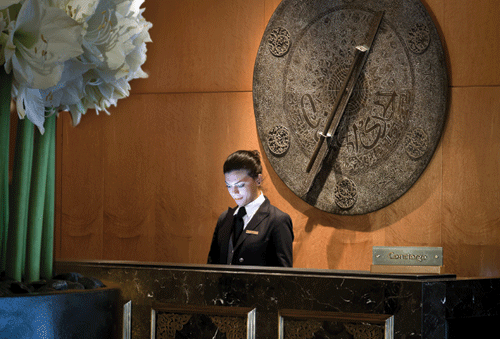
The job of a concierge in a five-star hotel is a portal into the stratospheric world of the super rich, a front-row view of how the ultra well-heeled live. Sometimes it is amusing, sometimes shocking and sometimes downright weird.

When paying top buck for service, guests can, and often do, expect everything on a platter. “I cannot say no to any request. Everything is possible, as long as it is legal,” said Reda Chaiban, senior head concierge at the Habtoor Metropolitan.

Chaiban exudes a genuine passion for his job. Having spent his working life striving to be at the top of his game, he sees himself as someone who can organize just about anything. “A concierge’s contacts are his toolbox. He needs to know everyone in town so he can fix any request,” he explained. 

Organizing a spot at the top table in town or a day out on a mega yacht is routine business for Chaiban, but sometimes he really has to go the extra mile to keep the guests happy. On five separate occasions a returning female guest has had him fly over from France one of the most desired hairdressers in the world. “Like I said, nothing is impossible,” he joked. But what about requests from guests with more illicit designs in mind for their stay in Beirut?

Walking on the wild side

 Chaiban was adamant that none of the staff at the five star hotels would get involved with organizing drugs or prostitutes for visitors.  However, the lines of distinction can become a little blurred.   A concierge from another five-star hotel told Executive, on condition of anonymity, that “there is normally someone in the hotel that knows someone outside who can arrange these things, but it is true we don’t fix it ourselves.” It’s a simple case of passing on a phone number.

The same concierge spoke about a party of men who booked the penthouse at a cost of more than $20,000 per night to throw private parties. “Every night they would bring between 30 to 40 prostitutes, and even if they didn’t sleep with them they would pay them several hundred dollars just for coming,” he said. “People pay up to $5,000 a night for a prostitute; some will pay more for a virgin,” he added.

Official policy is to inform the police if staff members are aware of illegal activity going on in the hotel. But the anonymous concierge smirked at this suggestion. “Even if we suspect illegal things are going on in people’s rooms, we don’t get involved. Quite simply it’s none of our business,” he said.

There is a prince from Saudi Arabia who is infamous amongst Beirut’s hotel staff for his outlandish requests, which have earned him the soubriquet “The Golden Boy”. A receptionist, again speaking anonymously, explained how the prince always books the same penthouse at one of Beirut’s most prestigious hotels. “He has all the windows blacked out, the whole floor carpeted in sheep’s fur and he will only wash in Perrier water or laban,” he said.

Tips are what makes the often-demanding job worth it and are an integral part of the hotel staff’s income. “If I told you how much I earn you would cry,” lamented a senior concierge at a high-end boutique hotel. “But in a good month in high season I can take $12,000 in tips,” he added with a wry smile. Tips don’t always come as notes greasing palms either. “The tips can come as gifts such as perfume, an iPad or an iPhone. Sometimes the guests come to see you as a friend so they want to give you a gift,” said Roxanne, a concierge at the Four Seasons.


July 3, 2011 0 comments
0 FacebookTwitterPinterestEmail
  • 1
  • …
  • 371
  • 372
  • 373
  • 374
  • 375
  • …
  • 707

Latest Cover

About us

Since its first edition emerged on the newsstands in 1999, Executive Magazine has been dedicated to providing its readers with the most up-to-date local and regional business news. Executive is a monthly business magazine that offers readers in-depth analyses on the Lebanese world of commerce, covering all the major sectors – from banking, finance, and insurance to technology, tourism, hospitality, media, and retail.

  • Donate
  • Our Purpose
  • Contact Us

Sign up for our newsletter

    • Facebook
    • Twitter
    • Instagram
    • Linkedin
    • Youtube
    Executive Magazine
    • ISSUES
      • Current Issue
      • Past issues
    • BUSINESS
    • ECONOMICS & POLICY
    • OPINION
    • SPECIAL REPORTS
    • EXECUTIVE TALKS
    • MOVEMENTS
      • Change the image
      • Cannes lions
      • Transparency & accountability
      • ECONOMIC ROADMAP
      • Say No to Corruption
      • The Lebanon media development initiative
      • LPSN Policy Asks
      • Advocating the preservation of deposits
    • JOIN US
      • Join our movement
      • Attend our events
      • Receive updates
      • Connect with us
    • DONATE