• Donate
  • Our Purpose
  • Contact Us
Executive Magazine
  • ISSUES
    • Current Issue
    • Past issues
  • BUSINESS
  • ECONOMICS & POLICY
  • OPINION
  • SPECIAL REPORTS
  • EXECUTIVE TALKS
  • MOVEMENTS
    • Change the image
    • Cannes lions
    • Transparency & accountability
    • ECONOMIC ROADMAP
    • Say No to Corruption
    • The Lebanon media development initiative
    • LPSN Policy Asks
    • Advocating the preservation of deposits
  • JOIN US
    • Join our movement
    • Attend our events
    • Receive updates
    • Connect with us
  • DONATE
Finance

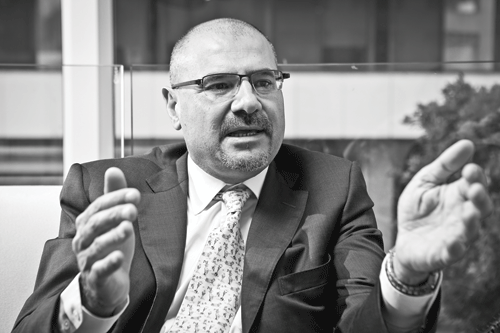
Q&A – Christos Papadopoulos

by Emma Cosgrove January 3, 2011
written by Emma Cosgrove

Christos Papadopoulos has been six months on the job as regional chief executive officer for the Middle East and North Africa at Standard Chartered. He recently sat down with Executive to discuss what we can expect from both Lebanese and regional banks in the new year.

E  What will be the drivers of regional asset growth in 2011?

The picture in the region is going to be somewhat diverse. There are some markets where on the wholesale banking side, especially in those markets where there are significant infrastructure investment plans, the wholesale banking assets will significantly grow. And then there are other markets where, just by virtue of large populations and ongoing healthy [gross domestic product] growth, we are going to have consumer assets growing —markets like Egypt — but it is not going to be uniform.

E  Why is wholesale banking part of your Lebanon strategy for 2011?

Standard Chartered is extremely good at connecting trade corridors and FDI [foreign direct investment] flows, so we have a significant role that we can play in Lebanon in providing those kinds of solutions, especially for those corporates that have regional or even [outside]businesses. And that means that we are bringing to the market something that the local banks cannot provide, or at least cannot provide to the extent that we can. What we are very successful at doing is bringing Asian investors and Asian money into this part of the world. So what we’ve done in the Gulf is we have had as much as up to 40 percent of new money coming out of Asia.

Historically Europe used to be a significant supplier of finance to this part of the world, but now Europe is going through its challenges so in many respects when it comes to refinancing, they are not looking to participate, they are looking to get their money back. The extent to which Asia steps in and fills that gap means that you have a successful fundraising effort. Increasingly the Middle East is looking into Asia — whether it is to raise funding or to engage and do business.

When you look at the big trade corridors, whether it’s companies importing from China, whether it’s Korean contractors coming and doing business here, or whether it’s Chinese contractors coming in and working in the region, there is a significant engagement.

You have FDI flows going from the region to Asia, for example when the Qatar Investment Authority bought a significant stake in Agricultural Bank of China, so the world has changed in terms of the shift of economic growth and the emergence of Asia — a shift from West to East. And to a certain extent there has been a shift from North to South — whether it’s moving to the Brazils of this world or moving into Africa because of their commodities story. So you’re building corridors between Asia, Africa, the Middle East and Latin America.

E  What are your expectations for mergers and acquisition (M&A) activities in the region?

We have seen some big deals. We have seen very recently the deal with Zain and Etisalat, which was a significant transaction. Here in Lebanon you have the deals with Bank Audi and EFG-Hermes, so I think good deals that are available will be happening. I don’t think you will see a frenzy of activity, but there will be opportunistic deals as people seek to take advantage of those economies that increasingly provide more attractive returns.

If you want to be in a market that is otherwise unavailable to you, Libya for example, you might consider an M&A type entry into the financial sector. In the nonfinancial sectors, you will increasingly see[activity in] the telecoms sector.


January 3, 2011 0 comments
0 FacebookTwitterPinterestEmail
Comment

Vanquish visas and they will come

by Paul Cochrane January 3, 2011
written by Paul Cochrane

Over the past decade the Middle East has shaken off its ‘danger zone’ reputation of being a place where only the foolhardy or “conflicted tourists” would plan a holiday. Since 2000, the number of tourists visiting the region (excluding Turkey and Israel) has more than doubled, from 24.9 million to more than 53 million. And while 2009 saw a 5 percent slump in international tourist arrivals, the region was only behind Northeast Asia globally in the rise in tourists in 2010, up 16.1 percent, according to the United Nations World Tourism Organization.

Perceived heightened stability, investment, infrastructure development and marketing campaigns have all contributed to tourism in places other than long-term favorites Egypt, Turkey and the Holy Land.

The rise has partly been fuelled by wary Westerners warming to the Middle East as an attractive vacation destination, after being swayed by the flurry of advertising campaigns and travel articles extolling old Damascus’s charms, Dubai’s palatial hotels and Beirut’s infamous ‘phoenix rising from the ashes’ reputation. However, inter-regional tourism has been a key driver for the sector and has corresponded with the emergence of low cost air carriers and the aggressive expansion of Middle Eastern airlines in general.

The rise in tourism has also dove-tailed with a resurgent middle class with the desire and funds to take a trip within the region but not quite enough cash to splurge on a family holiday to Europe or America. Syria has become a regional poster child in this regard, with its tourism sector exploding since the economy was opened up at the beginning of this century; visitor numbers have surged from two million in 2004 to nearly six million in2010. What is notable is that the majority of tourists are from the Gulf, with2.9 million Arabs visiting in 2010, compared to 1.35 million tourists from other, primarily European, countries.

It has been the increased openness of countries that has really encouraged the inter-regional tourism boom, with Damascus scrapping visas for Iranians and Turks and Turkey abolishing visas in 2010 for Syrians and Lebanese. Once the regulations changed, there was a 117 percent rise in Iranian visitors to Syria, while the Turkish-Syrian agreement encouraged482,000 Syrian holidaymakers to stream into Turkey, an 113 percent increase, and an 170 percent rise in Turks heading to their southern neighbor. This sensible bi-lateral move resulted in the largest jump worldwide in visitors between two countries in 2010.

Meanwhile, Ankara’s decision led to 73 percent more Lebanese visiting Turkey than in 2009, and easier visas and marketing campaigns led to74 percent more tourists from the United Arab Emirates, a 60 percent rise from Iran and a 47 percent increase from Saudi Arabia. While Arab and Iranian tourist numbers surged, Ankara’s strained relations with Tel Aviv resulted in a41 percent drop in Israeli tourists, to 80,000 visitors.

That’s not much of a surprise though, as politics and outbreaks of violence frequently cause the region’s tourism figures to yo-yo from one year to the next. But with all the development and infrastructure investment underway — from airport expansion in the Levant and the colossal aviation hubs in the UAE and Qatar, to the new resorts and hotels being built —the region is on track to becoming a top global travel and tourism destination. Indeed, according to the World Travel and Tourism Council, the Middle East’s tourist and travel economy is forecast to rise 149 percent by 2020 from the current $173 billion to $430 billion.

What should be addressed is the scale and feasibility of tourism projects. Mass tourism — as compared to more sustainable tourism that is not primarily seasonal — can have negative social and environmental ramifications. Now is the time for the public and private sectors to plan ahead.

The easing of border and visa restrictions should also expand further to bolster regional travel for Middle Eastern citizens and foreigners; as Turkey and Syria have clearly demonstrated, scrapping visas makes visitor figures jump. In Syria’s case, the country received $2 billion more in tourism revenues in 2010 than the year before.


PAUL COCHRANE is the Middle East correspondent for International News Services


January 3, 2011 0 comments
0 FacebookTwitterPinterestEmail
Comment

Erdogan lumps the leaks

by Peter Grimsditch January 3, 2011
written by Peter Grimsditch


Turkey’s fiery, if thin-skinned, Prime Minister Recep Tayyip Erdogan has a love-hate relationship with the press. He loves the organizations that show appreciation of his policies and seems to hate those that don’t. Heis prone to threaten the offending publications with lawsuits, while urging their boycott by advertisers and readers alike.

Little surprise then that Erdogan should bristle at many of the stories emanating from the Wikileaks disclosure of diplomatic cables over the past few weeks. The notoriously hard-working premier wanted to sue a former United States ambassador to Turkey, Eric Edelman, for claiming, according to some of the press reports, that he had secret bank accounts in Switzerland.

If any such accounts could be found, he proclaimed to the media, he would donate the total deposits to the main political opposition, the Republican People’s Party (CHP). In addition to Edelman, he also wanted to sue the US State Department for uttering such a calumny. The excitable Turkish press debated for days the practicalities of putting such a threat into practice, seeking opinions from senior members of the legal establishment.

While the threat of legal action made for lurid headlines, it somewhat misses the point. The content of the cable was not that he had Swiss bank accounts but that the ambassador had been told by two sources that they existed. The cable did not include an opinion about the likely truth of the claims. It was also a confidential document — essentially a private conversation — between the envoy and his bosses in Washington. Edelman also described Erdogan as having “unbridled ambition stemming from the belief God had anointed him to lead Turkey” and an “overweening desire to stay in power.”The latter comment, of course, is less an insightful piece of news for the home base than a glimpse of the blindingly obvious regarding any political leader.

In any case, a more likely target for lawsuits than the State Department would have been either Julian Assange, the founder of Wikileaks, or the myriad media outlets that published the cables.  In a political environment as beset with gossip, rumour and mendacity as Turkey’s, the prime minister’s tetchiness understandable, even if the tendency to use some of his boundless energies in pursuing the authors of published criticism is perhaps as wasteful as it is unrewarding.

More significant than the tittle-tattle tales of tabloid headlines is the general picture that the US diplomatic service, overall, rejects the notion that the ruling Justice and Development Party (AKP) is hell-bent on turning Turkey into an Islamic state similar to Iran or Sudan, or even that it is unreasonably turning its back on the West and switching its allegiance eastwards.  What the cables do suggest is that Turkey has been redefining its place in the world ever since it realised that its importance as the eastern flank of NATO diminished after the collapse of the Soviet Union.

Especially since 2002, when the AKP came to power, the country’s security policy has been integrated with its economic transition and growth. Turkey’s strength is better illustrated by the size of its economy than the number of soldiers in its army. The cables may be tiresome and embarrassing but are not even news for the most part.

If Erdogan wants an example of real toughness in the face of adversity, maybe his aides could show him one leaked cable that doesn’t even mention him or the AKP. In January of last year, a 75-year-old American, Hossein Ghanbarzadeh Vahedi, walked into the consular section of the US Embassy in Ankara after a dramatic escape from Iran, where he had been held for seven months. Vahedi, according to the cable, had travelled to the country to visit the grave of his parents when, for reasons he never discovered, the authorities confiscated his passport. Vahedi rejected the offer of handing over $150,000for its return and opted instead to pay people to smuggle him out of Iran. After three days of furtive flight, including a nightmare 14 hours on horseback over a freezing mountainous trail, Vahedi reached Turkish soil where he took a bus for Ankara. That’s real fortitude in the face of adversity.


Peter Grimsditch is Executive’s Istanbul correspondent


January 3, 2011 0 comments
0 FacebookTwitterPinterestEmail
Comment

An outpost obstinate & obsolete

by Adam Pletts January 3, 2011
written by Adam Pletts


Command Outpost (COP) Spera is located 800 meters from the border with Pakistan in Afghanistan’s Khost province. The platoon section that occupies the COP can only come and go by helicopter and they have no vehicles based here. As the lieutenant in charge explains, “all we got here is our legs and as you can see everything is higher than us.”

One of the peaks that occupies the high ground around the COP is code named “New York” and another, “the Taliban Hotel”, but the coalition’s enemy here is not actually the Taliban but rather the Haqqani network who, although allied with the Taliban, retain their own identity and considerable influence in the Khost border region and beyond, emanating from their power base at Miran Shah on the Pakistan side. Set up in 2003 and originally used as a Special Forces base, the COP was handed over to regular United States army units in 2005 with the intention of controlling insurgent infiltration from Pakistan to Afghanistan. Within my first five minutes on the base the lieutenant has compared the well-established infiltration routes that the insurgents use on a seasonal basis to the Ho Chi Minh trail, an apt analogy given that cutting supply lines of insurgent support now in Pakistan has proved little more successful than it did decades ago in Vietnam.

In fairness, the border traverses a vast and barren mountain range; since Spera is the only COP for miles along the frontier it is hardly surprising that the insurgents have simply changed their routes.

As one officer put it, “They just walk around the COP.”Another confided that “[COP Spera] is kind of a stupid base to have; the enemy attack it simply because it’s there but it doesn’t really serve a purpose.”

With this in mind, requests have been made at the brigade level to have the COP closed down but the US military sees it as a delicate subject, given how such a move could play into the propaganda war: the US would say it was a strategic withdrawal while the Haqqani network and the broader Taliban would claim to have forced the Americans out. This is perhaps why the Commander of US Forces in Afghanistan, General David Petraeus, will have to sign off on shutting Spera down.

You might have thought that the difficulty of controlling borders had been understood following the experience of insurgent infiltrations from Syria to Iraq, not to mention the problems that the US has on its own border with Mexico, or for that matter Europe has with human trafficking from the East and Africa. But the situation here is particularly complex.

The coalition would like to see Pakistan do more to secure the border but Pakistan is a volatile ally with mixed motivations. It has long been accused of attempting to destabilize Afghanistan, thereby mitigating the risk of being sandwiched between two potentially aggressive neighbors, while at the same time maintaining what they think of as “strategic depth” in Afghanistan in the worst case scenario of an Indian land invasion.

Whatever the decision on the closure, those who might be saddest to see it go are, strangely, the very soldiers who are based there and endure regular attacks and mortar shelling roughly twice per week. While I was there, the call “incoming” woke me from a brief afternoon nap as the mortar rounds were detected by radar, giving a few precious seconds to grab body armor and take cover. I’m not suggesting that anybody likes being fired at but the soldiers I spoke to all said they enjoyed their deployment. A public affairs officer put it this way: “At Spera they’re actually doing the job they signed up to do, not stuck in a TOC (Tactical Operations Centre) staring at a computer screen.”

It must be said that the atmosphere at Spera is one of close camaraderie. One Lieutenant said, “Here the guy to your left or right is your security — your survival depends on him.” It’s also true that the closer you are to the war, the more some of the rules break down. As one of the younger enlisted soldiers told me, “When I leave here I gotta go back to that bullshit saluting.”


ADAM PLETTS is a freelance journalist currently embedded with coalition
forces in Afghanistan.


January 3, 2011 0 comments
0 FacebookTwitterPinterestEmail
Finance

Femme finance

by Emma Cosgrove January 3, 2011
written by Emma Cosgrove

When female banking executives discuss their path to the top, the word lucky is almost always mentioned. They were lucky that their experience was without gender discrimination or sexual harassment. They were lucky to have respectful mentors and to get to their positions without any apparent sexism in the way.
 

“I certainly had a fortunate experience in that throughout my career I never felt discriminated against or put down just because of my gender,” said Bana Akkad Azhari, Lebanon country manager for The Bank of New York Mellon, speaking on the sidelines of the New Arab Woman Forum (NAWF) in Beirut on December 2. The ubiquitous gratitude at reaching heights in careers they are fully qualified for begs a discussion of why women working in the financial world feel that a career without gender-related bumps is a luxury, not an expectation.

The numbers

Of the six of Lebanon’s alpha banks surveyed by Executive, women made up an average of 45.5 percent of the workforce. Banque Libano-Francaise had the highest representation of women with 49.66 percent, while Byblos Bank had the lowest of the banks surveyed with 41.1 percent.  Lebanon’s workforce is 24.8 percent female according to 2010 figures from the World Economic Forum’s (WEF) Gender Gap Index, compared to 25.4 percent in Morocco and 46 percent in the United States. The World Bank puts the female percentage of Lebanon’s workforce slightly higher, at 27 percent.

Despite the difference in the estimations, both statistics indicate that Lebanon as a country is behind in terms of gender equity in the work place, though the banking sector, it would seem, is well ahead of the national trend. 

A curious juxtaposition to the gender gap within the workforce is the gender dynamics of Lebanon’s universities. According to the WEF report, there are 1.19 times more women with tertiary education than men. Furthermore, 56 percent of students taking American University of Beirut’s Master of Business Administration program are female.

And that’s not the only oddity: when you scratch below the surface of the seemingly enlightened banking sector, it’s clear that women are largely crowded at the bottom and middle rungs of the ladder. In fact, the only female general manager of a conventional bank is Pik Yee Foong, of Standard Chartered, which isn’t a homegrown Lebanese institution. Furthermore, only two of the six banks surveyed by Executive have women on their boards.

Roles to play

The great debate surrounding the inequalities between men and women in the workplace is whether women choose to slow down their careers and delay promotion by taking maternity leave, or whether they are professionally punished for being biologically responsible for procreation. “Women are very educated in Lebanon but there is this Levantine mentality where they are very excited to be active and work after university, but upon their marriage there is a tendency to go back home to engage in a new challenge, which is building a family. It’s quite paradoxical with the level of education,” said Freddie Baz, chief financial officer at Bank Audi. 

The legally mandated maternity leave in Lebanon is just seven weeks with 100 percent pay. This is significantly less than the 12 weeks given to Moroccan women and half of the minimum leave granted to American women.

Although there is little conclusive evidence as to the effect of maternity leave on the composition of workforces overall, there is conclusive evidence that taking maternity leave lowers a woman’s pay over her career, as concluded by a 2004 Ohio State University study. This also indicates that choosing to take maternity leave makes promotion less likely. But in Lebanon, there are two forces at work. Some women may choose to leave the workforce when they start families, but many are also drawn out of the country by better-paid opportunities elsewhere.

This is a man’s world

Regional players indicate that the boys club dominating the upper echelons of banking is not so much a consequence of cultural mores as the result of a testosterone-prone industry.

“The United States is considered the most open and most diverse society that we have; at least we try to promote it as such. But in the banking environment it still tends to be a very white, male, pinstripe suit, white collar type of environment,” said Nadine Chakkar, head of global financial institutions for The Bank of New York Mellon, also speaking at the NAWF conference. Chakkar has worked her entire career in the US, but is of Lebanese origin.


The case in Lebanon is similar, but with the added issue of the common habit of passing family businesses from father to son — which is largely no longer the case in the West.  However, familial patronage aside, financial workplaces worldwide tend to display the same behavioral patterns. “Guys tend to help each other a lot more. When they move up they move everybody up with them,” said Chakkar. “With women, for some reason, we are wired differently. Instead of pulling everybody else with us we feel that we have to move up and push everybody else down. I think women just need to realize that somebody else’s success doesn’t hurt them.”

From the boardroom to the teller
A Lebanese mother became the first woman in the country to open a bank account for her children on December 17, 2009, when she opened accounts for each of her two sons at the Bank of Beirut and the Arab Countries (BBAC). “I’ve been trying to open a bank account for my two sons for 10 years now, but I was continuously told that only my husband could sign the papers,” said Barbara Batlouni, the Lebanese-American director of the non-governmental organization Amideast, to the Associated Press. Batlouni’s victory came after the Association of Banks in Lebanon changed rules that discriminated against women after receiving pressure from the Institute of Progressive Women and other like-minded groups. This move was a positive step, but Lebanon is still far from financial equality: a Heritage Foundation/Wall Street Journal Financial Freedom index shows that financial freedom has actually decreased in Lebanon in the past two years.
The World Bank reports that Lebanon is one of 42 countries in the world that does not afford men and women equal access to institutions in both the public and private sector. Married men and women do not enjoy equal financial rights. Women may work the same hours as men but are prohibited from certain industries and must retire four years earlier than men, at age 60. Finally, Lebanon is one of just four countries to grant tax breaks to men with unemployed wives, but not women with unemployed husbands.

Thus some hindrances may come from women themselves. However, Chakkar also said that reaching senior levels at financial institutions is a particular challenge for women due to the different ways that the two genders are perceived. “When I display a little bit of passion, I’m acting as a ‘bitch’ or being extremely aggressive, whereas a guy is just being competitive,” she said.  However, Roula Habis, general manager at Middle East Capital Group, says that she uses the assumptions about women to her advantage as a private wealth manager.  “Men usually know that women are more loyal and they are more focused,” she said. “You rarely hear about fraud and corruption among women — it’s more men. It’s easier for me to earn clients’ confidence because I am a woman.”

Future

Chakkar said that she is feeling a change in the wind.

“I think the industry’s changing, and not because the guys at the top had a revelation. I think it’s changing because society is changing. I think they are realizing that good talent has no color, no gender. I think they are also succumbing to the pressure of the environment out there,” she said. “Today corporations are being put on the spot. You get asked ‘how many women do you have on your board? How many women do you have in senior management?’”


January 3, 2011 0 comments
0 FacebookTwitterPinterestEmail
Comment

Qatar

by Peter Speetjens January 3, 2011
written by Peter Speetjens

Following the suspension of two FIFA executive committeemembers for accepting bribes, the world’s governing football organization onDecember 2 announced that Russia and Qatar will host the World Cup (WC) in 2018and 2022 respectively.

While Russia — with England — was a favorite from the start,Qatar came as a total surprise. Especially in the West, commentators ask: whyorganize such a major tournament in such a tiny country that is blessed withsummer temperatures soaring up to 50 degrees, has no football tradition tospeak of, and which most people are unable to locate on a world map?

While this is a legitimate question, it seems thetraditional football power-houses may have underestimated the strength of theQatar bid, as well as FIFA President Sepp Blatter’s wish for the WC to betterreflect the game’s global appeal. In the past, the organization of the world’sbiggest sporting event more or less routinely changed hands between Europe andSouth America. Yet ever since Blatter came to FIFA power in 1998, Asia hostedits first WC in 2004, the first WC in Africa followed in 2010, while the 2022version will be hailed as the first-ever in an Arab and Muslim country.

The (controversial) Blatter believes that football has thepower to bring people together and enhance mutual understanding, peace andprosperity. Critics, however, claim that Blatter’s global interests mainly aimto enhance his own chance of a political FIFA-afterlife. Western footballnations may also have overlooked the influence of Mohamed bin Hammam, theQatari Head of the Asian Football Federation and current “number three” in theFIFA hierarchy, who is a strong candidate to succeed Blatter.

Still, even in the troubled FIFA ranks that would not beenough for Qatar to beat the bids of its main competitors, Australia and theUS, both countries absolutely nuts about sports and blessed with superbfacilities. As Qatar possesses none of the above, it seems to have outsmartedits bigger rivals by emphasizing being small.

Qatar promises to organize the most compact tournament ever.It will build or expand a total of 12 stadiums located within, at most, anhour’s drive, which will allow football fans to attend more than one game perday. Try doing that between New York and LA, or Sydney and Perth. In addition,once the 2022 world champion has been crowned, the stadiums’ upper tiers willbe removed and donated to countries that lack proper sport facilities. Theoffer is a novelty on ‘Planet Football’, one that was no doubt welcomed byFIFA’s poorer Asian and African representatives.

Qatar’s main weak point is, of course, the weather, as theWC traditionally takes place in summer. Previously, the FIFA technicalcommittee had considered the weather a potential health risk, not just forplayers and fans, but also for “officials and the FIFA family,” and requiredthat precautions should be taken.

To overcome this “slight” inconvenience, Qatar introducedanother novelty: to equip its stadiums with a solar-powered outdoorair-conditioning system that is able to keep the stadiums’ temperature at aconstant and comfortable 20-something degrees. Oh, and beer-drinking fans neednot worry. Qatari officials have promised that alcohol will be allowed inhotels and special outdoor “fan zones,” and they too will be connected to the“green” cooling system.

While most Qataris are no doubt proud and thrilled to hostthe 2022 football bonanza, some may question if building 12 stadiums andorganizing a WC is the best way of investing the country’s wealth. The stadiumsalone have a price tag of some $4 billion. South Africa in 2010 spent less thanhalf that amount, yet failed to record a profit as only two thirds of theprojected 450,000 visitors attended the games.

To the Qatari authorities however, money is not an issue.They think big and have more important things on their minds. Following the2022 WC, which has billions of viewers the world over, few people will still beunable to pinpoint Qatar on a world map. And there are other sport events tocome, such as the Asian Games, the Asian Cup in 2011, and, ultimately, theOlympics. Expect Qatar to be bidding for the ultimate dream in 2024 or 2028.


PETER SPEETJENS is a Beirut-based journalist


January 3, 2011 0 comments
0 FacebookTwitterPinterestEmail
Comment

Conflict nigh as waters dry

by Nicholas Blanford January 3, 2011
written by Nicholas Blanford


The storms that wracked Lebanon in mid-December were among the most severe in several years. While they helped douse the epidemic of late season brush fires and allowed nervous ski resort owners to open the pistes for the first time, the welcome rainfall could not disguise the fact that Lebanon and the region in general is experiencing a worsening drought.

While the concept of “water wars” in the Middle East has been articulated for many years, the looming crisis over the lack of water is certain to lead to greater competition for resources, fuelling not only inter-state tensions but domestic upheavals between the haves and have-nots.

Before the first rains fell in earnest in December, Lebanon’s meteorological office had registered just 51.2 milli meters (2.01inches) of rain since September. That compares to 214.8 milli meters (8.45inches) for the same period in 2009.

Years of war and government mismanagement have wasted Lebanon’s most prized natural resource, the envy of much of the region, particularly Israel to the south which has coveted Lebanese waters since the notion of a Jewish state in Palestine was first suggested more than a century ago. An Arab League project in the early 1960s to divert the Hasbani River from flowing into Israel indirectly led to the 1967 Arab-Israel war, in which Israel seized the Golan Heights from Syria and the West Bank from Jordan.

Since then, Israel has exploited both territories for their water reserves. The Mountain Aquifer in the West Bank, which produces some 600million cubic meters of water per annum, is supposed to be a shared resource for Israelis and Palestinians.  But Israel exploits about 80 percent of the aquifer for its own needs. Israelis on average consume three times as much water as Palestinians. The Coastal Aquifer in Gaza once kept the Jewish settlements watered and provided some 18 percent of Israel’s water supply. But years of over-pumping emptied the aquifer ,allowing salt water to seep in, so that by the time Israel abandoned its settlements in Gaza in 2005 there was little water left for the Palestinians to exploit.

The sensitivities between Lebanese and Israelis over water resurfaced nearly 10 years ago when several minor pumping projects in the Hasbani river to provide water for certain villages and to irrigate some farmers’ fields prompted the Israeli government to threaten war against Lebanon. A four-year drought in north eastern Syria has left an estimated 2million to 3 million people living in what the United Nations terms “extreme poverty.” Thousands of inhabitants of the Jazeera region in Syria’s north east have migrated toward Damascus, living in ad hoc settlements in the hope of finding work. With once productive arable land turning into desert, Syria has gone from a net exporter of wheat to a net importer.

Lebanon boasts some 40 major rivers and 2,000 springs, but the UN estimates that half of the annual flow of 1,150 million cubic meters is lost to the sea or neighboring countries. A World Bank study concluded that Lebanon could be experiencing chronic water shortages by 2020 due to over-consumption, over-pumping, pollution and poor management. Much of Lebanon’s water is used for agricultural irrigation, particularly in the relatively arid Bekaa. But the lack of sustainable irrigation techniques places a burden on local water resources with ever more wells drilled and a consequent lowering of the water table. A 1999 plan to harness water resources called for investments of $1.5 billion to construct dams and reservoirs. The plan was supposed to be completed this year, but it has hardly got off the ground due to the failure of successive governments to allocate funds for the project.

If action is not taken soon, water shortages could provoke social unrest, especially given the expanding divide in Lebanon between the wealthy and poor. In recent months, residents of the Bekaa and the north, the two poorest regions in the country, have had to purchase water from tankers because the state supply ran out. In 1992, the collapse of the Lebanese lira sparked riots in the streets of Beirut, which ended up toppling the then-government of Prime Minister Omar Karami. Those protests were dubbed the “bread riots.” The next could be over water.


Nicholas Blanford is the Beirut-based correspondent for The Christian Science
Monitor and The Times of London


January 3, 2011 0 comments
0 FacebookTwitterPinterestEmail
Comment

Elections without opposition

by Heba Morayef January 3, 2011
written by Heba Morayef


Egypt is still reeling from the recent elections for the People’s Assembly, the lower and primary house of the country’s bicameral parliament. The first round, on November 28, was marred by reports of fraud, violence and widespread denial of access to accredited observers. The organized opposition was left with only four seats. The Muslim Brotherhood, which in 2005had won 88 seats with members running as independents, did not win a single seat.

In response to what they saw as widespread vote rigging, both the Brotherhood and the Wafd — another of the main opposition parties —announced their withdrawal from the second round, held on December 5. The final tally gave the organized opposition a mere 3 percent of the seats, compared with 23 percent in 2005. “An Assembly Without Opposition” read the headline of one independent newspaper after the announcement of the final results. 

Many Egyptian analysts expected that there would be fraud in the absence of independent judicial supervision, but nobody quite expected a People’s Assembly so devoid of opposition. The government had in recent years pointed to lively debates in parliament and the media as evidence of democratic life when speaking to the outside world. A government that remains as image-conscious as this one needs to have an opposition in parliament.

The overall results reflect the exclusion of the opposition that Human Rights Watch observed during the campaign and the first-round voting itself. In the weeks prior to the elections, security officers resorted to their usual pre-election crackdown on the Muslim Brotherhood, arresting at least 1,300 members between October 9 and November 28. I spoke to 24 of those who’d been arrested and held for periods ranging from 24 hours to six days, all eventually released without charge. These were young, educated men who had been putting up campaign posters or handing out flyers in support of a Brotherhood candidate. Four of them told me they’d been tortured. A fair and free election requires opportunities for candidates to campaign — in other words, to express their views freely and to bring supporters together in rallies and meetings. The authorities showed little respect for these basic rights.

On the first-round voting day, representatives of independent and opposition candidates were excluded from polling places, and even journalists and civil society monitors with permits were denied access; half the staff of one NGO with 2,600 monitors found themselves in this position. As the Human Rights Watch team went around to polling place after polling place we heard the same story: representatives of opposition candidates were denied entrance because of a regulation that had been issued overnight stating that their ‘proxies,’ or forms, already formally approved by a notary, now had to be stamped at the local police station. When Brotherhood representatives tried to meet this additional requirement, police stations refused to grant them stamps. Some who did get the stamps were still refused entry.

The systematic exclusion of independent observers was particularly critical given Egypt’s tradition of fraud.  Yet two heartening narratives come out of these elections: the role of the judiciary and the media coverage. Denial of access to polling places for independent journalists and monitors was made up for by the wealth of citizen journalism. Ordinary people documented fraud, violence, and interference by security forces with their mobile phones or small cameras and disseminated them widely through social networking or opposition websites.

The other force the government couldn’t fully control is the judiciary. Although greatly weakened by governmental interference, the judiciary in Egypt still enjoys the most respect of all state institutions for its relative independence. Constitutional amendments in 2007 had drastically reduced independent judicial supervision of polling places to oversight by “general committees,” marginalizing the role of judges.

After voting day, though, some judges courageously spoke out about incidents of fraud. And before election day, administrative courts ruled again and again against decisions barring some candidates, often emanating from the Interior Ministry, ordering the authorities to reinstate candidates or cancel the elections in certain constituencies. The impact of those rulings, which the government ignored, will not go away easily; Egypt heads toward presidential elections in 2011 burdened by the enormous legitimacy deficit of this new ‘People’s Assembly’.

HEBA MORAYEF is a Middle East and North Africa researcher for Human Rights Watch based in Cairo.


January 3, 2011 0 comments
0 FacebookTwitterPinterestEmail
Society

Decision Points

by Rayya Salem January 3, 2011
written by Rayya Salem

George Bush’s recently released memoir Decision Points is unlikely to change anyone’s opinion on one of the world’s most divisive characters, but instead confirms whatever you already thought of the former United States president. This is your last chance to go as deep as it gets, but keep in mind, he’s into action rather than intellect or introspection. The result is a summary of his actions, written in short, blunt prose that mimics a fireside chat.

Previously unseen highs of emotional intelligence are sprinkled throughout Bush’s account of his decision making, but more evident is the all-encompassing Bush factor: unwavering inner strength emanating from his familial roots and religious faith.

His intractable stance — on foreign policy at least — is defended with characteristic conviction: going to bed knowing that 400potential September 11s threaten America’s homeland every month is a weight that never burdened the shoulders of any president so heavily. The events that transpired after September 11 and the shifting sands of the Middle East are far too large, and their radius far too wide, for them to be judged so soon, Bush would have us believe.

Though Bush’s inherited thick skin allowed him to cruise above the political frenzy, it is his own introspection that brings faultfinding. Without blaming the CIA, he admits he gets a “sickening feeling to this day” that intelligence reports were wrong about Iraq’s weapons of mass destruction, but adds a familiar aside:  the world is a safer place without its former dictator. To dispel popular belief that the United States entered Iraq for oil, he devotes but half a line in the 497-page memoir: “It’s simply not true.” 

He tries to tell us that media analysis of his decisions is too sophisticated to be useful. To understand his decision-making process, look no further than his historical review of West Texas. The world really is black and white. This memoir is the white-out to smother all the “God damn” dirty politics that sullied his time in power. But the hope that lacing in a couple of jokes here and there will make him more likeable, and thus believable, actually works; his machismo and naiveté blend well. It’s sweet if you can set aside the bloodshed.

Blunt admissions of embarrassing pitfalls swarm the memoir, hitting a home-run on the field of self-cleansing. On his 40th birthday, he disappointed his parents and wife at a dinner party when he drunkenly asked an older lady what sex is like after 50. Then there’s his bitter inner battle to quit drinking in 1986 and his mother’s never-before-mentioned bouts with clinical depression.

Perhaps what would ease America’s struggle for allies is the natural extension of this typical American ideal: the country mimics the born-again nature of its people. Tomorrow is a new day, our outlook and positions change, we are born again with new convictions, and our foreign policy is not written in stone.

Instead, he convinces us that it’s written in his heart. Imagine a double-date sleepover party with Tony and Cherie Blair in Camp David, February 2001. The former president would have us believe that one of the most important alliances to come was based on bonding over the comedy “Meet the Parents.”

His mistrust of Arab leaders such as Yasser Arafat is made colorfully clear, but awkward meetings with others make us wonder why he’s flaunting the role of luck in his politics. After Saudi Arabia’s Prince Abdullah left Crawford Ranch bemused by the president, it was the prince’s stop to see Bush Senior that patched up relations with America’s most important Arab ally.

To add to his foreign policy folder, an over simplification of Lebanon’s 2005 Cedar revolution balances out an otherwise media-unfriendly Middle East news reel. At least Walid Joumblatt might be happy to be quoted in the New York Times #1 bestseller.


January 3, 2011 0 comments
0 FacebookTwitterPinterestEmail
Society

A moving picture of air pollution

by James Reddick January 3, 2011
written by James Reddick


“We are running late because the CEO of RYMCO can’t find parking,” said Najat Saliba, associate professor of analytical chemistry at the American University of Beirut (AUB), explaining the absence of Abdo Sweidan, chief executive officer at Rasamny Younis Motor Company.

It was a fitting prelude to a December 9 press conference unveiling the details of a new study on street-level air pollution in Beirut and its suburbs. Saliba has been analyzing particulate matter in the Beirut area for years; she recently partnered with colleagues at AUB and the National Council for Scientific Research to publish a report on the air we breathe, finding the levels of all sizes of particles to be an average of three to four times greater than the World Health Organization’s recommended level. While that project gathered data using technology rooted in fixed locations, the new study will provide a more in-depth look into where the average Beiruti spends large portions of their time: on the road.  

Saliba, undergraduate research assistant Carl Joe Mehanna and engineers at Nissan have outfitted a van with the capacity to take in and analyze particulate matter as it drives along Beirut’s main roads. With the financial support of Bank Audi and RYMCO to the tune of $135,000, over the course of the next year Saliba’s team will be able to remotely monitor air pollution in real time as the van moves through the congested arteries of the city, from the AUB campus up to Jounieh.  

“The Highway is our Airway,” reads the slogan along the side of the van, a scary thought for the estimated 500,000 people who commute in and out of the city every day. The health risks of exposure to particulate matter in the air vary depending on their size. PM10, or particles greater than 10micrometers, “affect the throat level,” Saliba explained. “PM2.5 go into the lungs and can cause pulmonary diseases, while nano-particles can go into the blood and even the brain.” 

In a city with little industry, the volume of cars is predominantly to blame. Abdo Sweidan, CEO of RYMCO, Lebanon’s exclusive Nissan distributor, suggested a need for emissions standards for imported vehicles.“If a car is not safe to use on the road in Europe, why should it be used here?” he asked, before reminding his audience that it is the consumer that dictates the market. 

“We have two problems here: pollution of the air and pollution of the mind.”


January 3, 2011 0 comments
0 FacebookTwitterPinterestEmail
  • 1
  • …
  • 394
  • 395
  • 396
  • 397
  • 398
  • …
  • 686

Latest Cover

About us

Since its first edition emerged on the newsstands in 1999, Executive Magazine has been dedicated to providing its readers with the most up-to-date local and regional business news. Executive is a monthly business magazine that offers readers in-depth analyses on the Lebanese world of commerce, covering all the major sectors – from banking, finance, and insurance to technology, tourism, hospitality, media, and retail.

  • Donate
  • Our Purpose
  • Contact Us

Sign up for our newsletter

[contact-form-7 id=”27812″ title=”FooterSubscription”]

  • Facebook
  • Twitter
  • Instagram
  • Linkedin
  • Youtube
Executive Magazine
  • ISSUES
    • Current Issue
    • Past issues
  • BUSINESS
  • ECONOMICS & POLICY
  • OPINION
  • SPECIAL REPORTS
  • EXECUTIVE TALKS
  • MOVEMENTS
    • Change the image
    • Cannes lions
    • Transparency & accountability
    • ECONOMIC ROADMAP
    • Say No to Corruption
    • The Lebanon media development initiative
    • LPSN Policy Asks
    • Advocating the preservation of deposits
  • JOIN US
    • Join our movement
    • Attend our events
    • Receive updates
    • Connect with us
  • DONATE