• Donate
  • Our Purpose
  • Contact Us
Executive Magazine
  • ISSUES
    • Current Issue
    • Past issues
  • BUSINESS
  • ECONOMICS & POLICY
  • OPINION
  • SPECIAL REPORTS
  • EXECUTIVE TALKS
  • MOVEMENTS
    • Change the image
    • Cannes lions
    • Transparency & accountability
    • ECONOMIC ROADMAP
    • Say No to Corruption
    • The Lebanon media development initiative
    • LPSN Policy Asks
    • Advocating the preservation of deposits
  • JOIN US
    • Join our movement
    • Attend our events
    • Receive updates
    • Connect with us
  • DONATE
Comment

Iran smiles through sanctions

by Gareth Smith December 3, 2010
written by Gareth Smith


As 2010 began, there was global speculation as to the future of the Islamic Republic of Iran. Mass demonstrations after the disputed 2009 presidential election raised hopes among opponents of the Ahmadinejad regime that a new revolution beckoned, and any momentum in the Obama administration for engagement over Tehran’s nuclear program was thwarted by outrage at the suppression of Iran’s opposition ‘Green Movement’. When 2011 opens, the resilience of the Iranian authorities — both in overcoming domestic unrest and in coping with a new wave of American, European, Asian and United Nations sanctions — may create a better atmosphere for engagement.

The challenge — reaching a compromise over Iran’s nuclear program — has barely changed in seven or eight years. Tehran’s bottom line is its “right” to nuclear technology, especially as a signatory of the Nuclear Non-Proliferation Treaty. But the world powers insist is that Iran accepts a limit on its uranium enrichment and allows intrusive inspections by the UN’s International Atomic Energy Agency. As is often the case, the devil is in the details, but without the will to reach an agreement, no details are discussed.

During the 2003 to 2006 talks between Iran and the European Union — a time I was based in Tehran — it was clear that some on the Western side recognized that Iran would have some level of domestic enrichment, and that the European Union demand for suspension was temporary.

It was just as clear that there were those on the Iranian side ready for limits on enrichment in return for recognition of Iran’s “rights.” According to what I was told by two regime insiders, a majority of the leadership accepted this, at least until late 2006. Throughout those years, Iran’s leaders were trying to understand the United States’ motivation, and this remained true when President Barack Obama was elected. Was Washington serious in wanting an agreement?

And here’s the problem — as Djavad Salehi-Isfahani, economics professor at Virginia Polytechnic Institute and State University, has pointed out, for the US “all policy making [over Iran]… is evaluated through the lens of regime change.” By this he means the assumption of policy-makers — and it’s true of “Iran experts” and journalists as well — is that the “problem” with Iran is its “regime.” Every aspect of Iran is seen this way, feeding a sense that the Islamic Republic is on the verge of collapse. This has long encouraged a view of the Iranian economy as a basket case.

But while Iran has failed, like many oil exporters, to finance enough productive investment, it has — for a developing country — been relatively successful in reducing poverty and building an infrastructure. Most Iran-watchers see the Ahmadinejad government’s plan to phase out in 2011 the subsidy of everyday items — from bread to gasoline and electricity — merely as a potential cause of more unrest that can hasten the demise of the Islamic Republic, or at least lead it to abandon the nuclear program.  The International Monetary Fund, however, backs the plan, applauding “a dual purpose” of generating more revenue and curbing waste. The fund recognizes that subsidies, at $100 billion annually, absorb resources that could go into investment. “There is something to be said for a populist president doing price reforms,” notes Salehi-Isfahani.

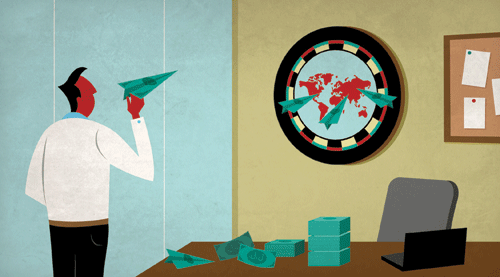
“Sanctions that bite,” to quote US Secretary of State Hillary Clinton, are the West’s means of choice to squeeze Iran. But the main losers are young Iranians, who are paying the cost through unemployment, as Salehi-Isfahani argues in a recent paper published jointly by the Dubai School of Government and the Kennedy School at Harvard.  Iran’s opposition argues that sanctions strengthen the government; if they are right, sanctions may make nuclear compromise more elusive. Furthermore, should the Ahmadinejad administration’s subsidy gamble be successful, it may achieve a better economic performance.

Although removing subsidies will increase prices, Iran has leeway: inflation fell from nearly 30 percent in late 2008 to 9.2 percent in the Iranian month of Mehr (23 September to 22 October). And while economic growth has been only 1.6 percent this year, the IMF projects 3 percent in 2011, only 0.2 percent behind the United Arab Emirates. Improving inflation, success over subsidies, maintaining the nuclear program and enhancing the country’s standing across the Islamic world would add up to a very happy 2011 for Iran’s leadership.

GARETH SMYTH is the former Tehran

correspondent for the Financial Times


December 3, 2010 0 comments
0 FacebookTwitterPinterestEmail
Society

Cultural capital

by Rayya Salem December 3, 2010
written by Rayya Salem


Tourism Minister Fadi Abboud said in October that he expected 2010 to have been another bumper year for Lebanese tourism, predicting that revenues from the industry will hit nearly $8 billion by the end of the year, compared to $7.2 billion in 2009. After 2009’s record-setting revenues, expectations and hype were running on overdrive this year, and not without good reason: the first nine months of 2010 mark another record for Lebanon’s tourism industry, despite the slowdown during the normally booming month of August due to Ramadan.

According to the Ministry of Tourism, the number of tourists totaled some 1.694 million from January to September, compared to 1.439 million during the first nine months of 2009, a 17.8 percent increase. The World Travel and Tourism Council (WTTC) expects the real growth rate of the industry to be 11.3 percent by the end of 2010; last year, Lebanon’s tourism sector was the fastest growing of 165 countries. In terms of contribution to gross domestic product, travel and tourism’s share is expected to be 13.3 percent, compared to the 9.3 predicted in 2009. In December, the ministry said they expected a total of some 2.2 million visitors to arrive by the end of this year.

The distribution of visitors by region remained unchanged; about 42 percent came from Arab countries and nearly 25 percent came from Europe, followed by visitors from Asia and the Americas.

Since the opening of Beirut Souks and numerous high-end international boutiques this year (see retail section on page 196), retail and tourism are now, more than ever, mutually beneficial business generators. Global Blue, the organization that counts value added tax refunds, released figures showing the Beirut area attracted 82 percent of total spending by tourists in Lebanon, mostly on clothing and watches, with 23 percent of total tourist spending coming from Saudi Arabian wallets. It seems there was also an increase in visitors from Syria, as spending by Syrian tourists increased 40 percent in the first 10 months of the year.

The number of airport passengers, which includes departures and transits, increased 11.6 percent year-on-year in the first 10 months, according to figures from Rafiq Hariri International Airport.

Occupancy

Though occupancy rates averaged 68 percent in the first nine months of 2010, down 3 percent yearly, the average room rate in Beirut was $262, up six percent from last year, according to financial auditor Ernst & Young. The average revenue per available room (REVPAR) in Lebanon rose 11 percent this year to $136 by end of August 2010, according to Deloitte Middle East, the regional wing of the international accounting and consulting firm.

Tourists from Arab countries made up some 34% of all visitors to Lebanon

Minister Fadi Abboud told Executive in August that “the average stay is about nine days and the average [amount] spent is about $3,500,” adding that the country is unsuitable for “fish and chips” tourists with $500 a week or less to spend.

In addition to contributing a significant chunk to Lebanon’s GDP, tourism is a major employer, with 553,000 jobs — 38 percent of the workforce — directly or indirectly affiliated with the industry, according to the WTTC.  Meanwhile, bank loans to the sector reached $858 million by July 2010, an increase of 11.5 percent from a year ago, Marwan Barakat, head of research at Bank Audi, told The Financial Times.

Easy prey

Abboud claimed that efforts have been made to reform the industry and provide more rigid regulations to ensure that tourists are not subjected to price gouging.

Still, the same complaints about inconsistencies abound. For example, if an individual tourist comes from Europe they don’t have to pay for a visa, but if a tour group comes, each has to pay. Many tourists report being ripped off by fortune-seeking drivers, especially as they make their way from the airport to their hotels.  Meter-less taxis leave the tourist with no option but to pay whatever the driver demands, in many cases.

Tax-free tourist spending by nationality, 2010 (Jan-Sept) - Beirut, Lebanon

Similar complaints are heard about restaurants, salons and other service-oriented businesses, prompting the ministry to try and clamp down on the practice, though its efforts have been stunted by limited manpower and money. Experts agree there should also be basic information desks or even maps distributed to help tourists who wander Beirut by foot.

IDAL

In August, Abboud said the country had some $4 billion invested in the tourism industry. Some of this cash was steered by the Investment Development Authority in Lebanon (IDAL), a public investment promotion agency that aims to attract and facilitate investment in tourism and other core industries. One of the incentive programs IDAL offers investors — the ‘package deal contract’ — provides exemptions and tax reductions on investments that meet certain criteria, such as being more than $15 million (if in Beirut) or employing a workforce exceeding 200 people. To encourage investment projects in more rural areas such as Baalbek, the necessary investment is only $1 million to qualify for the package deal.

In 2010, IDAL gave four Beirut hotel projects package deals. Together, they represent more than $350 million in investment, mostly from Lebanese and Saudi Arabian investors.

However, Hawlo Tleiss, executive vice president of IDAL, says some administrational issues still exist. “It [Law 360, formed in 2001] is supposed to be a one-stop shop for investors, but in Lebanon, politically, it’s difficult to get the authority of the tourism [and other ministries]” to give investors the ‘package deal’ incentive.

The biggest obstacle to tourism investment remains security. Compared to other fields like industry and technology, tourism is more sensitive to even the suggestion of security upheavals and thus is more risky for investors. But security issues can’t blanket Lebanon’s true potential, and the world is catching on.

“Only last week we were in The New York Times, The Times of London, and the American Express travel magazine,” Minister Abboud told Executive in August. “In the last six months, Lebanon was probably mentioned in every decent publication in the world.”

In addition to accolades from magazines like Britain’s Tatler, which targets upscale consumers, the Lonely Planet travel guide rated Beirut third on its 2010 list of “The 10 greatest comeback cities,” behind Berlin and Ayacucho, Peru. The guide describes the city as a “world-famous cultural center,” favored by “fashionistas and partygoers.”

By mid-2012, the Phoenicia will have a whole new look due to major refurbishment that started this year, including the Eau de Vie restaurant

However, the party spirit of 2010 may have been dampened by a dent in spending, as some believe that the waves of the financial crisis have finally washed upon Lebanon’s shores.

The usual summer round of concerts, music festivals and international DJs saw a drop in attendance, despite being heavily promoted. The Virgin ticketing office reported total sales of around 400,000 tickets for major musical events and concerts last year, but 30 to 40 percent less in 2010 even though there were more events, according to Abdo Housseiny, partner and general manager. Housseiny said shows were only promoted in Lebanese media, missing out on potential visitors that he believes would come based on the summer schedule.

Industry issues & concerns

In contrast to previous years, efforts were made in 2010 to promote a more mature tourism sector. To spread tourism over 365 days a year and not depend on summer and holiday periods, more attention was focused on niches such as health tourism, eco-tourism and religious tourism. Several exhibitions and conferences were held to attract and diversify investment, with view to spreading the seeds over the whole country and not just Beirut, where 77 percent of tourists currently stay.

But Lebanon may be losing out in a regional marketing race, as neighbors — mainly Turkey, Jordan, Syria and Egypt — are spending heavily to promote themselves as destinations and are building up their tourism sectors at a faster rate.

“Istanbul and Cairo have done tremendous promotional work… but they are targeting more the economy market versus the luxury market, so we haven’t lost anything in the luxury market,” said Georg Weinlaender, general manager of the Phoenicia hotel.

Meanwhile, tourists from Turkey tripled when visa requirements were lifted this year, according to the ministry. The Phoenicia recently witnessed this phenomenon first-hand when a visiting group representing one of the largest beverage producers in Turkey was so numerous they had to split between three other hotels.

Number of hotels in Lebanon 2010

Corporate clients are big business for the nation’s premier hotels but Weinlaender said he fears inadequate conference facilities are restricting this market from its full potential.

Although the Beirut International Exhibition and Leisure Center (BIEL) has been busy with the increase in international congresses and exhibitions Beirut saw in 2010, Weinlaender said the city needs a bigger venue if the city is to keep pace as it moves up the meetings, incentives conferences and exhibitions (MICE) ladder.

“A convention center usually has to take up to 12,000 to 15,000 people,” says Weinlaender, but BIEL’s main conference center has a capacity to seat 9,000.

Although larger “city-wide congresses” have taken place —  such as the International Medical Congress organized out of the United States, which took place at the Phoenicia, Habtoor and other hotels — to attract more MICE business, Beirut needs a bigger meeting facility.

Operators and hotels

The lack of specific guidelines regulating the sector means that anyone can set up shop as a tour operator, leaving tourists facing wildly differing prices and levels of service. Unlike other countries, tour operators are also left in the cold in regards to foreign competition. 

“Hotels do not protect the local tour operator, while in other countries they do,” said Sandro Saadé, chief executive officer of Wild Discovery. “For example, if we call a hotel in Egypt, they refuse to work directly with us. We have to come through a local tour agent, and thus they [local firms] are protected by law.”

As only 3 percent of tourism emanates from tour packages, there is room for tour operators to have a larger role in attracting the new tourists. The ministry says it is keen on bringing in increased numbers from Germany, the United Kingdom and Russia specifically.

Though the positive spin on glitz and glamour is helpful to counteract the war-torn image of the past, Beirut’s expensive reputation is a double-edged sword. While there are three-star hotels outside the capital, there are not many in the city center.

“We can’t force tourists to go out of Beirut because we have to fill the hotels,” says Saadé. “Hotels outside of Beirut have to have a value-added and change their positioning. If they want to wait for tourists to come it won’t happen.”

December 3, 2010 0 comments
0 FacebookTwitterPinterestEmail
Comment

Banking the Holocaust

by Peter Speetjens December 3, 2010
written by Peter Speetjens


Victims turned into villains on November 9 when the United States Federal Bureau of Investigation (FBI) announced it had arrested 17 people accused of issuing false claims and documents to obtain pensions and hardship allowances from the Conference on Jewish Material Claims against Germany, better known as the Jewish Claims Conference (JCC).

There are strong suspicions the $42.5 million fraud case is only the tip of the iceberg. Especially in the last two decades, the JCC has come under fierce criticism for greed, mismanagement and a lack of transparency, even within Israel and the Jewish establishment. Founded in 1951, the JCC represents Jewish victims of Nazi persecution and their heirs in negotiating for compensation and restitution from the German government “to secure… a small measure of justice.”

To date, Germany has paid some $60 billion, which the JCC administered and distributed not only among victims and heirs, as was originally intended, but also among a long list of Jewish organizations that deal with Holocaust victim care, commemoration and education. Many of these organizations are represented on the JCC Board of Directors. Following the FBI statement, the JCC went into spin mode with adverts and interviews to portray itself as a victim, which was the language adopted by most media and even the US prosecutor.

Yet, six of the accused actually worked for the JCC, including Semen Domnitser, who since 1999 headed two of its funds. He was jailed, but immediately freed on $250,000 bail pending trial. The actual victim is of course the German taxpayer.  Writing in Israeli daily Haaretz, Anschel Pfeffer defined the JCC as “the richest, most powerful and least answerable old-boys’ network in the Jewish world” and feared the scandal was unlikely to be a case of “a few bad apples.”

According to a former JCC director, the organization has amassed more than $1 billion in liquid assets, while the Jewish Chronicle criticized the $437,811 salary one JCC official received in 2004. Isi Leibler, a former chairman of the World Jewish Congress, accused the JCC of incompetence and cover-ups and called for an independent review board. Likewise, the Movement for Quality Government, an Israeli anti-corruption platform, calls for the JCC to be placed under supervision. The JCC’s creative accounting methods seem to have started after the fall of the Berlin Wall, when the organization saw a whole new world of options and possibilities to seek compensation for Jewish victims and their heirs living in countries of the former Soviet Union. The $42.5 million fraud mainly deals with such cases.

One case in particular has created bad blood both within and outside the Jewish community. In 1990, when the new democratic government of East Germany introduced a law to restitute property nationalized by the former communist regime, the JCC — even before the reunification of East and West Germany — ensured that this included the restitution of Jewish-opened property sold after 1933 or confiscated by the Nazis. What’s more, the JCC became the legal successor to all Jewish property that went unclaimed by the end of 1992, whereby it had the privilege to file “broad claims” in which such minor details as the property’s actual location and the owners’ names could be filled in at a later stage. German weekly Der Spiegel reported that some 240,000 claims were filed in East Berlin alone. In some cases, there were 10 claims for one property and in nearly all cases the JCC was one of the claimants. According to the JCC, the “real estate” fund brought in some $2.3 billion. The JCC is currently negotiating with other Eastern European countries over a similar settlement. Finally, the JCC administers the $1.5 billion of the curious Swiss Banks Settlement account, which some people have called the biggest case of legal blackmail in the history of mankind.

While the $42.5 million scandal may have opened the lid for more investigations concerning the JCC, some more fundamental questions come to mind. For example, if a Jewish victim of Nazi persecution is entitled to claim property he was forced to sell before fleeing in 1938, should a gypsy or homosexual holocaust survivor not be able to do the same? And, last but not least, what does this all mean for a Palestinian farmer who lost everything in 1948?

PETER SPEETJENS

is a Beirut-based journalist

December 3, 2010 0 comments
0 FacebookTwitterPinterestEmail
Comment

A house of ineptitude

by Executive Staff December 3, 2010
written by Executive Staff


As the first decade of this century draws to a close, Lebanese public policy is face down in a stagnant swamp. Of more than 60 draft laws put before parliament since it was elected more than a year and a half ago, it has passed only two.

Despite this, headlines in 2010 heralded Lebanon’s renaissance, with storied statistics glorifying the banks and real estate developers for propping up the country’s soaring gross domestic product. But if times are so good, then why has it become so common to see people digging through trash bins for recyclables to sell? Why can so few wage-earning Beirutis afford a home in the city?  

It is because Lebanon’s economic growth has produced few new jobs and wealth accumulation has been limited to the already affluent, who also frequently happen to be members of parliament, ministers and their associated entourages with major stakes in banks and real estate companies. While a handful of MPs seem genuinely concerned for the nation’s welfare, most elected officials show little initiative to operate more than a semblance of a state — one functional enough for them to protect their interests, but not so functional as to provide the Lebanese with services independent of their patronage.

Even the exclusionary growth Lebanon has been experiencing is unsustainable, however, with global organizations — such as the International Monetary Fund — and prominent Lebanese economists sounding warnings. The intensity of wealth concentration in Lebanon is starving the wider free market of capital, while government deadlock on infrastructure reforms is hobbling our productive sectors: industry lacks reliable electricity, our archaic telecommunications network stunts the service sector and entrepreneurial innovation, while agriculture needs a clean, secure water supply. The sprinting GDP growth is slowing and without new investments in infrastructure to carry it, the economy will run out of road.  

A positive note over the past year is that an understanding seems to be building in government that something needs to be done; the Council of Ministers, Lebanon’s cabinet, approved an electricity reform plan and a blueprint to overhaul the water sector is in the works, as is a new fiber-optic network. On paper at least, these plans show promise.

The problem is the different branches of government are not performing their most basic functions: parliamentarians are not passing legislation and thus cabinet’s reform plans have not been made law; reams of legislation that was passed in years gone by remain unimplemented by the ministries, and the judiciary has been impotent in holding ministers to accountable for this.

The current excuse MPs, cabinet and the courts have for not doing their job is the confrontation between the government and the opposition over the United Nations’ Special Tribunal for Lebanon (STL), which has degraded political dialogue in the country to imbecilic chest thumping. The STL, however, for everything else it is, is also a scapegoat. The intransigence of Lebanon’s political and sectarian chiefs preceded the STL and will most likely survive its passing.

It is not the STL stopping the implementation of widely beneficial, desperately needed socio-economic reforms — our so-called leaders are doing that.


December 3, 2010 0 comments
0 FacebookTwitterPinterestEmail
Economics & Policy

Q&A with Raya Hassan

by Sami Halabi December 3, 2010
written by Sami Halabi


Raya Hassan is Lebanon’s finance minister. Saddled with a debt  around one-and-a-half times the size of the country’s economic output, a gaping deficit and a lack of infrastructure, she is tasked with making a method out of the madness. In an exclusive interview Hassan sat down with Executive to discuss everything from her ministry’s performance to the economic priorities of the government.

E  The ministry’s strategy to reduce the debt-to-GDP ratio appears to have been successful, but we only have potentially unreliable national accounts figures for 2008 to go on. As such, how can we accurately assess the progress made in the last two years, or even make projections?

For 2010 we brought an expert from INSEE [French National Institute for Statistics and Economic Studies] to help us project a growth rate for 2010. On the basis of the 2008 data we extrapolated, we can then determine what the 2010 GDP would be. We also use that same base for a projection for 2011 and 2012. Of course, the projections in terms of real growth rates are reviewed each year based on the projected activities in the economy. It is not based on real surveys for the economy but it is as close as we can get in the absence of work that is [now] being done by the Central Administration for Statistics (CAS).

E  For the first time you have projected a decrease in the amount of debt servicing, but the principal continues to grow. With telecom privatization being discounted for a few years to come and other Paris III reforms tied up in parliament, how will you reduce the principal on the debt now that our rate of borrowing is getting better?

In terms of reduction in the stock of debt, I don’t think there is any action in the foreseeable future… because as you said there are no plans for imminent privatization of the telecom sector [which would create capital with which to make repayments]. Of course [the stock of debt] is important, but for us I think what is more important is how to reduce the flow and ensure that the debt is not increasing at an increasing rate. That is why we look at growth as an anchor for controlling debt-to-GDP and at ensuring that we have a primary surplus in the budget in order to ensure that, at least, as the years progress we have a restriction on the increase of the debt stock in a sort of controlled manner. It’s the best we can do, as the primary surplus creates a cushion to any increase in the stock of debt.

E  But that primary surplus comes from the lack of infrastructure spending. We are going to have a problem with growth if we don’t catch up with infrastructure, so the primary surplus is not necessarily a blessing.

It’s a mixed blessing because even though the debt increase is going to be controlled, on the other side you are not going to have all the capital expenditures that would unleash the full potential of the Lebanese economy. The 8 percent growth rate that we project for 2010 is very good. However, in order to ensure the sustainability of this growth rate and to ensure that it is being translated developmentally on the ground, it is important for us to address the structural deficiencies in the economy. If the 2010 budget is ratified, all of these capital expenditures hopefully will be released and we will start to see some benefits coming out of it.

E  You have said that the current growth has not translated into jobs on the ground. Now that political tension is rising and there is a lag in policy making, have we lost this growth cycle?

There has not been as much job creation as we would have liked [and] I think the golden opportunity that we had in 2010 is now starting to fade away. What is good is that even with all the political upheavals we are still seeing some positive developments. I am a bit surprised frankly. However, 2010 would have been a golden opportunity to really capitalize on these positive developments and move forward in order to capture these good indicators and consolidate them. [The longer] this political environment persists, the less we will be able to do in the short term.

E  You seem to have abandoned a value-added tax (VAT) increase again for 2011 and are now saying you would re-examine exemptions. What is the current VAT strategy?

It’s not just [about] VAT. Our tax policy [aims to be] equitable, distributed and efficient. When I first took office this is what I [did] in terms of the assessment of the current tax structure. What we have concluded out of this study is that the tax policy is equitable, believe it or not, efficient and reflects the structure of the Lebanese economy. This economy is based on consumption and mostly on imports and not exports.

Now, if we are going to increase unproductive expenditures this is something that I will fight. But if the parliament approves and ratifies current expenditures that would put a dent on the primary surplus or the budget deficit then I will have no choice except to increase revenues.

E  By imposing new taxes?

New taxes, of course, because we are adamant that the budget deficit should be controlled and it should not increase, and we need to have a primary surplus, and we need to reduce the debt-to-GDP ratio. If there is going to be an uncontrollable increase in expenditures, the Ministry of Finance has no choice but to increase revenues. Growth will take care of some of it, but we have to look at other options.


E  You say that the tax structure reflects the Lebanese economy, but the economy is changing with real estate constituting an ever-greater proportion of GDP and the productive sector becoming less important. You have suggested an increase of 5 to 7 percent on the registration tax for properties over $500,000 and now say that you want a re-evaluation tax, but there are other real estate taxes that are much easier to apply.

I did suggest a tax on vacant real estate… because [vacant properties] are not taxed today. That is what I proposed in the 2010 budget but it was not approved within the parliamentary committee. For the 2011 budget I proposed a ‘quasi-capital gains tax’ [on real estate]. It’s not a capital gains tax per se because to be able to impose a capital gains tax you would have to have a complete database of the real value of real estate, and we don’t have that today. But in the absence of a complete valuation database, I am saying that we have to impose a 1 percent tax on revenue emanating from the sale of properties.

E  How much do you expect that to take in?

Some 200 to 300 billion [LL] ($133 million to $200 million). But this is not an optimal solution. What we are hoping to do is make this a transitory solution until either the valuation exercise is complete or we take a decision, and this will be discussed by the Council of Ministers. There is going to be a cut off point as of, say January 1, 2011, and afterwards we will capture the real value of the property, start to recognize any future transactions, and try to impose a capital gains tax.

E  Many of the MPs, if not most of them, have interests in real estate and some of the ministers as well. Is this the main problem with imposing real estate taxes?

[Sigh,] Look, we passed a 2 percent increase in the registration tax. There is [a possibility of] the tax on vacant property. There were going to be three tax measures that were going to be imposed on real estate. However, I think the concern was that in the advent of this slowdown in the economy, especially in the last two months, there is a fear that all three measures would really impact the real estate sector very hard. Whether we like it or not, the real estate sector is part of the growth pillar. I think this is where they are coming from. The fact that we passed at least one, and the fact that we are still going to discuss the 1 percent on revenue, I think would be fair for the time being.

E  In terms of salaries and related payments (the second largest expenditure item) the salary scale is not changing, the organizational structures proposed by the Office of the Minister of State for Administrative Reform (OMSAR) are not being implemented, the public bodies remain bloated bodies of patronage and the United Nations Development Programme (UNDP) is doing a lot of the work that the public sector should be doing…

Not a lot of the work; the policy work.

E  When does this stop and the transfer of capacity happen and we start cutting the edges?

I agree with you fully but the underlying factor is the political will to do it. This is not just up to the Ministry of Finance or OMSAR. We believe that the public sector could be much more productive. We think the public sector is bloated and needs to be reformed: the laws, the regulations and the capacities. However, that would mean that maybe we need to do some retrenchment in the numbers and need to look at the salary scales and look at training and this is a huge political decision. I think, and I discussed this with the Prime Minister, that the time is opportune to look at the salary scales and review them because the last time we reviewed them was more than 10 years ago. But, the review of the salary scale cannot be done independently…

E  It has to be changed along with the organizational structures of public administrations. But at the same time you are proposing to increase the number of security services significantly and this will mean more salaries and pensions. Frankly, the security services cannot fight Israel or fight battles in the streets. What is the point?

[Laughs] But, ok. You need them not just to maintain security within Lebanon but also you need them for traffic control, for ensuring the proper functioning of the state. For the army, we are trying, as much as we can, to get grants from abroad. This is a priority. Listen, if you don’t have security, you don’t have an economy.

E  But it is a political decision for them to come into Bourj Abi Haidar when there is a clash. This has nothing to do with if there are 20 or 100 troops.

But you are talking about the sovereignty of the state and the prestige of the state; you can’t have that if you don’t have a strong army and a strong internal security force that would allow you not to depend on non-Lebanese or non-official sources.

E You have already advanced the money for the fiber-optic broadband cables plan to the telecom industry to get the ball rolling. First of all, how much has been advanced and how did you do it without parliamentary approval?

It’s a treasury advance. And we are always attacked for treasury advances [by] the Ministry of Energy and the Ministry of Telecoms… We advanced the Ministry of Telecom around 100 billion [LL] [$66.7 million] to start the fiber-optic plan in the absence of a telecom sectoral plan. Now the fiber optics is a given and we have to do it, but how does this fall into an overall plan? We still don’t know.

This [issue] is the most detrimental in terms of the competitiveness of the Lebanese economy. We have been waiting now for more than a year, we have not even discussed any potential sectoral plan. Nothing. Not even a discussion. The TRA [Telecom Regulatory Authority] is crying. The whole economy is crying. This is where I think we are at our weakest. There should be something done very quickly. We could take years to come up with the perfect plan but that time is costing us huge amounts of economic growth. It’s going to be a huge detriment to the economy.

E  What is your forecast for 2011?

Well, that depends on what will happen in the next short period. If this political impasse persists then I think we are going to be seeing a tangible slowdown. In the last couple of months we have seen somewhat of a slowdown but this has been compensated by the very high growth we witnessed in the first six months of the year. If this persists then I’m going to be really concerned about the state of the economy in 2011.

December 3, 2010 0 comments
0 FacebookTwitterPinterestEmail
Finance

Executive insight – Standard Chartered

by Nicole Purin December 3, 2010
written by Nicole Purin


The Islamic finance market is currently undergoing structural transformation. Arguably, the most significant legislative development in 2010 for the industry was the publication of the Sharia-compliant Tahawwut (hedging) Master Agreement (TMA).

The TMA is the first standardized cross-jurisdictional document of its kind for privately negotiated Islamic hedging products. It has been developed by the International Swaps and Derivatives Association (ISDA), together with the International Islamic Financial Market (IIFM), under the approval of the IIFM Sharia Advisor Panel and in consultation with market participants (such as the Dubai International Financial Center authority and Standard Chartered Saadiq).

The completion of this document has been regarded as monumental for the Islamic hedging sector. The global crisis highlighted the importance of more robust risk management processes and standardization of Islamic hedging documentation in the context of Islamic derivatives. ISDA and IIFM worked closely with the Sharia scholar community to ensure that the structure and content of the document would meet approvals across the board; such consensus was finally secured after protracted negotiations.

The Tahawwut Master Agreement

The TMA is modeled on the 2002 ISDA Master Agreement which is used by market participants to document conventional derivative transactions, but unlike the conventional master agreement, the TMA is limited to Islamic hedging products such as profit rate and currency swaps.

The document complies with the requirements of Sharia Law and accordingly the form eliminates interest and stipulates that trades may not be entered for gambling purposes (but solely for the purposes of hedging). In addition, no settlement based on valuation or without tangible assets is allowed. It is essentially a framework agreement where Islamic structures such as murabahas (a sale and deferred payment arrangement used to provide trade or acquisition finance) and wa’ads (unilateral promises) are documented, which includes completed and future transactions. Fundamentally, the agreement creates the hedging mechanism by separating various legs of the underlying hedged transactions for the purposes of Sharia compliance.

Make or break

Industry participants have claimed that the TMA is a highly innovative document that achieves standardization without compromising on Islamic principles. Afaq Khan, chief executive officer of Standard Chartered Saadiq, stressed that the TMA will allow Islamic banks to offer end-to-end solutions to their customers and will allow better treasury-risk management tools for Islamic financial institutions to competitively manage market risks. However, to this date, the TMA remains untested in the market.

Firstly, it appears that in some Muslim countries market participants would rather conform to locally established hedging techniques. Secondly, from a technical perspective, the close-out netting mechanism — close-out netting allows parties to aggregate their exposures and reduce them down to a single payment following a default or other termination event by a counterparty — in the TMA faces practical limitations as it can only be enforced on counterparties in jurisdictions where netting is part of the national insolvency law, such as common-law based legal regimes.

Will change come in 2011?

Overall, in spite of all the industry’s efforts, it is unclear at this point in time whether the agreement will become widely used in the market. One must not forget that when the 2002 ISDA Master Agreement was launched, key market players were reluctant to use it and they preferred to rely on the 1992 form. Eventually, the 2002 version superseded the 1992 form.

Change is a perpetual characteristic in the current business environment and in spite of the Islamic industry’s adherence to existing practices, the benefits of market standardization outweigh any potential risks. In the spirit of standardization and innovation, the adoption of this document by market participants would be a positive development and there is a strong consensus in the market that 2011 might be the break-through year for the TMA.


December 3, 2010 0 comments
0 FacebookTwitterPinterestEmail
Economics & Policy

Executive insight Byblos Bank

by Nassib Ghobril December 3, 2010
written by Nassib Ghobril


Official figures put the average real growth rate of Lebanon’s economy at about 8.8 percent during the years 2008 to 2010, constituting one the highest average growth rates in the world over that period.

Indeed, only Qatar, Afghanistan, Timor-Leste, China and Ethiopia posted better growth rates than Lebanon during these three years. Further, Lebanon’s real gross domestic product growth rate averaged 9.2 percent in 2008 and 2009, almost identical to China’s 9.4 percent output for the same years. These figures put the performance of the Lebanese economy among the best globally, a remarkable achievement if one were to believe the official numbers. But high and sustained rates of economic growth require a number of factors, including a very competitive economy in most of its pillars. This year, and for the first time, the competitiveness of the Lebanese economy has been measured and benchmarked against the rest of the world.

The World Economic Forum ranked Lebanon in 92nd place among 139 countries on its Global Competitiveness Index for 2010-11. It also ranked Lebanon in 26th place among 32 upper-middle income countries and in 12th place among 15 Arab economies included in the survey. The index measures national competitiveness and highlights its micro and macroeconomic foundation. It measures a country’s and its enterprises’ ability to compete in global markets, based on the supporting institutions, infrastructure, economic policies and education and healthcare systems, the country’s capacity for innovation as well as the sophistication of domestic markets and local business practices.

Hamstrung by poor infrastructure

A closer look at the index ‘s detailed results shows that Lebanon does well on efficiency-enhancing indicators such as health and primary education, higher education and training, efficient markets, financial sector development and business sophistication, among others. But it is clear that the poor state of infrastructure is a major impediment to the competitiveness of the Lebanese economy.

Lebanon ranks in 123rd place among 139 countries for the quality of its infrastructure. In other words, Lebanon has a better infrastructure than just 22 percent of the countries surveyed. Lebanon falls immediately behind Mauritania, Mali and Lesotho, while ranking ahead of Paraguay, Cameroon and Cambodia. Mauritania and Mali are low-income economies and Lesotho is classified as a lower-middle-income economy.

Lebanon also has the worst infrastructure among the 15 Arab countries included in the index, as well as among countries of the same income level. The results indicate that Lebanon has the infrastructure of low-income countries, while its per-capita income is one of the highest among upper middle income economies.

However, the details show that it is not the entire infrastructure that is neglected, as Lebanon has the 36th best air transport infrastructure, the 55th best port infrastructure and the 71st best fixed telephones network in the world. So what is dragging the quality of infrastructure to the level of poor economies is primarily the low quality of electricity supply and mobile telecommunications, followed by the poor state of roads and railroads.

The quality of electricity supply is the single biggest infrastructural obstacle to the competitiveness of the Lebanese economy, as Lebanon ranks in 136th place on this category, classifying it as having the fourth worst electricity supply of the 139 countries surveyed.

The quality of mobile telecommunications does not fare much better, as Lebanon has the 16th lowest level of mobile phone subscription, reflecting the network’s limitations.

In parallel, a survey showed that a plurality of executives at Lebanese companies consider that the inadequate supply of infrastructure is the single biggest problem for doing business in Lebanon, as 18.5 percent of respondents put infrastructure bottlenecks as the most important obstacle for their work, ahead of government bureaucracy, political instability and corruption.

Making it all add up

So how can the Lebanese economy grow by an average of 9 percent annually and, at the same time, have vital components of its infrastructure in such a dismal situation? The more pertinent question would be: does Lebanon growing by an average of 9 percent annually mean the country does not have infrastructural impediments, or are infrastructural bottlenecks so significant as to raise questions about the reliability of the growth figures?

Benchmarking the scope of improvement for Lebanon shows that if the country achieves a maximum value on each of the categories in the infrastructure sub-indicator within the Upper Middle Income group to which it belongs, its rank would jump by 91 spots to 32nd place globally in the quality of its infrastructure. As such, Lebanon’s infrastructure would become comparable to that of Estonia, Israel, Thailand and Oman.

In turn, this would push the country’s overall competitiveness ranking to a level allowing the economy to effectively compete on a regional level and achieve its growth potential.

Studies by the International Monetary Fund and the World Bank indicate that improving the electricity supply would raise Lebanon’s real per capita GDP by 1 percent annually, while upgrading the broadband infrastructure would add as much as 1.4 percent annually in real per capita growth.

The electricity issue is being addressed through a comprehensive five-year restructuring plan, which has been approved by the cabinet with vast sums allocated in the 2010 budget for this purpose.

Also, the Cabinet’s Ministerial Statement called for upgrading the telecom infrastructure. These initiatives, even with political consensus, will require time to be completed but they would help alleviate key obstacles to economic growth.

If competitiveness is to truly be raised, along with upgrading Lebanon’s hard infrastructure, the country’s statistical infrastructure must also be upgraded in order to provide a more realistic and transparent picture of the actual growth and performance of the economy.

December 3, 2010 0 comments
0 FacebookTwitterPinterestEmail
Economics & Policy

Time of mixed fortunes

by Sami Halabi December 3, 2010
written by Sami Halabi


During the civil war, Beirut’s Commodore Hotel acted as a shelter for the various journalists and dignitaries who would brave the chaos to try and understand why this small but promising Mediterranean nation had fallen prey to the ravages of conflict.

Twenty years since the guns fell (relatively) silent, and with many a former warlord now a politician or member of cabinet, it was fitting last month that the Lebanese Economics Association (LEA) chose the same hotel to launch its own assault on how the powers that be are again squandering opportunity and endangering the country.

“It’s always about how they split the kaaki [traditional Arab bread],” said Elias Saba, two-time former Lebanese minister of finance, at the press conference. “When they [politicians] agree on that, all the bickering ends and it’s over.”

By the end of 2010, that kaaki had yet to be divvied up, and the cabinet had come to a complete standstill over the United Nations’ Special Tribunal for Lebanon. Not to be outdone, Parliament had yet to convene to pass a budget for the year, despite being constitutionally mandated to do so in October.

“When the Council of Ministers [Lebanon’s cabinet] gets postponed it turns out to be an achievement, instead of them fighting,” sighed Nassib Ghobril, head of economic research and analysis at Byblos Bank.

While Lebanon’s policy makers tussled over wider political issues, the economy was witnessing — on the surface at least — what many observers deem to be the end of Lebanon’s economic honeymoon. The current economic recovery cycle began its upward curve in 2006 when real growth hit a low of 0.6 percent. Since then, the economy has bounced back to register 7.5 percent real growth in 2007 and peak at 9.3 percent in 2008, a figure that only became apparent in April, 2010, when the 2008 National Accounts were released to the public.

Coincident indicator (An average of eight weighted economic indicators)

A lack of reliable data means that everything from that point onwards is more or less a blur. However, economists from the International Monetary Fund (IMF), the finance ministry and the Economist Intelligence Unit (EIU) all agree that growth has begun to slow and move into a trough, which will result in anywhere from 5 to 8 percent growth in 2010, and even less in 2011.

That means that even though growth is still high by global standards, the chance to take advantage of this opportunity has been missed, “as always, as usual,” said Jad Chaaban, acting president of the LEA, “because the politicians are bickering.”

The dearth of economic data notwithstanding, it has become apparent that the political tensions that have materialized in the second half of 2010 are hitting the country’s economic standing hard.

The coincident indicator, an average of eight weighted economic indicators published on a monthly basis by Banque du Liban (BDL), Lebanon’s central bank, shows that economic activity mushroomed during the first three months of the year, climbing 8.3 percent to reach 264.5 points in March and fell back to a still respectable 251.9 points in July.

Fears of instability, brought on by incidents such as clashes in Bourj Abi Haider (above), and the exchange of fire between Lebanese and Israeli forces on the border, threaten economic growth

In August it saw a sharp decline to 228.3 points, ostensibly a result of political tension rising after a cross-border firefight between the Lebanese and Israeli armies and clashes between the Shia Hezbollah and the Sunni Al Ahbash groups. Tacked on to this was the fact that Ramadan fell in August, resulting in hotel occupancy rates of just 43 percent at a time when they are usually full to the brim with Gulf tourists escaping the summer sizzle.

As Executive went to print, the indicator was resting at 229 points for the month of September, the same month Prime Minister Saad Hariri admitted that it was a mistake to have accused Syria of his father’s assassination and that “false witnesses” misled the investigation. The latter sparked an explosive row which put the cabinet’s policy agenda on the backburner.    

“Since July everything has shifted to politics and the tribunal and the president’s role has been limited to trying to assemble the Council of Ministers. So who is talking about other things at this stage?” said Ghobril.

Uneven growth

Whatever growth has been achieved has been unevenly distributed to limited segments of the economy, according to Eric Mottu, the IMF’s resident representative in Lebanon. He estimates that 4 to 5 percent of real economic growth came from retail trade and 2 percent stemmed from construction, leaving agriculture and industry with marginal to negative growth. This corresponds with his organization’s estimate of 8 percent growth in 2010.

As Lebanon’s economy has been dominated in recent years by services industries, productive sectors have more or less taken a backseat. According to Toufic Gaspard, economic consultant and former director of research at BDL, this historical phenomenon is lamentable, because even though in many developed countries industry now constitutes a small share of total gross domestic product, they developed high productivity within their manufacturing sectors in the past, before transitioning into services and other sectors.  

“No country in the world has developed without manufacturing, and it’s not because we like the smoke stacks, it’s because manufacturing creates jobs and is a driver of productivity,” said Gaspard. He added that the growth experienced from 2007 to 2010 was mostly the result of pent-up demand following the withdrawal of Syrian forces and was constrained to the real estate, construction and tourism sectors in the center of the country. “If we have the same [de-industrialized] structure we [will] produce the same performance. No matter how you look at it we are not doing well at all.”

Looking at the numbers, it’s no surprise that many are pointing to real estate as the main source of uneven growth across sectors. According to the General Directorate of Land Registry and Cadastre (GDLRC), the sector saw the value of property sales skyrocket by 60.6 percent during the first three quarters of 2010 to hit a record-breaking total value of $6.96 billion, some 20 percent of the EIU’s 2010 GDP estimate. 

Record real estate profits and banks with more cash than they know what to do with mean little to Lebanon
</p>
									            </div>
        </div>

		            <div class=

December 3, 2010 0 comments
0 FacebookTwitterPinterestEmail
Society

Looking to the future

by Ahmed Moor December 3, 2010
written by Ahmed Moor


Lebanon has a long history of leveraging its strong capital base and geographical position to compete both regionally and globally for economic success.

The great civilizations of Egypt and Mesopotamia flourished around ancient Lebanon. The Phoenicians who inhabited this coastal Mediterranean strip thousands of years ago understood the value of their geography and natural resources. They cultivated their cedar wood and exported it to Egypt; when archeologists unearthed the Pharaoh Khufu’s Giza tomb, they recovered a fully intact cedar-wood funerary barge — a testament to the enduring impact of Lebanese entrepreneurship across the ages and across the region. 

Even today, wherever the Lebanese go — whether it’s Brazil, Sierra Leone, Canada or the United States — they set up shop and thrive. Different people attribute their drive to different factors. Some say that entrepreneurialism is in the Lebanese blood, while others attribute it to a unique social and geographical environment.  Others suggest that in a society where wealth accumulation is virtually impossible for the salaried employee, starting one’s own business is the best way to attain a middle class standard of living. Whatever the cause, there can’t be any doubt that entrepreneurialism is a hallmark of Lebanese society.

Loai Naamani — a successful Boston-based Lebanese entrepreneur — explained it this way: “When we come to the essence of entrepreneurship, there are three fundamentals for any business you create. One is the idea; either you have leverage in your technology, intellectual property, a way of cutting costs and so on. The second is access to capital and third is the human capital. These are the people who will be developing the idea and managing it.” 

The idea

This year witnessed Lebanon’s participation in Global Entrepreneurship Week (GEW), which is celebrated across 103 countries. A series of events were organized to promote the emergence of viable Lebanese businesses and to marshal support for those that may need it.

YallaStartup, a non-profit created by a successful Lebanese entrepreneur, “aims to foster early-stage entrepreneurship in the Middle East and North Africa (MENA) region.” As part of GEW, YallaStartup organized a weekend getaway in November for approximately 300 entrepreneurs and other interested parties as part of its focus on “address[ing] the gaps in the early- stage entrepreneurial ecosystem.”

The organization was created by Habib Haddad — an American University of Beirut (AUB) graduate and a founder of the popular Yamli.com search engine — and two fellow successful Arab entrepreneurs. The idea to create YallaStartup sprung from a conversation that Haddad had with an angel investor. The investor expressed frustration that he was finding it difficult to locate promising startups. Haddad had been hearing something similar from entrepreneurs — that they were having trouble accessing angel capital. 

Berytech is just one of the country
</p>
									            </div>
        </div>

		            <div class=

December 3, 2010 0 comments
0 FacebookTwitterPinterestEmail
Society

Drivers race to downsize

by Paul Cochrane December 3, 2010
written by Paul Cochrane


Lebanon’s car sector kept the pedal to the metal in 2010, estimated to be worth around $600 million. The 6.5 percent growth clocked in October maintained the momentum set two years ago when car sales surpassed all records to reach a new benchmark.

“The sector peaked in 2008 and sales have stayed there. It has been a good year all round,” said Fayez Rasamny, vice chairman of Rasamny Younis (Rymco), dealer for Nissan, GMC and Infiniti. “What is happening is the same pace in the number of cars sold, but the bottom line — our margins — have been less.”

As of October, 28,404 registered new vehicles had been sold in Lebanon, an increase of 6.5 percent on the 26,664 units sold over the same period in 2009, while 27,341 units were sold in 2008, according to the Association of Car Importers in Lebanon. These figures come after the sector’s turnaround, with sales this year representing a more than 40 percent increase on 2007’s total year-end figure of 20,082 registered vehicles sold.

Fuelling demand has been the country’s relatively stable political environment, economic growth, easier access to bank loans, the Beirut motor show and the increased availability of affordable compact cars. However, sales slid in September and October, with Lebanese consumers jittery as political instability once again threatened to rear its ugly head.

“The last two months have seen a slowdown due to concerns over the [Hariri] Tribunal. And the last two months of the year are always tough, so all dealers had to come up with offers to keep the momentum going,” said Farid Homsi, general manager of IMPEX, distributor for GM, Chevrolet, Cadillac, Hummer and Isuzu. “This eats up profits so you end up with thin margins but we had to do it as we have a certain level of inventory and have to make concessions. It is good for the consumer of course.”

Korea’s year

While the sector grew overall in the number of units sold, 2010 was distinctly different from the past boon years when there was strong growth across the board for nearly all manufacturers. This year saw some brands soar while others limped along.

Two thousand and ten was undoubtedly South Korea’s year, with the country’s brands out-riding all competitors, up 84.21 percent on 2009 (when comparing the first 10 months of both years). Kia was the most popular brand in 2010, rising 88.41 percent with 5,432 units sold compared to 2,883 as of October 2009. Hyundai also powered forward in Lebanon in line with its global rise — sales are up 21 percent worldwide as of September, with sales in Lebanon surging 78.34 percent to 3,360 vehicles in the first 10 months of 2010.

Top 10 in volume sales of new cars - Beirut, Lebanon

Korean carmakers’ stratospheric rise was felt keenly by the competition: Chinese brands dropped 18.75 percent, Japanese brands fell by 12.91 percent, American brands by 13.22 percent and European brands by 4.72. It was a particularly bad year for Chrysler, which plummeted 83 percent, GMC (down 61.9 percent), Saab (down 71.88 percent), Peugeot (down 39 percent), and Jeep and Lexus (which both fell by 52 percent). Nissan, which was knocked off the top-selling spot by Kia this year, was down 16.58 percent with 4,703 vehicles sold.

“We’re down but by the end of the year we will pick up,” said Rasamny. “Two years ago the battle was between Nissan and Toyota, of the Tiida versus the Yaris, which was $2,000 cheaper than our model. We fought the battle and won.”

Now, the battle for sales is not between Japanese brands but with the Koreans. “It is Kia versus Nissan. But it is unfair competition as our cheapest car is $6,000 more,” added Rasamny.

Rymco plans to level the playing field next year when it introduces the Micra. “We are lucky that this successful model is coming now. We have never had a B segment model, so we’re really excited,” said Rasamny. “And we want to focus on small cars. We have to promote all models equally, but to market bigger cars is a harder task. As I don’t know the future, or what the country’s stability will be like, it is better to focus on smaller cars as they are also easier to liquidate [if something negative happens].”

Kia keeps on keepin’ on

Kia
</p>
									            </div>
        </div>

		            <div class=

December 3, 2010 0 comments
0 FacebookTwitterPinterestEmail
  • 1
  • …
  • 396
  • 397
  • 398
  • 399
  • 400
  • …
  • 686

Latest Cover

About us

Since its first edition emerged on the newsstands in 1999, Executive Magazine has been dedicated to providing its readers with the most up-to-date local and regional business news. Executive is a monthly business magazine that offers readers in-depth analyses on the Lebanese world of commerce, covering all the major sectors – from banking, finance, and insurance to technology, tourism, hospitality, media, and retail.

  • Donate
  • Our Purpose
  • Contact Us

Sign up for our newsletter

[contact-form-7 id=”27812″ title=”FooterSubscription”]

  • Facebook
  • Twitter
  • Instagram
  • Linkedin
  • Youtube
Executive Magazine
  • ISSUES
    • Current Issue
    • Past issues
  • BUSINESS
  • ECONOMICS & POLICY
  • OPINION
  • SPECIAL REPORTS
  • EXECUTIVE TALKS
  • MOVEMENTS
    • Change the image
    • Cannes lions
    • Transparency & accountability
    • ECONOMIC ROADMAP
    • Say No to Corruption
    • The Lebanon media development initiative
    • LPSN Policy Asks
    • Advocating the preservation of deposits
  • JOIN US
    • Join our movement
    • Attend our events
    • Receive updates
    • Connect with us
  • DONATE