• Donate
  • Our Purpose
  • Contact Us
Executive Magazine
  • ISSUES
    • Current Issue
    • Past issues
  • BUSINESS
  • ECONOMICS & POLICY
  • OPINION
  • SPECIAL REPORTS
  • EXECUTIVE TALKS
  • MOVEMENTS
    • Change the image
    • Cannes lions
    • Transparency & accountability
    • ECONOMIC ROADMAP
    • Say No to Corruption
    • The Lebanon media development initiative
    • LPSN Policy Asks
    • Advocating the preservation of deposits
  • JOIN US
    • Join our movement
    • Attend our events
    • Receive updates
    • Connect with us
  • DONATE
Real estate

A short reprieve

by Executive Editors January 14, 2011
written by Executive Editors

Beirut real estate witnessed never-before-seen levels of building activity in 2010. The average value per property sale shot up a staggering 22 percent in the first nine months of last year compared to the same period in 2009, according to Bank Audi, pricing much of the middle class out of the market.

But calm came after the storm and property sales started to slow in August and dropped 9.3 percent year-on-year in October 2010. Experts agree that the market has reached a plateau, and prices will remain steady for at least a year, specifically in Beirut. For the long term, it’s a different story; the scarce supply of prime land, increasing demand from locals and expats and underlying legal issues threaten to bump builders’ costs. The result is another storm brewing in the distance, as developers will likley pass their higher costs on to the consumer, pumping up prices yet again. The only question is when.

Elie Sawma, who says he represents nearly 1,400 developers as president of the Building Promoters Federation of Lebanon (BPFL), said the group is “making efforts to keep construction at a steady level to keep a window of opportunity for citizens to buy, because the price will experience another wave [upwards] after this period of calm, at the end of 2011.” Sawma says the rising prices seen since 2008 were a fully expected “natural market correction.”

Problems on the horizon

Land costs have shot up in the past two years, estimated by some developers to have risen from 30 to 50 percent of their project costs. Thus, despite surging overall home sales and prices since 2008, the proportion of developers’ profit margin per project has generally decreased.

In addition, the BPFL say the 2011 budget proposal crafted by the Ministry of Finance could mar their bottom line. Developers may face a tax increase from zero to 1 percent on the total revenue amount of a transaction, a proposal that is expected to bring Lebanon’s cash-strapped government between $133 million and $200 million in revenue, according Minister of Finance Raya Hassan. The BPFL says taxes like this proposed by the finance ministry are weighing heavily on the minds of industry players.

“In every other country, the government imposes a tax on the seller’s profit, but not on the total sales amount,” says Sawma, who is working with the ministry and cabinet to block this clause.

There is also a proposed new tax on unoccupied apartments developers own (as, commonly, when a developer’s asking price is not met for a new unit, rather than lower the price to market value, he will hold on to the flat and wait until the market value increases). Though details are murky, Sawma says, “[the tax] could reach as high as $10,000 a year on some of the larger apartments downtown.” Developers are unlikely to absorb these charges out of their own profits, and will instead charge the end-user the extra costs.

Nader Obeid, partner at Lebanese law firm Alem and Associates, believes the initiatives will help the “real users” of residences. Though the proposals may hinder some types of real estate investment, the authorities should control investment, via taxes, when it burdens the citizens. “[Lebanon] is barely big enough for housing its people; accordingly the community’s need to provide accommodation for… citizens is greater than its benefit from investment in real estate,” said Obeid. “The solution to this dilemma is to give priority to housing and to force the real estate owners to use it for this purpose, not for speculation.”

Whether the proposals break through or not, many experts agree that prices can only shoot up in Beirut. When they do, it’s likely they will rise at a faster rate than we have witnessed this year due to the scarcity of land supply.

January 14, 2011 0 comments
0 FacebookTwitterPinterestEmail
Real estate

For your information

by Executive Editors January 14, 2011
written by Executive Editors

Lebanon on fire

A forest fire re-erupted one week after it had first started in Fitri, 45 kilometers north of Beirut, affecting a total of 150,000 square meters of forest area near homes. The Dec 5 fire was the largest of as many as 120 smaller ones that erupted during the first weekend of December, due to dry air, hot soil and a lack of rain after an unusually long summer period. Interior Minister Ziad Baroud confirmed that 57 fires had started that day across the country. Simultaneously, another fire in Baabda forced hundreds of families to flee their homes. The municipality president Imad Daou told Agence France Presse that firefighters were not able to effectively put out the flames because of the rough terrain and lack of roads and city planning, making it difficult to reach the affected area.  President Michel Sleiman remarked at the scene that the town’s unsatisfactory urban planning meant the fires spread much more than they would have otherwise.  The increase in forest fires is a serious problem for Lebanon as much of its verdant land has been compromised in recent years. With global warming seen as the culprit, this is the first time Lebanon has experienced so many forest fires in such a concentrated period of time.

Doha takes the cup

Fifa’s announcement that Qatar will host the 2022 World Cup games — a month-long event that will require a whole new construction topography for the already booming nation — has construction firms eyeing the $57 billion to be doled out to prepare hotels, roads, stadiums, a metro system and other infrastructure projects, according to Arabian Business (AB). Some $4 billion is needed to build 12 air-conditioned stadiums. The $11 billion New Doha International Airport should be complete within the next two years. The $5 billion to repair existing roads is a small fix compared to the $35.6 billion required for the most ambitious of the infrastructure projects: the new metro rail system, to be fully complete by 2019, which plans to link Qatar internally as well as with the rest of the GCC countries. To deflect some of the cost, the Ministry of Business and Trade is currently researching public-private initiatives. Booz & Co partner Ulrich Koegler told AB, “While they will be actively looking — and discussions with our clients show that this is happening — they will also be diligent in trying not to produce failures that would hurt their reputations ahead of the World Cup.” Drake & Scull International DSI, based in Dubai, and Arabtec Construction, the largest construction firm in the GCC, are already established in Qatar and expected to be the frontrunners for contract awards. Thomas Barry, Arabtec’s CEO, told the daily, “We would expect to be in a position to win a higher share of such a market as we have the correct experience both in stadiums, hotels, residential and retail projects and the like — we are optimistic about our chances.” Industry experts agree that most of the contracts will be awarded to regional firms as Qatar doesn’t have the local expertise for such  infrastructure implementation.  On December 6, Arabtec shares jumped 9.1 percent and Drake & Scull (DSI) shares jumped 6.5 percent to a 12-month high amid expectations for both firms to win contracts in Qatar.

Industrial real estate creeping up the ranks

In contrast to the residential and commercial sectors of real estate, light industrial and logistics will carry a higher rate of return, on average, for investors looking to place their money in real estate in the MENA region, according to a December 12 report by Jones Lang LaSalle. Light industrial real estate is often overlooked and has the most growth potential, with demand rising. Usually controlled by government entities in the GCC, opportunities for the private sector are opening up. There are about 65 million square meters of industrial space in Dubai, making it the most promising industrial market in the region, followed by Abu Dhabi, Riyadh, Cairo and Jeddah. Citing an increase in demand from logistics specialists in Europe and Asia over the last two years, the report predicts the sector “will provide significant potential to generate increased sales activity in this market over the next few years.”

And the award goes to…

Middle Eastern firms are gaining global recognition, with several winning top prizes at the 17th annual International Property Awards gala in late November. Qatar was in the spotlight, as Barwa Financial District won the “International Office Development” top award. Chairman and managing director of Barwa, Ghanem bin Saad al-Saad, said in the firm’s December 6 press release, “Barwa Financial District stands out as a key development for Doha and demonstrates the diversity of our approach to real estate development, from high-end projects to those which meet the needs of all sectors of society and the Qatari economy.” Damac Properties, the region’s largest luxury developer, won in the category of ‘Best High Rise Architecture’ for their upcoming Damac Tower in downtown Beirut. Bahrain’s Pegasus Real Estate was voted the best property development marketer. Turkey’s first LEED-registered project, the $1 billion Varyap Meridian, won in the ‘Best International Architecture – Multiple Units’ category. The mixed-use project, which is under development by Varya, includes a 5-star hotel, residences and office buildings. Located in the Atasehir district of Istanbul, it will comprise 107,000 square meters, 90 percent of which will be green space.

Sales keep rising

The number of sales transactions for properties in Lebanon reached 77,360 during the first 10 months of the year, a 20.6 percent increase compared to the first 10 months of 2009, and a record high for that time period, according to figures from the Directorate of Real Estate, as reported by Bank Audi. Total revenues from the sales reached $7.7 billion in this period, a 51.4 percent increase from the first 10 months of 2009. The average value per sale in this 10-month period grew 25.5 percent to reach LL149.5 million ($99,666). The growth in the number of transactions started to level off in July of 2010, in parallel with declining levels of capital inflows.

Architecture party

On December 11, Beirut-based Loft Investments, founded by Mark Doumet and Ayad Nasser, launched, in partnership with BLOM Bank, their first award show for young Lebanese architects. More than 500 people attended the event in Ashrafieh, where the top prize for contemporary loft design went to Joanne Hayek and Zeina Koreitem. The purpose of the awards, Nasser said, is to encourage young designers to stay in the country, adding, “We have plenty of opportunity here.”

January 14, 2011 0 comments
0 FacebookTwitterPinterestEmail
Banking & Finance

For your information

by Executive Editors January 14, 2011
written by Executive Editors

Lower rates for green hot water

Lebanon’s banks began offering lowered rates on loans to finance the purchase of solar water heaters on December 15, as announced by Banque du Liban, Lebanon’s central bank, earlier in December. Lebanon’s Energy and Water Minister Gibran Bassil, President of the Association of Banks in Lebanon Joseph Torbey and committees from both organizations met on November 29 to discuss potential collaborations between the government and the banks regarding renewable energy initiatives. Torbey said after the meeting that the banks would be looking into financing other products in an effort to decrease electricity consumption, as current energy production does not meet demand. 

Ja, das ist eine libanesische Bank…

Deutsche Bank began coverage of both Bank Audi and BLOM Bank this month, offering an in-depth report on the health of the Lebanese banking sector. The German bank gave both Audi and BLOM “buy” recommendations, suggesting a target price of $9.75 per share for Bank Audi and $13.75 for BLOM Bank. The report predicted that the Lebanese banking sector could maintain 8 to 10 percent asset growth for the next few years, but challenges remain. Deutsche Bank said that rigorous restrictions from Banque du Liban, Lebanon’s central bank, have limited the ability of Lebanese banks to turn ample deposits into profitable lending, as 15 to 25 percent of deposits must be kept at the central bank. This has left the loan-to-deposit ratio in the country at a very low (yet low-risk) 32 percent. The report acknowledged that profits have grown in recent years but said that further improvement of cost-to-income ratios and increased international expansion would help the sector’s profitability ratios. The report also concluded that Lebanon’s banks’ income is earned mainly from interest. Commission income represents only 20 percent, and other non-interest income (such as trading fees) represents only 10 percent, of total income. Deutsche Bank suggested that this be corrected through diversification, in line with larger banks.  Ratings agency Standard & Poor’s (S&P) upgraded the ratings on both BLOM and Audi last month, raising the rating of both banks from “B” to “B/positive.” S&P credited the upgrade to Lebanon’s perceived intention to reduce the public debt through structural reforms. The ratings of Lebanon’s banks continue to be hindered by the below-investment grade rating of the Lebanese sovereign, as Lebanese banks hold a significant part of the country’s enormous public debt. The exposure of Bank Audi to government debt stood at 4.3 times common shareholders’ equity at the end of June 2010, which has recently been lowered by the sale of some Lebanese Eurobonds in favor of international bonds, according to BLOMInvest Bank research. BLOM Bank’s exposure to the sovereign represented 5.4 times common shareholder equity at end-June.

Head start on Basel III

Lebanese banks are slowly working to apply recommendations of the most recent Basel Accords, or Basel III, according to Joseph Torbey, President of the Association of Banks in Lebanon (ABL).  “We have applied most of the recommendations of Basel I and II over the past few years and we intend to do the same in Basel III with the help of the regulatory and monetary authorities,” said Torbey on December 3, at a lunch hosted by the ABL to honor a visiting Turkish delegation.  “Our economy is small but it is wide open to the international markets. We fully abide by the international rules and this will be our firm vision,” he said. Basel III recommendations involve higher standards for tier-one capital adequacy and common liquidity requirements, among other suggestions.  Speaking about Lebanon’s preparedness to meet the Basel III guidelines, Riad Salameh, governor of Banque du Liban, Lebanon’s central bank, said in a September 27 speech at the Standard Chartered Thought Leadership Bankers’ Conference: “Our banks have an average [tier-one capital] ratio of over 6 percent, therefore meeting the 7 percent [requirement] in the coming four to seven years as scheduled by Basel III… is not going to be a problem for our banking sector.”

Angels invest in sausages

The Lebanese Business Angels (LBA) announced this week that it would be investing $100,000 in a startup agro-food business called OVIS. The company makes casings for foods such as sausage and expects to create 100 jobs in the medium term. LBA will take a 15 percent stake in OVIS for their investment. LBA was started by the Bader Young Entrepreneurs Program and consists of individuals and companies willing to invest in local startup efforts. Saad Azhari, chairman and general manager of BLOM Bank leads the group.

Chinese accounts for MENA banks

Both of Lebanon’s biggest international banks are working on forming closer ties between Lebanon and China through business and trade opportunities.  HSBC held an event on December 6 bringing together business leaders from both China and Lebanon in an effort to spur business between the two countries. Speakers mentioned the Shanghai Electric Power Generation Group projects in Saudi Arabia and Iraq as an example of the potential business to be done between the Middle East and North Africa (MENA) and Chinese players. “Companies such as Shanghai Electric… generate a huge amount of subsidiary business when they establish a presence in a country,” said Francois-Pascal de Maricourt, chief executive officer of HSBC Lebanon. “We see a direct impact on FDI [foreign direct investment], employment and trade rise, as well as bringing their expertise to the contracted project.” Standard Chartered has also been looking for ways to ease business between China and its regional clients. On September 29, the bank announced that it had signed in Beirut renminbi (RMB) cross-border trade-settlement account agreements with five MENA banks. Alnima Bank Saudi Arabia, Bank Al Falah Pakistan, BankMed Lebanon, Habib Metropolitan Bank Pakistan and Union Bank Jordan can now settle customer invoices in RMB.  Farooq Siddiqi, regional head of transaction banking for the MENA region at Standard Chartered said this option would present “many opportunities” to the banks’ corporate clients, adding: “As the trade volume between China and the MENA region continues to grow significantly year-on-year, we feel that banks in the region should be prepared to meet the increasing RMB requirements of their corporate clients.”

Syria’s first bond

The Syrian government sold local currency bonds and treasury bills for the first time ever on December 13, worth a relatively modest $21 million. Just a few days before the sale, Adib Mayaleh, governor of Syria’s central bank, told Bloomberg that he expected to have “no problem” selling the bonds to willing buyers. The bonds were conventional in nature rather than Islamic and were only available to registered banks. The sale is meant to add to the funds Syria is spending to develop its energy production and tourism, including the construction of a 5,000-megawatt power facility and a new terminal at Damascus Airport. Also toward these ends, Abdallah Dardari, deputy prime minister for economic affairs, said in September that the country would receive $55 billion in foreign direct investment over the next five years.  According to a recent report from ratings agency Capital Intelligence, Syria has “comparatively strong solvency and liquidity indicators and a demonstrable commitment to gradual economic reform,” but its “economic structure and institutional frameworks are relatively weak and the financial system underdeveloped.” The country’s public debt is held largely (90 percent) by Syria’s central bank and other state-owned banks, with 63 percent of the debt held in local currency.

January 14, 2011 0 comments
0 FacebookTwitterPinterestEmail
Editorial

The price of purgatory

by Yasser Akkaoui January 14, 2011
written by Yasser Akkaoui

To sign the Taef accord in 1989, which helped bring to an end the civil war, every Lebanese member of Parliament and warlord was paid between $2 million and $8 million, depending on the size of their party representation and, of course, fire power. More recently in Qatar, in May 2008, the scenario was repeated but took much more cash — given conflict-adjusted inflation — to convince our warlords-disguised-as-politicians to call off their thugs from fighting in our streets. 

The ability of our political class to manipulate fear in the population using sectarianism and segregation seems to be what determines their price tag for either inflaming or restraining the Lebanese propensity to hate. This is parasitic leadership.

As a governance equation, the Lebanese have got the algorithm all wrong. In the world as it should be, politicians are rewarded according to their ability to create a prosperous environment where society can thrive, and inspire that other great Lebanese propensity — that of living the good life.

Since spring 2010 we have been kept in anticipation for the next confrontation. Each month the threats increase in frequency, as politicians from each side get more creative in articulating what they are ready to do if things don’t go their way. Conflict predictions are high for January. International observers have joined the regional and local chorus of concern regarding our security should indictments in the United Nations’ Special Tribunal for Lebanon be announced.

By now, however, much of the public has become inured. Many live in denial, others have lost interest, while others have simply decided to look on the brighter side of life and to avoid concerning themselves with things that seem beyond their control.

And it’s just this sort of learned helplessness and disenfranchisement that makes pawns of the populous in the politicians’ game of chess.

In the absence of a sober, disimpassioned voice to call us to our senses and lead us from this valley of threats, we can only hope someone, somewhere, is stuffing Samsonite cases with cash to courier to Lebanon’s many mansions at a moment’s notice.

January 14, 2011 0 comments
0 FacebookTwitterPinterestEmail
Finance

The only way is up

by Thomas Schellen January 12, 2011
written by Thomas Schellen

The term ‘stock market’ has quite a ring to it, particularly in the mouths of emotionally-invested stock market officials. Listening to them explaining the appeal and importance of securities trading is more like reading poetry: “the stock exchange has made our hearts beat faster” and the securities market is “the main mirror of the economy.”

Others have recognized the thrill factor in bourse trading, but have been reluctant to chase big profits based on the tenuous idea of ‘reading the market right’.

The skepticism long predates 2008’s financial crash and even the Great Depression and the Wall Street stock market crash of 1929. Don’t gamble on share movements in October, the once-bankrupt American novelist Mark Twain warned famously a century and a half ago. “This is one of the peculiarly dangerous months to speculate in stocks. The others are July, January, September, April, November, May, March, June, December, August and February.”

Investors willing to take a risk or, heaven forbid, gamble in United Arab Emirates stock markets, however, have one clear advantage heading into 2011. There is little downside risk when buying stocks, as markets have already been “punished too much.” Analysts have confirmed that equity investors can expect to face at the very least not a negative and, more probably, a positive year.

“I think it is going to be a positive year in terms of overall index performance and that is primarily because of the significantly low base that we are in right now,” said Walid Shihabi, head of equities at UAE-based investment firm Shuaa Capital. A realistic approach is called for, he added, but whereas the market “can go lower, it is certainly unlikely to go any lower simply because of the deep, deep discounts we are getting right now.”

Bullishness in abundance

“My opinion on the region on the equity side is quite bullish,” said Tareck Farah, chief executive officer of FFA Dubai, a financial services unit of Lebanon’s FFA Private Bank. The ground has been prepared for positive movement in UAE equity markets in 2011, he added, by a cleanup that has taken place in a number of sectors, especially banking and, to some extent, among development and construction companies.

“A lot of provisions have been taken,” he said. “Restructuring has happened in many companies, and any good news and new contracts that any company or bank [can announce] will automatically have positive impact.”

Entering 2011, the bedrock supporting UAE equity markets are the company valuations in terms of asset and book multiples, Shihabi said. “The other positive element I anticipate to happen in 2011 is that the international pool of money might be enticed to become more active in UAE markets.”

Foreign institutional investors have had a great impact on the Emirati stock markets for the past four years, acting as the markets’ “determinant of direction,” Shihabi said. “Local investors have, over the past few years, taken their cues from international investors in the local market. If in 2011 international money arrives as anticipated, it might cause a broader activity cycle and as the liquidity of the market improves, the performance of the underlying stocks will also improve.”

Foreign banks and fund managers are also high on Farah’s watch list for positive market stimulants. “Institutional investors are watching us and bankers are coming to the region on a weekly basis, meeting companies and studying their balance sheets. Perhaps one big [local] bank needs more time to be clean but, overall, things are improving and we notice this on the ground,” Farah said, citing renowned fund manager Mark Mobius’ positive views about the UAE.

Mobius, director of Singapore-based Templeton Asset Management and aficionado of emerging markets, voiced his optimism on UAE stock markets when visiting the country and in recent media interviews.

He is bullish on the BRIC (Brazil, Russia, India and China) markets and keen on frontier markets such as Abu Dhabi and Dubai, along with Nigeria, Vietnam, Kazakhstan and Ukraine, according to an article in Singapore’s Business Times in December.

Another international nod of encouragement came in December from HSBC asset managers at the bank’s New Frontiers Fund; they were quoted by Reuters as saying that they saw investment opportunities in Abu Dhabi banks for 2011 but were still cautious about Dubai banks.

Beyond the stimulus role of international investors, positive transformations of behavior by participants in UAE markets may also produce some impetus to support growth. According to Shihabi, retail investors have become more alert to the impact of significant research findings on the market behavior of institutional money.

The economic environment has also matured in other ways, he said. The system, having developed a thicker skin, is less likely to over-react to any sudden event, and stakeholders in the UAE economy have demonstrated their resourcefulness in working around shortages in liquidity and funding sources.

Traders working in Wall Street, in New York at the beginning of the 1929 Stock Market Crash. Within the first few hours the stock market was open, prices fell so far as to wipe out all the gains that had been made in the previous year

A key expectation for the future of UAE stock markets is consolidation. For FFA’s Farah, a merger of the UAE exchanges could be announced at any moment. “We cannot predict a date, but logically this will happen and it will boost liquidity in the market,” he said.

Shuaa Capital’s Shihabi agrees that a merger is a good idea, which indeed appears to be a widespread sentiment in the financial industry, both locally and regionally. The consolidation of securities exchanges, he said, “seems to have become a priority with the powers-that-be and there is a rational driver in that the UAE needs one exchange and the unification of the exchange.”

He cautioned, however, that the process could prove more difficult than some people anticipate, adding: “I would be somewhat surprised though, if the actual final product arrives in 2011.”

Consolidation is more likely to occur in the realm of financial intermediaries in 2011, Shihabi told Executive. For brokers, 2010 was a “horrible year,” mainly because of the effect very low trade volumes had on their earnings, “but the flip side is that the market has cleaned up — the year will drive a lot of consolidation,” he said. “The cleaning up is actually positive for the companies that have the staying power and can survive the lean period. I think you will see more consolidation in 2011 as a lot of [exit or merger] decisions have been made and you will see the implementation of those decisions and a reduction in the number of brokerages,” he said.

It can’t be worse…

Trading in new classes of financial instruments, such as Exchange Traded Funds, is expected to contribute to expansion of trading activity in the UAE, particularly in the longer term. Also, the activity of primary markets should increase in 2011. There is zero probability that initial public offerings on the Abu Dhabi or Dubai stock exchanges will be less in value or number in 2011 versus 2010: you can’t go below nil with IPOs. To the contrary, there is almost an optimism dawning with the new year that a resurgence of the region’s primary market activity will follow from fundamental economics.

Salim Chahine, professor of finance at the American University of Beirut, told Executive that the downturn in primary markets after the equity boom-years has been within economic cyclicality, pointing out that, “The bubble in IPO markets has taught investors the price of risk. IPOs will come back as economies are cyclical by definition.” 

There is a positive outlook for IPOs in the UAE in 2011 in the view of Shuaa Capital, which has a strong interest in the growth of primary markets. “I am optimistic and we have expectations of IPOs coming in,” said Shuaa’s Shihabi, adding, however, that current regulations such as a requirement to list a minimum of 55 percent in an IPO in the UAE are slowing the prospects for faster growth.

How many IPOs does he expect to see realized in 2011? “Realistically? – Two.” For investors who would like a stock pick at the start of 2011, FFA’s Farah recommended Emaar as his top favorite, saying that the developer “completed most of their projects and delivered them. They are getting rent and fees; their convertible bond issue [in Q4, 2010] was oversubscribed within a few hours; Emaar is a very good buy.”

“I am also bullish on logistics,” he added. 

Saying he viewed Emaar as a good name but did not feel particularly enthused about them at the moment, Shihabi still offered a positive view on the battered real estate and construction sector. “The market overall has been punished a little too much, including the names in the real estate space and in the construction space. From my perspective, names such as Arabtec and Drake & Skull are actually quite attractive. At the current time, these are among my favorite stocks in the market,” he said. Other interesting themes for 2011 could include telecoms, with a slant to the domestic UAE market, and insurance, he added.

However, investors may do well to temper their enthusiasm and remember the risks associated with greeting the new year with a phalanx of predictions and positive assumptions. While limited like all forecasts, research-driven predictions by experienced and knowledgeable market participants that do not promise omniscience are as good as it gets in anticipating the future.

January 12, 2011 0 comments
0 FacebookTwitterPinterestEmail
Comment

Erdogan lumps the leaks

by Peter Grimsditch January 3, 2011
written by Peter Grimsditch


Turkey’s fiery, if thin-skinned, Prime Minister Recep Tayyip Erdogan has a love-hate relationship with the press. He loves the organizations that show appreciation of his policies and seems to hate those that don’t. Heis prone to threaten the offending publications with lawsuits, while urging their boycott by advertisers and readers alike.

Little surprise then that Erdogan should bristle at many of the stories emanating from the Wikileaks disclosure of diplomatic cables over the past few weeks. The notoriously hard-working premier wanted to sue a former United States ambassador to Turkey, Eric Edelman, for claiming, according to some of the press reports, that he had secret bank accounts in Switzerland.

If any such accounts could be found, he proclaimed to the media, he would donate the total deposits to the main political opposition, the Republican People’s Party (CHP). In addition to Edelman, he also wanted to sue the US State Department for uttering such a calumny. The excitable Turkish press debated for days the practicalities of putting such a threat into practice, seeking opinions from senior members of the legal establishment.

While the threat of legal action made for lurid headlines, it somewhat misses the point. The content of the cable was not that he had Swiss bank accounts but that the ambassador had been told by two sources that they existed. The cable did not include an opinion about the likely truth of the claims. It was also a confidential document — essentially a private conversation — between the envoy and his bosses in Washington. Edelman also described Erdogan as having “unbridled ambition stemming from the belief God had anointed him to lead Turkey” and an “overweening desire to stay in power.”The latter comment, of course, is less an insightful piece of news for the home base than a glimpse of the blindingly obvious regarding any political leader.

In any case, a more likely target for lawsuits than the State Department would have been either Julian Assange, the founder of Wikileaks, or the myriad media outlets that published the cables.  In a political environment as beset with gossip, rumour and mendacity as Turkey’s, the prime minister’s tetchiness understandable, even if the tendency to use some of his boundless energies in pursuing the authors of published criticism is perhaps as wasteful as it is unrewarding.

More significant than the tittle-tattle tales of tabloid headlines is the general picture that the US diplomatic service, overall, rejects the notion that the ruling Justice and Development Party (AKP) is hell-bent on turning Turkey into an Islamic state similar to Iran or Sudan, or even that it is unreasonably turning its back on the West and switching its allegiance eastwards.  What the cables do suggest is that Turkey has been redefining its place in the world ever since it realised that its importance as the eastern flank of NATO diminished after the collapse of the Soviet Union.

Especially since 2002, when the AKP came to power, the country’s security policy has been integrated with its economic transition and growth. Turkey’s strength is better illustrated by the size of its economy than the number of soldiers in its army. The cables may be tiresome and embarrassing but are not even news for the most part.

If Erdogan wants an example of real toughness in the face of adversity, maybe his aides could show him one leaked cable that doesn’t even mention him or the AKP. In January of last year, a 75-year-old American, Hossein Ghanbarzadeh Vahedi, walked into the consular section of the US Embassy in Ankara after a dramatic escape from Iran, where he had been held for seven months. Vahedi, according to the cable, had travelled to the country to visit the grave of his parents when, for reasons he never discovered, the authorities confiscated his passport. Vahedi rejected the offer of handing over $150,000for its return and opted instead to pay people to smuggle him out of Iran. After three days of furtive flight, including a nightmare 14 hours on horseback over a freezing mountainous trail, Vahedi reached Turkish soil where he took a bus for Ankara. That’s real fortitude in the face of adversity.


Peter Grimsditch is Executive’s Istanbul correspondent


January 3, 2011 0 comments
0 FacebookTwitterPinterestEmail
Comment

An outpost obstinate & obsolete

by Adam Pletts January 3, 2011
written by Adam Pletts


Command Outpost (COP) Spera is located 800 meters from the border with Pakistan in Afghanistan’s Khost province. The platoon section that occupies the COP can only come and go by helicopter and they have no vehicles based here. As the lieutenant in charge explains, “all we got here is our legs and as you can see everything is higher than us.”

One of the peaks that occupies the high ground around the COP is code named “New York” and another, “the Taliban Hotel”, but the coalition’s enemy here is not actually the Taliban but rather the Haqqani network who, although allied with the Taliban, retain their own identity and considerable influence in the Khost border region and beyond, emanating from their power base at Miran Shah on the Pakistan side. Set up in 2003 and originally used as a Special Forces base, the COP was handed over to regular United States army units in 2005 with the intention of controlling insurgent infiltration from Pakistan to Afghanistan. Within my first five minutes on the base the lieutenant has compared the well-established infiltration routes that the insurgents use on a seasonal basis to the Ho Chi Minh trail, an apt analogy given that cutting supply lines of insurgent support now in Pakistan has proved little more successful than it did decades ago in Vietnam.

In fairness, the border traverses a vast and barren mountain range; since Spera is the only COP for miles along the frontier it is hardly surprising that the insurgents have simply changed their routes.

As one officer put it, “They just walk around the COP.”Another confided that “[COP Spera] is kind of a stupid base to have; the enemy attack it simply because it’s there but it doesn’t really serve a purpose.”

With this in mind, requests have been made at the brigade level to have the COP closed down but the US military sees it as a delicate subject, given how such a move could play into the propaganda war: the US would say it was a strategic withdrawal while the Haqqani network and the broader Taliban would claim to have forced the Americans out. This is perhaps why the Commander of US Forces in Afghanistan, General David Petraeus, will have to sign off on shutting Spera down.

You might have thought that the difficulty of controlling borders had been understood following the experience of insurgent infiltrations from Syria to Iraq, not to mention the problems that the US has on its own border with Mexico, or for that matter Europe has with human trafficking from the East and Africa. But the situation here is particularly complex.

The coalition would like to see Pakistan do more to secure the border but Pakistan is a volatile ally with mixed motivations. It has long been accused of attempting to destabilize Afghanistan, thereby mitigating the risk of being sandwiched between two potentially aggressive neighbors, while at the same time maintaining what they think of as “strategic depth” in Afghanistan in the worst case scenario of an Indian land invasion.

Whatever the decision on the closure, those who might be saddest to see it go are, strangely, the very soldiers who are based there and endure regular attacks and mortar shelling roughly twice per week. While I was there, the call “incoming” woke me from a brief afternoon nap as the mortar rounds were detected by radar, giving a few precious seconds to grab body armor and take cover. I’m not suggesting that anybody likes being fired at but the soldiers I spoke to all said they enjoyed their deployment. A public affairs officer put it this way: “At Spera they’re actually doing the job they signed up to do, not stuck in a TOC (Tactical Operations Centre) staring at a computer screen.”

It must be said that the atmosphere at Spera is one of close camaraderie. One Lieutenant said, “Here the guy to your left or right is your security — your survival depends on him.” It’s also true that the closer you are to the war, the more some of the rules break down. As one of the younger enlisted soldiers told me, “When I leave here I gotta go back to that bullshit saluting.”


ADAM PLETTS is a freelance journalist currently embedded with coalition
forces in Afghanistan.


January 3, 2011 0 comments
0 FacebookTwitterPinterestEmail
Finance

Femme finance

by Emma Cosgrove January 3, 2011
written by Emma Cosgrove

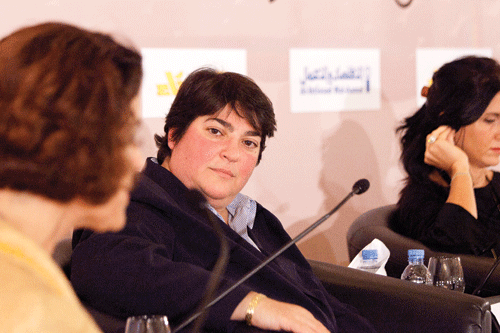
When female banking executives discuss their path to the top, the word lucky is almost always mentioned. They were lucky that their experience was without gender discrimination or sexual harassment. They were lucky to have respectful mentors and to get to their positions without any apparent sexism in the way.
 

“I certainly had a fortunate experience in that throughout my career I never felt discriminated against or put down just because of my gender,” said Bana Akkad Azhari, Lebanon country manager for The Bank of New York Mellon, speaking on the sidelines of the New Arab Woman Forum (NAWF) in Beirut on December 2. The ubiquitous gratitude at reaching heights in careers they are fully qualified for begs a discussion of why women working in the financial world feel that a career without gender-related bumps is a luxury, not an expectation.

The numbers

Of the six of Lebanon’s alpha banks surveyed by Executive, women made up an average of 45.5 percent of the workforce. Banque Libano-Francaise had the highest representation of women with 49.66 percent, while Byblos Bank had the lowest of the banks surveyed with 41.1 percent.  Lebanon’s workforce is 24.8 percent female according to 2010 figures from the World Economic Forum’s (WEF) Gender Gap Index, compared to 25.4 percent in Morocco and 46 percent in the United States. The World Bank puts the female percentage of Lebanon’s workforce slightly higher, at 27 percent.

Despite the difference in the estimations, both statistics indicate that Lebanon as a country is behind in terms of gender equity in the work place, though the banking sector, it would seem, is well ahead of the national trend. 

A curious juxtaposition to the gender gap within the workforce is the gender dynamics of Lebanon’s universities. According to the WEF report, there are 1.19 times more women with tertiary education than men. Furthermore, 56 percent of students taking American University of Beirut’s Master of Business Administration program are female.

And that’s not the only oddity: when you scratch below the surface of the seemingly enlightened banking sector, it’s clear that women are largely crowded at the bottom and middle rungs of the ladder. In fact, the only female general manager of a conventional bank is Pik Yee Foong, of Standard Chartered, which isn’t a homegrown Lebanese institution. Furthermore, only two of the six banks surveyed by Executive have women on their boards.

Roles to play

The great debate surrounding the inequalities between men and women in the workplace is whether women choose to slow down their careers and delay promotion by taking maternity leave, or whether they are professionally punished for being biologically responsible for procreation. “Women are very educated in Lebanon but there is this Levantine mentality where they are very excited to be active and work after university, but upon their marriage there is a tendency to go back home to engage in a new challenge, which is building a family. It’s quite paradoxical with the level of education,” said Freddie Baz, chief financial officer at Bank Audi. 

The legally mandated maternity leave in Lebanon is just seven weeks with 100 percent pay. This is significantly less than the 12 weeks given to Moroccan women and half of the minimum leave granted to American women.

Although there is little conclusive evidence as to the effect of maternity leave on the composition of workforces overall, there is conclusive evidence that taking maternity leave lowers a woman’s pay over her career, as concluded by a 2004 Ohio State University study. This also indicates that choosing to take maternity leave makes promotion less likely. But in Lebanon, there are two forces at work. Some women may choose to leave the workforce when they start families, but many are also drawn out of the country by better-paid opportunities elsewhere.

This is a man’s world

Regional players indicate that the boys club dominating the upper echelons of banking is not so much a consequence of cultural mores as the result of a testosterone-prone industry.

“The United States is considered the most open and most diverse society that we have; at least we try to promote it as such. But in the banking environment it still tends to be a very white, male, pinstripe suit, white collar type of environment,” said Nadine Chakkar, head of global financial institutions for The Bank of New York Mellon, also speaking at the NAWF conference. Chakkar has worked her entire career in the US, but is of Lebanese origin.


The case in Lebanon is similar, but with the added issue of the common habit of passing family businesses from father to son — which is largely no longer the case in the West.  However, familial patronage aside, financial workplaces worldwide tend to display the same behavioral patterns. “Guys tend to help each other a lot more. When they move up they move everybody up with them,” said Chakkar. “With women, for some reason, we are wired differently. Instead of pulling everybody else with us we feel that we have to move up and push everybody else down. I think women just need to realize that somebody else’s success doesn’t hurt them.”

From the boardroom to the teller
A Lebanese mother became the first woman in the country to open a bank account for her children on December 17, 2009, when she opened accounts for each of her two sons at the Bank of Beirut and the Arab Countries (BBAC). “I’ve been trying to open a bank account for my two sons for 10 years now, but I was continuously told that only my husband could sign the papers,” said Barbara Batlouni, the Lebanese-American director of the non-governmental organization Amideast, to the Associated Press. Batlouni’s victory came after the Association of Banks in Lebanon changed rules that discriminated against women after receiving pressure from the Institute of Progressive Women and other like-minded groups. This move was a positive step, but Lebanon is still far from financial equality: a Heritage Foundation/Wall Street Journal Financial Freedom index shows that financial freedom has actually decreased in Lebanon in the past two years.
The World Bank reports that Lebanon is one of 42 countries in the world that does not afford men and women equal access to institutions in both the public and private sector. Married men and women do not enjoy equal financial rights. Women may work the same hours as men but are prohibited from certain industries and must retire four years earlier than men, at age 60. Finally, Lebanon is one of just four countries to grant tax breaks to men with unemployed wives, but not women with unemployed husbands.

Thus some hindrances may come from women themselves. However, Chakkar also said that reaching senior levels at financial institutions is a particular challenge for women due to the different ways that the two genders are perceived. “When I display a little bit of passion, I’m acting as a ‘bitch’ or being extremely aggressive, whereas a guy is just being competitive,” she said.  However, Roula Habis, general manager at Middle East Capital Group, says that she uses the assumptions about women to her advantage as a private wealth manager.  “Men usually know that women are more loyal and they are more focused,” she said. “You rarely hear about fraud and corruption among women — it’s more men. It’s easier for me to earn clients’ confidence because I am a woman.”

Future

Chakkar said that she is feeling a change in the wind.

“I think the industry’s changing, and not because the guys at the top had a revelation. I think it’s changing because society is changing. I think they are realizing that good talent has no color, no gender. I think they are also succumbing to the pressure of the environment out there,” she said. “Today corporations are being put on the spot. You get asked ‘how many women do you have on your board? How many women do you have in senior management?’”


January 3, 2011 0 comments
0 FacebookTwitterPinterestEmail
Comment

Qatar

by Peter Speetjens January 3, 2011
written by Peter Speetjens

Following the suspension of two FIFA executive committeemembers for accepting bribes, the world’s governing football organization onDecember 2 announced that Russia and Qatar will host the World Cup (WC) in 2018and 2022 respectively.

While Russia — with England — was a favorite from the start,Qatar came as a total surprise. Especially in the West, commentators ask: whyorganize such a major tournament in such a tiny country that is blessed withsummer temperatures soaring up to 50 degrees, has no football tradition tospeak of, and which most people are unable to locate on a world map?

While this is a legitimate question, it seems thetraditional football power-houses may have underestimated the strength of theQatar bid, as well as FIFA President Sepp Blatter’s wish for the WC to betterreflect the game’s global appeal. In the past, the organization of the world’sbiggest sporting event more or less routinely changed hands between Europe andSouth America. Yet ever since Blatter came to FIFA power in 1998, Asia hostedits first WC in 2004, the first WC in Africa followed in 2010, while the 2022version will be hailed as the first-ever in an Arab and Muslim country.

The (controversial) Blatter believes that football has thepower to bring people together and enhance mutual understanding, peace andprosperity. Critics, however, claim that Blatter’s global interests mainly aimto enhance his own chance of a political FIFA-afterlife. Western footballnations may also have overlooked the influence of Mohamed bin Hammam, theQatari Head of the Asian Football Federation and current “number three” in theFIFA hierarchy, who is a strong candidate to succeed Blatter.

Still, even in the troubled FIFA ranks that would not beenough for Qatar to beat the bids of its main competitors, Australia and theUS, both countries absolutely nuts about sports and blessed with superbfacilities. As Qatar possesses none of the above, it seems to have outsmartedits bigger rivals by emphasizing being small.

Qatar promises to organize the most compact tournament ever.It will build or expand a total of 12 stadiums located within, at most, anhour’s drive, which will allow football fans to attend more than one game perday. Try doing that between New York and LA, or Sydney and Perth. In addition,once the 2022 world champion has been crowned, the stadiums’ upper tiers willbe removed and donated to countries that lack proper sport facilities. Theoffer is a novelty on ‘Planet Football’, one that was no doubt welcomed byFIFA’s poorer Asian and African representatives.

Qatar’s main weak point is, of course, the weather, as theWC traditionally takes place in summer. Previously, the FIFA technicalcommittee had considered the weather a potential health risk, not just forplayers and fans, but also for “officials and the FIFA family,” and requiredthat precautions should be taken.

To overcome this “slight” inconvenience, Qatar introducedanother novelty: to equip its stadiums with a solar-powered outdoorair-conditioning system that is able to keep the stadiums’ temperature at aconstant and comfortable 20-something degrees. Oh, and beer-drinking fans neednot worry. Qatari officials have promised that alcohol will be allowed inhotels and special outdoor “fan zones,” and they too will be connected to the“green” cooling system.

While most Qataris are no doubt proud and thrilled to hostthe 2022 football bonanza, some may question if building 12 stadiums andorganizing a WC is the best way of investing the country’s wealth. The stadiumsalone have a price tag of some $4 billion. South Africa in 2010 spent less thanhalf that amount, yet failed to record a profit as only two thirds of theprojected 450,000 visitors attended the games.

To the Qatari authorities however, money is not an issue.They think big and have more important things on their minds. Following the2022 WC, which has billions of viewers the world over, few people will still beunable to pinpoint Qatar on a world map. And there are other sport events tocome, such as the Asian Games, the Asian Cup in 2011, and, ultimately, theOlympics. Expect Qatar to be bidding for the ultimate dream in 2024 or 2028.


PETER SPEETJENS is a Beirut-based journalist


January 3, 2011 0 comments
0 FacebookTwitterPinterestEmail
Comment

Conflict nigh as waters dry

by Nicholas Blanford January 3, 2011
written by Nicholas Blanford


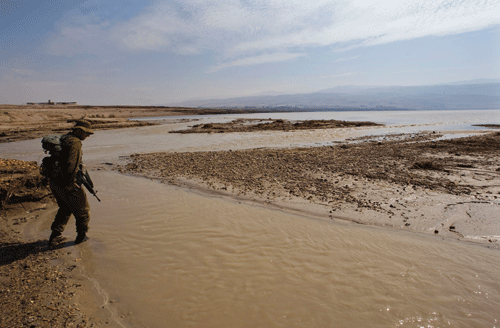
The storms that wracked Lebanon in mid-December were among the most severe in several years. While they helped douse the epidemic of late season brush fires and allowed nervous ski resort owners to open the pistes for the first time, the welcome rainfall could not disguise the fact that Lebanon and the region in general is experiencing a worsening drought.

While the concept of “water wars” in the Middle East has been articulated for many years, the looming crisis over the lack of water is certain to lead to greater competition for resources, fuelling not only inter-state tensions but domestic upheavals between the haves and have-nots.

Before the first rains fell in earnest in December, Lebanon’s meteorological office had registered just 51.2 milli meters (2.01inches) of rain since September. That compares to 214.8 milli meters (8.45inches) for the same period in 2009.

Years of war and government mismanagement have wasted Lebanon’s most prized natural resource, the envy of much of the region, particularly Israel to the south which has coveted Lebanese waters since the notion of a Jewish state in Palestine was first suggested more than a century ago. An Arab League project in the early 1960s to divert the Hasbani River from flowing into Israel indirectly led to the 1967 Arab-Israel war, in which Israel seized the Golan Heights from Syria and the West Bank from Jordan.

Since then, Israel has exploited both territories for their water reserves. The Mountain Aquifer in the West Bank, which produces some 600million cubic meters of water per annum, is supposed to be a shared resource for Israelis and Palestinians.  But Israel exploits about 80 percent of the aquifer for its own needs. Israelis on average consume three times as much water as Palestinians. The Coastal Aquifer in Gaza once kept the Jewish settlements watered and provided some 18 percent of Israel’s water supply. But years of over-pumping emptied the aquifer ,allowing salt water to seep in, so that by the time Israel abandoned its settlements in Gaza in 2005 there was little water left for the Palestinians to exploit.

The sensitivities between Lebanese and Israelis over water resurfaced nearly 10 years ago when several minor pumping projects in the Hasbani river to provide water for certain villages and to irrigate some farmers’ fields prompted the Israeli government to threaten war against Lebanon. A four-year drought in north eastern Syria has left an estimated 2million to 3 million people living in what the United Nations terms “extreme poverty.” Thousands of inhabitants of the Jazeera region in Syria’s north east have migrated toward Damascus, living in ad hoc settlements in the hope of finding work. With once productive arable land turning into desert, Syria has gone from a net exporter of wheat to a net importer.

Lebanon boasts some 40 major rivers and 2,000 springs, but the UN estimates that half of the annual flow of 1,150 million cubic meters is lost to the sea or neighboring countries. A World Bank study concluded that Lebanon could be experiencing chronic water shortages by 2020 due to over-consumption, over-pumping, pollution and poor management. Much of Lebanon’s water is used for agricultural irrigation, particularly in the relatively arid Bekaa. But the lack of sustainable irrigation techniques places a burden on local water resources with ever more wells drilled and a consequent lowering of the water table. A 1999 plan to harness water resources called for investments of $1.5 billion to construct dams and reservoirs. The plan was supposed to be completed this year, but it has hardly got off the ground due to the failure of successive governments to allocate funds for the project.

If action is not taken soon, water shortages could provoke social unrest, especially given the expanding divide in Lebanon between the wealthy and poor. In recent months, residents of the Bekaa and the north, the two poorest regions in the country, have had to purchase water from tankers because the state supply ran out. In 1992, the collapse of the Lebanese lira sparked riots in the streets of Beirut, which ended up toppling the then-government of Prime Minister Omar Karami. Those protests were dubbed the “bread riots.” The next could be over water.


Nicholas Blanford is the Beirut-based correspondent for The Christian Science
Monitor and The Times of London


January 3, 2011 0 comments
0 FacebookTwitterPinterestEmail
  • 1
  • …
  • 394
  • 395
  • 396
  • 397
  • 398
  • …
  • 696

Latest Cover

About us

Since its first edition emerged on the newsstands in 1999, Executive Magazine has been dedicated to providing its readers with the most up-to-date local and regional business news. Executive is a monthly business magazine that offers readers in-depth analyses on the Lebanese world of commerce, covering all the major sectors – from banking, finance, and insurance to technology, tourism, hospitality, media, and retail.

  • Donate
  • Our Purpose
  • Contact Us

Sign up for our newsletter

    • Facebook
    • Twitter
    • Instagram
    • Linkedin
    • Youtube
    Executive Magazine
    • ISSUES
      • Current Issue
      • Past issues
    • BUSINESS
    • ECONOMICS & POLICY
    • OPINION
    • SPECIAL REPORTS
    • EXECUTIVE TALKS
    • MOVEMENTS
      • Change the image
      • Cannes lions
      • Transparency & accountability
      • ECONOMIC ROADMAP
      • Say No to Corruption
      • The Lebanon media development initiative
      • LPSN Policy Asks
      • Advocating the preservation of deposits
    • JOIN US
      • Join our movement
      • Attend our events
      • Receive updates
      • Connect with us
    • DONATE