• Donate
  • Our Purpose
  • Contact Us
Executive Magazine
  • ISSUES
    • Current Issue
    • Past issues
  • BUSINESS
  • ECONOMICS & POLICY
  • OPINION
  • SPECIAL REPORTS
  • EXECUTIVE TALKS
  • MOVEMENTS
    • Change the image
    • Cannes lions
    • Transparency & accountability
    • ECONOMIC ROADMAP
    • Say No to Corruption
    • The Lebanon media development initiative
    • LPSN Policy Asks
    • Advocating the preservation of deposits
  • JOIN US
    • Join our movement
    • Attend our events
    • Receive updates
    • Connect with us
  • DONATE
Society

Investing in the name

by Emma Cosgrove December 3, 2010
written by Emma Cosgrove


A company has a brand whether they want it or not” is a popular adage for explaining the importance of branding as a discipline. And, according to a recent survey conducted by local branding firm Brandcell entitled ‘The State of Brand Management in Lebanon,’ it is one that may need to be more explicitly communicated to Lebanese businesses, organizations and institutions.

“In Lebanon [branding] has become, by force, a need. But it hasn’t been easy and still it’s not easy. Branding is still largely misunderstood and unappreciated and very vague to the client,” said Abdo Saleh, executive design director at Brand Central. Brandcell’s survey polled 50 professionals — from marketing managers to chief executive officers to communications and public relations (PR) managers — to find out if they truly have a grasp of the illusive concept of branding and if it is properly integrated in both the perception and operations of their institutions.

City Mall - Lebanon

The study found that “although Lebanese marketers believe in the importance of branding and its influence on customer choice, they lack the full knowledge related to a brand’s economic value creation and to a brand’s relation to business strategy.”

Joumana Rizk, owner and managing director of Mirros Communication and Media Services, said that she was in the public relations (PR) game for over 10 years before she began recommending that her clients work with her company in addition to branding firms in order to create the best solutions and strategies.

“When we want to deal with PR or work on PR and communications we cannot take just one part and forget the other parts,” said Rizk. “PR has to be incorporated in a bigger strategy, which includes branding and communications and marketing. So of course when I discuss PR and communications with my clients, it has to be incorporated in a branding approach.”

Taanayel Dairy Brand - Lebanon 

In-house

There is only so much an outside PR professional or branding firm can do to make sure that a branding strategy permeates every level of an organization; something branding professionals insist is essential to ensuring the “authenticity” of a branding strategy. Though it is the job of the branding consultant to make sure that the brand identity and strategy chosen is organic to the institution, internal communication and the spreading of a branding philosophy throughout an organization ensure that the strategy is kept consistent and executed on every possible level.

“Its not a one way thing — it’s a chain. Everybody has to be involved,” said Rizk.

Only 31 percent of marketers in Lebanon think that their company’s employees have a good understanding of the core ideas of the brand identity, even though 73 percent of marketers survey their employees regarding their understanding of the brand, according to the Brandcell survey.

Branding Survey: Beirut, Lebanon

This indicates that 42 percent of marketers are aware that their branding strategies are not penetrating through the ranks, but have so far been unsuccessful in remedying the situation. 

The study notes that Lebanese marketers “need to devote more branding efforts especially to engage employees, have a more supportive management and have brands aligned with business strategy and operations.”

However, Saleh says that this disconnect is a common occurrence in organizations in highly developed markets as well.

“To be fair [this] can be found in developed markets — you would be surprised,” he said. “In very sophisticated markets and with very sophisticated companies you will still find those faults of understanding. That’s quite normal because it’s a very tricky discipline.”

Going into the metrics

One way to convince executives and even staff of the importance of an intimate knowledge of their own brand is by presenting it in terms of dollars and cents.

But this is yet another “tricky” task. While 80 percent of the marketers claim to measure the financial value of their brands and the return on brand equity generated by their efforts, only 40 percent of marketers claim to be aware of how brands create financial value for their organizations.

Supporting a theme of overconfidence, this paradox suggests that 40 percent of marketers are attempting to measure their brand’s financial value without truly grasping how this value is generated. This fact contributes to a widely acknowledged lack of standardization in return on brand equity and brand value metrics.

Branding survey cont...: Beirut, Lebanon

“Return on investment in branding is as elusive as the search in alchemy for the elixir of life,” said Saleh. “Every branding specialist worldwide and every marketing guru claims that they have formulated the right approach on how to financially prove the success or failure of branding… but you won’t find one standard today that most people are adopting. Everyone has their own and sometimes they are protected by a proprietary system claiming that they have the only answer.”

Yet another curious contradiction among marketers is their rock solid belief that their tactics are effective. Even though 92 percent of marketers say their branding is effective in influencing the choices customers make, only 71 percent of them claim to survey their customers about their brands. This leaves 21 percent of marketers believing that their efforts are working without bothering to be sure.

It is an issue of consistency and follow-through, which are the main roadblocks to truly effective branding and a particular problem in the local market. “Lebanese people are very good at creating concepts and ideas but they don’t sustain them properly. Our main problem is consistency,” said Albert Thoumy, head of communication strategy and development for Crepeaway. “We have good brands and good communication skills but we do not question ourselves enough to do something different, to apply high quality standards and to innovate,” he said in conjunction with Brandcell’s survey.

Important aspects of branding according to brand managers: Beirut, Lebanon

The evidence shows that this is not an industry at a crossroads, but simply a phase in a progression toward a mature branding market, though it may frustrate the experts waiting for their clients to catch up.

December 3, 2010 0 comments
0 FacebookTwitterPinterestEmail
Real Estate

Executive insight Sayfco Holding

by Chahe Yerevanian December 3, 2010
written by Chahe Yerevanian


In light of the strong price performance of the Lebanese real estate market during the last three years, a popular topic of discussion across the country has been whether we are in the middle of a market bubble. Are prices destined to fall, or is there truth to the old Lebanese proverb that land in Lebanon is as precious as gold?

As with any product or service, real estate prices will always be governed by the laws of supply and demand. In addition to increasing local demand, the real estate market in Lebanon also attracts buyers from the Lebanese expatriate community (which some estimates peg at as much as 15 million), and from wealthy Arabs. In a region mostly dominated by desert plains, Lebanon’s temperate climate, lively nightlife and diverse geography stand out like an oasis in the sands.

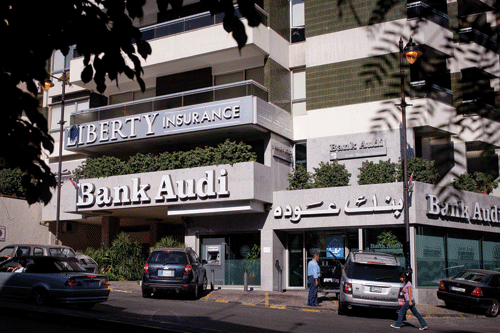
However, in the first nine months of 2010, sales to foreigners actually dropped by 0.7 percent relative to the same period last year, according to Bank Audi.

Strong end-user demand from both residents and non-residents, coupled with a limited land area, has driven increases in real estate valuations. The average value of property sold in Lebanon increased 28 percent in the first nine months. Some areas of Beirut, such as Downtown, Verdun, and Achrafieh, are especially sought-out but also have relatively low land availability; consequently, these areas have experienced the highest increases in value.

Spreading out

Given the sharp increase in price, which starts around $6,000 per square meter in downtown, demand has shifted to the suburbs of Beirut (such as the Metn) where prices are comparatively more affordable.

Again, once fair value is reached in these suburbs, the trend and demand will shift further out into the outer suburbs (Keserwan/Jbeil from one side and Aley/Chouf from the other side). As in the development of any country, high prices in the city center will displace local demand farther out to the periphery of the city. A crucial factor for this continued growth is the development of an adequate transportation infrastructure for residents to easily commute from these suburbs to their area of employment.

Finally, from a financial perspective, the key ingredient in past real estate bubbles around the world — debt-fueled speculation — is for the most part missing in the local market due largely to wise governance from Banque du Liban, Lebanon’s Central Bank. Given the regulatory limits on debt extended by banks for real estate construction, most major developers fund a majority of a project’s cost with equity and, to a lesser extent, cash proceeds from the pre-sales of apartments. Even credit facilities to the buyers of a residence are typically only extended if a substantial percentage of equity has been injected into the transaction.

These positive factors do not mean that prices will forever increase at double-digit rates in all areas, or that a slowdown in sales activity will never occur. Even with positive market dynamics, the type of supply must follow changes in buyer requirements or desires. For example, as real estate prices rise in Beirut, demand is increasingly shifting to smaller apartments (below 200-250 square meters), the typical market demand of major European cities. Periodically, political or security fears may also sometimes cause a temporary drop in sales volume. However, the long-term fundamentals of the real estate sector in Lebanon are sound. 

Given its distinctive cultural heritage, geography and the resilience of its people, there will always be strong demand for real estate in Lebanon from residents and non-residents alike. This demand, coupled with a relative scarcity of supply, will support prices in the long run. Monetary authorities in the United States and Europe may have the power to run their printing presses and to create dollars and euros at will, as they have recently shown, but God stopped creating land in Lebanon a long time ago.

December 3, 2010 0 comments
0 FacebookTwitterPinterestEmail
Comment

Betting on the Blue Line

by Nicholas Blanford December 3, 2010
written by Nicholas Blanford

You have to hand it to Khalil Abdullah, who must be the most optimistic businessman in Lebanon. He is currently putting the finishing touches on an extravagant Afro-Arabic style tourist resort on the bank of the Hasbani River, less than a mile upstream from the border with Israel.

This section of the Hasbani River cuts a narrow gorge through a grassy plain at the foot of the Shebaa Farms hills, flanked by dense oleander and eucalyptus trees. The Blue Line, the United Nations-demarcated boundary that corresponds to Lebanon’s southern border runs up the middle of the Hasbani at this point. If visitors to Abdullah’s resort swim to the far bank of the river, they will have entered Israeli-occupied Syria and risk being shot by Israeli troops. Indeed, when Abdullah began work on his project, Israeli troops would turn up on the cliff on the opposite bank and peer at him through binoculars.

Israel’s unease over Abdullah’s activities was probably due to concerns he was planning to pump water from the river. The Hasbani is one of three tributaries of the Jordan River that flows into the Sea of Galilee, Israel’s largest source of fresh water. Previous small-scale pumping schemes by the Lebanese government and local farmers have triggered uproars and even threats of war.

Furthermore, this section of the border is notoriously porous and a favorite location for cross-border smuggling, particularly narcotics. In 2007, two drug smugglers wearing Spanish United Nations Interim Force In Lebanon (UNIFIL) uniforms attempted to enter Israeli-occupied Syria near Abdullah’s resort by crawling through a storm drain. Unfortunately for them, Israeli troops had staked out one end and shot one of the two smugglers as he emerged.

The Alawite village of Ghajar, lying a mile north of Abdullah’s resort, has long been a conduit for cross-border smuggling. The Blue Line splits Ghajar so that the upper two-thirds fall inside Lebanon and the remainder in Israeli-occupied Syria. After Israel’s troop withdrawal from South Lebanon in 2000, Hezbollah set up a position in the northern part of the village from where they ran an intelligence operation inside Israel. Israeli troops occupied the area during the 2006 war and have remained there ever since to ensure Hezbollah cannot return.

In November, the Israeli government finally agreed to a UN-brokered compromise in which it will cease its military presence in northern Ghajar in exchange for UNIFIL and the Lebanese army maintaining a tight security cordon to prevent anyone from accessing the village from the northern side. There was an element of bloody-mindedness in Israel’s procrastination over Ghajar. The village is sealed off on the southern side anyway, with the only available access through a checkpoint manned by Israeli soldiers. Given the presence of the Lebanese army in the border district and UNIFIL’s cordon of fences, patrols and watchtowers, it is unlikely, if not impossible, for Hezbollah to return to the village as they did before 2006. 

However, there was a legal complication in that the residents, although Syrian nationals, have held Israeli citizenship since 1981. That meant that Israeli citizens technically would be living on Lebanese territory.

What would happen if one of them fell sick and needed an ambulance to take them to hospital, or if repairs needed to be conducted on a house in northern Ghajar? Could an Israeli doctor or electrician cross the Blue Line into Lebanon? The UN, Israel and, grudgingly, it seems, Lebanon, have agreed on a sensible compromise to return the situation to pre-2006 so that the residents can lead normal lives.  Ultimately, the curious case of Ghajar can only be fully resolved when the Israelis and Syrians strike a peace deal and Israel withdraws from Ghajar, the adjacent Shebaa Farms and the Golan Heights. However, Israel’s decision to finally adopt long-standing legislation mandating a national referendum to decide whether or not to end the occupation of Syrian territory and East Jerusalem has dimmed hopes of a resumption of peace talks and increased chances of war.

But the ever-optimistic Abdullah has an answer for that. A later phase of his project will see the construction of a 60-room hotel on the cliffs overlooking the Hasbani gorge and his resort: “Maybe they can hold future peace talks there. After all, it will be at the junction of the Lebanon, Syrian and Israeli borders.”

NICHOLAS BLANDFORD is the Beirut-based

correspondent for The Christian Science

Monitor and The Times of London


December 3, 2010 0 comments
0 FacebookTwitterPinterestEmail
Real Estate

Q&A Bassim Halaby

by Rayya Salem December 3, 2010
written by Rayya Salem


This year saw the launching of Beirut Terraces in Minet el Hosn — developer Benchmark’s second high-end project in the capital, with one of the highest prices per square meter in Beirut starting at $7,200. With more than $1.4 billion invested in residential projects, both in Lebanon and the region, the four-year-old firm is one of the key players in Beirut’s luxury property market. Executive sat down with Chairman and Chief Executive Officer Bassim Halaby to chat about the current and future state of Beirut’s property market, with a special focus on the Beirut Central District (BCD).

E Were the rises in the price of property in Beirut over the last two years expected or even healthy?

Since the 2006 to 2008 period, the spike in prices made Lebanon seem brighter than it was. It’s the gap between the retraction in the world economy with the growth of Lebanon’s property market that made us look very good. But we all knew it was just a one or two-year phenomenon. Now, 2010 to 2012 is a time where solvency is expected to take place in the market. Most stock of housing should be absorbed by the market. If it [isn’t], it will take one additional year. Developers work on a pre-sale basis, so my sense is that in 2012 the market will stop witnessing mushrooming of new projects and there will be a major slowdown in the construction industry. Sell-offs will not happen at rock-bottom prices, but at good value for money.

E What about prices outside of Beirut?

The price of land doubled in the last five years in BCD and more than tripled around Beirut. So the BCD was already leading [the market] and hit a ceiling quickly. Beirut [areas outside of Solidere] has grown irrationally to the extent that prices around Beirut are very comparable to Solidere, without having the level of accessibility, the level of organized environment, control and zoning. It’s a fixed, regulated, predictable neighborhood. This is why people buy in BCD, because they know what they will view from their office or home. I would say prices have reached stabilization— a normalization of the market.

E Is infrastructure improving to be able to absorb the increase in construction?

Beirut infrastructure is a disaster in progress. The BCD has been planned on the basis of density, size of roads and anticipated traffic. But the moment the spillover of traffic of [greater] Beirut goes into BCD on the port roads, the BCD closes down.

E We have seen more demand for smaller apartments. How are developers responding?

Beirut’s property market is not homogenous; there are 17 micro markets each behaving differently. Small apartments — 90-150 square-meter (sqm) — are not a new trend in some of these markets, particularly on the outskirts of the city, but would definitely be a novelty in BCD.

People have been buying small apartments, crowding themselves into spaces they believe they can live in and then closing off balconies with glass, meaning that the indoor space was not enough for them. That’s why one of the concepts of Beirut Terraces was to create an indoor/outdoor living space. But in general, the smaller the apartments, the more a developer has to provide costly parking space. For a 300 sqm apartment I have to provide two spaces. If I build three 100 sqm apartments, I have to provide three. Outside Beirut, the municipal law is not as strict on amenities and services provided.

E From your building experience in the BCD, what are buyers’ preferences shifting toward?

Having tried Wadi Hills, where people wanted townhomes with gardens, we came to the conclusion that we could do the same concept of townhomes, yet stacked vertically. They feel private yet close to each other, like in a village.

E  More developers are claiming to build “green” projects. Are buyers more aware of environmentally-friendly construction?

Today, “green” is not a selling item. LEED certification [the United States Green Building Council certification system] is not a valid draw for a buyer. But buyers are becoming more and more concerned about long-term running costs of their unit. The reason to buy is still location, size and quality of life offered.

E What draws investors to Lebanon in spite of the political instability?

Politics, security and stability have never been a reason to stop Lebanese from investing in real estate. The market is led by at least 66 percent demand from [local] Lebanese, 20 percent from Lebanese expatriates and 14 percent from non-Lebanese demand. So Lebanese are always interested in having an apartment for themselves or their kids.

E Have developers’ profit margins changed over the last few years?

Today we don’t have a project in Beirut that exceeds $130 to $150 million in [construction] costs, unless it’s something like City Mall or a commercial project. A project value of $500 million [such as Beirut Terraces] means you’re talking about $150 to $170 million for the cost of land, $150 million on construction cost and the rest are revenues that you have to pay taxes on, so it’s not [all] profits. Developers are operating on profit costs ranging between 10 to 30 percent.

E How will the BCD area change in the near future?

The landfill area [reclaimed land on the seafront adjacent to Beirut International Exhibition and Leisure (BIEL) center] consists of available plots in BCD. BIEL is a temporary structure to be replaced by a tower, which might be 200 meters high, which Solidere is planning. Whereas the height of Wadi Hills is 110 meters, the height of towers on landfill plots is going to be around 180 meters.

E  Looking towards 2011 and beyond, what cost issues are developers facing?

Developers do ‘land banking’ and therefore buy land in anticipation of the next project and not because we hedge on whether there is stability or long-term peace. There is always a project in the pipeline. Construction cost fluctuates depending on demand, but it has stabilized due to the financial crisis. China is no longer building by the billions and thus increasing raw material prices. Gulf countries are no longer experiencing high growth potential. So we are working with a normal situation where construction cost is predictable. The value of real estate has normalized.

E What about the recent influx of “nonprofessionals” in the real estate market?

This is an unregulated business and anyone can become a developer. That’s why we saw so many entrants. People think that you can bring the architect and make him the project manager, architect, builder and everything. You [can] bring a contractor who would subcontract everything else. Some people get together, build a project, distribute shares or units among themselves and sell the remainder, which brings in some profits.

The problem is when these same people get into another project, but now they have to sell all of it off to market. Without the right calculations, they build the wrong product for the wrong market. In Beirut, approximately 30 percent of stock has been built with substandard quality and is wrongly priced. The market regulates itself so they will eventually close down their shop.

E Is choosing the right architect for a major project in BCD becoming more important because of the construction boom and subsequent competition?

We want Beirut Terraces to be an award-winning design at the global level. We want to put Beirut on the map of quality of architecture and quality of life and match what Solidere is trying to promote: ‘Beirut as a reborn city.’ By choosing Herzog & de Meuron [architects] we have been able to achieve, despite the market’s soft tendencies today, great interest and a demand that is resilient to market softness.

E What is the key ingredient that makes Beirut real estate vigorous?

Beirut has shown that cities are based on culture and not only services and economies. When I was doing my thesis back in the 1980s, I looked at cultural activities like jazz festivals that re-invigorated the economies of New York, Boston and cities in Canada. Beirut has all the ingredients of cultural activities, beyond the nightlife, beyond the food, beyond everything. The biggest ingredient is the people… this culture transcends to every single Lebanese, so big developers today are more or less targeting a diaspora that has the taste of globalization but has the real know-how of the local culture.

December 3, 2010 0 comments
0 FacebookTwitterPinterestEmail
Comment

Gold’s glorious 2010

by Paul Cochrane December 3, 2010
written by Paul Cochrane


It’s been a glittering year for gold globally, with a Troy ounce (37.1 grams) rising $300 to a record $1,424.60 in November, before backing down slightly into the high $1,300s as Executive went to print. And it’s been just as bright a year for the precious metal in the Middle East. The Saudi Arabian Monetary Agency (SAMA) re-checked its accounts to find it had 180 tons more than it originally thought, Lebanon’s central bank reserves appreciated by more than $2 billion to close on $13 billion, and gold bugs in the United Arab Emirates were given the novel option to buy 24 karat bars from vending machines.

For individuals and governments alike, gold has been the go-to “alternative monetary asset,” as World Bank President Robert Zoellick put it in November.

Bullion took on a new allure as the United States dollar and the euro continued to weaken amid ongoing concerns about the financial markets, and central banks sought to hedge against inflationary pressure. Driving demand even higher was the inability of institutions and currency hawks to buy Chinese renminbi, as its exchange is restricted, leaving few options to hedge against further drops in the world’s two leading currencies. Gold’s surge has raised debate about whether the precious metal should have a monetary role four decades after the US ended the gold standard. A return to the gold standard is not likely, or indeed necessarily wanted, but any country that sold off a good chunk of its gold, like Britain did a decade ago, is today regretting not having hard assets tucked away in the vaults.

For dollar-pegged currencies, which includes Lebanon and most of the Gulf Cooperation Council (GCC) countries, holding sizeable gold reserves has been a real boon. Five Middle Eastern and North African (MENA) states are in the top 30 countries in the World Gold Council’s (WGC) World Official Gold Holdings rankings. But it is not the usual suspects of the oil-rich Gulf states taking the titles: Lebanon ranked 18th globally — just behind Britain and ahead of Spain — with 286.8 tons, equivalent to 25.2 percent of the central bank’s total reserves. Algeria, ranked 23rd, has 173.6 tons, Libya is right behind with 143.8 tons, and Turkey is in 29th place with 116.1 tons,

Out of the GCC nations, only Saudi Arabia makes it into the top ranking, leaping from 24th to 16th place in March when SAMA announced that, incredibly, due to “a difference in accounting” rather than new gold purchases, the kingdom had 322.9 tons instead of the earlier announced 143 tons. One can only wonder how much unaccounted-for gold there may be still hidden under the tiled floors of the Saudi central bank when such a staggering discrepancy is revealed. Furthermore, such holdings are only the reserves of SAMA, not the private stash of the estimated 7,000 members of the Saudi royal family, nor of Saudi citizens. Then there is the vast amount of gold ore lying under the kingdom’s sands, estimated at 20 million tons, according to Australian government statistics. The Saudi Arabian Mining Company (Ma’aden) has five operating gold mines, with proven gold ore deposits of 1.3 million ounces and current exploration suggests deposits of more than 8 million ounces elsewhere on its acreage. This year British and Australian gold mining companies obtained exploration licenses.

With gold production having peaked in 2011 at 2,645 tons, and the output of the four traditional producers — South Africa, the United States, Canada and Australia — on a downward curve, Saudi Arabia, in addition to its gushing black gold, appears to be experiencing a gold rush of the more traditional type.

The big question now is whether gold will continue to rally in 2011. Gold bugs are dreaming of an ounce hitting $2,000, while other pundits suggest the rally may be over and it is better to buy silver.

MENA central banks holding gold appear to have no desire to sell. As Riad Salameh, the governor of Lebanon’s central bank, told Reuters in October: “Lebanon will sit on its gold… In a world where you could see major crises, the payment instrument of last resort is gold — especially for a country like Lebanon that doesn’t have natural resources.” The same could be applied to individuals. Personally, as a gold bug myself, I’m hoping for another glittering year in 2011.

PAUL COCHRANE is the Middle East

correspondent for International News Services

December 3, 2010 0 comments
0 FacebookTwitterPinterestEmail
Real Estate

Towering profits

by Rayya Salem December 3, 2010
written by Rayya Salem


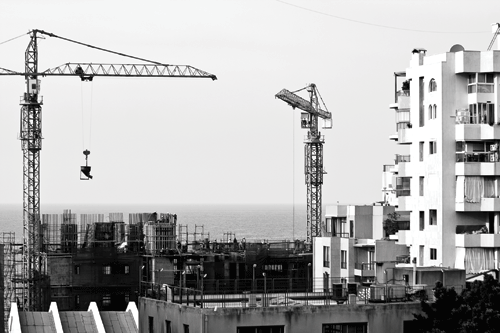
A remarkable 2010 witnessed the wholesale destruction of records in the real estate sector. Soaring tower heights were matched by booming construction activity, high-profile conventions, more sales than ever (and of higher values) and the launching of unprecedented mega-developments. With foreign investment steadily increasing and excess liquidity at local banks, the property sector enjoyed a healthy stock of both cash and confidence.        

Lending for new homeowners has never been more varied, as banks competed this year to offer housing loans across the market with rates tailored to various requirements. Some lending facilities allow residents to borrow 80 percent of a home’s value and have raised the maximum value of loans in parallel with the climbing real estate prices seen across the country, though especially in central Beirut.

As the supply of free plots runs thin and the cost of land climbs ever higher, experts agree that prices, though they have stabilized, will remain at levels too high for most local Lebanese. Bilal Alayli, president of the Order of Engineers and Architects, said there were around 100 plots left in Beirut, covering some 400,000 square meters. He added that owners are holding on to their land, hoping prices will continue to soar.

The ubiquitous cacophony of construction that has been Beirut’s soundtrack all year is scored in the statistics: figures from the Order of Engineers and Architects of Beirut and Tripoli show that construction permits, one of the major indicators of real estate activity, covered an area of 14.4 million square meters in the first ten months of 2010, compared to 10.19 million square meters in the same period last year, a 41.4 percent increase. Cement deliveries reached 3.8 million tons in the first nine months of 2010, an increase of 5.3 percent from 3.7 million tons in the same period last year, according to the Banque du Liban (BDL), Lebanon’s central bank.

Total revenue from property sales in Lebanon reached a record-breaking $6.96 billion in the first nine months of this year, an increase of 60.6 percent compared to the same period last year, according to the General Directorate of Land Registry and Cadastre (GDLRC). The number of total transactions increased by 25.3 percent to 69,501, also the highest recorded in that category. The average value of all the property sales in the nine-month period increased 28.2 percent compared to the same period in 2009.

According to the Ministry of Finance, property registration fees in 2009 made up 1.2 percent of gross domestic product, which translates into $417 million. In the first quarter of 2010 alone, registration fees jumped 87 percent year-on-year, reaching $128 million.

Investment

According to the Investment Development Authority of Lebanon (IDAL), 70 percent of total foreign direct investment in 2009 was funneled into the property sector, which translates into more than $3.3 billion. Hawlo Tleiss, executive vice president of IDAL, conceded that while some foreigners may be put off by Lebanon’s shaky national security situation, the group pointed potential investors toward the low crime and robbery rates in Beirut compared to other major cities.

A World Bank report also suggested that a growing proportion of remittances, estimated to reach up to $8.2 billion by the end of this year, are being used to buy land and housing.

Those in the sector say that the administrative red tape involved in property development — a major drawback for investors — has been more burdensome than usual in 2010, which was borne out in the “Doing Business 2011” report issued by the World Bank/International Finance Corporation in November. Lebanon was ranked 142nd globally out of 183 countries and in 16th place in the Middle East and North Africa (MENA) region for ease of obtaining construction permits. It also ranked 111th place globally and 16th regionally for time it takes to register a property.

Lending

This year, banks were more willing than ever to offer tempting mortgage deals to homebuyers, thanks to the excess liquidity on their books, courtesy of the influx of funds that flowed into Lebanon’s banking sector after the financial crisis.

Nassib Ghobril, chief economist at Byblos Bank, told the Development and Real Estate Annual Meeting (DREAM) conference in November that mortgages increased in value by nearly 50 percent in the year ending June 2010. As of that same month, mortgages accounted for 13 percent of Lebanese banks’ private sector lending, according to Executive calculations based on BDL data.

Despite easier access to credit, one of the major topics this year in real estate was the fact that most locally employed Lebanese have been priced out of the Beirut property market due to the growing disparity between prices and income. Few Lebanese can afford a home in Beirut when first floor prices in new buildings start at $6,000 per square meter. However, despite the financial crisis, wealthy Lebanese expats and Arabs living in the Gulf continued to spend on Lebanese property, sustaining the high prices.

Downsized demand

While the real estate sector in general has experienced sustained growth and momentum, the stagnation in the upper end of the market that started in 2009 extended throughout this year. Sales of ultra-luxury apartments slowed, and sky-high prices began to — if not come down to earth — at least plateau.

“It’s probably healthy that it did [slow down],” said Karim Makarem, director of Ramco real estate advisory firm. “We were seeing 25 percent growth in prices per year for five years, which is unsustainable.”

Faris Smadi, chief executive officer of SV Properties & Construction, agrees: “After the surge of real estate prices in the last three years, we did reach something of a plateau this year, mainly due to the fact that developers put prices that weren’t achieved.”

The let-up in the market seems to be focused on prices of large apartments, which have been stagnant for the last year and a half, with some prices even falling as sales slowed. According to Joe Kanaan, president of brokerage firm Sodeco Gestion, “there is a shortage of what is really in demand — small apartments.”

Faris Smadi of SV Properties and Construction, the firm behind 3Beirut

Demand has clearly shifted toward 80 to 200 square meter apartments, especially on the outskirts of downtown. High-end areas such as Sursock, where developers usually build larger apartments, are also experiencing the shift.

“The mentality has changed,” said Smadi of SV properties. “Before, the traditional buyer in downtown wanted a large apartment, particularly with large traditional living rooms, and the sea view was more important to him. Now, buyers are happy to have smaller apartments in the right location with the right infrastructure and amenities. We took that into account in our new project [3 Beirut] where approximately 50 percent of the apartments are between 200-240 square meters.”

Land going through the roof

Construction prices and the price of labor remained stable in 2010 (as opposed to a slight rise in 2009), but finding reasonably priced land in Beirut was a major headache for many developers. The Beirut Central District (BCD) does have available plots, but is too over-priced to be a feasible option for most. As such, many developers have started construction — even of high-end residences — on the outskirts of Beirut. Houssam Batal, founder and CEO of Premium Projects, said that the “market noise” created by some of these developments is confusing clients, as they are marketed as luxury residences in “prime areas.”

Construction area authorized by building permits (million square meters)

“Developers buy relatively cheap lots [in areas such as Badaro, Zkak El Blat, Tehouita, or Sioufi] and claim that the location is prime, but they are at risk because sophisticated clients will realize that these residences are not worth the higher prices and are resistant to pay for the more expensive units,” he said.

Mohamad Chamseddine of Information International, a Beirut-based research consultancy said: “This year, land prices in villages rose because more people want to build homes there, seeing that Beirut prices and rents are too high. Tens of thousands of Beiruti families have moved to suburbs like Damour, Meshref, Khalde and Aramoun. We even saw [during the 2009 elections] that politicians who want to appease the Beirut voters visit these areas heavily because those families can’t afford to live in Beirut anymore.”

The average price per property on sale in Beirut grew 22 percent year-on-year in the first nine months of 2010, while the figure stood at 28 percent for Lebanon as a whole in the same period, according to Bank Audi. As land became scarce, prices had no place to go except up, although a period of stabilization is expected in the immediate future.

To keep prices from escalating further, Alayli of the Order of Engineers and Architects suggests higher taxation on property sales, noting that the registration tax is a lowly 6 percent. Currently there is also no capital gains tax. Kanaan, of Sodeco Gestion, also suggested axing the old rental law, in gradual phases, to allow old buildings to be demolished, freeing up new lots for new developments.

FDI inflow to the real estate sector + Arab FDI inflow to the real estate sector

Higher price tags are causing property shoppers and potential clients to become savvier, focusing on the construction specifications, negotiating harder and taking longer to seal the deal.

Due to limited space, rising prices, and a more competitive market in general, developers are spending less time analyzing their bottom line to focus on staying ahead of the pack. To entice clients with a prestigious address, Premium Projects spent about two years buying out the old residents and combining properties to put together a 1,800 square meter plot for Sursock Yards in Ashrafieh, an 18-story complex that is already 65 percent sold. Premium Projects’ Batal said, “We are willing to consume time and cost to get these prime locations.”

The “non-professional” scourge

Many developers and brokers have complained that there have been a rising number of non-professionals in the business, attracted by what they perceive as opportunities to get rich quick in Lebanon’s booming real estate market. They say the negative side effects have affected the whole industry.

“Since 2007, we have been seeing more people developing buildings that are really not professionals in the field. If they don’t take into account the urban planning, they are harming the area around them,” said Alayli, adding that there needs to be more regulation of urban development. 

Property forecast

Lebanon’s real estate market is predicted to grow 10 to 15 percent in the next three years, Fuad Fleifel, director general of the Ministry of Economy, said in November at the Beirut International Property Fair.

Apartment permits issued - Beirut, Lebanon

Experts agree that such growth is normal and expected for a country with so much demand, both local and foreign.

“From now until 2013 in Beirut, 90 percent of available land will be built up,” said Alayli, who adds that local demand is rising. “We have around 35,000 marriage contracts and 5,000 divorces per year; thus you can say we need at least 40,000 new apartments.”

Developers predict that even the roughly 350 projects underway in downtown will be fully absorbed, though it may take more time than usual.

Some suggest that as the Lebanese have become relatively more affluent in the past few years, more Lebanese (as opposed to Arab nationals) will be buying than before. Smadi said in earlier projects, such as Beirut Tower, 50 percent of buyers were Gulf clients and expatriates. The more recent Bay Tower is 90 percent Lebanese-occupied and most are local residents, attributing the change to the fact that the latter apartments were smaller.

Cement deliveries (First nine months of each year - in 1,000
</p>
									            </div>
        </div>

		            <div class=

December 3, 2010 0 comments
0 FacebookTwitterPinterestEmail
Comment

Turkey’s EU report card

by Peter Grimsditch December 3, 2010
written by Peter Grimsditch


The 104 pages on Turkey’s European Union progress (or lack thereof) from EU Enlargement Commissioner Stefan Füle represent the kind of school report which children would rather not show their parents. Its examination of the 35 “chapters” Ankara needs to reach agreement on to join the EU was a damning indictment of its failure to meet European standards in almost every area.

The document, published in late October, detailed deficiencies in freedom of speech and religion, minority rights, constitutional reform, questionable behavior by the police and an attitude toward women’s equality that talked the talk but failed to halt the rise in honor killings and forced marriages of girls in their early teens, especially in the east and southeast.

Perhaps conscious of the need to throw in a few sentences that could be shown to mum and dad with a smile, many of the most savage sections conclude with the somewhat bizarre observation that “overall some progress is being made.”

The report’s most positive part concerned the economic environment, which Füle’s team acknowledged had vastly improved. But at a time when Greece, Ireland, Portugal and Spain (and maybe soon Italy) are in deep financial and economic trouble, the report could come to no other conclusion. Despite a proud history that includes Euclid and Archimedes, the Greeks have shown they can’t add up — estimating the size of the budget deficit is one of the country’s bigger growth industries. Dublin’s initial insistence that everything was under control now looks like a Guinness-fuelled Irish joke. The governments of Portugal and Spain are paying more to raise money than at any time since the eurozone was founded.

With an economy looking at 11 percent growth this year and a banking sector immune to the catastrophes suffered by reckless American and European banks these past two years, little wonder the Turks can afford to feel superior. Ankara feels justifiably aggrieved that countries like Romania and Bulgaria (where corruption is a national sport) have been positively dragged into the EU club. The truth, of course, is that the major reason for accelerating their entry was to prevent them from falling back into Moscow’s sphere of influence.

For Turkey, failure to resolve the Cyprus issue is blocking talks on 18 of the 35 EU accession chapters, while France has unilaterally stalled another five. There are rumblings that a hint of movement may be imminent on Cyprus. The European Commission is said to have proposed talks on the energy and justice chapters in exchange for Ankara’s opening one of its ports and airspace to Cypriot shipping and aviation by the first week of December. Turkey’s acceptance of the secret deal is allegedly conditional on allowing international flights into Northern Cyprus, as well as direct trade with the self-declared republic. Officially in Turkey, the proposal doesn’t exist. While implementation of such an agreement could be trumpeted as success, the fallout of a failure could hurt the government’s chances in next June’s elections.

What the leadership is very happy to assert, however, is that keeping Turkey out of the EU is Europe’s loss. “As long as we are not a member of the EU, the EU will not become a global actor,” was Prime Minister Recep Tayyip Erdo?an’s assessment of the EU report. To President Abdullah Gül, speaking to the Chatham House think tank in London, membership was not a matter of domestic Turkish politics. Turkey is taking a strategic view, looking 20, 30, even 50 years ahead, he said. Lower down the political food chain, Egemen Bagis, Turkey’s chief negotiator, claimed grandiosely that the EU needs Turkey more than Turkey needs the EU.

With the exception of comments on press freedom (Gül would like more of it, Erdo?an says it is not limitless and Bagis thinks it already exists), much of the reaction from Ankara to the EU report has been in similar-sounding generalizations. The report itself was packed with specific accusations in many areas, citing examples, although it too occasionally threw in unsupported generalities similar to those trotted out by the Turkish political establishment. Füle concluded that “despite overall progress in 2009, we are concerned that Turkey’s accession process is losing its momentum. The key to changing this is primarily with Turkey.” Ah, that word ‘overall’ again. Despite the sugar coating, mum and dad are unlikely to be fooled.

PETER GRIMSDITCH is Executive’s

Istanbul correspondent

December 3, 2010 0 comments
0 FacebookTwitterPinterestEmail
Society

The souk of splendor

by Emma Cosgrove December 3, 2010
written by Emma Cosgrove


Consumption is keeping Lebanon alive. As a major contributor to gross domestic product, the Lebanese penchant for luxury puts the shine on the country’s numbers, financially precarious as it may be for the individual. At the close of 2010, after years of waiting and false starts, the highlife has found a true home in the revived downtown Beirut. Still, the current conditions, which have the potential to carve Beirut a place among the world’s great retail cities, are not assured. 

With Beirut Souks — Solidere’s consumerist dream — at the center of it all, downtown Beirut rivals, at least in names, the great shopping districts of Paris or New York. The 200-outlet complex began its very soft opening in October of 2009 and has now seen its first full year of operation. Persistent delays and mismanagement of initial space allotment, especially in the Gold Souks section, made for a rocky start, but on the whole, retailers have been keen to move into one of the final puzzle pieces of downtown Beirut’s rebirth.

“Of course the companies were thrilled when we proposed to them the mono-brand boutique concept in Lebanon, especially in Beirut Souks, which is the ideal place to be, in the heart of the city,” said Barkev Atamian, business manager for local luxury watch empire Atamian. His company now dominates an entire corner of the Gold Souks with IWC Schaffhausen, Jaeger-LeCoultre and TAG Heuer mono-brands and a multi-brand boutique containing watches from Breguet, Blancpain, Glashütte Original and Ulysse Nardin.

Despite congratulations from many foreign brands happy to have a centralized home of luxury in a desirable market, the Souks still stand as a disappointment to some.

“To be quite honest the souk is not up to our expectations yet, but we think that there is a future for it,” said Izzat Traboulsi, managing director of Hugo Boss for the Middle East.

The Souks ‘value-added’ features such as a cinema complex and many of its promised dining locations and cafes are conspicuously absent. Solidere’s General Manager and Chief Financial Officer Mounir Douaidy told Executive last September that the northern section of the souks, set to contain a 14-screen cinema and a department store, would be completed by the end of 2011 — one year to go.

“It’s still a mess because there are some missing cafes,” said Traboulsi. “The cafes [that do exist] are on the edge of the souks… we don’t have any cafes as a stop in the middle.”

In addition to the lack of patron-enticing entertainment venues among the retail spaces, the mixed price tag of retailers within the complex makes luxury retailers less willing to choose locations in the thick of it. This means that some truly top-end retailers are still looking for a presence outside of the souks on the outlying streets of Foch, Allenby and Park Avenue.

But these streets pose yet another challenge for the retailers who want to keep company with their contemporaries; each building and sometimes each space has a different owner, whose interests and ideas do not necessarily tally with the vision for the area. So, the new challenge with the growing presence of luxury retailers downtown is keeping the area on message.

“If somebody is going to be paid $1,400 per square meter they don’t care if it’s a high end place or a shwarma place,” said Traboulsi.

The cafe culture of Maarad Street is yet to be  successfully replicated in Beirut Souks

Although a hefty per-square-meter price tag should keep the falafel stands from downtown for now, a lack of a central unified plan means that at any given moment these top-end retailers could find themselves with a neighbor not of the rarefied company they would usually keep.

Furthermore, rising rent prices in an area with a finite amount of attractively located, ground floor space could jeopardize the future health of Beirut’s luxury center.

“The only issue we are facing now is, since the demand is a little bit big, the prices are tending to go high also. Today [rent] is representing a very big part of the turnover, which is not normal,” said Antoine Eid, chairman and chief executive officer of Joseph Eid & Co. — which owns the Alberta Ferretti, Faconnable and Lanvin Men’s boutiques downtown — to Executive in July.

Eid said that today, rent for a boutique in the Beirut Central District (BCD) represents 7 to 10 percent of revenue. This in itself is a bit too high for comfort and, with rents increasing, Eid is worried.

“We think that this is dangerous because maybe some of the companies will not be able to sustain these rents for a long period of time and it would be a pity to see some of them closing,” he said.

And on top of the geographical and spatial dynamics of downtown, political dynamics, as ever, have their role to play.

Hotel occupancy rates in August dropped from 75 percent in 2009 to 43 percent in 2010. Likewise, rates in September dropped from 62 percent in 2009 to 53 percent in 2010, according to international consulting firm Ernst and Young.

Though Ramadan’s August arrival this year was partly to blame, Traboulsi believes that inflammatory rhetoric from various political leaders and trepidation regarding the uncertainty of reactions to the United Nations’ Special Tribunal for Lebanon (STL) scared away some prime tourist dollars. He estimates that Hugo Boss saw a 10 to 15 percent drop in sales in August and September from last year, when development and tourism trends predicted growth.

It’s not just complicated forces like politics that impact luxury sales; even simple forces like weather can, and have, hindered retail sales this year.

“We got the fall merchandise and we are still having summer. There is no appetite from the clients,” said Traboulsi.

Missing out

The seemingly constant openings and events celebrating fashion in the BCD in 2010 encourage the idea that it is the only place for luxury in Beirut. But this centralization of luxury downtown has taken focus away from other areas of the city and frustrated some established proprietors.

Grace Sehnaoui, brand manager at E and E group which runs TOD’s, Hogan and multi-brand boutique Kamishibai, said when Beirut was beginning to re-establish itself in terms of a luxury retail destination after the civil war, development was haphazard and scattered around the city. With the new centralization of luxury, many of the high-end retailers who appeared early on now find themselves somewhat isolated among the riffraff.

Clever marketing with a gigantic shop-sized travel case ensured Louis Vuitton was one of the more hotly anticipated luxury openings seen in BCD this year

“Outside of [ABC Ashrafieh] it’s quite dead now,” said Traboulsi. “Joseph Eid and Via Spiga had luxury stores [near Sassine], today they don’t function as before because all of the luxury [brands] have moved downtown where it is done in a proper way. Now whenever a premium brand wants to open a shop, the only destination they have is downtown Beirut.”

Sehnaoui’s Kamishibai sits down the block from Joseph Eid near Sassine and is surrounded by a random smattering of salons, cell phone shops and, most frustrating to her, banks.

“When it’s a shopping area it should be a shopping area,” she said. “The banks here have beautiful [locations]. They are huge and on the ground floor because they are the best paying.” 

Luxury brand managers and owners have little hope for the success of any other ground level, open air shopping districts in Beirut, as a coordinated effort to create shopping streets is unlikely. The very fact that there are far more players in the game today than there were five years ago is a testament to Lebanon’s flourishing luxury retail sector.

But the forces threatening sales still dictate success and the concerns of the industry’s leaders suggest that this is no time to sit back and relax. With the resolution of the STL pending, Traboulsi said: “In Lebanon I don’t see any growth [for 2011]; we see it as a stable market for the moment.”

December 3, 2010 0 comments
0 FacebookTwitterPinterestEmail
Comment

An Afghan errand

by Adam Pletts December 3, 2010
written by Adam Pletts


As the attack was radioed in, we upped our pace to such a speed across the rugged terrain that I was thrown across the inside of our armored vehicle. Looking out of the tiny window to my side, all I could make out was a ridge of Afghan mountaintops see-sawing from side to side through a cloud of earth-colored dust. “Demon 26 this is Monkey 6,” the military radio was saying. “We’re still taking indirect, three o’clock at three hundred meters,” to which someone in our vehicle retorted on the internal channel: “Well, if you know where they are then fucking shoot them,” and to my surprise we burst into genuine but bravado-flushed laughter.

We were on our way to make contact with the elders of Saray village, which sits geographically at the top of a valley but temporally much further away, in the throes of something I would only recognize as medieval. Our 27-vehicle convoy was winding its way through the Lal Por District of Nangarhar Province in the far east of Afghanistan. It’s known to American forces and their allies as an insurgent infiltration route from Pakistan to Afghanistan. Once over the border the Taliban make their way north to resupply the insurgency in Kunnar Province, which sustains the heaviest fighting anywhere in Afghanistan other than Helmand and Kandahar.

Lal Por is scarcely populated, apart from along the banks of Kabul River that forms its southern boundary, and there is no tarmac road leading to the village that shares a name with the country’s capital. Until now, the Taliban have enjoyed free reign to pass through the desolate mountain ranges that cover most of the district. 

The meeting lasted about 20 minutes and did little more than establish that the villagers seemed genuinely concerned about the Taliban presence. The lieutenant in charge promised them a well, but whether they’ll take him up on this is another matter. Like so many in isolated rural locations across Afghanistan, the villagers of Saray are stuck between the wrath of the Taliban and the suspicion of coalition military forces.

As the discussion came to a close and the group broke from the cover of a small line of trees where they had been taking shade, I couldn’t help but wonder whether such risk and expense had been worth it just to offer a well which may not be needed. But then I suspect the intention was every bit as much to send a message to the Taliban that they can’t move with impunity in the region.

Lal Por was one of many districts across Afghanistan where the Taliban did their best to disrupt the parliamentary elections last September, bombarding Afghan Police and United States military patrols with mortars from the hills north of its sleepy village capital.

The bombardment that I was caught in was the furthest south that the Taliban have attacked in this district since those elections but it was hardly a surprise; as two platoons, together with a mine-clearing unit, a quick reaction force and an Afghan army unit, we hardly looked subtle making our way up a valley into “coalition virgin territory.” The going was so tough that two vehicles were lost to mechanical failure, forcing lengthy pauses in the open valley as if to advertise our presence.

Intentional or not, the advert drew Taliban attention. Although some 25 mortars were fired at the convoy, together with heavy machine gun fire, none met their target.

In contrast, there were at least two confirmed hits on the Taliban before the arrival of air support prompted an effective disappearing act. The US officer in command told me he believed there were at least two Taliban killed in action and more wounded.

That’s certainly a message, but not necessarily the one the convoy was hoping to deliver. 

ADAM PLETTS is a freelance

journalist currently embedded

with coalition forces in Afghanistan.


December 3, 2010 0 comments
0 FacebookTwitterPinterestEmail
Society

Boutique bouquet

by Emma Cosgrove December 3, 2010
written by Emma Cosgrove


Despite many new brands entering the Beirut market for the first time this year, a large number of existing shops have chosen to use the revival of downtown Beirut and the inauguration of the Souks to open up new stores and increase their brand exposure — a potentially pricey risk in such a small market.

“The idea of mono-brand outlets is relatively new here in Beirut and I think it reflects an increased interest by big-name brands in Lebanon and in the Middle East in general,” Stefano Macaluso, vice president of luxury watchmakers Girard-Perregaux, told Executive in July. “At a time when luxury watchmakers were tallying losses in Europe and the United States, sales soared in this region.”

Top-end retail executives seem to agree that having multiple points of sale even in a small country like Lebanon gives customers the most complete experience with the brand, making a more lasting imprint and, ultimately, financial sense.

“We find that whenever we open our stores nearby a place we already have distribution, the total distribution grows because you can see what the line [offers] much more,” said Jerome Griffith, chief executive officer of Tumi.

New strategy, new players

While the influx of mono-brand stores has not led to the abandoning of the very popular multi-brand stores, such as Aishti and Boutique 1, the trend has begun a wave of new fashion relationships between brands and local partners that defy the traditional requirements of exclusivity.

Luxury watch-makers, such as Jaeger-LeCoultre (above), flooded to downtown Beirut in 2010

“[Exclusivity is] like protectionism,” Griffith said. “It’s not really good for overall business. You think it is, because at a fundamental level it makes sense that if I’m the only one that has a brand, then I’m the only one that sells it, but actually you don’t really gain a brand’s potential until that brand is seen multiple times, because a customer has to recognize [it].”

According to Izzat Traboulsi, managing director of Hugo Boss for the Middle East, the relationship between local or regional partners and the brands themselves has changed quite significantly since the mono-brand invasion.

Brands tend to maintain their own mono-brand points of sale and then work with a different local partner to open a direct franchise location, as opposed to hiring a company as an exclusive representative or independent agent of the brand, as is the case with Hugo Boss. 

“Today the regional partners are already there. The set-up is already there. Today, lots of the emerging brands do it directly,” he said.

The shrugging-off of exclusivity is not yet universal, but should pave the way for more mono-brand stores to come.

As George Kern, chief executive officer of IWC Schaffhausen said, “There is no other way to express the brand [than] in a boutique. You cannot do it with a shelf.”

December 3, 2010 0 comments
0 FacebookTwitterPinterestEmail
  • 1
  • …
  • 396
  • 397
  • 398
  • 399
  • 400
  • …
  • 686

Latest Cover

About us

Since its first edition emerged on the newsstands in 1999, Executive Magazine has been dedicated to providing its readers with the most up-to-date local and regional business news. Executive is a monthly business magazine that offers readers in-depth analyses on the Lebanese world of commerce, covering all the major sectors – from banking, finance, and insurance to technology, tourism, hospitality, media, and retail.

  • Donate
  • Our Purpose
  • Contact Us

Sign up for our newsletter

    • Facebook
    • Twitter
    • Instagram
    • Linkedin
    • Youtube
    Executive Magazine
    • ISSUES
      • Current Issue
      • Past issues
    • BUSINESS
    • ECONOMICS & POLICY
    • OPINION
    • SPECIAL REPORTS
    • EXECUTIVE TALKS
    • MOVEMENTS
      • Change the image
      • Cannes lions
      • Transparency & accountability
      • ECONOMIC ROADMAP
      • Say No to Corruption
      • The Lebanon media development initiative
      • LPSN Policy Asks
      • Advocating the preservation of deposits
    • JOIN US
      • Join our movement
      • Attend our events
      • Receive updates
      • Connect with us
    • DONATE