• Donate
  • Our Purpose
  • Contact Us
Executive Magazine
  • ISSUES
    • Current Issue
    • Past issues
  • BUSINESS
  • ECONOMICS & POLICY
  • OPINION
  • SPECIAL REPORTS
  • EXECUTIVE TALKS
  • MOVEMENTS
    • Change the image
    • Cannes lions
    • Transparency & accountability
    • ECONOMIC ROADMAP
    • Say No to Corruption
    • The Lebanon media development initiative
    • LPSN Policy Asks
    • Advocating the preservation of deposits
  • JOIN US
    • Join our movement
    • Attend our events
    • Receive updates
    • Connect with us
  • DONATE
Economics & Policy

Lebanon in a new regional order

by Khalil Toubia March 9, 2021
written by Khalil Toubia

The Middle East and the Mediterranean are going through great changes that are redefining the region. The countries of the Southern shore of the Mediterranean (Algeria, Tunisia, Libya) are experiencing major transformation with the fall of the old military regimes and the attempts to establish new governance. The countries of the Eastern Mediterranean, Syria, and Lebanon are undergoing a change characterized by instability. In Iraq, administrative divisions on the basis of community sensitivities weaken the country’s security. The countries around the Red Sea, for their part, are experiencing a strong imbalance, whether it is Yemen, Sudan, Eritrea, or Djibouti.

Throughout the region, the US presidential elections were seen as a deadline. President Trump’s mandate was marked by a series of blows that began with a strengthening of the American alliance with Saudi Arabia (May 2017), then by the recognition of Jerusalem as the capital of Israel (December 2017), and then the withdrawal of the United States from the nuclear deal with Iran (May 2018), the meeting with the leader of North Korea (June 2019) and the new trade agreement with China (January 2020). The latest peace agreement concluded between the United Arab Emirates and Israel (August 2020) marks a turning point in the regional conflict.

We are at the heart of a major turntable in the history of the region. One hundred years after the Treaty of Sèvres (August 10, 1920), which sought to give the Arab populations the possibility of independence from the Ottoman Empire, the region seems to be heading towards a new regional order. All of these developments lead us today to reflect on the political choices to be adopted, as four projects are emerging in the region. Each of these political projects involves the imposition of its own economic and social model.

The first of these projects involves the emergence of a new Arab World aligned with the international community. The second consists of the Russian Minority Alliance Project, which uses the Orthodox Church as leverage, and which claims to be able to provide protection to Christians in the East. The Wiliayat al Fakih of the Tehran – Baghdad – Damascus – Beirut axis makes up the third project. And the fourth and final project concerns Sunni political Islam, supported by Turkey and Qatar.

Cut off from its port since the August 4 explosion, Beirut is losing a vital organ around which the city had organized and developed. In addition, the geopolitical developments that occur with this explosion are causing the capital to lose its strategic importance and its primordial function as a hub between the West and the East.

Beirut: born around its port

The Port of Beirut has been a lever for Beirut and the Lebanese economy. Currently, it represents a transshipment hub for major global carriers, including CMA-CGM. The importance of the Port of Beirut and the services developed in its city are the result of an accumulation of skills acquired over decades.

Around 1830, Mohamad Ali, the new ruler in Egypt, arrived at the gates of Constantinopolis. His son, Ibrahim Pasha, occupied Beirut and decided to move the administrative capital from Saida to Beirut. He developed the port of Beirut and built warehouses, established customs, erected the quarantine hospital building, as well as a souk. Attracted to Beirut, the foreign consuls left Saida to settle in the new metropolitan area.

Later, due to growing French influence in the region, and some time before the start of work on the Suez Canal in 1859, Count Edmond de Perthuis obtained the concession of the right to build and operate a road from Beirut to Damascus (1856). The boom in the city of Beirut pushed the various religious congregations to open schools in the capital and to establish a state-of-the-art education system, the two main educational centers being the Syrian Protestant College, now known as the American University of Beirut (AUB) in 1866, followed by Université Saint Joseph (USJ) in 1875. Infrastructure works were then financed and carried out by companies with European capitals, mainly French. Foreign investments in Beirut led to the creation of the Wilaya (state or province) of Beirut in 1888. Beirut thus gained in independence and prosperity. The Régie des Tabacs was granted in concession in 1883, the Compagnie du Port des Quais et des Entrepôts de Beyrouth was created in 1888 then built the ferry terminal, terminus of the Beirut and Damascus railway lines in 1897. This line would have a dual commercial and touristic function since it was used to transport pilgrims to Mecca. Beirut continued to develop with the Company of Tramways and Lighting (1894). With the inauguration of the modern Port of Beirut in 1895, life was organized in the city around this hub. The Ottoman Bank, the Orosdi-Back Department Store, the Khan Antoun Bey Square, the Police Center, and several hotels were established there. Customs warehouses were opened in the port area, as well as a main post office which housed French, English, Russian, Austrian, German, and Italian posts, ensuring direct correspondence with these countries and greatly facilitating trade. This postal service would soon far exceed that of the Ottoman Post, suffering from incompetence. The city of Beirut and its port acquired a quality know-how, which gave them a certain advantage, defying all competition.

The success of the Port of Beirut was an example for other cities with access to the sea and wishing to develop. This would be the case for the Moutassarifate regime (1861 – 1915) which aspired to projects of the same scope in Jounieh. Also, to counter this momentum, the Port of Beirut Company was granted the exclusive right to build and operate other seaports all along the coast.

Following the country’s independence gained in 1943 and the consequences of the events of 1958 in Lebanon, a new governance and a new compromise between the two currents of the time (pro Pact of Baghdad against Pro-Nasserism) was established. During his mandate, President Fouad Chehab (1958 – 1964) developed a Lebanese land-use planning with Father Lebret, the Institut de Recherche et de Formation en vue du Développement (IRFED) plan, according to the country’s capacities, its resources and regional constraints. And given that the city of Beirut, administratively speaking, was becoming crowded, he developed with Michel Ecochard, a master plan for Beirut and its suburbs. In 1960, the management of the Port of Beirut was granted for 30 years to a Lebanese company, the privately-owned Company of Management and Exploitation of the Port of Beirut.

Since the end of the company’s operating rights, the state has been responsible for the management of the port. In 1992, the Damascus-Tehran axis strongly opposed the very strong vision of Prime Minister Rafic Hariri, characterized by the reconstruction of Beirut around the Port, the Airport and the City Center. Any action to open up and develop Lebanon would be strongly reprimanded throughout the post-Taif period by both the Syrian regime and that of Iran. As a result, the role of the Port of Beirut could not be recovered without regaining sovereignty.

From a city limited to less than 1 km² in 1840, to the administrative city of Beirut now covering an area of ​​20 km², the Lebanese capital today tends to expand to cover a larger area, mainly along the Lebanese coast. The economic value of this 240 km-long coastline makes it possible to organize and plan the element of “power” that Lebanon could play. There was a time when Lebanon succeeded in being a pivotal space, thanks to its double opening, on the one hand to the Arab countries, and on the other hand to the countries of the Mediterranean, through the development of other coastal cities from Tripoli to Jounieh and Saida, which linked Iraq but also the Gulf countries with the Mediterranean, thanks in particular to the road to Damascus, the railway line, but also to oil pipelines such as Tapline or IPC. As an example, the Lebanese coast can be compared to the coast of the region of Liguria (Genoa) in Italy (214 km). Liguria is the third smallest region in Italy, 5.421 km², but is also the third most populated region with 300 inhabitants/km². Montenegro, 13.812 km², is administratively subdivided into three regions, the coastal region, 293 km long, the central region, and the northern region. The development of the 240 km of the Lebanese coast represents a single economic unit that could be a considerable competitive advantage for the country.

A hub between East and West

Geopolitical realities will have an impact on the development of the Port of Beirut and the city. In fact, four realities should be noted: The Suez Canal project which cuts the route to India from the British, the Franco-British competition under the 1920 mandate, the boycott by the Arab States of the State of Israel since 1948, and the substitution of the Lebanese state by militias since the signing of the Cairo agreements in 1969.

Napoleon Bonaparte, who wanted to cut the British route to India, led the Egyptian campaign (1798 – 1801). The opening of the Suez Canal in 1869, and the influence that France gained over the eastern Mediterranean, dealt a heavy blow to the British navy, which saw its maritime route modified. With the French mandate in Lebanon and Syria that began in 1920, and despite new governance having been put in place and new geopolitical issues being underway, competition with the British persisted. The Haifa-Baghdad axis was controlled by the British. The capacity of the Port of Haifa was twice that of the Port of Beirut. The construction of a railway line between the Port of Haifa and Amman was also planned. The Iraq Petroleum Company (IPC) pipeline from the Mosul oil fields was supposed to end in the Port of Haifa. The latter was included at one time in the Tapline plan, a pipeline going from eastern Saudi Arabia to the Mediterranean, which was later redirected to the Lebanese port of Zahrani (near Saida) following the decision of King Abdul Aziz Al Saoud and the Arab boycott of the State of Israel. This competition would push the French mandatory force to enlarge the Port of Beirut by adding a second dock basin and developing other infrastructures in parallel.

In 1948, with the creation of the State of Israel, the Arab countries boycotted this new state. They concentrated their trade with the Mediterranean through Lebanon and therefore, through the Port of Beirut. The Port of Beirut reasserted its position as the leading port in the Eastern Mediterranean. Moreover, as Syria, Egypt, and Iraq faced regime changes, followed by nationalization plans and capital drains, Lebanon which was then the only country in the Middle East to have a liberal political and economic regime, succeeded in attracting capital from all over the Middle East, thanks in particular to the establishment of a favorable business environment, reinforced by the banking secrecy law proposed by Raymond Eddé in 1956.

Following the defeat of the Arab armies against Israel in 1967, Lebanon, which had remained outside the conflict, found itself in the spotlight with a Palestinian militia which began to organize from south-Lebanon. Since the signing of the Cairo Agreement in 1969, Lebanon has moved from the domination of one axis to another, under the governance of the dominant militias.

A benched MVP 

Currently, Lebanon is going through its most serious economic and financial crisis, in a climate of regional tension and in the total absence of a state. The Hezbollah militia controls all economic and political life as well as the airport and the Port of Beirut. As a result, Iran has become a full-fledged geopolitical player in the Mediterranean. Lebanon, once the lung of economic, political, financial, and cultural freedom of the Middle East, is being held hostage. It is therefore the very essence of the country’s “raison d’être” that is being questioned, its role, its usefulness for the region and consequently, its constitution and its Arab and international friendships and support.

Today, Lebanon is facing a major turning point in the history of the region. In view of the succession of events that are taking place, what choices must Lebanon make in light of new alliances between the United Arab Emirates and Israel? Will the free forces and private institutions be capable of banking on the competitive advantages offered by the country and rebuilding the country according to the new order that is emerging in the region? How should the Russian, Iranian, and Turkish projects be evaluated? Are they carriers of growth and development, capable of bringing peace and providing prosperity to our country? The free forces, the main vector of economic advancement in Lebanon, must reposition themselves in the face of the various options that are emerging. These should anticipate their future and define their objectives, role, and usefulness for the region according to their skills. One thing is clear: the power of the private sector in Lebanon, the prosperity of Beirut and that of its port cannot be realized outside three invariable pillars: the maintenance of the Lebanese constitution, the Arab natural identity, and the respect for international law and UN resolutions.

March 9, 2021 0 comments
0 FacebookTwitterPinterestEmail
Photo Essay

Fighting for women’s rights on International Women’s Day… and every day

by Greg Demarque March 8, 2021
written by Greg Demarque

On March 8th 2021, Lebanese women led a demonstration near the National Museum to mark International Women’s Day. Both female and male citizens stood together in support of women’s rights to equal representation, equal participation in social and political life, equal pay, an end to child marriage, and other key issues.

[rl_gallery id=”27327″]

March 8, 2021 0 comments
0 FacebookTwitterPinterestEmail
Opinion

In the crossfire of regional elections

by Paul Salem March 5, 2021
written by Paul Salem

The US elections of November 2020 will cast a long shadow in the Middle East.  But elections in Israel in March, Iran in June, and Turkey in a couple of years from now will also have significant geopolitical impacts in the region in 2021.

The Biden administration will be overwhelmed by domestic concerns related to the pandemic, the socio-economic crisis, and political extremism. Foreign affairs will focus on global issues such as climate change, rebuilding traditional alliances in Europe and Asia, and confronting the rise of China.  Biden wants to restore the nuclear deal with Iran that he and President Obama negotiated in 2015; his administration says they also want to discuss Iran’s missile systems and its regional interventions. But once they get their restored—and maybe slightly reinforced—nuclear deal, other matters are much lower down in the priority list.  Washington is moving to restore relations with the Palestinians, and will try to revive Israeli-Palestinian talks, but with very little hope of actual progress.  

In terms of geopolitics, while Trump sided heavily with Israel and the Gulf countries and used many of America’s levers of power—sanctions, cyber and covert attacks, assassinations of top figures like Qasem Soleimani and Mohsen Fakhrizadeh—Biden’s team will have a more distanced approach.  While they will maintain a number of sanctions against Iran—indeed many are hard to remove without Congress’s approval—their attitude is likely to resemble Obama’s attitude toward the end of his term, namely that the powers of the region are going to have to figure out how to “share the region.”  And that could be a formula for more proxy war and regional power grabs.

Upcoming Knesset elections in Israel

Israel is holding its fourth Knesset election in a span of just two years.  But the March 23 elections are unlikely to dramatically change the political landscape in Israel, or alter Israel’s geopolitical alignment.  Israel has “succeeded” in weakening and undermining the Palestinians, and is well on its way to trying to maintain an apartheid state for the next decades of the 21st century.  Regionally, it achieved a major breakthrough during Trump’s term represented in the historic normalization agreements with the UAE, Bahrain, Morocco, and Sudan.  The new Israeli-Gulf axis (of which Saudi Arabia quietly approves) will represent a new economic and technological juggernaut in the world, and also creates a strong Israeli-Gulf-American alliance close up against the southern flank of Iran.  Whether this will deter Iran from more adventures or trigger a new round of escalation in the region will be revealed in the coming months.

A key dynamic in these questions are the Iranian presidential elections scheduled for June 2021.  Although these are not free and fair elections Editor’s note: According to international democratic standards], and although the president does not command Iran’s military or foreign policy, the process does indicate the direction in which the Supreme Leader and increasingly the Revolutionary Guards want to take Iran.  The new president is very likely to be a hardliner, and not anyone of Rouhani’s profile, but there is vigorous debate even among the hardliners whether it is wiser to negotiate with the US and slightly moderate Iranian foreign policy in order to save the economy, and thus save the future of the regime, or whether to double down on defiance and escalation. The Biden administration is really only interested in reviving the Obama-era nuclear deal, with some revisions; Iran wants to restore the deal also.  How Iran will behave after that will be largely decided in Tehran, but will have consequences from Beirut to Sanaa and beyond.

Consequences of upcoming elections in Turkey 

The Turkish elections, although scheduled for 2023, are already having a transformative effect on the region. President Recep Tayyip Erdogan has been fighting for his political life for some years now, as he and his family have been mired in corruption scandals, the Turkish economy has lost its dynamism of years ago, and his election results have grown increasingly precarious.  In 2019, he lost key municipal elections in Turkey’s main cities of Istanbul and Ankara. As a former mayor of Istanbul, he knows what such a loss means.  In order to shore up his domestic support, he has found that pursuing an aggressive geopolitical foreign policy gains him the important support of Turkey’s hardline nationalists. This aggressive foreign policy includes a sustained war against the Kurds, military interventions in Syria and Libya, standing up to the US and NATO by purchasing Russian S-400 systems, and deploying Turkish naval forces to stake out Turkey’s interests in the eastern Mediterranean.  Erdogan has seen how Iran has built a major sphere of influence through militias and proxy presence.  As US power ebbs and regional powers scramble for their spheres of influence, Erdogan has gotten into the game.

The Middle East is settling into three competing axes.  An Israel-Gulf-Egypt axis which enjoys support from a disengaging US.  An Iranian axis that boasts strong influence in Iraq, Syria, Lebanon and Yemen, and enjoys Russian encouragement. And a Turkish axis with influence in the Levant, the Gulf and North Africa, and a leading role in sponsoring Sunni political Islamic movements. 

Whereas the Middle East, especially in the wake of the pandemic and other looming crises, should be moving toward dissolving axes, de-escalating conflict and building regional cooperation, it seems to be moving in the opposite direction.  And as great power competition increases between a declining US, a rising China, and a struggling Russia, the Middle East risks being an arena of their competition as well.  

March 5, 2021 0 comments
0 FacebookTwitterPinterestEmail
Economics & Policy

Currency boards or central banks?

by Nabil Makari March 3, 2021
written by Nabil Makari

With Lebanon going through hyperinflation, some economists have deemed the establishment of a currency board (CB) necessary to help curb inflation. To better assess the possible establishment of a CB, and its probable effect on the Lebanese monetary situation, Executive Magazine talked to Steve Hanke, professor of Applied Economics at Johns Hopkins University and one of the world’s leading experts on hyperinflation and exchange-rate systems, particularly CBs and dollarized systems. Professor Hanke is the architect of CB systems installed in Estonia, Lithuania, Bulgaria, and Bosnia and Herzegovina between 1992 and 1998; he currently sits on the Board of Directors of the United States National Board for Education Sciences.   

1) Could you please start by explaining the mechanism of a CB, as opposed to the central banking mechanism?

A currency board issues, notes, and coins convertible on demand into a foreign anchor currency at a fixed rate of exchange. As reserves, it holds low-risk, interest-bearing bonds denominated in the anchor currency and typically some gold. The reserve levels are set by law and are equal to 100 percent, or slightly more, of its monetary liabilities (notes, coins, and, if permitted, deposits). A currency board generates profits (seigniorage) [Editor’s note: seigniorage is the profit a government makes by issuing currency, for example the difference between the face value of coins and their production costs] from the difference between the interest it earns on its reserve assets and the expense of maintaining its liabilities. By design, a currency board has no discretionary monetary powers and cannot engage in the fiduciary issue of money. It has an exchange-rate policy (the exchange rate is fixed) but no monetary policy. A currency board’s operations are passive and automatic: its sole function is to exchange the domestic currency it issues for an anchor currency at a fixed rate.

Consequently, the quantity of domestic currency in circulation is determined by market forces; namely, the demand for domestic currency. A currency board cannot issue credit. It cannot act as a lender of last resort or extend credit to the banking system. Nor can it make loans to the fiscal authorities and state-owned enterprises. Consequently, such a regime imposes discipline on the economy through a hard budget constraint.

In opposition to this, central banks can engage in active monetary policy. As a result, when compared to countries that employ central banking, currency-board countries have lower fiscal deficits, lower debt-to-GDP ratios, lower inflation rates, and more rapid growth.

2) In the case of Lebanon, inflation is “imported” due to a large trade deficit. Is this situation any different from that in Bulgaria in 1997 when you helped establish a currency board? All in all, how is a CB, in your opinion, effective in situations of hyperinflation in developing countries?

I do not agree with the premise of your question. As Milton Friedman correctly told us back in 1963, inflation is always and everywhere a monetary phenomenon created by monetary policy and an overly aggressive expansion of the money supply by the central bank. That is what has happened in Lebanon. Indeed, that’s why Lebanon entered the world’s 62nd episode of hyperinflation in history in July 2020. As for Bulgaria, it was engulfed in an episode of hyperinflation in 1997. Bulgaria’s hyperinflation was much more severe than Lebanon’s. The monthly inflation rate in February 1997 was a staggering 242 percent per month. Currency boards have been totally effective in smashing hyperinflations. There have been over 70 currency boards in history, and none have failed.

3) What would be the foreign currency monetization base for Lebanon?

The logical anchor for the Lebanese pound issued by a currency board would be the US dollar, particularly since Lebanon is already highly dollarized.

4) How would the mechanism be put in place on day one of the first meeting of a CB? How would the new rate of the Lebanese pound be established?

To set the currency board’s fixed exchange rate, I suggest following the procedure that was used in Bulgaria to establish its currency board in 1997. After the announcement of the installation of a currency board for Lebanon, the Lebanese Central Bank would refrain from issuing any monetary liabilities (the monetary base would be frozen). The Lebanese pound would then be allowed to float for 30 days. After that 30-day period, a careful examination of the results of the floating exchange rate, including benchmark calculations of “a fair value” determination, would be undertaken, and the fixed rate would then be set. That’s exactly what was done in Bulgaria.

5) Lebanon has been running high deficits due to a heavy debt burden and a growing public sector. What effect, in your opinion, would it have on the Lebanese Government budgets? Could it result in the Lebanese government having to lower its expenditures?

Fixed-exchange rate regimes, like a currency board, impose a hard budget constraint. This reins in fiscal authorities, even in countries with weak institutions. Bulgaria illustrates this point. All economic indicators improved rapidly and dramatically after the currency board’s hard budget constraint was imposed. And, stability has been maintained by various types of governments in Bulgaria for over 20 years. Indeed, if we focus only on the fiscal balance, we observe a great deal of fiscal discipline and relatively small deficits. As a result, Bulgaria has the second-lowest debt-to-GDP ratio in the European Union: 18.6 percent. Estonia is the only EU country with a lower debt-to-GDP ratio: 8.4 percent.

6) Are there any new statements or research on the consequences of CBs by the World Bank, International Monetary Fund, and others?

All international organizations that assess the performance of currency boards come to the same obvious conclusion: currency boards smash inflation, establish stability, and turn banking systems from being insolvent to solvent, among other things. Allow me to present a few assessments by the IMF and OECD that have followed the installation of currency boards in Estonia, Lithuania, Bulgaria, and Bosnia and Herzegovina.

Estonia (1992): An IMF press release of March 1st 2000, remarked, “The policy of strict adherence to the currency board arrangement has served Estonia well and the currency board arrangement remains the cornerstone of the authorities’ policy framework.”

Lithuania (1994): The IMF Executive Board assessment issued on May 4th 2006, shortly after Lithuania repaid its last outstanding obligation to the IMF, observed that “directors welcomed the continued rapid growth with low inflation, and observed that Lithuania’s performance over the past five years ranks among the best within the European Union (EU). Directors attributed this impressive outcome to strong macroeconomic policies, firmly supported by the currency board arrangement that has served the economy well, the implementation of wide-ranging structural reforms, and integration with the EU.”

Bulgaria (1997): In the final review of the last Standby Arrangement Bulgaria has had, in March 2007, the IMF’s First Deputy Managing Director said, “Bulgaria is reaping the benefits of sustained sound macroeconomic policies and structural reform efforts with solid real per capita income growth, falling unemployment, and broadly moderate inflation… The authorities have maintained a firm fiscal stance that remains the central policy pillar supporting the currency board arrangement. This is reflected in the record budget surplus in 2006, which resulted from strong spending restraint and dedicated revenue collection efforts.”

The 1999 Organization for Economic Cooperation and Development (OECD) Economic Survey of Bulgaria stated, “By mid-1996, the Bulgarian banking system was devastated, with highly negative net worth and extremely low liquidity, and the government no longer had any resources to keep it afloat.” The OECD also observed, “By the beginning of 1998, [six months after the installation of its currency board], the situation in the commercial banking sector had essentially stabilized, with operating banks, on aggregate, appearing solvent and well-capitalized.”

Bosnia and Herzegovina (1997): A 2020 IMF staff report on Bosnia and Herzegovina noted that, “the banking system appears well-capitalized and liquid on average,” and that the “currency board arrangement continues to serve the economy well.”

7) Is it an authority that would be within the central bank or completely different from it? Would it entail abolishing the current central bank system or just reform it?

A currency board could be contained within the central bank as long as its accounts and operations were totally ring fenced from the rest of the central bank’s activities. That is the case in Estonia, Lithuania, Bulgaria, and Bosnia and Herzegovina. Or, it could be a totally separate operation, such as the case in Hong Kong.

8) There is ongoing criticism of Lebanon with regards to the policy of pegging the pound to the US dollar. Could you expand on the difference between a “peg” and a fixed rate?

A strictly fixed rate is a regime in which the monetary authority is aiming at only one target at a time. Fixed rates operate without exchange controls and are free-market mechanisms for balance-of-payments adjustments. With a fixed rate, there are two possibilities: either a currency board sets the exchange rate but has no monetary policy—the money supply is on autopilot—or a country is dollarized and uses a foreign currency as its own. Consequently, under a fixed-rate regime, a country’s monetary base is determined by the balance of payments, moving in a one-to-one correspondence with changes in its foreign reserves. With this free-market exchange rate mechanism, there cannot be conflicts between monetary and exchange rate policies, and balance-of-payments crises cannot rear their ugly heads. Fixed-rate regimes are inherently equilibrium systems in which market forces act to automatically rebalance financial flows and avert balance-of-payments crises.

Although pegged and fixed exchange rates appear to be similar, they represent totally different types of exchange rate regimes. Pegged-rate systems are those in which a monetary authority is aiming at more than one target at a time. They often employ exchange controls and are not free-market mechanisms for international balance-of-payments adjustments. Pegged exchange rates are inherently disequilibrium systems, lacking an automatic mechanism to produce balance-of-payments adjustments. Pegged rates require a central bank to manage both the exchange rate and monetary policies. With a pegged rate, the monetary base contains both domestic and foreign components. It is important to note that pegged rates, in fact, include a wide variety of exchange-rate arrangements, including pegged but adjustable, crawling pegs, managed floating, etc.

Unlike fixed rates, pegged rates invariably result in conflicts between monetary and exchange rate policies. For example, when capital inflows become “excessive” under a pegged system, a central bank often attempts to sterilize the ensuing increase in the foreign component of the monetary base by selling bonds, reducing the domestic component of the base. And, when outflows become “excessive,” a central bank attempts to offset the decrease in the foreign component of the base by buying bonds, increasing the domestic component of the monetary base. Balance-of-payments crises erupt as a central bank begins to offset more and more of the reduction in the foreign component of the monetary base with domestically created base money. When this occurs, it is only a matter of time before currency speculators spot the contradictions between exchange rate and monetary policies and force a devaluation, the imposition of exchange controls, or both.

9) On a practical level, how do CBs hold reserves? Current reserves requirements at the Lebanese Central Bank are a certain percentage of deposits (for example 15 percent of commercial banks deposits in dollars), how would they be affected?

If the Lebanese pound was issued by a currency board at a fixed exchange rate with the US dollar, the only way one could obtain Lebanese pounds is by exchanging an equivalent amount of US dollars for Lebanese pounds. The asset side of the currency board’s balance sheet (read: US dollar reserves) would go up by an amount exactly equal to the value of the liabilities (read: Lebanese pounds) that have been issued.

The reserve requirements for commercial banks are completely separate from the currency board’s operations. Those requirements would be handled by the central bank. They have nothing to do with the currency board’s operations but are related to commercial bank regulations.

10) There is a lack of confidence in the economic governance of Lebanon. In light of this crisis of confidence, wouldn’t the mechanism result, in your opinion, in excessive pressure should the Lebanese economy be subject to outflows of foreign currencies?

The answer is absolutely “no.” The history of currency boards is uniform and clear: once established, a huge confidence shock ensues and foreign exchange pours into the currency board country. There are no exceptions. For example, in Bulgaria, just prior to the installation of the currency board, the foreign exchange level was USD 864 million. By the end of 1998, the year after the currency board was installed, Bulgaria’s foreign reserves surged to USD 3.1 billion.

11) How does the mechanism relate, in your opinion, to the Central Bank Digital Currency the Lebanese Central Bank is considering establishing with regards to US dollars held in Lebanon and subject to capital controls (“Lollars”)? Would this currency be viable if a CB were to be established?

The currency board system would transform the Lebanese pound into a clone of the U.S. dollar and establish stability. And while stability might not be everything, everything is nothing without stability. As a result, confidence would return, and the economy’s death spiral would come to an abrupt halt. This would improve the current tenuous state of the “Lollar.”

12)  Lebanon is a highly dollarized economy, with most deposits being held in US dollars pre-crisis. Would the CB allow for them to be exchanged at the board?

Again, by attracting capital inflows and restarting the economy, a currency board would improve the state of the Lollar. That is, Lollars would become more valuable and liquid after the currency board was installed than they were prior to its installation.

March 3, 2021 0 comments
0 FacebookTwitterPinterestEmail
Leaders

Breaking the wheel of economic karma

by Thomas Schellen March 2, 2021
written by Thomas Schellen

With no discernible forward motion and no convincing desire for creation of a reform government being exhibited by the parties to Lebanon’s latest and most severe political vacuum, the year to date has been
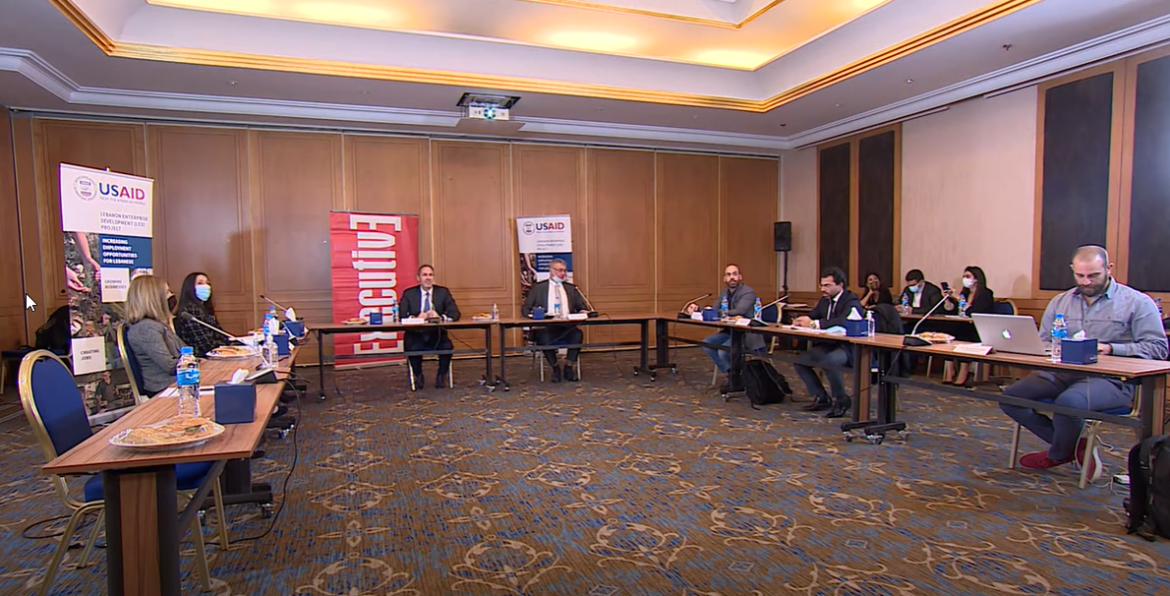
largely void of options. Generally it offered people from the humble worker to the most resourceful entrepreneur two choices: succumb to despair over lack of electricity, lack of money, lack of national political will and leadership, and rail against their unjust fate, or construct, with all mental resources, a space where awareness of this country’s assets of human and social capital creates realistic hope and practical economic solutions. Executive has had no choice in the matter. This magazine’s identity is based on the cognition of the real assets of Lebanon and on the idea of activating these assets for the economic and social good of the country and its people. Thus it was our ordained path to cross over barriers of international collaboration and engage in a mutually beneficial partnership with the United States Agency for International Development (USAID) on the opportunity to organize a journalistic project focused on employment creation and productivity improvement in five select industries. If there is such a thing as journalistic predestination, that was it. The project, strategically aligned with our Executive Economic Roadmap vision of the past five years, was twice fortuitous. It enhanced our roadmap concept by adding emphasis on practical ventures that can serve as models for success under duress. It delivered also a perfect fit with Executive’s new community model of inclusion of business leaders, future leaders, and dynamic stakeholders. Aligned with the thought platform of Executive’s new business strategy and allocation of our precious human capital, the project of the five industry roundtables was kicked off in February. Its entailed the diligent selection of a steering committee (SC) of experts and thought leaders, and a foundational meeting where our consultative approach determined the five industries the project would focus on. The SC discussed industries from luxury fashion to waste recycling, from traditionally under-reputed and financially non-profit maximizing ventures in communication and media to obvious choices of exportable products and exportable concepts.
When the roundtables convened on March 30 and 31, the first outcome was an affirmation. Although it is no
secret that Lebanon has a wide diversity of finance and investment experts, consultants and industrial practitioners, the energy that these experts invested into the roundtable deliberations left behind an almost
giddy assurance the these dynamic stakeholders in the private sector economy are not just knowledgeable and experienced but also dedicated to constructing a better economy. The valiant efforts of these roundtable participants to discuss constructively demonstrated their readiness to inquire about uncommon opportunities and to challenge their own positions and preconceived notions. A second result of the deliberations was that industries appeared to have as yet underused potential for coordination in the current crisis. At every roundtable, the discussants addressed the same challenges from gaining market access to absence of productive government interaction and finding the right finance model. Executive gained the impression that such cross-sectorial collaboration – perhaps with involvement of a supra-industrial steering and evaluation mechanism – could be unleashed with even more efficiency if pooling of plans across the five diverse industries was augmented by developing and monitoring a coherent policy on environmental, social, and governance as well as finance (ESGF). As a third conclusion and implication of untapped potential, the roundtable discussions have hinted at vertical and horizontal opportunities of supply chain development and innovative pairings of industries for mutual benefits. Local industries that in the past did not withstand the pressures of de-facto subsidization of imported goods have opportunities to explore. One could even make a case to pursue external lessons from in geography and size distant producers. Wine insights, such as the impact of fake products on the reputation of Austrian wine and the uneven boost triggered by the Argentinian economic collapse of 2002 for that country’s makers, or the difficulty of Lebanese content creators to compete in Arab markets against massively state-funded production houses, seem to hold many lessons that are not yet exploited. In this context, it is in order to add observe the experience of Executive Magazine with new publishing entrepreneurship: adaptation to the new models under preservation of our journalistic virtues has been a challenge until the economic crisis and the drying up of retail channels for print magazines coerced us to open up to the challenges. This project made the magazine break new ground as part of our response to the
economic crisis and challenges for journalism, wherein the overall adaptation of our business model in the
recent past has involved a retooling of our organization. Roles like customer care, community building, and sponsor outreach, were redrawn from previous emphases on distribution, circulation, and public relations. Roles in digital outreach and technology adaptation were newly filled or expanded. On the editorial and general management layer, Executive applied its ethical policy to new partnership and sponsorship concepts, in addition to tackling the new community building program of the Executive Circle, driven by fundamental agreement that this program will reach far beyond a marketing ruse or subscription campaign. The powerful show horses of industry and entrepreneurship are running up against triple-bar oxers as soon as they enter the Lebanese economy arena. These oxers comprise ascending obstacles of bureaucratic red tape, partisan self-interests, and ego-barriers. Flashback: a mental tug of war has been raging in Lebanon for a year. National rescue through reform and economic restructuring was the rope. Everyone was pulling on it. As with every tug of war, the game plan did not allow for a win-win outcome, and so the most concerned parties were dedicating all their efforts in order to win this competition. “The only way out [of economic free fall] is to regain the trust of the Lebanese people and the international community together, and to refuel and rebuild an economy living on productive and high added-value sectors,” argued one year ago the then government of Hassan Diab who was pulling to win from the angle of a forceful restructuring that put the blame and shame for the Lebanese crisis on the financial sector and proposed to save the country by means of state-induced focus on productive forces in the economy. The private sector party most-at-risk from the government plan was the banking industry. Diametrically opposed to the government’s attempt, the industry pulled just as hard as the government. “Lebanon is a cash-poor but asset-rich country that owns assets worth well in excess of what is needed to restore financial stability,” the Association of Banks in Lebanon argued in its proposal for national rescue. It took the perspective of blaming the crisis on irresponsible government spending but largely sought to absolve the financial sector from blame and concentrate on a solution that would keep banking power intact and allocate the reform burden differently, away from a forced banking restructuring. Whereas a win-win solution is not coded into a tug-of-war, one other outcome, besides win-lose, is a lose lose scenario when the rope snaps. The rope of any orderly plan for national rescue snapped first when the pandemic disrupted the nation with a few hundred daily infections, and then, much more violently, when the
criminality of the negligent governance “system” of wasta-cracy in Beirut Port shook the capital with the mother of all blasts and then with the resignation of the Diab cabinet. Thus, the Lebanese will never know if either rescue plan could have kept its promises. This 2020 season story of a doomed plan for national recovery is the most shocking of many cautionary tales in the annals of Lebanese plans. Only about two years
prior, another of those painful lessons on the vanity of politically induced plans for the Lebanese economy was provided with the delivery of a million-dollar plan called Lebanon Economic Vision commissioned by the Ministry of Economy to consultancy McKinsey for a very proud amount. By the time this plan was debated
from its revealed power-point slides, the first milestone targets in its design had already passed. And
so forth. Plans, all the way back to the Horizon 2000 vision in the 1990s, have a habit of becoming old before
they become real. But inaction is not an option for Lebanon’s economic actors. Surviving this polity is on one
hand a miracle of the people’s solidarity and ability to function while under attack from all sides, from patronizing foreign politicians and self-interested diplomatic aggressors, from pontificating neocolonial activists that sell their intrusions into Lebanese life as civil society interventions, local elites that dream of living in the 18th century, and a gun-happy bomber of civilization that has held onto power for too many decades.

March 2, 2021 0 comments
0 FacebookTwitterPinterestEmail
Economics & Policy

Currency board for Lebanon

by Nabil Makari March 2, 2021
written by Nabil Makari

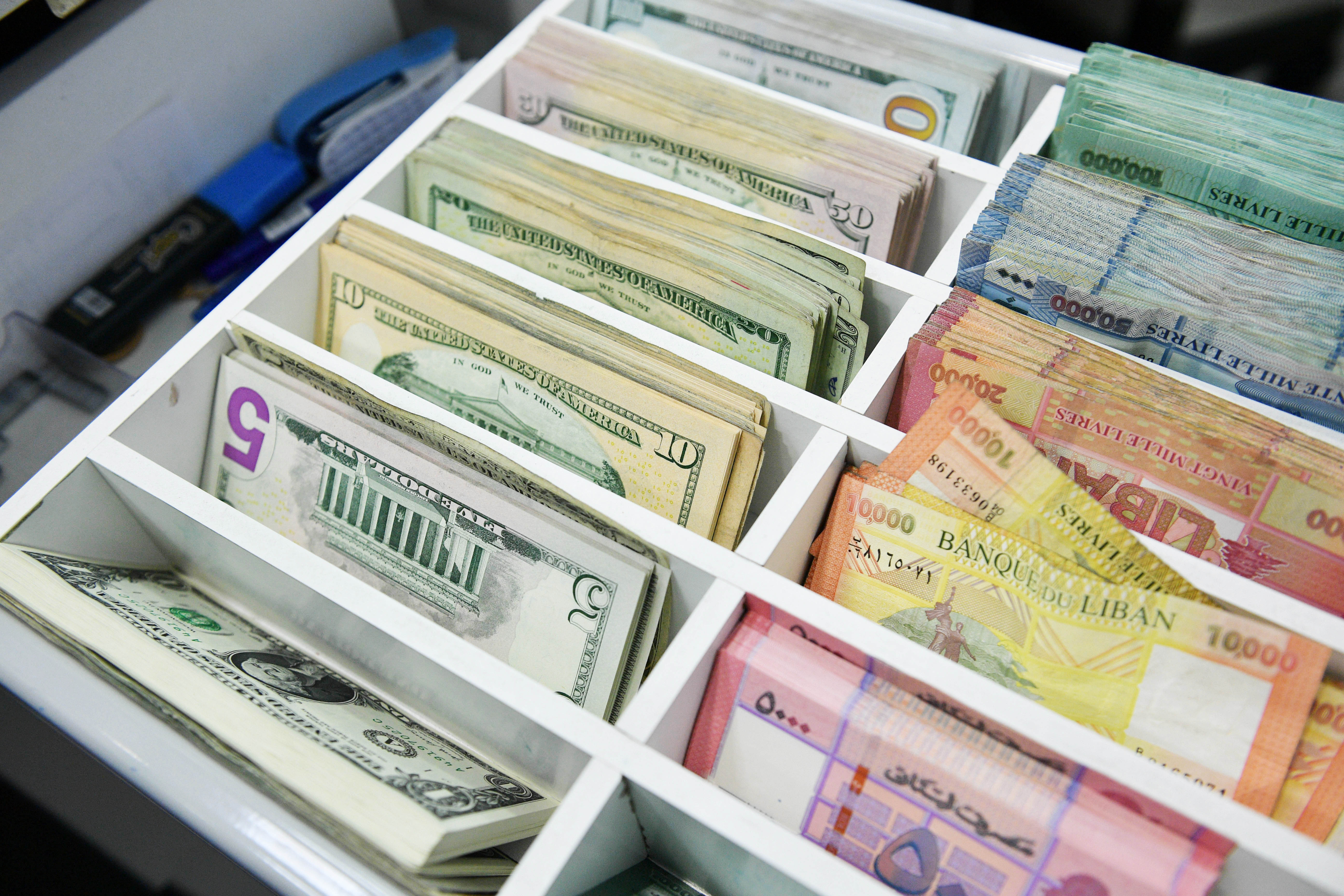
The Lebanese are currently subjected to depreciation, with the ever-rising prices of goods and services, self-imposed limits on withdrawals by banks at a rate of LBP 3,900 to the dollar, and a local currency estimated at LBP 9,600 to the dollar as at March 1st 2021. Rampant inflation was estimated at 84.8 percent for the full year 2020 according to the Central Statistics Department, with end-of-year inflation from December 2019 to December 2020 estimated at 14.8 percent. Additionally, any release of controls for withdrawals in LBP would result in added inflation due to an expansion of the monetary mass and a rush to buy USD currency at black market rates. The depreciation of the currency reflects, in part, a loss of confidence in the national currency, and a flight to safer cash currencies on the black market. In light of this situation, some financial experts have recommended the establishment of a currency board (CB) in Lebanon to help tackle inflation.

Broadly defined, a currency board is an authority in charge of managing the money supply and the exchange rate of a country’s currency, in lieu of the central bank. Its tasks are set by law, and no printing of the currency can occur without it being 100 percent backed by another foreign currency, in most cases the US dollar as the worldwide preferred medium of exchange. Unlike a typical central bank, it is not a last-resort lender and is not legally allowed to print currency and lend to the government under any circumstance.

Under a CB management, the exchange rate and the monetary level are determined independently by the board, who is ruled by law and, due to its direct task, is less likely to be under political pressure. CBs often have a 100 percent reserve requirement, therefore a specific unit of foreign currency must back every unit of currency printed. For someone to obtain a fixed amount of LBP, they must ask their bank to convert dollars at the CB. Thanks to a stable foreign-currency-backed fixed exchange rate, CBs allow fighting inflation more effectively.

Overall, more than 70 countries have adopted currency boards, most notably Hong Kong, Estonia, Bulgaria, and Denmark amongst others. In the case of Estonia, the institution of a currency board in 1992 helped end hyperinflation, with monthly inflation falling from 80 percent in early 1992 to only 3.3 percent in December of the same year.

Determining a fixed exchange rate

The question is: How would this be implemented? In an exclusive interview for executive Magazine, Professor Steve Hanke, the main proponent of the CB for Lebanon, recommended freezing all printing of Lebanese currency for a month, in order to lower the supply of LBP, which would drive down the price of the USD in the black market, a recommendation echoed by Dr. Patrick Mardini, head of the Lebanese Institute for Market Studies. In this situation, market forces would determine the rate.

This new fixed rate, unlike a currency peg, would not rely on the trust and credibility of a central bank in managing the money supply, as it would be 100 percent backed by reserves. “Developing countries don’t have the proper institutional framework to protect the Central Bank from government interference,” says Dr. Mardini. According to him, in a CB system, the currency in circulation grows in the presence of capital inflows, and if a person wishes to send their money abroad they would have to give their LBP to the CB, which would take them out of circulation, in exchange for providing an amount of USD in reserves. Such a CB would only require a law to be implemented to modify the Lebanese Code of Money and Credit, noting that such model-laws do exist, including one that has been drafted by Professor Hanke.

This is in contrast to the opinion of Jean Riachi, Chairman and Chief Executive Officer at FFA Private Bank. In his opinion, the problem with the peg is its inability to adjust to external conditions, deeming the fixed rate of the CB as similar to that of the dollar peg at LBP 1,500. “It’s just another peg, which has cost the Lebanese economy a lot,” he says. Indeed, fluctuations of currencies permit adjustments to changing economic conditions: for example, deficits in trade balances result in devaluations in order to limit imports and favor exports of goods and services. Riachi believes that “we were pegged when we needed more flexibility to export and produce,” as the LBP peg to the dollar was deemed to be overvalued and therefore made Lebanon expensive, causing it to lose any competitive edge.

Impact on inflation

The implementation of CBs has been deemed by many economists a success in fighting inflation. Imposing a 100 percent foreign reserves guarantee for local currencies succeeded in ending hyperinflation entirely in some countries: in 1997, Bulgaria’s CB ended hyperinflation in just one month.

Nevertheless, this requires effective governance and trust in institutions. “You need very strong governance to sustain it; you need fiscal discipline,” says Riachi. On the other hand, the opinion of economists supporting such an implementation is that the framework, which is backed by law, is enough to support trust in such a system, as the CB would not be allowed to print any amount of local currency if it doesn’t have the equivalent amount in USD in its reserves.The CB would be free from political interference and, for example, would not be allowed to lend the government to finance its budget deficits (this would be done either through taxes or through issuing debt on the financial markets).

In principle, implementing a CB would result in added foreign investments and therefore reserves: currently, the Central Bank of Lebanon (BDL) holds around USD 17.5 million in reserves, while it has around LBP 55 trillion in bank deposits and LBP 30 trillion in currency in circulation. At this level, the foreign currency reserves would serve as an anchor in order to cover such amounts in LBP. Any additional surplus from abroad in USD would allow for an expansion of the monetary base without any inflation, as it would be backed by USD reserves.  It is worth noting that implementing a CB in Bulgaria quadrupled foreign reserves in a matter of 12 months between 1997 and 1998 thanks to an influx of foreign investments (wishing to take advantage of arbitrage possibilities, which will be addressed below).

As a consequence, inflation levels would drop dramatically. It should be noted though, that in the case of Bulgaria, Estonia, and others in the former Soviet bloc, the CB has been adopted in the aftermath of Soviet management. In the case of Lebanon, this would occur after a long tradition of laissez-faire economics that had been aggravated by corruption and infective governance: while for the former soviet republic countries, the adoption of a CB was perceived internationally as a sign of willingness to engage in reforms, in the case of Lebanon it could appear as one last attempt to stall the necessary reforms by solving one issue only, which is inflation; it is therefore less certain that this would result in additional trust in Lebanon’s economic governance.

Impact on public finances

A CB is forbidden by law to loan the central government and/or to cover its deficits by printing money. Nevertheless, outflows of USD dollars would result in a lesser amount of LBP and therefore might impact the public sector: the government would have to revise its budget, which would result in a contraction of the economy. According to Riachi, the timing is wrong, “I don’t think we can have a balanced budget on the short to medium term”. Indeed, the current state of the economic crisis in Lebanon, with GDP projected to contract heavily, makes it difficult for the Lebanese government to balance its budget. On the other hand, should an inflow of foreign capital occur, the money supply in Lebanon would expend and therefore allow for the government to meet its expenditures as government revenue from taxes will increase due to inflows allowing for more bank lending and would therefore stimulate the economy. The questions remain nevertheless: why would this currency stability result in massive inflows of foreign capital?

Impact on foreign investments: arbitrage solution

The idea of arbitrage entails that a fixed rate in Lebanon would result in lower interest rates, in principle, as the currency would be interchangeable at the CB with US dollars. Nevertheless, the LBP interest rate would still be higher than its USD counterpart as interest rates incorporate political risk, sovereign debt risk, and others, which are higher than those of the United States. Therefore, due to low interest rates offered on the USD in international markets, holders of dollars would want to deposit money in LBP to take advantage of higher interest rates. Unlike the practices of the last years in Lebanon, the LBP would be fully backed by the dollar.

According to Mardini, USD interest rates would be lower than in past years but higher than overseas ones, therefore investors would be interested in taking advantage of this by depositing their dollars in Lebanon and exchanging them for LBPs.

Because of this, banks would be able to lend money in LBP and this would jumpstart the private sector thanks to lower rates and more liquidity in the Lebanese economy. Still, political factors in Lebanon, including geopolitical risk and lack of reforms, and limited trust in political institutions, could dissuade some from investing their money. According to Riachi, “reality bites when it comes to confidence,” as confidence remains the main motor to attract long-term investments, and the main issue with the peg remains its lack of flexibility in adjusting to shocks, “being solid is an illusion, you need flexibility,” he says. In the case of Lebanon, a floating currency would adjust to economic shocks, whereas a peg would not).

Indeed, though the fixed rate thanks to a CB would be lower than the current official LBP 1,500 to the dollar rate, and could therefore stimulate exports, it would still remain fixed and therefore would not change according to laws of supply and demand. In addition, lack of trust in the Lebanese economic sector, especially after a year of inaction on the part of the political class, could result in outflows, which would impact the interest rates and result in higher rates, therefore there could be little impact on resuming lending. Indeed, were the CB able to attract capital at a lower rate than typical Lebanese rates, the private sector would profit from a boost thanks to lower lending rates. If interest rates were to remain the same, additional inflows would have little impact on re-boosting the private sector.

Impact on the private sector

Should a CB be successfully implemented, lower rates than the typical rates of 8 to 9 percent on USD lending would be lowered, and this would in principle serve as a boost to the private sector. Business executives in Lebanon have long complained that high interest rates have had a negative impact on economic lending as it has discouraged investments due to the inability of businesses to make returns that would be high enough for them to service their debt. Lower interest would then permit more private sector lending.

In addition, this would result in banks getting back to diversifying their lending portfolio more in favor of private enterprise and allow for returns. The trade deficit would therefore be reduced as a fixed rate would be lower than the current peg and therefore favor exports. On the other hand, should this result in outflows from Lebanese willing to exchange their LBP notes to dollars, a consequence would be more pressure on the governmental budget due to difficulties in levying taxes: less activity would result in less profit and therefore less tax revenue for the state.

A limited solution?

Overall, the implementation of a CB would, in theory, help end the threat of hyperinflation in Lebanon, and attract foreign capital that would allow banks to lend to the productive economy. This would be accompanied by larger investments, and with a rate lower than LBP 1,500 to the dollar, promote Lebanese exports.

International investors would, again in theory, also be interested in acquisitions due to a productive and now cheaper (due to the devaluation) workforce. But this solution would seem in principle limited to the extent that it would solve hyperinflation alone, and reforms would still need to be implemented to help restructure the sovereign debt and the banking sector, and also help improve transparency and limit corruption. After years of eroding the confidence of the populace in their government and political class, Lebanon, indeed, does not suffer only from enormous inflation, but also from public deficits, an ever-growing public sector resulting in more currency printing and inflation, budget deficits, perception of extreme corruption, and a dearth of trust in the state.

With regards to the banking sector losses, an inflow of foreign capital would allow banks, in the long run, to lend again in LBP and therefore to stimulate the economy and make profits again. This would in theory help reduce the losses of the banking sector, though Mardini believes that it is only a stepping-stone that would provide stability, not excluding other necessary reforms. “Bankers can become bankers again,” says Mardini, “that’s how the CB solved the banking crisis in Bulgaria.” In the case of Bulgaria, banks were deemed insolvent but were able to repay their losses once they started making money.

Though controversial, the issue of instituting a CB in Lebanon is gaining ground. For example, Member of Parliament Paula Yacoubian has submitted, in June of 2020, a draft-law in parliament that would allow for the establishment of a CB.

Still, it is not deemed to be a miracle solution that would rid Lebanon of its economic difficulties. Even if it were successfully implemented and hyperinflation thus avoided, and with investment inflows pouring in, Lebanon’s government will still have to institute the necessary reforms that have been a key demand of civil society groups, non-governmental organizations, and international financial institutions. Lebanon still suffers from a lack of trust in institutions, lack of transparency in governance, and massive corruption.

The implementation of a CB in Lebanon could occur, but overall, there is doubt as to its attractiveness due to the lack of effective and transparent governance in Lebanese institutions, which may deter foreign investments even if the CB’s institutional framework could in principle be effective and transparent. Another risk is the implementation of a CB in name only as was the case in Argentina from 1991 to 2002: though called a CB, it had the authority to use its reserves in a discretionary manner and to lend the state, which resulted in an economic crisis and the suspension of the convertibility of Pesos to USD.

Overall, Lebanon appears short on viable alternatives, given that already much time has been wasted where the exchange rate problem and inflation pressures have been allowed to fester. A floating peg, whereby the Central Bank or the treasury reassesses the value of the peg periodically and then changes the peg rate accordingly, has also been on the table, though it remains difficult to assess whether this will require a hike in interest rates in order to stabilize it . Digitization of the dollars held in banks has been discussed but has been deemed a limited option, as it would not be a freely transferable currency. Reforms would take time and there is a sense of urgency with regards to tackling Lebanon’s woes, which call for solutions that would be implemented quickly. The final lacking element is simple: trust, and whether or not a CB would help restore trust from a monetary perspective is still subject to debate.


March 2, 2021 0 comments
0 FacebookTwitterPinterestEmail
Photo Essay

Protests against recusal of Beirut port blast judge

by Greg Demarque February 19, 2021
written by Greg Demarque

Parents and relatives of the victims of the Beirut port blast staged a spontaneous protest near the Courts of Justice in Adlieh in the evening of February 18th 2020 to express their anger and frustration at the recusal of Judge Fadi Sawan from the investigation earlier in the day, a decision condemned by both human rights activists who denounced perceived political interference in the judiciary process and the parents of the victims who still cry out for justice more than 6 months after the blast.
The recusal of Judge Sawan is expected to further delay the investigation to uncover the parties responsible for the presence of the ammonium nitrate inside the port and the explosion that left more than 200 dead, 6,000 wounded and thousands homeless.

[rl_gallery id=”27263″]
February 19, 2021 0 comments
0 FacebookTwitterPinterestEmail
Photo Essay

Vaccination campaign finally launched

by Greg Demarque February 14, 2021
written by Greg Demarque

On Sunday, February 14th 2021, began the pre-vaccination campaign organized by the Lebanese Ministry of Health for Lebanese medical personnel at the Rafic Hariri University Hospital, Saint Georges Hospital University Medical Center, and the American University of Beirut Medical Center (AUBMC), to be followed on Monday 15th by a general vaccination campaign for Lebanese citizens aged 65 years and more that have registered for the vaccine on the website of the Ministry of Health.

[rl_gallery id=”27236″]
February 14, 2021 0 comments
0 FacebookTwitterPinterestEmail
Photo Essay

The Funeral of Lokman Slim

by Greg Demarque February 11, 2021
written by Greg Demarque

In the midst of Beirut’s beleaguered southern suburbs, statements for logic and reason, as well as empathis condemnations of terror and weapons, were solidified on this February 11, as clerics and dignitaries from Lebanon’s religious communities along with several foreign ambassadors joined with activists and family in the funeral of slain Lebanese filmmaker and fearless journalist Lokman Slim

[rl_gallery id=”27228″]
February 11, 2021 0 comments
0 FacebookTwitterPinterestEmail
Photo Essay

Civil unrest in Tripoli

by Greg Demarque February 1, 2021
written by Greg Demarque

Tripoli protests continued to be intense, on January 31, 2021, in Al Nour square. It started with the arrival of demonstrators from Beirut, and ended up with armored vehicles and the Lebanese army soldiers’ pursuit of a group of young demonstrators in the streets of Tripoli.

[rl_gallery id=”27231″]
February 1, 2021 0 comments
1 FacebookTwitterPinterestEmail
  • 1
  • …
  • 37
  • 38
  • 39
  • 40
  • 41
  • …
  • 696

Latest Cover

About us

Since its first edition emerged on the newsstands in 1999, Executive Magazine has been dedicated to providing its readers with the most up-to-date local and regional business news. Executive is a monthly business magazine that offers readers in-depth analyses on the Lebanese world of commerce, covering all the major sectors – from banking, finance, and insurance to technology, tourism, hospitality, media, and retail.

  • Donate
  • Our Purpose
  • Contact Us

Sign up for our newsletter

    • Facebook
    • Twitter
    • Instagram
    • Linkedin
    • Youtube
    Executive Magazine
    • ISSUES
      • Current Issue
      • Past issues
    • BUSINESS
    • ECONOMICS & POLICY
    • OPINION
    • SPECIAL REPORTS
    • EXECUTIVE TALKS
    • MOVEMENTS
      • Change the image
      • Cannes lions
      • Transparency & accountability
      • ECONOMIC ROADMAP
      • Say No to Corruption
      • The Lebanon media development initiative
      • LPSN Policy Asks
      • Advocating the preservation of deposits
    • JOIN US
      • Join our movement
      • Attend our events
      • Receive updates
      • Connect with us
    • DONATE