• Donate
  • Our Purpose
  • Contact Us
Executive Magazine
  • ISSUES
    • Current Issue
    • Past issues
  • BUSINESS
  • ECONOMICS & POLICY
  • OPINION
  • SPECIAL REPORTS
  • EXECUTIVE TALKS
  • MOVEMENTS
    • Change the image
    • Cannes lions
    • Transparency & accountability
    • ECONOMIC ROADMAP
    • Say No to Corruption
    • The Lebanon media development initiative
    • LPSN Policy Asks
    • Advocating the preservation of deposits
  • JOIN US
    • Join our movement
    • Attend our events
    • Receive updates
    • Connect with us
  • DONATE
Society

Investing in the name

by Emma Cosgrove December 3, 2010
written by Emma Cosgrove


A company has a brand whether they want it or not” is a popular adage for explaining the importance of branding as a discipline. And, according to a recent survey conducted by local branding firm Brandcell entitled ‘The State of Brand Management in Lebanon,’ it is one that may need to be more explicitly communicated to Lebanese businesses, organizations and institutions.

“In Lebanon [branding] has become, by force, a need. But it hasn’t been easy and still it’s not easy. Branding is still largely misunderstood and unappreciated and very vague to the client,” said Abdo Saleh, executive design director at Brand Central. Brandcell’s survey polled 50 professionals — from marketing managers to chief executive officers to communications and public relations (PR) managers — to find out if they truly have a grasp of the illusive concept of branding and if it is properly integrated in both the perception and operations of their institutions.

City Mall - Lebanon

The study found that “although Lebanese marketers believe in the importance of branding and its influence on customer choice, they lack the full knowledge related to a brand’s economic value creation and to a brand’s relation to business strategy.”

Joumana Rizk, owner and managing director of Mirros Communication and Media Services, said that she was in the public relations (PR) game for over 10 years before she began recommending that her clients work with her company in addition to branding firms in order to create the best solutions and strategies.

“When we want to deal with PR or work on PR and communications we cannot take just one part and forget the other parts,” said Rizk. “PR has to be incorporated in a bigger strategy, which includes branding and communications and marketing. So of course when I discuss PR and communications with my clients, it has to be incorporated in a branding approach.”

Taanayel Dairy Brand - Lebanon 

In-house

There is only so much an outside PR professional or branding firm can do to make sure that a branding strategy permeates every level of an organization; something branding professionals insist is essential to ensuring the “authenticity” of a branding strategy. Though it is the job of the branding consultant to make sure that the brand identity and strategy chosen is organic to the institution, internal communication and the spreading of a branding philosophy throughout an organization ensure that the strategy is kept consistent and executed on every possible level.

“Its not a one way thing — it’s a chain. Everybody has to be involved,” said Rizk.

Only 31 percent of marketers in Lebanon think that their company’s employees have a good understanding of the core ideas of the brand identity, even though 73 percent of marketers survey their employees regarding their understanding of the brand, according to the Brandcell survey.

Branding Survey: Beirut, Lebanon

This indicates that 42 percent of marketers are aware that their branding strategies are not penetrating through the ranks, but have so far been unsuccessful in remedying the situation. 

The study notes that Lebanese marketers “need to devote more branding efforts especially to engage employees, have a more supportive management and have brands aligned with business strategy and operations.”

However, Saleh says that this disconnect is a common occurrence in organizations in highly developed markets as well.

“To be fair [this] can be found in developed markets — you would be surprised,” he said. “In very sophisticated markets and with very sophisticated companies you will still find those faults of understanding. That’s quite normal because it’s a very tricky discipline.”

Going into the metrics

One way to convince executives and even staff of the importance of an intimate knowledge of their own brand is by presenting it in terms of dollars and cents.

But this is yet another “tricky” task. While 80 percent of the marketers claim to measure the financial value of their brands and the return on brand equity generated by their efforts, only 40 percent of marketers claim to be aware of how brands create financial value for their organizations.

Supporting a theme of overconfidence, this paradox suggests that 40 percent of marketers are attempting to measure their brand’s financial value without truly grasping how this value is generated. This fact contributes to a widely acknowledged lack of standardization in return on brand equity and brand value metrics.

Branding survey cont...: Beirut, Lebanon

“Return on investment in branding is as elusive as the search in alchemy for the elixir of life,” said Saleh. “Every branding specialist worldwide and every marketing guru claims that they have formulated the right approach on how to financially prove the success or failure of branding… but you won’t find one standard today that most people are adopting. Everyone has their own and sometimes they are protected by a proprietary system claiming that they have the only answer.”

Yet another curious contradiction among marketers is their rock solid belief that their tactics are effective. Even though 92 percent of marketers say their branding is effective in influencing the choices customers make, only 71 percent of them claim to survey their customers about their brands. This leaves 21 percent of marketers believing that their efforts are working without bothering to be sure.

It is an issue of consistency and follow-through, which are the main roadblocks to truly effective branding and a particular problem in the local market. “Lebanese people are very good at creating concepts and ideas but they don’t sustain them properly. Our main problem is consistency,” said Albert Thoumy, head of communication strategy and development for Crepeaway. “We have good brands and good communication skills but we do not question ourselves enough to do something different, to apply high quality standards and to innovate,” he said in conjunction with Brandcell’s survey.

Important aspects of branding according to brand managers: Beirut, Lebanon

The evidence shows that this is not an industry at a crossroads, but simply a phase in a progression toward a mature branding market, though it may frustrate the experts waiting for their clients to catch up.

December 3, 2010 0 comments
0 FacebookTwitterPinterestEmail
Real Estate

Executive insight Sayfco Holding

by Chahe Yerevanian December 3, 2010
written by Chahe Yerevanian


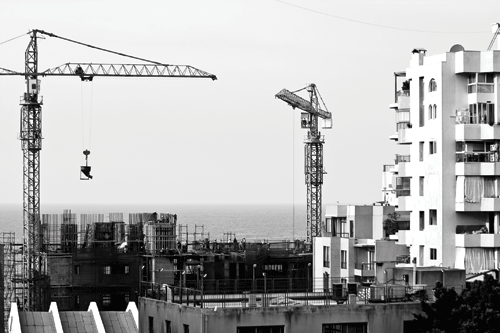
In light of the strong price performance of the Lebanese real estate market during the last three years, a popular topic of discussion across the country has been whether we are in the middle of a market bubble. Are prices destined to fall, or is there truth to the old Lebanese proverb that land in Lebanon is as precious as gold?

As with any product or service, real estate prices will always be governed by the laws of supply and demand. In addition to increasing local demand, the real estate market in Lebanon also attracts buyers from the Lebanese expatriate community (which some estimates peg at as much as 15 million), and from wealthy Arabs. In a region mostly dominated by desert plains, Lebanon’s temperate climate, lively nightlife and diverse geography stand out like an oasis in the sands.

However, in the first nine months of 2010, sales to foreigners actually dropped by 0.7 percent relative to the same period last year, according to Bank Audi.

Strong end-user demand from both residents and non-residents, coupled with a limited land area, has driven increases in real estate valuations. The average value of property sold in Lebanon increased 28 percent in the first nine months. Some areas of Beirut, such as Downtown, Verdun, and Achrafieh, are especially sought-out but also have relatively low land availability; consequently, these areas have experienced the highest increases in value.

Spreading out

Given the sharp increase in price, which starts around $6,000 per square meter in downtown, demand has shifted to the suburbs of Beirut (such as the Metn) where prices are comparatively more affordable.

Again, once fair value is reached in these suburbs, the trend and demand will shift further out into the outer suburbs (Keserwan/Jbeil from one side and Aley/Chouf from the other side). As in the development of any country, high prices in the city center will displace local demand farther out to the periphery of the city. A crucial factor for this continued growth is the development of an adequate transportation infrastructure for residents to easily commute from these suburbs to their area of employment.

Finally, from a financial perspective, the key ingredient in past real estate bubbles around the world — debt-fueled speculation — is for the most part missing in the local market due largely to wise governance from Banque du Liban, Lebanon’s Central Bank. Given the regulatory limits on debt extended by banks for real estate construction, most major developers fund a majority of a project’s cost with equity and, to a lesser extent, cash proceeds from the pre-sales of apartments. Even credit facilities to the buyers of a residence are typically only extended if a substantial percentage of equity has been injected into the transaction.

These positive factors do not mean that prices will forever increase at double-digit rates in all areas, or that a slowdown in sales activity will never occur. Even with positive market dynamics, the type of supply must follow changes in buyer requirements or desires. For example, as real estate prices rise in Beirut, demand is increasingly shifting to smaller apartments (below 200-250 square meters), the typical market demand of major European cities. Periodically, political or security fears may also sometimes cause a temporary drop in sales volume. However, the long-term fundamentals of the real estate sector in Lebanon are sound. 

Given its distinctive cultural heritage, geography and the resilience of its people, there will always be strong demand for real estate in Lebanon from residents and non-residents alike. This demand, coupled with a relative scarcity of supply, will support prices in the long run. Monetary authorities in the United States and Europe may have the power to run their printing presses and to create dollars and euros at will, as they have recently shown, but God stopped creating land in Lebanon a long time ago.

December 3, 2010 0 comments
0 FacebookTwitterPinterestEmail
Comment

Betting on the Blue Line

by Nicholas Blanford December 3, 2010
written by Nicholas Blanford

You have to hand it to Khalil Abdullah, who must be the most optimistic businessman in Lebanon. He is currently putting the finishing touches on an extravagant Afro-Arabic style tourist resort on the bank of the Hasbani River, less than a mile upstream from the border with Israel.

This section of the Hasbani River cuts a narrow gorge through a grassy plain at the foot of the Shebaa Farms hills, flanked by dense oleander and eucalyptus trees. The Blue Line, the United Nations-demarcated boundary that corresponds to Lebanon’s southern border runs up the middle of the Hasbani at this point. If visitors to Abdullah’s resort swim to the far bank of the river, they will have entered Israeli-occupied Syria and risk being shot by Israeli troops. Indeed, when Abdullah began work on his project, Israeli troops would turn up on the cliff on the opposite bank and peer at him through binoculars.

Israel’s unease over Abdullah’s activities was probably due to concerns he was planning to pump water from the river. The Hasbani is one of three tributaries of the Jordan River that flows into the Sea of Galilee, Israel’s largest source of fresh water. Previous small-scale pumping schemes by the Lebanese government and local farmers have triggered uproars and even threats of war.

Furthermore, this section of the border is notoriously porous and a favorite location for cross-border smuggling, particularly narcotics. In 2007, two drug smugglers wearing Spanish United Nations Interim Force In Lebanon (UNIFIL) uniforms attempted to enter Israeli-occupied Syria near Abdullah’s resort by crawling through a storm drain. Unfortunately for them, Israeli troops had staked out one end and shot one of the two smugglers as he emerged.

The Alawite village of Ghajar, lying a mile north of Abdullah’s resort, has long been a conduit for cross-border smuggling. The Blue Line splits Ghajar so that the upper two-thirds fall inside Lebanon and the remainder in Israeli-occupied Syria. After Israel’s troop withdrawal from South Lebanon in 2000, Hezbollah set up a position in the northern part of the village from where they ran an intelligence operation inside Israel. Israeli troops occupied the area during the 2006 war and have remained there ever since to ensure Hezbollah cannot return.

In November, the Israeli government finally agreed to a UN-brokered compromise in which it will cease its military presence in northern Ghajar in exchange for UNIFIL and the Lebanese army maintaining a tight security cordon to prevent anyone from accessing the village from the northern side. There was an element of bloody-mindedness in Israel’s procrastination over Ghajar. The village is sealed off on the southern side anyway, with the only available access through a checkpoint manned by Israeli soldiers. Given the presence of the Lebanese army in the border district and UNIFIL’s cordon of fences, patrols and watchtowers, it is unlikely, if not impossible, for Hezbollah to return to the village as they did before 2006. 

However, there was a legal complication in that the residents, although Syrian nationals, have held Israeli citizenship since 1981. That meant that Israeli citizens technically would be living on Lebanese territory.

What would happen if one of them fell sick and needed an ambulance to take them to hospital, or if repairs needed to be conducted on a house in northern Ghajar? Could an Israeli doctor or electrician cross the Blue Line into Lebanon? The UN, Israel and, grudgingly, it seems, Lebanon, have agreed on a sensible compromise to return the situation to pre-2006 so that the residents can lead normal lives.  Ultimately, the curious case of Ghajar can only be fully resolved when the Israelis and Syrians strike a peace deal and Israel withdraws from Ghajar, the adjacent Shebaa Farms and the Golan Heights. However, Israel’s decision to finally adopt long-standing legislation mandating a national referendum to decide whether or not to end the occupation of Syrian territory and East Jerusalem has dimmed hopes of a resumption of peace talks and increased chances of war.

But the ever-optimistic Abdullah has an answer for that. A later phase of his project will see the construction of a 60-room hotel on the cliffs overlooking the Hasbani gorge and his resort: “Maybe they can hold future peace talks there. After all, it will be at the junction of the Lebanon, Syrian and Israeli borders.”

NICHOLAS BLANDFORD is the Beirut-based

correspondent for The Christian Science

Monitor and The Times of London


December 3, 2010 0 comments
0 FacebookTwitterPinterestEmail
Real Estate

Q&A Bassim Halaby

by Rayya Salem December 3, 2010
written by Rayya Salem


This year saw the launching of Beirut Terraces in Minet el Hosn — developer Benchmark’s second high-end project in the capital, with one of the highest prices per square meter in Beirut starting at $7,200. With more than $1.4 billion invested in residential projects, both in Lebanon and the region, the four-year-old firm is one of the key players in Beirut’s luxury property market. Executive sat down with Chairman and Chief Executive Officer Bassim Halaby to chat about the current and future state of Beirut’s property market, with a special focus on the Beirut Central District (BCD).

E Were the rises in the price of property in Beirut over the last two years expected or even healthy?

Since the 2006 to 2008 period, the spike in prices made Lebanon seem brighter than it was. It’s the gap between the retraction in the world economy with the growth of Lebanon’s property market that made us look very good. But we all knew it was just a one or two-year phenomenon. Now, 2010 to 2012 is a time where solvency is expected to take place in the market. Most stock of housing should be absorbed by the market. If it [isn’t], it will take one additional year. Developers work on a pre-sale basis, so my sense is that in 2012 the market will stop witnessing mushrooming of new projects and there will be a major slowdown in the construction industry. Sell-offs will not happen at rock-bottom prices, but at good value for money.

E What about prices outside of Beirut?

The price of land doubled in the last five years in BCD and more than tripled around Beirut. So the BCD was already leading [the market] and hit a ceiling quickly. Beirut [areas outside of Solidere] has grown irrationally to the extent that prices around Beirut are very comparable to Solidere, without having the level of accessibility, the level of organized environment, control and zoning. It’s a fixed, regulated, predictable neighborhood. This is why people buy in BCD, because they know what they will view from their office or home. I would say prices have reached stabilization— a normalization of the market.

E Is infrastructure improving to be able to absorb the increase in construction?

Beirut infrastructure is a disaster in progress. The BCD has been planned on the basis of density, size of roads and anticipated traffic. But the moment the spillover of traffic of [greater] Beirut goes into BCD on the port roads, the BCD closes down.

E We have seen more demand for smaller apartments. How are developers responding?

Beirut’s property market is not homogenous; there are 17 micro markets each behaving differently. Small apartments — 90-150 square-meter (sqm) — are not a new trend in some of these markets, particularly on the outskirts of the city, but would definitely be a novelty in BCD.

People have been buying small apartments, crowding themselves into spaces they believe they can live in and then closing off balconies with glass, meaning that the indoor space was not enough for them. That’s why one of the concepts of Beirut Terraces was to create an indoor/outdoor living space. But in general, the smaller the apartments, the more a developer has to provide costly parking space. For a 300 sqm apartment I have to provide two spaces. If I build three 100 sqm apartments, I have to provide three. Outside Beirut, the municipal law is not as strict on amenities and services provided.

E From your building experience in the BCD, what are buyers’ preferences shifting toward?

Having tried Wadi Hills, where people wanted townhomes with gardens, we came to the conclusion that we could do the same concept of townhomes, yet stacked vertically. They feel private yet close to each other, like in a village.

E  More developers are claiming to build “green” projects. Are buyers more aware of environmentally-friendly construction?

Today, “green” is not a selling item. LEED certification [the United States Green Building Council certification system] is not a valid draw for a buyer. But buyers are becoming more and more concerned about long-term running costs of their unit. The reason to buy is still location, size and quality of life offered.

E What draws investors to Lebanon in spite of the political instability?

Politics, security and stability have never been a reason to stop Lebanese from investing in real estate. The market is led by at least 66 percent demand from [local] Lebanese, 20 percent from Lebanese expatriates and 14 percent from non-Lebanese demand. So Lebanese are always interested in having an apartment for themselves or their kids.

E Have developers’ profit margins changed over the last few years?

Today we don’t have a project in Beirut that exceeds $130 to $150 million in [construction] costs, unless it’s something like City Mall or a commercial project. A project value of $500 million [such as Beirut Terraces] means you’re talking about $150 to $170 million for the cost of land, $150 million on construction cost and the rest are revenues that you have to pay taxes on, so it’s not [all] profits. Developers are operating on profit costs ranging between 10 to 30 percent.

E How will the BCD area change in the near future?

The landfill area [reclaimed land on the seafront adjacent to Beirut International Exhibition and Leisure (BIEL) center] consists of available plots in BCD. BIEL is a temporary structure to be replaced by a tower, which might be 200 meters high, which Solidere is planning. Whereas the height of Wadi Hills is 110 meters, the height of towers on landfill plots is going to be around 180 meters.

E  Looking towards 2011 and beyond, what cost issues are developers facing?

Developers do ‘land banking’ and therefore buy land in anticipation of the next project and not because we hedge on whether there is stability or long-term peace. There is always a project in the pipeline. Construction cost fluctuates depending on demand, but it has stabilized due to the financial crisis. China is no longer building by the billions and thus increasing raw material prices. Gulf countries are no longer experiencing high growth potential. So we are working with a normal situation where construction cost is predictable. The value of real estate has normalized.

E What about the recent influx of “nonprofessionals” in the real estate market?

This is an unregulated business and anyone can become a developer. That’s why we saw so many entrants. People think that you can bring the architect and make him the project manager, architect, builder and everything. You [can] bring a contractor who would subcontract everything else. Some people get together, build a project, distribute shares or units among themselves and sell the remainder, which brings in some profits.

The problem is when these same people get into another project, but now they have to sell all of it off to market. Without the right calculations, they build the wrong product for the wrong market. In Beirut, approximately 30 percent of stock has been built with substandard quality and is wrongly priced. The market regulates itself so they will eventually close down their shop.

E Is choosing the right architect for a major project in BCD becoming more important because of the construction boom and subsequent competition?

We want Beirut Terraces to be an award-winning design at the global level. We want to put Beirut on the map of quality of architecture and quality of life and match what Solidere is trying to promote: ‘Beirut as a reborn city.’ By choosing Herzog & de Meuron [architects] we have been able to achieve, despite the market’s soft tendencies today, great interest and a demand that is resilient to market softness.

E What is the key ingredient that makes Beirut real estate vigorous?

Beirut has shown that cities are based on culture and not only services and economies. When I was doing my thesis back in the 1980s, I looked at cultural activities like jazz festivals that re-invigorated the economies of New York, Boston and cities in Canada. Beirut has all the ingredients of cultural activities, beyond the nightlife, beyond the food, beyond everything. The biggest ingredient is the people… this culture transcends to every single Lebanese, so big developers today are more or less targeting a diaspora that has the taste of globalization but has the real know-how of the local culture.

December 3, 2010 0 comments
0 FacebookTwitterPinterestEmail
Finance

Sounding the alarm

by Emma Cosgrove December 1, 2010
written by Emma Cosgrove


Common sense is the currency of rational minds — in this respect Dubai may be short on change. On November 25, Dubai World, the wholly owned subsidiary of the Dubai government, announced that it would request a 6-month standstill on all payments and debt servicing of some $11 billion due to creditors in December — effectively giving notice that the further $49 billion the company has outstanding may also be beyond its means.

The announcement came after the markets closed for the four-day Eid al Adha holiday, during which time the company maintained complete silence while the news shook the financial world, prompting panicked investors to line up at the doors of Gulf markets to dump exposed portfolios when bourses reopened on November 30. As they waited in the Gulf, financial markets from London to Beijing shed share value in fear of their own exposure.

Dubai and Abu Dhabi markets dropped instantly at the opening bell, followed closely by other regional markets. The next day, Dubai World released a statement confirming it was in talks with United Arab Emirates banks to restructure $26 billion in debt. The company said restructuring could consist of “deleveraging options,” “asset sales,” and “formulation of restructuring proposals.”

“We would expect a decision to come out of [the discussions]  on what assets underlay the liabilities, and what the plan is for liquidizing those assets so that bondholders get some partial repayments,” said Raj Madha, director of equity research at EFG-Hermes.

Dubai has hedged its future on booming demand to fill some of the biggest malls in the world

As executives and Dubai authorities prioritize Dubai World’s obligations behind locked doors, the rest of the financial world can do nothing but wait and watch the markets.

The markets react

By the middle of November 2009, the financial world seemed optimistic — and with some justification. The Morgan Stanley Capital International (MSCI) index had recovered 48.9 percent of losses incurred during the downturn, while the MSCI Emerging Markets index had fared even better, recovering 58.13 percent. The MSCI Arabian Markets index — Gulf Cooperation Council, Egypt, Jordan, Morocco, Tunisia and Lebanon — also followed suit, albeit with a little less vigor, recovering 30.89 percent of their losses.

After the announcement that Dubai World could effectively not pay its debt on time, that recovery quickly went into regression. In just two days of trading the Dubai Financial Market (DFM) dropped 12.5 percent and the Abu Dhabi Stock Exchange fell by 11.6 percent. Dubai’s indices for real estate, as well as investment and finance, saw some of the worse losses, down 18.1 percent and 15.5 percent respectively.

Question marks hang over the prospects of Dubai
</p>
									            </div>
        </div>

		            <div class=

December 1, 2010 0 comments
0 FacebookTwitterPinterestEmail
Comment

2010: year of the food fight

by Executive Staff December 1, 2010
written by Executive Staff


</p>
									            </div>
        </div>

		            <div class=

December 1, 2010 0 comments
0 FacebookTwitterPinterestEmail
Finance

The vocabulary of the recovery – Recurring profitability

by Emma Cosgrove December 1, 2010
written by Emma Cosgrove

Recurring profitability

The repeated act of earning more than is spent.

“Banks have been hit by loan losses as well as investment losses due to the financial crisis. Recovering from the crisis effectively means returning to stable profitability,” said Moody analyst John Tofarides when asked what indicators are the most important to watch.

GCC Banking universe 2010 profit growth by region

Profitability is perhaps the most obvious indicator, but can also be the most misleading. Banks in the UAE, for example, saw a healthier first quarter of 2010 than second quarter, due mainly to an edict from the Central Bank to stop provisions for the first quarter. When a let up of bad loans did not materialize, they then had go into provisioning overdrive, which is why most saw smaller profits growth in the second quarter of 2010 than the first. Aggregate profits of the entire GCC banking sector declined 5 percent year-on-year at the end of June, and more tellingly, 10 percent quarter-on-quarter, according to Global Investment House, reversing the upward blip if the first three months of 2010.

UAE banks struggled the most in the second quarter and saw profitability shrink a dramatic 42 percent quarter-on-quarter. Omani banks, which saw profit drop 4 percent, were the other losers for the quarter. Banks in Saudi Arabia, Kuwait and Qatar averaged positive profit growths of 1 percent, 6 percent and 7 percent respectively, relative to the first quarter. Saudi Arabia and the UAE, however, were the only two countries with negative profits growth year-on-year.

Standard and Poor’s (S&P) predicts that profitability will be the last indicator to stabilize and return to a steady upward trajectory.

 So, recurring profitability is the sign that the financial fever has broken, the virus killed, and the GCC patient is back on the road to recovery.

Loan growth  

The percentage by which the total value of a bank’s loans changes over a certain period of time.

Healthy lending is the only way for banks to return to normal profitability. They can and are increasing their non-interest income through upping fees and offering more paid services, but if they are to fully recover, lending must resume.

Lending Growth, H1 2010 - GCC countries

But finding viable lending opportunities is challenging when personal as well as corporate finances are under such stress. Lending growth therefore can show not only the health of a bank, but also the health of the financial environment in which it operates. But the vacuum of viable lending is not the only hurdle. In crisis, banks become exceedingly cautious and reluctant to lend.

Steady lending growth will show not only an encouraging financial trend, but a behavioral shift as well, said Peter Baltussen, CEO of Dubai Commercial Bank. “Incremental loan growth will indicate whether banks are indeed willing to reverse their risk-averse approach of the previous years and start a positive credit cycle again, which will have a direct positive impact on the economy,” he said. 

In the first quarter of 2010, lending growth was varied throughout the region with most of the bad news coming from Saudi Arabia, the United Arab Emirates and Kuwait. However, though trends exist, lending practices vary more from bank-to-bank than from country-to-country. So this is an area where banks must be scrutinized individually rather than aggregated from each country (see chart). Though most of the region’s largest banks posted positive lending growth for the first half of 2010, many growth rates were quite low, leading regional experts to be very pessimistic in the their estimates of when lending will return to normal.

Sophia el-Boury, a UAE bank analyst at Shuaa Capital, said: “We’re not very optimistic in terms of lending growth. From now until the end of the year, banks will still be prudent and cautious to lend; the current operating environment is still changing.”

Bad loans

Loans that are not bringing income to the lending institution.

“Bad and doubtful debts and provisions reflect the credit worthiness of a bank’s customers and, sometimes, a region’s overall economy,” said Chief Executive Officer at United Arab Bank Paul Trowbridge of the GCC financial press’s new favorite phrase. “While reasons for potential non-payments can include disputes over supply, delivery or conditions of goods, they in general provide a clear indication on the appearance of financial stress within customer operations.”

According to S&P, non-performing loans have been steadily climbing since 2008, increasing across the GCC from 2.7 percent at the end of that year to 5.4 percent by the end of September 2009. S&P predicted in its February Banking Industry Report Card that NPLs would peak by mid 2010.

Qatar and Saudi Arabia have seen the lowest NPL ratios of all GCC countries. Qatar’s success in avoiding bad debt is no doubt due to the government’s swift action at the onset of the financial crisis, with the government buying up loans to the real estate sector from its banks and injecting capital into the system in October 2008. Kuwait is showing the most NPL struggles due to its banks’ predilection for local investment firms and real estate, which quickly became delinquent upon the onset of the crisis.


“Starting the second half of 2010 and assuming the economic recovery proceeds according to our expectations, we believe that asset quality for Gulf banks will likely bottom out before slowly improving,” stated the S&P report. NPLs are an important indicator not only because they demonstrate the general economic health of borrowers, but also because they forecast the continuing fortification against them, which is a major drag on profits.

Provisioning

The setting aside of funds to allow for existing or expected bad loans.

“The level of provisions has been the single biggest swing factor for regional banks in recent years,” said Dubai Commercial Bank’s Baltussen. Provisions in the GCC as a whole jumped nearly 5 percent year-on-year in the second quarter of 2010. Amid buzzing news of recovery at the beginning of the year, provisioning slowed across the board with the UAE Central Bank actually instructing its institutions to stop provisioning for their biggest threat, Dubai World.

Provisioning, H1 2010 - GCC countries

The instructions seem to have been quickly disregarded, however, as there was a 48 percent quarter-on-quarter increase in provisioning in the GCC in the three months to July 1, with nearly half of the quarter’s provisions taken by UAE banks. Saudi banks came in second regarding provisions, representing 23 percent of the quarter’s total.

Aggregate figures show provisioning by GCC banks peaked in the fourth quarter of 2008 when it became clear that the GCC would not be shielded from the crisis, and again in the fourth quarter of 2009, when the scandal and defaults of Saad Group and Algosaibi & Brothers had come into full effect and Dubai World had faltered. The second quarter of 2010 has seen the third most provisioning of any quarter since the crisis began, reaching nearly $2 billion.

A slowdown in provisioning will be perhaps the first sign of recovery for each country’s banking sector; an event that may be already occurring in Oman, as provisions there have returned to normal levels this quarter, according to Global Investment House.

December 1, 2010 0 comments
0 FacebookTwitterPinterestEmail
Society

Abu Dhabi Grand Prix comes of age

by Nadim Mehanna December 1, 2010
written by Nadim Mehanna

The final round of the 2010 Formula 1 Grand Prix Championship, held at Abu Dhabi’s Yas Marina Circuit, could have been pulled from the back pages of an airport novel: high stakes; skilled opponents; victory snatched from a scandal-scarred incumbent by a gifted young champion, all set against a backdrop that could have been plucked from the imagination of a science fiction writer.

Sebastian Vettel’s flawless race and ultimate victory over Fernando Alonso, after overcoming the Spaniard’s 15-point lead, established Vettel as the youngest champion in F1 history and catapulted the Red Bull team into the limelight. At the same time, as Vettel completed his victory lap and Yas Island’s 100,000 guests let loose during the last of seven nights of festivities, it was clear that their host, Abu Dhabi, had enjoyed a triumph of its own.
The Emirate debuted its state-of-the-art racing facilities last year, when it hosted the final F1 race of 2009. Yet in terms of organization, planning and new infrastructure, the country’s facilities only reached maturity in 2010. Yas Island, and the Grand Prix in particular, are the most visible of a number of new touristic and cultural endeavors aimed at diversifying the country’s oil-based economy.

As Abu Dhabi’s leader Sheikh Khalifa pointed out in the early days of the “tournament,” sports are an integral part of the United Arab Emirates’ plan to strengthen its position on the regional and global stage, along with tourism and trade. At the same time, the capital is moving toward cultural development, as can be seen in the rapid pace of construction at the sites of the local branches of the Guggenheim, Louvre, Sorbonne University and the Abu Dhabi National Museum.

Prominent progress

For the guests who attended 2010’s Grand Prix, that progress was in evidence at all times during the festive week that led up to the race. High-end restaurants and hotels, concerts and clubs — among them, an outlet of the Beirut-based Skybar — were packed night and day.

Many of the most striking features of Yas Island were little more than foundations two years ago, yet an aerial view of the island today shows a glittering city of hotels, clubs and boulevards, bounded by the world’s most advanced F1 racetrack and hemmed at the edges by fleets of luxury yachts. During the week of the Grand Prix guests enjoyed top-end accommodation, round-the-clock service and a tight, though not restrictive, security network.   

The most significant of the island’s venues to be unveiled this year was undoubtedly Ferrari World, a massive 5.5 kilometer theme park rising at the edge of the island’s skyline. From the building’s architecture — modeled on the classic double curve body shell of a Ferrari GT — to the futuristic attractions housed within it, the park added a new dimension to an environment already pushed to architectural extremes. The world’s fastest roller-coaster, the heart-stopping G-Force elevator and a virtual tour through a giant four-dimensional model of the Ferrari V12 engine, were only a few of the attractions Ferrari rolled out for the auto aficionados who attended their park in the lead-up to the race.

If the Emirate was hoping for a high-intensity finale to crown the week — in addition to their achievements in boosting tourism — they were not disappointed.


NADIM MEHANNA is an automotive engineer and the pioneer of motoring on Middle Eastern television since 1992.

December 1, 2010 0 comments
0 FacebookTwitterPinterestEmail
Society

Drawn to the desert

by Zainab Mansoor December 1, 2010
written by Zainab Mansoor

The United Arab Emirates hascoveted for itself an image of unrivaled opulence, with few rivals on PlanetEarth. Dubai put a massive exclamation mark on this sentiment at the beginningof 2010 with the spectacular opening ceremony of the Burj Khalifa, which boaststhe world’s highest observation deck, the highest number of stories, highestoccupied floor and the tallest service elevator in the world. Not to be left inthe shadows, Abu Dhabi has also been busy creating its own noise this year,with the capital city inaugurating Ferrari World, the Ferrari-themed amusementpark at Yas Island, home to Formula Rossa, the world’s fastest roller coaster.To add to the excitement, the prestigious Formula One race, the Abu Dhabi GrandPrix, was held at the Yas Marina Circuit, crowning champion Sebastian Vettel.

The latest figures availablefrom the Abu Dhabi Tourism Authority (ADTA) reveal that the emirate’s directtourism industry, which includes sectors directly in contact with visitors,generated AED6 billion ($1.6 billion) in 2008, or 1.1 percent of the economy.Tourism directly generated almost 40,000 jobs in the emirate that same year,accounting for 3.6 percent of the total employment. The total economic impactof tourism in Abu Dhabi, which includes direct, indirect and induced effects,amounted to $4.6 billion in 2008, or 3.2 percent of the economy. When excludingthe oil sector, the relative importance of the total economic impact of tourismrose to 10.7 percent of the emirate’s non-oil GDP.

“Global attractions like theFormula One race, Ferrari World and our events portfolio attributed to growthconsiderably.” said Lawrence Franklin, Strategy and Policy Director of ADTA,adding: “Ferrari World is important for us not just because of its massive sizeor scale but predominantly due to the aspirational quality of the Ferraribrand. It sends out a strong signal about Abu Dhabi’s leisure tourismcredentials.”

Charting the growth

Franklin said that domestictourism in Abu Dhabi showed an 8 percent increase in guest generation in thefirst 10 months of 2010. “We have seen strong domestic growth from the UAE andvibrant growth from the [United Kingdom].”

The UK market retained itstop slot amongst international markets, with 18 percent growth rate realizing94,776 guests. India, the United States and Germany were close behind,according to Franklin.

Some 1.48 million guestsstayed in the emirate’s hotels and apartments in the first 10 months of theyear with total guest nights climbing to some 4.1 million.

“We are well on our way toachieving our 2010 hotel guest target of 1.65 million,” said Franklin. “Giventhe 16 percent increase in hotel guests in the first 10 months, optimisticallywe hope to go beyond that figure. We are targeting 1.9 million hotel guests for2011, which will be an approximately 15 percent increase from what we willachieve in 2010.” In parallel, Dubai Mall, one of the world’s largest shoppingand entertainment destinations, claimed to have entertained 45 million visitorsin 2010. Traffic figures for Dubai International Airport

Dubai’s Candylicious, theworld’s largest candy shop, saw visitor traffic of 1.5 million in 2010, ofwhich approximately 40 percent were foreign and regional tourists. The shopentertains 2,500 to 3,000 walk-in customers on any given week-day, whereas onweekends the visitor numbers can go up to 10,000.

“Dubai is an entertainmentdestination. So many tourists come to this market from the Middle East, Europeand elsewhere. The number of franchise requests that we get [for Candylicious]on a daily basis is illustrative of the massive influx of foreign visitors,”said Sunaina Gill, Director of Operations and Merchandising of Retail is DetailL.L.C. On top of Candylicious, Gill’s company operates eight different conceptstores in Dubai Mall.

She added: “Dubai knows howto entertain people; it has become a place where people come from across theworld to relax, shop and get entertained. From the way it is built, Dubai has along way to go for many years to come.”

Amadeus Gulf, a servicescompany that is a leading technology partner for the regional travel andtourism industry, is also confident of the region’s overall outlook.

“According to the latestUnited Nations World Tourism Organization (UNWTO) report the Middle East hasshown positive results with 16 percent growth for arrivals in the region, thehighest among all the world’s regions,” said Antoine Medawar, vice president ofAmadeus Middle East & North Africa. “Compared to the same period of thepre-crisis peak year of 2008, international tourist arrivals increased over onemillion [more than 3 percent] in the Middle East. International arrivals inDubai grew by 9 percent in the first half of the year, while its internationalairport set a new traffic record in July [4.3 million passengers].”

What is working well?

“Our strategic hub status,increased aviation capacity and future development prospects increase the scopeand potential of the tourism markets open to Abu Dhabi,” said Franklin, notingthat in addition to business tourism generating steady revenue for the country,leisure tourism has grown as well. 

Dubai has also been toutedas a global leisure tourism destination and impressive passenger figuresrevealed by Dubai Airports mirror the city’s growth in 2010.

“This unprecedented growthhas been driven by Dubai’s ideal location — within eight hours of two-thirds ofthe world’s population — an open skies policy that welcomes airlines fromacross the globe, the provision of

top-flight infrastructure atcompetitive rates and the emergence of Emirates Airline as one of the topairlines on the planet,” said Paul Griffiths, chief executive officer of DubaiAirports.

Niche tourism set to soar

Along with general tourismpromotion, many also feel there is an inherent need for focus on the nichesectors within the tourism portfolio such as health, cruise and green tourism.These niche markets, in years to come, will act as major contributing factorsto the overall tourism revenue.Dubai
</p>
									            </div>
        </div>

		            <div class=

December 1, 2010 0 comments
0 FacebookTwitterPinterestEmail
Finance

Executive Insight – GVCA

by Imad Ghandour December 1, 2010
written by Imad Ghandour


It is telling that the most exciting event in private equitythis year was the Celebration of Entrepreneurship event in Dubai — also knownas Wamda, the equivalent of the West’s eureka. It brought a much neededfreshness and vigor to a private equity industry that is in search ofexcitement and vision.

The private equity industry landscape has changeddramatically in the past two years as the mood has swung from celebration tohumility. Fundraising and deal-making activity shrunk in 2009 by as much as 85percent and did not recover, as many, including yours truly, hadprophesied. 

The number of funds that are active and investing has alsoshrunk to less than a dozen in the Gulf Cooperation Council from a peak of morethan 50, with many fund managers unwillingly switching from being deal makersto caretakers. Some funds have already closed down shop while others are facingup to the fact that, after their current ventures wrap up, there aren’t any tofollow.

Over the past four years, successful managers raced to raisebigger and bigger funds (as big as $4 billion) and few managers remainedfocused on the smaller opportunities, which constitute the mainstream of thecorporate landscape in the Arab world. Constrained by their current mandate,the remaining mammoth funds are now facing a new challenge: access to qualitydeal flow. These large funds are starving for new investment opportunities thatcan deliver the promised returns and are facing the grim scenarios of eitherreturning some of the cash raised to investors or investing in sub-pardeals.  

Funds raised in the MENA, by size

Going back to Wamda celebrations, the 2,000 delegates thatparticipated in the festive conference represent a renewed and revived core ofthe Gulf’s economic activity. Gone are the days when business in the region meantbetting on inflated real estate prices and skyrocketing stock markets. A muchmore sober mood of industrious entrepreneurship is setting in.

The number of people I know personally that are en-route tostarting their own businesses, despite the recessionary environment, isenormous. They come from all walks of life — from students to executives — andare setting up everywhere from Riyadh, to Jeddah, to Cairo, to Dubai, toBeirut, to Amman.

In the past 20 years working in the region, I have not seensuch a vibrant entrepreneurial environment as I do today. The benefits ofeconomic liberalization are starting to trickle in.

So what does that mean for private equity?

It means that there is a stellar increase in demand forequity funding, which is good news in principle, except that economicliberalization measures have not extended to privatizing large-scale stateenterprises. Instead they have given rise to a wave of grassrootsentrepreneurialism.

In other words, large private equity funds seeking to attract,say, a company like Gulf Air, are going to compete with each other over the fewopportunities of such scale that remain. On the other hand, smaller growthcapital funds focused on funding a company like Bateel — a successful regionalchain of date stores and cafés — will have ample opportunities from which tochoose.

Large funds are rigidly geared to do large deals; due to thehigh profile of the people they hire and the bandwidth of their fund managersit won’t be easy to switch their focus to smaller deals.

IMAD GHANDOUR is chairman of Gulf Venture Capital Assocation


December 1, 2010 0 comments
0 FacebookTwitterPinterestEmail
  • 1
  • …
  • 399
  • 400
  • 401
  • 402
  • 403
  • …
  • 696

Latest Cover

About us

Since its first edition emerged on the newsstands in 1999, Executive Magazine has been dedicated to providing its readers with the most up-to-date local and regional business news. Executive is a monthly business magazine that offers readers in-depth analyses on the Lebanese world of commerce, covering all the major sectors – from banking, finance, and insurance to technology, tourism, hospitality, media, and retail.

  • Donate
  • Our Purpose
  • Contact Us

Sign up for our newsletter

    • Facebook
    • Twitter
    • Instagram
    • Linkedin
    • Youtube
    Executive Magazine
    • ISSUES
      • Current Issue
      • Past issues
    • BUSINESS
    • ECONOMICS & POLICY
    • OPINION
    • SPECIAL REPORTS
    • EXECUTIVE TALKS
    • MOVEMENTS
      • Change the image
      • Cannes lions
      • Transparency & accountability
      • ECONOMIC ROADMAP
      • Say No to Corruption
      • The Lebanon media development initiative
      • LPSN Policy Asks
      • Advocating the preservation of deposits
    • JOIN US
      • Join our movement
      • Attend our events
      • Receive updates
      • Connect with us
    • DONATE