• Donate
  • Our Purpose
  • Contact Us
Executive Magazine
  • ISSUES
    • Current Issue
    • Past issues
  • BUSINESS
  • ECONOMICS & POLICY
  • OPINION
  • SPECIAL REPORTS
  • EXECUTIVE TALKS
  • MOVEMENTS
    • Change the image
    • Cannes lions
    • Transparency & accountability
    • ECONOMIC ROADMAP
    • Say No to Corruption
    • The Lebanon media development initiative
    • LPSN Policy Asks
    • Advocating the preservation of deposits
  • JOIN US
    • Join our movement
    • Attend our events
    • Receive updates
    • Connect with us
  • DONATE
Economics & Policy

Propping up the State

by Sami Halabi October 3, 2010
written by Sami Halabi

During the civil war, when the residents of Lebanon would give directions, they could always rely on one landmark from which to guide visitors to their homes — the mountain of garbage that had built up in each neighborhood over the years of violence and absence of a functioning state. Today those mountains may be gone, but other remnants of those terrible years are still as pungent as the stench of rotting trash.

After the war ended, Lebanon’s public institutions were literally in a shambles. “We used to go to general directors of ministries and they would say to us, ‘before you talk to me about computers there is the window that needs fixing because the employees are freezing’,” says Nasser Israoui, project manager of United Nations Development Program (UNDP) at the Office of the Minister of State for Administrative Reform (OMSAR). 

Recognizing the dire need for reform, in 1992 an agreement was made between the Government of Lebanon and the UNDP to begin a joint partnership at the finance ministry, aimed at reforming the institution. The agreement was the start of what became known as the ‘UNDP program.’

As Executive went to press the program consisted of 67 projects, and is now influential across ministries and public administrations throughout Lebanon. Their activities range from clearing mines to drafting laws, effectively creating “a different executive arm that could provide policy formulation as well as policy implementation in key ministries,” says Hassan Krayem, policy specialist and portfolio manager of the governance program at the UNDP.

The expansion of the projects began at the Office of the Minister for Administrative Reform (OMSAR), which itself was created as a result of a needs assessment study of public administrations carried out in the mid-1990s by the Lebanese government with money from various donors.

At the time, in order to channel donor money for reforms, a UNDP unit was established at OMSAR. “It was supposed to play the role of a catalyst; this was the plan,” says Israoui, who doubles as the director of the technical cooperation unit at OMSAR. “Unfortunately, this did not take place.”

Ffat and dysfunctional government

Since the UNDP unit which today comprises around 40 percent of OMSAR’s staff — was created, the organizational structures at most ministries have not been made more efficient. Of the 18 new organizational structures proposed to ministries by OMSAR, only the environment and sports ministries have implemented them.


The problem is that OMSAR has tiny teeth, if any. Unlike the other ministries, it was not created by any law but exists only as a legal entity through a vote of confidence it received from parliament and the budget it receives from the finance ministry. It cannot impose reform policies on public administrations nor can it, for instance, actually enter into ministries to review staff performance and then recommend they be promoted or fired. The only way OMSAR can effectively push through reform is if the minister, currently Hezbollah Member of Parliament Mohamad Fneish, takes the case to the cabinet that then, with a two-thirds majority, can impose reform on public institutions. That scenario has yet to occur.

Without new organizational structures, ministries are subject to the haphazard dictates of whichever minister happens to be on the top of the pyramid — and there have been many, given the amount of times the cabinet has been reshuffled since the civil war. What this also means is that a review of salary structures is impossible, which has been identified by every person Executive interviewed for this article as one of, if not the largest, hurdle to civil service reform.

The lack of a proper organizational structure has also resulted in a bizarre situation in which ministries are bloated and over-staffed and yet, at the same time, chronically understaffed in key positions, and therefore they cannot fulfill the basic functions of their mandate. This does not look to be changing anytime soon because of the government’s apparent, yet unwritten, policy of halting new hires in public administration, with the exception of the security services and the army.

“You know that further employment is [essentially] not allowed,” says Israoui. “There is some but it is limited.”

According to a source at the UNDP who spoke on condition of anonymity, in the Lebanese civil service there are three levels of employees: those within the organizational structure, contracted employees and temporary workers. The first two categories are subject to the authority of the Civil Service Board (CSB), which regulates public sector employment and is independent of any ministry, including the labor ministry, but reports to the prime minister’s office. The temps, however, are not regulated by the CSB and are appointed by the ministry.

The issue is that, more often than not, the number of contractual workers and temps exceeds those required by the departments.  This, in effect, results in staff employed at the ministries and in public administration without a position, receiving salaries paid for by the people who in turn suffer from inefficient public services.

It’s an open secret that these ‘workers’ — many of whom do not do the jobs they were hired for — are often little more than political appointments, turning civil service bodies into patronage departments. For instance, the latest plan to reform the electricity sector in Lebanon noted that Electricité du Liban, the state-owned electricity company, “employs around 2,000 contractual and daily workers, many of whom are political appointees and unqualified workers.”

“If you want to recruit an effective team that can implement reforms, new policies and can speed up the delivery of services and so on… in the structure of the current state you need civil service reform, a new salary scale, new ethics and probably it will take years,” says Krayem with a half sigh.

Karim Makdisi, associate director of the Issam Fares Institute for Public Policy (IFI) and assistant professor of political science at the American University of Beirut, suggests that Lebanon’s political class needs to be pragmatic about getting rid of the ineffectual workers they themselves hired.

“Between yourselves,” he says, as if speaking to the political patrons, “pay these guys off in a lump sum. If someone has been in a ministry for 10 years and was a political appointment, and they are not coming to the office, either fire them or figure it out.”

“It’s more than patronage; its control, its power,” Makdisi adds. “If you are [Prime Minister Saad] Hariri or [Parliamentary Speaker Nabih] Berri you come and you say ‘when you work for me, in or out of government, you are my guy, you are not a Lebanese government employee.’ As long as you have that mentality, all the reform business is nonsensical.”

The other civil service

Until the government gets its act together, the UNDP projects are continuing to do much of its work. The stated purpose of the projects is to fill specific gaps at the various ministries and public administrations, build their capacities, then pull out and let the government bodies do the work themselves. As yet they have not had the opportunity to pull out, effectively creating a counter-bureaucracy that circumvents the malfunctioning public institutions.

“We try to make sure that what we are providing [in terms of staff] is not available and could not be available because of the lack of civil service reform and the salary scale,” says Krayem, adding that “99 percent” of their staff is Lebanese, unlike most countries the UNDP works in. Though not universally true, UNDP staff tend to meet the qualifications of the high-level advisory positions they fill, and demand corresponding salaries. 

As part of some of its projects, the UNDP ends up providing basic services to the public instead of the ministries or municipalities doing so. In collaboration with the Council for Development and Reconstruction (CDR), headed by current Future Movement MP Samir el-Jisr, (which itself does much of the work the public works ministry should be responsible for), the UNDP has commissioned pavement repairs, purchased septic trucks, built storm water conduits and rehabilitated public parks.

According to the IFI’s Makdisi, when Rafiq Hariri came to power in the early 1990s he “consciously” created a counter-bureaucracy with teams of advisors and quasi-government institutions including the CDR and Solidere, to circumvent the inefficient and patronage-based state structure, but also to consolidate power.

“The logic at the time was too much red tape and too much Syrian influence and ‘I’m a businessman and just want to do my thing’. What happened over time is they replaced these teams with UNDP,” he says. “The creation of counter-bureaucracies has its logic up to a point. The problem is that at best, you are talking about a transitory period within which you are training your people so that they can take over within a plan. Those of us who cared to know at the time knew that it was not going to happen, and it didn’t.” The CDR was not available for comment.

“These UNDP projects have been criticized many times as parallel administrations,” says Mazen Hanna, economic adviser to the prime minister, who did not reject the idea outright but suggested that such criticism is politically motivated rather than rooted in actual opposition to the UNDP projects. “Most of the ministers that criticized UNDP projects did not criticize them when they became ministers. In the absence of a civil service reform overhaul the need for UNDP projects will always remain.”

Some of the projects that are ongoing are partnered with opposition ministers, but many — if not all — of the project documents are missing the opposition minister’s signature. This was the case with the “Country Energy Efficiency and Renewable Energy Demonstration Project for the Recovery of Lebanon” (CEDRO), that would in theory be signed by the opposition energy minister, but instead carries the signatures of only the UNDP and the CDR. In this case, the energy ministry is categorized under “other partners.”

What’s more, the financial scales are heavily tipped toward the projects in the ministries controlled by the ministers from the parliamentary majority, as well as the CDR. The most expensive project the UNDP carries out is at the finance ministry and is budgeted at $18.5 million, followed by a project aimed at increasing decentralization and strengthening strategic partnerships between municipalities of the North and the South, budgeted at $11 million through CDR, with another project at the Ministry of Economics and Trade rounding out the top three at $8.7 million.

How the deal works

Today, in order to start a UNDP program in a public administration, an agreement has to be made between the UNDP and the public body on what is to be done, how long the project will take, and who will pay for it. Depending on the public institution, the project must “reflect the policy of the national coordinator who is either the minister or eventually the CDR,” says Samir Nahas, senior economist at the UNDP project in the office of the prime minister.

Funding for projects comes from three sources: the government, international donors, and the UNDP itself. The amount of money spent has seen exponential growth, increasing by 4.6 times since 2004 and last year reaching $39.1 million. Of late the lion’s share of the money spent has come from “international donors,” who contributed $34.3 million last year.

The UNDP’s breakdown of the money individual government bodies have “committed” to projects since 2004 shows the Ministry of Finance has spent $20.50 million, the Ministry of Telecoms has spent $5.9 million, the Office of the Prime Minister spent some $3.1 million, CDR has $1.8 million, and the Ministry of Agriculture $100,000, totaling $31.4 million. But separate UNDP data for government contributions since 2004 pegs it at $27.7 million — a discrepancy of $3.7 million.

The reason for this, Krayem explains, is that much of the funding from ministries and government bodies comes through a maze of separate bilateral agreements with donors that are then funneled to the UNDP programs. Hence, figuring out how much the government is allocating from the national budget is nearly impossible to do without going into the books of every ministry to find out where all their donor money is coming from and going to.

Still, a closer look at the donor list reveals a strong connection between some UNDP projects and the prime minister’s private business interests. Solidere, for example, contributed $120,000 to the UNDP this year. Krayem explains that the money was an in-kind contribution for an environmental campaign, and as such insists that there is no conflict of interest. The “Institutional Support to the Ministry of Environment,” project began this year under Future Movement Minister Mohamad Rahal.

“Political affiliation is none of our business; we work with Berri or Hariri,” says Krayem who stressed that the UNDP is “apolitical, but not naive.”

…but for how long?

Politics aside, there is little doubt that Lebanon has benefited greatly from the expansion of UNDP projects. At the moment many of the projects are being evaluated to see whether they will be renewed, extended, changed or discarded at the end of the year. The projects include those at the finance ministry, the Ministry of Economics and Trade, poverty reduction at the ministry of social affairs, support to mine affected communities, support to the Lebanese parliament, strengthening the electoral process in Lebanon, and improving the performance of the justice ministry, among others.

While Hanna says it is unlikely UNDP projects will ever become larger than their affiliated public institutions, he believes that they will continue to grow at the same pace they have since 2004. Krayem disagrees, noting that thanks to the country’s economic growth and increasing per capita income, Lebanon could soon graduate to the UN designation of ‘net contributing country’ (NCC), which would make it ineligible for certain levels of developmental support. The UN press office in New York, however, said Lebanon’s case was “far from decided.”

“The argument has been made and sold to the UN that the developmental needs of Lebanon are not affected by the GDP growth because there are imbalances such as regional imbalances and so on,” says Hanna. Makdisi also agrees that the transition to NCC will have no effect. “We have a class of political elite who are very adept at building royal palaces and begging for money from abroad,” he quips.

Conditional love

“The problem is that the system is malignant and the UNDP are doing the minimum to keep it afloat and give it a certain respectability,” says Makdisi. Hanna adds: “You have this patient [Lebanon’s civil service], thank god you have this doctor because without this doctor this patient will die.” 

One way to force the issue forward would be for the UNDP to offer further assistance on a conditional basis, but Nahas says it is not the UNDP’s job to impose reform on the government. “We cannot intervene if there is a director general or a staff that is not performing, this is their duty,” Krayem adds.

Without that reform the ministries and public administration bodies continue to work without a system to measure their output or effectiveness. Only the environment ministry and the public works ministry have taken on pilot programs to implement systems similar to the Key Performance Indicators used by the UNDP.

Ministries also do not have human resources (HR) departments, although a law has been proposed by OMSAR to implement HR departments in all ministries. As such, the only way that their performance can be evaluated is by the various ministers and heads of administrations. This runs contrary to the constitutional principle of administrative decentralization enshrined in the Taef Accord.

More fundamentally, what the Taef Accords also proposed was the implementation of a process to abolish political sectarianism. This has yet to happen and the ongoing sectarian division of the government hampers the creation of open, effective governing bodies.

“As long as I have Shia, Maronite, Sunni, Greek Orthodox and all the politicians and their interests, that’s it — you have a system that is essentially dysfunctional,” says Krayem. “You cannot imagine that your children will live in this system. But this is what I thought when I was young and I’m sure my father thought the same when he was young too.” 

October 3, 2010 0 comments
0 FacebookTwitterPinterestEmail
Economics & Policy

Profits over principles

by Sami Halabi October 3, 2010
written by Sami Halabi


Summer in the Middle East is typically a time when life slows down;  business deals are put off until everyone has finished their vacations and the weather has cooled off. So in August when Credit Suisse issued a statement that it was embarking on a $1 billion-plus fund “with a small group of Credit Suisse’s key shareholders,” it perhaps thought that no one would notice.

Not so. Almost immediately the Israeli press picked up on the announcement and began to report that the Jewish state’s economic prowess had once again managed to circumvent the Arab boycott. The reason being that Credit Suisse’s largest shareholders are the Qatari government’s sovereign wealth fund, the Qatar Investment Authority (QIA) and the Saudi Olayan Group, who own 8.9 percent and 6.6 percent of Credit Suisse respectively, alongside Koor Industries (3.24 percent owners) — part of influential Israeli businessman Nochi Dankner’s empire.

Then it was the Western press’ turn to jump on the bandwagon with Reuters reporting that Koor’s parent company, Dankner’s IDB Group, would put up $250 million through its subsidiaries Koor and Cal Insurance — each contributing $125 million — to be matched by an equal contributions from “Credit Suisse and two of the bank’s largest shareholders.”

A sensitive issue

The QIA and the Olayan Group did not respond to Executive’s repeated requests for comment, while Credit Suisse said that they “don’t disclose or comment on the parties.” The query apparently raised some eyebrows, as several days after the request was made Executive was contacted by Credit Suisse’s Middle Eastern Public Relations contractor to confirm if it intended to cover the story.

“At a time when Israel is not exactly popular around the world, particularly the Arab world, the agreement by two large investment companies from the Gulf states to cooperate with an Israeli group is no trivial matter. It can even be assumed that they will come under fire for it,” wrote Israeli columnist Irit Avissar in business newspaper Globes on the day the announcement was made. “For the Saudis this is less worrying. There it’s a matter of a private body that can always use the Qatar government as a fig leaf for the approval of an investment alongside an Israeli company. The participation of Qatar, however, has real significance, because that is a matter of a sovereign fund of a very rich and important Arab country.”

The fact that the announcement came at a time when Israel and the Palestinian Authority were debating whether to re-engage in direct peace negotiations has prompted some to suggest that the impetus for the deal was a political sweetener for the Israeli’s via the Qataris.  “[Qatar’s] role in the peace process is to lubricate and the only thing they have to lubricate with is money and increasing normalization by trying to incentivize the Israelis,” said Karim Makdisi, professor of political studies and associate director of the Issam Fares Institute for Public Policy at the American University of Beirut. “It’s like a woman lifting her skirt and showing you her leg saying: ‘Come on board, and you are going to get a lot of pleasure out of this.’”

It is difficult to gauge whether the move is in line with the QIA’s previous investment strategy because, given that the fund is considered one of the world’s less transparent SWFs, few people are really sure what that strategy is. According to the Linaburg-Maduell Transparency Index developed by the United States-based think tank the Sovereign Wealth Fund Institute, the QIA features on the lower half of the index with a score of 5 out of 10.

“The exact execution of the investment strategy of the QIA is very opaque,” said Sven Behrendt, Associate Scholar at the Carnegie Middle East Center. “There is no information about the strategic asset allocation, like other SWFs publish. Therefore one can only refer to anecdotal evidence.”

Profits over politics

According to Ashby Monk, co-director of the Oxford SWF Project, what that anecdotal evidence suggests is that pure economics rather than political considerations were the impetus for the deal. “I think the QIA saw a unique and compelling investment opportunity, and they took it,” he said. “I really doubt that the QIA is being used as a pawn in some sort of financial diplomacy.”

Monk explained that because the QIA, Olayan and IDB are all major stakeholders in Credit Suisse, it would most likely mean they received better terms and will sit on any investment committee that will make decisions regarding where to place capital.

That would mean that representatives of a Qatari state-owned agency, a Saudi company (albeit based in Greece), and representatives of an Israeli conglomerate will be sitting around the same table mulling investments. It’s not hard to imagine this not going over well with the Arab public, given the ongoing occupation of Palestinian lands.

At the same time, a number of non-Arab SWFs, such as the Norwegian Government Pension Fund, have excluded Israeli companies from their portfolios in response to their actions in the occupied territories.

“What is ironic is that you have an increasingly active global society that is just beginning [to boycott the occupation],” said Makdisi. “This [deal] is the opposite. The Arabs are saying to the Israelis: ‘Come join us in the middle and we will be your main markets, your main buyers of technology and at the same time we will have a common initiative to fight terrorism and the whole Iran/Hezbollah/Shia issue.’”

October 3, 2010 0 comments
0 FacebookTwitterPinterestEmail
Finance

Executive insight – Warring bankers line up on Basel III battle lines

by Fabio Scacciavillani October 3, 2010
written by Fabio Scacciavillani

More than three years after the start of the financial crisis and two years after the default of Lehman Brothers, the world economy is still struggling to climb back from the depth of the latest Great Recession.

The summer of 2010 has seen probably the quickest recovery pace since late 2008, thanks to the rebound in manufacturing, the resilience of China (and other Asian economies) and the fiscal stimuli enacted in early 2009, but the forecasts for the rest of the year are less upbeat.

One of the areas of major concern is the state of the banking sector. Until recently, the measures to tackle the aftermath of the crisis have been limited to unprecedented injections of money by taxpayers and liquidity from central banks (which also comes from taxpayers, just under a different heading).

Despite this, plans to revamp prudential regulations and buttress the pillars of the world’s financial architecture had remained on the drawing board. But on September 12, the Group of Governors and Heads of Supervision — the oversight body of the Basel Committee on Banking Supervision in charge of establishing the framework of international financial regulations — achieved a major breakthrough in a long and thorny negotiation round, announcing a substantial increase in banks’ capital requirements, even above the levels preliminarily agreed to in July.

The announcement was cheered by markets as quite positive for financial stocks, especially those banks seen as well capitalized, not least because the reforms will not be introduced immediately. In fact, the implementation by member countries of the Bank of International Settlements (BIS) is due to start on January 1, 2013, although national laws and regulations must be in place before that date, and the minimum common equity and tier 1 capital requirements will be phased in gradually between January 2013 and January 2015. All in all, that is more than five years of transition, a horizon hardly in line with the bombastic rhetoric on swift and draconian actions heard from politicians and regulators after the quasi meltdown of the international financial system and the trillions of dollars spent to rescue major banks.

Buffer boost

The BIS reforms will increase the minimum common equity from 2 to 4.5 percent of the banks’ risk-weighted assets (RWA). In addition, banks will be required to hold a capital conservation buffer of 2.5 percent to withstand potential losses during periods of stress, bringing the total common equity requirements to 7 percent. Tier 1 capital (i.e. including liquid financial instruments) will be increased from 4 to 6 percent of RWA (hence to 8.5 percent if one includes the conservation buffer) while total capital will reach 8.5 percent of RWA (or 10.5 percent with the buffer).

Although compliance with these ratios is due by 2015, in January 2013 the process will start with new mandatory minimum requirement ratios: 3.5 percent common equity/RWA; 4.5 percent tier 1 capital/RWA, and 8.0 percent total capital/RWA.

While banks will be able to use the conservation buffer during downturns, as their regulatory capital ratios approach the lower threshold, their dividend payments will be increasingly restricted. An additional countercyclical buffer up to 2.5 percent of common equity or other fully loss-absorbing capital (for example convertible bonds) will be left to the discretion of national authorities.

The purpose of the countercyclical buffer is to underpin macro-prudential stability, because risk piles up during booms, but materializes during recessions — hence the need to devise a mechanism for reining in the banking sector’s excessive credit growth in good times and sustain lending to the enterprises during bad times. Finally, systemically important banks will be subject to stricter loss-absorbing capacity beyond the standards announced, but specific measures are still being debated and were undergoing a consultative process as Executive went to print.

A sense of déjà vu

The new regulatory framework is certainly a step in the right direction, although given the harsh lessons from the crisis it could have been more ambitious. One can be forgiven for suspecting that the boost to banks’ shares was not only a sign of relief for the delayed implementation of the new prudential parameters, but also an acknowledgement that the new rules are not as strict as feared by bank executives. Nevertheless, it is likely that national authorities will go beyond the BIS standards (which set merely a minimum common criterion), especially in Europe.

Rather than being the final word, the agreement reached at the Basel Committee on Banking Supervision represents merely the initial salvo in a battle that will be fought on many fronts: accounting rules for financial instruments, definition of risk weights, powers of inspection by supervisors, countercyclical buffers and so on. Unfortunately there is never a simple receipt for ensuring the stability of financial institutions.

It is a recurrent problem and it dates back to the dawn of modern finance (and arguably earlier). For example, the Austrian economist Ludwig von Mises, writing in 1928 about the monetary policy of the Bank of England during the 19th century, observed:

“It was usually considered especially important to shield the banks that expanded circulation credit from the consequences of their conduct. One of the chief tasks of the central banks of issue was to jump into this breach. It was also considered the duty of those other banks that, thanks to foresight, had succeeded in preserving their solvency, even in the general crisis, to help fellow banks in difficulty.”

Some 10 years later, Von Mises’ colleague and friend Friedrich von Hayek  commenting on the Peel Act, a law forbidding the extension of bank credit in England through banknotes (but not through deposits), observed that each time there was a financial crisis the Peel Act was suspended. From these episodes he drew a damning conclusion:

“The fundamental dilemma of all central banking policy has hardly ever been really faced: the only effective means by which a central bank can control an expansion of the generally used media of circulation is by making it clear in advance that it will not provide the cash (in the narrower sense) which will be required in consequence of such expansion, but at the same time it is recognized as the paramount duty of a central bank to provide that cash once the expansion of bank deposits has actually occurred and the public begins to demand that they should be converted into notes or gold.”

Does it sound familiar? It should, because it is exactly what happened in the aftermath of the financial tsunami in the fall of 2008 and is still happening today with quantitative easing and other creative ways of describing money printing by central banks.

Indeed, like the Peel Act, the articles of the Amsterdam Treaty forbidding the European Central Bank to monetize the public and private debts have been suspended (or thrown to the bushes). Hence, it is not surprising that the gold price is setting new records.


October 3, 2010 0 comments
0 FacebookTwitterPinterestEmail
Finance

Healthy growth or a warped market?

by Emma Cosgrove October 3, 2010
written by Emma Cosgrove

Buildings go up and banks earn profits; it’s a simple fact of life in any reasonably functioning economy. Both the banking and the real estate industries would most probably prefer the public not see exactly how those two things go together. Some, such as Fadlo Choueiri, head of corporate finance and economic research at Credit Libanais, argue that the link is limited. “The way things differ between Lebanon and the region and the United States when we are talking about real estate development is that new real estate projects are not financed though banks,” he said.

Relative to other markets, this is partially true. Banque du Liban (BDL), Lebanon’s central bank, limits commercial bank financing available to real estate developers to a greater extent than other central banks, and property purchases are often equity financed. For incentivized Lebanese lira lending, only 60 percent of the value of the land may be loaned, according to Antoine Chamoun, general manager of Bank of Beirut Invest. Dollar lending is not capped, though Chamoun insists that 100 percent financing is never given.

However, what a developer may build on top of that land can be financed as much as the banks deem appropriate, based on cash flow analysis, which often includes a high dependence on off-plan sales.  The truth is that the real estate sector is a big part of the Lebanese economy and is therefore a driving force behind the banking sector.

“It is not true that developers are not leveraged,” said Nassib Ghobril, head of economic research at Byblos Bank. “Some of them are using their money; some of them are using part of their money. They do have loans from banks. It doesn’t mean that they are overleveraged, but it doesn’t mean that they are leverage free.”

Since banks’ published balance sheets are not broken down far enough to find out, Executive set out to go beyond the rhetoric and find out the real extent of real estate lending — a difficult task when the financial power players are trying their best to ride out the wave of the real estate boom for as long as possible.

“There are banks who directly have real estate affiliates who are building and directing projects. So what do you expect them to say? Everything is rosy, everything is nice… you end up living in a fantasy land,” said Ghobril.

According to a sector breakdown of aggregate bank lending provided by BDL, when all relevant cogs of the real estate machine are combined, the total comes to about 36 percent of the banks’ private sector loan portfolio. This is a significant amount and a much higher portion than many bankers have said publicly in the past. And so with a significant amount of bank lending tied up in an industry that has proven to be a ticking time bomb in other parts of the world, it is essential to understand where Lebanon’s real estate market is going and how the banks could be affected.

Market Adjustment

In a market like Lebanon’s where lending to the private sector is relatively low, credit conscientiously provided can be a positive force for economic growth. But one man’s growth is another’s exposure, and the real estate market in Lebanon is not what it was a year ago. Prices have increased 250 percent since 2005 due to what Ghobril says is a combination of positive forces that is unlikely to ever come together again. Political stability, rampant speculation between 2007 and 2008, strong expat demand and market crashes elsewhere in the region have made for seemingly insatiable demand in the last three years.  But “the pace of demand has slowed already and everybody is talking about it,” said Choueiri. Large luxury apartments have become so expensive that experts say developers will need to adjust their plans in order to stay on top of market trends.

“For developers who are looking to pursue their operations and their developments as if nothing has happened, this is a risky endeavor,” Choueiri added. After such astronomical price growth in only a few years, Lebanon is at a potentially precarious point and is less of a failsafe investment than it used to be.

“You no longer have this gap where the market here is undervalued and attractive compared to the rest of the region or the world,” said Ghobril. “In fact if you look at the actual indicators of the sector, the gross rental yield, the price to rent ratios, you see that valuation of apartments in Beirut have become higher than the rest of the region.”

According to The Economist, for a 120 square meter apartment gross rental yield has declined to reach about 4 percent, while the price to rent ratio — the number of years you need to rent an apartment to recover the cost you bought it at — for an apartment that size is currently 24 years, the highest in the region.

Further, Ghobril says that the indicators that do exist in Lebanon are insufficient and often misleading. For example, the number of construction permits issued is often used as an indicator of sector health, but the number of permits cancelled is not published.

He adds that Lebanon’s real estate market cannot be properly assessed without statistics such as the time it takes to sell an apartment, population growth and round trip costs for the person investing and divesting.

Fuel to the flames

In an effort to soak up excess local currency liquidity and spur lending, BDL lifted reserve requirements on loans for primary housing in June 2009 and has extended the incentive until June of 2011. This is where the two sectors become incontrovertibly tied. At first glance, the measure appears to be a success. Housing loans reached $3.1 billion at the end of March, increasing by $750 million since the introduction of the circular.

But there is growing disagreement as to whether the measure was a prudent one in the first place, though it has obviously achieved its objectives. The difference in opinion seems to be based on a preference for short or long-term thinking.  The circular allowed banks to drop mortgage rates to new lows, with most hovering around 5 percent and some currently available below 4 percent for the first year. At rates this low, if inflation is factored in, the interest effectively disappears.

Bank of Beirut’s Chamoun says that the popularity of these loans is evidence of growing rather than fading demand.

“The number of demands [for loans] and loans granted since 2000 has been always increasing… that means demand is still going up,” said Chamoun.

But the availability of financing is one of the many factors pushing prices up. This is not a problem as long as the facility is still available and cheap mortgages abound. But if and when the facility ends, and banks are forced to raise their rates, Lebanon will be left with expensive mortgages and expensive property. And this is where the disagreement comes in. 

Chamoun says that the good the facility has done for ordinary Lebanese citizens outweighs the future risk.  “It’s better for me to be able to buy an apartment even with a higher price than not to have the possibility to buy any apartment,” he says.  But Ghobril is more wary. As Chamoun admits, “prices are going by [the elevator] and our income is taking the stairs.” This, Ghobril says, is why after the circular expires in July 2011, it should not be extended.

So, we’re left with rising prices and an ever-growing dependence of banks on real estate market-dependent revenue. This is not to say that Lebanon is headed toward anything close to a Dubai-style bust. Only time will tell whether prices will retain their lofty position, as most believe. But this summer has shown that real estate in Lebanon, and especially Beirut, cannot keep climbing in value and sales forever. As gravity kicks in it is important to understand not only the forces at work in the real estate sector, but also how they can affect the keepers of our cash.  

October 3, 2010 0 comments
0 FacebookTwitterPinterestEmail
Business

Microsoft

by Executive Staff October 3, 2010
written by Executive Staff

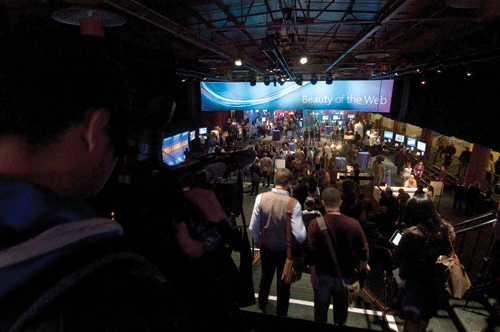
Vahe Torossian is the corporate vice president of the Worldwide Small and Midmarket Solutions and Partners group at Microsoft

October 3, 2010 0 comments
0 FacebookTwitterPinterestEmail
Comment

Dark days are upon us

by Paul Cochrane October 3, 2010
written by Paul Cochrane

It’s been a long hot summer. Temperatures hit all-time highs and Ramadan demand put power grids under serious strain across the Middle East. Few countries were spared as power outages hit Kuwait, Saudi Arabia, Bahrain, Sharjah, Yemen, Iraq, Lebanon, Syria and Egypt. But in those places suffering from power cuts, people seemed largely unaware of the rest of the region’s electricity woes.

While Lebanese carried out their daily litany of complaints about blackouts, damning and blasting the government, many were surprised when I told them that Sharjah had such an electricity deficiency that residents were sleeping in air conditioned cars to avoid baking in concrete apartment blocks. It was so hot in the emirate that hospitals were inundated with cases of heat stroke and a construction worker died from heat exhaustion.

 In Damascus, residents hot under the collar due to a lack of air conditioning knew of Lebanon’s long-term electricity conundrum, but were unaware that Saudi Arabia and Kuwait — those rich Gulf countries where many Syrians seek work — were also having blackouts. With an 8 percent annual deficit, the situation was so bad in Saudi Arabia that school children were passing out while taking exams and airplanes were grounded. Kuwait’s network hit 99 percent of capacity.

Power shortages in the region’s poorer, more corrupt and war ravaged countries — Iraq, Yemen, Lebanon — are daily occurrences and are not unexpected, but why are they happening in the energy-rich Gulf?

The problem is that peak demand occurs every summer at the same time across the region. Populations growing in size and affluence means more air-conditioners — and industrial activity is increasing. All of this, coupled with exceedingly low electricity tariffs and an incredible lack of forward-planning has resulted in a major shortage of megawatts (MW). And without the modern day wonder of air conditioning, the region, particularly the Gulf, is not a place conducive to working or living as the mercury rises.

Thomas Edison, one of the inventors of the light bulb, once said: “I shall make electricity so cheap that only the rich can afford to burn candles.” In much of the Middle East, Edison’s saying has been translated as: “We shall make electricity so cheap everyone uses too much of it, and only the rich can afford to run generators.” Lebanon is a case in point, with power “provider” Electricité du Liban to generate $800 million in bills this year, while the Lebanese will spend $1.76 billion on running generators.

But there is hope that such electricity shortages will be abated, with the cuts prompting such furor among the people that governments have been forced to invest in more power production.  The Gulf countries are to spend an estimated $200 billion on power plants, Lebanon some $4.7 billion, Iraq up to $10 billion. Everywhere else there are plans for upgrades and new plants. Renewable energy and nuclear power are also in the pipeline, as is the $560 billion Desertec solar power project in North Africa. And if other solar power initiatives get underway in the rest of the Middle East and North Africa, the region will be able to produce up to 470,000 MW of sustainable electricity by 2050, according to research by the German Aerospace Center.

While such initiatives are laudable, practical solutions to the current shortages need to be implemented. It takes around three years to build a conventional power plant, and once output is increased, there is usually a corresponding rise in demand as people use more electricity. It’s a vicious cycle.

Before these projects get underway, thinking about how to lower overall consumption across the region should be part of every national power plan. Can we really call a ski slope in a mall in the desert an efficient use of electricity? Do empty office blocks have to be lit up like Christmas trees in the middle of the night? And when the whole of Lebanon lacks electricity, did the Maronite Church have to erect the world’s largest illuminated cross at Qanat Bekish in Mount Lebanon, a 240 foot high construction lit by a staggering 1,800 spotlights?

If temperatures are as high again next year and such wanton waste of electricity continues, power cuts are likely to be worse. In the meantime, higher tariffs to encourage people to use power more wisely would help to ensure more people are sleeping in their houses rather than their cars this time next year.

October 3, 2010 0 comments
0 FacebookTwitterPinterestEmail
Comment

Baghdad’s enduring nightmare

by Alice Fordham October 3, 2010
written by Alice Fordham

On wide, high-definition screens, images flash up for two seconds at a time: flayed skulls, charred limbs, disemboweled torsos, heads bloated and bulging around taped-up eyes. Men and women sitting in plastic seats flinch as they squint at the real-life horror show, trying to identify husbands, cousins and friends. This is the Baghdad morgue, where the grim body count of the last seven years has been a daily reality, where bodies were piled up and lay unclaimed by terrified families before being driven to vast graveyards with numbered plots.

As American-led troops battled resistance and then civil war, this building and its 50 employees dealt with the consequences. In 2006 and 2007, the morgue received 150 corpses a day. Today, although the stream of dead has slowed to a trickle, the morgue remains a nightmarish reminder of the fighting’s lingering effects as people come to hunt through the photographs of some 20,000 bodies which remain unidentified.

Abu Issam, 47, from the capital’s New Baghdad neighborhood, was looking for his cousin, a 60-year-old man who was kidnapped from his home by men in three cars in January 2006. As corpse followed corpse on the screen, he said, "I look at these pictures and say to myself, ’what is the guilt of these people?’"

Meanwhile, officially, the war is grinding to a halt. On September 1, United States combat operations in Iraq were declared over and, with some fanfare, Operation New Dawn began, a mission of advice and assistance with less than 50,000 American soldiers on the ground.

Media attention has begun to drift from Iraq; the pyrotechnics of Pakistan and Afghanistan are now more interesting than the rumbling violence in Baghdad. But in a country where people are still mourning for disappeared loved ones, divisions and grievances run deep and there is not yet a clear victor in the messy endgame to the war.

Since the end of combat, American soldiers supporting Iraqi colleagues have found themselves in lethal shoot-outs and open fighting in Baghdad, Diyala and Fallujah. Two American soldiers were shot dead on September 8 in Salaheddin by a man in an Iraqi Army uniform who was among the men they had been training.

Other troubles still plague Iraq. Hundreds of people die violently every month and, more than half a year after elections, there is no sign of a government being formed. The divisions between Sunni and Shia, which Iraqis insist were negligible before the 2003 US-led invasion, are still being deepened by violence and politics. There are frequent assassinations among the largely Sunni militias which defected during the American troop surge. The Iraqiya party, which campaigned on a platform of secularism, is likely to be overpowered in government by a coalition of religious Shia parties, alienating the Sunni voters who largely backed Iraqiya.

The infrastructural impact of the invasion lingers. Electricity production has never reached pre-war levels, which were not high, and after a scalding summer marked by riots, the electricity minister was forced to resign. Bureaucracy and bribery dog municipal functions of the state and the police are corrupt and brutal. Minorities are still targets. Christians are associated with the hated occupiers and during the scandal surrounding the planned Koran-burning in Florida, every church in Baghdad was threatened.

The best-case scenario for Iraq going forward is the rather modest one laid out by Barack Obama, in which violence is at a manageable level and there is some semblance of democratic rule. But the ingredients are all there for a deterioration, and if a government doesn’t emerge or there is a serious attack on a religious site, for example, the decline could be swift and have a wide-ranging fallout.

Some American soldiers feel frustrated at the perception in the US that the war is finished. Lieutenant-Colonel Donald Brown commands the infantry division whose two soldiers were shot. After attending the “very emotional” memorial service for the two who were killed, Lt-Col Brown said that his wife and family had felt this kind of danger was unlikely since combat operations ended.

“This sort of event was only in the back of their mind until the events of the last few days clearly codified that this is still a very dangerous place,” he said. A sharp personal reminder that on the ground, the war ain’t over yet.


October 3, 2010 0 comments
0 FacebookTwitterPinterestEmail
Comment

The art of crime

by Peter Speetjens October 3, 2010
written by Peter Speetjens

The recent theft of a $50 million Van Gogh painting from the Mahmoud Khalil Museum in Cairo is hardly an isolated case. As art prices continue to skyrocket, the underworld is rapidly developing a taste for culture, turning art theft into a global business worth some $6 billion annually, according to the FBI. Only last May, for example, four modernist masterpieces, including a Picasso and Matisse, were stolen in Paris, while in 2008 a Cezanne and Monet were lifted from a Zurich museum. Meanwhile, thousands of Iraqi antiquities remain unaccounted for and Christian icons vanish on an almost daily rate, mainly in countries of the former Soviet Union.

That said, the way in which the Van Gogh still life “Vase with Flowers” was taken from the Cairo museum seemed like scene from the latest Adel Imam flick that could be called “Only in Egypt.” After all, where else can one enter a museum in broad daylight, move a couch under the desired painting, cut the canvas from its frame, and walk out without being spotted by either guards or cameras?

A museum employee admitted that the museum’s alarm system and most of the 49 security cameras had not been working for a while. “The museum officials were looking for spare parts but hadn’t managed to find them,” he told Agence France-Presse. The affair becomes all the more humiliating knowing that the same painting was stolen from the same museum in 1978 only to pop up two years later in Kuwait.

Admittedly, the theft of four paintings with a combined value of $130 million from the Paris Museum of Modern Art in May was nearly as embarrassing. Here too, the alarm system was out of order, as the museum was awaiting spare parts.

The security cameras however, did work. They recorded how a lone hooded thief broke a window around midnight, climbed in, cut the canvasses from their frames and left. Pity that the museum guards for some reason failed to look at their screens and only the next morning spotted the empty frames.

Yet even working cameras and guards that are awake can do desperately little against the threat of violence, which seems the underworld’s favorite modus operandi. In Zurich, for example, three men armed with automatic weapons stormed into the E.G. Buhrle Foundation, grabbed four paintings with a value of some $163 million and fled minutes later in a waiting car. Similar armed robberies have taken place in Rio de Janeiro, Sao Paolo, Stockholm and Boston, where two thieves disguised as policemen entered the Isabella Stewart Gardner Museum in 1990 and stole some $500 million worth of art. The stunt is still known as the biggest art heist in history.

It should be noted that the stolen Van Goghs and Picassos are only the tip of the iceberg. Most thefts do not concern classic masterpieces and hence fail to write headlines. Furthermore, while stealing a work of art is one thing, selling it is quite another. The problem is that an art work is a unique piece. There is only one “Guernica,” only one “Vase with Flowers.” Consequently, it is impossible to simply offer the works on the market, especially since both the FBI and Interpol established art crime departments that, among other things, maintain a database of stolen works. Instead, as in an ordinary kidnapping case, art thieves will often try to obtain a ransom.

According to Interpol, the theft of cultural objects affects the whole world, but the two countries most affected are France and Italy. The organization furthermore notes that the illicit trade is sustained by demand from the arts market, the opening of borders and political instability in certain countries. The latter especially refers to the situation in Iraq and Afghanistan, as looting has always been an intrinsic part of war. From the National Museum of Iraq alone some 7,000 to 10,000 artifacts remain missing, after the US army failed to protect the country’s leading cultural institution during the invasion.

In general, the future for stolen antiquities and art works looks bleak. Julian Radcliffe of The Art Loss Register estimates that only 15 percent of stolen art works are recovered within a period of 20 years. Hence, it may take a bit longer this time around before Van Gogh’s “Vase with Flowers” makes its way back to Cairo.

October 3, 2010 0 comments
0 FacebookTwitterPinterestEmail
Society

Musical Movements

by Emma Cosgrove October 3, 2010
written by Emma Cosgrove

Watches. “You either love them or you don’t care,” said Ronan Keating, sitting back on an overstuffed armchair in the library of IWC Schaffhausen’s new downtown boutique.

Keating cares. In fact, he gushes, unable to tame his passion for luxury watches. An Irish pop star and a former member of the 1990s boy band Boyzone, Keating is one of IWC’s many celebrity endorsers. He and Chief Executive Officer George Kern came to Beirut to open the brand’s new boutique in Beirut Souks on August 26, where the singer explained how he and Kern travel the world opening IWC boutiques.

“I’m like a kid in a candy store. This is something I have a passion for and I love watches,” he said. His prominent presence throughout the opening event highlighted the importance brands place on selecting an appropriate celebrity endorser; the right choice can lend credibility to a brand or even make it a household name, but the wrong one can sully its reputation.

At first Keating might seem like an odd choice; while he is not a completely unrecognizable figure outside the British Isles, his fame is somewhat localized to that northwestern edge of Europe. But IWC says it has a different strategy than other brands when it comes to its celebrity “family.”

“George didn’t have to convince us and start waving money in front of us, it’s not about that with the brand,” said Keating. “It’s a passion that we all share together.” Invited to become a brand representative when Kern saw him performing on Swiss television wearing an IWC watch, Keating is just one of many big names recruited to represent the brand in recent years. Other celebrities wrapping IWC around their wrists include Australian actress Cate Blanchett, French actor Jean Reno, French footballer Zenidine Zidane, Australian model Elle Macpherson and American actor Kevin Spacey.

Celebrity endorsements, the cornerstone of luxury watch advertising, can cost millions. The values of individual contracts are kept under lock and key and often vary greatly from company to company, star to star, but they rarely come cheap. Keating then, having recently been present at IWC’s openings in Kuala Lumpur and Vietnam, represents a significant strategic investment.

Building a brand is a complicated process, said Kern. “Millions of elements come together — advertizing, PR strategy, corporate social responsibility strategy, the way you decorate or the way you design stores.” When all the elements present at the boutique’s launch in Beirut Souks are scrutinized together, Keating’s presence  fits like a gear in a precisely tuned timepiece.

The opening featured the usual fare of hors d’oevres, champagne and branded miniature cakes. But after the ribbon cutting with Kern, Keating and members of the Atamian family, IWC’s Lebanese partners, Keating played a short, lighthearted acoustic set. Suddenly, the boutique’s styling, the utilitarian elegance of the watches and the music all blended with a melodic harmony.

Sure, the casual asides Keating tossed to the crowd during his set to profess his undying enchantment for IWC watches may have seemed a little over-the-top, but Keating’s limited local star power meant that he could walk through the crowd without needing security and without the usual surrounding wall of photographers. He shook hands and met actual people.

Perhaps it is an uncommon choice to use a lesser-known celebrity to keep the vibe light where a big name would shut down the show and hog all the attention. But ditching superstar power in favor of brand unity is certainly a bold move.


October 3, 2010 0 comments
0 FacebookTwitterPinterestEmail
Finance

Balance sheet blues

by Natacha Tannous October 1, 2010
written by Natacha Tannous

Running the gauntlet that is Gulf finances these days, Emirati bank balance sheets are being battered; double-teamed by deteriorating asset quality and non-performing loans. Fortunately for them, however, the fight is effectively rigged, as both the government and the Central Bank of the United Arab Emirates have readied their checkbooks to pay up whatever it takes to keep the banks from going down.  

Asset quality deterioration

A major blight on statements has been Dubai World exposure; UAE banks hold 45 percent of the up-to $26 billion of outstanding debt, of which Emirates National Bank of Dubai (ENBD) and Abu Dhabi Commercial Bank (ADCB) have the highest shares (see estimated exposure table).

As Executive reported in March, even if Dubai World offered full debt repayments, the net present value would only amount to 62.1 cents on the dollar (with a five-year extension at a 10 percent discount).

However, a pledge by the Dubai government on March 25 to “support proposals with significant financial resources” and inject fresh funds of $9.5 billion through the Dubai Financial Support Fund, has eased the Dubai World situation and will lower the discount rate for the debt proposal.  This now entails a higher net present value for the “100 percent principal repayment through the issuance of two tranches of new debt with a five and eight year maturities,” said the Dubai government.

This could avoid additional provision charges but will not help healthy balance sheets show up at UAE banks.

“Problems at Dubai-based banks will not end after the restructuring of Dubai World, with the economy of the Emirate almost in a standstill,” says Marcel Kfoury, senior trader for the Middle East and North Africa region at Nomura Holdings in London. “The default rate on the consumer side will just rise further, adding to an already deteriorating loan-book, as more contractors fail on their obligations.”

UAE banks were already suffering from retail loan portfolios and real estate exposure via lending books, subsidiaries or direct investments in properties. First Gulf Bank (FGB) is the most exposed bank in this matter, as it had in December 2009 a real estate portfolio of $1.6 billion, the market value of which has undoubtedly decreased. With the current oversupply situation, particularly in Dubai, the banks are now left with vacant and non-cash flowing real estate projects that have lost 50 percent of their value; approximately one third of aggregate projects have been postponed or even cancelled.

UAE
</p>
									            </div>
        </div>

		            <div class=

October 1, 2010 0 comments
0 FacebookTwitterPinterestEmail
  • 1
  • …
  • 406
  • 407
  • 408
  • 409
  • 410
  • …
  • 707

Latest Cover

About us

Since its first edition emerged on the newsstands in 1999, Executive Magazine has been dedicated to providing its readers with the most up-to-date local and regional business news. Executive is a monthly business magazine that offers readers in-depth analyses on the Lebanese world of commerce, covering all the major sectors – from banking, finance, and insurance to technology, tourism, hospitality, media, and retail.

  • Donate
  • Our Purpose
  • Contact Us

Sign up for our newsletter

    • Facebook
    • Twitter
    • Instagram
    • Linkedin
    • Youtube
    Executive Magazine
    • ISSUES
      • Current Issue
      • Past issues
    • BUSINESS
    • ECONOMICS & POLICY
    • OPINION
    • SPECIAL REPORTS
    • EXECUTIVE TALKS
    • MOVEMENTS
      • Change the image
      • Cannes lions
      • Transparency & accountability
      • ECONOMIC ROADMAP
      • Say No to Corruption
      • The Lebanon media development initiative
      • LPSN Policy Asks
      • Advocating the preservation of deposits
    • JOIN US
      • Join our movement
      • Attend our events
      • Receive updates
      • Connect with us
    • DONATE