• Donate
  • Our Purpose
  • Contact Us
Executive Magazine
  • ISSUES
    • Current Issue
    • Past issues
  • BUSINESS
  • ECONOMICS & POLICY
  • OPINION
  • SPECIAL REPORTS
  • EXECUTIVE TALKS
  • MOVEMENTS
    • Change the image
    • Cannes lions
    • Transparency & accountability
    • ECONOMIC ROADMAP
    • Say No to Corruption
    • The Lebanon media development initiative
    • LPSN Policy Asks
    • Advocating the preservation of deposits
  • JOIN US
    • Join our movement
    • Attend our events
    • Receive updates
    • Connect with us
  • DONATE
Feature

A day at the Races

by Executive Editors October 23, 2010
written by Executive Editors

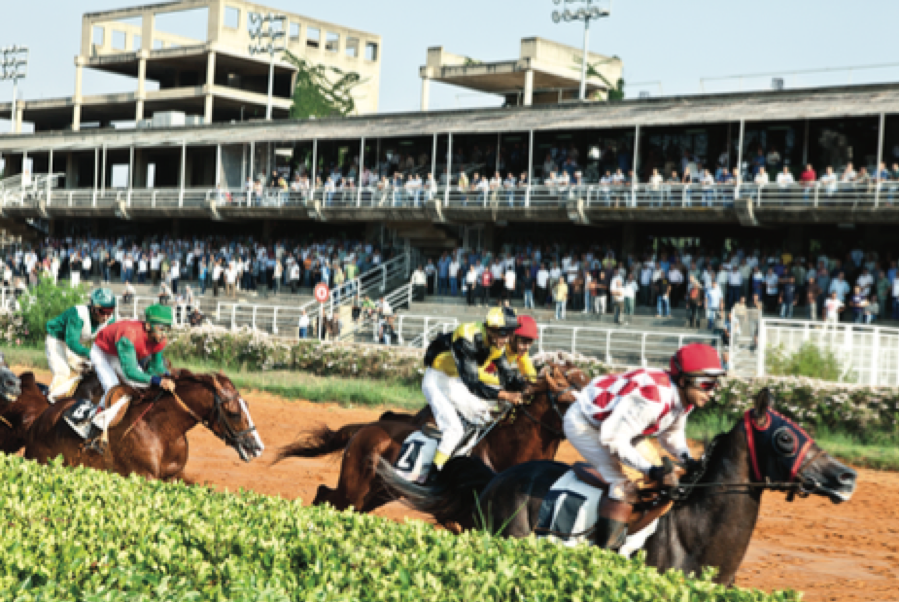
While a British day at the races is known for its champagne and women in outrageous headgear, a typical afternoon at the Beirut Hippodrome is a largely hatless, all-male affair. Each Saturday in summer and Sunday in winter these race aficionados gather at the walled track in between the National Museum and the residence of the French ambassador to Lebanon.

Every weekend six races take place, each with five to 10 competing horses bestowed with heroic names such as “Tiger of Lebanon,” “Son of the Sheikh,” “King of Horses” or “Symbol of Justice.” Before the race starts, they are paraded at the green behind the Hippodrome’s grandstand for the connoisseurs to check out the fitness of the competitors and pick their steed.

And they’re off…

While the horses are led to the track, the spectators head to the betting offices. Most will bet on the winner or the winner and runner-up in a single race, or in a combination of races whereby bets are placed on the number, not the name of the horse. The minimum bet is only LL 3,000, and while there is no official maximum bet, in reality the bets rarely exceed LL 100,000, as the Hippodrome’s limited betting volume produces a natural ceiling.

Just before the race starts, a near total silence descends on the stadium, which erupts in a cacophony of cries as soon as the horses fly out of the gates. One man placed a LL 10,000 bet on “6-2:” Horse No. 6 to win; 2 as runner-up. It was almost his lucky day. No. 6 dominated the race from start to finish. On the very last meter however, horse No. 2 was overtaken by horse No. 1. The man could not believe his eyes. He cursed with gusto before sinking into silence. Meanwhile, the lucky winners danced in front of the grandstand.

“I’ve been coming to the races since I was 18, for almost 60 years,” said another man inside the Hippodrome’s air-conditioned first class stand. “I love horses and I love horse racing. It’s like a drug, a weekly rush of adrenaline.”

Beirut horse racing has been organized by the Society for the Protection and Improvement of the Arabian Horse in Lebanon (SPARCA) — which also maintains the Hippodrome — since 1970. It is a non-profit organization recognized by international horse racing bodies. Furthermore, SPARCA is the keeper of the stud book for Lebanese horse racing, which among other things checks the horses’ paternity through DNA typing and marks them with micro chips.

In addition to organizing the local races, SPARCA signed an agreement with its counterpart France Galop to allow people at the Hippodrome to bet on horse racing in France. “We receive some 1,500 people per racing day,” said the Hippodrome’s General Manager Nabil Nasrallah. “The total volume of betting amounts to some $250,000 per week, with a peak of around $350,000 in the mid-1990s. Illegal bookmakers however, may make up to five times that amount. Many of Lebanon’s bigger players place their bets with them because they offer a discount of up to 35 percent in case of a loss, as well as credit facilities.”

The illegal bookies are able to offer such lucrative deals because they operate with minimal costs. They do not invest in the race track nor pay the prize money. In other words, they make money from horse racing, yet channel nothing back into the sector. Illegal bookies have long been a problem in Lebanon, yet were never a priority for Lebanese law enforcement. Why? Ask anyone at the Hippodrome and the answer will be the same: because the bookies are protected by the authorities.

According to article 62 of the 2001 budget law, the Beirut municipality, which owns the land, receives 5 percent of the Hippodrome’s betting income. Depending on the total volume of betting, the Ministry of Finance receives a progressive tax of 1 to 20 percent, which last year amounted to some 7 percent. SPARCA receives 15 percent, while the winning tickets divide the remaining amount.

“Racing horses is a luxury, like owning a football team. Currently, a horse owner, at best, may cover 25 percent of his costs”

For love, not money

SPARCA uses its 15 percent commission to maintain the Hippodrome, organize the races and pay the race winners prize money, which averages $2,000 per race. According to SPARCA’s statistics, Lebanon has close to 700 racehorses, some 350 of which are stabled at the Hippodrome, while there are some 600 horse breeders, mainly located in Akkar and the Bekaa Valley. It is estimated that, from breeder to jockey, around 3,000 families depend on horses and racing for their livelihood.

To a large extent, the sport is  kept alive by Lebanon’s stable owners, with Mounir Dabaghy, Michel Pharaon and Nabil de Freige the three kingpins of the trade. Having started in 1965 with just handful of horses, SPARCA Secretary Dabaghy currently has the country’s biggest stable with some 80 racehorses.

“I don’t breed horses, I buy them in Lebanon or Syria,” he said. “The average price for a one-and-half-year-old is some $5,000. It takes 1.5 years of preliminary training before the horse will run its first race. Including the cost of food, the salaries of trainers, jockeys and stable boys, training a horse costs an average of around $600 a month.”

His most famous horses are Mosleh, which won the Presidential Cup twice, followed by Ibn al-Zawat and Maazour, which each won it once. The Presidential Cup is Lebanon’s leading race with a prize of LL 10 million (nearly $7,000). The prize money is divided 70 percent to the winner, 20 percent to the runner-up and 10 percent to the second runner-up. The winning trainer and jockey each get a 10 percent commission, while the remainder flows in the pocket of the stable owner.

Does that make horse racing a profitable business? “Not at all,” Dabaghy said. “Breeding horses is an industry. Racing horses is a luxury, like owning a football team. Currently, a horse owner, at best, may cover 25 percent of his costs. One or two horses may actually make money, but the profit of a stable as a whole is zero, nil, zip.”

Nasrallah estimated that in order to give the industry a boost, the prize money should be upped to at least $5,000 per race. Bigger prizes would encourage more people to breed, raise and train horses, which would lead to more races and a bigger betting volume, which would enable SPARCA to pay bigger prizes, and so on. It would also allow the organization to renovate the Hippodrome.

The Hippodrome and the pine forest next door offer one of the few oases of greenery amid the dense urban jungle that is Beirut

A storied past

Interestingly, if everything had gone according to Ottoman plans, the Hippodrome would today be the beating heart of an extensive gambling and entertainment complex. Former Beirut mayor Kenaan Taher Bey granted a 50-year-concession to Alfred Sursock to develop such a complex in 1915.

Yet while the Hippodrome hosted its first races in 1918, the planned restaurants, cafés and cinema were never built, and World War One ended plans for a casino. The victorious French decided that the mansion south of the racetrack should become the residence of France’s representative to Lebanon rather than a gambling haven.

Much like Casino du Liban, the Hippodrome had its golden years in the 1950s and 1960s when the region’s blue-blooded and well-heeled would descend on Beirut for a day at the races. Famous regulars included the former Shah of Iran and King Hussein of Jordan. The Civil War brought an end to all that, even though the racetrack remained open during most of the conflict years and regularly served as a neutral meeting ground for representatives from all sides.

One of the darkest chapters in the Hippodrome’s history occurred in 1982, when the invading Israeli army blew up the arched Belle Epoch grandstand and burnt down the once extensive pine forest. Some 23 horses at the Hippodrome were killed during one particularly nasty spell of fighting, while more than 300 horses in the stables were trapped without food or water.

The incident produced perhaps the most effective display of diplomacy in 15 years of civil war. The current SPARCA president and a member of Parliament, Nabil de Freige, called then-Lebanese President Elias Sarkis, himself an ardent horse lover, who informed US mediator Philip Habib, who in turn contacted Israeli Prime Minister Menachem Begin: the next morning a five-hour ceasefire was in place which enabled SPARCA to relocate the horses.

A tough nut to crack

The Hippodrome had barely survived the war before it was confronted with a threat of a very different nature. In November 1989, Lebanon’s government announced a plan to demolish the racetrack to make way for a new presidential palace and an extensive complex of government buildings. Yet a series of public protests, including a much publicized sit-in by everyone from breeder to stable boy forced the government in January 1990 to shelve its ambitions. Racing resumed shortly after.

Today, there are no plans to concrete over the Hippodrome, but that does not mean its future is safe and sound. The track is in a prime location that property developers are no doubt eager to get their hands on.

It would be an eternal shame if that were to happen. The track and racing make up an essential part of the effort to safeguard the future of the Arabian horse, while the Hippodrome and the pine forest next door also offer one of the few oases of space and greenery amid the dense urban jungle that is Beirut.

A night at the Casino

A government cash-cow heads back toward its former glory
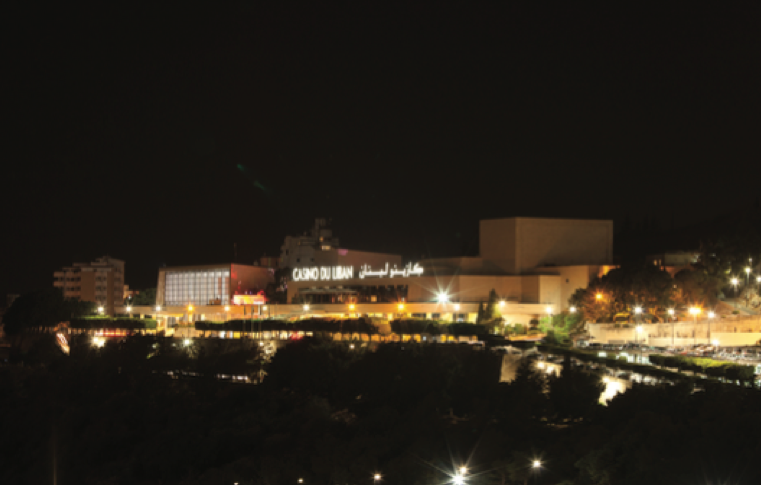
It is Saturday night and Casino du Liban (CDL) is packed. With a bucket of coins in one hand and, more often than not, a cigarette in the other, row after row of people try their luck on the machines in ‘Slots Palace.’ A regular cascade of coins brings relief to one and hope to all that the ‘big one’ is yet to come.

The International Room, opposite the Slots Palace, is home to both slot machines and table games, the most popular being roulette, blackjack and stud poker. It’s hard to find an empty seat to join the fray. At the blackjack table, a man in a white suit runs out of chips. He changes $500 worth with a fellow player and immediately puts all in on two hands of cards.

Winning one, loosing one, he bets all again, but is less lucky this time as the bank sweeps the table with 21. With his pockets $500 lighter in less than a minute, he decides to call it a day. A night at the casino can be fast and furious, and is never an affair for the faint-hearted.

Founded by presidential decree in 1957, CDL first opened its doors in 1959. It enjoys a monopoly on all Lebanese gambling, except horse racing, although it should be noted that Beirut in particular boasts numerous slot machine-filled “amusement centers.”

CDL is a privately owned concession company, albeit one with a significant public face. The biggest shareholder is the Intra Investment Company (IIC) — formerly known as Intra Bank — which holds a 51.87 percent stake. However, 35.16 percent and 10 percent of the IIC is owned by Banque du Liban, Lebanon’s central bank, and the Ministry of Finance, respectively.

The family-owned Abela Tourism Development Company owns a 14 percent stake in CDL, while the remainder of the shares are held by a number of other private investors. The Lebanese state is entitled to 40 percent of gross annual revenues, with the casino taking in some $250 million in recent years.

High stakes

Anyone reasonably well-dressed and older than 21 can enter the casino, with the exception of “government employees, military personnel and cashiers at banks or other commercial establishments.” A registration procedure, at least for the gaming tables, aims to make sure the guideline is implemented.

Home to nearly 500 slots machines and 60 gaming tables, the casino offers thrills — and disappointments — for all budgets. While one can play the slot machines for as little as LL 500, the minimum bet at the gaming tables is LL 10,000. This increases to LL 100,000 at the Cercle d’Or tables on the first floor. In addition, CDL is home to two private rooms for the so-called ‘high rollers’, where the minimum bet is often LL 250,000 or more.

“It is hard to define a high roller,” said CDL Marketing Manager Lara Hafez. “One player may lose $200,000 on the night but never come again, while another player looses only $10,000 but visits twice a week. We rather speak of a ‘good client:’ someone who visits regularly and at times may lose up to $30,000.”

Most of the casino’s gamblers operate on smaller budgets. While the average guest visits the casino for the entertainment of gambling, for a core group gambling becomes an obsession, one that can lead to financial and personal ruin.

“I used to go to the casino once a week to play horses on the slot machines,” said 35 year-old Jad. “For a while I regularly won up to $500 and I really thought I had figured it out. Then my luck turned and I started losing. But at first I couldn’t accept it. I thought if I keep playing, my luck will turn again, but it didn’t. I actually sold my car to continue playing, but after that I had nothing left, so I stopped.”

According to the American Psychiatric Association, pathological gambling is an impulse control disorder, a chronic and progressive mental illness. A gambling addiction shares many characteristics with a drug or alcohol addiction, such as preoccupation (to have gambling on one’s mind), tolerance (ever larger and more daring bets are needed to develop a rush) and lying (to hide the true extent of one’s habit). Addicts often value gambling above all else, including their relationships.

“My mother divorced my father because of his gambling habit,” said Eliane, a 43-year restaurant owner. “The thing that struck me most about his behavior was that, no matter how often or how much he lost, he always thought he was in control. He was convinced that, sooner or later, he would win because he ‘knew’ the game.”

Glory Days

A night at Casino du Liban is not per definition all about gambling. One can wine and dine with a view over Jounieh Bay or attend a show at the Salle des Ambassadeurs. CDL, like most casinos, defines itself an entertainment complex rather than a gambling firm.

A decade ago, some 70 percent of annual turnover stemmed from the gaming tables and 30 percent from the slot machines. Today they evenly make up some 95 percent of revenue. The remaining 5 percent stems from non-gaming activities, such as food, beverages and show tickets.

 Annually, CDL attracts an average of 300,000 visitors, some 70 percent of whom are Lebanese, while some 21 percent are from the wider Middle East and North Africa region. The remainder mainly come from the United States and Europe.

“In 2009, the ratio slightly changed,” said CDL’s Hafez. “The number of Lebanese customers decreased to 65 percent, while the number of MENA visitors increased to 27 percent, which is a reflection of the growing number of tourists coming to Lebanon.”

Over the years, the casino’s fortunes have reflected those of Lebanon. The casino experienced its golden years in the 1960s and early 1970s, when it rapidly rose to fame on the international gambling circuit and became a “must-see” attraction.

Photos hanging on the walls recall the glory days when Omar Sharif was a regular visitor, as were King Hussein of Jordan, Shah Mohammad Reza Pahlavi of Iran, Prince Albert of Monaco and Greek shipping billionaire Aristotle Onassis. These were also the days when CDL staged its own theatrical and musical productions, which could run for months on end.

The international clientele quickly vanished when the civil war broke out in 1975. The casino was damaged, yet by and large remained operational until 1989 when it was forced to close completely. It reopened in December 1996, thanks to a $50 million state injection.

Expansion

Today, CDL is once again the region’s leading “playground.” Not taking into account illegal casinos, its few competitors are located in Egypt, northern Cyprus and Greece. Syrians make up half of the casino’s foreign clientele, followed by Jordanians and Gulf nationals. While in recent years there has been a notable increase in Iraqi players, the number of Syrian gamblers is likely to decrease, as Damascus aims to open a casino of its own.

“CDL is looking at ways to attract more people from the region, from Turkey, Cyprus and Greece, yet as we nearly operate on full capacity, we need to expand first,” said Hafez. The same is true for attracting the region’s high rollers. While people from the Gulf states, for example, do visit the casino, most big players prefer to fly to more prestigious and high spending casinos in Monaco, London or Las Vegas, where they are welcomed with extensive junket programs.

“A junket program aims to reward players by reimbursing their expenses in terms of travel, accommodation, food and beverages,” said Hafez. “Of course, in return the player is required to commit to play at a certain level in terms of length, level and type of play.”

Like every casino, CDL has an extensive database in which clients are characterized in terms of visit frequency, the level of cash swap and the level of win and lose, but so far it has not offered junket programs.

Casino Du Liban’s new management team has been quiet regarding future plans. More gaming facilities and perhaps a hotel would seem to be the minimum conditions for future expansion. If it plays its cards right, CDL could put itself back on the international gambling map.

October 23, 2010 0 comments
0 FacebookTwitterPinterestEmail
Feature

Syndicate in the spotlight

by Executive Editors October 23, 2010
written by Executive Editors

An Executive journalist recently presented himself at the Parliament to request an interview, and was confronted by a guard who demanded to see his official press syndicate credentials.

The journalist laughed. “Have you ever seen the press syndicate?” he asked, referring to the elusive quasi-governmental body responsible for granting local journalists press cards.

 The soldier rolled his eyes and waved the journalist through. Though he may not have found the joke funny, he understood its punch line.

Very few Lebanese journalists carry official press cards, despite the fact that, according to the country’s 1962 Press Law, all journalists and editors must be organized within the Lebanese Press Syndicate. The syndicate is organized into the Press Association and Editors Association, both of which submit members to the 12-seat Press Council where most of the syndicate’s power is concentrated.

Theoretically, the syndicate grants press credentials, licenses periodicals, offers its members special services to facilitate their work and regulates the conduct of the press through its disciplinary committee, among other functions. However, journalists and editors from across Lebanon’s print media spectrum paint a far different picture of the reality of the situation.

As of 2008, only 1,086 journalists out of some 3,000 working in Lebanon belonged to the syndicate, according to the research company Information International.

“At present, if they were to apply the law, all the journalists who are not members would be prosecuted,” says Tony Mikhael, legal advisor to the Maharat Foundation, a media advocacy group. In a recent interview with Executive, Information Minister Tarek Mitri said: “I realize there is a problem [at the Association of Editors]… There are people who are members who should not be and people who are entitled to be members who are not.”

These problems are widely acknowledged, but there is less agreement as to why they exist.

“There is a decision in the syndicate to not let many people register. This is intentional,” said Mikhael, adding that the board aims to keep the numbers low and manageable so that, “they can control them and make sure that they vote for them. If all the journalists in Lebanon could enter [the Syndicate] their standing would be unsettled.”

Hassan Khalil, the publisher of Al Akhbar newspaper, says his publication is not active in the Syndicate because they view it as politicized and unrepresentative.

“We don’t see the Press Syndicate as an effective body,” he says. “The Syndicate, like any other body in Lebanon, reflects a mirror image of the political scene.”

Rumors abound of journalists being refused entry to the Syndicate on political and sectarian grounds, or being made to wait up to 10 years to finally get their credentials. However, Habib Chlouk, responsible editor at An Nahar and a member of the Press Council, argues that even if these stories are true, the Syndicate cannot be held solely responsible.

“The membership process is run by the membership committee which is made up of three branches: a representative of the Information Ministry, two representatives of the Press Association and two of the Editors Association — no one group can approve memberships without the consent of the other two,” he says. “Therefore, any problem that arises from approving memberships of certain individuals puts all three bodies at fault, and not just one.”

Even those who have managed to join over the years remain highly skeptical of the usefulness of their membership. “It took more than seven years, from the time I applied for membership [at the syndicate], to be issued a press card,” says Hayda Houssemi, chief of the business news desk at Al Mustaqbal newspaper. “It’s been a year now since I was told the card was ready, and I still haven’t gone to pick it up. I just think, what’s the point?”

Houssemi and other journalists say that although the syndicate offered concrete advantages in the past, today the benefits of membership are vague at best. According to Antoine Howayek, president of the Lebanese Press Club (an independent body), promises of discounted airfares, phone services and other allowances for the syndicate’s journalists have consistently failed to materialize. The syndicate has, until very recently, kept its business behind closed doors, disclosing almost nothing of its finances, internal decisions or governing laws. However, with the death of the president of the Association of Editors and founding member of the syndicate, Melhem Karam, on May 22, 2010, those doors have begun to rattle with the rising clamor of journalists, members and non-members alike, who see this moment as their best chance in decades to instigate reform.

Yet even with his passing, Karam’s influence can be felt; the syndicate he established, still under the direction of his inner circle, may well prove as obstinate to change today as it has for the last half-century.

“We don’t see the Press Syndicate as an effective body…[it] reflects a mirror image of the political scene”

A one-man show

The story of the Press Syndicate is inextricable from that of its founder. The driving force behind the syndicate’s establishment, Karam directed his organization as its president from the moment of its creation in 1962 to the moment of his death. Supporters have called his role in the syndicate paternal; critics term it dictatorial. Neither contests his nearly unilateral ability to influence the internal structure and operations of the organization.

“He was what you might call a one-man show,” said Baria Ahmar, a long-time Lebanese reporter currently freelancing for CNN. “I think in the end that’s what killed him: he simply would not delegate.”

According to sources close to the syndicate, Karam established the first Press Council, the syndicate’s ruling body, from a select group of loyalists, housing the group in a building he owned and instating himself as president. Over the next four decades or more, those same

administrators retained their seats with almost no alteration.  “Has there been any change to that original list? I think no,” said the Press Club’s Howayek. “Perhaps we have seen some members replaced for health reasons, others have passed away. But otherwise, I believe there has been very little change to the Council’s membership.”

According to its internal law — a document last amended in the early 1980s that looks like it was hammered out on a teletype machine — the syndicate must re-elect the council and president every three years. True to that law, every three years Karam and his already seated council members  would submit themselves for reelection. And each time, they would pass uncontested. Why, in more than 40 years, no individual or alternate list was ever submitted as a candidate is a matter for speculation.

Journalists interviewed by Executive assert that Karam’s influence was too strong, his presence too intimidating, for anyone to attempt to unseat him. Others claim that the syndicate prevented any possible contest by closing its doors during the brief period in which opposing candidates could declare their candidacy.

“In the past, the syndicate relied completely on its president’s [charisma], but we want to change that. We want to turn the syndicate into a real institution as opposed to being solely about the syndicate’s head,” said An Nahar’s Chlouk, who is in the running to replace Karam as the head of the Association of Editors. He also has plans to update the syndicate’s antiquated by-laws to include journalists working in online, TV and radio.

“In the past, the syndicate relied completely on its president’s [charisma] but we want to change that”]

By the press, for the press

The journalists and editors who make up the non-Council members of the syndicate have a single function within the body: it is their job to elect, at the end of each three year term, a new council and president of their choosing. They have yet to fully exercise the only power granted to them. But with Karam’s passing, many see this moment in time as their best chance since the syndicate’s inception to establish a truly representational body within the council.

At the moment, however, the ball remains in the council’s court. The internal law states that should the president of the council die or be compelled to forfeit his or her seat for any reason, the council has the power to appoint a new member to the vacant seat for the duration of his or her term. Critics fear that in the interim period before the new elections the council will use its powers to amend the law in such a way as to guarantee that current members retain their places indefinitely.  

“I met with the members of the syndicate earlier this month, and I challenged them to have the courage to resign, all of them,” said CNN’s Ahmar. “If they want to launch, as they claim, free and fair election reform in this body, which is very important, I challenge them to resign and call a general election. I want [each Council member] to be someone I elected, someone I can ask to do things, someone I can communicate with.”

Ahmar said that, for now, the Press Council is guaranteed an interim period of nine months before elections can be held. However, there may be other legal means of unseating the council before that term ends. The starkest of these is found in article 19 of the internal law which states: “No person who owns or manages a periodical shall hold a seat on the council, unless they choose to give up ownership or renounce their function prior to assuming the seat.”

A source following the debate, who chose to remain anonymous, said that, at this moment, as many as seven of the current 11 Council members are in violation of this clause, as they are either owners or managers of news outlets in Lebanon. Information Minister Tarek Mitri has voiced similar concerns about the appropriateness of owners and managers currently sitting on the Council.

Chlouk, however, who is both a member of the council and responsible editor at An Nahar, suggests that these concerns are misplaced. “It’s been like this for 40 years… When the General Assembly votes in that person’s favor by 99 percent, then that means that they approve of that person, despite what the by-laws say,” he says. “We may amend the by-laws when a new executive board is formed in a year and a half; maybe the amended by-laws would allow owners of publications and editors to run for positions on the executive board.”

Chlouk added that as they don’t get a salary from the syndicate, it’s essential for board members to have second jobs. Money, suggests Al Akhbar’s Khalil, is at the root of many of the problems of both the Syndicate and the wider media scene in Lebanon.

“The tragedy of the profession of the press is that journalists are meant to be the fourth estate, a pillar of society, but the salaries that they are paid make them exactly like the judges: vulnerable to be being manipulated by political forces,” he laments. “Money plays a pivotal role in the political persuasions of journalists.”

October 23, 2010 0 comments
0 FacebookTwitterPinterestEmail
Feature

Dubai vs Singapore

by Executive Editors October 23, 2010
written by Executive Editors

The set up

The catalyst of colonial trade turned two humble coastal towns into regional powerhouses

We had to create a new kind of economy, try new methods and schemes never tried before anywhere else in the world, because there was no other country like Singapore,” wrote the nation’s first prime minister Lee Kuan Yew in his memoirs. 

Countries the world over have since sought to emulate the Southeast Asian city-state’s model of progress which has seen a small developing nation turn into a global hub of trade and finance in a matter of decades. Some have called it an economic miracle.

Similarly, Dubai has also had to cast its own economic mold in moving away from hydrocarbon dependence into what the International Monetary Fund called a “Singapore-type diversification into global trade and services.”

Though separated by nearly 6,000 kilometers of the Indian Ocean, analogies and similarities between the two abound, and much of Dubai’s development has — both intentionally and not — followed in the footsteps of Singapore. At the same time, Dubai has not been shy to take its own road when it saw fit.

In this Executive Special Report, we compare and contrast the various ends and means to economic development these two regional hubs have pursued, and critique the successes and failures of each along the way — as well as the very different paths they have taken through the storm of the global financial crisis.

A similar past apart

Though small in size, both Dubai and Singapore have rapidly turned themselves from relatively minor colonial trading posts into major independent globalized economies. Observers have drawn comparisons between Dubai and Singapore’s meteoric rise from third to first world over the last century, noting that paternalistic, authoritarian rulers have steered the course to economic development in both places, carefully managing the creation of technology and services-led economies.

The parallels go back to the early 17th century, when both Dubai and Singapore — at that time just small fishing villages — were attacked by Portuguese raiders. Once the Portuguese had left, the British stepped in, establishing colonial control over both Singapore and what was at that time called ‘Historic Oman’ in the Arabian Gulf in the same year, 1819.

Matching the stats

* UAE
Sources: Economist Intelligence Unit, Statistics Singapore, Dubai Statistics Center, CIA World Factbook

Though both areas were poor in natural resources (oil wasn’t discovered in Dubai until 1966), the British turned Singapore and Dubai into colonial entrepôts from which they could store and transport goods to the far flung corners of their empire. Working with local rulers, the British developed the infrastructure needed for import and export, building ports and, later, opening small airports in both Singapore and Dubai in 1937. The bustling trading hubs attracted merchants and businessmen from their respective regions, swelling the two cities’ populations in the late 19th and early 20th centuries. 

However; the post-colonial prosperity of these two small city states was by no means guaranteed. Dubai was still relatively undeveloped when it gained independence from British rule in 1971, battling an unforgiving climate and terrain and only just beginning to receive income from its oil wells. Singapore, with its ethnic tensions, fractious relationship with neighboring Malaysia and almost total dearth of natural resources and arable land was unsure of its ability to function as a stand-alone entity outside the wider economy of Britain’s regional colonies after its full independence in 1965.

Source: UAE Ministry of Labor
*Non-Emiratis are barred from being naturalized as UAE citizens 
Source: Singapore Department of Statistics
**Stats are for citizens and permanent residents only, which make up 74.3% of the population.

Through a combination of top-down economic planning and free market principles Prime Minister Lee achieved his aim for Singapore, creating a modern, technology-led economy with one of the highest GDP levels per capita in the world and phenomenal growth rates almost every year since independence. 

Likewise, Dubai has achieved spectacular growth over the past 30 years, diversifying its economy far beyond the energy industry to create a gleaming glass and steel metropolis where only a few decades ago stood coral-built houses with Persian wind towers. Like Singapore, its high-performing banking, real estate and technology sectors attracted swathes of foreign talent, and like Singapore its government remains at most quasi-democratic.

The story of the rise of these two modern city states is remarkable, but the parallels only go so far. While Singapore’s place among the global economic elite seems assured, the troubles of the last few years have hobbled Dubai and raised doubts about its sustainability.

Economy

A more mature financial system puts Singapore ahead as Dubai ponders taxes

Before the crisis you heard it everywhere you went: “Dubai is the Singapore of the Middle East.” At the time it seemed like a plausible statement. After all, just like its eastern cousin, the statelet has metamorphosed from a barren undeveloped hinterland into a towering economic powerhouse within living memory.

On the face of things, the two city-states have more than a little in common. From a historical point of view, both Dubai and Singapore gained independence from the British Empire  just six years apart (1971 and 1965 respectively) and both had a solid platform from which they launched their bids to become regional centers of commerce.

Dubai, like its big brother Abu Dhabi, was dependent on income from the oil discovered in 1966 during the first stage of its development. The zenith of the desert state’s oil production came in 1991 when the emirate was pumping some 410,000 barrels per day, but that figure has been declining ever since. It was around this juncture that clear signs started to appear that Dubai was seeking to expand its economy away from oil to enact (as was mentioned in the introduction) what the International Monetary Fund called a “Singapore-type diversification into global trade and services.”

Location, location, location

For most observers, it is the ‘hub mentality’ that Dubai developed, drawing on its recent history as a free port, that ostensibly draws most of the parallels with Singapore’s economic model. By leveraging its key geographic location on the Strait of Malacca, Singapore embarked on a charted course to develop its jungle rainforests into what has become today, arguably, the world’s most successful economic transformation. Dubai followed the same modus operandi and today serves as the premier port and transport destination between the Arabian Gulf and the Indian Ocean.

Much like Dubai, international trade has always been central to Singapore’s model. But that reliance on international trade has always made Singapore’s economy, as well as Dubai’s for that matter, susceptible to global demand fluctuations. At the height of the downturn in global trade last year, Singapore’s transport and storage industry contracted by 7 percent, according to official figures. Dubai, with 80 percent of the UAE’s total exports and some 85 percent of re-exports in 2009, was hammered with a 20.3 percent year-on-year decline in direct foreign trade the same year.

*UAE figure
Sources: Statistics Singapore, Ministry of Manpower Singapore, Monetary Authority of Singapore, Dubai Statistics Center, Shuaa capital, Transparency International

Both Dubai and Singapore are large global port operators, with the government of Singapore operating the world’s largest through its flagship company Singapore PSA. The firm handled 9.5 percent of all global sea-borne container traffic last year, according to London-based shipping consultants Drewry. Dubai’s equivalent, DP World, comes in at a close third, handling 31.5 million containers in 2009 to make up 6.7 percent of the global total.

Similarly, both Dubai and Singapore’s trade figures are now back in the black and seem to have recovered from the drop in demand, helped by the pickup in global trade driven by emerging markets such as China and India, Dubai’s largest trading partner.

“If you just look at share, the euro zone, United States and even Japan are still the top export markets,” says Irvin Kwang Wee Seah, vice president and senior economist at the Singapore state-owned bank DBS Group. “But if you look at contributions to export growth, markets [such as] China and regional markets in Asia are becoming more important.”

“In a nutshell, the prospect of the logistics and transport sector depends on the traffic and trade growth between Asia, [the Middle East and Africa], and Europe,” says Fabio Scacciavillani, director of macroeconomics and statistics at Dubai International Financial Center (DIFC).

Apart from seaports, airports are also key to both Singapore’s and Dubai’s fiscal models. Dubai has been steadily increasing its capacity at more than 10 percent annually for the past decade and passed Singapore’s Changi airport in terms of passenger numbers in 2008. Last year Dubai International handled 40.9 million passengers, compared to Changi’s 37.2 million, and its 1.9 million tons of cargo outstripped Changi’s 1.63 million tons.

In addition, both large airports are the pride of their national carriers, which make up the core business case of their respective bases. Singapore International Airlines’ fleet numbers some 100 planes, but last year announced a fleet reduction of 17 percent. Dubai’s national carrier Emirates, on the other hand, has been on an expansion spree with President Sheikh Mohammed bin Rashid Al Maktoum stating that the carrier is planning to increase its current stock of 147 planes by “a minimum of a hundred over the next eight years,” according to Reuters.

Airline and airport figures are one of the few cases where the desert city has economically overtaken its tropical counterpart.

Bring them over

Large airports and airlines also facilitate tourism, a growing sector that has been the focus of policy makers in both Dubai and Singapore.  “If you have a very good transport hub it facilitates tourist arrivals as well, which is a sector we are diversifying into today,” says Alvin Leiw, Standard Chartered’s ‘on-the-ground economic analyst‘ in Singapore.

Tourism currently makes up an estimated 6 to 8 percent of Singapore’s economy, according to DBS’s Seah. “No one has a clear idea [exactly] how big this tourism sector is, but definitely over the years it has become an increasingly important segment of the economy,” he says. Aside from their airports, both governments have poured billions into developing facilities to attract ever more arrivals.

Dubai’s tourist amenities include the world’s tallest tower and the Atlantis Hotel, which cost the government some $1.5 billion each to build. Singapore has built two “integrated resorts,” basically casinos with hotels, exhibition spaces, and even a Universal Studios theme park. The price tags for these developments are an estimated $4.5 billion (Resorts World Sentosa) and $5.5 billion (Marina Bay Sands).

The viability of the Singaporean mega resorts has so far been mired in a sea of economic question marks. To meet Citigroup’s estimate of $1.2 billion in revenue by 2011, every tourist arriving that year would have to visit one of the two integrated resorts and every adult over 21 would have to go to one of the casinos five times in a year, while every adult resident of the neighboring Malaysian state of Johor would have to visit twice yearly. Such visitation rates are already improbable, but a $75 dollar entrance fee for Singaporeans skews the possibility even further. “According to news headlines here they [the resorts] seem to be doing really well,” says Su Sian Lim, an economist at the Royal Bank of Scotland in Singapore, but she concedes that “the 100 [Singapore] dollar fee that Singaporeans have to pay is quite a deterrent and not every Singaporean is going to go there five times.”

As for Dubai, the same can be said about its Atlantis resort, which was the epitome of Dubai’s property boom-turned-bust. The resort opened with a grand $20 million party in September 2008, but it has already had to cut staff as part of the restructuring of its parent company Jumeirah Hotels and Resorts last year and was rumored to have reduced rates, something the hotel denied. 

A different base

While Dubai had its oil industry to fuel the nascent stages of its development, Singapore had no such comparable natural resource to draw upon. Instead, it created one. Manufacturing has been the backbone of Singapore’s economy since 1967, when the government introduced the Economic Expansion Incentives Act that hacked away at manufacturing taxes. By the 1970s the government had imposed a series of measures to focus on high value-added industries such as electronics. For years Singapore was the global hub for hard-disk manufacturing, before transitioning into the semiconductor business. “The next sector they put their bets on was the biomedical sector, which has grown phenomenally,” says Su Sian Lim, economist at RBS Singapore.

The south-east Asian nation’s high-tech manufacturing base has allowed it to weather shocks to its transport and logistics sector relatively better than Dubai, who’s manufacturing base is predominately lower-end and uses low-cost labor as its competitive advantage element. In 2003, using an Organization of Economic Cooperation Development method to classify industries by use of technology, only 1 percent of Dubai’s manufacturing industries and 0.5 percent of its labor force were engaged in high-tech industries. Moving to 2008 — the latest available data for the official break-up of Dubai’s GDP by sector — basic metals, chemicals, machinery and equipment make up the largest segments of the manufacturing sector. Accordingly, manufacturing made up 14.1 percent of Dubai’s output (at current prices) in 2008, compared to 19.5 percent in Singapore in 2009.  Looking at the data, it seems Singapore’s higher-end manufacturing approach has come out on top in the current global economic situation. During the last three downturns in Singapore — the Asian Financial Crisis (1997), the dot com bust (2001), and the 2009 recession — the nation has rebounded within a year. After a contraction of 1.3 percent in 2009, Singapore’s real GDP expanded by 18 percent in the first six months of this year; total GDP growth for the year is estimated at 14.9 percent, according to a survey of 20 economists conducted in June by the country’s central bank, the Monetary Authority of Singapore (MAS).    

Dubai has been less fortunate, to say the least. The IMF estimates that the emirate will continue to contract, by 0.4 percent this year. Nonetheless, the IMF’s Middle East director told Bloomberg that he expects to revise that forecast upward by an undisclosed amount, after the portion of Dubai World’s debt that’s up for restructuring has been resolved.

“A diversification strategy cannot be based on traditional manufacturing,” says the DIFC’s Scacciavillani. “It’s not an attractive model from the social or economic viewpoint to try to compete with countries where the wage level is low, such as China and India and in the not-so-distant future, Africa. The meaningful strategy would be directed at developing high value added sectors.” 

Another area where Singapore has performed markedly better than Dubai is in managing growth while minimizing the downturn’s adverse effects on the economy.

During the oil boom both cities experienced bumper growth, but it was Singapore that managed to keep its inflation under control, while Dubai’s consumers were forced to shell out more for less. In 2007, Singapore’s growth rate hit 8.5 percent with an inflationary level of 2.1 percent. The next year growth came in at a modest 1.8 percent with inflation reaching its highest level since 1981, at 6.6 percent. Compared to Dubai’s inflation figures from 2007 and 2008, 10.8 and 11.1 percent with 5.7 and 9.2 percent growth respectively, Singapore’s figures are enviable for consumers.

The reason that Singapore has such an ability to curb inflation stems from the amount of fiscal and monetary tools it has at its disposal, which Dubai lacks. To begin with, since both Dubai and Singapore are highly dependent on trade, most of their inflation is caused by import inflation and currency inflation.

Dubai’s dirham is pegged to the dollar and dependent on the greenback to determine its real value, but the Singapore dollar is pegged to an undisclosed basket of currencies. As such, the MAS uses this opaque policy along with other monetary tools to manipulate the real price of its imports.

According to Standard Chartered’s Leiw, another reason inflation has been kept in check is because of Singapore’s open door policy toward foreigners in top-tier and bottom-tier positions, a phenomena that resonates with the makeup and immigration policies of Dubai’s labor market. As this has been the trend for the past decade or so, he says wage inflation has been suppressed because low-wage foreign labor keeps it down. But if the government makes good on its promise to curb lower-wage immigration and focus on knowledge based industries, this honeymoon period for Singapore could come to an end, says Leiw. Dubai has also expressed the desire to cut the amount of low-wage labor coming into the country, a policy that could mean even greater inflation for the city’s residents.

Sit by or impose taxes

The fact that Dubai does not have a formal tax regime has been one of its most attractive features for businesses and expats alike. But its inability to manipulate taxation policy also greatly hinders the emirate’s ability to implement fiscal measures that would allow it to crawl out of the debt hole that reached an estimated 109 percent of the city’s GDP in 2009, according to IMF estimates.

Talk of imposing a value added tax (VAT) has been bubbling under the surface, with the IMF stating that the Emirati authorities have promised to impose a VAT in 2012, although they have never officially confirmed this. “It has been suggested to eliminate customs duties and substitute them with VAT, but it is a decision that needs to be taken at the GCC level, given that a customs union exists,” says Scacciavillani.

The government of Dubai has other fiscal revenues through various fees it levies, including road tolls, airport tax, hotel tax, house rent tax, visa fees and various license fees, although these would pale in comparison to a modern tax regime. 

According to DBS’s Seah, another way Singapore’s government manages downturns is through counter-cyclical fiscal policy; giving tax breaks to businesses and sectors they deem key to economic growth. During the last downturn the government fended off job losses by actually paying part of the salaries of all workers in Singapore.

“It was an extreme measure but they had the foresight to put a timeline on it,” says Leiw. The government also manages salary levels by manipulating the amount employees and employers pay into the state pension fund, The Central Provident Fund (CPF), which the government also uses to stimulate bond markets.

“What the government does is it issues securities to the CPF board, which basically in a way is then lent to the government for development and for the development of a secondary bond market,” says Leiw. “Essentially the government is borrowing money from the people and their savings. Which is why it has high ‘public debt.’” Indeed, the debt the Singaporean government owes, all $229 billion of it by the first half of 2010, is domestic debt with 80 percent of it classified as “registered stocks and bonds.”

“[Dubai] will still have to change key aspects of its economic policy if it hopes to enjoy the seemingly crisis-proof growth and expansion of Singapore”

No residents, no citizens

It is not hard to imagine that any imposition of further taxes in Dubai, such as the one Singapore uses for its CPF, would be a deterrent to much needed foreign labor due to the small number of actual Emirati citizens there are in the city. Without a tax regime however, the ability of the authorities in Dubai to manipulate fiscal policy will remain limited to say the least.

“In our government’s mind, if you have a large population who do not have a sense of ownership or sense of belonging to the country, at the first instance of any trouble — be it financial or international — these people will move because they are global citizens and they can go anywhere,” says Lim Ban Hoe, group director Middle East and Africa of International Enterprise Singapore, the Singapore state-run body that promotes Singaporean companies and international trade overseas. 

Because Dubai and the Emirates as a whole do not allow expats to have permanent residency or attain citizenship, the long term viability and commitment of the non-citizens to the city is always a question that looms.

“Dubai would benefit from having a population that has a longer-term horizon,” said one Dubai-based executive who spoke on condition of anonymity. He explained that the system was created when most expats were laborers and were not seen as having a long-term stake in the country, because they were not staying long. “Nowadays it’s not suitable anymore. Maybe in Dubai people would be more liberal but this is a federal issue.”

Singapore maintains a ‘dual path’ for residents wishing to pitch a tent in the country. They can either file for permanent residency, which gives them practically all the benefits of citizens, or apply for citizenship, which usually takes around seven years to achieve. This policy has caused some friction between citizens and expats and has prompted the Singaporean government to take measures to begin to curb the inflow of workers, though it still needs those workers to sustain its economic growth. 

Same but different

So, while Dubai’s economy has in some ways lived up to the promise of becoming the Singapore of the Middle East, it will still have to change key aspects of its economic policy if it hopes to enjoy the seemingly crisis-proof growth and expansion of Singapore.

Banking

Rumors are currently circulating around the water cooler of the global financial community that Standard Chartered Bank may be moving its headquarters from its home in London to a more easterly location. It’s no surprise that two of the rumored locations are Singapore and Dubai; each is certainly a regional financial center.

They both offer state-of-the-art infrastructure, a diverse international workforce and a history of attracting banking talent. But this is not a contest between equals: the two city states have very different operating environments, and Standard Chartered would have to decide if it wants to settle for the steady reliability of Singapore or risk the alluring promise of Dubai.

The City of London Corporation, an arm of the municipal government of London, conducts a yearly survey entitled “Global Financial Centres,” ranking cities by connectivity and worldwide notoriety, diversity within the industry and specialty in services  In this year’s survey, Dubai was labeled as an emerging global financial center and ranked 24 out of the 76 cities included in the survey, losing three places from last year’s survey. Singapore, having a much larger banking sector, held its fourth place slot for another year behind London, New York and Hong Kong.

The similarities between Dubai and Singapore are no happy accident. In fact, when the Dubai International Financial Center (DIFC) was in the planning stages, officials visited Singapore to draw inspiration from its success. But the two sectors have fared very differently in the financial maelstrom of the last two years, highlighting their significant differences.

A question of culture

The different operational behaviors of the two financial centers are rooted in their culture and demography, and dictated their vastly divergent experiences throughout the financial crisis.

Due to a decidedly savings-oriented culture, Singapore’s banks are deposit rich. Not only are compulsory savings mandated by the government in the form of the Central Provident Fund social security system, but “on top of that, Singaporeans tend to have a high level of discretionary savings and this is a key feature that distinguishes the two banking systems,” said Joseph Tan, director and Asian chief economist at Credit Suisse. Singapore’s banks therefore are able to fund most of their own operations, allowing them to avoid wholesale banking and interbank lending options.

“High savings, and consequently deposits, is an added safety feature especially in the context of a credit crunch,” said Tan. “When you have a credit crunch and interbank rates spike up, it can jeopardize your banking activities if you do not have a broad enough deposit base.”

Due to their ability to draw necessary capital from deposits, the only regulator action necessary in Singapore during the crisis was a deposit guarantee, as when news of the fall of several foreign banks began to surface, deposits began shifting from foreign banks to local ones.

In stark contrast, following the onset of the financial crisis, Dubai’s banks required a plethora of government support including a deposit guarantee, liquidity support and long-term government deposits.

Size matters

*Includes claims on official government entities
Sources: Economist Intelligence Unit, Monetary Authority of Singapore, UAE Central Bank

Note: all financial figures as of June 20

This is obviously due in part to banks’ exposure to debt-ridden government entities such as Dubai World and defaulting Saudi family firms, but a lack of a savings culture and a proper credit screening system, along with a large amount of income repatriations out of the country, have also put the banks in a precarious funding situation.

“You have to appreciate that in terms of the working population in Dubai, they have more foreigners than locals and consequently repatriation flows are sizeable from Dubai,” said Tan.

In fact, the capital adequacy of Singapore’s banks is so sound that Trevor Kalcic head of the Association of Southeast Asian Nations equity research at Royal Bank of Scotland, says that regarding the new Basel III regulations on capital requirements, “Singaporean banks fly through that without blinking an eyelid.” United Arab Emirates Central Bank officials claim that UAE banks also meet these standards, though they concede that this would most likely not be the case had it not been for the $13.6 billion liquidity support from the country’s finance ministry in 2009.

Keeping the books

On top of the obvious need for firmer capital adequacy standards, the financial crisis has also exposed the need for modern and dependable bankruptcy and insolvency laws — the area where the two markets differ perhaps most dramatically.

Singapore’s regulators are notoriously active, for example, stepping in when they noticed some banks selling very complicated products to unsophisticated investors just before the financial crisis. Debt trading and structured products were much less regulated in Dubai, which led to a bigger fallout when the United States housing market collapsed, followed shortly by the Dubai real estate market’s tumble.

Singapore is also better equipped to pursue delinquent borrowers and deal with insolvency. “The banks here are able to go after creditors with no trouble whatsoever if they are in default, simply because you have the legal infrastructure that would allow you to do that,” said Kalcic.

This process is notoriously difficult in Dubai, especially outside of the DIFC. Many bad debts are settled behind closed doors without passing through the legal procedures at all. Because of this, though modern insolvency laws exist in the DIFC, they are largely untested.

As Executive reported in June, the World Bank and Hawkamah, a corporate governance institute in Dubai, conducted a regional insolvency systems survey.

The UAE ranked eighth in terms of “effective insolvency and creditors’ rights systems,” falling behind the Egypt, Kuwait, Oman, Palestine, Saudi Arabia and Qatar. The only countries in the region to trail the UAE were Jordan and Yemen.

The UAE’s insolvency systems received just 74 out 155 possible points, compared to an average score of 124 points for Organization of Economic Cooperation and Development countries.

According to the World Bank, when a business is liquidated in the UAE, creditors get back an average of 10.2 cents for every dollar owed and the proceedings take an average of 5.1 years; in Singapore creditors get back an average of 91.3 cents on the dollar (the second best in the world behind Japan) in an average of 0.8 years. As a comparison, in the United States creditors average 76.7 cents on the dollar from defaults, with proceedings averaging one and a half years. 

“From a bank’s perspective, even just having your systems working on Sunday when the rest of the world is not, can be an issue. Especially when it comes to calculating and settling financial products. Even a simple thing like not working on Fridays does make a difference” –Joseph Tan, director and Asian chief economist at Credit Suisse

The tortoise and the hare

But with tighter regulations and greater reserves comes smaller profits.

“The flipside is that it’s a very low return market, the [return on equity] for the [Singapore] banks are somewhere around 10, 11, 12 percent,” said Kalcic. Before the crisis, return on equity (ROE) at the UAE’s banks hovered around 20 percent in most cases, with the sector’s aggregate ROE at 20 percent in 2006.

Raj Madha of Rasmala Investment Bank forecasted in a July report that the top six UAE banks would achieve an average of 14 percent ROE in 2011, with returns back up to the high teens by 2012-2013.  He said that the average ROE in the UAE banking sector as of July was 10.7 percent. Because of their different paths through the financial crisis, the challenges and goals of the two sectors are quite different.

Dubai is certainly still in recovery mode. Banks are scrambling to lower their soaring loan-to-deposit ratios and recover much needed capital, and their biggest challenge is the financial climate.

But for Singapore, the financial climate is less of a challenge than the local market. Singapore’s banking sector is saturated with both large universal banks and small niche banks and according to Tan, increasing profits and market share year to year is not easy.

“The biggest challenge going forward is how do you grow?” he said. Tan says that private banking is one of the more popular choices, in line with global trends, and that Singapore’s regulations are particularly suited to private banking. But one target growth area has been a challenge for the city-state: Islamic banking.

Though Islamic banking may seem unnecessary in a state which is only 15 percent Muslim, Singapore’s banks have the sector in their sights due to the regional appeal of the offering.

“It is quite difficult, we’re trying to develop the sector in a big way but we’ve got Malaysia up to the north and Indonesia down to the south. We have had some success where some sukuk bonds were issued in Singapore, but not a lot,“ said Tan.

The choice that Standard Chartered Bank has to make, and indeed any other institution looking to set up shop outside the Western bastions of banking, is like choosing between an older, more experienced investor and a younger, more dynamic one. Singapore is the safe bet. Dubai, the risky choice, but with risk can also come reward.

Real estate

Planning pays off as Singapore sails while Dubai shakes in the storm

The skylines of Dubai and Singapore look much the same: gleaming glass and steel towers jostle for space along modern redeveloped waterfronts, epitomizing 21st century urban culture in the new elite states of the global south. But the similarities end at the aesthetic, with Singapore’s urban development carefully controlled by a government committed to providing sustainable housing for all, and Dubai’s government — until recently — seemingly focused on building the biggest, flashiest and most expensive skyscrapers in record time, a testosterone-fueled testament to their new place on the world stage.

“I wouldn’t call it a master plan, but a conceptual idea,” says Ronald Hinchey, director at the Dubai office of international property consultancy Cluttons LLC, of Dubai’s extravagant vision for its property sector. Large developers in Dubai, part-owned by the government, made an outline for their own specific land parcels, but conventional detailed master plans only evolved some time between 2004 and 2007, he explains.

There was a basic outline for urban planning under the authority of the Dubai municipality and the respective authorities of the emirate’s different ‘zones,’ such as the free trade zones, says Fadi Moussalli, regional director at Jones Lang Lasalle Middle East and North Africa. But in reality, development was largely ad hoc, dictated by the whims of capital and prestige rather than the strategic forward thinking of the urban planner.

With the most successful home ownership scheme in the world, some 80 percent of Singaporeans own their own flats

A controlled rise

In contrast to the Dubai authorities’ laissez faire attitude to real estate development in the early stages, stepping in to manage the property market is something the Singaporean government has done often, and with much success. Singapore went through a slower period of evolution after independence in 1965, where sustainability and basic, mass housing were of primary importance as the government had limited resources to spend.

As of October 2009, the government’s Housing and Development Board (HDB) had housed 82 percent of Singapore’s 5 million people in the most successful home ownership scheme in the world. Today, some 80 percent of Singaporeans own their own flats (HDB has built nearly 900,000), aided by government grants disbursed through the Central Provident Fund. On average, they only spend around 20 percent of their monthly income on mortgage repayments. Planned communities also integrated work sites for local residents to prevent traffic congestion. 

Singapore’s government also keeps a tight reign on master planning, zoning, and architectural design. Francis Lee, chief executive officer of DP Architects speaks from the experience of designing some of the city’s landmarks: “Each and every building should be an integral part of an overall master plan. For architects and developers, it is good to work within a master plan of the city [Singapore], because guidelines, rules and parameters of the site and surrounding areas are known. We know what the views will be like from each corridor.”

Plot ratio is highly controlled in Singapore, especially near the port area where building height is low-to-mid rise. In the central business district, 280 meters upwards is the limit. Lee adds that the skinny, fashionable and tall buildings on small plots that are often not linked or integrated in Dubai don’t exist in Singapore, where about 4,300 skyscrapers symbolize the island’s economic status. He recommends that less harmonized areas on Sheikh Zayed road should be better integrated with the provision of covered walkways between buildings, which are required in Singapore by the government to protect pedestrians from the heat and humidity.

Today, the Dubai government seems to be taking more notice of Singapore’s way of working. According to Clutton’s Hinchey, the Dubai municipality now sets clear planning and building regulations, which have proved successful at regularizing and harmonizing urban development in the emirate, although the industrial free zones still have their own planning units, such as the Jebel Ali authority. And, with the emirate’s luxury market saturated, Dubai developers have begun shifting their focus to affordable housing.

Miscellaneous minutia

  • In Jones Lang LaSalle’s Global Real Estate Transparency Index 2010, Singapore ranked 16th, while Dubai came in 37th
  • Dubai has the world’s tallest building, Burj Khalifa, at 828 meters high; Singapore has the world’s tallest Ferris wheel, the Singapore Flyer, with a diameter of 162 meters
  • Terminal 3 at Dubai International Airport has the world’s largest floor space, at 16.1 million square feet

“Suddenly after the crisis, every developer is targeting low-income housing, but that’s a problem because there has to be specialization and not everyone will be able to achieve profitability,” says Masood al-Awar, chief executive officer of Tasweek Real Estate Development and Marketing. Laura Adams, residential sales manager of Better Homes, the largest realtor in the Middle East, adds: “There is an opening in the market for rental properties that cater to single expatriates on salaries of less than 4,000 AED [$1,089].”

Dashing out of the gates

In terms of the system of financing and investment in Dubai, EFG-Hermes analyst Jad Abbas says the focus of real estate players in the early days was off-plan sales, usually to bulk investors. These were used to finance the construction of commercial and residential projects; a cycle that picked up speed after the emirate eased foreign ownership rules and introduced the growing expatriate population to the freehold market.

One year after the 1997 law allowing foreigners to buy land via 99-year leases was passed, Emaar, the UAE’s first and largest property developer, delivered the first residential project where real estate sales were commercialized, delivered from a one-stop-shop to individual end-users. “People thought it was easy because [Emaar] had a monopoly,” says Awar, a former advisor to the chairman of Emaar, “but… it was the introduction of a new concept; pre-sale, end-sale, real estate by a private company, instead of in the hands of Land Department brokers.” 

The private market became more competitive in 2001 when freehold rights were introduced and Nakheel’s first Palm project was launched. By 2009 there were 795 developers and 899 projects registered in Dubai, according to the Real Estate Regulatory Authority (RERA), the regulator introduced in 2006 to professionalize the industry. RERA ensured that accredited companies were registered with the land department, forced developers to hold their clients’ money in escrow accounts, and most importantly, standardized sales agreements.

In 2008, government statistics showed that “real estate, business services and construction accounted for 24 percent of Dubai’s nominal gross domestic product.” Nabil Ahmed, an analyst at Deutsche Bank, told Bloomberg that if building materials and financing are included, the figure was about 40 percent.

In Singapore, the government has maintained control of real estate development using its Government Land Sales Program (GLS), through which it leases land by tender to developers for 99 years and regulates its usage. The state owns most of the country’s land (by 1994 it owned 90 percent), and according to Tay Huey Ying, director of research and advisory at the Singapore office of Colliers, the program “has become an important mechanism for the government to regulate land supply to meet demand for properties by the private sector.”

In the private sector, The Far East Organization is the largest developer in the city-state, headed by Singapore’s wealthiest man, Ng Teng Fong, until his death in February.

City Developments, the second largest developer by market value, owns more than 650,000 square meters of lettable office, industrial, retail and residential space; it claims one of the largest land banks among private developers, with more than 335,000 square meters in Singapore.

Splash of the downturn

Dubai’s Palm Islands (Palm Jumeirah, Palm Jebel Ali, Palm Deira) project by Emaar’s rival, Nakheel (Dubai World’s property arm), typifies the incredible rise of Dubai’s real estate sector and its subsequent crash back to earth. The construction of the Palm Jumeirah alone necessitated extensive dredging that dug up 94 million cubic meters of sand and 7 million tons of rock at a cost of $12.3 billion. Though partly rescued by Abu Dhabi’s aid package, many of Nakheel’s projects are today still on hold as the firm works out its debt restructuring.

Singapore has also undertaken an extensive land reclamation project since the 1960s, but in a very different way to Dubai. The reclamations have expanded the island’s land area from 581.5 to 710 square kilometers, and were necessary to build infrastructure, such as the Changi airport’s runways, and to provide housing and build causeways for trade, rather than for luxury residential and hospitality projects. 

However, it was not just Dubai’s island projects that suffered when the financial crisis hit; the whole real estate industry has felt the pinch. Average office rents in the emirate have declined 45 to 60 percent since their peak in mid 2008, while housing prices have halved since then, depending on the area. According to Jones Lang Lasalle’s second quarter Dubai market report, the value of transactions, apartment rents and villa rents have all decreased year-on-year.

It took property prices in Singapore more than two years to recover from the 1997 Asian Financial Crisis, but the island nation has bounced back from the most recent global economic turmoil far quicker. Singapore’s property prices fell by 22.7 percent in the first quarter of 2009, but the country recorded the highest increase in prices in the second quarter of 2010 among all countries surveyed by the Global Property Guide. Property prices were up 34.03 percent over the year to the end of the second quarter, the highest recorded year-on-year increase in the country since 1995.

The price increase, which had begun in the third quarter of 2009, was due to “high liquidity due to the stock market recovery, the low interest rate… and strong demand by owner-occupiers upgrading from the public housing sector,” said Collier’s Ying. On May 21, the government upped the amount of land to be sold, which could potentially yield 13,905 private residential units within three years. The government also beefed up regulations to dampen rampant speculation by imposing taxes on homes sold within three years, and increasing cash down-payments on second mortgages from 5 to 10 percent.

Awar believes that Dubai’s real estate will rebound if the cost of financing, services and maintenance are reduced. Dubai’s hefty mortgage interest rate, usually at 2 percent above the United States base rate and averaging 8.5 percent in 2009, has remained stubbornly high, despite the fact that property values decreased more than in other regions. The emirate’s mortgage market is in its infancy compared to Singapore, and banks were not keen to re-negotiate loans in tough times as they did in Singapore.

Green shoots in the sand

Singapore’s real estate market was also able to come out of the downturn relatively unscathed thanks to quick government action to prevent unemployment. Given that nearly a quarter of the country’s population are non-resident foreigners who mostly rent, layoffs would have led to them leaving the country, flooding the rental market with vacant properties.

The government initiated the $4.3 billion Job Credit Scheme, effectively subsidizing company payrolls and preventing firms from firing staff. Collier’s Ying says the plan minimized distressed sales, buoyed the rental market, and “property repossession was kept at bay because some banks allowed borrowers to only pay interest during the crisis period.” By mid 2010, the property sector shot up again, so much so that the government had to step in to cool speculation.

Though Dubai’s real estate sector took a heavy hit during the recession and has been slow to bounce back, particularly compared to Singapore’s impressive recovery, there are positive signs. According to Hinchey, in a bid to regain credibility, Dubai is going for international best practice across all areas, including “writing an ethics law and valuing guidance law [to properly value land.]”

Architect Lee remains optimistic about the emirate’s comeback. “I sense that in the next two to three years Dubai will make a comeback and evolve eventually like Singapore has done. Hence, I maintain an office there, to await the upturn.”A

Telecom

Sculpted by their respective states, Dubai and Singapore’s telecoms triumph

With small populations, limited space and little in the way of natural resources, Dubai and Singapore were never going to be industrial giants. But the features that hindered industry were perfect for technology, allowing both governments to roll out ambitious information and communications technologies (ICT) infrastructure that has underpinned Dubai and Singapore’s rapid development.

Both city-states rank among the world’s best for telecoms and information technology, but Singapore clearly has the edge. According to the latest World Economic Forum (WEF) Technology Report, Singapore ranks second globally for network readiness, just behind Sweden. The Economist Intelligence Unit (EIU) describes the island nation as a “market leader in the telecommunications industry,” and the International Telecoms Union’s (ITU) 2009 ICT Development Index ranks Singapore as having the best tariffs for landlines, mobiles and broadband in relation to gross national income (GNI) per capita.

The country has plans to roll out the world’s first nationwide broadband network, SingaporeOne, and the mobile phone penetration rate stood at approximately 134 percent in 2009.

As in many areas, Dubai is still sprinting to catch up with Singapore’s success. As both of the United Arab Emirates’ ICT operators, du and Etisalat, are nationwide, few figures are available for Dubai itself, but it can be reasonably assumed that the UAE data is reflective of Dubai’s situation. 

The UAE ranked 23rd in the WEF’s report, top in the region and ahead of a number of European countries, but behind the United States, Japan and the Scandinavian nations. It has the best internet, mobile and fixed line penetration of  all the Arab states, according to the EIU, and the Dubai Technology and Media Free Zone hosts more than 650 companies, including major global ICT suppliers such as Oracle, Microsoft, Sony and Cisco.

The ITU ranks Dubai’s tariffs as 6th globally, with the prices of mobile and fixed line services in relation to GNI per capita equal to Singapore’s.

Number of telephone lines (000’s)

Mobile subscriptions (000’s)

Source: Economist Intelligence Unit
*a – actual / e – EIU estimate / f – EIU forecast

Singapore had a head start, as it was already relatively more developed than Dubai when IT took off in the 1980s.

“In the late 70s and early 80s we saw the potential of IT in accelerating Singapore’s development, and decided that we had to systematically plan ahead and move quickly in this direction,” says Ronnie Tay, chief executive officer of the Infocomm Development Authority of Singapore (IDA), the government body that formulates IT and telecoms policy and regulates the industry.

The Singapore government has played a key role in guiding the development of the ICT sector, as it has in many other sectors of the economy, and the WEF puts Singapore first in the world for government prioritization of ICT. According to Chong Kok Keong, senior vice president of Crimson Logic, a Singapore-based eGovernment solutions provider, “besides putting in place an excellent telecoms and IT infrastructure, the government has also established a regulatory regime that facilitates industry development.”

Total IT spend ($ billions)

Source: Economist Intelligence Unit
*a – actual / e – EIU estimate / f – EIU forecast

Overall ICT prices (2008 data)

Displaying levels of government interference that would leave ardent free marketeers choking, the state carefully nurtured the growth of telecoms and IT, incrementally introducing competition as and when they saw fit. The government-owned SingTel had a monopoly on basic telecommunications services until 2000 (although it had initially been promised a longer monopoly), and although the government began selling shares in the company in 1997 it is still the majority shareholder.

“In the late 1990s, the global infocomm landscape changed dramatically and many countries were opening up their telecoms market to full competition and investments. We had to keep pace and brought forward the full liberalization to April 1, 2000,” says Tay.  StarHub was allowed to join the fray in 2000 and there are now three main telecoms operators in Singapore, while SingTel is a major regional player. There are 95 Internet service providers, according to the EIU, but only four of those carry any real weight and Singnet, a subsidiary of SingTel, has captured more than half the broadband market. Despite the ongoing dominance of SingTel, “liberalization has led to the entry of a host of new operators, and has created a competitive market,” a 2010 EIU report states.

Internet penetration per 100 people

Source: Economist Intelligence Unit
*e – EIU estimate / f – EIU forecast

The Dubai government has also had a paternalistic hand in guiding the growth of its nascent ICT sector, limiting competition and investing heavily in infrastructure. The state-owned Emirates Communications (Etisalat) has dominated the market since its inception in 1976, and enjoyed a monopoly until the government set up the Emirates Company for Integrated Telecommunications (EITC) in 2005. The EITC rebranded itself as du in 2006, and quickly went about grabbing an impressive chunk of the telecoms and IT pie, securing a 32 percent share of the mobile market by 2009, according to EIU figures. However, the recent financial crisis may have stopped du’s planned march toward market dominance in its tracks. Etisalat is already a big name in the region, operating in 18 different countries, whereas du is currently only domestic but had plans to expand outside the UAE’s borders. “The financial crisis diminished du’s ability to carry out its expansion plans and catch up with Etisalat — it’s had to shelve its plans and the gap between them is growing, not shrinking,” says Riad Bahsoun, an expert at the ITU and vice chairman of the SAMENA Telecommunications Council.

This may lead the UAE authorities to open the market to a third operator, or push du to team up with another regional operator, such as Saudi Arabia’s STC, he suggests. Either way, says Bahsoun, the lack of competition in Dubai’s market isn’t a big problem. “Prices are already very low, and penetration rates are high, so the market is saturated — there would be very little for new operators to do.” Singapore is ahead in the ICT stakes at the moment, and its plans for the future as outlined in the Intelligent Nation 2015 master plan — including an ultra-high speed national broadband network and the leveraging of infocomm technologies to transform sectors such as education, healthcare, maritime and retail — ensure it will remain a major player for years to come.

But that is not to say that Dubai couldn’t give its fellow city-state a run for its money in the future. It is already showing signs of catching up, and the EIU predicts that by 2014, the UAE’s total IT spending will overtake Singapore’s. The WEF’s Technology Report ranks the Emirates as number two in the world for the importance of ICT to the government’s vision of the future, second only to Singapore, and according to Bahsoun the UAE’s telecoms sector is packed with “a young generation of very competent people who can drive growth and innovation.”

October 23, 2010 0 comments
0 FacebookTwitterPinterestEmail
Comment

Fueling Tehran’s plans

by Gareth Smith October 23, 2010
written by Gareth Smith

When Iran introduced gasoline rationing in 2007, Ehud Olmert, then Israeli prime minister, said the torching of some Tehran gas stations showed “economic sanctions are working increasingly well.” Threats to blockade Tehran’s gasoline imports brought rebellious Iranians to the streets and the Islamic Republic to its knees. But the more things change, the more they stay the same. Since 2007, there have been two more rounds of United Nations sanctions, far tighter United States sanctions and a European Union ban on investment in Iran’s energy sector.

And yet Iran’s nuclear program is further advanced, Mahmoud Ahmadinejad is still president and Ayatollah Ali Khamenei is still the supreme leader.

Iran’s reformists have long pointed out that sanctions strengthen the very people they are supposedly designed to undermine, enhancing the role of the state and its various agencies. US President Barack Obama was elected with a pledge to “engage” Iran, but once in office strengthened the sanctions regime developed under President George W. Bush, on the grounds it may push Iran to abandon its nuclear program. Many Obama supporters say this is the only alternative to military action — hence those who back sanctions need to show they are “working” or come up with new ideas for sanctions that will “work” better.

The saga of gasoline imports shows the pattern all too well. It was fear of sanctions — rather than, say, the chronic air pollution in Tehran — that led Ahmadinejad’s government to introduce gasoline rationing in 2007. Politicians had long dragged their feet over increasing the price of fuel from a subsidized price of 9 cents a liter, despite a consequent demand for gasoline that Iran’s own refineries were unable to supply.

When rationing was introduced in 2007, the allocation of cheap petrol was 100 liters a week, with motorists paying a higher price for any extra. The ration stayed at this level for three years, but was reduced to 80 liters at the beginning of the current Iranian year (in March) and to 60 liters in June, despite the usually higher consumption of the summer holiday period. During the summer, oil minister Masoud Mir-Kazemi put production at 44.5 million liters per day and imports at 20 million liters.

At the time of rationing, consumption was 75 million liters per day and appears to have fallen 14 percent to 64.5 million, while imports — 35 million liters daily back in 2007 — have fallen from 47 percent of consumption to 31 percent. A report in August from the Paris-based International Energy Agency forecast a 75 percent fall in the cost of Iran’s gasoline imports within five years, partly through opening new refineries and curbs in consumption. Incrediblely, the National Iranian Oil Company announced at the end of last month that a sudden 40 percent jump in domestic production had allowed the country to actually begin exporting gasoline, having covered domestic demand.

As production has increased and consumption has fallen, the sources of supply that have made up the difference have also shifted. Oil traders such as Glencore, Trafigura and Vitol, and companies such as Total and Shell began to end gasoline sales earlier this year as talk of sanctions increased. But the gap left by Western companies has been filled by Turkish refiner Tupras and state-owned Chinese companies including Sinopec.

Chinese companies have supplied around half of Iran’s gasoline imports in recent months, and there have even been reports that the Russian oil giant Lukoil, despite its substantial US retail operation, has resumed sales to Iran in a partnership with China’s Zhuhai Zhenrong. All this despite Lloyd’s of London — which has 15 to 20 percent of world marine insurance — announcing in July it would not insure or reinsure gasoline shipments to Iran. Iran’s trading partners and neighbors lack sympathy with the American approach, arguing sanctions should relate solely to Tehran’s nuclear and missile programs. The new UN measures passed in June blocked assets of individuals and entities allegedly involved in proliferation, whereas EU and US sanctions go much further. Washington’s financial sanctions seek to block from the US market not just Iranian businesses but third parties with significant dealings in Iran’s energy and financial sectors.

Widespread resentment at the US approach aids Iran’s search for partners willing to continue or expand trade. As one Iranian economist recently told me: “I actually believe Ahmadinejad likes sanctions. They help make him the underdog, standing up for his country’s rights against a superpower behaving unfairly.”

Gareth Smyth is the former Tehran correspondent for the Financial Times

October 23, 2010 0 comments
0 FacebookTwitterPinterestEmail
Comment

When peace is the target

by Nicholas Blanford October 23, 2010
written by Nicholas Blanford

Two separate editorials on the same day in the Israeli press last month underlined the confusion that informs analysis on Syria’s intentions regarding the resumption of peace negotiations with Israel.

The right-wing Jerusalem Post castigated Syria for its “derisive” response to attempts by the Obama administration to engage with Damascus after the years of isolation under George W. Bush. A day after George Mitchell, the United States Middle East envoy, met with President Bashar al-Assad in Damascus to further hopes of a resumption of Israeli-Syrian accord, Russia confirmed it would honor its agreement to supply Syria with P-800 Yakhont anti-ship missiles. The Jerusalem Post surmised that the missiles would probably end up in Hezbollah’s hands, enabling it to fulfill General Secretary Hassan Nasrallah’s vow in May to target shipping along Israel’s entire coastline.

In fact, Hezbollah probably already has acquired anti-ship missiles larger than the Iranian Noor/C-802 system it used in 2006 to disable an Israeli warship off the Beirut coast. Iran produces a longer-range version of the Noor called the Raad, which could theoretically hit Israeli shipping off the coast of southern Israel from launch sites as far north of the border as Beirut.

The Jerusalem Post also noted that Assad “made it clear with whom his loyalties lie” when he met with Mahmoud Ahmadinejad as the Iranian president stopped briefly in Damascus a day after Mitchell’s visit.

“It has become abundantly clear that the Obama administration’s attempt to ‘engage’ Syria… has been a resounding failure,” the Post said. In contrast, the liberal Haaretz newspaper interpreted Ahmadinejad’s visit to Damascus as showing his “fear that Syria will weaken its strategic relationship with the Iranians.”

Haaretz blamed Israeli Prime Minister Benjamin Netanyahu for the lack of progress on the Syria-Israeli track and urged him to heed the advice of the Israeli military establishment, including Defense Minister Ehud Barak, and accept Assad’s offer to resume talks. The conflicting viewpoints of these two Israeli newspapers may have earned a smile of satisfaction in Damascus. The Syrian regime is a master at fence-straddling, turning what normally would be a tactical ploy into a permanent strategy. Playing all sides at once ensures a degree of relevance and a steady queue of regional and international envoys knocking on Assad’s door. Critics of Syria insist that the regime’s ambiguity disguises an insincerity over its commitment to a peace deal with Israel. Peace would alter the geo-strategic environment of the region and compel Syria to make some hard decisions, such as reconfiguring its relationship with Iran and, therefore, also with Hezbollah.

There may or may not be some truth in such analyses, but we will not know because successive Israeli governments in the past decade have shown almost no interest in forcing Damascus to make those hard choices by pursuing peace. The last meaningful negotiations between Syria and Israel were in early 2000. Even then, Barak, the prime minister at the time, who enjoyed a broad mandate to pursue peace and the active support of the Clinton administration, got cold feet and could not bring himself to offer what he knew Hafez al-Assad wanted — the return of the Israeli-occupied Golan Heights to Syria — fearing it would not be accepted in Israel. No successive Israeli prime minister has shown any genuine interest in resuming talks with Damascus. Why would they? The border with Syria has been quiet since 1973.

The US is incapable of compelling Israel to talk to the Syrians if the Israelis are not interested. Given Israel’s succession of frail government coalitions, no prime minister is willing to risk his job for the sake of peace with Syria. Israeli leaders already have to contend with an increasingly militaristic and violent settler movement in the West Bank, so why antagonize the settlers in the Golan Heights as well?

I was once told an anecdote that well illustrates Israel’s reluctance to change the status quo with Syria. During a meeting of the Israeli cabinet in 2004, then Foreign Minister Silvan Shalom recommended attacking Syria and changing the regime. Ariel Sharon, the then prime minister, shook his head and said that that was a very bad idea.

“If we did that one of two things would happen,” he said. “Either we get the Muslim Brotherhood running Damascus or we get a democracy, and then we would have to make peace with it.”

Nicholas Blanford is the Beirut-based correspondent for The Christian Science Monitor and The Times of London

October 23, 2010 0 comments
0 FacebookTwitterPinterestEmail
Editorial

Real estate reality check

by Yasser Akkaoui October 23, 2010
written by Yasser Akkaoui

The good news for the Beirut property market is that the dangerous bubble everyone said would form has not. The reasons are straightforward: the two-years between the 2006 summer war and the June 2008 Doha Agreement, a period that was punctuated by the March 8 downtown sit-in and a spate of political assassinations, saw the property market hit rock bottom. Many Lebanese sold up and left, faced with a future filled with uncertainty and plagued by security concerns.

Post-Doha, Lebanon had guarantees and political consensus. It had a new president and within a year held successful elections. Almost overnight, Lebanon became a safe haven for capital fleeing the Gulf Cooperation Council in financial disarray, seeking property and land as well as investment opportunities in the tourism and retail sectors. At the same time prices on the global commodities market rose, leading to a hike in the cost of building materials and the price of oil needed to ship them. These factors, and the new found demand from returning Lebanese, gave the impression that the market was growing at an unsustainable pace. The reality was that it had come from the depths and was merely adjusting to new market forces.

The market has now peaked. With the cost of construction materials and the price of land unlikely to fall, demand for big apartments has stalled for five consecutive months and developers are reacting to the demand for smaller apartments. In short, the market is finding its new comfort zone.

Optimists predict a mild correction, and developers that entered the market early and bought land before prices exploded will enjoy a larger margin of maneuver.

The real concern is that many of the residential and commercial units that were bought as investments are unlikely to perform as well as they should. The Lebanese lira is currently offering an average of 5.7 percent on deposits, a rate of return that most new properties will be unable to achieve in the rental market. In fact, landlords will be lucky to get half that in the current climate. They will have to take what they can get unless they want inflation to eat into a non-performing asset.

Prices won’t come down dramatically, so for Lebanon’s property market to genuinely perform in line with local spending power, it is incumbent on the state to create a blueprint for general prosperity. Until Lebanese incomes rise to meet housing prices, domestic demand will never be able to keep Lebanon’s property market where it deserves to be.

The market has adjusted; now it’s Lebanon’s turn to do the same.

October 23, 2010 0 comments
0 FacebookTwitterPinterestEmail
Economics & Policy

Profits over principles

by Sami Halabi October 3, 2010
written by Sami Halabi


Summer in the Middle East is typically a time when life slows down;  business deals are put off until everyone has finished their vacations and the weather has cooled off. So in August when Credit Suisse issued a statement that it was embarking on a $1 billion-plus fund “with a small group of Credit Suisse’s key shareholders,” it perhaps thought that no one would notice.

Not so. Almost immediately the Israeli press picked up on the announcement and began to report that the Jewish state’s economic prowess had once again managed to circumvent the Arab boycott. The reason being that Credit Suisse’s largest shareholders are the Qatari government’s sovereign wealth fund, the Qatar Investment Authority (QIA) and the Saudi Olayan Group, who own 8.9 percent and 6.6 percent of Credit Suisse respectively, alongside Koor Industries (3.24 percent owners) — part of influential Israeli businessman Nochi Dankner’s empire.

Then it was the Western press’ turn to jump on the bandwagon with Reuters reporting that Koor’s parent company, Dankner’s IDB Group, would put up $250 million through its subsidiaries Koor and Cal Insurance — each contributing $125 million — to be matched by an equal contributions from “Credit Suisse and two of the bank’s largest shareholders.”

A sensitive issue

The QIA and the Olayan Group did not respond to Executive’s repeated requests for comment, while Credit Suisse said that they “don’t disclose or comment on the parties.” The query apparently raised some eyebrows, as several days after the request was made Executive was contacted by Credit Suisse’s Middle Eastern Public Relations contractor to confirm if it intended to cover the story.

“At a time when Israel is not exactly popular around the world, particularly the Arab world, the agreement by two large investment companies from the Gulf states to cooperate with an Israeli group is no trivial matter. It can even be assumed that they will come under fire for it,” wrote Israeli columnist Irit Avissar in business newspaper Globes on the day the announcement was made. “For the Saudis this is less worrying. There it’s a matter of a private body that can always use the Qatar government as a fig leaf for the approval of an investment alongside an Israeli company. The participation of Qatar, however, has real significance, because that is a matter of a sovereign fund of a very rich and important Arab country.”

The fact that the announcement came at a time when Israel and the Palestinian Authority were debating whether to re-engage in direct peace negotiations has prompted some to suggest that the impetus for the deal was a political sweetener for the Israeli’s via the Qataris.  “[Qatar’s] role in the peace process is to lubricate and the only thing they have to lubricate with is money and increasing normalization by trying to incentivize the Israelis,” said Karim Makdisi, professor of political studies and associate director of the Issam Fares Institute for Public Policy at the American University of Beirut. “It’s like a woman lifting her skirt and showing you her leg saying: ‘Come on board, and you are going to get a lot of pleasure out of this.’”

It is difficult to gauge whether the move is in line with the QIA’s previous investment strategy because, given that the fund is considered one of the world’s less transparent SWFs, few people are really sure what that strategy is. According to the Linaburg-Maduell Transparency Index developed by the United States-based think tank the Sovereign Wealth Fund Institute, the QIA features on the lower half of the index with a score of 5 out of 10.

“The exact execution of the investment strategy of the QIA is very opaque,” said Sven Behrendt, Associate Scholar at the Carnegie Middle East Center. “There is no information about the strategic asset allocation, like other SWFs publish. Therefore one can only refer to anecdotal evidence.”

Profits over politics

According to Ashby Monk, co-director of the Oxford SWF Project, what that anecdotal evidence suggests is that pure economics rather than political considerations were the impetus for the deal. “I think the QIA saw a unique and compelling investment opportunity, and they took it,” he said. “I really doubt that the QIA is being used as a pawn in some sort of financial diplomacy.”

Monk explained that because the QIA, Olayan and IDB are all major stakeholders in Credit Suisse, it would most likely mean they received better terms and will sit on any investment committee that will make decisions regarding where to place capital.

That would mean that representatives of a Qatari state-owned agency, a Saudi company (albeit based in Greece), and representatives of an Israeli conglomerate will be sitting around the same table mulling investments. It’s not hard to imagine this not going over well with the Arab public, given the ongoing occupation of Palestinian lands.

At the same time, a number of non-Arab SWFs, such as the Norwegian Government Pension Fund, have excluded Israeli companies from their portfolios in response to their actions in the occupied territories.

“What is ironic is that you have an increasingly active global society that is just beginning [to boycott the occupation],” said Makdisi. “This [deal] is the opposite. The Arabs are saying to the Israelis: ‘Come join us in the middle and we will be your main markets, your main buyers of technology and at the same time we will have a common initiative to fight terrorism and the whole Iran/Hezbollah/Shia issue.’”

October 3, 2010 0 comments
0 FacebookTwitterPinterestEmail
Finance

Executive insight – Warring bankers line up on Basel III battle lines

by Fabio Scacciavillani October 3, 2010
written by Fabio Scacciavillani

More than three years after the start of the financial crisis and two years after the default of Lehman Brothers, the world economy is still struggling to climb back from the depth of the latest Great Recession.

The summer of 2010 has seen probably the quickest recovery pace since late 2008, thanks to the rebound in manufacturing, the resilience of China (and other Asian economies) and the fiscal stimuli enacted in early 2009, but the forecasts for the rest of the year are less upbeat.

One of the areas of major concern is the state of the banking sector. Until recently, the measures to tackle the aftermath of the crisis have been limited to unprecedented injections of money by taxpayers and liquidity from central banks (which also comes from taxpayers, just under a different heading).

Despite this, plans to revamp prudential regulations and buttress the pillars of the world’s financial architecture had remained on the drawing board. But on September 12, the Group of Governors and Heads of Supervision — the oversight body of the Basel Committee on Banking Supervision in charge of establishing the framework of international financial regulations — achieved a major breakthrough in a long and thorny negotiation round, announcing a substantial increase in banks’ capital requirements, even above the levels preliminarily agreed to in July.

The announcement was cheered by markets as quite positive for financial stocks, especially those banks seen as well capitalized, not least because the reforms will not be introduced immediately. In fact, the implementation by member countries of the Bank of International Settlements (BIS) is due to start on January 1, 2013, although national laws and regulations must be in place before that date, and the minimum common equity and tier 1 capital requirements will be phased in gradually between January 2013 and January 2015. All in all, that is more than five years of transition, a horizon hardly in line with the bombastic rhetoric on swift and draconian actions heard from politicians and regulators after the quasi meltdown of the international financial system and the trillions of dollars spent to rescue major banks.

Buffer boost

The BIS reforms will increase the minimum common equity from 2 to 4.5 percent of the banks’ risk-weighted assets (RWA). In addition, banks will be required to hold a capital conservation buffer of 2.5 percent to withstand potential losses during periods of stress, bringing the total common equity requirements to 7 percent. Tier 1 capital (i.e. including liquid financial instruments) will be increased from 4 to 6 percent of RWA (hence to 8.5 percent if one includes the conservation buffer) while total capital will reach 8.5 percent of RWA (or 10.5 percent with the buffer).

Although compliance with these ratios is due by 2015, in January 2013 the process will start with new mandatory minimum requirement ratios: 3.5 percent common equity/RWA; 4.5 percent tier 1 capital/RWA, and 8.0 percent total capital/RWA.

While banks will be able to use the conservation buffer during downturns, as their regulatory capital ratios approach the lower threshold, their dividend payments will be increasingly restricted. An additional countercyclical buffer up to 2.5 percent of common equity or other fully loss-absorbing capital (for example convertible bonds) will be left to the discretion of national authorities.

The purpose of the countercyclical buffer is to underpin macro-prudential stability, because risk piles up during booms, but materializes during recessions — hence the need to devise a mechanism for reining in the banking sector’s excessive credit growth in good times and sustain lending to the enterprises during bad times. Finally, systemically important banks will be subject to stricter loss-absorbing capacity beyond the standards announced, but specific measures are still being debated and were undergoing a consultative process as Executive went to print.

A sense of déjà vu

The new regulatory framework is certainly a step in the right direction, although given the harsh lessons from the crisis it could have been more ambitious. One can be forgiven for suspecting that the boost to banks’ shares was not only a sign of relief for the delayed implementation of the new prudential parameters, but also an acknowledgement that the new rules are not as strict as feared by bank executives. Nevertheless, it is likely that national authorities will go beyond the BIS standards (which set merely a minimum common criterion), especially in Europe.

Rather than being the final word, the agreement reached at the Basel Committee on Banking Supervision represents merely the initial salvo in a battle that will be fought on many fronts: accounting rules for financial instruments, definition of risk weights, powers of inspection by supervisors, countercyclical buffers and so on. Unfortunately there is never a simple receipt for ensuring the stability of financial institutions.

It is a recurrent problem and it dates back to the dawn of modern finance (and arguably earlier). For example, the Austrian economist Ludwig von Mises, writing in 1928 about the monetary policy of the Bank of England during the 19th century, observed:

“It was usually considered especially important to shield the banks that expanded circulation credit from the consequences of their conduct. One of the chief tasks of the central banks of issue was to jump into this breach. It was also considered the duty of those other banks that, thanks to foresight, had succeeded in preserving their solvency, even in the general crisis, to help fellow banks in difficulty.”

Some 10 years later, Von Mises’ colleague and friend Friedrich von Hayek  commenting on the Peel Act, a law forbidding the extension of bank credit in England through banknotes (but not through deposits), observed that each time there was a financial crisis the Peel Act was suspended. From these episodes he drew a damning conclusion:

“The fundamental dilemma of all central banking policy has hardly ever been really faced: the only effective means by which a central bank can control an expansion of the generally used media of circulation is by making it clear in advance that it will not provide the cash (in the narrower sense) which will be required in consequence of such expansion, but at the same time it is recognized as the paramount duty of a central bank to provide that cash once the expansion of bank deposits has actually occurred and the public begins to demand that they should be converted into notes or gold.”

Does it sound familiar? It should, because it is exactly what happened in the aftermath of the financial tsunami in the fall of 2008 and is still happening today with quantitative easing and other creative ways of describing money printing by central banks.

Indeed, like the Peel Act, the articles of the Amsterdam Treaty forbidding the European Central Bank to monetize the public and private debts have been suspended (or thrown to the bushes). Hence, it is not surprising that the gold price is setting new records.


October 3, 2010 0 comments
0 FacebookTwitterPinterestEmail
Finance

Healthy growth or a warped market?

by Emma Cosgrove October 3, 2010
written by Emma Cosgrove

Buildings go up and banks earn profits; it’s a simple fact of life in any reasonably functioning economy. Both the banking and the real estate industries would most probably prefer the public not see exactly how those two things go together. Some, such as Fadlo Choueiri, head of corporate finance and economic research at Credit Libanais, argue that the link is limited. “The way things differ between Lebanon and the region and the United States when we are talking about real estate development is that new real estate projects are not financed though banks,” he said.

Relative to other markets, this is partially true. Banque du Liban (BDL), Lebanon’s central bank, limits commercial bank financing available to real estate developers to a greater extent than other central banks, and property purchases are often equity financed. For incentivized Lebanese lira lending, only 60 percent of the value of the land may be loaned, according to Antoine Chamoun, general manager of Bank of Beirut Invest. Dollar lending is not capped, though Chamoun insists that 100 percent financing is never given.

However, what a developer may build on top of that land can be financed as much as the banks deem appropriate, based on cash flow analysis, which often includes a high dependence on off-plan sales.  The truth is that the real estate sector is a big part of the Lebanese economy and is therefore a driving force behind the banking sector.

“It is not true that developers are not leveraged,” said Nassib Ghobril, head of economic research at Byblos Bank. “Some of them are using their money; some of them are using part of their money. They do have loans from banks. It doesn’t mean that they are overleveraged, but it doesn’t mean that they are leverage free.”

Since banks’ published balance sheets are not broken down far enough to find out, Executive set out to go beyond the rhetoric and find out the real extent of real estate lending — a difficult task when the financial power players are trying their best to ride out the wave of the real estate boom for as long as possible.

“There are banks who directly have real estate affiliates who are building and directing projects. So what do you expect them to say? Everything is rosy, everything is nice… you end up living in a fantasy land,” said Ghobril.

According to a sector breakdown of aggregate bank lending provided by BDL, when all relevant cogs of the real estate machine are combined, the total comes to about 36 percent of the banks’ private sector loan portfolio. This is a significant amount and a much higher portion than many bankers have said publicly in the past. And so with a significant amount of bank lending tied up in an industry that has proven to be a ticking time bomb in other parts of the world, it is essential to understand where Lebanon’s real estate market is going and how the banks could be affected.

Market Adjustment

In a market like Lebanon’s where lending to the private sector is relatively low, credit conscientiously provided can be a positive force for economic growth. But one man’s growth is another’s exposure, and the real estate market in Lebanon is not what it was a year ago. Prices have increased 250 percent since 2005 due to what Ghobril says is a combination of positive forces that is unlikely to ever come together again. Political stability, rampant speculation between 2007 and 2008, strong expat demand and market crashes elsewhere in the region have made for seemingly insatiable demand in the last three years.  But “the pace of demand has slowed already and everybody is talking about it,” said Choueiri. Large luxury apartments have become so expensive that experts say developers will need to adjust their plans in order to stay on top of market trends.

“For developers who are looking to pursue their operations and their developments as if nothing has happened, this is a risky endeavor,” Choueiri added. After such astronomical price growth in only a few years, Lebanon is at a potentially precarious point and is less of a failsafe investment than it used to be.

“You no longer have this gap where the market here is undervalued and attractive compared to the rest of the region or the world,” said Ghobril. “In fact if you look at the actual indicators of the sector, the gross rental yield, the price to rent ratios, you see that valuation of apartments in Beirut have become higher than the rest of the region.”

According to The Economist, for a 120 square meter apartment gross rental yield has declined to reach about 4 percent, while the price to rent ratio — the number of years you need to rent an apartment to recover the cost you bought it at — for an apartment that size is currently 24 years, the highest in the region.

Further, Ghobril says that the indicators that do exist in Lebanon are insufficient and often misleading. For example, the number of construction permits issued is often used as an indicator of sector health, but the number of permits cancelled is not published.

He adds that Lebanon’s real estate market cannot be properly assessed without statistics such as the time it takes to sell an apartment, population growth and round trip costs for the person investing and divesting.

Fuel to the flames

In an effort to soak up excess local currency liquidity and spur lending, BDL lifted reserve requirements on loans for primary housing in June 2009 and has extended the incentive until June of 2011. This is where the two sectors become incontrovertibly tied. At first glance, the measure appears to be a success. Housing loans reached $3.1 billion at the end of March, increasing by $750 million since the introduction of the circular.

But there is growing disagreement as to whether the measure was a prudent one in the first place, though it has obviously achieved its objectives. The difference in opinion seems to be based on a preference for short or long-term thinking.  The circular allowed banks to drop mortgage rates to new lows, with most hovering around 5 percent and some currently available below 4 percent for the first year. At rates this low, if inflation is factored in, the interest effectively disappears.

Bank of Beirut’s Chamoun says that the popularity of these loans is evidence of growing rather than fading demand.

“The number of demands [for loans] and loans granted since 2000 has been always increasing… that means demand is still going up,” said Chamoun.

But the availability of financing is one of the many factors pushing prices up. This is not a problem as long as the facility is still available and cheap mortgages abound. But if and when the facility ends, and banks are forced to raise their rates, Lebanon will be left with expensive mortgages and expensive property. And this is where the disagreement comes in. 

Chamoun says that the good the facility has done for ordinary Lebanese citizens outweighs the future risk.  “It’s better for me to be able to buy an apartment even with a higher price than not to have the possibility to buy any apartment,” he says.  But Ghobril is more wary. As Chamoun admits, “prices are going by [the elevator] and our income is taking the stairs.” This, Ghobril says, is why after the circular expires in July 2011, it should not be extended.

So, we’re left with rising prices and an ever-growing dependence of banks on real estate market-dependent revenue. This is not to say that Lebanon is headed toward anything close to a Dubai-style bust. Only time will tell whether prices will retain their lofty position, as most believe. But this summer has shown that real estate in Lebanon, and especially Beirut, cannot keep climbing in value and sales forever. As gravity kicks in it is important to understand not only the forces at work in the real estate sector, but also how they can affect the keepers of our cash.  

October 3, 2010 0 comments
0 FacebookTwitterPinterestEmail
Business

Microsoft

by Executive Staff October 3, 2010
written by Executive Staff

Vahe Torossian is the corporate vice president of the Worldwide Small and Midmarket Solutions and Partners group at Microsoft

October 3, 2010 0 comments
0 FacebookTwitterPinterestEmail
  • 1
  • …
  • 405
  • 406
  • 407
  • 408
  • 409
  • …
  • 707

Latest Cover

About us

Since its first edition emerged on the newsstands in 1999, Executive Magazine has been dedicated to providing its readers with the most up-to-date local and regional business news. Executive is a monthly business magazine that offers readers in-depth analyses on the Lebanese world of commerce, covering all the major sectors – from banking, finance, and insurance to technology, tourism, hospitality, media, and retail.

  • Donate
  • Our Purpose
  • Contact Us

Sign up for our newsletter

    • Facebook
    • Twitter
    • Instagram
    • Linkedin
    • Youtube
    Executive Magazine
    • ISSUES
      • Current Issue
      • Past issues
    • BUSINESS
    • ECONOMICS & POLICY
    • OPINION
    • SPECIAL REPORTS
    • EXECUTIVE TALKS
    • MOVEMENTS
      • Change the image
      • Cannes lions
      • Transparency & accountability
      • ECONOMIC ROADMAP
      • Say No to Corruption
      • The Lebanon media development initiative
      • LPSN Policy Asks
      • Advocating the preservation of deposits
    • JOIN US
      • Join our movement
      • Attend our events
      • Receive updates
      • Connect with us
    • DONATE