• Donate
  • Our Purpose
  • Contact Us
Executive Magazine
  • ISSUES
    • Current Issue
    • Past issues
  • BUSINESS
  • ECONOMICS & POLICY
  • OPINION
  • SPECIAL REPORTS
  • EXECUTIVE TALKS
  • MOVEMENTS
    • Change the image
    • Cannes lions
    • Transparency & accountability
    • ECONOMIC ROADMAP
    • Say No to Corruption
    • The Lebanon media development initiative
    • LPSN Policy Asks
    • Advocating the preservation of deposits
  • JOIN US
    • Join our movement
    • Attend our events
    • Receive updates
    • Connect with us
  • DONATE
Finance

Goodbye to great rates

by Paul Cochrane September 3, 2010
written by Paul Cochrane


The high interest historically paid out by Lebanese banks on deposits in Lebanese lira (LL) made the country an attractive location for stashing cash. At its peak, near the end of the civil war in February 1988, the average rate on lira deposits was 20.55 percent, according to data from Banque du Liban (BDL), Lebanon’s central bank. Such double-digit interest was the norm when Lebanon needed as much capital as possible to reconstruct the country. Come the Paris II donor conference in November 2002, lira interest rates dropped below 10 percent, never to return to such highs, as perceived risk was lower. They’ve been more or less in a gradual decline ever since, hitting a three-decade low in June this year when the weighted average interest rate on deposits hit 5.83 percent, according to data provide by BDL.

The cost of competition

As the global financial crisis set in, Lebanon was once again an attractive depositors’ haven, with $55 billion flowing into the country from 2007 to the first half of 2010, according to Bank Audi data. Such an abundance of liquidity, combined with the lower rates offered internationally and the heightened confidence in the Lebanese financial system meant interest rates had to tumble. As a result, the Central Bank and the Ministry of Finance were in a position to demand lower returns on treasury bills (TBs) and certificates of deposit (CDs). 

But this represented a challenge for the banks in managing their spreads, particularly when the three-year and five-year TBs and CDs in lira matured, as it would no longer be advantageous to pay out high interest to clients when the banks themselves were no longer receiving such returns.

“On government paper for lira, [interest] was 11.25 percent for [the last] five years, but now it is 6.18 percent, so a huge drop in just a year and a half,” said Walid Raphael, general manager of Banque Libano-Francaise. “If you look at the three-year paper — what most banks are holding with the government — it was at 9.3 percent and is now just below 6 percent, so a 3.30 percent drop. It is the banks that are bearing this reduction in interest. If the market was really efficient the banks would not pay more than they are getting on TBs but much less, yet this is not the case.”

Earlier this year, the Association of Banks in Lebanon decided that the rates banks offered should be lowered, as paying out their current interest was no longer sustainable. But in a free market it is the prerogative of banks as to what rate they offer, even if this costs the institution to do so. “If you are getting 5.3 percent on three-year local treasury bills, why are you paying depositors 5.5 percent?” said Freddie Baz, chief financial officer at Bank Audi. “It is because of idiotic competition to attract clients. Banks are shooting themselves in the foot.”

The banks have to tread carefully though, as a rapid reduction in interest rates on the lira could trigger conversions back to US dollars and threaten the currency’s stability. As Baz remarked, the Lebanese “are not mentally prepared for this,” as depositors have become used to the high rates on the lira. He does, however, advocate a drop of 1 percent on lira interest in 2011.

Decline prompts diversity

Najib Semaan, assistant general manager at the Bank of Beirut, considers the lower interest rates as a boon for the government, the economy and the banks.  “Banks are happy to see rates go lower in foreign currency and the lira. Why? Because it will give a boost to the lending on the retail and corporate side, and servicing the debt of the republic will cost less,” he said. “But while it is beneficial to the government to have lower interest rates, I insist we reach a level acceptable to the government and the banks.”

The decline in the interest rates has clearly affected bank’s strategies, placing a greater emphasis on services to attract and retain clients; before it was a case of shopping for the best interest rate on offer. That said, interest rates are still a primary tool to expand the depositor base, hence some rates on offer are on par and even above the returns banks get on TBs and CDs.

For instance, Bank of Beirut is offering an account to new clients that pays 7.20 percent over 15 months. “We want to diversify and increase our client base, and have cross selling, such as to small investors,” said Semaan. “We are not accepting deposits over LL 60 million as we want to diversify and have longer term maturities. The interest rate is a welcome gift to new clientele because otherwise, on a small amount, whatever you pay doesn’t make sense.”

Such a rate is increasingly rare, and overall interest rates are likely to drop in years to come. This could prompt a change in mindset among Lebanese that have lived off the high interest.

“We are coming to normal times, not the extraordinary times of high interest and premiums, which could not last forever,” said Baz. “This could trigger a quicker development of the domestic capital markets as people will be forced to look at other alternatives. Today it is a rentier economy; if I can still get 6 to 8 percent interest, why should I understand the stock market?”

September 3, 2010 0 comments
0 FacebookTwitterPinterestEmail
Finance

Q&A with Muwaffak Bibi

by Emma Cosgrove September 3, 2010
written by Emma Cosgrove

If Muwaffak Bibi is in charge of your money, then you’re sitting on at least $25 million. The regional head of Citi Private Bank recently sat down with Executive to discuss where he would put that tidy sum and how the demands of high net-worth investor’s are evolving.

E  What kind of presence does Citi have in Beirut?

We have had a presence since the 1950s and are mostly focused on corporate banking and investment banking. We cater to governments, to banks and to large multi-nationals and large corporations. We cover private banking also and we work very closely with the branch here, but we cover it mostly from offshore centers.

E  How are high net-worth individuals (HNWIs) faring in the region?

This region in particular created a lot of excess wealth in the last 40 years as the oil boom started, and that has been reflected within the GCC but also [throughout the Middle East].

I would say that the growth in high net-worth individuals has been more significant in certain years than others. There is a new report by [Capgemini Worldwide], who consolidates all this information, and they showed a growth in 2009 of about 7 percent in high net-worth individuals in the Middle East versus in Asia, which was higher at 15 or 16 percent. So it fluctuates, but the most important thing is that the growth continues and it is sustainable because [it is tied] to oil wealth.

Our business is to be the window for investors globally. There is always excess liquidity that needs to be deployed in the international market, depending on where those opportunities are, and we would like to present ourselves as the bridge to those international opportunities.

E  Are HNWIs increasingly choosing to be single-banked as opposed to multi-banked?

Not really. Our experience with HNWIs is that the usual average is four to five banks. Some might have more, some might have less, but I really find it very unusual [for HNWIs] to have only one bank. 

E  Why so many?

To get different ideas from different thinking. Usually they would like to deal with a Swiss [bank], to deal with an American [bank], to deal with a UK bank, so it is very typical that you have four or five banks in a portfolio.

E  What sort of client base have you found in Beirut?

We have a large client base in Beirut as well as in the region. And obviously these days in Beirut there are a lot of the regional visitors coming in so we also meet a lot of our clients from the region in Beirut. People get bored on holiday and they want to think of ways to make money, so we’re there.

E  How has the relationship between the HNWIs and the banks changed in the last two years?

I would say that given the depth of the crisis which all the financial institutions have gone through, and the decline that happened in different asset classes across the world — and I stress the word “across” because everywhere there was an impact, the magnitude differed, but everywhere there was an impact –– I would say a lot of the trust between clients and financial institutions has been impacted and I think we are now in the healing phase.

There was a schism that was created in that trust. I think people are coming back to see where the blame is. Is it really the banks to be blamed or is it the system? Of course, we think it is a bigger issue than just blaming the banks — not that the banks didn’t have a role to play.

Our clients… are coming back with more demand for information. [They are] looking at banks and saying “I want to know exactly what I am investing in.” [They are looking for] maybe a little more simplicity: a lot of fixed income and lot of direct equity investments are being proposed rather than funds per se.

But, bit by bit the appetite is coming back. Given that the interest rate environment of close to zero percent does not excite people to [keep] money as cash, everyone is looking at other alternatives. But they want to know exactly what those alternatives are and to be careful about who’s behind them.

E  Are investors more interested in real assets as opposed to investment products and funds?

It depends on the client. We have seen clients buying more gold. We have seen clients being interested in real estate — that’s another important aspect if you are talking about inflationary fear, which we are not worried about immediately. But, if there are inflationary fears, real estate is a good hedge against that.

E  Where is real estate still a viable investment?

The United Kingdom is a very common area that our investors look at [for real estate], particularly central London. We’ve done many deals there. The United States is now coming up in terms of opportunity because we think that commercial real estate has come down dramatically and continues to do so as we are talking. I think we’re starting to come up with ideas as to how to capture that for investors.

E  Is it worrying that everyone seems to be turning their attention to UK real estate?

I don’t think so. There is no doubt that there has been an adjustment. If you took a property in Mayfair [an exclusive neighborhood in London] in 2006 or 2007 at the peak [of the crisis] and then looked at it in June of 2009 you probably had a 15 to 20 percent decline in value, but the surprising thing is between June 2009 and September or October, we saw the yields pick up dramatically because money started flowing in.

We think the reason our clients like London in particular is [because] it is very foreign-investor-friendly; the tax laws are very straight forward and more importantly, you have a lease structure of long-term leases of 15 and 20 years. For a lot of our investors this is like buying a bond with an underlying coupon with an appreciation in the capital value because London is limited — you don’t see cranes, you don’t see more buildings, there are a lot of building controls.

E  How do you perceive Citi’s US government bailout and what is the status of repayment?

We looked at that as something that was fortunate for us. I always say it: if we were a bank that was incorporated in Iceland, we would not be sitting together now and having this discussion. We would have disappeared.

The government stepped in and supported us with the TARP money, [along with] 10 other institutions, because that was a very, very difficult and challenging time. We are fortunate and grateful to the taxpayers for the US support we got.

I am very pleased to say that we have paid back the TARP money as of the end of December and more importantly, the government had 27 percent ownership as common stock in Citi as of April and they have designated Morgan Stanley as an independent party to sell off their shareholding.

Their entry point is $3.25. The sale continues as we talk and we expect that by the end of the year the government will have sold for profit — which is good for the taxpayers — their share in Citi. But we are very, very grateful that we got that support.

E  Do you feel that there is increasing competition in this region among banks competing for market share in private banking?

There is no doubt in my mind that during the past four or five years, even before the crisis, that a lot of institutions discovered the Middle East. And without naming institutions, without being derogatory, putting [signs] up and saying “I have opened a private bank for the Middle East” doesn’t mean you have a private bank.

Going and opening an office in the DIFC and saying “now we have Middle East representation” does not mean you are present in the Middle East. It takes a lot of years. We have had footprints for 50 years in the Middle East and it didn’t come easy. It came with a lot of work.

I’m not trying to be arrogant. I respect competition and I think it makes the best out of any institution. But, I can tell you, a lot of them are here for a very short period and they are going to disappear. It takes a lot of commitment and effort to stick around.

September 3, 2010 0 comments
0 FacebookTwitterPinterestEmail
Business

A new venture for capital

by Sami Halabi September 3, 2010
written by Sami Halabi

When it comes to political stability, you either drink the Kool-Aid or you don’t,” says Tarek Sadi, managing partner of Middle East Venture Partners (MEVP), using an American adage for wholeheartedly believing in something, as he sips a Nespresso in his office overlooking Martyr’s square. “We drank the Kool-Aid and we are investing in it,” he adds, as his partner Walid Hanna nods in agreement.

The pair and a third partner, Rani Saad, set up operations in Beirut in January when they decided it was time to brave the Lebanese venture capital (VC) market and invest in the county’s virtually nascent asset class.  

The idea was the brainchild of Hanna, who previously headed up Dubai International Capital’s Arab Business Angels Network. As the word ‘venture’ became less attractive to a market at a standstill, the imperative to move to greener and, previously, riskier pastures became all the more evident.

“It was very clear that the opportunities — what I do, and what I enjoy in venture capital — were not going to be found in the Gulf and that the real opportunity was in the Levant,” Hanna says. Hanna then convinced Sadi and Saad, who now advises the fund, to leave the ailing emirate and set sail for Lebanon.

That was a little more than a year ago. Today the company has already closed its first fund, the Middle East Venture Fund, at $10 million, and has targeted a treasure chest of $20 million. The partners are hoping to announce their first investments this month, following the approval of their investment committee.

Almost a Greenfield

The hope amongst many is that if MEVP meets its target and invests in its first company within nine months of setting up shop, the company will have set the stage for the revitalization of Lebanon’s relatively dormant VC space. Prior to MEVP entering the market, just three VC funds had operated in the country: the Berytech Fund, the Building Block Fund (BBF) and Byblos VC, Byblos Bank’s VC arm. Byblos VC never really got off the ground and no longer exists.

The BBF, which declined to comment for this article, has been inactive for over a year and recently fired its management over quarrels with its investors, leaving Berytech as the only functioning fund on the market. But even this is relatively small — Berytech Fund currently has only $6 million compared to BBF’s reported $16 million, which sits idly by, waiting to be invested. Nonetheless, the fund is in the process of closing its fourth investment, which had yet to be officially announced as Executive went to print.

Berytech Fund’s managing partner and part shareholder Sami Beydoun said he welcomed the competition that MEVP would bring to the market and does not view the company as a threat to his effective monopoly.

“It’s all about creating the ecosystem,” he says. “If you are a single jeweler on a street you are not going to get a lot of business but if others open up next to you they will spur on more activity, which is a good thing for everyone.” 

Indeed, outside of the technology sector where the Berytech Fund focuses its investments, the market for MEVP is wide open. The firm has already looked at some 40 companies and has narrowed the field down to five. If they occur, MEVP’s initial investments will range between $500,000 and $2 million for a period of three to five years and carry a management fee of 2.5 percent, as well as a target gross internal rate of return of 35 percent.

The high-risk-high-return dynamic at the firm is “the nature of the beast,” according to Maurice al-Haddad, financial analyst at MEVP.

“The growth capital that we inject comes at a very crucial point in the company’s history: the first three to five years. These companies experience their highest growth period’s year-on-year during that period so when we exit them, they are moving faster towards their peak and thus valuations are high and we get these high returns.”

Regional view

While MEVP’s investment targets may be Lebanese for the most part, the target markets of the companies they intend to invest in are not. “We look at businesses that have at least a regional, if not global, offering and Lebanon is a great test bed for that,” says Sadi.

“We wouldn’t invest in a company whose market is just Lebanon because it’s too risky,” adds Hanna.

The target market strategy is understandable considering the multiples that the firm is looking to achieve. According to Hanna, for companies to be shortlisted for possible investment, they must be expected to grow to the point where the firm gets back five to 10 times their original investment. In order to achieve this ambitious aim, the company says it is willing to allocate the resources required to take a “hands on” approach during the investment phase and help organizations structure their financial models before investing. 

“It takes much longer here to get to a point of investment than in other places because the entrepreneurs aren’t prepared and the semantics are different,” says Sadi. “We bit the bullet and we are willing to take the risk of the operation until we get our return,” he adds, while insisting that such an approach should be viewed as preferential treatment for favored investment opportunities rather than their standard modus operandi.

That notwithstanding, the firm also minimizes its risk by targeting mainly minority stakes in companies. “We invest in people primarily; so we don’t want to run or manage those companies,” adds Sadi.

MEVP insists that whatever risks it takes during the investment process, it has also taken wide ranging measures to cover its back before plunging into contracts in the murky waters of Lebanon’s infamous legal structures.

The firm’s “bulletproof” shareholder agreements, as Hanna describes them, include several clauses including the right of first refusal, a put option and preemption, and a veto on hiring senior management. For anything else that the law doesn’t cover, “we can always negotiate a shareholder agreement that makes up for all the missing parts of the law,” says Hanna.

Even though the fund has a Lebanese tinge, it took the decision to register in the Cayman Islands because “it’s a tax haven and we want to be tax efficient,” Hanna says, referring to the 10 percent capital gains tax on funds in Lebanon. That has also allowed the fund more leeway to set carried interest of 20 percent, distributed on an exit to the employees.

“Obviously a managing director gets more than others,” says Hanna without divulging the distribution of the carry over at the firm.

Feeding frenzy

Despite the added diversity MEVP may bring to the market in the long term, in the short term the firm is looking to consolidate its position by eyeing up the competition. According to Hanna, since BBF is currently in the doldrums, MEVP has launched a bid to take over management of the fund. If that occurs, it will have around $26 million between its own investors and those of BBF’s to exercise in the market — in effect quadrupling the amount of active capital in the market space.

In addition, the company is also open to syndicated investments, partnering up with other funds to make investments.

What’s more, having already closed its first $10 million, MEVP is looking to close another $10 million in the next three to six months. In order to do so, it is looking to draw on its current investor base comprised of “two of the leading five Lebanese commercial banks, three large Lebanese conglomerates, and six individuals who are mostly Lebanese with a couple of Saudis,” says Hanna. 

Both Hanna and Sadi insist that this institutional investor base is what sets them apart from the other VC funds that have operated in the Lebanese market. For instance, Hanna points to the fact that the Berytech Fund is backed by a large enterprise of several firms, which means “they do not have to cover their immediate salaries with management fees because they have the back-up.”

The Berytech Fund is indeed supported by 19 shareholders who include “prominent Lebanese banks, large national corporations, Fortune 500 multinational companies, local NGOs, a university and individuals,” according to its website.

Berytech Fund’s Moubayed, however, disagrees with Hanna and Sadi’s premise, arguing that the fund is a separate operational entity from Berytech — the large entrepreneurship, health and technology incubator which is supported by the European Union — but has a contract with the firm to manage the fund.

“The fund is an institution. It is neither more nor less ‘institutional’ [because of its investor base],” Moubayed insists.

A starry outlook

However “institutional” the firm may be, MEVP has been given a mandate to exercise between $10 and $20 million over three years, starting June 30. If the fund lives up to the promise of its potential, the Lebanese VC may finally emerge from the dark ages into an investment renaissance.

“Today the stars are aligned; the country is growing, the government is behind entrepreneurs, as are the corporates and the academics,” says Sadi.

But whether or not the hoped for renaissance occurs will largely depend on the market and if it takes to the kind of investment that VC entails. In the end, as Sadi concedes, “the more people who get involved the more real it becomes.” 

September 3, 2010 0 comments
0 FacebookTwitterPinterestEmail
Comment

Where to draw the line

by Nicholas Blanford September 3, 2010
written by Nicholas Blanford

Last month’s deadly border clash between Lebanese and Israeli troops raises a question about the curious manner in which the Blue Line — the term given to the United Nations boundary that follows the original 1923 border between Lebanon and Palestine — was delineated a decade ago. 

Other than the original 1923 border agreement, subsequently reconfirmed as the 1949 Armistice Line, the main source of data to define the line was the last border survey carried out by the Israel-Lebanon Mixed Armistice Commission (ILMAC) in 1949-1950. The appendices contained a list of coordinates, sketches and large-scale maps, which were used by the UN to help mark out the boundary after the Israeli withdrawal from South Lebanon in 2000. The process hit controversy when the UN agreed to a series of compromises that deviated the Blue Line away from the path of the original border to satisfy Israeli security interests.

One objection concerned a curious anomaly beside the kibbutz of Misgav Am. Long ago Israelis had pushed the border fence some 500 meters into Lebanon beside Misgav Am, and over the years the settlement had expanded onto Lebanese soil.  When it came time to delineate the Blue Line, the ILMAC map coordinates of the border provided by Lebanon cut through Misgav Am, leaving part of the kibbutz inside Lebanon. But ILMAC’s written description of the boundary recorded that it should run “to the west” of Misgav Am. In 1950, the written description may well have corresponded to the coordinates. But in 2000, the border identified by the ILMAC report had inched deeper into Lebanon, matching the creeping westward expansion of the kibbutz. The UN opted for the written description over the coordinates (thus sparing the evacuation of a few houses in Misgav Am) even though it clearly deviated the Blue Line away from the international boundary.

Another disputed area was a four-kilometer stretch of the border southeast of Metullah to the Hasbani River. The UN placed the Blue Line 100 meters north of the 1923 border. They appeared to have misread the 1923 boundary agreement, a point the cartographic team leader acknowledged to me in an interview in July 2000. The result, however, was that Israel was not required to pull back another 100 meters along this stretch of the frontier, allowing it to keep intact a military outpost and spare Israeli farmers from losing some apple trees.

More significantly, minor deviations spared the Israelis from having to pull back their forward outposts on the mountain peaks of the Shebaa Farms. If the Blue Line had followed the Lebanon-Syria border in this area, it would have shaved off the northern edges of three Israeli outposts, requiring the Israelis to dismantle the positions. Instead, the Blue Line loops around each IDF compound by a few dozen meters. The most bizarre deviation is at Addaisseh, the scene of the August 3 border clash. Here, the line runs for a few hundred meters just north of the main border road inside Lebanon, along which runs the fence. In other words, when Lebanese motorists drive between the villages of Addaisseh and Kfar Kila, for a part of their journey they are actually driving on the Israeli side of the Blue Line. The UN had blindly followed the ILMAC coordinates at this spot even though it was contrary to the description of the 1923 boundary, which states that the border runs on the southern side of the road. It seems, however, to have been a genuine mistake. One cartographer who worked on the Blue Line delineation blamed the anomaly on the short amount of time available to draw up the line, the inability to survey the ground (it was still under Israeli occupation at the time) and the relatively small (1:50,000) scale of the Blue Line base map.

As for the Addaisseh incident, the initial question in the wake of the deadly firefight which left two Lebanese soldiers, a Lebanese journalist and an Israeli officer dead was on which side of the Blue Line lay the tree that the Israeli soldiers wanted to prune. The UN confirmed that the tree was on the Israeli side. But what no one has mentioned publicly, either through ignorance or discretion, is that even the Lebanese soldiers shooting at the Israelis were on the Israeli side of the Blue Line, thanks to the idiosyncrasies of the delineation process 10 years earlier.

NICHOLAS BLANFORD is the Beirut-based correspondent for The Christian Science Monitor and The Times of London

September 3, 2010 0 comments
0 FacebookTwitterPinterestEmail
Comment

What lies beneath

by Paul Cochrane September 3, 2010
written by Paul Cochrane

The Middle East and North Africa (MENA) region is fortunate to be able to tap the majority of its oil onshore and in shallow coastal waters. That’s meant a minimal need for deepwater drilling and its associated risks, exemplified by the disastrous BP oil spill in the Gulf of Mexico that saw some five million barrels of crude spew out of the Macondo well over the course of three months.

But with oil fields maturing in North Africa, oil companies are exploring for black gold at ever-deeper depths in the Mediterranean Sea. In Libya, for example, the colossal Gulf of Sirte basin extends to depths 2,000 meters below sea level — that’s some 500 meters deeper than the Macondo well. Deepwater drilling is already underway in the territorial waters of Tunisia, Libya and Egypt.

Yet it was only when the tarnished British oil company BP announced in the wake of the Gulf of Mexico spill that it is to start exploration off the Libyan coast that Mediterranean states and environmental groups took note of the potential dangers, calling for a moratorium on deepwater drilling. Italy has been the most vocal in calling for a unified strategy for the Mediterranean, what with the Sirte basin only some 500 kilometers from its territory. The Italian foreign minister suggested deepwater drilling should be referred to the Union for the Mediterranean, but this body of European Union and littoral states has essentially been a white elephant thus far, initially beset by problems within the EU and stymied by the Israeli-Arab conflict. The need for a common front on deepwater drilling is a pressing one. An oil spill in the Mediterranean would be a disaster on par if not more calamitous than in the Gulf of Mexico, given the size of the sea and the 21 countries it borders. As the recent BP spill has shown, oil companies and governments are not prepared for when accidents occur.

Libya, according to the United Nations, does not yet have a national contingency plan for an oil spill, while Italian budget cuts have hampered the country’s response effectiveness. The rest of the Med is equally ill-equipped to cope with a major oil spill. With so many countries involved a unified front is unlikely, but pressure could be brought to bear on oil companies with deepwater drilling operations to hold off until the BP spill in the Gulf of Mexico has been fully investigated, as the United States and Norway have done. Indeed, BP appears to have caved to pressure, delaying the launch of deepwater operations in Libya.

But deepwater drilling is also in the cards for the Red Sea, and over in the Persian Gulf more than 1,600 offshore wells — albeit in much shallower waters — have been drilled in the past decade, according to Energyfiles. A consolidated stance on offshore drilling for the whole MENA region is clearly needed, which could be spearheaded by the Arab League and then developed in coordination with the EU and other neighbors.

While many want deepwater drilling banned outright, as long as the planet relies on oil-powered economies, we arguably have little choice but to take the oil wherever it may be found. Indeed, over the past 15 years, deepwater drilling has sourced some 60 billion barrels of oil, according to Deutsche Bank, and will account for 10 percent of global oil production between 2008 and 2015. 

Deepwater drilling should be viewed in light of the pros and cons. Sure, income is generated, but an oil spill would cost billions to clean up and have untold costs on the fishing industry and the Mediterranean’s top earner, tourism. Ten percent of global oil production coming from deepwater drilling is significant, but alternative energies could offset this, such as the solar power projects underway in Morocco.

Countries embarking on offshore drilling, particularly in deep waters, need to weigh up these upsides and downsides. In any event, energy producing states and oil companies should set up a multi-billion dollar contingency fund for any potential spill in the MENA region. With so much money being made off energy, protecting the environment should be considered an operational cost.  This makes even more sense when you consider that demands on MENA oil production are set to increase to offset lost output in the oil-drenched Gulf of Mexico.

PAUL COCHRANE is the Middle East correspondent for International News Services

September 3, 2010 0 comments
0 FacebookTwitterPinterestEmail
Comment

Yes is a four-letter word

by Peter Grimsditch September 3, 2010
written by Peter Grimsditch

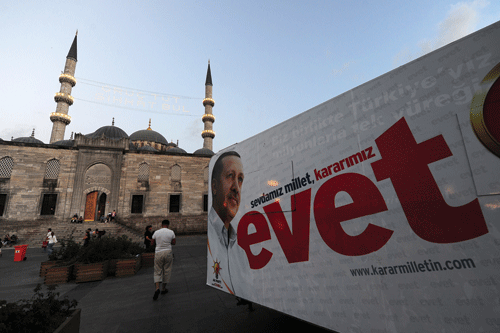
Campaigning for this month’s referendum on constitutional reform in Turkey has not only aroused the expected political passions, but also reduced an Istanbul bride to tears on her wedding day.

If the proposals are approved, Parliament for the first time will be involved in appointing members of the Constitutional Court. Three of the 17 members would be elected by a parliamentary majority, effectively allowing the ruling Justice and Development Party (AKP) to select candidates.

The AKP sees the Constitutional Court as an elitist, undemocratic hangover from the days of military coups. The party’s spokesmen say that reforms will modernize the judicial system and bring the country into line with European Union recommendations. Anything that helps Turkey’s tortuous accession to the EU must be a good thing, they argue. Well, not quite, according to referendum opponents, who come from almost every quarter except the AKP.

Kemal K?l?çdaro?lu, leader of the Republican People’s Party (CHP), argues that a two-thirds majority should be mandated since this would broaden the parliamentary views required to elect a member of the court. He is also concerned that the opportunity has been missed to remove the Minister of Justice from the Supreme Board of Judges and Prosecutors, which would emphasize the separation of powers between politicians and the judiciary.

But more important than any high-flown political philosophy is one of few things shared by both the AKP and the CHP — deep mutual mistrust. The AKP could correctly point to the use of the Constitutional Court by the opposition as a tool to stymie moves that it doesn’t like but is unable to stop through democratic parliamentary means, such as the election of President Abdullah Gül. The opposition, meanwhile, suspects the AKP of having ulterior motives.

The AKP controls parliament and the presidency, leaving only the Constitutional Court free from its direct influence. In 2008, the court considered imposing a five-year exclusion from politics of Prime Minister Recep Tayyip Erdo?an, Gül and around 70 AKP members of parliament for Islamic activity incompatible with the constitution. The verdict was little more than a finger-wagging but it increased the AKP’s mistrust of the court, whose membership it now wants to broaden.

Voters are split down the middle. An opinion poll last month said 50.9 percent are opposed to the reforms, with 49.1 percent in favor — a marginal increase in the ‘anti’ vote from a poll conducted in July.

The referendum will be a harbinger for next year’s parliamentary polls, so winning has a huge secondary significance. But, according to Hurriyet Daily News, that clearly was not on the mind of Fatma Ormanc? last month. Despite being head of the AKP’s Women’s Branch in Beykoz, a district of Istanbul, Ormanc? was on a day off from politics when local mayor Yücel Çelikbilek performed her son’s wedding ceremony.

Çelikbilek, also an AKP supporter, received the traditional three replies of “evet” (yes) from the bride and groom, before adding: “I expect you to say ‘yes’ on September 12, too.” The bride’s father squared up to the mayor to complain about turning his daughter’s wedding into a political meeting. At one point, wedding guests intervened to keep the dispute from escalating into a fight. Even Ormanc? was not happy with the mayor’s political ad lib (she was also furious with the behavior of her son’s new father-in-law.)

The near-brawl in Beykoz followed a more peaceful nuptial political stunt 24 hours earlier in the distinctly secular confines of Izmir on the Aegean coast. Ediz Tat?, son of a local CHP mayor, and his bride, Vildan Sever, opted to say ‘I accept’ instead of the ‘evet’ increasingly visible on AKP supporters’ baseball caps.

Deniz Baykal, former head of the CHP and a fierce advocate of a ‘no’ vote, praised the couple’s refusal to say ‘yes’, even to each other.

A lawyer said the ceremony was binding as no law dictates brides and grooms must use the word “evet”. ?lkhan Elçin was quoted in Hurriyet as saying: “Marriage depends on being in front of a registrar, signing the book and expressing that you want to marry in an open way that everyone can understand.”

Marriages may be agreed to in an “open way that everyone can understand,” but that’s more than can be said for the upcoming referendum.

PETER GRIMSDITCH is Executive’s

Istanbul correspondent
September 3, 2010 0 comments
0 FacebookTwitterPinterestEmail
Comment

India opens up to Iran

by Gareth Smith September 3, 2010
written by Gareth Smith

As President Barack Obama struggles for direction in Afghanistan, the prospect of reconciliation between the United States-backed government of Hamid Karzai and Taliban members has concentrated minds not just in Pakistan, which backs the idea, but also in Tehran and New Delhi. Iran’s deputy foreign minister, visiting New Delhi in early August said the two countries’ views on Afghanistan were “close.”

India is skeptical over Tehran’s desire to phase out US-led Western troops, but both countries want a stable, strong government in Kabul that can contain the Taliban. Iran and India have been wary of Sunni militants in Afghanistan since the US and its Saudi and Pakistani allies fostered a “holy war” against Soviet secularism in the 1980s. But Iranian ministerial visits to India in July and August focused not just on cooperation over Afghanistan, but on also improving economic links.

Iran and India have complimentary energy interests: India, which hopes for a sustained 8 to 10 percent growth despite meager energy resources, has long eyed Iran’s substantial oil and gas reserves — each the world’s second largest. It already imports around 14 percent of its crude from Iran, worth $11 billion annually. Such signs of trade and partnership go down like a lead balloon in Washington, which is pushing for greater isolation of Iran over its nuclear program. Back in 2006, Washington warned it would end nuclear co-operation with India if New Delhi did not vote in the International Atomic Energy Agency to refer Iran to the United Nations Security Council.  Since then, India has reluctantly followed the US lead, despite domestic criticism. Pressure from Washington has intensified under Obama, but so has Indian disquiet.

 Anticipating the latest US sanctions targeting gasoline supplies to Iran, the Indian private sector group Reliance Industries ended sales last year. But this summer New Delhi resumed talks with Tehran over the ambitious “peace pipeline.”  This project had been bantered about for the past decade, though India had dragged its feet under US pressure, pricing disagreements and worries over the transit route through Pakistan. In March the project morphed into an Iranian-Pakistani pipeline scheduled to pump at least 7.7 billion cubic meters (bcm) of gas each year from 2015 to 2040. Renewed talks to extend the pipeline to India show New Delhi is still hungry for what Iran claims would be 55 bcm of natural gas annually.

In return, Iran wants Indian investment in its vast but undeveloped South Pars gas field, and has targeted the state-owned Oil and Natural Gas Corporation Videsh (OVL) and the privately owned Hinduja group. Short of capital thanks to Western sanctions, Tehran needs some $200 billion to increase gas production from 0.6 bcm per day to 1 bcm by 2014. In August Iran stressed its desire to boost bilateral trade between the two countries from its current $15 billion, emphasizing India’s role in developing Chabahar port in Iran’s Sistan-Baluchestan province, which New Delhi sees as a major trade route that bypasses Pakistan into Afghanistan and central Asia. Iran seeks to raise the port’s annual capacity from two million to 12 million tons.

Chabahar is probably now the litmus test of Indian-Iranian relations, as Tehran may link Indian participation to wider co-operation. New Delhi has already helped finance a highway from Chabahar to Milak, on the Afghan border, where there is a crossing to Zaranj, in Afghanistan, to which India has laid a 213-km road from Dilaram, a major Afghan transport hub.

India is keen to develop the potential of this route. There is even speculation over an undersea gas pipeline to India, bypassing Pakistan, to supply Iranian and Turkmen gas.  Fresh Indian investment into Iran may irritate the US, but New Delhi cannot ignore new trade patterns in central Asia that are giving China access to Siberian timber, Mongolian iron ore, Kazakh oil, Turkmen natural gas and Afghan copper through roads, railways, pipelines and the Pakistani deep-sea port of Gwadar.

Gwadar, constructed with Chinese assistance and just 72 kilometers from the Iranian border, gives Beijing an economic edge over India and a military vantage point to monitor the US navy in the Persian Gulf and the Indian navy in the Arabian Sea.

Without access to Iranian and Turkmen gas, India will be short of energy. Hence New Delhi has reiterated its support for diplomacy over Tehran’s nuclear program. How all this squares with tighter US sanctions — much less US or Israeli air-strikes — remains to be seen.

GARETH SMYTH is the former Tehran correspondent for the Financial Times

September 3, 2010 0 comments
0 FacebookTwitterPinterestEmail
Society

Risk it

by Emma Cosgrove September 3, 2010
written by Emma Cosgrove

Beirut has the unique ability to bend, shape and mold brand identity to fit its flamboyant clientele. When Hermes opened it doors in Beirut Souks, the brand’s tradition and timelessness suggested that it might not be as susceptible to the same affection for flash to which so many fall prey. But, once again, the city proved that few are immune to its call to opulent arms.

Never mind that the abounding platform stilettos sunk straight into the grassy sod laid especially for the opening on Hermes’s corner of Marfaa Street. Never mind that the generator powering the crane swinging an angelic dancer above the crowd was so loud that it drowned out the music played for the spectacle. And never mind that the restricted entrance and exit, due to Prime Minster Hariri’s presence, meant that the tree-enclosed soiree was packed like a can of extremely expensive sardines.

The July 30 opening of the Hermes boutique was an example of brazen one-upmanship that we all should have expected.

But the sheer scale of it all, the extravagance, the excess, and the obvious staggering cost begs the question: what happens after the party? When the guests have gone and Hermes’s executives go home to Paris, who will be minding the store and what happens if the worst comes around to downtown Beirut again?

Why would Hermes, and all the other luxury brands invading downtown of late, take the risk of having to close a store if Lebanon’s cancerous instability comes out of remission?

They do it because the risk is not their’s to take.

Most of Beirut’s monobrand luxury boutiques are franchises, Hermes included. This means the location, and entire inventory of the store, is financed by the local franchise partner. Every item is bought and paid for before it hits the floor, which is why many developing markets, often being franchise-heavy, feature products at a significant mark-up.

So if any of downtown’s gleaming luxury palaces were forced to close their doors, it is local companies who would lose, with the brand escaping conflict with nothing more than a PR scratch. This is not to say that the embarrassment and public relations snafu of closing a store means nothing to an industry whose value is rooted in image. Luxury brands care what happens to their products, and especially their name.

On the day of the opening, Hermes International Chief Executive Officer Patrick Thomas told Executive that he chose Galop SAL as Hermes’s franchise partner out of many interested parties for its “long term” vision and singular focus. Michele Garzouzi, Galop’s president, said that she was not interested in offering, as many regional luxury franchises do, a smattering of trendy items and iconic pieces. She offered the full line and it nearly sold out in the first weekend.

And though her savvy buying strategy and dedication to Hermes — Galop’s only luxury brand — is proof of her long-term thinking, she has no contingency plan for Hermes’s fate if a conflict should crop up.

“You cannot plan for it really,” said Garzouzi. “When you have such an unstable situation you can’t really have a ‘Plan B’.”

Garzouzi is not alone in knocking on wood and hoping for the best; everyone hopes Lebanon will have no need for contingencies. But frankly, we should all stop being so grateful that these luxury titans are opening in our tailor-made shopping havens. We’re spending the money and taking all the risk, so bring on the absurdly extravagant parties downtown — we’ve earned them.


September 3, 2010 0 comments
0 FacebookTwitterPinterestEmail
Society

The East Moves West

by Paul Cochrane September 3, 2010
written by Paul Cochrane

Labeling this region as the “Middle East” or the lesser used “Near East,” is standard practice in the West, but the region can equally be called “West Asia,” the opposite end of a vast landmass that spreads from Vladivostok and Shanghai all the way to the Bosporus and the Suez Canal. This designation makes sense given the area’s historic ties and the ancient Silk Road trading routes.

Today there is a new Silk Road, with flourishing two-way traffic between the rest of Asia and the continent’s eastern end, particularly Gulf Cooperation Council (GCC) countries and Iran. In Geoffrey Kemp’s book “The East Moves West,” he sets out the case for this burgeoning relationship and where it is likely to go. Kemp, an American foreign-affairs think-tank director, adeptly steers the reader through the ties that bind Asia together, from the geo-strategic importance of Central Asia to the big players: China, India, Pakistan, Japan and South Korea, covering economics, energy, politics, military ties and infrastructure projects. 

It is a relationship that is clearly centered on energy supplies, with some 40 percent of China’s oil coming from the GCC, India receiving 45 percent of its oil from the Middle East, and Japan reliant on the region for 90 percent of its oil. Such reliance on the region’s resources has resulted in mutual dependence.

With Eastern economies in ascendancy while the West hobbles along, this relationship is set to flourish, with significant economic and political ramifications. Energy dependence on Iran, for instance, has been crucial in allowing Tehran to survive the economic sanctions imposed by America and Europe to curb its nuclear program.

The big question, as Kemp sees it, is whether Eastern Asia’s role in the region will grow beyond the traditional buyer-seller relationship. Economically, it has started to change over the past five years, with Asian countries inking contracts worth $500 billion for infrastructure projects in the Middle East, while the GCC has invested more than $250 billion in East and South East Asia. Both East and West Asia want more.

Iran and Saudi Arabia have adopted a “look east” approach for market growth, while New Delhi considers the GCC, to quote India’s former commerce minister, “as part and parcel of India’s economic neighborhood.” The statistics only reinforce this. For India, the economic relationship with the GCC is more important than with the European Union, the Association of Southeast Asian Nations and the United States, totaling $86.9 billion (excluding oil) in 2008-2009.

The UAE is India’s jewel in the GCC crown, the country’s second biggest export destination and the Emirates’ largest importer, accounting for a third of its trade in the Middle East. With Indians making up 33 percent of the UAE’s population and 50 percent of its workforce (of which 25 percent are unskilled workers, 50 percent semi-skilled and 25 percent professionals), it’s no wonder the UAE labor minister said in 2007: “God forbid something happens between us and India and they say, ‘Please, we want all our Indians to go home’… our airports would shut down, our streets, construction…”

With the US flailing in Iraq and Afghanistan and its credibility shot in much of Asia, East Asia seems set to be the new player at the table. But so far the Asian nations have largely refrained from the political arena of the region’s western extremity.

As Kemp notes: “How long they can sustain their hands-off approach is questionable if…they get drawn into the messiness of Middle East politics at a time when the US becomes disillusioned by the burdens of hegemony.”

There are a lot of “ifs” in the book, but given all the certainties proclaimed by Washington of late in its future prognosis for the region, Kemp refreshingly gives plenty of room for thought about the potentials of the new Silk Road.


September 3, 2010 0 comments
0 FacebookTwitterPinterestEmail
Society

Putting the ‘sport‘ back into SUV

by Executive Staff September 3, 2010
written by Executive Staff

Ever since the Porsche Cayenne debuted in 2003, it has faced a tough question: how to hold its niche in the luxury SUV market without jeopardizing the character of the Porsche brand.

Most critics and drivers agree that in terms of drivability and comfort, the Cayenne succeeded in meeting the public’s expectations. But seven years later, even though the Cayenne is now one of the company’s top-selling vehicles it still stands out as something of an anomaly in the Porsche family — like the one black sheep in a herd — and the company is looking for ways to bring it deeper into the fold. The new generation of Cayennes that entered the market this summer shows how Porsche plans to streamline this transition.

The bodywork of the Cayenne and Cayenne S Tiptronic, Cayenne Turbo, Cayenne Diesel and Cayenne S Hybrid all show noticeable development and look more in line with the Panamera — Porsche’s first four-door luxury Sedan — than their progenitors in the Cayenne line. The bodywork has taken a more forward-leaning, muscular design, incorporating elements of a sports car into what has otherwise been a utilitarian vehicle. 

But the changes to this new generation of Cayennes are not just cosmetic — far from it, in fact. The specs for the new Cayenne read like a user’s manual for the Hadron Collider: “Tiptronic S automatic transmission,” “Auto Start Stop,” “recuperation of the on-board network” and “variable overrun cut-off” are but a few of the highfalutin features the Cayenne boasts.

So what does this complex jargon mean when it comes to performance? In industry terms, 23 percent higher fuel efficiency than that of earlier generations of Cayennes. To put it colloquially: more bang for your buck. Like a lot of auto manufacturers these days, Porsche has enrolled itself in a serious weight-loss regime. They’re trimming excess mass wherever it can be found, shifting to lighter-weight materials — carbon fiber in particular — and pioneering intelligent technology to capture energy, conserve expenditure and transfer power to rechargeable sources. That process has shaved the new generation of Cayennes down by almost 200 kilos.

Easy on the gas

Fuel economy is particularly an issue as Europe prepares to begin enforcing stringent CO2 emissions caps and the United States mulls over its own fuel economy standards. Porsche’s response to this is the upcoming Cayenne S. Hybrid, the company’s first fusion gas-electric vehicle. In terms of mechanics, the company had been at pains to draw attention to its Tiptronic 8-Speed Automatic transmission, available in two of the new Cayenne models. The tiptronic transmission operates in generally the same manner as an ordinary automatic transmission, but offers the driver a manual override feature to force-change gears on their own. This gives the driver control over faster acceleration, engine breaking, gear holding going in and out of curves, downshifting before passing or early upshifting for cruising. Veteran Porsche drivers may wonder why the new Cayennes don’t include the dual-clutch transmission of the Carrera and Panamera, which has proven a favorite feature among drivers; the company claims that the dual clutch module does not fit size-wise with the Cayenne’s mechanical make-up.

Tardis effect

The new Cayennes are only slightly larger, but there’s a noticeable difference in space from inside the vehicle. A number of subtle interior adjustments, including a slight tip to the angle of the passenger seats, gives a little more legroom in the already ample interior.

Do the new generations fundamentally redefine the model’s personality? No, probably not. But they do suggest a clear direction that the Cayenne, and Porsche in general, is taking. The new line is increasingly efficient, and has taken notes from other Porsches from both ends of the spectrum, adding subtly to drivability, luxury and power. While priority has clearly been given to a higher standard of fuel economy, it is also clear that Porsche doesn’t want to lose touch with its sports car roots, and is moving forward with a clear vision of a unified image for all its cars, whether they be SUV, sedan or sport.


September 3, 2010 0 comments
0 FacebookTwitterPinterestEmail
  • 1
  • …
  • 408
  • 409
  • 410
  • 411
  • 412
  • …
  • 686

Latest Cover

About us

Since its first edition emerged on the newsstands in 1999, Executive Magazine has been dedicated to providing its readers with the most up-to-date local and regional business news. Executive is a monthly business magazine that offers readers in-depth analyses on the Lebanese world of commerce, covering all the major sectors – from banking, finance, and insurance to technology, tourism, hospitality, media, and retail.

  • Donate
  • Our Purpose
  • Contact Us

Sign up for our newsletter

[contact-form-7 id=”27812″ title=”FooterSubscription”]

  • Facebook
  • Twitter
  • Instagram
  • Linkedin
  • Youtube
Executive Magazine
  • ISSUES
    • Current Issue
    • Past issues
  • BUSINESS
  • ECONOMICS & POLICY
  • OPINION
  • SPECIAL REPORTS
  • EXECUTIVE TALKS
  • MOVEMENTS
    • Change the image
    • Cannes lions
    • Transparency & accountability
    • ECONOMIC ROADMAP
    • Say No to Corruption
    • The Lebanon media development initiative
    • LPSN Policy Asks
    • Advocating the preservation of deposits
  • JOIN US
    • Join our movement
    • Attend our events
    • Receive updates
    • Connect with us
  • DONATE