• Donate
  • Our Purpose
  • Contact Us
Executive Magazine
  • ISSUES
    • Current Issue
    • Past issues
  • BUSINESS
  • ECONOMICS & POLICY
  • OPINION
  • SPECIAL REPORTS
  • EXECUTIVE TALKS
  • MOVEMENTS
    • Change the image
    • Cannes lions
    • Transparency & accountability
    • ECONOMIC ROADMAP
    • Say No to Corruption
    • The Lebanon media development initiative
    • LPSN Policy Asks
    • Advocating the preservation of deposits
  • JOIN US
    • Join our movement
    • Attend our events
    • Receive updates
    • Connect with us
  • DONATE
Finance

Regional equity markets

by Executive Editors July 23, 2010
written by Executive Editors

Beirut SE  

Current year high: 1,200.49    Current year low: 991.49
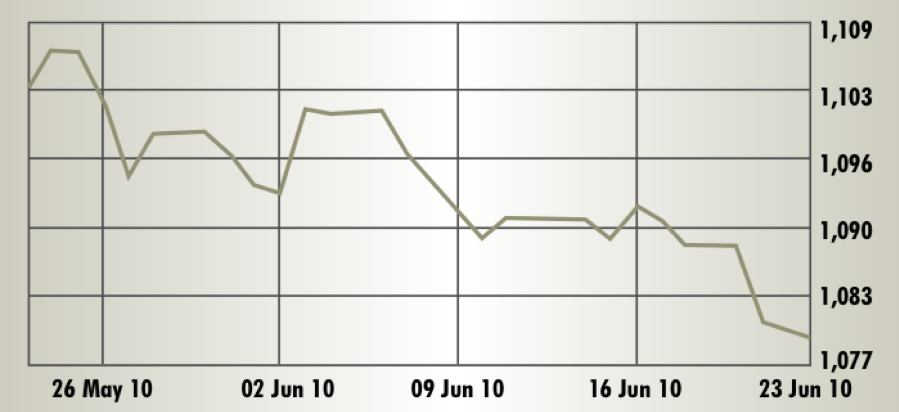
>  Review period: Closed – June 22 at 1079.28 Points          Period Change: -1.5%

The MSCI Lebanon index trended lower in a not overly dramatic fashion in the June 2010 review period, leaving all the excitement for Lebanon’s army of devoted football fans. When compared with its high of 1,180.98 points for the first half of 2010, the index softened by just over 100 points. However, the banking sector could show off another victory with a 31% y-o-y rise in its Q1 2010 aggregate net profit of the top 12 lenders. Market cap leader Solidere scored a goal of $189 million net profit last year in a stable performance.

Amman SE  

Current year high: 2,744.07                Current year low: 2,320.14
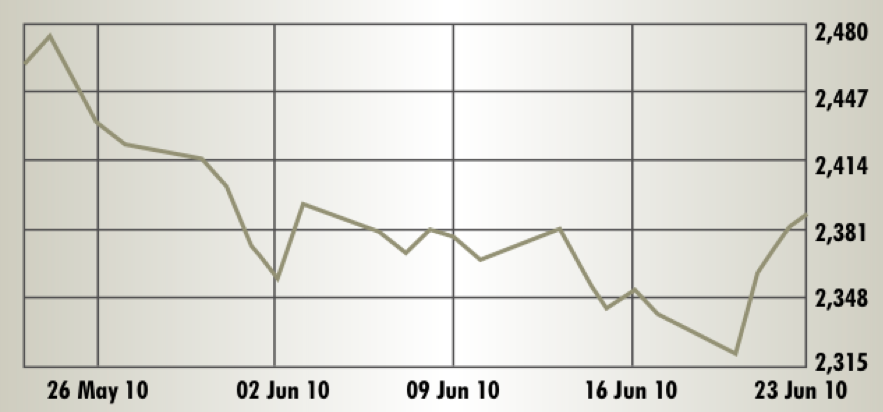
> Review period: Closed – June 23 at 2,388.94 points          Period Change: -0.5%

Having just passed across a multi-year low of 2,320.14 on June 20, the best wish for the Amman Stock Exchange may be for this to have been rock-bottom for the market and for new stamina to appear after the disappointing first-half. Sadly, endurance training seemed to be of no help to the insurance sector, which dropped 15.2% at the bottom of market trends. Banking, industrial, and services sectors, by contrast, traded range bound with the ASE general index and banking even achieved a tick into positive territory, starting from June 21.

Abu Dhabi SM  

Current year high: 3,239.74                Current year low: 2,467.04
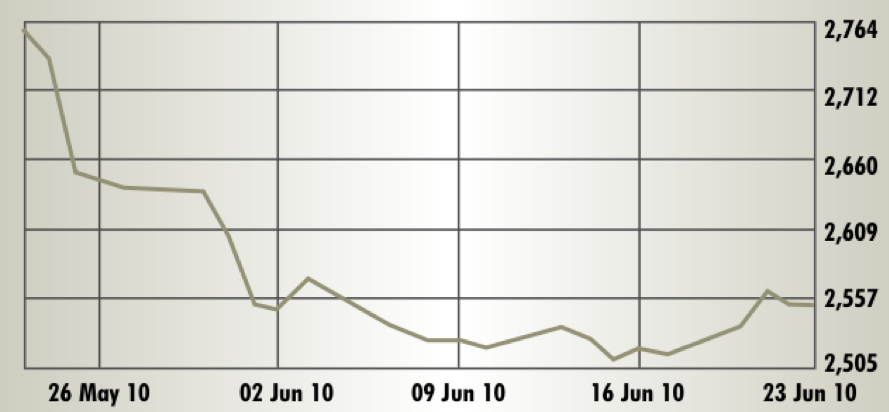
> Review period: Closed – June 23 at 2,551.39 Points                      Period Change: -2.0%

Abu Dhabi’s exchange has dropped a sizeable 7% from the start of 2010, though this decline is only half as steep as the plunge Dubai’s DFM took over the same period. The ADX exhibited some noticeable volatility in June and sector indices fluctuated in uncoordinated trends. The only sector index to end the period in positive territory, however, was the industrial index. Market cap leader Etisalat weakened 2.4% as Methaq Takaful and Gulf Livestock were beaten down 28.4% and 26.8%, respectively. The best gainer was Finance House, up 18.6%. 

Dubai FM  

Current year high: 2,373.37                Current year low: 1,487.93
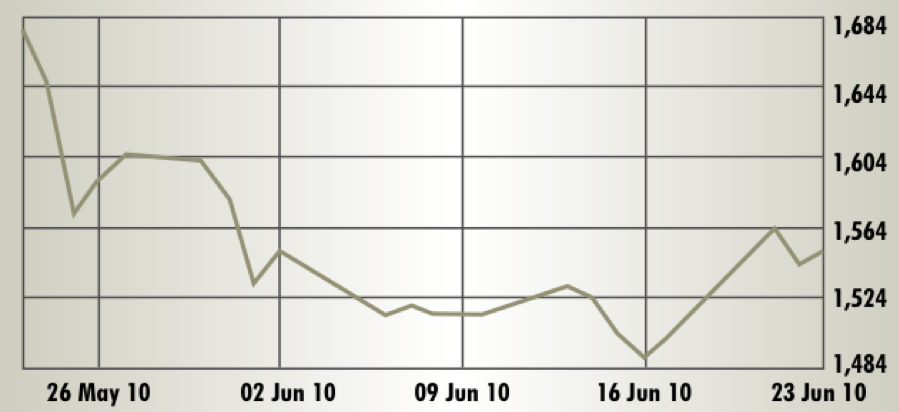
> Review period: Closed – June 23 at 1551.19 Points           Period Change: -1.8%

The ‘lord of the dip’ award goes hands-down to the Dubai Financial Market for the first half 2010. With the halfway point for 2010 quickly approaching, the DFM was down 14% for the year to date at its June 23 close and danced around 1,500 – levels last seen in February 2009. No vigor, no football competition, no cultural happening seemed to energize the DFM, where a 10.7% climb of Aramex stock was the only upward outlier. The vast majority of shares tended to the red, as did the sector indices, except for transport. 

Kuwait SE  

Current year high: 8,140.20                Current year low: 6,528.60
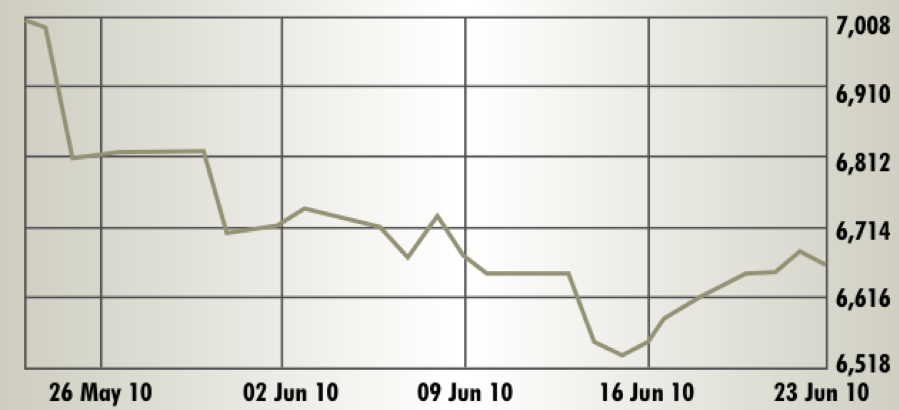
> Review period: Closed – June 23 at 6,653.00 Points          Period Change: -0.7%

The fact that the Kuwait Stock Exchange closed less than one percent down in the review period cannot soften the harsh realities of the bourse’s massive slide in May, which didn’t stop until the index hit a 15-month low of 6,528 on June 15. It remains to be seen if this will be rock bottom for 2010, or if investor nerves have worn so thin that share price performance in Kuwait will fall further. Banking and industry were better than the general index; real estate and investment underperformed.

Saudi Arabia SE  

Current year high: 6,929.40                Current year low: 5,407.31
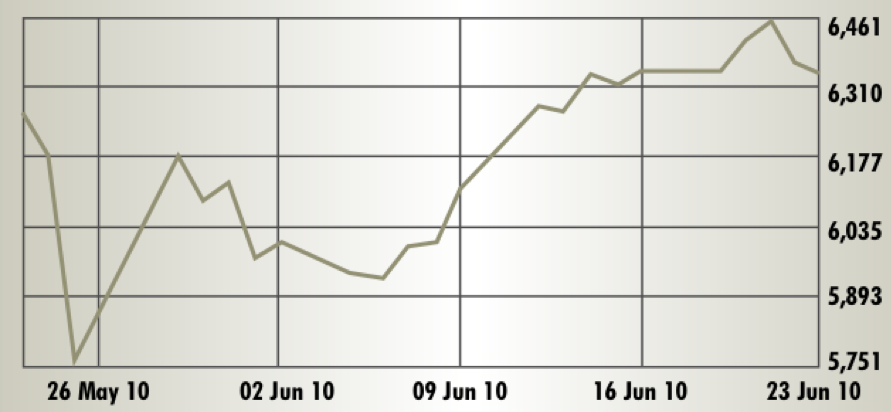
> Review period: Closed – June 23 at 6,343.47 Points          Period Change: 3.6%

After its immune system took a hit from various contagions in the second half of May, the Saudi Stock Exchange resurged in June, in a manner of speaking. Compared to its GCC peers, the SSE index was second best performer in the review period and for the year to date it is still the best student in the GCC securities college, with a 3.6% climb. Most SSE sub-indices moved range-bound with the TASI in the review period; a news-driven 23.1% spike in the Energy and Utilities index was the upward exception.

Muscat SM  

Current year high: 6,933.75                Current year low: 5,263.94
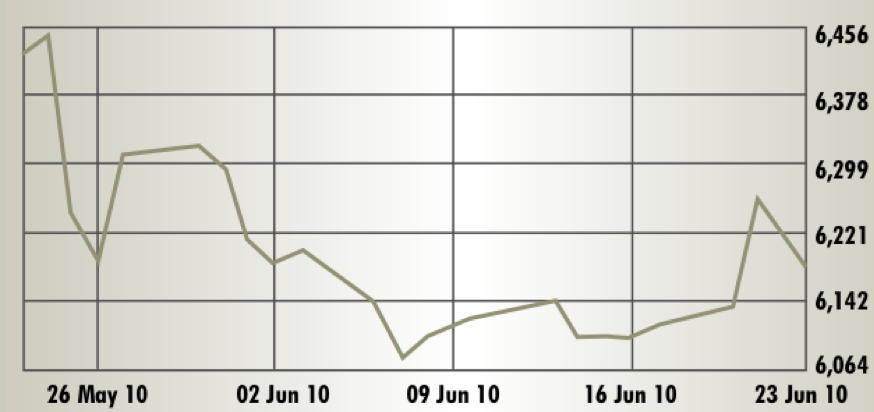
> Review period: Closed – June 23 at 6,173.33 Points          Period Change: -1.3%

The Muscat Securities Market had more losers than winners in the review period and the general index seemed to be finding its feet after two months of down pressures. While the industrial sub-index was the June market’s consistent best performer, banking had the most erratic ride. Brokerage Financial Services Co was the MSM’s best individual performer in June and shot up 19.6%, reversing a comparable drop it had suffered in May. National Mineral Water Co found no such mercy, dropping 21.6% from June 1 to 23.

Bahrain SE  

Current year high: 1,613.01                Current year low: 1,390.81
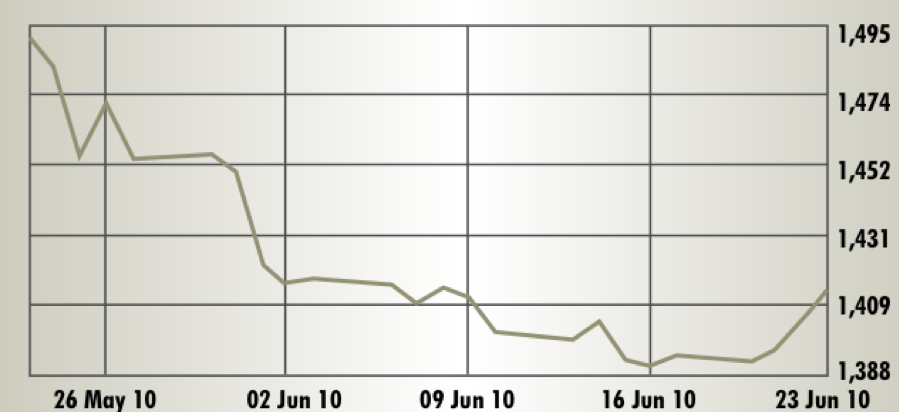
> Review period: Closed – June 23 at 1,413.19 Points          Period Change: -2.6%

Although the BSE’s bow beneath the 1,400 point line between June 15 and June 20 was merely a six-month low, and although the year-to-date performance of minus 3.1% is only the fourth worst in the seven GCC security markets, Bahrain’s investors will still be hoping the second half of 2010 bestows more blessings than the first.  While Esterad Investment fell 28.3% in the review period, a gain of 2.63% was made by Al Salam Bank – Bahrain, the period’s best performer.

Doha SM  

Current year high: 7,801.33                Current year low: 5,731.30
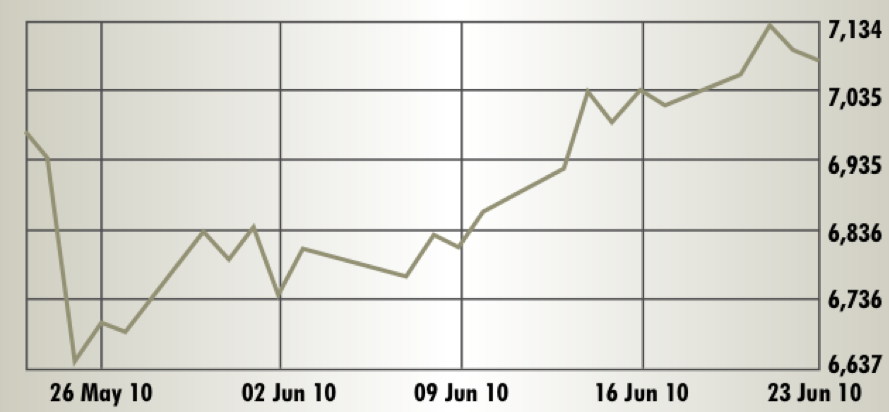
> Review period: Closed – June 23 at 7,072.08 Points          Period Change: 4.2%

Though the Gulf region has no team in the World Cup to bring home glory,  the Qatar Exchange took this month’s trophy for greatest market vigor. After its epic 1,250-point slide between April 13 and May 25, the ensuing gains of June made for a picture perfect V-shaped performance, albeit a V that is still rather short on the upside. The QE’s four sector indices all were positive, with insurance coming out on top as best performer. Was it because the country iterated another energetic bid to host a World Cup (2022)?  

Tunis SE  

Current year high: 4,772.39                Current year low: 3,337.48
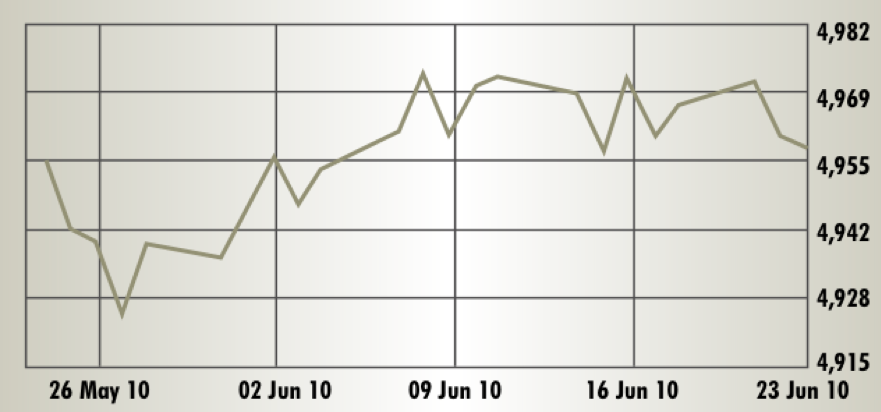
> Review period: Closed – June 23 at 4,957.85 Points          Period Change: 0.4%

Minimal volatility and sideways trading at the ceiling of historic performance was the game on the Tunisian Exchange. The period close represented a tiny retreat, by not even 15 points, from a new index peak of 4971.35, which was scaled on June 21. The market reported a smashing success in the initial public offering of cement maker Carthage Cement. The $89 million share offering for 49.8% in the company’s stock was oversubscribed more than 13 times and the stock debuted on June 22 with a first-day change of 26.3% when compared with the issue price.

Casablanca SE  

Current year high: 12,457.59              Current year low: 9,997.56
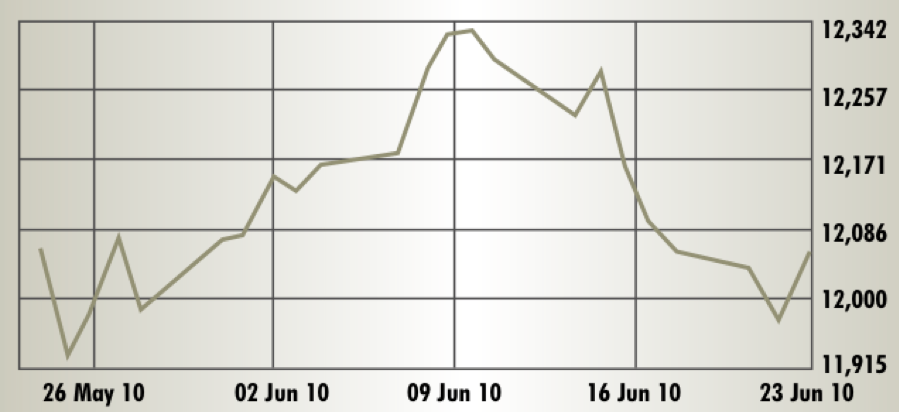
> Review period: Closed – June 23 at 12,055.36 Points        Period Change: -0.1%

The June 2010 match between bulls and bears on the Casablanca Stock Exchange was a draw. As the impact of the downturn in most global markets in late May caused the MASI to correct from record highs of almost 12,500 points, the optimists dominated on the pitch in the first eight sessions of the review period, but the bears came back in the second eight sessions for a flat net balance. Market cap leader Maroc Telecom advanced 4.7%, and leading bank Attijariwafa dropped 1.8%.  

Egypt CASE  

Current year high: 7,603.04                Current year low: 5,229.40
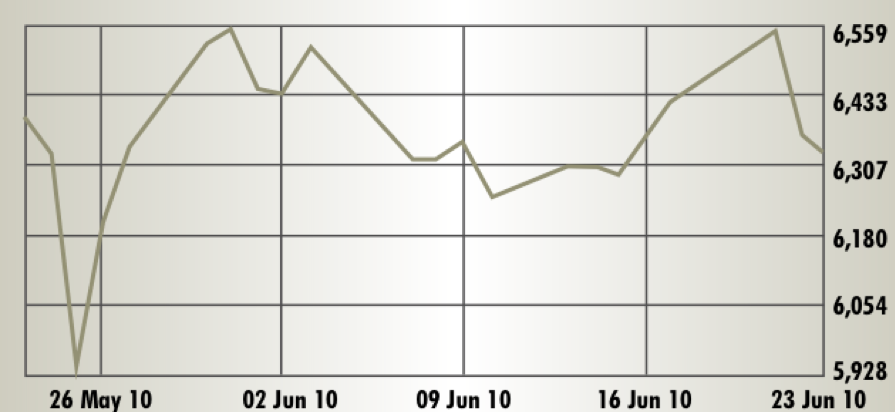
> Review period: Closed – June 23 at 6,319.00 Points                      Period Change: -3.5%

The highest volatility in North African markets marked the flow of trade on the Egyptian Stock Exchange in the June 2010 review period. After a massive drop and sharp rebound between May 18 and 31 into the mid 6,500 range, the EGX 30 fell more than 300 points to June 10, recovered by almost exactly the same point score, and weakened again. Telecom Egypt managed a flat performance but Orascom Telecom lost 14.7% as analysts questioned its planned divestment from Algeria.
July 23, 2010 0 comments
0 FacebookTwitterPinterestEmail
Feature

A species sinks

by Executive Editors July 17, 2010
written by Executive Editors

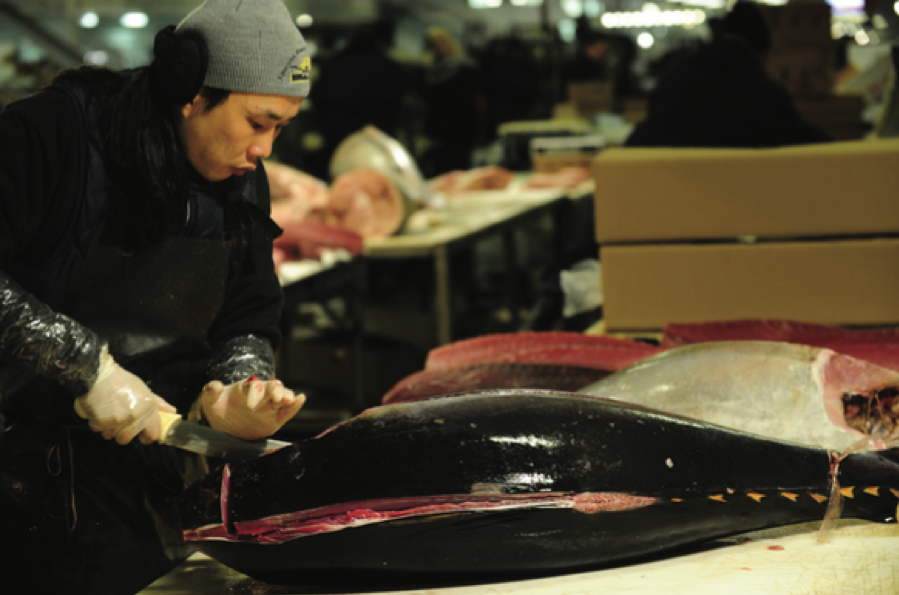
Blame it on the sushi. The rising popularity of the Japanese delicacy has brought the northern bluefin tuna to the brink of extinction, while at the same time profoundly altering the dynamics of fishing in the Mediterranean.

On June 9, the European Commission closed the Mediterranean bluefin tuna season, which had opened just three weeks earlier, because the annual quota had already been caught — predominantly by the ultra-efficient industrial fishing vessels sailed by Spain and France. At 13,500 tonnes, the 2010 quota was already set 40 percent lower than 2009 — a concession to environmental organizations, which had argued for a complete ban on bluefin fishing this year. For them, the European Union’s decision to halt bluefin fishing is too little, too late.

The Mediterranean’s stock of bluefin has shrunk to less than 15 percent of its original size due to overfishing.

“Bluefin tuna must be given a break,” said Sergi Tudela, head of fisheries at the World Wildlife Federation — Mediterranean. He advocates a global trade ban as the only way to ensure a sustainable tuna fishing industry in the Mediterranean. But the latest fishing ban applies only to EU countries — non-European fishermen will continue to fish the waters. Greenpeace believes that European boats will circumvent the ban by flying non-EU flags and gravitating to territorial waters off the North African coast, which are harder to regulate. 

Japan, which receives around 80 percent of the world’s tuna catch, has repeatedly moved to block an international tuna trade ban by the United Nations. Similarly, few Mediterranean countries are volunteering to give up a lucrative source of income, as tuna prices have shot up in recent years with the global popularity of sushi. A ton of the fish now sells for $1,000, up from $300 in 2005.

On the other side of the coin, declining supplies have had a deep impact on local fishing communities, especially in North Africa, where fishermen employ smaller vessels and outdated technology. In Morocco, where fishing is a pillar of the agricultural industry, tuna catches dropped 96 percent between 2006 and 2007, from 8,800 tons to 343 tons, leading to the discontinuation of local tinned tuna brand Tam. 

Some North African countries have increased measures to protect their dwindling fish resources. In April 2010, Tunisia passed a bill aimed at preventing illegal fishing in its territorial waters, where a tuna recovery program was initiated in the summer of 2009. Foreigners found fishing in these waters will be fined up to 300,000 dinars ($196,860), while Tunisian fisherman will be penalized up to 100,000 dinars ($65,620).

However, Africa remains a weak spot for the prevention of bluefin exploitation. The Gulf of Sidra off Libya, previously the largest breeding ground for Mediterranean bluefin, has been identified as the greatest site of illegal fishing in recent years, and yields approximately 40 percent of total bluefin catch.

While Libya has relatively scant fishing production itself, the country sells major European companies access to these waters. As a result, it has been one of the most vocal opponents of a bluefin fishing ban, which it believes disadvantages the developing nations that rely on the trade. 

At the Convention on International Trade in Endangered Species held in March 2010, Libya’s delegate forced a vote on the matter before any debate had taken place. The result was 68 votes against and 20 for, with 30 abstentions, clearly demonstrating that “governments are not ready to adopt trade bans as a way to protect species,” a spokesman for the UN told international press. In the minds of environmentalists, this nearsightedness has sealed the fate of the bluefin tuna. 

July 17, 2010 0 comments
0 FacebookTwitterPinterestEmail
Economics & Policy

For your information

by Executive Editors July 11, 2010
written by Executive Editors

Inking free trade

Lebanon, Syria, Jordan and Turkey came to an agreement June 10 to allow the free flow of goods between the four nations. Under the deal a “Cooperation Council” will be set up to tackle long-term strategic planning and implement a free movement zone. The agreement also included the lifting of visa obligations for individuals traveling between the countries. The deal was agreed by the foreign ministers of each country on the sides of a Turkish-Arab cooperation conference in Istanbul. The statement issued also stated that Turkey and Lebanon were required to complete a bilateral agreement before the multilateral agreement could go ahead. Three days later Lebanon and Syria also inked 15 memorandums and two executive programs covering the environment, consumer protection, agriculture, tourism, culture, justice, education, higher education, economics and vocational training.

Budget steps closer to approval

After several months of delays and almost a full five months past the constitutionally mandated deadline for Parliament to ratify a national budget, the Council of Ministers approved a version of the budget that was then passed on to Parliament for deliberation. If passed, the budget will be the first the country has seen since 2005. The draft budget was first submitted in April by the finance ministry and has been heavily debated by the opposition, specifically Telecom Minister Charbel Nahas and Speaker of Parliament Nabih Berri, who raised concerns about off-budget items and budget increases, respectively.  The proposal itself contained a total deficit of $4.3 billion based on a projection of  $9.2 billion in revenues — an 8.6 percent rise on 2009 — and $13.4 billion in expenditures. A total of $4.3 billion will be spent on servicing Lebanon’s public debt, which reached $51.48 at the end of April according to the latest available figures from the Association of Banks in Lebanon, constituting a year-on-year rise of 7.7 percent. The total debt at the end of the year according to the proposed budget is estimated to reach $55.18 billion, or a debt-to-GDP ratio of 147.47 percent, based on a estimated real growth of 4.5 percent and an inflation rate of 3.7 percent. According to the Central Administration for Statistics, Lebanon’s consumer price index, the primary indicator of inflation, had risen by 4.9 percent year-on-year as of the end of May.

A new plan for power

The Council of Ministers, Lebanon’s cabinet, approved a proposal on June 21 to overhaul and reform the country’s decrepit electricity sector. The plan, originally proposed by Minister of Energy and Water Gebran Bassil in March, lays out a 10-point, four-year agenda to move Lebanon toward producing more electricity through cheaper and more environmentally friendly natural gas, as opposed to the current use of fuel oil. The plan aims to increase the country’s production capacity from the current 1,600 megawatts (MW) to 4,000 MW by 2014, and then to 5,000 MW in 2015.

By 2014 it is envisioned that the country will enjoy 24-hour electricity. As part of the plan, the loss-making sector should be breaking-even by 2014 and generate a profit the following year. This would be achieved through cost cutting measures associated with weaning off fuel oil, and increasing the tariff structure of Électricité du Liban (EDL), Lebanon’s publicly owned electricity provider. The strategy earmarks a total of $4.87 billion to boost production and will be funded by several sources: the Lebanese government ($1.55 billion), the private sector ($2.32 billion) and donor countries ($1 billion). However, for all of the elements of the plan to be implemented, Bassil notes that several decisions will need to be approved by himself, EDL, the cabinet and the Parliament.

According to the energy ministry, the Lebanese pay around $700 million to EDL every year and $1.4 billion towards the private generation of electricity.  “If we don’t decrease the debts after reducing the cost of generation, we would go to $650 million in 2014 as direct losses to the treasury,” said Bassil. Both the finance minister and the International Monetary Fund have also stated that they support an increase in the price of electricity, although Bassil acknowledged the poor and the productive sectors will probably have to be compensated in some way. The energy minister also stated that renewable energy will make up 12 percent of the energy portfolio by 2020, a target first announced by the prime minister at the 2009 United Nations Climate Change Conference in Copenhagen. He added that the high possibility of finding gas offshore was a major factor in deciding to transition to more natural gas production in the plan. A law to regulate the exploration of gas in the country was before the Council of Ministers as Executive went to press.

Broadband: almost there…

Lebanon’s telecom sector is set to receive a boost from the government’s broadband infrastructure project, the first phase of which Minister of Telecoms Charbel Nahas announced on June 15 will cost $66 million. A spokesman for the ministry confirmed, on June 22, that a request for proposals would be issued in a matter of days . In January the Minister estimated that the much-anticipated project would total $166 million, then revised that figure down to $92.9 million in April. In March, Executive cited telecommunications experts at the International Telecommunications Union, the United Nations agency for telecommunications, as stating that the project should cost no more than $40 million. Anders Lindblad, president of Ericsson in the Middle East, confirmed that the project would constitute the “highways” or the national fiber-optic backbone, but did not include the access layer — the final crucial link between telecommunications infrastructure and the user which is still being studied by the ministry. 

“This part [highways], I assume will be public sector and I think that is a sound decision because there is a lot of money going into [it],” added Lindblad.  Nahas estimated that the project would need another 12 months to be completed and stated that in the 2011 budget “there will be a displacement of the tax burden on the telecom price structure,” adding that $800 million of the approximately $1.2 billion transferred to the treasury from the telecom sector last year was in the form of taxes; in a $160 million accounting discrepancy, the finance ministry stated that the total transfer from telecoms was $1.36 billion.

Lebanon praised and chided

The International Monetary Fund has concluded their annual consultation mission with Lebanese policy makers, including the Minister of Finance Raya el- Hassan, Central Bank Governor Riad Salameh, President of the finance commission  Ibrahim Kanaan and others.  “If the trend continues, [real] growth could reach 8 percent or even a bit more,” said Andreas Bauer, mission chief for Lebanon at a press conference alongside Hassan and Salameh.  “We have to caution that despite the progress made the vulnerabilities in Lebanon are still very high,” added Bauer. “There has been little progress on the structural side to address some of the bottlenecks and to strengthen the economic institutions in Lebanon.” The mission identified two main challenges for the country: to manage the strong economy with caution to make sure potential risks such as high inflation do not materialize, and to implement long delayed reforms to ensure the sustainability of the current economic growth. 

The IMF later issued further recommendations that advised Banque du Liban (BDL), Lebanon’s central bank, to privatize its non-financial assets, including Middle Eastern Airlines and its real estate portfolio, to improve its financial balance. Bauer also cautioned that the rise in real estate prices, the sector’s expansion and the amount of credit allocated to it should be watched “carefully.”  Using the finance ministry’s latest gross domestic product estimate (year-end 2009) and the BDL’s latest available figures on loans to the sector (February 2010), total credit extended to real estate in Lebanon is equivalent to some 33 percent of the economy. Speaking with Executive recently, Central Bank Governor Riad Salameh revised upward his previous estimate, from May, that real estate constituted 18 percent of total loans in the country.  “It might be one third, in fact, of the loan portfolio but it does not represent more than 10 percent of the total balance sheet of the banks,” he said. “Therefore, [with] the liquidity being very high in the banking sector, you do not have a situation of leveraging and the risk of bubbles.”

July 11, 2010 0 comments
0 FacebookTwitterPinterestEmail
Real estate

For your information

by Executive Editors July 11, 2010
written by Executive Editors

Lebanon’s real estate sector forges ahead

Total real estate transactions in Lebanon increased 39.5 percent in the first five months of 2010 compared to the same period in 2009. In that time the average real estate sale value jumped 47.2 percent and the number of construction permits rose 53.7 percent, according to Bank Audi’s June real estate report. The greatest indicator of demand, said the report, was the doubling of total real estate sales over the five months — between 2004 and 2009, average growth for this period was 19.5 percent. Lebanese residents and expatriates made up 85 to 90 percent of total demand, while the amount of sales to non-Lebanese grew by 10.7 percent compared to last year, according to the General Directorate of Land Registry and Cadastre.  Housing loans added up to $3.1 billion, thus considerably helping Lebanese residents’ purchasing power, said the report, while noting that these loans take up only 2.5 percent of banks’ balance sheets in Lebanon.

Solidere rakes in record revenue

Solidere, Lebanon’s largest property developer, recorded record revenues for 2009, hitting $336 million last year, up 17.5 percent year-on-year, according to the latest figures released on June 21 by BLOMInvest, the investment arm of BLOM Bank. The number matched BLOMInvest’s expectation of $340 million for the year and was mainly driven by land sales, which made up 91 percent of revenues. Rental revenues increased from $22 million in 2008 to $27 million in 2009, and this year are expected to draw a greater proportion of rental income in line with the recent full opening of the Beirut Souks retail project. Gross income rose 13 percent to reach $234 million, while net income grew only 3 percent, totaling $189 million, compared to $183 million in 2008. Liquidity dropped to $114 million due to necessary dividend payments and payouts for new projects.

More space to grow

Construction permits issued in the first four months of this year covered 5.1 million square meters, a 56.5 percent expansion compared to the same period a year ago, said Albert Aoun, chief executive officer of International Fairs and Promotions, at the opening of the 15th edition of the Project Lebanon exhibition last month at BIEL. Aoun, whose firm organized the event, said in his speech that the booming real estate sector in the country has not been affected by the credit crisis. Project Lebanon showcased regional and international construction, building materials, equipment and technology firms and drew some 600 exhibitors – the largest number to date by a margin of nearly 25 percent.

Noor International’s big talk in the south

Noor International Holding announced in mid June plans to build a residential project of 74 homes and 444 apartment units in the southern district of Azza, 62 kilometers south of Beirut. If construction actually begins, this will be the first project in the south of the country for the Lebanese developer, which has opened an office in Nabatiyeh. Other recently announced Nour projects include the “Cedar Island” off the coast of Lebanon and the “Arab Star Islands” off the coast of Syria, intended to offer “luxury” living communities on artificially created islands. Neither project, however, has yet to progress much beyond blueprints on a page, despite the fanfare.

Egyptian and Syrian developers join forces

Egypt’s fourth largest developer by market value, Six of October Development and Investment (SODIC), will acquire 50 percent of the Syrian developer Palmyra in a $40.5 million deal, according to a press release issued by the Egypt Stock Exchange last month. The newly formed Palmyra-SODIC, financially advised by EFG Hermes Syria, will be managed by SODIC and plans to develop several residential, retail and commercial projects in and around Cairo. “With a population of 20 million, strong economic fundamentals, an underserved real estate market and a strong and reputable partner, we are extremely optimistic about the future of this venture. We believe there’s a lot of value to be generated,” said Maher Maksoud, SODIC’s chief executive officer. Palmyra is a subsidiary of MAS Economic Group, and although it has 2.6 million square meters of land in Damascus, Aleppo, and Lattakia, its only existing project so far is a 169 villa residential compound near the periphery of Damascus, due to be completed by 2012. Real estate exchange set to open in Dubai

The first specialized real estate exchange in the world, trading asset-backed securities in the sector, plans to open branches in Dubai and London. The Irex Group, a Canadian company, announced in a press release last month that it will create and run a marketplace which will list and trade assets in real estate, functioning in a manner similar to a stock exchange. The Irex exchange branches should be open by 2012. All securities listed on the exchange will be approved and licensed by the appropriate government figures, according to the group, which is now in the process of seeking approval from the Dubai government to set up its MENA exchange branch there. Safar al-Harthi, executive chairman of the Irex Group, says that the company has been working on the real estate exchange for 10 years and is now in a position to set it up in the Gulf. “Dubai is the preferred location for the regional branch of the real estate exchange due to its infrastructure and regulatory framework,” he said, adding that the new mechanism will help developers through the credit crisis by offering financial instruments, such as real estate investment trusts, which will increase regulation and confidence among market players.

Concerns raised at real estate forum

The first edition of the Lebanon Property Investment Forum ‘Estate Lebanon 2010’ saw market experts discuss property-related issues, such as the effect of the global and regional financial crisis on the Lebanese real estate sector, property market trends in the country, regulatory framework and urban planning issues. In the first panel entitled “The Fundamentals of the Lebanese Real Estate Sector,” while most of the speakers expressed confidence in the real estate market and the health of the sector, Nassib Ghobril, head of economic research and analysis at Byblos expressed some concerns. Ghobril said he expected growth in the Lebanese property market to slow as expatriates, who used to represent a major share of the market, are finding Lebanese properties expensive and therefore may begin looking elsewhere for other opportunities. He added that there is a high level of land speculation that will hurt the market, in addition to the lack of a price index and adequate data. “No one realizes there is a bubble until it bursts,” he said.

Top award for world’s tallest tower

Less than six months after it opened, the Burj Khalifa in Dubai has won one of the Council on Tall Buildings and Urban Habitat’s awards for ‘Best Tall Building’, according to Emirates Business.  The daily also reported that service charges at the world’s tallest tower are $14.4 per square foot for residential units and $15.16 per square foot for office units. Mohanad Alwadiya, managing director of Harbor Real Estate, told the paper: “If you compare the total maintenance and service charges of Burj Khalifa to other luxurious projects in town, you’ll find that it is not the highest, which is quite impressive, as everyone was expecting the Burj Khalifa charges to break all records in terms of maintenance and service charges.”  Real estate brokers informed Emirates Business that most owners of the units, who all paid in cash, do not want to sell but would rather lease their units for now, as they expect prices to rise. Alwadiya said the current market price for residential units, capped at $1143 per square foot, is higher than the original price issued by Emaar, the Dubai developer that build the tower, which set a maximum of $980 per square foot. According to Gulf News, real estate ads are asking for $81,700 as the starting price of a two-bedroom apartment.

July 11, 2010 0 comments
0 FacebookTwitterPinterestEmail
Banking & Finance

Money matters bulletin

by Executive Editors July 11, 2010
written by Executive Editors

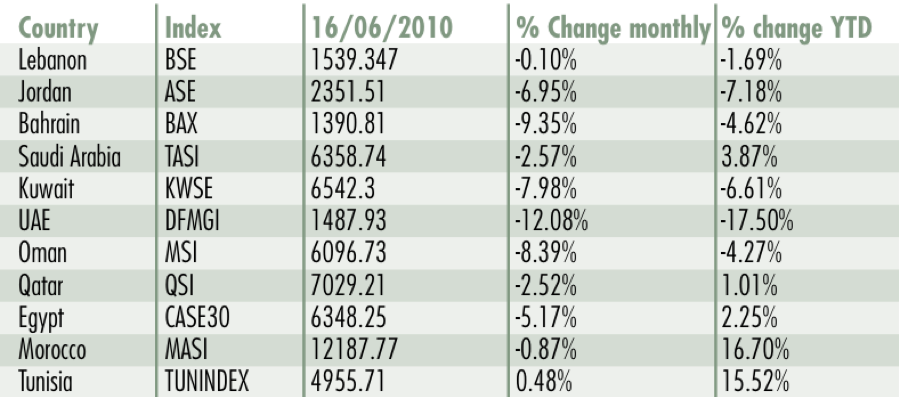
Regional stock market indices

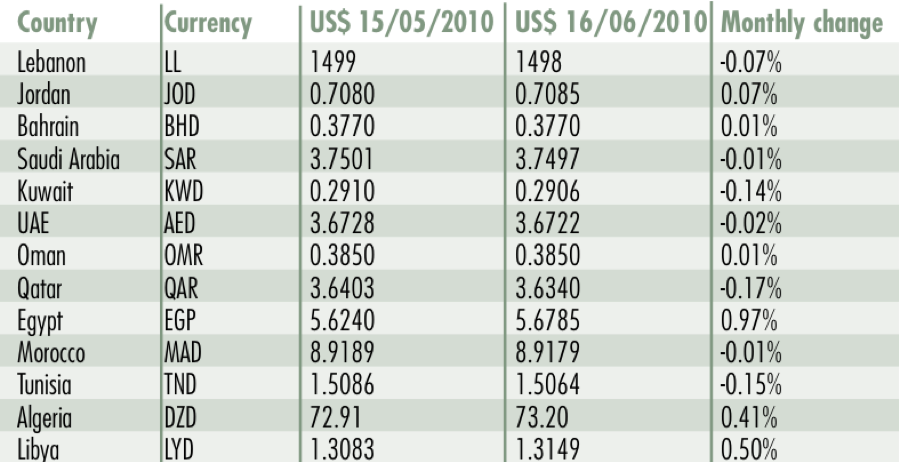
Regional currency rates

ICT aids textiles in Tunisia

Information and Communication Technologies (ICT) is currently the most promising sector in Tunisia’s economy. It has witnessed a growth of 14 percent this year, confirming the World Bank’s recent ICT access index that ranked Tunisia as top in the North Africa region. The sector’s importance was highlighted at the 8th Mediterranean ICT Summit, hosted on June 10 and 11 by El Ghazala’s Technological Pole, which was themed “ICT for the benefit of the competitiveness of textile companies in Tunisia.” Speaking at the occasion, the minister of communication and technologies stressed the importance of using ICT to boost productivity and enhance the added value and competitiveness of the textile sector. The country’s training of highly skilled human resources goes hand in hand with the sector’s evolution, as demonstrated by the recent convention signed between Tunisia and SunGard, under which the company plans to employ 450 engineers and university graduates in 2010, 650 in 2011 and 1000 in 2012.

Atomic alliance for Jordan and Japan

Jordan and Japan will sign a Nuclear Cooperation Agreement (NCA) before the end of the year. The Jordan Atomic Energy Commission (JAEC) announced that it has conducted long negotiations with Japanese officials to finalize the project, which will be located some 12 kilometers east of the southern coastal resort town of Aqaba. It will comprise a 1,000 and 1,150 megawatt model reactor, which incorporates technology from AREVA’s Evolutionary Power Reactor and Mitsubishi’s advanced Pressurized Water Reactor, and is expected to be completed by 2020. The JAEC and project managers Worley Parsons will begin a year-long process to select the final bidder, focusing on technological aspects. Jordan has already signed NCAs with France, Spain, China, South Korea, Canada, Russia, the UK and Argentina.

Investcorp rolls in the profit after US tire firm sale

Investcorp, a manager of alternative investment products with $12.4 billion in total assets under management, completed the sale of American Tire Distributors (ATD). The investment company had acquired ATD for $700 million in 2005 in collaboration with Berkshire Partners LLC and Greenbriar Equity Group LLC. Investcorp realized capital gains of $600 million in its five-year acquisition period, selling ATD for $1.3 billion. Investcorp has offices in Bahrain, New York, and London and is listed on both the Bahrain Stock Exchange and the London Stock Exchange.

ATD’s initial plans to go for an IPO were likely scrapped after TPG Capital bought the company from Investcorp. TPG will finance its acquisition through a combination of equity and debt financing from affiliates of Bank of America, Barclays Capital, General Electric Capital Corporation, and RBC Capital Markets. ATD is the largest independent tire distributor in the US, with 83 distribution centers, serving 37 states and 60,000 retailers.

July 11, 2010 0 comments
0 FacebookTwitterPinterestEmail
Banking & Finance

For your information

by Executive Editors July 11, 2010
written by Executive Editors

BLOM ahead in Dar spar

A British court has ruled that Kuwait’s Investment Dar should pay back a $10.7 million principal to BLOM Bank, after the Lebanese bank initiated a lawsuit last year to recoup its 2007 investment with 5 percent interest. Investment Dar has refused to comply, claiming the wakala Islamic contract was not compliant with its sharia law charter and thus could not be executed, since the 5 percent return on the principal could be interpreted as interest payment, which is illegal under sharia law. The court has not yet decided on the issue of the extra interest payment, as the case is still ongoing. The Kuwaiti firm’s supervisory board, which assures that contracts agree with the Islamic charter, held a meeting on May 22 and confirmed that the disputed wakala contract was indeed valid and that Investment Dar court claims are without merit. As investors in the region take note of the possible consequences of entering into a sharia contract, the uncertainty surrounding Islamic finance could lower the credit ratings of Islamic institutions, according to a research note sent out by Moody’s in May.   Investment Dar, which owns half of the carmaker Aston Martin, is in negotiations with a government committee to restructure its debt, and is the first company in Kuwait to seek the protection of the government under the newly established Financial Stability Law. However, a company statement released on March 13 said the company will not need government funds but rather legal help in restructuring its debts, totaling more than $3 billion. In May of 2009, Dar defaulted on a $100 million Islamic bond, which was the first default in the Gulf Cooperation Council region on an Islamic bond.

IMF urges structural reform for Lebanon

Lebanon’s Central Bank Governor Riad Salameh says confidence in Lebanon’s banks remains strong and that the focus for now is to maintain a constant interest rate and fight inflation, which he expects to stay at 4 percent throughout 2010. The remarks were made at a June 3 press conference held at the Central Bank, where International Monetary Fund representative Eric Mottu discussed the recently published Regional Economic Outlook for the Middle East and Central Asia. Salameh stressed that it is important to look at the markets in the Middle East and North Africa as well as Europe, since Lebanon depends on these markets to employ its citizens. Mottu advised Lebanon to focus on structural reforms rather than fiscal and monetary stimuli to help growth. Salameh added that the balance of payment surplus is currently a record $1.4 billion, and that bank deposits total $106 billion.

Lebanese banks’ assets skyrocket

There was an upsurge of total consolidated assets held by Lebanese banks during the first four months of 2010, according to Bank Audi. The measurement reveals that banks held $120.6 billion in total assets by the end of April 2010; this 4.7 percent growth in bank activity is double the average growth measurement for the first quarter in the previous eight years. Customer deposits, the strongest driver of growth in this period, totaled $99.1 billion at the end of the first quarter, a growth of 3.5 percent quarter-on-quarter.  The increase of deposits in Lebanese lira accounts for 73.7 percent of the growth, which means the deposit dollarization ratio fell to its lowest level in 10 years, to 63.2 percent.  Bank loans also broke growth records, expanding by 9.4 percent in the first quarter to total $31.0 billion at the end of April. Net foreign assets of Lebanon’s Central Bank rose by $1.96 Billion, causing the cumulative balance of payments to top off at a record $1.4 billion, showing growth of 23.4 percent compared to the same period last year.

Bank shares bolster BSE

According to figures released by the Beirut Stock Exchange (BSE), bank stocks helped pump up aggregate turnover by 369 percent in the first five months of 2010, to reach $1.4 billion, as they made up 91.7 percent of trading volume and 83.9 percent of the total value of shares traded. The 81 percent rise in total trading volume, compared to the same period last year, is partly due to Lebanese banks selling off sizeable stakes, according to a report by Byblos Bank.  In January, EFG Hermes sold its nearly 22 percent stake in Bank Audi. In the same month, Byblos Bank sold an 8 percent stake to International Finance Corporation, the private unit of the World Bank, and $30 million worth of common shares to Proparco, the French governmental development unit.

Turkish-Lebanese cooperation

In an effort to pool capital into joint regional projects, Turkish, Lebanese and  other Arab nation officials met on June 10 and 11 during the fifth Turkish-Arab Forum in Istanbul to discuss plans to create strategic partnerships between their respective banks in the future. Third Vice-Governor of Lebanon’s Central Bank Muhammad Baasiri expressed his desire for Turkish banks to extend branches to the Arab world. He said more joint cooperation between the banking sectors would lead to progress in joint projects, such as electricity and highway construction, which would in turn receive more support from other regional central banks. Signs of progress have already surfaced as Syrian Finance Minister, Mohammad al-Hussein, revealed that Turkey’s Ziraat bank, the country’s largest lender, may set up a branch in Syria and that officials from the two countries would meet soon to discuss this cooperation. Baasiri stated that training and regulation should be cohesive, suggesting: “Banking regulations in Turkey are in compliance with the bylaws in Lebanon, Syria and Jordan. Diagnosing any conflicting points, gathering periodically every three or six months and increasing interregional banking applications are of the utmost importance.”

Egypt’s mortgage industry set to grow

Egypt, the most populous Arab country with about 80 million people, expects to double its mortgage finance industry from its current total of around $812 million to some $1.4 billion by June 2011. This remark was made by Mostafa el-Hayawan, chairman of Mortgage Finance Fund, at the Euromoney Housing and Real Estate Finance Conference in Cairo on June 15, where analyst research showed that there is demand for about 500,000 new houses per year. The industry has swelled since 2005, when there were only two mortgage finance companies, to reach 11 in 2010. Investment Minister Mahmoud Mohieldin added that the parliament will push for a new mortgage law, already approved by the cabinet, to help increase transparency and growth in the mortgage sector, which currently only makes a small dent of less than half a percent in the country’s gross domestic product. The proposed new law, which would be stricter on loan defaults and regulated by the Egyptian Financial Supervisory Authority, would increase efficiency. Mohieldin wants to boost the growing mortgage sector, which now only has 750,000 customers, by attracting more international firms. He said the average current mortgage loan has a 12.45 percent interest rate and a length of 16.1 years. The government-run Mortgage Finance Fund will also use a $300 million loan from the World Bank to increase its low-income housing subsidies.

Mixed results for GCC bank profits

The first quarter banking sector profits across the Gulf Cooperation Council were mixed, with the highest growth occurring in the United Arab Emirates, according to the most recent report by Kuwait Financial House (Markaz). UAE banking and financial service profits rose to $1.4 billion in the first quarter. Qatar’s banking profits rose 2.5 percent year-on-year, while Oman and Bahrain both experienced steep falls in banking sector earnings, declining 26 percent and 17 percent respectively. Kuwait experienced positive growth in the financial services sector after two previous quarters of loss. In Saudi Arabia, banking sector profits, which account for 33 percent of total profits, fell by 10 percent to $1.5 billion in the first quarter.

July 11, 2010 0 comments
0 FacebookTwitterPinterestEmail
Feature

Destination Damascus

by Executive Editors July 11, 2010
written by Executive Editors

 “I see more tourists every year,” smiles tourist guide Abdul Razzak Homsi when asked about the prospects of his business. “Three years ago, museums in Damascus were empty. Now Europeans are queuing at the gates.”

Statistics from the Syrian Ministry of Tourism show that in the first five months of this year, the number of “tourist arrivals” in Syria rose to 3.1 million, a whopping 65 percent increase compared to the same period a year earlier. The figure is divided into three groups: Arab foreigners (1.7 million), non-Arab foreigners  (900,000) and Syrian expatriates (600,000). Although “tourist arrivals” is a loose definition — the ministry simply measures all arrivals and calls them tourists — unless Damascus suddenly became the world business conference capital, tourists are evidently flocking into Syria in large numbers.

Tourism was “a bit static” in the years following the 2005 assassination of former Lebanese Prime Minister Rafiq Hariri, says Osama al-Nouri, general manager of Damascus-based tour operator TransAsia Travel and Tourism, “but the past couple of years have witnessed the return of Syria, and Lebanon, as  major destinations.”

The word’s out in the West

Syria sees two types of visitors, says Nouri: Arabs who come for recreation, shopping and, to a lesser extent, religious sites, and Westerners — mostly Europeans — who seek the mystique of the Orient in Syria’s rich history, culture, world-class architectural sites like Palmyra and Krak des Chevaliers, and traditional Arab hospitality. 

Although the majority of tourists visiting Syria still come from the Arab/Gulf market — 59 percent of all arrivals in 2009 — people from outside the Arab world are increasingly finding their way to Damascus. According to Nouri, “whereas the Arab market is increasing by 6 to 9 percent per year, numbers of European and American tourists are going up by more than 25 percent per year.”

Potential for profit

With all these tourists come opportunities for local business. Tourist guide Homsi is one of 889,000 Syrians currently employed in the tourism sector — 11.5 percent of the work force. Over the past 18 years, he has slowly moved away from guiding flocks of tourists to teaching cultural heritage management at the Damascus Tourist Institute, and is now converting an old Damascene house into an art gallery where, he says, he will be able to combine his love for all things art and antique with commercial activity.

“Whenever I take tourists to see Syrian culture and art, they are very interested,” he says. “And surprised: they simply have no idea it exists.”

There are several other entrepreneurially-minded traders in Damascus’ tourist markets angling for original ways to make a buck from visitors, such as the owner of a shop called “Beebread,” who explains in a conspiratorial voice that Syria has many unique plants with medicinal qualities that Westerners have yet to discover. His shop sells low-sugar honey to locals, and has a growing customer-base in tourists buying honey-based facial cream and organic digestive pills manufactured according to a secret recipe.

But Homsi and Beebread’s innovative tactics are an exception among Syria’s tourism traders, who mostly follow the tried-and-tested business model of the clustered shawarma shop. Along Damascus’s biblical Straight Street, for example, most salesmen seem content to eek out a living selling the same pots and pans as their neighbors do. Although the luxury five-star Tadamora Palace hotel recently opened in Palmyra, commercial activity at the country’s prime archeological site still revolves mainly around groups of Bedouin that ride around on old motorbikes selling soda cans and checkered shawls. As one wandering tourist put it recently, “where are the hot-air balloon rides, the mountain bike rentals?”

“There is a huge gap” between potential and reality, admits Nouri, who explains that locals’ reluctance to exploit tourism possibilities may be a legacy of the past, when the state was the one and only player in many fields. Nowadays, he says, “business opportunities are enormous, particularly in the areas of eco-tourism and event management. The sites, accommodation and restaurants are there, but there are more and more people that are looking for activities like festivals, theater shows… the Ministry of Tourism is genuinely interested in promoting such activities.”

Bedroom boom

One sector that has been doing particularly well is the hotel industry, although the year saw a bit of a slow start, with occupancy at 49 percent in the first quarter of 2010 as opposed to 61 percent a year earlier. Though small luxury boutique hotels have popped up all over the Old City and the last decade has seen considerable investment in high-end hotels, there is still room to grow, says Julian Crane, director of marketing for the Damascus Four Seasons Hotel.

“There is a big opportunity for mid-range hotels and mid-range pricing,” he says. “There are not enough four-star hotels, for example.” But high-end hotels like the Four Seasons will remain in demand as well, he says, “as long as the demand for this destination in terms of commerce and leisure continues to grow. And there is no reason why it shouldn’t. Syria has an exotic mystique about it that people will continue to be interested in.”

Tourism is fast becoming a pillar of the Syrian economy, constituting 11.2 percent of the country’s gross domestic product in 2009 and expected to rise to 13 percent of GDP by 2019, according to the World Travel and Tourism Council. Still, it is a developing industry and there are obstacles to overcome, such as a lack of infrastructure and a shortage of skilled personnel. But as long as the region stays stable — a vital prerequisite for growth mentioned by nearly everyone Executive spoke to — the sector is likely to continue to grow as a major market.

“There are 5,000 mosques, 700 churches, 50 synagogues and 10,000 archeological sites in Syria,” says Homsi. “Most of them have yet to see a tourist.”

July 11, 2010 0 comments
0 FacebookTwitterPinterestEmail
Feature

Manhood on the cheap

by Executive Editors July 11, 2010
written by Executive Editors

The traditional Yemeni dagger, or jambiya, is worn by many men in Yemen as a symbol of their manhood and authority. But with its rhino horn, buffalo horn or ivory handles and sharp steel blade, a jambiya can put deep dents in the wallet, costing several hundreds and sometimes even thousands of dollars. Part of the reason it’s so expensive is because trading ivory and rhino horn is now illegal and has to be smuggled in, which pushes the price up.

With the average monthly income in Yemen only around $100, according to 2008  United Nations figures, that puts the traditionally-produced dagger out the reach of many. Now, however, there is a solution for those Yemenis who wish to flaunt their masculinity without spending their yearly wage for the privilege: plastic jambiyas.

They have been dubbed the “Chinese,” supposedly after the common perception among Yemenis that anything made in China is bad quality and breaks. But the fact that it costs only 20,000 Yemeni riyals or less (approximately $10) has made it a best seller among customers, according to Bashir al-Ezayri, who works in one of the biggest dagger selling stores in Sanaa’s souk.

“The jambiya in plastic sells well because everyone can afford it and it looks almost the same as the original,” he says. “It doesn’t show that it’s fake.”

Ezayri says he himself only wears a plastic jambiya during the week to avoid the potential of it being robbed on his way home from work, saving his more expensive dagger with a rhino-horn handle for special occasions like weddings and weekend excursions.

Not everyone, however, is willing to be seen in the streets with a plastic version of such an important symbol of wealth, status and virility.

Sheikh Mohamed al-Hazmi, an imam and an member of Parliament for the Islamist opposition party Islah, shakes his head and starts chuckling when asked the question.

“I wouldn’t wear it,” he says. “But maybe I’d buy one for my younger son.”

July 11, 2010 0 comments
0 FacebookTwitterPinterestEmail
Feature

Mubarak’s Pyramids

by Executive Editors July 11, 2010
written by Executive Editors

Egypt reacted furiously, even threatening war, when five upstream Nile countries signed an agreement in May denying Egypt its veto power over any project anywhere along the world’s longest river, a privilege it won in a 1959 treaty.

Cairo’s concern about developments upstream is understandable, as the Nile provides 97 percent of the country’s water. But it may also be a touch hypocritical for Egypt to deny others the right to use the river for irrigation and power generation, when it has done exactly that for decades.

Since the 1960s in particular, Egypt has invested billions of dollars in harnessing the Nile’s power. The country’s most famous water engineering work is, of course, the Aswan High Dam, the world’s biggest when it was inaugurated in 1971. The dam has prevented the river from flooding, allowing farmers to grow multiple crops per year, and created the immense reservoir of Lake Nasser.

In 1997, Egypt’s current President Hosni Mubarak launched another colossal project, and one that could not have existed without the Aswan High Dam: the South Valley Development Project, better known as the Toshka Project. Named after a natural depression some 225 kilometers south of Aswan, this massive development scheme foresees pumping Nile water from Lake Nasser into a 210-kilometer network of newly constructed canals to develop and cultivate 540,000 feddan (or 2,268 square kilometers) of desert land.

In the distant future, Egypt’s amount of cultivable land could be doubled if the government’s dream of creating a “second Nile Valley” becomes a reality. To do this, they would need to connect Lake Nasser and Toshka with Egypt’s string of western oases. Considering such grand ambitions, it comes as no surprise that the Egyptian press has hailed the project as “Mubarak’s Pyramids.”

Some critics even claim it should never have been started. For example, former Minister of Construction and Housing Hasaballah al-Kafrawi, defined the project as “useless and a waste of billions,” with the ‘billions’ referring to both gallons of water and dollars.

Bringing the desert to life

Situated in the south western corner of Lake Nasser, the Toshka Project’s engine is the $500 million Mubarak Pumping Station, which is said to be the world’s largest. Its 24 turbines can pump up to 25 million cubic meters of water per day into the 50-kilometer long Sheikh Zayed Canal. Both were completed around 2003. Named after the late ruler of the United Arab Emirates, the canal splits into two main networks; the northern part was completed some five years ago and the southern branch is slated to be inaugurated this August.

As former deputy chairman of Egypt’s National Water Resources Center, Dia el-Din el-Quosy supervised the birth of the Toshka Project.

“There is a big controversy about Toshka,” he said, sipping a tea in Cairo’s Groppi Café. “People complain that too much money has been spent. But the government had invested some 7 billion Egyptian pounds ($1.27 billion) when I left in 2003, and has not spent much more since.”

“People tend to forget that Toshka was no overnight decision. The project was first formulated in the 1960s and only presented to the public in the late 1990s,” he added.

According to Quosy, the project should be seen as part of the country’s “horizontal development” strategy. Egypt is running out of space. Some 95 percent of its population of around 80 million lives in the Nile delta, which represents but five percent of Egypt’s territory. As the Salam Canal did previously, the Toshka Project aims to lure people away from the densely populated Nile delta and the river banks.

 “The aim of Toshka is to create jobs by developing a core of economic activities, including mining, industry, tourism, as well as agriculture,” said Quosy. “In the future the region could be home to some 3 million Egyptians.”

 In laying the foundations for Toshka, the Egyptian government adopted a textbook liberal approach. The state played a facilitating role by developing the necessary infrastructure and offering an attractive investment climate to draw in the private sector, which in turn will build firms, farms and factories. The plan started well enough; for a bargain price of some $2,100 per square kilometer, most land was sold in no time.

According to the Ministry of Water Resources and Irrigation, some 1,430 square kilometers were allocated to a handful of major companies, including Prince Walid bin Talal’s Kingdom Holding, the Emirati firm Al Zahra, the Egyptian South Valley Development Company and Al Raghy Holding. Around 840 square kilometers along the project’s southern branches remain open to investors. So far, however, according to the ministry, only 147 square kilometers have been cultivated and nothing else has been developed — some claim even less land has been made available for agriculture. No doubt the recent credit crunch has made investors reluctant or unable to invest large amounts of money. Rumor has it, however, that some investors find it more lucrative to sell the land than to develop it.

“I agree that the project’s implementation may not have been perfect,” said Quosy. “First of all, there is too much emphasis on agriculture. Secondly, it seems that investors such as Prince bin Talal — whom I respect a lot — are more interested in the hotel business than in agriculture. Agriculture is a long term investment. If investors fail to develop the land, then I think the government will be forced to take it back and distribute it among other investors.”

Yet Quosy remains an advocate of the Toshka scheme. “We have the water, we have the land, all we have to do is work,” he said.

Not everyone agrees. According Mohamed Salama, professor of irrigation and hydraulics at the Cairo University, there are more fundamental problems involved.

“From an engineering project of view, it’s an excellent project: it is well made,” Salama said. “The problem is that the temperature at Toshka reaches up to 50 degrees. As the water is pumped into open canals, we have lost an enormous amount of water over the past five years due to evaporation. I estimate some 1,000 cubic meters a day. In addition, because of the high evaporation rate, crops need relatively more water. While farmers in the north need, on average, some 20 to 25 cubic meters per feddan per day, in the south they need up to twice as much.”

The test of time

The Egyptian government could have opted for constructing tunnels instead of canals to reduce the project’s average evaporation rate, but that would have made the project up to seven times more expensive.

“There is a social problem as well,” Salama continued. “To develop the region, you need people, and the idea is to move people from the over-populated north to the south.”

Given the heat and inhospitable climate, he said few would opt to make this choice, especially given the lack of facilities, such as hospitals and schools. “If the project is to be continued, I think it better to have people from southern Egypt work in Toshka, as they are used to the climate,” said Salama. Contrary to Quosy, Salama thinks it is best to stop the Toshka project sooner rather than later, instead of pouring in more water and money. “But what to do with the billions invested so far?” he asked.

Richard Tutwiler, head of the Desert Development Center at the American University of Cairo, just returned from a visit to Toshka and confirmed that so far little land has been developed. Although he agreed that some major question marks remain, he was hesitant to call for the project to be stopped right away.

“One major question is: will there be enough water?” said Tutwiler. “A river is a perfect irrigation and drainage system. You take out water, use it, and let it flow back into the river. The water is then reused further downstream. When you take out water to develop the desert you loose that advantage of a natural drainage system.”

He added that “desert developments” take at least 20 years, so the success of Toshka needs another decade to be determined.

There are also problems on the political front; Toshka has now become a highly sensitive (and as a result, taboo) subject. While Egypt’s newspapers continue to criticize upstream countries for wanting to develop Nile related projects, “Mubarak’s Pyramids” have largely vanished from the media’s radar. As a consequence, there is no public debate about the billions of gallons and dollars that have been spent so far and will be spent in the future.

That should perhaps come as no surprise, as we are talking about Mubarak’s legacy here. Just as his predecessors Gamal Abdel Nasser and Anwar el-Sadat did with the Aswan High Dam and Salam Canal, respectively, Mubarak attached his name and his reputation to a major water work that — on paper — has the potential to significantly alter the face of Egypt. The 81-year-old president does not want to be associated with the world’s biggest state-of-the-art pumping station and canal network if, at some point in the future, it becomes a white elephant abandoned and left to the desert.

July 11, 2010 0 comments
0 FacebookTwitterPinterestEmail
Feature

Behind the Scenes

by Executive Editors July 11, 2010
written by Executive Editors

If Cairo is the Hollywood of the Middle East, Beirut might aptly be called the region’s Vancouver, where canny filmmakers regularly recreate glamorous locations for a fraction of their on-location price. Lebanon may not churn out the cinema blockbusters that Egypt does, but it has successfully cornered a large section of the Middle East’s market for producing television commercials and music videos.

“I would say Lebanon has 60 percent of the whole region’s market share, excluding North Africa,” said Gabriel Chamoun, chief executive officer of The Talkies, a major Beirut-based production house, opened in 1988, which primarily produces television commercials. In North Africa, added Chamoun, commercials are generally produced locally.

Sten Walgren of The Gate — Lebanon’s only film processing center — told Executive that Lebanon produces as many as 80 music videos and 300 commercials annually. Before the worldwide economic recession took hold of the region, Walgren said those numbers were around 120 and 400 per year respectively.

“Ninety-five percent of the production houses here in Beirut are for television or commercials or music videos,” said  Pierre Sarraf, founder of production house ‘..né.à Beyrouth.’

Sarraf’s company — which also organizes the annual Lebanese Film Festival in Beirut — is one of the few in the country to make other film products, such as documentaries and feature films, though it finances these projects through producing between ten and fifteen high-paying music videos and television commercials per year.

Despite its narrow focus, the Lebanese film industry has prospered, attracting a large volume of business from around the region.  While filming and editing takes place in Lebanon, the clients of television commercials are generally advertising agencies based in Saudi Arabia or Dubai. Similarly, music videos are commissioned by record labels in the region, such as the $700 million Saudi-owned conglomerate Rotana.

Big budget productions

While there are no official figures, the film production industry in Lebanon easily rakes in tens of millions of dollars annually.

Chamoun said that at The Talkies, which films some 50 commercials annually, budgets for these projects can vary widely, between $60,000 and $500,000 depending on the client. Some shoots, he said, can bring in upwards of $1 million — though these have become rare in the current economic climate.

Leila Kanaan, a young director from Sidon who gained fame filming music videos for such Lebanese pop divas as Haifa Wehbe and Nancy Ajram, said music videos for A-list stars in the region can range anywhere from $150,000 to $400,000 or more. Her latest music video, “Wavin’ Flag” — a collaboration between Ajram and Somali-Canadian rapper K’naan for the World Cup —  easily cleared the $1 million mark.

“It’s a big industry and managers and singers are investing a lot in music videos because they do not just help to sell the CD: they also market the singer,” said Sarraf, whose firm often works with Kanaan. “The real revenue for the singer comes from the live concerts rather than selling CDs.”

For less prominent musicians, Kanaan said that music videos can cost between $60,000 and $100,000. For her own pay, Kanaan said that she charges $50,000 per music video or $10,000 per day of shooting for television commercials. Chamoun said most Lebanese directors he works with make between $2,000 and $10,000 per day of shooting. Mid-range salaries on set — such as for a focus puller, whose job is to keep the camera’s shot in focus during a shoot — run to around $350 per day.  Even low-end salaries, such as for a helper, are around $75, higher than daily wages for similar work in Lebanon.

Why Lebanon?

While prices for those 30-second TV spots and four-minute music videos might seem staggering to those unacquainted with the industry, they are significantly cheaper than the industry standard elsewhere. Chamoun said TV commercials can cost some two-thirds less to shoot in Lebanon than other locations, making Lebanon an attractive option for clients.

“We tend to give priority to Lebanon because it’s easier [to film] here and less expensive,”  said Sarraf, whose company occasionally films abroad.

When the financial crisis hit Dubai in 2009, some established Beirut production houses saw an increase in business as clients stopped opting to film in the emirate.

“When there used to be a lot of money in the market, they would rather go for convenience rather than savings,” Chamoun told Executive. “So they would shoot a lot in Dubai because the client happens to be there, the agency is there and it’s just more convenient.”

While on paper Dubai could look like a more attractive base for the film industry — with Abu Dhabi’s TwoFour54 and Dubai’s Media City providing a centralized infrastructure for film production — in the fallout of the economic crisis some Dubai firms began relocating or opening additional branches in Beirut.

Besides cost-saving, people in the industry say shooting in Lebanon has additional perks.

“I think Lebanon is the perfect place to shoot in the Middle East; we have the talents, the know-how and good taste in general,” said Kanaan.

Lebanon’s varied geography gives the country’s producers another edge, allowing them to film along the coast or in mountain villages that can sometimes pass for Europe, against the backdrop of Beirut’s skyline or among Roman ruins. Such diversity is lacking in the United Arab Emirates, where locations are confined to the desert and cityscapes.

Shaky footage

While Lebanon’s film production industry has survived the economic crisis thus far — with some production houses even benefitting — Lebanon’s occasionally unstable political situations continue to loom as a threat to its viability.

“We need to keep political stability — this is the worst thing that affects the industry,” said Sarraf. During the 2006 war, work came to a stop for production houses across the city. From the start of the war to the end of 2006, The Talkies produced only four commercials — an amount that would be created in just weeks during times of peace. The war and its aftermath quickly had clients looking to film elsewhere, afraid of what Lebanon’s future might hold.

“Even Lebanese people living in the Gulf were reluctant to come and shoot in Beirut,” said Chamoun, “every time there is a war we start from scratch again.”

Before the political situation worsened in 2005, the country was a favored destination for some European clients who wanted to use some of Lebanon’s more picturesque areas to replicate a European setting on screen at a much lower cost.  According to Chamoun, such clients accounted for between 30 and 35 percent of his company’s business in 2004.  However, the political turmoil which took hold of the country the next year would scare these clients away.  While Beirut film production houses have largely regained business from regional clients, jobs ordered from Europe are still few and far between.

And as the financial crisis pushed Dubai-based film production houses to set up shop in Beirut, Lebanon’s political instability has pushed some local outfits to open branches in more peaceful cities — such as Cairo — as a fallback for a worst-case scenario in Lebanon.

Across the country’s film production industry it is agreed that stability in Lebanon is the key to maintaining business. If peace holds and prices can be kept competitively low, the industry should keep its starring role in the region. If not, other countries, notably Turkey and Morocco, are waiting in the wings to take Lebanon’s spotlight.

“We tend to give priority to Lebanon because it’s easier [to film] here and less expensive”

July 11, 2010 0 comments
0 FacebookTwitterPinterestEmail
  • 1
  • …
  • 411
  • 412
  • 413
  • 414
  • 415
  • …
  • 683

Latest Cover

About us

Since its first edition emerged on the newsstands in 1999, Executive Magazine has been dedicated to providing its readers with the most up-to-date local and regional business news. Executive is a monthly business magazine that offers readers in-depth analyses on the Lebanese world of commerce, covering all the major sectors – from banking, finance, and insurance to technology, tourism, hospitality, media, and retail.

  • Donate
  • Our Purpose
  • Contact Us

Sign up for our newsletter

    • Facebook
    • Twitter
    • Instagram
    • Linkedin
    • Youtube
    Executive Magazine
    • ISSUES
      • Current Issue
      • Past issues
    • BUSINESS
    • ECONOMICS & POLICY
    • OPINION
    • SPECIAL REPORTS
    • EXECUTIVE TALKS
    • MOVEMENTS
      • Change the image
      • Cannes lions
      • Transparency & accountability
      • ECONOMIC ROADMAP
      • Say No to Corruption
      • The Lebanon media development initiative
      • LPSN Policy Asks
      • Advocating the preservation of deposits
    • JOIN US
      • Join our movement
      • Attend our events
      • Receive updates
      • Connect with us
    • DONATE