• Donate
  • Our Purpose
  • Contact Us
Executive Magazine
  • ISSUES
    • Current Issue
    • Past issues
  • BUSINESS
  • ECONOMICS & POLICY
  • OPINION
  • SPECIAL REPORTS
  • EXECUTIVE TALKS
  • MOVEMENTS
    • Change the image
    • Cannes lions
    • Transparency & accountability
    • ECONOMIC ROADMAP
    • Say No to Corruption
    • The Lebanon media development initiative
    • LPSN Policy Asks
    • Advocating the preservation of deposits
  • JOIN US
    • Join our movement
    • Attend our events
    • Receive updates
    • Connect with us
  • DONATE
Real Estate

SWFs – Any given corner

by Nada Nohra July 3, 2010
written by Nada Nohra


Since oil exploitation shot the Gulf into the realms of interstellar wealth, money, oil and foreign relations have always gone hand in hand. Whether to secure long-term returns on their energy bonanza or for political considerations, Gulf Cooperation Council governments have been expanding their investment portfolio since the 1950s. Today, GCC sovereign wealth funds (SWFs) represent 37 percent of global SWF holdings, according to the United States-based SWF Institute. The International Monetary Fund pegged worldwide SWF assets at some $1.64 trillion by the end of March.

The real estate sector takes a substantial chunk of SWFs’ overall portfolio, whether through direct investments in prime real estate in major world cities or by indirect investments in listed companies and unlisted property funds. However, since most SWFs do not publish their financial statements nor disclose where they invested, it is hard to find out how much of their fund goes into a specific sector. The Abu Dhabi Investment Authority (ADIA), for example, in its first ever annual report last year, said that 5 to 10 percent of its investment goes into real estate. Considering the sums of money involved at ADIA, the difference between 5 and 10 percent is a not insignificant $31.35 billion.

“For the most part they don’t tell you where they are investing, it is a sort of speculation… do they directly invest in properties? Did they have an indirect interest? We don’t know that, they don’t disclose it to such granular levels,” said Saud Masud, head of research and senior analyst at UBS, the financial services firm.

ADIA is currently considered the largest SWF in the world, with assets under management amounting to $627 billion, according to the SWF Institute.

After the crisis

Experts Executive spoke to said the wide fluctuation in oil prices in recent years had curbed regional SWFs investment bravado, while the global financial crisis also put dents in their portfolios. 

“You can guess that SWFs, in line with global investors, have suffered tremendously,” said Fadi Moussalli, regional director at Jones Lang LaSalle, the real estate services firm. “But the question is how much, since they don’t publish their figures,” he added.

Moussalli explained that while Abu Dhabi is dealing with its domestic issues, the most active SWF is currently Qatar Investment Authority (QIA), particularly in the real estate sector. The group has been acquiring large properties, mostly in London, through its investment arms such as Qatar Holding, Qatari Diar, and Barwa Real Estate. 

In a series of well publicized big-ticket purchases, Qatari Diar purchased the historic Raffles Hotel in Singapore for $275 million in April, after the company invested a 40 percent stake in Fairmont Hotels and Resorts, while Qatar Holdings bought the famous Harrods department store in London for $2.3 billion in May. Barwa Real Estate, which is 45 percent owned by Qatari Diar, also announced in June that it would be acquiring the $371 million Park House development, an office and retail project in London due to be completed in 2012. Although it has not been confirmed yet, Britain’s The Times reported in June that QIA will be taking over the London-based Songbird Estates — owner and manager of Canary Wharf, a large upscale office and shopping development in East London. The newspaper said that if the transaction takes place, the fund will be investing some $700 million to buy the 76 percent it doesn’t already own. Despite the rumors, Songbird Estates said that it had not been officially approached by QIA. QIA board member Hussain al Abdalla said at a press conference in March that most of Qatar’s $30 billion planned investment in Europe and the United States will go into commodities and real estate, according to Bloomberg.

“Qataris will emerge as the top investors and there are other large scale transactions cooking that will be announced soon to the world,” said Moussalli.

Why London?

According to Nicholas Maclean, managing partner at CB Richard Ellis for the Middle East, the reason Qatari SWFs are targeting the British market is because it is highly liquid and transparent, and thus assets could be disposed more easily than in other markets. The real estate market in London has recovered quicker than any other comparable market elsewhere in the world in the last six to nine months, attracting large amounts of capital.

Moussalli agreed, adding that the United Kingdom is currently offering investors the most tantalizing opportunities, in addition to some other major cities. “Paris is attracting more attention, Frankfurt, Rome to a lesser extent and also New York and Washington DC,” he said.

Maybe China?

BRIC countries (Brazil, Russia, India and China) are also offering tempting investment opportunities for SWFs due to their high return on investment. “The levels of return which have been reported [in China] are so strong so that the market cannot be ignored,” said Maclean.

In May this year, Kuwaiti authorities signed a Memorandum of Understanding (MOU) with China as a first step toward acquiring a Qualified Foreign Institutional Investor (QFII) permit, which would enable the Kuwaiti SWF, Kuwait Investment Authority (KIA), to invest in stocks of Chinese companies and increase their general economic involvement in the country.

QIA also announced that it signed an agreement with Agriculture Bank of China on June 17 and will be investing $2.8 billion in the bank’s initial public offering (IPO), Bloomberg reported.

With the high return on investment, Masud cautions that BRIC markets also represent high risk.  “Right now we are saying the BRICS are the strongest market, but what if China’s property bubble bursts? Then what happens?” he said. Masud also explained that since the SWFs deal in huge values, they might affect certain markets when moving in or out, and therefore they have to be careful when shifting their strategies. “When you are moving several billions of dollars out of a market into another, one has to reallocate carefully thereby not exacerbating any selling or buying pressures, which in turn impacts return on investment,” he added.

QIA is also showing high interest in investing in Malaysia. The SWF signed in May an MOU with Malaysian Development Bhd to establish a joint committee that would capitalize on investment opportunities in the energy and real estate sectors, with Qatar investing some $5 billion.

Expectations

While from the outside it may seem that SWFs are splashing billions of dollars about, relatively, they are being fairly conservative and selective. “There is a bit more care and due diligence in where they invest, perhaps they are a bit more risk averse given market volatility over last three to four years,” said Masud, adding that funds invest for the long run and might therefore sit on their investments for a while without being productive.

Moussalli thinks that with the oil prices stabilizing in the $70 to $80 per barrel range, regional SWFs will resume their investments, with Qatar emerging as the biggest player in the region and Abu Dhabi remaining relatively low-key while it deals with its domestic concerns.

As for real estate, Maclean thinks that many of the SWFs are going to increase their investment in the sector, mainly because they see it holding promise with minimum volatility. He expects SWFs will be back in the market in force by the beginning of next year, mainly focusing on the United States, UK and China.

“They are becoming even more important investors in the real estate market going forward… [but] they are cautious, they are analyzing the market place globally, very carefully to make strategic decisions,” he concluded.

July 3, 2010 0 comments
0 FacebookTwitterPinterestEmail
Business

Orascom Telecom holding – Khalid Bichara

by Paul Cochrane July 3, 2010
written by Paul Cochrane

Khalid Bichara is the chief executive officer of Egypt’s Orascom Telecom Holding, which has operations in Africa, Europe, Canada and Asia, as well as managing the Lebanese telecom provider Alfa. Bichara sat down with Executive at the Alfa headquarters in Beirut to discuss privatization, market share and why Lebanon still doesn’t have 3G.

E  Samer Salemeh, after just a short stint as Alfa’s CEO, recently resigned. He had reportedly complained of political interference. Is this true?

As the CEO of the holding, I don’t work day in day out in the business here and I am not really in the right place to comment on that. What I will say is that the business in Lebanon is one in which we are aware of the human capital, and we have a lot of Lebanese employees that have long been involved in the sector — Lebanon in 1994 was the leading mobile player in the region.

The other thing is that the short-term view of renewing management contracts is negatively affecting the market because it is a long-term market and known for long-term investment, that is why licenses are for 15 or 25 years. Whenever you manage a market for six month or one year chunks it definitely does not deliver the best results, not for the operator, nor the government and not for the Lebanese consumer.

E  Salemeh also said that HSPA plus (mobile broadband technology) was tested and ready to be deployed. This hasn’t happened yet. Why?

I don’t think we need to test it here, as it’s been tested everywhere else. Again, the [question] is: what is your time frame and how can you do it. Things take time. We are not here to re-define whether the private sector is faster than the government; this question has been answered before.

E  The revenue sharing agreement that is due for renewal in the coming months is a lot more stringent than before, and on top of that there has been no movement to privatize the sector. This doesn’t exactly inspire confidence.

There has never been a change here — the government has always honored agreements [with us] perfectly well. They have never given an agreement and changed it. What we said is the term was never long enough for us to have long-term development of the sector. So far we cannot complain of our experience here; what you see is what you get.

E  What about full privatization?

We are a company that plays in a very regulated market worldwide, so we have learned that it is sometimes easy and sometimes hard, and you have to follow local rules.

When we came in, nobody lied to us and said the sector would be privatized tomorrow, so we knew we would invest in a management contract —  whether a long-term management contract, a BOT [build-operate-transfer], or privatization — to be ready and in the right position.

We knew that from day zero and that is why we came in. Every market has its own peculiarities.

Today we met the minister, and we reiterated the same message: we are happy, we are delivering results, and we have doubled our customer base in a year, and have increased salaries twice. But it is all building up for the future.

We cannot claim we have been negatively surprised, as we in the private sector always want more and if you give us more, we want even more. And we want more visibility and a more long-term relationship for the sector to take shape in the way it once had. For Lebanon to have been the first country to have an advanced network in the region and to have no 3G, it is a waste.

E  Alfa has been losing market share to MTC, which has a 57 percent share according to recent figures. Why is this happening and what are you doing to claw back market share?

We had a business meeting today and we’ve gained 3 percent market share. We are not only about gaining market share but value share. If you want to distribute one million SIM cards it is not a big deal, but to sell to people that use it and we can make money from, is the harder trick. It is really incremental. If you move fast it will destroy you, you need a network that is up to scale.

E  Are we ever likely to see calling rates go down in Lebanon?

As a management company we don’t fully control pricing. The simple focus on price per minute is not the right focus. When we go to talk to regulators, their main role is to foster competition, but they sometimes forget that. If you don’t have competition, then you won’t find companies like us investing $3 billion in Italy.

I think prices [dropped], last year, and people were happy. The right thing to do is lower the price incrementally, because if you just drop the price it will create weaker players, worse service, and little money to invest in the future. You have to create the right balance and manage carefully.

E  So it’s important to take baby steps?

Fast baby steps. Because at the end of the day, while I am talking about patience, patience, patience, in 10 years we’ve gone from 200,000 to 120 million customers, so we are not slow. But there is a difference between being slow and being careless.

We have learned in some markets the hard way, you expand and the market changes. The team has successfully delivered here, quality has improved and the customer base has doubled. That is an achievement. Things go on.

E  What is the outlook for Lebanon if political interference in the telecoms sector continues?

We think that from the current view and current discussions we are having, we are getting there. The view from operators and from the government is that we need more long-term investment and commitment, whether long-term management contracts, or BOT, or privatization; these are different means to the same goal.

Once that happens you will see much faster development in the market; as for when that will happen, I don’t think I am the right person to answer.

E  Looking to the future of telecoms in the Middle East, the Arab world already has around 265 million cellular lines and penetration rates are soaring. How do you see the market in five or even 10 years time?

I always joke that my boss gave me the hard job — since he started the company as Orascom Telecom  we have generated $15 billion in revenues and have gained 120 million customers in the span of 10 years, from 1999 to 2009. So when he passed the baton to me, looking at the next 10 years, can I add 120 million customers? Can we add and grow at the same rate doing what we have been doing? The answer is clearly no.

We are looking at adjacent services and value added services, online content, Internet and mobile advertising, mobile banking, data centers, submarine cables, and all the business adjacent to our business; we are not going to open burger shops but expand around this core business. And we will always say our customer base is our biggest asset.

Our idea is to sell more services and go vertical with our customer segments, to people that like music, who are in the trade business or into the IT business. What services can I give them and how can my business be more relevant to them? It is really changing from a volume game to a quality game; we have the volume so [now we] can build quality on top of that.

July 3, 2010 0 comments
0 FacebookTwitterPinterestEmail
Comment

Europe’s anomaly

by Michael Young July 3, 2010
written by Michael Young

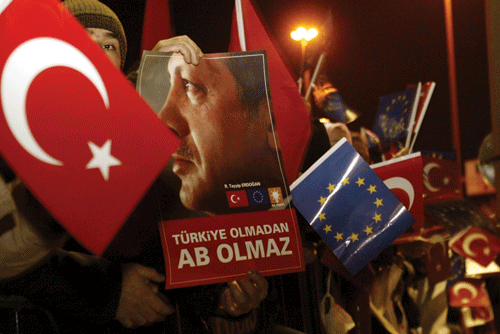
Lately, Arabs appear to have rediscovered Turkey, which they had previously tended to depict as something gruesome in its Ottoman personification. This shallow rediscovery — shallow for being pegged to Arab fears, mainly of Iran and Israel — comes amid more interesting dynamics related to Europe and the reversal of European integration.

In 2005, the European Union began membership talks with Turkey. As the EU was effectively delaying Turkish membership, this was less than Ankara had expected, after years of introducing reforms into its economic, political, and judicial systems to pave the way toward full integration. By then the tide was turning in Europe and its continuing difficulties in absorbing Muslim immigrants proved a major obstacle, as did the EU’s rapid expansion to 27 states by 2007. That year, Nicolas Sarkozy also happened to be elected president of France. Sarkozy had never hidden his hostility to full Turkish membership in Europe, a serious problem for the Turks given France’s influential role in the EU’s decision-making apparatus.

It is ironic that Greece has further undermined the aspirations of its old rival, Turkey. The Greek financial crisis and the initially sluggish, scattershot European response to it provoked a dual problem for the EU: it placed a big question mark over the viability of the dominant symbol of unification, the euro, and it cast doubt on the European enterprise in general. Today, Europe is awash in doubt, making the question of Turkish integration even trickier than before. However, this irony has hidden another. Turkey’s economy weathered well during this downturn, and according to the Organization for Economic Cooperation and Development, is expected to grow by 7 percent this year, albeit after contracting by 5.6 percent in 2009. The conditions for European integration, among them civilian domination of the armed forces, have also helped the ruling Justice and Development Party (AKP) push the Turkish military onto the defensive.

Yet this has come at a price: AKP is an Islamist party (or, as some say, a post-Islamist one), and has not been shy about attempting to advance Islamic values against the state secularism defended by the military.  The principles behind European economic and political integration were never supposed to be so contradictory. In the mind of Europe’s ideologues, economic integration and agreement over basic shared values by member states — open economies, rule of law, respect for human rights, secularism, and the like — were always supposed to reflect the liberal values of the EU’s core founders.

Turkey has muddied the waters, especially lately. Reforms have brought the country closer to the European ideal, and the AKP has defended open markets. The ruling party’s policy of “zero problems with the neighbors” has also been closely in line with the EU’s preference for nations to settle their differences peacefully.  However, Turkey has not fit the mold as snugly as the EU would like. While the AKP has sought compromise with Turkey’s Kurds, the Kurdish problem has not gone away, nor have its human rights implications. Turkish secularism has never been mistreated as it is today, by a ruling party with roots in the conservative region of Anatolia. And the EU could not have been happy with the government’s recent stance over Gaza, which brought it into confrontation with Israel and saw the prime minister, Recep Tayyip Erdogan, declaring that Hamas was not a terrorist group, in opposition to the official EU position.

 Some might argue that Turkey’s opening to the Arab world, and therefore its adoption of Arab political positions at odds with the EU consensus, has been a result of the slowdown in integration talks with Europe. That was the position of the United States defense secretary, Robert Gates, in June. But there must be more to it than that. In the same way that the EU has faltered as an idea lately, nothing in the European contract ever guaranteed that a complex state like Turkey would invariably take positions more appealing to the Western mainstream. Indeed, Turkey was always viewed as useful by the EU precisely because it had the cultural baggage to be a bridge to the Arabs.

Expect Turkey to play more on the contradictions between its European and its Middle Eastern and Islamic personalities in the foreseeable future. But don’t wait for Turkey to be more European than the Europeans. Europe hardly seems to know itself these days.

July 3, 2010 0 comments
0 FacebookTwitterPinterestEmail
Comment

UNIFIL’s thin blue line

by Nicholas Blanford July 3, 2010
written by Nicholas Blanford

In August 1986, a French soldier from the United Nations Interim Force in Lebanon (UNIFIL) on sentry duty shot and killed two members of the Amal Movement during an altercation. That night, nine French UNIFIL positions came under attack by Amal gunmen. Over the next month isolated attacks were launched against UNIFIL positions, mainly those manned by the French. In early September 1986, a roadside bomb killed three French soldiers on a morning run, and days later another French soldier died in a bomb attack against his patrol. The slew of attacks led Paris to pull the bulk of its troops, leaving just a small detachment to protect the peacekeeping mission’s headquarters in Naqoura.

Given its bloody history with UNIFIL, one would think France would understand more than most the sensitivities and realities of peacekeeping in South Lebanon. But recent French moves to press for a more robust approach in fulfilling United Nations Security Council Resolution 1701, which ended the July 2006 Lebanon-Israel war and calls for the disarmament of Hezbollah, among other things, suggests otherwise.

A peacekeeping force can only function if it has the support of the majority of the population and political forces in its area of operations. UNIFIL, which has been in Lebanon since 1978, survived in the south because it learned how to interact with the realities of a complicated and evolving situation on the ground. The local population has generally been in favor of UNIFIL’s presence and even Hezbollah came to tolerate and cooperate with the force.

Even though UNIFIL was unable to fulfill a key component of its mandate for 22 years — overseeing an Israeli withdrawal from Lebanon and helping restore Lebanese government control to the south — the force became a symbol of reassurance for southern Lebanese and a vital mediator between Hezbollah and Israel in times of heightened tension.

Following the 2006 war, UNIFIL’s numbers ballooned from 2,000 peacekeepers to more than 13,000. The bulk of the troops were drawn from top European militaries and the initial deployment consisted of a large number of special forces troops, which could deploy rapidly but were wholly unsuited for peacekeeping duties in such a complex arena. The Spanish battalion quickly landed in trouble when its elite troops pushed the boundaries of the mandate by staging reconnaissance missions in Hezbollah security pockets, unearthing old bunkers and arms stockpiles.

Warnings were given: tensions mounted with local residents, and soldiers encountered newly-planted improvised explosive devices while on patrol, but the Spanish continued their weapons searches. In June 2007, a powerful and sophisticated shaped-charge car bomb exploded beside a patrol of Spanish battalion armored personnel carriers, killing six peacekeepers. The investigation into the incident is ongoing, but the Spanish modified their behavior and have faced no more trouble.

 A UNIFIL officer told me recently that if one asks an average UNIFIL peacekeeper the purpose of his mission, chances are he will answer that it is to ensure that the area south of the Litani River is free from weapons.

“That’s not the mission,” the officer said. “That’s the mission of the Lebanese army. We are just here to help the Lebanese implement 1701.”

The French have been grumbling recently that there are too few Lebanese troops south of the Litani and are seeking to tighten controls on arms reaching the border district. That presumably means adopting a more unilateral approach to weapons searches and less coordination with the Lebanese army, seen as an unreliable partner by many in UNIFIL.

The French, and perhaps some other battalions, are taking their mission too seriously. In reality, UNIFIL is almost irrelevant when it comes to war and peace along the Lebanon-Israel border. If Hezbollah or Israel want to go to war, UNIFIL can do nothing to stop it. UNIFIL’s only essential role is to act as intermediary between Hezbollah, the Lebanese army and the Israelis. An indirect bonus of the force’s presence is the economic and humanitarian benefits brought to the south.

If war breaks out, the UNIFIL battalions will either leave Lebanon as fast as possible or dive into the bomb shelters to sit it out. Those with gung-ho attitudes about mandate fulfillment should take a deep breath, relax and enjoy the summer sunshine. There’s not much else they can do.

NICHOLAS BLANDFORD is a Beirut-based correspondent for The Christian Science Monitor and The Times of London.


July 3, 2010 0 comments
0 FacebookTwitterPinterestEmail
Comment

Antiquities right of return

by Paul Cochrane July 3, 2010
written by Paul Cochrane

I am among those fortunate enough to not only have visited the cream of the Middle East’s major historical sites — among them Persepolis, the Valley of the Kings, Palmyra and Baalbek — but also viewed antiquities taken from these places in European and American museums. Few people in Iran, Egypt, Syria and Lebanon have the same opportunity.

Though the ancient palaces and structures may remain, much of what they held is no longer on site, or even in the country. Spirited away over the past 200 odd years, many of the region’s most famous artifacts are in the West, torn from their historical and spatial context through acts of Elginism. The term — defined as cultural vandalism — was coined after the Earl of Elgin, who removed the Parthenon Marbles from Athens in the early 18th century to decorate his house in Scotland.

At the Louvre in Paris recently, I was taken aback by a huge Phoenician sarcophagus discovered in Sidon, far more imposing than any on display in Lebanon. It would be one of the centerpieces of the National Museum in Beirut, but instead is tucked into an underground gallery in one of the largest museums in the world.

I became only more indignant entering a gallery devoted to Palmyra, which shamed those in Tadmur or in Damascus. And then there was the Achaemenid exhibit containing sculptures taken from Persepolis. Why should I travel to Paris, London and numerous museums in the United States to see what should rightfully be shown in Persepolis, Palmyra or Sidon?

While I appreciate that millions of people have been able to admire the wonders of the ancient Middle East at these museums and that artifacts have been kept in safe conditions, there is a strong argument for the repatriation of relics.

Near perfect copies can be made if museums want to maintain their permanent collections or borrow items, a widespread practice. The idea that the region cannot look after its heritage properly is without merit and reeks of paternalism.

After all, the Lebanese National Museum managed to protect its collection throughout the civil war, while Syria, Egypt and Iran have all overhauled their museums. Indeed, one of the worst cases of cultural barbarism in modern history was instigated by the US-led invasion of Iraq, when the occupation forces failed to prevent the looting of what was perhaps the most significant collection of antiquities in the world at National Museum of Baghdad. There is growing momentum for artifacts to be returned to their roots, though this has been hindered by a well-meaning 1970 UNESCO convention calling for the restitution of antiquities and works of arts, but only for objects taken to other countries before that date.

The convention is one obstacle stopping the Rosetta stone, held by the British Museum for more than 200 years, or the 3,400-year-old bust of Queen Nefertiti at the Neues Museum in Berlin, from being returned to Egypt. While Lebanon has no official position on this matter, Syria, Iraq, Libya and Egypt are calling for the return of their cultural artifacts. In April, Cairo hosted a conference of 25 “countries that have suffered from theft,” as the outspoken head of Egypt’s Supreme Council of Antiquities, Zahi Hawass, put it.

“We will make life miserable for museums that refuse to repatriate,” said Hawass at the conference.

His threats have worked in the past. Last year Egypt broke off relations with the Louvre until steles stolen from a tomb in the Valley of the Kings in the 1980s were returned. Further arm-twisting came when Hawass threatened to ban French scholars from excavating in Egypt. The Louvre then capitulated.

But there are few precedents of Elginism being reversed — most pointedly exemplified by Greece’s as-yet unsuccessful 30 years spent lobbying Britain to return the “Elgin Marbles.” As Hawass suggested, cooperation between the aggrieved countries is needed to make threats effective, with countries putting together “wish lists” of what they want returned.

 These wish lists deserve broad international support to allow the artifacts of human history to be seen in their proper context, rather than in foreign museums thousands of kilometers away.

PAUL COCHRANE is the Middle East

correspondent for International News Services

July 3, 2010 0 comments
0 FacebookTwitterPinterestEmail
Comment

Israel spins its ship storm

by Stephanie Dotzer July 3, 2010
written by Stephanie Dotzer

Anything we can do for you?” the Israeli intelligence officer inquired after 10 minutes of interrogation. Mohamed Vall, an Al Jazeera correspondent who had been on board the Mavi Marmara, was among the VIP detainees the Israelis were handling with care. His hands were cuffed in the front, unlike most activists whose wrists were bound behind their backs; and unlike others, he was allowed the luxury of using the toilet.

Were Mohamed not a friend of mine, I still would have no clue what actually happened after Israeli commandos stormed the Gaza-bound flotilla and cut communications with the outside world. Western media wouldn’t tell me. Sure, I read the newspapers and zapped from CNN to BBC and back again, but it felt like I’d heard it all many times before. The flotilla-part is new, the rest is a ritual: Israeli spokespeople say what they always say — “Any other country in the world would do the same!” — while journalists and politicians engage their conditioned reflex: if they’re Arab, they get carried away with emotions; if they’re Western, they get caught up in their own precautions and end up saying nothing.

While the world has gotten used to the killing of Palestinian civilians, a deadly raid on an aid ship with passengers from 40 different countries is much harder to ignore. But, by and large, the Western world managed quite well. Granted, the story made the headlines and even Israel’s best friends — such as the United States and Germany — showed an unusual degree of indignation that the attack occurred in international waters.

Nonetheless, Arab commentators who tried to transform the tragedy into triumph, arguing that the world is finally waking up to Israeli crimes, don’t seem to have read much of the Western press.

Contrary to what many analysts claim, Israel has not lost the public relations war. It can still rely on thousands of loyal journalists to steer the international debate into side streets before it ever gets to the point. For, if there is one thing more blockaded than Gaza, it’s human common sense when it comes to Middle Eastern politics.  How else can you explain that most international media got stuck in a dead-end debate over who had what weapons and who was provoking whom? If fully armed soldiers storm your vessel at 4 a.m., would you assume they’ve come to join morning prayer? Instead of focusing on the fundamentals (like if the blockade itself is illegal under international law, then an attempt to enforce it on a third party cannot be particularly lawful), many Western journalists concluded that “the facts are unclear” and all one can safely state is the need for an “impartial investigation.”

To quote the above mentioned Mohamed Vall: “You got the GPS parameters, you got 600 eye-witnesses, what else do you need?”  Eyewitnesses? Heck yes. But where are they? In most mainstream media (with noteworthy exceptions such as The Guardian), eyewitness accounts were scarce. The German press largely ignored even their own members of Parliament who had joined the flotilla, arguing that, if they were on that ship, they were obviously biased and anti-Israel. Instead of listening to passengers, many journalists bought the idea that they were either radical Islamists or crazy leftists “being used by Islamists.” The Western logic seems to be: if it’s a bunch of hippies with dreadlocks doing yoga on the deck, ok, let them reach Gaza. If they wear beards and pray five times a day, then it suddenly seems much more acceptable to stop them from… well, from bringing cement and medicine to a besieged population.

More and more people are not falling for the spin and are managing to think for themselves. But the closer the Western public comes to seeing what’s happening in Gaza, the quicker opinion-makers reassert that “Israel’s fears must be acknowledged” and that “a country that is so isolated urgently needs its friends.”

Israel doesn’t need sheepish friends. It needs to take advice from its critics — and listen to Mohamed’s answer to the question asked by his Israeli interrogators. Sadly, the right reply only came to his mind long after his deportation: “Anything you can do for me? Oh yes, you can. Lift the siege, stop mocking the world, consider Arab lives as precious as Jewish lives… and then, ahlan wa sahlan, live happily ever after.”

STEPHANIE DÖTZER has worked for Al Jazeera English and Germany’s ARD news network. She now freelances in the Middle East

July 3, 2010 0 comments
0 FacebookTwitterPinterestEmail
Comment

Flotilla fallout docks in Ankara

by Peter Grimsditch July 3, 2010
written by Peter Grimsditch

The peripheral effects of the Mavi Marmara affair 100 kilometers off the Israeli coast on the last day of May have begun to remove some of the initial political glory that fell on Turkey.

Israeli commandos killed nine people when they stormed the former Bosphorus ferry to stop it from continuing to Gaza to deliver a cargo of humanitarian supplies. The nine victims were shot a total of 30 times and five were killed by gunshot wounds to the head, according to the Turkish council of forensic medicine. Ibrahim Bilgen, 60, was shot four times in the temple, chest, hip and back. Fulkan Dogan, a 19-year-old American of Turkish extraction, was shot five times from less that 45 centimeters in the face, in the back of the head, twice in the leg and once in the back. Five of the victims were shot either in the back of the head or in the back. 

 Ankara, justifiably angered by this disproportionate display of force, poured a tirade of vitriol upon Israel and appeared as a new and active champion of the Palestinian cause, which prompted outpourings of support for the government of Turkish Prime Minister Recep Tayyip Erdogan. While domestic political gains still abound, the fallout in various international arenas is spreading.

The jury is still out on the trite question of whether Turkey has killed off its chance of joining the European Union through currying favor with its eastern — and Muslim — neighbors. Politicians involved in the EU application deny any such policy shift. Indeed, friendly commentators in the United States and Europe point out that Turkey’s close relations with states like Syria and Iran make it a more attractive proposition for the EU.  It can boldly go for talks where few European politicians dare to venture.

Be that as it may, there are a number of areas where Turkey stands to lose out because of its public spat with Israel. Not least is in its campaign against the Kurdish Workers Party (PKK), in which some 50 members of the Turkish armed forces have been killed since March. One of the most useful tools in spotting PKK bases in Northern Iraq is the Unmanned Aerial Vehicle (UAV), or, more popularly, the drone. Six Israeli-made Heron UAVs stationed near the Iraq border have been providing surveillance data on PKK bases. The Israeli technicians present in Turkey to troubleshoot and give training are said to have pulled out two weeks after the battle of Mavi Marmara.

The Turks put a brave face on the withdrawal. Defense Minister Vecdi Gonul said Turkish personnel had been trained in Israel and would take over the task of operating the Herons. Other Turks say this is easier said than done.

But all may not be lost. In a triumph of pragmatism over principle, there is an unofficial agreement in Ankara that any decision to freeze military deals with Israel should be delegated to the defense ministry. Thus on June 22, as at a suspected PKK bombing of a military bus killed least five people in Istanbul, a Turkish delegation arrived in Tel Aviv to view the latest Heron tests and to take delivery of another four.

Meanwhile, Erdogan has claimed that “foreign elements” have been involved as a “subcontractor” in the escalation of PKK attacks on the Turkish army. It was left to acolytes lower down the line, speaking on convenient condition of anonymity, to point the finger at Israel. For good measure, there have been equally unlikely accusations that Israel was also behind the attack on a Turkish naval base at Iskenderun. This leaves a choice between believing that Israel is conspiring with the PKK to engineer attacks on the Turkish army, or it is cooperating with that same army to launch attacks on PKK bases. Turkey, like much of the Middle East, is replete with conspiracy theories.

Deteriorating relations with Israel could have another ill effect on Ankara. Israeli lobbies in the US have for decades taken up the cudgel on Turkey’s behalf to beat down attempts by the Armenian community to have the US Congress officially recognize the wholesale slaughter of 1915. Mike Spence, a Republican representative for Indiana, said if Turkey continued to become more antagonistic to Israel, he would reconsider his opposition to a resolution designating the events as genocide.

This has far-reaching financial implications. Congressional recognition of the genocide would make it possible for Armenian groups to sue for damages and seize Turkish assets in the US. The headline-grabbing flotilla unleashed a tide of events which could lead anywhere. Victory doesn’t appear to be one of the ports of call.

PETER GRIMSDITCH is Executive’s

Istanbul correspondent

July 3, 2010 0 comments
0 FacebookTwitterPinterestEmail
Comment

Bill’s American dream

by Riad Al-Khouri July 3, 2010
written by Riad Al-Khouri

What do former American President Bill Clinton and the new Miss USA Rima Fakih have in common? Jokes about Clinton’s notorious womanizing aside, rather a lot, actually: Rima is a perfect example of Bill’s answer to America’s economic woes. 

Speaking in April about fiscal responsibility, Clinton said immigration was a key to United States central government budget deficit reduction, which in turn was vital for America’s future. He was quoted on the website of The Atlantic magazine as saying, “We [the US] need more immigrants. We need to reverse the age ratio. I see that as part of fiscal responsibility.”

Coming from the US president who will perhaps best be remembered for putting a long deficitary American federal budget into surplus, this is serious stuff. Expounding on his theme, he added that “the great virtue of this country, the thing we have over China and India, is that we have somebody from everywhere here, and they do well. This country still works for immigrants.”

He should have added that immigrants also work for their new country. Typically fleeing trouble spots or poverty pockets, of which there are more than a few in the modern Arab world, migrants from the Middle East tend to be hard working and — on the whole — economically successful. Only a short hop from my vantage point of Ann Arbor, Michigan, places like Rima Fakih’s hometown of Dearborn show the inspiring impacts of Arab immigration to the US.

The bustle of places like Dearborn allows Clinton to conclude that: “The changes we make will be less draconian if we get more people into the system. I don’t think there’s any alternative than to increase immigration. I don’t see any kind of way out of this [deficit] unless that’s part of the strategy.”

This brings us back to Ms Fakih. With his eye for the ladies, one wonders what Bill makes of Rima personally, but there is no doubt that he approves of what she represents: a young and successful migrant to America. Born in Lebanon but raised in the US, Rima Fakih is fairly typical of newly arrived Arab-Americans: from a modest background and flourishing in their new homeland in ways difficult to imagine had they never come to the US. These emigrants have been arriving in force from the Arab world for over a century, and they and their descendants are to be found in most communities around the US.

Rima Fakih - Miss USA

The contribution of these Arab-Americans to the US economy has traditionally not been easily quantified in dollar terms or labor market participation. That is partly because so many of them change their names and turn their backs on their roots. Not so Rima Fakih: though she will represent the US in this summer’s Miss Universe competition, she has shown pride in her Arab heritage. Yet even if she doesn’t win the world crown, her camera-friendly credentials are assured and she will doubtless go on to parlay the Miss USA title into serious money. That way, Clinton’s beneficent fiscal loop happily closes, with migrants such as Fakih working their way up and enriching the American system. Young and successful, they pay more in taxes and don’t rely on state benefits.

On another level, Fakih underlines the positive moral and cultural importance of Arab Americans living in US society. OK, she’s easy on the eyes, and she and her successful immigrant community cheer up the American economy, but this sort of prominence is also playing another crucial role. Fakih has come as an antidote to the “Islamist terrorist” xenophobia that is unfortunately commonplace in the US press, both before and after 9/11. Long prior to the destruction of the Twin Towers in September 2001, this kind of sentiment was — and remains — widespread in America. And though Fakih has not been immune to the conspiratorial accusations of the right-wing media, the general praise of the mainstream — despite the minor pole-dancing distracter — has done well to marginalize her critics and better the image of Arab Americans.

Hopefully, the new Miss America’s rise will help a little to clear the air in that respect, even as Bill Clinton’s thinking on the economic role of immigrants reminds us of their strong positive contribution. 

RIAD AL-KHOURI is a senior economist at the William Davidson Institute of the University of Michigan in Ann Arbor 


July 3, 2010 0 comments
0 FacebookTwitterPinterestEmail
Comment

Wanton democracy

by Peter Speetjens July 3, 2010
written by Peter Speetjens

Words are like colors. They come and go with the seasons. Not so very long ago, words like “democratization” and “a new Middle East” were all the fashion in Washington and many a journalist, the trendy type, jumped on the bandwagon arguing that the Iraq war was about just that: democracy.

But the tune changed even under George Bush and today the “D-word” has largely fallen out of fashion. While it can still be used in criticizing such countries as Iran or Syria, it is generally avoided in reference to the rest of the region. Hence, we heard next to nothing about the democratic turns for the worse in Egypt and Jordan, which with Saudi Arabia, form America’s triangle of “moderate” Arab allies.

Despite a flood of promises not to, the Egyptian parliament on May 11 routinely and for the zillionth time extended the state of emergency that has continuously been in place since 1981, the year when Egypt’s former President Anwar Sadat was killed and his successor Hosni Mubarak took over.

While emergency rule per definition is a temporary solution to an extraordinary situation, a whole generation of Egyptians has come to accept as normal the suspension of their universal human rights. Members of Mubarak’s National Democratic Party (NDP), which has dominated Egypt’s political landscape since 1952, argue that the extra powers are needed to counter terrorism and drug trafficking. This hardly seems the ruling party’s only goal however. What’s more, the goal hardly justifies the means.  According to human rights advocates, many thousands of Egyptians spend their lives behind bars without charges and without a fair trial. Torture is widespread. Meanwhile, basic human rights such as the freedom of association and expression have been severely reduced. Censorship is everywhere.  It is no secret that the state’s extraordinary mandate has come in handy in the run-up to elections, when the NDP’s political opponents, especially members of the Muslim Brotherhood are arrested and locked up. Most of them are released once the elections are over, yet not everyone is that lucky.

When a civilian court in 2006 dismissed all charges against Khairat al-Shatir, the Brotherhood’s deputy supreme guide, and 15 other party members, Mubarak transferred their cases to a military tribunal, which in 2008 sentenced them to up to 10 years in jail. Naturally, the military court is no public affair, while the current emergency laws do not include the right to appeal.

Meanwhile, the ailing 82-year-old Mubarak continues to pave the way for his son Gamal to take over the presidential crown, while his second son, Alaa, keeps an eye on the family’s growing business empire.

The democratic barometer of Jordan does not peak much higher. Egypt’s eastern neighbor in May finally presented the long awaited new election law. King Abdullah II dissolved parliament late last year and parliamentary elections are set to take place by the end of this year.

While Jordan’s king publicly called for fair and free elections, he appointed Rajai Muasher, openly an opponent of political liberalization and reform, to take charge of formulating the new election law.

The end result is flawed, to say the least, and has been severely criticized by international human rights organizations. The main criticism concerns the fact that, while about half of Jordan’s population lives in Greater Amman, the new law has downsized constituencies and increased the number of seats in the lower house of Parliament to 120, which are spread all across the country. The obvious aim is to keep the “power of the people” firmly in the hands of the “true” Jordanian tribes, while Jordan’s capital remains underrepresented and with it the majority of Jordanians of Palestinian descent, as well as urban-based Islamic parties.

The color of the day is, therefore, not the “D-word” but “status quo,” and how to keep it no matter what. Having just returned from a trip to Egypt, the image that sticks in my mind as an epitome of the country’s politics is that of 40 elderly men protesting at the Ministry of Health against a cut in their benefits. They were faced by at least twice as many policemen in black, while around the corner two trucks filled with more uniforms awaited.

No image comes to mind regarding Jordan. The Hashemite Kingdom generally forbids demonstrations.

PETER SPEETJENS is a Beirut-based journalist

July 3, 2010 0 comments
0 FacebookTwitterPinterestEmail
Comment

Beware the black swan

by Natacha Tannous July 3, 2010
written by Natacha Tannous

Forecast to reach an altitude of $55.4 billion by year’s end, the precarious flight of Lebanon’s arrears is ruffling far too few feathers among our policy makers. Instead, they’re counting on economic growth to dilute the debt by reducing the debt-to-GDP ratio, which differing sources currently place around 150 percent. In the words of Finance Minister Raya el-Hassan: “Don’t use economic textbooks to understand the Lebanese model.”

Is Lebanon somehow serendipitously always right on the money? Is the country some sort of economic maverick with a secret recipe for success?

True, Lebanon has never defaulted on its debt, but staking so much on our economic exceptionality to see us through can only help hasten the arrival of our ‘black swan’ — that unpredictable and improbable high-impact event left unaccounted for in the economic models, which could sink us into a debt deathtrap.

Prudence therefore calls for effectively managing the surging debt burden; we need to reduce the debt inventory and avoid renewing bonds at maturity while containing inflation amid excessive liquidity.  Our archaic infrastructure cannot maintain current growth rates indefinitely and only the gullible would believe the cyclical reduction in Lebanese bond yields are sustainable.

Financing long-term growth requires structural reforms. We must improve infrastructure and promptly implement, among other things, an energy policy to tackle the national power company’s $1.4 billion yearly losses; we must realize the potential of our natural resources and human capital, and create new initiatives in education. The government must quit beating around the cedar tree and properly address these issues to build a healthy economy.

In a modern country it is unacceptable that the 2010 budget, if endorsed by Parliament, will be the first budget passed in five years. And as it stands, this budget projects a $4 billion deficit, meaning debt issuance is unlikely to slow anytime soon. Central Bank Governor Riad Salameh admits he is “concerned about the growing deficit and we are incessantly calling for reforms to decrease [it].”

How though, is not clear-cut; in terms of expenditure, the quality and transparency of public spending must improve and the chronic leakages that plague the system need to be stemmed. On the revenue side, wages in Lebanon total approximately $20 billion; with direct income tax rate of 10 percent, government should be collecting some $2 billion annually, not the current $780 million. Closing the loopholes on tax dodgers will take time to implement; in the meantime, additional revenues could be mobilized through a 2 percent increase in value added tax, though this would likely spur social upheaval. Government officials have sung about privatization, public-private partnership (PPP) and securitization answering our debt woes, but none of these options can fully fix the problem.

In regard to privatization, between the telecom operators and the low value of the national airline, utilities companies, ports and airports, the government would be lucky to collect $10 billion and not sell at distressed prices, while it would also lose the revenue of telecom tariffs – currently a de facto form of taxation that earned government $1.36 billion last year. Privatization could help pay down the volatile part of the Lebanese debt — Eurobonds held by non-Lebanese — but it is no long-term solution. PPPs could help improve infrastructure without increasing the public debt, but require an autonomous capacity for the private sector to finance itself, and this is not self-evident. Such partnerships are complex, and potentially unsustainable. Ultimately, PPPs will not solve Lebanon’s debt bind.

Securitization is not the answer either, as future revenue streams from such a scheme must be proven viable before implementation. The fact is, the Lebanese market isn’t mature enough for it and the International Monetary Fund does not consider securitization proceeds as debt reduction, but rather an alternative type of debt. So as the government toys with wishful thinking on ways to balance the books and stalls on progress in substantive structural reform, our debt continues to take flight.

As long as the economic forecast stays bright and shiny, the country should be able to glide through debt refinancing by issuing more sovereign paper. The problem is the improbable — that black-winged bird which swoops down on us from above while we were gazing at how high we’d climbed. When our economic model begins its plummet toward reality, we will only have ourselves to blame.

NATACHA TANNOUS is EXECUTIVE’s financial correspondent

July 3, 2010 0 comments
0 FacebookTwitterPinterestEmail
  • 1
  • …
  • 414
  • 415
  • 416
  • 417
  • 418
  • …
  • 686

Latest Cover

About us

Since its first edition emerged on the newsstands in 1999, Executive Magazine has been dedicated to providing its readers with the most up-to-date local and regional business news. Executive is a monthly business magazine that offers readers in-depth analyses on the Lebanese world of commerce, covering all the major sectors – from banking, finance, and insurance to technology, tourism, hospitality, media, and retail.

  • Donate
  • Our Purpose
  • Contact Us

Sign up for our newsletter

    • Facebook
    • Twitter
    • Instagram
    • Linkedin
    • Youtube
    Executive Magazine
    • ISSUES
      • Current Issue
      • Past issues
    • BUSINESS
    • ECONOMICS & POLICY
    • OPINION
    • SPECIAL REPORTS
    • EXECUTIVE TALKS
    • MOVEMENTS
      • Change the image
      • Cannes lions
      • Transparency & accountability
      • ECONOMIC ROADMAP
      • Say No to Corruption
      • The Lebanon media development initiative
      • LPSN Policy Asks
      • Advocating the preservation of deposits
    • JOIN US
      • Join our movement
      • Attend our events
      • Receive updates
      • Connect with us
    • DONATE