• Donate
  • Our Purpose
  • Contact Us
Executive Magazine
  • ISSUES
    • Current Issue
    • Past issues
  • BUSINESS
  • ECONOMICS & POLICY
  • OPINION
  • SPECIAL REPORTS
  • EXECUTIVE TALKS
  • MOVEMENTS
    • Change the image
    • Cannes lions
    • Transparency & accountability
    • ECONOMIC ROADMAP
    • Say No to Corruption
    • The Lebanon media development initiative
    • LPSN Policy Asks
    • Advocating the preservation of deposits
  • JOIN US
    • Join our movement
    • Attend our events
    • Receive updates
    • Connect with us
  • DONATE
Business

Orascom Telecom holding – Khalid Bichara

by Paul Cochrane July 3, 2010
written by Paul Cochrane

Khalid Bichara is the chief executive officer of Egypt’s Orascom Telecom Holding, which has operations in Africa, Europe, Canada and Asia, as well as managing the Lebanese telecom provider Alfa. Bichara sat down with Executive at the Alfa headquarters in Beirut to discuss privatization, market share and why Lebanon still doesn’t have 3G.

E  Samer Salemeh, after just a short stint as Alfa’s CEO, recently resigned. He had reportedly complained of political interference. Is this true?

As the CEO of the holding, I don’t work day in day out in the business here and I am not really in the right place to comment on that. What I will say is that the business in Lebanon is one in which we are aware of the human capital, and we have a lot of Lebanese employees that have long been involved in the sector — Lebanon in 1994 was the leading mobile player in the region.

The other thing is that the short-term view of renewing management contracts is negatively affecting the market because it is a long-term market and known for long-term investment, that is why licenses are for 15 or 25 years. Whenever you manage a market for six month or one year chunks it definitely does not deliver the best results, not for the operator, nor the government and not for the Lebanese consumer.

E  Salemeh also said that HSPA plus (mobile broadband technology) was tested and ready to be deployed. This hasn’t happened yet. Why?

I don’t think we need to test it here, as it’s been tested everywhere else. Again, the [question] is: what is your time frame and how can you do it. Things take time. We are not here to re-define whether the private sector is faster than the government; this question has been answered before.

E  The revenue sharing agreement that is due for renewal in the coming months is a lot more stringent than before, and on top of that there has been no movement to privatize the sector. This doesn’t exactly inspire confidence.

There has never been a change here — the government has always honored agreements [with us] perfectly well. They have never given an agreement and changed it. What we said is the term was never long enough for us to have long-term development of the sector. So far we cannot complain of our experience here; what you see is what you get.

E  What about full privatization?

We are a company that plays in a very regulated market worldwide, so we have learned that it is sometimes easy and sometimes hard, and you have to follow local rules.

When we came in, nobody lied to us and said the sector would be privatized tomorrow, so we knew we would invest in a management contract —  whether a long-term management contract, a BOT [build-operate-transfer], or privatization — to be ready and in the right position.

We knew that from day zero and that is why we came in. Every market has its own peculiarities.

Today we met the minister, and we reiterated the same message: we are happy, we are delivering results, and we have doubled our customer base in a year, and have increased salaries twice. But it is all building up for the future.

We cannot claim we have been negatively surprised, as we in the private sector always want more and if you give us more, we want even more. And we want more visibility and a more long-term relationship for the sector to take shape in the way it once had. For Lebanon to have been the first country to have an advanced network in the region and to have no 3G, it is a waste.

E  Alfa has been losing market share to MTC, which has a 57 percent share according to recent figures. Why is this happening and what are you doing to claw back market share?

We had a business meeting today and we’ve gained 3 percent market share. We are not only about gaining market share but value share. If you want to distribute one million SIM cards it is not a big deal, but to sell to people that use it and we can make money from, is the harder trick. It is really incremental. If you move fast it will destroy you, you need a network that is up to scale.

E  Are we ever likely to see calling rates go down in Lebanon?

As a management company we don’t fully control pricing. The simple focus on price per minute is not the right focus. When we go to talk to regulators, their main role is to foster competition, but they sometimes forget that. If you don’t have competition, then you won’t find companies like us investing $3 billion in Italy.

I think prices [dropped], last year, and people were happy. The right thing to do is lower the price incrementally, because if you just drop the price it will create weaker players, worse service, and little money to invest in the future. You have to create the right balance and manage carefully.

E  So it’s important to take baby steps?

Fast baby steps. Because at the end of the day, while I am talking about patience, patience, patience, in 10 years we’ve gone from 200,000 to 120 million customers, so we are not slow. But there is a difference between being slow and being careless.

We have learned in some markets the hard way, you expand and the market changes. The team has successfully delivered here, quality has improved and the customer base has doubled. That is an achievement. Things go on.

E  What is the outlook for Lebanon if political interference in the telecoms sector continues?

We think that from the current view and current discussions we are having, we are getting there. The view from operators and from the government is that we need more long-term investment and commitment, whether long-term management contracts, or BOT, or privatization; these are different means to the same goal.

Once that happens you will see much faster development in the market; as for when that will happen, I don’t think I am the right person to answer.

E  Looking to the future of telecoms in the Middle East, the Arab world already has around 265 million cellular lines and penetration rates are soaring. How do you see the market in five or even 10 years time?

I always joke that my boss gave me the hard job — since he started the company as Orascom Telecom  we have generated $15 billion in revenues and have gained 120 million customers in the span of 10 years, from 1999 to 2009. So when he passed the baton to me, looking at the next 10 years, can I add 120 million customers? Can we add and grow at the same rate doing what we have been doing? The answer is clearly no.

We are looking at adjacent services and value added services, online content, Internet and mobile advertising, mobile banking, data centers, submarine cables, and all the business adjacent to our business; we are not going to open burger shops but expand around this core business. And we will always say our customer base is our biggest asset.

Our idea is to sell more services and go vertical with our customer segments, to people that like music, who are in the trade business or into the IT business. What services can I give them and how can my business be more relevant to them? It is really changing from a volume game to a quality game; we have the volume so [now we] can build quality on top of that.
July 3, 2010 0 comments
0 FacebookTwitterPinterestEmail
Comment

Europe’s anomaly

by Michael Young July 3, 2010
written by Michael Young

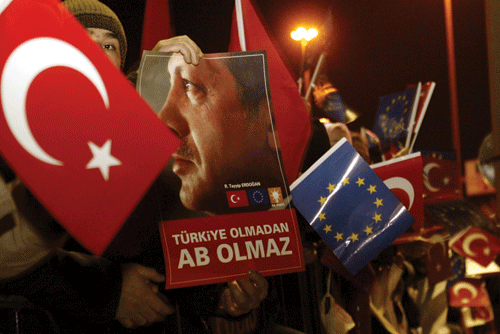
Lately, Arabs appear to have rediscovered Turkey, which they had previously tended to depict as something gruesome in its Ottoman personification. This shallow rediscovery — shallow for being pegged to Arab fears, mainly of Iran and Israel — comes amid more interesting dynamics related to Europe and the reversal of European integration.

In 2005, the European Union began membership talks with Turkey. As the EU was effectively delaying Turkish membership, this was less than Ankara had expected, after years of introducing reforms into its economic, political, and judicial systems to pave the way toward full integration. By then the tide was turning in Europe and its continuing difficulties in absorbing Muslim immigrants proved a major obstacle, as did the EU’s rapid expansion to 27 states by 2007. That year, Nicolas Sarkozy also happened to be elected president of France. Sarkozy had never hidden his hostility to full Turkish membership in Europe, a serious problem for the Turks given France’s influential role in the EU’s decision-making apparatus.

It is ironic that Greece has further undermined the aspirations of its old rival, Turkey. The Greek financial crisis and the initially sluggish, scattershot European response to it provoked a dual problem for the EU: it placed a big question mark over the viability of the dominant symbol of unification, the euro, and it cast doubt on the European enterprise in general. Today, Europe is awash in doubt, making the question of Turkish integration even trickier than before. However, this irony has hidden another. Turkey’s economy weathered well during this downturn, and according to the Organization for Economic Cooperation and Development, is expected to grow by 7 percent this year, albeit after contracting by 5.6 percent in 2009. The conditions for European integration, among them civilian domination of the armed forces, have also helped the ruling Justice and Development Party (AKP) push the Turkish military onto the defensive.

Yet this has come at a price: AKP is an Islamist party (or, as some say, a post-Islamist one), and has not been shy about attempting to advance Islamic values against the state secularism defended by the military.  The principles behind European economic and political integration were never supposed to be so contradictory. In the mind of Europe’s ideologues, economic integration and agreement over basic shared values by member states — open economies, rule of law, respect for human rights, secularism, and the like — were always supposed to reflect the liberal values of the EU’s core founders.

Turkey has muddied the waters, especially lately. Reforms have brought the country closer to the European ideal, and the AKP has defended open markets. The ruling party’s policy of “zero problems with the neighbors” has also been closely in line with the EU’s preference for nations to settle their differences peacefully.  However, Turkey has not fit the mold as snugly as the EU would like. While the AKP has sought compromise with Turkey’s Kurds, the Kurdish problem has not gone away, nor have its human rights implications. Turkish secularism has never been mistreated as it is today, by a ruling party with roots in the conservative region of Anatolia. And the EU could not have been happy with the government’s recent stance over Gaza, which brought it into confrontation with Israel and saw the prime minister, Recep Tayyip Erdogan, declaring that Hamas was not a terrorist group, in opposition to the official EU position.

 Some might argue that Turkey’s opening to the Arab world, and therefore its adoption of Arab political positions at odds with the EU consensus, has been a result of the slowdown in integration talks with Europe. That was the position of the United States defense secretary, Robert Gates, in June. But there must be more to it than that. In the same way that the EU has faltered as an idea lately, nothing in the European contract ever guaranteed that a complex state like Turkey would invariably take positions more appealing to the Western mainstream. Indeed, Turkey was always viewed as useful by the EU precisely because it had the cultural baggage to be a bridge to the Arabs.

Expect Turkey to play more on the contradictions between its European and its Middle Eastern and Islamic personalities in the foreseeable future. But don’t wait for Turkey to be more European than the Europeans. Europe hardly seems to know itself these days.

July 3, 2010 0 comments
0 FacebookTwitterPinterestEmail
Comment

UNIFIL’s thin blue line

by Nicholas Blanford July 3, 2010
written by Nicholas Blanford

In August 1986, a French soldier from the United Nations Interim Force in Lebanon (UNIFIL) on sentry duty shot and killed two members of the Amal Movement during an altercation. That night, nine French UNIFIL positions came under attack by Amal gunmen. Over the next month isolated attacks were launched against UNIFIL positions, mainly those manned by the French. In early September 1986, a roadside bomb killed three French soldiers on a morning run, and days later another French soldier died in a bomb attack against his patrol. The slew of attacks led Paris to pull the bulk of its troops, leaving just a small detachment to protect the peacekeeping mission’s headquarters in Naqoura.

Given its bloody history with UNIFIL, one would think France would understand more than most the sensitivities and realities of peacekeeping in South Lebanon. But recent French moves to press for a more robust approach in fulfilling United Nations Security Council Resolution 1701, which ended the July 2006 Lebanon-Israel war and calls for the disarmament of Hezbollah, among other things, suggests otherwise.

A peacekeeping force can only function if it has the support of the majority of the population and political forces in its area of operations. UNIFIL, which has been in Lebanon since 1978, survived in the south because it learned how to interact with the realities of a complicated and evolving situation on the ground. The local population has generally been in favor of UNIFIL’s presence and even Hezbollah came to tolerate and cooperate with the force.

Even though UNIFIL was unable to fulfill a key component of its mandate for 22 years — overseeing an Israeli withdrawal from Lebanon and helping restore Lebanese government control to the south — the force became a symbol of reassurance for southern Lebanese and a vital mediator between Hezbollah and Israel in times of heightened tension.

Following the 2006 war, UNIFIL’s numbers ballooned from 2,000 peacekeepers to more than 13,000. The bulk of the troops were drawn from top European militaries and the initial deployment consisted of a large number of special forces troops, which could deploy rapidly but were wholly unsuited for peacekeeping duties in such a complex arena. The Spanish battalion quickly landed in trouble when its elite troops pushed the boundaries of the mandate by staging reconnaissance missions in Hezbollah security pockets, unearthing old bunkers and arms stockpiles.

Warnings were given: tensions mounted with local residents, and soldiers encountered newly-planted improvised explosive devices while on patrol, but the Spanish continued their weapons searches. In June 2007, a powerful and sophisticated shaped-charge car bomb exploded beside a patrol of Spanish battalion armored personnel carriers, killing six peacekeepers. The investigation into the incident is ongoing, but the Spanish modified their behavior and have faced no more trouble.

 A UNIFIL officer told me recently that if one asks an average UNIFIL peacekeeper the purpose of his mission, chances are he will answer that it is to ensure that the area south of the Litani River is free from weapons.

“That’s not the mission,” the officer said. “That’s the mission of the Lebanese army. We are just here to help the Lebanese implement 1701.”

The French have been grumbling recently that there are too few Lebanese troops south of the Litani and are seeking to tighten controls on arms reaching the border district. That presumably means adopting a more unilateral approach to weapons searches and less coordination with the Lebanese army, seen as an unreliable partner by many in UNIFIL.

The French, and perhaps some other battalions, are taking their mission too seriously. In reality, UNIFIL is almost irrelevant when it comes to war and peace along the Lebanon-Israel border. If Hezbollah or Israel want to go to war, UNIFIL can do nothing to stop it. UNIFIL’s only essential role is to act as intermediary between Hezbollah, the Lebanese army and the Israelis. An indirect bonus of the force’s presence is the economic and humanitarian benefits brought to the south.

If war breaks out, the UNIFIL battalions will either leave Lebanon as fast as possible or dive into the bomb shelters to sit it out. Those with gung-ho attitudes about mandate fulfillment should take a deep breath, relax and enjoy the summer sunshine. There’s not much else they can do.

NICHOLAS BLANDFORD is a Beirut-based correspondent for The Christian Science Monitor and The Times of London.


July 3, 2010 0 comments
0 FacebookTwitterPinterestEmail
Comment

Antiquities right of return

by Paul Cochrane July 3, 2010
written by Paul Cochrane

I am among those fortunate enough to not only have visited the cream of the Middle East’s major historical sites — among them Persepolis, the Valley of the Kings, Palmyra and Baalbek — but also viewed antiquities taken from these places in European and American museums. Few people in Iran, Egypt, Syria and Lebanon have the same opportunity.

Though the ancient palaces and structures may remain, much of what they held is no longer on site, or even in the country. Spirited away over the past 200 odd years, many of the region’s most famous artifacts are in the West, torn from their historical and spatial context through acts of Elginism. The term — defined as cultural vandalism — was coined after the Earl of Elgin, who removed the Parthenon Marbles from Athens in the early 18th century to decorate his house in Scotland.

At the Louvre in Paris recently, I was taken aback by a huge Phoenician sarcophagus discovered in Sidon, far more imposing than any on display in Lebanon. It would be one of the centerpieces of the National Museum in Beirut, but instead is tucked into an underground gallery in one of the largest museums in the world.

I became only more indignant entering a gallery devoted to Palmyra, which shamed those in Tadmur or in Damascus. And then there was the Achaemenid exhibit containing sculptures taken from Persepolis. Why should I travel to Paris, London and numerous museums in the United States to see what should rightfully be shown in Persepolis, Palmyra or Sidon?

While I appreciate that millions of people have been able to admire the wonders of the ancient Middle East at these museums and that artifacts have been kept in safe conditions, there is a strong argument for the repatriation of relics.

Near perfect copies can be made if museums want to maintain their permanent collections or borrow items, a widespread practice. The idea that the region cannot look after its heritage properly is without merit and reeks of paternalism.

After all, the Lebanese National Museum managed to protect its collection throughout the civil war, while Syria, Egypt and Iran have all overhauled their museums. Indeed, one of the worst cases of cultural barbarism in modern history was instigated by the US-led invasion of Iraq, when the occupation forces failed to prevent the looting of what was perhaps the most significant collection of antiquities in the world at National Museum of Baghdad. There is growing momentum for artifacts to be returned to their roots, though this has been hindered by a well-meaning 1970 UNESCO convention calling for the restitution of antiquities and works of arts, but only for objects taken to other countries before that date.

The convention is one obstacle stopping the Rosetta stone, held by the British Museum for more than 200 years, or the 3,400-year-old bust of Queen Nefertiti at the Neues Museum in Berlin, from being returned to Egypt. While Lebanon has no official position on this matter, Syria, Iraq, Libya and Egypt are calling for the return of their cultural artifacts. In April, Cairo hosted a conference of 25 “countries that have suffered from theft,” as the outspoken head of Egypt’s Supreme Council of Antiquities, Zahi Hawass, put it.

“We will make life miserable for museums that refuse to repatriate,” said Hawass at the conference.

His threats have worked in the past. Last year Egypt broke off relations with the Louvre until steles stolen from a tomb in the Valley of the Kings in the 1980s were returned. Further arm-twisting came when Hawass threatened to ban French scholars from excavating in Egypt. The Louvre then capitulated.

But there are few precedents of Elginism being reversed — most pointedly exemplified by Greece’s as-yet unsuccessful 30 years spent lobbying Britain to return the “Elgin Marbles.” As Hawass suggested, cooperation between the aggrieved countries is needed to make threats effective, with countries putting together “wish lists” of what they want returned.

 These wish lists deserve broad international support to allow the artifacts of human history to be seen in their proper context, rather than in foreign museums thousands of kilometers away.

PAUL COCHRANE is the Middle East

correspondent for International News Services

July 3, 2010 0 comments
0 FacebookTwitterPinterestEmail
Comment

Israel spins its ship storm

by Stephanie Dotzer July 3, 2010
written by Stephanie Dotzer

Anything we can do for you?” the Israeli intelligence officer inquired after 10 minutes of interrogation. Mohamed Vall, an Al Jazeera correspondent who had been on board the Mavi Marmara, was among the VIP detainees the Israelis were handling with care. His hands were cuffed in the front, unlike most activists whose wrists were bound behind their backs; and unlike others, he was allowed the luxury of using the toilet.

Were Mohamed not a friend of mine, I still would have no clue what actually happened after Israeli commandos stormed the Gaza-bound flotilla and cut communications with the outside world. Western media wouldn’t tell me. Sure, I read the newspapers and zapped from CNN to BBC and back again, but it felt like I’d heard it all many times before. The flotilla-part is new, the rest is a ritual: Israeli spokespeople say what they always say — “Any other country in the world would do the same!” — while journalists and politicians engage their conditioned reflex: if they’re Arab, they get carried away with emotions; if they’re Western, they get caught up in their own precautions and end up saying nothing.

While the world has gotten used to the killing of Palestinian civilians, a deadly raid on an aid ship with passengers from 40 different countries is much harder to ignore. But, by and large, the Western world managed quite well. Granted, the story made the headlines and even Israel’s best friends — such as the United States and Germany — showed an unusual degree of indignation that the attack occurred in international waters.

Nonetheless, Arab commentators who tried to transform the tragedy into triumph, arguing that the world is finally waking up to Israeli crimes, don’t seem to have read much of the Western press.

Contrary to what many analysts claim, Israel has not lost the public relations war. It can still rely on thousands of loyal journalists to steer the international debate into side streets before it ever gets to the point. For, if there is one thing more blockaded than Gaza, it’s human common sense when it comes to Middle Eastern politics.  How else can you explain that most international media got stuck in a dead-end debate over who had what weapons and who was provoking whom? If fully armed soldiers storm your vessel at 4 a.m., would you assume they’ve come to join morning prayer? Instead of focusing on the fundamentals (like if the blockade itself is illegal under international law, then an attempt to enforce it on a third party cannot be particularly lawful), many Western journalists concluded that “the facts are unclear” and all one can safely state is the need for an “impartial investigation.”

To quote the above mentioned Mohamed Vall: “You got the GPS parameters, you got 600 eye-witnesses, what else do you need?”  Eyewitnesses? Heck yes. But where are they? In most mainstream media (with noteworthy exceptions such as The Guardian), eyewitness accounts were scarce. The German press largely ignored even their own members of Parliament who had joined the flotilla, arguing that, if they were on that ship, they were obviously biased and anti-Israel. Instead of listening to passengers, many journalists bought the idea that they were either radical Islamists or crazy leftists “being used by Islamists.” The Western logic seems to be: if it’s a bunch of hippies with dreadlocks doing yoga on the deck, ok, let them reach Gaza. If they wear beards and pray five times a day, then it suddenly seems much more acceptable to stop them from… well, from bringing cement and medicine to a besieged population.

More and more people are not falling for the spin and are managing to think for themselves. But the closer the Western public comes to seeing what’s happening in Gaza, the quicker opinion-makers reassert that “Israel’s fears must be acknowledged” and that “a country that is so isolated urgently needs its friends.”

Israel doesn’t need sheepish friends. It needs to take advice from its critics — and listen to Mohamed’s answer to the question asked by his Israeli interrogators. Sadly, the right reply only came to his mind long after his deportation: “Anything you can do for me? Oh yes, you can. Lift the siege, stop mocking the world, consider Arab lives as precious as Jewish lives… and then, ahlan wa sahlan, live happily ever after.”

STEPHANIE DÖTZER has worked for Al Jazeera English and Germany’s ARD news network. She now freelances in the Middle East

July 3, 2010 0 comments
0 FacebookTwitterPinterestEmail
Comment

Flotilla fallout docks in Ankara

by Peter Grimsditch July 3, 2010
written by Peter Grimsditch

The peripheral effects of the Mavi Marmara affair 100 kilometers off the Israeli coast on the last day of May have begun to remove some of the initial political glory that fell on Turkey.

Israeli commandos killed nine people when they stormed the former Bosphorus ferry to stop it from continuing to Gaza to deliver a cargo of humanitarian supplies. The nine victims were shot a total of 30 times and five were killed by gunshot wounds to the head, according to the Turkish council of forensic medicine. Ibrahim Bilgen, 60, was shot four times in the temple, chest, hip and back. Fulkan Dogan, a 19-year-old American of Turkish extraction, was shot five times from less that 45 centimeters in the face, in the back of the head, twice in the leg and once in the back. Five of the victims were shot either in the back of the head or in the back. 

 Ankara, justifiably angered by this disproportionate display of force, poured a tirade of vitriol upon Israel and appeared as a new and active champion of the Palestinian cause, which prompted outpourings of support for the government of Turkish Prime Minister Recep Tayyip Erdogan. While domestic political gains still abound, the fallout in various international arenas is spreading.

The jury is still out on the trite question of whether Turkey has killed off its chance of joining the European Union through currying favor with its eastern — and Muslim — neighbors. Politicians involved in the EU application deny any such policy shift. Indeed, friendly commentators in the United States and Europe point out that Turkey’s close relations with states like Syria and Iran make it a more attractive proposition for the EU.  It can boldly go for talks where few European politicians dare to venture.

Be that as it may, there are a number of areas where Turkey stands to lose out because of its public spat with Israel. Not least is in its campaign against the Kurdish Workers Party (PKK), in which some 50 members of the Turkish armed forces have been killed since March. One of the most useful tools in spotting PKK bases in Northern Iraq is the Unmanned Aerial Vehicle (UAV), or, more popularly, the drone. Six Israeli-made Heron UAVs stationed near the Iraq border have been providing surveillance data on PKK bases. The Israeli technicians present in Turkey to troubleshoot and give training are said to have pulled out two weeks after the battle of Mavi Marmara.

The Turks put a brave face on the withdrawal. Defense Minister Vecdi Gonul said Turkish personnel had been trained in Israel and would take over the task of operating the Herons. Other Turks say this is easier said than done.

But all may not be lost. In a triumph of pragmatism over principle, there is an unofficial agreement in Ankara that any decision to freeze military deals with Israel should be delegated to the defense ministry. Thus on June 22, as at a suspected PKK bombing of a military bus killed least five people in Istanbul, a Turkish delegation arrived in Tel Aviv to view the latest Heron tests and to take delivery of another four.

Meanwhile, Erdogan has claimed that “foreign elements” have been involved as a “subcontractor” in the escalation of PKK attacks on the Turkish army. It was left to acolytes lower down the line, speaking on convenient condition of anonymity, to point the finger at Israel. For good measure, there have been equally unlikely accusations that Israel was also behind the attack on a Turkish naval base at Iskenderun. This leaves a choice between believing that Israel is conspiring with the PKK to engineer attacks on the Turkish army, or it is cooperating with that same army to launch attacks on PKK bases. Turkey, like much of the Middle East, is replete with conspiracy theories.

Deteriorating relations with Israel could have another ill effect on Ankara. Israeli lobbies in the US have for decades taken up the cudgel on Turkey’s behalf to beat down attempts by the Armenian community to have the US Congress officially recognize the wholesale slaughter of 1915. Mike Spence, a Republican representative for Indiana, said if Turkey continued to become more antagonistic to Israel, he would reconsider his opposition to a resolution designating the events as genocide.

This has far-reaching financial implications. Congressional recognition of the genocide would make it possible for Armenian groups to sue for damages and seize Turkish assets in the US. The headline-grabbing flotilla unleashed a tide of events which could lead anywhere. Victory doesn’t appear to be one of the ports of call.

PETER GRIMSDITCH is Executive’s

Istanbul correspondent

July 3, 2010 0 comments
0 FacebookTwitterPinterestEmail
Comment

Bill’s American dream

by Riad Al-Khouri July 3, 2010
written by Riad Al-Khouri

What do former American President Bill Clinton and the new Miss USA Rima Fakih have in common? Jokes about Clinton’s notorious womanizing aside, rather a lot, actually: Rima is a perfect example of Bill’s answer to America’s economic woes. 

Speaking in April about fiscal responsibility, Clinton said immigration was a key to United States central government budget deficit reduction, which in turn was vital for America’s future. He was quoted on the website of The Atlantic magazine as saying, “We [the US] need more immigrants. We need to reverse the age ratio. I see that as part of fiscal responsibility.”

Coming from the US president who will perhaps best be remembered for putting a long deficitary American federal budget into surplus, this is serious stuff. Expounding on his theme, he added that “the great virtue of this country, the thing we have over China and India, is that we have somebody from everywhere here, and they do well. This country still works for immigrants.”

He should have added that immigrants also work for their new country. Typically fleeing trouble spots or poverty pockets, of which there are more than a few in the modern Arab world, migrants from the Middle East tend to be hard working and — on the whole — economically successful. Only a short hop from my vantage point of Ann Arbor, Michigan, places like Rima Fakih’s hometown of Dearborn show the inspiring impacts of Arab immigration to the US.

The bustle of places like Dearborn allows Clinton to conclude that: “The changes we make will be less draconian if we get more people into the system. I don’t think there’s any alternative than to increase immigration. I don’t see any kind of way out of this [deficit] unless that’s part of the strategy.”

This brings us back to Ms Fakih. With his eye for the ladies, one wonders what Bill makes of Rima personally, but there is no doubt that he approves of what she represents: a young and successful migrant to America. Born in Lebanon but raised in the US, Rima Fakih is fairly typical of newly arrived Arab-Americans: from a modest background and flourishing in their new homeland in ways difficult to imagine had they never come to the US. These emigrants have been arriving in force from the Arab world for over a century, and they and their descendants are to be found in most communities around the US.

Rima Fakih - Miss USA

The contribution of these Arab-Americans to the US economy has traditionally not been easily quantified in dollar terms or labor market participation. That is partly because so many of them change their names and turn their backs on their roots. Not so Rima Fakih: though she will represent the US in this summer’s Miss Universe competition, she has shown pride in her Arab heritage. Yet even if she doesn’t win the world crown, her camera-friendly credentials are assured and she will doubtless go on to parlay the Miss USA title into serious money. That way, Clinton’s beneficent fiscal loop happily closes, with migrants such as Fakih working their way up and enriching the American system. Young and successful, they pay more in taxes and don’t rely on state benefits.

On another level, Fakih underlines the positive moral and cultural importance of Arab Americans living in US society. OK, she’s easy on the eyes, and she and her successful immigrant community cheer up the American economy, but this sort of prominence is also playing another crucial role. Fakih has come as an antidote to the “Islamist terrorist” xenophobia that is unfortunately commonplace in the US press, both before and after 9/11. Long prior to the destruction of the Twin Towers in September 2001, this kind of sentiment was — and remains — widespread in America. And though Fakih has not been immune to the conspiratorial accusations of the right-wing media, the general praise of the mainstream — despite the minor pole-dancing distracter — has done well to marginalize her critics and better the image of Arab Americans.

Hopefully, the new Miss America’s rise will help a little to clear the air in that respect, even as Bill Clinton’s thinking on the economic role of immigrants reminds us of their strong positive contribution. 

RIAD AL-KHOURI is a senior economist at the William Davidson Institute of the University of Michigan in Ann Arbor 


July 3, 2010 0 comments
0 FacebookTwitterPinterestEmail
Last Word

Free market football

by Michael Young June 5, 2010
written by Michael Young

The World Cup is upon us, and for a few weeks the language of amity and unity will be pushed aside by rants and rumbles of nationalistic exclusivity. In the wake of the Greek financial crisis, European national amity and unity have also been severely tested, which leads one to wonder whether the future of capitalism will resemble the beautiful game.

 Whether in football or Europe, don’t be fooled, the integrative forces of the market will overcome the divisive dynamics in both. Football has long been an advanced manifestation of what open markets are supposed to be about: players move with little difficulty across national borders; a great deal of money liberally exchanges hands as a consequence, in no small part greased by highly profitable television contracts; marketing and appeal is global; and the most talented players and managers usually come out of the maelstrom far richer.

Some might protest that football in general, and European football in particular, works more like an oligopoly. The wealthy clubs are the most powerful; they are able to buy the best players, which allows them to win more games and gain more lucrative television contracts and advertising revenue, especially in European championship play. This earns them even more money and resumes the cycle.

But the power of some clubs is also what transforms them into truly global, unifying phenomena. If a club has the means to pick and choose players from an international menu, it will do so. Let’s say you’re an Italian club like Inter Milan; why select a majority Italian team when you have the money to mix things up and import even better players from Brazil, Argentina, Holland, and anywhere else?

 The irony is that football remains an unfettered outlet for fans’ allegiance to a particular city, country, region, or even in some cases social stratum. Yet capitalism has made such identities less and less meaningful. Inter was once regarded as the working class team of Milan, but the notion is almost laughable today, with the team a major financial powerhouse enjoying international appeal. The market has fundamentally altered Inter’s image, so that while this was once defined by what the team stood against (above all, its rival AC Milan), today it is defined even more by all that the team embraces through its expanding fan base. 

Which brings us to Europe after the Greek financial crisis. There too there has been much talk recently of nationalism and the emergence of a two-tiered European economy. The Germans didn’t initially want to pay for the profligate Greeks, and for a moment the European experiment looked like it might collapse. A deal was done, but the European Union is not out of the woods yet. What is emerging is a sometimes disturbing form of “cultural” differentiation, whereby the burden on Europe is said to come from the “southern” states, most on the Mediterranean, who take a very different view of taxes and public finances than their parsimonious brethren in the north.

 We might even go further to say that Europe has gone the way of football in allowing hubris to get the better of prudent accounting. Neither in Europe nor in football is the sky the limit anymore. And when that happens populist instincts return, as do doubts about the cosmopolitan advantages of the whole. But then reality somehow kicks in.

A sport defined by antagonism, but that has seen the relative dissolution of that antagonism thanks to the integrative dynamics of capitalism, finds itself in not so different a place as the project of European integration. This too faces antagonism, but capitalism was instrumental in the creation of a unified Europe and will continue to sustain it.

 And that place, quite simply, is the broad realization that retrenchment and divorce is not an option either for Europe or football, at least if both are to prosper. The market is a cruel leveler, but it takes enormous effort and time to restructure things when it is flawed. The penalties in participating may be damaging, fouls are common, but then, making it all worthwhile, come the goals.

June 5, 2010 0 comments
0 FacebookTwitterPinterestEmail
Consumer Society

Title take-back for the hummus heavyweight

by Executive Editors June 5, 2010
written by Executive Editors

Some competitions are won by a narrow margin. If the last six months are any precedent, the contest over hummus won’t be one of them.

On May 8th, Lebanon carved its initials into the immortal Guinness Book of World Records for the second time in less than a year with the most hummus ever assembled in a single place.

The record amount, initially claimed by Lebanon last October but snatched across the border by Israel in December, has grown exponentially as the competition between the two countries has escalated.

Israel’s December record of 4,090 kilos more than doubled Lebanon’s initial amount of two tons, and Lebanon’s May rebuttal sets the figure at 10,453 kilos. 

A day later, on May 9, Lebanon set the record for most falafel assembled, weighing 5173 kilos, which equals approximately 10452 dozens.

“We could have done 12 tons,” said Chef Ramsi Choueiry, who presided over both of Lebanon’s record-setting events, “but the specific amount [10,452 kilometers is the square-area of Lebanon] reflects the core philosophy of this event: that hummus is quintessentially Lebanese.”

The contest has been part of an aggressive bid by Lebanon to win international recognition for what the Association of Lebanese Industrialists call a “misappropriation” of the dish by other Mediterranean countries — and by Israel in particular — which export billions of dollars worth of the dish under the name hummus, the Arabic word for chickpeas, first used by a Lebanese manufacturer in the 1950s.

On May 8, under the direction of Chef Choueiry, 300 apprentice chefs attacked vats of chickpeas, tanks of olive oil and crates of lemons in an industrial fervor that would have brought a tear to Henry Ford’s eye. One by one, teams of apprentices dumped their brimming tubs into an enormous ceramic bowl — the world’s largest, designed by architect Joe Kabalan, earning the country another world record — while the numbers on a giant digital scale climbed skyward.

“This is really fantastic,” said Jack Brockbank, Guinness’s representative adjudicator who witnessed the record. “Lebanon has well and truly re-earned its place in Guinness.”

Whether reclaiming the Guinness record plays into Lebanon’s hands in its bid to register ‘hummus’ as a protected food — marketable under that title only if it is manufactured in Lebanon — the stunt has caught the world’s attention, with international news services from Britain’s BBC to the China-based Xinhua running the story over the course of last month.

June 5, 2010 0 comments
0 FacebookTwitterPinterestEmail
Consumer Society

The Struggle for Arab Independence

by Executive Editors June 5, 2010
written by Executive Editors

Albert Hourani, the late Lebanese-British historian once wrote: “All states are artificial… they have been formed by specific historical processes, by human acts within a given physical environment over a period of time.” It is precisely those processes and acts that are laid out in great detail by Middle Eastern historian Patrick Seale in his latest book on the region, “The Struggle for Arab Independence.”

This 730-page history book reads more like a gripping novel, with its protagonist carrying the tale from start to finish. In addition to plotting the course of how myriad Arab provinces came to become the rigid collection of states that we today call the Middle East, Seale also chronicles the life of Lebanon’s prodigal, yet perhaps most important, son: Riad el-Solh.

The life of Lebanon’s first prime minister is recounted from the days of his grandfather Ahmad to his untimely death in Amman in 1951.

Seale, who spent six years researching material for the book, describes a dark and tumultuous period of Arab history, jumping back and forth between the life of his protagonist and the broader events happening at the time, to offer one of the most comprehensive books in English on Arab struggles against Ottoman, Western and now Zionist occupiers.

The book cites countless sources from historical works, intelligence documents and personal accounts to paint what is, at times, a rose-tinted picture of Riad el-Solh’s political life and the role he played in shaping Lebanon and the wider Middle East. Seale portrays Solh as an internationalist, an Arabist, a working class sympathizer, an anti-colonialist, a journalist and a lawyer all in one.

The only criticism he seems to have of Solh — which by the end of the book seems to be a veiled compliment of sorts — is that he was no accountant, as he squandered a large portion of his family’s fortune on his political career and the fight to free the Arab world from its occupiers. But as any journalist, including Seale, knows, there are always at least two sides to every story, and indeed to every person.

Seale also goes to great lengths to give credit to others who fought for Arab “independence.” A laundry list of Arab notables, politicians, kings, imams, and thinkers are mentioned, leaving the reader with the impression that each of these men could have their own 700-page tome.

Meanwhile, Seale gives special attention to the calculations of the Zionists and their collusion with the British in such detail that it is perhaps only topped by Ilan Pappe’s “The Ethnic Cleansing of Palestine.”

Interestingly, he describes Solh’s repeated meetings with notable Zionists such as Chaim Weizmann, Israel’s first president; David Ben-Gurion, its first prime minster; and Moshe Sharett, Israel’s second prime minister, who he first met as a young boy when the latter’s father was employed as a smallholder at one of the Solh family friend’s estates in Jericho.

Solh naively offered these men a pact with the Arabs, a fact which Seale admits, but again paints it as a politically astute calculation during the 1920s and early 1930s, despite the disastrous affects of Israel’s creation.

However, it is details such as Solh’s childhood meetings with Sharett that makes the book stand out as a work of both exhaustive research and refined story-telling. It gives due credit to a man who is described in the first half of the book as a bastion of the wider Arab, and to a greater degree Syrian, struggle — a Greater Syria which included Le Grand Liban, which became the Lebanon we know today.

Midway through the book, Seale describes Solh’s most significant change of heart, when he started to believe in an independent Lebanon, something that set him apart from his fellow Arab nationalists. From that point onward, the reader follows Solh’s every political maneuver to become the first premier of the country, as he navigates his way past colonial French occupation, hostile Maronite opponents and even his own family members. The chapter describing how he and Bishara el-Khoury, the British-backed first president of Lebanon, battled with the French in the final throws of their colonial project, is separated into rounds — 14 of them, each a page or two long.

Finally, Seale describes how King Abdullah I of Jordan, the great grandfather of the current king, who sought to end the fight with the Zionists, tricked Solh into coming to Amman to mend ties that had deteriorated, only to be assassinated in what Seale suggests was an Israeli plot.

Seale may at times overstate the importance or relevance of Solh, but he does give him more of the genuine credit he is due than the Lebanese seem to today.

Tellingly, his book ends with the commissioning of Solh’s statue in the heart of downtown Beirut — today, the statue serves as little more than an adjunct to a construction site.   

June 5, 2010 0 comments
0 FacebookTwitterPinterestEmail
  • 1
  • …
  • 415
  • 416
  • 417
  • 418
  • 419
  • …
  • 696

Latest Cover

About us

Since its first edition emerged on the newsstands in 1999, Executive Magazine has been dedicated to providing its readers with the most up-to-date local and regional business news. Executive is a monthly business magazine that offers readers in-depth analyses on the Lebanese world of commerce, covering all the major sectors – from banking, finance, and insurance to technology, tourism, hospitality, media, and retail.

  • Donate
  • Our Purpose
  • Contact Us

Sign up for our newsletter

    • Facebook
    • Twitter
    • Instagram
    • Linkedin
    • Youtube
    Executive Magazine
    • ISSUES
      • Current Issue
      • Past issues
    • BUSINESS
    • ECONOMICS & POLICY
    • OPINION
    • SPECIAL REPORTS
    • EXECUTIVE TALKS
    • MOVEMENTS
      • Change the image
      • Cannes lions
      • Transparency & accountability
      • ECONOMIC ROADMAP
      • Say No to Corruption
      • The Lebanon media development initiative
      • LPSN Policy Asks
      • Advocating the preservation of deposits
    • JOIN US
      • Join our movement
      • Attend our events
      • Receive updates
      • Connect with us
    • DONATE