• Donate
  • Our Purpose
  • Contact Us
Executive Magazine
  • ISSUES
    • Current Issue
    • Past issues
  • BUSINESS
  • ECONOMICS & POLICY
  • OPINION
  • SPECIAL REPORTS
  • EXECUTIVE TALKS
  • MOVEMENTS
    • Change the image
    • Cannes lions
    • Transparency & accountability
    • ECONOMIC ROADMAP
    • Say No to Corruption
    • The Lebanon media development initiative
    • LPSN Policy Asks
    • Advocating the preservation of deposits
  • JOIN US
    • Join our movement
    • Attend our events
    • Receive updates
    • Connect with us
  • DONATE
Comment

Tight-lipped Libya’s brazen bluff

by Paul Cochrane February 3, 2010
written by Paul Cochrane

When sanctions against Libya were lifted in 2004, international oil companies (IOCs) viewed the former rogue state as the El Dorado of black gold, and clamored to be the first to exploit the country’s riches after a 30-year hiatus. But five years later, IOCs are reining in their enthusiasm as doubts arise over how much oil Libya really has.

As international relations thawed, Libya’s National Oil Corporation (NOC) embarked on a global campaign to attract IOCs, offering competitive bidding rounds to explore and develop the country’s energy reserves. Part of the enticement was an oft repeated statement that 70 percent of the country was yet to be explored for oil and that Libya had 39 billion barrels in proven reserves.

These ‘facts’ are still doing the rounds, with the “BP Statistical Review of World Energy 2009” and the United States’ International Energy Agency (IEA) stating Libya has 43.7 billion barrels of proven oil reserves. At face value, this would mean Libya has the fourteenth largest reserves in the world and the largest in Africa, ahead of Nigeria’s 36.2 billion barrels.

But Libya, like the majority of oil producing countries, has been playing it thick and fast with their figures. A leading petroleum geologist familiar with Libya, who asked for anonymity so he could still work in the country, told me: “[The reserve] is nothing like that, it is a third to half of that figure.”

That would mean anywhere between 14 to 21 billion barrels, placing Libya second in reserves in Africa, ahead of Algeria’s 12.2 billion barrels. And as for 70 percent of the country being unexplored, that figure is “nonsense; it is very well explored,” said the source.

The geologist added that the amount of reserves that Libya actually has are evident at the NOC’s technical conferences, where diagrams are shown that indicate less than half of the official government figure — if you know what you are looking for. When the presenters are questioned in public, “they squirm,” the source said, but when queried in private on a technical basis they agree that Libya doesn’t have the reserves it claims.

There was further indication that Libya has been inflating the figures when the NOC last year revised their production capacity target of 3 million barrels per day by 2015 down to 2.3 million barrels per day.

The exploration licenses Libya granted to IOCs are also indicative of there being less in the ground than hoped. Out of the 90 wells drilled after the country’s most recent exploration and production sharing arrangements — the EPSA-4 acreage, launched in 2004 — only five discoveries have been made. International oil and gas exploration and production company Occidental has had a zero success rate, drilling 18 dry wells.

IOCs are now banking on the Sirt, Ghadames and Kufra fields to turn up trumps, but even if there are sizable finds they are unlikely to boost the reserve’s figure to 43 billion barrels. The NOC’s current policy is to focus on developing existing fields — there are an estimated 60 to be tapped — rather than offer IOCs expensive tenders to explore territory that may well draw a blank.

So why is Libya cooking the books? One reason is that it attracts more foreign direct investment (FDI) and interest from IOCs, similar to how countries like to boast of huge FDI inflows yet fail to mention that however-many billions of dollars is over 10 years or has been ‘pledged’ in investment — very different from actual annual inflows. Secondly, it puts Libya in a better bargaining position within the Organization of Petroleum Exporting Countries (OPEC) when it comes to oil quotas.

“It isn’t acceptable within the NOC to question [the] numbers because [they are] given for political reasons, for political advantage within OPEC,” said the source.

But why would BP and the IEA back up the Libyan figures? Well, the British oil giant is operating in Libya and presumably doesn’t want to ruffle any feathers. As for the IEA, its credibility came under fire last November when a whistleblower said the agency was deliberately underplaying an impending global shortage over “fears that panic could spread on the financial markets if the figures were brought down further.”

The game that Libya is playing is dangerous and, alas, one that it is not playing alone. Saudi Arabia, the world’s largest oil producer, has never been transparent with its reserve figures, nor are the majority of OPEC producers.

If we can’t take oil reserves at face value and trust them, then how much oil is there? If you subtract 20 odd billion barrels from Libya’s ‘proven’ reserves, and so many billion barrels from, say, Saudi, Algerian and the United Arab Emirates’ reserves, among others, then the total global oil reserves would be substantially less than claimed. It’s time Libya — and everyone else — starts telling it like it really is or the financial markets could be in for yet another turbulent ride.

PAUL COCHRANE is the Middle East correspondent for the International News Services and writes for Petroleum Review

February 3, 2010 0 comments
0 FacebookTwitterPinterestEmail
Comment

Total tiptoes back to Iran

by Gareth Smith February 3, 2010
written by Gareth Smith


President Barack Obama’s Iran policy is complicating the calculations of all parties interested in the country’s vast energy reserves. But along with the resource-hungry Asian tigers, France’s largest oil company is keeping its options open.

Total has long wrestled with the United States’ policy toward Iran, which has obstructed the implementation of its 2004 deal to develop phase 11 of the 26-phase South Pars gas field. For Total, as for energy-hungry nations like China and India, South Pars is a massive prize with 13 trillion cubic meters of gas — around 8 percent of global reserves.

To date, US-led sanctions have slowed down Iran’s exploitation of the world’s second-largest reserves in both oil and natural gas. Measures aimed at US oil companies, enacted in 1996 by President Bill Clinton, have been followed by banking sanctions drawn up under president George W. Bush by Stuart Levey, an official retained by Obama as undersecretary at the Treasury.

New moves in Washington targeting companies linked to Iran’s Islamic Revolutionary Guard Corps (IRGC) are likely to bar from the lucrative US market any company worldwide that does business with companies and individuals on a US hit list, known as Specifically Designated Nationals (SDN). With the IRGC playing a growing role in Iran’s economy, “new intelligence” promised by Levey’s department could extend the SDN well into the energy sector.

Phase 11 of South Pars is slated to produce 2 billion cubic meters per day of gas for a liquefaction plant, South Pars LNG, as well as 70,000 barrels a day of condensate. At present, despite total gas reserves of around 29.6 trillion cubic meters, Iran currently plays only a small role in the global export market, consuming nearly all current domestic production of around 116 billion cubic meters.

For Iran, the production of liquefied natural gas (LNG) is essential for efficient export as it avoids the construction costs and market inflexibility of pipelines. LNG requires a high level of expertise and experience, both of which Total possesses.

Along with Statoil Hydro of Norway, Royal Dutch Shell and Spain’s Repsol, Total long delayed decisions over its involvement in South Pars, partly due to haggling with Tehran over terms but mainly because of sanction fears.

Frustrated at the Western companies’ delay, Iran looked east, agreeing on investment deals of more than $90 billion with Chinese, Indian, Malaysian and Russian companies. Last June, Iran and the Chinese state-owned company China National Petroleum Corp (CNPC), signed a contract for the upstream task of extracting gas from phase 11, apparently replacing Total.

But these investors are relatively untested in LNG, and Iran has no liquefaction plant eight years after work first began on South Pars. Unsurprisingly perhaps, reports continued in the Iranian media throughout last year that Total was working to continue its involvement, although the French company denied it was in talks with Iran.

Then in December Christophe de Margerie, Total’s chief executive, admitted to The Wall Street Journal that the company was keeping its options open over South Pars through wider cooperation with CNPC.

His interview was published shortly after Seifollah Jashnsaz, head of the state-run National Iranian Oil Company (NIOC), told Iran’s Mehr news agency that NIOC had met Total in the second week of that month.

But it seems Total has found a way around the problem. It isn’t talking to NIOC about South Pars, but it is talking to the Chinese.

De Margerie said Total was discussing with CNPC a multibillion-dollar natural gas project in northern China, as well as deals in Iran and Venezuela’s lucrative Carabobo region. Total and CNPC, with Malaysia’s state-owned Petrona, also won the rights to the small Halfaya oil field in Iraq in December. De Margerie portrayed the cooperation as being between Total’s expertise and China’s sheer volume and market presence. And he confirmed that Total was talking to CNPC about cooperation over South Pars — presumably as CNPC benefits from Total’s expertise in liquefaction, the key challenge in the Iranian field.

Exactly what form this work could take without upsetting Washington is unclear. De Margerie insisted Total would still prefer a comprehensive deal including gas extraction, its transformation into LNG and the export of LNG — something that would be incompatible with US sanctions. But short of this, Total is surely signaling it wants to keep open its interest in Iran.

For Tehran, the stakes could barely be higher as it plans to spend $200 billion to double gas production by 2014. While Iran’s oil revenue is recovering along with the recovery of oil prices to around $80 a barrel from $40 in February 2009, developing gas reserves remains a necessity if the country is to meet an ambitious growth target of 8 percent. Improving growth from the current 2.2 percent projected for 2010 by the International Monetary Fund is an urgent necessity if the authorities are to provide employment for young people and ease political unrest. Total may still play an important role in realizing these goals.

Gareth Smyth is the former Tehran correspondent for The Financial Times

February 3, 2010 0 comments
0 FacebookTwitterPinterestEmail
Comment

IMF still chasing Turkey’s tail

by Peter Grimsditch February 3, 2010
written by Peter Grimsditch

It threatens to be the longest running thriller since “The Mousetrap” opened at Saint Martin’s Theater in London more than half a century ago. Negotiations between the International Monetary Fund and Turkey over a standby loan have been on and off ever since the previous $10 billion agreement expired in May of 2008.

Bankers, analysts and journalists have been speculating for most of that time that a new deal would be struck within days, weeks or months, and the reports of the amounts being discussed have varied from $6 billion as the “minimum needed to rescue the Turkish economy,” to sums as high as $50 billion.

“Excuse our cynicism,” said Timothy Ash, head of emerging markets strategy at the Royal Bank of Scotland in London, “but we have had similar promises appearing in the media of an IMF deal being cut at the IMF autumn 2008, spring and autumn 2009 meetings, the Group of 20 summit in April 2009, then successive Barack Obama-Recep Tayyip Erdogan summits.”

Prime Minister Erdogan has been orchestrating a guessing game that rivals any Agatha Christie plot. His teasing snippets from time to time have left the press indulging in its well-practiced sport of inventing what it doesn’t know. What is certain is that, with deft sleight of hand, Erdogan is heading for a double victory in what seemed until recently a titanic domestic clash between politics and economics.

The prime minister and his closest cohorts have been talking up the Turkish economy for months, saying it survived the global financial crisis unscathed and dropping broad hints that the country didn’t really need an IMF loan anyway. His optimism seemed to fly in the face of a raft of depressing numbers — a recession that saw gross domestic product fall by nearly 6 percent in 2009, a ballooning budget deficit, an unemployment fall of 16 percent at one point, and slashed industrial output.

Certainly these numbers didn’t impress the IMF, which wanted the ruling Justice and Development Party (AKP) to cut public spending and raise taxes. For Erdogan, this was akin to inviting him to commit political hara-kiri. Raising taxes before the municipal elections of March 2009 would probably have sent his party’s popularity into a tailspin. In fact, Erdogan spent heavily to court voters in the month leading up to the poll. He also announced a $2 billion increase in retirement pension spending last month. Understandably, there was less fanfare about a vast range of tax increases revealed on December 31, 2009.

Putting up tax rates voluntarily rather than as a condition of any IMF loan probably doesn’t make too much difference to the people who have to pay them. Yet at least Erdogan can argue that he is negotiating with the IMF from a position of strength not weakness.

Petrol prices went up on January 1 to $2.64 for a liter of unleaded; cigarettes were hit, with a domestic packet now costing $2.86 instead of $2.35; most alcohol is more expensive; car taxes rose; tolls across the Bosphorus bridges went up; electricity bills will increase by 1.3 percent. Natural gas was spared — for the moment. Its cost is expected to rise by 5 percent this month in what may be the first of two increases for this year.

In effect, Erdogan has fully funded the pension increases with new taxes and even made an annual “profit” of $1.35 billion on the deal.

Even some of the prime minister’s opponents, as well as impartial sources, are beginning to share his resolute belief in the innate strength of the Turkish economy. A 30-year, $2 billion bond — the longest maturity ever issued in Turkey — was more than three-and-a-half times oversubscribed. The issue followed an upgrade in the country’s sovereign ratings to BB+ (one step below investment grade) from global rating agency Fitch Ratings.

The forecast for the economy is also on the up. A report by Turkish brokerage house Is Investment put likely growth for 2010 at 4.3 percent, increasing the figure to five percent if the elusive IMF deal comes off. In any case, IMF money is not viewed as a bailout but a measure to help Ankara roll over its foreign debt and ease the flow of loans to industry. Erdogan’s few quoted comments in January ranged from finalizing an agreement within “days or weeks,” to suggesting that a deal may not happen at all. IMF spokeswoman Caroline Atkinson provided more intrigue by saying, “We have not had a mission fielded nor requested.”

And so the plot thickens. As no one in the know is giving the IMF game away, la politesse and protocol dictates that Executive will not reveal the identity of the villain in the mousetrap either. It is enough to say that things are not always as they seem.

Peter Grimsditch is Executive’s Istanbul correspondent


February 3, 2010 0 comments
0 FacebookTwitterPinterestEmail
Comment

Iraq’s electoral maelstrom

by Ranj Alaaldin February 3, 2010
written by Ranj Alaaldin

Just two months shy of Iraq’s national elections in March, an apparent bombshell of a development hit the country. The country’s Independent High Electoral Commission (IHEC), as per the requests of the Accountability and Justice Commission, decided to ban more than 500 mainly Sunni electoral candidates from contesting the elections.

Iraq’s Sunni groups have organized and galvanized themselves in an impressive manner for the elections. There are at least three formidable groups that many expect to pose a serious challenge to post-2003 Iraq’s traditional powers: the Shiites and the Kurds. The Iraqi Accord Front, the Iraqi National Movement (INM) and the Unity Alliance of Iraq comprise serious and experienced politicians that, individually at least, have already proved their worth in Iraq’s previous elections.

Out of the three, it is the INM that has hit the headlines. One of the political parties within this coalition belongs to prominent Sunni Saleh al-Mutlaq, a former Baathist the IHEC has banned for glorifying and promoting the now outlawed Baath party. Banning such a well-regarded figure has the potential for disaster. It could lead to a mirroring of the 2005 Sunni boycott of the elections, with serious repercussions for the post-election environment and, as a result, complicate the United States’ plan to withdraw troops later this year.

Despite the headlines and the hype surrounding this debacle, it is not yet the “call to return to war” that some are making it out to be. The banned candidates were given the opportunity to appeal and 59 were reinstated. Ali al-Lami, the executive director of the Accountability and Justice Commission told Asharq Al-Awsat that the reinstatement of these candidates to the electoral list “was not a result of political or marginal agreements.” Rather, it was due to a mix-up over personal details such as names and dates of birth.

More important still is the reaction from Iraq’s other major groups, which have been relatively quiet; given that prominent figures such as Sheikh Ahmed Abu Risha, former Prime Minister Ayad Allawi and his fellow INM member, the current Vice President Tariq al-Hashimi, are still expected to take part in the elections, Sunni resentment in Iraq is unlikely to be anywhere as high as it was in 2005.

Analysts have been overwhelmingly critical of the IHEC decision, calling it a disaster for Iraq and a marginalization of the Sunnis. Some have derided the fact that just as former Baathists were being brought into the democratic system they are being pushed out again, just when they, and their “Sunni” Iraqi nationalist ideology, might pose a serious political threat.

Most former Baathists have recognized the futility of violence and are largely engaging in the democratic process. However, as the famous saying goes, do not confuse kindness with weakness. There is a feeling among Iraqis that as the so-called Baathists, or former regime loyalists, are welcomed back into the political arena, once they take up their positions of power and become comfortable (and confident), then they will start to show their true colors.

Take the example of parliamentarian Zafir al-Ani who recently, in defiance of the constitution, has openly praised Saddam Hussein and his former regime and has understated its crimes. This might be no more than attention-seeking antics, but it does stoke tensions.

Even more worrying for the vast majority of Iraqis were comments made in early January by British ambassador to Iraq, John Jenkins, who told the British Iraq Inquiry that a military coup in Iraq was a real possibility. Following this, Jenkins was vehemently criticized for making a remark that, essentially, played into the hands of those still yet-to-be reconciled Baathists.

According to on-the-ground Iraqis, the response from the Sunni tribes, who would be pivotal for any successful military takeover, was that they would be ready to overthrow the government if the British were willing to support it. The reason the British might want this, they said, would be that Iran wields too strong an influence in Iraq for the West to be able to match it through other means.

Just days after Jenkins’ remark, fears of a military coup abounded as Baghdad underwent a major security lockdown. According to Arab media reports, the lockdown was enforced in response to an attempt to overthrow Iraq’s Shiite-led government. The Iraqi government was quick to allay such concerns — reassuring that they had in fact foiled an attempted mass-terrorist attack — but the reality is that Iraq is still very much a victim of its past.

RANJ ALAALDIN is a scholar on Iraq and is published regularly in The Guardian

February 3, 2010 0 comments
0 FacebookTwitterPinterestEmail
Comment

Obama‘s self-defeatism

by Executive Staff February 3, 2010
written by Executive Staff


In his 2004 book “Colossus: The Price of America’s Empire,” the British historian Niall Ferguson offered an interesting premise for what might ultimately bring about the decline of the United States. 

Rather than being prompted by external phenomena, Ferguson wrote, decline might come from domestic financial dynamics, not least a ballooning fiscal crisis resulting from the American tendency to consume much and save little. The US, he warned, faced an impending social security crisis because Americans were living longer and the fiscal system was inadequate to pay for future generations. The self-defeating ways to deal with this reality, he continued, were to engage in massive increases in income and payroll taxes, to slash social security benefits by equally dramatic amounts, or to cut discretionary spending to zero.

Whether the massive debt incurred by the US government to absorb the repercussions of the financial shock of 2008 will accelerate this process is open to debate. But there is no doubt that the Obama administration has embraced a self-consciously skeptical worldview, with a willingness to openly admit to American limitations, financial and political. But, it’s not clear that honesty is the best policy in this case.

Take Obama’s speech last December, announcing his new Afghanistan strategy. What was to be a statement of American resolve was, in several passages, undermined. Instead of describing an America united in strength, Obama stated that “[in] the wake of an economic crisis, too many of our neighbors and friends are out of work and struggle to pay the bills. Too many Americans are worried about the future facing our children. Meanwhile, competition within the global economy has grown more fierce. So we can’t simply afford to ignore the price of these wars.”

On Afghanistan specifically, Obama stressed that Washington would not bankroll a nation-building project, because such a scheme “sets goals that are beyond what can be achieved at a reasonable cost.” How odd it was, then, that the American project as defined by Obama could only truly succeed if the administration actually does engage in nation building. In other words, the US is dangerously close to wanting to have its cake and eat it too in this period of acknowledged financial realism.

Most empires generally survive on two things: money and what we can call an ethos of domination: a sense of international entitlement and mission. In the case of the US, both have taken a beating in recent years, though American decline remains a relative concept. However, Obama, more than George W. Bush, has taken a bite out of America’s imperial ethos. From the start, as a presidential candidate, Obama highlighted American constraints, mainly to defend his idea of the country needing to seek cooperation rather than confrontation in the world. That was, perhaps, valiant, but the prospect of a weak America has great costs.

That’s because imperial powers can be instruments of stability, essential regulators of the global order. As Ferguson noted, the British Empire played an essential liberalizing role in the world economy, by being “an engine for the integration of international capital markets.” In the years “between 1865 and 1914 more than $4 billion flowed from Britain to the rest of the world, giving the country a historically unprecedented and since unequaled position as global net creditor, the ‘world’s banker’…or, to be exact, the world’s bond market.”

For the writer and academic Fouad Ajami, however, it is less the material than the psychological that preoccupies him when examining America’s, and Obama’s, newfound despondency. In a recent article in The Wall Street Journal, Ajami lamented what he called “the truth about the Obama presidency,” which he defined as “retrenchment abroad, and redistribution and the intrusive regulatory state at home.” Ajami expressed his anxiety with the administration’s essential isolationism, obscured by the “patina of cosmopolitanism” in the president.

“We’re weary, the disillusioned liberalism maintains, and we’re broke, and there are those millions of Americans aching for health care and an economic lifeline. We can’t care for both Ohio and Anbar, Peoria and Peshawar. It is either those embattled people in Iran or a rescue package for Chrysler,” Ajami wrote with barely concealed bitterness.

The desirable interplay between economic restrictions and political power is one the Obama administration has yet to properly define. In many respects power is as much about illusion as reality, even if the reality of US power still remains more compelling than the illusion. For the US to revel in its difficulties can also mean international instability. One needn’t like American power to realize that what America loses, the global political and financial system will lose too.

Michael Young

February 3, 2010 0 comments
0 FacebookTwitterPinterestEmail
Society

Style over substance

by Mona Alami February 3, 2010
written by Mona Alami


Network companies around the globe have been reporting delays and difficulties in data transmission, due to the exponential growth of number of smartphone users. Lebanon is no stranger to the trend, in a country where outdated telecom networks have become a cause célèbre and BlackBerry users, trendsetters.

Last December, British mobile phone operator O2 apologized for service trouble as some customers were periodically unable to make and receive calls or transmit data because of pressure on the network from smartphones.

In Lebanon Ayoub Merhi, manager of the BlackBerry store in downtown Beirut, acknowledged that when BlackBerry was introduced in 2009, users had initially faced similar network problems. These problems could be partially blamed on increased use of applications by customers with smartphones, which repeatedly pull data off the Internet at short intervals.

“Network services have certainly improved since last year, as mobile phone [companies] beefed up the network by adding additional stations around Lebanon,” he said.

“MTC currently provides about 10,000 lines to BlackBerry users,” he added. “Alfa joined the market at a later stage — it had to first update its network grid to obtain the right to service BlackBerry users which, today for Alfa, amount to about 3,000 clients,” said Merhi.

However, some 2,000 to 3,000 users with prepaid cards do not have access to online applications or email services.

Imad Tarabay, chief executive officer of Mobile Broadband Wireless Internet (MOBI), said Lebanese mobile operators’ service problems were mostly the result of a deficient international network route, which has yet to be updated to accommodate the growing number of BlackBerry and other smartphone users.

“Another problem worth mentioning resides in the fact that many of the hundreds of applications available on the BlackBerry website are blocked from Lebanon for unknown reasons,” he added.

With some 30,000 Blackberry users expected in Lebanon by the end of next year (according to the BlackBerry store), telecom companies should try to learn more about smartphone applications and what their increasing popularity might entail in the long run, to try to alleviate pressure from phone networks.

February 3, 2010 0 comments
0 FacebookTwitterPinterestEmail
Society

The ABC of corporate crisis management

by Executive Staff February 3, 2010
written by Executive Staff


May you live in interesting times.” More than ever before, this Chinese curse painfully rings true for companies treading today’s dangerous world, prone to corporate crises and scandals on a daily basis.

With the recent global economic downturn, companies worldwide have been undertaking significant cost-cutting to stay on their feet. But cutting costs means cutting corners and slacking off on quality. Last year’s melamine scandal that surfaced in China and shook the world showed us exactly what can happen when some companies are financially squeezed, when in an attempt to cut costs, dairy farmers and distributors ended up poisoning and even killing people, including infants.

The financial crisis has also contributed to a more hostile and cynical environment, with rampant mistrust that has the public ready to pounce and punish companies in the event of the slightest mishap. This is compounded by an increasingly connected public, making it much easier for scandals to break and spread, and where one frustrated customer on Twitter can cost a company millions of dollars.

In such merciless times a company mishandling its response to a crisis can mean its demise, the fittest are the ones that successfully deploy the right crisis management and communication strategy. This means following the ABCs of crisis communication, which can get a company through any ordeal with its reputation intact.

Act swiftly

Whenever there is a hint of a corporate scandal, the general inclination is to follow a “wait and see” approach, allowing the issue to unravel before deciding on the measures to be taken. Although this might seem like the reasonable thing to do, when many facts have yet to unfold and reactions have yet to emerge, a company that decides to test the waters to see how the public will react and then make a move will unmistakably be throwing itself into a blaze and is unlikely to emerge unharmed. Moving quickly is essential to mitigating the crisis, as stakeholders need to be reassured that the organization is committed to immediately investigating the issue at hand and ultimately taking the proper actions.

Johnson & Johnson’s handling of the poisonous Tylenol crisis is always used as a best practice example when it comes to acting swiftly; the company not only launched its investigations but immediately, and in parallel, sent out an instant alert about the dangers of the Tylenol product on the market at the time and recalled around 31 million bottles with a retail value of more than $100 million. Johnson & Johnson sent out a clear message that it puts customer safety first, before worrying about profit or reputation, by promptly responding to the crisis and assuming responsibility of the tampering of Tylenol although it was not directly responsible for the poisoning, and then proceeding with the complete investigation.

However, moving swiftly should certainly not imply acting brashly or responding before having reached a clear understanding of the issue, as Perrier learned the hard way. When traces of benzene were found in Source Perrier’s bottled water, the company issued a rushed explanation, which later turned out to be incorrect. This only served to undermine the company’s credibility and reputation.

Be transparent

There is no denying that transparency has become an essential value in the corporate world, with stakeholders considering it a fundamental right that companies provide them with all the information that might be of interest to them. Today, more than ever, the public holds companies accountable for their level of transparency and crises are no exception to the rule.

It is therefore imperative that, whenever a crisis emerges, the company openly acknowledges the problem, if in fact there is one, and accordingly assumes responsibility, regardless of the costs it may incur.

There have been many examples across history of companies withholding the real facts, trying to cover up the truth or spinning it in the hopes of escaping unscathed, and in almost every single case, this strategy backfired and ended up in severe and irreparable damage to their brand image, stock value and sales.

A recent example was when Coca-Cola launched Dasani water in Europe as a “pure, still” water. Soon after, the media broke the story that it was not natural spring or mineral water but purified water being sold for 3,000 times its price. Samples of the water were also found to contain a cancer-causing chemical, causing Coca-Cola to recall the product. Throughout the crisis, Coca-Cola responded to the accusations by using half-truths, issuing defensive statements denying the public concerns, and repeating its marketing messages. By spinning the truth, Coca-Cola only dragged out the crisis, made stakeholders even more wary of the company and left everyone wondering what the truth was about Dasani.

Choose the right spokesperson, message and channel

The time of a “one size fits all” approach has come and gone. This cannot be truer when it comes to crisis management. The nature of the issue, its extent and scale, who it has affected and its future repercussions, are only some elements that should imperatively determine the person who should be assigned to handle the crisis publicly. Whereas the company’s head of public relations can successfully ward off damage in a certain crisis, only the chief executive officer should address the issue in another, as the choice of spokesperson can speak volumes as to the seriousness and importance that the company is giving to the concerns of its stakeholders. In some cases, only the more knowledgeable person in the specifics of the issue should provide a direct and detailed response to the crisis.

A clear example was when the CEO of JetBlue Airways took it upon himself to address disappointed and upset customers and apologize to them, after a severe ice storm brought operations to a standstill and subjected passengers to major inconveniences. He also created a blog on the airline’s website where he personally addressed customers’ questions and interacted with them.


When it comes to communicating the right message, none can be more effective than a message of stalwart commitment to stakeholders and of placing their well-being and interests ahead of all other considerations. This implies adopting the right tone of sincere regret, apology and dismay in the case of harm that is caused by the company in one way or another. It also entails explaining the corrective measures to be put in place and, when warranted, the punitive actions that will be taken to hold those responsible to account.

Continuing with the JetBlue example, when their terminals buzzed with hundreds of disgruntled passengers and the airline was facing a maelstrom of criticism, the CEO adopted a suitable apologetic tone whereby he expressed the company’s true remorse for disrupting passengers’ schedules. He also explained how JetBlue was going to rectify the situation and emphasized that corrective measures were going to be taken in order to avoid such problems in the future, among which was the “JetBlue Airways Customer Bill of Rights,” the company’s commitment to its customers as to how it will handle uncontrolled operational interruptions in the future, including details of compensation.

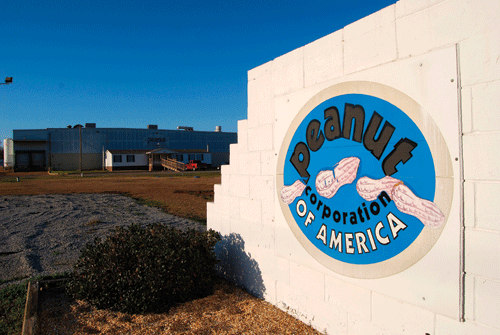
What sets a company apart today is not whether it monitors the web and social media platforms for burgeoning crises, but whether it also successfully leverages these channels to reach, inform and reassure its stakeholders. In January 2009, the Peanut Corporation of America announced a recall of peanut butter products due to salmonella contamination.

During this crisis, a comprehensive social media campaign was rolled out, using new media channels like blogs, eCards, text messaging, podcasts, online videos, social networking sites, widgets, micro-blogs and virtual worlds such as Second Life. The crisis communication fittingly leveraged these new channels, which reached and informed consumers, successfully mitigating the crisis and eventually saving many lives.

A savvy company in today’s world is the one that not only wards off damage to its brand and reputation in the wake of a crisis but also turns it into an opportunity to strengthen bonds with stakeholders by showing deep concern and unfailing commitment to their well-being. Successfully handling a crisis takes a disciplined implementation of the basic ABC principles of crisis communication, a formula that can break the curse of our tumultuous times and turn them into fruitful ones.

Dima Itani, Zeina Loutfi & Ramsay G. Najjar S2C

February 3, 2010 0 comments
0 FacebookTwitterPinterestEmail
Society

Modernizing the marque

by Executive Staff February 3, 2010
written by Executive Staff

BMW Group’s unveiling of the Ghost, its newest addition to the Rolls Royce line-up, at the Frankfurt Motor Show last September sent a small shockwave through the blogs and forums of the automotive world. Critics responded to the new model, which is smaller and significantly cheaper than its predecessors, with a mixture of surprise, praise and confusion.

As top dog in the high-end luxury auto market, Rolls Royce’s decision to “tone down” its new model, ostensibly to produce a more affordable, driver-focused experience, seems a deviation from the company’s long-standing policy of marketing only to the best-heeled buyers. Since its earliest days, Rolls Royce has cultivated a reputation as a kingmaker — today, just owning a Rolls separates suzerains from ordinary human beings. After more than a century of production, the company has built up a reputation that goes beyond the physical properties, considerable as they may be, of the cars themselves. Now the world is wondering: could an expanded consumer base put that reputation in jeopardy?

Certainly, expanding production seems to be a major feature of BMW’s plans for the brand. When the German automaker salvaged the company in 1998 it took concerted steps to keep the personality of the brand quintessentially Rolls — in terms of know-how, feel and luxury — as well as retaining the original factory in Goodwood, England. At the same time, BMW began a gradual escalation in production levels. In 2007, Phantom sales broke the four-digit mark for the first time in the brand’s history. Today, current projections for 2010 more than double that figure, with production of 2,000 to 2,500 Ghosts anticipated.

Speed demon

Yet the Ghost is by no means a streetcar. Carrying a price tag of between $200,000 and $300,000, the car is likely to satisfy buyers that the Rolls Royce marque, in terms of quality and luxury, is as alive as ever in this newest model. The body alone shows the effort its designers made to incorporate the brand’s most fundamental design cues: the upward sweeping sill line, elevated prow and long bonnet all impress upon the viewer that this car, in every essence, is a Rolls.

At the same time, there is an air of informality — if such a thing can be said about a Rolls Royce — and dynamism present in the Ghost that clearly sets it apart from other cars in the Phantom line or before it. Chrome tailpipes, the car’s smaller size and flowing, powerful lines hint at a shift toward speed and power.


Indeed, the Ghost is the most powerful car made by Rolls Royce to date, due in part to its smaller size, but also to a number of mechanical modifications. The new 6.6-liter V12 engine used in the Ghost supplies 563 British horsepower — enough to propel the car from zero to 96 kilometers per hour in just 4.7 seconds. That’s not quite a supercar, but it’s getting close in terms of performance.

Breaking new ground

At the same time, the Ghost’s interior boasts all the trappings of luxury. Elegant frosted lamps, reclining lounge seating and deep-pile carpets affirm the car’s true nature. Two LCD screens, analogue watches and meters, as well as the signature flying lady icon add to the image. There is little doubt that, powerful as the Ghost may be, it is still a luxury vehicle, and still a Rolls Royce.

The real question is: can the brand foray into new territory without corrupting its core values? At the moment, the general consensus seems to be yes. The Ghost maintains an elevated standard of luxury while breaking new ground in speed and drivability. One might speculate that, spurred by a drop in sales during the global recession, the car has taken Rolls Royce to a new breed of auto enthusiasts — younger, with plenty of money to spare and an eye for both luxury and performance — without selling the brand short of the expectations of its traditional customer base.

Where does the company go from here? Is the Ghost the lowest threshold, or will BMW continue to pare down the Rolls into an ever-fainter specter of its former glory?

A policy like this would prove fatal in the long run for the same reasons it might prove lucrative in the short run. It’s the name that sells the Rolls Royce, a name built up through decades of top performance. But the drivers play a role as well — every king, president, celebrity or sheikh that adds their name to the list of Rolls’ customers adds something to the brand as well. To spread that brand around, to make it more accessible to the public, puts its star power at risk — and without star power, what is a Rolls but a really, really high-end car?

Nadim Mehanna is an automotive engineer and has been a pioneer of motoring on Middle Eastern television since 1992


February 3, 2010 0 comments
0 FacebookTwitterPinterestEmail
Economics & Policy

Fiscal deficit at $2.6 billion

by Executive Staff February 3, 2010
written by Executive Staff


Lebanon’s Ministry of Finance has stated that the fiscal deficit widened to $2.6 billion in the first 11 months of 2009 — 25.1 percent of the 2009 budget. Standard Chartered Bank forecasts that the total budget deficit for this year will reach 9.5 percent of the economy, the highest in the Middle East and North Africa and the second highest in emerging markets. The Economist Intelligence Unit forecasts the deficit to constitute 10.3 percent of gross domestic product in 2010. Government expenditure came in at $10.3 billion, a 15.5 percent year-on-year increase in the first 11 months of 2009. Debt servicing — the payment of interest on the public debt — also increased to $3.4 billion, making up a third of total expenditures. Revenues over the first 11 months of 2009 also rose to $7.7 billion (21.9 percent), mostly from taxes, which accounted for a total of $5.5 billion. A further $1.68 billion came from customs revenues over the same period, constituting a year-on-year rise of 72.9 percent. Some 87 percent of total customs receipts were processed through the Port of Beirut.

February 3, 2010 0 comments
0 FacebookTwitterPinterestEmail
Economics & Policy

New year, few IPOs

by Executive Staff February 3, 2010
written by Executive Staff

The start of 2010 sparked discussions on better primary market conditions in the Middle East when compared with the preceding 18 months, but hard evidence for a good year in initial public offerings has yet to emerge.

The Saudi Stock Exchange (SSE) regulators had approved three IPOs back in December, of which one, by restaurant operator Herfy, took place in January. The other two, for industrial manufacturing group Al Sorayai and for travel company Al Tayyar, have been scheduled for February 1 to February 7, and February 22 to February 28, respectively.

Subscription to the $110 million Herfy IPO for 30 percent in the company closed on January 17. Details on the share allocation and distribution rate were not available at the time of going to press. The issue price of $13.60 per share included a premium of $10.93. 

The second IPO in the region was set off on January 17 by real estate developer Mazaya Qatar. With $137 million in value, the issue by an affiliate company of Kuwait’s Mazaya has faced skepticism from analysts.

Herfy’s major shareholders are Savola, the massive food conglomerate, and the Al Tayyar Travel Group, started 30 years ago as a family business. Little other information is available about either, as the companies have made scarce news in the international or regional press.

Moods in world markets were mellow with regards to IPOs at the start of 2010. Asian markets were reported as most optimistic on account of buoyant economic growth forecasts, but in the United States the year’s first public offerings had a rough time and issuers in January either reduced their price expectations, as in the case of insurance firm Symetra Financial, or cut the size of the offering.


Although the fourth quarter had been positive for secondary markets in the Middle East, and emerging equity markets rallied in the past three quarters, 2009 provided such slim pickings in primary markets that it seemed almost inevitable to expect more from 2010.

In 2009, even the comparatively low value of $2.1 billion in aggregate Middle Eastern IPOs — excluding issues that had been offered for subscription in 2008 but started trading in 2009 — masked the fact that more than 75 percent of this value was delivered in only two of 15 IPOs: Vodafone Qatar and National Petrochemical Company in Saudi Arabia.

Some of the 11 IPOs that were completed on the Saudi Stock Exchange (SSE) in 2009 were so small in size that one had to hunt for them with a magnifying glass. This was reflected in the fact that demand for SSE primary market issues fell back to an average of 1.16 million subscribers per IPO.

The forecasts that every investor would like to have — what will the markets be like in 2010 — have been circulating in January in the vast agora of advice and opinions, but there is no sign and no reason to expect that this year’s predictions will be different in their reliability from those made in 2008 or 2009.

Among the more amusing expectations, one Gulf-based newspaper had apparently given its editors the New Year’s holiday off and came up with a late December tale that “as many as 45 Saudi-listed (sic) companies have plans to launch initial public offerings” in early 2010.

The count of companies that have at some point voiced ambitions for flotation on one of the bourses in 2010 is easily above 150.

How many of these rumored offerings will be delayed further, channeled into different equity raising deals or simply evaporate is anyone’s guess, but might not even be the main question. It still seems to be a too widely held assumption that a large number of public offerings are automatically good news for the market.

One might note, though, that post-IPO track records of primary market activity in the past few years showed some highly hyped companies falling severely short in performance and governance compliance, such as the case of jewelry company Damas, which apparently incurred a very costly mishap to investors due to not applying basic practices of corporate governance.

To return to hard numbers, the post-IPO performance data in the Middle East showed two clusters of companies coming out on top.  Last year’s debutants in Saudi insurance showed share price gains since flotation at an average 335 percent and six companies listed on the new Damascus Stock Exchange (DSE) achieved climbs of 138 percent, on average. The DSE, which will celebrate its first anniversary in March, could still radiate some of the charm of a sleeping beauty awakened when further companies will list there in the coming months.  

February 3, 2010 0 comments
0 FacebookTwitterPinterestEmail
  • 1
  • …
  • 431
  • 432
  • 433
  • 434
  • 435
  • …
  • 686

Latest Cover

About us

Since its first edition emerged on the newsstands in 1999, Executive Magazine has been dedicated to providing its readers with the most up-to-date local and regional business news. Executive is a monthly business magazine that offers readers in-depth analyses on the Lebanese world of commerce, covering all the major sectors – from banking, finance, and insurance to technology, tourism, hospitality, media, and retail.

  • Donate
  • Our Purpose
  • Contact Us

Sign up for our newsletter

    • Facebook
    • Twitter
    • Instagram
    • Linkedin
    • Youtube
    Executive Magazine
    • ISSUES
      • Current Issue
      • Past issues
    • BUSINESS
    • ECONOMICS & POLICY
    • OPINION
    • SPECIAL REPORTS
    • EXECUTIVE TALKS
    • MOVEMENTS
      • Change the image
      • Cannes lions
      • Transparency & accountability
      • ECONOMIC ROADMAP
      • Say No to Corruption
      • The Lebanon media development initiative
      • LPSN Policy Asks
      • Advocating the preservation of deposits
    • JOIN US
      • Join our movement
      • Attend our events
      • Receive updates
      • Connect with us
    • DONATE