• Donate
  • Our Purpose
  • Contact Us
Executive Magazine
  • ISSUES
    • Current Issue
    • Past issues
  • BUSINESS
  • ECONOMICS & POLICY
  • OPINION
  • SPECIAL REPORTS
  • EXECUTIVE TALKS
  • MOVEMENTS
    • Change the image
    • Cannes lions
    • Transparency & accountability
    • ECONOMIC ROADMAP
    • Say No to Corruption
    • The Lebanon media development initiative
    • LPSN Policy Asks
    • Advocating the preservation of deposits
  • JOIN US
    • Join our movement
    • Attend our events
    • Receive updates
    • Connect with us
  • DONATE
Comment

Diversifying Kurdistan

by Riad Al-Khouri February 1, 2010
written by Riad Al-Khouri

Turkish products dominate supermarket shelves in the Iraqi Kurdistan town of Dahuk

Iraqi Kurdistan’s continued over-reliance on oil wealth helps the Kurdistan Regional Government (KRG) dominate employment in the province by creating large numbers of unproductive city-based public sector jobs. Not diversifying away from oil thus leads to many short and long-term problems, but the irony is that Kurdistan — unlike some other economies in the Middle East — has a lot more going for it, including abundant water and agricultural resources, which remain largely unexploited.

Hoping to tap these riches the KRG’s plan for agriculture was launched in 2009, and officials of the province have been receiving experts, funders and business delegations from Europe, America and elsewhere with an interest in Kurdistan’s agricultural potential. The first investment in the sector thus far has been by the United States-based private equity firm The Marshall Fund in the village of Harir, which put $6 million into the development of a tomato paste and fruit processing plant that had been defunct since 2003. Coming on stream last year, the project is doing fine, but remains a miniscule success when measured against the $10.5 billion in agricultural investment and infrastructure that the strategy calls for.

In fact, manufacturing and industrial processing in Kurdistan has recently been characterized by disinvestment. Unable to compete with imports, 170 factories (about 10 percent of the province’s total number) closed down last year, according to publicly cited figures from the KRG Ministry of Trade. In the bad old days of the 20th century, the reaction to such news would have been to impose high protective tariffs, but that time is now gone. With Iraq negotiating entry into the World Trade Organization (WTO), it will eventually lower existing trade barriers. This is basically good, as tariff protection often leads to the emergence of inefficient industries. The other problem is that the KRG, though enjoying considerable autonomy, is not sovereign and so cannot decree limits on importing foreign products into the market apart from the restrictions imposed by the central government in Baghdad.

Yet, something needs to be done, as many of Kurdistan’s factories remain vulnerable to foreign competition and are in danger of closing, threatening the jobs of the manufacturing sector’s 13,000 or so employees. The KRG has to support domestic producers, but this should not be done with subsidies, which become complicated under the WTO rules that will sooner or later apply to Iraq. One answer is to make manufacturing more efficient through reliance on local raw materials, including some of the province’s agricultural wealth. That doesn’t mean that any crop grown in Kurdistan can and should be processed through manufacturing, but it is also true to say that positive example set by the Harir project could be replicated in many areas.

Another way for Kurdish manufacturing to compete is through higher productivity brought about by better machines and management, especially those coming through Turkey — the province’s most powerful industrial neighbor, which politically is no longer hostile to things Kurdish. The ironic thing about such a scenario is that it is mainly Turkish products that are overwhelming local manufacturers in the market of Iraqi Kurdistan. But the policy of the KRG seems to be that if you can’t beat the Turks, then join them. Some Turkish exporters have figured out that they can do even better by setting up their factories in the province itself, partnering with Kurds. This would end up giving Turkish products an even greater competitive edge, while employing Kurdish workers and other local resources.     

That is one of the messages brought by Turkish business delegations that are increasingly coming to Iraqi Kurdistan, including the latest arrival in the KRG capital Erbil in mid-January. With a focus on discussing investment in the Erbil area (the manufacturing center of Kurdistan) the high-level delegation included senior members of the Turkish Chamber of Industry and Commerce, as well several company owners. For their part, the province’s officials responded enthusiastically by offering support to Turkish companies willing to develop business in the region under the KRG investment law, which in some respects is more favorable than the regulations that apply in the rest of Iraq. This would also allow Turkish firms to supply central and southern Iraq in addition to Kurdistan, and even to export back into Turkey.

Whatever happens in the case of individual products in this respect, combining the strengths of Turkish industry with advantages offered by Iraqi Kurdistan seems to be a winning combination, which profits both sides and brings them closer politically, while also helping the KRG shed its dependence on oil revenue. 

Riad al-Khouri is senior economist at the William Davidson Institute of the University of Michigan in Ann Arbor, and dean of the business school at the Lebanese French University in Erbil


February 1, 2010 0 comments
0 FacebookTwitterPinterestEmail
Real Estate

The internet looks to property

by Nada Nohra February 1, 2010
written by Nada Nohra

Laura Martorano is the chief executive officer of Leo Sterling, the brokerage firm she founded in Dubai at the beginning of 2009. Previous to this, Martorano had been the CEO of Jamal Al Habtoor Real Estate since 2003. Executive sat with Martorano to discuss the increasing importance of e-marketing in regional real estate and strategies companies are adopting online.   

Laura Martorano is the chief executive officer of Leo Sterling - Brokerage firm in Dubai

E  What is the online strategy that you are adopting and how do you think companies should approach Internet advertising, especially since it is relatively new in the region?

Many companies are currently adopting a new marketing plan, which will include the Internet and web activity to gain more exposure and new clients.

We are currently working on improving our internal and external PMA (property management application), a database listing all properties that the company has. It is an interactive program on which you can list your property, search for a property, and get a price and an appraisal for your property. These are integrated with the website and we try to optimize the website when it comes to Google searches and other database searches.

In addition to that, the communication with the client has changed. Before, it was essential to meet the client, to show them the brochures of the property. Now, the first step of establishing the connection with the client is to send them the information by email. So this is truly number one. And let’s say five years ago people didn’t have time to read or send email. Right now our clients always ask if we can send them the brochure by email.  

E Since Internet penetration rate in the region is low compared to the West, how does this affect this strategy? Do you think it limits the market?

Yes and no, because if we talk about Dubai, the United Arab Emirates or the Middle East, it is a very new region. Specifically, Dubai is a new city. In the last 10 years we had to learn how to reach the client, sell the property and manage the property. Now the whole business has grown.

The tools that were available were adopted within the business plan of each company in the industry. Right now there are more and more tools that are available in the market, like property portals, and there are other social portals, which are becoming increasingly popular in the web community.

I’m talking on behalf of many companies who are realizing just how important the Internet is and are trying to adapt their business plans to use the Internet as an essential marketing tool.

I do think there is a vast improvement going on, specifically in Dubai. We are adopting a trend happening in Europe and the United States; we have definitely increased the speed of communication and delivering the information.

Before, to get some information about a property, you would be lucky if you got anything within a week. Now you can get it in a couple hours.

E  Online advertising is emerging as the leading marketing tool, but how would you fight fraud?

It is true, there have been a number of fraud [cases], but it has been happening around the world and no one is immune. It is the responsibility of the client to make sure he is receiving the right information. I am not necessarily saying that purchasing property over the phone or Internet is the proper way. It is like shopping for clothes online. You see a good picture and then you receive something else.

So yes, unfortunately it happened to very intellectual clientele from Europe and the US but again no one is immune. When you buy insurance you have to read the policy, when you get the loan you need to read the contract. So when you get the property you need to know where it is located and who the developer is.

E  Is there anything else prospective clients should watch out for if they are looking online?

Just because you are happy with what you have seen on the Internet, that does not mean that is necessarily the reality. It is used for both sharing information and also [to] market a product. It is a place for both critics and sales people. So it is a huge debate. But I still think that the Internet is the best source of getting such information. I think sometimes in the news you don’t hear as [much] as you hear on the Internet. 

E  How much of your revenue do you think will come from online marketing and how will the percentage increase in the next few years?

Within the current market situation, online marketing always increases the chance of reaching new clients. For us it is good news. Again reaching a new client does not mean a done deal. There are three stages in real estate: identifying the clients, negotiating the terms and closing the deal, so the Internet only helps in the first step.

It could also serve in negotiating and communicating the offers by email, but when closing a deal, people still like to come and see and feel the property. But more people means there are more potential sales, and more sales definitely means more revenue.

E  How much are you investing in your online strategy?

Investment in the Internet is incredibly small. If you compare the expenditure on Internet marketing activity versus media such as newspapers or magazines or exhibitions, it is extremely tiny — it makes up 10 percent of the whole budget, and delivers the same result as any other media activity.

It is still important to have a personal touch, to meet clients directly at the exhibition or a launch of the project, but using the Internet in terms of identifying new clients is definitely a win-win situation for every company in any industry. It has become one of the most important aspects of every marketing plan.

E  Are buyers who search the Internet more likely to find a home?

Yes and no. When buying a home, you can buy it for two reasons; you either want to buy a specific home that would really cater to your needs, or you are just looking for the price.

If you are looking for a price bargain, the Internet would be a good option, but finding your own ideal home can best be done by physically visiting.

E  What is the future of online real estate advertising?

Online marketing in our particular industry had a lot of hiccups because Internet users have evolved and upgraded — they are so interactive now. Some time ago just having a simple website to list your mission statement and mention your address and a phone number was enough, now it is not.

Now the market demands you invest a lot in your website, and not to be just informative but to be a portal as well. Maintaining such interactive websites is a job for a few people, and often companies don’t like to invest in IT [information technology] or marketing departments by adding people to maintain databases and updates.

We had frustration from clients saying that information on the portal or the Internet was very old. It is still happening since the region is not too Internet-focused. Although lots of people may be using social networking tools such as Facebook and Twitter, it does not mean everyone is using the Internet for other purposes.

A lot of business people have recognized these weak areas and have slowly started shifting toward investing in IT employees and IT departments. Unless companies recognize that this is important [they will fall behind]. I would say that some companies that are already doing it will definitely have a superior advantage in market share.

While they are improving, people will be inventing. People who are not using it will be left behind in a few years, but Dubai is extremely competitive right now and the whole business community is recognizing the Internet is an essential tool and are now investing a lot in it.

February 1, 2010 0 comments
0 FacebookTwitterPinterestEmail
Feature

SuperFreakonomics

by Executive Editors January 29, 2010
written by Executive Editors

Did you know that a prostitute in Chicago is more likely to have sex with a cop than be arrested by one? Did you think that it was dangerous to drink and drive? Well, you’re not wrong, but did you ever think about the fact that walking drunk is eight times more likely to get you killed than driving drunk?

It is these interesting twists of perception and everyday occurrences that Steven Levitt, an economics professor at the University of Chicago, and Stephen Dubner, the author of several books, have packed into“SuperFreakonomics.”

Freakonomics, the name of the first book that caused a global sensation, is the simple idea of “marrying the economic approach to a rogue freakish curiosity.” According to the authors, the essential message of all the varied and, well freakish, facts and figures, is that microeconomics can reveal a fundamental truth about human beings: “people respond to initiatives.”

Take the example of seat belts for instance. Seat belts reduce the risk of death by as much as 70 percent; but even after 15 years from when seat belts were introduced in the United States, just 11 percent of people wore them. It took a range of ‘nudges’ such as advertising campaigns and annoying beeping sounds in cars — which became the real incentive for a change in behavior, as opposed to the reduction in the death rate — over a 30-year period to achieve the current day rate of 80 percent of Americans wearing seat belts.

This book is packed with fascinating insights. But the essential problem with the concept of “Freakonomics” is that it makes great assumptions on very specific points, based upon data that is often more varied. This is most obvious when the pair tackle terrorism.

Levitt and Dubner based their argument for the type of person that commits terrorism on the research of Alan Krueger, an economist at Princeton University. Krueger used a Hezbollah newsletter Al-Ahd to collect bibliographical data for 129 shahids, or martyrs. From this data Krueger concluded: “terrorists tend to be drawn from well educated, middle-class or high-income families.”

This holds true around the world from Latin American rebels to the 9/11 attackers, Krueger claims. 

It is easy to see that Krueger’s data input is highly flawed. Going back to the original piece of

research, Krueger himself admits as much. “The deceased Hezbollah fighters were involved in a mix of activities, not all of which might be classified as terrorist attacks. An attack on a military post was the most common type of activity… Three died in suicide bombing attacks.”

 So categorizing the attacks carried out by those listed in Al-Ahd very much depends on your definition of terrorism, which is admittedly its own minefield. Trying then to boil down all these different military tactics to a single concept of terrorism and to then discover whether “terrorists” are from ‘good’ or ‘bad’ backgrounds is evidently a lot more complicated than Levitt and Dubner, or Krueger for that matter, would like to admit. 

How useful is it, even if you were able to confirm that all the 129 shahids were terrorists, to make a general assumption about the social background of terrorists in general? Hezbollah, an organization that is very well integrated into the social political fabric of its own Shiite community, has little in common, even if you agreed they are both terrorist organizations, with the highly fractured and cell-like structure of Al-Qaeda. 

Making sweeping generalizations can be useful in some cases and completely misleading in others. This is a warning that Levitt and Dubner do not always heed, and appropriate caution should be used when reading their book. But in removing this caution and taking risks, Levitt and Dubner have created fascinating insights. 

In effect, “SuperFreakonomics” asks more questions than it answers. Like good students, Levitt and Dubner challenge conventional wisdom throughout the book, from issues of terrorism to global warming to prostitutes. Even when they don’t get it right they do make you think again.

Levitt and Dubner challenge conventional wisdom, from terrorism to global warming to prostitutes

January 29, 2010 0 comments
0 FacebookTwitterPinterestEmail
Feature

Clash of the Turkish titans

by Executive Editors January 29, 2010
written by Executive Editors

Turkish Prime Minister Tayyip Erdogan makes no secret of how much he dislikes Aydin Dogan, chairman of the powerful Turkish media group Dogan Yayin Holding (DYH), which owns more than half of Turkey’s print and broadcast media, including CNN-Turk. 

In a recent interview, Erdogan lashed out at the media baron, likening him to the infamous Italian-American gangster boss Al Capone.

For more than a year, the two have been engaged in a high-level public battle over critical news coverage aired by Dogan’s media group about the Erdogan administration. Dogan has emerged as one of the most vocal critics of Erdogan’s ruling Justice and Development Party (AKP), constantly ruffling the premier’s feathers, with his media organization publishing a watershed of reports on corruption scandals involving public figures and claims that the Erdogan administration is a threat to Turkey’s secular order.

When the Turkish Parliament voted to lift the ban on headscarves in Turkish universities in 2008, Dogan’s flagship Hurriyet newspaper splashed the headline “411 hands up for chaos” on its front page, referring to the number of parliamentarians who had voted in favor of rescinding the ban.

The flurry reached new heights in the fall of 2009 when the Turkish authorities handed Dogan a record $3.2 billion fine for an alleged tax delinquency. Some believed the media mogul and the Turkish tax authorities would sooner or later reach an agreement, but negotiations in November failed to settle the gigantic fine, resulting in Dogan ringing in the New Year with a fierce court battle ahead of him.

Dogan’s media empire already appears to be smarting from the row, with the group’s foreign investors said to be fleeing the field now that the drama has turned ugly. Most recently, German publisher Axel Springer AG, who already owns a 25 percent stake in Dogan TV, announced that plans to buy a further 29 percent stake in the Dogan group were “postponed” until the feud with the Turkish tax office was resolved — a signal that Dogan’s powerful friends abroad are not planning to rush to the rescue.

Dogan, however, seems determined to stay afloat and sell off assets. DYH announced in a company statement issued early December that it was pursuing a partial or complete sale of subsidiaries, but that a deal had yet to be finalized.

Silencing free speech?

The high stakes drama between the Turkish premier and the country’s media monolith has gripped the nation and become a top news item in print, radio and television. The case has also raised concerns about the state of press freedom in Turkey among some groups, including the European Commission, which described the fine as disproportionate and a constraint on press freedom.

Critics argue the enormous tax bill is a means for Erdogan to try and square the political vendetta by taxing his foe to death. Dogan himself appears to share this view, and has fiercely accused the authorities of singling him out for politically motivated retribution. Erdogan, meanwhile, remains defiant and dismisses allegations that the case bears any political connotations.

A wolf in publisher’s clothes

The 73-year old Dogan has not curried sympathy from all quarters as a martyr of free speech. Critics contend Dogan is a businessman who “ruthlessly destroyed his rivals” and went into the media business, not because he necessarily cared about good journalism, but because he wanted to gain influence and political ground.

Some even go as far as likening him to Italy’s eccentric Prime Minister Silvio Berlusconi, with the only difference being that Dogan has yet to seek a political mandate.

Yavuz Baydar, a columnist at the Turkish newspaper Zaman, a competitor to those of the Dogan group, warns against branding the Dogan case a straight forward attack on press freedom in Turkey, stressing that there are “no innocents” in the case.

One version of events that has made the rounds in both Turkish and international press is that the Dogan media group uncovered information linking the AKP to embezzlement in Germany, involving a Turkish-run charity there called Deniz Feneri. The media baron sat on this information for more than three months, however, to blackmail concessions from the government for his many business interests. Among the favors Dogan allegedly wanted was for the Istanbul Municipality to change zoning laws and issue building permits allowing luxury residences to be built as extensions to the Hilton Hotel in Istanbul, but the government didn’t budge.

After Dogan failed to get the concessions he wanted from the authorities, Baydar says he noticed an “overwhelming” number of Dogan’s media outlets started to report aggressively on the AKP and Erdogan’s family, distorting the news at times.

“A corrupt media cannot uncover corruption in a democracy,” he told Executive. “It has to be transparent and accountable. This rule is almost always forgotten by those who want to minimize the case to [an issue concerning] press freedom.”

The row between the pair has “[snowballed] to a point of unbearable confrontation,” said Baydar.

Whether a crooked businessman or not, the Turkish tax authorities slamming Dogan with a $3.2 billion fine is still an excessive punishment in Baydar’s view. He said the Dogan case highlights the need to rid the Turkish tax authorities of its governmental straightjacket.

“There is a serious problem with tax inspection. It’s vertically directed by the government while it should be autonomous,” said Baydar.

Reshuffling the cards

With some circles believing Dogan’s empire will come tumbling down sooner or later, there are hopes rising that this would give the Turkish media industry a much-needed facelift, allowing it to become more diversified.

“We are expecting a reshuffling of cards in the Turkish media with the dissolution of Dogan,” Sahin Alpay, a columnist and senior lecturer at the department of political science at Bahcesehir University in Istanbul, told Executive. “Some people worry about it, especially…journalists.”

Alpay believes change is needed. Dogan’s media empire, he says, is a threat to media pluralism in Turkey and polarizes Turkish journalists.

He hopes the authorities will introduce legislation that limits crossover ownership, which he believes enables people like Dogan to build “media aristocracies” by controlling broad swaths of both the print and broadcast media markets.

Baydar also believes it is time the Turkish media game was given a shake-up, however, he warned that, “If you don’t change the rules, someone else will take his place.”

“We are expecting a reshuffling of cards in the Turkish media with the dissolution of Dogan”

January 29, 2010 0 comments
0 FacebookTwitterPinterestEmail
Feature

Lights out

by Executive Editors January 29, 2010
written by Executive Editors

Uniceramic once ruled on high in the Lebanese ceramics market. Established in 1973, the company’s fortunes began to fade as it entered its fourth decade of operations — a combination of subsidized imports, record high energy costs, the removal of safeguard measures and an inability to relocate operations outside Lebanon saw Uniceramic’s market position fade.

Today it no longer exists

According to Lebanon’s Ministry of Economy and Trade (MOET), by mid-2006 the company constituted 82 percent of local ceramics production. While this may be an impressive figure, when the total size of the industry is taken into account, it becomes less awe-inspiring. According to government figures, in 2003 local production of ceramics stood at 48 percent of total market share; by 2005 it had dropped to 31 percent.

“Prices fell even though production costs went up. This was reflected in Uniceramic’s decreased profits and with returns on investment registering losses for three consecutive years,” said an official from the Trade Remedies Investigative Authority (TRIA), who asked for anonymity, as they were not authorized to speak to the press.

The TRIA, overseen by the MOET, is the government body that investigates and makes recommendations as to whether measures should be taken to protect certain strategic industries.

With surging imports of ceramic tiles flooding the market and costs soaring for the energy necessary to fire the ovens used for ceramics manufacturing, Lebanon’s industry simply had no way to compete with countries such as Egypt and China, which enjoy cheaper labor and energy. As such, in March 2006, the Association of Lebanese Industrialists (ALI) put forward a petition to request safeguard measures be applied to the ceramic tile industry. The subsequent TRIA investigation, completed by May of the same year, found that between 2001 and 2005 imports of ceramic tiles had risen by 63 percent, which it classified as a “significant rise.”

A debate over how much and what kind of protection should be adopted promptly ensued. Lebanon is not a member of the World Trade Organization (WTO), mostly due to matters related to intellectual property and other compliance issues. The country does, however, apply many of the organization’s trading rules, as well as those of the Greater Arab Free Trade Area (GAFTA), that seek to eventually abolish tariffs between most Arab nations.

As a safeguard measure, Lebanon decided to adopt the WTO’s “most favored nation” policy that, basically, states that all countries must be treated equally. Accordingly, in September 2006 the MOET, then under Minister Sami Haddad, proposed to the Council of Ministers that an ad valorem safeguard measure of 20 percent, or a minimum of $2 per square meter (whichever was higher) be applied to ceramic imports for a period of three years, even when these were arriving from GAFTA countries. The Council of Ministers agreed to levy the tax but only for a period of one year, according to official documents obtained by Executive. Both Syria and Egypt promptly filed complaints with the Lebanese Government and the Arab League.

This was not the first time the Lebanese government had granted Uniceramic or the ceramics industry its protection.

They also enjoyed protection up until the post-war government headed by Salim el-Hoss “removed customs on everything, even whisky,” said Joseph Ghorra, chairman and largest shareholder of Uniceramic.

Ghorra explained that the political initiative to protect his industry in 2006 came largely from the late Industry Minister Pierre Gemayel, who was also the main proponent of a bill aimed at protecting national industries from cheaper foreign imports.

“If [Gemayel] had not got into a huge political fight with [then Prime Minister] Fouad Siniora, nothing would have happened,” said George Gorayeb, general manager of Lecico, now Lebanon’s largest ceramics manufacturer, which also benefited from the safeguard measure. (Ghorra actually helped setup Lecico and still owns a stake). Gorayeb said Gemayel was able to get the protective measures instituted for one year, but “when he died, so did [the measures].”

Two months after protection was granted, gunmen assassinated Gemayel in his car. 

A little more than two weeks later, on December 8, Lebanon replaced its aging anti-dumping legislation with the “Law on the Protection of National Production.” Under the new law Lebanese industries would be protected from dumping, subsidized imports and substantial increases in imports.

The law looked to be a boon for Lebanon’s industrial sector, long overlooked by policy makers as a potential driver of the country’s economy.

“As long as this was in place the company was making money,” said Fadi Abboud, president of the ALI and Lebanon’s current Minister of Tourism, in reference to the safeguard measure. However, even though the safeguard measure may have kept Uniceramic alive, the company wasn’t exactly kicking.

According to disclosure figures obtained from Zawya Dow Jones, the company had managed to accumulate $8.2 million in losses by the end of 2007, despite having enjoyed the safeguard measure until September of that year.

A large part of this loss was seen to be a result of the company’s cost structure, which relied heavily on the consumption of natural gas. The other culprit was Uniceramic’s loss of market share — resulting from cheaper import prices in lower-end ceramic tiles.

“Egypt is the biggest cause of the flood that started in Beirut on the lower-end of the market,” said Gorayeb, whose company also manufactures ceramics in Egypt.

During the period from 2004 to 2007, Egyptian ceramic tiles constituted a total of 37 percent of total imports, with the rest coming from China, Spain, the United Arab Emirates and Italy, according to the TRIA.

Egyptian ceramics producers are the recipients of longstanding government supplied gas subsidies, which rose from $2.6 billion in Egypt’s 2004 fiscal year, to $11.41 billion in the 2008 fiscal year. Gorayeb explains that as of 2009, his Egyptian factories paid 6 cents per cubic meter in costs, while in Lebanon he pays $1. This, he says, allowed Egyptian products to undercut prices and sell at around 50 cents per square meter below Uniceramic’s prices.

When the company did apply for safeguard renewal in August of 2007, one month before the measure was set to expire, the TRIA began a second investigation, covering the period from 2004 to 2007.

“The picture that emerged during this review was that imports continued to grow, though at a slower place, amounting to 32 percent for the entire investigation period — this is almost half the rate of increase under the initial review,” said the TRIA official.

By September of 2007, the safeguard had lapsed and industry leaders began to get jittery as energy prices continued to skyrocket.

 “We asked [the MOET] why did you stop [the measures]? This company will go bankrupt,” said Abboud. “They said: ‘We did not stop. When we gave [protection] to Uniceramic, the implementation procedures had not been issued. In the beginning we did it to placate Pierre Gemayel. [Now] we are going to give it back according to the procedures.’”

The implementation procedures, which total 103 articles, were eventually issued detailing how an investigation would proceed. This time it seemed the investigation would not be a short and sweet affair for the ceramics industry.

“They did not implement [the decree]. They kept asking us to give them numbers…and they didn’t implement it,” said Ghorra. 

“The people at the ministry are liars, and you can write that and underline it three times”

Others were less forgiving

“We put in a million applications but the people at the ministry are liars, and you can write that and underline it three times,” said Gorayeb. “They are trying to impose their own form of neo-liberalism.”

As Executive went to print, the TRIA had not responded to requests for comment.

While the investigation continued into 2008, Uniceramic was trying to keep its head above water. One of the tenets of the safeguard measure was that those enjoying its protection, such as Uniceramic and Lecico, could not raise their prices.

Nevertheless, real estate executives who spoke to Executive on condition of anonymity complained of a “30 percent rise” in Uniceramic’s prices. Ghorra denied this claim, saying that the perceived rise was due to a new product mix focused on the high-end segment, which Uniceramic was attempting to adopt to adapt their model to the new market realities.

However, as Abboud noted: “A factory cannot survive only on the upper-end, you have to have the bread and butter with an olive.”

The price-fix also came at a time when the market price of ceramics was surging. According to TRIA, during the first three months of the safeguard’s application the average price of ceramics had increased by 50 to 70 percent. The measure has been decried by the industry as yet another reason local ceramics could not take advantage of the increased demand and reconstruction subsequent to the July 2006 war.

“For those families that were forced to rebuild their homes, it is part of the Ministry’s responsibility to ensure that they have access to building materials, such as ceramic tiles, at reasonable prices,” said the TRIA official.

Realizing that their model was unsustainable, Uniceramic attempted to move its operations away from Lebanon. Instead of diversifying its product-mix, as Lecico currently does with its Egyptian production, Uniceramic deemed the market oversaturated and the company attempted to set up shop in gas-rich Qatar.

“The Qatari [Energy and industry] Minister Abdullah bin Hamad al-Attiyah was generous enough to give us a license without a Qatari partner,” said Ghorra, though he added that, “When people saw that we did not have a Qatari partner they started to make things complicated.”

Ghorra said Uniceramic is still actively seeking out a Qatari partner to restart the company in the Gulf. 

By April 2008, the company finally threw up its hands and closed its factories in Lebanon’s Bekaa Valley; it also had let go of the majority of its 450 workers. Media reports at the time stated that the company was losing $15,000 per day.

Uniceramic laid the blame squarely at the feet of the MOET.

“Sami Haddad made us empty promises. He kept promising us till he couldn’t any longer and then he told me to take the machines and work outside Lebanon,” said Ghorra.

Haddad, who is now chairman and general manager of Byblos Invest Bank, denies that he made any such suggestions.

Victim of a crisis

“They know what is in their interest and they don’t need my advice. They can manufacture something else,” said Haddad. “It is not very logical for us to try to compete in producing stable commodities. We cannot decide to produce a good with a higher cost, impose it on the consumer and not face competition.

“Don’t forget we were faced with a very strong inflationary pressure at that time; people were clamoring about and everything was expensive.” 

It’s worth noting that while the second investigation was ongoing, Lebanon’s government was in the middle of a full-blown political crisis that culminated in the events of May 7, 2008. Masked gunmen from opposing political parties fought battles in Beirut and in the Chouf region. The fighting stopped a few days later, with Lebanon’s political factions eventually signing the Doha agreement, which paved the way to the formation of a new interim government. In July of 2008, Mohamad Safadi became the Minister of Economics and Trade and extended the investigation period to 18 months until February 2009 — the maximum duration allowed by the implementation decree.

“First it was [Minister] Haddad then [Minister] Safadi who asked us to wait until the elections were over,” said Ghorra, referring to the June 2009 elections.

By February of last year it seemed the final nail in Uniceramic’s coffin had been hammered. The MOET adopted the TRIA’s decision to reject the safeguard petition.

“At that point in time, help for the ceramic tile industry was to be found outside the Law of Protection of National Production, given that the main issue in the Uniceramic case is the high energy costs rather than the increase in imports,” said the TRIA official. The official also stated that price hikes subsequent to the lifting of safeguard measures, and the demand for ceramics after the 2006 war, also contributed to the decision.

Almost instantly, industry leaders cried foul, stating that the subsidies foreign importers were receiving were not taken into consideration in the decision.

When Executive contacted the WTO, a spokesperson confirmed that the organization allows any country to “seek the withdrawal of the subsidy or the removal of its adverse effects, or the country can launch its own investigation and ultimately charge extra [countervailing] duties on subsidized imports that are found to be hurting domestic producers.”

When asked if Egypt’s gas subsidies were legal under WTO standing regulations, the organization declined to comment.

Upsetting Egypt by imposing safeguard duties on their exports may not be a wise choice, given that the same gas Cairo offers at subsidized rates to Egyptian industries is now being piped to Lebanon’s power plants, saving the country’s debt-ridden government around $240 million a year in fuel oil expenditure.

“No one, especially in the Arab world, wants to discuss subsidies. The Ministry of Economy is trying to use every trick in the book and find reasons why we should not give Uniceramic any safeguard measures,” said Abboud, who was chosen for the post of tourism minister by opposition leader Michel Aoun.

The Ministry of Economy and Trade is still headed by Mohamad Safadi, a long-time member of Parliament and part of the ruling March 14 coalition.

A less than level playing field

The more blatant and pressing issue with regard to safeguards in the Lebanese economy relates to which industries are receiving protection from imports. Currently, cement and electric cables both enjoy a ban on imports due to trade licensing agreements issued by the Ministry of Industry in 1992 and 1977 respectively. These industries do not have to go through the laborious process of investigations and petitions that other industries seeking protection must endure.

“They say cement is strategic but are electric cables also? When we look we find out there are a lot of companies that are enjoying safeguard measures,” said Abboud. “There is no economic logic; it looks like it very much depends on who owns what.”

The Ministry of Industry did not respond to requests for comment.

What is even more incredulous is that some of the owners in these industries are the most influential political figures in Lebanon. Walid Jumblat, an MP and head of the Progressive Socialist Party (PSP), is chairman and general manager of Ciment de Sibline, a company with a production capacity of 1 million tons of cement per year. The PSP also currently holds three seats in Lebanon’s Cabinet, including the Ministry of Public Works and Transport, which relies on cement to develop its projects.

Jumblat owns a 19.16 percent stake in the company along with GroupMed, owned by Prime Minister Saad Hariri and his family, which has a 19.65 percent stake.

Holcim Liban, Lebanon’s largest cement producer, is partly owned by the Maronite church, which has a 4.13 percent stake. The company made $167 million of revenues in 2008.

Haddad called the banning of cement imports a “mistake” and agreed that protection was being applied selectively. “Uniceramic has been discriminated against unfavorably; other industries are being positively discriminated for. [In that] there is no doubt,” he said.

In September 2009, Uniceramic finally filed for bankruptcy with $12 million in liabilities. When capital losses are also taken into account, Ghorra says the company is down around $17 million. Uniceramic’s shares were delisted from the Beirut Stock Exchange in November of last year.

Nonetheless, Ghorra insists that since energy prices have now stabilized the company can be profitable once again, citing a study conducted by major international accounting and consulting firm Deloitte & Touche. Deloitte & Touche declined to provide the study due to  confidentiality constraints. Ghorra was not available for further comment on the issue.  Ghorra said that his company has sold Uniceramic’s name to Qatar for $1 million and is currently seeking both foreign and local investors to buy in.

“We are talking to two parties in order for them to buy the entire company, and we are willing to let them keep a part of the staff,” Ghorra said.

It seems the company is not just targeting the private sector for help.

“We did not knock on the prime minister’s door before, but we are knocking on it now,” he added.

As for Lebanon’s industrial sector, it continues to attract less investment and constitutes a decreasing portion of gross domestic product. It may well be the case that unless companies, let alone sectors, are treated equally then this trend will continue, and the fate of Uniceramic may well be replicated across other industries.

“Uniceramic was around for 30 years; in just a few years, energy prices increased, hit its budget and now it’s gone,” said Gorayeb. “We weren’t born just to close factories. We have to get to a point where we have logical solutions because what is happening is not logical.”

“We did not knock on the prime minister’s door before, but we are knocking on it now”

January 29, 2010 0 comments
0 FacebookTwitterPinterestEmail
Feature

Hear no evil

by Executive Editors January 29, 2010
written by Executive Editors

It is hard now to recall that 2009 began with such optimism over engagement between Iran and the newly-elected United States President Barack Obama. The year ended with the Washington-Tehran dialogue ruptured without truly starting, a domestic Iranian political situation drawing Obama into critical pronouncements that Tehran saw as interference, and the prospect of more economic sanctions for Iran.

With two fifths of the world’s oil passing through the narrow Strait of Hormuz on Iran’s southern coast, a vast US regional military presence and Israel anxious to shift Washington’s attention from the Palestinians, 2010 will see Iran at the center of a web of geopolitics and energy needs.

Many who were hopeful about Obama’s promise of a fresh start are now disappointed. The US president’s recorded video message for Iranians, timed for the Iranian new year in March, is remembered as “opening a genuine window of opportunity” by Marsha Cohen, fellow at the Middle East Center of the  Florida International University.

Trumped by domestic demands

Cohen, a seasoned Iran analyst, believes the US administration has since retreated into old ways. “The window was soon shuttered,” she told Executive, “by the retreat to Bush-era talk of ‘carrots and sticks,’ the mistaken conflation and confusion of ‘sanctions’ with ‘diplomacy,’ and the administration’s apparent acquiescence to Israeli pressure for a deadline for Iranian compliance.”

This drift came through the summer and autumn. When in June Iran informed the International Atomic Energy Agency (IAEA), the United Nations regulatory body, that its supply of uranium from Argentina for medical purposes would run out in 2010, the Obama administration adopted a new tactic.

As Iran lacked the capacity to enrich uranium to the required 20 percent level, Washington suggested a swap: it would agree to Iran importing the medical fuel in return for Tehran exporting the bulk of its existing stocks of domestically produced low-enriched uranium (LEU).

The proposal — which quickly won the support of Washington’s allies — was presented to Iran at a meeting in September with the “P5+1,” the permanent members of the UN Security Council and Germany. Even that level of engagement drew criticism from within the US and Israel. And the proposal was quickly criticized in Iran itself, first by conservatives but also by reformists.

Wary officials in Tehran began to talk of a phased swap and “100 percent guarantees,” while prominent parliamentary deputies rejected the whole idea of exporting Iran’s  LEU.

When the two sides met in mid-October in Vienna, the IAEA chief Mohamed el-Baradei was unable to bridge the gaps. Gareth Porter, an investigative journalist and analyst of US foreign and military policy, told Executive that the Geneva process therefore failed to tackle the wider issues that the US and Iran must confront to address their differences.

“This was an opportunity to craft a much more difficult agreement that would establish incentives for Iran to remain a non-nuclear weapons state power in return for its agreement to allow a more intrusive IAEA system of surveillance,” Porter said. “That would have meant being willing to talk about reducing or eliminating the elements of US policy that are inherently hostile to Iran, including the threat of military aggression or the tolerance of it by Israel, the economic and financial sanctions against Iran, and the refusal to give Iran a seat at the table in regional consultations.”

Porter believes that Obama avoided such talks because “the pressure on him at home was simply too great,” and that “the level of dissidence within Iran after the election clearly played a major role in making it all the harder for him to give serious consideration to anything but a zero enrichment demand.”

Tough times for dissidents

Events in Iran after June’s disputed presidential election indirectly undermined engagement.

“The manipulation of the presidential election and the brutal crackdown on political dissent undercut the position of advocates of rapprochement and normalization in the US and Europe,” said Florida International University’s Cohen.

The Obama administration has headed back toward a policy of imposing further sanctions, aiming to undermine the Iranian authorities by hitting the economy. Longstanding US sanctions have deterred the major Western energy companies from the lucrative Iranian market, a trend that continued in 2009.

Resources are limited in Iran, but those with access to oil revenue or political influence have an advantage — hence a privatized 51 percent plus one share in the Telecommunications Company of Iran in September was won at an auction by a consortium including retirement funds for members of Iran’s Islamic Revolutionary Guards Corps (IRGC).

Turkish and Asian companies have also moved in. The most recent agreement, in November, saw China’s Sinopec sign a memorandum of understanding for $6.5 billion worth of oil refineries, adding to Sinopec’s existing interests, which include a 51 percent stake in the huge Yadavaran oilfield and daily imports of between 150,000 to 160,000 barrels of Iranian crude. Two Korean companies, GS Engineering & Construction and Daelim, in October announced multi-billion deals tied to Iran’s vast South Pars gas field.

Sanctions, and the repeated talk of military strikes on Iran’s nuclear facilities, have also shaped Iranian domestic politics.

“Threats of military action against Iran by Israel, with or without the assent and/or assistance of the US, as well as the instability and violence on Iran’s borders with Iraq, Pakistan and Afghanistan, are being used to justify unprecedented levels of domestic securitization,” said Cohen.

The most visible signs came with the violent dispersal of demonstrators who contested Mahmoud Ahmadinejad’s presidential victory. Arrests and show trials — including leading opposition figures like Saeed Hajjarian, the “brain of the reformists,” and Mohammad Ali Abtahi, a vice president under Mohammad Khatami — undermined but did not silence an opposition led by defeated presidential candidates, Mir-Hossein Mousavi and Mehdi Karroubi.

Iran’s critics argued the country had become a military dictatorship under the IRGC, who deployed the Basiji militia to break up demonstrations. But many experts dispute such an analysis.

Chilling the investment environment

“While there has been a qualitative elevation of the position of the Revolutionary Guards, there does not yet appear to be a single military strongman or junta with absolute dictatorial powers who is making all of the country’s decisions and displacing the supreme leader, Ali Khamenei,” said Cohen. “Nor is Khamenei himself an autocrat who can act without accountability… Ironically, the ‘Islamic’ aspect of Iran’s governing institutions may actually be serving as a bulwark against a takeover by a secular, militaristic cabal.”

Farideh Farhi, an Iran specialist at the University of Hawaii, agrees. “The decision to identify the current situation as ‘crisis’ and give the command to IRGC was a decision taken by Iran’s civilian leadership,” she told Executive. “The Iranian state is relying more on dictatorial means to control or address the deep challenge that it is facing.”

This challenge includes the pressing economic issues highlighted by the June election campaign. Rather than run on traditional reformist slogans about political freedom, Mousavi challenged Ahmadinejad on his cherished ground of “social justice,” creating jobs and improving the lot of the less well off.

The fall in oil price from around $150 a barrel in the summer of 2008 to around $65 at the end of May 2009 (albeit a recovery from lower levels earlier in 2009) made it hard for presidential candidates to ignore the need to reduce Iran’s $100 billion annual bill for universal subsidies, which cover basic items including bread, electricity and gasoline.

Since his disputed election win, Ahmadinejad has pressed ahead in parliament with a plan to phase out subsidies, recognizing that reform is needed urgently to reduce consumption, increase investment and so stimulate economic growth.

The International Monetary Fund projected growth of just 1.5 percent in 2009, after 2.5 percent in 2008, 7.8 percent in 2007 and an average 5.4 percent from 1996 to 2006. Yet, in January 2009, Ayatollah Ali Khamenei announced a five-year plan for 2010 to 2015 with an 8 percent target for annual growth.

“Iran’s economy was not able to reach this rate in the best years of the Fourth plan [2005-10], which had the same target,” said Djavad Salehi-Isfahani, an economics professor at Virginia Polytechnic currently visiting Tehran. “The Iranian year 2008 to 2009 was bad, and there is no reason to think 2009 to 2010 will be better.”

Salehi-Isfahani has calculated that 7 percent growth is needed to reduce unemployment to 8 percent over time, from the current level of 12.5 percent.

“If [Ahmadinejad’s] plan is implemented and prices on energy products are raised while preventing adverse impact on income distribution, it will help growth in the long run,” he said. “But the plan faces serious obstacles in implementation and is yet to be approved by the Guardian Council [the constitutional watchdog].”

Skeptics also fear Ahmadinejad sees savings from reducing subsidies more as a means to buy political favors than to generate investment.

 “Iran’s parliament is challenging Ahmadinejad for the right to decide how the savings from the subsidies will be put to use,” said Cohen. “There’s suspicion that Ahmadinejad might use the proceeds of the subsidy cuts as a political tool, rewarding [his] political base, targetting his opponents and contributing to a climate of corruption”.

Farhi is equally doubtful. “Ahmadinejad is on record stating that more than 70 percent of the population will continue to get some sort of subsidy and his policies have not been very investment-friendly,” she said.

As oil prices decline, Iran needs to reduce its $100 billion annual bill for universal subsidies

January 29, 2010 0 comments
0 FacebookTwitterPinterestEmail
Comment

Same battle, new tactics

by Nicholas Blanford January 29, 2010
written by Nicholas Blanford

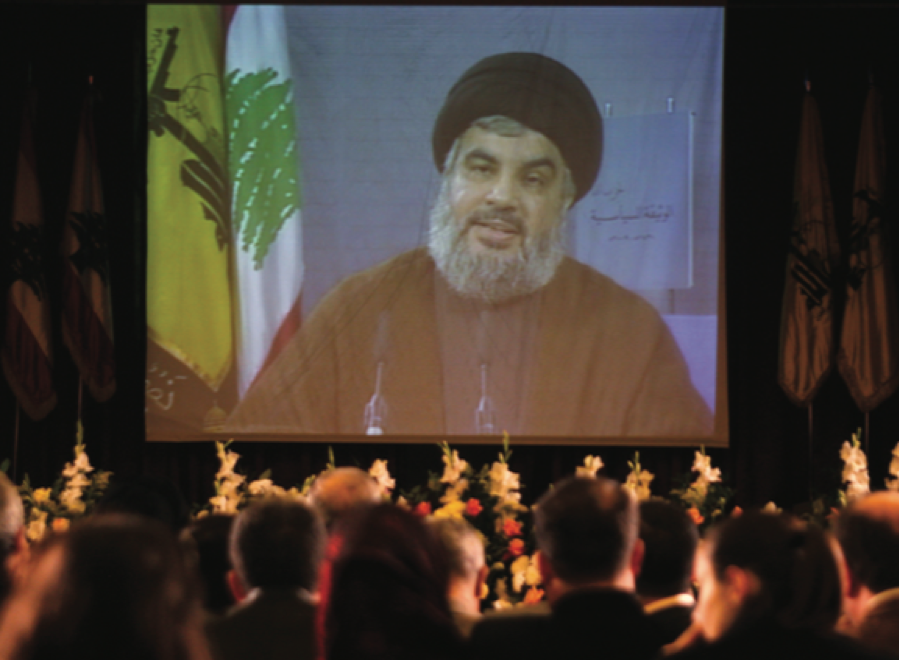
Hezbollah’s new political manifesto has taken a long time to materialize. As long ago as October 2002, Sheikh Naim Qassem, Hezbollah’s deputy secretary-general, said the party was working on an update of their original “Open Letter” of February 1985, which documented Hezbollah’s ideology and ambitions.

“Much has happened and much has changed between 1985 and now [2002],” Qassem said. “Our basic principles remain the same because they are at the heart of our movement, but many other positions have changed due to the evolving circumstances around us.”

The update was put on hold for several years, however, before being recently revived. The outcome was the 32-page document that Sayyed Hassan Nasrallah, Hezbollah’s secretary-general, unveiled at a press conference in November.

The new political manifesto is the work of an organization that has profoundly altered the manner of its public discourse, even if its core ideological principles remain unchanged. If the tone of the Open Letter echoed the wild-eyed enthusiasm of a teenager, bursting with zeal and passion, and littered with the motifs of revolutionary fervor, the new document has the more measured balance and experience of an adult: confident, discreet and pragmatic. Where the Open Letter was strategic, the new manifesto is clearly tactical and tailored to suit the political environment in which Hezbollah finds itself. For Hezbollah watchers, the most interesting aspect of the document was less what was included and more what was left out. Where are the references to Islam and the wilayet al-faqih (the desire to live under an Islamic state)?

These were all spelled out in the original Open Letter, in which Hezbollah vowed to “abide by the orders” of Ayatollah Ruhollah Khomeini, the “rightly guided imam” and said governance under Islamic Sharia should be adopted. It even invited Christians to convert to Islam.

The new document makes almost no mention of Islam. As for the preferred system of governance for Lebanon, Hezbollah echoes its February 2006 memorandum of understanding with Michel Aoun’s Free Patriotic Movement by calling for a “consensual democracy.”

This does not mean Hezbollah has abandoned the dream of living under Sharia; the ideal of an Islamic state remains one of Hezbollah’s ideological pillars, but the party long ago accepted that it is an unrealistic concept given Lebanon’s multi-confessional pluralistic society. Like the Open Letter, the new manifesto urges the abolition of political sectarianism, (a “consensual democracy” is only a temporary measure pending the eradication of the confessional system).

There is no mention of Iran as an ideological reference for Hezbollah through the wilayet al-faqih, the indissoluble thread that binds the Islamic Republic to Hezbollah. Instead, Iran is lauded as an upholder of Arab and Islamic causes and the spearhead of opposition to the American-Israeli agenda for the Middle East.

The rest of the document is broadly familiar. There is an exposition on Hezbollah’s security strategy in which the Resistance is regarded as an essential component of defense against the possibility of future Israeli aggression. Hezbollah uses the “defense strategy” debate to finesse attempts to dismantle the Islamic Resistance. In the 1990s, the assumption was that Hezbollah would have to disarm once Israel’s occupation of Lebanese territory was at an end. What the party intended to do when Israel pulled out of south Lebanon became a standard question for journalists interviewing Hezbollah officials to ask. The equally standard answer was a noncommittal “wait-and-see.”

While the Shebaa Farms anomaly and Israel’s shortsighted refusal to release Lebanese detainees were temporarily sufficient to justify Hezbollah’s armed status after Israel’s troop withdrawal in May 2000, it was evident that the party required a more substantive rationale to deflect domestic and external demands that it disarm. By arguing that its weapons are required “as long as Israeli threats and ambitions to seize our lands and waters continue, in the absence of a capable strong state and the strategic imbalance between the state and the enemy,” Hezbollah is declaring that the fate of the resistance is open-ended and not subject to a quid pro quo settlement with Israel.  In other words, it does not matter whether Israel abandons the Shebaa Farms, returns Northern Ghajar, ceases its overflights, hands over any remaining detainees and bodies of resistance fighters or forswears all ambitions to harness Lebanese territory or waters. The Resistance will remain as long as Israel remains a threat, a nebulous condition that presumably would only end with a comprehensive regional peace agreement.

The new manifesto is a carefully phrased blend of strategic intent and ideological ambition, combined with short-term tactical interests. Hezbollah has built an array of delicate cross-confessional alliances in Lebanon and abroad, which it needs to sustain to defend its interests, and which could be upset by an ill-chosen phrase.

Given that the new political manifesto, like the Open Letter, is a product of its time, it is unlikely that this latest disquisition will be the last.

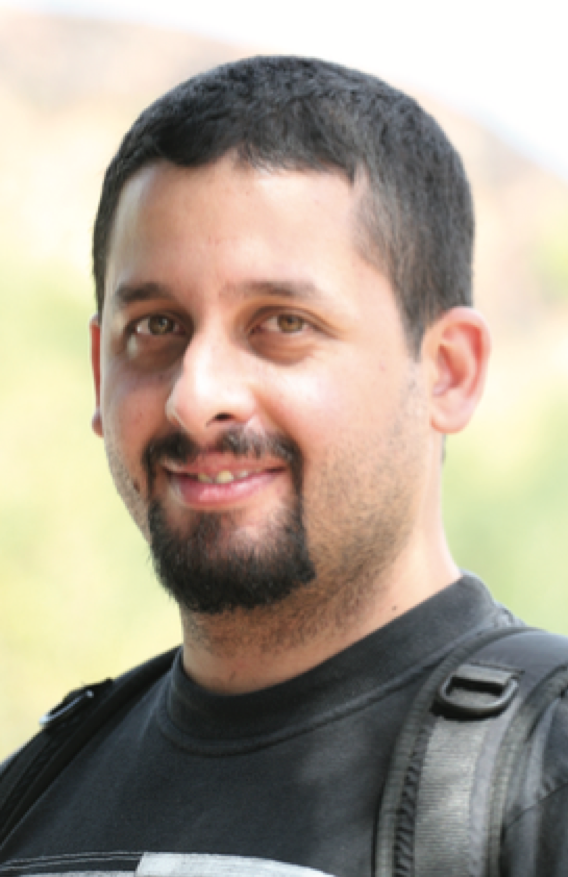
Nicholas Blanford is the Beirut-based correspondent for The Christian Science Monitor and The Times of London

January 29, 2010 0 comments
0 FacebookTwitterPinterestEmail
Editorial

Coming of age

by Yasser Akkaoui January 29, 2010
written by Yasser Akkaoui

No one knows how politics manipulates fear more than the Lebanese. Yet at the same time, the small Levantine country, which has witnessed so much tragedy in the past four decades, has been able to put conflict behind it again and unite to create one of the most energetic — even if it is at times erratic — private sectors in the region.

This ability to bury the past and move on was demonstrated at the Taef peace talks, held in Saudi Arabia in 1989 to end 15 years of brutal civil conflict, and in Doha in 2008 after Lebanon came perilously close to plunging itself once again into the abyss. The Lebanese may at times be powerless to the political maneuverings of bigger nations, but they have witnessed first hand how regional tremors can derail prosperity and they know how to be pragmatic, even when pragmatism comes at a personal cost.

There can be no better example of this than Lebanese Prime Minister Saad Hariri’s trip to Damascus last month. The visit may have been held in line with his government’s ministerial policy statement and as part of a regional effort to, “reunite Arab states and unify Arab positions on regional challenges,” but one cannot forget that the Syrian regime is still the prime suspect in the murder of Hariri’s father, the former Prime Minister Rafiq Hariri.

Saad Hariri has clearly decided that he would not allow Beirut’s relations with Damascus to be shaped by a personal feud. After all, the consequences of his father’s assassination went well beyond solely a Hariri family tragedy — it put in motion events that reshaped the geopolitical power dynamics of the region and galvanized action by the most powerful leaders in the world.

Now, there are big challenges ahead, but for the moment we can at least say that Hariri came of age on the tarmac at Damascus Airport.

January 29, 2010 0 comments
0 FacebookTwitterPinterestEmail
EnvironmentSpecial Report

Wael Hmaidan

by Executive Editors January 22, 2010
written by Executive Editors

The 2009 United Nations Climate Change Conference in Copenhagen last month brought together dignitaries, diplomats, activists and business leaders from 192 nations. While the Lebanese government contingent at the conference was led by Prime Minister Saad al-Hariri, among those representing Lebanon’s non-governmental organizations was Wael Hmaidan, executive director of IndyAct. Executive spoke with Hmaidan during the conference to hear his views on the negotiation process and its implications for the Arab world.

  • How is the negotiation process going and have there been any significant breakthroughs?

Negotiations seem to be heading toward a greenwash scenario, which is a suicide deal for all countries. The nations that are participating in the negotiations are not showing much ambition: developed countries are on one hand refusing to adopt the much needed and necessary measures to rein in global warming, on the other hand, developing countries are not pushing for a more stringent approach, fearing that any possible deal may have a negative impact on them.

An agreement has been reached on a possible emission reduction of 17 percent (relative to 1990 levels) by the year 2020 for developed countries,  and 14 to 15 percent for developing countries. This figure falls far behind the 40 percent drop in carbon emissions recommended by the scientific community. Ideally countries need to funnel $200 billion of annual aid into a special fund destined to help developing countries curb their carbon emissions; only $10 billion have been offered on a yearly basis for the next three-year period.

  • Will Lebanon benefit from such a fund?

As a developing nation, Lebanon will certainly benefit from such a fund in terms of technology transfer penned by any possible agreement. However the issue at stake is much more important, we are talking about the future of the country. Lebanon is threatened by severe desertification, which would leave residents scrambling for water and food supplies.

  • Is Lebanon actively participating in the Copenhagen negotiations?

Negotiations around climate change have been going on for years during which Lebanon has, for the most part, been a silent participant. Lebanese delegates sit like students in a class, listening to the various interventions without voicing their concerns. Although Lebanon is a small country it should be pushing for more measures that would allow for the survival of the planet. As an example, President Mohamed Nasheed of the Maldives has shown great leadership in defending the climate change cause. Lebanon is part of this planet and, like other countries, it will be significantly affected by global warming.

  • What is Lebanon’s contribution to global warming?

It contributes some 0.07 percent of the total value. However, it is nonetheless one of the highest per capita contributors.

  • How serious is the impact of global warming on a country like Lebanon and on sectors such as agriculture?

Climate change threatens human civilization at large when a stable climate system is modified beyond its tipping point. The short-term impact can be felt on sectors such as agriculture, with farmers facing more frequent droughts and subsequent shortage of water, which might lead to desertification. This will reflect on agricultural output, which will naturally fall. We are also witnessing changes in soil quality and the appearance of new diseases and pests, which are attacking plants.

In the long run, sea levels are likely to rise, destroying coastal

areas used for agriculture.

Some seasons will be longer — namely the summer period — and will also be dryer.

Precipitation and distribution patterns are changing, causing floods in certain areas that are followed by very dry seasons. Frost is also occurring out of season, which is another contributing factor for the decrease in agricultural output. Due to the rise in temperature levels, the natural line of trees will move higher. To respond to this trend, farmers will rely more on chemicals and fertilizers thus contributing to increasing toxicity levels in natural produce.

  • Is the government taking any measures to counteract the effects of global warming on Lebanon?

No real action has been taken by the subsequent governments, except in the Hermel area, where terraces which catch rain water have been built. This particular project has been financed by the UN. 

  • How are other Arab countries faring?

Egypt, which is tackling the climate change issue very seriously, has certainly taken the regional lead in the Copenhagen negotiations. Other countries like Saudi Arabia are being very proactive but in a negative manner. The Saudi kingdom considers climate change as a threat to oil trade and has raised doubts as to the validity of climate change theories while attempting to obstruct the negotiation process.

  • Do you believe that Lebanon and other Arab countries should be concerned by the issue of climate refugees?

The issue of climate refugees is only one dangerous aspect of the global warming problem, which is very complex and has many implications for the region.

  • Have China and the United States — the two main CO2 emitters — adopted more proactive stances toward climate change?  

The US is part of the problem underlying the negotiations deadlock. Although President Barack Obama seems to be serious about the issue of global warming, he lacks the support of the American Congress. He has come up with CO2 reduction figures that are better than the ones proposed by former president George W. Bush, but they remain insufficient on the broader scale of things. Conversely, China has adopted a very flexible stand toward the climate change issue.  

  • There seems to be a growing opposition between blocs representing poor countries, which are adamant that rich nations commit to emission cuts beyond 2012 under the Kyoto Protocol and the developed nations, which are pushing for a new agreement that would replace the protocol… Do you believe that the two-track approach could be a possible solution?

The two-track approach is not something new and has been underway for more than a few years. Kyoto was adopted in 1992 with the exception of the United States and some other developing countries. These countries that are out of the Kyoto Protocol have now joined the negotiations, which makes the two-track approach a growing reality for most.

January 22, 2010 0 comments
0 FacebookTwitterPinterestEmail
Finance

Regional equity markets

by Executive Editors January 17, 2010
written by Executive Editors

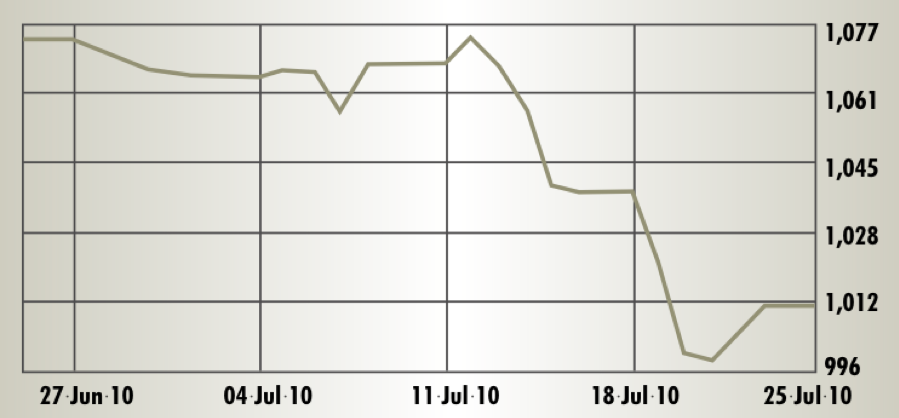
Beirut SE  

Current year high: 1,200.49    Current year low: 991.49

>  Review period: Closed July 23 at 1010.55 points                            Period change: -5.2%

The MSCI Lebanon index continued trending flat with a downward bias in the early part of July but then dropped sharply in the latter part of the review period, making the Beirut Stock Exchange the weakest performer among MENA bourses. Much of the downward trend was focused on the real estate sector and its dominant stock, Solidere. The two-tiered scrip weakened by 8.1% and 8.7% in the review period, with most of that drop an ex-dividend allocation on July 14. Stocks in the banking sector also mostly fell; only Bank of Beirut closed the period with a marginal gain.

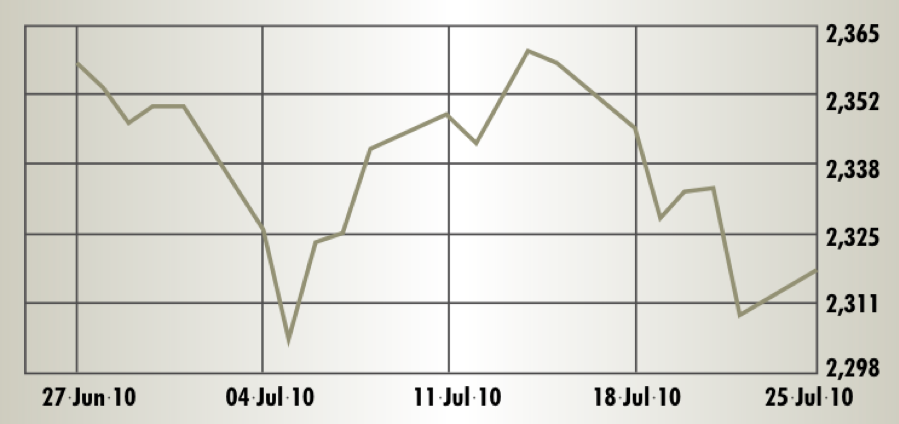
Amman SE  

Current year high: 2,693.91                Current year low: 2,303.44

> Review period: Closed July 22 at 2,307.87 points              Period change: -1.7%

The Levant stock exchanges were notable losers in July. A 350-point intra-month climb on the Amman Stock Exchange was not sustained by investor sentiment and the ASE index slumped back to a July 22 close that was just a notch above the latest multi-year low, which the index had passed through on July 5. The services sector was the best performer between Jul 1 and 22, managing a gain of 0.9%. Banking was range-bound to the general index, or vice versa; industry and insurance underperformed.

Abu Dhabi SM  

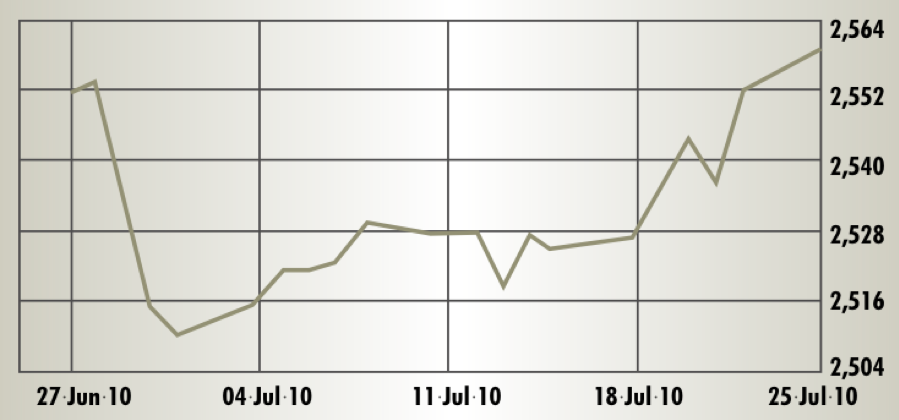
Current year high: 3,239.74                Current year low: 2,467.04

> Review period: Closed July 22 at 2,550.98 points              Period change: 1.5%

Continued declines in trading volume from earlier weeks and volatility of less than 4% created an image of a fairly normal shift into the summer vacation season on the Abu Dhabi Exchange. However, the ADX index is still 7% down when compared with the start of 2010, making it the GCC’s second biggest loser for the year to date after Dubai. The energy index was the upward outlier among ADX sector indices, with a 20.7% climb in July. As far as individual companies, eight ADX stocks achieved double-digit gains, led by delisting candidate Aabar Investments (+40.1%).

Dubai FM  

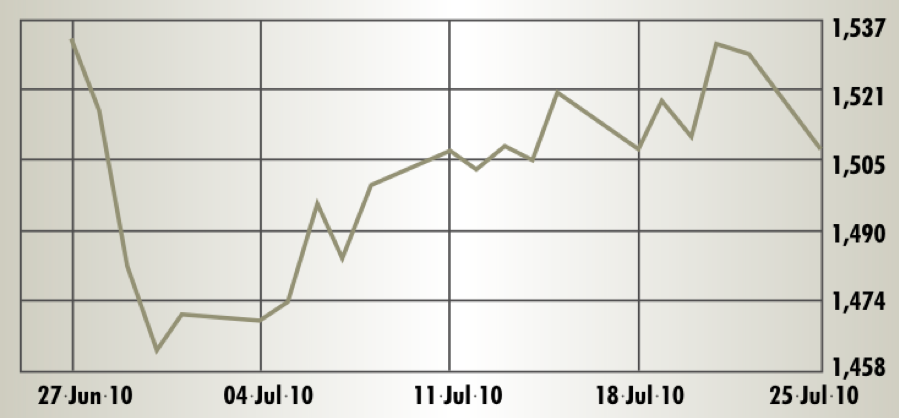
Current year high: 2,373.37                Current year low: 1,461.80

> Review period: Closed July 22 at 1528.97 points               Period change: 4.6%

Fresh into the second half of the year, the Dubai Financial Market index booked the GCC’s best gains — but only when compared with the start of July. Wearing mirror coated sunglasses outside and inside were the accessory recommended to investors who wanted to look cool and stay calm in the face of the DFM benchmark index’s fat drop of 15.2% from the start of the year — the MENA’s steepest year-to-date fall on the review date and even 1.2 percentage points down from 30 days earlier. Of indices around the globe, not many have shown a steeper downside in 2010.  

Kuwait SE  

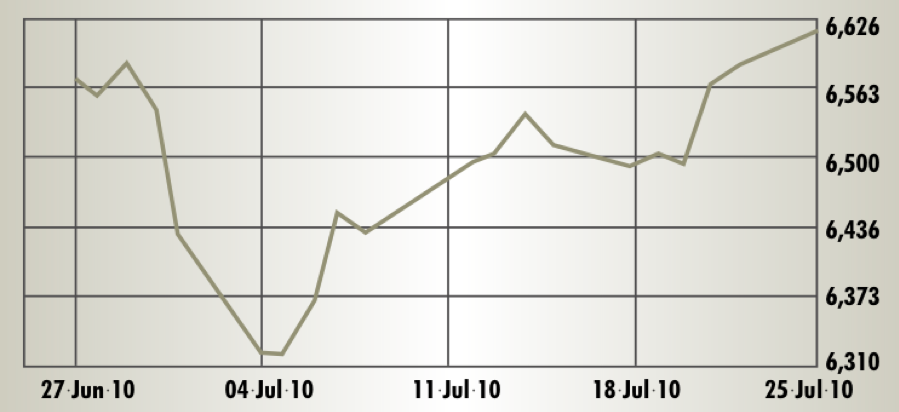
Current year high: 7,964.30                Current year low: 6,319.70

> Review period: Closed July 22 at 6,582.60 points              Period change: 0.6%

With the start of July, the Kuwait Stock Exchange index promptly dropped below 6,400 points for the first time since March 2009. As the index clawed its way back above the 6,500-point line by July 13, most sector indices followed the benchmark’s modest gains. Insurance and non-Kuwaiti stocks lagged behind, however, ending the review period 7.7% and 5.8% down. The KSE is down 6% year-to-date but at least July trading volumes (and volatility) were up when compared with the June review period.

Saudi Arabia SE  

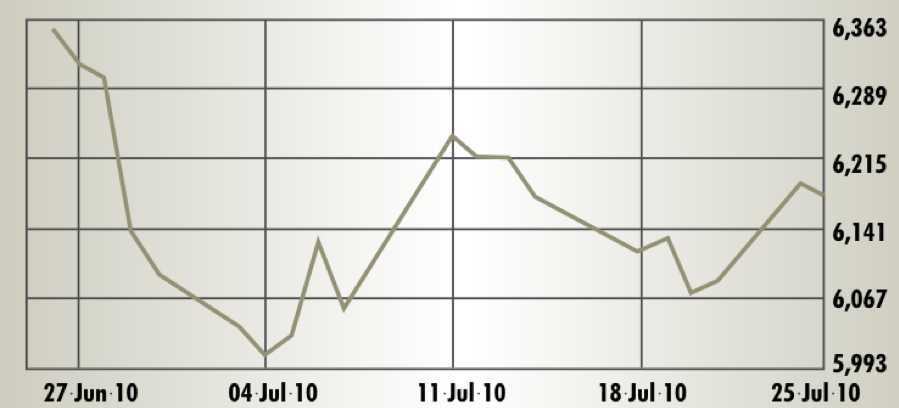
Current year high: 6,929.40                Current year low: 5,617.31

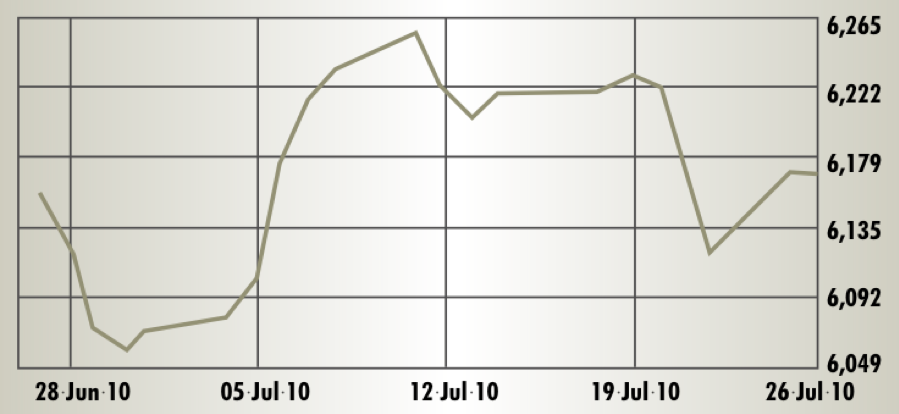
> Review period: Closed July 21 at 6,089.95 points              Period change: -0.1%

The Saudi Stock Exchange was, by measure of its 14.31x P/E ratio, the most expensive GCC bourse at market close on July 21. The TASI benchmark index, which had entered the second half of 2010 on a downtrend followed by a short lived 240-point rise in the second week of July, ended the review period with marginal drops on both the month and the year. Manufacturer SABIC, who showed big increases for gross and net income in both the last quarter and the first half, gained 0.9% between July 1 and 21.    

Muscat SM  

Current year high: 6,933.75                Current year low: 5,263.94

> Review period: Closed July 22 at 6,117.25 points              Period change: 1.0%

Although the Muscat Securities Market had a better start into the second half of 2010 than several other GCC stock exchanges, the MSM index softened toward the end of the review period under selling pressure. This reduced the Omani market’s gain to the same 1% range as its peers in Qatar, Kuwait, Abu Dhabi, and Bahrain. As in the previous month, the industrial index in July was the best performing sector on the MSM. Dhofar Poultry Co flew up 57.5% to the rung of the review period’s top gainer. It accomplished this feat with two small trades on Jul 22. 

Bahrain SE  

Current year high: 1,605.98                Current year low: 1,361.19

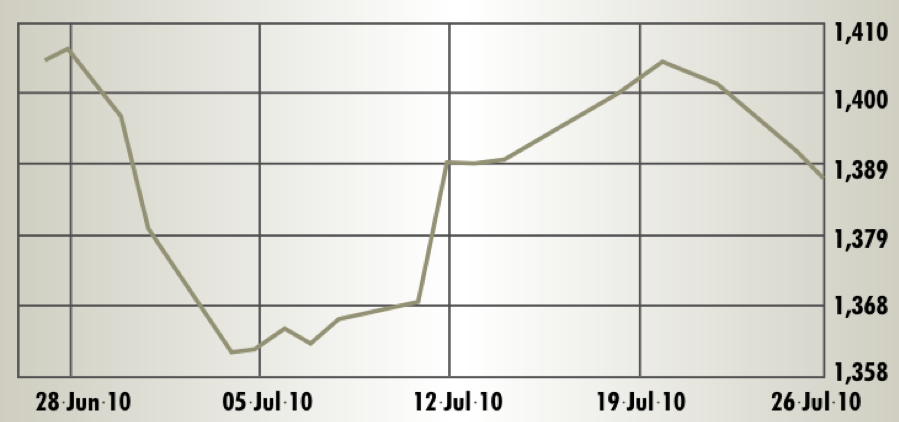
> Review period: Closed July 22 at 1,401.42 points              Period change: 0.4%

Visibly lower daily trade volumes than in the two previous months and a twelve-month index low on July 4 were talking points on Bahrain Stock Exchange performance going into the second half of 2010. The BSE’s recovery from being oversold at the start of the month allowed it to end the review period with a positive twist. The banking and insurance sub-indices outperformed but the investment index underperformed the general index. Inovest, an Islamic real estate developer, was the period’s best gainer and closed up 21.7%.

Doha SM  

Current year high: 7,801.33                Current year low: 6,502.93

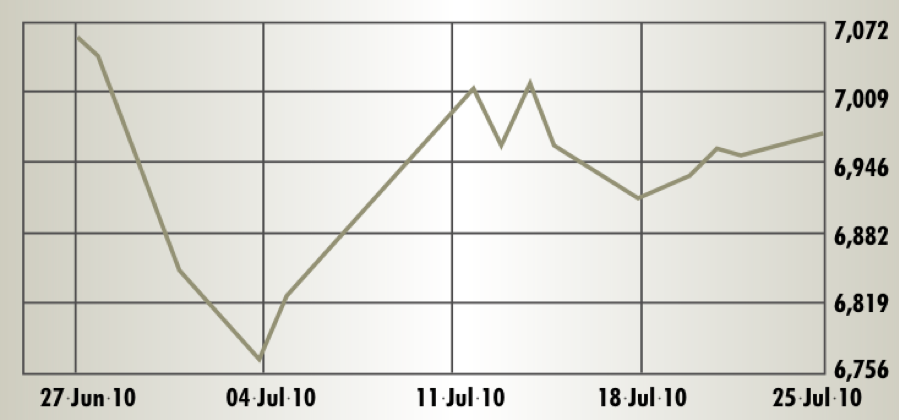
> Review period: Closed July 22 at 6,951.89 points              Period change: 0.8%

Like its GCC peers, the Qatar Exchange hit a seasonal low right at the start of the third quarter and as on other bourses near and far, the QSE index trends appear to be reflections of uncertainty. For the year to date, the QSE was basically flat at the close of the July 22 session. Whereas sub-indices for banking, services and industry moved range-bound with the general index, the insurance index recorded more pronounced fluctuations and closed the period 2% up. Qatar Islamic Insurance (+21.2%) and Al Khaleej Insurance (+17.2%) were the best performers.

Tunis SE  

Current year high: 4,971.94                Current year low: 3,615.36

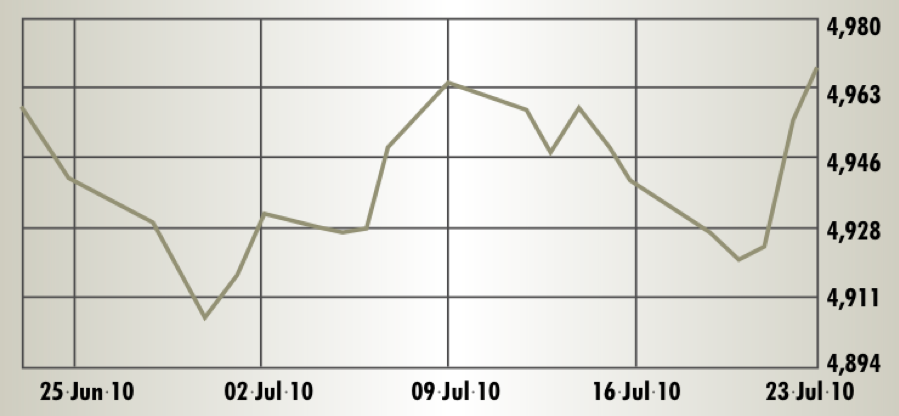
> Review period: Closed July 23 at 4,969.66 points              Period change: 1.3%

Another high floating month in Tunis. After scaling a new historic high on June 21, the Tunindex saw a week of mild profit taking before upward motion resumed with the first session of the third quarter. The Poulina Group conglomerate started July with a furious rally, driving the stock higher 16.1% to market cap above $1.1 billion. Other top gains came from two newcomers. June debutant Carthage Cement Co, although softening after an intra-month price peak, gained 13.8% in the review period. Automotive company ENNAKL, who debuted on July 16, was up over 52% by the July 24 close.  

Casablanca SE  

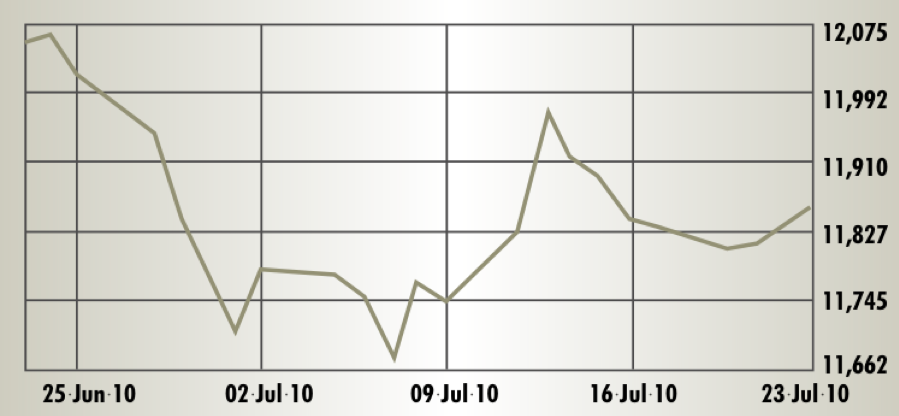
Current year high: 12,457.59              Current year low: 9,997.56

> Review period: Closed July 23 at 11,857.08 points                        Period change: 0.7%

The Casablanca Stock Exchange started the second half of 2010 with more up and downs than its Tunisian peer, resulting in 8% volatility in the MASI versus about 4% on the Tunindex. Although losers outnumbered gainers in the review period on the Moroccan bourse, the leading stocks by market capitalization closed the period up. Maroc Telecom gained 4% and Attijariwafa Bank, 0.6%; Tunisian automotive dealer ENNAKL dual-listed from day 1 on the Moroccan market where it gained 6.7% by July 24 close.

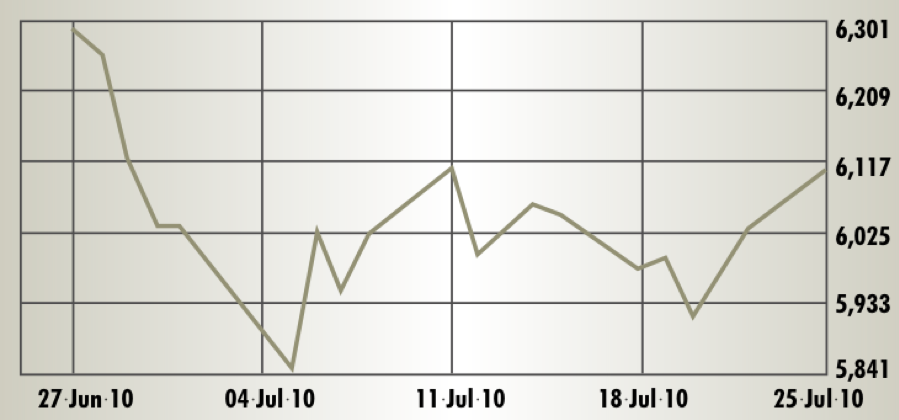
Egypt CASE  

Current year high: 7,603.04                Current year low: 5,850.00

> Review period: Closed July 22 at 6029.00 points               Period change: -0.1%

Thinking global trends while buying local stocks has been a well-entrenched pattern in investor behavior on the Egyptian Stock Exchange as well as other regional bourses. But what to think if global markets are in confusion and signals are all mixed? Largely thanks to global market impacts, the EGX 30 index was a beacon of volatility in the July review period, at 21.2%. Small and medium sized stocks by the bundle recorded double-digit gains, but not so the Orascom twins.

January 17, 2010 0 comments
0 FacebookTwitterPinterestEmail
  • 1
  • …
  • 433
  • 434
  • 435
  • 436
  • 437
  • …
  • 696

Latest Cover

About us

Since its first edition emerged on the newsstands in 1999, Executive Magazine has been dedicated to providing its readers with the most up-to-date local and regional business news. Executive is a monthly business magazine that offers readers in-depth analyses on the Lebanese world of commerce, covering all the major sectors – from banking, finance, and insurance to technology, tourism, hospitality, media, and retail.

  • Donate
  • Our Purpose
  • Contact Us

Sign up for our newsletter

    • Facebook
    • Twitter
    • Instagram
    • Linkedin
    • Youtube
    Executive Magazine
    • ISSUES
      • Current Issue
      • Past issues
    • BUSINESS
    • ECONOMICS & POLICY
    • OPINION
    • SPECIAL REPORTS
    • EXECUTIVE TALKS
    • MOVEMENTS
      • Change the image
      • Cannes lions
      • Transparency & accountability
      • ECONOMIC ROADMAP
      • Say No to Corruption
      • The Lebanon media development initiative
      • LPSN Policy Asks
      • Advocating the preservation of deposits
    • JOIN US
      • Join our movement
      • Attend our events
      • Receive updates
      • Connect with us
    • DONATE