• Donate
  • Our Purpose
  • Contact Us
Executive Magazine
  • ISSUES
    • Current Issue
    • Past issues
  • BUSINESS
  • ECONOMICS & POLICY
  • OPINION
  • SPECIAL REPORTS
  • EXECUTIVE TALKS
  • MOVEMENTS
    • Change the image
    • Cannes lions
    • Transparency & accountability
    • ECONOMIC ROADMAP
    • Say No to Corruption
    • The Lebanon media development initiative
    • LPSN Policy Asks
    • Advocating the preservation of deposits
  • JOIN US
    • Join our movement
    • Attend our events
    • Receive updates
    • Connect with us
  • DONATE
Lebanon

Election – The ballots bought

by Sami Halabi June 3, 2009
written by Sami Halabi

Lebanon’s June 7 parliamentary elections are expected to be a close affair, pitting the March 14 coalition against the opposition parties of Michel Aoun’s Free Patriotic Movement, Hezbollah and Amal. The elections are unprecedented in many respects, not least of which is the introduction of a new electoral law.
Lebanon’s new electoral law is unique in the region, addressing core issues such as media objectivity during the elections and campaign finance. The reforms are a step towards adopting legislation that would bring Lebanon’s elections in line with international standards. But the current legislation is “diluted by significant loopholes,” said Madeline Albright, the former United States Secretary of State, when she touched down in Beirut to head a delegation to monitor elections from the National Democratic Institute (NDI).
The loopholes are many, but certain reforms that did not exist prior to this year’s elections have been adopted. Not least of which is Lebanon’s newly formed Constitutional Council that can adjudicate contraventions of the electoral law. 

Spending caps skirted
In theory, the new election law stipulates that an “electoral campaign account” must be established for each candidate and “all electoral contributions and expenses shall be exclusively made through this account during the period of the electoral campaign.”
The law restricts each candidate to a campaign spending limit, including pay-in-kind expenses, of approximately $100,000, plus a variable of around $2.66 per registered voter in an electoral district, which is measured by the Ministry of Interior’s list of registered voters. But the actual number of eligible voters in a district is impossible to calculate because Lebanon has not conducted a census since 1932. 
“Candidates are required to do all their spending from their electoral account, but they can make transactions from their personal accounts or their family’s accounts and no one can know,” said Lynne Ghossein, the campaign finance project manager at the Lebanese Transparency Association (LTA). 
One possible solution to this skirting of the law would be to monitor candidate’s personal accounts or those of their families. But this provision is not included in the new electoral law. 
“I gave my opinion while discussing the draft electoral law and I said very openly that we cannot limit banking secrecy to the campaign account,” said Lebanon’s Interior Minister Ziad Baroud at a press conference for the Supervisory Commission on the Election Campaign (SCEC). Baroud is responsible for insuring the SCEC fulfills its mission of implementing the new electoral law.
Lebanon is one of the only countries in the world that maintains a policy of banking secrecy on personal accounts. Banking secrecy can only be lifted by the Special Investigation Committee (SIC) of the Lebanese Central Bank.
“We have not lifted banking secrecy on any candidate’s accounts nor received any request to do so,” said Hisham Hamzeh, director of the audit and investigation unit at the SIC.
Hamzeh explains that banking secrecy is only lifted in order to investigate suspected “terrorist” activity, as well arms and narcotics trafficking and money laundering. Even if candidates are found to have violated the campaign spending clauses of the electoral law, the public would not find out about it until after the elections, when many of the candidates will have already assumed office.
“The only thing that can happen is when the election is over someone does the inventory and campaign auditing for a candidate. [Then] they can see that there is more money spent than what was in the [electoral campaign] account,” said Nadine Farghal, legal counsel and coordinator at the Lebanese Civil Campaign for Electoral Reform (CCER). “This way they can see that [the candidate] has used another account.”  
Violations of campaign financing regulations are to be submitted to Lebanon’s Constitutional Council, whose formation has been delayed for years. On May 19, a group of 55 Lebanese civil society organizations and eight universities sent a formal letter to President Michel Sleiman demanding the creation of the Constitutional Council.
On May 26 — less than two weeks before the election — Lebanon’s cabinet finally appointed its half of the council’s membership (five out of the 10 seats). The council is Lebanon’s highest judicial body that can rule on the constitutionality of the elections and is seen as an essential judicial organ providing an alternative to violent conflict over electoral contentions.
In addition to being prevented from tracking the personal accounts of candidates, the SCEC can only begin to monitor campaign accounts from the point when candidates officially submit their eligibility, a period that ran from March 2 to April 7. Hence, supposing that candidates do follow the letter of the law and only use their campaign accounts to fund their campaigns, there is still no adequate mechanism in the law to account for the total amount spent on a campaign, which began well before the submission period.
“The monitoring time is [too] short and we didn’t get the time we wanted,” Baroud said.
Yara Nassar, executive director of the Lebanese Association for Democratic Elections, said that long before the monitoring period began, candidates used their own accounts or that of their party. She said the lack of an official commission to report violations in the run-up to the election period is another significant shortcoming of the new law.
“This is the first time the SCEC is here,” she said. “They haven’t been around for four or five years and this is part of the problem.”

Foreign influence 
In theory, Lebanon’s new electoral law specifically prohibits candidates “from accepting or receiving, whether directly or indirectly, contributions or aids from foreign states or from a non-Lebanese natural or legal person.”
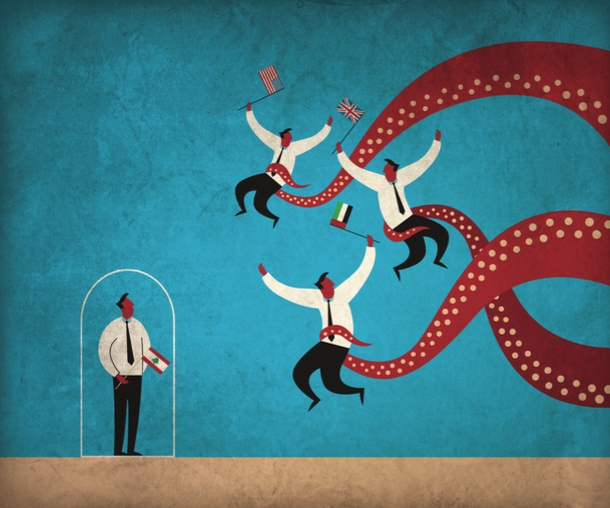
But without oversight on candidates’ personal accounts, there is technically little to stop candidates from ignoring the law and accepting the support of foreign entities willing to dish out cash to support their interests.
“Candidates can receive money in other accounts then transfer it to their electoral account,” said Gaelle Kibranian, programs director at the LTA. “We cannot know where this money is coming from.”
Lebanon’s role as a battleground for regional and international players makes it a prime candidate for illegal money entering the country to support one side of the political divide more than another.
“Can you say that Hezbollah doesn’t take money from Iran or Saad Hariri doesn’t take money from Saudi or [Michel] Aoun from Qatar,” added one legal expert who spoke on condition of anonymity. “It’s all around the media and no one is investigating it.”
The practice of accepting foreign money has become so commonplace in affecting the course of Lebanese politics that many politicians have heralded it as a necessary element to achieving their political aims. Ahmad el-Assad, a candidate running for the Shiite seat in the Marjayoun electoral district and founder of the Lebanese Option Gathering (LOG), said he has “no problem” with accepting financial help from Saudi Arabia or the US “because if we don’t do that things don’t move forward.” However, he denied receiving any funding for his campaign from foreign sources.
His organization aims to provide an alternative to Hezbollah’s influence over Shiites in the south of Lebanon. Assad accused Hezbollah and its allies of intimidating the residents of Lebanon’s south and of receiving “tens of millions of dollars” from Iran. Hezbollah declined to comment on Assad’s accusations.  

Vote buying
International and local election watchdogs say the biggest obstacle to preventing vote buying is the balloting system in Lebanon. Ballots can be printed or written out on any piece of paper and parties usually hand out their pre-printed “list” before a voter enters a polling station.  
A party can hand out a variety of ballots, with candidates listed in any order and any font. This in turn allows political parties to trace the ballot back to a particular voter or bloc of voters. 
Despite repeated calls by civil society and some government figures like Minister Baroud, the proposed introduction of standardized, pre-printed and government distributed ballots at the polls was not included in the 2008 Election Law, due to opposition from parties on both sides of the political spectrum.   
“We know that the buying happens at the ballot because it is just a piece of paper and they [candidates and parties] put signs on it and pay for the votes afterwards,” the LTA’s Kibranian said. 
She said each party has representatives at the polling station during vote counting who, in turn, monitor the number of votes cast for each candidate or list of candidates.  CCER’s Farghal said the markings are usually simple alterations in the lists of candidates, such as having the “second name in italics or the third name in a different font.”
Election observers agree that most of the ballot rigging happens at the ‘family level,’ whereby large families in electoral districts agree to arrange for their family members to cast votes for a certain candidate or list of candidates. Once the ballots are counted, each family then receives cash or pay in-kind services according to the number of counted votes. 
“We have witnessed representatives of the candidates marking each name when they count the votes,” said Nassar of LADE.  “They see the ballots they need to mark and then they mark their own register.”
But it’s not just families that take part in vote buying corruption. An anonymous source working with one of the major Christian opposition parties in Lebanon said his party  recruited through an “electoral pyramid scheme,” whereby the amount of money ‘recruiters’ make increases with the number of people they ‘recruit.’ The source has agreed to vote for the party in question and act as a representative at the polling booth. 
“All they wanted was a photocopy of my ID,” the source said. “If you have a car they need your driver’s license and you can get more [money] because they ask you to transport people.”
The source said he was receiving $100 for his vote and $100 to man the polling station come June 7.
Candidates and parties are also looking to bring votes back to Lebanon from abroad, and with it the voters, because current legislation does not allow Lebanese citizens to vote outside the country.
An anonymous source in Dubai with links to a prominent Sunni party said the electoral pyramid scheme that applies to local vote buying is also being put to use abroad. The source said that parties are giving voters abroad, especially those from tightly contested districts, either airline ticket vouchers or sending them tickets directly. 
While this is not technically an illegal practice, the electoral law specifically states that transportation costs must be deducted from a candidate’s electoral campaign account.
“If you can prove that the candidates themselves are paying for people to fly in from abroad to come and vote for them, then it can be counted as campaign spending,” said Farghal.
As for the foreign staff in charge of recruiting voters, the payment of their salaries will not pose much of a problem in circumventing the law.
“If I am a candidate and I have a lawyer, even if he is not a very smart one, I will find a way to make it seem like these people [foreign staff] are volunteering to get me more votes abroad,” added Farghal.
The current law allows for volunteers to provide services for free which are not counted as campaign expenditures.

Pay-in-kind and your vote is mine
Apart from candidates merely paying people in cash to further their campaign, many parties and candidates are blatantly disregarding the illegality of pay-in-kind services to further their campaigns.
In May the March 14-affiliated Kataeb party advertised on its website that it had distributed free medicine and healthcare in a “special for the campaign.”
El-Assad’s campaign also “distributed health cards that were conditional upon voter choices,” according to a report issued by LADE. El-Assad admited to this violation but says that it pales in comparison to Hezbollah’s violations. Hezbollah declined to comment.

The media’s bark
The new electoral law aims to restrict Lebanon’s sectarian media landscape from unbalanced reporting on the elections. Given that each major media outlet in Lebanon belongs to one political party or another, this is turning out to be an uphill battle for the SCEC.
“Our media landscape is controlled by people who are running in the elections and obviously they will use their media outlets for their own purposes,” said Roula Mikhael, executive director of the Maharat Foundation, a local NGO that is monitoring the media during the elections.
The SCEC’s first report in early May identified 293 media violations of just one article of the electoral law committed over 14 days, from April 14 to April 28. The report covers several categories of contraventions across different types of media that include libel, slander, defamation and broadcasting that triggers sectarian tensions.
The first report contained no specifics as to who committed which media violation because of what head of the SCEC Ghassan Abu Alwan, called “a period of forgiveness.” Minister Baroud added that “we should not consider that it is impossible for the media to follow the law.”
The media organizations however seem to be above the law as they enjoy widespread support among large swaths of the Lebanese public because of their political and religious affiliations. Nassar of LADE explained that the issue of addressing what the media are allowed to do is “something that the authorities in Lebanon are afraid to tackle or take action against,” because “even if the court says you are right, you are well documented and you have everything you need to do this, public opinion could sway against you.”

Piles of posters
The new law also lays out the explicit terms for displaying political posters by which each municipality must assign spaces for display.
But given Lebanon’s municipal elections are scheduled to be held next year, municipalities have a lot to consider if they are to take down illegal posters of a candidate who could represent them in government after June 7.
“Municipalities are usually politicized so they will not, in most cases, forbid people from hanging posters of a certain figure,” said Tony Mikhael, lawyer and legal expert at Maharat. But since the beginning of May, reports have surfaced that the law is being applied in some areas of Lebanon, but “if you go outside of Beirut you see the chaos when it comes to hanging pictures,” said Mikhael.
This practice has greatly impeded any monitoring body’s ability to track campaign expenditures on campaign posters. The SCEC has declared that the cost of any promotional material that even alludes to a candidate or their party will be counted against their campaign account. On the ground, however, there are always ways around such rules.
“You cannot forbid people from placing posters on private property,” Tony Mikhael said. “If you put a picture on the roof or balcony of a building, the municipality can do nothing.”

Abusing public office
Public officials have been accused by various monitors and NGOs of abusing their public offices to promote their campaigns. One of these is the telecommunications Minister Gebran Bassil who recently sent out a voice recording to mobile phone subscribers advertising Lebanon’s recent deduction in phone tariffs.
The message started out by saying “This is not a lie, but the truth” mentioning the minister’s name, but not that of his ministry, which prompted a flurry of accusations. His office said that he recorded the message on April 1, before he submitted his candidacy. Gebran’s office said “technical reasons” caused some subscribers to receive the message later.
Even Parliamentary Speaker Nabih Berri, an opposition leader, has been criticized by LADE for promoting himself and his electoral list by giving speeches at the opening of public events.
Ali Hamdan, a senior adviser to Berri, said that the SCEC has approved of all of the speaker’s speeches, and in turn accused LADE of being biased.
“The US is supporting this NGO so how can they be neutral,” said Hamdan. “They are not neutral anymore and [hence] they should be phased out.” LADE declined to respond to the allegation.
The mudslinging will most likely continue well into and past the elections. But with the legal body to prosecute violations in place, the law now has some teeth. And, with some key reforms advocated by civil society already enacted, there is a sense that the ball has at least started rolling on the path to a democratic process that is in line with international standards.

June 3, 2009 0 comments
0 FacebookTwitterPinterestEmail
Finance

Bank Audi – Freddie C. Baz

by Executive Staff June 3, 2009
written by Executive Staff

E Economist Marwan Iskandar recently said that it is not realistic to think that Lebanon has not been affected by the global financial crisis, especially considering the public debt; what’s your take on this?

Our customer deposits represented almost 90 percent of our funding base. Boring banking, boring banks. Lack of sophistication based in commercial banking is why Lebanese banks have been insulated from the crisis.
What Iskandar is saying is true in marginal terms, not absolute terms. The International Monetary Fund has forecasted real gross domestic product growth for 2009 between 3 and 4 percent. Global GDP will witness a negative growth of negative 1.5 percent. This drop in our growth rates translates into some of the burdens felt by the global financial crisis, but it’s a mix of positive and negative contributions, with a net contribution still positive, but at 3 percent, not at 8.5 percent. At this point of the year, it is too early to confirm what Iskandar is saying or not.

E Some believe that by lending the government money, Lebanese banks are perpetuating the country’s debt problem. How much longer can the banks carry Lebanon’s debt?
It’s a political statement, it’s not an objective or professional statement. Nobody imposed the subscription to any public paper on the banks. At the end of the day, the government has to pay salaries to the public servants, so if there is no income, you either borrow or you sell assets. This easy borrowing has made the politicians’ lives easier in not feeling the need to reach a consensus on financial reforms. Easy borrowing has provided an exit.
If you evaluate all pubic assets, and you allocate a very conservative value to each of those assets, you will reach a bottom line which is much bigger than the outstanding debt. So the Lebanese government is not in a situation of technical bankruptcy, whereby their asset value is lower than their outstanding debt. Their asset value is still higher than their debt. The issue is more one of cash flows than of net asset value.

E Due to the slower pace of lending to the private sector compared to public sector lending, many feel that banks in Lebanon should increase their lending and are pressuring the central bank to lower the interest rates in order to stimulate investment in the private sector. What is your take on this?
At the end of the day, figures talk. The consolidated exposure of Lebanese banks to the domestic private sector in terms of lending is almost 100 percent of GDP. The benchmark worldwide is 60 percent. It’s a false problem that has been created by politicians. We are at 85 or 90 percent lending to the private sector. When you have such a high level of exposure in Lebanese banking, you shouldn’t even dare to mention that we are under-lending to the private sector.
If you go into the breakdown of the overall portfolio by size of companies and how much we are lending to big corporates, with respect to middle size corporations and small to medium [sized] enterprises (SMEs), there is a [higher] concentration in the bigger corporations. That is because of the contribution of those important borrowers to the GDP of Lebanon. If 80 percent of my portfolio is concentrated on tier 1 companies, it’s because the top 100 companies in Lebanon contribute up to 80 percent of the GDP formation in Lebanon.
I agree that we should give more loans to SMEs in order to increase their contribution to the economy of Lebanon, but it’s a matter of governance much more than one of size. SMEs are mostly family profiled or not legally organized. The responsibility is not at the level of the banks, because those companies have not developed into well organized companies eligible for bank loans.

E Do you expect to see mergers and acquisitions in the Lebanese banking sector?
On the regional scene, there is a place for one or two mega Lebanese institutions [to merge]. This is something that frustrates me a little bit because this should have been encouraged by the central bank. It will definitely happen. Among the top 10 banks in Lebanon we have to see two or three mega-mergers. What we have witnessed so far are lobsters eating shrimps; what we need in Lebanon is lobsters marrying each other.

June 3, 2009 0 comments
0 FacebookTwitterPinterestEmail
Comment

The frontier of Iraqi investment

by Ranj Alaaldin June 3, 2009
written by Ranj Alaaldin

At the Invest Iraq conference, held last month in London, a flood of investment projects and opportunities were presented by the Iraqi government to more than 250 foreign investors from British and international companies. The high-profile delegation from Iraq included Prime Minister Nouri al-Maliki, Deputy Prime Minister Barham Salih and officials from Iraq’s various ministries and provincial investment commissions.

This was going to be an all-out team effort because Iraq, quite simply, needs foreign investment and expertise. The country needs a colossal $400 billion worth of infrastructure to meet the basic needs of its population. It needs power plants to generate electricity (electricity rationing still occurs in the country); it needs water systems, new hospitals, schools, transport networks and more than 3.5 million residential units within the next 10 years at a rate of 350,000 per year. The list continues to include agricultural and food production needs.
Falling oil prices mean Iraq is unable to independently fund its reconstruction and is looking to the private sector for funds. It exports a mere 1.8 million barrels per day (bpd), far below potential for a country that has a 119 billion barrel oil reserve (the third largest in the world) and which expects to get 86 percent of its revenue from oil in the coming year. Its desperate need for funds was highlighted by its recent reversal over Kurdish oil exports, now permitted through the country’s national pipeline and into international markets. Oil from the TaqTaq and Tawke oil fields in the Kurdish north should bring in a revenue stream of $5 million per day (at $50 per barrel) from what initially will be exports of 100,00 bpd in June, but which could rise to 250,000 bpd down the line.
At the London conference, Iraq’s oil minister Hussein al Shahristani said the oil industry needs an estimated $50 billion over the next five years to repair and upgrade the oil industry, still suffering from decades of war, sanctions and financial neglect. Still yet to be passed, however, is an oil law that provides for revenue sharing from the production and exploration of Iraq’s oil. Until heated disagreements between Baghdad and Erbil are resolved and the law is passed, foreign investment and expertise will stay away.
But it is not just the oil law that keeps foreign investors away. Corruption is rampant and, as it stands, a foreign investor can take man, machine and money to Iraq only to be prohibited from purchasing land, although the government is attempting to change this. At the London conference investors expressed concern at what they feel is an ambiguous regulatory and legal framework that fails to guarantee, in clear terms, how they will be protected. Foreign investors, for example, can transfer abroad any profit incurred during the course of business, pursuant to Article 11(1) of the Investment Law 2006; however, banks do not open accounts in the name of foreigners and the Companies House does not register shares to foreigners. Of greater concern still is that government agencies and ministries do not always act in accordance with the same law that investors are required to.
The aforementioned obstacles are arguably transitional, and expected in a nascent democratic state recovering from totalitarian rule. The Iraqi government’s 500 different investment projects across the various sectors means serious opportunities exist to stake a claim in the country’s future. More than $10 billion worth of British and international investment deals are currently on the table, and investors from the region and the Gulf states have already stepped into the market.
Moreover, Iraq’s banking sector is dramatically improving. The Trade Bank of Iraq has increased its assets to $10 billion from $2.8 billion in 2006. Iraq needs a stable banking sector if the economy is to reach maximum potential: the country now has six state-owned retail banks and more than 30 private banks, including international bank HSBC. But only 2.7 million Iraqis have bank accounts and persuading Iraqis to trust the banks and part with cash will be the hard task.
It would be premature to maintain that investors should flock to Iraq without hesitation; in addition to the aforementioned issues, security, although improved, is still a matter for consideration. Baghdad has the necessary vision, as illustrated by its decision to contract Lebanese consultants Khatib & Alami to draw up a construction masterplan for the city. The next step is to place greater emphasis on a three-pronged attack that dispels uncertainty not just over Iraq’s economic and investment needs, but also its political and security needs, all interwoven and interdependent on each other.

Ranj Alaaldin is a Ph.D. candidate at the London School of Economics focusing on post-invasion Iraq

June 3, 2009 0 comments
0 FacebookTwitterPinterestEmail
Finance

Lebanon – Insulated, not impervious

by Executive Staff June 3, 2009
written by Executive Staff

“Boring banking,” said Freddie Baz, “is why Lebanese banks have been insulated from the crisis.”

Baz, the group chief executive and strategy director at Lebanon’s biggest bank, Bank Audi, said the “lack of sophistication” in commercial banking was the key factor protecting the Lebanese banking sector from the financial turmoil plaguing the rest of the world.
Other factors have been the conservative policies set by Banque du Liban (BDL) — Lebanon’s central bank — and traditional, prudent strategies used by domestic banks. Last year the average profit for the top five banks topped 20 percent. Those record breaking profits are in the past, but early 2009 numbers seem to indicate Lebanon’s banks are doing just fine: Bank Audi, BLOM Bank and Byblos Bank — the three largest in Lebanon — posted total profits of $149 million in the first quarter of 2009, a 13 percent gain on the same quarter last year, according to a BLOM Bank report.
Still, Lebanon has not been immune to the financial crisis, said Francois-Pascale de Maricort, chief executive officer of HSBC Lebanon.
“It’s quite obvious that Lebanon has been affected by the global markets,” he said. “If you look at the growth rates, Lebanon recorded a very high rate of 8 percent last year. This year we forecast growth to be between 3 to 4 percent.”
But at least it’s still growing, unlike Lebanon’s regional brethren.  To deal with the slowdown, banks have maintained the status quo, using the same strategies to try to mimic last year’s success. But while Lebanese commercial banks have been insulated from the global turmoil and remain resilient, they are not isolated, nor immune.
As a natural repercussion from the global circumstances, profitability among banks is expected to slow year-on-year, but still achieve positive results. Foreign remittances from Lebanese expatriates working abroad may also decline. It is important to note, however, that confidence in Lebanese banks remains high.
“So far in Lebanon we have been quite protected, we haven’t seen a decrease in remittances; the real estate market is doing quite well,” said de Maricort.

Banque du conservatism
The BDL prohibited Lebanese banks from purchasing sub-prime products and derivatives in the West and built up its foreign reserves to $13 billion, which acted as a preventive measure to guarantee the Lebanese lira’s stability. The central bank ordered banks to have a minimum of 30 percent of their total assets in cash and also set rigid loan level ceilings for real estate projects.
In November 2008, central bank Governor Riad Salameh announced the combined assets of Lebanon’s banks totaled more than $100 billion — four times the country’s gross domestic product. Bankers agree that BDL and domestic banks take pride in shying away from complex investments and structured products that they do not understand. Although criticized by some bankers at first, the policy turned out to be prudent and beneficial, given the events of the last eight months.
Most recently, the central bank has been working on freeing Lebanese banks from mandatory reserves for projects financed in Lebanese lira between 2009 and mid-2010, excluding real estate projects and consumer loans. This move would cause Lebanese lira interest rates to fall by 2.25 percent, thus lowering the cost of borrowing in local currency to a favorable 7 percent.
EFG-Hermes research believes that the “central bank is seeking to lower interest rates indirectly to preserve high interest rates on deposits, which are vital in ensuring capital inflows at a time when other inflows, including remittances, are expectd to decline.”
Clearly, higher interest rates on deposits in local currency will entice and encourage depositors to place more capital in domestic banks. Dollarization of accounts dropped from 77 percent in March 2008, to 67.7 percent by March 2009, a four-year low, as mass capital inflows streamed into the local banks after the infamous fallout of Lehman Brothers in September 2008, in order to benefit from divergent interest rates between the Lebanese lira and the US dollar.
The central bank’s strategy seems to be working well, as deposits in Lebanese lira have risen nearly 10 percent from the end of 2008 and by almost 62 percent year-on-year. Deposits in foreign currencies increased by a mere 0.7 percent since the end of 2008, and only 2.9 percent year-on-year.
After the fallout of Lehman Brothers, the somewhat unexpected influx of liquidity allowed Lebanon to bask in balance of payment surpluses of $1.4 billion in the first quarter of this year, as opposed to a $200 million deficit in the first quarter of 2008. This plan is in line with other BDL steps aimed at increasing lending in Lebanese lira, hence giving the central bank an even larger role in stimulating the economy and reducing risk potentials.
The role of the central bank is a contentious subject among banking experts and executives.
Economist Marwan Iskandar said BDL has “done a good job of making banks and individuals avoid very large [losses],” but that the “central bank has become the biggest private bank in Lebanon.”
“This is not its role,” he said.
For example, Iskandar said it is atypical for a central bank to own shares of a casino — BDL currently owns 42 percent of Intra Investment Company, which owns Casino du Liban — or own a national airliner, in this case Middle East Airlines.
Yet, the argument against such statements is that the central bank saved these entities from demise when no one else could, and that privatization will eventually happen. Iskandar said he does not want to see the central bank go ahead with plans to amplify its role.
“In recent months, the central bank has received a truly inflated image and they need to settle on the basics,” he said. “With the governor, [the four new deputy governors] should concentrate on trimming the role of BDL, not expanding it further; it has expanded beyond principles of real guidance for a free economy.”
Most experts are less harsh on the central bank, as over the years it has established a very positive relationship with local banks.
Laila Sadek, associate director in the financial institutions group at Fitch Ratings in London, said the relationship between BDL and Lebanese banks is “mutually supportive.”
Saad Azhari, chairman and general manager of BLOM Bank, echoed this perspective.
“We have an excellent dialogue,” he said. “There is a lot of trust between the banks and the central bank, which has proved to be very important in critical times such as 2005 and 2006.”
Unfortunately, one thing the central bank cannot protect the sector from is political instability.

Red, white and green
Infamously known for its volatile social and political environment, Lebanon made a comeback after the Doha Accords in May 2008. With the scheduled June 7 parliamentary elections, the question of confidence in the Lebanese economy arises.
Salim G. Sfeir, chairman and general manager of Bank of Beirut, said the biggest threat to the banking sector is “any disruption in the country’s political stability.”
“There is no financial soundness in the presence of political shakiness,” Sfeir said.
“There is always a problem of uncertainty,” said Azhari. “So for people wanting to make major investments in Lebanon, they won’t want to do so before the period of uncertainty passes.”
HSBC’s de Maricort said that so long as the situation remained relatively peaceful, the country’s economy and banks wouldn’t take any major hits.
“So far things are going well, we haven’t seen specific tensions,” de Maricort said. “Investors may delay some projects or investors wait until after the elections.”
Even with the regular political instability, it seems Lebanese confidence both inside and outside Lebanon has not waned.
Foreign remittances by expatriates were the best confirmation that Lebanese abroad viewed local banks as safe havens, totaling $6 billion by the end of 2008. The Economist Intelligence Unit (EIU) believes that the elections will bring political uncertainty, which could have a negative impact on the flow of foreign remittances.
As the country remains highly dependent on remittances, Salameh and others have forecasted a worst case scenario of a 10 to 30 percent drop in remittances by the end of the year. Bankers in the country claim otherwise, though the second quarter is yet to be closed and no numbers can validate such forecasts just yet.
“It’s just speculation,” said Walid Raphaël, deputy general manager of Banque Libano-Française (BLF). “A reduction in remittances has not materialized, but we have not seen any figures.”
With the undeniable regional and global recession, it seems inevitable — and a natural consequence from the ripple effect of the crisis — that remittances will decline to some extent. This is not to say that the Lebanese diaspora will not continue to send money back home, just that their capital will not be as plentiful as before.

The perils of public debt
One of the chief problems the Lebanese economy faces is the size of its national debt. Currently, the net public debt stands at $47.8 billion, constituting an increase of 1.8 percent from the end of 2008 and a 10.7 percent rise from the end of March 2008. As of March 2009, commercial banks account for 56 percent of the total debt, while BDL holds 21 percent of the debt.
The government borrows from the local banks in the form of treasury bills and Eurobonds. Bank of Beirut’s Sfeir explained that domestic banks’ “aggregate subscription in Lebanese treasury bills and Eurobonds exceeds 30 percent of their deposits base.”
With interest rates ranging between 8 and 11 percent (depending on the maturity date), it is favorable for the government to continue borrowing from the domestic banking sector rather than foreign entities.
According to Sadek of Fitch Ratings, the loan relationship between the government and local banks is beneficial for both sides.
“It’s a very lucrative business, but on the whole banks would be happy to reduce their exposure to the sovereign if that were possible.”
With the government’s worrisome finances negatively affecting Lebanese banks’ international credit ratings, domestic banks would, unquestionably, like to see the debt reduced.
Nassib Ghobril, head of economic research and analysis at Byblos Bank, agreed, saying the “last thing” banks want is for public debt to increase. The government’s debt is already estimated to increase by $4 billion this year. Ghobril said banks would prefer to redeploy their liquidity elsewhere.
“[The] bloated public sector is an obstacle to economic growth in the country overall,” he said. “The government has to reduce its structural, fiscal deficit and the public debt by doing reforms, improving the investment climate and the business environment, which would help raise the rating of the country.”
Georges Abou Jaoude, chairman and general manager of the Lebanese Canadian Bank, said banks are treating the Lebanese government with kid gloves.
“We are making life easier for the politicians. We should put many more conditions when we lend [to] the government,” Abou Jaoude said.
On top of properly addressing the public debt, there are many benefits to the government conducting financial reforms.
“The Lebanese economy has a huge potential and we need politicians to help raise this potential, but this will only happen through new reforms,” said Raphaël of BLF.
Similarly, Ghobril urged politicians to get their house in order.
“Whoever wins [the election] and whatever the formation of the cabinet, they need to realize the urgency of putting financial and economic issues as top priorities, and letting political decisions be taken to serve these priorities,” Ghobril said. “This is long overdue, because politics trump economy and finance.”
BLOM Bank’s Azhari would like to see the new government accomplish what the present administration and its predecessors have been unable to do. He said privatizing Electricité du Liban, the mobile networks and MEA would be a good start. Also, the structure of the public debt should be improved, in order to boost the economy’s potential and increase bank capitalization. The good news is that even with the turbulent circumstances in the global markets, Lebanese banks continue to enjoy high levels of liquidity.
According to Sfeir, the Lebanese banks’ robust balance sheet liquidity is one of the highest in the world.

Cash is king
Although liquidity is abundant in the banking sector, the structure of this cash has changed since May 2008. This modification is due to the large conversion of US dollars to Lebanese lira after the Doha Accords, when depositors gained confidence in the Lebanese currency.
And while the structure of the liquidity has changed, it has undoubtedly been altered to the benefit of the Lebanese economy as confidence in the local currency continues to rise. HSBC’s de Maricort said no matter what its form, liquidity is a key ingredient to a successful banking sector and economy.
“For all banks one of the top issues is to make sure we keep a high level of liquidity, because we’re in a very volatile global environment,” he said.

Rule of many, by the few
The number of banks in Lebanon has left top bankers anticipating a serious consolidation in the near future. Lebanon boasts 52 commercial banks and could easily cut this figure in half, while still being able to cater well to its population at home and abroad. Byblos Bank’s Ghobril said Lebanon must get down to 20 banks. Iskandar describes the banking sector as “oligopolistic,” as the top 10 banks account for 90 percent of the total balance sheet of all domestic banks in Lebanon.
De Maricort said he would not be surprised if mergers and acquisitions take place in the near future.
“It would make a lot of sense to consolidate, due to the over-banked nature of the banking sector.”
Frustrated with the central bank for not encouraging consolidation in the sector, Bank Audi’s Baz said he would like to see two or three mega-mergers within the top 10 banks. Although a number of mergers have taken place, they’ve been anything but momentous.
“What we have witnessed so far is lobsters eating shrimps,” Baz said. “What we need in Lebanon is lobsters marrying each other.”
According to Baz, the big banks “swallowing” medium and small banks are “not real consolidation.”
Raphaël, of BLF, highlighted the fierce competition that exists between local banks.
“The Lebanese are getting the benefits of this competition through unbelievable rates for their deposits and their credits,” said Raphaël. “Mergers and acquisitions are something that banks need to be larger, stronger and play a major role in the regional and global scene.”
Even with the current international circumstances, regional expansion is seen as a key for Lebanese banks to widen their presence and capitalization. Abou Jaoude of Lebanese Canadian Bank considered expansion as “a necessity” for domestic banks.

Conclusion
Lebanese banks will soon begin to see the inevitable slow down in economic growth in the coming months. Economic growth is set to slow in 2009, while consumer spending looks set to dip, with the volume of imports declining by 9.1 percent in just the first quarter of 2009, perhaps marking the beginning of a slowdown in domestic consumption.
Georges Saghbini, deputy general manager of SGBL, said that due to the anticipated slowdown in the real economy, banks will feel “a slower dynamic and a shortfall in transfers, thus a slowdown in consumption as well.”
The factors effecting the country’s growth are mainly political uncertainty, economic contraction of Western markets and the sluggish growth rates in the Gulf. These elements are also likely to have an implicit impact on foreign remittances and Lebanon’s tourism, real estate, construction and financial sectors, according to the EIU.
But the potential for damage is cushioned by the Lebanese banks conservative management and the central bank’s policies. With the high levels of liquidity, little exposure to real estate lending, robust deposit bases and strong support from the central bank, Lebanese banks are well positioned to weather the global economic storm.

June 3, 2009 0 comments
0 FacebookTwitterPinterestEmail
Comment

Kuwait the unforgiving

by Paul Cochrane June 3, 2009
written by Paul Cochrane

It’s been 19 years since Saddam Hussein’s army invaded Kuwait, and six years since the United States led the invasion that overthrew the dictator, but Kuwait is still demanding reparations from the Iraqi people.

According to Kuwaiti officials, Iraq still owes $25 billion in war reparations, in addition to some $16 billion in loans that funded Iraq’s eight year war with Iran. At the same time, Iraq is considering a request for $7 billion in loans from the International Monetary Fund as it struggles to pay for reconstruction. Oil revenues have plunged from $7 billion in June 2008, to just over $2 billion in May.
Given the beleaguered state of Iraq, and all it has been through, it is high time that these reparations and debts are confined to the dustbin of history, finally closing the chapter on the Saddam Hussein era.
It is outrageous that a country that is among the richest in the world, with a per capita income of $41,000, is forcing Iraqis, with a capita income of just under $4,000, to pay for Saddam Hussein’s actions.
Kuwait was, after all, no innocent bystander in the Iran-Iraq war, or a hapless victim of the 1990 invasion. It helped fund the war and was happy to have Iraq do all the dirty work to contain and weaken the fledgling Islamic Republic. Kuwait had goaded Iraq from the outset of the end of the war, allegedly violating OPEC agreements by increasing oil production pumped from the disputed Rumaila oilfield, which is partly in Kuwait but mostly in Iraq.
The increased production caused oil prices to tumble. Iraq accused Kuwait of waging “economic warfare” and violating Iraqi sovereignty. Baghdad estimated the loss in revenue cost Iraq’s treasury an estimated $4 billion per year, which the regime said it needed for reconstruction. After a 16-month standoff, Saddam made his fateful mistake and invaded his southern neighbor. The Iraqis have been paying economically ever since.
After the end of US-led war to expel the Iraqis from Kuwait, the United Nations Compensation Commission (UNCC) was created to assess and payout claims, with Kuwait claiming $386 billion in damages. Individuals and businesses from 100 countries also filed claims. Multinational corporations have received vast sums, not for war damage, but for “profit loss” and “lost potential earnings.” As of April, according to the UNCC website, Iraq has paid out $27 billion to the commission.
But as Kuwait reminded Baghdad, there is still a further $25.5 billion to pay. And then there are the other debts Hussein accrued with numerous nations around the world. However, following lobbying from the US after its occupation of Iraq, and pressure from organizations such as Jubilee Iraq, many countries have waived Iraq’s debts, most recently the United Arab Emirates writing off $7 billion.
Kuwait should follow suit. The 1990 invasion was a decision of a dictator, not the Iraqi people. Furthermore, history has numerous precedents of debts being written off that were made by an individual — the leader — not the country itself. And most famously, of course, reparations have been shown to have negative consequences, particularly if one recalls the outcome of the Versailles Treaty in 1919 that forced Germany to pay out billions, yet resulted in hyperinflation and acted as a catalyst for the rise of National Socialism. We all know where that led.
But while such an outcome is exceedingly improbable in Iraq, paying out reparations means there is less money for reconstruction. It is also disingenuous on Kuwait’s part to divert such funds away from Iraq, as an unstable and poor neighbor is not to Kuwait’s benefit, or anyone else for that matter.
To date, Iraq has received $125 billion in reconstruction aid, according to the US Government’s Special Inspector General for Iraq Reconstruction. Hundreds of billions of dollars more are needed. Oil revenues are expected to help in this regard, but with low oil prices and billions needed to upgrade energy infrastructure, Iraq is still years away from being able to allocate oil revenues to pay off debts when it needs money for reconstruction. Either debts are frozen until Iraq has ample revenues, or written off completely by Kuwait. This is what Iraq has asked for.
Equally, the whole reparations deal reeks. There have been innumerable wars and invasions since World War II and the victorious Allies rightly realized that reparations from Germany and Japan were a bad idea. Few, if any countries, have received compensation since then for being on the receiving end of aggression. The US has certainly never paid out reparations for the numerous wars and conflicts it has been involved in, while Israel has never paid a cent for the damage it has caused to the Arab economies, left to foot the bill from decades of Israeli aggression.
While Kuwait has not acted militarily, the Gulf state’s demands are not healthy for Iraq, for its border with its neighbor, or for the region. Kuwait’s requests should end and allow a more prosperous Iraq to develop.

PAUL COCHRANE is the  Middle East correspondent for International News Services

June 3, 2009 0 comments
0 FacebookTwitterPinterestEmail
Finance

Banking Analysis – A look at the books

by Executive Staff June 3, 2009
written by Executive Staff
  • In the first quarter of 2008, the five listed banks on the Beirut Stock Exchange (Bank Audi, BLOM Bank, Byblos Bank, Bank of Beirut and Bank BEMO) recorded a year-on-year average percentage change in aggregate profits of 24.1 percent.
  • Notably, Bank of Beirut (BoB) witnessed a 50.5 percent increase in profits in the first quarter of 2008, reaching $13.53 million.
  • From the first quarter of 2007 to that of 2008, the five banks’ average increase in total assets was 19.4 percent, illustrating healthy growth in each of the banks throughout the year.
  • Bank Audi reported the highest climb in total assets in the first quarter of 2008, totaling $17.55 billion, a 27.3 percent increase from the first quarter of 2007.
  • Customer loans amongst the listed banks increased, on average, 44 percent. Bank Audi and BLOM witnessed the most significant climbs in loans, with 60.8 and 50.7 percent respectively.
  • Deposits enjoyed a healthy year-on-year growth in the first quarter of 2008, averaging an 18.7 percent increase.

Results of listed banks for first quarter of 2008

* Year on Year

(1) Customer loans and deposits

Source: Byblos Bank Economic Research and Analysis Department

  • By the end of 2008, the net profits of the five listed banks on the Beirut Stock Exchange totaled $823 million, meaning earnings rose by 23 percent from the end of 2007, when total profits were $667 million. This increase is due to an overall growth in deposits, as Lebanese banks were seen as safe havens for depositors from both residents and non-residents of Lebanon.
  • According to Byblos Bank’s Economic Research & Analysis Department, the “average net profits of the five banks increased by 22.6 percent in 2008, constituting a slowdown from the average net profit growth of 34.5 percent in the first three quarters of 2008 and from the average net profit growth of 43 percent posted in the first half of 2008.”
  • Bank Audi witnessed the largest surge in deposits of 21.9 percent year-on-year, totaling $17.1 billion by the end of 2008.

Results of listed banks for 2008

* Year on Year

(1) Customer loans and deposits

Source: Byblos Bank Economic Research and Analysis Department

  • From the end of 2008 to the first quarter of 2009, customer deposits increased in all five listed banks, averaging a 4.44 percent increase. This shows the healthy capital inflow continuing to pour into domestic banks.
  • Growth in lending has slowed down in the first quarter of 2009. According to analysts, the global slowdown is affecting demand for credit this year; there is an especially marked decrease in demand for loans to non-resident Lebanese abroad whose projects were financed by Lebanese banks.  Of the top three banks, Bank Audi witnessed a 2 percent decrease from the end of 2008 in customer loans, whilst Byblos reported a decrease of 1.2 percent in customer loans. BLOM was the only bank to see a slight increase in loans, reaching 0.6 percent growth.

Results of listed banks for first quarter of 2009

* Year-on-year

**Change from end-2008

(1) Customers loans and deposits

Source: Byblos Bank Economic Research and Analysis Department

  • By the end of 2008, total commercial bank deposits reached $78.7 billion, a near 16 percent increase from the $68 billion total recorded in 2007.
  • Deposits in commercial banks and the central bank are — so far — growing faster this year than last, mainly because banks are investing less liquidity abroad where interest rates are lower. Thus, domestic banks prefer to place their funds internally at higher return rates.
  • Total deposit growth amongst the five listed banks on the Beirut Stock Exchange grew by 15 percent in the first quarter of 2009.
  • Due to global economic circumstances, swelling unemployment rates and, in particular, the considerable slowdown in the Gulf Cooperation Council economies, deposits are expected to slow by the end of 2009, yet still achieve positive, robust figures.


Commercial banks deposits ($ billions)

Source: Banque du Liban

  • At the end of 2008, the consolidated assets to liabilities of commercial banks operating in Lebanon totaled $94.3 billion (142 billion Lebanese lira). This is an increase of 14.6 percent from the end of 2007, when the aggregate assets/liabilities of commercial banks in Lebanon was $82.6 billion (nearly 124 billion Lebanese lira), a 10.7 percent year-on-year increase at the time. 
  • Due to the large size of the banking sector compared to the size of the Lebanese economy — with 52 commercial bank (including four Islamic banks) and abundant liquidity, local banks have the capability to expand beyond local borders. Many domestic banks continued regional expansion schemes throughout 2008, and plan to do the same for the whole of 2009.

Total assets/liabilities of commercial banks operating in Lebanon (End of period – Billion LBP)

Source: Banque du Liban

June 3, 2009 0 comments
0 FacebookTwitterPinterestEmail
Comment

New tracks for the peace train

by Claude Salhani June 3, 2009
written by Claude Salhani

There has been a sudden change of pace in the Middle East peace-making process. After almost eight years of stagnation, of summit meetings that led to absolutely nothing other than photo-ops for the resident of the White House, the pace is suddenly picking up. For the moment only tidbits of information that are filtering through. Yet what seems certain is that the Obama administration has a new idea that will take the process forward.

The basis for all negotiations remains the Arab peace initiative, first introduced at the Beirut 2002 Arab League meeting. Almost every analyst inside the Washington Beltway is of the opinion that we are on the verge of witnessing something major.
Let’s back up: towards the end of April, King Abdullah II of Jordan was in Washington predicting doom and gloom, saying that unless there was a surge in the negotiations there would be violence on a large scale.
The people have had enough, the king told a select few over lunch in Washington, where he had met earlier with President Obama and major political and religious leaders. He delivered a message to the US leadership that Washington had better get involved in the peace process, and in a serious way. Only Washington’s clout, the prestige of the White House and the kind of pressure that only a US president can exert on Israel could save the day.
Jordan’s Abdullah came to the White House speaking for himself, as well as for King Abdullah of Saudi Arabia and President Hosni Mubarak of Egypt in advocating a sense of urgency for talks to resume.
The king is the first to agree that peace between Israel and the Arabs will not solve all the region’s ills. But, said the monarch, it will go a long way in appeasing anti-US sentiments and it will take away one leitmotif of terrorism in the Middle East.
But just a few days later the king is in Berlin talking about new opportunities and of a new conference involving Lebanon, Syria, Israel, Egypt, the Palestinians and many more countries and parties.
So what happened? And what is happening?
No one is talking officially, most noticeably Obama’s chief Middle East negotiator, George Mitchell. Partially, what happened is that the new White House plan realizes that all the Middle East issues tied to the question of Palestine must to be solved at the same time. And that is what makes this all the more difficult.
As the “mind map” illustration shows, all the pieces need to fall into place at the same time, otherwise they leave the door wide open for “spoilers,” those who remain opposed to the peace process.
This new idea, several specialists believe, would be based largely on the Arab peace initiative, a comprehensive plan to settle the Middle East conflict. It offers Israel recognition by all 23 members of the Arab League (22 states plus Palestine) in exchange for Israel’s withdrawal to pre-1967 borders.
Of late there has been talk of revisiting the Arab peace agreement and amending it, primarily so that Israeli Prime Minister Benyamin Netanyahu does not look, at least in the eyes of his constituents, to have given in too easily to US pressures. And although many see Netanyahu as a super conservative, it is worth remembering that it was the Likud party that returned the Sinai and yielded Gaza, and they may just finalize the peace with the Palestinians.
“Netanyahu is going to surprise us all,” Benjamin Ben-Eliezer, an Israeli Labor minister, told the Israeli daily newspaper Haaretz. “He understands that there is a new administration in the United States… and that if we don’t come up with a peace plan, someone else will call the shots for us,” Ben-Eliezer said.
Yet there remains one more hurdle to jump, one matter which makes the rest of the issues appear weak by comparison: the issue of inter-Palestinian reconciliation, bringing Fatah and Hamas together. Ironically, in the end it may turn out to be that the final stumbling block holding up the creation of a Palestinian state may well be the Palestinians themselves. Unless they can place their differences behind them, they risk prolonging the conflict for another 60 years.

Claude Salhani is editor of the Middle East Times in Washington, DC

June 3, 2009 0 comments
0 FacebookTwitterPinterestEmail
Comment

A poor cull in Egypt

by Riad Al-Khouri June 3, 2009
written by Riad Al-Khouri

Egypt has seen scores of human cases of bird flu, the largest number in any country outside Asia, since the first known appearance of the H5N1 virus in humans more than four years ago. Bird flu deaths in Egypt are now at 22 and climbing, and as if that weren’t enough the threat of the swine flu virus (H1N1) is also hanging over the country.
The livelihoods of pig breeders, and of those who raise chickens in home gardens to help feed a family or generate extra income, have been threatened by government culls of swine and fowl to combat the two forms of influenza. Most bird flu victims are those who look after chickens, typically poorer people in the countryside. Though raising pigs is not a big deal in Egypt, rearing poultry at home is important for the incomes of a significant number of people in rural areas; recent government measures to stamp out bird flu have forced families to stop keeping chickens. Though losses to bird owners may be outweighed by a lowered risk of flu, the pig cull designed to prevent the H1N1 virus from taking hold is controversially not seen as useful — and evaded by some. No cases of swine flu have been reported by the Egyptian authorities, but up to 300,000 pigs are to be slaughtered.
Needless to say, all of this is hitting the poor more than the affluent. Regarding the situation of the latter — far from infected birds or dead pigs — the glitzy developments springing up in parts of Cairo and in seaside resorts such as Sharm el-Sheikh, are mainly benefiting the country’s businesspeople and better-heeled urbanites. For the rest of the country, especially the population of rural areas or slums, the standard of living is stagnant. One fifth of Egyptians survive on less than $1 per day. Poverty, food insecurity and malnutrition remain significant. For example, in Upper Egypt alone, 36 percent of the population (close to 11 million people) consume less than the recommended minimum caloric intake, presumably including some who are eating less chicken or pork than before.
The state response has been to continue subsidizing basic necessities with an even stronger social safety net. As household expenditure on food rose by almost 50 percent in the first six months of 2008 due to inflation, the government fought back with sharply higher budgetary allocations to the social safety net, extending subsidy ration cards to a further 10 million people (hence reaching around 60 million Egyptians). The subsidy system, which covers a large portion of basic living costs — food, energy, water, housing, medical expenses etc. — contributes to a sizeable budget deficit, roughly 8 percent of gross domestic product, and is ultimately non-sustainable.A large proportion of imported food is channeled into the vast subsidy scheme of the government, which covers about half of the total Egyptian consumption of sugar, flour and rice, and three-quarters of the vegetable oil, as well as much of the meat consumed in the country.
Of course all this is now cheaper thanks to lower commodity prices. For example, from March 2007 to March 2008, the price of wheat on the international market increased by 48 percent; in the 12 months since, however, it dropped by almost the same percentage. The price falls also dampened inflationary pressure: in 2008 the government’s economic policy was mainly focused on reducing inflation, reaching a year-on-year peak of 24 percent in August 2008. Yet, prices have steadily decreased in the past few months: inflation fell to less than 12 percent at the end of March and is projected to drop to 10 percent in June, although it will remain above the government’s target rate of 6 to 8 percent.
However, inflation is not yet under control. The sharp retrenchment in international commodity prices, which had begun in the second half of 2008, has not been fully reflected in domestic price levels due to lack of competition. The government still has to beware of increasing liquidity to the point where domestic demand starts to overheat. While inflation still looms, the authorities have to tread a fine line between providing liquidity to maintain sagging growth on the one hand, and over-heating the economy on the other.
Dampened inflation and a stronger social safety net have brought limited respite to Egypt’s poor (including some of those whose pigs and chickens have been killed). Few of the less affluent in the slums and countryside have benefited from the Egyptian mid-decade boom; now, with economic expansion waning, policies such as a strengthened social safety net create a feel-good factor. In the long-term, however, the task of getting Egypt out of its slump and on the path to equitable growth that will underpin social stability may be a lot more complicated. 

Riad Al Khouri is a senior associate consultant at the William Davidson Institute of the University of Michigan

June 3, 2009 0 comments
0 FacebookTwitterPinterestEmail
Comment

The outdoors’ beauty and scars

by Norbert Schiller June 3, 2009
written by Norbert Schiller

For hundreds of years, travelers have criss-crossed Lebanon’s mountains and valleys in search of ancient mysteries and hidden treasures, or just to marvel at their majestic splendor. From Alexander Kinglake and Lady Hester in the mid-19th century, to H. V. Morton and Colin Thubron a century later, the mountains of Lebanon have held an allure for many intrepid travelers.
It was Thubron’s book, The Hills of Adonis, that first led me to discover the Lebanese mountains. His four-month journey, which began just prior to the 1967 Arab-Israeli war, is no typical travel journal. Rather, he weaves an intricate story which looks at the terrain, the people, the myths and legends that once dominated this land. His ultimate mission was to discover the cult of Adonis.
The first time I read Thubron’s book I wanted to retrace his exact footsteps and see for myself the country he describes. Unfortunately, I read Adonis 30 years too late and much of the landscape he depicted had already been altered beyond recognition, a casualty of 15 years of civil war and the Israeli occupation of the south. However, that did not stop me from pursuing my quest to explore the country. Fearful of walking over an unsuspecting mine field or stumbling onto a restricted military area, I joined Libantrek, a local hiking group founded by one of Lebanon’s ecotourism pioneers, Michel Moufarrij. Moufarrij showed me a side of Lebanon I thought did not exist anymore and he introduced me to the Lebanon Mountain Trail (LMT), the first long distance trekking trail in the Arab world.
The LMT is more than just a long distance path; it is a journey through the heart and soul of Lebanon. Beginning in Al Qbaiyat in the north, the trail makes its way through the interior of the country until it reaches Marjaayoun in the south. The total length of Lebanon is only 225 kilometers, but the trail is almost twice as long, climbing its way over mountains and descending into deep valleys. The trail, conceived by a group of non-partisan Lebanese, provides a rare view of the heartland rarely visited by outsiders. This group, which includes Moufarrij, broke down sectarian barriers and called themselves environmentalists. Now, their sole purpose is to develop ecotourism in economically depressed rural areas of Lebanon. Lebanese and foreign tourists who walk the trail are encouraged to use local guides and stay in local rest houses and designated family homes, as well as buy and eat local products along the way. As the villagers view the LMT as a source of income, they are expected to look after the trail and protect the natural environment in their area.
In April, I was invited to be part of a six-person team which was to be the first to walk the entire 440 kilometer trail. On April 2, the group set out on what can best be described as a journey of a lifetime. For the entire month we traversed the length of Lebanon, eating and sleeping in local homes and guest houses. As a way to promote the trail the LMT Association, the organization behind the trail, encouraged others who wanted to enjoy part of the experience to join us during weekends and holidays. Overall, the journey was a magical experience for all those involved. We walked through parts of the country that we didn’t imagine existed in Lebanon.
There was also a downside to this experience. It was impossible for us to overlook the garbage dumps, illegal rock and sand quarries and ugly unfinished cement structures that dotted the breathtaking landscape, leaving irreversible scars. No matter how hard we tried to ignore these eyesores, it was difficult because of the extent of the damage.
Lebanon is a tiny country that has so much to offer for the outdoor enthusiast. The old cliché that Lebanon is a country where you can ski in the morning and swim in the afternoon still holds true today as it did a generation ago. However, Lebanon’s size may one day prove to be its demise. Since it is so small, the harm done to the environment has a far greater impact and thus a longer lasting effect. It is imperative now for the Lebanese government to take the lead and implement laws to protect the environment. In order to do so, authorities will need to establish and train special teams in charge of environmental protection. Of course, public awareness campaigns should be launched to educate the public. However, as long as no punitive action is taken, these campaigns will land on deaf ears.
Since independence in 1943, Lebanon, its people and the land have been through a great deal of turmoil and suffering. It is one thing to have stopped the fighting, but it is a whole other issue to repair the damage. On the human level, there are still raw scars that need healing, but there are some efforts to avoid provoking new ones. On the environmental front, however, it is as if the civil war has never stopped.

Norbert schiller is a Dubai-based photo-journalist and writer

June 3, 2009 0 comments
0 FacebookTwitterPinterestEmail
Society

IWC – Georges Kern (Q&A)

by Executive Staff June 3, 2009
written by Executive Staff

Georges Kern, 37, has been chief executive officer of the International Watch Company (IWC) since January 2002. He has worked in the watch industry since 1992, when he was responsible for TAG Heuer’s global distribution network. Kern recently sat down with Executive for a one-on-one interview to offer up a CEO’s view of how IWC and the watch industry are weathering the current global recession.

E Are Swiss watch manufacturers and the IWC focusing more on the Middle East and the Levant region? What’s your strategy?
The Middle East is a strong buying region for all brands and luxury goods, specifically the Gulf region. Dubai has been booming for years, they have a slowdown now, but the fundamentals are there and the region will continue to grow. Concerning the Levant, let’s face it, it’s Lebanon. In Lebanon you have a much more developed luxury culture than any other country [in the region] and the education towards luxury goods is much more developed. What we try to do is to develop local markets. We don’t need your purchases in only Paris, London or Dubai. We want to have business at a local level because it creates a much more sustainable business model. This is why everybody is coming to Lebanon and is looking for opportunities to do a drive.
The second question is always: ‘Yes, but Lebanon is smaller than France or whatever.’ That is not the point. The point is that we are a global brand; we are not a local brand. The customer in Lebanon is the same as in Paris, New York or Tokyo. He has a certain level of income, a certain level of knowledge and he is part of a certain club. He wants to see the brand with the same quality worldwide, in Avenue Montange as well as in Solidere. That is why we have to offer the same service, the same boutiques and the same environment because otherwise it’s not a real successful global brand.

E How has the financial crisis affected IWC and the luxury watch industry as a whole?
I think we have to be realistic and pragmatic. We cannot hide. I don’t think any brand in the world can hide from this crisis. The question is: How badly are you affected? I like the quote by Warren Buffet who said ‘when the tide goes down you see who was swimming naked.’ This really depends on how resilient you are in terms of your prices and what you offer in terms of real value, because consumers today don’t want ‘show value.’ The days when bankers who made a good bonus walked into a store and bought a watch for $50,000 are over. That customer base is done. Today it’s really back to the roots and you need preparation. The easy money is gone. You need to really build on your values, your history, your roots and have the confidence of the consumer. Thank God we have [that confidence] because of everything we have done over the last 140 years.

E Have you turned your focus away from the luxury watch sector as a result of recession? Are there plans to market more mid-range products?
You might see this in the exports; that some segments and cross segments have been hit harder than others. I think that in any price segment you can be successful or you can have major problems. The point is how strong your brand is, not which price segment you are [in]. You can be successful in any segment. The question really is how good your products are, how good your image is, how solid your values are and then you are fine. I can give you examples of total flops in any price segment and I can give you examples of very good brands in any price segment. We stick to where we are. There might be some technical adaptation but nothing fundamental.

E So there is no paradigm shift in your strategy to focus less on high-end segments?
I mean this would be a drama because then it would mean that our strategy was really wrong. But we had our bathing suits on.

E Swiss watch exports dropped 26 percent this year from last year, according to the Swiss Watch Federation. Are you experiencing a similar decline in exports?
As I said, you cannot hide. You cannot seriously say that such a crisis is not affecting you. The two fundamental questions are, in such a situation, what is your business model, and number two: how strong is your brand. Your business model, in terms of your cost structure to ensure strong profitability and cash flow, how ‘verticalized’ you are in terms of production and how many boutiques you have. What is your cost basis? That is the first question. The second question is how strong is your brand? I think we have those aspects under control.

E Watches and luxury goods in the Americas have been hit hard. Is this why you are focusing on other regions like the Middle East?
Of course we are looking for opportunities. Fundamentally, I think the United States will get out of the crisis. I think it’s a very reactive region. Most probably Europe will suffer longer than the US. In such a situation you optimize everywhere and we know that we have a lot of potential in the Middle East, including Lebanon. You have the [Lebanese] elections that will see 100,000 people travelling to Lebanon to vote, all paid for by political parties. Well, thank you very much. Go to our stores and buy some watches before flying back.

E There have been signs that a global economic recovery could be approaching, especially in this region. Have these signs translated into increased activity?
I don’t have a crystal ball but indeed we should all hope and pray that the financial system will be consolidated by the end of the year. You have to consider the real economy. The real economy is coming [back] one year or two years later [than the financial economy]. We are just starting to see the real economy in the US and Europe be affected. Unemployment rates in the States in April were announced at 8.9 percent. It’s a historical high and the impact is being felt now. If everything falls back into place we can hope that the real economy will be affected [positively] by, say next year. I explained the financial crisis to my 12-year old son by saying ‘finance in a body is like a heart and the money is the blood. If the heart doesn’t beat there is no money flow and the body is dying.’ If you cut off a hand like General Motors, you will still survive but if the financial system does not work, it’s over.

June 3, 2009 0 comments
0 FacebookTwitterPinterestEmail
  • 1
  • …
  • 465
  • 466
  • 467
  • 468
  • 469
  • …
  • 686

Latest Cover

About us

Since its first edition emerged on the newsstands in 1999, Executive Magazine has been dedicated to providing its readers with the most up-to-date local and regional business news. Executive is a monthly business magazine that offers readers in-depth analyses on the Lebanese world of commerce, covering all the major sectors – from banking, finance, and insurance to technology, tourism, hospitality, media, and retail.

  • Donate
  • Our Purpose
  • Contact Us

Sign up for our newsletter

    • Facebook
    • Twitter
    • Instagram
    • Linkedin
    • Youtube
    Executive Magazine
    • ISSUES
      • Current Issue
      • Past issues
    • BUSINESS
    • ECONOMICS & POLICY
    • OPINION
    • SPECIAL REPORTS
    • EXECUTIVE TALKS
    • MOVEMENTS
      • Change the image
      • Cannes lions
      • Transparency & accountability
      • ECONOMIC ROADMAP
      • Say No to Corruption
      • The Lebanon media development initiative
      • LPSN Policy Asks
      • Advocating the preservation of deposits
    • JOIN US
      • Join our movement
      • Attend our events
      • Receive updates
      • Connect with us
    • DONATE