• Donate
  • Our Purpose
  • Contact Us
Executive Magazine
  • ISSUES
    • Current Issue
    • Past issues
  • BUSINESS
  • ECONOMICS & POLICY
  • OPINION
  • SPECIAL REPORTS
  • EXECUTIVE TALKS
  • MOVEMENTS
    • Change the image
    • Cannes lions
    • Transparency & accountability
    • ECONOMIC ROADMAP
    • Say No to Corruption
    • The Lebanon media development initiative
    • LPSN Policy Asks
    • Advocating the preservation of deposits
  • JOIN US
    • Join our movement
    • Attend our events
    • Receive updates
    • Connect with us
  • DONATE
Executive Insights

Fighting for talent

by Tommy Weir April 3, 2009
written by Tommy Weir

Going into the global financial crisis, the business world was experiencing a massive shift as the markets moved from the West to the East. McKinsey Management Consulting firm stated that, “there was a war for talent.” Companies were growing at rates unheard of in modern business history and they were consistently breaking growth records. Then all of a sudden our attention shifted back to the West as those markets came to a screeching halt. We went from a “war for talent” to a “war on talent.” Many of the companies that were experiencing record growth are now travelling in reverse. And unfortunately, companies are shrinking as their market capitalizations are in a downward spiral. This sudden move leaves a big question looming in my mind, “What will happen after the recovery?” I am not as consumed with when the economic recovery will happen as I am with what will happen when it does. What do you think?

A few facts that were true, are true now, and will be true after the recovery:

• The markets have officially shifted from West to East.

• The majority of explosive global business growth is in the East.

• The majority of the massive downsizing (and layoffs) has been by Euro-American based companies.

• And, there are not enough potential employees in the fast-growth and emerging markets.

So, what is going to happen after the recovery? We are going to experience a talent shift. Not a talent war as McKinsey has been espousing since 1997. I declare that the war is over and it is not coming back. But, unfortunately for business, “talent” has won the war.

With all the layoffs, the shrinking of businesses and the previous “war for talent,” you may be asking, “How can I say that there will not be a continuation of this war and that ‘talent’ has won?”

To understand this, all we have to do is look at the demographics. Here is the reality: only 48 percent of the fast-growth and emerging market population are of working age. Yet they need to provide for all of the needs, business, products and services for the 5,474,500,000 people living in those markets. There is a decreasing pool of working age employees and an increasing demand for business. Workforce availability is a key resource for business growth and speed.

Simply stated, there are not enough potential employees, so they (the talent) win the war. This fact raises the question that we all should be asking, “What is going to happen after the recovery?” There is no debate that the most important corporate resource over the next 20 years will be talent — finding it, keeping it and getting the greatest performance from it. The talent reality is really bad; it is much worse than previously anticipated. And this pain will be a reality for every business. This global shortage of talent is the “after recovery” new crisis.

In the fast-growth and emerging markets, once the recovery takes place, we need to make a talent shift. The fact is that for our businesses to succeed — and probably even to survive — we must address this new crisis head-on. The businesses that are proactive and do this will win.

Next you should be wondering, “What do we need to do to make the talent shift?” Here are seven points to consider:

• Create a talent strategy
• Avoid business colonialism
• Understand emerging market talent
• Look globally for local talent
• Develop workforce skills
• Build a permanent temporary workforce
• Don’t fight in a war that is already over

When you think about making the talent shift, I beg you not to make the disastrous mistake and give it away to the human resources (HR) department. Making the talent shift is not for the HR department. Rather, it is a critical new set of business skills for every leader throughout your entire organization. The more personal effort your executives give to it, the better chance you have of making the shift and succeeding after the recovery.

Tommy Weir, Ph.D., serves as managing director of the EM Leadership Center

April 3, 2009 0 comments
0 FacebookTwitterPinterestEmail
Finance

Standard Chartered Bank, Lebanon – Pik Yee Foong (Q&A)

by Executive Staff April 3, 2009
written by Executive Staff

Appointed chief executive officer of Standard Chartered Bank (SCB) of Lebanon in September 2008, Pik Yee Foong is the only female CEO in the country’s entire banking sector. She is also the first woman to hold such a senior position at SCB in the entire Middle East. Previously, Foong was chief financial officer of SCB Malaysia, with over 20 years of experience in banking, sales, finance, operations, risk management and auditing. Executive recently held a one-on-one interview with the CEO to discuss her insights on 2008 financial performance and what path she expects the global financial crisis to take in the next 12 to 18 months.

E How would you describe Standard Chartered’s 2008 financial performance?
I’m very proud of the group’s strong performance despite a deteriorating macroeconomic environment, particularly in the second half [of the year] and I would like to share with you two headline numbers. First is income growth at 26 percent to approximately $14 billion and an operating profit increase of 13 percent to $4.6 billion. This was achieved under our very strong balance sheet with a very strong capital ratio — we have a total capital ratio of 15 percent and Tier 1 capital ratio of 10 percent, which is much above the minimum requirement. We have strong liquidity with an advances-to-deposits ratio of 75 percent and [we] saw a huge increase in customer deposits, especially in the second half of the year where total increase in deposits was 31 percent. We are also a net lender to the inter-bank market. I think all these indicators and how we managed our balance sheet enabled us to achieve the kind of results that we did.

E Seeing as Standard Chartered was one of the few banks to report profits in 2008, what were your biggest challenges amidst the global financial downturn? How did you overcome them to achieve such
positive results?

I have to admit that we really don’t have a crystal ball — the global uncertainty and the global crisis has hit us along with everyone else worldwide. The challenge for us at Standard Chartered was really to continue delivering to shareholders’ and customers’ expectations, whilst managing the macroeconomic uncertainties. What has supported and continues to support us during these uncertain times is our capital adequacy and the strong liquidity management discipline that we have across the bank, which is underpinned by a disciplined costs and risk management process. I believe that it’s about having a very clear and consistent strategy and most importantly sticking to it. We have and do business in the markets that we know, with products that we fully understand, with customers we know and with whom we want to mature and build relationships. We are well positioned to continue to perform despite current economic uncertainties whilst at the same time, capturing opportunities we see emerging from the turmoil.

E So do you feel more prepared now than pre- global financial crisis?
Yes. We believe that 2009 will continue to be a volatile year and that’s why in the bank we’ve themed it as ‘riding the storm,’ which will continue. However, we believe that with our strong discipline and a clear focus on our strategy we will continue to do what we do well.

E How does it feel to be the only female bank CEO in Lebanon?
I have to say I am very fortunate to be given this opportunity by the bank to come out to the Middle East and Lebanon. We have lots of very strong, capable women leaders in the bank, I’m just one of them. I think that with my experience in so many roles at Standard Chartered and given my passion for traveling and my exposure to living and working in so many countries in Asia (Hong Kong, Singapore, Malaysia) and Australia, and also working in a global role before, has helped put me in a good position to come to the Middle East. I asked for a posting to the Middle East because I see the MENA as the next growth region for the bank.
Our strategic intent is to be the best international bank in Asia, Africa and the Middle East. As the Middle East is one of the bank’s strategic markets, I feel that I’m in the best position, having benefited from the tools and products we’ve established in Asia, now to bring it with me to Lebanon. To benefit this country and this region is a great opportunity for me.

E Where do you see the most potential for growth in the Middle East? Why?
Although we say Middle East, each country operates quite differently. Potential for growth has to be with the population. First, it’s a very young population in the region, especially in Lebanon where 70 percent of the population is under the age of 40. This means it’s about demand for consumer finance. Then there are SMEs — as I’ve seen in Asia, SMEs are always a strong pivot for any government to support because that is the catalyst for growth for your future and growth of the country. Here, around 80 percent of the companies are in the SME category and I feel that has to be the area of growth where Standard Chartered is in a very strong position to partner these companies to grow, to help them take their business to the region or maybe to Asia or Africa. We have the kind of products to support these companies. As for the individuals, with the kind of liquidity and wealth in this country and the MENA region, we see a potential to work with the high-net worth individuals and to help them grow their wealth.

E How would you describe the liquidity situation in the Lebanese banking sector versus the rest of the Levant and the GCC countries?
I’m glad you separate Lebanon from the rest! Lebanon is very different, it’s an exceptional case and very different from the GCC because we’re in a very strong liquidity position here in Lebanon. [Last year was] a good year for Lebanon and for the banks, especially in the second half of the year where the GCC was suffering a liquidity crisis but Lebanon actually had an influx of deposits into the country. The AD [advances to deposits] ratio that the banking industry enjoys is about 33 percent – it’s the kind of phenomena that you would not experience in any other part of the world.
However, whilst I say that we’ve been protected from the global crisis, we are not totally immune from the effects of it going into 2009. I’d like to say that we are better prepared for what we’ve gone through last year and we are quite confident that we can ride the storm in 2009. I think Lebanon may still be affected indirectly from the effects of the recession around the world. Despite our in- house economists’ conservative view, they still project a positive GDP growth for Lebanon, which is a testimony to the strength of Lebanon.

E What is your prediction on the global financial crisis? When do you think the major markets of the global economy will start to recover?
My view, based on what I know, is that 2009 will continue to be a very volatile year. When you talk about seeing change and improvements in the global economies… I think Asia will start to recover first, as the depth of the recession there is probably shallower than in Europe and the US. We’ll probably see an improvement in the economic condition in Asia first in early 2010, then maybe spreading out to Europe and the US later on in 2010. That’s why I say 2009 will continue to be a year of economic uncertainty, so it’s very important to ride out this year. Standard Chartered has had a good momentum so far. We believe we’re in a good, strong position leveraging on our strong discipline on cost and risk management, and having strong liquidity and capital adequacy positions.

E The region will see growth of two to three percent on average, as compared to negative growth globally. Does this mean that the region will see more intense competition among banks who will try to compensate for the losses or the shrinking markets around the world?
It is undoubtedly so. When I was in Asia in December, the talk amongst bankers was already about ‘where should their next area of growth be’ and ‘where should they be investing.’ So I have no doubt that every bank will be thinking more strategically. Standard Chartered is one that welcomes competition, we have survived the competition all these years — we’ve been in Asia for 150 years and in the Middle East for 89. We believe for any bank to survive, you need to have a very core competency and very strong knowledge of the markets that you want to be in.

April 3, 2009 0 comments
0 FacebookTwitterPinterestEmail
GCC

Private equity – The new playing field

by Executive Staff April 3, 2009
written by Executive Staff

Family offices are by nature conservative, but in recent years they have stepped out of their mold and began to invest in several asset classes including private equity (PE). This change in tack has earned them much profit over the past few years but it has also exposed them to the recent financial turbulence. In the past, family offices have been reluctant to embrace PE because of both cultural and structural preconceived notions about ownership. But these notions have largely been set aside in recent years by the promise of expansion and high return on investments (ROIs).

That said, with valuations at all time lows, it’s no wonder that regional institutional investors remain reluctant to move capital as their primary concern now is to preserve or liquidate their portfolios. This is especially the case for family conglomerates that are reported to own between 70 and 90 percent of all businesses in the GCC and to control assets of around $3 trillion, according to most estimates.

“I think that family conglomerates have been hit very hard and that it will take them time to find their bearings again,” says Yahya Jalil, senior executive officer and head of private equity at The National Investor in Dubai.

Thus regional family conglomerates will increasingly have to look to PE as a source of much needed liquidity in an increasingly illiquid world.

“Finance for some regional family groups will become more of an issue because banking lines may have been withdrawn or reduced and there is an inability to pursue other sources of financing, such as IPOs, due to current market conditions,” says Robert Hall, head of transaction services Middle East & South Asia at KPMG.

In addition to being short of liquidity, many family offices took on business lines during the upturn that were not their core competency. Now that things are on the downturn, many family offices will look to PE to trim the excess weight they put on when there were many businesses, not to mention the opportunity to resolve or preempt family feuds.

“Family groups in the region usually have anywhere from, say, 10 to 30 different lines of business. If they can’t push forward on all of those at the same speed due to lack of financing, they may have to sell some and PE will be the ideal partner to step in and help,” says Hall.

Ammar Al Khudairy, managing director & CEO of Amwal Al- Khaleej Investment Co, adds that “Taking care of succession through PE is definitely one of the core motivating factors and one of the core deal sources for PE firms.”

Although regional family offices may look to PE for funding, they will almost certainly cease to be active PE investors for some time to come.

“[Family conglomerates] can take a wait-and-see approach for a very long time because cash is king. Today, it’s not how much return you can make on your money, it’s whether you can return your money,” says Al Khudairy.

“People are no longer focused on capital growth, they are focused on capital preservation.”

Sovereign Wealth

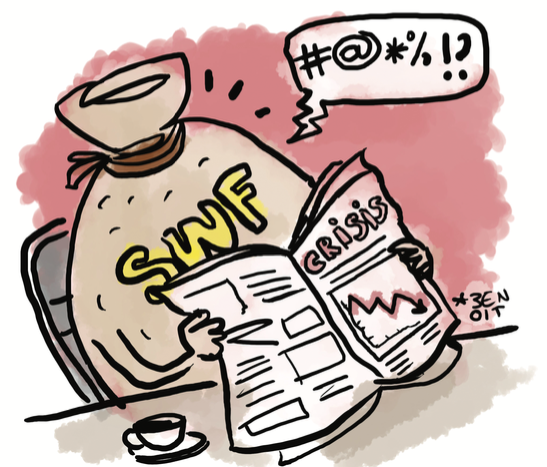
With family offices sitting this one out, the question on everyone’s minds is what will the regional PE industry’s other big slugger, the sovereign wealth funds (SWFs), role be in the current downturn? SWF investment has been largely focused on acquisitions in the Western financial sector, propelling them into the limelight. Over $14 billion were invested by regional SWFs in Western financial intuitions over the course of 2007, of which $7.5 billion (a 4.9 percent stake) was invested in Citigroup by ADIA, Abu Dhabi’s SWF, valued at more than $850 billion. Not to be outdone, the Kuwait Investment Authority, Kuwait’s SWF valued at approximately $250 billion, invested $10 billion in Western financial institutions, including a $3 billion investment in Citigroup and a $2 billion investment in Merrill Lynch. Also in 2008, the Qatar Investment Authority, valued at around $50 billion, invested a further $5 billion in Barclays. According to Thomson Financial, SWF acquisitions in January 2008 accounted for 28 percent of the total merger and acquisition activity in the United States.
The valuations of Gulf SWFs should be regarded as the educated guesses of outsiders rather than firm numbers from accountants inside the institutions.

Indeed, it is the opacity inherent in most aspects of SWFs operations that has been difficult for Western markets to accept. Almost immediately after the SWF investments listed above, commentators and governments began to demand that SWFs more clearly explain their intentions to the world. The hysteria, however, turned out to be short lived when the value of the stocks that the SWFs invested in — namely Citi and Merrill — plummeted and it became evident that the SWFs had bit off more than they could chew.

“These guys [SWFs] are even more traumatized than family offices because they did some very high profile deals and one of the downsides of doing high profile deals is that people keep talking to you about them if they go sour,” says Al-Khudairy. “High profile deals are a double edged sword. I don’t think anyone is going to forget the hosing they took on some of these assets.”
Without a doubt, SWFs will now have to take stock of their losses to figure out the next step. Last month Hussain Al Abdullah, executive director of the QIA, told reporters in Dubai that the fund had lost less than 20 percent of its value in 2008 and that it has decided to suspend buying activity for a total of six months. Many of the other SWFs are also expected to follow suit even though, not surprisingly, they have not advertised it yet.

“In the short term the damage has been so great that [SWFs] want to sit down and take a breather; they are really not thinking of going to their investment committees with anything right now,” explains Al Khudairy.

Whether it’s six months or longer, the region’s SWFs will eventually have to start investing again.

“There is a lot of soul searching going on in the SWFs and many are asking themselves what asset classes they should be investing in,” says Jurgen Heppe, managing director of direct investment at Istithmar World. Once they are done looking in the mirror, the overarching sense is that the SWF petrodollar will begin to look inwards. Western markets are expected to take much longer to recover and they have proven themselves not to be the financial havens of investment they were once heralded to be.

However, for the time being the SWFs are not widely expected to be the silver bullet that will pull the regional PE industry out of its slump, simply because regional governments have other short-term priorities.

“The added impetus for SWFs to invest in PE in the region is the imperative of their host governments to support regional projects and businesses that are close to home, which will help sustain economic productivity in the short term,” says James Tanner, head of placement and relationship management at Investcorp.

Thus there is room for positive developments at the region’s PE firms. “There is likely to be increased pressure on [SWFs] from the rulers to look inwards and to at least make some investment within the region in terms of PE type investments,” says Hall. Others in the industry are even more optimistic about the paradigm shift in the investment outlook for regional SWFs.

“In the medium to long term there is going to be a significant upturn in the amount of money SWFs will be investing within the region,” says Al-Khudairy. “It’s going to be a boom for sure.”

Before PE firms start to queue up at the doors of the region’s SWFs, they would do well to consider the change in focus of sovereign capital and macroeconomic trends. Having established that SWFs will now look to the region to place their vast pools of capital, and knowing that their investments are long term in nature, it is obvious which sectors will benefit.

“A number of sectors in the region have shown resilience and proved countercyclical, such as infrastructure, agriculture, healthcare, and to a certain extent FMCG and telecoms,” says Rami Bazzi, senior executive officer at Injazat Capital.

Heppe adds that “all of the defensive sectors look appealing, however, the reason they are defensive is because they are stable and hence they will not be beneficiaries of a cyclical upturn in the way that other sectors were. Secondly, returns in [defensive] sectors take a long time to mature and that is why the money went elsewhere previously — so they will benefit.”

Never the same again

Whether it’s family offices, SWFs or high net-worth individuals, the nature of institutional investment is undergoing a radical change. The age of short-term flipping is over and investors are looking for areas that will give them solid and reliable returns.

“We cannot assume that there is just a shortage of liquidity and it will pass then we will be back to business as usual when it comes to fundraising,” says Hisham El Khazindar, managing director and co-founder of Citadel Capital.

“Just as this crisis fundamentally affects hedge funds and investment banks it will also affect the PE industry and the way PE fundraises and operates.”
That change will manifest itself in a more sober market that looks more towards expertise than the haphazard investment we have seen in the past three years.

“The market here was growing so quickly and the economy seemed so robust and very few of the people who were raising funds around the region had any sort of track record to run on,” says Benjamin Newland, partner at King & Spalding. “Investors were not investing based on manager performance histories but based on the narrative, connections or the identity of other shareholders and the sponsor [sic].”

As investor’s attitudes change, PE firms must also adjust their pitches and tactics to meet the challenges and new realities of the market.


April 3, 2009 0 comments
0 FacebookTwitterPinterestEmail
Finance

Standard Chartered Bank, Qatar – Tom Aaker (Q&A)

by Executive Staff April 3, 2009
written by Executive Staff

With years of banking experience under his belt, Tom Aaker — chief executive officer of Standard Chartered Bank (SCB) Qatar and North Africa — has an expansive resume. Aaker joined SCB in 1993 and has held numerous senior positions around the globe, from Hong Kong to London, Zambia and the USA. Currently, Aaker is a board member of SCB Botswana, SCB Zimbabwe and Corpmed Medical Center. Executive recently conducted an exclusive interview with the bank’s top man, discussing the current banking situation in Qatar and around the region.

E What strategies will Qatar banks use in 2009? How will they differ from 2008?
Standard Chartered Group had an exceptional performance in 2008. Profits were up 19 percent from 2007 globally and that was up from the year before. We are one of the very few banks in the world that had significant earnings growth from 2007 to 2008 and the prospects for 2009 are very strong as well.
Our bank is in Asia, Africa and the Middle East and those are regions that have had some difficulties, but are nowhere near like the US and Europe. Our bank is typical of the performance in those regions; we don’t have the sub- prime mortgage problems and things that have really hurt banks in the West. So our performance last year was terrific. In Qatar specifically, we have record earnings, we don’t disclose our performance because we’re a branch of SCB in the UK, but I can tell you that our earnings, revenues and growth were record-breaking in 2008 in Qatar.
Our bank is very strongly capitalized and very liquid. Many banks in the world have taken capital injections through bailout packages or by taking capital from various strategic investors — we haven’t done that, we haven’t needed to, our capital base has been very strong. We did a rights issue last year, which was very successful and that was raising capital from existing shareholders.
Our loans-to-deposit ratios are far better than our competition, in Qatar and globally. We have more deposits than we have loans; so there are excess deposits that we generated sitting with the central bank and that gives us a huge advantage.

E What has SCB learned from the global financial crisis? Have these lessons
affected your global strategy?

I would say that probably the best way to describe our strategy in 2009 is to stay with what has worked in the past. We succeeded last year because we remained very true to our strategy, which was retail and corporate banking in Asia, Africa and the Middle East with a long-standing group of customers and with products that we knew well, that were time tested, and we had success. We’ll continue on with the same strategy; I don’t think there will be any departure to new markets or new products, I think it’s more of the same because it’s worked well.
In terms of lessons learned, our group CEO is always reminding us to identify what we call ‘loose rivets,’ and by that he means potential risk areas that if we get a little bit complacent, there could be an unpleasant surprise. He’s told all of us to be always on the look out for that loose rivet that could pop and [result in] an operational breakdown. So we’re being very careful on the operational side right now just to anticipate things that could go wrong. An example of that is liquidity. We know that’s a huge advantage in the global financial markets — to be liquid — so we’re being proactive, raising plenty of deposits so that we are more liquid than anyone else just in case [things] do get worse, [although] we’re anticipating… better. We’re sticking to what we know. In these times it’s not wise to be doing anything too new or experimental when the marketplace is so unpredictable.

E What are the top issues and concerns that banks in the MENA region will be
facing in 2009?

I think there is still a risk that we’ll see bad loans and a lot more provisioning by banks in this region. You’re seeing it happen in record amounts in the West and to some degree we’re starting to see it in the MENA. Some of the UAE banks are now starting to write-off massive amounts of loans to real estate developers and some of the consumers who were employed in those sectors… I think that’s one of the risk areas that we need to be very cautious of this year: credit quality and which banks have strong asset portfolios and which don’t. The ones that don’t are going to be writing-off large amounts of bad loans this year.
Fortunately I believe our quality is very good, not only here in Qatar but around the MENA region because we have very strict credit criteria. In Qatar for example, we don’t even make mortgage loans… we’re not in real estate. That’s one of the areas that I think is the most risky. Those banks that have made mortgage loans to build office towers, they could find difficulties this year… but we’re not in that sector, so I’m not as worried for us, but for the region’s banking sector… I think bad loans, write-offs and provisions are going to be a theme this year.

E There has been a significant decrease in demand in the Qatari property market. How has this affected banking operations in the country?
It hasn’t affected our operations. You hear that real estate prices are down 20 percent, 30 percent… I don’t think it will be anywhere near as severe as the situation in Dubai. There is not a surplus of properties [in Qatar]. The leadership of this country has been visionary to make sure that the build-up of real estate has been at a measured pace and the economy here is not built on real estate, it’s built on infrastructure, natural gas, health care, education, etc… It’s a very diverse economy, and it’s one that I believe has been very well planned.
Even if there is a dip in real estate prices, I don’t think there is going to be a crash like other markets. But even that dip might prove painful for certain banks because they were very exposed and had made some very aggressive loans.

E How would you describe the liquidity situation in the Qatari banking sector?
It’s hard to tell because any data that you get is a couple of months old by the time you see it. One of the situations that was difficult in Qatar last year was the inflow of foreign money in anticipation of the peg being revalued. A lot of speculators around the world thought the riyal was undervalued and should be stronger; there were no exchange controls, no problems moving money in, so a lot of investors would bring dollars into Qatar, buy riyals, sit on those riyals and hope there would be a revaluation… then they could re-buy their dollars back cheaper and take them out.
This time last year, there was this huge amount of riyal liquidity, this hot money that had come in from speculators… What happened last summer when these speculators had gotten in trouble somewhere else and realized they were done with that trade, they bought their dollars back and took them out of the country to use them somewhere else. There was this exit of a lot of liquidity from the system. It all pulled out at pretty much the same time.
All those banks that were sitting on those deposits saw them disappear. In the fourth quarter, a lot of banks in this market were scrambling around trying to get new deposits so they could present good numbers by December 31 to comply with central bank rules. So you saw a scramble at the end of the year and what happened is that banks were willing to pay a lot more for deposits. In this market the rates went up as high as seven or eight percent. Customers were able to pick and choose and move their money around and earn very nice deposit rates. At the end of the year, there was a liquidity issue going on in the sector.

E In a recent report, ratings agency Moody’s forecasted a negative outlook for the Qatari banking sector, reflecting expectations of deteriorating operating conditions. What is your take on the banking sector’s outlook in the next 12 to 18 months?
I think first of all, the ratings generally feel like they were way behind the curve in the last year when there was deterioration in banks and ratings agencies didn’t anticipate it very well. Bad things happened before they had negative outlooks and downgrades. So I think now and for years to come, rating agencies are going to be much more pessimistic and are going to try and anticipate bad things much sooner.
On the other hand, there is still a lot of unknowns in Qatar in terms of the quality of assets. Time will tell whether some of the banks in the sector have lent too aggressively in the real estate sector, personal loans, credit cards, etc. There could be some banks that will really suffer from big write-offs this year and I imagine that some of the ratings agencies are just anticipating that that’s a possibility and saying that the outlook is just not as good as it was.
In terms of economic growth for Qatar, we as an institution are very optimistic — we forecast that the GDP growth will be 16.5 percent, nominal growth… then if you take out our forecast of inflation of about eight percent, you’re left with about 8.5 percent of real growth. That’s very strong growth! If the economy grows at that rate, then I think the banking sector and the whole country will still do pretty well. We see Qatar as booming right ahead, especially with the natural gas reserves that they will continue to sell.

April 3, 2009 0 comments
0 FacebookTwitterPinterestEmail
GCC

Private equity – Bigger, fewer, more focused

by Executive Staff April 3, 2009
written by Executive Staff


Predicating the future has never been an easy task and it has gotten no easier today. Charlatans with crystal balls are in ample supply however, especially when it comes to the lifeblood of the region. Last year when the price of oil was at around $150 a barrel, Merrill Lynch was predicting that the price would reach anywhere between $180 to $200 a barrel. Last December their figure was around $25 per barrel. According to Business Monitor International (BMI) and OPEC, the 2009 average for oil prices will level out at around $50 a barrel. All of this ‘shooting in the dark’ leaves private equity (PE) firms — and everyone else for that matter — at a loss with regard to how much cash flow will be generated in the region in the near future.

Therefore, ignoring the predictions is probably the best way to go about handling the issue of oil prices. Nevertheless, “Oil will remain the backdrop on which we exist,” said Arif Naqvi, CEO of Abraaj Capital, while speaking on a panel at last month’s PE investment international conference in Dubai. “Everyone is happy with $60 to 80 per barrel,” he went on to say. While the intrepid CEO may be wrong about what everyone’s satisfaction levels are pertaining to the price of oil — even if the budgets of countries around the region are positioned well below the $50 a barrel mark — there can be little doubt that he is right in that without an ample supply of petrodollars, the PE industry’s prospects for growth are not promising.

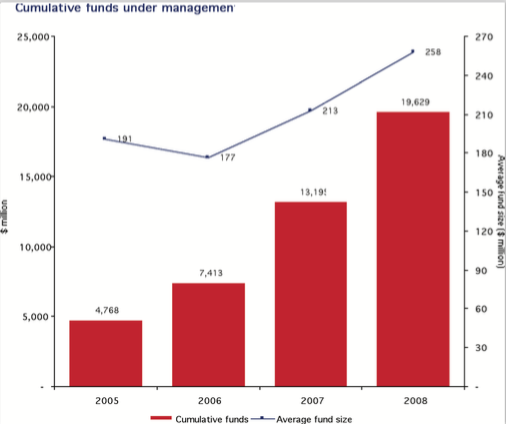
The average fund size in 2008 registered at around $258 million, up from around $177 million in 2006, according to research conducted by Zawya Private Equity Monitor (ZPEM) and the Gulf Venture Capital Association (GVCA).

Coming together

That said, there has been much debate within the industry regarding where future investment will be targeted and how the landscape of the industry will look.

“We expect this trend [of larger funds] to continue, with a smaller number of larger general partners leading the industry through its next phase of evolution,” wrote Vikas Papriwal, partner private equity and sovereign wealth funds at KPMG, in the annual GVCA Private Equity and Venture Capital in the Middle East report.

In support of the argument that larger and more diversified firms will rule the day, many observers point to the prospects of mergers and acquisitions between funds that seem to be in the pipeline.

“There are growing signs that a cooling market, tightening liquidity and rising borrowing costs could prompt a wave of consolidation in the region,” says James Tanner, head of Placement and Relationship Management.

Imad Ghandour, executive director of Gulf Capital, notes that “there has been an increase recently in funds buying from each other.”

On the surface things may look to be stagnant, but things are happening out of sight. “There are quite discrete asset sales and processes going on. Every week someone says, ‘officially we are not really selling, but unofficially here is what’s available,’” says Yahya Jalil, senior executive officer and head of private equity at The National Investor in Dubai. This may not seem surprising given that worldwide the value of companies PE firms are holding has decreased by around 50 percent, according to The Economist. Moreover, only half of the funds announced since 2006 have so far been raised and approximately $11.7 billion of announced funds in 2006 to 2008 have failed to make a close, according to ZPEM and the GVCA. Clearly the number of PE funds in the region will need to be consolidated greatly.

This new makeup of funds, however, does not necessarily predicate the fact that these consolidated funds will be attractive to investors, who are becoming more prudent and concerned with specialization as opposed to reputation.

“When investors begin to deploy money again it is going to be less to general funds that have generic purposes and more to specific opportunity funds. They will begin to ask the PE firms about the specific opportunities present where the firm wants to invest their money,” says Hisham El Khazindar, managing director and co-founder of Citadel Capital.

Ammar Al-Khudairy, managing director and CEO of Amwal Al Khaleej Investment Co., remarks that, “the asset accumulation firms are less in fashion than they were a year ago. The pure dedicated type of firms are more in fashion; this is the new paradigm without a doubt.” He adds that “institutional investors much prefer to deal with people who do nothing but PE. They are being much more selective and a larger size is not one of the selection criteria; they see it as a negative aspect.”

What will the future hold? The argument seems to be far from over, but given the two opposing forces in the market and the eventual equilibrium that will have to be met, in all likelihood “there will be a ‘happy medium’ and funds will not want to go over $10 billion,” concluded one senior PE executive.

April 3, 2009 0 comments
0 FacebookTwitterPinterestEmail
Finance

Qatar – A pearl of prudence

by Executive Staff April 3, 2009
written by Executive Staff

Watching their regional counterparts struggle to stay afloat, banks in Qatar are making very calculated and prudent moves this year. While the global financial turmoil has not hit the Qatari banking sector as hard as other GCC nations, bankers and analysts alike are expecting the ripple effect of the crisis to arrive sooner than later. Fortunately, most banks in the pearl of the Gulf did not invest heavily in structured products or toxic assets — as many other banks in the region did — which has helped Qatar avoid major a fallout in its small, yet robust, banking sector.

With a predicted real GDP growth of around 8.5 percent in 2009, today Qatar is one of the fastest growing economies in the world. As global markets face an indefinite period of recession, many investors are looking for financial safe havens. With its diverse and relatively peppy economy, Qatar hopes bankers and investors will continue to flock to the country and help it achieve financial supremacy over its oil-poor neighbors Bahrain and Dubai. With many multi-billion dollar projects spanning numerous industries in the works, the banking sector would be a major beneficiary of such developments. Unfortunately, due to the global economic slowdown, many of those projects are expected to be delayed or cancelled, leaving banks to feel the blow in their loan portfolios. But thanks to major diversification strategies, banks in Qatar are believed to be well protected against any aftershocks the global meltdown could send their way.

Sovereign serenity
Despite the inevitable slowdown in growth, with the affluent government standing behind its economy all sectors are expected to perform adequately this year. The resilience of the banking sector, according to Mohamed Damak, a rating specialist in financial services at Standard & Poor’s, is “above average,” which is “mainly due to the combination of lower exposure to structured investment products” and the proactive role taken by the Qatari government. For example, in the fourth quarter of 2008, the Qatar Investment Authority (QIA) announced its plans to acquire between 10 and 20 percent ownership in every local bank — of which there are 11 total — helping to increase confidence across the banking sector and to boost liquidity conditions in the market. More recently, at the end of March 2009, the government purchased $1.8 billion worth of local banks’ investment portfolios in order to share the burden of such funds, revive lending, boost liquidity and to support the economy.
While this latest act has been welcomed with open arms by banks across the country, Raj Madha, director of equity research at EFG-Hermes in Dubai, points out “the reality is this is essentially a free gift from the government. It does have the negative impact of encouraging risky behavior on the basis of relying on the government to act as a backstop. However, given the very unusual nature of the current global situation, it may seem reasonable to make an exception on this occasion.”
Still, Madha views this “start of greater intervention from the government” as “positive for valuations, underpinning that the government stands behind the [banking] sector in case of a blow up. Clearly,” he cautions, “this creates some moral hazard, but this is not really the market to be worrying about moral hazard and perverse incentives.”
Abdulbasit A. Al-Shaibei, chief executive officer of Qatar International Islamic Bank (QIIB), believes that this move “is a prudent strategy [by] the government of Qatar,” while calling the sovereign’s decision — unsurprisingly — “generous” toward local banks.
But, Madha highlights, one must not forget that “credit portfolios are still exposed” and the government’s purchase of investment portfolios “has no impact on loan provisioning.” As far as the central bank’s role is concerned, the majority of observers seem to be quite content with how well the institution is managing its banking sector.
Elena Panayiotou, an analyst at Moody’s Investors Service, trusts that Qatar Central Bank (QCB) “aims to exercise sufficient prudential control and supervision of the local banking sector and to harmonize Qatari banking regulations with international standards, as well as to address specific risk areas.”
Damak reiterates this sentiment, saying, “the [QCB] is hands-on with risk issues, meaning they are aware of the different risks and they tend to be proactive when dealing with risks.” In general, Damak — like Madha — sees the “interventionist” attitude of the government as a positive thing. In the event of an emergency, he believes, Qatari banks can expect to “see some kind of extraordinary support.”
Overall, there is no disagreement about the supportive role played by the Qatari government toward its banking sector. Yet, despite the copious sovereign support, “the main issue will be whether the government spending will take up the slack from slower growth in the private sector,” warns Madha.

Home is where the heart is
Before the international financial crisis began, banks around the world — Qatar included — were looking abroad. Whether it was for cross border investments, lending or general expansion, Qatari banks “were a bit aggressive in terms of going abroad,” notes Al-Shaibei. In 2009, he says, “Qatari banks will focus more on the local market [and] concentrate on strengthening their equity base.”
Over the past five years, contends Damak, banks have been “growing tremendously.” Qatar National Bank (QNB), Commercial Bank of Qatar (CBQ) and Doha Bank (DB) alone have witnessed a growth rate of 43.2 percent in 2008, Damak discloses.
Madha agrees, saying that last year “was all about growth and finding new areas to expand the balance sheet into. This year, growth is almost a bad word, with banks focusing primarily on profitability.”
Panayiotou emphasizes “a slowdown in the Qatari banks’ business growth, reflecting the current global economic environment, the tightened funding conditions both domestically and internationally, [as well as] the banks’ more risk-averse behavior.” Strategically, banks will have to “apply more prudent lending policies, particularly in the retail sector as consumer indebtedness in the country rises and as the risk element of the segment increases,” she adds. According to Moody’s data, Panayiotou explains, personal loans have one of the highest delinquency rates in the entire Qatari banking system.
Robert Thursfield, a director in the financial institutions group at Fitch Ratings in Dubai, chimes in saying that “lending growth is likely to be slower” this year in the Qatari banking sector.

Risky business
Due to the declining property market in Qatar, banks will indubitably be adopting a shrewder attitude towards developers and customers alike. Even though the Qatari property market conditions are not nearly as severe as those in Dubai, it is still a crucial concern for the banking sector. Mortgage lending will witness a significantly more conservative approach, insists Damak, as “the expected decline in property prices will have some manageable effects on the Qatari banking system… and the fact that some of the projects will be delayed or cancelled will translate into lower opportunities for growth going forward.”
Al-Shaibei admits, “Of course, we will get hit because of the drop in property prices.”
Panayiotou illustrates the deteriorating real estate situation in the country, saying “a further decrease in demand in the Qatari property market will lead to slower growth in the financing of the construction and the real estate sectors in the country.”
Luckily, Al-Shaibei insists, “everything will be manageable. [The real estate issue] is not going to get out of control.” All local banks are heavily dependent on government projects, so thankfully for them the sovereign’s damage control should be sufficient to deal with any property contractions. Bank growth is also expected to slow due to continued declining liquidity.
Liquidity in the Qatari banking sector is currently adequate, but like in every other economy around the world, it is expected to tighten significantly as the crisis unfolds. Experts unanimously agree that liquidity has been declining in the Qatari banking system lately. The extended and unknown period of global distress is, explains Panayiotou, “expected to lead to a tightening of the banks’ liquidity levels, particularly as funding conditions in Qatar and in international markets continue to be challenging.”
This year, banks in the country will be targeting lower growth than ever before in order to preserve liquidity in the long run and to achieve realistic profitability goals. In terms of balance sheet growth, Madha says, “Qatari banks are now reducing their expectations to low double digits, from the stratospheric levels we saw in 2006 through 2008. This will require some shift in mentality, with banks being much more selective about providing credit.”
Damak asserts that this year, “preserving liquidity and asset quality indicators” will be top priorities on the agendas of local banks.
Seeing as banks are prominently dependent on customer deposits, there is “[f]ierce competition in Qatar in attracting deposits, together with the challenging conditions in the inter-bank and wholesale markets, [which] is likely to put pressure on banks’ funding and liquidity levels going forward,” voices Panayiotou. The good news, she proclaims, is that Moody’s’ concerns “are partly mitigated by the government’s strong financial position and its significant and growing contribution to the Qatari banks’ funding base.”
Another risk, noted by both Panayiotou at Moody’s and Damak from Standard & Poor’s, is the banks exposures to the Doha Stock Market (DSM). Damak warns that Qatari banks will have “some exposure to the stock market and with this decline we will see some one-off effects on profitability if the stock market is not stabilized during the remaining quarters [of 2009].”

What to do
In order to avoid financial catastrophes, Qatari banks will have to act preemptively on a number of fronts. First and foremost, banks must maintain, if not boost, their current liquidity conditions in order to safeguard themselves from future crises in either global or local markets. Secondly, banks should be cautious with provisioning and balance sheet security. Damak stresses the need for calculated risk management, as the international operating environment is clearly not as favorable as it used to be. Also, he says, taking good care of credit and funding is important to banks’ success and protection in the current circumstances. Panayiotou draws attention to the banks’ “need to identify and finance clients that provide good returns with relatively low risk profile, while at the same time ensuring that they take early remedial actions in cases where delinquency rates of existing clients start to rise.”
Prudent moves and preventative measures are the safest best for Qatari banks in 2009. To date, Qatar’s banking sector has been able to avoid any major hits on its domestic front from the global financial crisis, but symptoms of the downturn are likely this year with anticipated slower growth and tightened liquidity conditions.

April 3, 2009 0 comments
0 FacebookTwitterPinterestEmail
GCC

Private equity – Where to scare up the cash

by Executive Staff April 3, 2009
written by Executive Staff


In times of crisis come times of great opportunity, or so we are told. The proverb does seem to bear some truth, however, when applied to the regional private equity (PE) market. Perhaps for too long, PE activity has been focused on a few hotspots in the Middle East and North Africa and has neglected many of untapped or fundamentally solid areas. Now there is little choice when it comes to being picky; firms need to go where the opportunities are rife and many countries in the region are taking advantage of the newfound openness towards expansionism that has taken hold of the industry.

The first country in the cross hairs seems to be Saudi Arabia. The usual criticisms of Saudi being a cumbersome and overly conservative market have turned out to be unfounded. Both Saudi Arabia’s central bank and its sovereign wealth fund (SWF) are coming out of this financial debacle much less scarred than most of their regional counterparts, but that’s not to say they have been unaffected.

“There will be an increased reliance on cash coming out of places such as Saudi… which are unlikely to be so badly affected by current market conditions,” says Robert Hall, head of transaction services Middle East & South Asia at KPMG. Others are more reserved in their analysis.

Ammar Al-Khudairy, managing director and CEO of Amwal Al Khaleej Investment Co, says “I would not point out Saudi Arabia as a bastion or a haven of still available money. It is a haven of less economic turmoil without a doubt. That does not, however, necessarily give investors more comfort than other markets vis-à-vis deployment or fresh commitment of capital.”

Flow like the Nile

Another country that looks to continue its upward trend despite the effects of the global downturn is Egypt. The land of the pharaohs has already attracted $2.8 billion in PE investments (33 percent of total MENA investments) since 2005 according to Zawya Private Equity Monitor and the Gulf Venture Capital Association. Even though this figure is largely attributed to Abraaj’s investments of $1.4 billion in the Egyptian Fertilizer’s Company (EFC) and a $501 million investment in EFG Hermes in 2006, Egypt is expected to continue to attract investment from PE firms desperate for buying opportunities.

“There is a positive outlook on the medium to long-term prospects of Egypt because of the demographics, reforms and the fact that Europe needs the southern Mediterranean basin as a manufacturing base because of environmental and cost of labor issues,” says Al Khudairy.

For the more risk-prone capitalist there is always Iraq which, despite its obvious shortcomings, cannot be written off when considering investment opportunities in the region.

“Obviously Iraq has its challenges, but PE is a local business and you need to be there early,” says Hisham El Khazindar, managing director and co-founder of Citadel Capital. In theory, the promise of post-conflict Iraq is monumental given its oil reserves, demographics and the amount of greenfields on offer for potential investors. However, other industry heavyweights would rather pay more when and if the political risks of Iraq ever do subside.

“Iraq still has significant geopolitical risks and we won’t know the full effect of these risks until the US winds down its occupation,” says a regional PE chief executive who spoke on condition of anonymity. “I would rather pay three times the amount [for a company] without a civil war than with one.”

Preservation is key

The regional PE sector is at a crossroads, or perhaps the more accurate term would be a U-turn. Gone are the days when investors lined up to throw money at PE firms. Today, what separates the wheat from the chaff will be cold hard cash.

“If you have already raised money then you will be OK, if you haven’t then you are in trouble,” says Imad Ghandour, executive director of Gulf Capital. That notion becomes even more reinforced when one considers that leveraging options have all but dried up for the immediate future.

“I do not see previous levels of leveraged investments restored in the foreseeable future, as the market will need to clear excess leverage,” says Rami Bazzi, senior executive officer at Injazat Capital. Al Khudairy adds that, “leveraging is gone for two or three years at least.”

As regional PE firms move forward, the key to surviving will be to take care of ones own and keep limited partners happy whether or not the bottom has been reached.

“The bottom may have been reached but it is important to remain disciplined and stay focused on your existing portfolio a little bit longer, to make sure it is in good form and weathering the storm before starting to get distracted by some of the great opportunities, even if it means you miss the bottom,” says El Khazindar.

The ride has been bumpy and it’s not over yet. What remains to be seen is whether regional PE firms will hold on for the ride or if they will be thrown to the wayside.

“We have had a rising tide that lifted all the boats and the industry never had to really roll up its sleeves and do the dirty work as portfolio companies,” says Yahya Jalil, senior executive officer and head of private equity at The National Investor in Dubai. “That time is now at hand.”

April 3, 2009 0 comments
0 FacebookTwitterPinterestEmail
GCC

The dollar’s exposure

by Executive Staff March 22, 2009
written by Executive Staff

“The dollar is our currency, but your problem,” quipped US Secretary of the Treasury, John Connolly, to his European counterparts in 1971. Today, nearly 40 years later, his words couldn’t ring truer. While the value of the US dollar weakened relative to the world’s other major currencies for most of the George W. Bush presidency, the slide became ever more precipitous in the first half of 2008. This helped spur inflation across the Middle East — where the value of many countries’ currencies are pegged to the greenback — as imports priced in euros, yens and anything other than dollars quickly became more expensive.

For states in the Gulf Cooperation Council (GCC), the equation was even more costly as the dipping dollar eroded the value of their trillions in accumulated dollar holdings. New revenues from oil receipts are also priced in dollars, and so even as the dollar price per barrel of oil reached record highs through the first half of 2008, the value of each dollar earned from oil was declining.

What was pushing the dollar down? The factors are numerous, complex and interrelated, but part of the answer is that America has been living well beyond its means and is thereby exposed to significant liabilities. Total US government debt surpassed $10 trillion in September 2008, helped along by the trillion dollar tax cuts early in Bush’s presidency and the hundreds of billions absorbed by military adventures in Iraq and Afghanistan. More generally, however, the American economy simply consumes more than it produces and has been doing so for a long time — in 2008 this imbalance amounted to $677 billion. The US has run an annual balance of payments deficit on current accounts of approximately six percent of GDP for most of the last decade, implying that for every $100 worth of goods and services produced, America consumes $106 worth. Where does the other six dollars come from? In essence, America has been borrowing money from the rest of the world.

If the Americans could have continued forever printing more dollars to send out into the world in exchange for the tangible products the rest of the world makes, they might not have had a problem. However, as total American debt lurched ever higher through the 2000s, moneylenders everywhere began to question America’s ability to pay this money back. These creeping doubts meant that US debt — effectively the dollars sent abroad — became less attractive to hold onto, thus contributing to the dollars declining value.

US dollar against major world currencies

Monthly average values

Welcome to the financial crisis

The grinding slow-down in the US economy through 2008 led the US Federal Reserve Bank to continually lower interest rates to try and encourage growth, with the January 2008 rate of 4.25 percent falling to 0.25 percent — effectively zero — by year’s end. Yet as the global financial crisis began to cascade and investors’ August of angst morphed into September’s sheer panic, capitalists grabbed their money and ran to where they always run when Armageddon seems nigh, the pocket of their champion, Uncle Sam.

“Despite the next to nothing yield offered by dollar denominated investments, a flight to safety into US dollars and government bonds has kept the US dollar from collapsing,” wrote Kathy Lien, director of currency research at FX360.com, in a December 2008 report. “The concern for safety was so high that investors were willing to take negative yields just to park their money with the US government.”

Thus, since August 2008 the dollar’s dive has U-turned — albeit, far from smoothly — riding demand for dollar-shelter and appreciating nearly 20 percent against the euro between July 2008 and February 2009. How can this be happening when there are so many good reasons to sell the dollar? The non-partisan Committee for a Responsible Budget estimated that the different bailouts and stimulus packages the US government has announced will total $2.6 trillion in new spending; Morgan Stanley predicts the 2009 US deficit at $1.5 trillion, or some 10 percent of GDP. While some of this new spending will be paid for through new borrowing, the rest of the money will be created, in essence, out of thin air.

“The Federal Reserve is basically printing money and using that money to flood the market with liquidity, eroding the value of the US dollar in the process,” noted Lien. “The central bank will not be worried about a weaker currency and will in fact welcome one because they know that a weaker currency is like an interest rate cut in many ways because it helps to support and stimulate the economy.”

Foreign exchange traders are a cynical lot. More than one has noticed the long-term benefits to America in driving the dollar down. Effectively, it allows the US to renege on a portion of its foreign debt, as US debt is denominated in dollars. If, for example, an American borrowed $100 worth of euros and used them to purchase goods in July 2007, they would have been able to buy 73 euros worth of stuff. If they repaid the $100 a year later in July 2008, after the US dollar had declined in value, it would only have bought 64 euros worth of stuff, meaning whoever lent America that money is getting short changed.     

As well, American workers need jobs and American politicians lose theirs when unemployment remains high. A high value for the dollar means that foreign imports into the US are continually displacing American producers, while a low dollar produces a surge in exports and creates jobs for middle class Americans, thereby preserving political careers.

“The G.C.C. states are locked into the dollar and the fate of the dollar is their fate as well”

The Chinese checker

While many countries worry about dollar devaluation, few have more to lose than China, by far America’s largest lender with a staggering $1.95 trillion in its foreign exchange reserves. The US has been able to run such a large balance of trade deficit for so long in large part because China has, essentially, been recycling its trade surplus — which was $262 billion in 2008 — back into buying US treasury bonds, supporting the dollar’s value, keeping US interest rates low and lending America back the money to buy more Chinese goods. Daniel Sternoff, director of emerging markets and energy research at Medley Global Advisors (MGA), explains that China’s trade surplus will shrink if China’s exports fall as the world economy weakens, or if China’s own $580 billion economic stimulus package to bolster domestic demand successfully props up its economy, keeping imports “at a relatively decent level.” These possible scenarios make it uncertain whether China will continue to have sufficient trade surpluses in 2009 to recycle back into the US treasury market to prop up the dollar.

“And that’s just a question of what’s the overall supply of dollars they have to be purchasing more,” says Sternoff. “Whether they will begin to sell their reserves outright is more of a political question, and we have received some indications that they are going to be spending at least $300 billion of their foreign exchange reserves.” 

A nightmare scenario for the US and the global economy at large would be if China began dumping its US reserves. This would flood currency markets with dollars, causing their value to drop, in turn evaporating the value of US dollar savings held by countries, companies and people the world over and writing off the US as the globe’s largest export market. Beijing has “serious worries over the potential for much greater dollar weakness and the erosion of the value of their holdings,” and has been looking for ways to try and diversify its reserve holdings, Sternoff points out. Yet he adds that the Chinese also “have a very strong vested interest in the stability of the global financial system and in the stability of the US economy… They’re not about to start currency wars with the US by shooting themselves in the foot by selling their bond holdings.” A second nightmare scenario is that the vast overhang of dollars in portfolios around the world has grown to a magnitude that may be beyond the control of any single group of players — and that when everyone is worrying about currency depreciation, it may only take a small event to spark a stampede for the exits.

GCC’s dollar marriage

The fabric of Gulf economies has been intertwined with the dollar since the 1970s arrangement with the Organization of Petroleum Exporting Countries (OPEC) to have oil sales priced exclusively in dollars. With five out of the six GCC currencies currently pegged to the dollar, Kevin Muehring, a financial journalist specializing in macro economics and monetary policy, remarks that, “for better or for worse, the GCC states are locked into the dollar and the fate of the dollar is their fate as well.” The Gulf’s banking systems are structured around the dollar, the banks, the government and the private sector all hold huge proportions of their assets in dollars and, most importantly, “oil is priced in dollars and therefore most of their revenues, before they are converted into their domestic currencies through government spending, are in dollars,” says Muehring.

However, one need only look to Iran to see that a dollar divorce is, although long and unpleasant, possible. In 2003, the world’s fourth largest oil producer began large-scale movement of its foreign-held assets out of dollars and as American financial sanctions continued to press on the exposed parts of the Persian purse, Tehran announced in April 2008 that it was no longer taking dollars in exchange for its oil.

“We agreed with all the buyers of Iran’s crude to trade oil in currencies other than the dollar,” said Hojjatollah Ghanimifard, international affairs director of the National Iranian Oil Company, to the Fars News Agency. “In Europe, Iran’s crude is being sold in euro, in Asia in euro and yen.”

Kuwait also caused ripples through the Gulf when it became the first GCC country to break ranks and de-peg from the dollar in May 2007, instead locking its dinar into an exchange rate mechanism based on a ‘currency basket’, including the dollar, the euro, the pound and the yen.

“The massive decline in the dollar’s exchange rate against main currencies… has contributed to the increase in local inflation rates and this step is part of the central bank’s efforts to curb inflationary pressure,” said Sheikh Salem Abdul-Aziz al-Sabah at the time.

Inflation due to dollar devaluation had other GCC states openly speculating through the first half of 2008 that they might also de-peg their currencies, “but now, this discussion is not happening,” remarks Sven Behrendt, associate scholar at the Carnegie Middle East Center in Beirut. In recent years Gulf states have funnelled much of their surplus oil revenues into sovereign wealth funds (SWFs) to reinvest, with the Council on Foreign Relations estimating the Gulf SWFs’ 2007 external portfolio at $1.3 trillion. However, the global financial storm has pummeled Gulf SWF holdings, with the Abu Dhabi Investment Authority alone estimated to have lost some $140 billion through 2008.

“They shifted a lot into equity, and with that came a higher risk exposure to their portfolios,” says Behrendt. “Now they’ve burned — quite substantially — their fingers in some of their investments.”

Given the lack of transparency with which the SWFs operate, accurate fiscal assessments are difficult, but what is clear, says Behrendt, is that they have been burned with heavy losses and are now among those sheltering their bundles of cash in US treasury bonds, in turn helping to keep the dollar high.

Should a viable alternative to the dollar reveal itself to investors, support for the dollar will collapse

Forever a dollar world?

Everybody uses US dollars because everybody else accepts them, but this was not always the case. Historically, the pound was the world’s general medium of exchange and the invoice currency of much of international trade. In the 1960s, however, major weaknesses in Britain’s economy forced London to de-value the domestic currency and the sterling lost its international shine, making way for the assent of global dollar hegemony. Today, with the US economy plummeting and the greenback baring an ever-growing debt, is the dollar’s reign near its end?

Muehring, the financial journalist, acknowledges the dollar will experience massive downward pressure in 2009, but “the offsetting pressures will be the lack of currency alternatives as the underlying economies of both the euro and the yen are in worse shape than the US.”

This was highlighted last month when German Finance Minister Peer Steinbrueck stated that a number of the 16 euro zone countries were “getting into trouble” and may need help — read ‘financial bailout’ — from the euro’s two biggest economies, Germany and France. Bloomberg reported European countries have committed more than $1.5 trillion to “save their banking systems from collapse,” and a number of countries are now staggering under the debt-load. The cost of insuring the debt of Ireland, Greece and Spain against default is at an all-time high. As well, Austria’s exposure to banks in eastern Europe has Vienna pleading with the EU for help, as the country “is on the hook for so much money that essentially if they don’t get paid by eastern Europe they’ll go bust,” said Marc Faber, managing director of Marc Faber Ltd., to Bloomberg. 

And so as the global financial crisis pushes counties and economies to the cliff’s edge, investors continue to huddle under the dollar for lack of anywhere else to hide. But the foundations of the dollar’s dominance are cracking and should a viable alternative reveal itself to lure investors away, support for the dollar will collapse.

March 22, 2009 0 comments
0 FacebookTwitterPinterestEmail
Levant

Politics over pragmatism

by Peter Grimsditch March 22, 2009
written by Peter Grimsditch

If the International Monetary Fund (IMF) were putting up candidates in this month’s municipal elections in Turkey, the best advice would be for them to withdraw before being trounced. On one side, the ruling Justice and Development Party, or AKP, is spending lavishly on certain local authorities while holding off on raising tax revenues. Those killjoys from the IMF have been campaigning for months for Prime Minister Recep Tayyip Erdogan to do exactly the opposite. If Turkey wants a new standby loan to see it through the tough times of 2009, say the men with built-in calculators, it needs to be less profligate.

A “deal” has been on the cards allegedly since last November and even in February Erdogan claimed the talks were progressing well despite a “last minute hitch” when the IMF was said to have injected some “unacceptable conditions.” A team from the Fund spent most of January in Turkey seeking to hammer out a deal before suspending the talks. Smart money (and certainly not the IMF’s) is going on a forecast that no agreement will be reached before the elections on March 29. A plummeting currency and rising unemployment are making life difficult for the Turks as it is, without the possibility of cutting public spending and improving tax collection.

The indication of economic performance afforded by early 2009 numbers make for grim reading. Officially the government’s policy is still to aim for four percent growth this year, a number it has been adhering to despite advice from the IMF and others that it was not only unattainable, but ruinous. In January, the budget deficit rose by 466 percent year-on-year to $1.65 billion, overall revenues limped up a mere 0.3 percent, tax revenues fell by 2.4 percent and spending shot up 15.3 percent. In face of the inevitable, some economists are now predicting that a two percent drop in GDP this year is far more likely than growth of any size.

Greasing democracy’s palm

While the IMF is talking of belt-tightening and even said to be suggesting a tax on pensions to help fund the social security system, AKP local authorities are distributing free food, washing up liquid and, reportedly, fridges and cookers, a tactic reminiscent of the Lebanese parliamentary elections of 2000.

In Ankara, the AKP-controlled metropolitan municipality awarded $64 million in local tenders in the first six weeks of 2009. The equivalent 2008 figure for the whole of January and February was $12 million. One tender this year for $26.6 million to buy washing up liquid, soap, detergent, beans, rice, jam, vegetable oil, pasta and cheese was won by Orpas Gida, with a note on the tender saying the products were to be delivered to locations specified by the head of the municipality’s social services department. In 2008 the exercise cost $1.4 million. The voters also know the temporary rules of the election game, with reports from throughout the country of the owners of illegally constructed buildings (of which there are many) using the campaign period to add another floor, reasoning that no local authority of sense would raise objections just ahead of polling day.

Meanwhile, more conventional ways of trying to stimulate the economy, which at any other time would have appeared sound suggestions, look increasingly hollow these days. New measures announced in February allow investors up to a 75 percent reduction in corporate tax for five years if they create at least 100 jobs and move textile plants to the eastern or south-eastern parts of the country before 2010. To help the car industry, the government is urging drivers to scrap their old vehicles to buy new ones. The central bank cut its benchmark interest rate by 1.5 percent to try to encourage business to borrow and grow. In practice, one of few expansion areas is the number of unemployed, with a rise of more than two percentage points in the last quarter of 2008 to 12.3 percent.

All of this depressing statistical news makes the more lurid politics of the mayoral race in Kecioren almost a welcome diversion. The AKP incumbent Turgut Altmok has pulled out of the election after photos were handed to the party leadership of him and a woman with whom it was claimed he was having an affair. The real problem appears to have been less his alleged dalliance than the fact that he refused to accept influence from the mayor of the neighboring Ankara Municipality about who should be on the AKP ticket.

March is going to be an interesting month.

Peter Grimsditch is Executive’s Turkey correspondent

March 22, 2009 0 comments
0 FacebookTwitterPinterestEmail
Levant

Aid work on a shoestring

by Executive Staff March 22, 2009
written by Executive Staff

“Give me the money that has been spent in war and I will clothe every man, woman, and child in an attire of which kings and queens will be proud,” said 19th century US senator and anti-slave leader Charles Sumner in reference to the US Civil War. His words have lost no salience since. The war in Iraq, for instance, has cost US tax payers at least $3 trillion according to research conducted by the former chief economist at the World Bank, Joseph E. Stiglitz. That’s enough money to put a lot of shirts on a lot of backs.

In Lebanon, war has become somewhat of a national sport pitting the interests of regional and global players against each other in a seemingly endless saga of death and destruction. Indeed, the latest episode of Lebanon’s war saga that took place in 2006 between Israel and Hizbullah proved no different, leaving dead around 1,200 Lebanese dead — mostly civilians — and 160 Israelis, mostly soldiers. Human suffering aside, Lebanon’s Council for Development and Reconstruction (CDR) estimated that the total material cost of the war stood at $3.6 billion.

Lebanon’s many needy

What was unique about the 2006 conflict, however, was the speed and magnitude of international humanitarian assistance in the form of funding that poured into Lebanon upon the cessation of hostilities.  A host of non-governmental organizations (NGOs) have since moved in to provide the humanitarian relief and development assistance needed for the country to recover from the conflict. Furthermore, the Nahr el Bared conflict in 2007 between the Lebanese army and the Fatah al-Islam militant organization kept the focus on Lebanon in terms of funding for humanitarian assistance. The Italian Government alone has committed over $217 million towards emergency relief and infrastructure in Lebanon since the 2006 war.

Today, however, Lebanon enjoys relative political stability, with Merril Lynch estimating 2009 growth at 2.7 percent, while most of the countries that have pledged money towards humanitarian efforts in the country are contracting. “The global financial crisis has affected humanitarian work around the globe. Countries worldwide have to make reductions and external elements are an obvious selection,” says Christina Bennike, Lebanon country program manager at the Mines Advisory Group (MAG), a British mine clearance organization.

Additionally, the transient nature of humanitarian work entails a specific work model that comes in three stages: the emergency phase (during and directly after a conflict or natural disaster), the post-war construction and capacity building phase and, finally, the development phase characterized by long, drawn out funding cycles. This natural progression also brings with it funding constraints that complicate the budgets of humanitarian organizations operating in Lebanon.

“Funding for projects during the crisis period could typically be expedited in around three months as opposed to the time it takes today which can be up to a year,” says Wolfgang Hager, EU senior policy adviser to the Lebanese Government. “Projects are now moving into more of a maintenance phase.”

As such, most revenue streams flowing into Lebanon for emergency and construction phases are expected to dry up by the end of this year. “The final phase of financing for our emergency program will [go from] 2009 until 2010 and I don’t think we continue with financing after that,” says Fabio Melloni, director of the Italian development cooperation office, the humanitarian and development arm of the Italian government.

“Usually when you have a crisis situation in any country you have a lot of international NGOs and donors that will come in and give a lot of money to handle emergency relief issues and then all of a sudden they leave,” adds Ghassan Makarem, editor and media coordinator at Lebanon Support, an organization that coordinates humanitarian efforts in Lebanon. “People already got their money for the first part of 2009. The problems will start when they apply for funding for 2010 or late 2009.”

Time to tighten the belt

As the cash flow of large donors becomes increasingly restricted, humanitarian relief organizations and some NGOs are feeling the crunch.

“This year we are getting half the budget we received last year, for projects of a similar nature [sic],” said a senior director of a European NGO, speaking on condition of anonymity.

Sarah Shouman, country director at Search for Common Ground, says “there is definitely going to be an effect on NGO funding and donors will be a lot more stringent on their regulations as to how they give out funding. Everyone is going to feel that and be taken aback.”

On some levels the lack of funding has already begun to materialize through the scaling down of projects essential to the well-being and development of the Lebanese population. Two of the seven international mine clearing organizations in the country have already shut down due to a lack of funding and it seems likely others will follow.

“Last year we had 22 [mine clearing] teams; at the beginning of this year we had 18 and now we are down to 15. We stand to loose more than half of our teams,” says Bennike. “The more we reduce teams the less likely there will be a handover of land, which is going to impede economic recovery, the construction of villages and homes as well as increase civilian casualties.”

As if that wasn’t enough, another natural element of the humanitarian sector is to move with the tide of wars and natural disasters. “Unfortunately, with the NGO game wherever the need is; you have to rush there,” says Shouman. Ergo, the recent Israeli onslaught on Gaza is expected to deplete the already skeletal coffers of large donors like the EU and the US. To some extent this transference of priorities has already begun to materialize. On February 18, the EU announced in a joint statement that it will grant the UN agency for Palestinian refugees (UNRWA) a further $51 million to meet humanitarian needs in the Gaza Strip.

Naturally, the combination of these factors has begun to affect Lebanon’s real economy as many people who were employed in these organizations are either on the verge of being unemployed or have already been handed a pink slip.

“The [number of] jobs will drop with the money,” explains Makarem. “There have been situations where all of a sudden you have all of the men in a village… unemployed.” Also complementary businesses stand to suffer once their cash cows leave Lebanon for greener pastures. “It’s over for the suppliers and some of them know it, but there is nothing they can do about it,” adds Makarem.

All in all, it looks like the party is over for the humanitarian sector in Lebanon. Most of what’s left to do inside the country will either be completed by the end of this year or pan out across several years and funding cycles before eventually being handed over to local partners and the Lebanese government. What remains to be seen is whether Lebanon’s government and civil society can shed their sectarian pretensions, step up to the plate and help themselves instead of having others do it for them.

Israel’s recent gaza onslaught is expected to deplete the coffers of donors like the U.S and E.U.

March 22, 2009 0 comments
0 FacebookTwitterPinterestEmail
  • 1
  • …
  • 476
  • 477
  • 478
  • 479
  • 480
  • …
  • 685

Latest Cover

About us

Since its first edition emerged on the newsstands in 1999, Executive Magazine has been dedicated to providing its readers with the most up-to-date local and regional business news. Executive is a monthly business magazine that offers readers in-depth analyses on the Lebanese world of commerce, covering all the major sectors – from banking, finance, and insurance to technology, tourism, hospitality, media, and retail.

  • Donate
  • Our Purpose
  • Contact Us

Sign up for our newsletter

[contact-form-7 id=”27812″ title=”FooterSubscription”]

  • Facebook
  • Twitter
  • Instagram
  • Linkedin
  • Youtube
Executive Magazine
  • ISSUES
    • Current Issue
    • Past issues
  • BUSINESS
  • ECONOMICS & POLICY
  • OPINION
  • SPECIAL REPORTS
  • EXECUTIVE TALKS
  • MOVEMENTS
    • Change the image
    • Cannes lions
    • Transparency & accountability
    • ECONOMIC ROADMAP
    • Say No to Corruption
    • The Lebanon media development initiative
    • LPSN Policy Asks
    • Advocating the preservation of deposits
  • JOIN US
    • Join our movement
    • Attend our events
    • Receive updates
    • Connect with us
  • DONATE