• Donate
  • Our Purpose
  • Contact Us
Executive Magazine
  • ISSUES
    • Current Issue
    • Past issues
  • BUSINESS
  • ECONOMICS & POLICY
  • OPINION
  • SPECIAL REPORTS
  • EXECUTIVE TALKS
  • MOVEMENTS
    • Change the image
    • Cannes lions
    • Transparency & accountability
    • ECONOMIC ROADMAP
    • Say No to Corruption
    • The Lebanon media development initiative
    • LPSN Policy Asks
    • Advocating the preservation of deposits
  • JOIN US
    • Join our movement
    • Attend our events
    • Receive updates
    • Connect with us
  • DONATE
Lebanon

Development – Raising a new bourj

by Executive Staff September 3, 2008
written by Executive Staff

Beirut seems in a building frenzy, and Bourj Hammoud, a suburb east of the city on the other side of the Beirut River, is no exception. Parallel to the highway in an area known as Sandjak, the municipality is to construct three residential-commercial towers, a multi-story parking and a public garden. The project has generally been well received as a sound attempt to upgrade the area and improve access to Bourj Hammoud. The remaining inhabitants however, await eviction and an uncertain future. They complain that the compensation by the municipality is not sufficient.

With an estimated cost of $20 million, the Sandjak project is an initiative from the municipality, which is quite a rarity in Lebanon. The local authorities bought the land from its Lebanese owners for some $2 million and are currently in the process of securing loans. The two-and- three-room apartments of up to 120 square meters, however, will not be available for just anyone.
“Bourj Hammoud is saturated,” said Raffi Kok Oghlanian, project manager at Sayfco Holding and deputy mayor of Bourj Hammoud. “A lot of young people are leaving. One of the goals of this project is to offer affordable housing to the newly-wed and young people born in Bourj Hammoud.”
When completed, the project is to significantly change the face of Bourj Hammoud, offering direct access from the highway, as well as ample parking facilities. This to great relief for Bourj Hammoud’s thousands of shopkeepers, as the area today is only accessible from two narrow entry points and suffers from endless traffic jams and a chronic lack of parking.
As always, however, progress comes at a price. While half of the Sandjak area has already been demolished, the other half is still standing, yet awaits a similar fate. The some 100 families still living there await a notification to leave, which is likely to arrive between 6 and 12 months from now. “I was born here 43 years ago,” said the owner of a small supermarket. “I now live in Antelias, but my parents are still here. Where can they go? The municipality gave us $13,000. The house next to us got $5,000. What can you do with that? ”

The good of the many
Oghlanian said he understands people’s grievances, yet added that the problem of a few cannot stand in the way of a project that benefits the whole community. What’s more, according to him, the municipality has done everything to soften the suffering of current and former inhabitants. “We asked the Lebanese court to look into the dossier and formulate a recommendation regarding compensation, according to which we paid everyone up to $15,000,” he said.
To understand the specific difficulties related to the Sandjak Project, within the wider context of urban development in densely populated Bourj Hammoud, it is necessary to have a brief look at the area’s history. Situated on the eastern bank of the now nearly waterless Beirut River, Bourj Hammoud is one of Beirut’s most distinctive areas, for several reasons.
Although having become more and more mixed in recent years, the quarter is still predominantly Armenian. The area was only developed from the 1920s onward when survivors of the Armenian Genocide (1915-1918) arrived in Beirut. Until then, it had been an area of fields and agricultural land dotted with farms. In fact, Bourj Hammoud is named after the only two-storey house that existed at the time, which happened to be owned by the Hammoud family.
The first development centered around four clusters: Marash, Cis, Adana and Sarkis. Apart from the latter, they were named after cities in what is today eastern Turkey, yet what Armenians refer to as “historical Armenia.” Gradually, as wood made way for concrete, the former refugee camp became an integral part of the Lebanese capital. In fact, with some 150,000 inhabitants cramped together on an area of some 2.4 square kilometers, Bourj Hammoud ranks among the most densely populated areas in Lebanon and the region.
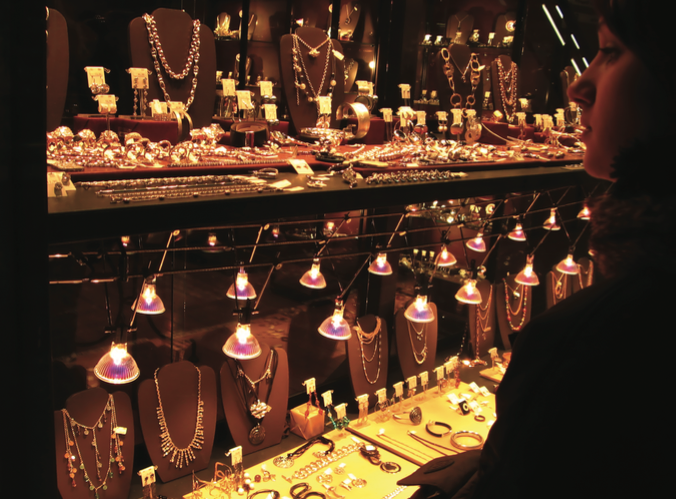
Bourj Hammoud has also become one of Greater Beirut’s most popular shopping districts. The area offers a true high street, mainly catering for a middle class clientele. In addition, it is famous for its many jewelers, watch makers and goldsmiths. Finally, it is quite an industrious area as well. Inside the labyrinth of little alleyways, there are hundreds of textile, shoe and metal workshops, while heavier industry is located on the seashore.
“The first urban development in Bourj Hammoud took place on land donated to the Armenian community,” Oghlanian explained. “The land was divided in smaller plots, on which people constructed their homes. Later on, the municipality bought land and allowed people to construct their homes. They own their homes, yet can only sell with permission of the municipality. The third form of urban development was technically illegal. People constructed their home on land that was not theirs. Such was predominantly the case in Sandjak.”
One should know that Sandjak was not just any area within Bourj Hammoud. It had a bad reputation. “Even the police would not dare go inside,” one shopkeeper said. Others claimed it was a hotbed for criminality. Yet, despite the occasional “mafia” graffiti on some of the walls still standing in Sandjak, one hardly feels unsafe when walking around. Regardless of its reputation being true or not, the fact is that Sandjak was one of the quarter’s poorest areas.

Local demographics
“There were essentially three groups of people living in Sandjak,” Oghlanian explained. “First of all, there were a number of foreign workers who in recent years had rented rooms. Second, there were people who had been renting from the original Armenian owners for a very long time. And third, there were the people who constructed the houses and still lived there.”
The first group was given notice to leave and look for alternative lodging. The second group was paid between $2,000 and $5,000, while the third group received between $5,000 and $15,000. That may not seem a lot, and has to do with the fact that most of the dwellings were constructed illegally in the first place.
“The Lebanese owners of the land were more than happy to sell, as it was quite impossible for them to remove the inhabitants,” Oghlanian explained. “Now, we could have gone to court and just thrown them off the land. However, that would be rather inhumane and cause a major upset within the community. Hence, we asked the Lebanese court for a recommendation and paid compensation.”
The Sandjak project is part of a wider initiative by the municipality to upgrade Bourj Hammoud. “The government has long considered Bourj Hammoud as the backyard of the capital,” said Oghlanian. “Every time it planned a sewage treatment plant or factory, Bourj Hammoud was proposed. We, as a municipality, have worked very hard to change that perception. Bourj Hammud is a not only a residential, but also a very productive commercial and industrial area.”
Over the past decade, the face of Bourj Hammoud has indeed changed. The municipality invested significantly in a beautification campaign. Streets and pavements were widened, trees planted, public lightning improved and building facades were cleaned and painted. By law, building owners are obliged to take care of the façade, but the municipality decided to exercise that right instead — all in all, some $10 million was spent.
In addition, with financial aid of the central government the area’s infrastructure was improved, notably the sewage system — which often was not able to absorb severe rains — was upgraded for $7 million. Where 10 years ago streets would flood after a heavy shower, today everything stays dry.
As Bourj Hammoud offers relatively little room for expansion, the Sandjak Project has the potential to significantly alter the area, as well as one of Beirut’s main access roads. Construction is expected to start within a year and could be completed by 2010. The compensation paid to Sandjak’s inhabitants and their future, however, is not the municipality’s only worry.
According to Oghlanian, the municipality calculated that the project is to cost some $20 million. But seeing the rapidly rising costs of construction materials such as steel and concrete, the price could increase significantly. In that sense, it seems construction should start sooner rather than later, at least seen from the municipality’s point of view, though the remaining inhabitants of Sandjak no doubt have a different opinion.
September 3, 2008 0 comments
0 FacebookTwitterPinterestEmail
Lebanon

Industry – Diamonds from the rough

by Executive Staff September 3, 2008
written by Executive Staff

Lebanon is a country of great diversity, which has proved to be its greatest weakness and most powerful asset. Seemingly, Lebanon’s industry reflects this permanent contradiction.

Lebanon’s exports are a good indicator for the condition of its industry. According to Fadi Abboud, president of the Lebanese Industrialists Association, “electrical products contribute to a large chunk of our exports accounting for as much as $500 to $600 million. Food items come in second, while jewelry (including scrap metal) and finished products are faring quite well.” On average, jewelry figures exceed official ones as many Lebanese artisans export their precious works without declaring them to customs.
Mazen Soueid, Head Economist at Banque de la Mediterranée, underlined that manufacturing only represents about 6% of the country’s GDP. He identifies jewelry to be among the best performing segments, which interestingly enough is partly exported to Switzerland, whether under the form of scrap metal or finished products. Foodstuffs come in second, followed by machinery and chemicals in third place. “The worst performers in terms of exports are the plastic and optical instruments industries. However, it is quite interesting to note that the export value of works of art has doubled last year,” he said.
When highlighting profitable sectors economists seem to agree. Marwan Mkhael, head of research at BLOM Bank, believes that the Lebanese players should focus on those industries that are flourishing and try to understand the reasons that contribute to their growth. “Lebanon has to focus on industry segments in which it has a competitive advantage, whether in the form of know-how, or high added value. One of such examples is the agro- industry, which presents very interesting opportunities for Lebanon as our country has the right products, the proper machinery and the know-how, to which can be added excellent marketing skills,” he said.
Products can be easily exported to Europe, where items such as Conserva Chtaura (a local Lebanese brand of canned food) or high-end Patchi chocolates can be easily stocked on shelves in countries like France, Italy or England.
“Lebanon can’t compete when it comes to the production of mass items, and can only succeed with high value added product categories,” Mkhael underscored. Such products require skilled workmanship and belong to sectors such as IT, pharmaceuticals, design, fashion, any industry backed by R&D.
Abboud also said a number of industries are protected by either high custom duties or import bans — such as mineral water, cement and electrical cables — and have thus thrived inside the country. “This indicates that local industries should be protected by tariffs when they have an economic sense,” he said.

An uneven playing field
In Lebanon, as in the rest of the world, energy intensive industries are facing difficult times. Inflationary trends fueled by oil prices reaching towering heights have put a toll on energy intensive production. Many of Lebanon’s trading partners are benefiting from subsidized energy bills, mostly in oil producing countries, causing regional inequality when it comes to energy costs. “This situation creates unfair competition that contradicts the principles underlying agreements such as GAFTA or the WTO,” Abboud said. One of the new local victims of the rise in fuel costs is Uniceramic — a ceramic wall and floor tile manufacturer — whose energy costs jumped to 25 times those of Egypt, rendering the company unable to compete and forcing its closure.
Abboud envisions four possible solutions to solve the energy problem, and alleviate pressure on the Lebanese industry sector.
The first solution resides in industrialists lobbying for cutting energy subsidies in oil producing countries — an issue that cannot be realistically enforced. The second solution entails imposing additional tariffs on energy intensive goods imported. The third option is based on the creation of a fund financed by oil producing Arab countries that would subsidize industries in non-oil producing nations such as Lebanon, a proposal also suggested by Indevco’s CEO Neemat Frem. Finally, Abboud argues that in the event that the Lebanese government comes to the conclusion that energy intensive industries cannot be competitive in our current environment, it should provide players with a viable exit strategy.
In Frem’s words, “The problem of energy in Lebanon has taken the dimension of a national disaster. After all, the country is much more vulnerable to fluctuations in gas prices than other neighboring countries boasting significant oil reserves.” Indevco currently produces about 12 MW to cover part of the electricity needs of its local factories, and is thus directly affected by spikes in international oil prices.
Soueid underlined how the difficulty faced by Lebanon’s energy intensive industries is partly due to their inability to transfer cost increases — resulting from rising fuel prices — onto the final consumer.
“Lebanon has been historically considered as the Switzerland of the Middle East; maybe it is time to take this expression seriously by reproducing the Swiss model and concentrating on high-end items,” Mkhael suggested. Industries that are currently performing well belong in various fields — jewelry, fashion, or high end food items. “In this particular segment we can replicate the example of Thailand that has been successfully selling Thai microwavable food on international markets. We could easily export Lebanese food all over the region and build on the popularity of our local cuisine,” said Soueid.
The economist also explained that the IT sector, though small and somewhat fragmented, definitely holds promising opportunities for the future. According to Soueid, a project to create an IT village was under planning before it was recently abandoned.
Industrialists, on the other hand, do not share the economists’ Manichean view of Lebanon’s economy. Many believe the contrary: that growth in Lebanon’s industrial sector can only be built on a real twinning of the traditional as well as state-of-the- art niche industries. “Lebanon’s industry needs to be rebuilt on a dual approach, which preserves its existing traditional industries and develops new innovative ones, focusing on high end products” said Frem.

Economies past and present
Abboud maintains that Lebanon’s traditional industries are the backbone to the Lebanese economy. “Lebanon already does not recycle its paper or metal. Can you imagine if we have to cover all our needs in plastic bags, cups and other items by importing such items? Lebanon’s industry sector can’t be only built on niche markets,” he said, also pointing out that a balanced approach would also allow the absorption of the additional 50,000 job seekers that come on the market every year.
Frem argued that, “One has to keep in mind that any business still operating in Lebanon’s complex environment can be viable on the long term. After all, it has survived in spite of extreme and adverse conditions! ”
What is the role of the state in shaping the industrial sector and the economy? Regarding the agro-industry, Lebanon definitely needs to become more self-sufficient in terms food requirements, while also trying to cater to the newly rich who are more health-conscious and look for better, fresh produce. According to Soueid, the most urgent task faced by the government is devising a successful national strategy for reducing the deficit, while simultaneously developing industry segments that are profitable. He emphasized the importance of a clear national strategy that will effectively plan for emergency food needs. Other measures that should also be undertaken by the government include the reduction of debt levels, which will
allow interest rates to fall and promote private sector lending. As Soueid asserted, “When one has the opportunity to place [their] money in treasury bills and obtain a comfortable return on investment, one will not be motivated to open a plant or a business!”
Another essential reform identified by the economists is that of the power sector. In 2008, it will cost the Lebanese government about $1.5 billion. This situation leads to inefficiencies in the industrial sector, where most companies end up settling two different power bills instead of one, in order to cover both their generator and EDL costs. “It seems to me that the industry has been abandoned by the government as it remains, after all, one of the rare sectors in Lebanon not to be protected,” said Abboud.
Frem agrees that the political instability hinders the government’s efforts. In addition, he does not think that the various governments that came to power over the years ever “realized the industry’s essential role, one that can create powerful synergies with other sectors such as services or tourism. A salad sold in one of the capital’s many restaurants made with vegetables produced locally will have a multiplier effect that eventually reflects on various segments of the economy.”
Mohamad Choucair, CEO of Patchi, deems that former industry minister Pierre Gemayel had put in place a plan for shaping Lebanese industry, which was never implemented because he was assassinated. However, he hopes that it “will be eventually implemented by the new minister in charge of the sector.”

The way forward
Another problem plaguing the Lebanese economy, according to Mkhael, is that some businesses have not been able to adapt to changes and blame others for their failings. The fact that many businesses in Lebanon remain family owned further hinders the evolution of the industry while a modernization of the sector would attract investment as well as allowing a better application of economies of scale.
According to Frem, “The future of Lebanon’s industry lies in businesses requiring multiple skills such as IT industries, video games development or movie production or any business which is built on system integration.” In his view, Lebanon’s image, its brand, can also be efficiently put to use in a region with a trillion dollar economy.
Another opportunity lies in more exports to the Euro zone, further pushing Lebanon to look outwards, instead of inwards.
But in the end, quality is the sector cornerstone. “I believe that our company has been extremely successful because of its minute attention to quality. This, in conjunction with an original concept and good branding, has allowed us to succeed internationally,” Choucair said. Frem pointed out, however, that before being able to turn the country’s individual corporate success stories into a collective success, there is a need to fix Lebanon’s political structural issues and to build the right system for governance and decision making processes that focus on real creation of value.


September 3, 2008 0 comments
0 FacebookTwitterPinterestEmail
Editorial

Corporate social profitability

by Yasser Akkaoui August 13, 2008
written by Yasser Akkaoui

With this month’s special report, Executive has taken root in the CSR orchard; it has demonstrated that it is the business magazine that monitors and evaluates what is arguably the most dynamic, worthy and important weapon in today’s corporate arsenal: that of giving back to the community or developing initiatives that make our lives healthier, cleaner, relevant and enriching.

Businesses have recognized that, by allying themselves to good causes they can raise their profile, improve their image and shape their identity. They can fight back at accusations of environmental damage by going green, both in the office and in the community; they can fight back at accusations of exploitation by lobbying for trade reform, youth initiatives and working to make better lives for their workforce; and they can, by their CSR programs, bring together civil society and the private sector to appraise how governments are running our lives. In short, the corporate world is finding its conscience and the good news is that it is actually improving the bottom line.

Still, in every blue sky there looms a cloud. Last month’s adventurism by Russia not only trod on Georgian sovereignty, it sent out a dangerous message to those states who might see the so-called rescue mission into Georgia as a template upon which to build their own regional aspirations. Such a path of action would involve taking sides in what could easily turn into a Cold War Lite. The last time the Arab World took sides (with the USSR incidentally) was in 1967, a period in which the USA had not yet committed itself to any Middle East policy, though was forced, by default, to embrace an isolated Israel. History has a nasty habit of repeating itself but we can learn from it too and today, the Middle East, which has the potential to enter a golden age of commercial prosperity, should not be tempted to once again take sides by rekindling old habits.

Finally, as the Lebanese summer season draws to a close, we cannot but say a word about the thousands of expatriates who have descended on Beirut for a well-deserved break. Yes, it was difficult to find a good table at short notice, but the simple fact of the matter is that, not only have they driven our economy for the past year, their achievements in the region have set a benchmark of professional excellence and put a premium on Lebanese human resources. We have always maintained that Lebanon is the sum of its private sector endeavors both at home and abroad.

It would be a hard case to argue against.

August 13, 2008 0 comments
0 FacebookTwitterPinterestEmail
Financial Indicators

Global economic data

by Executive Staff August 13, 2008
written by Executive Staff

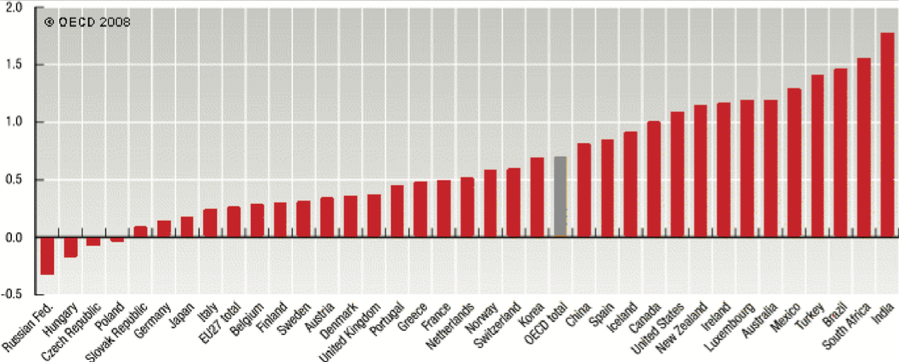
Population growth rates

Average annual growth in percentage, 1993-2006 or latest available period

In 2006, OECD countries accounted for 18% of the world’s population of 6.5 billion people. China accounted for 20% of this number and India for another 17%. Within OECD, the United States accounted for 25% of the OECD total, followed by Japan (11%), Mexico (9%), Germany (7%) and Turkey (6%). Between 1993 and 2006, the population growth rate for all OECD countries averaged 0.7% per annum. Growth rates much higher than this were recorded for Mexico and Turkey (high birth rate countries) and for Australia, Canada, Luxembourg, Ireland, New Zealand and US (high net immigration). In the Czech Republic, Hungary and Poland, populations declined from a combination of low birth rates and net emigration. Growth rates were very low, although still positive, in Germany and the Slovak Republic. The population growth of OECD countries is expected to slow down in the coming decade. Until the middle of this century, the population of OECD countries is expected to grow by less than 0.3 per cent per annum. Total fertility rates have declined dramatically over the past few decades, falling on average from 2.7 in 1970 to 1.6 children per woman of childbearing age in 2005. By 2005, the total fertility rate was below its replacement level of 2.1 in all OECD countries except Mexico and Turkey. In all OECD countries, fertility rates have declined for women at younger ages and increased for women at older ages because, on average, women are postponing the age at which they start their families.

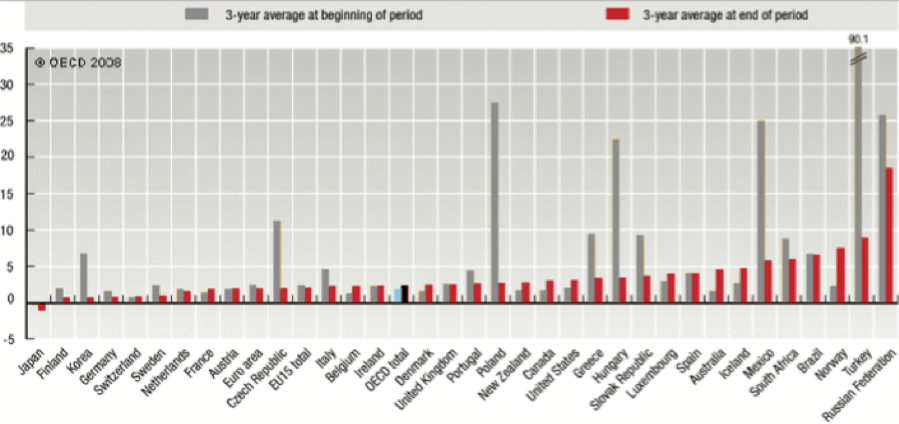
GDP defaltor

Average annual growth in percentage

Between 1993-2006, OECD inflation was lowest in 1999 at 1.2%. It then gradually increased to 2.5% in 2006. The average annual inflation over the last three years was below 5% for all OECD countries except Norway, Mexico and Turkey. The volatility in the Norwegian GDP deflator is mostly due to variations in the export prices of petroleum, and these grew very strongly over the last few years. Strong growth in the GDP deflator for Mexico and Turkey reflects general domestic inflation, though both countries have, drastically reduced their inflation from 1993-2006. At the other extreme, Finland, Germany, Korea, Japan, Sweden and Switzerland recorded average annual rates of inflation over the last three years of below 1%. Several countries (Canada, Czech Republic, Finland, Germany, Luxembourg, Norway and Switzerland) recorded deflation between 1993-2006 for one or more years, but Japan is the only country where this has been sustained over several years.

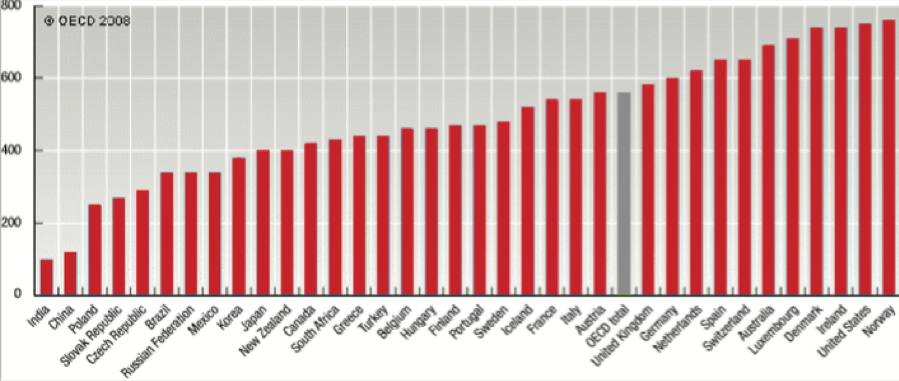
Municipal waste generation

kg per capita, 2005 or latest available year

The quantity of municipal waste generated in the OECD area (30 countries) has been rising since 1980 and exceeded 650 million tons in recent years (560 kg per capita). Generation intensity — i.e. kilograms per capita — has risen mostly in line with private final consumption expenditure and GDP, but there has been a slowdown in the rate of growth in recent years. The amount of municipal waste also depends on national waste management practices. Only a few countries have succeeded in reducing the quantity of solid waste to be disposed of. In most countries for which data are available, increased affluence, associated with economic growth and changes in consumption patterns, tends to generate higher rates of waste per capita.

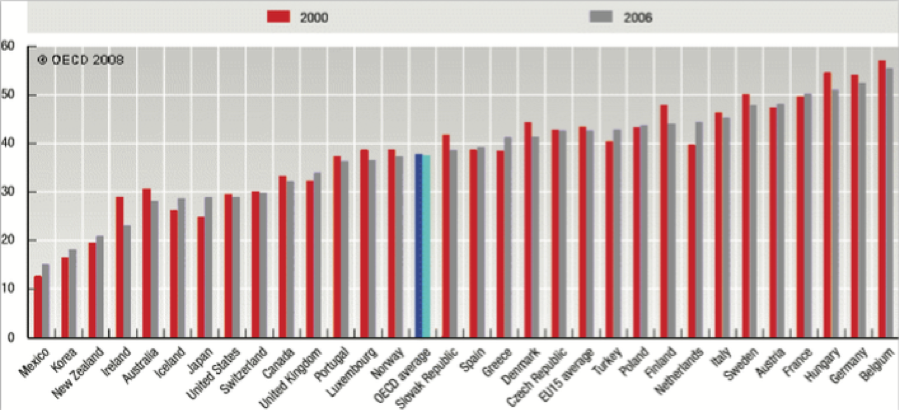
Taxes on the average worker

As a percentage of labor cost

On average, the taxes on an average worker increased until 1997 and have since declined, in both the European Union and the OECD as a whole. However, there are important differences between countries. The countries that have experienced an overall increase in the taxes on an average worker since 2000 include Japan, Mexico and the Netherlands. Countries that have experienced an overall decline include Australia, Denmark, Finland, Ireland, Luxembourg and the Slovak Republic.

August 13, 2008 0 comments
0 FacebookTwitterPinterestEmail
Financial Indicators

Regional equity markets

by Executive Staff August 13, 2008
written by Executive Staff

Beirut SE: Shuaa  (1 month)

Current Year High: 3,470.63  Current Year Low: 1,761.53

The Blom Stock Index for the Beirut Stock Exchange closed the July 25 session at 2013.55 points, down some 38 points when compared with the last close in the previous month. After climbing to a peak of near $40 per share on July 7 in reflection of a 10% dividend that will be paid out starting end of August, shares of real estate firm Solidere traded lower ex-dividend and closed at $36.01 on July 25. As politicians seemed to get something right in their negotiations in the second week of the month, the economically hopeful formation of a new cabinet drove the BSI to a new record high of 2,119 points. There was a bit of a hangover caused by renewed and probably incessant political squabbles later in the month but on the balance, July underscored that political improvements are the key in unlocking economic growth potentials for listed stocks and the whole economy. The central bank announced that reserves reached $15.5 billion in mid-July; a new sovereign bond issue was under preparation with the help of local and international banks as a $399 million bond neared its date of maturing on August 6.

Amman SE  (1 month)

Current Year High: 5,043.72  Current Year Low: 3,003.07

Share price trends on the Amman Stock Exchange broadly pointed sideways in the review period. After shedding some points early in the month, the ASE general index fluctuated between 4,500 and 4,700 points and closed the July 24 session at 4,711.36 points. This volatility in the general index was influenced largely by fluctuations in industrial stocks. These fluctuations in turn were attributed mostly to plans for introduction of a capital gains tax, which were withdrawn by tax authorities in mid July. The industry index, the main force in upward movements on the ASE in 2008, underperformed the market in July but ended the period at par with the general index. Insurance and services trailed the general index throughout the month while the banking sector displayed the best performance and gained 4.2%.

Abu Dhabi SM  (1 month)

Current Year High: 5,148.49  Current Year Low: 3,327.86

The Abu Dhabi General Index clung to the 5,000 points mark as the summer’s trends for booking profits and investing in individual relaxation made their impact. With a close at 5,005.70 points on July 24, the ADX index recorded a small gain that month because the exchange had a positive week at the end of the review period, after three weeks of losses. Sector indices did not report much that was worth writing home about. Energy was buoyant and real estate and telecoms also were positive on the month while banking was very close to the general index. The insurance, consumer, construction, and industrial sub-indices dropped between 0.85% and 2.53%, underperforming the general index. Real estate and energy led the gains in the last week of the review period.

Dubai FM  (1 month)

Current Year High: 6,291.87  Current Year Low: 3,968.09

Owing to a 215-point uptrend in the latter part of the period, the Dubai Financial Market’s general index had one nostril above water on July 24. The index closed at 5,437.54 points, 0.1% up from the start of the month. July thus did not alleviate the DFM’s standing in the regional performance tables for 2008; with a drop of 8.34% year-to-date, the DFM is still the second-worst performer this year in the GCC after the Saudi bourse. The sub-indices broadly confirm the downtrend: most sectors were flat or slightly negative throughout July; compared with the start of January, the transport, real estate, telecoms and utilities sector indices are down between 15 and 30%. Only the indices for insurance and materials bucked the trend and moved in positive territory with year-to-date gains of 6.4 and 13.5%, respectively. On the other extreme, however, stocks in the consumer staples category plummeted by more than 39% in July. The small sector lost half its value since the start of 2008. Jeema Mineral Water Co, which had listed earlier this year, shed 50% of its share price between June 18 and July 24.

Kuwait SE  (1 month)

Current Year High: 15,654.80            Current Year Low: 12,039.00

The Kuwait Stock Exchange had the highest index losses of any GCC bourse in July, closing at 14,887.80 points on July 24, down 3.7% from the start of the month. Pundits associated the slide, which had set in after the index reached a historic high above 15,650 points on June 24, with investor worries over potential attacks on Iran as the US and Israel deployed the verbal sledgehammer in their criticism of the ayatollahs’ nuclear theocracy. While all major sectors on the KSE weakened between June 24 and July 25, index losses during this particular period were the highest for industry (9.5%), followed by services (4.85%). The banking and insurance sub-indices, on the other hand, lost between 3% and 2% and suffered the least. When analyzing July share price movements alone, however, insurance and industry dropped between 5 and 6%, more than other sectors. Despite its loss in July, the KSE general index is still quite the looker for 2008 to date with a gain of 18.5% since January 1.  

Saudi Arabia SE  (1 month)

Current Year High: 11,895.47            Current Year Low: 7,506.45

The Tadawul Index on the Saudi Stock Exchange dipped down to 8,706 points on July 16, its lowest reading since October 2007. The SSE recovered to a close at 9,080.87 points in its July 23 session, signifying a 2.9% drop in the opening period of the year’s second half and certainly not enough to change the SSE’s situation as the most underperforming Middle Eastern securities market this year. Three sub-indices out of 15 in the SSE showed gains in the review period, namely telecommunications, retail, and industrial investments. All three major telecommunications companies, Etisalat Etihad, Zain Saudi, and STC, made gains toward the end of the review period but STC advanced the most, lifting away from a 12-months low recorded on July 16 on news of a good outlook for the Saudi telecommunications industry. Among debutants, Alinma Bank continued trading lower in the second month of its life on SSE.

Muscat SM  (1 month)

Current Year High: 12,109.10            Current Year Low: 6,423.95

The Muscat market was not to be caught by its GCC peers in July. The Muscat Securities Market general index closed the review period up 2% at 11,544.61 points on July 23 ahead of a long national holiday weekend. While the month did not see trading reach exhilarating levels, the MSM performance ahead of the other GCC bourses secured the Omani bourse’s claim to being the strongest gainer in 2008 at being up almost 28% when compared with the start of the year. Banking stocks struggled in the review period relative to other sectors; the banking sub-index closed 1.14% lower on July 23 when compared with the beginning of July. Industrial stocks, which had frequently served as drivers of the market gains in the first half of 2008, stayed married to the general index, leaving it to the services sector to outperform the general index with a gain of 4.2% on the month. The shares of Omantel were among the most watched during the month as the stock drew attention from buyers on announcements that the government plans to sell another major chunk of its 70% stake. 

Bahrain SE  (1 month)

Current Year High: 2,902.68  Current Year Low: 2,495.28

Stocks on the Bahraini bourse moved generally lower in July as the Bahrain Stock Exchange extended its losing streak into a second month. The general index closed at 2819.58 points on July 24, down 1.4% on the month and up 2.3% on the year. The sub-index for hotel and tourism companies, already the best performer among the BSE sector indices in the first half of 2008, continued to stay ahead of the market and added 3.7% in the July review period. Banking, insurance, services, and investments on the other hand moved lower last month; the investments sector gave up 2.4% and underperformed the general index the most, by a full percentage point. Al Khaleej Development Co, the BSE’s best performer this year so far, made further modest gains while the sharp slide of Arab Banking Corporation – the year’s hardest hit stock in Bahrain – appeared to be tapering out into a more stable picture (but one of a negative price to earnings ratio).

Doha SM: Qatar  (1 month)

Current Year High: 12,627.32            Current Year Low: 7,340.06

The Doha Securities Market’s general index slipped in July but switched to a sideways pattern in the second part of the month. The market closed at 11,851.02 points on July 24, representing a drop of 0.7% on the month and a retreat by 845 points from its year high on June 11. Banking stocks shadowed the general index in their July trend whereas industrial and insurance values outperformed the index, adding 3.9 and 2.8%, respectively. The services sector underperformed with a drop of 4%. Reporting a price to earnings ratio of 19.89x, the DSM is the most expensive market in the GCC, though, and it serves to remember that the bourse is up over 50% when compared with a year ago. In the real estate sector, Barwa Real Estate, whose share price fluctuated in the upper 80s (Riyals) in July, tops most DSM traded stocks in terms of the P/E ratio, at 43.81x. However, 2008 newcomer Ezdan, also a real estate player, displays an even higher P/E of astounding 67.03x.

Tunis SE  (1 month)

Current Year High: 3,059.63  Current Year Low: 2,436.94

The Tunis Stock Exchange had a month that ended better than it started. Dropping some 75 points in the first ten days of July, the Tunindex gained most back and closed the July 24 session at 3020.55 points. Investors on the TSE got some exciting news in July as agro, manufacturing, and real estate conglomerate Poulina Group Holding (PGH) announced plans to list 10% of its capital via a capital increase on the exchange in what PGH touted as the largest initial public offering in the TSE’s history. PGH, which has 71 subsidiaries, moreover said it will be the bourse’s new market cap leader after the flotation; subscription in the IPO was opened in roughly equal proportions to local investors and foreign institutional investors and was scheduled to run from July 24 to August 6. In other market news, the Tunisian government was reported to be planning to sell a 35% stake in listed insurance company STAR to the French insurer Groupama.

Casablanca SE All Shares  (1 month)

Current Year High: 14,925.99            Current Year Low: 11,394.32

The Casablanca Stock Exchange index added 272 points between July 1 and its close at 14,463.40 points on July 25. Up 13.93% since the start of 2008, the Moroccan bourse remains at the top of the price ladder for all stock exchanges in the Middle East and North Africa, with a proud price to earnings ratio of 32.75x. Market cap leader Maroc Telecom traded sideways in July; however, the company announced 10% higher net profits in the first half of 2008 when compared with the same period in 2007. The company attributed the profit increase firstly to revenue growth at its domestic mobile communications division.

Egypt CASE (1 month)

Current Year High: 11,935.67            Current Year Low: 7,517.77

Although it had a couple of positive sessions in mid-month, the Cairo & Alexandria Stock Exchanges could not come to a liftoff in July. The CASE 30 index closed at 9382.51 points on July 24, down 4.5% from the start of July. Market capitalization leader Orascom Construction Industries had a volatile time but showed a net gain of EGP 20 the share on the month to close at EGP 387.55 on July 24. The second largest company on CASE by market cap, Orascom Telecom Holding was less fortunate and saw its shares lose 14.9% in value between July 1 and 24. OTH additionally received a valuation rebuff from international investment bank Morgan Stanley; the bank’s analysts reportedly lowered their target price for OTH by more than 25%, citing the company’s uncertainty over strategy and vulnerability to inflation. OTH, OCI, and Orascom Hotels & Development, the third large firm in the family, each lost between 30 and 40% of their value since the start of 2008. Showing few positive examples of companies that currently enjoy trust of investors, the market is still looking for its new champions.

August 13, 2008 0 comments
0 FacebookTwitterPinterestEmail
Executive EducationSpecial Report

Money Matters by BLOMINVEST Bank

by Executive Staff August 13, 2008
written by Executive Staff

Regional stock market indices

Regional currency rates

Middle East contracts at $5.4 billion

According to the Middle East Economic Digest, contracts awarded in the Middle East in the first half of this year reached $5.4 billion. The most prominent projects are Saudi Arabia’s installation of a 1,200mw thermal power plant that is commissioned to Alstom (France) at $3 billion. On the other hand, United Arab Emirates’ (UAE) Shah gas field exploration by Abu Dhabi National Oil Company (Adnoc) and Conoco Phillips is worth $1 billion. Other prominent projects include Tunisia’s 400mw combined cycle power plant that is being built by Alstom for $529 million. Country wise, UAE’s total awarded projects stand at $1.6 billion, Saudi Arabia’s at $3.15 billion and Kuwait’s at $158.5 million.

GE and Mubadala in $8 billion partnership

Mubadala Development Company, an investment company owned by the Abu Dhabi government, announced an $8 billion partnership agreement with GE to establish a commercial financial business. The aim of the agreement is to invest in infrastructure assets, real estate, clean energy research and development and aviation. Both parties will contribute $4 billion each in equity to the joint venture over the next three years and expect to build assets up to $40 billion over the next 12-18 months. It is worth noting that according to Khaldoon Al Mubarak, CEO of Mubadala, the company’s long term plan is to become one of the top ten shareholders in GE through buying shares on the open market. GE is worth about $3.3 billion.  

Fitch upgrades Saudi Arabia’s credit rating to AA-

The Middle East and Africa monitor expects Saudi Arabia’s real GDP growth to push higher in 2008 and 2009, to be around 4.0% and 4.3% respectively. This is mainly due to the non-oil sector expansion, increasing oil production and a jump in global oil prices. Moreover, the monitor expects the OPEC basket to average $121.5/bbl in 2008, up 57% from the previous year. This will spill over other areas of the economy, notably the external sector that will lead to a trade surplus of around $328 billion, more than double the $151 billion recorded in 2007. In line with Saudi Arabia’s growing economic strength, on the back of record oil prices and increasing energy production, Fitch Ratings have upgraded the kingdom’s credit rating from A+ to AA-. The agency also changed the kingdom’s long-term ratings outlook from positive to stable. The new ratings put Saudi Arabia on a par with Kuwait, and one notch below Abu Dhabi, and although Saudi Arabia is unlikely to need any additional financing in the short-to-medium term, the upgrade is likely to increase foreign direct investments.

August 13, 2008 0 comments
0 FacebookTwitterPinterestEmail
Executive EducationSpecial Report

Morocco’s educational capital

by Executive Staff August 13, 2008
written by Executive Staff

As the global economy continues on its path of integration, more Moroccan students and professionals are turning to business schools to gain an edge in competitive job markets. Enrollment in business and management programs increased by 3.1% in 2003/04 from the previous school year, according to the Ministry of Education. A growing group of public and private schools are offering advanced degrees in business and management education to meet rising demand. 

Schools of today and tomorrow

Business and management schools are adapting their programs to changes in the global business environment. In particular, demand is growing for English-language MBAs and executive education. Al Akhawayn University, the Hassania School of Public Works (Ecole Hassania des Travaux Publics), and Ecole des Mines de Rabat all offer executive MBAs taught in English. To encourage innovation in business development, institutions also foster synergies with engineering schools and combine research into local business development with global dimensions of business education.

Houdaifa Ameziane, director of the National School of Business and Management of Tangier (ENCG), calls the evolution of Moroccan business schools “very satisfying.”

“We came on the scene somewhat timidly several years ago, to fulfill the needs of local businesses by according training programs in management aptitude. After that, we organized on-the-site training in the enterprise, with modules specially formulated for groups installed in the region. Since then, we have passed to the stage of master’s level diplomas available for students who seek managerial know-how and for professionals interested in continuing their education.” The ENCG network has invested heavily in relations with the region’s socio-economic powerhouses. Representatives from the shipping and transport companies that are rapidly growing in the Tangier region, and from the nation-wide telecommunications, manufacturing and banking sectors regularly recruit from the pool of ENCG’s students.

Going back to school

For those who have already joined the workforce, several institutions offer continuing education programs in business and business-related fields. Al Akhawayn University, a leader among Moroccan higher education institutions, offers a master of science in corporate finance, international master in e-business management, and an executive MBA. The executive MBA is completed through short weekend classes and evening seminars in Casablanca and residential sessions at the idyllic Ifrane campus. A part-time MBA is also available for public and business administration managers who want to raise their earning potential without sacrificing their current employment.

Some higher education institutions are tailoring their programs for the globalizing world by developing partnerships with international schools in Europe, Canada, and America and providing joint degrees. Joint degree programs are mainly master’s and executive master’s in various fields, such as business administration, public management, logistics, finance, and operation management. There are also franchising networks of private institutions from within Morocco, and others created by consortia of businesses, who groom students as trainees or future employees.

Casablanca business school ESCA recently teamed up with France’s Grenoble School of Management to offer Grenoble’s ‘specialized masters in business intelligence’ to students and executives living in Morocco. The Grenoble school said in a statement that the program was formulated to respond to particular problem areas in Moroccan businesses, “as business intelligence is increasingly playing a significant role in terms of business performance, but lacks specialists notably in the retail, marketing, consulting, and project management fields.”

Moroccan executives regularly lament the lack of qualified personnel in the region, and often recruit foreigners, particularly French nationals, for high-level positions. In turn, foreigners come equipped with high-level training, but often have trouble understanding local business practices and culture. With Morocco becoming a hub of regional investment and trade, local business schools are increasingly important in creating the skilled professionals needed to manage new wealth and sustain high levels of growth.

August 13, 2008 0 comments
0 FacebookTwitterPinterestEmail
Executive EducationSpecial Report

Jordan’s business class

by Executive Staff August 13, 2008
written by Executive Staff

Executive education in Jordan has yet to become a staple of academic institutions, but the country’s accelerating integration into the global economy means that ambitious Jordanians increasingly have to be on the lookout for the competitive advantages offered by focused higher degrees. Faced with more competition, one way for the young Jordanian executive to keep up is through a mid-career boost from a small but growing number of master of business administration (MBA) and similar courses. Particularly innovative is the new MBA degree offered by the German-Jordan University (GJU) at its Talal Abu-Ghazaleh College of Business (TAG CB) in Amman. Established in 2006 as one of the faculties of the new university, TAG CB represents an education partnership rare in the Arab world between academe and the region’s private sector, bringing the expertise of the Abu-Ghazaleh business consulting and services group to the GJU. The latter, a public university jointly launched in 2004 by the German and Jordanian governments, is headquartered in Amman and plans to open branches in various other Arab cities.

Designed as a passport to a higher management career for ambitious young executives, the GJU MBA program enforces the concept of transferring knowledge from classes into real-world workplaces. Normally, students in this program will have qualified some three to five years previously with a Bachelor’s degree and then gone on to perform well and show leadership at work. In a sign of the times, GJU points out that its MBA graduates could go on to serve as effective managers not only in the private sector, but also in business aspects of government or other public agencies. Though not at the level of Dubai and other high-flying economies where state offices often function as smoothly as private business, Jordan’s public sector is nevertheless moving in that direction — helped by a growing number of bright young graduates of executive education programs. In particular, GJU allows its MBA students to specialize in such areas as finance, statistics, marketing, or international business, not to mention the Abu-Ghazaleh specialties of Intellectual Property and Accounting.

More specialized, but still aimed at the executive, is the MBA offered by Jordan’s Queen Nour Civil Aviation Technical College. Established in 1973 and recently privatized, the college meets Jordanian and regional civil aviation needs through a two year program leading to a community college diploma, as well as by special training. However, in the process of upgrading and revamping its offering, eight years ago the college started an MBA in Aviation Management. Designed for high-flyers, as it were, Jordanians and students from elsewhere in the region have benefited from this course, helping their respective airlines compete an increasingly sophisticated and vital sector.

Finally, for Jordan’s finest young executives, the Queen Rania Global Leader Scholarship is offered annually by the famed Thunderbird School of Global Management in Arizona. The scholarship goes to Jordanian business leaders interested in pursuing an MBA in global management. Candidates for the award must have a minimum of two years’ work experience and they have to be motivated by factors other than personal advancement. In fact, applicants for this MBA scholarship must submit an essay on how they intend to use their education to make a positive contribution to their nation, region and/or the world community. Jordan’s Queen Rania promotes the award saying that empowering women is, “perhaps, the single greatest legacy we can bestow upon our children.” Although in the age of gender equality, men are also eligible for this prestigious MBA scholarship. Look for more of these initiatives in Jordan, as well as an expansion of home-grown MBAs, over the next few years.

August 13, 2008 0 comments
0 FacebookTwitterPinterestEmail
Executive EducationSpecial Report

Learning business in the Middle East

by Executive Staff August 13, 2008
written by Executive Staff

“Every degree becomes obsolete five years down the line, so you have to renew your knowledge,” said Assaad Raphael, chairman and general manager of Porsche Center Lebanon. This is why Raphael returned to his Alma Mater, the American University of Beirut (AUB), for the Executive MBA (EMBA) program last year. The 20-month program meets every three weeks for a three-day weekend: Thursday, Friday and Saturday mornings.

“I know that this program added value to my role at my company,” Raphael said. He was quick to point out that a major benefit was the ability to learn from the experiences of his classmates, who came from all over the region. “Fully 50 percent of my classmates were commuting in from outside of Lebanon,” he added. According to AUB’s Olayan School of Business (OSB), which hosts the program in addition to their MBA, typically half of EMBA students are residents of Lebanon. Of the others 14% are Saudi, 12% Kuwaiti, 9% Qatari, 5% Emirati and 5% are even residents of Europe.

Student ages vary as well, asserted the EMBA Program Director Riad Dimechkie. “We aim at executives and those aspiring to be executives,” he said. Thus participant age varies from 30 to 60 years, although the average age is 40. The students’ combined and varied experience plays directly into the program. Class sizes of 15-20 students, roughly half that of many EMBA programs in the United States, means that classmates have an intimate setting in which to share their experiences and learn from each other.

From an academic angle, Dimechkie said “the overall focus is on general management” so that all elements of the contemporary business world are covered. This facet allows an executive to speak with an accountant, human resources manager or marketing executive and be able to follow the conversation without a second thought.

Furthermore, the AUB program prides itself on having strong roots in the region. This is also reflected in the academics of the EMBA, which aims to be Middle East relevant in three ways. First, there is a strong focus on the service industry, which is very important to both the Levant and the Gulf. Second, there is an emphasis on small and mid-sized enterprises. This is a nod to the numerous family-run businesses of the Middle East. Finally, there is a specific focus on Arab businesses. The OSB facilitates this by conducting case studies on the Arab world and by bringing in Arab leaders to lecture.

The cost of class

Full tuition for the program is around $35,500, usually paid in one of two ways: either the students cover the cost themselves or their company pays. A common practice when the company pays is that the cost gets amortized over a three-year period. For example, if the freshly graduated employee leaves the company after one year, they must reimburse the company for two-thirds the cost of the program. If they leave after two years they are responsible for one-third the cost and if they leave after three years they owe nothing. This approach helps to prevent a valuable human resource investment from walking out the door.

While AUB’s business school is cheaper than many Western options, there are several other options in Lebanon for the value conscious. One of these is the Ecole Supérieure des Affaires (ESA) in a quiet neighborhood of West Beirut. “Both our MBA and EMBA require 16 months of course work and four months for the thesis,” said ESA Academic Coordinator Jan Schaaper. The MBA is designed for young professionals with less than five years of experience. It is a much more technical degree, while the EMBA focuses on soft skills like employee relations and negotiation. Schaaper suggested the EMBA has value added in that “professionals are coming together, not only for course work, but to share their experiences as well.”

ESA’s graduate business students usually hail from Lebanon, though some come from Syria and Jordan as well. The MBA programs are conducted in cooperation with ESCP EAP European School of Management and are taught in French. But according to Schaaper, the main difference between the American MBA system and French programs like ESA is specialization. “The French system has specialized master’s degrees. We have not only an EMBA, but also four specialized master’s for executives including finance, marketing, hospital management and we will be offering Islamic finance next year,” he said. The MBA program costs some $13,000 and the EMBA is roughly a thousand dollars more.

For young executives involved in the North African market, the American University of Cairo’s MBA might be of interest. “It is the only AACSB accredited program in the country and many prominent Egyptian business people have graduated from the program,” said Mohga Badran, head of the management unit at AUC’s Department of Management. MBA students can choose to concentrate in accounting, finance, international business, leadership and human resources management, information systems management, marketing or operations management.

According to Badran, 90% of these MBA students come from Egypt and the remainder from other Arab countries, Europe and the US. Half of the students are engineers, while the others are physicians, family business owners or from multi-nationals with offices in Egypt. The program is entirely in-house as it has no affiliation with any foreign universities. Regarding the cost of tuition, students who complete the minimum 33 semester credit hours pay $52,000. Students coming from the sciences, however, may qualify for the full-ride Gameel Fellowship.

Learning in the GCC

There are also several options for MBA programs in the Gulf. The United Arab Emirates boasts several business schools such as the American University of Sharjah (AUS). “Diversity is one of the attractions of AUS. Our MBA students come from the UAE (28%), Iran (21%), Syria, Jordan, Palestine and throughout the GCC,” said Rob Bateman, acting dean of the Business Management School.

The program’s core courses often require practical projects involving actual business situations, preparation of business plans or resolutions of leadership problems, added Bateman. Most students enroll part-time as they have full-time employment at corporations based in the Emirates. It is possible to complete the degree in one year, although three to four years is more common. Starting tuition for the program is $39,000.

Also in the Gulf is Qatar University (QU) in Doha. “The Qatar MBA curriculum presents students with a cross-functional approach to business education that leads to a better understanding of real world challenges in the current business environment,” according to Mohammad Najdawi, dean of the Business and Economics College. The average age of MBA students is 27 years and the average undergraduate GPA is 3.3. As for foreign affiliation, QU has relationships with Nanyang Technological University in Singapore and it will soon have a relationship with Bocconi University in Milan, Italy. The degree costs a minimum of $9,900 for non-Qataris with a business background. Non-nationals who have not previously studied business are required to take 12 foundational credits, raising the price to $13,000. Qatari nationals receive a 30% discount.

Finally, for the up and coming professional looking for executive education in Damascus, the Higher Institute for Business Administration (HIBA) offers a solution. HIBA students are predominantly Syrian, but also come from Jordan, Egypt and France. HIBA offers both an MBA and an EMBA.

“There are three main foci for the MBA program,” according to HIBA’s dean Fouad Dib, “communication in business administration, economics, and quantitative methods in business administration.” Students can also specialize in marketing, human resources and finance. All courses are given in English and the MBA program takes 18 months on average. HIBA has cooperation agreements with Universitat Autonoma in Barcelona and with the Bordeaux Business School in France. Tuition for the EMBA costs $11,700 for Syrians and $12,000 for internationals.

Thus there is no shortage of executive education in the region. From North Africa to the Levant and the Gulf, opportunities for professional growth abound, with the MBA is still the most common form of graduate business degree. As long as the regional need for executive talent continues to grow, the number of executive education programs available will continue to grow with it.

August 13, 2008 0 comments
0 FacebookTwitterPinterestEmail
Executive EducationSpecial Report

The Rock of Qatar’s classroom

by Executive Staff August 13, 2008
written by Executive Staff

Survival in the Arctic tundra requires a certain wherewithal — a variety of aptitudes that differ slightly, one might assume, from what one needs to know to live in, say, a blazing hot desert. Increasingly however, it seems to be that whether one’s walk of life leaves tracks in sand or snow, it’s all in the same stride.

Take for example the barren, wind-blasted coast of the northern tip of Newfoundland where tiny pockets of communities cling to existence. In this region of “The Rock” — as Newfoundlanders wistfully refer to this island off Canada’s east coast — people are not so much the salt of earth as the salt of the sea. Historically, growing up here meant being in a boat with one’s father learning the jigs and reels of fishing cod from the frigid North Atlantic.

Today’s lessons

In the later half of the 20th century, however, fleets of industrialized factory freezer vessels arrived from around the world to pillage the bountiful Grand Banks, dragging nets the size of city blocks across the ocean floor and hauling up cod by the ton with every pass. Today, the fish stocks are decimated beyond commercial viability and the ageing fishermen of these outport settlements are undoubtedly among the last of their kind.

With no future for them at work on the waves, the children of these fishermen are left to learn a new livelihood, a fact that has led may of them to the classrooms of the College of the North Atlantic (CNA) in St. Anthony which, with close to 3,000 residents, is by far the region’s largest town and claims the only traffic light for the next 450 km.

Here, some 100 full-time students pursue college diplomas and trade certificates in fields ranging from health sciences to information technology and business studies to industrial trades. Indeed, the CNA has been a public institution in Newfoundland and Labrador — the province’s official name — for more than 40 years, with 16 other campuses similar to the one in St. Anthony spread through the vast southern expanses of the island, offering training and opening career opportunities for the some 8,500 full-time students who attend. The CNA is often the only locally available institution for post-secondary education, and the role it plays on The Rock today — offering students new skill-sets necessary to adapt to rapid economic change — has resonated in places that couldn’t be farther removed.

Just under a decade ago, in the torrid heat and dust storms of the Middle Eastern state of Qatar, a problem began vexing Her Highness Sheikha Moza Bint Nasser al-Misnad and other members of Qatar’s royal family: despite an economy surging on oil revenues and a GDP per capita amongst the highest in the world, few Qataris were actually engaged in an active role in their nation’s development — they simply did not have the training to be able to do so, and thus most of the skilled technical work was being done by expatriates.   

The education quest

To remedy this situation and encourage greater Qatari participation in national industries like oil and gas, it was decided a “college of technology” ought to be founded in the emirate under the guidance of a foreign partner institution. Deeming the Canadian education model most attractive, the Canadian Bureau of International Education (CBIE) was contacted, which then accepted submission proposals from colleges across Canada and short-listed four for the Qataris’ inspection.

And so on May 2, 2001, some 14 arduous hours drive south of St. Anthony, a plane carrying a delegation of senior advisers to Her Highness landed at the airport outside Newfoundland’s capital St. John’s. The Rock was still frozen in winter’s grip as the royal family’s emissaries stepped from their chauffeured limos at the provincial legislature building, greeted by a massive Qatari flag rippling in the wind above a flagpole half buried in a gargantuan snow bank.

“I think they saw a little of themselves in us,” said Stephen Lee, CNA’s marketing and communications manager, floating the idea of cultural similarities derived from Qatar’s pearl diving past and Newfoundland’s fishing heritage, also noting that Qatar’s oil-fuelled economic revolution is what Newfoundland dreams will come of its own relatively-infantile-but-expanding oil industry. “Really, we’re following in their footsteps,” he claimed.

However dubious this might sound, money talks, and soon after the 2001 visit the two parties signed a 10-year, $500 million contract for the creation of the somewhat-oddly-named “College of the North Atlantic – Qatar.”

In the seven years since the agreement — the largest deal ever for any Canadian university — CNA-Q has grown to be the second largest educational institution in the emirate, worth some $1.7 billion, with 600 employees, 2,500 students, a 75,000 square meter campus with state-of-the-art industrial workshops, laboratories, computer systems, libraries, lounges, swimming pools and cafés. 

In June 2008 Newfoundland’s premier Danny Williams, on his first trip to Qatar to attend graduation ceremonies at the CNA-Q, remarked, “It really was an unbelievable ceremony. This young girl gets up, the valedictorian, and speaks so eloquently without notes… and the energy minister turns to me and says, ‘we owe all of this to Newfoundland and Labrador’.”

And with that a most unlikely of fraternities was affirmed, bonding The Pearl of the Persian Gulf to The Rock of the North Atlantic, with the educational essentials of living in the modern age building the bridge over the oceans between. 

August 13, 2008 0 comments
0 FacebookTwitterPinterestEmail
  • 1
  • …
  • 514
  • 515
  • 516
  • 517
  • 518
  • …
  • 696

Latest Cover

About us

Since its first edition emerged on the newsstands in 1999, Executive Magazine has been dedicated to providing its readers with the most up-to-date local and regional business news. Executive is a monthly business magazine that offers readers in-depth analyses on the Lebanese world of commerce, covering all the major sectors – from banking, finance, and insurance to technology, tourism, hospitality, media, and retail.

  • Donate
  • Our Purpose
  • Contact Us

Sign up for our newsletter

    • Facebook
    • Twitter
    • Instagram
    • Linkedin
    • Youtube
    Executive Magazine
    • ISSUES
      • Current Issue
      • Past issues
    • BUSINESS
    • ECONOMICS & POLICY
    • OPINION
    • SPECIAL REPORTS
    • EXECUTIVE TALKS
    • MOVEMENTS
      • Change the image
      • Cannes lions
      • Transparency & accountability
      • ECONOMIC ROADMAP
      • Say No to Corruption
      • The Lebanon media development initiative
      • LPSN Policy Asks
      • Advocating the preservation of deposits
    • JOIN US
      • Join our movement
      • Attend our events
      • Receive updates
      • Connect with us
    • DONATE