• Donate
  • Our Purpose
  • Contact Us
Executive Magazine
  • ISSUES
    • Current Issue
    • Past issues
  • BUSINESS
  • ECONOMICS & POLICY
  • OPINION
  • SPECIAL REPORTS
  • EXECUTIVE TALKS
  • MOVEMENTS
    • Change the image
    • Cannes lions
    • Transparency & accountability
    • ECONOMIC ROADMAP
    • Say No to Corruption
    • The Lebanon media development initiative
    • LPSN Policy Asks
    • Advocating the preservation of deposits
  • JOIN US
    • Join our movement
    • Attend our events
    • Receive updates
    • Connect with us
  • DONATE
Comment

Syria moves ahead

by Riad Al-Khouri March 3, 2008
written by Riad Al-Khouri

Syria’s current economic performance is strong, as the country benefits from growth in exports and inflows of private investment, which helped the economy to grow at a rate of 6.2% in 2007, compared to 5.1% registered in 2006. American sanctions are not a major impediment to the Syrian economy. In fact, gradual globalization helps to push numerous US products in Syria, from fried chicken franchises to a major sugar refinery. Far from helping to achieve purported US regional goals, such as isolating the Iranians, the effect of American sanctions on Syria has been counterproductive, opening the door to greater influence on Damascus by regional powers — including Iran, itself seeking stronger Middle Eastern ties to counter America.

Tehran has thus partly filled the gap created by sanctions. Taking advantage of some economic possibilities; and new Syrian-Iranian economic joint ventures in Syria include among many others: an oil refinery (to be built in partnership with Venezuela), two factories to make Iran-designed family cars, and a plant to produce 1 million tons of cement annually and help meet the demands of Syria’s building boom. This is part of the Syrian strategy of improving relations with its neighbors. Cold-shouldered by America, and to some extent by Europe (the Syrian Euro-Med agreement has been initialed but not signed), Damascus has for the past few years looked to the region for economic and business collaboration.

In that respect, notable developments recently include a rapprochement with Jordan, as well as positively evolving links across much of the rest of Syria’s neighborhood. After a frosty period caused by the perception that Amman sided with the US and its other allies in the region against Syria, the visit to Damascus by Jordan’s King Abdullah in November has helped to improve relations between the two neighbors. The pace of co-ordination between the two countries has quickened since then. In among other spheres, movement of passengers and goods between the two countries is huge and growing. Coming south are Syrian and other goods destined for Jordanian factories and consumers (as well as to Saudi Arabia and neighboring economies) and large numbers of Syrian workers seeking employment in Jordan. Headed in the other direction are increasing numbers of Jordanian and GCC tourists. The vast majority of these people and goods cross the border by road, though a small number also travels between the two countries by air, with flights between Jordanian and Syrian cities increasing. At the same time, although the two countries had neglected their railways in recent years, over the past few months Jordan and Syria have agreed a new railway project to link the two countries.

From the east, Iraqis liked Damascus so much that up to 1.5 million of them are living there and in other Syrian cities, by far the largest number of Iraqi refugees accepted by any state in the region. Since most of these are neither poor nor uneducated, they are a source of increased business between the two countries over the longer term, though in the short run the refugees have strained Syrian production capacity in various sectors and pushed some prices up. Another factor linking the two countries is water, which along with Turkey they share through the Tigris-Euphrates system. Syria had to contend with drought recently, making even more significant the recent meeting (the first in many years) between Damascus, and Baghdad, along with Ankara, to talk about their shared river basin.

In the same vein, Syria asked the Turks in January to release more water from their dams on the Euphrates to build up supplies for irrigation. In November, Ankara also underlined its co-operation with Damascus in another sphere, when Syrian plans were unveiled, to import natural gas from Iran via a pipeline running through Turkey. Coupled with these and other infrastructural developments was the launching of numerous joint ventures between the two neighbors, as well as an increasing flow of people and goods across their borders.

Finally, regarding Lebanon, economic relations between Beirut and Damascus are far too important for the current crisis between the two neighbors to have a serious impact. The alternative for the Lebanese, to normal relations with Syria, is normalization with Israel, but the latter will not happen coercively, and on any case not before the former. Syria on the other hand cannot properly deal with the employment implications of its population growth without the safety valve of the Lebanese labor market absorbing hundreds of thousands of Syrian workers. In other words, the two countries need each other too much for rifts to continue long. Meanwhile, Syria continues to pursue a regional strategy, opening up to other countries of the Middle East.

Riad al Khouri is a visiting scholar at the Carnegie Middle East Center, and Senior Fellow of the William Davidson Institute, University of Michigan.


March 3, 2008 0 comments
0 FacebookTwitterPinterestEmail
Comment

A change in US Mideast policy?

by Claude Salhani March 3, 2008
written by Claude Salhani
 
To be able to say that there is a shift in US policy regarding Syria, one has first to assume that there was indeed a coherent policy on how to deal with Damascus in the first place. Yet for the most part Washington’s policy regarding regimes that the Bush administration disagreed with has been to: A) refuse to talk to them, and B) to berate them at every chance. Washington’s stance regarding Damascus was a typical example of such policy. Could that policy be changing so late in the game? Possibly. But then again, more likely not.

In his final State of the Union address President George W. Bush was quite forthright in his accusations aimed at Iran and its leaders. Bush issued a stern warning to the leadership in Tehran, warning them that the United States would not stand idly by, in view of what he deemed was, Tehran’s aggressive policy in the region.

The president devoted a sizeable portion of his address to the Middle East, particularly focusing on the situation in Iraq and on what he likes to call “the war on terror.” Bush stressed the importance of “confronting enemies abroad and advancing liberty in troubled regions of the world.” He spoke of witnessing “stirring moments in the history of liberty.” He spoke of images of liberty that have “inspired us,” such as Iraqis voting in free elections for the first time. He also spoke of “images that sobered us.” He referred to “[passenger] trains in London and Madrid ripped apart by bombs,” a bride in a blood-stained dress at a wedding party in the Jordanian capital, and people carrying coffins in Lebanon.

There was, in effect, nothing new to what should have been a landmark speech, his last, after two terms in the White House and two wars in the Middle East. This speech will, after all, be the one that historians will remember most and will in years to come be compared it to those of other presidents.

On second thought, however, there was indeed an important new element to the president’s speech; the novelty was not so much in what was said, but more in what was left out of the presidential address. If Bush continued to view Tehran as representing a clear and present danger to the security of the United States, repeating that all options remained on the table when it came to Iran, the president was conspicuously silent when it came to Syria.

In retrospect, this silence seems rather odd when compared to previous speeches summarizing the situation in the Middle East. Until now, members of the Bush administration had no qualms about accusing Damascus of interfering in the affairs of its neighbor to the west, as well as those of its neighbor to the east.

Could it be that Washington has decided to engage Damascus in dialogue rather than continue its previous policy of shunning those that it disagrees with? Besides the Iraqi imbroglio, which Washington says Damascus has been involved in, facilitating the transit of weapons and fighters through its territory. The Bush administration has also clashed with Damascus over the political tug of war in Lebanon, more recently over the question of the Lebanese presidency.

Is this sudden silence concerning Syria an indication that Washington and Damascus are talking to one another? If so, both sides have been very discrete and successful in maintaining a complete media blackout, a near impossibility in a city such as Washington.

Hiam Nawas, a political analyst in Washington, follows Syrian affairs with a keen interest. She believes that if we are to resolve the Lebanon issue, “engaging Syria is crucial.”

True words. But other than the president’s silence there is no other indication of a thawing of relations between Syria and the United States. Rather, all indications seem to hint at Damascus having “given up” on attempting to deal with the Bush administration, instead focusing on how to do business with the next administration, now less than a year away.

Indeed, if Washington has lacked a coherent policy on how to deal with Syria, on the other hand the policy applied by Damascus when dealing with an intransigent Washington has been quite simple: Wait until a new administration moves into the White House.

Not pressured by the same four-year electoral cycle under which US presidents operate, Syria’s rulers — as well as a number of other leaders around the world — have learned to retrench and sit out the remaining time left to an administration they disagree with. This has long been the strategy practiced by President Hafez al-Assad and it continues to be the method of choice of his son and successor, Bashar.

Claude Salhani is editor of the Middle East Times.


March 3, 2008 0 comments
0 FacebookTwitterPinterestEmail
Sudan

Room for growth

by Executive Staff February 27, 2008
written by Executive Staff

Mobile phone usage has exploded in Africa over the last decade, with 197.4 million mobile phone users in 2006, up from just 25.3 million in 2001, according to the UN’s International Telecommunication Union. The growth was so spectacular that some of the bigger markets like South Africa and Nigeria have already shown signs of consolidation. But analysts say there is still plenty of room for growth in Sudan.

Ahmed Haroun’s tiny newspaper stand in the middle of Khartoum is plastered with mobile phone posters and strings of pre-pay cards, wallpapering the back of the shack and hanging down in front of customers like festive decorations.

Outside, the street is cluttered with advertising urging passersby to sign up with state-run Sudani, South Africa’s MTN or Kuwait’s Zain. Even the rubbish on the pavement is littered with bent and used up mobile phone scratch cards, most of them in the smallest denomination of five Sudanese pounds ($2.50). It is a scene repeated endlessly across Sudan’s dusty capital, on street corners and roadside shacks, each of them a front line in the fierce battle for mobile phone customers currently raging across Africa.

Sudan, the sixth biggest African country by population, came to the growth game relatively late. It missed out on much of the early days of the telecom boom, thanks to the turmoil of more than 20 years of civil war, compounded by an illiberal telecom market and crippling economic sanctions imposed by the US.

The world’s telecom companies, encouraged by a welcome liberalization in the national market, have been rushing into Sudan to scoop up as many new customers as they can get their hands on. There are now three established players in Sudan — Sudani, MTN and Zain.

Canar, a fixed-line group owned by UAE’s Etisalat, has also been negotiating for a fourth national mobile license over recent months. The market has become so crowded that Zain’s chief executive in Sudan warned that the granting of yet another license would force him to reconsider a huge expansion package. “We definitely think that the market can continue to grow,” said Andrawes Snobar, senior research analyst at Jordan’s Arab Advisors Group.

“The presence of three mobile operators in the market right now means there is plenty of competition. That will lower prices and increase the number of services offered to new subscribers. And that will increase the number of subscribers. “The mobile phone penetration is also very low in the country compared to regional standards and absolute levels.” Devine Kofiloto, principal analyst at UK-based Informa Telecoms & Media, agrees. “Sudan is a very interesting case, based on the parameters of low penetration and high population,” he said.

Near virgin territory for operators

At the end of 2006, just over 13% of Sudan’s 40 million-strong population had access to a mobile phone, according to the latest figures released by the Arab Advisors Group. Investors would have to search far and wide to find an equally sizable market and attractive penetration statistics elsewhere in the region.

Three out of Africa’s six biggest countries by population — Nigeria, Egypt and South Africa — already have mature mobile markets. No outside operators are allowed into Ethiopia, where the huge and inefficient Ethiopian Telecommunications Corp holds a state monopoly. That only leaves the Democratic Republic of the Congo — with its 60 million inhabitants, of which only 9% have mobiles phones, according to Informa — to rival Sudan in the investment stakes. Analysts thus concur: There are plenty of opportunities for expansion in the country.

Khartoum may have plenty of handsets and mobile phone masts. But huge areas of the country — from Darfur in the west, to the Red Sea coast in the east, remain near virgin territory for operators. If new mobile licenses prove hard to come by, there are always other ways in. Sudatel floats on the Bahrain and Abu Dhabi stock exchanges.

Another largely untapped opportunity lies in South Sudan with two mobile licenses of its own, currently held by the tiny operators Gemtel and NOW. Both could be tempting acquisition targets. Big names that are still on the sidelines without a stake in Sudan include the Anglo-South African Vodacom and Egypt’s Orascom Telecom.

Guilt by association

As in all markets, there are also risks. One of the biggest, especially for any operators with ties to Europe or the US, is the possibility of getting tainted through association with the festering conflict in Darfur. Human rights campaigners have mounted huge publicity campaigns against foreign companies suspected of propping up the Sudanese government or supporting atrocities in Darfur. German engineering giant Siemens, which has a sizable telecommunications division, pulled out of Sudan last year citing “moral and political” reasons. France’s Alcatel-Lucent has also been forced to defend its business interests in Sudan, following campaigns by divestment and human rights groups.

Most affected of all has been Sudan’s own national operator Sudatel, controller of the Sudani mobile brand. The company was one of 31 Sudanese groups barred from doing any business with US companies last year, after the White House accused it of “contributing to the conflict in Darfur.” But even that exclusion from the world’s biggest economy has not prevented Sudatel from finding its own opportunities for growth. In December, it snapped up a 70% stake in Intercellular Nigeria Limited. Three months before that, it spent $200 million on a mobile phone license in Senegal.

When Sudatel’s CEO Emad Ahmed was asked by reporters what impact America’s sanctions were having on his business, he replied: “The sanctions do not affect Sudatel at all. We are still dealing with the main builders of telecommunications … except American companies. The technology is available everywhere: it is available in Europe, it is available in the Far East and China, especially in China.”

February 27, 2008 0 comments
0 FacebookTwitterPinterestEmail
Sudan

The waiting game

by Executive Staff February 27, 2008
written by Executive Staff

Never good, the dusty red roads of South Sudan’s capital, Juba, have been further potholed and haphazardly widened by the steady increase in traffic since peace between north and south was signed in 2005, ending Africa’s longest running conflict.

In the same three years sprawling markets filled with crockery, cloth, never-before-seen vegetables and thousands of bright, cheap Chinese motorcycles have sprung from areas that formerly housed soldiers, half-buried mines and unexploded ordinances.

Small hills of the side-products of peacetime plenty — Ugandan water bottles, Congolese plastic bags, milk powder packets from Mombasa — pile up on every street corner. Foreign journalists dropping in have called the former garrison, miserably cut off during the long years of civil war, Africa’s new “boom town”.

But while Juba has plenty of northern Sudanese, Somali and Kenyan wholesalers, thousands of Ugandan traders and a fair share of Chinese restaurateurs, it is hard to find a new southern businessman.

“They are not used to business, but to war,” Ahmed al-Nour explained. He works in a north Sudanese-owned hardware shop whose shade attracts a few of Juba’s increasing street children, squinting up at that sun with their hands outstretched for coins.

And, al-Nour says, although the armed conflict that killed 2 million people and displaced a further 4 million is over, there is a strong sense that the struggle for the South still continues.

He explains that the most important thing for southerners is to hold on until 2011 when, under the terms of the peace deal, they will have their chance to vote for independence in a referendum.

“They (Khartoum) have not made unity attractive, the south will separate,” al-Nour said.

“We are just waiting, every year,” echoed Paul Amoko, an unemployed ex-soldier desperately looking for work in Juba’s crowded hospital in another part of town. Like many, he has looked instinctively to the new government for a job and not the private sector.

The secession vote is just one part of the three year-old North-South peace deal that also gives the South 50% of revenues from the oil-rich region and enshrines democratic transformation of the country together with wealth and power sharing.

The largest of the former southern rebel groups, the Sudan People’s Liberation Movement (SPLM) who signed the deal with Khartoum’s leading National Congress Party, now leads the semi-autonomous southern government, headed by President Salva Kiir, who is also the First Vice President of Sudan.

Lack of trust

Part of the mandate of the two signatories to the Comprehensive Peace Agreement (CPA) is to make unity attractive. Although, confusingly, many members are open secessionists, the SPLM in theory stands for union with northerners; based on the choice of the South’s population, probably standing at around 10 million people.

But after more than 50 years of on-off war over ethnicity, religion, ideology and in more recent years, oil, many southern Sudanese believe independence is the only path to freedom, a coming of age from southern anxiety to the normalcy that is a pre-requisite for real development.

“I, even, am one of the ones who will remain reserved until 2011,” Elizabeth Majok, head of the Employees Justice Chamber said. 

She agreed that southerners, who also have little experience, have missed out on many of the business opportunities that arrived with peace because they are waiting and not acting.

Majok argued that after many broken promises for southern equality by various northern governments, and what she sees as a distinct lack of commitment to the new peace deal by Khartoum, southerners are throwing themselves behind the promise of independence, not the current peace.

A long and troubled journey

Both sides have accused the other of violating the CPA deal and slowing down its implementation. Scuffles over oil agreements with foreign companies and occasional armed hostilities have contributed to keeping tension high between the former foes.

But international alarm peaked following a decision by the SPLM to pull its ministers out of a Government of National Unity in October, protesting the failure of northern soldiers to redeploy out of the South and their lack of real influence in the coalition.

The former southern rebels accused Khartoum of unwillingness to implement the deal, saying they were purposely dragging their feet.  

However, SPLM ministers went back to work in December, ending the crisis after Sudan’s President Omar Hassan al-Bashir agreed to some of the demands by the SPLM ministers. He reshuffled the cabinet and re-funded the delineation and demarcation of the contentious North-South border. But new deadlines for the late withdrawal of northern troops out of the South have been missed since. When fighting broke out along the border in December between southern soldiers and armed northern nomads  President Kiir said the nomads are supported by Khartoum, exciting tensions. 

The SPLM is also accusing President al-Bashir of withholding cash due to the southern government, leaving much crucial work in the South behind schedule. The southern government is almost wholly dependent on their share in Sudan’s 500,000 barrel per day production. Officials frequently complain there is a lack of transparency in how figures are calculated and say Khartoum is claiming wells beyond the border as theirs.

South Sudan’s Minister for Presidential Affairs Luka Biong said that the South is missing $1 billion from the oil-rich Abyei area alone, which both North and South fiercely contest as their own.

In a speech during southern celebrations of the third anniversary of the peace deal earlier this year, Kiir said that given the struggles in implementation so far, a much better relationship between the signatories is needed to get through a national census, democratic elections, and the 2011 referendum.

The pre-fab problem

From the road, the Beijing Juba Hotel looks almost as grand as its name. With its two stories and gold pillars guarding the entrance and sitting on prime Juba land it looks a world away from the tumbled-down cement houses and huts that makes up most of the southern capital.

But the lettering is cut from polystyrene and painted black and the building itself is pre-fabricated, put together from a giant kit over a few weeks by the Chinese owners. Pieces from the lurid blue and green mosaic floor inside are already chipping away.

Providing accommodation for the sudden in-rush of thousands of international aid workers and government employees that suddenly massed in the small capital, the Beijing Juba Hotel is even more expensive than most of the some 35 other tented or pre-fab camps that sprang up after the peace deal.

Like the dozens of restaurants that cater to internationals and former rebels flushed with government job cash, almost all of them are owned by foreigners.

Charging up to $200 a night, the owners hope to make back their investment in five years, after which the giant, presumably sun-worn prefab will be given to the southern government as a “gift”. 

It is not only southerners, Majok said, who are waiting for 2011; international investors, nervous about war breaking out again, are also “one foot in and one foot out”.

“Perhaps after 2011 there will be more investment, when people know what is going to happen,” she said. The US has also put sanctions down on Sudan and although the South is technically exempt, some think proper separation would make the region more attractive.

John K. Pan Paguir, director-general of trade at the South Sudan Trade and Commerce Ministry, said that none of the foreign businesses that have registered with the ministry have fulfilled long-term investment promises. All, he said, are in it for the quick money.

These investors, like the thousands of east African traders, are taking their money back out of the country. According to Majok, the short-term mentality — together with the habit of employing foreign staff — is not doing anything to contribute to stability in the South.

“Food is being brought in from outside, there is no real construction, no tax that is equivalent to the millions they are getting. We are not benefiting. At least the workers should be Sudanese.”

An Indian-owned hotel sitting right next to the beautiful and empty blue of the Nile is typical; while 10 or so local girls have been hired for cleaning and to wash clothes, all waiters and bar staff, kitchen staff, many construction staff and all of management are foreigners.

It is Kiswahili as often as Arabic that is spoken under the mango trees.

Four-wheel drives and salaries

Paul Amoko, who spent most of his life in the army before being demobilized, will soon be joined by 45,000 men and women, who the former rebel southern Sudan People’s Liberation Army — struggling with a massive 70,000 parade payroll — want to reintegrate into society.

With the flame of the South’s entrepreneurial spirit still small and with little or no access to cash, many of them will look to the government for jobs, not the private sector.

Although the civil service is already swollen and eating up more than 70% of the government’s $1.5 to $1.7 billion a year in oil revenues, it is obvious why it attracts southerners: it is those in the government who are benefiting from peace most.

For those without a government, or almost equally prized NGO or UN salary, life is tough. According to joint UN and government figures, the South has the world’s worst maternal mortality rate with one in 50 women dying during delivery. Some 10.2% of newborns die in childbirth. Only 2.7% of those who survive to childhood are fully immunized.

Little has changed for the rural peoples who make up most of the southern population, said the parliament’s economic and development head Barri Wanji, adding that so far there’s been little effort at promised decentralization. He explained that parliament had a difficult time last year getting cash out of central control for rural development projects. “[Ministers’] priorities are different from rural areas … where the emphasis is on high salaries, emphasis is on getting cars, emphasis is on building good houses.”

But even these high salaries are not staying in the South. Majok explained that she — like all of the South’s top officials — has her family outside, which is where she spends most of her salary on the schools and other services the South still struggles to provide.

And, she added sadly, even those with the backing to get loans from the Nile Commercial Bank — of unclear ownership but propped up with government funds — are probably spending it investing outside of the country.

Growing dissatisfaction at home

While southerners say they are confident that the SPLM will try to maintain peace, there is also a growing discontent with the party’s ability to deliver services to underdeveloped communities and deal with corruption within its ranks.

“Even [with] the roads, nothing is happening,” said John Mabior, a soldier, who added that money was being lost to corrupt politicians rather than reaching the people. “It is now a very big problem in southern Sudan.”

A report from the government’s Anti-Corruption Commission on government contracts in mid-2007 is still not available to the public but one government official described the contents as showing “shocking … overspending.”

And it is unclear whether investigations are still moving forward or not in what has become a test-case for Kiir’s zero-tolerance on corruption, said an MP. Over $70 million was spent on government vehicles, bought at twice the market rate. Most never arrived.

But no other southern party has yet challenged the SPLM’s supremacy. And as one Juba citizen put it, in their current position, waiting for independence, southerners have little choice. “There is room to play, to discuss with the SPLM. With the North, there is no room.”

February 27, 2008 0 comments
0 FacebookTwitterPinterestEmail
North Africa

The other oil

by Executive Staff February 27, 2008
written by Executive Staff

Olive oil may be overlooked as a commodity in the world economy, but for Tunisia it is the largest export earner and it provides livelihoods for hundreds of thousands of its people. The government has undertaken a concerted program to boost production and improve the earning potential of areas already under cultivation by improving irrigation and encouraging organic farming. These developments should help the sector surmount issues it faces such as trade limitations and an undeservedly shaky reputation in some countries.

Tunisia will produce 1.1 million tons of olives and 200,000 tons of oil from them in 2007-2008, the Tunisian agriculture ministry announced last December. This will make this year the fifth in a row that it has produced this amount, placing it as the world’s fourth largest producer of olive oil, after Italy, Spain and Greece. The government has set its sights on boosting production further, to ensure that other growing producers such as Turkey do not overtake it — and if possible to improve Tunisia’s ranking further.

As part of this policy, the government will encourage the planting of an additional 30,000 hectares of olive fields every year to boost oil production to at least 210,000 tons annually. Some 130,000 tons will be exported. As harvests have in the past been affected by droughts — production fell to 30,000 tons of oil in 2001-2002 and 70,000 in 2002-2003, the government is also increasing spending on irrigation.

Tunisia has around 56 million olive trees planted on 1.6 million hectares, a third of the country’s total cultivated area. The bulk of production is in the center of the country, where 52% of the country’s olives are grown, with smaller amounts from regions in the north (33%) and south (15%).

The economic and social importance of the olive oil industry cannot be overstated. Olive oil is the main source of income for more than 500,000 families from Tunisia’s population of 10 million, according to the Office National d’Huile; it accounts for around 50% of export revenues.

There is considerable scope for export growth, if some hurdles can be overcome. Despite its large output, Tunisia has a relatively low profile as an olive oil producer among consumers, as most of its overseas sales are in bulk, rather than through brands.

The European Union, which is a major importer of many Tunisian goods, currently limits the entire bloc’s purchases of Tunisian olive oil to an annual average of 50,000 tons a year, due to pressure from the EU’s own olive oil manufacturers. Competition from Turkey and Syria on the EU market also makes life tough for Tunisian exporters.

The sector has also received some negative publicity of late, with scandals involving the relabeling of Tunisian oil as local produce in Italy and Spain, doing little to improve their image abroad — even though Tunisian exporters themselves were not necessarily implicated.

Tunisia’s olive oil does have some competitive advantages. Most Tunisian olive growers use little or no chemical fertilizers and pesticides, so much output can be classified as organic, and giving access to a growing niche market and moving it up the value chain. So far 35,000 hectares have either been certified as producing organic olives or are actively in the process of acquiring this status.  Additionally, the government is encouraging better promotion of Tunisia’s olive oil in growing markets, such as Asia and North America as well as Europe.

Tunsia’s Maghreb neighbor Morocco is also looking to develop its olive oil industry, boosting production and improving technology. Its oil production sector is in need of revitalization, and will not become as large as Tunisia’s — the government’s target is production of 30,000 tons of oil within the next few years — but could play an important role in the economy of some rural areas. Currently, some 500,000 hectares are cultivated for olive trees, and the government hopes to double this figure by 2010.

In September, the first, of a wave of 10 new 1000-hectare olive groves, was planted in the Beni Hellal region in west central Morocco. The project to develop new export-oriented farms has been launched by Oléa Capital, a joint venture between Crédit Agricole du Maroc and the Société Générale Asset Management.

Crédit Agricole president Tariq Sijilmassi has said that the fund will help bring a sector “in need of success stories” up to date and introduce “a modern financial framework.”

However, demand for olive oil continues to grow, so Oléa’s founders have seen the potential for exports from modern farms and plants in Morocco. Oléa hopes to lead the way in showing how Morocco’s olive oil production can develop and prosper.

February 27, 2008 0 comments
0 FacebookTwitterPinterestEmail
North Africa

Pushing ahead

by Executive Staff February 27, 2008
written by Executive Staff

Morocco moved into 2008 continuing economic reforms aimed at boosting growth and reducing poverty under a new government.

Towards the end of last year Prime Minister Abbas el-Fassi outlined his government’s plans for reform, which were approved by parliament by 155 votes to 93. The launch of the policy package followed September’s election, which resulted in el-Fassi’s appointment, with his Istiqlal Party becoming the largest party in parliament. The policies, however, continue the broad course of the previous government, and el-Fassi has pledged to see through structural reforms in tourism, infrastructure and housing. “We are going to take on other reforms and bring to completion those begun by my predecessor Driss Jettou,” he said.

While the reform plans have been broadly welcomed, some issues have not been addressed, most notably boosting regional trade and allowing the dirham to float.

In his address to Parliament in October, el-Fassi described the course he wishes to take over his five-year term. Liberalizing fiscal reforms continue with the aim of boosting growth through encouraging enterprise. Business taxes are being lowered to 30% from 36% and value-added tax (VAT) reduced. It is hoped that these cuts will actually increase the tax take, by encouraging business registration and making avoidance less attractive, bringing the grey economy into the formal sector.

Despite its generally liberal outlook, the government has also made commitments to tackle poverty. It has pledged $2.43 billion worth of subsidies in 2008, in order to boost the spending power of the less affluent and combat inflation. These will target primary products, notably imported fuel and cereal crops, which have been particularly subject to inflation in recent years. However, the subsidies will distort markets and could discourage local agriculture if they are allowed to undercut domestic product prices. Therefore they may be a temporary measure until global supply shocks ease.

One of the key policy planks is bringing down rent costs and improving the housing stock. To this end, the government plans to bring on stream 150,000 new units annually.

The construction industry will receive a fillip from this, as well as the development of almost 50 hotel developments by French hotel group Accor, which already owns 24 hotels in Morocco through its Casablanca Stock Exchange (CSE) — listed subsidiary Risma.

This will in turn boost the country’s cement sector, which is dominated by foreign-owned firms and already growing strongly. Cement production increased 10% in 2006 and then 15%, to around 10 million  tons, in the first three quarters of 2007, and a further increase is likely to be necessary to meet the growing demand for social housing and other developments. The industry’s growth will help create much-needed jobs, helping address one of the government’s other major goals of bringing down unemployment and providing for young people coming into the labor market.

However, the government’s program has not tackled some issues which many in the business community would like it to. Currently intra-Maghreb trade is very low, accounting for less than 10% of the trade of Morocco, Algeria and Tunisia together. This is despite three fast-growing and increasingly productive economies, and the development of a trans-Maghreb motorway. Diplomatic disagreements with Algeria, which backs the Polisario Front separatists in Western Sahara, have hamstrung any attempts to develop trade ties. El-Fassi has yet to put forward plans to improve integration, which would surely boost the economies of all countries.

The government has also yet to finalize plans to allow the dirham to float freely, which is desired by many in the domestic business community and their foreign partners. Currency liberalization would facilitate export and import activities.

Morocco has set regional standards on democratization, enjoying free elections and a lively media. However, a complex electoral system makes it very difficult for any party to win an outright majority, leading to messy post-election horse trading; the days after the election were characterized by squabbles over ministerial positions and budgets rather than policy issues. Though admittedly this is common in many European democracies as well, it was an unedifying sight.

Nonetheless, el-Fassi’s government seems to have the momentum to continue the reform process, as well as addressing pressing social issues. Perhaps a year of growth and development will embolden the government to tackle the issues of regional cooperation and the dirham.

February 27, 2008 0 comments
0 FacebookTwitterPinterestEmail
North Africa

Farming faces the future

by Executive Staff February 27, 2008
written by Executive Staff

Recent drought has highlighted the weaknesses of the Moroccan agriculture sector, with the government stepping in to help. In the long term, privatization and consolidation of farm holdings will be more important, as emergency subsidies, in securing its future.

Directly and indirectly, agriculture provides the livelihoods for half of Morocco’s population, and has suffered a great deal of late, due to the drought in 2007. Given its importance as an export sector as well, the government is keen to take action. It is already tackling the most immediate issues by increasing subsidies on products such as equipment which reduces water loss in irrigation systems, but broader reform will be needed.

At the Institutional Seminar on Agricultural Development in Rabat on December 12, the Minister of Agriculture and Fisheries Aziz Akhannouch called for a “sustained effort” to increase output and competition. He said that the state would play a key role in improving coordination between investors and agriculturalists.

“Given the realities of the sector, the current situation of farmers, calls for a redefinition of the state’s role, in the form of new relationships between the producers and industry players.” Akhannouh also added that the government would initiate programs to promote innovation, financing and access to markets.

Beyond the immediate moves to tackle the water shortages, the government has stepped up its policy of leasing state farms to the private sector. In December it offered 38,700 hectares of farmland previously managed by Société de Développement Agricole (SODEA) for tender. The system has had the desirable results of bringing in capital and management experience through foreign direct investment (FDI). The leasing of 42,800 hectares of land in 2004 brought in $610 million, and new foreign management brought in $3.3 million in 2006. The new farm offerings have attracted interest from France, Egypt, Spain and the United Arab Emirates.

The fractured nature of farmland

Despite this success, the majority of the Moroccan agriculture sector remains fractured and increasingly uncompetitive.

Landholdings in Morocco are very small — 69% of farms are smaller than five hectares, and only 11,000 farms are larger than 50 hectares — due to inheritance traditions that divide family land between offspring.

The fractured nature of the farms limits productivity and means that most farms are too small to make much of a profit. Therefore they struggle to make necessary investments in equipment, vehicles to take food to market and new staff to boost output. Larger, more profitable farms would have the cash to spend on better irrigation systems and to lessen the effects of droughts, like last year’s. Farmers will have better access to the financing, innovation and markets rightly highlighted by Akhannouch.

So Morocco’s attempts to remain competitive and increase exports as it integrates into the global market are hampered. The World Trade Organization and Morocco’s trading partners are likely to apply increasing pressure on Morocco to overhaul the way agriculture is organized.

The understandable cultural and emotional attachment to the family land, and the government’s reluctance to contradict it, has stalled the process of consolidation. But the fact remains that the global market has no such sentiments, and unless reforms can be introduced, small farms are unlikely to grow, and may go out of business.

February 27, 2008 0 comments
0 FacebookTwitterPinterestEmail
Levant

Doubling efforts

by Executive Staff February 27, 2008
written by Executive Staff

Chakib Khelil, minister for energy and mines, has announced ambitious plans to increase Algeria’s phosphate production, generating valuable additional export revenue for the state, and creating up to 50,000 jobs.

Speaking at a mining conference in Algiers in December, Khelil told assembled guests Algeria was “open for business.”

“We have placed Algeria on the world map as a prominent player in the mining sector,” he added.

Algeria currently produces just less than 2 million tons of phosphates a year. Ferphos, the state phosphate mining company, has hopes to increase exports to 4 million tons by 2010, and eventually 30 million tons by 2020. This would see Algeria become the third largest phosphate producer in the world, after the US and China.

Phosphate production in Algeria has more than doubled in the past six years following a decline in the mid-1990s. Given the current high price of minerals in the market, investment in the sector is increasingly attractive. Should Ferphos meet its 2020 target, phosphate sales could generate $7-8 billion a year for the state.

In an interview with local press on October 22, Lakhdar Mebarki, CEO of the Ferphos Group, said early indicators for Algeria’s phosphate industry were encouraging.

“With the exports already carried out we confirmed that there is a good place for Algerian phosphate on the international market,” he said.

However, Mebarki added that it was difficult for Ferphos to establish an international presence, with competition becoming increasingly fierce.

Increasing capacity for higher output

Ferphos is already well on the way to answering Khelil’s call to boost output. With an estimated 2 billion tons of reserves, Algeria’s main limiting factor in output is currently infrastructure. To keep to its schedule of doubling output by 2010, the company has announced plans to build a new processing plant at Bouchegouf, 450 km east of Algiers, with the capacity to turn out between 2 million and 3 million tons of phosphates a year.

Further down the track, similar facilities will be established at Mdarouche, while a third plant, with an annual capacity of 12 million to 14 million tons to be built in Jijel, some 350 km east of the capital. All the processing facilities will be located close to the massive Djebel Onk mining complex, in the province of Tebessa.

A further challenge is transportation infrastructure. The existing rail lines serving the regions where Ferphos currently operates do not have the capacity to meet the company’s freighting needs. According to local press, Ferphos can only transport 1.2 million tons of phosphate by rail each year, and had to establish its own road freight subsidiary to haul the additional 800,000 tons it produces. The port of Annaba, through which Ferphos makes most of its exports, is also in need of an upgrade. The port’s facilities will be hard put to handle the 2 million tons of exports expected, let alone the 4 million tons projected in just two years’ time.

However, the announcement on December 15 that the government intends to spend $18 billion on upgrading the country’s rail network, including the opening of a new line in Tebessa, will go some way to easing Ferphos’s concerns about land haulage.

Even at full pelt, Algeria’s phosphate reserves should last another 65 years. However, to maximize value from this finite resource the government is also looking to diversify the industry vertically. The Bouchegouf facility will not only be used to extract raw mineral phosphates, but will also have the processing capacity to turn the material into fertilizers, adding value to export sales. Having received initial approval for the project by the Council of State Participation, Ferphos is now waiting for final clearance to create a joint venture with a foreign partner.

Phosphates have the potential to further improve Algeria’s trade balance. However, the government would do well to proceed with caution. As history has too often demonstrated, national wealth garnered from resource extraction — be it phosphates, oil, or even remittances from overseas nationals — can have a deleterious effect over time on a nation’s wider economic development. Signs of this “curse” can already be found in Algeria: the World Bank’s Doing Business 2008 ranking, published this month, sees the country dropping to 131st — the only Maghreb country to witness a slide. If Algeria wants to translate natural wealth into national wealth, it will have to work harder on reforming its economy.

February 27, 2008 0 comments
0 FacebookTwitterPinterestEmail
Levant

Developing the past

by Executive Staff February 27, 2008
written by Executive Staff

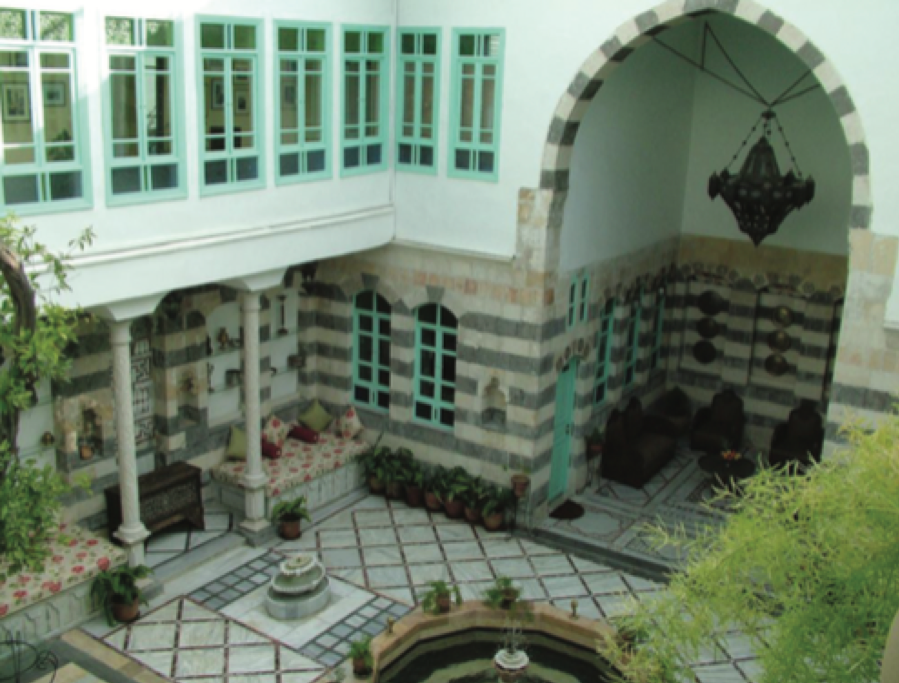
As the heavy wooden door of the Old Vine Hotel — the newest addition to Damascus’ ever expanding stable of Old City boutique hotels — swings shut, the noise and chaos of the outside lanes fades. Gone are the scrums of tightly wrapped tour-guided Iranian pilgrims, the small boys artfully carrying steaming cups of sweet tea through the crowds and the calls of Syrian merchants flogging cheap Chinese wares. They have been replaced by the Damascus of folklore: a narrow hallway leads to a marble courtyard embellished with a large fountain, filling the traditional Beit Arabi with the soothing sounds of running water.  Like its growing number of competitors, the nine room boutique hotel promises to transport visitors back to the Middle East of the Thousand and One Nights legend.

“Business has been good, demand is strong,” general manager Sami Maamoun said. “Our guests want to stay in a unique environment which they can’t find anywhere else. They want to experience a traditional Damascene house and the atmosphere that goes with it.”

Long ignored by the country’s wealthy, who traded their sprawling traditional houses for modern apartment blocks in the new city, in recent years the Old City of Damascus — heralded as the world’s oldest continuously inhabited city — has attracted intense interest from the private business sector. Around 70 restaurants and six boutique hotels are operating in the area; a further 28 restaurants, 13 cafes and 40 hotels have been granted licenses and are expected to commence operations within the next two years. All of which has seen property prices soar, increasing by up to 300% since 2000.

Preserving the past

A new-found passion for the Old City is, however, raising concerns about the impact such development is having on the World Heritage Listed site. A proposed development to widen Al-Malik Faisal Street, which runs parallel to parts of the northern wall, would entail the demolition of a number of historic buildings. The potential for demolition has resulted in the area being placed on World Monuments Watch’s List of 100 Most Endangered Sites for 2008. UNESCO has further threatened to revoke the area’s World Heritage Listing should the project proceed. While a decision is yet to be made — Syrian authorities will again meet with UNESCO officials later this month — recent comments by government officials indicating they would like to expose the Old City’s original walls have been viewed by many as an indication the project will be given the green light.

At the same time, the boom in restaurants and hotels is putting massive strain on an already weak infrastructure. Waste water, traffic management and air pollution have been identified as primary threats to the area by a joint Syrian-EU project working to preserve the Old City. Other questions are being raised, such as whether some of the restorations being carried out by private investors are adhering to strict guidelines imposed by the Syrian government, which stipulate that only traditional materials and methods be used, adding considerable expense to any project. “It would take an army of inspectors to guarantee that everything that should be happening during a renovation is happening,” architect and historical monuments expert Luna Rajab said. “We also need to move away from creating new decorations — fake ancient if you will. From a restoration point of view, you should not create anything new for which you don’t have documentation.”

A preservation strategy needs to be developed that would treat the Old City as a continuous area of equal importance, says Rajab, rather than simply focusing on individual buildings and monuments. “We need to pay attention to all the elements that make up the urban tissue of the area,” she said. “The importance may not be in the house itself. But that house next to this mosque and near that madrassa forms a continuum which needs to be respected.”

Preservation experts are not the only ones concerned about the private sector-led renaissance of the area. Many local residents complain about the noise and crowds that now choke, what until a few years ago used to be, sleepy lanes and alleyways. At the same time, poor services and skyrocketing housing prices are exasperating a long term exodus from the Old City — between 1995 and 2005 more than 20,000 residents moved out — threatening the traditional character and ambiance of the area. “We don’t want the Old City to be turned into a dead city, one that is only used as a tourist zone, one that people visit for shopping and restaurants and then leave,” Erfan Ali, program director of the Syrian-European Union Muni­cipal Administration Modernization (MAM) project, said. “Old Damascus has never been that, it has always been a living city and it is important to preserve that character.”

The master plan

These are all issues that the long anticipated master plan for the Old City is working to address. The plan, expected to be finalized in May, will divide the city into distinct commercial, tourism and residential zones and place limits on the number and style of future developments. Three tourism restaurant zones will be created in the areas of Qaymarieh, Bab Tuma and Midhat Pasha, while boutique hotels without restaurants will be able to establish their premises anywhere in the city. Syrian authorities have stopped granting business licenses until the new guidelines outlined in the master plan are finalized. In all, 59% of the Old City is expected to be zoned as residential. “I think we can say this plan is getting the mix between commercial, residential and tourism right,” according to Ali. “With more than 50% of the Old City designated as a residential area, the traditional character of the city will be maintained and we will have a living city.”

Tourism infrastructure will also be improved and themed walking routes are expected to be launched by the end of the month. Visitors will be provided with pamphlets that chart out routes of interest and include information about sites of historic and cultural significance. The walking tracks will include those which highlight the area’s spiritual heritage, taking in the numerous Islamic, Christian and Jewish monuments, as well as others which focus on classical sites, handicrafts and souqs. Plaques are to be installed around the city to help visitors navigate the maze of streets, lanes and alleys. A permanent sound and light show is also scheduled to commence in April in front of the Umayyad Mosque detailing the history of Damascus in 10 different languages.

Plans to restrict traffic access during certain hours and create pedestrian only zones are also scheduled to begin next year. Electric cars and even a tramway running around the city’s walls are all on the drawing board as ways of introducing environmentally friendly transport means around and within the area.

Damascus authorities have also started working with the German Technical Cooperation Program (GTZ), which recently concluded a 13-year program in the northern city of Aleppo to assist low-income residents in restoring and repairing their homes through a system of micro-loans and grants. The project worked to keep residents of Aleppo’s Old City in their homes which, in-turn, preserves the ‘living character’ of the area: residents venturing out in the morning in their pajamas to buy bread, children playing in the alleys and running errands for their parents and old men playing backgammon and smoking nargileh in front of their homes and small stores. As project manager Regina Kallmayer pointed out, “The aim is to create instruments that will enhance the ability of residents to upgrade their homes and improve their living conditions which will encourage them to stay in the Old City.”

“The Old City needs a lot of work and the government, despite best intentions, simply cannot carry out what is needed because they just don’t have the money,” he stated. “The government could put as a pre-condition on investors requirements that they take care of the surrounding area and this would have a big impact.”

“We can still have a successful mix of commercial, tourist and residential areas like every historic city throughout the world,” said May Bendki Mamarbachi, founder of the city’s first boutique hotel Beit al-Mamlouka, which recently received its third Condé Nast Traveller gold star award. “The difference is that Syria is at the beginning. It will take time for us to develop like the established historic cities of Spain or Italy, but we are moving forward toward this.”

Not all investors, however, are as community minded. Ali said many need to change their mindset when coming to do business within Damascus’s ancient walls.

February 27, 2008 0 comments
0 FacebookTwitterPinterestEmail
Levant

Taking stock

by Executive Staff February 27, 2008
written by Executive Staff

It may come as a surprise that Palestine has a successful stock exchange, especially given the recent political difficulties that have dislodged the economy. However, with a total market capitalization of $1.9 billion, the Palestinian Securities Exchange (PSE) accounts for only a small portion of the would-be state’s economy and investment opportunities. Inevitably the exchange’s development and economic prospects will be intricately linked to the outcome of the new peace negotiations kicked off by the Annapolis talks in late 2007. Nonetheless, given political stability, it has strong potential for growth, a factor that led Kuwait’s Global Investment House (GIH) to take a 10% stake in the exchange, in February 2007.

Based in Nablus, with offices in Ramallah, the PSE is controlled by the Palestinian Development and Investment Company (PADICO) and was incorporated in 1995, following a period of relative optimism. During this time a significant number of successful and ambitious diaspora Palestinians were returning home with the intent to build what they hoped would become their nation-state. The first shares were traded in February 1997, but since then the economy and investor confidence have often taken a battering, first at the hands of the second intifada and more recently from the infighting between Hamas and Fatah. Although stocks have at times suffered heavily, especially during the last two years, the PSE itself has weathered the storm well. As Talal Samhouri, head of Asset Management in the MENA region for GIH, said, “the exchange is actually in really good shape, with excess capital and equity it has been making money even through the bad times of 2007.”

Politically limited risks

Anybody who has heard the age-old adage “Warning: Prices can go down as well as up!” will be well aware that there can be difficult times but there are also bumper years. In 2005 the total market capitalization reached $4.5 billion and the Al-Quds Index increased by 306%. These were among the highest growths in the world that year, partly as a correction to previous weaker, politically difficult years and partly due to improved performance of listed companies combined with the optimism that Gaza disengagement seemed to hold. As is particularly the case in politically volatile countries, little did they know what lay ahead. By year-end 2006 market capitalization had decreased to $2.7 billion, losing 38% of its value, a trend that continued through 2007, which it ended at $2.35 billion, a 13% drop year-on-year. The services index was the best performing sector of 2007, down a mere -5.42% while the insurance sector slumped -41.13% on the previous year.

Samhouri explained that, “in some ways the nice thing about the PSE is that it has a very high correlation with political improvement.” This is borne out by the recent gains on the exchange: the second half of 2007 saw steady improvement, although not enough to get out of negative territory for the year as a whole. Performance in early 2008 has been strong with 11% gains on the Al-Quds Index in the first three weeks of trading.

In many ways the PSE is ahead of its field compared to local exchanges. It was supposed to have been the first Arabic stock exchange to go public but due to the adverse political situation that has dominated since 2006 the offering was postponed. Although the exchange itself was ready to take the measures, the closure of government departments with many staff not having been paid for months made it impossible to push through the legal and bureaucratic requirements. Since the PSE is owned by PADICO, which is also listed on the exchange, the IPO is seen as an essential step in removing any conflict of interest. In the end, it was the Dubai Financial Market that was the first Arabic stock exchange to list, in November 2006.

All being well politically, the IPO is planned to take place in 2008. GIH, who have board representation on the PSE, see their investment in it as a private equity opportunity and are confident of achieving high returns. Samhouri thinks that “we can see improvements coming in the future and can hold for the next few months or years until the situation stabilizes because then there will definitely be improved market conditions.”

Certainly, the developments since the Annapolis peace talks began seem to indicate that the American administration is prepared to push harder than before to achieve an equitable solution that would eventually allow the conditions to which Samhouri refers to take root. Bush’s use of the word “occupation” and his assurance that Abbas is as much a partner in peace as Olmert are good news to investors in the Palestinian economy, just as they are to Palestinian citizens. However there is still a sense that Annapolis is too little, too late in the presidency and to achieve stability will require, as much as anything else, the next US president to take up the reigns of the peace process at the start of his or her presidency rather than the end.

Stock exchange a winner in volatile market

Although political instability is bad news for the stocks themselves it can actually translate into good business for the exchange. As Samhouri pointed out, “this is the great thing about stock exchanges, they make money whether the market is going up or down.” The last two years of plummeting stocks have led to large and volatile trading volumes, a winner for the stock exchange, which makes its money on commissions. All the same, at times it has been forced to take precautionary actions, closing on three occasions in the last two years following major events and having to restrict price fluctuations to 3%, rather than 5%, following Hamas’ election victory.

The PSE has state of the art trading systems, was among the first exchanges in the region to introduce e-trading in April 2007 and as such is well equipped to deal with volatile market trading conditions. However, the PSE’s location in Nablus, much better known for its frequent occurrence in the news as a flash point in the Israeli-Palestinian struggle, may leave doubts with potential investors as to its reliability. Dr. Abu-Libdeh, chairman and CEO of the PSE, has commented on this to the international press, “The challenge for us, as I see it, is not in securing the administrative, logistical and infrastructure conditions for the work, its convincing an investor in Dubai that it is worth investing in Palestine through the stock exchange.”

In his opinion, “the prices in shares are very much undervalued […] and the analysis of the companies shows beyond any shadow of a doubt that these companies are doing very good business; they are really solid in terms of their plans and ability to strike operational profits.”

Perhaps the exchange’s main weakness is its size. With only 35 companies listed, the total market cap of $1.9 billion is only a fraction of the potential and in no way constitutes a liquid secondary market. Nearly two-thirds of this market cap is dominated by just three companies, namely; the Palestinian Telecommunications Company (PAL TEL) accounting for about one-third; PADICO for a fifth and the Bank of Palestine for a tenth.

In coming years the exchange hopes to develop stronger relationships with other regional bourses. To date it already has a memorandum of understanding with the Cairo and Alexandra Stock Exchange and is in negotiations with other regional exchanges, including Oman, Jordan, Qatar, Bahrain and the Dubai Financial Market to set up closer relationships. A pan-Arab platform is also in discussion, over which exchanges would be able to swap blocks of shares. The board of directors hopes that measures such as these, together with the investment and board participation of GIH, will improve their visibility to other nations, particularly the cash heavy GCC.

Resumption of aid will help

Improvements to the broader Palestinian economy, or that of the West Bank at any rate, can be expected following the resumption of international aid and the pledge of $7.4 billion from over 70 countries and 20 organizations at the Paris donors conference. The sum was significantly more than the $5.7 billion that the Palestinian Authority requested and will translate to improved financials for companies listed on the exchange as the money filters through the economy. With this in mind though, according to the World Bank, the single biggest obstacle to improving the Palestinian economy are the restrictions on the movement of people and goods. Improvements on these fronts would lead to far greater trade and significant gains on the Al-Quds exchange.

No matter what happens, the PSE seems set to stay put but the degree of its success will depend on the peace talks and their outcome. As Abu-Libdeh has commented, “We are entertaining a lot of options for the future, but it all hinges on what happens to the political process, if it doesn’t give us the breathing room we need it will be difficult to generate the necessary interest to continue growing.” That said, if prospects continue to improve (at least in the West Bank) then the PSE could buck the trend of decreasing world stocks caused by fears of a US recession. The London Stock Exchange recently saw its largest decrease in value since 9/11, while elsewhere bear markets are emerging in many of the world’s leading economies. Should the peace talks gain momentum then the Palestinian Stock Exchange could be one of the biggest beneficiaries of Annapolis.

February 27, 2008 0 comments
0 FacebookTwitterPinterestEmail
  • 1
  • …
  • 544
  • 545
  • 546
  • 547
  • 548
  • …
  • 688

Latest Cover

About us

Since its first edition emerged on the newsstands in 1999, Executive Magazine has been dedicated to providing its readers with the most up-to-date local and regional business news. Executive is a monthly business magazine that offers readers in-depth analyses on the Lebanese world of commerce, covering all the major sectors – from banking, finance, and insurance to technology, tourism, hospitality, media, and retail.

  • Donate
  • Our Purpose
  • Contact Us

Sign up for our newsletter

    • Facebook
    • Twitter
    • Instagram
    • Linkedin
    • Youtube
    Executive Magazine
    • ISSUES
      • Current Issue
      • Past issues
    • BUSINESS
    • ECONOMICS & POLICY
    • OPINION
    • SPECIAL REPORTS
    • EXECUTIVE TALKS
    • MOVEMENTS
      • Change the image
      • Cannes lions
      • Transparency & accountability
      • ECONOMIC ROADMAP
      • Say No to Corruption
      • The Lebanon media development initiative
      • LPSN Policy Asks
      • Advocating the preservation of deposits
    • JOIN US
      • Join our movement
      • Attend our events
      • Receive updates
      • Connect with us
    • DONATE