• Donate
  • Our Purpose
  • Contact Us
Executive Magazine
  • ISSUES
    • Current Issue
    • Past issues
  • BUSINESS
  • ECONOMICS & POLICY
  • OPINION
  • SPECIAL REPORTS
  • EXECUTIVE TALKS
  • MOVEMENTS
    • Change the image
    • Cannes lions
    • Transparency & accountability
    • ECONOMIC ROADMAP
    • Say No to Corruption
    • The Lebanon media development initiative
    • LPSN Policy Asks
    • Advocating the preservation of deposits
  • JOIN US
    • Join our movement
    • Attend our events
    • Receive updates
    • Connect with us
  • DONATE
Financial Indicators

Regional equity markets

by Executive Staff April 12, 2007
written by Executive Staff

Beirut SE: Blom  (1 month)

Current Year High: 1,625.45  Current Year Low: 1,168.36
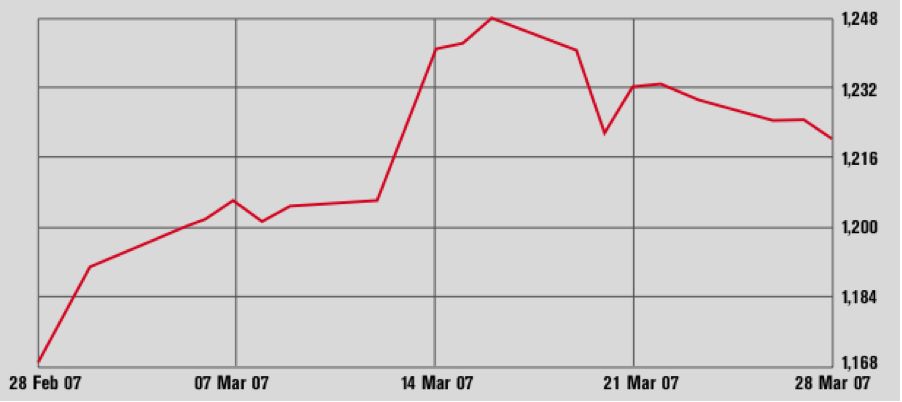
Between Feb. 28 and March 16, the BSE saw a spike in hope, as much as spikes go in a coma. The index moved from a year low of 1,168.36 points in late February to 1,248 points on March 16, basically driven up by talks between the opposing sides in the Lebanese political quagmire. As the voices announcing impending solutions faded, so did the traders’ enthusiasm and the third week pushed the BSI lower, to 1,224.19 points on March 26. Research, which Dubai-based investment bank Shuaa conducted on Audi Saradar banking group and concluded with a Neutral recommendation, led Audi to shoot back and claim that the fair value of its stock is significantly better than the $61.09 calculated by Shuaa. Audi shares closed at $63 on Mar 26.

Amman SE  (1 month)

Current Year High: 7,407.15  Current Year Low: 5,267.27
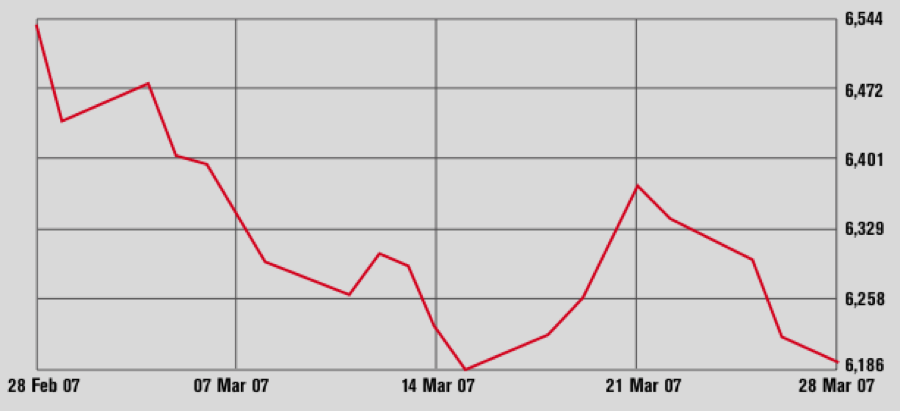
The Amman Stock Exchange moved sideways in a range above 6,200 points to close at 6,219.51 points on Mar 26. Arab Bank made headlines, beginning with having to deny a story in a US newspaper that warmed up allegations from a lawsuit that the bank had been used to finance “terrorism.” Later in March, the bank said it halted negotiations on a share sale to a strategic investor thought to be Emaar Properties, and the Jordanian government was said to be increasing its shareholding in Arab Bank in order to keep the Hariri family shareholders from buying up a controlling stake. The stock saw some lively trading in March, with a downward drift. Real estate firm Taameer Jordan was one of the main volume movers toward the end of March. Its share price regained in the second half of the month what it had given in the first half.    

Abu Dhabi SM  (1 month)

Current Year High: 4,648.80  Current Year Low: 2,899.43
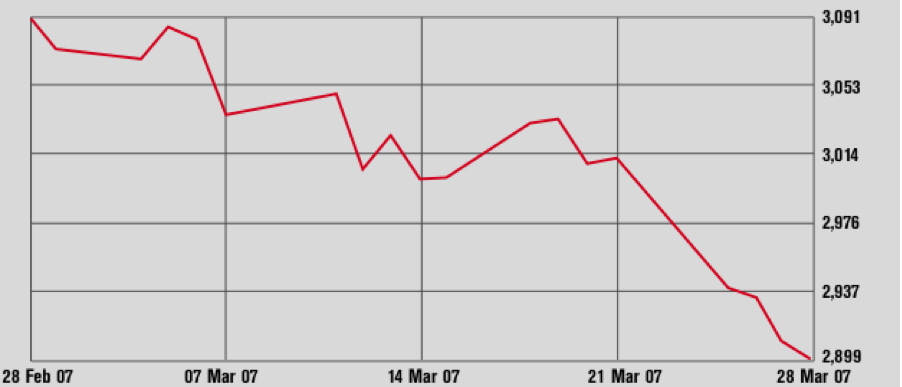
The Abu Dhabi Securities Market could not sustain the gains it had made in late February when it clawed its way above 3,000 points. The index dropped by 4% between March 1 and its close of 2,939 on March 25. At the end of the month, property and energy stocks were on the sunny side of the ADSM while banking values were selling. National Bank of Abu Dhabi, which issued 40% cash dividend and 30% bonus shares on March 22, traded down by 11% in the week between March 19-26. Banking news from neighboring Dubai with its impending merger between Emirates Bank and National Bank of Dubai mean the NBAD will, upon completion of the merger, lose its claim to being the biggest bank in the UAE.

Dubai FM  (1 month)

Current Year High: 6,987.91  Current Year Low: 3,675.93
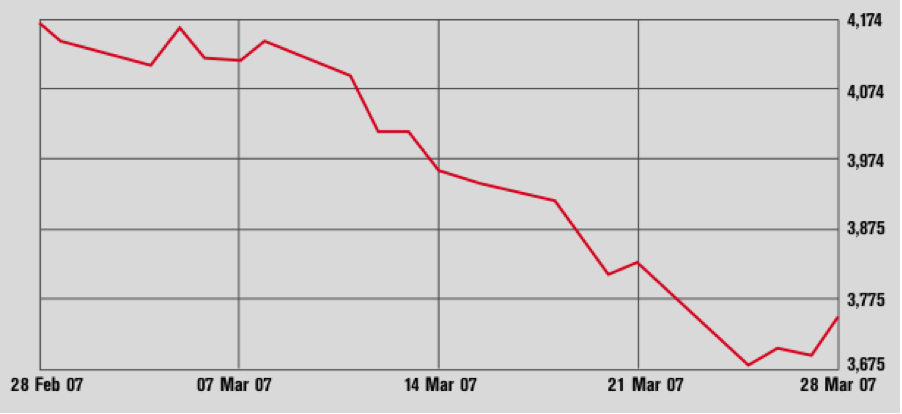
The DFM had a bad month in March, as its index weakened by almost 13% to a new year low of 3,675.93 points on March 25, from 4,207.51 points on Feb. 25. The DFM’s own shares started trading. Emaar, which pleased some analysts with a lower than expected dividend of 20% but disappointed stock owners with the move, traded down and was pushed even to a 12-month low of AED 10.60 on March 25 after Dubai Holding said it will acquire 28% in Emaar through a land-for-shares deal. Shuaa Capital bought back 3 million shares and the stock jumped 10.8% on a single day with high trading volume before sliding again.

Kuwait SE  (1 month)

Current Year High: 10,812.30            Current Year Low: 9,164.30
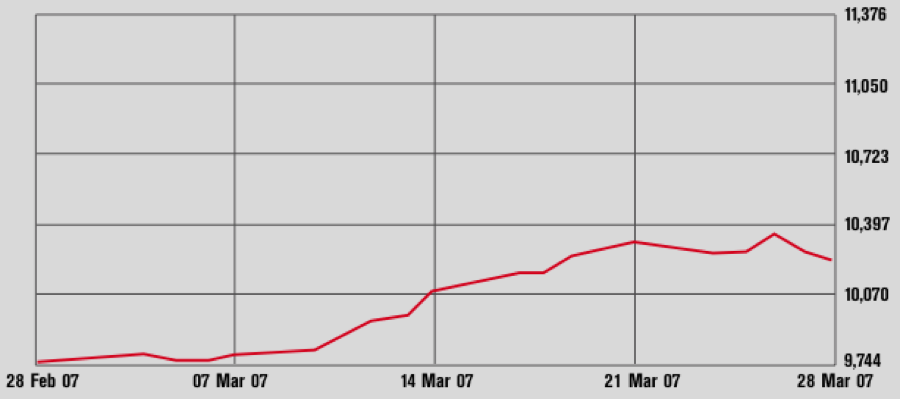
The Kuwait Stock Exchange had a period of growth as its index strengthened by almost 6% to 10,341.3 points on March 26 from 9,769.2 points on Feb. 27. Telecommunications events supplied major influences on the KSE. In the beginning of the month, the share price of Kipco got a boost from the company’s extraordinary profit from selling shares in Kuwaiti mobile operator Wataniya to Qatar’s Qtel. Shares of MTC, the leading telco in Kuwait, advanced 15% to KWD 3.20 on Mar 26, from KWD 2.79 on Feb. 28. At the end of March, MTC emerged as highest bidder in the contest for Saudi Arabia’s third mobile phone license.

Saudi Arabia SE  (1 month)

Current Year High: 17,730.96            Current Year Low: 6,916.85
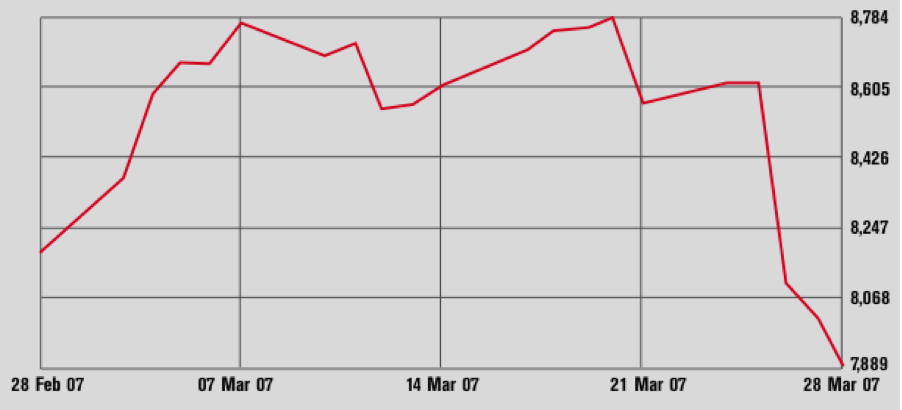
The Saudi Stock Exchange ended a month of modest gains and sideways movements with a splash of cold water. The TASI lost 522 points, or just over 6%, on March 26 in its worst one-day drop since falling 6.3% on July 19 of last year. Sell-offs on March 26 included blue chip companies and leading banks such as Sabic, Al Rajhi Bank, SEC, and the two telcos. For the month, the market moved from 8,356.48 points on Feb. 27 to 8,098.36 points on the evening of March 26. Insurance industry IPOs came in a bundle of five simultaneous subscription offerings worth combined SAR 266 million. The Saudi government created a new $320 million company to operate the SSE, with a long-term view of taking the bourse public. 

Muscat SM  (1 month)

Current Year High: 5,956.46  Current Year Low: 4,657.16
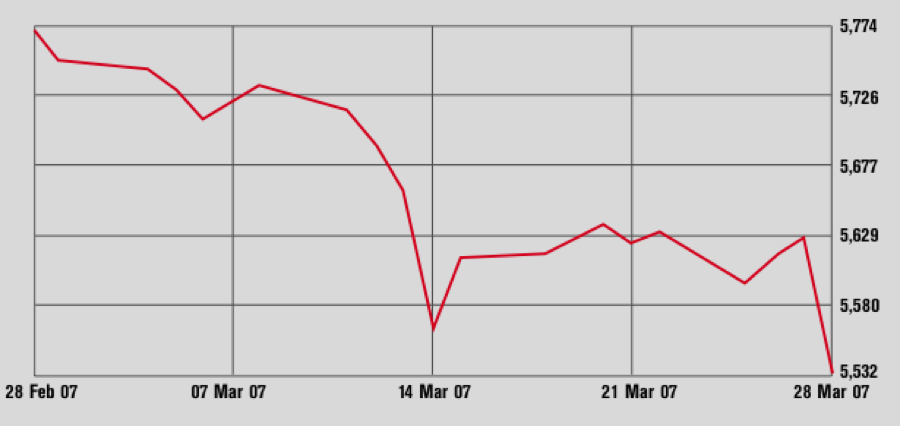
After a slide in February to 5,781.1 points on Feb 26, the Muscat Securities Market went down by 216.73 points, or 3.7%, between Feb. 26 and March 14 before regaining some ground to close at 5616.24 on March 26. The sultanate’s primary market raised new expectations as four companies announced IPO plans. Besides engineering firm Galfar’s OMR 60 million flotation, Oman Merchant Bank and government-owned investment firm Takamul (in May) and Oman Oil Marketing Company are the IPO candidates for 2007. Additionally, Al Omaniya Financial Services will float a two-year OMR 8 million convertible bond.

Bahrain SE  (1 month)

Current Year High: 2,251.15  Current Year Low: 1,996.68
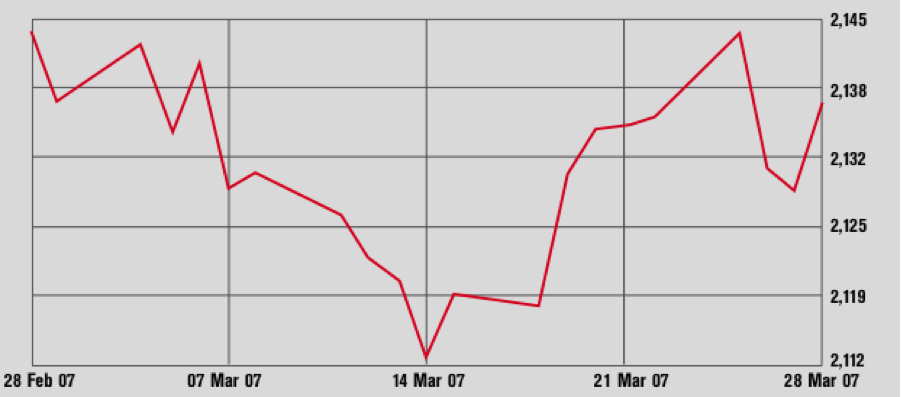
The Bahrain Stock Exchange closed at 2,130.71 points on March 26, down by 0.6% when compared with its level on Feb. 27. The index had dipped lower in the middle of the month but things appeared uneventful and volumes were once again low. Esterad Investment Company moved up 12% in the second half of March and Nass Corp saw some volume toward the end of the month. Mobile phone operator Batelco announced the purchase of 20% in Yemeni network SabaFon for $144 million.

Doha SM: Qatar  (1 month)

Current Year High: 9,878.10  Current Year Low: 5,825.80
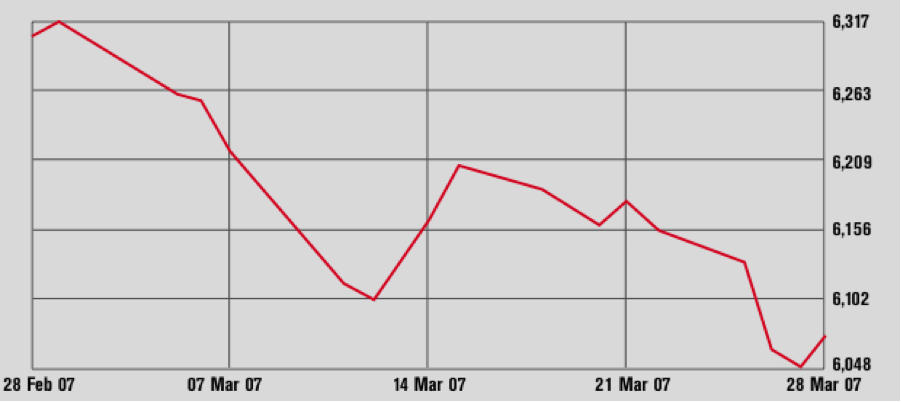
The downward movement of the Doha Securities Market slowed but did not cease and the DSM index slipped 3.5% to 6,060.16 points on March 26 from 6,277.1 points on Feb. 27. This performance put the DSM again as the GCC’s largest underperformer for the year-to-date with a drop of 15% since Jan. 1. After dividend events, banking stocks such as Ahli and Commercialbank paced the market’s downward trend in the later part of the month. Qtel, which initiated the purchase of 51% in Kuwait’s Wataniya telecom, stabilized toward the end of the month. Nakilat continued its rise that started in February and gained 18% in March. DSM market authorities suspended a brokerage for one month for violating regulations.

Tunis SE  (1 month)

Current Year High: 2,712.33  Current Year Low: 1,861.15
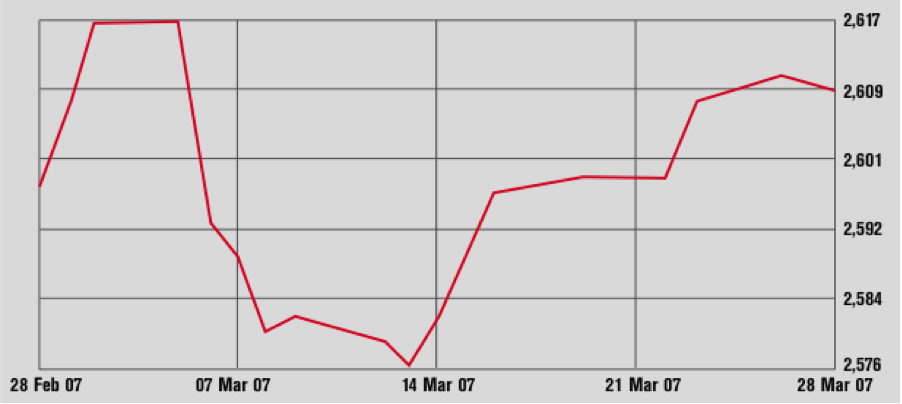
The Tunisian Stock Exchange in March traded sideways on a high plateau and the Tunindex closed at 2,610.14 points on March 26, about 100 points below its year high from Feb. 9. Tunis International Bank participated as lenders in a 55 million euros project finance facility for a new residential project in Libya, the first such finance arrangement in Libya’s real estate sector.

Casablanca SE All Shares  (1 month)

Current Year High: 11,552.97            Current Year Low: 6,563.27
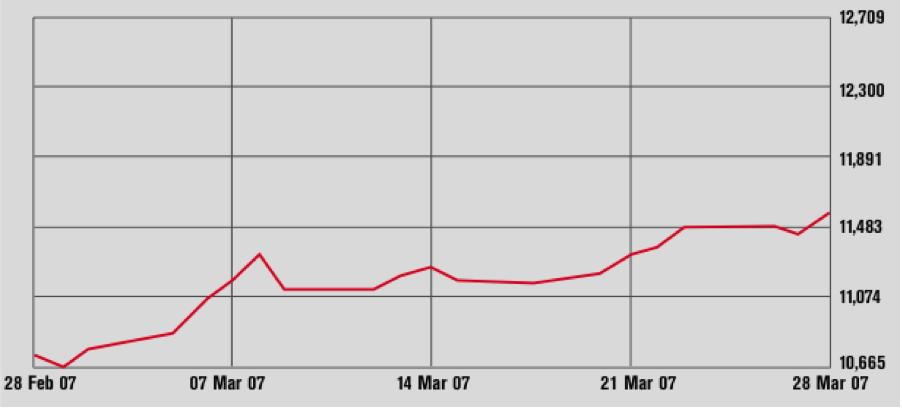
The Moroccan exchange broke through the 11,000 points line in early March and scaled further index gains to close at 11,478.87 points on March 26 in continuation of its rise which brought its gain for the year to date to a tidy 21%. Morocco’s central bank said it expects commercial banks in the country to be compliant with Basel II rules by this summer. With ongoing reforms, the central bank also hinted that a loosening of restrictions on investing in foreign bourses might be on the books, which might take steam out of the Casablanca Exchange and its extended rally.

Cairo SE: Hermes  (1 month)

Current Year High: 65,135.08            Current Year Low: 41,965.37
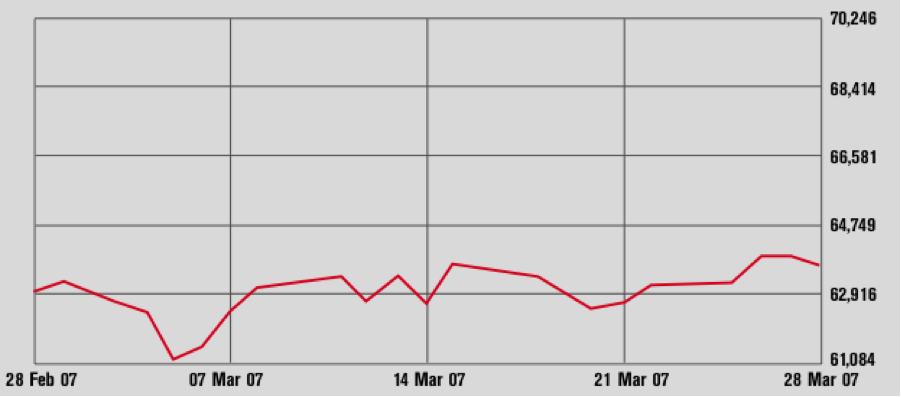
The Cairo and Alexandria Stock Exchanges entered the month with a week of downward motion to the 61,000 points level but the index moved back up and closed at 63,859.80 points on March 26. While Telecom Egypt shares made some gains in late March on news of higher 2006 results and a very faint outlook of a secondary 20% flotation in a few years’ time, Orascom Telecom Holding received three regulatory decisions against its MobiNil affiliate and got disqualified from bidding for the third Saudi mobile license, with rumors going wild on the reasons. Al-Watany Bank found several suitors interested in buying a strategic stake. Emaar Properties subsidiary Emaar Misr said it would file a complaint over a CASE decision refusing to list its shares.  

April 12, 2007 0 comments
0 FacebookTwitterPinterestEmail
InsuranceSpecial Report

Islamic Insurance: The concept

by Jihad Feitrouni April 12, 2007
written by Jihad Feitrouni

People have used insurance in the past to protect against impact of damages and risks.

In the absence of the social insurance, which Islamic countries shoulder to counter the effect and impact of damage to a nation and its assets, and as the majority of countries relinquished their responsibilities in reinforcing cooperation between their people, there grew the need to look for an alternative that guarantees to protect against damage and loss. This alternative is insurance companies operating in Islamic countries, similar to those commercial insurance companies operating in western countries.

Since the nature of transactions practiced within non-Islamic commercial insurance companies do not comply with provisions of Islamic shariah (and often insure establishments and companies that practice types of business not in compliance with shariah provisions), it became essential to look for an Islamic alternative, one that adopted cooperative insurance principles in its business transactions. Islamic insurance is known as “a collective insurance contract” by virtue of the fact that every contributor pays a specific amount of money as a donation for the purpose of indemnifying other contributions on the basis of solidarity and takaful.

Insurance operations are managed by a specialized company on basis of proxy wakala against a pre-determined charge. The subject of the contract is the commitment by all those insured to bear the risk sustained by another contributor. Thus, it is a contractual relationship based on solidarity and takaful to spread risk.

The role of insurance companies in the Islamic insurance system is to manage insurance operations by way of underwriting and execution since this is beyond the policy holder’s capabilities due to the large number of contributors. The company enters into agreement with the contributors by which it collects insurance premiums and pays incurred indemnity to those who have sustained damages in accordance with the regulations, principles and criteria dedicated for the purpose, in addition to all other operations which are required within the insurance industry. All these duties are performed in its capacity as a proxy wakeel against a predetermined charge. The company promises, in the name, and interest of the contributors, to either indemnify against a great portion of damages and losses sustained or indemnify it totally.

As for insurance premiums which are collected from contributors, it is usually enough to cover operational costs, pay incurred indemnity amounts or allot to all types of technical reserve amounts.

For the purpose of determining the amount of insurance premiums, formal statistical principles are applied for each type of cover. Should the premiums not be enough to meet the liabilities, the deficit will be covered by the shareholders on the basis of al qardh al hasan or  “Good Loan,” and if the company has a reserve balance as a result of insurance premiums profit surplus, the deficit then will be met by that surplus.

Jihad Feitrouni is the general manager of Dubai Islamic Insurance & Reinsurance

April 12, 2007 0 comments
0 FacebookTwitterPinterestEmail
InsuranceSpecial Report

Region’s insurance market has ups and downs

by Executive Staff April 12, 2007
written by Executive Staff

The insurance industry in the Middle East has been sitting on the launch pad of great expectations for a very long time. Regulatory changes and the growth of Islamic insurance services are central to suppositions that more customers will flock to insurance around the region. In terms of geography, the main carriers of promise are Saudi Arabia and Syria: two severely underinsured countries which both last year implemented legislation opening significant new spaces for insurance providers.

Saudi Arabia is currently buzzing with an insurance gruenderzeit, at least as far as its stock market. All seven companies that staged initial public offerings in the first quarter of 2007 on the Tadawul bourse were insurers, and they offered $162.3 million worth of shares to Saudi subscribers.

The largest of the seven IPOs was that of Medgulf Insurance, the biggest provider in the kingdom after NCCI, the former monopoly provider that pioneered the move of insurance companies to the Saudi stock market when the state-owned company was privatized to 70% through an IPO. Medgulf, which had previously operated in Saudi Arabia through a Bahraini offshore unit, offered 25% of its shares for $53.3 million in late February. Other shareholders in Medgulf Saudi are the companies of the Medgulf Group from Bahrain and Lebanon (together 35%), Saudi Investment Bank (19%), and 21 other investors, most of them Saudi individuals, who hold between 1% and 2% each.   

Medgulf’s late February IPO was preceded by that of Malath Cooperative Insurance and Reinsurance, which offered shares to investors in a $38 million IPO in early February. By taking 47.5% of its capital to market, Malath conducted the largest IPO in the first quarter of 2007 in terms of percentage offered and was the first of 13 insurance providers to fulfill a mandate to take part of their capital public as one of the conditions under which the 13 firms received licenses from Saudi authorities in 2006.

Saudi market looking bright

In March, the Capital Market Authority in Riyadh directed five insurers to undertake simultaneous initial public offerings at the standard share price of SR10 ($2.7) set by the CMA. Subscription to the stocks was open from March 17 to March 26, and the companies offered shares worth a total of just under $71 million.

The five firms that conducted subscription in March were relatively small, offering between $8.3 million and $21.4 million in shares representing between 31% and 40% of their respective capitals for subscription periods that ended on March 26. The companies coming to market are SABB Takaful, and cooperative insurance companies Saudi United, Saudi IAIC, Saudi Fransi and Arabian Shield.

Subscription rates for the five March IPOs were not yet announced when Executive went to print. But the two earlier IPOs got the warm welcome of high demand for their share offerings. Malath reported subscription coverage of 499%, worth $189.4 million. Medgulf reported that its offer attracted subscription requests from 1.4 million persons and demand for shares reached $209 million, or a 400% subscription rate.

The high subscription rates to the two offerings may be indicative that the rulings of Islamic scholars in support of mutual insurance are having more influence than opposing views circulating in Saudi Arabia, which still maintain that all insurance is a game of chance, and thus objectionable under the ban against activities that entail elements of uncertainty and gambling, as well as taking interest from investment portfolios.

While the oversubscription figures signal that the Saudi retail investors regard insurance companies as primary market opportunities that are acceptable under the investors’ religious standards, one cannot easily surmise that the financial attractiveness of insurance IPOs with CMA-mandated issue pricing is a guarantee for the companies’ success in either the retail insurance market or on the bourse.

According to estimates quoted frequently in discussions on the Saudi insurance market, the insurance sector is estimated to value about $2 billion and to have a potential to grow to $4 to $6 billion over the next five-to-ten years (without much adjustment of these estimates in the past two years). This is a minute percentage of the country’s economy, especially when considering that GDP increased to $347.4 million in 2006 and per capita GDP (measured in purchasing power parity) has been growing at rates of more than 5% in 2006 and is expected to grow by another 5% in 2007.

The reasons for optimism on Saudi insurance sector performance in the coming years arise concretely from motor and health insurance requirements, which have become mandatory, and, in general terms, from the kingdom’s economic development and its population growth. There is little evidence to suggest that optimism on the growth of insurance awareness among retail customers and in media, or on vast expansion of insurance sector expertise and human capital, has a strong base. 

While the creation of an insurance sector is seen as an important addition to the financial industry and equity markets of Saudi Arabia, it also seems unlikely that the sector’s arrival will provide a large short-term contribution to widening the institutional investment market or set new milestones in corporate governance. Examples of insurance sectors in other GCC markets over the past few years show them as holding significantly less importance than most other sectors which financial analysts track through sector indices.  

Syrian market grows, too

Just as regulatory forces have been setting the pace for insurance development in Saudi Arabia, authorities in Syria have been infusing a spark of opportunity into their country’s outlook for creating a sustainable insurance industry.  Since last year, insurance firms have received license approvals and started setting up shop in Damascus.

In March, Noor Takaful, a shariah-compliant insurer in Syria whose founding partners include a Kuwaiti-Pakistani insurance joint venture and Jordanian companies, said it would complete a public offering for $15.03 million, or 50.1% of its capital before the end of last month. Similarly, Kuwait-affiliated Syrian insurance company Al Aqeelah Takaful told Executive that it plans an $18.74 million offering for 51% of its capital before the end of spring. Managers at Noor and Al Aqeelah said the firms intend to start operations in April and August, respectively.

The lust for public offerings of financial companies in Syria rests on the foundation of heightened readiness by Syrian authorities to issues operator licenses to insurance providers and is nurtured by tax incentives, which offer firms a 10 percentage point lower tax bracket if they solicit capital participation from the public.

Lebanese insurance firms have been participating in prying open the Syrian market. Arope, a member of the Blom Bank Group, started operations in Damascus in July of last year. While it is too early to look at results of the venture, said Fateh Bekdache, Arope’s general manager in Lebanon, the experience of building something where no private sector insurance existed previously is intriguing. “The start is bumpy,” he said, “simply because it is a new law and a new sector. But it is extremely interesting to start something.”

Like BSO Bank, the Syrian bank linked to the Blom Group, Arope Syria chose to undertake a public offering that brought it tax benefits, which Bekdache cited at a rate of 15% of local taxes instead of 25% of local taxes for companies that prefer a private ownership structure without public offering.

Adir, the insurance daughter of Byblos Bank Group and France’s Assurances Banque Populaire, opted for private ownership in its Syrian venture, which last month received a preliminary license from Syrian authorities and expects to be up and running within six months.

According to Jean Hleiss, Adir’s assistant general manager, the new company will start operating with a $25 million capital and offer general and life insurance products in Syria under the name Adonis Insurance Syria.

Although the Syrian insurance market has been a favorite topic of expansion dreams among Lebanese insurance companies for years, the difficult situation of the Lebanese economy and its repercussions on the insurance sector seem to have somewhat stifled the eagerness for going cross-border. Bank-affiliated firms like Arope and Adir appear to have advantages in venturing east because they are part of groups with deep pockets and have greater access to working capital than standalone operators.

Additionally, having a bank in Syria enhances efficiencies, because the Syrian Insurance Supervisory Commission and the central bank gave “full approval to run insurance operations in the branches of banks,” Bekdache said. Thus, in addition to its head office in Damascus and an office in Aleppo, Arope Syria can base employees in the branch network of BSO and sell its insurance products there.

Lebanon not a fertile growth area

Meanwhile, in Lebanon, insurance growth prospects are faint, at least in the short run. The sector did not take direct hits during the war in July and August of 2006, said Max Zaccar, chairman of Commercial Insurance. “The Lebanese insurance sector was not affected negatively by the war, in terms of premium income,” Zaccar told Executive, adding that marine and transport insurance lines saw small growth in premiums because of greater insurance needs in the summer, and that payment morale among insurance clients actually improved.

Despite the war and political troubles at the end of the year, 2006 was better for Lebanon’s insurers than 2005, added Bekdache. He attributed last year’s satisfactory performance to very good business in the first half and a few good months immediately after the end of the Israeli war.

But for 2007, things are a lot murkier. The main problem is that Lebanese businesses are not making new decisions, because they are waiting for political progress to materialize. Under the circumstances, which include cash flow problems in many companies and private households, “the insurance sector has no new business and companies are fighting over what is there, competing with reduced prices to take slices of business from one another,” Zaccar said.

He added that local insurers also continue to be in a clinch with the Ministry of Economy, over the ministry’s plan to legally mandate insurers to structure companies separately for life and general business, and meet $10 million capital requirements that would only make sense with much more substantial premium incomes than the providers can muster in Lebanon’s $600 million premiums-strong market.   

GCC feeling the pinch

GCC insurance companies felt pressure in 2006, mostly from the downturn in returns for their investment portfolios. As many of the sector companies are highly capitalized and have concentrated on their investment portfolios for the good profits they had in 2005, shifting focus to increase underwriting income quickly does not seem to be an easy path, given that the maturing of regional insurance markets has been following the mantra of the snail, despite all sector talk about rapidly growing insurance industries in countries such as Bahrain and Qatar.

Islamic insurance products will add to the widening of the market, but also in this segment, hype over fast gains and limitless potentials has not been substantiated by the equivalent growth of underwriting activities. In Oman, for example, insurance penetration—the ratio of insurance premiums to GDP—has remained below 1% and the share of life insurance has stagnated below 15% of all premiums, according to a study by BankMuscat.

In all GCC markets, most of the underwriting, moreover, is concentrated in motor and health insurance, exactly the two coverage areas which have more risk and less reward to offer than most other insurance activities. Takaful family and takaful life products, which assist households in creating wealth, may provide a way into greater presence of the benefits that responsible insurance offers to a country, but even by one optimistic scenario for Saudi takaful life insurance growth, premiums would pass the $1 billion mark only by 2015.

The founding wave of new insurance companies thus seems to be the most positive development in regional insurance affairs for the time being. Add to this that multinational insurance firms have shown interest in the market and that a player like Allianz—the world’s number two in the insurance sector—has taken a license to establish a takaful unit in Bahrain. Lebanon also just might harvest some further gains from the interest of multinational players, as the local affiliate of a big international firm is rumored to be in negotiations to buy another firm with several branches in the Middle East, in order to broaden the multinational’s access to the region’s markets.

April 12, 2007 0 comments
0 FacebookTwitterPinterestEmail
Banking & Finance

Money Matters by BLOMINVEST Bank

by Executive Staff April 12, 2007
written by Executive Staff

Regional stock market indices

Regional currency rates

ARAMEX launches 30,000 square foot one-stop shop at Heathrow

Dubai-listed transportation and logistics solutions provider ARAMEX announced the merger of three of its European companies into one 30,000 square foot one-stop-shop at Heathrowairport, outside London. As such, upon the acquisition of UK-based Priority Airfreight and Dublin-based TwoWay Vanguard, ARAMEX unified these two companies with its Heathrow operations at ARAMEX House, its new premises in Heathrow. ARAMEX reported net profits of AED95.2 million ($26 million), up 28% year-on-year.

Al Baraka posts 20% increase in net profits to $123.7 million

Al Baraka Banking Group (ABG), an international Bahraini-based Islamic Bank, recorded net profits of $123.7 million, up 20% from $102.9 million in 2005. The bank’s total assets were at $7.6 billion, up 21% for the same period, while costumer deposits rose 15.3% to $6.2 billion. ABG underwent an initial public offering in June 2006, leading to a 73% increase in shareholder’s equity to $978.6 million. ABG recently signed a memorandum of understanding with the Arab Trade Finance Program (ATFP), thus becoming the program’s eleventh national agency. ATFP will thus provide credit facilities through a line of credit opened at ABG.

Country profile: Egypt

International rating agency Moody’s Investors Service released its latest report on Egypt affirming Egypt’s government bond ratings at Baa3 with a negative outlook in local currency, and Ba1 with a stable outlook for foreign currency bonds. The report stated that Egypt has been experiencing upturns in growth since 2004, mainly boosted by a rise in international oil prices, a strong tourism sector and strong export performance. Moody’s estimates Egypt’s GDP real growth rate at 6.9% in 2006, up from 4.6% in 2005, and forecasts real growth rates of 6.0% and 5.5% in 2007 and 2008 respectively. Moody’s notes that Egypt’s fiscal deficit declined in 2006 for the first time in five years. The reforms introduced since 2004 are starting to materialize as tariffs and taxes are being reduced and privatization is being revived. Moody’s also stated that despite a manageable external debt burden and an important geostrategic position, the government’s weak fiscal position and fast-growing population are the main credit challenges facing the Egyptian government.

April 12, 2007 0 comments
0 FacebookTwitterPinterestEmail
Cover story

No nukes are good nukes? Gulf not so sure

by Executive Staff April 12, 2007
written by Executive Staff

Electrical power generation in the Middle East may have become a bargaining chip in a different power contest—a contest over security cum political dominion. The region has pressing needs for developing new power-generation capacities to supply its growing economies, but when the GCC heads of state decided at the end of last year to pursue a research program into civilian use of nuclear energy, the political questions were inevitable.

Does the GCC want to challenge Iran’s controversial nuclear program—that red flag for the US and most Western governments because of its military potential—by making sure it does not fall behind a threatening neighbor in nuclear technology?

Or does the GCC plan have a primarily economic rationale?

Over the past few weeks, supporters of building nuclear power plant(s) in the Middle East have argued that a plant could be completed in seven to 17 years’ time. The UAE—but also Jordan and Egypt—were named as countries where Middle Eastern nuclear reactors could be located.

Supporters of the idea pointed to the fact that France relies on nuclear power for a large portion of its electricity production. Arguments in support of developing nuclear capacities even went as far as saying that countries like Turkey have the same skills and human resources as developed countries, shifting the issue towards national self-assertion vis-à-vis other nations.

Energy demands racing ahead

In light of the growth of existing production capacities and demand, it is usually said that the energy needs of MENA countries are growing at about 6% per year, with an expected continuation of that high-growth scenario for at least another 10 years because of the region’s population growth and ambitious development plans.

However, adding a nuclear component to regional power projects—from the GCC electricity grid under implementation to national power generation programs in North Africa—may require shifts in energy policies and, as one Kuwaiti academic suggested, a cultural shift to make countries more collaborative.

In Saudi Arabia, which accounts for just under half of GCC power generation, electricity generation grew at a cumulative average growth rate of 6.9% between 2000 and 2005. The Saudi Electricity Company has a number of new power generation projects lined up, with an investment volume of over $12 billion from today until 2017 in power generation from fossil fuel.

Egypt, which relies heavily at present on its Aswan Dam for power generation, has a program for refurbishing and expanding gas-burning plants—but it is also looking at the nuclear option. The reason for the country’s interest in a nuclear reactor is said to be that the Nile republic will only be able to export liquefied natural gas to Europe in the amounts it plans if it covers its domestic needs with nuclear production.

According to available research, investments into MENA power projects over the next four years will have to exceed $35 billion to increase the generating capacities by more than 40%. These additions are almost all in conventional power and have advanced beyond the initial planning stage.

Nuclear units under construction worldwide

Source: International Atomic Energy Agency PRIS database
Updated: 2007

A nuclear reactor project, by contrast, is not likely to be on the books for several years after the day that the GCC plan for a nuclear research program is implemented. Considerations in preparation for such a reactor project will have to include serious issues that go far beyond financing and the feasibility of nuclear power generation during the lifespan of a reactor, which, with current technology, is described by European experts to be around 40 years at best. 

Few installations are more heavily scrutinized by the international community for security reasons than nuclear reactors. The memories of Three Mile Island and Chernobyl rest heavy on the minds of emergency planners, because one extreme incident in a nuclear power plant can affect an entire region for years. This is not a question of some countries having a better track record on safety than others: in Japan, one of the most safety-conscious countries, several  minor incidents last month led to a further tightening of technical reporting and oversight regulations for civilian nuclear facilities.

Secondly, at least in the perception of some planners, putting a nuclear power plant into the Middle East may be like putting a juicy bone in front of a dog. Potential terrorist threats against a nuclear reactor in Yanbu or on the UAE coast would, certainly, raise serious objections in Western nations, who would likely oppose selling the requisite number of reactors to the Arab world for extensive electricity generation in the GCC or North Africa. (The Levant, as long as peace is absent between Israel and its neighbors, seems the least likely candidate for a nuclear power plant.)  

Nuclear technology has been a remote issue for American and most European energy planners for at least the past two decades. The high cost of building a secure nuclear plant has been one deterrent, which led energy companies to shift their focus from nuclear power in the 1990s. In several European countries, most notably Germany, basic fear and grassroots political opposition to anything nuclear has forced a halt of new nuclear power plants, both light water or heavy water reactors.

Top 10 countries generating nuclear power – 2005 (Billion kWh)

*Includes Taiwan, China
Source: International Atomic Energy Agency and Global Energy Decisions / Energy Information Administration
Updated 11/06

A lot of trouble, but an opening of discussion

The dangers of uranium enrichment, the processing of nuclear waste, and most of all, the need for storing this waste for centuries, have restricted the civilian nuclear options. The way in which North Korea’s Kim Jong Il has played the nuclear threat card in his impoverished country’s poker game with the United States, and the uproar created by the Iranian nuclear program despite Tehran’s insistence on the program’s civilian aims, have drawn new attention to the possibility of using nuclear programs in contemporary political power games.

The high costs of energy worldwide and perhaps less nuclear-phobic attitudes among younger people today seem to have encouraged supporters of nuclear power to return to the table and discuss the use of this technology anew. The current plans for a feasibility study on a nuclear program for the GCC is not the only recently reignited debate over atomic energy. In Europe and the US as well, nuclear power is a growing discussion topic.

As the GCC and other Middle Eastern nations to investigate their nuclear options, the new nuclear files come with many open questions about political and security risks, but also costs and viabilities. The rich countries of the region are among the world’s heaviest consumers of electricity per capita. Before the region is likely to see nuclear power sources for its economies, power conservation and increases in conventional production are likely to be the topics that can have the most positive impact on the energy sector. 

April 12, 2007 0 comments
0 FacebookTwitterPinterestEmail
North Africa

Tunisia’s sell-off slowdown

by Executive Staff April 12, 2007
written by Executive Staff

The privatization process in Tunisia is starting to run out of steam, though not from lack of support for the program from the government. It has instead become a victim of its own success, as the state is beginning to run out of assets of interest to investors.

Although the program is ongoing, the pace at which it is moving is less than in the past. On Jan. 12, Direction Générale de la Privatization, Tunisia’s privatization authority, announced it was calling for tenders for a 76% stake in the state-owned retail chain Magasin Général. The winning bid for the profit-making chain of 43 outlets is set to be made public in the second quarter of 2007.

Bids have also been called for the privatization of state-owned electrical transformer and power and solar water heater producer Société Anonyme de Constructions Electromécaniques (SACEM). As with the sale of Magasin Général, Banque d’Affaires de Tunisie, which has become something of a specialist in the field of privatization, is serving as the main adviser for SACEM’s sell off.

Another enterprise that has recently been put up for sale is Nour El Ain Hotel, operated by Ain Draham Tourism Society. Located in the north of the country, close to mountain ranges and hunting preserves, the 60-room hotel has drawn strong interest from investors. The tender process for the hotel closed on March 20.

Early adopter of privatization

Tunisia was an early convert to the privatization process in the region, first launching its program in 1987, after the policy shift away from a centralized economy. The program can be divided into three distinct phases. The first ran from 1987 until 1994, when many unprofitable state enterprises were sold off, the majority being in the tourism, commerce, fishery and agro-foods sectors.

The second phase, which covered a four-year period from 1994, saw the state put in place legislative procedures to allow it to sell off more profitable assets, launch initial public offerings and block sales, laying the foundations for the expansion of the program.

Since 1998, the focus has shifted to the privatization of major state enterprises, in strategic areas such as heavy industry, communications, energy, transport and retailing.

To date, Tunisia has achieved solid success, having sold off just over 200 state enterprises, spread across three broad categories—services, industry and fisheries/agriculture—with 45 sell-offs in the tourism sector, one of the most important for the Tunisian economy. Over the past 20 years, some $4.2 billion has been raised from the sales.

During the period of Tunisia’s 10th five-year economic plan, which commenced in 2002, 47 state enterprises were partly or fully sold off. In terms of numbers, this was only exceeded by the preceding five-year term, in which 75 state assets went under the hammer. However, as far as revenues go, 2006 broke all records, with $2.37 billion being transferred into the government’s coffers.

An interesting aspect of Tunisia’s privatization program is the high level of interest it has attracted from overseas investors. Of the total $4.2 billion generated so far, $3.7 billion has come in the form of foreign direct investment (FDI).

Tunisie Télécom a moneymaker

The success of 2006 has been underpinned by the sale in July last year of a 35% stake in Tunisie Télécom to Tecom Dig, a subsidiary of Dubai Holding. The sale raised $2.25 billion, accounting for more than half of the program’s total revenue and the vast majority of FDI.

Another achievement is the ongoing viability of the vast majority of enterprises after their shift away from the public sector. According to studies conducted by the privatization authority, almost all of the businesses and assets privatized have prospered, even those loss makers that the state divested itself of early in the program.

While Tunisia’s privatization program may not have generated some of the highest levels of revenue garnered by other countries in the region, the process has been a steady and carefully moderated one, rather than a “fire sale” of assets. Moreover, according to state surveys, most enterprises have upped their profits and taken on staff following their privatization, translating into an ongoing benefit to the economy, instead of a one-off windfall. As Tunisia is discovering, boosting the private sector can prove fortuitous.

April 12, 2007 0 comments
0 FacebookTwitterPinterestEmail
North Africa

Algeria’s industrial strategy

by Executive Staff April 12, 2007
written by Executive Staff

During a conference with various employers’ associations in March, Hamid Temmar, the minister of state shareholdings and investment promotion, unveiled the Algerian government’s new strategy for industry. The state program consists of several growth plans, with a special focus on restructuring and upgrading production facilities to make Algeria more competitive and bring the country in line with international standards.

Temmar emphasized the need for companies to become more independent and act as sole decision-makers in their businesses. “Industrial companies,” Temmar said, “must seek to become modern enterprises with regards to technology. Besides, in the long term, industrial exports are expected to account for an integral part of the liberalized economy.”

If plans for economic diversification are to move ahead, industrial products will make up a greater share of exports, thus reducing the country’s reliance on hydrocarbons. Not only does this shake-up concern the existing industrial sector, including public and private companies, but also any future industrial investments, as they will need to be made with this logic in mind.

Set up in the 1970s and 1980s, the current industrial facilities are outdated and inefficient due to the political turmoil of the 1990s. This era prevented Algeria from following major technological developments. Although foreign direct investment (FDI) has picked up, most of it is still earmarked for the oil and gas sector, while the manufacturing sector in the country has been suffering from poor equipment and foreign competition from low-cost imports.

Time for companies to take center stage

Temmar added that while the government will remain a key actor in implementing the new strategy, individual companies will have to take center stage and not rely on the state for advice and assistance. Firms will need to build on their own strengths and comparative advantages in order to grow. Companies must adapt to world industry standards, create independent decision-making processes, and focus on technical, technological, financial capacities and human resources.

Indeed, among Algerian industrial companies, the training deficit is huge. Issad Rebrab, CEO of Cevital, described it as “the major stumbling block.” He added that “finding the right people in any position, but notably at top managerial posts, is increasingly difficult.”

As Algeria is embracing free market principles, local companies need to start acting and thinking in line with the changing economy. The state will target several sectors for development where it feels the potential is strong and where there are real synergies with other segments. The government has currently singled out the petrochemical industry, pharmaceutical industry, fertilizers, food-processing businesses, the steel industry and mechanical and construction material-making as areas of potential development. Two new activities are to be given priority: automobile production and information and communications technology.

Furthermore, some sites have also been targeted for the implementation of this strategy. Three types of zones have been established or are in the process of development. Firstly, there are “competivity poles,” which will involve the restructuring of facilities located in Algiers, Blida, Oran, Mostaganem, Annaba, Setif-Bordj Bou Arreridj, Boumerdes, Tizi-Ouzou and Ghardaia-Hassi R’mel. Secondly, there are “technopoles,” which will be located at Sidi Abdullah near Algiers for new technologies, Bejaia for food processing and as an export hub due to its sizeable port, and Sidi Bel Abbes for electronics. Finally, “specialized zones” will be developed at Arzew, Hassi Messaoud, Skikda and Oran. Other regions may also be identified in order to promote other sectors such as tourism, agriculture and fishing.

While companies are expected to upgrade their infrastructure, human resources and management remain key to the strategy’s success. An estimated $1 billion will be allocated to support its development, though how this is used will greatly determine the direction economic growth takes in Algeria.

April 12, 2007 0 comments
0 FacebookTwitterPinterestEmail
North Africa

New competition on line three

by Executive Staff April 12, 2007
written by Executive Staff

The launch of Morocco’s new telecom operator, Wana, was greeted with much popular relish, revealing the appetite Moroccans have for the fruits of telecommunications liberalization. The high-profile launch comes on the heels of the decoupling of Maroc Télécom’s network and ahead of measures to ensure number portability between operators.

As a sign of the competition gearing up, the newly re-branded Wana (formerly Maroc Connect) launched its Bayn array of services in both the mobile and fixed-line markets on Feb. 7. The company’s offices were swamped by interested customers, with some 24,000 signing up on the first day, over twice the amount expected.

Through an investment of $703 million, the new operator, controlled by two holding groups close to the royal family, ONA and SNI, expects to turn a profit by 2010. Having installed 500 base stations across the kingdom, Wana has tapped into the 4,600 km fiber-optic network installed by the electrical group ONE (Office National de l’Electricité).

While the two existing operators, Maroc Télécom and Méditel, have kept their market shares relatively stable over 2006, Wana states it plans to aggressively gain up to 20% market share in the next three years. Maroc Télécom still dominates the market with 67% of all lines.

Industry insiders are hoping for big things with the new competition in town, expecting a substantial growth in associated telecoms services.

“The new operator, Wana, is welcome to the market, as the competition will drive improvements in service and range of products on the market, while at the same time providing a driving force for our sales,” said Jarmo Santala, Nokia’s general manager for North and West Africa.

Competing for services

A number of technologies are to be implemented by Wana to drive the competition for services, including using Code Division Multiple Access (CDMA) technology, rather than GSM, which will allow the deployment of large-scale fixed telephone and internet services over wider areas, thus optimizing the capacities of Wana’s network.

This noteworthy start was also witnessed at the corporate service level, as Wana has plans to install the local copper infrastructure at Casashore, an industrial park specializing in offshoring. It is estimated that the companies based at Casashore, which is expected to be operational by the fourth quarter of 2007, will benefit from a 30% fall in prices.

The success of the new offer has bred its own problems, however. The excess demand on the first day of services overloaded the network and disrupted communications. In addition, the Bayn numbers are not accessible to subscribers of the two other networks, Méditel and Maroc Télécom, as yet.

These issues, to be resolved shortly according to Wana, arose despite the uncoupling of the local copper loop maintained by the dominant Maroc Télécom. The National Agency for the Regulation of Telecommunications (l’Agence Nationale de Réglementation des Télécommunications, or, ANRT) approved the technical and tariff offer proposed by Maroc Télécom on Jan. 29.

This first phase of the liberalization specifies that, retroactively from Jan. 1, Maroc Télécom’s competitors can offer services using the local loop built and maintained by Maroc Télécom for a fee of $5.90 per user. This phased liberalization process will culminate in the full opening of the local loop on July 8, 2008, at which time all telecoms service providers will be able to use the local loop without paying a fee.

The reduction in this interconnection price should translate into further savings for consumers, as telecoms operators are allowed to compete without having to invest in building their own local loop copper infrastructure.

Additionally, number portability across service providers will have been introduced on March 1. This step will help consumers move between operators, allowing for a more fluid pricing structure.

“The upcoming implementation of number portability between mobile operators proves the level of cooperation within the industry. 2007 is set to be a very healthy year for the telecoms market,” said Santala.

As Inigo Serrano, CEO of Méditel, put it, “The lock-in effect will be broken and consumers will be free to choose an operator without concern about changing their number. We have been working with the other operators and the ANRT for a few months now to organize this transition, which will take effect soon.”

Analysts, however, do not believe these moves will impact Maroc Télécom’s market share, given that penetration rates are set to progress at a healthy rate.

While the market penetration rate for mobile phones rose to 53.4% at the close of 2006 (reaching over 16 million subscribers), fixed-line penetration actually dropped by 5.6% over the same period, to stabilize at a mere 4.24% of the population. With the weakest fixed-line penetration rate in the Maghreb, Moroccans seem to prefer mobile rather than fixed connections, a trend noticed in many other African countries with poor fixed-line architecture.

April 12, 2007 0 comments
0 FacebookTwitterPinterestEmail
North Africa

Housing boom for Egypt in 2007

by Executive Staff April 12, 2007
written by Executive Staff

The real estate sector in Egypt is looking to build on its strong 2006 performance, with new regulations encouraging home ownership. The hoped-for result? As mortgage financing becomes increasingly available, economic growth is expected to help fuel a property boom.

While some analysts have voiced doubts regarding a continuation of the Middle East’s real estate boom, pointing in part to the slowing of the market in the last months of 2006, such concerns don’t appear to be affecting Egypt.

In part, the Egyptian real estate sector has not experienced the same frenzied activity as in the Gulf states, nor seen the same massive levels of investment. Growth has been somewhat more measured, but has increased over the past two years.

Strong price gains in some areas, mainly around Cairo, have occurred. However, the high level of appreciation in some parts of the market does not presage an equally spectacular fall.

According to Maher Maksoud, CEO of the 6th of October Development and Investment Company (SODIC), one of Egypt’s largest home-grown property developers, there is no risk of the real estate bubble bursting.

“Not even close,” said Maksoud in one recent interview. “Egypt is changing significantly. We have a massively frustrated demand for all kinds of real estate, not only housing. Purpose-built office and retail space is still a rarity. The demand has existed for several years now, but the economic situation in the country has previously stood in the way.”

This changing situation has been accelerated by the entry into the market of major Middle Eastern property developers, though many of the ventures by such firms in the Egyptian market have been in the tourism sector. One of the most notable exceptions has been the Dubai giant Emaar, which last year announced plans for a massive $14 billion development outside of Cairo, combining residential, commercial and recreational facilities.

A chronic shortage of housing

Lavish as this and other top of the market developments are, they do little to address the chronic shortage of housing facing the man in the street. Recent figures show that Egypt needs 2.5 million housing units just to meet existing demand and a further 350,000 annually to keep pace with its burgeoning population growth.

One project that will go some way to help is the Talaat Moustafa Group’s Madinaty City development to the east of Cairo. When completed, the new satellite city will comprise 80,000 residential units, a mix of apartments, villas and townhouses, complementing the group’s nearby Al-Rehab development, home to some 200,000 people.

Egypt’s residential property market has received a number of boosts from the government, which in recent years has simplified and speeded up the registering of property and slashed registration fees to $350. The state has also been encouraging the country’s banks to be more active in providing financing for prospective homebuyers. Currently, there are just 12 banks and two mortgage financing companies operating in the domestic market, a figure the government hopes will increase this year.

At least in part, it appears that the government’s hopes are being realized, with Dubai-based finance firm Amlak announcing on Jan. 9 that it would be expanding into Egypt to offer financing and real estate services.

Amlak is to offer long-term housing finance of up to 20 years, using financial models in line with the principles of shariah. Until recently, most home financing on offer in Egypt had a maximum term of just five-years, limiting the number of Egyptians who could avail themselves of the service.

Entering a small market

Amlak is entering what is by global standards a small market. Figures released by the Egyptian Mortgage Finance Authority show the level of mortgage loans at less than 0.5% of GDP. This compares with the UAE’s figure of 2% in 2005, or 39% in the EU.

There is the danger that many middle income earners could be priced out of a market that is just opening up to them. With land and housing prices rising well above the 2006 inflation rate of 12%, potential buyers could be playing catch up in the still tight market.

However, with the Egyptian economy tipped to expand by around 7% this year, and both greater access to financing and an expanding middle range property market, many more Egyptians may end up owning the roof over their heads.

April 12, 2007 0 comments
0 FacebookTwitterPinterestEmail
GCC

Bridge to drive economy

by Executive Staff April 12, 2007
written by Executive Staff

It’s hard to believe that a 9-mile bridge could link two continents and potentially draw a life-changing economic course for Yemen and Djibouti, whose strategic coastal locations offer an ideal setting for a connecting bridge.

Yet this ambitious enterprise is precisely what is currently being studied. According to Al-Bayan newspaper, the Middle East Development Company of Dubai is in talks with the governments of the two nations regarding the construction of the bridge, hoped to serve as a gateway for tourism and commerce for the source countries.

Previously connected only by common hardships, the two nations will now be able to share in what promises to be no less than an economic revival. The bridge project, rumored to launch in early spring 2007, is estimated to cost $1 billion, with no word yet on the completion date.

In addition to the highway encouraging inter-continental visits, the bridge will include a railway track, which will offer Yemeni exporters a faster alternative to maritime shipping and a more cost-effective option over air transport. With the increase of free-trade agreements and inter-regional construction projects, the ease of transport between the two regions should extend export advantages for Arab countries in product and labor costs.

Yemen’s exports, which include crude oil, vegetables, coffee and cotton, among other necessities for Africa’s arid countries, are sure to rise with the construction of this bridge.

The bridge will also open promising doors to labor exchanges with the continuously thriving GCC countries in the areas of manufacturing, construction and engineering.

Djibouti, a major regional port, trans-shipment and refueling center, and the oil-exporting nation of Yemen both stand to benefit from such an enterprise, because of its restorative economic potential in the areas of trade, tourism and labor. Thus this bridge could envision the fairly rapid and much-needed insertion of funds for their ailing economies.

April 12, 2007 0 comments
0 FacebookTwitterPinterestEmail
  • 1
  • …
  • 586
  • 587
  • 588
  • 589
  • 590
  • …
  • 688

Latest Cover

About us

Since its first edition emerged on the newsstands in 1999, Executive Magazine has been dedicated to providing its readers with the most up-to-date local and regional business news. Executive is a monthly business magazine that offers readers in-depth analyses on the Lebanese world of commerce, covering all the major sectors – from banking, finance, and insurance to technology, tourism, hospitality, media, and retail.

  • Donate
  • Our Purpose
  • Contact Us

Sign up for our newsletter

    • Facebook
    • Twitter
    • Instagram
    • Linkedin
    • Youtube
    Executive Magazine
    • ISSUES
      • Current Issue
      • Past issues
    • BUSINESS
    • ECONOMICS & POLICY
    • OPINION
    • SPECIAL REPORTS
    • EXECUTIVE TALKS
    • MOVEMENTS
      • Change the image
      • Cannes lions
      • Transparency & accountability
      • ECONOMIC ROADMAP
      • Say No to Corruption
      • The Lebanon media development initiative
      • LPSN Policy Asks
      • Advocating the preservation of deposits
    • JOIN US
      • Join our movement
      • Attend our events
      • Receive updates
      • Connect with us
    • DONATE