• Donate
  • Our Purpose
  • Contact Us
Executive Magazine
  • ISSUES
    • Current Issue
    • Past issues
  • BUSINESS
  • ECONOMICS & POLICY
  • OPINION
  • SPECIAL REPORTS
  • EXECUTIVE TALKS
  • MOVEMENTS
    • Change the image
    • Cannes lions
    • Transparency & accountability
    • ECONOMIC ROADMAP
    • Say No to Corruption
    • The Lebanon media development initiative
    • LPSN Policy Asks
    • Advocating the preservation of deposits
  • JOIN US
    • Join our movement
    • Attend our events
    • Receive updates
    • Connect with us
  • DONATE
Banking & FinanceBy Invitation

GCC governments hope to boost stock listings

by Imad Ghandour May 1, 2007
written by Imad Ghandour

The number of listed securities in the GCC is a flaw that the local governments have been trying to correct. Hence, there is a general consensus amongst regulators that getting more companies into the public market is a “good thing.” Their end goal is creating deeper markets with more securities and better diversification, ensuring lower market volatility, decreasing valuations to more reasonable levels, and spreading the wealth generated from economic growth and privatization to the general population.

Thus, GCC regulators have allowed more than $16 billion worth of IPOs to take place since 2004, and are examining the applications of an additional 90 companies. Of course, timing has been an issue, and some regulators have opted to delay some IPOs so as not to exacerbate the downward pressures already in play.

However, GCC investors (both retail and institutional) are becoming more discerning. Today, the IPO story has to be solid, and has to be one of growth and strategic focus. Management track record is essential for investors to buy into the future. Size is also an issue, as small IPOs may have difficulty in registering on the radar screen of investors and regulators alike.

Initially, the role of private equity funds was limited to acquiring minority equity stakes in companies just before going public. As part of circumventing the legal restrictions in the outdated listing process, funds would finance the establishment of a green field company that will acquire the operating company at a price closer to its true value, thus evade using the book value approach adopted by many regulators.

It became quickly apparent that funds can assume a bigger role in the preparation for the listing. Investors were more comfortable with a fund entering and ensuring that everything is in order and transparent. Funds would enter at a discount, and put their seal of approval that the company is ready for an IPO.

Nowadays, companies aspiring to be listed are faced with even a bigger challenge, and investors have raised the bar even further. In addition to ensuring proper corporate governance and proper financial accounting, private equity players are sought after as a strategic active investors that may propel the company to the next level by investing “smart” money. Strategic advise, business development, and financial restructuring are few of the services expected from the private equity funds. Top tier funds go as far as providing IT, HR, and operational consultancy. The latest research by KPMG has confirmed that “active” private equity funds have been rewarded with higher return on their investment.

As a result, PE-backed companies are proving to attract significant interest from investors. Maritime Industrial Services, the leading contractor for off-shore rigs, has been backed by Gulf Capital and two other PE funds, and is now preparing to go public on the Oslo Stock Exchange. The PE firms have brought institutionalization to MIS, and prepared its management to deal with the requirements for going public by first dealing with a limited number of active investors. Moreover, Gulf Capital has actively worked with MIS management on several strategic initiatives that have significantly improved the operation of the company.

This trend is set to continue as private equity increases its role in the M&A activity in the region. Whether it is the floatation of a privatized state utilities or a family business, the active involvement of PE funds pre-IPO will better prepare companies to deal with public equity market.

IMAD GHANDOUR, Principal-Gulf Capital. Head of Information & Statistics Committee-GVCA

May 1, 2007 0 comments
0 FacebookTwitterPinterestEmail
Banking & Finance

Long in the shadow of Islamic banking, Islamic trade finance plan start to grow

by Executive Staff May 1, 2007
written by Executive Staff

Although still small in comparison to the conventional global banking sector, Islamic Banking (IB) has nevertheless grown so impressively in recent years that it now seems more like a critical driver for the industry as a whole than a niche market reserved only for a small slice of the map.


Indeed, as the General Council for Islamic Banks and Financial Institutions reported in early 2007, world-wide assets for IBs and Islamic Financial Institutions (IFI) now stand at over $260 billion, with financial investments totaling more than $400 billion. Year on year growth rates for the sector over the past seven years have averaged almost 15% helping to bring the total number of IBs and IFIs (IBFIs) to 267 in 2006, up from 176 in 1997. Islamic equity funds also now exceed $300 billion in value (growing an average of 25% annually over the past seven years), while Islamic sovereign and corporate sukuks (instruments similar to conventional bonds) have reached $50 billion.

One recent Standard & Poor’s (S&P) review, though, has provided particular fodder for market watchers eager to claim new markets: the overall sector could be worth as much as $4 trillion if it were fully exploited. In fact, according to one prominent IB, Al Baraka Bank, the Islamic share of banking activities specifically in the next decade is expected to rise to half of all bank activities in the Arab world. That’s largely because, according to one recent conference presentation by Nasser Saidi, chief economist of the Dubai International Financial Center, only about 20% of the Muslim population in the oil-rich Gulf Cooperation Council (GCC) countries buy shariah-compliant financial products currently.

According to S&P, the figure is even less, just 10%, if one includes the banking practices of the entire worldwide Muslim population. Which is to say nothing of the percentage of companies and wealthy individuals in the Middle East and Southeast Asia who rely on conventional banking and finance instruments. Or the fact that two-thirds of all IB users in  Malaysia, the main hub of the sector, are not even Muslim.

Islamic Trade Finance

As far as Islamic Trade Finance (ITF) is concerned, its share of global Trade Finance activity and IBFI activity overall is of an even smaller order, although no consensus estimate exists.

In fact, partially because the major Western players have seen the boundary-pushing Islamic Project Finance (IPF) arena as both more profitable and higher-profile (involving the use of options and derivatives in several recent cases), some institutions which nevertheless engage in substantial ITF activity tend not to want to highlight such activities.

As one major German-based financial institution put it,“We only take a reactive approach to such [trade-based] transactions as opposed to a proactive one.”

In other words, if a trade deal comes, then we might just take it. But we don’t go out looking for them.

Do such responses mean that some of the majors might be missing the boat when it comes to the ITF market?

Perhaps. But for IBFIs that are through-and-through shariah-compliant—i.e., not just with an Islamic window or a segregated branch—ITF is critically important, and should be even more so in the future.

“There is a massive amount of short term liquidity in Islamic institutions that needs to be invested in something,” explained Michael Gassner, managing director of Michael Gassner Consultancy. “It is either trade or [project finance] in companies. Trade finance, by its short terms nature, meets this need perfectly. It involves real assets not nominal ones [one key for being shariah-compliant] so this can really be done well.”

ITF Instruments

Doing shariah-compliant trade finance well, however,

generally involves costs and operations above and beyond

traditional trade finance, which means that ITF is both more

complicated and potentially less profitable.

Thus, although many of the risk mitigation tools used in

both structured trade and project finance have strong

similarities with various tools that have evolved in Islamic

finance, the supply side, or the instruments made available

by IBFIs, tend to be supported more by a desire on the part

of institutions to propose Islamic financing to

clients—a move that can then translate into a

competitive edge overall.

On the demand side, according to one 2006 UN Trade and

Development report, “those that are able to tap into

Islamic financing markets can obtain relatively low-cost

capital.” Of course, this is not always true. But more

than a relative cost saving, a growing number of clients

simply want to ensure a shariah-compliant transaction.

In that case, several instruments are available for

structuring trade deals. All must, however, fall in line

with a number of basic Islamic precepts that fundamentally

revolve around the necessity of taking and sharing risk

through the possession of real assets.

Although interest taking is therefore prohibited first and

foremost in favor of asset-backed, partnership arrangements,

this particular element is not the only one that makes a

deal shariah-compliant.

Islam also prohibits trading excessive financial risk

(gharar), with such activities regarded as gambling.

Additionally shariah prohibits investing in businesses that

are considered haram—those that sell alcohol or pork,

or businesses that are engaged in gambling or produce

un-Islamic media.

As a result, it is generally accepted (generally, because

there is no single interpretation of what is permitted, and,

in any case, each IBFI has its own shariah board), that

deals are only undertaken with a business whose interest

income is less than 9% of total income and/or who holds a

ratio of debt to total assets lower than 33% of total

assets.

With these prohibitions and benchmarks as a basic

foundation, four instruments for financing trade are

employed in the Islamic market: murabaha, bai al salaam,

musharaka and istisna. According to the recent book,

“An Introduction to Islamic Finance: Theory and

Practice” by World Bank official Zamir Iqbal and IMF

Executive Director Abbas Mirakhor, close to 90% of all

Islamic trade financing is currently based on murabaha, with

more than half of the assets of some Islamic banks invested

in murabaha transactions.

Challenges and Horizons

All four instruments pose unique challenges to both IBFIs

as well as conventional BFIs who wish to enter the Islamic

Trade Finance marketplace. As Sayyed Alwi bin Mohamed

Sultan, senior financial analyst at the Accounting &

Auditing Organization for Islamic Financial Institutions,

said: “There are lots of risks. Market risks, credit

risks, operational risks. The same risks any conventional

bank or financial institution may face and over and above

that [you also face] shariah compliance which is another

risk that Islamic banks have to address.”

One particular problem native to all four instruments is

that the mere presence of sufficient collateral is not

sufficient for a transaction. In contrast, an extensive

evaluation of a borrower’s business is required,

which, as the UN report points out, “can slow down

financing decisions, and disqualify borrowers without much

of a track record, thereby stifling economic growth.”

Added to this is the problem of how to give the

flexibility of variable interest rates, since financing is

generally made on a basis equivalent to fixed interest

rates. As one industry report recently said: “It is

not clear whether borrowers can swap out of such a position,

but if not, fixed interest rates (in an environment where

most companies have the possibility to actively influence

the rates they are paying) may seem at times somewhat

unattractive.”

Nevertheless, “Islamic trade finance is our bread

and butter,” said Yakub Bobat, global head of

commercial banking at HSBC Amanah. “It is an efficient

contributor to our overall Islamic finance activities and it

is a key driver of the Islamic banking pie as a

whole.”

While that appears to be the general sentiment among those

involved in ITF, the truth is that the sector will only

become an indispensable driver of growth if it is matched up

with the far more ambitious tools now being pioneered by

Islamic project finance.

“Frankly, the industry needs to move away from

commodity murabaha,” added Bobat. “Historically

there has been a lack of a comprehensive product suite, but

this is fast developing [and now] you have rollouts across

markets.

“You will see,” he predicted, with apparent

enthusiasm. “The industry gaining critical

mass.”

May 1, 2007 0 comments
0 FacebookTwitterPinterestEmail
Comment

The so-called ‘peace process’

by Lee Smith May 1, 2007
written by Lee Smith

Here in Washington, the winners of the 2006 mid-termelections had just started to enjoy their spoils when the2008 presidential campaign already started to heat up. Nosooner had Nancy Pelosi finished her tour of the Hamadeyasouq than the Clinton campaign decided to make Syria part ofthe campaign platform.

See, former President Bill Clinton used to say that themajor impediment he faced in solving the Israeli-Arabdispute was Yasser Arafat. But now with Hilary on thecampaign trail, that’s all in the past. Peace in the MiddleEast is easy, as long as you have the right person in theWhite House—and a proper knowledge of history. Clinton saysthe peace process was derailed for one reason alone—thebullet that killed Yitzhak Rabin.

“The assassination of Rabin killed the whole process,”Clinton told the London-based pan-Arab daily, Ash-SharqAl-Awsat. “This one bullet not only killed Yitzhak Rabin butthe whole process that we were working on.”

That’s right—it was a Jewish extremist who ruined Oslo.Never mind the second intifada and Hamas’s genocidalcampaign against Jews. And Chairman Arafat had nothing to dowith sabotaging the peace process. If it weren’t for thatone Jewish bullet we even would have had peace betweenIsrael and Syria. And we still can—“It will take 35 minutesto resolve the problem between Israel and Syria,” saysClinton. 35 minutes! Wow—I wonder which Americanpresidential candidate could pull that stunt off?

Ah, peace. It is true that the “P word” is certain to strikea Pavlovian chord among the Americans, who are particularlyprone to Middle Eastern fantasies, but it’s not just WhiteHouse hopefuls putting a tired Middle Eastern nag throughher pointless paces. Consider the curious case of Ibrahim“Abe” Suleiman, a Syrian-born naturalized American citizenfor close to half a century now. In April, Suleiman traveledto the Knesset to explain how an Israeli-Syrian peace dealwas possible within six months. Ok, that time frame isconsiderably longer than a half hour and change, but giventhat the Israelis and Syrians both think Suleiman’s talkingout of his hat, six months is nothing short of miraculous.

The US press has followed the case with interest, albeitconfusedly so. For instance, there’s the New York Times,which for well over half a year now has waged a relentlesscampaign demanding the Bush administration “engage”Damascus. The space they’ve devoted to l’affair Suleiman hasbeen for all practical purposes to explain that Syria’sspecial envoy seems to represent no official position inDamascus and has found no confidence in Jerusalem. In otherwords, it is a story about a non-story.

On the other hand, the anti-Syrian Kuwaiti daily al-Siyassahhas reported that Suleiman is the brother of former regimeaffiliate Bajhat Suleiman, once believed to be involved inthe assassination of Rafiq al-Hariri—a fact that wouldsuggest that “Abe” is indeed well connected in Damascus.

However, much more troubling than any genuine relationshipSuleiman may have to the Asad regime is the prospect thathis role as mediator will generate its own momentum andcause chaos throughout the region.

We have already discussed why Washington is apt to embraceeven the most dubious prophet of peace and concord, butother regional interests have their own reasons as well.

Israeli officials are no doubt looking a little more than ayear into the future and wondering whether a possibleDemocrat in the White House will demand concessions fromJerusalem that the Bush administration did not. In thatcase, it would be wise for Israel to keep an apparentlysincere fool like Suleiman close at hand rather than sufferthe vicious Arabist inanities of, say, Walid Moallem orFarouq al-Shara. And even if the new White House is asfriendly to Israel as the present one, the Jewish state hasits own internal politics to worry about. However improbablepeace may seem, Olmert or Netanyahu or whoever winds up inthe running for Prime Minister is going to need some sort ofroad map or peace process to keep voters interested. Whoknows but that the Syria track may seem more appealing thana deal with the Hamas-controlled PA.

Damascus of course would like nothing more than to be tiedup in a peace process—while it also threatens war againstIsrael to liberate the Golan, a prospect even more fantasticthan Clinton’s 35 minutes to peace. The Asad regime isterrified of the international tribunal charged with handingdown indictments in the Hariri murder. So far, Damascus hasallegedly assassinated Lebanese citizens and backed a waragainst Israel in its attempts to forestall the tribunal,but the train is steadily and surely approaching thestation. With so much riding on a “peace process,” no matterhow phony, who would dare punish Damascus for the blood ithas shed not just in Lebanon, but throughout the region? Andafter all, isn’t that how the regime has been selling itscase to the international community for some time now? See,we don’t really want to kill people. We want to be part ofthe rest of the world, we want to come in from the cold, wewant a deal. And isn’t it a shame that until we get what wewant we will have to keep killing people—and just so wedon’t have to keep killing people?

Lee Smith is a Hudson Institute visiting fellow and reporter on Middle East affairs.


May 1, 2007 0 comments
0 FacebookTwitterPinterestEmail
Lebanon

Retailors join forces

by Executive Staff April 12, 2007
written by Executive Staff

Major Lebanese businesses, such as Aïshti, Bank Audi, ABC, Patchi, MEA, BankMed, InterContinental Phoenicia, Virgin Megastore, Global Refund and CityMall have joined forces in a new campaign dubbed “Bhebak Bil Rabih,” (I Love You in Spring.) Promoting Lebanon as a tourist and shopping destination in a conference held on March 1, business owners highlighted the activities planned, including fashion shows, festivals, prizes, car giveaways and more. Participants took, however, a stern stance against both the Lebanese government and politicians, who were taxed with irresponsibility for their failure to solve the ongoing political deadlock paralyzing the BCD (Beirut central district) since the beginning of December. 

“In this year alone, we have witnessed a 70% drop in activity. We’re currently trying to compile loss estimates, while our lawyers study different options, including a possible lawsuit,” said Tony Salameh, chairman of the Aïshti department stores. “A committee mainly responsible for looking into rental, electricity and tax expenses with a possible waiver of companies’ payments will be also formed.”

Michel Ferneyni, owner of La Posta, said Lebanon’s political situation presented an unfathomable paradox that started first with the “ongoing dialogue” resulting in the closure of the BCD, followed by “pacific demonstrations,” which crippled the country’s economy. According to participants, to date, over 80 companies have closed down, most of them permanently. Rumors also circulated about the Habtoor Hotel being put up for sale.

Paul Ariss, president of the Syndicate of Restaurant Owners, who met recently with leaders from all political factions, announced that the prime minister’s office had formed a committee, including representatives from the economy, tourism and finance ministries as well as leaders of industry associations to look into possible solutions. In addition, he asked the government to subsidize no interest, medium and long-term loans for existing businesses.

“The greatest damage done is not merely to Lebanon’s economy, but to its image as well, as the people are increasingly losing faith in their country,” concluded Ferneyni. “Many employees, even those with a secure job in Lebanon, are opting for a career abroad, and will never be coming back.” 

April 12, 2007 0 comments
0 FacebookTwitterPinterestEmail
Lebanon

Radio Orient goes global

by Executive Staff April 12, 2007
written by Executive Staff

Radio Orient, aka Izaat Al Shark, has become the first Arabic language radio station broadcasting worldwide. In its January issue, Forbes included the station, which is owned by Future TV, as number 17 on its list of the top 40 brands in Middle East. This month, in order to take advantage of its new global reach and maximize its coverage, the station is revamping its grid of programs, bolstered by three major shows as well as a prime entertainment program called “With a Stars.”

Available all over the MENA region through its internet and satellite networks, the radio station is using local channels to retransmit its programs. “In some countries they’re even retransmitted in full,” said Elie Rahme, manager of Radio Orient in Lebanon. The program grid has been modified to take advantage of its new global coverage, including the morning show (airing during peak drive time in Australia), the afternoon show (broadcast in the morning in the US), and the night show. The program “With a Star” features a different Arab star every week, with giveaway prizes that have participants calling in from the all over the world.

Although Rahme did not reveal international market penetration figures, he stated that the international audience participation to the station’s various programs is substantial. “The fact that people call from the United States, Iraq, Australia or Africa provides us with a clear idea of the station’s global reach,” he explained. 

Radio Orient is supported by a staff of 17 employees based in Lebanon, with the sound operators and editors shared with Future TV. The joint features of the TV and radio stations explain the unified overall marketing approach, however, it should be pointed out that they do not share advertisement booking deals. “People advertising with Future TV will not necessarily use our radio network, because each medium achieves a different type of exposure,” explained Fayez Bizri, Future TV’s financial manager.

According to Bizri, Radio Orient complements Future TV’s network by reaching beyond the traditional televised medium. “Whether they’re at work or driving in their cars, most people have access to a radio. This exposure will likely increase in countries where driving distances are longer,” says Bizri.

When asked about the cost of the worldwide reach of Radio Orient, Bizri did not disclose any figures, saying, “It is difficult to tabulate leasing, licensing and marketing expenses involved in the process.” He did state, however, that the most advanced technology had been used to place the radio station on the satellite system.

Further bolstering Radio Orient’s appeal is the growth of Future TV’s network. “The TV station expansion plan includes the addition of a 24-hour news channel – scheduled to air in April or June – which will definitely benefit Radio Orient by providing up-to-the-minute reporting,” said Rahme.

During April, Future TV will witness another major overhaul besides its new expansion plan and program grid, when current Chairman Nadim Munla will be replaced by BankMed executive, Samir Hammoud.

April 12, 2007 0 comments
0 FacebookTwitterPinterestEmail
Financial Indicators

Global economic data

by Executive Staff April 12, 2007
written by Executive Staff

Obesity

Percentage of population aged 15 and above with a MBI greater than 30, 2003 or latest available year

Source: OECD

More than 50% of adults are now defined as either being overweight or obese in no less than 10 OECD countries: the United States, Mexico, the United Kingdom, Australia, the Slovak Republic, Greece, New Zealand, Hungary, Luxembourg and the Czech Republic. By comparison, overweight and obesity rates are much lower in the OECD’s two Asian countries (Japan and Korea) and in some European countries (France and Switzerland), although overweight and obesity rates are also increasing in these countries. Focusing only on obesity, the prevalence of obesity among adults varies from a low of 3% in Japan and Korea to a high of 31% in the United States.

Based on consistent measures of obesity over time, the rate of obesity has more than doubled over the past twenty years in the United States, while it has almost tripled in Australia and more than tripled in the United Kingdom. The obesity rate in many Western European countries has also increased substantially over the past decade.

Gender differences are striking. Over all countries, more men are overweight than women, but in just over half of OECD countries, more women are obese than men. Taking overweight and obesity together, the rate for women exceeds that for men in only two countries—Mexico and Turkey.

Forest

Forest and other wooded land

As a percentage of land area, latest available year

Source: OECD

The percentage of land covered by forest and other wooded land varies widely from country to country: from shares of over 60% in Finland, Sweden, Japan and Korea to 10% or less in the United Kingdom, the Netherlands, Ireland and Iceland.

Long time series are required to capture changes in forest areas. Increases are generally due to active government policies of land afforestation while decreases may be caused by fires, clear-felling of forests without replanting, and conversion of forest land to residential, agricultural and other uses.

The area of forests and wooded land has remained stable or has slightly increased at national level in most OECD countries and has remained stable in the OECD as a whole. However, forest areas have been decreasing at the world level due in part to continued deforestation in tropical countries.

Tsunami aid

DAC member country responses to the tsunami disaster

Millions of US dollars

Source: OECD

The unprecedented humanitarian response to the Indian Ocean tsunami prompted governments, international organizations, private individuals, charities and companies to pledge $13.6 billion to the affected countries. Of that, $5.3 billion was from OECD member governments, and a further amount from private citizens in OECD countries.

Donor governments and the European Commission have committed $1.7 billion to emergency aid and $1.9 billion to longer-term reconstruction projects, to be spent by 2009. More than 90% of the emergency aid—nearly $1.6 billion—was spent in the nine months immediately following the disaster. For reconstruction, $473 million has been spent, leaving $1.4 billion committed and in the pipeline for spending over the coming years.

Together, Indonesia and Sri Lanka have received more than 60% of the funds committed so far.

Government debt

General government gross financial liabilities

As a percentage of GDP

Source: OECD

From 1990 to 1996, government gross financial liabilities were rising in most countries. Since then, government debt has been decreasing as a percentage of GDP in many of the 27 countries in the table. There are, however, exceptions: government debt ratios continued to increase particularly fast in Japan and Korea and significantly in France, Germany and Greece. Korea’s government debt ratio rose by over 7% per year from 1990 to 2003, but this is measured from a very low initial rate and by 2003, Korea’s government debt ratio was still among the lowest in the OECD.

In 2004, government debt ratios exceeded 100% in Greece, Italy and Japan and was close to 100% in Belgium. Most countries were in a band between 40% and 70%, with three countries reporting debt ratios of under 20%—Luxembourg, Korea and Australia.

April 12, 2007 0 comments
0 FacebookTwitterPinterestEmail
Financial Indicators

Regional equity markets

by Executive Staff April 12, 2007
written by Executive Staff

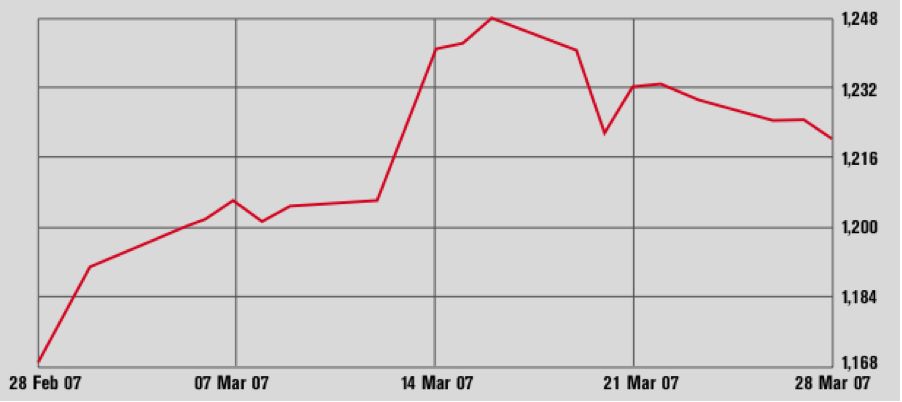
Beirut SE: Blom  (1 month)

Current Year High: 1,625.45  Current Year Low: 1,168.36

Between Feb. 28 and March 16, the BSE saw a spike in hope, as much as spikes go in a coma. The index moved from a year low of 1,168.36 points in late February to 1,248 points on March 16, basically driven up by talks between the opposing sides in the Lebanese political quagmire. As the voices announcing impending solutions faded, so did the traders’ enthusiasm and the third week pushed the BSI lower, to 1,224.19 points on March 26. Research, which Dubai-based investment bank Shuaa conducted on Audi Saradar banking group and concluded with a Neutral recommendation, led Audi to shoot back and claim that the fair value of its stock is significantly better than the $61.09 calculated by Shuaa. Audi shares closed at $63 on Mar 26.

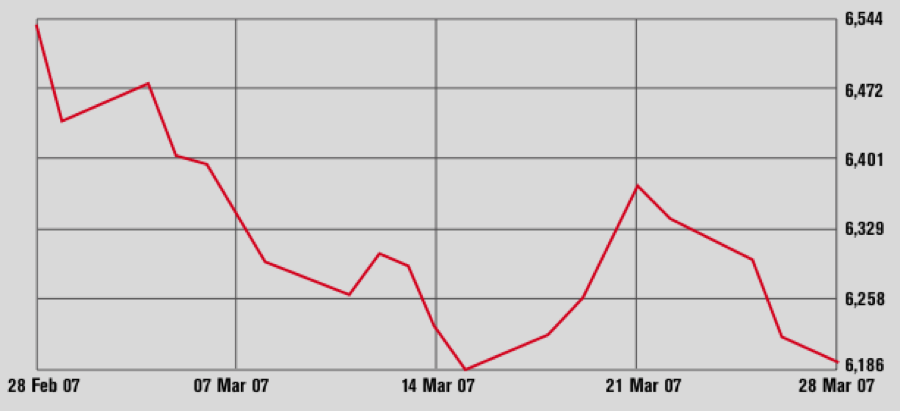
Amman SE  (1 month)

Current Year High: 7,407.15  Current Year Low: 5,267.27

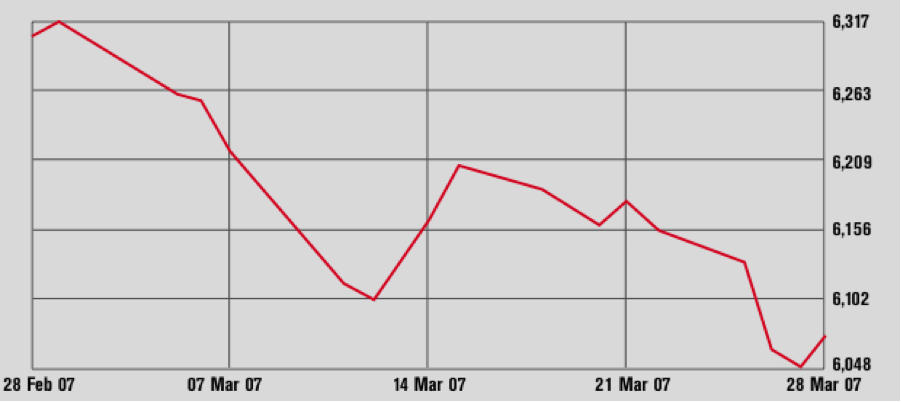
The Amman Stock Exchange moved sideways in a range above 6,200 points to close at 6,219.51 points on Mar 26. Arab Bank made headlines, beginning with having to deny a story in a US newspaper that warmed up allegations from a lawsuit that the bank had been used to finance “terrorism.” Later in March, the bank said it halted negotiations on a share sale to a strategic investor thought to be Emaar Properties, and the Jordanian government was said to be increasing its shareholding in Arab Bank in order to keep the Hariri family shareholders from buying up a controlling stake. The stock saw some lively trading in March, with a downward drift. Real estate firm Taameer Jordan was one of the main volume movers toward the end of March. Its share price regained in the second half of the month what it had given in the first half.    

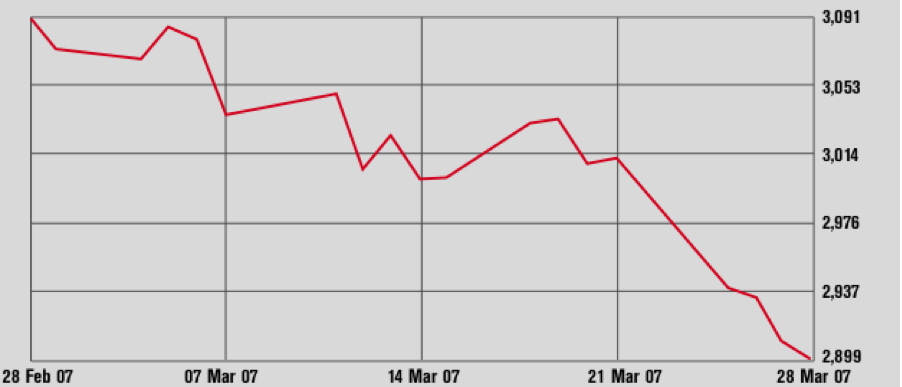
Abu Dhabi SM  (1 month)

Current Year High: 4,648.80  Current Year Low: 2,899.43

The Abu Dhabi Securities Market could not sustain the gains it had made in late February when it clawed its way above 3,000 points. The index dropped by 4% between March 1 and its close of 2,939 on March 25. At the end of the month, property and energy stocks were on the sunny side of the ADSM while banking values were selling. National Bank of Abu Dhabi, which issued 40% cash dividend and 30% bonus shares on March 22, traded down by 11% in the week between March 19-26. Banking news from neighboring Dubai with its impending merger between Emirates Bank and National Bank of Dubai mean the NBAD will, upon completion of the merger, lose its claim to being the biggest bank in the UAE.

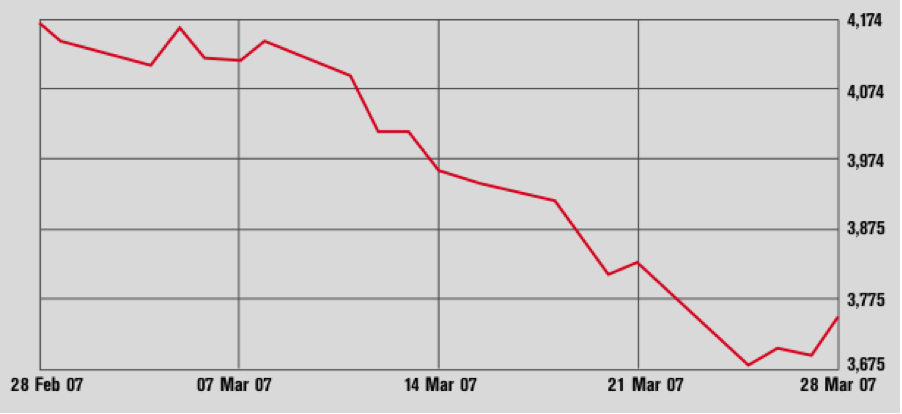
Dubai FM  (1 month)

Current Year High: 6,987.91  Current Year Low: 3,675.93

The DFM had a bad month in March, as its index weakened by almost 13% to a new year low of 3,675.93 points on March 25, from 4,207.51 points on Feb. 25. The DFM’s own shares started trading. Emaar, which pleased some analysts with a lower than expected dividend of 20% but disappointed stock owners with the move, traded down and was pushed even to a 12-month low of AED 10.60 on March 25 after Dubai Holding said it will acquire 28% in Emaar through a land-for-shares deal. Shuaa Capital bought back 3 million shares and the stock jumped 10.8% on a single day with high trading volume before sliding again.

Kuwait SE  (1 month)

Current Year High: 10,812.30            Current Year Low: 9,164.30

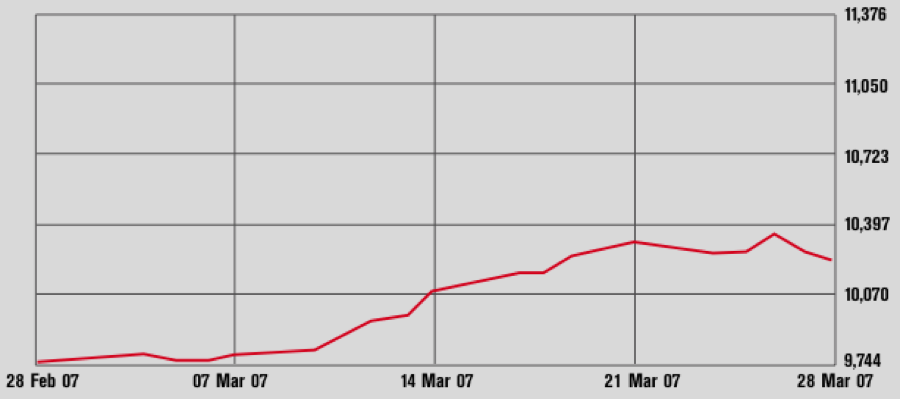
The Kuwait Stock Exchange had a period of growth as its index strengthened by almost 6% to 10,341.3 points on March 26 from 9,769.2 points on Feb. 27. Telecommunications events supplied major influences on the KSE. In the beginning of the month, the share price of Kipco got a boost from the company’s extraordinary profit from selling shares in Kuwaiti mobile operator Wataniya to Qatar’s Qtel. Shares of MTC, the leading telco in Kuwait, advanced 15% to KWD 3.20 on Mar 26, from KWD 2.79 on Feb. 28. At the end of March, MTC emerged as highest bidder in the contest for Saudi Arabia’s third mobile phone license.

Saudi Arabia SE  (1 month)

Current Year High: 17,730.96            Current Year Low: 6,916.85

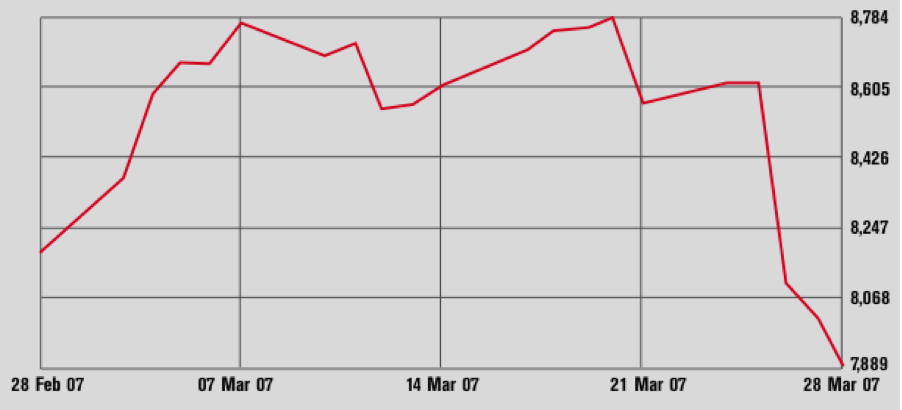
The Saudi Stock Exchange ended a month of modest gains and sideways movements with a splash of cold water. The TASI lost 522 points, or just over 6%, on March 26 in its worst one-day drop since falling 6.3% on July 19 of last year. Sell-offs on March 26 included blue chip companies and leading banks such as Sabic, Al Rajhi Bank, SEC, and the two telcos. For the month, the market moved from 8,356.48 points on Feb. 27 to 8,098.36 points on the evening of March 26. Insurance industry IPOs came in a bundle of five simultaneous subscription offerings worth combined SAR 266 million. The Saudi government created a new $320 million company to operate the SSE, with a long-term view of taking the bourse public. 

Muscat SM  (1 month)

Current Year High: 5,956.46  Current Year Low: 4,657.16

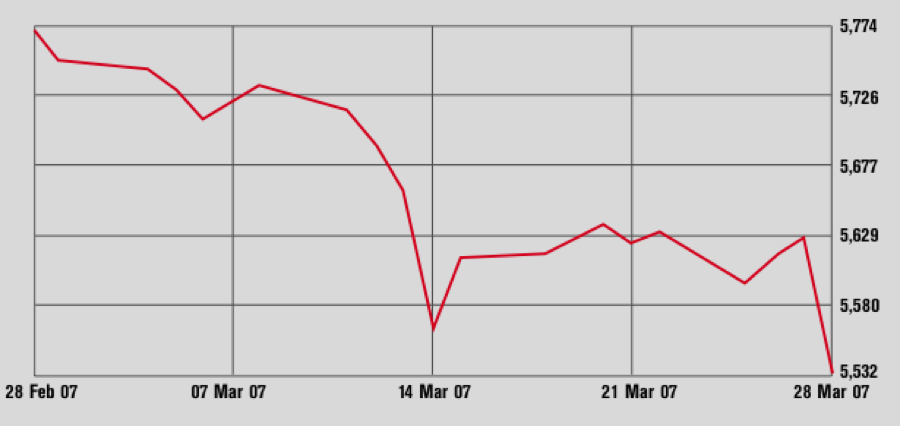
After a slide in February to 5,781.1 points on Feb 26, the Muscat Securities Market went down by 216.73 points, or 3.7%, between Feb. 26 and March 14 before regaining some ground to close at 5616.24 on March 26. The sultanate’s primary market raised new expectations as four companies announced IPO plans. Besides engineering firm Galfar’s OMR 60 million flotation, Oman Merchant Bank and government-owned investment firm Takamul (in May) and Oman Oil Marketing Company are the IPO candidates for 2007. Additionally, Al Omaniya Financial Services will float a two-year OMR 8 million convertible bond.

Bahrain SE  (1 month)

Current Year High: 2,251.15  Current Year Low: 1,996.68

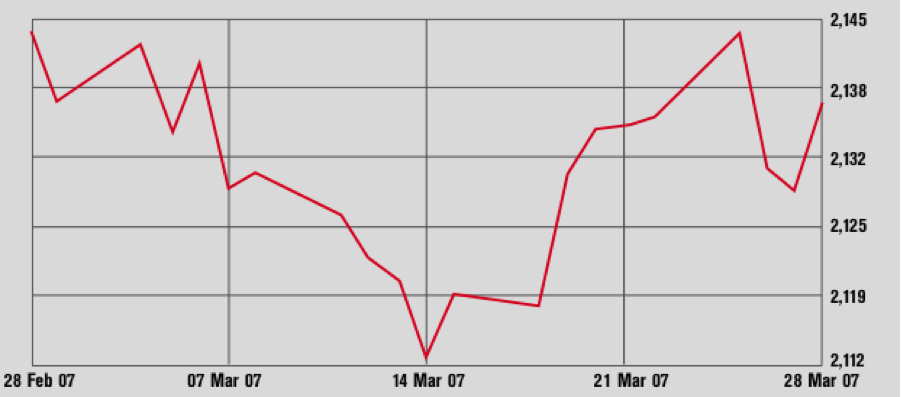
The Bahrain Stock Exchange closed at 2,130.71 points on March 26, down by 0.6% when compared with its level on Feb. 27. The index had dipped lower in the middle of the month but things appeared uneventful and volumes were once again low. Esterad Investment Company moved up 12% in the second half of March and Nass Corp saw some volume toward the end of the month. Mobile phone operator Batelco announced the purchase of 20% in Yemeni network SabaFon for $144 million.

Doha SM: Qatar  (1 month)

Current Year High: 9,878.10  Current Year Low: 5,825.80

The downward movement of the Doha Securities Market slowed but did not cease and the DSM index slipped 3.5% to 6,060.16 points on March 26 from 6,277.1 points on Feb. 27. This performance put the DSM again as the GCC’s largest underperformer for the year-to-date with a drop of 15% since Jan. 1. After dividend events, banking stocks such as Ahli and Commercialbank paced the market’s downward trend in the later part of the month. Qtel, which initiated the purchase of 51% in Kuwait’s Wataniya telecom, stabilized toward the end of the month. Nakilat continued its rise that started in February and gained 18% in March. DSM market authorities suspended a brokerage for one month for violating regulations.

Tunis SE  (1 month)

Current Year High: 2,712.33  Current Year Low: 1,861.15

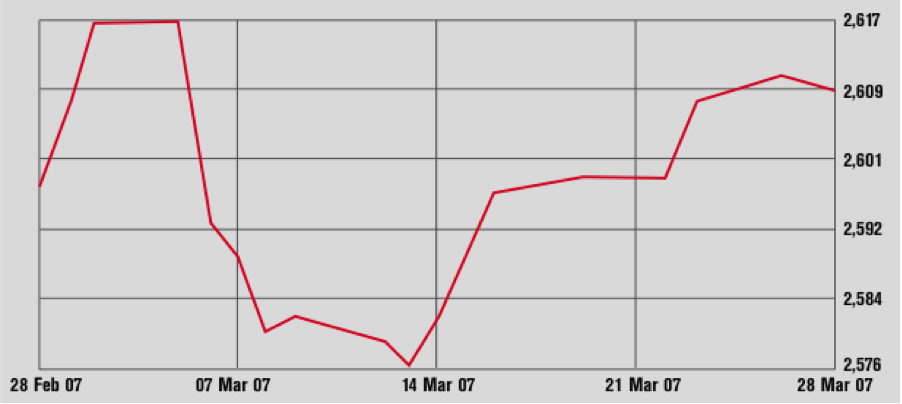
The Tunisian Stock Exchange in March traded sideways on a high plateau and the Tunindex closed at 2,610.14 points on March 26, about 100 points below its year high from Feb. 9. Tunis International Bank participated as lenders in a 55 million euros project finance facility for a new residential project in Libya, the first such finance arrangement in Libya’s real estate sector.

Casablanca SE All Shares  (1 month)

Current Year High: 11,552.97            Current Year Low: 6,563.27

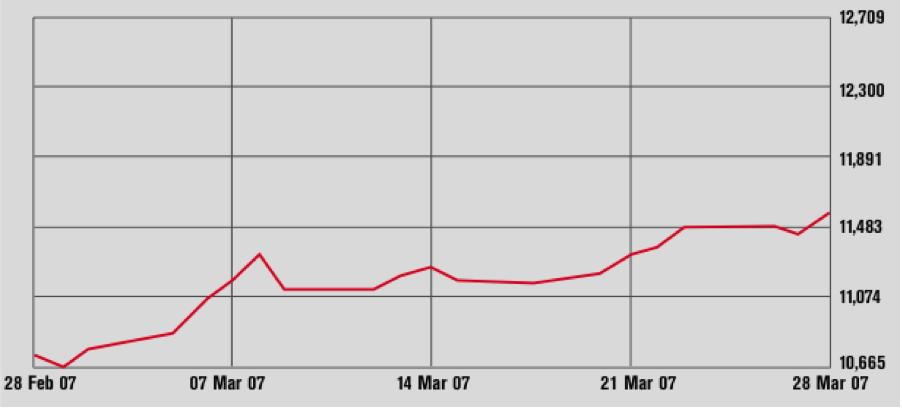
The Moroccan exchange broke through the 11,000 points line in early March and scaled further index gains to close at 11,478.87 points on March 26 in continuation of its rise which brought its gain for the year to date to a tidy 21%. Morocco’s central bank said it expects commercial banks in the country to be compliant with Basel II rules by this summer. With ongoing reforms, the central bank also hinted that a loosening of restrictions on investing in foreign bourses might be on the books, which might take steam out of the Casablanca Exchange and its extended rally.

Cairo SE: Hermes  (1 month)

Current Year High: 65,135.08            Current Year Low: 41,965.37

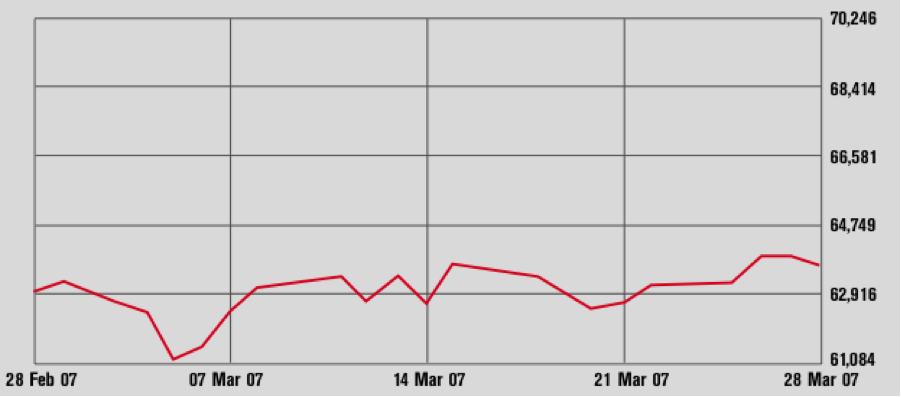
The Cairo and Alexandria Stock Exchanges entered the month with a week of downward motion to the 61,000 points level but the index moved back up and closed at 63,859.80 points on March 26. While Telecom Egypt shares made some gains in late March on news of higher 2006 results and a very faint outlook of a secondary 20% flotation in a few years’ time, Orascom Telecom Holding received three regulatory decisions against its MobiNil affiliate and got disqualified from bidding for the third Saudi mobile license, with rumors going wild on the reasons. Al-Watany Bank found several suitors interested in buying a strategic stake. Emaar Properties subsidiary Emaar Misr said it would file a complaint over a CASE decision refusing to list its shares.  

April 12, 2007 0 comments
0 FacebookTwitterPinterestEmail
InsuranceSpecial Report

Islamic Insurance: The concept

by Jihad Feitrouni April 12, 2007
written by Jihad Feitrouni

People have used insurance in the past to protect against impact of damages and risks.

In the absence of the social insurance, which Islamic countries shoulder to counter the effect and impact of damage to a nation and its assets, and as the majority of countries relinquished their responsibilities in reinforcing cooperation between their people, there grew the need to look for an alternative that guarantees to protect against damage and loss. This alternative is insurance companies operating in Islamic countries, similar to those commercial insurance companies operating in western countries.

Since the nature of transactions practiced within non-Islamic commercial insurance companies do not comply with provisions of Islamic shariah (and often insure establishments and companies that practice types of business not in compliance with shariah provisions), it became essential to look for an Islamic alternative, one that adopted cooperative insurance principles in its business transactions. Islamic insurance is known as “a collective insurance contract” by virtue of the fact that every contributor pays a specific amount of money as a donation for the purpose of indemnifying other contributions on the basis of solidarity and takaful.

Insurance operations are managed by a specialized company on basis of proxy wakala against a pre-determined charge. The subject of the contract is the commitment by all those insured to bear the risk sustained by another contributor. Thus, it is a contractual relationship based on solidarity and takaful to spread risk.

The role of insurance companies in the Islamic insurance system is to manage insurance operations by way of underwriting and execution since this is beyond the policy holder’s capabilities due to the large number of contributors. The company enters into agreement with the contributors by which it collects insurance premiums and pays incurred indemnity to those who have sustained damages in accordance with the regulations, principles and criteria dedicated for the purpose, in addition to all other operations which are required within the insurance industry. All these duties are performed in its capacity as a proxy wakeel against a predetermined charge. The company promises, in the name, and interest of the contributors, to either indemnify against a great portion of damages and losses sustained or indemnify it totally.

As for insurance premiums which are collected from contributors, it is usually enough to cover operational costs, pay incurred indemnity amounts or allot to all types of technical reserve amounts.

For the purpose of determining the amount of insurance premiums, formal statistical principles are applied for each type of cover. Should the premiums not be enough to meet the liabilities, the deficit will be covered by the shareholders on the basis of al qardh al hasan or  “Good Loan,” and if the company has a reserve balance as a result of insurance premiums profit surplus, the deficit then will be met by that surplus.

Jihad Feitrouni is the general manager of Dubai Islamic Insurance & Reinsurance

April 12, 2007 0 comments
0 FacebookTwitterPinterestEmail
InsuranceSpecial Report

Region’s insurance market has ups and downs

by Executive Staff April 12, 2007
written by Executive Staff

The insurance industry in the Middle East has been sitting on the launch pad of great expectations for a very long time. Regulatory changes and the growth of Islamic insurance services are central to suppositions that more customers will flock to insurance around the region. In terms of geography, the main carriers of promise are Saudi Arabia and Syria: two severely underinsured countries which both last year implemented legislation opening significant new spaces for insurance providers.

Saudi Arabia is currently buzzing with an insurance gruenderzeit, at least as far as its stock market. All seven companies that staged initial public offerings in the first quarter of 2007 on the Tadawul bourse were insurers, and they offered $162.3 million worth of shares to Saudi subscribers.

The largest of the seven IPOs was that of Medgulf Insurance, the biggest provider in the kingdom after NCCI, the former monopoly provider that pioneered the move of insurance companies to the Saudi stock market when the state-owned company was privatized to 70% through an IPO. Medgulf, which had previously operated in Saudi Arabia through a Bahraini offshore unit, offered 25% of its shares for $53.3 million in late February. Other shareholders in Medgulf Saudi are the companies of the Medgulf Group from Bahrain and Lebanon (together 35%), Saudi Investment Bank (19%), and 21 other investors, most of them Saudi individuals, who hold between 1% and 2% each.   

Medgulf’s late February IPO was preceded by that of Malath Cooperative Insurance and Reinsurance, which offered shares to investors in a $38 million IPO in early February. By taking 47.5% of its capital to market, Malath conducted the largest IPO in the first quarter of 2007 in terms of percentage offered and was the first of 13 insurance providers to fulfill a mandate to take part of their capital public as one of the conditions under which the 13 firms received licenses from Saudi authorities in 2006.

Saudi market looking bright

In March, the Capital Market Authority in Riyadh directed five insurers to undertake simultaneous initial public offerings at the standard share price of SR10 ($2.7) set by the CMA. Subscription to the stocks was open from March 17 to March 26, and the companies offered shares worth a total of just under $71 million.

The five firms that conducted subscription in March were relatively small, offering between $8.3 million and $21.4 million in shares representing between 31% and 40% of their respective capitals for subscription periods that ended on March 26. The companies coming to market are SABB Takaful, and cooperative insurance companies Saudi United, Saudi IAIC, Saudi Fransi and Arabian Shield.

Subscription rates for the five March IPOs were not yet announced when Executive went to print. But the two earlier IPOs got the warm welcome of high demand for their share offerings. Malath reported subscription coverage of 499%, worth $189.4 million. Medgulf reported that its offer attracted subscription requests from 1.4 million persons and demand for shares reached $209 million, or a 400% subscription rate.

The high subscription rates to the two offerings may be indicative that the rulings of Islamic scholars in support of mutual insurance are having more influence than opposing views circulating in Saudi Arabia, which still maintain that all insurance is a game of chance, and thus objectionable under the ban against activities that entail elements of uncertainty and gambling, as well as taking interest from investment portfolios.

While the oversubscription figures signal that the Saudi retail investors regard insurance companies as primary market opportunities that are acceptable under the investors’ religious standards, one cannot easily surmise that the financial attractiveness of insurance IPOs with CMA-mandated issue pricing is a guarantee for the companies’ success in either the retail insurance market or on the bourse.

According to estimates quoted frequently in discussions on the Saudi insurance market, the insurance sector is estimated to value about $2 billion and to have a potential to grow to $4 to $6 billion over the next five-to-ten years (without much adjustment of these estimates in the past two years). This is a minute percentage of the country’s economy, especially when considering that GDP increased to $347.4 million in 2006 and per capita GDP (measured in purchasing power parity) has been growing at rates of more than 5% in 2006 and is expected to grow by another 5% in 2007.

The reasons for optimism on Saudi insurance sector performance in the coming years arise concretely from motor and health insurance requirements, which have become mandatory, and, in general terms, from the kingdom’s economic development and its population growth. There is little evidence to suggest that optimism on the growth of insurance awareness among retail customers and in media, or on vast expansion of insurance sector expertise and human capital, has a strong base. 

While the creation of an insurance sector is seen as an important addition to the financial industry and equity markets of Saudi Arabia, it also seems unlikely that the sector’s arrival will provide a large short-term contribution to widening the institutional investment market or set new milestones in corporate governance. Examples of insurance sectors in other GCC markets over the past few years show them as holding significantly less importance than most other sectors which financial analysts track through sector indices.  

Syrian market grows, too

Just as regulatory forces have been setting the pace for insurance development in Saudi Arabia, authorities in Syria have been infusing a spark of opportunity into their country’s outlook for creating a sustainable insurance industry.  Since last year, insurance firms have received license approvals and started setting up shop in Damascus.

In March, Noor Takaful, a shariah-compliant insurer in Syria whose founding partners include a Kuwaiti-Pakistani insurance joint venture and Jordanian companies, said it would complete a public offering for $15.03 million, or 50.1% of its capital before the end of last month. Similarly, Kuwait-affiliated Syrian insurance company Al Aqeelah Takaful told Executive that it plans an $18.74 million offering for 51% of its capital before the end of spring. Managers at Noor and Al Aqeelah said the firms intend to start operations in April and August, respectively.

The lust for public offerings of financial companies in Syria rests on the foundation of heightened readiness by Syrian authorities to issues operator licenses to insurance providers and is nurtured by tax incentives, which offer firms a 10 percentage point lower tax bracket if they solicit capital participation from the public.

Lebanese insurance firms have been participating in prying open the Syrian market. Arope, a member of the Blom Bank Group, started operations in Damascus in July of last year. While it is too early to look at results of the venture, said Fateh Bekdache, Arope’s general manager in Lebanon, the experience of building something where no private sector insurance existed previously is intriguing. “The start is bumpy,” he said, “simply because it is a new law and a new sector. But it is extremely interesting to start something.”

Like BSO Bank, the Syrian bank linked to the Blom Group, Arope Syria chose to undertake a public offering that brought it tax benefits, which Bekdache cited at a rate of 15% of local taxes instead of 25% of local taxes for companies that prefer a private ownership structure without public offering.

Adir, the insurance daughter of Byblos Bank Group and France’s Assurances Banque Populaire, opted for private ownership in its Syrian venture, which last month received a preliminary license from Syrian authorities and expects to be up and running within six months.

According to Jean Hleiss, Adir’s assistant general manager, the new company will start operating with a $25 million capital and offer general and life insurance products in Syria under the name Adonis Insurance Syria.

Although the Syrian insurance market has been a favorite topic of expansion dreams among Lebanese insurance companies for years, the difficult situation of the Lebanese economy and its repercussions on the insurance sector seem to have somewhat stifled the eagerness for going cross-border. Bank-affiliated firms like Arope and Adir appear to have advantages in venturing east because they are part of groups with deep pockets and have greater access to working capital than standalone operators.

Additionally, having a bank in Syria enhances efficiencies, because the Syrian Insurance Supervisory Commission and the central bank gave “full approval to run insurance operations in the branches of banks,” Bekdache said. Thus, in addition to its head office in Damascus and an office in Aleppo, Arope Syria can base employees in the branch network of BSO and sell its insurance products there.

Lebanon not a fertile growth area

Meanwhile, in Lebanon, insurance growth prospects are faint, at least in the short run. The sector did not take direct hits during the war in July and August of 2006, said Max Zaccar, chairman of Commercial Insurance. “The Lebanese insurance sector was not affected negatively by the war, in terms of premium income,” Zaccar told Executive, adding that marine and transport insurance lines saw small growth in premiums because of greater insurance needs in the summer, and that payment morale among insurance clients actually improved.

Despite the war and political troubles at the end of the year, 2006 was better for Lebanon’s insurers than 2005, added Bekdache. He attributed last year’s satisfactory performance to very good business in the first half and a few good months immediately after the end of the Israeli war.

But for 2007, things are a lot murkier. The main problem is that Lebanese businesses are not making new decisions, because they are waiting for political progress to materialize. Under the circumstances, which include cash flow problems in many companies and private households, “the insurance sector has no new business and companies are fighting over what is there, competing with reduced prices to take slices of business from one another,” Zaccar said.

He added that local insurers also continue to be in a clinch with the Ministry of Economy, over the ministry’s plan to legally mandate insurers to structure companies separately for life and general business, and meet $10 million capital requirements that would only make sense with much more substantial premium incomes than the providers can muster in Lebanon’s $600 million premiums-strong market.   

GCC feeling the pinch

GCC insurance companies felt pressure in 2006, mostly from the downturn in returns for their investment portfolios. As many of the sector companies are highly capitalized and have concentrated on their investment portfolios for the good profits they had in 2005, shifting focus to increase underwriting income quickly does not seem to be an easy path, given that the maturing of regional insurance markets has been following the mantra of the snail, despite all sector talk about rapidly growing insurance industries in countries such as Bahrain and Qatar.

Islamic insurance products will add to the widening of the market, but also in this segment, hype over fast gains and limitless potentials has not been substantiated by the equivalent growth of underwriting activities. In Oman, for example, insurance penetration—the ratio of insurance premiums to GDP—has remained below 1% and the share of life insurance has stagnated below 15% of all premiums, according to a study by BankMuscat.

In all GCC markets, most of the underwriting, moreover, is concentrated in motor and health insurance, exactly the two coverage areas which have more risk and less reward to offer than most other insurance activities. Takaful family and takaful life products, which assist households in creating wealth, may provide a way into greater presence of the benefits that responsible insurance offers to a country, but even by one optimistic scenario for Saudi takaful life insurance growth, premiums would pass the $1 billion mark only by 2015.

The founding wave of new insurance companies thus seems to be the most positive development in regional insurance affairs for the time being. Add to this that multinational insurance firms have shown interest in the market and that a player like Allianz—the world’s number two in the insurance sector—has taken a license to establish a takaful unit in Bahrain. Lebanon also just might harvest some further gains from the interest of multinational players, as the local affiliate of a big international firm is rumored to be in negotiations to buy another firm with several branches in the Middle East, in order to broaden the multinational’s access to the region’s markets.

April 12, 2007 0 comments
0 FacebookTwitterPinterestEmail
Banking & Finance

Money Matters by BLOMINVEST Bank

by Executive Staff April 12, 2007
written by Executive Staff

Regional stock market indices

Regional currency rates

ARAMEX launches 30,000 square foot one-stop shop at Heathrow

Dubai-listed transportation and logistics solutions provider ARAMEX announced the merger of three of its European companies into one 30,000 square foot one-stop-shop at Heathrowairport, outside London. As such, upon the acquisition of UK-based Priority Airfreight and Dublin-based TwoWay Vanguard, ARAMEX unified these two companies with its Heathrow operations at ARAMEX House, its new premises in Heathrow. ARAMEX reported net profits of AED95.2 million ($26 million), up 28% year-on-year.

Al Baraka posts 20% increase in net profits to $123.7 million

Al Baraka Banking Group (ABG), an international Bahraini-based Islamic Bank, recorded net profits of $123.7 million, up 20% from $102.9 million in 2005. The bank’s total assets were at $7.6 billion, up 21% for the same period, while costumer deposits rose 15.3% to $6.2 billion. ABG underwent an initial public offering in June 2006, leading to a 73% increase in shareholder’s equity to $978.6 million. ABG recently signed a memorandum of understanding with the Arab Trade Finance Program (ATFP), thus becoming the program’s eleventh national agency. ATFP will thus provide credit facilities through a line of credit opened at ABG.

Country profile: Egypt

International rating agency Moody’s Investors Service released its latest report on Egypt affirming Egypt’s government bond ratings at Baa3 with a negative outlook in local currency, and Ba1 with a stable outlook for foreign currency bonds. The report stated that Egypt has been experiencing upturns in growth since 2004, mainly boosted by a rise in international oil prices, a strong tourism sector and strong export performance. Moody’s estimates Egypt’s GDP real growth rate at 6.9% in 2006, up from 4.6% in 2005, and forecasts real growth rates of 6.0% and 5.5% in 2007 and 2008 respectively. Moody’s notes that Egypt’s fiscal deficit declined in 2006 for the first time in five years. The reforms introduced since 2004 are starting to materialize as tariffs and taxes are being reduced and privatization is being revived. Moody’s also stated that despite a manageable external debt burden and an important geostrategic position, the government’s weak fiscal position and fast-growing population are the main credit challenges facing the Egyptian government.

April 12, 2007 0 comments
0 FacebookTwitterPinterestEmail
  • 1
  • …
  • 586
  • 587
  • 588
  • 589
  • 590
  • …
  • 696

Latest Cover

About us

Since its first edition emerged on the newsstands in 1999, Executive Magazine has been dedicated to providing its readers with the most up-to-date local and regional business news. Executive is a monthly business magazine that offers readers in-depth analyses on the Lebanese world of commerce, covering all the major sectors – from banking, finance, and insurance to technology, tourism, hospitality, media, and retail.

  • Donate
  • Our Purpose
  • Contact Us

Sign up for our newsletter

    • Facebook
    • Twitter
    • Instagram
    • Linkedin
    • Youtube
    Executive Magazine
    • ISSUES
      • Current Issue
      • Past issues
    • BUSINESS
    • ECONOMICS & POLICY
    • OPINION
    • SPECIAL REPORTS
    • EXECUTIVE TALKS
    • MOVEMENTS
      • Change the image
      • Cannes lions
      • Transparency & accountability
      • ECONOMIC ROADMAP
      • Say No to Corruption
      • The Lebanon media development initiative
      • LPSN Policy Asks
      • Advocating the preservation of deposits
    • JOIN US
      • Join our movement
      • Attend our events
      • Receive updates
      • Connect with us
    • DONATE