• Donate
  • Our Purpose
  • Contact Us
Executive Magazine
  • ISSUES
    • Current Issue
    • Past issues
  • BUSINESS
  • ECONOMICS & POLICY
  • OPINION
  • SPECIAL REPORTS
  • EXECUTIVE TALKS
  • MOVEMENTS
    • Change the image
    • Cannes lions
    • Transparency & accountability
    • ECONOMIC ROADMAP
    • Say No to Corruption
    • The Lebanon media development initiative
    • LPSN Policy Asks
    • Advocating the preservation of deposits
  • JOIN US
    • Join our movement
    • Attend our events
    • Receive updates
    • Connect with us
  • DONATE
GCC

A global network in the making: Nokia and Siemens teaming up for mobile web of data

by Executive Contributor May 13, 2007
written by Executive Contributor

In the ever expanding telecommunications industry, rife with new acquisitions, joint ventures and mergers, the recently formed Nokia Siemens Network has ventured into the fray to connect a projected 5 billion people by 2015.

The Nokia Siemens Network (NSN), a 50-50 joint venture (JV) between the two European  telecommunications’ powerhouses that was pending agreement since last June, has a top three global position in the industry, valued at $31.6 billion.

The network was only launched in April this year, delayed due to Nokia’s concerns over bribery investigations at Siemens that had led to the arrest of several former Siemens employees, including Thomas Ganswindt, former head of the German company’s telecommunications equipment division.

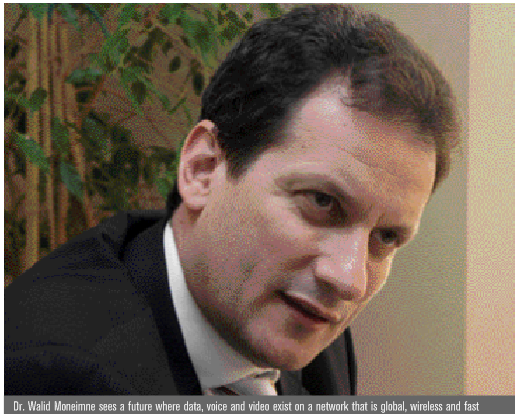
Based in Helsinki, Finland, NSN’s chairman for the Middle East and Africa, Dr. Walid Moneimne, said the motivation behind the JV was to consolidate the two companies’ research and development teams, and become the world’s No.1 communications enabler.

The merger of Siemens’ networks business group and Nokia’s carrier-related operations is also aimed at cutting costs to make the companies more effective in the global market. Expecting to slash annual costs by an estimated $2 billion by 2010, most of the savings will come from restructuring and a 10-15 percent reduction in the network’s 60,000-employee work force. Annual sales are projected at $20.2 billion.

Big future looming

“We see the telecommunications market by 2015 at five billion customers either connected by fixed line or broadband—about 70% of the world’s population. Bandwidth will grow a hundred fold, so that gives you an idea of the future—a 50% increase in requirement,” said Moneimne.

The Middle East and Africa (MEA) will be a major focus of NSN’s rollout worldwide, in addition to the rapidly emerging markets of India and China.

With only 300 million people connected out of the MEA’s combined population of 1.3 billion, that figure is expected to double to 600 million by 2010 as penetration rates increase and access to networks expand. “We are talking of a huge opportunity and demand to deploy these networks in the MEA region,” said Moneimne.

The network’s entry into the region is opportune, coming at a time when major regional operators such as MTN, MTC, Etisalat and Qtel are expanding and increasingly operating in new markets. The growth of regional operators, particularly Kuwait’s MTC through its acquisition of pan-African mobile operator CelTel in 2005, gaining access to 14 African markets and investing billions of dollars to bring infrastructure up to scratch, will also be a boon for NSN’s regional strategy.

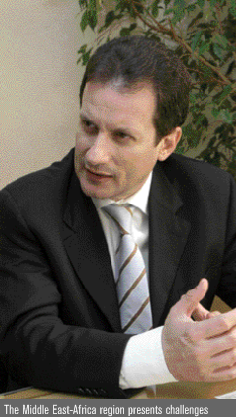
Region presents challenges to growth

NSN recognizes that the growth of the telecommunications sector in many markets in the MEA, particularly Africa, are being hindered by insufficient infrastructure and low incomes.

“There is a level of income that determines what people can do. Our goal is to work with operators to bring the best technology at the lowest price. On the other side of the spectrum are countries where there is a 100% penetration and handset replacement is high, so we will implement 3G networks and a major technology refresh as content (music, video) becomes more important,” said Moneimne.

In more advanced markets in the region, NSN are carrying out pilot tests on WiMax technology in certain cities, although Moneimne declined to say which ones.

“Our objective is really to see what the market needs, to put fixed and mobile together, 2G, 3G and WiMax solutions. All present a big investment for our customers,” he said.
The internet is also a major driving force for the network.

“When we look at 5 billion connected, the internet is at the center of that as all content is on the internet. Internet companies have a vested interest in this market,” Moneimne said.

However, expanding the network in Africa and the Middle East is not without its challenges,

Moneimne conceded. “Human resources are limited and it is a problem to deploy networks, particularly for issues of a high technicality,” he said. Lebanon was resultantly chosen as a platform for the region due to the high number of qualified and skilled employees and graduates.

Getting around the issue of inadequate electricity supplies in parts of Africa and the Middle East, NSN have been pioneering solar panels for sites, said Moneimne. “There is a lot of variation in how to use technology. Networks are not huge users of electricity, but will cause electricity generation expansion in certain countries,” he added.

But despite certain drawbacks, the relatively virgin markets of the MEA do present major opportunities compared to other markets worldwide.

“Despite the MEA having some of the highest penetration rates, it also has the least penetrated regions in the world and growing the fastest. Most developed countries are now just seeing mobile subscribers exceed fixed line subscribers, but in the MEA it’s already 75 million mobile subscribers,” added Moneimne.

The network has five product business units—Radio Access, Broadband Access, Service Core and Applications, IP/Transport, and Operations Support Systems—for fixed, mobile and converged networks.

“NSN has the size and resources to compete, but we also recognize that true competitiveness goes well beyond scale,” said Moneimne. The network’s competitiveness will draw on both companies’ research and development teams. Last year a R&D team that is now part of the network demonstrated the world’s first Long Term Evolution (LTE) radio access solution, transmitting data at a rate of 10 gigabits per second via an optical access network four times faster than rates achieved in the past.

Moneimne also said that there will be “major developments” in mobile phone handsets within the next two to three years. “Nokia calls them multimedia computers, so 3G networks are a must, but not just for 3G itself but the follow up, High-Speed Downlink Packet Access (HSDPA). The difference is in bandwidth speed: 2G dial up is roughly 100 bits, then the 3G at 384 kb/second and HSDPA 14 megabits a second. So clearly what all this brings is a HSDPA phone and network that will provide better customer experience and more available services,” explained Moneimne.

Although annual sales are projected at over $20 billion, the network announced in April that it only expects “slight” growth this year due to a “narrowing of visibility” and signs of a slowdown in spending by communications service providers in certain regions. As of April, the financial results of the network have been consolidated into Nokia.

May 13, 2007 0 comments
0 FacebookTwitterPinterestEmail
GCC

Fake or Real? Counterfeits major issue

by Executive Contributor May 13, 2007
written by Executive Contributor

Curbing the counterfeiting and smuggling of goods has become such a pressing concern for international businesses that last year 19 companies teamed together to create a Brand Owners’ Protection Group (BPG) in the Middle East to tackle the region’s part in the $500 billion global counterfeit trade.

According to the Dubai Economic Department between 2000 and 2004 the GCC authorities seized fake products worth $50 million, of which $35 million was confiscated in Saudi Arabia alone. In a raid on a warehouse in October last year, the Saudi authorities seized 90 tons of copycat Unilever products, worth $1 million.

Along with Saudi Arabia, the UAE has become a focus point for the BPG as the Emirates’ main port, in Dubai, is a major regional export hub.

“More than 7 million containers pass through Dubai with 20% annual growth according to Dubai Ports, so it is very important for brand owners to be protected,” said Omar Shteiwi, chairman of the BPG and regional intellectual property advisor for Nestlé Middle East in Dubai.

The BPG has been working closely with Dubai Customs, which has established an Intellectual Property Unit (IPU) and been on the offensive, seizing counterfeit goods estimated at $3.9 million between February and June last year. The IPU has the right to seize and destroy goods that are entering or in transit.

By comparison to Dubai’s IPU, set up in December 2005, seizing goods in other countries is not as easy said Shteiwi, despite trade, patent and customs laws in the GCC area.

To improve seizures at the point of entry, the BPG is providing educational workshops to inform customs what to look for in shipments. “Hopefully we will have a kind of engagement with the customs to train inspectors to differentiate between genuine and real products,” he said.

Robert Taylor-Hughes, CEO of Beiersdorf Middle East, said finding the source of the fake goods was the best chance of nipping the problem in the bud, but added that the judiciary system in the UAE lacked appropriate penalties.

“One seizure took place over a 10 month period where we found a ring that had been taking in goods from China. We allowed them to enter the Dubai Free Zone, leave and enter the warehouses of counterfeit traders to trace the distribution network. The downside was the judiciary system. Our legal and investigative costs were about 80,000 euro but when he appeared in court was fined $817. The threat of the deterrent is simply not large enough,” he added.

To try and improve legislation, the BPG has organized a one-day seminar with the UAE Ministry of Economy and Trademark Office to exchange information, come up with recommendations, and involve the enforcement agencies.

Although the UAE still has a way to go in handing out tougher sentences, some countries’ judiciaries are taking the issues more seriously, such as in Saudi Arabia and Iran.

Saudi Arabia carried out 100,831 inspections last year at stores selling foods and fast moving consumer goods (FMCGs) that resulted in the seize of 798 tons and 943,231 small pieces of food unfit for human consumption, according to the Saudi Ministry of Economy and Trade.

Iran has a massive problem with counterfeit goods entering the country, largely from China and Central Asia.

Taylor-Hughes said that last year, the Iranian authorities worked closely with Beiersdorf investigators to seize fake goods. “They not only work quickly but are very severe. Both violators were fined $50,000, the message got out, and (illicit activity) quietened down for a year,” he said.

Cosmetics and toiletries firms such as Beiersdorf have been particularly affected by the counterfeit trade, estimated as high as $210 million in the GCC last year—which could be as much as 10% of the overall Gulf market for cosmetics and toiletries.

In Egypt, the company had to pull its whole line of sun-creams following email complaints from customers that got badly sunburned in Sharm El Sheikh after using counterfeit lotions.

“We removed all goods from the market and are now holo-spotting in Egypt—you need a special eye glass to read the code, and counterfeiters can’t duplicate this new technology so far,” said Taylor-Hughes.

The holo-spot, which costs half a euro per spot, is solely being used in areas where the company has had problems, such as Egypt and in Russia, where Beiersdorf found counterfeit shampoos on sale.

A further issue brand owners face is the lack of statistics and data about the extent of the counterfeit trade in the region. To address this the BPG has commissioned international auditing firm KPMG to carry out an economic study on the counterfeit trade in the UAE that will focus on FMCGs, pharmaceuticals, cosmetics, and automotive spare parts.

“The added value of this study will be a roadmap for us and the government as to whether to adopt new intellectual property laws, improve existing laws, give more authority to customs, and enable brand owners to carry out investigations,” said Shteiwi.

The size of the Saudi market is a strong selling point and local banks will in any case make it a matter of their pride to be present and very visible in KAFD and later on in KAEC financial center. That will widen the Saudi financial scene and elevate its profile but it will not by itself fulfill the vision for the two huge projects. Then again, it must be true for new financial districts what is true for the whole world of finance: without risk, no profit.

May 13, 2007 0 comments
0 FacebookTwitterPinterestEmail
GCC

Time to invest in Arabia Felix?

by Executive Contributor May 13, 2007
written by Executive Contributor

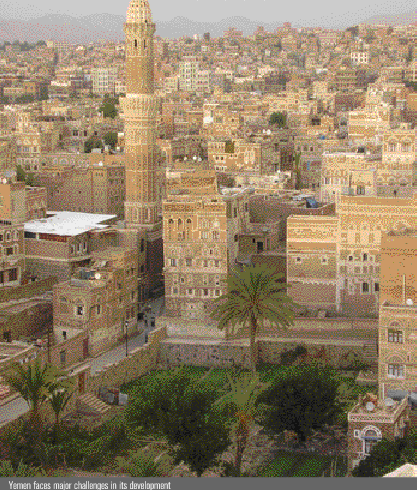
last month’s Investment Opportunities in Yemen conference was the first of its kind to be held in the country. It highlighted some of the striking challenges and opportunities in the Arab world’s poorest and most undeveloped state, which despite myriad difficulties now faces a period of transformation.

Long considered the backward underbelly of Arabia, one of the world’s poorest countries and certainly one with the highest number of weapons per capita, Yemen is stepping up efforts to entice investors into what is virtually a pristine economy.

A daunting host of political, social and economic problems currently lay siege to the country’s development, however, including a frighteningly high population growth, water shortages, weak government control, over-reliance on oil revenues and endemic corruption.

Nevertheless, Yemen’s investment authorities are doing all they can to attract a new influx of foreign capital—especially from the GCC—and reverse the economic misfortunes of recent times.

Getting it together

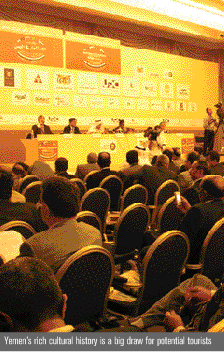
The Investment Opportunities in Yemen conference, which, after being postponed twice, eventually took place late last month in the capital, Sanaa, was largely designed as a private-sector follow-up to an international donors’ conference held for Yemen in London last November.

That event raised some $4.7 billion in pledges to support Yemen’s development, about half of which came from the GCC, to which Yemen wants—perhaps ambitiously—to accede within the next decade.

This time around, though, the focus of the conference was firmly on private investment. A packed house of some 650 delegates and 70 ministers from across the region gathered for a two-day series of speeches and debates on Yemen’s prospects, whilst a trade exhibition showed off some of the country’s key investment opportunities, mostly in the construction, manufacturing, real estate, tourism and energy sectors.

“Yemen is witnessing a significant transformation marked by a will and determination to create a prosperous future full of welfare and peace,” said President Ali Abdullah Saleh, the strongman who has managed to hold the country together through long decades of civil strife.

“We realize that today’s world is one of economic blocs, a world marked by heated competitiveness and rapid transformation in all economic aspects where there is no room for those who think traditionally,” he told the conference.

But although Yemen may lie in the same geographical zone as some of the world’s richest states, in most other respects it has more in common with Ethiopia than the Emirates—something which might not change too much in the near future.

Towards the edge

Crippling problems face Yemen as it looks to develop and diversify its economy. Amongst the most worrying of these is spiralling population growth, which at a rate of over 3% puts Yemen amongst the fastest-growing nations in the world, and will levy a even greater toll on some resources, especially water, which are already close to breaking point.

This population, whilst large in size, is small in purchasing power. About 45% of Yemenis live under the poverty line, according to the UN, and almost three-quarters reside in rural areas. Unemployment is unofficially over 40%, and a sizable chunk of the average male income (and waking hours) is dedicated to qat, a natural stimulant which is the country’s most lucrative cash crop and which occupies the majority of fertile land.

GDP growth, meanwhile, is barely keeping up with population growth, whilst inflation is equally onerous, reaching a peak of 18.4% in 2006 according to the World Bank.

As part of the aid deals and donor grants negotiated with external benefactors, a halting program of reforms has nevertheless been gathering pace over the past 18 months, although some measures may prove unpalatable to the local population.

“The government finds itself in a difficult position between keeping its promises to donors on one hand, and treading carefully with the local population on the other,” says Dr. Ali al Abdulrazzaq, Senior Economist with the World Bank in Sanaa.

 “They need to be very careful with measures that may have an effect on income levels, such as cutting fuel subsidies or raising taxes,” he told Executive.

And whilst the investment authorities have enacted specific reforms to attract capital, such as introducing a new investment law in 2003, modernizing real estate legislation and opening a “one-stop shop” for interested parties, Yemen is still an opaque place to do business.

Corruption is considered to be endemic and the entrenched tribal power in most parts of the country mean that it is often more valuable to have the backing of the local tribal power than that of the central government. 

Energy levels

Underlying all these issues is a fundamental over-reliance on oil, which constitutes 71% of government revenues and is already suffering from waning production as reserves dwindle.

Yemen presently pumps some 350,000 barrels of oil per day (bpd), and whilst the majority of the country’s exploration blocks have not yet been probed, analysts believe they are unlikely to wield any earth-shattering finds. Nevertheless, the Ministry of Oil and Minerals is about to launch a new bid round for interested parties, which include a number of big international names.

Yemen’s gas reserves have perhaps more to offer, with the country’s largest-ever single investment, the Yemen LNG project, currently under construction. A consortium made up of the Yemeni government, Total, Hunt Oil and two Korean companies is investing a total of $3.7 billion in the plant, which is set to come onstream in early 2009.

It will extract gas from an exploration block in the centre of the country, transport it by pipeline to a state-of-the-art plant on the Gulf of Aden and then convert it to LNG before shipping it on to clients.

“The plant will produce around 7 million tons of LNG per year, or about 180,000 barrels of oil equivalent [BOE]” said Joel Fourt, Chairman of the Yemen LNG Company. “In answer to the question: is it possible to build a world-class, world-scale project in Yemen, the answer is yes,” he told delegates at the conference.

The real question that many are asking, though, is how Yemen can diversify its economy away from this over-dependence on hydrocarbon revenues: LNG alone is not a long-term solution.

Milking the land of honey

One possible answer is tourism, a sector which the authorities seem particularly—and justifiably—eager to promote. Yemen’s rich cultural heritage, its old towns, unspoiled beaches, mountains and islands, theoretically put the country head and shoulders above regional tourist hotspots like the UAE in terms of natural attractions. 

Yet a consistently bad image, a lack of infrastructure and expertise, poor air connections and a meagre promotional budget mean that Yemen is light years behind its northern neighbors in terms of drawing in holidaymakers.

Speaking to Executive, Yemen’s Minister of Tourism, Nabil al-Faqeeh, says that the first priority is simply to build more infrastructure.

“In Yemen we have a lack of rooms, a lack of hotels, a lack of restaurants. We need to attract as many investors as possible for these kinds of projects,” he says.

“In 2006 we only had 382,000 tourists. We want to increase this by 20% in 2007 and we’re changing our strategy to try and attract more Arab tourists, especially from the GCC, where traditionally we have concentrated heavily on the European market.”

But finding the money for these projects is problematic. The state lacks the kind of disposable oil revenues which nearby countries like the UAE have been able to pour back into promoting tourism and real estate, whilst the local banking system in Yemen is too underdeveloped and illiquid to support start-up needs for new investors.

“Financing is the biggest problem for new tourist projects”, Alwan Saeed al-Shibani, Chairman of the Sanaa-based Universal Group, told the conference. “Our commercial banks don’t give out loans, and that needs to change. We have Gulf investors who want to start projects but they’re being held back by this.”

Yemen may also have to shrug off its image as a minor hotbed of kidnapping. Small groups of tourists travelling in rural Yemen, usually Europeans, are periodically spirited away by local tribes who treat their “prisoners” like guests whilst making modest demands on the government, such as building roads, hospitals or schools in their villages.

Island life

According to Al-Faqeeh, the government has no particular geographical priorities for tourist development, but one special area of opportunity is Yemen’s roughly 190 islands. Some have already caught the attention of regional powerhouses such as Orascom and the Mikati group, both of whom are reportedly finalizing agreements to develop islands in the Red Sea.

Yemen’s largest and best-known island is Soqotra, which lies in the Arabian Sea south-east of Aden and boasts a unique ecosystem which has evolved independently of the mainland. Potentially a tourist magnet, visitor numbers have been gradually on the up since an airport opened on the island several years ago, although the ministry are at pains to point out that no major developments will be allowed here: instead, they want to attract a classier breed of eco-tourists.

But although Soqotra looks as if it may thankfully be preserved from mass tourism, the mainland is already gearing up for some large-scale tourist and residential developments spearheaded by courageous investors.

The biggest and most ambitious of these is the Jenan Aden project, which will cover 14 km2 of pristine mountainside and beaches just outside of Aden. Phased over 10 years, the development is being led by a Saudi-Yemeni joint venture, Bin Farid and Baghlaf, and when complete will contain 4,000 residential units, four hotels, two marinas, a school and a university.

“There’s definitely an element of being pre-emptive in the market,” says Chris Orrell, Chief Operating Officer of the project. “But there’s also a belief that this is Yemen’s time. It is an exceptionally beautiful country with a great deal of potential.”

Most developers planning projects in the country say they are targeting a relatively small crust of high-income locals, but more importantly the Yemeni expatriate population, which is largest in Saudi Arabia, other Gulf states and also the UK.

Rise or fall?

No-one would argue that huge amounts need to be done in order to improve Yemen’s business climate, particularly, according to investors, in terms of the real estate registry and the commercial court system. But it seems that the government, at least, has realized the urgency of the need to diversify away from oil.

“I think many of the changes enacted over the past 18 months will really begin to bear fruit in 2008,” says the World Bank’s al-Abdulrazzaq. “The government is pushing for reforms, which is encouraging.”

Yemen is clearly only at the start of a long road to attract foreign capital, and it will need to create a positive track record that can earn the trust of investors, particularly those from outside of the GCC.

It is uncertain whether sufficient time remains to tackle critical issues like population growth and declining resources before it is too late, but there is enough excess cash available in the region, enough vested interest in keeping Yemen stable, and enough latent potential in the country itself to suggest that this could be the start of Yemen’s entry into the modern age.

Battling local tribesmen, Sanaa claims Iranian-backed militants wish to establish a Shia-run imamate

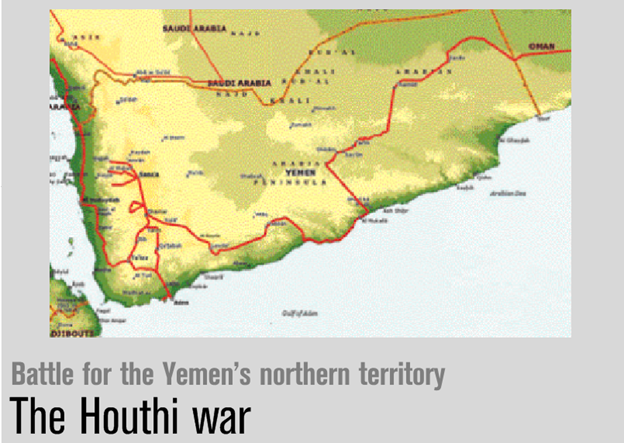
Yemenis are no strangers to unrest, having fought their way through a string of civil wars in the past half-century, but a longstanding dispute in the northern Sa’ada region of the country is now erupting into something approaching full-on warfare.

The conflict is the latest in a series of skirmishes between government forces and followers of the al-Houthi clan, who are based in the isolated mountains close to the Saudi border around the town of Sa’ada.

The sides have already crossed swords in two previous clashes, in 2004 and 2005, and the latest fracas has intensified rapidly since the start of 2007 to claim hundreds of lives on both sides.

Confusion surrounds the root cause of the fighting, which now appears to have spun completely out of control. The government claims that the Houthis, bankrolled by Iran and radicalized by the situation in Iraq, are attempting to establish a Shia-ruled Imamate in northern Yemen.

Others argue that the conflict has little to do with Sunni-Shia divides and is more related to the weakness of government power outside the main cities.

“It’s more a case of the government stepping on the toes of the local tribes and trying to extend its control in certain parts of the country,” said one western diplomat in Sanaa. “The system of power in Yemen means that these areas are largely autonomous, and they don’t like any outside interference—even from their own government.”

Beset by heavy losses and little progress, the army is pouring vast resources into Sa’ada. The local press reports that warplanes, tanks, artillery and thousands of soldiers are being dispatched northwards, although the region has been completely sealed off and it remains difficult to establish the reality on the ground.

“Even we can’t really understand what’s going on up there,” one civil servant in Sanaa told Executive. “Yemenis have never been religious extremists—both Sunnis and Shias in this country have traditionally been very moderate in their outlook.”

Whatever the case, the fighting has again shown up the fragility of a state in which allegiances are first and foremost tribal, not national, and in which the army is far from being the only significant military power.

May 13, 2007 0 comments
0 FacebookTwitterPinterestEmail
Cover storyGCC

Regional trade for China awakens dragon

by Executive Contributor May 13, 2007
written by Executive Contributor

In what is being dubbed “the New Silk Road,” trade and political ties between China and the Arab Gulf are growing stronger as both regions take an increasingly prominent role on the financial world stage. Politics is playing its part, with Saudi Arabia’s newly appointed King Abdullah opting for Beijing over Washington for his first trip overseas last year, and Chinese President Hu Jintao repaying the visit with trips to Riyadh and Dubai.

Bilateral trade between the United Arab Emirates and China is soaring as Emirati companies look eastward for investment opportunities to diversify away from oil, while Beijing secures energy sources and new export markets to keep its burgeoning economy afloat.

Strictly business

“Arabs see China purely as business, at least for the moment,” said Glen Osmond, managing partner for Middle East Strategy Advisors, a leading strategy consultant and investment advisory firm in the GCC.

“The Chinese don’t have problems such as political baggage or externalities like protecting the region, and are not here for consumers—the GCC is not a major consumer of Chinese goods compared to the EU or US—but for raw materials,” he added.

China has been quietly taking advantage of its negligible political history in the Middle East and Africa over the last five years, investing billions of dollars in infrastructure projects, signing energy deals, and attracting Gulf money, estimated as high as $20 billion in the past year from the GCC countries alone.

Although Saudi Arabia, the Middle East’s largest economy, has attracted the lion’s share of Chinese investment to the region and been more active in entering the Chinese market, the UAE is slowly catching up.

Since 2001, trade has grown by 30% per annum and the UAE is now China’s top export market in Western Asia and North Africa, according to Global Sources, with exports reaching $14.2 billion in 2006, up from $8.7 billion in 2005. Trade is likely to double by 2010 if targets projected by the Chinese government prove correct. Based on past trade growth, surging 45.5% in 2004 alone, this figure doesn’t seem to be overly optimistic.

“The UAE is a trading centre for the Middle East, so I think this year, or next, trade will grow at high speed,” said Han Xi, Vice Commercial Consul at the Consulate General of China in Dubai.

Dubai’s rulers are certainly aware of the potential.  “We want to be number one, and not second. If we join forces together (China and the UAE), we will be number one,” the UAE’s Vice President and Prime Minister Sheikh Mohammed Bin Rashid Al Makhtoum said at a recent press conference.

But Dubai’s ruler is also aware that China is not the only game in town. Trade between the UAE and Malaysia soared 20.7% last year to $3.4 billion while UAE-India trade not far behind China at an estimated $11 billion in 2006. India has emerged as Dubai’s largest export destination ahead of Pakistan, Iran and Kuwait, Indian investment in the UAE has doubled in the past four years and trade is expected to surge to $20 billion by 2010.

Indeed, in a seeming about face on the growing UAE-China relationship, Sheikh Mohammed also called for raising India-UAE bilateral trade to the ‘number one’ spot in the region.

But Sheikh Mohammed’s statement is perhaps more about pragmatism, realizing the UAE’s need to have its fingers in many pies. As Osmond pointed out, “the more buyers the better. It’s a souk mentality, and they have a huge machine and it needs to be fed.”

India certainly has a more established connection with the UAE, bolstered by approximately 1.4 million expatriate Indians working in the Emirates versus an estimated 50,000 Chinese expatriates.

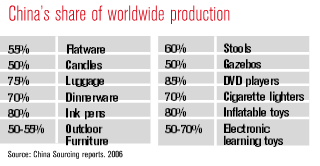
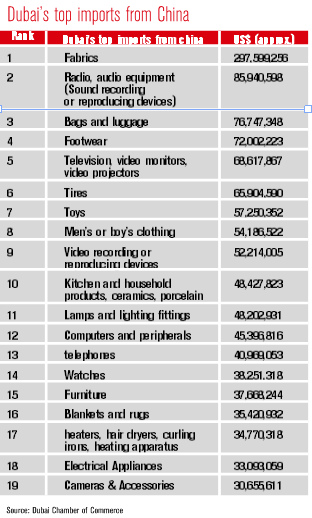
India however lacks the political and military position of China on the world stage (China is widely seen as a potential counterbalance to the US that Middle Eastern states are keen to develop), and is not a manufacturing powerhouse on par with China. Indeed, in terms of trade with Dubai the statistics speak for themselves: 36.6% of textile imports, 40.7% of furniture, toys and sports products, and 48% of all footwear, headgear, umbrellas and flowers came from China in 2005. And according to the Dubai’s Department of Ports and Customs, 17% of all of Dubai’s imports came from China in 2005, making China Dubai’s top supplier of imported goods.

“Dubai is the third largest re-export market in the world, after Hong Kong and Singapore—that is a very impressive statement,” said Bill Janeri, the Middle East general manager of Global Sources, a Hong Kong-based publisher and trade show organizer.

Enter the Dragon

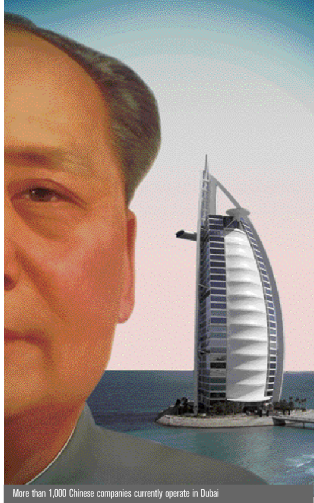
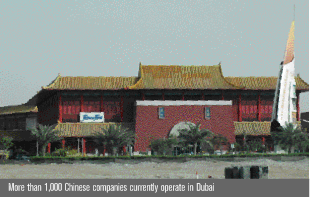
There are now more than 1,000 Chinese companies operating in the UAE, according to Standard Chartered, and that figure is expected to grow as investment floods in.

“China’s first export markets have traditionally been the US or Europe, but everyone wants to sell to these established markets,” said Janeri. “So over the years Chinese companies have either sold to there or been creative and looked for new markets when demand is equally strong—markets where they can be the number 1, 2, 3 player in their segment. Dubai has shown that it is a good location where these companies can ‘plant their flag,’ win new customers, and build market share where demand is strong.”

Global Sources will hold its first trade fair in the region, the China Source Fair, in Dubai in June—with over 500 exhibitor booths, it will be the largest ever exhibition of Chinese products in the Emirate, according to the Dubai Trade Center.

Although only $200 million was invested by private Chinese companies in the UAE in 2005, that figure surged to $800 million last year and UAE financial institutions are scrambling to procure a slice of the growing trade between the UAE and China.

Standard Chartered have recently rolled out a UAE-China ‘trade corridor’ to cater to small and medium-sized enterprises (SME’s) in the UAE and China.

“We felt this need as China kept the heat turned up on its Gulf marketing blitz to overtake such industrial giants as the US and Japan to become the top exporter to the UAE since 2004,” said Sandeep Bose, Regional Head of SME Banking at Standard Chartered in Dubai. “This is expected to continue as the most populous nation on earth is stepping up its export offensive, aided by the fact that its products are more competitive than the products of most other industrial nations.”

But the investment deals and joint ventures the Chinese government is most interested in are Abu Dhabi’s gas, petrochemicals, and aluminum nuggets.

 “I wouldn’t be surprised if China makes strategic investments in the region to develop the relationship in all the energy rich countries… Britain has been in the UAE for how long? China wants a piece of that,” said Osmond. 

Non-energy imports from the UAE are steadily growing however, up from $2 billion in 2005 to $2.8 billion last year. Investment in China’s booming economy, the fourth largest in the world, is also increasing, spurred on by high liquidity in the UAE and Gulf markets.

“Because oil prices are high there is more interest by UAE businessmen in worthwhile markets, and China has the economic and social elements for attracting such business,” said Han.

Dubai’s mammoth construction companies Emaar and Dubai Holdings, both responsible for tens of billions of dollars in real estate projects throughout the MENA region, have also opened offices in Shanghai. DP World, the world’s fourth largest port operator, also has a corporate division in the North-Eastern Chinese city of Tsingtao.

“I think this is the beginning of Dubai real estate coming to China,” said Han.

But it is not just real estate that is attracting Arab businessmen.

“I went to a trade show in Yiwu recently and part of the town is all Middle Eastern restaurants and businesses,” recalled Janeri. “It doesn’t surprise me that other markets are looking to invest in China. There is gaping wide demand for certain products—in fact, everything you can imagine,” he added.

Interest in China is certainly growing, with the consulate in Dubai China’s busiest worldwide. 

“Everyday we receive more than 300 visa applications—you can see more people want to go to China,” said Han.

An increase in airline flights is also indicative of the growing links, with China Southern Airlines opening an additional route between Dubai and Guangzhou at the end of last month.

Lost in Translation

Dealing with Chinese companies is not always easy—a common complaint voiced by businessmen ever since China opened its doors to the outside world in the 1980s, citing cultural differences and transparency in business practice.

“You hear stories of Chinese signing deals with companies and then reneging on the deal, saying it didn’t comply with their legal definitions or simply disappearing,” said a source at a real estate firm.

“There have also been cases of the Emirati authorities closing down construction sites as in the heat the Chinese workers strip down to their underwear and only wear hardhats, which is against UAE law—they have to cover up,” he added.

Han acknowledged that the consulate had received complaints, largely about wording and English terminology, but said the language issue and business transparency were being addressed.

“Both languages are difficult to learn, so it’s not a deep relationship but a growing one between the Arabs and the Chinese,” said Han.

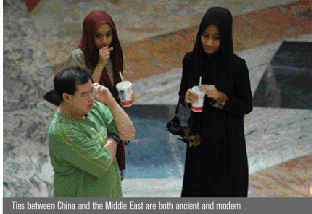
The relationship is in fact an ancient one that is being gradually rejuvenated.

According to historical texts, some 1,400 years ago there were an estimated 10,000 Arab and Persian traders in Guangzhou (Canton) plying the waters between China and the Middle East. Evidence of the ancient link is also present at Dubai’s Ibn Battuta Mall, where one section is devoted to the famous Tangerine’s travels in the 14th century to China—the exterior a partial replica of the Forbidden City and the interior painted red and offset with traditional Chinese woodwork.

The dark side of the relationship

But it is the Chinese Ministry of Commerce-supported Dragon Mart in Dubai that is the Emirates’ real China Town.

The China connection is not only bolstering official trade ties. As has been the case for most rapidly growing markets, organized crime is on the rise in Dubai. Russian and Indian money launderers are considered the main perpetrators in the financial line, taking advantage of Dubai’s construction boom and real estate speculation to launder money without paying out large commissions to “clean” the cash. But in terms of counterfeit goods, China is the bad guy.

One source likened China to a “massive Xerox machine,” ready to copy any product a buyer might want. China is indeed the No. 1 manufacturer of counterfeit goods, which are estimated at $500 billion worldwide.

Dubai has become the conduit for that illicit trade in the Middle East, with Dubai ports handling some seven million containers a year. Although most of the illicit trade transactions are between Chinese suppliers and Middle Eastern buyers, Dragon Mart, a mall and business center established three years ago, has become the hub for Chinese organized crime, according to a source in the real estate sector.

Earlier this year an undercover Dubai cop was sent to the Dragon Mart to investigate organized crime links at some of the center’s businesses. Told to call in on the hour, every hour, the cop suddenly disappeared. The Dubai police made a raid on the Dragon Mart and after kicking down a few doors, found the policeman dead in a freezer.

Such gruesome incidents are not the only illicit activity connected with China.

According to the real estate source, construction companies linked to the People’s Liberation Army—China’s largest business owner—were exporting convicts to work on sites in the UAE to cut overheads.

The issue has reportedly become so acute that the UAE government has recently banned Chinese construction workers. “It has become too much of a headache for both contractors and the government to regulate,” said the source.

China denies it is involved in such activity, however.

“It’s not true. China is now free, so if a construction company wants to go elsewhere, workers must have passports and visas,” said Han.

China is also reportedly trying to curb counterfeits. “China has a special department to regulate products, especially for exporting products as too many people want to do forgeries and sell low quality products to our friends—this is not good for business,” he added.

Even if this developing friendship will bring with it certain negativities, both economies are experiencing double-digit growth so bolstering such a relationship can only be prudent business for all concerned parties.

But as Han points out, the increasingly strong trade ties require political and economic stability in the Middle East for the relationship to warm any further.

“I think growth all depends on the regional situation, particularly over Iran. If Dubai keeps silent, like the present situation, China will pay more attention.”

May 13, 2007 0 comments
0 FacebookTwitterPinterestEmail
Comment

Region needs real journalism

by Fadi Chahine May 1, 2007
written by Fadi Chahine

Local and foreign observers across the MENA region are inconsensus that the region lacks a key ingredient to anythriving democracy: a pool of professional journalists. Thishas created a drought of oversight and accountability.

While the problem is known, there is hardly any evidenceit is being addressed. Even the institutions that one wouldturn to first, the region’s universities, have failed intheir task. The lack of journalistic standards in the regionhas allowed those universities and colleges that do offer adegree in journalism—which are few and far in between—tograduate students with little practical know how and writingskills based on the standards used in the developed world.

Whether the education was Arabic, English or French, theacademic training afforded to journalism students does notcome close to being equal to the education and trainingavailable in more developed countries, which means that mostof these colleges graduate wannabe journalists.

Governments of the region are keen to maintain theirofficial news agencies, and some of these agencies havestaff sizes rivaling those of international wire services.However, the state influence over the media has been drivenby a desire to control and is a huge obstacle to thedevelopment of journalism as democratic regulative or fourthestate. The dominant culture of unquestioning submission tothe state and any kind of institutional authorityexacerbates the problem. From Lebanon to Sudan, politicalaccountability and scrutiny is nil in the region.

In most countries, governments have either neglected ordeliberately avoided creating training programs to improvethe ability of Middle Eastern and North African journaliststo report effectively about politics, business and economicsand increase understanding among Arab populations of theseissues. Press associations and journalist unions also havenot delivered impulses that would stimulate the creation ofa press corps deserving of the name.

Finally, by not doing enough to nurture young journalistsand reward them for thorough inquisitive reporting anddisclosure of political, social, or corporate wrongdoings,media owners and publishing companies share part of theblame for the absence of a professional press corps. Thus,today very few journalists take a serious stand on issuesrelated to the welfare of the public and maybe one in athousand journalists makes an attempt to hold governments orgovernment officials accountable for their misdoings.

A good number of the region’s journalists find it hard toseparate being responsive from caving, being accountablefrom being a tool, being sensitive from being weak.Journalists are meant to be, by definition, eager forinvestigations of government misconduct. That is supposed tobe their purpose, embedded in their DNA.

A recent study conducted by the Amman-based Higher MediaCouncil (HMC) on the training requirements for members ofthe media showed that journalists lacked the most basicskills of the craft, including proper training for writingand editing skills, use of languages, computers and theInternet.

The study revealed that 35% of media practitioners havenever been involved in any training courses, while only22.7% of those working in the sector have a degree injournalism. Most writers have less than 10 years ofexperience.

In recent years, media institutions like Al Jazeera andinternational news organizations like Reuters, as well asNGOs such as the International Journalism Institute havemade efforts to offer workshops and training programs forpractitioners of journalism in the Middle East. Journalismprograms at some universities receive token support from theUN or have linked up with international programs. But goodas they may be, these efforts are not enough to create apool of journalists who are ready and primed to tackle thebig issues facing the region’s countries.

To start doing this, the Middle East needs a trainingenvironment where centers in all major cities provide thosewho want a career in journalism the understanding of therequired knowledge and skills. This training environmentwill only succeed if it is centered on building journalisticskills that are rooted in practice and suited to addressingthe challenges which working writers face daily in theirwork. It must also empower journalists in building a newjournalistic culture that serves the larger needs of theMENA region.

It is now more than ever that we need new writers, editorsand readers to step forward and speak up. Journalism in theMENA region is calling and good journalists to representpeople who do not have a voice in society. The press mustgive voice not only to those in power, but also to those whoare not being heard.

We need more active inclusion of journalists in continuousmonitoring of governments work, further understanding offree access to information and conflict of interest conceptsand better integration of legal frameworks in journalisticpractice. If we are able to achieve this in the MENA regionthen there is a chance that the media can be triumphant.

Fadi Chahine is the Managing Editor of Zawya Dow Jones in Beirut.


May 1, 2007 0 comments
0 FacebookTwitterPinterestEmail
Comment

The Blonde on the Billboard

by Rana Hanna May 1, 2007
written by Rana Hanna

You must have seen her. She’s blonde, fair andclear-skinned, blue-eyed with a perfect pout and an evenmore perfect nose. She’s staring at you frompractically every billboard in Beirut and urging you to takeout a “Plastic Surgery Loan” from First National Bank, sothat you too can look perfect.

Going under the knife to give you that edge—personally orprofessionally—is no longer a taboo. Beauty is no longergenetic luck. It has become attainable and affordable, andFirst National Bank have just made it even easier to getthere.

In fact they’ve made it very easy. As long as you earnover $600 a month and can afford to pay it back within 24months (with 6% interest), the patient-to-be can borrow upto $5,000 within 48 hours, with no down-payment required.You can have any procedure you want, from laser eye surgeryto orthodontics via laser hair removal and botox. Hate thatgut? Get rid of it!

The ad itself, part of a bigger brand awareness campaign, issomething of a marketing coup and has the whole towntalking. Among the hundred or so daily calls that the bankhas been receiving since the launch of the campaign, areinquiries from CNN and the BBC, who, like everyone else,noticed the blonde on the billboard and decided it was aquirky story.

While many who believe that we should not tamper with whatHe gave us, or feel that as a society we are heading toShallowsville, it would not be fair to accuse First Nationalof exploiting vanity—buying a car is also a style statement.It is merely responding to a demand that reflects the needsof a population that places high value on looking its best.Each year the Lebanese spend a fortune on cosmeticprocedures and First National expects to approve hundreds ofloans. And it’s not only the women. Over a third of thecalls that the bank has received have been from men.

According to FNB, the product is not new and had been indevelopment since 2004 and was scheduled to launch on 28July 2006. The project was delayed because of the summer warbut after the guns fell silent, the bank noticed that demandhad not diminished; quite the contrary, it increased.

It transpired that the war had proved the perfect window fora quick surgical procedure. Social events were kept to aminimum—a combination of decorum and danger had seen tothat—and so there was ample time to recover from a minorprocedure. Others had more pressing needs, especially thoseinjured during the war—burns and facial disfigurement andthe like—and who could not pay for a procedure without aloan and FNB have gone to some lengths to explain this.

Still there is the billboard picture of the perfect blondestaring at me telling me that I can now get the makeover ofmy dreams and live the life I’ve always wanted.

It’s nice to be a looker but is it a factor in success? Wellapparently yes. Many studies have shown a positivecorrelation between beauty and professional success, bettermarketability, better positions in the workplace, highersalaries and even stronger political prospects (baldleaders, for example, are perceived as lacking in that finaldollop of charisma).

In Lebanon, plastic surgery is available on every streetcorner, it is relatively affordable and the doctors areexcellent. And with the country so depressed at the moment,it’s probably a good idea to give yourself a littlesomething to feel good about. The Lebanese have proved, onceagain, to be above all hardship. The trophy wife mantra usedto be “when the going gets tough, the tough go shopping.” Inour case, when the going gets tough, we sign up forRhinoplasty.

RANA HANNA admits to having had plastic surgery

May 1, 2007 0 comments
0 FacebookTwitterPinterestEmail
Comment

Ruffing it, Bahrain style

by Paul Cochrane May 1, 2007
written by Paul Cochrane

A recent trip to Bahrain, what should have been a fairlyrun-of-the-mill interview with a CEO to discuss the launchof the Middle East’s first sports car plant turned intosomething rather different from the usual chat over coffeein a hotel lobby.

I was informed just an hour before the interview by theassistant to Alois Ruf, the owner of Germany’s highperformance sports car company Ruf, that I was to meet himout at the Bahrain International Circuit (BIC), home of theFormula 1 racetrack and the location for Ruf’s $20 millionfactory.

When I arrived at the VIP section of the Formula 1 track,my eardrums were subjected to the magnificent roar of adozen Lamborghinis straining at the leash. I hadunexpectedly gate-crashed the Speed Trip, one of the BIC’s200 annual events, at which owners of super cars and Ducatimotorbikes use their machines for what they were meant for:pushing the pedal to the metal and not worrying about overlyzealous traffic cops.

Lined up in the pit stop off the racetrack were the Ruf RKCoupe and Ruf Rt 12, which both looked pretty much likeunmarked Porsche 911s. This was not far from the truth, withthe chassis modeled on the Porsche, but everything else,from the electrics to the engine, completely refitted andseriously supercharged.

Talking with the head engineer while waiting for Mr Ruf toshow up I asked if either of the Ruf cars could take on oneof the Lamborghinis going hell for leather around the track.“The silver one no, the blue (RK Coupe), sure.” With the RufRK Coupe topping 220 mph and the Ruf Rt 12 reaching a mere189 mph, its no wonder Ruf is highly sought after cars bycar enthusiasts in the know.

In business since 1939, Ruf is not well known outside of caraficionado circles but those who can afford them buy them.

Ruf has had a 20-year relationship with the Bahraini royalfamily, inviting sheikhs over for test drives and servicingmodels at the Pfaffenhausen base in Germany. Indeed, LotharDrescher Ruf-Bahrain’s General Manager used to supervise theservicing of the royal family’s sizeable car pool.

With the Gulf awash in petrodollars, Bahrain close to SaudiArabia, a tax-free haven and with the region’s only F1track, Bahrain was a natural choice for Ruf’s first factoryoutside of Germany.

With plans to manufacture 20 cars a year by 2008, Ruf willsoon be pumping out 100 “boutique super cars” a year by 2012for export worldwide.

Ten days later, I was back in Bahrain for the opening of thefactory and in the short time I had been away the Ruffactory had been transformed, lights flooding out of thewindows into the desert, and pools of water shimmeringaround the entrance.

Following the arrival of Crown Prince Sheikh Salman binHamad Al Khalifa and his entourage of assorted sheikhsdecked out in black abayas, a surprise was in store for the200 guests.

Heralded by the revving of a powerful engine coming frombehind the seated audience a sleek, silver matt sports cardrove up to the stage and out swung Alois Ruf from hiscompany’s latest creation—the $450,000, 375 km/h Ruf CTR3.

If rubbing shoulders with royalty and not having a sizeableenough bank account to afford a car like the CTR3 didn’tinform me of my lowly financial position, nothing can putyou further in your place than not attending the Formula 1,and certainly if one is not watching the grand prix from theBIC’s VIP viewing tower.

“Are you coming to the Formula 1?” asked a rather lovelyBrazilian lady. “It’s so much fun up in the VIP box,mingling with the sheikhs and bumping into walls and PrinceAndrew saying, ‘Ah, here are the Brazilians!’ No? Shame.”

Shame indeed, so I headed for the parking lot chomping on afree cigar to locate my rather staid mode of transport totake me back to Manama.

PAUL COCHRANE is a regional business writer based in Beirut 


May 1, 2007 0 comments
0 FacebookTwitterPinterestEmail
Consumer Society

Plastic makes perfect: Beirut banks boost

by Executive Staff May 1, 2007
written by Executive Staff

Money talks,” thus reads the clever ad for the Alfa Blom MasterCard. And money talks all right, as this particular card co-branded with the mobile phone operator offers the card holder 60 minutes of free talk time upon issuing the card and an additional 5 minutes for every $100 spent. The Blom initiative is but the latest addition to Lebanon’s ever growing number of credit cards and incentive schemes.

As general conditions and interest rates among credit cards rarely vary, banks increasingly rely on loyalty programs and consumer incentives to reward existing card holders, and attract new clients. Air miles, chocolate boxes, wine bottles, coffee pots, hair dryers, watches and cash paybacks: you name it, banks offer it … As long as you just use that card.

For nearly 5 years, Blom has offered a more regular loyalty program: as the card holder uses his card to purchase goods, he collects points that can be redeemed for gifts, varying from kids toys to airline tickets. In addition, when purchasing at a selected group of retailers, he automatically takes part in a kind of lottery and he may become the lucky winner of a lucrative gift. In Europe and the US, using the credit card to pay for the smallest items is increasingly becoming the norm. Why not? Somewhere down the line there will be an air ticket.

According to Dr. Gladys Younes, head of BLOM’s Communication and Investor Relations Department, the bank has long resisted entering the co-branded market, as it preferred to work with a group of retailers, rather than a single partner. “The telecommunication industry however, is a consumer magnet in both Lebanon and in the world,” he said.“We have always viewed a co-branded card with a major telecom player as a partnership that can add major value. A brand like Alfa embraces a customer database that is at least as big as ours.”

One of the lowest debts in the world inLebanon

The Alfa BLOM MasterCard is the first of its kind in theMiddle East and seems a perfect deal for all parties involved, as it promotes purchasing and using the BLOMMasterCard, as well as subscribing to the Alfa classic line, instead of buying units.

Currently, there are an estimated 100,000 cardholders inLebanon, with an average credit debt of some $30 per capita, which is one of the lowest ratios in the world. As a comparison, in Saudi Arabia the average debt per credit cardholder is $161, in Britain $5,188 and in the United States$9,312. In other words, the Lebanese credit market still has an enormous growth potential and it should not come as a surprise therefore that banks continue to launch new offers and incentives.

According to Philippe Hajj, Head of Fransa bank’s RetailBanking Division, most credit cards offered by Lebanese banks are quite similar. “What differentiates them is mainly the cost, conditions, and benefit packages related to them,”he said. “That is the reason banks are reviewing their pricing, while adding benefits to their cards.”

Fransa bank recently launched its “Cash-Back” loyalty scheme, which allows card holders to redeem the points collected by credit card purchases by cash money, which will be credited directly to their cards upon their request. For every dollar spent, one gets a point, which in its turn is good for $3 cents. Hajj emphasized however, that point clients may still prefer to redeem their points at MEA, Aishti or MTC touch.

Standard Chartered Bank and Credit Libanais both offer elaborate gift schemes. Standard Chartered offers 100 points for every $100 spent. With 5,000 points, the card holder can start redeeming from a range of household items and other gifts. Credit Libanais offers 10 points for every $100spent. Rewards range from wine to travel insurance and even a home theater.

For its part, Byblos Bank has devsied the Cool Card. No doubt, aimed at introducing younger customers to the benefits of credit cards, it offers retail discounts and enters cardholders into prize draws.

Incentive schemes well-received

According to Alain Hakim, assistant general manager ofCredit Libanais business and marketing development division, the bank’s incentive scheme has been well received, although“cardholders remain mostly oriented towards cash withdrawal rather than purchase settlement.”

Although a potential client would first look at a card’s interest rate and charges, he may be tempted to opt for a credit card that promises him a reward, said Hakim. “A credit card in need can be a friend indeed,” he said. “If a cardholder can be disciplined enough to use his credit card for his day-to-day purchases, while keeping money aside to pay his bills at the end of the month, then it can be a win-win situation.The savvy consumer can earn interest on his savings for that month, while receiving cash back or free-of-charge incentives from the card provider.”

In addition to an elaborate gift scheme, Audi Saradar Bank recently introduced an air mileage program. For every $100spent by Visa or MasterCard, the card holder gets 10 points.With 500 point he or she is entitled to a chocolate box, with 50,000 points a free air ticket to Amman or Cairo.

“Many institutions have implemented loyalty programs, yet few have fully understood the nuances and challenges involved,” said Niovi Daoud of Audi Saradar’s CommunicationsDepartment. “Many believe a good loyalty program can virtually run by itself, that once you’ve set it in motion, you can sit back and enjoy the ongoing success. In reality, we’ve found that programs should be continually modified in order to fit clients’ lifestyles.” To do so Audi Bank offers dozens of different cards and incentive schemes.

Blom Bank’s Younes could not agree more with his Audi Bank counterpart. “The US market, the world’s most developed in terms of credit cards, is composed of 50% co-branded cards,”he said. “The Lebanese market has at least 15 co-branded programs. Are these 15 institutions in Lebanon capable of generating enough volume? For a co-branded program to be profitable, at least 3,000 cards should be generated and sold. Even more, should be generated if the co-branded card is to have generous and often expensive features. That is why we find that many banks issuing co-branded cards are doing so for prestige purposes rather than business reasons.”

HSBC offers its Premier Credit Card holders 3 points for every dollar spent, which can then be redeemed to acquire electronics or luxury goods. However, to obtain a PremierCard one is required to have $75,000 in savings or have a combined credit balance of home loan, savings and other assets of at least $100,000.

According to HSBC’s Cards Executive, Omar Farhat, the bank’s loyalty and incentives program is not meant to be a recruitment program, but meant to reward existing clients and thus build up client loyalty.

“We try to differentiate our card from others mainly through our services,” he said. “So, we offer card holders a24-hours help desk worldwide, as well as a travel insurance that meets requirements for a Schengen visa. In addition to the points scheme, we occasionally do special campaigns, in which we offer card holders such things as cinema or concert tickets.”

Music to their ears!

May 1, 2007 0 comments
0 FacebookTwitterPinterestEmail
Editorial

An honest man, badly drawn

by Yasser Akkaoui May 1, 2007
written by Yasser Akkaoui

While corporate governance continues to be the hot topic ina region with a still-evolving corporate culture, it isinteresting to note that even the supposed arch-exponents ofthe practice sometimes fall foul of the standards theyimpose.

George Bush-appointed World Bank chief and noted neocon,Paul Wolfowitz, appears to have been a victim of a campaignto discredit him over the treatment of his girlfriend, alsoa senior World Bank member, who, to avoid a conflict ofinterest, was found a plumb job at the US State Department.Despite the hullabaloo, the ex-deputy Secretary of State ofDefense, appears to have acquitted himself honorably and Iam sure that many Arab politicians and high ranking figuresare still wondering what all the fuss was about.

But the case highlights two interesting issues: First itshows just how important it is to walk the line in terms ofpersonal conduct and setting an example to all. Second,after the deeply flawed Seymour Hersh feature in thenormally stringent New Yorker, in which he accused the Bushadministration in not doing its homework and funnelingmonies to groups with al Qaeda-esque profiles backed by theLebanese government of Fuad Seniora, it is yet anotherexample of the deep-seated level of anti-Bushfeeling in certain corners of the Americanestablishment.

Wolfie was, as they say in London, stitched-up, even thoughhe did his best to play the collision of his private andpublic life by the book.

The new Arabia

This month we also doff our caps to the tremendous stepsmade state-owned enterprises in Dubai in particular and theUAE in general in turning what could easily has been left asa flabby desert outpost, living off dwindling naturalresources, into a muscular trading giant, real estate tyroand tourist heaven.

Its bilateral economic ties with China and India are aclear indicator of Dubai’s intentions to become a globalplayer by seeking out alliances with 3 billion newcapitalists, while its real estate giants are already atwork in the dragon kingdom, exporting their particular, andspectacular, brand of development know-how. From being anexpat backwater as recently as the early 90s, Dubai hasbecome a genuine holiday destination—the third most popularwith UK travelers—and a global venue for blue chip sportingevents that attracts the biggest names and fattest purses onthe planet.

It proves that a lot can be achieved by micro-managing themacro-economy if there is a strong ruling class with avision.

One wonders what Adam Smith might say to such a plan.

May 1, 2007 0 comments
0 FacebookTwitterPinterestEmail
Comment

Flashes in the neo-con pan!

by Peter Speetjens May 1, 2007
written by Peter Speetjens

Muslims living in Holland should tear the Koran in half, as half of the book advocates violence, thus maverick Dutch politician Geert Wilders recently suggested, subtly adding:“If Mohammed lived here today, I could imagine chasing him out of the country tarred and feathered as an extremist.”

This was the latest in what has become an extensive repertoire of Wilders’ “wisdom” on immigration and Islam. He has also held forth on headscarves and mosque building, and it is this populist and provocative approach that has brought him headlines as well as friends and foes in equal measure. His nicknames include: bulldog, crusader, street fighter and, on account of his carefully waxed LouisXIV white locks, the Blond Dolly of The Hague.

Having left the liberal party in 2004, which he thought“too left,” Wilders went on to establish his Freedom Party, with which he won 9 out of 150 parliamentary seats during the 2006 elections; and according to a recent poll, Wilders would win seats, if elections were held today.

Latest in a series of political grandstanders

However, one would gravely underestimate current trends inHolland by writing off Wilders as a noisy crank, thrown out by the exotic tradition of Dutch coalition-based politics.Wilders is but the latest in a series of very colorful, if highly controversial politicians, who have played the anti-immigration card for significant political gains and triggered a wind of change, transforming the Dutch Kingdom from one of Europe’s most progressive and welcoming states into a country with the toughest immigration laws on the continent.

It all started at the end of the 1990s with the emergence of the flamboyant Pim Fortuyn, a former communist turned liberal university professor with a love for designer suits and controversy. Warning of “an Islamization of Dutch culture,” even though Muslims make up but 5% of the population, Fortuyn was the first to put immigration and integration firmly on the political agenda. He was shot dead in May 2002 by a Dutch environmentalist.

Next to carry the anti-immigration and anti-Islam flag was Ayaan Hirsi Ali, a Somali refugee who was granted political asylum in 1997 and who entered parliament for the LiberalParty in 2002, under a storm of criticism, as she had always been a member of the Labor Party. Ali was and still is a very ambitious woman and, like Fortuyn, emphasized the“backwardness” of Islam, especially regarding women.

Loyal to her new liberal party masters, Ali also called for tough immigration laws, until in May 2006 it was discovered that the 37-year-old had lied about her past. She had not lived through and survived the Somali civil war, but in fact attended one of the best schools in Kenya. Too much of a political hot potato for her party, Ali withdrew quietly from mainstream politics and accepted a job with the ultra-right American Enterprise Institute.

With Fortuyn killed and Hirsi Ali gone, only Wilders remains. Often called “the new Fortuyn”—a title he vehemently rejects—Wilders wants to be seen as` his own man.“I want people to judge me on who I am,” he stated during a visit to the United States. “I am Geert Wilders. What we share is our anger that the popular voice is not being translated into policy.”

The last sentence says it all. Like Fortuyn before him,Wilders claims that Dutch politicians have lost touch with“the street.” To back up his often outrageous comments,Wilders likes to refer to “the millions outside(parliament)” who think like him. Fortuyn claims he dared to say what “most people” only dare to think. Such populist references to “the silent majority” have had often disastrous consequences in the past. At the height of its popularity in 2003, Fortuyn’s party took only 17% of Dutch seats, while Wilders could only claim 6% in 2006.

The purpose of Wilders’ trip to the United States was to meet a number of neo-con and Christian right groups. “I want to explain what’s going to happen in Holland and ask for support—political support, maybe financial support, all the support possible.” Wilders is in dire need of support, mostly monetary, as he is no longer part of the well-offLiberal Party, and has become painfully aware of the fact that a political party cannot live on screaming headlines a lone. Yet, although the new breed of Dutch politicians can rely on some sympathy among America’s conservative elite, it is unlikely they are to receive much cash.

First of all, institutions linked to the US government will think twice before financing a Dutch opposition party, while Holland belongs to America’s most loyal allies in the so-called War on Terror. Secondly, conservative Holland is not quite yet conservative America. Wilders may be anti-Islam and cherish a free market ideology, yet he lives in a country that has formally embraced gay marriages, abortion, euthanasia and a liberal drugs policy.

What does this mean for the future of Wilders? Well, on the short term, he will no doubt continue to provoke headlines.Yet on the long term, a combination of limited finances and equally limited political experience will see the FreedomParty follow in the footsteps of Pim Fortuyn’s party, which failed to win a single seat in the 2006 elections.

PETER SPEETJENS is a Dutch writer and freelance consaltant

May 1, 2007 0 comments
0 FacebookTwitterPinterestEmail
  • 1
  • …
  • 584
  • 585
  • 586
  • 587
  • 588
  • …
  • 696

Latest Cover

About us

Since its first edition emerged on the newsstands in 1999, Executive Magazine has been dedicated to providing its readers with the most up-to-date local and regional business news. Executive is a monthly business magazine that offers readers in-depth analyses on the Lebanese world of commerce, covering all the major sectors – from banking, finance, and insurance to technology, tourism, hospitality, media, and retail.

  • Donate
  • Our Purpose
  • Contact Us

Sign up for our newsletter

    • Facebook
    • Twitter
    • Instagram
    • Linkedin
    • Youtube
    Executive Magazine
    • ISSUES
      • Current Issue
      • Past issues
    • BUSINESS
    • ECONOMICS & POLICY
    • OPINION
    • SPECIAL REPORTS
    • EXECUTIVE TALKS
    • MOVEMENTS
      • Change the image
      • Cannes lions
      • Transparency & accountability
      • ECONOMIC ROADMAP
      • Say No to Corruption
      • The Lebanon media development initiative
      • LPSN Policy Asks
      • Advocating the preservation of deposits
    • JOIN US
      • Join our movement
      • Attend our events
      • Receive updates
      • Connect with us
    • DONATE