• Donate
  • Our Purpose
  • Contact Us
Executive Magazine
  • ISSUES
    • Current Issue
    • Past issues
  • BUSINESS
  • ECONOMICS & POLICY
  • OPINION
  • SPECIAL REPORTS
  • EXECUTIVE TALKS
  • MOVEMENTS
    • Change the image
    • Cannes lions
    • Transparency & accountability
    • ECONOMIC ROADMAP
    • Say No to Corruption
    • The Lebanon media development initiative
    • LPSN Policy Asks
    • Advocating the preservation of deposits
  • JOIN US
    • Join our movement
    • Attend our events
    • Receive updates
    • Connect with us
  • DONATE
Special Report

Syrian reform , Adopting the market

by Executive Contributor December 18, 2006
written by Executive Contributor

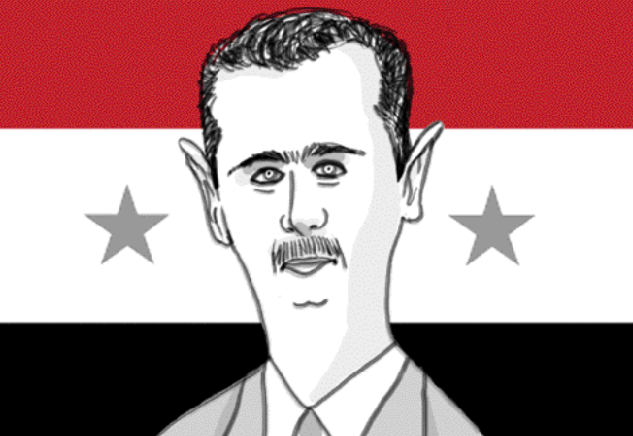
Syria is stepping up reforms to become a “social market economy,” and accelerated changes are widely expected in 2007. But with the country projected to become a net importer of oil in 2008 and the structure of a command economy still in place, deep and radical change cannot come too soon.
Syria’s economy has the potential to one day be among the region’s most diversified. Strong foreign currency reserves, low national debt, abundant agricultural production and a large manufacturing sector are some of the points in its favor. Yet the economy is not even operating at 15% of its capacity, according to the estimates of Abdul Kader Husrieh of Ernst & Young Syria. Corruption, chronically inefficient industry and agriculture and a bloated and opaque bureaucracy are among many reasons for decades of underperformance.
A long-awaited reform program to provide cohesion and underpin the ambitious goals stated in five-year indicative development plan that started in 2006 is under formulation and expected in the first half of 2007. Ambitiously, it projects a growth rate averaging 5-6% per year, reaching 7% in 2010. Although many economists doubt this is possible, they applaud a new desire to aim high as a sign of commitment to progress. In a significant ideological shift, heavily centralized Syria formally adopted market reforms at the Baath Party congress of June 2005, arming reformers to defend their arguments against a shadowy “old guard” that remains resistant to change.
Leading Syrian economist Nabil Sukkar points out that reform will require the leadership to lose its adversity to risk at a time when dwindling oil reserves—and with them hard currency receipts and state revenues—threaten the macroeconomic framework and the political environment is particularly unstable. Syria remains under severe international pressure with US sanctions and the international investigation into the assassination of former Lebanese Prime Minister Rafik Hariri, which has implicated Damascus.
Expectations of a US rapprochement with Syria were gaining strength at the time of writing, in anticipation of the release of the Baker Commission’s Iraq study, which is expected to recommend dialogue with Syria and Iran. Syria and major trading partner Iraq restored diplomatic ties in mid-November. But strife in Iraq and Lebanon in 2006 exposed the vulnerability of Syria’s investment climate to regional troubles. Accusations that Damascus had a hand in the assassination of Lebanese Minister of Industry Pierre Gemayel in November cast a shadow over hopes that Syria was coming in from the cold.

Reform outlook
Reform started at a snail’s pace in the late 1980s under late President Hafez al-Assad, who, faced with a public sector that could no longer provide, made tentative steps to encourage the private sector. But after Investment Law No. 10 of 1991, which offered incentives to investors, including those from abroad, reform largely froze.
Bashar al-Assad’s reform pledges when he took over in mid-2000 built up hopes, but bankers and investors have grown impatient with the slow pace and lack of depth and say reforms tend to be disjointed and reactive. The term “social market economy” is also ambiguous. Policy-makers have yet to determine, Sukkar says, how much emphasis to place on social safety nets, how much on growth.
Change has been significant, however—particularly in banking and insurance—and appeared to regain some momentum in 2006. A stock market is expected to open in early 2007. Economists hail Deputy Prime Minister for Economic Affairs Abdullah Dardari as a determined reformer. Despite initial resistance from reactionaries in the leadership, he now appears to have stronger state backing, reflecting a belated recognition that there is no alternative to reform. A February cabinet reshuffle handed technocrats the ministries of Industry, Economy and Higher Education.
A fundamental shift is needed in the state’s role. Subsidies on fuel and commodities are an example of state drainage of the economy and one of the most pressing—and politically sensitive—concerns. An International Monetary Fund report from October 2005 found that subsidies equated to about 14.7% of Syria’s GDP. Dardari has promised a blueprint by the end of 2006 showing how to tackle the problem. No doubt with an eye to the civil disturbances that followed subsidy cuts in Egypt, Jordan and Yemen, it is believed the government is seeking a way to “target” the subsidies to ease the burden on the poor.
Creating jobs for a burgeoning population is one of the most urgent challenges for Syria. New entrants to the job market number 250,000-300,000 per year, but the economy only creates 180,000 new jobs. The realization is dawning that only a dynamic private sector can fill the gaps. A UNDP report in 2005 found that 2 million Syrians, out of a population of 17 million, could not afford to meet their basic needs. Broader poverty affected nearly a third of Syrians. While the government estimates unemployment is around 8%, economists say it is closer to 20%, and that does not include legions of under-employed workers that would need to be retrained and redeployed under any far-reaching reform of the public sector.
Using some of the oil revenues to create a fund to cushion the transition, pay unemployment benefits (currently non-existent in Syria) and retrain is advocated by reformers. Some 90% of the workforce is employed by the state, and under Syria’s antediluvian labor laws, only the prime minister can fire them. A major obstacle to creating a competitive market economy in Syria is the low level of technical training—Syria’s free and universal education system places little emphasis on usable skills. The recent decision to allow private universities is hailed by the private sector as a step in the right direction.

Economists hail Deputy PM for
Economic Affairs Abdullah Dardari as a determined reformer

Growth areas
Syria’s oil reserves are estimated at about 3 billion barrels of crude. Oil production is trailing off dramatically, barring new discoveries. Natural gas reserves are considerable, at around 240 billion cubic meters, but production is under-developed and most of the gas is destined for internal use rather than export. Syria’s potential for diversification is high, but will take a radical overhaul of state structures and institutions. According to the Syrian Investment Bureau, FDI in licensed projects rose to 30% in 2005 from 11% in 2004. With free trade agreements (FTAs) with Iran, Iraq and the Gulf—not to mention an anticipated EU agreement currently held up for political reasons—Syrian manufacturers have no shortage of markets.
However, FTAs hold severe risks as well as promise in a country where, for decades, industries remained deliberately small—95% of companies employ 10 people or less—for fear of nationalization. The government and rapidly developing private sector need to focus on supporting small and medium-sized enterprises (SMEs), the backbone of Syria’s economy, to help them upgrade if growing free trade is not to destroy local businesses and harm Syria’s balance of payments. Providing a transparent regulatory environment is crucial to enabling private factories to compete.
Manufacturers are missing out on considerable profits because of a lack of marketing and packaging capacity. In textiles, Syria’s second industry after oil, Syria tends to provide to wholesalers. Critics say the government has opened up to foreign competition—cheap garments from Asia hit the shelves this year—without supporting an industry that employs a third of the workforce. Syria gives no financial breaks to the textile exporters that would help the industry, mainly based in the northern city of Aleppo, to compete with Egypt and Turkey, particularly in European markets.
Similarly, Syria is the world’s fourth-largest producer of olive oil, but the country has no capacity to bottle and market it, so well-equipped producers such as Italy buy Syrian oil, repackage it and earn the bulk of the profit. At $800 a barrel, olive oil could be considerably more lucrative than fuel oil. Economists say local businesses need technical assistance and exposure to the outside to learn how to standardize production for export and compete internationally after decades of protectionism.
Across agriculture as a whole, it’s a similar story. Syria has food self-sufficiency and the potential to become a regional breadbasket, but socialist land laws—which place limits on the amount of land one person can own—mean farms are small. These ceilings are another sensitive issue, but one Syria will need to overcome in order to upgrade and mechanize production for export.
Damascus is placing high hopes in tourism as an eventual replacement for oil’s hard currency receipts. Tourism Minister Saadallah Agha al-Qalaa has stated tourism figures will be up by 6-8% for 2006, despite a disappointing summer season because of the war in Lebanon. Growth reached 11% in 2005, when 3.4 million tourists visited Syria. Damascus hopes that figure will reach 7 million by the end of the decade.
Syria has abundant cultural, historical and recreational tourism potential, with a wealth of historical sites and a stunning coastline. The country’s largest-ever tourism development plans to take advantage of the latter: Antaradus, a $200 million hotel and leisure complex at the northern port city of Tartous, was inaugurated this year. The tourism ministry has earmarked a further 82 projects for investment and cut taxes and red tape applying to tourism investments. Critics say the government could do more to promote tourism abroad, and in November, the ministry announced a sharp increase in its marketing budget for 2007, up to $5.5 million from $1.6 million. Gulf interest is considerable and expected to be keener if the regional political situation calms in the coming months.

Syria must catch up with
decades of lost momentum

The fledgling real estate sector has received much attention since licenses were first permitted in 2005, especially from Gulf investors, though again, many appear to be waiting for political tensions to ease. Emaar jumped in with the Eighth Gate, a multi-billion-SYP project in Damascus. The potential is clearly vast, but few projects have yet broken ground.
For Syria to defuse the economic time-bomb presented by shrinking oil reserves, it must catch up with decades of lost momentum. All eyes are on the state’s reform program, hoping it will provide a clear path to the market economy that is now all but inevitable for Syria. For this challenge to be met in more than a piecemeal way, Syria will have to tackle the toughest problems of all: setting out an independent judiciary and a transparent bureaucracy, almost certainly in the face of vested interests. As other emerging economies have shown, taking a shallow approach to market economy transition can concentrate money in the hands of a corrupt elite, deepening the economic woes of the masses and risking eventual instability.
December 18, 2006 0 comments
0 FacebookTwitterPinterestEmail
Regional outlook

Stock markets ending year down across region

by Executive Contributor December 17, 2006
written by Executive Contributor

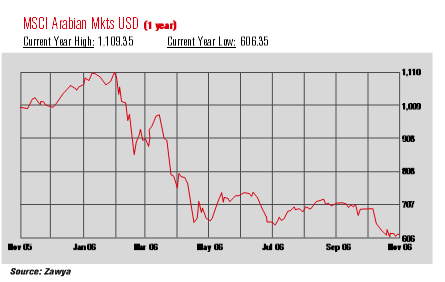
Instead of the post-Ramadan surge which many of the region’s financial analysts and traders had augured during the slow days of summer, important Middle Eastern stock markets converged to a measly November diet in the bear’s kitchen. Over the coming months, these markets will have to deal with the poor investor confidence of which the selling mood speaks volumes—all the more so since corporate results and macro indicators may be much friendlier than the share price performance toward the end of 2006.

Downturns across the region
The Cairo and Alexandria Exchanges retained their ground with continued sideways trading, but the Tadawul Index of the Saudi Stock Exchange moved south by about 2,000 points, or 20%, between Eid Al Fitr and November 26. The Dubai Financial Market was not far behind with a drop of 17%, the Doha Securities Market lost 15%, and the Abu Dhabi Securities Market retreated by about 12% over the period.
The Bahrain Stock Exchange shed the gains it had made between mid-August and late-September and dropped back to levels in the 2,100 points range. The Kuwait bourse similarly weakened more than 5% and receded below 10,000 points in late November.
In Amman, the market gave up over 8% and in Beirut, the BLOM Index fell 7%—but that was its closing before the country received another blow through the assassination of Industry Minister Pierre Gemayel, after which the Beirut Stock Exchange shut its doors for several days, along with most of the country’s businesses.
This means that with exception of the smallish North African bourses in Tunisia and Morocco, Arab stock markets had nothing to boast of in the period immediately following the fasting month of Ramadan, a period which many experts had assumed would lead the markets to new consolidation or signal growth impulses after the correction phase that hit GCC and Levant capital markets in the first half of 2006, with some variations in terms of exact timing and severity of the respective share price drops.
While the danger of a crash in regional stock markets was thought distant by a substantial share of market protagonists in 2005, by the spring of 2006, capital market experts had noted that the downturn could no longer be considered a brief interlude. Many still expected the second half of the year to bring new promise, however.
With the year-end in sight, that optimism seemed increasingly premature, even as analysts said that the valuations of GCC equities are reasonable and offer good new potential—also given that the burst of the bubble in 2006 was fairly predictable because the region’s capital markets rally was driven by the oil boom and toward the peak of the rally, the ratios between oil prices and GCC equity market valuations had become excessive.
“At the market peaks, a significant disconnect developed between oil and regional equity pricing,” said Dubai-based investment firm Gulf Capital Group in a recent report, while concluding nonetheless that the markets are poised for future growth.

Harvest of oil revenues will continue
The broad consensus of international and regional financial institutions and banks is that oil will be the major force behind Arab economic and capital market trends for years to come, which also means that the region’s influence in the current account triangle of Western consumers, Asian manufacturers/new consumers and Middle Eastern oil suppliers is likely to increase.
In long-term perspectives, the global thirst for oil will not relent and oil-producing economies are bound to harvest the benefits. Within this outlook, the region’s economies and sectors will have further development opportunities, and various methods of share price modeling show that there are plenty of Middle Eastern companies with attractive upsides to their current share prices.
This is true even as 2006 results of listed companies suffered on the whole, due to shortfalls in their investment-related income and because some companies incurred losses that depressed the picture. As the National Bank of Kuwait pointed out in an analysis of earnings by UAE companies in the first nine months of 2006, one group of 14 companies with sound core earnings and accounting for over 60% of market capitalization achieved 27% growth in their net profit to a total of over $5 billion.
That was a much better performance than suggested by the modest 5% profit growth for 66 listed companies with published results, due to the fact that 23 companies reported declines in earnings and 11 incurred losses.
Thus, by global and local reasoning, investors will be well-advised to review the performance of Middle Eastern equities in the first nine months of 2006 and the entire year neither in search of short-term profit nor obsessing over the year-on-year slowing of earnings growth by many companies—which already a year ago seemed hardly avoidable for the 2006 earnings season, when corporation after corporation in the third and fourth quarters of 2005 had announced stellar growth rates in profits.
However, quick and speculative gains may not be easy to come by in the coming months and analysts now tend to see the consolidation phase of Arab stock markets as bound to take more time than expected earlier in 2006, which implies that rallies and bull runs in the near term will be the exception rather than the rule. But by measuring price to earnings as well as price to earnings to growth ratios, researchers such as Gulf Capital say that Middle East equity markets—with the exception of Saudi Arabia—are priced attractively in the long run.
Another matter of importance for the development of Arab equities is the regulatory environment and market culture. In this regard, several GCC countries moved to implement strict regulations and standards in order to purge violators of corporate disclosures and transparency issues.
UAE, Kuwait and Saudi Arabia tried hard to implement these rules and presented several companies to trials for lack of transparency and insider trading.
Additionally, the GCC countries realized that trading awareness and diversification are key aspects of sound capital markets. Governments encouraged education of market participants and supported the creation of increased awareness in the minds of inexperienced investors who were following the market trends and buying stocks without conducting fundamental analysis.
IPOs
The stock market correction did not prevent GCC investors from looking for quick profits through subscription in initial public offerings by Gulf companies in 2006.
IPOs of large companies such as Emaar the Economic City in Saudi Arabia, Al Babtain Power and Telecommunications, Advanced Polypropylene Co., Saudi Research and Marketing Group, Qatar’s Al Rayyan Bank, Bahrain’s Al Baraka Banking Group, the UAE’s Emirates Integrated Telecommunications (DU) and Kingdom Hotels Investment were oversubscribed several times.
The IPO trend is expected to continue in 2007, with 65 planned or rumored IPOs currently included in the IPO Monitor of regional business information provider, Zawya.
More than half of these IPOs are scheduled for Saudi Arabia and another 20% for the UAE, clearly indicating that the GCC markets will again dominate the regional IPO scene in 2007 as they did in 2005 and 2006. In Egypt, privatization and sales of already listed but state-owned companies will continue to appeal to investors.
Some of the high profile companies planning to go public or be privatized in the GCC are Saudi Development Bank (Inmaa) with $2.8 billion IPO, Saudi Arabian Mining Company ($1.06 billion), Saudi Aramco with $1.01 billion, Bahraini United International Bank ($800 million) and the privatization of UAE’s International Petroleum Investment Co. for between $540 million and $810 million.
Syria, where plans to launch the Damascus Stock Exchange are more likely to be implemented in the latter portion of 2007 than early on, could bring a boon to local investors through public offerings of new joint venture banks even ahead of the formation of the bourse. Later on, when the bourse’s rules have been tested and the playing field is open, the country has strong potential for its own IPO wave.
In Lebanon, where a number of IPOs scheduled for 2006 have been postponed until 2007 because of the summer conflict, the new year’s IPO prospects may have become open questions as long as the country’s political struggles preclude a clear investment picture.
To secure the interest of investors in future IPOs where political risk is not the problem, observers say that markets need to free themselves from overpricing issues through excessive issue premiums. One such example was the August 2006 IPO of Red Sea Housing Services in Saudi Arabia. The company’s asking price of 58 Saudi riyals ($15.5) per share represented a premium of SAR48 added to the share’s par value of SAR10. Analysts said that the SAR48 premium was 35% above the stock’s fair value.

Quick and speculative gains
may not be easy to come by
in the coming months


On the other hand, investors are also likely to stay alert to the unfulfilled promises that marred some IPOs such as the flotation for 20% of the Hariri family’s Oger Telecom on the London Stock Exchange and the Dubai International Financial Exchange, which was called off in the last minute in November because of “adverse market conditions.”
Integration of markets or expansion of corporate networks?

Other than tunisia and morocco, Arab stock markets had nothing to boast of
following Ramadan


One aspiration of Arab capital markets is convergence into larger trading realms. As a herald of greater integration of Arab capital markets into globalized trade, the DIFX was overall off to a slower start than its promoters had announced at its launch in September 2005. Similarly, rapid integration and eventual mergers of other Middle Eastern stock markets are not to be counted on with certainty for 2007.


However, on the level of corporate expansion and investments, the region’s equity markets are set for further enhancements. Some of the strategic privatization investments in Egyptian companies are prone to originate from investment firms and other corporations in the Gulf, and there is a strong likelihood of expanded equity participation by Gulf companies in firms in Jordan, Syria, and, provided that political fundamentals improve, Lebanon.
In one example for infusing capital into regional firms, Dubai International Capital invested $272 million in the Amman-based Jordan Dubai Capital Investment Company.
Such involvements are less prominent but for regional economies no less meaningful than high profile international investments by the likes of Dubai International Capital, which in 2006 included the purchase of UK engineering firm Doncasters and assumption of a $1 billion stake in DaimlerChrysler.
A recent report by International Institute of Finance (IF) and Dubai-based Hawkama, a corporate governance institute, said that GCC companies acquired close to $26 billion worth of assets in UK, Europe and North America in the first eight months of 2006.
Despite the scrutiny of Arab investments in US-linked companies and the problems that marred Dubai Port World’s acquisition of P&O over the group’s US operations, the 2006 trend of international investments by regional corporations is bound to continue in 2007, while the importance of Arab investment firms grows in regional and global capital markets.

December 17, 2006 0 comments
0 FacebookTwitterPinterestEmail
Regional outlook

One bank, two bids for monetary union

by Executive Contributor December 17, 2006
written by Executive Contributor

The race to host a central bank for the western Gulf region sees Bahrain and the UAE emerging as the top two candidate nations and, barring any more fanciers, one or the other is likely to be the location of a central financial institution for the Gulf Cooperation Council (GCC). If the organization achieves its 2010 target of monetary union, the choice will probably be either Abu Dhabi or Manama. The two cities are bidding hard.
Late entries, however, cannot be ruled out, with Saudi Arabia also tipped to enter the lists. News of this came at a routine meeting of the region’s central bankers in Abu Dhabi at the end of October 2006. During a break at this event, GCC Secretary General Abdulrahman bin Hamad al-Attiyah said that Saudi Arabia had not yet submitted a bid to host the institution, but elsewhere Hamad al-Sayari, the governor of the Saudi Arabian Monetary Agency (SAMA), said that this should not be taken as confirmation that his country would not throw its hat into the ring.

Saudis an expected entrant
Many had been expecting the Saudis to make the contest a three-horse race, with some analysts wondering if their current reluctance is tactical, as they awaited more details to emerge on the other two offers.
Others have pointed out that there is still plenty of time for the Saudis. Not only is 2010 some way off, but there are many in Gulf capitals who wonder at the likelihood of that target being reached. Skeptics argue that the GCC has not had a good track-record in working together on economic issues, as spats over Free Trade Agreements have illustrated.
Nonetheless, the “race” does give observers a chance to study the form. Abu Dhabi is certainly a strong contender, known as the economic and political powerhouse of the UAE and a key global player in energy and investment markets. This gives it a substantial financial and banking community and the resources to match.
UAE Central Bank governor Sultan bin Nasser Al-Suwaidi confirmed in late 2006 that the UAE bid was submitted well in advance of Bahrain’s recent counter-offer, an indicator of Abu Dhabi’s confidence that it will be the eventual winner.
Al-Suweidi also took the opportunity to propose that any single currency in the GCC should, in the longer term, lose its dollar-pegging. He argued that it would not make sense to have a single currency linked to a hard currency and that the currency should be free floating. He also dismissed an idea that it could be linked to a basket of currencies, arguing that within such a basket there would always be one dominant currency.
According to Steve Brice, senior economist at Standard Chartered Bank, in an ideal world, the Gulf Central Bank would be in a better position to set interest rates than the US Federal Reserve. He further said that there seems to be some acknowledgement of this within the region as long as central bank’s intentions were flagged in advance, so businesses can protect themselves against the different currency and interest rate exposures they might face.

Problems ahead for the union
One particular concern regarding the proposed union is the differing inflation levels in the various participating countries. The UAE has a much higher rate of inflation, for example, than Saudi Arabia. Of all the convergence criteria including public debt, currency reserves and interest rates, inflation will be the most difficult to meet before the single currency. Without it, the union will not work.
However, Muhammad al-Mazrouei, assistant secretary general for economic affairs at the GCC, is not worried. At a meeting of GCC central bank governors in Abu Dhabi in October 2006, he said that inflation is transitory and limited to certain sectors such as real estate. He further dismissed concerns over frailing to meet all the criteria, recalling that even the Europeans violated the criteria, and still launched a single currency.
But what about Bahrain? The island emirate also scores highly. While the kingdom lacks Abu Dhabi’s hydrocarbon clout, it has long been known as the Gulf’s financial and banking capital, with its lack of oil and gas obliging it to specialize in such sectors such as this. It has also emerged as the hub for Islamic finance in the region, while also possessing good economic transparency and a lack of excessive bureaucratic regulation. At the same time, the central bank of Bahrain’s stringent laws governing the local financial sector have also won praise internationally.
According to a new study conducted in the region by Dubai-based Fusion Marketing and Management in conjunction with a US company, SurveyMonkey, the organizers of the Leaders in Dubai Business Forum 2006, Bahrain ranks second only to Dubai for ease of doing business.

December 17, 2006 0 comments
0 FacebookTwitterPinterestEmail
Regional outlook

Regional banks on the rise but challenges loom

by Executive Contributor December 17, 2006
written by Executive Contributor

Speaking at the MENA Economic Forum in Kuwait in November 2007, Ibrahim Dabdoub, CEO of the National Bank of Kuwait, declared that the “Arab banking landscape is being transformed” by the four horsemen of globalization, liberalization, technology and staggering regional growth. He noted that from now on, banks would have to prime themselves for competition and should seriously consider consolidation. “Success,” he said, would mean creating an ideal “economic, financial and institutional environment.” His words are as good a blueprint as any for the GCC banking sector in 2007.

Historically slow growth
Historically, conditions have stifled growth for Arab banks, but this is no longer the case. At the turn of 2007, the Arab banking sector finds itself, at last, in an environment conducive to sustained investment and strong economic activity that should persist until 2010. What has prompted this about-face? Among other factors are strong growth fundamentals, high liquidity and genuine moves to diversify and reform. And while oil prices remain high, there will be demand for lending as new and ambitious real estate developments are announced—and built—at a staggering rate. Both assets and revenues are set to increase, propelled by IPOs, bullish stock and property markets.
As profits boom, the new areas are emerging with strong growth potential. These break down into two categories: those that are already gaining momentum and those that show promise. In the former, there are new opportunities for corporate banking in an “energized” private sector and the financing of real estate projects, given the thriving commercial, office and residential markets. There’s also Islamic banking and brokerage and investment services as sectors to watch. In the “promising” category are on-shore private banking and wealth management services, as well as investment banking, which should accelerate as more family-owned businesses go public, new industries expand and private equity moves across borders. Finally, look for substantial prospects for financing oil, gas and infrastructure projects.
Nonetheless there are always challenges—maintaining bullish performance—and threats—bubbles and geopolitical risks in a region known for its turbulence. As local competition intensifies, weaker banks tend to move towards speculative lending without putting the necessary risk-reward structures in place. Capital markets are increasingly being used as alternative sources of financing; likewise, investment funds have begun to overtake low-cost deposits. Meanwhile, fiscal reforms and labor policies may actually have a negative impact on a low-cost sector that is already feeling the bite. Just as worrying is the threat that the technology sector, the WTO and market liberalization will open up profitable business segments to foreign banks that can, in turn, pick off local customers already looking for higher-quality service and better performance.
Attention should be paid to the underdeveloped regional operating environment, where the combined assets of all Arab banks are less than the total assets of Barclays Bank PLC. The environment is further limited by numerous structural weaknesses. A low spending capacity for development has held back innovation. Compared to their international counterparts, GCC banks invest relatively little in tech, and the regional human resources pool lacks real and sustainable talent. There is also an excessive dependence on interest income, while risk management and corporate governance remain weak.
Banks are employing a variety of strategies as they forge ahead, however. Some have sought out mergers with larger partners, while others have exploited niches such as Islamic and private banking to diversify revenue streams; as competitors seek to differentiate themselves, some banks have integrated strong IT platforms and process control. Furthermore, the culture and concept of corporate governance is slowly beginning to work its way into the banking consciousness.

New problems arise
However, these developments have spawned a new set of structural problems. They include speculative lending by smaller banks and an excessive number of new banks emerging that are liquidity-driven, rather than predicated on a real business plan or strategy. Meanwhile, effective asset and liability matching and large dividends in an era of rising capital requirements are also a concern. Also, in banking, at least, size does matter: smaller banks quite simply cannot compete with their larger, often foreign, counterparts. These competitors are financially stronger, better-equipped to absorb and diversify risk and technologically sophisticated, with a greater ability to innovate. They can also hire better bankers, often importing professionals from abroad—and raiding the best employees from local banks. In addition, several niches may prove vulnerable, such as private banking and wealth management, areas that offer new options to businesses that previously kept their wealth onshore.
With an ever-broader array of choices and products, customer loyalties in the Arab banking sector are set to be tested. Technological advances now offer customers greater options—and flexibility—in where they bank, and foreign banks tend to provide better access to capital markets, as well as strong experience in wealth management. These factors, especially in conjunction with generational transfers of wealth, could lead many customers to abandon longstanding family ties with local banks and move their business to more competitive foreign branches.
So what must Arab banks do to compete? First of all, they must recruit and train better-quality staff—from abroad if necessary—and improve their tech infrastructure. They also must be able to offer objective, comprehensive assessment of risks and rewards while coming in line with internationally accepted standards of corporate governance.

Banks must improve in order to compete
Success will also hinge upon improving core banking business, offering broader product lines, better advising services for clients, and strengthening their brands, in addition to improvements in the three most basic determinants for customer satisfaction: lower prices, better service and a higher level of convenience (both through wider branch networks and online banking services). Local banks should also play to their strengths, and highlight the value-added they can bring to the table, such as local market and customer knowledge and offering tailored services and products.
Much like the consolidation trend among Western banks in the 1990s, which saw the formation of “mega-banks,” Arab banks must also expand geographically, buying or merging with other banks in the region. To do this, governments and regulators should play an active role in ensuring the vitality of Arab banks by supporting the consolidation process across the region. However, they must be equally vigilant in preventing mergers that would create banks with too a large market share, threatening the stability of the sector, as well as those that could give foreign banks control over domestic sectors. They should introduce supervisory methods that suit new, larger banks, update local legislation on mergers and reform labor policies regarding layoffs as merged banks seek to maximize efficiency and productivity. Banks should also change their attitudes: acquisition targets have become limited due to the undervaluing of shareholders, paired with the tendency of controlling shareholders to overvalue their independence. Misplaced national pride and even tribalism present further challenges to expansion.


In addition, more basic issues also need to be addressed as banks eye the regional market. The Arab banking sector needs a degree of homogenity, especially in terms of labor, management, corporate governance, accounting standards and tax laws.
Yes, as Dabdoub said, the future competitiveness of Arab banks ultimately depends on the achieving the optimum economic, financial and institutional environment. This must be coupled with macroeconomic stability, bringing fiscal reform, privatization and market liberalization drives. In addition, more vigorous financial regulation and supervision must be implemented, to foster the kind of enabling institutional atmosphere banks need to operate effectively: a legal framework, a culture of corporate governance, genuine transparency and disclosure as well as greater emphasis on education and labor market reform.
Time will tell … but the clock is ticking.

December 17, 2006 0 comments
0 FacebookTwitterPinterestEmail
Regional outlook

Economic outlook for region

by Executive Contributor December 17, 2006
written by Executive Contributor

looks good for 2007

Simply put, the economic outlook for the Middle East in 2007 is good. Investment flows, GDP projections, and international demand forecasts for the region’s export commodities, oil and gas, point to a year of growth for the Middle East-North Africa (MENA) region.
Within the forecast-happy pages of the World Economic Outlook (WEO, a product of the International Monetary Fund) the outlook for the Middle East region “generally remains favorable, given that oil prices are expected to remain high, and regional GDP growth is projected at close to 6% in 2006. With continued prudent financial politics and little growth in oil production, GDP growth is expected to moderate slightly to about 5.5% in 2007.”
These growth forecasts position the region well ahead of global averages for GDP developments in 2006 and 2007, which the IMF projects as 5.1% and 4.9% respectively. However, this big picture view easily crumbles into divergent and contradictory country details.
A look into country-specific assessments, such as the latest country risk summaries by the Economist Intelligence Unit (EIU) issued in November 2006, reveals assessments that are far apart. Oman gets solid “A”s for sovereignty, currency, banking, and economic structure risks. Iraq, however, receives straight “D”s in all these criteria.
Kuwait scores high in the finance-related risk categories, Egypt received risk assessments in the “B” range, Jordan was given a negative outlook on currency risk because of energy cost pressures, Syria got no more than a “CC” in political risk because of “Western antipathy to the regime” and potential sanctions over the Hariri investigation.
When examining Middle Eastern economic and socioeconomic prospects, it simply must be taken into account that this is not a region with so-called natural boundaries, but instead features plenty of unnatural boundaries, political and otherwise.
In consequence of this reality, even definitions of the region vary—implying from the start a less coherent picture of the Middle East as a world region than, say, North America, Oceania or Latin America.
These divergences make it more complicated to evaluate information such as the region’s position in global flows of foreign direct investments. The UNCTAD 2006 World Investment Report (WIR) credited Western Asia with having achieved the largest increase in FDI inflows worldwide with an 85% gain to a total of $34 billion. However, when breaking down the numbers, the WIR listed Turkey as one of the region’s major destinations for inward FDI flows, ranking it second after the UAE as the region’s top country for FDI inflows with $12 billion in 2005.
In all economic views on the however-defined region, oil features as the Middle East’s economic platform, unavoidably so because of its global importance as commodity and its dominant role as revenue source for the region’s most powerful economies. This means that oil economies traditionally have received a large share of analytical attention, even as large parts of the Middle Eastern population have historically been unable to benefit significantly from the oil economy.
The WEO, which groups the western Maghreb countries with Africa but Egypt and Libya with the Middle East, allocates a little under three pages to the Middle East in its 34-page chapter on country and regional trends.
Much of that space is dedicated to discussing how growing oil revenues have impacted and are likely to further impact producer countries, from reduction of government debt and improvements of the fiscal balance to inflationary pressures and risks of overheating of property prices and financial markets.
As the cherry on top of the cake, the WEO projects that the Middle East’s current account surplus will rise further to 23% of GDP in 2006—to around $280 billion—before starting to decline in 2007.
The region is indeed well positioned to do well in achieving return on its blessings, especially as the WEO asserts that the management of the oil-generated wealth has improved and “most countries have appropriately begun to use the opportunity provided by higher revenues to increase spending to address long-standing structural problems.”
The report expects that the Levant countries and Egypt will benefit from a supportive environment on both the regional and global levels, but acknowledged that near-term economic prospects for the region’s oil exporters are “generally more propitious” than for the energy have-nots.

Energy, money and blood
The sub-division of the Middle East into oil and non-oil based economies has been long standing and reveals sharp differences in areas such as GDP and current account surpluses.
But while it seems prudent to not entangle the regional identity issues into considerations of Middle Eastern economic growth prospects in 2007, it is necessary from an in-region perspective, to approach the outlook for the region’s diverse economies in the coming year not on a oil versus non-oil basis, but within a—perhaps somewhat provocative—triangle of the forces of energy, money and blood.
Energy is still the primary economic resource and export commodity of the region. Money reflects the productivity of the Middle Eastern economies in both their oil and non-oil segments. Blood, in a very figurative sense, represents the population development and human capital growth potential of these economies.
In another sense, however, the term blood can be used to symbolize the risks of intra-country, intra-regional and even extraneous armed conflicts targeting Middle Eastern countries—risks which have risen disturbingly in recent months.
The link between energy and money is very strong in the current period, much more so than in the final years of the last century when then Crown Prince Abdullah of Saudi Arabia urged the kingdom’s people to increase their efforts towards economic diversification. Exploitation of the energy resources oil and gas for a rather long period translated nowhere as easily into cash flow as it did in 2005 and 2006 and will, according to forecasts, in 2007.
From the economic outlook perspective, today’s renewed strong earning prospects of oil and gas exploitation and processing mean that more of the region’s countries are currently engaging in energy sector developments. In particular, the North African countries are aggressively prospecting new exploration blocks for oil and gas. At the same time, countries from one end of the region to the other are engaging in new refinery projects, expanding processing and often also transportation capacities for oil, gas or both.
These investments imply that the ratio of energy exporting to non-energy exporting countries in the region over the coming years will shift towards more producers and a wider spread of energy wealth.
Egypt has opened exploration concessions near its southern border and on its northern coast. Jordan, one of the main energy import dependent countries, has initiated exploration of its large oil shale deposits. Even Lebanon, where proven offshore gas reserves have remained untapped for non-economic reasons, has at least theoretical potentials to develop its energy resources as well as refining capacities.
In this context it has to be noted that the longer-term prospects of oil export-based economies are of course laden with their own question marks. Research by Credit Suisse recently investigated the sensitivity of oil producing countries to oil price changes.
CS found that the OPEC member countries in the EMEA region (Europe, Middle East, and Africa) derive about 77.5% of their fiscal revenues and 44% of their GDP from the oil sector.
According to the report, the nine countries—Algeria, Iran, Iraq, Kuwait, Libya, Nigeria, Qatar, Saudi Arabia, and the UAE—face theoretical vulnerabilities to their fiscal and current account balances in 2007 if oil prices drop significantly, but the CS researchers considered the possibility as remote since the countries’ break-even prices for crude oil are significantly below the bank’s forecasted Brent oil price of $63 per barrel in 2007.
Excluding Iraq, Qatar would be most vulnerable to a decline in oil prices with a break-even price of about $47 per barrel in 2007, CS said, whereas Algeria, Saudi Arabia, the UAE, and Kuwait would not feel much pain before oil prices were to drop below $40, since their projected break-even prices range between $38.8 for Saudi Arabia and $22.4 for Kuwait.
In short, the energy exporters are not expected to run into any short-term danger of building new fiscal deficits. “Existing and potential fiscal reserves of the EMEA oil exporters suggest to us that the public sector’s debt-to-GDP ratio in these countries will likely continue to decline,” CS said.
On another note, however, a 10% decline in world oil prices would impact the current account balances of the regional energy exporters with some significance. In this regard, Saudi Arabia is the most sensitive, CS said, and 10% lower oil prices would impact its current account as percentage of GDP by -5.2%, followed closely by Qatar with a projected impact of -5.1%.
These pronounced potentials for direct influences of oil price fluctuations only underscore the importance of alternative money flows and investment strategies that are playing out in the region.
The annals of the developments funded with big money—new industrial cities in sectors such as petrochemicals and manufacturing, tourism-related real estate mega projects like Dubailand or the numerous new artificial islands along the Gulf, and entire new population centers such as the multi-billion dollar King Abdullah Economic City project in Saudi Arabia—are just writing in their forewords and first pages. In 2007 and the following years, these projects will start to unfold their economic performance, showing whether their strategies produce the expected returns.
In another manifestation of the liquidity impact on the entire region, intraregional flows of foreign direct investments in the sectors of real estate, tourism, finance, manufacturing, telecommunications, and services can be counted upon as development areas for channeling new or increasing flows of money, predominantly from the Gulf region to other parts of the Middle East.

Governance and structural improvements
According to the International Labor Organization, the unemployment rates for young people in the Middle East and North Africa are the highest in the world, with over one-fifth of the youth workforce having no jobs.
With so much new blood seeking to enter economic life every year, efforts to improve education, labor markets, business formation rates and social networks will have to be kept up and intensified.
The World Bank said in its Doing Business 2007 publication that 61% of countries in the MENA region implemented one or more positive reforms in 2005/06 that helped improve the business climate in the respective country.
MENA countries listed in the publication as achievers included Morocco, Egypt, Saudi Arabia, and Syria for improvements in business startup procedures; Kuwait and Morocco for registering property; Tunisia for protecting investors; Egypt, Morocco, and Yemen for paying taxes; and Jordan and Syria for improvements in cross-border trade facilitation.
However, with Saudi Arabia being the MENA country with the greatest ease of doing business—ranked 38 out of 175 in the worldwide charts—and Egypt as far down as rank 165, there is still more than enough room for Arab decisionmakers to improve productivity frameworks and business climates.
The same applies to the realm of national and corporate governance, where the September 2006 charts of the World Bank Institute show respectable performance values for GCC countries such as Qatar, Kuwait, Oman, the UAE and Bahrain, but still have many of the region’s other countries in the lower half (and Iraq in the bottom percentiles) of rankings by worldwide governance indicators such as the fight against corruption and the effectiveness of government, both of which are areas where performance improvements are proven economic growth boosters.
The final note of caution must belong to the security risk outlook. When Israel and Hizbullah entered into their open military confrontation in July of 2006, the capital markets in the Gulf region responded with substantial concern. Equally, as intraregional investments increase in size, the region’s big companies in the investment realm are becoming increasingly vulnerable to any deterioration of political stability in the MENA countries where they are investing.
The danger of new conflicts in any corner of the Middle East in the coming year is thus a major factor to consider. Whether it involves rumors of wars or civil wars, this risk, more than ever before, mandates policymakers and economic leaders in every country from Morocco to Kuwait to exert their maximum influence in working for regional stability as safeguard to realizing their countries’ economic and business growth.
If, however, the political risks are handled with efficiency, based on its GDP and investments outlook, the Middle East in 2007 will have high chances of private sector economic and business success for skilled individuals and smart companies, in areas reaching from education, tourism, hospitality and real estate to media and financial services.

December 17, 2006 0 comments
0 FacebookTwitterPinterestEmail
Comment

Whither Iraq?

by Christopher Allbritton December 11, 2006
written by Christopher Allbritton

With the news from Iraq turning ever more savage, many in the Middle East were glad to see the Democrats take Congress from the GOP in November, delivering a well-placed rebuke to President George W. Bush. But make no mistake: the Democrats’ victory will not deliver any major policy shift, as the American Constitution grants Bush, for better or for worse, chief authority in matters related to foreign and military policy. So now, the discussion must turn to how the Democrats can influence or pressure Bush; they will not be making new policy on their own.
And that’s too bad, because Iraq needs a fundamental rethinking of American policy and goals. Staying the course has led to the destruction of a country, destabilization of the region and a massive human catastrophe with at least 150,000 Iraqis killed. Bush’s adventure in Iraq is a failure on an unprecedented scale.
One thing has already been rethought: Donald Rumfeld’s employment status. Robert Gates, the senior President Bush’s CIA director, is the new Secretary of Defense, but Rumfeld’s departure may be less a change of direction than an attempt to keep Rumsfeld from testifying before Congress when the Democrats take power in January.


So, what can we expect to see in the next year or so, both from Iraq and from the American presence there? It’s not pretty, because the president’s stubbornness has led the region into a cul-de-sac of bad choices that almost certainly will see either continued chaos and death or an empowered Iran and Syria. In either case, America’s grand plans for the region are finished.
The US will now leave Iraq with as much face as the Iranians and the Syrians will allow, which probably isn’t much. Indeed, the Iraq Study Group, headed by long-time Bush fixer, James Baker, and former Democratic congressman Lee Hamilton have already opened up backchannels to Damascus, as Syrian ambassador to Washington Imad Mustapha revealed in November. He told the study group “in detail what actual things we can do, and what are the things that we cannot do. We were very candid with each other.”
For the Americans, much depends on whether they are willing to meet their adversaries’ prices. For the Iranians, they will reign in the Shia militias if they can get a guarantee of supremacy in Iraq through the Shia-dominated government in Baghdad. Tehran has long sought to remove Iraq as a threat on its western flank, something allowing them dominance in the south and Baghdad will permit them to achieve. For Syria, they will halt their support for the Ba’athists financing and running the Sunni-insurgency in Iraq if they can have Lebanon back; it’s the economic ventilator for the wheezing Syrian economy.
In return, the United States gets to keep its army and take it home. Most of it, anyway.
But for the Iraqis, the future will be bloody. The Sunnis and their allies in the region will not be happy with Iraq being reduced to an Iranian client state. Indeed, in November, Adnan al-Dulaimi, head of the Iraqi Accord Front and one of the most powerful Sunni politicians in Iraq, called on the Sunni world to help their Iraqi co-religionists, “lest Baghdad become a capital for the Safavids,” he said. With such polarization, even if the US accedes to Tehran’s wishes, the sectarian civil war already raging will likely get worse when the Shia government doesn’t have US troops to attack Sunni insurgents. However, it will be brief; With Iranian support, the Iraqi Shia will show little mercy to their former tormentors.
As for Lebanon, well, the US will have its hands too full getting its army out of Iraq to support the March 14 forces in their attempts to face down Syrian machinations in the form of Hizbullah and Free Patriotic Movement putsches, although the slaying of Industry Minister Pierre Gemayel last month seems to have re-energized the movement. It may not be enough, however. Just as in 1990, the US will once again abandon Lebanon to the Syrians in exchange for the support of Damascus in Iraq, but this time Michel Aoun could be the beneficiary instead of the victim of America’s fickle affections.
And that is how Iraq likely ends, with both a bang and a gurgled whimper. Back in 2004, King Abdullah of Jordan warned of a “Shia Crescent” stretching from Tehran through Baghdad, Damascus and Beirut should the Shia win the elections in Iraq. They did, and the civil war in Iraq—along with the American public’s disgust at Bush’s handling of it—has grown so intense that in order to save the 140,000 American troops now stuck in the crossfire (and Republican electoral hopes in 2008) America now needs the help of the two countries it most hoped to pressure when it invaded in 2003. Iran will be the preeminent power in the Gulf, and the Sunni-dominated governments of Jordan, Egypt and Saudi Arabia will have to respond. Instability, regional arms races and a loss of American influence will be the order of the day.
Welcome to the New Middle East.

December 11, 2006 0 comments
0 FacebookTwitterPinterestEmail
Real estate

Q&A: Mounib Hamoud

by RabihIbrahim December 8, 2006
written by RabihIbrahim

After a four-year-delay, Solidere has finally obtained the necessary permits to complete construction of the much anticipated 100,000m2 Souks retail Project in the Beirut Central District. In an exclusive interview with Executive, Mounib Hamoub (SPELLING??), Solidere’s (INSERT TITLE) outlines the details of the mammoth project as well as Solidere’s vision of how it will add a new dynamic to the heart of the new Beirut.

The Souks Project is a quite misleading name. What is exactly meant by the term?

Contrary to what many people think, the Souks Project does not refer to the souks in the traditional sense of the word. It is a high street retail area that is going to blend into the Beirut Central District and complete the retail scene. It is like the last piece of the jigsaw puzzle that had been missing so far.

When exactly did Solidere obtain the permits? And when will construction start?

The Souks project consists of a northern and southern part. We obtained permits for the southern part, which is the retail area. Works will start in January. As all underground facilities, including the parking, have already been completed, we only need to build the superstructure. Delivery time is some 16 to 18 months, so we expect the project to be completed in the summer of 2006.

How come you did not obtain permits for the project’s northern part?

The northern part consists of a cinema and department store. The design for the cinema stems from 1996 and just needs updating. The trend has changed. Today, a cinema needs to be done like an arena with at least 1.10 meters of leg space, so people can pass without stepping on each other. That’s why the initial plans had to be revised. The updated design for the department store has been handed in and we’re waiting for the final permits.

What can we expect in the retail area?

It will be a self-sustained and complete retail area with underground parking facilities for some 2,500 cars. The complex will be covered, but not like a traditional souq. It will be a pedestrian area with some 250 shops both inside the complex, as well as outside along the streets. The whole structure has a very beautiful architecture and will offer a clean and secure environment for the whole family, both day and night. As the area is constantly guarded, shops do not need any shutters, so people can even visit at night to go window shopping.

What will be the main retail features?

The area will have four anchors. First of all, there will be the jewelers’ corner, where most Lebanese and international jewelers have taken an option on both retail and office space. There will be no specialized streets in the area, but for security reasons, all jewelers will be based in one area. Jewelers at the souq are a major magnet. Shoppers from the region who have a personal relationship with jewelers will come to shop and then use the rest of the Souks. The second anchor will be a gourmet supermarket, which will be based in what used to be the old French souq. Thirdly, there is the cinema complex and fourthly a department store.

Is there demand for such a large development in the downtown area? What would be your immediate catchment area?

First of all, in residential terms, there is the Saifi Village, which has been a highly successful project with some 240 apartments sold. Then there are the seafront apartments, many of which have already been bought by high-end individuals. Zeitouni Street will become a residential area, geared up for both medium and upper income individuals. The same is true for the Wadi Abu Jamil area, while Zoukak al Blatt is already fully occupied. Secondly, there are some 3,500 hotel rooms on the western end of the project, which will be increased to some 5,000 in the near future. Visitors can walk from their hotel into town to go for a meal or to go shopping. Then, there is the business and public sectors. All government institutions are based in downtown. If you need to be at the finance ministry, at the prime minister’s office or at customs, you have to come to downtown. Most foreign embassies are located in downtown. Most Lebanese and foreign banks have their head office in downtown. The same is true for insurance companies. And there are all the Lebanese and foreign companies which have their offices here.

But in terms of office space, the BCD has so far not experienced the success as expected?

That’s a misconception. There is a lot of demand. Starco is full. Azariah is almost full. Atrium is full. In fact, 95% of all smart office space is occupied. This is why [Joseph] Mouawad is building a second Atrium. And, contrary to what people think, some 85% of all old buildings has been booked. The thing is that a lot of clients own office space, but haven’t moved in yet. At the moment, I have only five or six offices for rent. That’s it. And so, the situation for offices is similar to the residential one, where 95% is occupied and 5% is natural recycling.

Are you not afraid of competition with malls such as ABC in Ashrafieh and the new Admic mall in Dora?

Only time can tell what will happen, but I think the Lebanese retail market is becoming more mature. I think each has its market and critical mass.

In 2001, Admic was considering taking the department store plot and opening an outlet of the Les Galeries Lafayette? Are they still interested?

We’re currently talking to a number of international players. I can’t say more than that. 

Can you tell us about the pricing strategy.

That is also too early to tell, as we only got the permits a month ago. As soon as the tenant strategy has been determined, we can decide on prices.

A lot of people in the country have been wondering why it took so long to obtain permits. Maybe you can give us the definitive answer. Was it a political issue?

I’m not the one to ask this question. All I can say is that this is an extremely complicated project, with both private and public spaces. What’s more, we’re not just talking about constructing a building here. We’re regenerating streets and recreating the heart of the city, which not only promotes Beirut but the whole country, and which has to compete on a regional level. That’s why it received a lot of political attention from all sides.

Did you lose business because of the delay?

The Souks were always supposed to be the driving force, the engine, of the refurbishing of downtown. Today, Solidere has succeeded without. Already we have some 30,000 to 40,000 visitors a day, and these are people not living within the project. Especially when downtown Beirut will be residentially mature, the Souks will only complement what already exists and only push Beirut further into being a regional magnet.

Will Beirut be able to compete with for example Dubai?

It is not about competition. Dubai has its market and we have we ours. However, apart from things like climate, geography and history, Beirut as a retail and entertainment center offers one big difference with Dubai. I was in Dubai recently and ended up eating in the hotel restaurant for three days in a row. Not only was I tired from work, but it would take about 20 minutes to go to the restaurant of my choice. In Beirut you leave the hotel, go for a walk, and you have an overwhelming choice.

December 8, 2006 0 comments
0 FacebookTwitterPinterestEmail
Comment

No Room for Openness

by Michael Young December 1, 2006
written by Michael Young

If 2003 was a year when, realistically or not, there was hope for liberalism in the Middle East, this past year was most certainly one in which that hope collapsed. Initial optimism that a capitalist culture of free markets and free minds might emerge from the fall of the despotic regime of Saddam Hussein has been replaced by deep pessimism. The region is retreating toward its extremes, leaving little room for open societies.

Perhaps the most disturbing aspect of this phenomenon is the performance of supposed Arab liberals. That the United States approached its invasion of Iraq in the most unconvincing of ways, that it never quite understood what it needed to do to stabilize the country after its triumph, is undeniable; however, the moment that Saddam’s savage regime fell, it was a rare occasion that liberals should have used in their own struggle against the dictators repressing them. Instead, they seemed moved primarily by anti-Americanism, so that many of the region’s liberals stood side by side with their oppressors, but also Islamists, in condemning the US, oblivious to the fact that this was unlikely to buy them a reprieve.

Following the Republican defeat in the American midterm elections in November, it became clear to the Bush administration that things had to change in Iraq. President George W. Bush’s idea of a democratic project in the Middle East was already on life support thanks to the Iraqi conflict, and the elections may have pulled the plug. With Americans inclined to fall back on a default foreign policy imposing more caution overseas, the idea of advancing democracy in a region where even liberals can’t seem to like America has become a low priority.

That’s why the key question today is not just whether the US and Western democracies in general should readily abandon democratization in the Arab world and even Iran, but also whether they should jettison all thought of using force or coercion in trying to promote open societies.

The answer to the first question would seem obvious. The US has always put democracy at the center of its public rhetoric in the Middle East, but that didn’t mean it was necessarily transformed into policy. On the contrary, successive administrations, adopting a “realist” policy of advancing interests instead of values, accepted dictatorial regimes as allies, as long as they were “our dictators.” Talk of democracy was there as a convenient fig leaf to camouflage such cynicism. So, what is needed today is to take the rhetoric and place it at the forefront of policy, but in tandem with a more hardnosed assessment of how to advance democracy.

Democracy will not bloom like a hundred flowers in the Middle East, but it may, in its own many imperfect forms, bloom, or be sown, in specific locations in the region, as it was in Lebanon in 2005. Based on such successes, the US, but also the European democracies, can use these countries as wedges or stepping stones toward greater change elsewhere. Interests are fine, but the most enduring interest the Western democracies have in the Middle East—and also the most enduring interest of the peoples of the region—is pluralistic democracy and free markets.

Whether this agenda should be advanced by coercion or force is more controversial. The European Union has often been derided as “speaking softly and carrying a big carrot.” Indeed, the EU has often imagined that grand political change could be brought about solely through dialogue and economic inducements. That method has failed, as the Barcelona process has shown: virtually none of Europe’s southern Mediterranean partners have become more politically liberal in the 11 years since the process was initiated, and even their economies have remained largely under the control of state institutions, regimes, or both.

The limitations of a big carrot hardly mean the US and the EU should resort to force at the turn of a hat. However, nothing but arms were ever going to remove Saddam, and nothing but coercion was going to get Syria out of Lebanon and keep it that way. Force may not be a pleasant word to describe advancing one of the more enlightened human traits—the search for liberty—but sometimes force works. And as 2006 comes to a close, as illiberal groups and states in the region reaffirm their authority in the face of US setbacks, that lesson may be one the people of the region think of more often in the not-too-distant future.

December 1, 2006 0 comments
0 FacebookTwitterPinterestEmail
Lebanon Outlook

Lebanon’s real estate sector in the air – Rebuilding Beirut on hold

by Executive Staff December 1, 2006
written by Executive Staff

At the end of 2006, both good and bad news is emerging from Beirut’s real estate sector. On the positive front, none of Lebanon’s prime properties was directly hit in the summer war between Israel and Hizbullah. No major sell-offs took place, and prices across the board have held steady. Furthermore, there was no widespread freeze on construction: most projects that had broken ground before the war continued shortly after it ended. But if the good news is that most existing projects are moving ahead on schedule, the bad news is that few developers are willing to embark on new ventures under currently unstable conditions in Lebanon: no major deals were concluded in the final months of 2006. There is still interest—and there have been inquiries—but no sales.

This wait-and-see attitude is, of course, a reaction to the end-of-year stalemate in Lebanon’s political arena. Real estate only flourishes in a stable environment; with almost every Lebanese party at each others’ throats and a high potential for mass upheaval, Lebanon at the end of 2006 fails to inspire investor confidence. The lackluster attitude among project developers—and their clients—is likely to prevail as long as no political agreement is reached.

Political compromise will restart market

Most players are convinced, however, that as soon as the political leadership comes to some kind of compromise, the market will pick up where it left off when the war started on July 12. “The market will skyrocket immediately,” insists Raja Makarem of Ramco. “There is still a lot of trust and goodwill among Arab investors. I still remember, just days after the assassination of Hariri, someone signed a deal for 30,000 meters BUA [built-up area].”

Apart from goodwill, there is also plenty of cash looking for a destination. Ever since the crash of the Arab bourses, investors increasingly perceive real estate as a relatively safe investment, with likely returns of 15% to 25%. All over the region, from Marrakech to Muscat, construction giants like Emaar and Dubai Property Holdings and property developers such as Damac have set up shop, building luxury apartments, office towers, malls, hotels and holiday resorts. However, this doesn’t mean Lebanon should fear increased competition: for most Gulf Arabs, the country remains the preferred choice for holidays and second homes. Still, their patience may eventually run out if there is no upturn.

Walking through downtown and other parts of the capital, one would hardly know there has been a lull in Beirut’s real-estate market during the second half of 2006. Construction is underway everywhere, especially in the area around the Souqs and along the seafront. Work on the mixed-use Seramis building, the Berytus Parks office building and Hilton Hotel are nearly completed, while excavation has started for the Grand Hyatt Hotel and Capital Plaza, which will have 32 apartments with a total BUA of 13,235 m2.

Following the success of the Beirut Tower, which is due to be completed in the second half of 2007, its owners have started to lay the foundations for a second residential high rise, the 29-story Bay Tower. According to Sales Director Samir Diab, 75% of apartments in the Beirut Tower have been sold, spurring the initiative to build a second property. Facing the Beirut marina, the Bay Tower will offer luxury apartments varying in size from 250 m2 to 750 m2, and a top-floor penthouse of 1,500 m2. Ranging from $3,000 to $5,800 per m2, the prices are in tune with surrounding developments.

“We had started construction just before the war and never had any intention of stopping, as 30% of the apartments have already been sold,” says Diab. Interestingly, while 80% of apartments in the Beirut Tower were sold to Gulf Arabs and 20% to Lebanese, sales for the Bay Tower are thus far a 50/50 affair. Diab confirms that the market is weak today, yet insists that it remains strong on the long-term, which, according to him, is especially true for the relatively scarce seafront properties.

The Bay Tower is not the only new development facing the marina. In between the Marina and Beirut Towers, the $100 million, 8-story Dana Building is set to appear. One of the most significant “confidence boosters” has been the Abu Dhabi Finance House’s $600 million dollar Beirut Gate project, in heart of the capital. With its territory already demarcated with logo flags downtown and final plans pending approval from Solidere, the massive project is on track to break ground in early 2007. The “gate” will consist of eight separate buildings with a total built-up area of 178,500 m2, some two-thirds of which will be residential, with the remainder reserved for commercial and retail space.

In terms of changes to Beirut’s urban landscape, the launch of the Landmark Project, a $250 million mixed-use development at Riad al-Solh Square, may be seen as equally significant. With its 168-meter-high tower, characterized by an asymmetrical design of balconies, terraces and gardens, this is a “love it or hate it” development and will undoubtedly be one of the most eye-catching structures within the Beirut Central District.

A Landmark landmark

Designed by French architect Jean Nouvel, the Landmark Building has a total BUA of 149,000 m2. The tower will host a 5-star hotel and, on the top floors, 16,300 m2 of luxury apartments. The two adjacent buildings, of 10 and 15 stories respectively, offer service apartments, retail and office space. The nine floors underground will house 37,500 m2 of parking and an 11-screen cinema complex.

However, not every developer is charging ahead. On a more negative note, Levant Holdings’ Phoenicia Village development has been temporarily halted. With a reported value of $1 billion, Phoenicia Village will be one of the largest real estate developments in the history of Lebanon. The project’s four buildings have a total BUA of 207,000 m2, some 60% of which will be residential, with the remainder consisting of office (20%) and retail (15%) space. The Kuwaiti-registered Levant Holdings issued shares for the project last June and had planned to start building as soon as it had collected $410 million in start-up capital. In light of recent developments, however, that scenario proved too optimistic.

The development climate in downtown may be illustrated by the price of Solidere shares that, after a yearly high of over $26 in January, decreased to some $18 during the war and hovered at that level for the rest of the year. However, the current lull in land and real estate transactions will likely result in a (temporary) decrease in construction in the near future, which will no doubt have consequences for the price of a Solidere share. These consequences may be mitigated by Solidere’s recently-announced plans to expand its operations outside Beirut.

Beirut is, of course, more than just downtown. In Clemenceau, Verdun, Ashrafieh and along the Corniche—to name but a few locations—construction of prime residential projects continues as well. Yet downtown is the capital’s barometer, the heart upon which everything else depends and around which everything else evolves. In that sense, it is interesting to note that there are a number of formerly inhabited, now vacant buildings in areas adjacent to downtown, such as Zokat al Blatt, Rue Spears and Qantari. As the political situation improves, no doubt they will soon make way for new developments.

Another kind of barometer

However, downtown Beirut is also a barometer in another sense. “We were about to sign contracts with five major multinationals to lease office space when the war broke out,” says Wael Makarem of the Berytus Parks, which is now in the final stages of construction. “Until now, no one has signed. They do not trust the political situation and would rather go to Dubai, even though it is much more expensive and a less pleasant place to live.”

Situated next to the nearly-completed Hilton Hotel, Berytus Parks offers 10 floors with a total of 12,200 m2 of office space. Annual rental prices conform with the average downtown: $275/m2. In Dubai, equivalent rentals are around $400/m2, and operational costs are significantly higher as well. Nonetheless, that may seem like a price worth paying when the alternative comes with political instability.

December 1, 2006 0 comments
0 FacebookTwitterPinterestEmail
Lebanon Outlook

Lebanon’s rosy 2006 shattered by war and political killing

by Executive Staff December 1, 2006
written by Executive Staff

As recently as early November 2006, local and regional economic experts were projecting exponential growth across all sectors of Lebanon’s economy, including rapid recovery from the damages caused by the 34-day war between Hizbullah and Israel this summer. But given the assassination of Lebanon’s Minister of Industry, Pierre Gemayel, on the eve of National Day and threats for further eliminations of other high profile political figures, the country’s outlook was put in jeopardy. However, Lebanon is known above all else for its resiliency, and this, experts predict, will pull Lebanon through its political instability into 5% to 8% growth in 2007.

Before it was thrown into another period of turmoil, Lebanon’s economy had made impressive gains in the first half of 2006, and in some sectors, even afterwards. The banking sector—the strongest and most resilient sector in the country—registered strong profits and assets growth, with BLOM Bank leading the pack in terms of profits with LL199.65 billion ($132.2 million) at the end of September, and Audi Saradar coming out on top in assets with LL20.08 trillion at the end of September, up from LL16.42 trillion a year earlier.

The tourism sector, which accounts for approximately 10% of total government annual revenues—saw a first ray of hope for recovery in September with an increase of 153% in the number of incoming tourists compared with August. The real estate sector continues to witness exponential growth despite the political upheaval. Gulf investors’ appetite for Lebanon’s real estate market seemed insatiable as new mega-projects worth billions of dollars were announced in 2006. Property taxes recorded a 51% increase in the first half of the year. The banking sector—which sustained Lebanon’s economy for many years during the civil war, and now continues to do the same after the assassination of former Prime Minister Rafik Hariri—has positioned Lebanon as a regional leader in banking and financial services.

Macroeconomic Check

According to the Lebanese Ministry of Finance, Lebanon’s budget deficit expanded by 54.95% during the first nine months of 2006, standing at LL2,989 billion at end of September, up from LL1,929 billion over the same period in 2005. Today, the country’s total debt to gross domestic product ratio is almost 190%, while the internal debt to GDP exceeds 120%.

According to figures issued by the central bank, Lebanon’s balance of payments (BoP) registered a surplus of $2.2 billion in the first nine months of 2006, compared to a deficit of $191 million a year earlier. In September 2006, the BoP registered a surplus of $640 million, compared to $235 billion in August 2006 and $152 billion a year earlier. September’s BoP came as a result of a $325 million rise in the net foreign assets of the central bank, coupled with a rise of $315 million in private banks’ net foreign assets.

Figures released by the Association of Banks in Lebanon shows the country’s gross public debt reached $39.4 billion in August 2006, up 1.6% from last July, and up 6.9% year-on-year. In turn, external debt rose by 2.4% from last July to $20.4 billion, while gross domestic debt increased by 0.7% to $18.9 billion. Year-on-year, external debt increased by 11% from $18.4 billion in August 2005, while domestic debt went up 2.8% in the same period.

Better late than never

After several tries and many delays, the 2006 Proposed Budget Law was sent to the Council of Ministers for approval in early November. (The 2005 budget was not approved until the start of this year due to political bickering). Although Minister of Finance Jihad Azour said that the 2007 draft budget wuld be ready by December 2006, analysts predict further delays and don’t expect the 2007 budget to be approved until mid-year.

The 2006 budget calls for a total spending of $7.4 billion, up $793 million from the 2006 budget. The Ministry of Finance had predicted a decline in deficit to 20% for 2006. However, the ministry’s plan went out the window when the devastating July-August war increased the projected deficit to 40%, compared with 30.83% in 2005. Azour said that Lebanon’s public debt would reach $41 billion by the end of this year, with the increase mainly due to material damage to the country estimated at $3.6 billion.

Revenues reached $4.4 billion, down from $4.6 billion in the 2005 budget. The drop in revenues and rise in spending is mainly attributed to the rise in military and defense expenditures after the Israeli war, and the decline in tax revenues after the ministry implemented tax exemptions due to the hostilities. The 2006 budget, which has yet to be approved, is expected to terminate the duties of the Council of the South and the Fund for the Displaced by the end of 2008. The 2006 budget deficit of $3 billion will be financed through the issuance of treasury bills.

Reforms? What Reforms?

Economic reforms and privatization of the state-owned companies was supposed to get started in early 2006. And sure enough, news about the good performance and planned privatization of the country’s flag air carrier, Middle East Airlines (MEA) and the rescue and successful sale of BLC Bank was encouraging to many local business leaders and analysts alike. Officials also re-started talks about the country’s power firm, Electricité du Liban (EDL), with plans to sell it to private investors or possibly float it on the stock market. But experts say that if the government is to be successful in its efforts to privatize state-owned enterprises, it must first strengthen the equity market, and make it efficient so that an average citizen—not just the elite—can participate in the privatization process.

Furthermore, reforms and privatization require a united will by all the parties involved in the governing of the country. Given the current tense political atmosphere, analysts say privatization plans will not see the light in early 2007. Possibly, if the Siniora government manages to create a united cabinet in the next three months, the privatization process and other economic reforms may start to move forward towards the end of 2007.

To Paris III or not to Paris III?

Lebanon is expected to receive major financial aid from the Paris III conference, scheduled for January 25, 2007. According to some analysts, the country needs about at least $8 billion for the reconstruction process and to repay its $2.4 billion Paris II loan that is maturing in December 2006. The Paris III meeting will mark the third time the French capital has hosted an aid conference to help Lebanon since 2001, when the Paris I conference raised 500 million euros.

However, realistic expectations for Paris III are estimated around $4 to $5 billion. Economy and Trade Minister Sami Haddad pointed out in early November that Lebanon would need to raise a minimum of $4 billion at Paris III in order to avert a financial crisis. "We expect to get double the amount of Paris II and we expect to get soft loans and grants,” he said. Haddad also hinted that Lebanon is “seriously” considering an IMF program and officials are working out the details before an announcement can be made.

Paris III was due to convene last year, but the conference has been repeatedly postponed amid political bickering over an economic reform program, including IMF requirements. The government is pressing the opposition to accept an IMF program to help the country—not simply to finance reconstruction, but also to restructure the economy. Prime Minister Fuad Siniora and his team have put together a comprehensive five-year economic strategy that includes plans to reduce the fiscal deficit, bring down state debt and spur economic growth. Other top items on the Paris III agenda include serious commitments by the Lebanese government on privatization, specifically the country’s two mobile telephone providers and EDL, increasing tax revenues and implementing measures designed to improve and increase private investment.

Discussions in business halls say that Paris III may not happen this year if a comprehensive solution for the country’s internal political disputes is not found soon. The opposition—made up of Hizbullah and other pro-Syrian groups—has made it clear that if they do not get the concessions they are looking for, they will derail any economic programs and obstruct the government from carrying out its duties. Almost 1/3 of all government expenditure is in interest payments on existing debt, and if Paris III and other forms of assistance could reduce this debt, Lebanon’s troubles could be quickly reduced. And should Siniora’s five-year plan play out, the country’s debt-to-GDP ratio would stabilize, raising GDP growth to an average of at least 3% over the life of the plan.

2007 projections

Central Bank Governor Riad Salameh has emphasized that prospects for growth in 2007 depend on a positive political environment, which in turn would provide a favorable investment climate. He also pointed out that a successful outcome to the Paris III conference would buttress projected growth.

Although it wasn’t an easy feat, Lebanon was able to maintain financial stability during the war with Israel and this has raised confidence in the country’s ability to protect its currency in the short term. With the assistance of $1.5 billion transferred to the central bank by Saudi Arabia and Kuwait, the Lebanese pound’s peg to the US dollar was sustained throughout the conflict. Nevertheless, a prolonged political crisis, adding pressure on reserves to meet demand for foreign currency, could still place the pound under serious strains.

Lebanon must now resolve its political disputes and allow the country to enter a new era of rebuilding its infrastructure, economy, social core—and its status on the world stage. All involved know that changes of such magnitude usually come with a heavy price, but alas, Lebanon has already paid a great price many times over. The time has come to move forward with all reform plans aimed at stimulating growth, creating employment and improving social indicators. For Lebanon, 2006 was a dramatic year. The economy ended the year almost unchanged in size from the beginning, with widespread forecasts of zero GDP growth or possibly a 5% contraction. Now, Lebanon must reduce the large public debt and its heavy burden, and foster a stable business environment conducive to investment and job creation.

Furthermore, it is time to pass a law promoting fiscal accountability limiting the government’s borrowing and reducing the risk of inflating the deficits. The capital market must be further developed and promoted among the country’s citizens, many of whom hold substantial savings that could be used in the privatization process, thus creating liquidity and encouraging internal investments. This will also encourage additional cash-flow from the GCC and other foreign investors.

Lebanon’s friends have already proven their willingness to assist Lebanon on all levels. Lebanon must now seize this opportunity to meet the people’s desire to live in dignity and prosperity, to live in peace, building a future based on consensus and coexistence. For citizens and foreigners alike, Lebanon’s diversity, multi-confessionalism, freedom of expression, democracy, tolerance and liberty is equal to none. Simply said, this must be preserved.

December 1, 2006 0 comments
0 FacebookTwitterPinterestEmail
  • 1
  • …
  • 604
  • 605
  • 606
  • 607
  • 608
  • …
  • 688

Latest Cover

About us

Since its first edition emerged on the newsstands in 1999, Executive Magazine has been dedicated to providing its readers with the most up-to-date local and regional business news. Executive is a monthly business magazine that offers readers in-depth analyses on the Lebanese world of commerce, covering all the major sectors – from banking, finance, and insurance to technology, tourism, hospitality, media, and retail.

  • Donate
  • Our Purpose
  • Contact Us

Sign up for our newsletter

    • Facebook
    • Twitter
    • Instagram
    • Linkedin
    • Youtube
    Executive Magazine
    • ISSUES
      • Current Issue
      • Past issues
    • BUSINESS
    • ECONOMICS & POLICY
    • OPINION
    • SPECIAL REPORTS
    • EXECUTIVE TALKS
    • MOVEMENTS
      • Change the image
      • Cannes lions
      • Transparency & accountability
      • ECONOMIC ROADMAP
      • Say No to Corruption
      • The Lebanon media development initiative
      • LPSN Policy Asks
      • Advocating the preservation of deposits
    • JOIN US
      • Join our movement
      • Attend our events
      • Receive updates
      • Connect with us
    • DONATE