• Donate
  • Our Purpose
  • Contact Us
Executive Magazine
  • ISSUES
    • Current Issue
    • Past issues
  • BUSINESS
  • ECONOMICS & POLICY
  • OPINION
  • SPECIAL REPORTS
  • EXECUTIVE TALKS
  • MOVEMENTS
    • Change the image
    • Cannes lions
    • Transparency & accountability
    • ECONOMIC ROADMAP
    • Say No to Corruption
    • The Lebanon media development initiative
    • LPSN Policy Asks
    • Advocating the preservation of deposits
  • JOIN US
    • Join our movement
    • Attend our events
    • Receive updates
    • Connect with us
  • DONATE
Business

We don’t suntrust you

by Thomas Schellen September 1, 2006
written by Thomas Schellen

When the Bush administration passed the USA. Patriot Act after the multiple terrorist attacks of September 11, 2001, it very probably did not intend to punish the innocent alongside the guilty. However, a recent experience I had with my American bank, SunTrust, showed me that that goal has been, at best, imperfectly achieved.

The Atlanta-based SunTrust is among the largest banks on the East Coast of the United States, with total deposits of $122 billion. On June 27, I received a letter, dated May 23, informing me that my account at a Washington, DC branch had to be closed by June 23. Management had decided to discontinue financial services to any “individual residing in an OFAC [the Treasury Department’s Office of Foreign Assets Control] sanctioned or other high risk country,” and I live in Lebanon.

Red flag

Because the letter arrived in my mailbox past deadline, the bank had already closed my account. International mail is often delayed, so SunTrust gave clients little or no time to set up an alternative US account. Nor did the bank bother to FedEx the closure letters so they could reach their destinations on time, let alone telephone overseas depositors.

Under the USA Patriot Act, banks are responsible for monitoring accounts deemed potentially threatening with respect to the financing of terrorism. Someone living in the Middle East but also holding an American account puts up an obvious red flag. While the targeted SunTrust depositors were not accused of wrongdoing, their accounts were terminated because they apparently entailed higher banking costs.

There were several aspects of the decision that were disturbing. Banks are entitled to choose with whom they do business, and SunTrust is no exception. However, other than the absurdly short deadline afforded to depositors to close their accounts, the bank engaged in what can only be described as collective punishment. Depositors were effectively told to move elsewhere, without it being adequately explained to them why they had to suffer such humiliation for happening to live in the wrong country.

Risk countries

I’ll wager that not one depositor sent packing by SunTrust was involved in terrorism. Indeed, if the government suspected an account, it probably would have kept it alive to survey all transactions. SunTrust might respond that its decision was based on a calculation of costs and benefits. True, but banks invariably seek out more depositors. That’s why the Treasury Department should realize it is harming the interests of American banks and depositors in “risk” countries, while probably doing little to disrupt terrorists, who must be wise as to how to circumvent restrictions.

A second problem is that Americans will find it increasingly difficult to do business in so-called risk countries. Yet the Bush administration has sent precisely the opposite message. It has urged Middle Eastern states to embrace free markets, which by extension means encouraging American businessmen to invest there. However, if Americans begin seeing their accounts at home closed because they reside in the Arab world, they will conclude not only that they were misled by their government, but that doing further business in the region is far too much of a hassle.

The third problem is that the fight against terrorism can only be won if Americans and Arabs together define common interests in winning that battle. Behavior like SunTrust’s, in stark contrast, only reinforces American insularity vis-à-vis the region. Both for Americans living among Arabs and Arabs wishing to place their money in America, such actions only confirm that the two sides are destined never to agree.

A deeper issue is that stifling globalization is hardly the best way to fight terrorism. Cutting off money flows, encouraging retrenchment, presuming that anyone is a possible terrorist threat – such undiscerning steps only make the world seem a more hostile place. It is in such environments, where the culture of capitalism is denied, that terrorism thrives. SunTrust should have had the good sense to dig deeper than the bottom line.

September 1, 2006 0 comments
0 FacebookTwitterPinterestEmail
Comment

Lentil soup

by Yasser Akkaoui September 1, 2006
written by Yasser Akkaoui

All good clichés have a ring of truth and the current favorite that charts Lebanon’s sudden decline from Ibiza to Gaza is grimly accurate. We have been under Israeli blockade, unable either import or export or even travel abroad. We are helpless and cannot help but be resigned to the fact that Lebanon has been absorbed within Israel’s disciplinary compass. Some victory!

It is a feeling reinforced in Stockholm at the end of last month, when Lebanese officials queued alongside the Palestinians in their pursuit of donor nation funding. We, who reveled in being the playboys of the region, have become the latest Arab hobos to arrive at the international soup kitchen.

Even the food metaphor contains a cruel truth as we learn that the world has sent us lentils. Imagine lentils! Sent to a nation known across the globe for its culinary prowess, where even with lentils, we can make elegant dishes. Still, it’s the thought that counts.

But what do you expect when our leaders spend their time devising slumber parties. That’s it? The total cumulative effort of how to bring pressure to bear on the international community is to arrange a sleep-in with bottled water and a few bars of Camay. Do we really think that the sight of a few middle aged men in pajamas make the Israelis think twice about their actions?

But perhaps the biggest joke that might emerge from this whole pantomine, will be the self-congratulation if and when the embrago is lifted. For of course it could only have happened as a direct result of their ‘sacrifice’.

Seriously though, surely the main thrust should come from the syndicates, the associations and the economic councils. They have suffered the most and therefore they should be more driven to draft real initiatives. It is telling that industry, a sector scorned for the simple reason it has not been able to perform in an environment that does little to encourage it, was woefully misrepresented in Stockholm.

No one has learned anything. The money will dry up and we all soon realize what we have become – the puppets of those who have taken us hostage.

Beware of the Stockholm Syndrome!

September 1, 2006 0 comments
0 FacebookTwitterPinterestEmail
Money Matters

Money Matters

by Executive Editors August 9, 2006
written by Executive Editors

SABIC Reports $2.4bn Profits in H1-2006

Riyadh-based Saudi Basic Industries Corporation (SABIC), reported total profits of $2.35bn in the first six months of 2006, down 10.2% year-on-year. SABIC stated that the negative impact of the rise in the prices of liquid raw materials and iron ore led to this reduction in profits. Still, the quantity of production for the first half of 2006 improved by 4.4% to 23.5 million tons, and the quantities sold amounted to 18.8 million metric tons, compared to 17.3 million metric tons for the same period last year. SABIC’s board of directors approved a cash dividend of SAR1.5 ($0.4) per share for H1-2006. SABIC’s share was last traded on Saudi Arabia’s stock exchange at SAR155 ($41).
QNB Posts 57% Increase
in H1-2006 Profits

Qatar National Bank (QNB) posted a 57% year-on-year increase in first half 2006 profits to $304m. Operating income reached $357m, up 29.2%, mainly due to a 30% increase in income from Islamic financing and a rise in net interest income. The bank’s assets as at June 30, 2006 amounted to $16bn, up 31.7% year-on-year, while loans and advances improved by 27.5% to reach $2.17bn in the same period. QNB’s share was last traded at QAR249 ($68).

Country Profile: Egypt

The Executive Board of the International Monetary Fund (IMF) concluded the 2006 Article IV consultation with the Arab Republic of Egypt in July 2006. Following their discussions with the country’s authorities and representatives of the private sector and the labor unions, IMF directors found that over the last two years, Egypt has accelerated reforms aimed at improving growth and creating employment. Growth increased from 4.9% to 5.7% in the first half of 2005/06. Inflation fell sharply during 2005, from 11.4% to 4.1%, and real interest rates turned positive for the first time in years. This was supported by the strong achievements in privatisation and financial sector reform, which had greatly increased market confidence. IMF directors expressed concern about the large fiscal deficit and therefore welcomed the government’s medium-term plan to reduce it by at least 1% of GDP per year. In addition, they praised the efforts of the Central Bank of Egypt to modernize monetary policy formulation and operations, and agreed that the current position of monetary policy appears to be largely consistent with stabilizing inflation at current levels.

August 9, 2006 0 comments
0 FacebookTwitterPinterestEmail
Analysis

The road from damascus

by Alex Warren August 9, 2006
written by Alex Warren

In his restaurant in Abou Roumaneh, an upmarket district close to one of the Syrian capital’s few luxury hotels, Mohamed Takki looks on as customers pour in.
Business has been good since the first wave of Gulf tourists fled the bombardment in Lebanon, packing Damascene hotels and triggering a mini-boom in the city’s tourist business. Yet there’s more to it than a bit of extra cash.
“I came in one morning to find a Lebanese pharmacist and his family waiting to drink tea,” says Takki. “They’d just run away from Beirut and didn’t have anywhere to stay. All the hotels were fully-booked and they couldn’t find a flat, so I insisted they stay at my house. You have to help: you have this humanitarian feeling.”


Takki is only one of thousands of Syrians who is hosting a stranded family. A sense of popular solidarity with the Lebanese – perhaps surprising given the frosty relations which the two countries have endured in recent years – is one Syrian reaction to the war between Hizbullah and Israel.
Other reactions have included defiance, anxiety, anger, and perhaps most importantly a quietly content realization that Syria’s embattled international status can only be strengthened by the fighting in Lebanon and northern Israel.

Lending a hand
Just over two weeks after the Israelis began their bombardment, some 160,000 people had come across the border from Lebanon. Most were Lebanese, with many hundreds of families still crossing into Syria at the time of going to press.
Syrian immigration authorities have waived visa requirements for all citizens coming across from Lebanon – including US nationals, who were previously unable to get a visa at the border – and have also opened the country’s airports and ports to aid being shipped in from abroad.
Those who could get out of Lebanon earlier – Gulf tourists, wealthier Lebanese and western nationals who chose to make a run for it rather than wait for their governments to evacuate them – flew home as soon as possible from a chaotic Damascus airport or drove south through Jordan to the Arabian peninsula.
But poorer families, mainly from ravaged Shia areas in the Beirut suburbs, South Lebanon and the Bekaa valley, continue to filter across.
Most have made the journey by a combination of walking and hitching rides, a hazardous trip which often took days as exit routes came under attack by Israeli warplanes.
In Damascus, their final destination for the time being, many are sheltering in schools and sports stadiums converted into temporary shelters. Well-organized aid efforts are in motion, with local companies donating truckloads of essential supplies to stranded families and the UN Syria office launching a campaign to raise some $13.6 million in flash funds.
The local Syrian Red Crescent has been especially active, campaigning for locals to give blood, make donations, and host homeless families. It has also set up a dedicated helpline for anyone stranded in Syria.
“Private sponsors came to us immediately to help,” says Khaled Erksoussi, vice president of the Damascus branch of the Red Crescent. “Syriatel and Areeba [the country’s two mobile phone companies] gave us every square inch of their advertising space in Damascus, whilst Bank Audi Syria opened an account for us to receive donations. The speed of the response has been really surprising.”
Damascenes have been receiving SMS messages urging them to help out, while the Red Crescent has printed 100,000 awareness leaflets and continues to send food and medical supplies by truck to the Syrian-Lebanese border – at least, through those border crossings which are still intact.

Standing and staring
Popular support for Hezbollah has been overt. Even ignoring the predictably exaggerated state-organized demonstrations – the Ministry of Information, for instance, claimed that “millions” turned out in central Damascus to wave flags and chant slogans – Nasrallah’s face is in shop fronts, on taxi windscreens, on the tip of people’s tongues.
Yet there has been no sense of panic that Syrian targets are next in Israel’s often random sights.
“I think what’s happening in Lebanon is terrible,” said 28-year- old Mohamed Arafi, who works in a small family-owned textiles company in Damascus. “But Syria is a strong country and is not afraid of Israel. It can defend itself, and I think that the international circumstances don’t allow Israel to attack us, either now or later. We have powerful friends who are with us.”
Pre-eminent amongst these chums is, of course, Iran, whose loudmouthed president has warned Israel against widening its assault to Syria. Iranian foreign minister Manuchehr Mottaki has also been in town to hold talks with President Assad.
Although there has been no statement from the Syrian president, the ruling Baath Party and various ministers have condemned the Israeli attack. The official line has been two-pronged, on the one hand promising a swift response if Syria was attacked, and on the other making it plain that Damascus is ready to open dialogue with Washington.
Syria has also clashed with those Arab nations who have been less vocal in their condemnation of Israel. State-run daily Tishreen slammed what it called the “shameful silence” from the Arab world, whilst foreign minister Walid al-Muallem allegedly sparred with his Saudi counterpart at an emergency Arab League meeting in Cairo shortly after the Israeli assault began.
Yet in a reflection of how Syria is set to be strengthened from the Lebanese conflict, Damascus is courting friends.
In late July, Assad met Deputy Russian Foreign Minister Alexander Sultanov – Moscow being one of the few vocal critics of the Israeli response. Assad has also been on the phone to Turkish PM Recep Tayyip Erdogan, with brewing anti-US sentiment in Turkey likely to send out warning signals to anyone listening in Washington.

In the driving seat?
Many argue that the war in Lebanon is the best thing that has happened to Damascus for a long time. After heavy international pressure and general discredit following Hariri’s assassination in February 2005, which resulted in the withdrawal from Lebanon and further international isolation, Syria may now have regained the diplomatic upper hand.
A widened Israeli assault here is unlikely; it would stretch military resources by opening up a “third front,” draw in Iran and lead to disastrous consequences for US ambitions in the wider region.
“Iran has the power to ensure that the American project in Iraq fails for good,” said one lawyer and political analyst in Damascus. “It can also threaten to cut off energy supplies and send oil prices sky-high. Israel might have the strongest military power, but power is not just about the military.”
If that assertion is true, then many feel that the US-Israeli axis must at some point face the unpalatable reality of dealing directly with the Syrians.

Many argue that the war is the best thing that has happened in Damascus for a long time…
Syria may now gain the diplomatic upper hand


As a military conclusion between Israeli and Hezbollah remains highly unlikely, some analysts even envisage a US-Syrian “deal.” Such an agreement might end Assad’s international isolation, give him a place at the negotiating table and possibly even halt US sanctions. In return, Syria (and indirectly, Iran) might act as broker for Hezbollah, using its influence to help call a ceasefire and perhaps organise a prisoner swap.
Yet the US president’s inadvertently recorded desire to “get Syria to get Hizbullah to stop doing this shit,” raises the question of whether Damascus actually has that ability.
Few would deny that Assad, as one of Hizbullah’s chief backers, has Nasrallah’s ear, but the extent to which the latter is acting independently of Damascus or Tehran is more uncertain.
This suggests that any eventual agreement would have to encompass the demands of all key parties – Bush, Olmert, Nasrallah, and Assad – so that each could pass off the end result as a victory to his respective supporters.
A huge task, no doubt, yet Damascus now holds a lot of the cards. In the meantime, Syrians like Mohamed Takki are doing what they can to help the beleaguered Lebanese.

August 9, 2006 0 comments
0 FacebookTwitterPinterestEmail
For your information

Jihad Azour

by Executive Editors August 9, 2006
written by Executive Editors

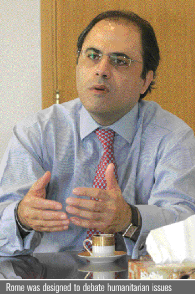
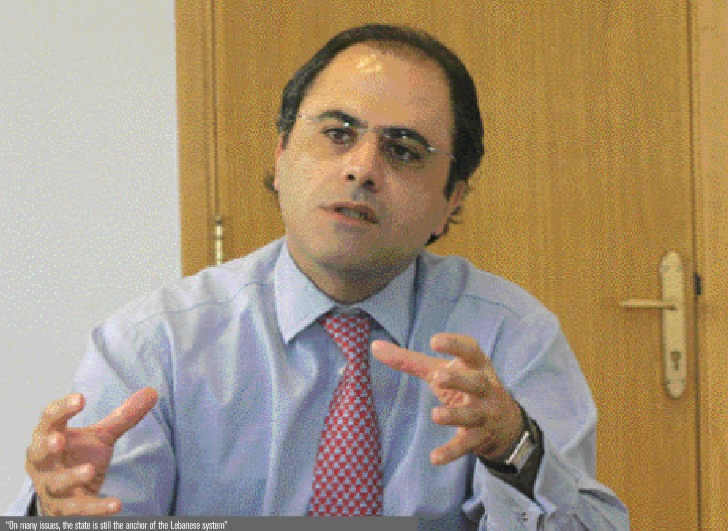
Dr. Jihad Azour, Lebanon’s Minister of Finance, sat down with Executive on July 29 to discuss the roles of the government and his ministry in the current war: their efforts in relief and diplomacy, how choices made in the past year have helped them meet these challenges, and what lies ahead for the economy and the state of Lebanon.

E In the coming months, everyone will be competing to adopt the issues of relief and support. The government must lead these efforts, otherwise many people may fall in the hands of other groups that want to benefit from their misery. What is your strategy for relief?
It’s a very challenging task. For the first few weeks, the government was the only provider of supplies. All the aid came from the government, through the High Relief Committee. However, due to the acceleration of the displacement, the destruction of roads, Israeli bombardments of convoys and any truck, and the difficulty of communication between various regions, the Committee opted to decentralize support, and provide the municipalities and districts with the resources to buy supplies locally and provide them to the displaced. So we paid almost LL40 billion to the municipalities directly. The objective was to give them the ability to provide basic needs without waiting for the trucks to come from Beirut or from somewhere else, to give them flexibility and quicken response times. Unfortunately, various political parties took advantage of this strategy as a way to show off and to distribute the aid in their own party’s name. It happened everywhere—all the parties did this.
E How will the government take the lead and become the primary decision-maker in these kinds of situations in the future? Hezbollah made a unilateral decision, and we’ve all had to deal with the consequences. How will the government regain power and authority in decision-making?
On many issues, the state is still the anchor of the Lebanese system. The majority of the displaced have been taken care of by state agencies: the army, the schools, the High Relief Committee, the municipalities. The government also took the necessary measures to provide unity behind these issues: in the High Relief Committee, you have more than eight ministers.
In terms of financial issues, from day one, the objective of the government has been to provide sufficient financial support to the agencies in charge of relief. In two days, we put in place the necessary support for the army, the Ministry of Health, the displaced fund and other agencies. This was possible due to efforts we’ve made in the last 12 months, which improved the financial situation substantially. We increased our liquidity; this gave us the ability to move very quickly.
The second objective was to keep government agencies functioning during the time of the crisis. We’re not getting any revenues, but we have to supply funds to the various agencies. In fact, we managed to pay on time and even early. Some bypasses and special procedures were implemented to support citizens and the business community. For example, we created a new customs office, because the ports and airport were not very safe, and we provided special procedures for supplies coming from outside.

“we are making the necessary measures
to adjust to different types of war”

The third thing that is important in countries where you have fragility, like Lebanon, is maintaining financial stability. This was a big challenge for us: to make sure the financial situation doesn’t add pressure to the monetary situation; to finance the government without being obliged to raise the Bank’s interest rate; and to maintain confidence in the system. Again, we could do this because we had made certain choices over the last 11 months. For example, on the debt front: the exchange of debt and the Eurobonds, our pre-financing strategy, all this kept us from having a big amount of debt to be renewed in the second half of 2006.


We also substantially improved the primary balance of the budget. In June 2005, the primary balance – the net operation of the government outside debt—had a surplus of LL200 billion. In June 2006, we had a surplus of LL1.2 trillion, which is five times more. We reimbursed the Central Bank $3 billion of debt that was issued last year and improved the balance sheet of the Bank. The improvement of the balance of payment was a surplus of $1.8 billion, and improved liquidity and free capital flows, which strengthened the system overall. We were not expecting what happened, but since I took office as Minister of Finance my policy has been to stay vigilant at all times, and to be proactive. You need to have your safety valves working. After almost three weeks, the system is functioning.
We are now starting to prepare for the day after the end of the war. We’re going to divide the program into two phases. Phase one is the emergency recovery: what to do for the first 90 days. We need to create solutions for a lot of problems: how to deal with the return of people to their villages, housing issues, schooling issues, and all the psychological and physical problems people are sustaining. How to deal with the infrastructure, how to mobilize funds quickly—if you go to the World Bank and others, you need to wait at least six months to get a loan. In order to act in the first 90 days, we must solve where to get the money from.
In addition, you have to figure out how to stabilize the private sector: when the war ends, you may have trouble for certain sectors in the economy, so we need mechanisms in place in advance to support the private sector. The government will also have to take care of its own financial situation, and all this must happen in the first three months. After that, we need a reconstruction plan, which will kickstart after the first phase. But the first phase is a very critical moment: to answer your question, this is how the government will take hold of the situation. This is something we have to plan and structure very tightly; the difficulty is that the situation is changing on a day-by-day basis.

E What type of state will result once the war is over? We have to decide: are we living in a state of war, where war can break out any second and destroy everything that was built? Or are we living in a different type of state where people can be confident in investing and rebuilding the country?
What type of state is viable? The viable one is a state where you have a lasting political solution, in order to assure the citizens of the South that they can go back and rebuild. You cannot bring people back to the South without that, if there’s still a threat that in five years or 20 years, everything will be destroyed again.
Secondly, you need a durable solution for both foreign and local direct investment to operate. Otherwise people will tell you, “I’m not going to adventure and invest heavily in a country where the situation may change,” and you’ll return to the economy we had during the civil war: low investment and low growth; a lot of our comparative advantages would disappear. In this type of model—one without a lasting solution— we will enter into at least five to 10 years of destabilization, especially since we have a vulnerable financial situation. During the civil war, a system was functioning. But at what cost? Per capita went down to less than $800, whereas today, we are at almost $6,000. Our exports have increased by 30%; we’re one of the best destinations for investments in the region. Our expectations were that, progressively, the Lebanese talents would come back and establish in Lebanon. This was the best tourism season for 30 years; we were expecting to import more than $10 billion this year, which gives you an idea about the economy. If you want to have a strong system, where the economy is functioning for the benefit of the citizens, the first model is the only model. This is the type of system that can survive in Lebanon. The second model cannot: it will spill over or make the financial situation unsustainable, and it will impact the socio-political stability of Lebanon. The Lebanese will not accept this kind of life.

E How likely is Hizbullah to subscribe to such an equation?
Hizbullah is not advocating the second model. Politics aside, their level of involvement in the government never gave the impression that they didn’t want the first model. I think the issue is that this war came at a time when it could be used regionally and internationally. There are other purposes, and therefore Lebanese actors become secondary in the decision-making— including Hizbullah. Rather than making the solution, we become the solution. And the solution could be in our favor, or not in our favor— that’s the risk of the current situation.
E How much has already been lost in this crisis? How long can the government support the system?
Damage-wise, I think it’s too early to get a serious assessment that indicates the magnitude of destruction and how long it will take to rebuild. In addition to the destruction of infrastructure, there are other damages to be considered. In the private sector, many industries were directly hit; certain economic activities stopped altogether. Almost all the sectors in Lebanon are suffering economically because of what happened. The owner of one of the biggest supermarket chains was telling me that 80% of his customers left the country with the evacuations. Yes, now he’s going to sell more rice and milk, but that’s not where he makes money. Every sector was hit, from agriculture to tourism to trade to banking.
There is also a negative impact on government finances. Usually, July is the month where we receive the second payment of VAT. Due to the war, we had to postpone it twice, because we cannot ask people in this time to come and pay. Our revenues are down, but our expenditures increased, and there is the risk that interest rates will go up; beyond that, the value of Lebanese assets went down.
There is also a secondary circle of lost opportunities and investment. Billions of dollars of investments were expected to be decided this summer. Now, they will be postponed at best. Many companies were looking at Beirut as their regional platform again— in the last five months, we saw tens of international companies relocating in Lebanon.
The shock is creating many waves. We can easily quantify the immediate wave when the war ends, but we also have to take the others into account if we want to kickstart the economy. We have to be imaginative. How can we involve not only donors, but also private sector investors in the solution? How can the private and public sectors work as partners to address the situation, along with the various NGOs and social communities? It’s not an issue the government or the Council of Ministers can solve alone. This has to be done on a nationwide level, with the full mobilization of all our resources, in addition to the support of others— be it international institutions, donors, expatriates, whoever wants to help.

E How many waves of impact can the government withstand? Can it last another three or four months?
We are making the necessary measures and protections in order to adjust to different types of war. We have to find solutions. We cannot say, “Ok, we can stay up and running for one month”: we have to find a solution to extend it to two, three, four, five, six months. If you have destabilization on the financial side, it will have an immediate impact on the economy and cause a disaster on the social level.

E Are we talking about stabilizing the Lira?
The whole financial situation. The monetary situation has been kept stabilized—there’s pressure, but controlled pressure. The type of crisis we are going through is different from the one experienced after the assassination of Prime Minister Hariri. The war has economic and financial implications, but our ammunitions are bigger: before the assassination, from October 2004, we had pressure on the pound. The Central Bank started using its reserves even before Hariri was assassinated. This time, the reserves were at a peak, and the balance of payments was very strong. We have already taken steps and measures to make sure that the financial situation can hold for several months.

E You’ve just returned from the
Rome conference, where international leaders failed to call for an immediate ceasefire. What did Lebanon accomplish at the conference?
From the beginning, the objective of the Rome conference was to discuss the humanitarian issues and gain support. A ceasefire was one objective, but we went knowing that we might not be able to achieve this. In diplomacy, things move progressively. This was an opportunity to present the Lebanese views to the international community and to increase support for Lebanon, and we did this. We also presented the seven points the government believes are the framework for a solution to the conflict. And we didn’t get any disapproval on these points from the international community. Rome was also an occasion for us to get a feeling for the views and positions of various parties, and to redirect some of their proposals. For example, one of the ideas was to send NATO forces and we said, “It doesn’t work, we cannot accept this.”
In addition, since Rome, pressure on the US government is much bigger than before. When the war started, the international community was not with Lebanon. The international community was even looking at Lebanon as troublemaker, and now the situation is completely different.
We were also able to achieve specific targets. For example, the conference in Rome requested the Secretary-General of the UN call for a Security Council meeting to prepare a resolution for the ceasefire. This was not granted before going to Rome. And lastly, we now know that the international community will be with Lebanon in the reconstruction and rebuilding phases. This is what the trip to Rome was about.

E Many people predict that once this is over, help will come to Lebanon: assistance with pre-existing problems and new ones created by the war. What should people expect?
First of all, we should fight to get a ceasefire as soon as possible. Not only from the humanitarian and political perspectives, which are very important, but also from an economic perspective. If the war lasts for six months, investors will turn away and go somewhere else, even if they love Lebanon. We need a ceasefire.
Secondly, I believe that this country has the strengths and the skills and the energy to rebuild itself. I have no doubt that the Lebanese are going to rebuild. Honestly speaking, this state is holding better than the state of Israel, where you see more and more division.
However, in terms of reconstruction, we have to do it differently this time. It’s not only by rebuilding the infrastructure that the economy can function. We need to develop a comprehensive strategy: how to work with everybody who is involved in the functioning of the economy, even the labor. It’s an effort where everybody has to contribute, to reactivate the economy and to get back to where we were prior to the war. And then, yes, there will be international support. We should work to maximize this support, but we also have to be realistic: we can’t say we’re going to lie back and wait until international support comes, or that someone else is going to rebuild Lebanon, and what we have to do is go to the beach. This is not the way we should do it.


The war may also provide an opportunity to make changes in certain roles and regulations in the government, I think this is a time to say, “Let’s start something new. Let’s revise some of the processes and procedures, let’s renovate some of the ways we do business in Lebanon.” It’s an opportunity.

“In terms of reconstruction, we have to do it differently this time”

E What do you think about the remarkable way in which civil society has reacted?
The Israelis made a big mistake. A lot of people did not agree with what Hezbollah did— and many voiced their disapproval— but when it came to the solidarity among the Lebanese, everybody was there. No one said, “No, I don’t want to help because the decision was not the right one, or this war is not something I believe in.” Even in the cabinet, there are political forces who are not in Hezbollah’s favor, but we’re all standing together.
People who bet negatively on the Lebanese are always mistaken.

August 9, 2006 0 comments
0 FacebookTwitterPinterestEmail
For your information

Robert Fisk

by Executive Editors August 9, 2006
written by Executive Editors

Robert Fisk, Middle East correspondent for British newspaper The Independent, is one of the most acclaimed—and experienced—journalists in the region. Three decades in Lebanon have given Fisk a first-hand knowledge of local political and cultural dynamics that is simply unparalleled. On July 15, Fisk offered Executive his insights on the current war, speaking about Hizbullah, Israel, parallels and connections to Lebanon’s past, and his predictions for the future of the embattled country.

E Who do you hold responsible for the current conflict in Lebanon?
This is about Syria, and about Iran. This is about people needing Syria and Iran to use their influence to stop the war. The Hizbullah were well aware that they broke international law by crossing the border into Israel. They went through the wire, into Israel. They crossed the UN rules, the Blue Line. So they broke all the rules.
They must have planned a scenario. Nasrallah says this has been planned for more than five months—I’m sure he’s telling the truth. And that means they would’ve known the Israeli response, and would’ve planned their reply to that. For example, the gunboat hit last night. That wasn’t just someone who said, “Oh look! There’s a gunboat, let’s find a missile and shoot it.” That was planned before the attack across the border. It must have been. This was an Iranian long-range missile. This is very serious stuff. This is not Katyusha or Kalashnikov.
Remember that, weeks ago, they sent a drone over Haifa. I’m sure it took pictures. I would imagine they were aiming at the oil storage tanks in Haifa. And they obviously worked on the principle that Israel would reply most cruelly to that attack, which as usual Israel did, most cruelly. We’ve now got something like 90 people dead, up to date. And, as usual, the Israelis are failing in Lebanon. They sent their soldiers across the border 35 feet, they lost four men and had a tank blown up. Then they got shelled in Haifa. Then they’ve lost a gunboat. What are the gains? They’ve helped to destroy the infrastructure of Lebanon—gas stations, bridges, you name it. And they can go on destroying it and bring down the government. Then we’ll have a pro-Syrian government again and they can ask the Syrians to come back. Is that what they want?
I don’t think Olmert has any idea about military affairs, I don’t think he has any of it planned, I don’t think the Israeli military know what they’re doing. When you get down to it, killing people in trucks and blowing up homes with eight kids in them and attacking gas stations, it’s the end, isn’t it? It’s over, it’s finished. They’ve got no idea where their soldiers are and they haven’t got them back. So, if it was planned by Hizbullah to drag the Israelis into this mess, they were very successful. But they would’ve known how many innocent lives that attack across the border was going to cost. Because they were counting that Israel would attack the innocent, and Israel did, as usual. So in that sense, what Hizbullah did was reckless, ruthless, and carefully conceived. They relied upon Israel’s cruelty and they got it right.

“Who gave Nasrallah the right to take such
unilateral responsibility?”

E What sort of responsibility does Hizbullah bear for what’s happening?
Did they get a vote or a referendum from the Lebanese people to stage this attack over the border? Who gave Nasrallah the right to take such unilateral responsibility, knowing that there will be such terrible results? Nobody did. This wasn’t even Shebaa Farms. If it were Shebaa, one could understand the logic behind it. But the logic behind this is about Syria and Iran.

E So how do you think Syria and Iran can be brought into the solution?
Diplomats will go to Damascus and ask the help of President Bashar al-Assad. And one year after his army retreated in great humiliation from Lebanon, he’ll be back on the stage again.

E Do you mean that you anticipate a Syrian return to Lebanon?
No. They’re here! They’re here in the sense that they’re in our minds – look at what has happened in the South! Don’t tell me that the Syrians didn’t have any idea that such an operation would take place. I don’t mean Assad, but the ‘Syrians.’ That missile that was fired last night was a highly sophisticated, Iranian-made missile. That wasn’t brought here because somebody wanted to weight their baggage and bring their clothes in the other bag, you know? That didn’t come here because they were going to practice it. They’ve already practiced somewhere else, probably in Iran. That came here to be used on ships, and it was used, successfully. If I were the Iranian military attaché in Beirut, I would’ve been watching that with great interest. It’s test firing, isn’t it? Combat-proven, that’s what you say at arms fairs.
They’re in the market, aren’t they? The Israelis are saying “This proves the Iranian hand in all this!” Well, what’s the manufacturer of the missiles that are hitting all these houses [in Lebanon]? They’re made in California. They’re made in Seattle as well. And one of the missiles they’re using is made in Duluth, Georgia; another one is made in Florida. So, what does that prove? That proves the Americans’ hand?

E At this point, do you feel that Hizbullah is essentially directing Lebanese foreign policy?
They are! They are—the government isn’t, is it? [Lebanese Prime Minister] Fuad Seniora is reduced to ringing up Condoleezza Rice and President Bush.

E Is there a more active role the Lebanese government could take here?
Well, if [assassinated former Prime Minister] Hariri were alive, yes. Hariri would be in St. Petersburg now [at the G8 Summit], demanding to speak to Putin and Bush—and he’d get them. Fuad Seniora is a very nice guy, and I know him personally, and he’s a great economist, but in this sort of tragedy, the Senioras of this world don’t swing any weight.
E Even in a best-case scenario, where this situation resolved quickly, do you see it causing a crisis of legitimacy for the Lebanese government?
Well, it’s causing one already.

E What are the prospects for Lebanon in the short-term?
Well, you’ll have to go to Paris and ask for more money from the European Union. Which means, as usual, that the taxpayers in my country and others will end up paying for this trashing and vandalization of Lebanon. The Hizbullah —how they’ll come out of it, I’m not sure. You see, the crueler the Israelis are, the cleaner they look even though they started it. And they’ll work on that principle. And they’re correct. As usual.
When this started, most Lebanese were cursing the Hizbullah for bringing this down upon Lebanon. But I don’t think there were many Lebanese last night weeping for the crew of that ship. You see?
Syria will have proven that it decides the future of Lebanon. Not Mr. Seniora, Mr. Jumblatt, Mr. Aoun and all the other dignitaries downtown.

E On the subject of Aoun—how will current events affect the future of his relationship with Hizbullah?
Well, it was very interesting to hear the comments he made two days ago. He was remarkably soft in his comments about Hizbullah, wasn’t he? Aoun was always a very messianic person, and when he got back [from Paris] he was being hailed as this kind of savior: reading L’Orient-Le Jour when he returned home was like reading the Syria Times under Bashar al-Assad—utterly uncritical. It was like reading the Iraqi Times when Saddam was there. And since then, he’s proven what I’ve always thought, that he can be a very, very different man from the messianic general we saw before.
E What about the future of Hizbullah? Israel is saying they won’t cease hostilities against Lebanon until UN Resolution 1559 is implemented?
Israel always makes these threats. I’ve got a file I’ve pulled out on Israeli threats to Lebanon. And they’re always saying, “We’ll never release prisoners,” and then they do. They did in 2004, they did in 1985; at one point, they released 1,050 Lebanese and Palestinian prisoners in exchange for, I think, one Israeli spy and three dead soldiers. So, of course they’ll release prisoners. Ehud Olmert may not think he is, but he will.

E Even with a parallel situation taking place in Gaza?
Well, they might get the guy in Gaza, they might find him—it’s a little place, and they’re surrounded. But here, it’s a different matter. They have no idea where the soliders are, nor does anyone else. Well, someone does of course, but not me.

E You were here for the Israeli invasion in 1982. What similarities do you see between the two situations?
It’s not going to be 1982 again. The Israelis are not going to come here on foot. It was a disaster for them: this was their Iraq. They lost the whole operation. Do you remember the purpose of 1982? To secure the northern border of Israel; “We will not leave until we have wiped out the evil cancer of Palestinian terrorism.” And now it’s “evil cancer of Hizbullah terrorism.” Terrorism, terrorism, terrorism, terrorism, terrorism—I sat and watched the BBC’s coverage of the UN Security Council yesterday, and up pops the Israeli ambassador to the UN Security Council, and sure enough, he uses “terror” 20 times, or 21 times, in two minutes. It’s like a punctuation mark now, the word terror.
Everyone here who remembers ’82 will think of ’82 now, of course. I’ve been thinking about it: I’ve gone back looking at my book on Lebanon, Pity the Nation, and recalling what I wrote about it, and looking up all the quotations. “We will not stand idly by,” was one of them – the same quote used by Olmert the other day – it’s the same thing that Begin said.

E What kind of solution do you see for the present conflict?
Well, it all goes around [UN Resolution] 1559, doesn’t it? And the way Lebanon gets around it is to keep postponing things. They got the Syrians out, which everyone here more or less wanted; that put the Hizbullah in a much stronger position, of course. And they appreciate that.
Once the UN have gone and paid homage to Assad and everyone else, there’ll be some kind of agreement that the Israeli soldiers will be released soon, that there’ll be a promise through negotiators that the Israelis will release X number of prisoners, the Europeans will offer loans to rebuild Lebanon, as usual – why we should have to pay for this trash, I don’t know, but we do. The Israeli prime minister will appeal for the patience of Israelis, as complicated negotiations managed to release their soldiers, who wouldn’t have been released had Israel not taken a firm hand with Lebanon after the attack. (Laughs) Try me—see if it works. See if it still happens.

E What will be the future of Hizbullah after the war, in your opinion?
I don’t know. They wanted to be in politics and they got into politics: they went into the government, democratic elections. But they also still want to be a militia. Now, can you be a member of the government, playing a democratic role, while the same organization you belong to starts a war that devastates your country without even telling the government?
It always comes back to the same problem: this is not a modern state, because it’s a confessional state. And as long as the president has got to be a Maronite and the prime minister a Sunni and the speaker of Parliament a Shia, it can never be a modern state. But if it’s not a sectarian state, it won’t be Lebanon anymore. Big problem. Upon that, everything else hinges, including the Hizbullah.
So what will they be like afterwards? Well, it depends how many more people get killed. It depends on whether the Hizbullah score some other high-profile attack, like shooting down an airplane, for example—which I’m sure they’re thinking about. With their new missiles, I think they could probably do it—at least, they have a chance of it. And I’m sure they’ve thought about it, planned it, discussed it. I mean, that planning of that ship was done a long time ago. “Oh look, there’s a ship! Let’s go for it.” Forget it.

E Do you think the timing was intentional, coming as it did at the peak of tourist season in Lebanon and coinciding with the situation in Gaza?
Just after the exam season was over and the Baccalaureates are taking place. I noticed that, too.
But no – it needed a particular Israeli unit in a particular place. When this was planned originally, they didn’t know that Gaza was going to happen. I mean, the Hamas delegate here in Lebanon says there wasn’t any coordination; I think he’s probably right. What do you want to do, ring up Gaza and open a phone line? “We’re planning to get two guys tomorrow.” The people who did it in South Lebanon knew that Gaza was taking place, didn’t they? It had been going on for a week or so. But they weren’t inspired by it all, it wasn’t that the projects and the money came from Gaza. Hizbullah said months ago they were going to capture Israeli soldiers.
One of the dangerous sides to all this is that Hizbullah, despite its worth to the country, is a Shia Muslim organization. And a lot of Sunnis are getting killed in this. And you know, with the sectarian conflict in Baghdad.
The one thing this represents now is that the West—in terms of Israel, America, Britain, and everyone else—are all fighting Islamists. We’re fighting Islamists in Afghanistan, we’re fighting Islamists in Iraq, the Israelis are fighting Islamists in Hamas, and they’re fighting Islamists in Lebanon. When I first came here, the West was always fighting nationalists, secular nationalists. That all changed.
The other thing that’s changed is Arabs are no longer afraid. Now, the Hizbullah races to southern Lebanon to fight them. It’s not happened before. The idea that you can beat the Arabs into submission is over. It doesn’t work. Once you lose your fear—and this started in ’82—once you lose your fear, you never get the fear back again. You’re injected against it. You can’t come and re-inject a person. When the Israelis say, “We shall attack painfully,” – yeah, well you’ve done that before!

E Do you feel that anything could have been done in the past year by the Lebanese government to prevent the
current crisis from happening?
The key thing would be to get the Hizbullah to join the army. But they’re not going to join the army, because they won’t be the Hizbullah anymore. It’s interesting that the financial situation of Lebanon was much worse after Hariri’s death than it is today after this bombardment. Both in terms of stocks, and in terms of propping up the Lebanese pound. Hariri’s death proved the maturity of Lebanon, because a lot of us thought that all the ghosts were going to climb out of the mass grave and the civil war would restart. And it didn’t.

E So you don’t see this becoming a long,
drawn-out conflict?
There are too many people involved now. The UN’s involved, the G8 are involved, the Arab League are involved—not that that matters for anything; the world’s attention is on it, and people are becoming sickened by the casualties. Israeli military is coming out very poorly, not just because they’re killing a lot of innocent people. Who would ever have thought that Lebanon would produce anyone who could ever fire a missile and hit a gunboat? It was astonishing last night, it changed the whole balance of power. I mean, are those gunboats going to come back to shell the coast road anymore? I don’t think so.
They came across the border, got blown up in their tank and they didn’t come back anymore, did they?

E Based on your experience in
Lebanon, what kind of economic
impact do you anticipate?
As long as the pound stays at 1,500 to the dollar, Lebanon’s ok. I don’t know how long it can go on nursing a $39 billion public debt. People are always predicting the downfall of the Lebanese economy, and it’s true that at the start of the civil war, if you had a 50-pound note – 50 Lebanese pounds – you kept it somewhere safe. I think Hariri stabilized the economy here, and I think it’ll go on being ok.
Let’s speak with horrible frankness: this country has been repairing and re-repairing and re-repairing and re-repairing itself so long now, it won’t be long before they get those bridges back up again, and the lines repaired. I’ve seen this country devastated by 15 years of civil war, devastated in ’82 by the Israeli invasion with absolutely crushing force – whole towns went missing—and it’s all been rebuilt. And it will be again. And the French will help.
I don’t know what the effect will be on the Israeli economy. Apparently, the Shekel is falling against the dollar at the moment. It’s one thing for the Israeli officials to say they’re going to put Lebanon back 20 years, but Israel could go back 20 years, too. I remember when they had to replace the old Shekel with the New Shekel, and that was a shock.
The other thing which will have a big effect on the G8 is that this is pushing up the price of oil even higher. It’s now almost at $80 a barrel. Just think, it was $16 a barrel at the 1991 Gulf War! That hurts America in its pockets, and I think that if America is hurt in its pockets, it matters more than America’s support for Israel. And that is what the G8 summit will actually be talking about: the dollar, and the barrel and the oil. That’s what it should be talking about, I should say. And this is having its effect; Israel always appeals to the world’s conscience, but it never seems to heed what the world needs as well— that there are other people living on this planet who also have needs, like driving their cars. I’m sure there will be efforts contrived to blame the Arabs for all this – I suppose you can blame the Hizbullah as well—but I think that Lebanon will survive, it always does.
I always remember this wonderful mythical story of the Australian economist who was invited by the Chamber of Trade, before the civil war, to come here and explain to them how the Lebanese economy works, and he spent two or three weeks researching, and talking to everyone and reading every book and pamphlet and came back, and stood up allegedly in front of the Chamber of Commerce and said, “Ladies and gentlemen, I haven’t the slightest idea what you’re doing, but keep it up!”

“[Lebanon] will be [rebuilt] again. and the french will help”

E Are Hizbullah’s actions – kidnapping the two soliders— in any way excusable?
You can look at it in certain ways. Number one, there are still people locked up in Israeli jails. Including hundreds and hundreds of Palestinians without trial. And no one’s got them out. This is the only way that has ever got them out of prison, apart from the Oslo agreement. So, that’s one argument that the Hizbullah have put forward already.
Another one: the Israeli prime minister says its “an act of war,” and the Lebanese government has to take responsibility for it. And we all know that they can’t take responsibility for a single militiaman – it’s untrue. But if you apply the same standards, when Jewish settlers kill and murder Palestinians—holders of Israeli passports coming from Israel, landing at Tel Aviv airport from America in some cases—can the Palestinians declare war on the Israeli government? Do they blame the Israeli government for it, even though the government has actually armed the settlers? They don’t. They may blame Zionism, they may blame the way Israel is run, but they don’t declare war on Israel, do they? But Israel can declare war on the Lebanese government. Or say it’s an act of war. Odd, isn’t it?
Israel can do more or less anything they want anywhere, can’t they?

August 9, 2006 0 comments
0 FacebookTwitterPinterestEmail
The Buzz

When the going gets tough .

by Frank Krumb August 1, 2006
written by Frank Krumb

There is no doubt that the recent violence between Israel and Lebanon has dented the Lebanese economy to the tune of roughly $4 billion and counting. And even though it is likely that funds for repairs will be made available, the cost in terms of morale – the years repairing damaged homes, factories, roads and bridges – will also be considerable.

The banking sector had counted on a bumper tourist season. However, it is now expected that the country’s GDP, which experienced solid growth of around 6% by the end of June, will probably experience negative growth, or stagnation at best.

Heavy exposure

Like other sectors, Lebanese banks have been directly hit by the crisis. Not only have they lost potentially significant business as a result of a spoiled summer season – the sector had wanted to use the summer to add deposits, increase the number of expatriate and foreign customers, and increase non-interest revenues – but they are now witnessing the effect of a deteriorating political and economic situation on economic capital.

Many banks, including the larger ones, were heavily exposed to small and larger businesses which were annihilated during the early days of the fighting, while other banks are starting to provision against non-performing housing loans, initially granted to individuals whose homes have been flattened in previous fighting. Such factors are likely to push risk weightings upwards, and increase the need for additional capital, at a time when capital is almost impossible to find. Forced provisioning against unexpected non-performing loans are also likely to affect a rising profitability for the banking sector as a whole.

For those banks listed on the Beirut Stock Exchange and other exchanges across the world, such as Audi, Byblos, BLOM, Bank of Beirut, Bemo, and BLC, the loss in market capitalization has been estimated at around 15%-20%. Local and international investors are in a situation where the liquidation of their holdings, albeit at a loss, is the absolute priority, as it is difficult for them to draw up a vision of what the economic and political future of Lebanon will look like in the short or long-term.

Deposits are also fleeing the country, although at a lesser rate than during the period following the assassination of Rafik Hariri. The smaller banks are the worst hit, as they do not have foreign subsidiaries or branches to which they can divert their customers, while others – small and medium-sized banks – with no international presence are losing valuable deposits to other larger banks which do. Elsewhere, the larger banks that decided to expand geographically now realize that it is precisely situations like these that vindicated their decision to do so.

Dollar holding

Then there is the dollar. The Banque du Liban (BDL) was quick to alleviate fears of a lack of liquidity by announcing that it had sufficient foreign currency reserves ($13 billion) to counter the panicky conversion of Lebanese pound deposits into US dollar deposits. In three weeks of hostilities, around $1 billion of these reserves are believed to have been spent. The recent announcement that Saudi Arabia had deposited $1 billion at the BDL came as a welcome relief and is regarded as a substantial morale boost, as it reflects the level of support Lebanon continues to enjoy from friendly Gulf nations.

The hostilities have come as a painful reminder to banks that an economy cannot prosper and profits cannot be sustained when the political environment is unstable. For some banks, particularly the larger ones, a policy of geographical diversification has been on the cards for a while now, as their management and shareholders rightfully concluded that the Lebanese operating environment was not particularly conducive to efficient business.

So far, the banks’ profitability has come mainly from interest income, which itself is more than 50% accounted for by interest received from government debt securities. Non-interest income, such as fees, commissions, selling savings and investment products, foreign exchange and money market dealing, still make up less than 20% of total operating income, whether you are looking at a large or small bank. The banks lack significant diversity in their revenues, given that they operate in a constrained and difficult environment. The recent military crisis is unlikely to encourage or allow the further diversification of revenues and may, on the contrary, push Lebanese banks to expand geographically in order to move away from Lebanese risk, which could be expected to worsen at the end of the hostilities. Some of the larger Lebanese banks have already started their geographical expansion into countries in the Arab region, which offer significant long-term potential and where sophisticated and efficient banking regulations are still at an under-developed stage. These countries include Sudan, Algeria, Iraqi Kurdistan and Syria.

Diversification

Geographical expansion is probably the most efficient way for Lebanese banks to diversify revenues and build up a recurrent income stream. By developing foreign franchises and focusing on activities that are the most in demand inside these foreign markets, Lebanese banks would assure their profitability for years to come, as well as hope to outgrow the Lebanese domestic market revenue base, which should have reached its peak by now. An efficient geographical expansion would also diversify risk and reduce the burden on regulatory and economic capital.

Although some Lebanese banks are concentrating on developing their activities in under-developed countries such as Algeria, Sudan and Syria, others are following a more conservative and cautious route. Indeed, this latter group of banks is focusing instead on fast-developing and developed markets such as those of the Gulf (Saudi Arabia, the UAE, and Qatar), due to these markets’ less risky nature, greater political stability and more diversified economies. This approach could be regarded as wiser, since revenues and assets emanating from more stable markets are likely to have a much lesser constraint on capital. In fact, many Lebanese banks are keen to emulate the Arab Bank model, where more than 80% of assets and revenues are derived from developed markets such as the UK, France and Switzerland. Arab Bank is one of the rare banks in the world to be rated above the investment grade level and well above the sovereign ceiling of Jordan, whilst it remains the largest bank in Jordan and the most significant stock on the Amman Stock Exchange.

With Basel II looming and the political situation worsening, Lebanese banks are aware that they need to diversify their assets and revenues away from the Lebanon risk and the low sovereign rating (B- until further notice) of the country, which constrains all borrowers and issuers in the same country to the same rating. A geographical and product diversification of banking revenues is the only way to build a stable and constant income base, which in turn would help capital increase internally, without having recourse to frequent capital raising. However, Lebanese banks’ shareholders must realize that to become another Arab Bank, there must be a firm commitment to recruit and adequately compensate qualified and experienced personnel, as well as develop detailed and realistic strategies that would be implemented by a management force with the right rack record and approach. The corporate governance issue would also have to be tackled seriously.

With the future of the Lebanese economy remaining extremely uncertain at this stage of the political-military crisis with Israel, Syria, Hezbollah and vis a vis the rest of the geopolitical context of the Middle East, Lebanese banks must start applying plan B. A contingency plan which consists principally of diversifying products and activities away from Lebanon could become a blessing in disguise and the trigger for the process of internationalization of Lebanese banks to finally take place.

August 1, 2006 0 comments
0 FacebookTwitterPinterestEmail
The Buzz

Believe in the Lebanese Way

by Michael Karam August 1, 2006
written by Michael Karam

Like many Lebanese at the time, my grandfather, Esper Karam, left Lebanon at the end of the 19th century and headed for Brazil to make his fortune. He established Esperadio Karam Trading and, by all accounts, he prospered – he was a senior freemason in the Sao Paulo lodge, learnt Portuguese and married a Swedish dressmaker.

This is the Lebanese way.

In 1915, he returned to Lebanon with his young family, only to be caught in the blockade of Beirut and the ensuing famine. In his village, people survived by eating radishes and grass. My grandmother took in starving children who would otherwise have died, cared for them and returned them to their families when better times came.

This is the Lebanese way.

Esper lost his company in Sao Paulo, but with the Lebanese pioneering spirit still thundering through his veins, he headed off to Mali, where, with his brother, he established another trading concern in Koulikoro. Working in Mali today would be no picnic; quite what it was like in the late 1920s is unimaginable. But the heat, the malaria and the ever-present threat of violence did not deter a man, who despite his habit of losing money at cards, was not afraid of hard work.

This is the Lebanese way.

I did not inherit my grandfather’s knack for making money, but the entrepreneurial gene remains dominant in the Lebanese DNA. They cannot travel abroad and not do anything. Dump them in a foreign country, give them minimal capital and they will start a business, any business. They have to work; for their family and their future.

This is the Lebanese way.

During the civil war, Lebanese of all religious stripes fanned out across the globe – to Africa, Australia, Canada, the US, the Gulf and Europe. They established communities and opened businesses: restaurants, supermarkets hardware stores, car dealerships, dry cleaning operations, even petrol stations. Their kids were the products of a foreign education system but were drilled by Lebanese parents for whom education was a religion. They became doctors, lawyers and engineers, while others simply got a business degree and joined the family firm. And when the fighting finished, many came back.

This is the Lebanese way.

Once back, they were hungry to share new ideas and techniques. They opened restaurants and bars and, out of nothing, created beach resorts. They grew grapes and made wines that made the world blink in surprise. They established IT companies and developed property. They worked in advertising, banking, finance and tourism. They established factories and agro-industrial plants and they opened department stores and shopping malls. All this they did with little or no government help or incentive.

This is the Lebanese way.

For Lebanon’s bankers, financiers, entrepreneurs, developers, traders and wine producers are the real Lebanese: brilliant, educated, hard working people, who, like generations before them, want to make a better life. This year, in the course of my work, I have been encouraged by the energy and determination of the Kassem family, the foresight of Lebanese Canadian Bank’s George Zard Abou Jaoude, the vision of Exotica’s Etienne Debbane and the entrepreneurial energy of Akram and Nayef Kassatly.

This is the Lebanese way.

From the wine industry, I have been privileged to be allowed into the inner sanctum of Chateau Ksara to see how Lebanon’s oldest winery operates. I have been moved by the bravery of Massaya’s Ramzi Ghosn, who stayed with his winery as the bombs rained around him. Selim Wardy, owner of Domaine Wardy, told me over the phone of how he was helping coordinate relief efforts in his beloved Zahleh, while Serge Hochar, who in 1982, harvested his grapes under the Israeli, Syrian and Palestinian guns, defiantly announced that that it was “business as usual.” They are all fatalistic, but they still have faith.

This is the Lebanese way.

And the bombs continue to fall on Lebanon. The heroes of the private sector, their achievements, their shattered vision and their material loss, are also victims of a futile, vainglorious adventure and the obscenely disproportionate response it has provoked. But they will be back.

This is the Lebanese way.

Now it is time for all Lebanese to show their commitment to the Lebanese way once and for all by putting national consensus before sectarian allegiances and be inspired by the Lebanese work ethic. The government must now draft a concrete economic plan, not only for the immediate reconstruction needs, but for sustainable future economic development in all areas of the country, including the Akkar, the Bekaa and especially South Lebanon. It must no longer avoid privatization and it must identify and develop areas of undisputed potential, such as tourism and wine as well as harness vital natural resources such as water. Lebanon, more than ever, must be developed as a brand, a country that is investment-friendly and an oasis of progressive, liberal values in a traditionally conservative region.

This is the Lebanese way.

August 1, 2006 0 comments
0 FacebookTwitterPinterestEmail
Comment

World War three will not start here

by Yasser Akkaoui August 1, 2006
written by Yasser Akkaoui

This black cloud has been a long time gathering: since 1996, in fact, when the sponsors of war unveiled their agendas. Until the end of 2005 – after the presidential extension, UN Resolution 1559, the assassination of Rafik Hariri, and finally the Martyrs’ Square demonstrations calling for a sovereign nation – the twin forces of conflict and prosperity had been sparring and trading jabs.

We were not free. When we woke up from our Independence-Revolution-induced-drunken-stupor, the forces of conflict had merely regrouped, and were still working to stymie progress at every turn and impose the state of war that feeds their very existence.

We have learned the hard way that Shebaa farms were of more use to Israel, who saw a land dispute as the perfect tool with which to keep its war options open.

And so the drums of war are getting louder. After tasting a sample of what this war is like, it is obvious that little Lebanon can neither take much more nor suffer the consequences. Now is the time to acknowledge that the only viable resistance is the one forged in the fires of economic supremacy. It is the time for every political party to subscribe to a new mission that will remove us from the well-worn regional agenda predicated on conflict and start to build a prosperous country, free from any affiliation or interests other than its own.

Refusing to allow others to wage their wars on Lebanese soil does not mean that we do not exist on the regional map. We are as much an Middle Eastern state as Switzerland was European during the Second World War, when its German, French and Italian cantons remained neutral and became a refuge for all that remained precious. Getting to this point will not be easy, but united we can make it.

And still there remains the hand of the assassin. Do not think that because Lebanon has entered a new, arguably more violent chapter in its history that those who shaped the dark days of 2005 have slipped into obscurity. National weakness is the perfect opportunity to sow the seeds of death and confusion. While death still looms, those who are still committed to freedom of speech and thought are not out of danger. Let’s pray that assassins will not reembark upon their deadly art.

Bridges and roads can be rebuilt, but lives are gone forever.

August 1, 2006 0 comments
0 FacebookTwitterPinterestEmail
The Buzz

It’s War

by Executive Staff August 1, 2006
written by Executive Staff

It took Israel’s military thinkers about two weeks to declare the systematic destruction of Lebanon’s infrastructure – along with Hizbullah’s launching of hundreds of rockets into Israel – a war. The nearly one million Lebanese civilians fleeing the South and Beirut’s southern suburbs, turned into refugees in their own country, could have told them as much on day one.

So, too, could the casualties of that war: at time of writing, some 950 killed and about 3,225 wounded.

For the first time since Israel withdrew from south Lebanon six years ago following its 18-year occupation, the Jewish state is getting involved once again in Lebanon. And once again, it finds itself caught in the Lebanese quagmire with its plans for a quick campaign going askew.

Lopsided conflict

Indeed, it may well be a war as the Israeli military has declared, but it is a very lopsided conflict, with Israel inflicting collective punishment on the entire Lebanese population for the actions of Hizbullah, a party over which the Lebanese government has absolutely no control.

Initially, Israel believed it could limit its involvement on the Lebanese front to an air campaign, while using heavy artillery on its side of the border to pound Hizbullah positions. Israel also thought it would be a quick offensive, and that the Party of God would capitulate within days. But as an Israeli general later admitted, “Not all wars are won in six days.”

The question the Israeli high command must be asking itself now, almost a month into the war, is whether it can be won at all?

Seeking to limit its military casualties, Israel believed it could conduct its campaign mostly from the air. Prime Minister Ehud Olmert wanted to avoid committing boots on the ground, aware of the political and military consequences of being drawn inside Lebanon anew.

Israel is not about to forget the protracted and costly war in Lebanon that grew out of it’s invasion in 1982. In fact, today’s war is partially a continuation of a conflict that started more than two decades ago. It was that very invasion 24 years ago, dubbed Operation Peace for Galilee, that gave birth to Hizbullah. The Shia organization came to fill the void left by the precipitated departure of the PLO from the South and the Lebanese government’s failure to reclaim the region.

The Israeli invasion of Lebanon in 1982 also divided Israeli public opinion as rarely before, tearing at the very fabric of Israeli society. Many questioned the wisdom of the operation, and even within the military establishment there were diverging opinions.

Nonetheless, if the 1982 invasion of Lebanon gave birth to Hizbullah, that same war also produced the Peace Now movement in Israel, adding to the division of opinion.

However, this new war is very different. For the moment, it still has the backing of the majority of Israelis. Prime Minister Olmert has enjoyed their largely unwavering support on his decision to take military action in Lebanon following the kidnapping of two soldiers by Hizbullah . But as casualties begin to mount, that is likely to change.

Obvious risks

Olmert knows only too well the history of the last war in Lebanon, a war that nearly ended the illustrious – albeit tumultuous– career of his former boss, Ariel Sharon. At the time serving as defense minister, Sharon found himself accused of dragging Israel into a costly war when he took the fight all the way to Beirut. The prolonged siege of the Lebanese capital and the massacre of Palestinians in the Sabra and Shatila refugee camps only exacerbated negative domestic and international public opinion.

Indeed, Israel knows the risks of getting dragged into Lebanon. While this may still change, for the moment, the chances of another full-fledged invasion seem unlikely, despite Israel’s shattered hope of a quick victory over Hizbullah. With civilian casualties mounting every day, so too is pressure from the international community for the war to stop.

Israel maintains it wants the Lebanese government to assume control of its destiny, and for the national army to take hold of the Hizbullah-dominated South. However, Israel’s relentless bombing of Lebanon’s infrastructure will only weaken the Lebanese state.

So where is the logic behind the brutal bombardment of Beirut, its suburbs and other cities, ports, airports, roads, bridges, and so forth?

Israeli objectives

Israel’s plan, it would seem, was to pound Hizbullah into submission – or nearly enough. The intense bombing campaign was meant to weaken it to the point where it would be incapable of resisting the implementation of UN Resolution 1559, which calls for the disarmament of all militias in Lebanon, and allow itself to be disarmed by the Lebanese Army – the only boots that should be on the ground in Lebanon in the first place.

While the continued pounding of Hizbullah positions must have taken its toll on the group, the effect Israel hoped to achieve has largely failed. Unable to achieve the desired effect through its air campaign, Israel found it had to commit infantry troops and armor to the battle. The resistance put up by Hizbullah in fierce fighting in the South – and the casualties it inflicted on the Israeli army – has strengthened the movement, rather than weakening it. Instead, the continued destruction of Lebanon’s infrastructure is weakening the government.

The South has plagued Israel for several decades, as its control passed from the PLO to Hizbullah. Two invasions by Israel – the first in 1978, that brought about the deployment of the United Nations Interim Force in Lebanon, and the second in 1982 – failed to pacify Israel’s northern frontier.

Just as Israel set about to distance the PLO from its northern border in 1982, it is now seeking to do the same with the Lebanese Hizbullah, which has replaced the PLO in southern Lebanon.

In destroying Hizbullah, Israel sought to reverse the group’s victory in May 2000 that forced Israel out of southern Lebanon. That triumph paid much dividend to Hizbullah, both in Lebanon and in the rest of the Arab world where Hizbullah’s fighters were hailed as heroes. Hamas in particular hoped to emulate Hizbullah through it.

Israel’s new war on Hizbullah was undoubtedly partially intended as payback for the 2000 defeat and to discourage hopes within Hamas that they could gain same stature as Hizbullah – something for which the Palestinians in Gaza received a brief apercu following the capture of Corporal Gilad Shalit when Israeli troops re-entered the territory.

What next?

The war in southern Lebanon did not turn out as expected for Israel. Resistance put up by Hizbullah appears to have caught the Israelis by surprise. As a result, Israel intensified its bombardment and lowered the bar on its expectations. An initial demand that Hizbullah be completely destroyed is now changed to a request that Hizbullah keep its weapons out of the south. Although Israel originally rejected the deployment of international peacekeepers along the border, it has now made its withdrawal contingent on the presence of such a force.

Meanwhile, various parties are trying to patch together this multinational deterrence force — to facilitate and support a Lebanese army deployment in the South – in a way that satisfies the demands of all parties. However, there is widespread disagreement over its nature and composition. Lebanon will accept a 2,000-strong international peacekeeping force led by UNIFIL; the Israelis, on the other hand, deem the inclusion of “incompetent” UNIFIL as unacceptable, demanding a force of combat units rather than inspectors.

In addition to any international peacekeepers, it appears that the Lebanese army will also be deployed to the South once Israel withdraws. The government has announced plans to send 15,000 troops to the southern border, and has asked its reservists to report for duty by mid-August.

In the aftermath of the hell currently raining down on South Lebanon, the people of the South would certainly welcome the national army. But as in all troop deployment, the honeymoon period between the newly-arrived military in a region and the local inhabitants may be short-lived.

When the Lebanese Army deploys to the South, it had better come prepared to replace Hizbullah in all capacities : that includes setting up free clinics, schools and social centers. Of course, the Lebanese armed forces are not geared to the administration of school and medical dispensaries. This will require the immediate and close cooperation of the Lebanese government to ensure that competent ministries, along with NGOs, pick up the slack where Hizbullah left off. They will only have one chance at getting it done right, because honeymoon periods often expire rather quickly, and people in need tend to have very short memories. A few mistakes by the Lebanese military or government, and the villagers may be clamoring for Hizbullah’s return.

August 1, 2006 0 comments
0 FacebookTwitterPinterestEmail
  • 1
  • …
  • 612
  • 613
  • 614
  • 615
  • 616
  • …
  • 686

Latest Cover

About us

Since its first edition emerged on the newsstands in 1999, Executive Magazine has been dedicated to providing its readers with the most up-to-date local and regional business news. Executive is a monthly business magazine that offers readers in-depth analyses on the Lebanese world of commerce, covering all the major sectors – from banking, finance, and insurance to technology, tourism, hospitality, media, and retail.

  • Donate
  • Our Purpose
  • Contact Us

Sign up for our newsletter

    • Facebook
    • Twitter
    • Instagram
    • Linkedin
    • Youtube
    Executive Magazine
    • ISSUES
      • Current Issue
      • Past issues
    • BUSINESS
    • ECONOMICS & POLICY
    • OPINION
    • SPECIAL REPORTS
    • EXECUTIVE TALKS
    • MOVEMENTS
      • Change the image
      • Cannes lions
      • Transparency & accountability
      • ECONOMIC ROADMAP
      • Say No to Corruption
      • The Lebanon media development initiative
      • LPSN Policy Asks
      • Advocating the preservation of deposits
    • JOIN US
      • Join our movement
      • Attend our events
      • Receive updates
      • Connect with us
    • DONATE