• Donate
  • Our Purpose
  • Contact Us
Executive Magazine
  • ISSUES
    • Current Issue
    • Past issues
  • BUSINESS
  • ECONOMICS & POLICY
  • OPINION
  • SPECIAL REPORTS
  • EXECUTIVE TALKS
  • MOVEMENTS
    • Change the image
    • Cannes lions
    • Transparency & accountability
    • ECONOMIC ROADMAP
    • Say No to Corruption
    • The Lebanon media development initiative
    • LPSN Policy Asks
    • Advocating the preservation of deposits
  • JOIN US
    • Join our movement
    • Attend our events
    • Receive updates
    • Connect with us
  • DONATE
Business

FNB reaches for the top

by Thomas Schellen November 1, 2004
written by Thomas Schellen

Provided that their development of assets and deposits continues along the lines of the first nine months, Lebanon’s First National Bank is set to achieve growth in the magnitude of 20% to 25% this year – strengthening its claim to be one of the fastest advancers in Lebanon’s banking industry at the beginning of the millennium. In their half-year results on June 30, FNB reported total assets breaching the $1 billion mark at LL1.506 trillion, and by August 31, the bank’s books showed further growth to LL1.536 trillion. On December 31, 2003, assets clocked in at LL1.308 trillion. Customer deposits reached LL1.196 trillion at the end of August, up from LL1.112 trillion at the close of last year.

These figures mark 2004 as a year of moderation in the development of FNB, knowing how the bank has advanced in less than five years from assets of merely $80 to $100 million, to its current position in the upper middle field of Lebanese banking. Beginning in 2000, the numerical stepping-stones of this growth journey comprised annual increases averaging in the magnitude of 40%. In 2002, FNB recorded profit growth of 130% at an increase of 50.5% in deposits (the sector average then was: 7.52%) through a combination of new business and the acquisition of smaller bank, Societé Bancaire du Liban. The bank last year achieved another jump in profits, from $720,000 net income in 2002 to $2.07 million in 2003, but still lagged behind its peer group. For 2003, FNB was ranked 17th in the sector in terms of assets.

Under the current categorization of Lebanese banks, its recent performance advanced FNB into the realm of the sector-leading Alpha Group of banks, whose assets exceed $1 billion. But just as his bank could claim the cherished qualifier, FNB chairman and general manager, Rami Nimer, would raise the bar. “I think the Alpha Group should be over $2 billion,” he told EXECUTIVE. He certainly has a point. The compounding of assets in the sector today is such that more and more banks cross into ten-figure territory. While the $1 billion barrier seemed high enough just a few years ago to delineate the sector hierarchy, a bank today needs to be safely over $2 billion in assets to claim a market share of 3%. As trends have been moving, the gap between the top ten banks – which dominate the market to over 70% and would constitute the Alpha Group at over $2 billion in assets – and the tiers of capable mid-sized or smaller banks, is becoming even more pronounced. By this rationale, establishment of a new Alpha Group marking makes sense to set the lead group apart from the pursuers. So in Nimer’s reckoning, FNB should be regarded as an institution in the high Beta Group. In his view, banks should turn their attention more to off-balance sheet activities, such as private banking and fiduciary operations and Nimer made it clear that it can be better for a bank to not be craving after size for size’s sake. “There are so many changes in the world of banking and being a good mid-sized institution is beneficial. Banks should think different to the classic game of size,” he said. “It is an important issue and volume makes the difference. But with Basel II, size is not the issue. Size without utilization can be more of a burden than a plus.” He is not the only top bank executive to deliver it but this message bears repeating in light of the risk pressures weighing on the Lebanese banking sector.

While thus espousing an esteem of unpretentious banking and maintaining an approach that FNB is a young and growing bank, Nimer nonetheless affirmed the wide consensus among local sector players that banks here need to reach certain size or would be faced with oblivion. And there is no doubt which side of the game FNB wants to be on. In the bank’s annual report for 2002, the chairman’s letter described the rise to then 19th rank in the sector as paving the way to become one of the top 15 banks “in the near future” and, in the longer term, ascend to be one of the top ten banks. The undercarriage of FNB’s growth capabilities was established with its founding by a group of Kuwaiti and Gulf Arab businessmen in 1994, who initiated marginal expansion of the bank’s activities over the first years of its operations. According to Nimer, these newcomers to Lebanon’s surging financial market couldn’t take FNB’s evolution to its potential but they established a capable organization that provided a good platform for the growth instigated following Nimer’s entry into the bank and a change in management between 2000 and 2001. This allowed FNB to prove that it had the foundations to be more than a delta group player and the bank quickly advanced through the ranks of the sector, defying any concept that the Lebanese banking field today couldn’t any longer offer the opportunities of rapid expansion that had abounded a decade earlier. “We are still building the bank but the results until now are quite encouraging. Although the big banks were there, we grew drastically,” summarized Nimer the experience of the past four years. Attributing the ability of FNB to succeed to the bank’s greater flexibility in comparison to larger players, he named as other factors the trust of their shareholding base in the team’s professionalism and performance and the new management’s experience in the local market. Giving proofs for the bank’s confidence and accomplishments, Nimer cited how FNB won out in arranging financing for the Four Seasons Hotel project in Damascus and shares many cross clients with its peer group and leading banks in Lebanon. Judging from Nimer’s engaged personal style, another component in the bank’s recipe appears to be a substantial dose of dynamism. In a business where the art of success lies in defining and applying an institution’s strengths out of a limited arrear of choices well known to all players, key instruments with which FNB wants to build its continued growth are further expansion of the retail operation, private banking, and venturing cross border. In the retail arena, FNB planted their stakes by developing the branch network from 6 in 2000 to 16 by end 2004, with a Jounieh branch scheduled to open this month. The bank enhanced its market reach with a catchy new logo and expanded retail products and in the summer of this year, it heightened its profile by moving its headquarters from Hamra to a new prestigious downtown address. As far as niche creation, Nimer is looking strongly to private banking. Having not long ago commenced working in this business line, the bank this year already achieved $80 to $90 million in off-balance sheet volume, he said. FNB made footprints in the local financial markets also through developing funds traded on the BSE, collaborating on them with Bank of Beirut. True to the Lebanese banking mantra of regional growth, FNB has two concrete ambitions for cross border activities: Syria and Iraq. In Syria, the bank is a partner in a project with Kuwaiti and Jordanian institutions and the prerequisite domestic investors, working to start a joint venture bank that plans to be operational in 2005. FNB shareholding participation in that venture is projected at 10% to 11%. For Iraq, FNB secured the license to establish a representative office from the country’s central bank and hopes to establish this office before the end of the year as first step into that market. While he described organic growth in the Lebanese market as his first choice for the development of First National Bank, Nimer named a further acquisition or merger as a viable option for FNB. In this field, the banker had accumulated experience through his role in the assimilation of Banque Beyrouth pour le Commerce into Byblos Bank, which at the time (1997) was the largest merger in the history of the sector here. Although that experience was not smooth, it gave Nimer very useful expertise for managing the acquisition of Societe Bancaire du Liban, which he called very successful. In terms of mergers, Nimer saw the bonding between the Banque Audi Group and Banque Saradar as an ideal situation and encouraging example to the industry although for the time being, FNB would be thinking on a different scale for its eventual merger projects. “We haven’t reached our potential yet, so my preference is a merger with an equal or smaller size institution, not a larger one,” Nimer said.
November 1, 2004 0 comments
0 FacebookTwitterPinterestEmail
Economics & Policy

Go West or East young bank

by Nicolas Photiades November 1, 2004
written by Nicolas Photiades

Banque Audi’s recent move into Jordan is much more than just a reflection of Lebanese pioneering tradition. Lebanon’s dire economic situation has affected the quality of loan portfolios and domestic placement opportunities and has forced many of Lebanon’s leading banks to look beyond their borders to diversify assets, improve the quality of profits and revenues, and rely less on a stagnant local economy.

Indeed, in the last ten years, banks such as Société Générale de Banque au Liban (SGBL), Byblos Bank, Banque Audi, BLOM, and Lebanese Canadian Bank have either purchased banks in neighboring countries, set up joint ventures with local banking groups in these countries, or established branches abroad. SGBL was the first to show interest in Jordan and purchased a small Jordanian bank in the late 1990s (Middle East Investment Bank), while Banque Audi recently followed suit by obtaining a license to open branches there. Audi has already opened three branches in Jordan, and has an objective of opening up to ten branches, while BLOM has also obtained a branch license in Jordan. Meanwhile, Byblos Bank has set up a banking subsidiary in Sudan, and Lebanese Canadian (LCB) has purchased a minority stake in a local Sudanese bank. LCB even set up a full branch in Canada to cater for the 300,000 strong Lebanese community there and ultimately aims at obtaining a full banking license from the Canadian Authorities. Finally, Fransabank has expressed a keen interest in opening a branch in Algeria.

While branches are being opened willy-nilly throughout the region, many Lebanese banks have been keeping an eye on the development of the Iraqi banking sector, where potential is significant. It is only a matter of time before Lebanese banks start sniffing around Baghdad and other main Iraqi cities for opportunities. The Iraqi banking market has around eighteen private banks, and almost as many government owned banks, with the private banks having all been set up during the embargo years by local merchant families. These are now all keen to develop their banking franchise and have expressed clear intentions to hook up with fellow Arab banks, mainly as a means to acquire expertise and banking know-how. Lebanese banks have been particularly favored by Iraqi bankers, who are said to be impressed with their technical capabilities and banking traditions. A number of Iraqi banks have made it clear to Lebanese bankers that they would be ready to give up 49% of their capital (which is the regulatory maximum for foreign stakes in Iraqi banks) to Lebanese banks, as well as the management. Although the security problem in that part of the world still hampers any efforts to establish banking operations, and the greed of some Iraqi bankers as regards to their selling prices is a major obstacle, Lebanese banks will certainly start making acquisitions there in due course.

Other countries such as Egypt and Algeria also appear to be interesting for Lebanese bankers, who would definitely have a clear qualitative advantage over their local peers, particularly with regards to Algeria. The latter is very similar to Syria, in that local banks have little or no sophistication in a country that sticks out as one of the richest in the Arab world in terms of natural resources. Moreover, the corporate, project finance and retail banking sectors are just crying out for more sophisticated financial institutions located on-site. However, Algeria’s banking environment is still severely hampered by insufficient and antiquated regulations, and transparency and disclosure standards remain light years behind those of Lebanon. The old socialist or even Soviet-style banking sector is still in place despite almost complete decrepitude, and the Algerian authorities have a significant amount of work to carry out before transforming Algeria into a gold rush destination for Lebanese bankers. Setting up a branch there as a first step would not be a bad idea though, as it would give the bank in question time to gauge the market, establish a list of what is needed in terms of regulation, and even get opportunistic in terms of project financing and retail banking.

Egypt is a different proposition, in that it is the most populated Arab country and has a very solid industrial and corporate base, which is also characterized by a strong track record. Gaining market share, even small, in the Egyptian corporate sector would be a major revenue boost for Lebanese banks, and would allow them to diversify away from the limited and small Lebanese corporate sector. However, Lebanese banks have to bear in mind that, despite Pharaonic efforts by the Egyptian central bank to improve regulations and supervision, the banking sector remains characterized by a weak financial profile of the country’s banks – particularly with regards to public sector banks – due to a weak operating environment and to a slowdown in the economy and in structural reforms that started in 1998. A challenging economic situation and regional uncertainties, combined with weak industry fundamentals, are expected to keep the banking sector under significant pressure in the medium term, especially considering that most Egyptian banks are not well equipped to face unexpected shocks.

For the moment, the Egyptian banking sector suffers from poor underwriting skills and asset quality, low profitability and under-capitalization of the state banks (the four largest banks in the country) and of some of the private banks, a low level of automation, underdeveloped risk management systems, low level of disclosure and high reserve requirements, which hamper efforts to spend in other areas where investment is urgently needed. The experience of Jammal Trust Bank (JTB), the only Lebanese bank to have courageously ventured into Egypt in times of state dominance, should serve as a good example to other Lebanese banks with expansion thoughts in this particular market. JTB has been consistently asked by the Egyptian authorities to provide substantial amounts of capital and employ unnecessary staff (including elevator attendants and an army of makers of bad coffee).

Lebanese bankers, however, could take heart from the recent efforts in terms of regulation, as well as from the abysmal state of the local competition. A market share can be built in Egypt, provided that efforts to expand there are supported by significant financial and operational resources, and extra-competent management. Indeed, competition from the few private banks, particularly on corporate banking, should be tough.

The Syrian market has also attracted a lot of interest from Lebanese banks, since the opening up by the Syrian authorities of the local banking market to foreign banks, with Lebanese banks being particularly favored. BLOM, SGBL, BEMO, Byblos, Fransabank and Bank of Beirut have opened branches there, with Bank of Beirut even setting up a joint venture with Emirates International Bank and Qatar Islamic Bank. The Syrian market offers significant potential to Lebanese banks, which are more comfortable with this market than foreign peers. Exposure to Syrian customers has been substantial for Lebanese bankers for decades, and it is a question of the Syrian authorities developing and improving the regulatory environment before Lebanese banks start cruising in this market.

With its population of 15 to 17 million, and its growing industrial base, Syria offers interesting potential on both the retail and corporate banking sides, although there is still a lot of work to be done on the Syrian side. Indeed, not only does the country need to be rated, but banking regulations have to be significantly developed to look at least similar to those that already exist in Lebanon, while transparency, accounting standards and other important regulatory and supervisory pillars are far from being ideal.

The advantages of establishing branches or fully authorized banks abroad are multiple for Lebanese banks, with the most obvious and important being the opportunity to diversify revenues, assets, funding and capital. For the moment, Lebanese banks are constrained by the high risk offered by their economic, political and social environment. The Lebanese government’s rating is so low that it does not do justice whatsoever to the domestic banks and the banking authorities, which have worked hard in the last few years to develop a solid regulatory environment and strong internal infrastructures (risk management, treasury, banking products, etc.). This hard work is now being cancelled out by a weak and volatile environment, which is forcing banks to seek for profits and size elsewhere. The existence of large, and relatively under-developed fellow Arab countries, virtually next door, is encouraging for Lebanese bankers, who see clear expansion opportunities.

By developing and expanding into other countries, Lebanese banks would gradually cancel out the low rating tag of the Lebanese government, and would be less reliant on a unique source of income and funding (deposits). They would slowly develop into regional financial institutions, and if European and North American activities are also developed (like they should), some Lebanese banks could gain international status as well as start to be considered as universal banks. In other words, getting to become another Arab Bank would most probably be the key objective for a Lebanese bank. Jordanian based Arab Bank is one of the largest banks in the Arab world, and is one of few banks world-wide to benefit from a rating that far exceeds that of Jordan (Arab Bank has a rating that goes beyond the investment grade level as compared to the Hashemite Kingdom of Jordan’s current rating of B+). This is due to Arab Bank’s significant presence in France, the UK and Switzerland (all AAA rated countries), which dwarfs the bank’s total asset levels in Jordan, and consequently produces substantial and permanent Euro and US dollar revenues that flood into the bank’s coffers from stable and strong economies.

Finally, it is worth noting that the development of French, Swiss, US and other activities located in developed economies is not an impossible task for Lebanese banks. These institutions have the possibility, similarly to other Turkish and Middle Eastern banks, to bring their operations in the West up a level or two, by gradually entering parts of the local markets (e.g. syndicated loans, government securities trading, etc.), where they can reap some benefits. Acquiring local expertise would be one way to develop their presence in Western countries, which would be key in placing Lebanon in the map of countries with innovative and pioneering banking expertise.

The Phoenician spirit

During the civil war period, several Lebanese banks made the strategic decision to establish sister banks to the ones already established in Lebanon in countries such as France, Switzerland and Belgium and even the US. These sister banks had more or less the same shareholders as the Lebanon-domiciled banks, and were fully authorized by the French, Swiss, Belgian and US central banking authorities. The aim of these foreign entities was to channel Lebanese savings out of Lebanon in times of war and to cater in terms of banking services to the Lebanese communities, who had sought refuge in these countries.

Most Lebanese banks, which had set up sister companies overseas, still keep their foreign operations in place today. Indeed, BLOM has a successful sister bank of appreciable size in France and Switzerland (Banorabe), while Banque Audi has a fully authorized banking institution in Switzerland, which has succeeded in twenty five years to carve itself an interesting little niche in private banking. Audi also has a solid presence in New York, and even had at one stage an outfit in Los Angeles, that was sold in the mid 1990s. Other Banks, such as Byblos Bank and Banque Libanaise pour le Commerce (BLC) also saw, at an early stage, the importance of establishing domestically authorised banks on foreign soil. While Byblos chose Belgium, BLC chose to open four branches in the United Arab Emirates. A certain number of Lebanese banks also followed suit in the 1970s by establishing branches or fully authorised banks in other countries, such as Banque Saradar and Fransabank in France, or Jammal Trust Bank in Egypt.

Today, the reason for setting up shop elsewhere is aimed principally at following a new breed of Lebanese economic immigrants. While the objective to escape from Lebanon is still present, this time it is more to flee from an inhospitable economic environment rather than a war. The reasons, for overseas expansion are now dominated by different parameters, of which the most important remains the diversification of revenues away from a very risky domestic economic situation.

November 1, 2004 0 comments
0 FacebookTwitterPinterestEmail
Special Section

Convergence and synergies happy hour

by Thomas Schellen October 30, 2004
written by Thomas Schellen

Take a hint from Solidere: Lebanon’s flagship share appreciated nicely over the first eight months of the year, settling on a much friendlier market valuation platform close to where analysts had already placed its fair share value. Besides Solidere’s smart restructuring initiative and buyback offer not to mention allegations of a few inelegant machinations – both reported on by Executive – the surge in the share price was also influenced by reliable market whispers that it would take a step beyond the Beirut Stock Exchange and co-list its shares on the bourse of Kuwait (KSE). 

This move and the effectiveness of its mere rumor in helping Solidere shares grow, say analysts in Beirut, would a) result in a much improved demand and trading potential for Solidere at the potent KSE and b) demonstrated that the BSE had failed in giving its largest stock the investor exposure it needed. As much as we had been aware of the BSE’s infirmity, the valuable pointer provided by Solidere’s likely KSE listing is that a look at regional stock markets could be well placed in discussing the development options for Lebanese companies and the nation’s financial markets. 

Latest estimates of privately held Arab wealth coming to $1.5 trillion and public coffers overflowing with petrol bounty, new all-time highs in share prices at neighboring stock markets are lately being reported more often than one has time to keep track of. Combined market capitalization by the top 150 listed companies in the GCC was $359 billion at the end of July, $121 billion higher than a year ago and more than three times of what it was in 1999, said for instance a report by Shuaa Capital, drooling with excited descriptors such as “engines of growth” and “robustness.”

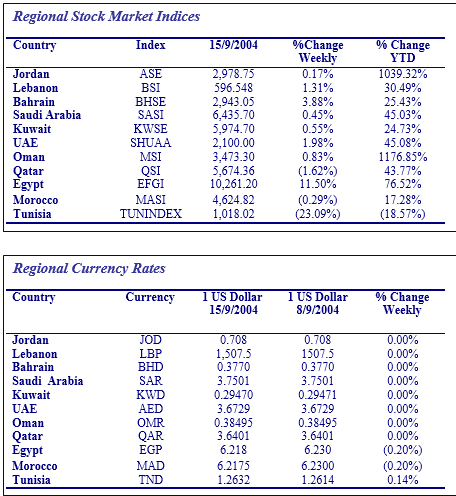
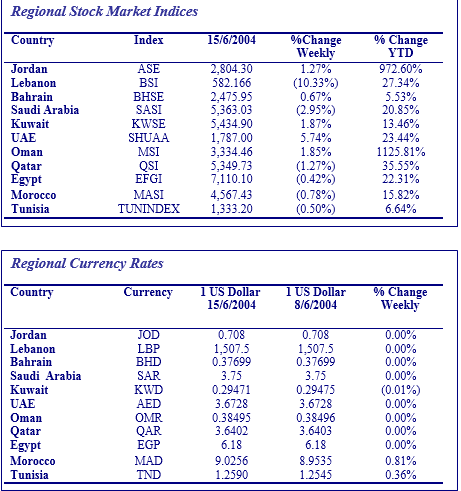
While some experts recently warned of the potential for Gulf markets to overheat, analysts optimistic about the continuation of the boom point to the fact that the ratios of market capitalization to GDP in the GCC countries are, with exception of Kuwait, still substantially below the ratios in developed economies. Faithful collectors of Executive can easily verify that vigor of Gulf stock markets for themselves by comparing this month’s regional stock market indices (page xx) to those in an issue from January 2003 or June 2001. 

Outside of the indices, the evolutionary thrust of Arab stock markets was highlighted last month by a host of news, of which the linkage of the UAE national stock markets in Abu Dhabi and Dubai and the announcement of a new investment conference in Bahrain in October were about the smallest.

The undoubtedly hottest financial infrastructure news of the month was the opening of the Dubai International Financial Centre, DIFC. With its main Gate Building visually quoting the La Grand Arche in Paris in a sort of 21st century Arc d’Arabia way, the center professes that it wants to be the new link between Western and Eastern financial market places – and it has the scope to match these ambitions.

To understand this scope, one needs only look at the DIFC parking “lot.” Upon completion, this facility is designed to accommodate in excess of 34,000 cars. A while back, the DIFC project had temporarily looked a less certain development bet than usual for Dubai, because of fears analysts attributed to the US over what a money hub in the region could do for the likes of al-Qaeda. The DIFC had also experienced a few recent personnel ruckus over Western top executives who were said to have stepped down because of conflict-of-interest situations they witnessed.

But now, not only has the DIFC opened for business and granted its two first operating licenses (to banks Standard Chartered and Julius Baer), the center has also its very own regulatory authority – the DFSA or DIFC Financial Services Authority, touted as fully compliant with the toughest supervisory demands of our age – and its own “international exchange for wealth creation,” the DIFX.

The DIFC International Financial Exchange is billed by its creators as a high-tech stock market for the Arab countries, equipped for trading of all types of securities from equities and funds to derivatives and Islamic structured products. This will presumably take it out of the restrictions applying to national bourses in GCC countries. Gulf-based analysts already speculated early last month that the UAE government might privatize one of its attractive assets, to give the DIFX a birthday present and startup boost.

Curiously enough, just as the DIFC announced its presence, officials from Arab stock markets meeting in Cairo announced that a new pan-Arab bourse under the name of “United Arab Stock Exchange” would be created by early or mid 2005. Located in Egypt, the bourse would enjoy participation from six Arab stock exchanges (including Lebanon, but not mentioning the UAE), and it would be the largest in the region.

Given that full-mouthed announcements for great joint projects in this region come with an inbuilt disbelief factor and cooperation agreements such as the 1996 one between the CASE and KSE acceded to by the BSE have been unnoticeable in practical terms, what to make of these plans for a Unified Arab Stock Exchange?

“I am skeptical, simply because there has been much talk for many, many years about creating a pan-Arab bourse and it hasn’t been done,” said Ziad Maalouf, senior vice-president at newly formed Mena Capital, a Beirut-based private equity and merchant banking firm.

With investor confidence in the BSE thoroughly lacking and performance of the Amman Stock Exchange dismal over many years, Maalouf questioned the viability of a regional stock exchange involving Levant and North African bourses. International investors approached the Cairo and Alexandria Stock Exchange with great enthusiasm about a decade ago, he explained, but proved disappointed as most companies listed on the Egyptian exchange today are so solely because it brings them tax breaks.

Only the stock markets in Tunisia and Morocco are reasonably structured and operate satisfactorily, said Maalouf, who helped as a market analyst with the International Finance Corporation in the mid 1990s to put North African bourses on international investor maps by introducing them to the IFC’s Emerging Markets Group. As competent naysayers long to be proved wrong, individual bourses could yet defeat their ghosts and the pan-Arab bourse could still see the light next year. But a new, Nasdaq-like regional stock market at the DIFC looks far better programmed to become a success.

“It is a good idea. Dubai is at the center of capital in the Gulf. This is where the money is,” Maalouf said. “If companies in the region take this new proposition seriously and dual list at DIFX and the market becomes liquid, it has the potential of becoming a pan-Arab stock exchange and trading desk.” For BSE-listed Lebanese banks for instance, the possibility to dual list on an Arab market would mean exposure to a much wider investor base and the chance to substantially increase trading of their shares.

In summa, the developments of autumn 2004 confirm a triangle of locations vying for prominence in Arab finance. Next to Dubai and Cairo, this includes Bahrain. The emirate underscored its aspiration to the role of regional player by signing a free trade agreement with the United States in the third week of September, albeit ratification of the agreement in the US is not expected before the end of the year.

And Beirut? One point that all experts here seem to be in agreement on is that a convergence of Arab stock markets is in principle a good thing and that it will be beneficial to the country to be involved in such developments. But one cannot ignore a bitter flair to their statements. Regularly, many feel that Lebanon should have risen to the role of natural financial market place for the region. Instead, as the rest of the Arab world noted, the Lebanese were playing politics.

The morale of the story: The nation’s financial sector is being boosted with new blood and ingenuity of personalities willing to go to great length to appear smart (even in what cars they drive) and act congenial, rather than falling for the slowly vanishing styles of the brothers Pompous and Patronizing. Regulations still require improvements and with the insurmountably small domestic market, some obstacles we will never be able to remove. But the financial sector’s real problem is the political superstructure, which dominates the nation’s reality.  

October 30, 2004 0 comments
0 FacebookTwitterPinterestEmail
Money Matters

by Executive Contributor October 28, 2004
written by Executive Contributor

Capital Intelligence Raises Shamil Bank’s Rating to BBB-

Capital Intelligence (CI) rating agency has raised SBB’s (Shamil Bank of Bahrain) long-term foreign currency rating and financial strength rating from BB+ to BBB-. The bank’s short-term foreign currency rating and support rating were kept at A3 and 2 respectively whereas a stable outlook was assigned to all the ratings. The agency noted that this upgrade is attributable to the strong growth in profitability and continuing reduction in non-performing financing. CI added that its ratings were based on SBB’s strong corporate-only balance sheet, full coverage from financing-loss reserve, its solid capital position in addition to the fact that investment account holders in Islamic banking share their own risk.

NBK Awarded “Bank of the Year” in the Middle East

In its annual Bank of the Year Awards given to banks in 133 different countries, The Banker magazine, an affiliate of the Financial Times Group, has named National Bank of Kuwait (NBK) as the best bank in Kuwait and the Middle East for the third time in a row. The Banker attributed this achievement to the bank’s excellent performance, innovation and regional expansion. The magazine added that NBK continued to post strong results in 2004 as its profits in the first half of the year reached record levels following a 27.7% return-on-equity registered at the end of 2003.

Country Profile: Jordan

An IMF report published in September 2004 demonstrates the recovery of Jordan’s economy from the disturbance caused by the war in Iraq. It shows that real GDP grew by 6.9% in the first quarter of 2004 amid a 29% yearly increase in exports. This upsurge in exports is attributable to the growing demand from the Iraqi market in addition to the continued rise in textile exports especially from the Qualified Industrial Zones (QIZ) to the United States. On the other hand, inflation was restrained at an average rate of 2.8% in the 12 months through March 2004 while the unemployment rate remained relatively high at 14.5% compared to a 5% growth in the Amman Stock Exchange index during the same period. On the fiscal side, the government’s better budgetary management, tighter government spending in addition to higher foreign grants led to the achievement of a 137 million Jordanian dinars ($194 million) budget surplus in the first quarter of 2004, equivalent to 1.8% of expected GDP. This fiscal surplus reduced net government debt by 8 percentage points to 93.5% of expected GDP.

October 28, 2004 0 comments
0 FacebookTwitterPinterestEmail
For your information

Welcome back

by Executive Contributor October 28, 2004
written by Executive Contributor

Since September 1, the Lebanese authorities have again been allowing South Koreans to obtain visas upon arrival in Lebanon. The practice had been discontinued in November 2003, when the Lebanese government imposed visa restrictions on a number of countries.

South Korean embassy officials declined to offer an explanation for their country’s inclusion on the list, although one official suggested Lebanon felt that South Korea had not been doing all it could to facilitate visits to the country by Lebanese. They did suggest that the move would boost South Korean-Lebanese business ties. In fact, since the decision was implemented, a South Korean trade delegation has already paid a visit to Lebanon, which imports roughly $64 million in South Korean products a year, for only $8 million in exports.

“Business people have very busy schedules,” asserted the head of the delegation, Youn-Hwan Chung. “We were having to wait up to three weeks for a visa. And even then we weren’t sure of getting it.”

But although the visa hurdle has been dismantled, other obstacles to increased South Korean-Lebanese business remain.

“There are differences in business culture,” noted Chung. “And South Korea is geographically far removed from Lebanon. The Lebanese are more familiar with, and prefer, European brands. And Lebanon’s IT industry is not well developed. The Internet is very slow.”

“Most South Koreans still think Lebanon is very dangerous,” observed the South Korean embassy’s commercial attaché, Kihyoung Choe. “Members of the trade delegation were asking me if it was safe.”

The South Korean ambassador to Lebanon, Young-Sun Kim, however, remained upbeat: “I want to talk only about the positive aspects,” he said. “There is no doubt that the move will greatly contribute to the promotion of business between the two countries.”


October 28, 2004 0 comments
0 FacebookTwitterPinterestEmail
Money Matters

by Executive Contributor October 25, 2004
written by Executive Contributor

Capital Intelligence raises ARABIC’s rating to A-

Capital Intelligence rating agency has raised Saudi Al-Rajhi Banking & Investment Corporation’s (ARABIC) long-term credit rating from BBB+ to A-, thus placing it at the same level as the long-term sovereign rating of Saudi Arabia. The bank’s short-term foreign currency rating and financial strength was kept at A2 and A- respectively. The agency noted that this upgrade is attributable to the significant improvement in the bank’s liquidity profile due to its success in developing an acceptable means of investing in Saudi government securities. It is to note that ARABIC retained in 2003 its traditional ranking as Saudi Arabia’s most profitable bank with total assets standing at $17.3 billion (about 12% of the Kingdom’s banking assets).

Bank Muscat issues $64 million bond

Bank Muscat, Oman’s largest bank, launched a 25 million rial ($65 million) 10-year bond with a 6.25% fixed rate. The deadline for the issuance, which will be listed on Muscat Securities Market, is set at June 30th and was assigned a BBB rating by the international rating agency “Fitch.” This issuance came a month after the bank introduced a 96.25 million rial ($250 million) bond, which closed oversubscribed at 134.75 million rial ($350 million). It is to note that Bank Muscat recorded in its first-quarter a net profit of 7 million rial ($18 million), up form 6.4 million rial ($17 million) in the same quarter last year.

Country Profile: Palestine

The World Bank approved an emergency structural adjustment grant of $20 million as an immediate budgetary support for the Palestinian Authority (PA), which after three years of crisis, is facing severe economic and fiscal challenges with a financing gap estimated at $650 million for this year. Contributions to the bank-administered multi-donor instrument reform fund amounted to a current $25 million. In addition, the World Bank launched a Social Safety Reform Project with an initial financing of $10 million aimed at providing regular cash assistance, food donations and health insurance provisions to nearly 36,000 beneficiary families. The bank has been active in the West Bank & Gaza for the past 10 years, adopting to the prevailing political climate from reconstruction to institution building, and since September 2000 to emergency assistance. The fiscal situation in the West Bank & Gaza remained difficult in 2003 and 2004. PA’s budget deficit for 2003 amounted to $558 million and to $329 million after including external budgetary support of $230m (compared to $467 million in 2002 and $530 million in 2001). In addition, the stock of indebtness to the banking sector reached $176 million at year-end 2003, or 5.4% of GDP.   

October 25, 2004 0 comments
0 FacebookTwitterPinterestEmail
For your information

Strength in the face of adversity

by Executive Contributor October 13, 2004
written by Executive Contributor

The killing in Iraq of three Lebanese businesspeople, including a married couple, and the wounding of another, as well as further kidnappings of Lebanese since then, have dealt more serious blows to already faltering Lebanon-Iraq trade.

Initial business optimism generated by the quick fall of the former Iraqi regime has been replaced by uncertainty as the security situation in Iraq fails to improve. In recent months, a number of Lebanese businessmen and truck drivers have been kidnapped. According to the satellite television station Al-Jazeera, a statement on the Internet signed by a militant Iraqi group threatened to “slaughter any Lebanese working with the US Army and drag their bodies through the streets of Iraq.” Hundreds of Lebanese have flocked to Iraq over the last 15-16 months, in a quest to cash in on the massive postwar reconstruction effort.

“If there wasn’t so much money to be made in Iraq, we would already have stopped sending people there,” acknowledged Elie Shamsy, a manager of Beirut Cargo Center, which transports goods to Iraq. However, the company has stopped using Lebanese drivers. “We only use Syrians and Iraqis,” said Shamsy, “because they appear to be targeted less.”

But it is in Iraq, asserted Lebanese Industrialists’ Association head Fadi Abboud, that the time-honored determination of Lebanese industrialists has become again apparent. Despite the dangers, he noted, scores of Lebanese businesspeople remain in the country, and others continue heading there. “Iraqi importers who ask for half a million dollars of cement from Lebanese firms can’t provide security. People don’t want to send employees to Iraq. We’re finding it difficult to insure. But the Lebanese will not stop doing business with Iraq. Lebanese businesspeople have historically overcome hardship. They embody the SAS (British commandos) motto: ‘Who dares, wins.’”

October 13, 2004 0 comments
0 FacebookTwitterPinterestEmail
For your information

A tough financial run

by Executive Contributor October 13, 2004
written by Executive Contributor

The organizers of the Beirut Marathon–in its second edition this year–say they have learned from last year’s mistakes. In their haste to stage an impressive debut event in 2003, they failed to pay enough attention to spending. The result was a whopping $1.5 million bill–of which only about $150,000 was covered by sponsors. (Close to a million was covered by the marathon’s patroness, May Khalil).

This year, the event organizers have been careful to shop around for the best deals, and have also been able to attract an additional 6,000 contestants. As a result, this year’s bill will run at roughly $800,000–a welcome diminution of last year’s cost, but significant nonetheless.

Despite this, cajoling potential sponsors into forking out cash is not proving much easier this year. The organizers expect only $50,000 more than last year’s $150,000. “It is very, very tough to get hard cash out of companies,” observed Event Coordinator Nadine Moawad. “There is a recession. Everyone says they don’t have the cash to spend on events.”

The race organizers hope that in a few years they will be self-sufficient, but acknowledge that a long road lies ahead. “We will have to show potential sponsors the added value,” noted Moawad. “But it is difficult to get that message through. For the moment, sponsors are not getting a feel of how important this event really is.”

“And even when we do break even, we will have to cover the losses of previous years,” remarked Beirut Marathon General Manager Ara Artine.

October 13, 2004 0 comments
0 FacebookTwitterPinterestEmail
For your information

Growing mini cards

by Executive Contributor October 13, 2004
written by Executive Contributor

Lebanese banks Fransabank and Banque Audi recently introduced a new debit card format marketed as “mini cards” due to their 43 percent smaller size over standard plastic.

Issued in collaboration with Visa, the new cards offer advantages for participating banks through the prospect of increased point-of-sales (POS) purchases by consumers. In their functionality, mini cards are engineered to POS usage because they cannot be used in standard Automated Teller Machines (ATMs). A value added is that users carry a fashionable accessory characterized by “greater portability”, thanks to a hole in the plastic allowing it to be attached to a key chain or a mobile phone.

For banks, debit card POS purchases are more profitable than withdrawal of cash from ATMs, which still accounts for most instances of debit card usage. Debit or cash cards, such as the Visa Electron card popular in Lebanon, do not carry credit features.

“The purpose is to migrate people from using ATMs to more POS spending and change customer habits away from withdrawing cash,” a representative of Banque Audi’s payment cards department told Executive. He confirmed that the cards were targeted at “all Visa Electron holders in general but especially young, outdoorsy type of people.” Until the beginning of 2005, Banque Audi is offering their Visa mini card for free.

Fransabank is going after youths by stating in a flyer that its mini account and card are targeted at “cool and trendy people,” with offers of free benefits, including movie tickets.

Perhaps confounding consumers is a new prepaid card by BLOM Bank, introduced about two weeks after Banque Audi publicized its card. BLOM’s standard-size card was advertised as “mini”, but that referred to its ceiling of $500. Apparently targeting similar audiences as the Audi and Fransabank products, the bank crafted an extensive promotional program of discounts at places favored by young consumers (Virgin, Quicksilver, Chili’s, Waves, and on Cyberia).

October 13, 2004 0 comments
0 FacebookTwitterPinterestEmail
For your information

Banking on Lebanese films

by Executive Contributor October 13, 2004
written by Executive Contributor

On September 19, Lebanese director Philippe Aractingi started the shooting of Autobus, a full-length musical that he hopes will receive international play. It is Lebanon’s first feature film fully financed by private investors.

“To make the film,” said Walid Hayek, investment manager at the Arab Finance Corporation (AFC), “we had to come up with a new financial structure called investment certificates. Unlike shares, they offer a right on future revenues, but no right to vote. We had to avoid the situation that the investor on paper was able to interfere with the director.”

Asked to help in putting together a finance structure by the film’s producer Fantascope, AFC set up a proper business plan based on estimated cost and revenues to attract investors, and issued 140 investment certificates of $10,000 each, producing a total budget of $1.4 million. “So far, we’ve managed to raise $840,000,” said Hayek, “which is enough to make the film. The remainder of the proposed budget, $560,000, is mainly meant for marketing and promotion. Now that shooting has started, however, I’m sure we will be able to attract further funding.”

The film’s projected revenues have been estimated at $2.1 million, which include theater admissions in Lebanon and the Middle East, as well as from television, video and DVD sales. What’s more, Fantascope and Hayek hope to cash in on the sales of CDs and cassettes with the film’s music.

So far, all the investors are Lebanese, among whom the LBCI chairman Pierre Daher. “Daher is a strategic investor,” said Hayek, “who is not just interested in making money, but who wants to test the market and see what the possibilities are. If this film works, he may be interested in making more.”

This seems to be the motto for all involved in the making of Autobus: including AFC, which has traditionally been focused on investment banking, brokering and portfolio management. “We are interested in targeting other sectors,” said Hayek, “among them audiovisuals, which have so been disregarded by bankers.”

October 13, 2004 0 comments
0 FacebookTwitterPinterestEmail
  • 1
  • …
  • 655
  • 656
  • 657
  • 658
  • 659
  • …
  • 707

Latest Cover

About us

Since its first edition emerged on the newsstands in 1999, Executive Magazine has been dedicated to providing its readers with the most up-to-date local and regional business news. Executive is a monthly business magazine that offers readers in-depth analyses on the Lebanese world of commerce, covering all the major sectors – from banking, finance, and insurance to technology, tourism, hospitality, media, and retail.

  • Donate
  • Our Purpose
  • Contact Us

Sign up for our newsletter

    • Facebook
    • Twitter
    • Instagram
    • Linkedin
    • Youtube
    Executive Magazine
    • ISSUES
      • Current Issue
      • Past issues
    • BUSINESS
    • ECONOMICS & POLICY
    • OPINION
    • SPECIAL REPORTS
    • EXECUTIVE TALKS
    • MOVEMENTS
      • Change the image
      • Cannes lions
      • Transparency & accountability
      • ECONOMIC ROADMAP
      • Say No to Corruption
      • The Lebanon media development initiative
      • LPSN Policy Asks
      • Advocating the preservation of deposits
    • JOIN US
      • Join our movement
      • Attend our events
      • Receive updates
      • Connect with us
    • DONATE