
Welcome to the Third Millennium, B.C.
A customs official almost sent the country back into the
dark ages when he stopped a shipment of Intel motherboards,
which power 90% of PCs worldwide. Between $2 million
and $3 million worth of Intel products that had been
ordered by hardware retailers were retained as a result.
Following intervention by George Corm, the finance minister,
companies were allowed to reclaim their products and the decision
was later reversed. Upset by the lack of professionalism,
Corm has required customs officers to take a courtesy training
program. The cabinet has since barred customs officials from
stopping clearance of computer-related technology under any circumstances.
What a great way to start the millennium.
Virtual souqs
There may be a solution to traffic jams: stay home and shop
online. That is the marketing tool used by two new virtual
mall startups – Soukna.com (www.soukna.com) and E-Commerce’s
Souk Loubnan (www.soukloubnan.com). The two
sites, however, differ in concept and approach.
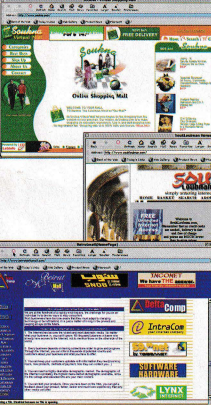
Soukna.com, which was launched in late November, is more like a supermarket.
Owned by Grace
Chaoul, the company
makes
wholesale purchases
of products and
resells them over
the net. Credit Card Services
Company, the local
representative for
Visa and
Mastercard, handles
the credit card clearance
system.
Clearance and approval of the customer’s card take place on
Visa’s international server, and “is 100% safe,” according to
Chaoul. She has spent $25,000 on advertising in the local media
to place Internet banner ads on six websites. Soukna.com will generate revenue from ads placed on its website as well as sales.
Chaoul expects to break even by the end of 2000 and to start seeing
profits the following year.
E-Commerce general manager Walid Hanna is not so optimistic.
He says his company will see a loss of $50,000 in its first
year, and doesn’t expect to reach the break-even point before
2001. Souk Loubnan was launched in mid-December with an initial
investment of $80,000. The website is an actual mall, in the
sense that customers purchase products from retailers who join
the site. Retailers include Librairie Antoine, Harley Davidson,
and 460 Multimedia Store. “We’ve signed on [big retailers]
because people know them,” says Hanna. “They don’t know Souk
Loubnan yet.” Hanna, a former Banque Audi employee, says revenue
will be generated by the margin on sales. The company has
plans to accept credit cards online; for now payments are made
upon delivery in cash, by credit card or cheque.
Soukna.com has contracted Beirut Course for deliveries
around Lebanon and abroad. Souk Loubnan plans to do the same.
Other similar online projects are madeinloubnan.com, beirutdeltamall.
com, and getforless.com.
Yalla!
Internet service provider Data Management’s (DM) new portal,
Yalla! (www.yalla.com.lb), hopes to become Lebanon’s
answer to Yahoo! Still in its initial stage, the site requires users
to register, and offers a free email account, fax box and voicemail
box. Maroun Chammas, DM’s managing director, says revenue
will be generated from advertising, though he declined to
disclose forecasts. The website’s most interesting feature is the
web traffic-cam, which has live broadcasts of the traffic conditions
on the Beirut-Jounieh highway. Local news and Agence
France Presse headlines are offered, as well as business, entertainment,
and sports. Users will have the option of personalizing
channels on the webpage starting January, and a shopping site,
Zenoubia.com, is under construction.
Move over, Net2Phone
Not too long after the ban on Net2Phone (EXECUTIVE,
December 1999), which offered international calls over the
Internet for rates as low as 10 cents a minute, comes a service
that’s 10 cents cheaper. Internet telephony, nemesis of the ministry
of post and telecommunications, became free with dialpad.
com, which so far only offers calls to the United States. In
operation since October, the new service signed 120,000 users
in its first two weeks. The company generates revenue from
adverts placed on its website. This form of Internet telephony, PC-to-
phone, transfers voice on the web in digital packets that are
then converted to analog signals when relayed to telephone
lines. In the ministry’s crackdown on any form of telephony that
deprives it of revenue, it won’t be surprising if Internet service
providers are called upon to block access to dialpad.com.
