The Internet is a well-stocked stream
if you’re fishing for information,
but a common phone line and a dial-up
modem make for slow trolling. That’s
why avid computer users have longed for a
way to cut the time spent idling, waiting for
the CNN website to appear on their screens
or their eBay bids to be recorded.
In terms of access, all roads lead to the
Information Superhighway, it’s simply a
matter of how much of a hurry you’re in to get
there. There is the way of the masses: the well-beaten
path whereby you, along with countless
others, are connected to the web with a
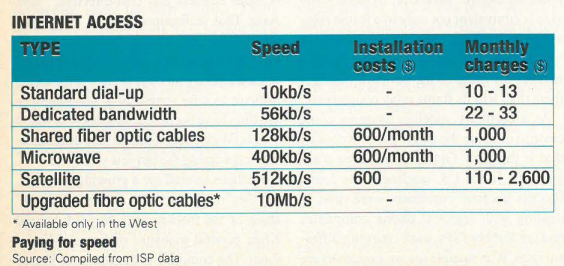
common phone line. At an average of 10 kb/s
(the rate is as much a function of the number
of users online as it is of your modem
speed), dial-up access is,
without a doubt, the slowest way to
surf. It’s also the cheapest, with monthly
charges for unlimited access ranging from
Terranet’s $9.99 to Cyberia’s $12.99.
Most local ISPs also market business-oriented
packages that are essentially dedicated
bandwidth connections (no one else is allowed on
your e-path) that are leased for an average
of $22 to $33 a month and provide download
speeds of 56kb/s, or more than five
times the pace of a regular line.
If you want to move off the path altogether
and onto motorway access, the high-speed via
internetica, then you’ll need to adopt a costlier
technology. In cable-modem systems,
which are well established in the West, top
speeds can be more than 45 times what the best
dial-up connection provides. In Lebanon,
with the absence of a cable network, surfers
have to resort to more expensive microwave
or satellite connections to acquire similar
high speeds. “Faster is always better, if you
have the means,” says Ranya El-Asmar of
Data Management, a local ISP that provides
package deals for both super-fast microwave
and satellite services. For example, downloading
a 1Mb file (about 37 pages of text)
takes 16 seconds via microwave or satellite
compared to about ten minutes by phone.
However, the price of
microwave modems remains
exorbitantly high, and has discouraged
all but big corporate subscribers who need a
reliable point-to-multipoint system. Clients
must have a receiver/transmitter, leased by the
ISP for $600 a month, before they can make
a great leap forward in speed for a further
$1,000 a month.
Satellite systems are marginally cheaper
with rates around $600 for installation and the
cost of a dish, as well as a monthly fee
depending on the amount of information to
be downloaded, $110 for 230Mb, $2,600 for
10Gb. Connection speeds via satellite are on
par with microwaves with throughput
speeds that top out at about 512 kb/s. “We
deliver direct, not, that is, on the air, but
through the air,” says Degaulle Azar, deputy
general manager of Bond Communications,
whose Direct-PC satellite program has 25
customers in Lebanon. “There is a growing
client base that is more interested in quality
and speed than in the price of a service.” Sam
Lutfallah, general manager of Inconet,
agrees. Since the launch of its satellite service
in April, the ISP has attracted 20 customers
ranging from small businesses to hospitals
and universities. “Speed has become the
new buzzword in Lebanon, the fastest bird
catches the information worm.”
Once connected, the high speeds of
microwave or satellite open up a world where
the Internet’s treasure trove of news, information
and entertainment is as handy as a
phonebook and as vivid as television.
However, speeds do fluctuate. In the case of microwaves, the ultra-fast connection hastens
only a portion of your trip to and from the
Internet. You’ll still have to share the lines from
your provider to the Internet, and from the
Internet to the website you’re trying to view.
Satellite systems have a different drawback.
For geostationary earth orbit satellites,
those in orbits that keep them stationary
relative to the Earth’s surface, one
of the major issues is the latency inherent in
a signal transport path that’s 22,300 miles
long in each direction. That translates into a
time lag of one-quarter of a second for the
round trip, plus framing, queuing and
switching delays that can increase the latency
to half a second or more, far too long a
delay to allow effective use of interactive
real-time applications. And there isn’t
much that can be done about the propagation
speed of electromagnetic transmissions.
Software compatibility is another essential
standard for enterprise satellite use. Given
the booming demand for Internet access
and the growing reliance on networks,
satellite compatibility with TCP/IP (the
standard Internet protocols) is particularly
important. Latency plays a role here as
well, since the delay inherent in the use of
geostationary satellites is long enough to disrupt
the acknowledgement handshaking
that is at the core of the packet transmission
system. To ensure usability, vendors are
scrambling to deploy solutions that include
data compression, packet spoofing (fooling
the sending TCP/IP system into continuing
to transmit data before acknowledgements
are received), and caching frequently
accessed Web data close to the requesting
systems. That way, delays in accessing that
data will be lessened.

In Lebanon, though, the most important
disadvantage to satellite systems is that
they are asymmetric, that is, given the
monopoly of the ministry of post and
telecommunications (MPT) on outgoing
traffic, you can download directly off
cyberspace, but you have to go through a
local ISP to upload. This turns into a key
selling point for microwaves as this technology
lets users stay constantly connected
to the Internet without tying up a phone line.
But given that the current cost for both
microwave and satellite is more than 50
times the monthly charges for standard
dial-up connections, only about 150 subscribers,
all corporate accounts, have
been able to afford the luxury of supersonic
speed. That’s paltry potatoes compared
with the nationwide rollouts of broadband
services that have about 85,000 customers
for dial-up connections.
Arab Finance Corporation (AFC), an
investment house, has been a heavy user of
microwave technology for almost two
years. According to project officer Fadlo
Choueiri, the microwave system carries
heavy data traffic between AFC’s office in
Gefinor and the world’s stock exchanges.
“That traffic includes trading transactions
and daily capital market activity, which
even on a dedicated land line would take too
long,” he says. “Microwaves have turned out
to be a more cost-effective technology than
any of the land-based alternatives.” Also,
many distributors in this security-conscious
age have firewalls that won’t easily allow the
broadband signal through, not an issue
when it’s delivered by microwave using a
secure dedicated connection.
The insurance company, Medgulf, is similarly
satisfied with the extra fleetness
brought on by their switch to microwaves. It
chose microwave technology because it’s the
most cost-effective way to get its bandwidth-
intensive programming out to the
field and in the words of IT manager, Walid
Sayyad, “because there’s no pipeline I
have to deal with. I don’t get clogged up.”
Microwave and satellite systems offer
businesses a number of other advantages.
“Deployment and cost-of-ownership comparisons
between terrestrial and satellite or
wireless carriers are difficult to make, particularly
in a country where infrastructure
issues are thorny,” says Azar. “A satellite service
is equivalent not only to a frame relay
access device but to the associated routers as
well.” Thus, the satellite services vendor
handles far more of the network management
than will its frame relay counterpart.
As a corollary, satellite systems come
close to offering the single point of contact
that is the Holy Grail of wide-area management.
In the US, satellites have found
success because customers were tired of
dealing with regional phone companies
and landlubber ISPs, each charging different
rates. With satellite access, customers are required to deal with only one provider.
“We’re still far from the US model,” concedes
Lutfallah. “We need to be able to cut
out the local loop, to upload and download
with equal ease over a long-distance carrier.
Dealing with just one provider would also
bring down the magnitude of the charges.”
But why use satellites in this age of redundant
terrestrial broadband capacity and near-commodity
pricing? “We looked at delivering
terrestrially versus satellites and quickly realized
that in going point-to-multipoint, satellite
is more efficient and cost-effective,” says
Azar. That realization is music to satellite
vendors’ ears, but it has been slow in coming.
First envisioned as a way to bring data and
voice telephony services to parts of the world
difficult to wire terrestrially, geostationary
satellites have become a component of many
WANs (Wide Area Networks) and distribution
networks during the last few years.
Satellites overall are a growing business,
but they’re starting from an “insignificant”
share of the market, says Naveed Ahmad
Khan general manager of Satco (Middle
East). The company is the agent for Fortec Communications, a US company with an
estimated 30% of the total market share of the
satellite industry. “The fact that local ISPs are
turning to wireless shows a certain maturity
in the Lebanese market,” says Khan.
But the fact remains that satellite and
microwave services have yet to capture a
substantial portion of the otherwise skyrocketing
digital transmission market.
However, these technologies enjoy a loyal
customer base when it comes to point-to-
multipoint applications. Satellite data transmission
can’t compete on price with terrestrial
systems for individual point-to-point
connections, and few say that will change in
the foreseeable future. In the developed
world, satellite’s strength is in delivering digital
content to large numbers of geographically
dispersed recipients or in collecting
inventory, point-of-sale or credit-card validation
data from multiple locations.
Nonetheless, even in the West, satellites are
rarely the easy choice for enterprise data or
content transmission. Dedicated lines are
still the safe option. That’s not just out of habit
or concern about new technology, terrestrial
fiber offers faster maximum bi-directional
point-to-point throughput. In North
America, major terrestrial carriers are
already upgrading their fiber-optic backbones
which will be capable of transmitting
data at up to 10 Mb/s, that’s a whopping 20
times faster than satellites and microwaves.
In Lebanon, though, and given tight control
by the MPT, such gains in terrestrial speeds
may be as distant as a decade away.
In global terms, Khan says typical estimates
put satellite traffic at 3% of the communications
market and forecast a 14%
annual growth rate between 2000 and 2005. Those numbers pale compared with
the amount of optical fiber already laid in
conduits, the new fiber backbones scheduled
to be laid in the West by 2005 and the
increase in carrying capacity expected.
Analysts’ projections of the annual growth
in demand for data transport over the next
decade range from 30% to 80%, but supply
is likely to outrun that substantially. These
growth rates are expected to be mirrored in the
local market, albeit in more humble fashion.

Another example of the terrestrial infrastructure
expansion comes with PSINet
Lebanon, whose recent entry into the market
with the purchase of Lynx, offers an alternative
to satellite and microwave with speeds of
16 kb/s to 512kb/s, a guaranteed 64kb/s goes
for a monthly $1,000. It’s currently the only
local ISP with a fiber optic link straight from
Lebanon to North America. And since about
85% of all Internet activities run on the
American backbone, this translates as significant
cuts in delay, typically 53% on the
30kb/s norm of a copper cable. “Ours is
essentially a super-carrier service as we cut out
the intermediate hubs and nodes en route to the
US, which other ISPs face,” says Hugues
Pouillie, IT consultant for PSINet Lebanon.
The main snag with their system is that, in the
absence of fiber connections between the ISP
and the end-user, microwave receiver/transmitters
are de facto required, bringing with it the
monthly microwave charge of $600.
Analysts anticipate that the next generation
of satellites will deliver business users a radically
lower price, exponentially expanding
the market. And Khan predicts that the satellite
pricing will move away from dedicated
bandwidth to a shared model that would further
reduce the cost to the end-user.
In the final analysis, the future of high-
speed Internet may be a contest between double-
quick microwaves/satellites and runaway
fiber optics. In such an e-landscape, it will be
hard to tell the tortoise from the hare. And even
if capacity upgrades in the cable systems
become so impressive as to leave satellites in
the dust, the cable-free service should continue
to thrive in rural areas or, as in the case of
Lebanon, where high-speed wire line services
will take some years to develop.
El-Asmar is confident that, with Data
Management’s new satellite service, the
firm will be up to the job of moving around
big bursts of digitized data, thereby providing
the technology for surfing the web as close to
real time as possible.
The initial customers for Internet via satellite
tend to be veteran internauts. But both El-Asmar
and Azar predict that the packaged
content provided by companies like theirs will
become increasingly important as more
inexperienced users sign up for high-speed
service and that, given the choice, few will opt
for the steamboat when there are regular
flights to the Internet world.