
Prepare for the next Internet feeding
frenzy. Sharks from several industries
are already circling the
nascent market for banking products and
services that will enable consumers to
receive account information and pay their
monthly bills online.
Amid a flurry of high-profile advertising
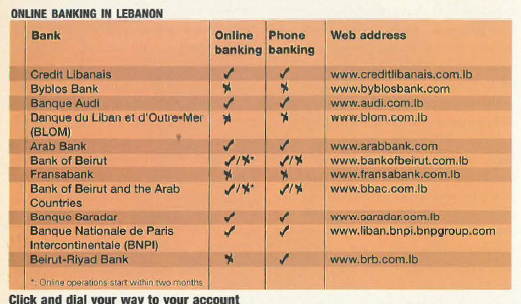
to boost online banking, Credit Libanais
rolled out its Internet service at the end of
July. More than 2,500 of a customer base of
around 90,000, or 3%, are already using that
service today, says Tony Zarifeh, the
bank’s manager of alternative distribution
channels. “Above all, consumers want
speed and the key benefit of always knowing
in real time where their finances
stand,” says Zarifeh. “That’s the initial
attraction of online banking.”
Michel Kilsey, general manager of
Internet Facilities, whose key area of interest
lies in e-banking security and online
payment, believes that the shift away from
the traditional brick-and-mortar neighborhood
bank may be inevitable. “Banks are
not all that different from other retail businesses,”
he says. “Unless they change, they
are likely to see continued erosion in all of
their markets.” Kilsey believes that technology
presents opportunities for growth in
new areas. ‘The future of banking lies in the
proliferation of systems that provide consumers
with online bill presentment by
merchants and utility companies, enabling
them to use the Internet to make payments
with a click of a mouse.”
Banks have long been looking to the web
to help them reach customers. Similar to
automatic cash machines, computers allow
customers to bank without taking up
expensive bank teller time. But so far –
and unlike online stock trading that is practiced
by a growing core of private
Lebanese entrepreneurs – online banking
has not been a killer application.
Consumers have been just as slow as the
banks to accept the Internet as a medium for
managing everyday money matters. This
isn’t just a local syndrome. Even in the
US, the Internet backbone and trailblazer for
e-models, of the 37% of US homes that have
Internet access, less than 20% of that figure
actually bank online.
Lebanese banks are starting to approach
the Internet and online banking as, globally,
clients become more secure with online
financial transactions and e-business models.
“This shift in focus on access methods
reflects the fact that banks are aware of the
rapidly increasing interest in the Internet by
consumers,” says Michel Sarofim, head of
retail division at Byblos Bank, who plan to
go online before the end of the year.
“Banks are hoping to capitalize on this
trend by making their offerings accessible
over the Web. We hope that while surfing
the Web, customers will check out the
bank’s website and what it has to offer and
begin making transactions via the Net.”
Banks could even play a leading role in
transforming e-commerce in the region from
a curiosity to a mass phenomenon. However,
according to Kilsey, the banking industry
doesn’t understand well enough how to sell
technology. “Within the next few years, we’ll
see applications that are so compelling for digital
consumers and merchants that eventually
the light bulb will go on for the banks,” he
says. At the moment, most banks have a
wait-and-see strategy for the age of digital
commerce and they remain reluctant to follow
initiatives taken by Western banks and international
credit card associations.
This may change soon because of pressure
from new commercial interests establishing
themselves on the Internet. “Until about a
year ago, people from the Internet community
said: ‘Why do we need banks?'” says
Kilsey. “But now, many of the merchants,
especially those selling digital content like
software, have come back to the banks saying:
‘OK, we need your help to prevent
fraud and expensive losses.”‘
According to Kilsey, banks have been slow to see the
huge potential. “The marketplace is showing
that the banks can provide tangible
value also in cyberspace,” he says. “The
banks should be very happy with that.”
While most prophets of e-commerce predict
enormous growth rates within the next
few years, Kilsey is more cautious. “In the
West, online banking is really taking off
because banks are the trusted brands that can
guarantee consumers and merchants a safe
environment on the Internet without the
risk of fraud,” he says. “The smaller
Lebanese banks need to get a system so
secure that they are willing to cover losses
on the merchants’ side.” Because of consumer
skepticism payment over the
Internet will remain a curiosity -or at best,
a business-to-business province.
“Security remains the chief hurdle to the growth of
online structures.”
Internationally, high-tech security
already exists under the guise of the Secure
Electronic Transactions (SET) standard
that was developed by Visa and
MasterCard to extend the high security of
traditional banking to the Internet. SET
uses complex cryptography to transmit
credit card numbers over the internet, and
digital signatures to ensure that both customer
and merchant are authentic. The digital
signatures are issued by banks and used
by customers and merchants for identification
in the virtual world. The other leading
security protocol is the Secure Sockets
Layer (SSL), which is an open, non-proprietary
standard used in most browsers today,
such as Netscape and Internet Explorer.
Credit Libanais, with sensitive online
services that include money transfers and
treasury and capital markets, are firm
adepts of SSL. “The conservative buyers
and sellers – which is most of the mass
market- need this kind of assurance before
they accept payment over the Internet,”
says Zarifeh. “If it’s not provided by the
banks with the SSL standard, it has to be
done by something very similar to it. And
card holders can be assured that they don’t
have to worry about abuse of their card
numbers on the Internet.”
Even as a strong believer in the SSL standard,
Zarifeh readily admits that a lot of
other solutions to e-commerce safety will be
developed. And he said that banks will not
be able to force through a top security standard
like SET if they aren’t able to convince
the market of its advantages. A major problem
is that SET, as a completely new standard,
needs its own software, which currently
is not built into Internet browsers.
Also, a consumer who installs SET can do
so on one computer only and then must do
all Internet shopping from that machine.
Kilsey thinks that a new, enhanced version
of the widespread SSL standard will
improve security and could become attractive
because it will be distributed with all
new Internet browsers. For most merchants
and consumers, the enhanced SSL
standard will provide sufficient security.
Given adequate security, will all our
banking turn on line one day? Probably not.
“The advent of Net-only banks may seem
exciting,” says Kilsey. “The reality is, there
aren’t many customers who want to do
everything only over the Net.” When it
comes to their savings, most people
demand that there be some vault somewhere
in the physical world where their
physical money may be stashed.
And while electronic banks may offer
better interest rates on deposits and loans
because they have virtually no overhead
compared with traditional banks, the costly
clusters of branches are still valuable
assets, analysts say. ‘The fact that a bank has
a physical branch in the vicinity of a client
is an enormous advantage and will remain
an enormous advantage,” says Sarofim. “A
local presence implies solidity, whereas
anybody can set up a website.”
The faith that most consumers place in traditional banks
is a powerful competitive advantage to
offline banks. “The problem Lebanese
banks have had historically is that they rely
on that loyalty and so they could take their
sweet time to get electronic,” says Kilsey.
On paper, at least, Credit Libanais’ on line
adventure has the stamp of success. Without
divulging any exact figures as to the number
of new accounts and the extra deposits that
their e-bank has brought them, Zarifeh
insists that they are pleased by the results in
these first two months. But there are a number
of financial institutions and banks that
have yet to get to first base, and many have
had to put off their Internet ambitions until
they update their computer systems.
It’s still very much the first round of the
online banking competition, but it’s apparent
that Lebanese banks are already finetuning
their strategies to capitalize on the
booming demand for accessing information
from anywhere. Having already cut into
the computer market with special PC-purchasing
plans that were launched last year,
the banking world now wants more than just
a piece of the Internet action.
In the West there has been a convergence
of the PC, Internet and banking industries,
a convergence that Lebanon is likely to emulate.
“We feel the time is ripe for
online banking, and for banks to take an
active role on the Internet,” says Suzanne
Saad of Banque Audi’s electronic banking
and card services. “The computer industry
needs connectivity to survive, and the
Internet industry wants to reach people on
the go, supplying information such as the
status of their bank accounts.”
Making account information available
electronically is certainly a step toward
offering what customers really want: a single
on line source of up-to-date information
about their finances, including savings and
checking accounts, credit cards and other
investments. “The Internet does offer
great opportunities for banks,” adds
Kilsey. ” But if they are to get the greatest
benefits from e-business, they must ensure
that their brands stand out in cyberspace –
not just that their sites are well-built and
easy to use.”
The power of Internet brands such as
Yahoo! and Amazon is evident. With most
major banks rushing to perfect online services,
use of the Internet as a key channel for
financial transactions is expected to grow
dramatically over the next several years.
Banks must therefore take steps to establish
their identity if they are to develop a strong
presence and thrive in a digital environment.
Only then may they hope to become medium-
sized fish in the global e-pond.
Questions to ask yourself when you consider banking online
Where do you pay your bills? If it’s at home on the kitchen table,
can you just as easily get to a computer? If you have computer
access only at the office, you may not feel comfortable having bills
scattered all over your desk. Are most of your bills to the same businesses
or people every month? If so, banking online would enable
you to set up repeat payments that would automatically pay out on
a particular day each month, saving a lot of time. If you tend to do business
with different people, stores and companies and don’t mind
addressing envelopes, you might want to hang on to your checkbook.
Do you foresee paying bills and transferring funds online? Or would
you use the service primarily to check your balances? If the latter is
true, your bank’s automated phone service will give you the information
much faster than you’ll be able to retrieve it by going online.
When you sign up for an Internet checking or savings account, have
your password sent to your local branch for you to pick up, rather
than having it emailed to you. Keep a hard copy of documentation
on your accounts from the bank in case any discrepancies occur.
If you regularly receive more than one bill from the same company
(for example, electricity bills for two different residences or two
different phone bills), be sure to enter the number for each account
on your recipient list in such a way that you’ll be able to tell them apart.
Otherwise, you might pay the wrong amounts to the wrong
accounts – mistakes that could take you hours to rectify.
Avoid installing or downloading online banking software or setting
up an online account outside normal business hours. Although some
Western banks have technical support around the clock, Lebanese
banks do not.
You may want to wait a few weeks before downloading or
installing upgraded software from your bank to avoid any early
glitches. When you do download or install an upgrade, keep a
backup of the program and your financial data on a storage disk
or a separate computer.
Last and perhaps most importantly, reconcile your accounts as frequently
as you would with paper-based banking
