Government officials are starting to
take a much closer look at the
World Wide Web. Thanks in part to the
widespread appeal of the Net, the government
is becoming much smarter about
information technology systems and
processes, and it is now directing that
knowledge to Internet efforts.
The Lebanese government is still far
from having its computer systems set up.
“Our research indicates we should
spend at least $100 million a year for the
next three to four years to establish a
functioning e-government system,”
says Raymond Khoury, IT strategy
advisor for the government. The initiative
seeks to create a virtual government
field office that would serve as a
single resource for citizens to search for
information and eliminate the need to
stand in lines. Moreover, once up and
running, the system would enable the
public to conduct government business
online, such as applying for a passport or
paying a fine.
Ideally, the government would also
streamline the payment clearing process
so that businesses seeking licenses from
various ministries could clear payments
electronically through one source
instead of several. But there are several
obstacles that could slow such initiatives
– the biggest of which is lack of
money. “We have so far received
between $10-$12 million toward the
development of e-government,” admits
Khoury, adding that the venture would
have to be highly integrated with the
private business sector.
But finding appropriate private-sector
partners and changing the business culture
within the government so that e-commerce
can be adopted may be just as difficult
as raising the necessary money.
Companies – especially dot-corns – may
find that doing business with the government
will require two things Internet
companies Jack: time and patience.
Blueprint tor
a gov.lb, anyone?

I]or those companies that have the r patience to work with the government,
the benefits can be substantial. The
announcement that the government is
serious about going online has been greeted
with enthusiasm from the private sector.
Hewlett Packard, the US-based global
IT company, has responded with a
grant valued at $ 150,000 for the most
creative business plan for Lebanon’s e-government.
The competition, which is
organized by Lebanon’s Higher
Committee for Information Technology
in collaboration with Hewlett Packard,
addresses entrepreneurs from throughout
the Middle East. Competitors will be
invited to submit a summary of their
proposal, and, if accepted, to present a
complete business plan to an international
jury.
Nasser Saidi, the minister of economy
and trade, welcomed the private scholarship
adding that it was “the first time that
competition was geared toward e-government.”
After an evaluation by an
expert committee, the companies with
the best plans will be selected to receive
professional coaching and matchmaking
sessions with venture capitalists.
The winners, to be announced in
January 2001, will walk away with the
Hewlett Packard prize money, having
drawn up more than just a blueprint for a
red-tape mainframe and an unhappy website
of parliamentary eloquence.
Gateway to tree
speech?
In the West, it takes a mixture of modem
technology, strategic planning and
entrepreneurial nerve to make it in the
volatile Internet market. la the Middle
East, it takes al I of the above pl us – more
often than not – political guts.
Arabs might get in trouble for criticizing
their leaders on the streets of many
Middle Eastern capitals, but now they
can get on the Internet and join in with
“Mock the Governments.”
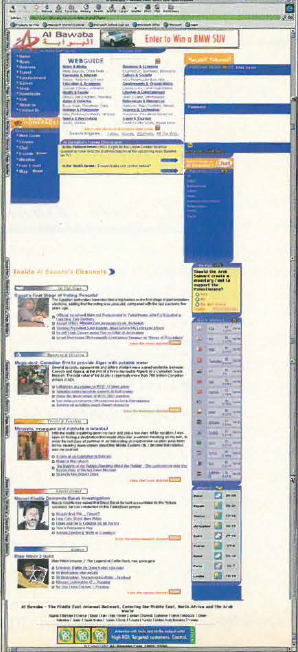
That’s one offering of an Arabic satire
page on AI-Bawaba (www.albawaba.com),
a new Internet portal not unlike the more
familiar Yahoo!.
AI-Bawaba, meaning “The Gateway,”
opened over the summer as the latest of
several major Arab websites, such as
Arabia.com and Planet Arabia, providing
mostly unfettered news, chat and
links to sites around the Arab world.
AI-Bawaba users can also go to the
relationships English bulletin board to
discuss taboo subjects in Arab society such
as, “Why are men in the Arab world
allowed premarital relations and women
not?” or “Should an Arab and an Israeli be
allowed to marry?”
In addition to the satire page, Al-Bawaba
intends to publish literature and articles that
have been banned in some countries in a bid
to push the limits of free speech. Local portal
contenders, Yalla! and Cyberia (see
cover story) should maybe consider taking
a leaf out of Al-Bawaba’s website.
A natural right
to a cyber homeland
Some battles are just easier in cyberspace.
After years of lobbying for its
own piece of cyber real estate, Palestine was
granted official status on the Internet with
the designation of its own two-letter
addressing suffix or top-level domain.
The ‘.ps’ domain – an addition to the list
of 244 country code designations – is open
to companies, organizations and people in
the Palestinian territories.
The action was taken with the endorsement
of the US government, which still
oversees the Web and must approve any
changes to the root files of the Internet – as
the instigator and prime mover of the Net,
the US is dispensed from country codes
and deemed the global webmaster.
“The ‘.ps’ domain is a top-level domain
just like any other,” says Yasser Dolah,
who is listed as the technical contact for the
domain. “Now Palestinian companies and
organizations will be able to register
under ‘.ps’ if they exist in that part of the
world, and people will know it is in that
part of the world.”
While the granting of the ‘.ps’ domain
was relatively straightforward – a limitless
cyberspace does away with the need
for street battles and bullets – the implication
of giving Palestine a long-sought
spot on the Net is more subtle: The
Palestinian Authority has been granted the
political standing of a full -fledged
nation. In a virtual sense, Palestine is
already a reality.
When the world is
in your hand
For years the industry has been promising
·’Internet appliances” – stripped down
devices designed to make getting
on line as easy as making toast. As the pundits
see it, businesspeople on the move as
well as households that have so far resisted
the siren song of the personal computer
would take the plunge once offered something
smaller, cheaper and less intimidating
than full-blown PCs.
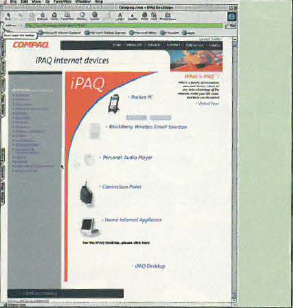
Enter Compaq’s iPAQ Pocket PC, the
palm-sized wonder-chip which, if the hype
is to be believed, will be the product that
finally brings the appliance concept into
the mainstream. “The iPAQ Pocket PC
combines the functions of a mobile phone,
a pager and a handheld organizer, which
means customers only need to carry one
slim, powerful device,” says Compaq’s
Amr Salem, area manager for the Levant
region. “Compaq’s iPAQ Pocket PC is
small enough to fit in your hand and it connects
you to any information you need,
including email and Web browsing.”
With 206MHz and 32MB of standard
memory, the iPAQ – to be launched in the
Middle East in November at an undisclosed
retail price – packs a veritable punch and
should allow surfers to see the cyber-world
pretty much as they currently view the Web
from a PC or a Mac.
But a word of warning to prospective buyers:
Don’t bundle out your computer just
yet. Since the device has no hard drive, floppy
drive or CD-ROM, there’s no way you can
install or run additional software or even
load browser plug-ins. All it can handle is Web
browsing, email and instant messaging. The
iPAQ tries to make Internet access easy in the
same way toasters make toasting easy: by not
doing much else.
Going out without
leaving home
These days, Internet companies are trying
to make it even easier to stay at
home. A natural progression from auction
houses and e-tailers are the food-delivery
sites where you just boot up, surf to your
favorite restaurant, place the orders, then
wait for the grub to arrive.
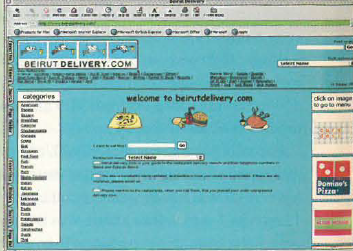
Beirut Delivery (www.beirutdelivery.com),
run by a group of young graduates, contains
more than 80 restaurant menus from
around Beirut (other cities are in the
works). Click the appropriate neighborhood
on the home page, and you get links to
a list of nearby dining establishments.
Each restaurant has its own page, listing its
full menu.
There’s no extra cost for the service,
since Beirut Delivery earns a $30 monthly
subscription from restaurants that leave
their menus with them.
For now, ordering a sushi or a pizza via the
Net is a work in progress. Beirut Delivery
is not yet able to deliver to your doorstep you
still have to resort to the old-fashioned
phone to actually place your order. But at
least the service does mean that you no
longer need to rummage through the junk
drawer for a half-dozen tom menus.