
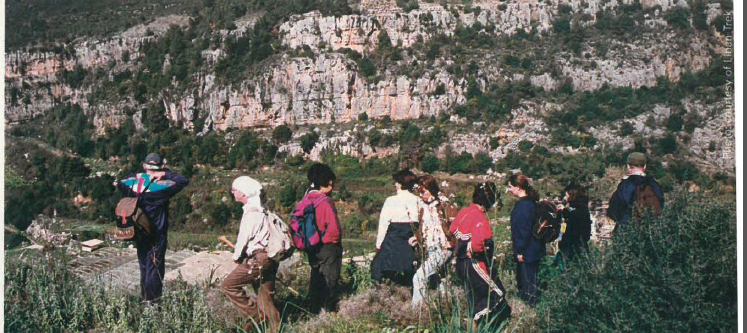
For many people, discovering Lebanon means visiting
archaeological sites and driving to remote villages to
lunch at local restaurants. That may be fine when the
grandparents are along, but for a growing number of people,
a simple trip to the mountains just doesn’t cut it. They want
more: more contact with nature, more exploring and more of the great outdoors. If
this sounds like what
you’re looking for,
now is the time to discover
trekking.
“Trekking is accessible,”
says Pierre Abi
Aoun of Wild Expeditions.
Other activities,
such as rock
climbing and rafting,
are technical and
require a certain
amount of skill, as
well as sporting
equipment. Trekking
needs no training.
“All that is needed is a
good pair of boots,”
says Michel Moufarege
of Liban Trek.
Lebanon’s mountains
and valleys
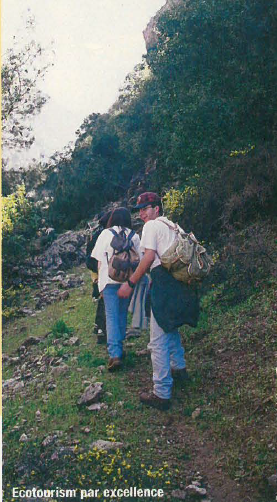
offer plenty of playgrounds for adventure. “Trekking is ecotourism par excellence,”
says Moufarege (see box). Treks often include cultural
excursions to sites where classical tours don’t go.
Besides its natural attributes, the Qadisha Valley, for example,
has a rich cultural heritage. “There are a lot of caves that
were occupied by monks and villagers during the Middle
Ages,” says Abi Aoun. “The only way to get to them is on
foot.” The Deir Es Salib cave, for example, is a site that
requires vigorous rock climbing to visit.
Trekking programs are divided according to levels of
difficulty. Liban Trek has two programs to the Horsh Ehden
nature reserves, one for beginners and one for amateurs. The
company also organizes a hike for those with an athletic aptitude
to Qornet Assawda, Lebanon’s highest peak at 3,083
meters.
Treks are led by one or more guides, who explain
the geography and history of the areas being explored.
Besides being educational, treks are socially stimulating and
a great way to meet people.
Liban Trek and Wild Expeditions provide bus transportation.
“The advantage is that we can start the hike at
point ‘A’ and finish at point ‘B’, where the bus retrieves the
group,” says Moufarege. “With cars, we would have to
make circular tours to get back to the starting point.”
If
transportation is included, costs rise to about LL 30,000 per
person. Lebanese Adventure doesn’t offer transportation,
so its treks cost about LL 15,000 per person. Prices are
determined based on the distance to destinations and on
entrance fees for reserves. Participants should bring a
simple picnic lunch, except when itineraries include lunch
at a local restaurant.
Down with five-star hotels
There’s historical Lebanon, with its Phoenician and
Roman sites. There’s leisure Lebanon, with its
beaches and ski resorts. And there’s carnal Lebanon,
with its nightlife, casinos and shopping galore. These
assets, which attracted tourists by the millions during
the country’s heyday, won’t be enough to entice a new type
of traveler that has since emerged – ecotourists.
These
modern-day adventurers are into nature trails and prefer
to explore countries while doing outdoor activities such as
trekking, cross-country skiing, caving, birdwatching and
camping.
“Ecotourism is the fastest-growing segment of
tourism,” says Felix Tohme of TLB.
Realizing this, the Ministry of Tourism recently formed a committee
to promote Lebanon as an ecotourism destination.
Some local tour operators are already trying to capitalize on
the growing demand for ecotours. TLB offers off-road
adventures that incorporate ecotourism. For example, it
offers a 16-day journey through Lebanon, Jordan and Syria.
Participants travel in 4×4 vehicles and stop to explore valleys,
mountains, deserts, towns and archaeological sites.
TLB also offers a number of nine-day package trips
through Lebanon, including a cross-country ski trip.
“Lebanon has natural assets that neighboring countries
don’t have,” says Tohme. “It’s easy to spend a couple of weeks
in the mountains.”
Some nights the participants camp out. On
other nights, they stay at mountain lodges or family homes in
remote villages. Because travelers visit out-of-the-way
places, ecotourism helps develop rural areas.
To have a successful ecotourism sector, preserving the
environment is a must. “If we don’t have a healthy and beautiful environment we can’t play a role in the ecotourism field,”
says Andre Bechara of Lebanese Adventure, which is
responsible for all outdoor activities in the Chouf nature
reserve.
“Lebanon’s nature is deteriorating fast,” says
Michel Moufarege of Liban Trek. Laws exist, but they often
aren’t enforced. For example, there’s a law that forbids bird
hunting, but it is largely ignored. Similarly, regulations exist
regarding quarrying, but the practice continues
unchecked.
“The best way to safeguard the environment
is to make big natural
reserves – protected
areas,” says Bechara.
Ecotourism requires
its own infrastructure,
including first aid facilities,
helicopters for
mountain rescues, forest
rangers, standardized
signs and up-to-date
maps.
A stable political environment
is needed to capture
more tourists. Liban
Trek was established in
1997, “on the eve of what
we thought was peace,”
says Moufarege. “We
expected more incoming
tours.” In the interim, Liban
Trek, like most companies,
concentrates on the
local market.
A GOOD NIGHT’S SLEEP CAN DO WONDERS
SWEET DREAMS
Are you prone to headaches or become agitated
quickly? Have you been forgetful lately or found
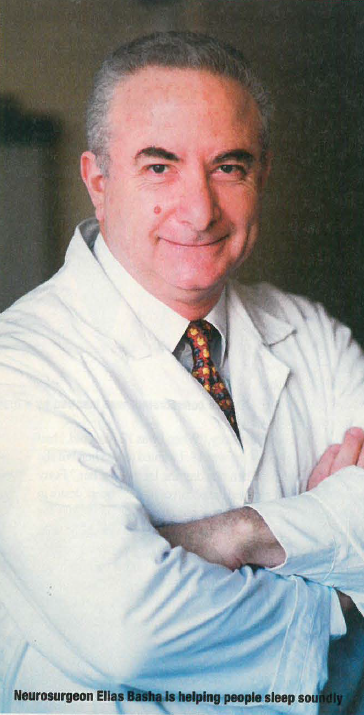
it hard to concentrate? According to neurosurgeon
Elias Basha, your problems may stem from a sleeping
disorder. “We sleep seven to eight hours a day – that’s
one-third of our life,” says Basha. “Therefore, sleep has an
important function.”
EEG recordings of the brain show five different types of
activity. When awake, brain activity is called alpha. When
asleep the brain registers four kinds of activity: slow waves
indicate drowsiness, spindles indicate light sleep, delta indicates
deep sleep and rapid eye movements (REM) occur when
we are dreaming.
This sleep cycle should occur five to seven times every night.
People who don’t experience these cycles have a sleeping
disorder, which can affect the quality
of their waking hours. “You can have a good state of wakefulness
or a diseased state of wakefulness,” says Basha.
Every stage of sleep has a function. For example, during
deep sleep hormones are secreted, such as growth, sex and
immunity hormones. Subsequently, light sleepers often
suffer from a deficiency of hormones. This can lead to
anything from stunted growth to frigidity, impotence and
a faulty immune system.
The most important stage of sleep is REM, because that
is when we dream. Dreams are directly related to memory,
problem-solving abilities, sexual health, intellectual faculties
and mood. A healthy amount of dreaming is 100 minutes
per night, over five to seven cycles.
“If you dream
enough, you’re fast-thinking, smart, alert, vigilant and creative,”
says Basha. “If you sleep badly, you wake up without
these faculties.” Basha even claims that proper sleep can
make a person more intelligent.
“Part of sleep is productive and part is wasteful,” says
Basha. Wasted time includes the hour it takes some people
to fall asleep, and the 15 to 30 minutes it takes others to fall
asleep after waking up in the middle of the night. According
to Basha, this can be harmful: “Dreaming is interrupted.”
Basha’s patients receive six 90-minute consultations,
each costing $50. They record their sleep patterns in a
diary. This enables Basha to determine the factors leading
to sleeping disorders. They are usually related to bad eating
habits, exercising before bedtime, smoking or drinking
coffee after 3:00 p.m. Tranquilizers are definite no-nos.
“They kill your dreams,” says Basha.
There are a number of other factors that can influence an
individual’s sleep cycle. These include whether the person
snores, talks in his or her sleep, or whether the individual suffers
from nasal obstructions. For this reason, patients spend
one night at the clinic in order to record their sleep patterns. The
cost is $750, but not all patients require a full night’s session.
“My sleep problem started when I was a kid,” says architect
Hani Choueiri, who consulted with Basha two years ago.
Recordings determined that Choueiri suffered from epilepsy
during his sleep. Choueiri used to depend on medication to fall
asleep and wake up. He gradually stopped taking the medicine
and began changing certain unhealthy habits.
“When the
quality of my sleep improved, the epilepsy went away,” he says.
“I have a better memory and in less time I am able to do more.”
Six months ago, Elie Chaaya was afflicted with a breathing
problem, which affected his sleep. He couldn’t get out of
bed easily, would wake up with a headache and his eyes
became irritated by strong odors. Recordings determined that
he had a snoring problem. Basha prescribed for Chaaya a
$1,600 breathing mask to wear when he went to bed.
“I’ll
have to use it between nine months and two years, depending
on my progress,” says Chaaya. So far,
the mask, which he has been using for a
month, has helped him sleep – and live
– better.
“I used to be irritable at work
and would get angry with clients,” says
Chaaya, who sells health equipment.
“Now I am able to deal with difficult situations
calmly.”
Basha also warns that a proper sleeping
ritual is of utmost importance. That
includes putting on pajamas just before
going to bed and using the bedroom
only for sleep and sex. That means no
phone, no television and no reading
material in the bedroom.
Top of Form
Bottom of Form
SPIRITED SCULPTURES
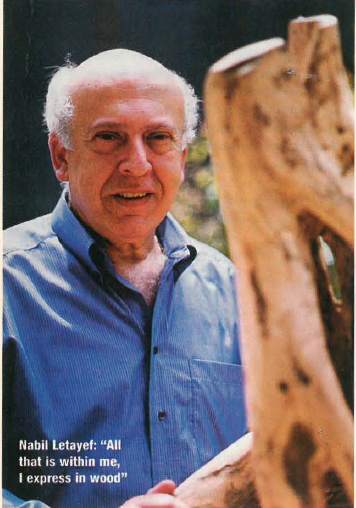
Nabil Letayf began sculpting when he returned to
Lebanon ten years ago. “Since then I haven’t
stopped.” Letayf is a dermatologist by profession
and sculpts as a hobby. An untrained artist whose preferred
medium is wood, the good doctor is an eccentric.
Darting around his workshop and makeshift studio, uttering
profound statements, Letayf acts like a crazed genius. “The
shape is the essence of a sculpture, but shape alone is not
enough. The meaning you give to a shape makes it alive,” he
says.
Letayf becomes passionate when talking about his sculptures
and completely absorbed when creating them. His intellect,
fervent imagination and skill with his hands merge to create
exceptional works of art.
Letayf sculpts outdoors because natural light falls on the grains
of wood in such a way that it compels forms. “I can see where
I have to work,” he says. He tackles wood “centimeter by centimeter”
or else it expands and cracks.
Letayf works with all
types of wood, but mostly pine and olive. He enjoys going into
the forest on weekends to gather fallen wood, which must first
be dried in the sun. “Sometimes the wood obliges you to wait several weeks,”
says Letayf. “That
is why I work on
several pieces at the
same time.”
What inspires
Letayf? Previous
inquiries encouraged
him to write
an explanatory
essay. Three and a
half years later he
completed a book,
Vibrations in Wood.
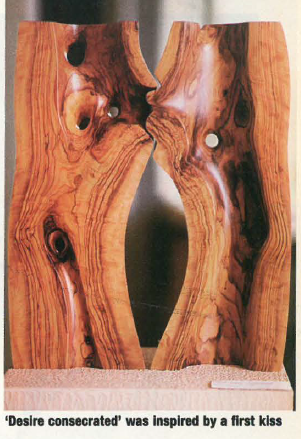
One piece, “Desire
Consecrated”, commemorates his first
kiss. Letayf recounts the story. “When I was 12 years old, I had
a beautiful neighbor – she was 18. I wanted to kiss her, but she
wouldn’t allow me. Then one day she let me kiss her.”
Forty
years later, Letayf recalled the object of his pubescent desire in
a dream, and immediately set about immortalizing the kiss she
granted him. “All that is within me I express in wood,” he says.
Not all the sculptures were inspired by personal experiences.
“The Horse of Don Quixote” pays tribute to the famous
novel by Miguel de Cervantes Saavedra. The base of the
sculpture is skillfully constructed to make it look as though the
horse is levitating. “It is not fixed because the horse is imaginary,”
he says.
Letayf has displayed his sculptures at a number of collective
shows in Beirut. But it was not until June 1999 that he held his
first one-man show. Of the 63 pieces exhibited, 14 were sold.
Since starting, he has only sold about 30 sculptures.
But he isn’t particularly fond of galleries. “Gallery owners
are not interested in art – only in selling art.” Letayf is a nonconformist.
It’s unlikely to find “please don’t touch” signs in front
of his sculptures. On the contrary, he invites people to touch the
sculptures, to feel the vibrations they emit. “Wood is something
alive,” he says. “I don’t like parting with my pieces, but I must
sell to continue.”
Letayf occasionally commissions bronze
reproductions of favorite sculptures.
Prices vary, but are mainly determined by size. “The Dermatologist
Who Lost His Hair” is a small piece
(7 cm × 11 cm × 11 cm). It is priced at $400. “Desire Consecrated”
is medium-sized (44 cm × 35 cm × 5 cm) and is priced at $1,800.
One of the larger sculptures, “Metamorphose”
(118 cm × 107 cm × 56 cm), costs $4,500.
