Following PSINet’s acquisition of Lynx
Following PSINet’s acquisition of
Lynx, EXECUTIVE asked several
Internet service providers (ISPs) whether
they’d sell. IntraCom wouldn’t comment,
while Cyberia had “no incentive to sell”
(see “The next wave.com”, March 2000).
Of course it doesn’t; it wants to gobble up
the rest. Soon after, in an email to its customers,
IntraCom stated that it would
“transition” its customers over to Cyberia.
What’s the deal? Talking exclusively to
EXECUTIVE, Aboud Omari, CEO of
Cyberia, and his counterpart at IntraCom,
Adel Rida, highlight the terms of the deal.
IntraCom, which claims to hold the second
position in the consumer market, is leaving
the ISP market to become an application
service provider (ASP), under the name
XtraCom. It will concentrate on the corporate
market, where the big dollars are, by
offering consulting and Internet services,
such as e-commerce and its popular
AudioTex, but no dial-up. “Dial-up will
be handled under the Cyberia brand,” says
Rida. Merger? No. Acquisition? Kind of.
Omari approached Rida last fall. “I
convinced him to sell,” says Omari.
“Costs are high. Only networks with a
significantly high number of clients can be
cost-effective. And the most effective
way is by acquiring.” Going after 6,000
users would cost $1,000 per user over a
period of six months, Omari says.
Rida insinuates that the deal contains two
parts: valuing the customer base and sharing
revenue per customer for a certain period
of time. Omari maintains that “money
will go to pay off any outstanding debts.”
Cyberia gave IntraCom clients, who were
paying $11.99 and $19.99 for unlimited and
digital unlimited access, a two-month period
of free access, until May 1, when
IntraCom would leave the picture.
Simply put, Cyberia bought IntraCom’s
database and dial-up network. There’s a
discrepancy over the number of customers.
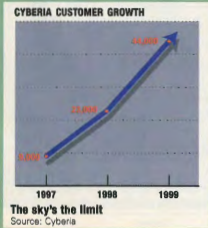
Cyberia downplays it to 13,800
customers, 35% of which are inactive.
Omari expects between 6,000 and 7,000 to
shift over to Cyberia. Rida, on the other
hand, boosts the number to 17,000, with
about 12,000 active accounts. Based on
Omari’s estimations, that would pump up
Cyberia’s database from 44,000 to around
50,000. It will control over 60% of the market,
according to Rida.
“We have an infrastructure that can handle
up to 30,000 users and a bandwidth of 512
kb,” Rida maintains. Other major players
remaining are IncoNet, Data Management,
TerraNet, and Sodetel. When it entered the
market in October 1998, IntraCom’s projections
were to reach 30,000 customers in
two years. “But growth is very slow and it’s
a small market,” says Rida. “One ISP is
enough for this market, really.” IntraCom
will concentrate on its dial-up markets in the
UK and especially Nigeria, where the number
of connected users reached 200,000 in
one year, according to Rida.
Oh, and one more thing. “There’s an
understanding of cooperation [between
the two companies] in markets abroad,”
Rida adds, “which will boost Cyberia’s
value-added services.” Who’s next?
From airwaves to cyberwaves
Listening to the radio? That’s so passé.
Now FM stations are battling it out in
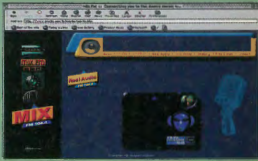
cyberspace. Mix FM (104.4 FM) launched
its $4,000 website on the occasion of its
fourth anniversary on February 23. Eat
your heart out, Radio One. But the two
websites project different images. Mix
FM, specialized in dance music, wants to
create a dance club image — “trendy and
cool,” says general manager Roger Saad.
The website was designed by Prezorse,
a US-based company, using the all-popular
Shockwave Flash 4. It has the regular
features: charts, real audio, chatting and
email accounts. The station’s target audience
is listeners between the age of 15 and
40. “We don’t claim we’re number one,”
says Saad. “We say we’re the most listened
to radio station.” The proof, according to
Saad, is that Mix FM can be heard in
shopping centers, restaurants and shops.
The station, which started out with low
costs, started seeing profits after nine
months on the airwaves, and has been
growing steadily. It attributes its success
to the popularity of dance music.
For its part, Radio One received the
award for the “Number One Arab website”
from the UAE satellite TV, and its developer,
Wael el Zanaty, was there to accept
it. Radio One’s new look upgrade is due on
April 1. Let the battles begin.
Lotus notes local company
Anzima Cooperative Solutions (CS)
recently received the “Best New
Comer” award from Lotus Middle East, an
IBM company that includes an area from
Egypt to Pakistan. Anzima CS, owned by
Elie Tabet and Fares Kobaissi, is one of
over 200 companies providing software
solutions to businesses. Launched two
years ago, the company uses the Lotus
Notes software and has an impressive customer
list, including Fransabank and
PricewaterhouseCoopers. Its sales last year
reached $250,000, with a staff of ten.
Going up against heavies like Istisharat
and Software Design, the company operates
in a small market, hindered by a lack
of funding and thin margins.
Anzima is not the only local company
affiliated with Lotus. Two-year-old Trilog
Group, owned by Alex Homsi, is also a
Lotus “Premier Business Partner.”