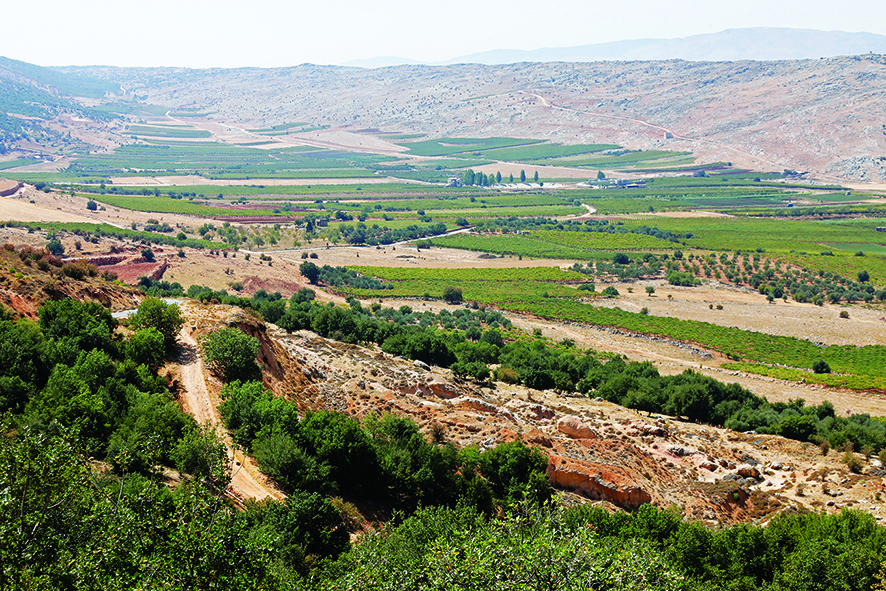
Lebanon’s food producers have spent the past seven years navigating a financial crisis, currency collapse, soaring prices and repeated conflict. The upheaval has fundamentally changed the economics of producing food locally. While higher import costs have created opportunities for some producers to replace imported goods, rising production costs, weakened purchasing power and conflict have made it increasingly difficult for others to maintain production and sales.
Those different realities are reflected in the experiences of three Lebanese producers operating in different parts of the food sector. Agrifresh, led by partner and CEO Roy Noujaim, produces fresh-cut vegetables in the Bekaa Valley, supplying primarily restaurants. Balkis, where Ali Beydoun is operations manager, produces juice at its facility in Insarieh, using fruit from orchards in southern Lebanon and targeting the higher end of the consumer market. Biomass, headed by CEO Mario Massoud, works with a network of farmers across Lebanon, bringing locally grown fresh produce to market.
Their experiences have been shaped by the pile-up of crises that began with the economic collapse of late 2019 and escalated with the COVID-19 pandemic and the Beirut blast of August 2020. Any relief from these polycrises was only tamped down by periods of lower level conflict beginning in October 2023, and subsequent phases of all-out war on Lebanon and the systematic destruction of the south which has damaged an estimated 22.5 percent of Lebanon’s agricultural land, according to Lebanon’s Ministry of Agriculture on 17 April 2026.
The currency collapse was accompanied by high inflation. Annual inflation reached 221 percent in 2023, before slowing to 45 percent in 2024 and 15 percent in 2025, according to Lebanon’s Central Administration of Statistics (CAS). Food inflation followed a similar trajectory, falling from 208 percent in 2023 to 22 percent in 2024 and 15 percent in 2025. While food prices rose almost as fast as overall prices in 2023, food inflation slowed considerably faster than the overall inflation in 2024, before the two rates converged in 2025.
Against this backdrop, agriculture has increased its share of the Lebanese economy. According to the Centre de Recherches et d’Études Agricoles Libanais (CREAL), agriculture accounted for 9.4 percent of GDP in 2025, compared with 5.8 percent in 2020. The increase does not necessarily mean that agricultural production has grown by the same proportion, as agriculture’s share of GDP is also affected by changes in the size and composition of the wider economy.
Adapting to a new economic reality
For Agrifresh, one of the first consequences of the financial crisis was losing access to financing for growth.
“When we started growing our company, we were relying on loans from banks like any other company that would grow. You can’t only rely on your own revenue stream or your profit. So when the economic crisis hit in 2019, that was one of the biggest challenges we were facing back then. Our growth was only based on our own revenue generation,” Noujaim explains.
The crisis also increased the cost of keeping the business running. Agrifresh relies heavily on electricity to keep its fresh vegetables refrigerated, while fuel is needed for distribution and irrigation.
“Our business relies a lot on energy because we have fridges all over the place. Our products have to be cooled at very low temperatures 24/7, so you can’t lose electricity,” Noujaim tells Executive.
Integrated Petroleum, a oil and gas trading organization headquartered in Doha, recorded a rising price of diesel by 85 percent in Lebanon between September 1, 2025 and September 1, 2026, adding further pressure on producers reliant on fuel for transport, irrigation and generators.
As electricity and fuel supplies became increasingly unreliable, Agrifresh invested in its own energy infrastructure in 2021, gradually expanding its solar system as the company’s energy needs have grown. The company also built a fuel station in 2022 at its factory to ensure that its distribution fleet would not be affected by shortages.
“Now we operate 100 percent on solar energy. We no longer rely on the energy provided by the government because we know it’s not reliable and it might go out at any second,” Noujaim says.
The wars have presented a different challenge. While Agrifresh’s production facilities have not been directly affected by the fighting, the company has felt the impact through its customers. Restaurants in the south were largely out of operation during periods of intense fighting, while some restaurants in the north saw a small increase in demand, among other reasons because displaced people moved north.
The impact extended beyond the areas directly affected by the fighting. “Most of our customers are restaurants. People would tend to go out less during war times,” he notes.
Another challenge for Agrifresh has been the rising cost of imported inputs.
“We rely a lot on imported materials, like packaging material. All of these are imported, they’re not produced in Lebanon. So they were impacted by inflation. Our products have, over the last six years, become a lot more expensive,” Noujaim tells Executive.
But higher import costs have also created opportunities for Agrifresh to replace some imported products with locally grown alternatives.
“There are five different kinds of vegetables that we didn’t grow in Lebanon because they had been imported and were not very expensive. Nowadays, because of inflation and high import costs, there was an opportunity for us to start growing those vegetables in Lebanon, and this is what we have done,” Noujaim explains.
The locally grown alternatives include baby spinach, sucrine lettuce and beetroot leaves. While these products continue to be imported, Agrifresh says it can compete with them on both price and quality.
“We are 15 to 20 percent cheaper,” Noujaim says.
Forced to shut down production
While Agrifresh has been able to adapt to the changing market, the war has presented Balkis with a more fundamental challenge of keeping its production running.
“We closed fully because our facilities are based in the south. Our areas were being targeted or being under threat, and it was not safe for us to operate in those areas,” Beydoun tells Executive.
The interruptions were not limited to a single period. In 2026, Balkis was unable to operate for almost two and a half months.
“Sometimes there was no threat and we were able to manufacture, and then there was a threat, so we had to shut down and go home. During those periods, we had to continue with the usual business expenses and all, but we were unable to supply the market, we were unable to sell,” Beydoun recalls.
The company also experienced a prolonged closure in 2024, when it was unable to operate for around three months. The closures came on top of the financial pressures created by Lebanon’s economic crisis. The banking crisis made it difficult for Balkis to access its funds and carry out international payments. Rising fuel and electricity costs have added further pressure to the company’s production costs.
The economic downturn has also hit Balkis on the demand side. As the company sells a high-end product, the decline in purchasing power has reduced the size of its potential market.
“We don’t make the same now as we did six years ago. In our case, our product is a luxury item. Due to the circumstances and wars, the consumer market has been materially impacted,” Beydoun says.
Avocados left at home
For Biomass, the consequences have been felt both in the fields and in its ability to reach foreign markets. The war has particularly affected their operations in southern Lebanon where farmers were forced to leave.
“It was way too dangerous to stay in the south. We lost crops and we lost farmers,” says Mario Massoud, CEO of Biomass.
The loss of production has also affected the company’s exports. “We export avocados to European countries. Most of our avocados are located in the south. During the wars we couldn’t export,” Massoud says.
The war has also changed Biomass’s geographical production footprint, with the company now producing less in southern Lebanon.
“The farmers in the south are more limited than they were in the past, so we have fewer farmers there now,” Massoud adds.
The rising cost of production has added another pressure on farmers. “Most of the irrigation is done on fuel, and you have farmers not irrigating as well, losing crops because they can’t afford the fuel,” he notes.
Despite the higher cost of producing locally, Biomass sees an advantage over imported fruits and vegetables.
“It has become more expensive to produce, but it is cheaper compared to imported goods. Producing locally is still more competitive than importing from Europe or from neighboring countries,” Massoud argues.
A weaker pound is no major gain for producers
Nassib Ghobril, Chief Economist at Byblos Bank Group, says the crisis has affected businesses through both declining purchasing power and rising costs.
“The financial crisis led to the decrease in the purchasing power of households, which affected consumption and consumer demand, which in turn affected sales at companies,” says Ghobril. “It increased the cost of imports and their operating costs and created a period of uncertainty and lack of visibility. There have been many theories that this will encourage local production and it will reduce imports. But we have not seen this.”
“The economy still relies on imports,” he adds. “We have seen an increase in local production but not to the point of replacing imports. Last year, the import bill was about $21 billion, which is the highest level on record. Exports were around $3.5 billion, so we still have a wide trade deficit.”
The figures refer to Lebanon’s overall trade in goods. Yet the depreciation of the pound has not translated into significantly lower production costs in Lebanon.
“It did not get cheaper because you still have high energy costs, you still have very high operating costs, administrative costs, the cost of formalities with the public administration, poor infrastructure. And anyway, there are products that are raw materials that industry still needs to import that are not produced locally,” Ghobril argues.
The continued reliance on imports comes despite some improvement in Lebanon’s overall economic conditions compared with the beginning of the crisis.
“Today conditions are relatively better than they were in 2020. You have a stable exchange rate, you have a larger economy, you have lower inflation, you have a functioning government and parliament,” Ghobril notes.
Infrastructure is the key to future growth
But adapting to the changing market is only part of the challenge. Roy Noujaim from Agrifresh says greater government support could help farmers adopt new technologies and production methods.
“Something that we would like to see more changes is probably more governmental support incentivise and support the adoption of new technologies,” Noujaim says. “It can be on the financial side and it can be on the consulting side as well.”
Beydoun and Massoud similarly point to the need for greater government support for the sector, including better access to finance and support for farmers.
Despite the challenges, Massoud believes Lebanon already has many of the natural conditions needed for its agricultural sector to prosper.
“We have a climate, soil, sun, water, and microclimates that few countries in the region have. Unfortunately, we don’t have the proper infrastructure in place for the farming and agriculture sector to prosper properly. If we get the right infrastructure, we have everything that the Lebanese terrain can offer. I think food production and agriculture here has a bright future,” says Massoud.