How direct is too direct?
Although it’s been proven that you don’t necessarily
have to market a product to see sales
grow, the local agent for Dell computers may
have to get more aggressive in the future
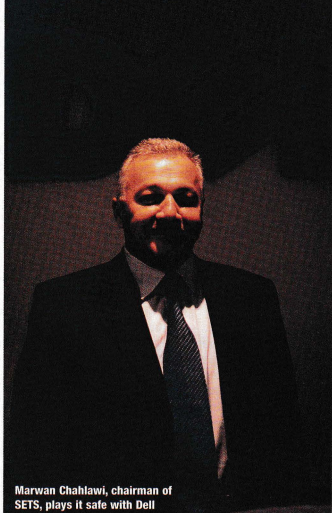
It’s possible Marwan Chahlawi takes Dell’s slogan ‘Be Direct’
too much to heart. Chahlawi is chairman of Systems
Equipment Telecommunication Services (SETS), the sole
Lebanese agent for Dell, the Austin, Texas-based outfit whose
incredible share price run made its founder, Michael Dell, the
world’s richest 34-year-old. In the third quarter of 1999, Dell overtook
its Texas rival, Compaq, as the top computer seller in the US and
is on track to be the world’s biggest seller of PCs in 2000.
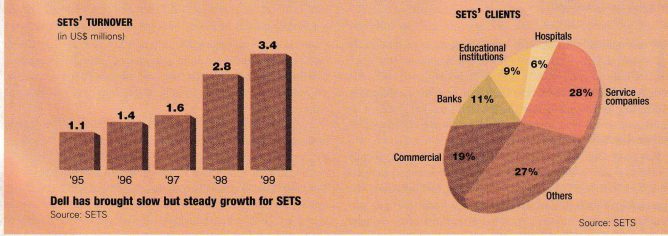
But in Lebanon, SETS’ revenue from sales of Dell computers in
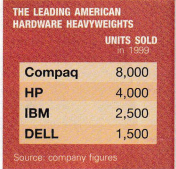
1999 was $3.4 million from 1,500 units sold; a figure that pales in
comparison to Compaq’s $15 million from 8,000 units sold and
IBM’s 2,500 units sold. Chahlawi, however, is comfortable with
direct one-to-one relationships with clients he knows, no sub-dealer
channels, no plans to get into volume sales and mass marketing.
So who knew that Dell has been here since 1991? Big, paying corporations.
And these are Chahlawi’s target.
The strategy is this: while other companies in Lebanon give
advance credit and fall into the trap of collecting payment,
Chahlawi sticks to a plan that’s safe in the face of an uncertain economic
situation. SETS, a small company of 30 employees, services
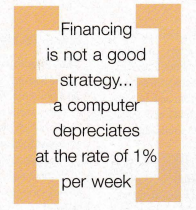
paying clients and only takes cash. Think about it. Financing is not
a good strategy in this field, where a computer depreciates at the rate
of 1% per week and becomes obsolete almost as soon as it is purchased.
Nor is it a good idea in an economic crisis. If customers get
to the point where they can’t pay their dues anymore, reclaiming the
computer is not an option, and does the company more harm than
good. “It’s not like reclaiming a car,” Chahlawi maintains, “which
can be resold. What would I do with a returned computer?” Cash payment also means that he doesn’t have to get into legal conflicts
or feuds with clients over late payments. This is important in a small
country like Lebanon, where reputation is part of business.
Clients who pay cash are big entities. SETS’ client list for hardware
as well as software and solutions contains a total of 19 banks, including
heavies such as BLOM, HSBC, BBAC, ten hospitals, including
Rizk and Najjar, and 16 educational institutions, including
International College, American Community School and the
American University of Beirut. SETS’ clients also include 50 service
companies like Associated Press and Nortel Telecom and 34 commercial
institutions such as Obegi Group, Cyberia and Lever Fattal.
The rest are industrial and engineering companies, public and nonprofit
organizations.
And, according to Chahlawi, the key thus far to keeping these big
clients has been direct, personal contact. In a small business environment
like Lebanon, personal contact plays an important role.
BLOM is a perfect example. Mohamad Soubra, the data processing
operations manager at BLOM, states that the bank had a long-term
relationship with SETS even before the company got into computers.
During EXECUTIVE’s meeting with Chahlawi, Maroun Fadel of
Nortel Telecom called after working hours to ask for a modem.
Chahlawi had it delivered to him that evening.
And while other brands are active in marketing their products,
SETS does not advertise; its marketing tool is the brand name itself.
The company applies Dell’s hunter-and-follower strategy, where telephone
sales representatives call existing or potential clients to
offer new product lines or solutions. Chahlawi puts into practice the
Dell model that eliminates the middleman. Resellers who are the
intermediary between the distributor and the client result in price
markups and a lack of quality control in the after-sales services.
SETS offers tenders at “very competitive prices,” says Tony
Wakim, financial manager of First National Bank.
With tariffs at 16% and margins a thin 7-10%, Chahlawi compensates
by offering a package deal that includes solutions and warranty
covering service calls without additional hourly fees. Software and
solutions make up 10-20% of revenues. Time Management, for instance, a software program that keeps track of employee attendance, has been
the company’s trump card for the last four years.
The company struck gold with the warranty, which is unlimited;
it includes replacement of parts and solving software problems.
“The compensation for the higher price is in the warranty. SETS
certainly did well, offering a three-year unlimited warranty,” says
Soubra. He adds, “Other companies give a one-year, or a limited
three-year that excludes spare parts and customer visits.” The
price therefore represents the total cost of ownership, which
includes the after-sales service, a much sought-after option.
Chahlawi is not keen on mass marketing; he’s conservative
when it comes to the popular practice of incurring losses to grab a greater market share and is the reason why Dell computers are not
encountered in local computer retail stores. Since it offers package
solutions, not just PC sales, the individual market is not in the company’s
interest. Its growth in clients would not necessarily be met
with a corresponding growth of the customer support department
of eight employees to maintain direct relationships
with customers, because of the already-tight margins and the cost of hiring qualified personnel.
Chahlawi believes that Compaq’s large
number of resellers and the price wars within
the same brand have led to the decline of
Compaq’s quality and reputation.
But the fact that SETS is the distributor, the
reseller and the after-sales problem-solver all
in one is not necessarily an advantage.
Nabil Abdel Nour, the general manager of the
IBM agent QuanTech, and Antoine
Kawkabani, the general manager for the
Hewlett-Packard agent Computer Information Systems, both argue that a
small market like Lebanon should have only one main distributor
that is the reference, and should distribute to retailers. IBM sells
through QuanTech and its sister company, BlueTech. Both brands
have reseller channels.
The drawback of exclusivity is that it translates into a brand
monopoly in the market. “I’m not fond of the company’s monopoly
over Dell locally,” says Tony Bonnaud, the head of information technology
at the International College, a major SETS customer. “If clients are not happy with an agent, they can’t go to a different Dell agent,”
he says. Banks, for instance, address this issue by buying from competitors
at the same time, like IBM and Compaq; then the provider does
not feel it has control over the client.
The delicacy of this situation is that, to a dissatisfied customer, the
only option is to change brands altogether,
meaning a loss not only to the company, but also to the brand itself.
Compaq, on the other hand, has three resellers
for the corporate market and a distributor to the
consumer market. This model results in much
competition within the brand, which is “not
healthy,” claims Kawkabani. Chahlawi
agrees, “Once I’ve fought off the competitor,
why do I want to enter into another battle of
which Dell reseller to buy from?”
Still, competitors are not becoming any less
aggressive. The company has finished developing
a new commercial software that it will market in 2000.
Chahlawi expects to double its revenue from
software sales to $400,000 next year. One thing SETS might want
to try is distributing to reseller channels and creating a separate entity
responsible for after-sales
control. Because although
Chahlawi’s strategy fits a precarious
economy, whenever
the situation picks up, SETS
might find itself left behind.
Hard to beat
DELL is famous for revolutionizing direct sales of PCs. The
model dispenses with wholesalers and middlemen to prevent
price markups. This means moving supplies without
carrying stocks and fostering a direct relationship with
clients, which the company uses to predict and shape future
solutions to current customers’ needs. It also means using
the Internet. DELL set up its website so that customers can
configure their systems online to come up with a price within
their budget, and order online. The result was website
sales of $30 million per day alone.
Selling direct has advantages that are hard to ignore:
DELL gets paid by corporations rather than resellers,
which are smaller companies. And in the case of the website
and credit card purchases, according to Fortune
Magazine, “DELL has its money in the bank before the
motherboard meets the chassis.”