
Internationally, Compaq is not having an easy time at the
moment. Dell, with its fast growth and direct sales strategy, is
the hot computer stock in the US. So hot, in fact, that it’s challenging
Compaq as the world’s number one PC manufacturer.
According to a recent market survey, Dell’s market share for the
third quarter of 1999 came in just under Compaq’s leading 13%,
but its sales are growing twice as fast.
But while Dell is a worry globally, that’s not the case locally.
Compaq’s sales in Lebanon have topped all its branded competitors,
taking in over $15 million in 1999 and growing at a constant
annual rate of about 30% in recent years, says Joseph Hanania, general
manager at Compaq’s regional office in Dubai. Compaq claims to have sold some 8,000 units here last year. In comparison,
Dell came in with $3.4 million in sales, or 1,500 units, QuanTech,
the IBM agent, is estimated to have sold around 2,500 units in 1999,
while Hewlett Packard’s local agent claims to have moved some
4,000 units.
Compaq’s success in the local market is undoubtedly the result of
its strategy to get its computers on the shelves of virtually all computer
shops in the country, a reflection of the sales approach Compaq began
in the US. In the early 1990s, Compaq, which has its headquarters in
Houston, Texas, decided that more was better, which meant sell, sell,
and sell some more, no matter what, no matter how. It began mass marketing
its products through multiple channels and volume sales. To increase sales, it grabbed the consumer market by selling through
retailers, slashing prices to match less expensive brands as well as
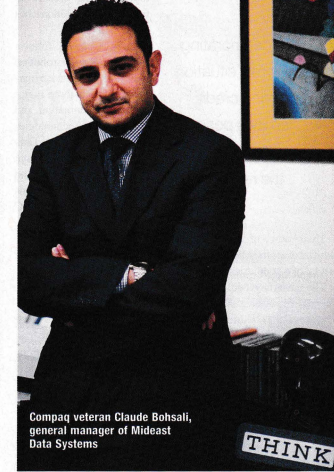
locally assembled units, explains Claude Bohsali, general manager
of Mideast Data Systems (MDS), which originally introduced
Compaq to Lebanon. The results? By the mid-1990s, Compaq topped the list worldwide
for PC sales, a position it has
so far maintained.
Locally, Compaq follows
the same open distribution
policy. Its products are marketed
through three major
resellers: Automation and
Computer Technologies
(ACT), Midware Data
Systems,
International
Computer and
Communication Systems
(ICC) and a distributor, PC
Deal Net.
Their source of supplies is Compaq’s regional office in Dubai,
which covers the Middle East, Mediterranean and Africa (MEMA),
a total of 42 countries.
The agents target different sections of the market, resulting in comprehensive
coverage. Midware, a sister company to MDS, and ACT
both target the end-user, selling to the private and the public sectors.
Midware accounts for the largest chunk of Compaq’s hardware market
with sales that reached between $8 million and $9 million
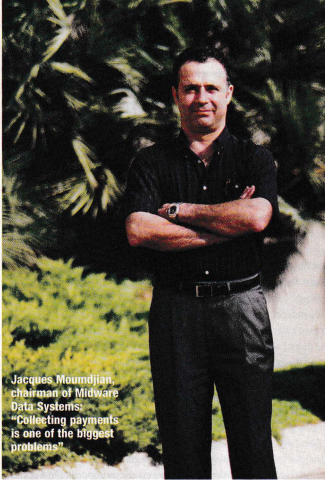
for 1999, according to chairman Jacques Moumdjian. Its customers
are mainly small- and medium-sized enterprises (SMEs), banks, and
the public sector. ACT and ICC, both of which entered the market
in 1998, are direct competitors.
The local consumer market generates an estimated $3 million for
Compaq. This is PC Deal Net’s specialty. It handles distribution of
Compaq’s Presario, the home-use model, to retailers and solution
providers. The advantage of retailers is that they offer support and
other services. If the hardware is defective, however, it is sent back
to PC Deal Net.
But despite a brand that sells incredibly well, no small thanks to
aggressive marketing techniques, Compaq resellers don’t have it
so easy. They have to live with difficult market conditions. While
consumers complain that the Dell model in Lebanon creates a monopoly, Compaq’s strategy is also not unproblematic.
There is a lot of competition and undercutting of prices in the corporate
and consumer markets. “The Compaq model is not ideal
because the client can get confused,” Bohsali says. “The multiple channels
with multiple pricing and multiple support frustrate customers.”
Competitors contend that different prices and services hurt the brand
image and reputation. “In small markets, there should not be more
than one good distributor, to whom customers develop a loyalty,” says
Antoine Kawkabani, chairman of Computer Information Systems
(CIS) and treasurer of the Professional Computer Association. As the
local HP agent, CIS distributes HP computers and printers to the consumer market through retailers.
QuanTech and its sister company,
BlueTech, which handles distribution for
IBM, work in the same manner. For consumers,
that means there’s only one reference
to turn to.
To Compaq, their products are marketed
more comprehensively and aggressively.
“Price wars are excellent, because they
result in the lowest prices on the market,
which chiefly benefits the customer,” says
Hanania. This also helps chip away at brand and price monopoly on the market. The strategy comes full circle
when the cheapest prices result in greater sales. This primarily benefits
Compaq, of course. Further down the ladder, on the reseller level,
the competition is tough.
There are also some serious obstacles to the local computer
hardware market. Tariffs are high,
about 16% in 1999. The cost
is passed on to the customer since, Moumdjian says, the
company cannot absorb it.
Combined with a dead market
and a deteriorating economic
situation, giving credit
facilities poses a dilemma to
the resellers. The flip side of
aggressive marketing and
grabbing greater market share
is the “big problem” of collecting
payments, says
Moumdjian. While declining
“The Compaq
model is not ideal
because the client
can get confused”
to give exact figures, he says that debt “by the millions” lies dead in
the public sector alone and dates back to 1996. ACT concedes that
it had thousands of dollars in unpaid receivables until it pushed collection
in December. Moumdjian sounds disenchanted when talking
about this issue. “Collecting payments is one of the biggest problems
the private sector is facing now, and it may lead to many companies
going bankrupt, even the big ones.”
Creative package offers make up for losses. Half of Compaq’s
turnover comes from solutions. Options on the consumer level
include bundling software and giving customer support. On a corporate
level, Bohsali says, the trend is to offer packages where the loss
in the hardware is made up for by solutions that have higher margins.
On Compaq’s part, it’s quite simple. Pay up on time to get the supplies.
The corporation does not extend payments to its partners.
Since Lebanon constitutes a “tiny bit” of its global business at
0.02%, the bulk being North America with 55%, it could sacrifice
the entire market without as much as a wince. For the resellers, it’s
each man for himself.
PC for Peanuts
Compaq had an “exceptional year” in 1999, says Jacques
Moumdjian, chairman of Midware Data Systems, one of
the Compaq resellers locally. No kidding. The rush for purchasing
Y2K-compliant computers could be one reason. But
the other is indisputably Banque Audi’s PC and Internet loan
in September. Though Audi would not reveal figures, those in
the industry estimate that 3,000-5,000 computers have been
sold. Byblos Bank and Credit Libanais both added Internet and
PC loans to their retail banking services.
Audi’s move caused a stir, mainly from the small retailers in the
PC sector and the Internet service providers. It was accused
of intruding on their business. The difference is delicate,
though. The bank offered a loan associated with Compaq computers,
and gave a list of retailers in different areas for customers
to pick up their PCs. The loan does not contradict the
bank’s legal boundaries, according to articles 152-3 of the Central Bank’s regulations on money and credit.
The main complaints came from computer retailers. The
accusations stem from two sources. First, that the deal
excluded many Compaq retailers. And secondly, that the
price undercut all offers on the market. One retailer claims
that the bank’s offer mainly affected locally assembled
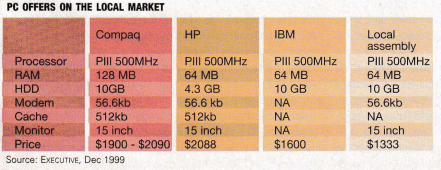
computers. For instance, one dealer offers a locally assembled
computer with options that resemble Banque Audi’s
Compaq (Intel Pentium III, 450 MHz, 64 MB RAM, 6.4 GB HD)
for $950. Consumers are generally more willing to buy a
brand name if the price is competitive. With Banque Audi’s
offer, the price of the Pentium III from Compaq is $1,188,
financed over 12 months with $99 in monthly installments.
But what Banque Audi did was to expand the market to a
customer base that might otherwise not have been able to
afford a PC. As for the low price, ordering in volume
reduces the wholesale price. This cannot be matched with
the smaller volume of PC retailers.
