
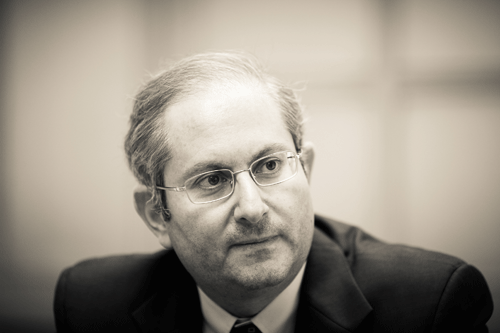
In September, Executive sat down with Nicholas Chammas, head of the Lebanese Traders Association (LTA), to discuss the retail sector’s weak performance following the events this summer, from the warnings against travel to Lebanon by Gulf states, to the kidnappings of foreign visitors and the closures of the airport. Given all this, it was no surprise that the LTA was warning of a major crisis should the situation persist. For our end-of-year issue, Executive sat down with Chammas again to see what, if anything, had changed since our last meeting.
Since our last chat with you, the third quarter index has come out. What can you tell us about that?
The third quarter of 2012, in comparison with 2011, saw a drop of 8.5 percent in the LTA-Fransabank retail index. All sectors have been affected but in different proportions. Durable goods [such as electronics and furniture] saw a steeper decline than basic goods [such as clothes, school items, food and drink]… as they are more expensive and are one-off items, while the others are basic staples and everyday consumptions which cannot be really postponed or compressed.
In fact, the only commodity whose purchasing percentages went up was fuel and oil [up 7 percent], because there is elasticity between the price and demand: when the price falls, the demand increases and this is what happened. Were it not for this, we would have had a double-digit drop in commercial activity.
How do you see the rest of the year playing out?
We usually have four high points on the trade calendar: the summer season, the Adha holiday period, the Eid al-Fitr holiday period and the Christmas period. This year, three of these points were hit.
As for the Christmas holiday period, things don’t look good so far because of regional and local tensions. Already half of the fourth quarter has been lost or wasted because of the assassination of Brigadier General Wissam al-Hassan [in October]. We are left with six weeks and if we extrapolate from an earlier period, I am not too optimistic. I hope for the best but fear the worst. If, God forbid, something negative happens in that period, then all will be lost and it will be one of the worst years for the retail sector since the [civil] war ended.
In 2013, the Beirut City Centre Mall will be opening its doors, as well as other malls outside of Beirut, such as the Cascada Mall in Bekaa. Do you think this will return some activity to the sector?
We hope so, but this is on the offer side, which is already dynamic. The offer is there, we have an oversupply even, but we need the other side of the equation, which is the demand. Once it’s there, there is no problem. The local demand is not nearly enough for the expanded offer that we have so we need the expats and the tourists.
What do you see for the retail sector in 2013?
There are three segments in the market, the Lebanese locals, the Lebanese expatriates and the Arab tourists, which are represented by a three-legged stool. One leg of the stool, the Arab tourists, has been lost. The second leg, the expats, has been coming more timidly to the country. So the country cannot survive without the three legs.
As for the Lebanese locals, as our report shows, there is shyness in spending and a drop in the purchasing power and disposable income of the Lebanese. So, this is why it is has been so tough. Here we need improvement across the board. We need stability and peace of mind for consumers to come back to Lebanon and spend.
