
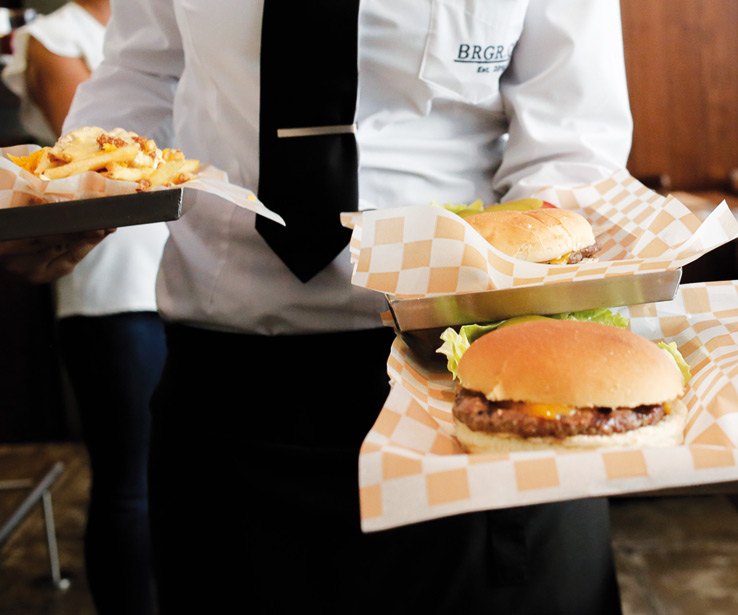
“We are not just a counter hamburger restaurant. We are a gourmet hamburger restaurant. That’s our niche.” With these words, Nadim Hammoud, chief executive of Par Contre, the founding company of Brgr. Co, summarizes the philosophy behind a burger joint that has been one of the country’s most successful since its 2010 launch in Ashrafieh.
Three years on, Brgr. Co now has two venues in Lebanon — the first in Ashrafieh was an investment of $500,000 and the second in downtown cost Par Contre $750,000 — one in London and a catering line that is busy all summer long. Revenues have tripled, says Hammoud, and are now close to $2 million. Par Contre has no plans to slow down and is expanding Brgr. Co locally and internationally, as well as branching into different culinary concepts, such as the soon to be launched Pzza Co, a $700,000 Italian restaurant concept that will turn its oven on in the Beirut Souks in October. Par Contre will also be launching their new 400 square meter (sqm) central kitchen in the area over their downtown venue, into which they invested $600,000.
Burgers are not new to Lebanon and many have childhood memories of the country’s first national burger joints which opened in the 1970s and 1980s, including Winners or Juicy Burger. In the 1990s came the advent of fast food, with Burger King and McDonalds setting up shop in Lebanon.
Such burger joints, and the success they met, established the foundations for future burger ventures in Lebanon. Starting in 2010, more than five ‘burger only’ diners opened up within a two year framework. Riding that burger wave was Brgr. Co. According to Hammoud, people are becoming more conscious of what they eat and are demanding traceability — to be able to track their meals back to a clean and safe source — and better quality food, something he says Brgr. Co is able to provide in a meal not commonly associated with refined dining.

The company’s Dowtown Beirut branch is proving a success
Brgr. Co’s emphasis on quality is also illustrated by their collaborators: Hussein Hadid, a well-known Lebanese private chef with 20 years of culinary experience in New York and 15 in Lebanon developing his own catering line and kitchen, is one of the partners in Par Contre and the creator of Brgr. Co’s signature burgers. “Hussein’s name is a seal of quality for our venues,” says Hammoud.
Other key figures that Brgr. Co has worked with include the architect behind their warm and classic décor, Gregory Gatserelia, an interior designer who has worked on Nikki Beach resorts around the world, as well as Cocteau and Balthus restaurants in Lebanon, and Maya Karanouh’s branding agency TAGbrands. “This is Brgr Co: all of the elements we use are quality and we are putting them all to work on the hamburger business. Probably, we’re the first globally to put this much emphasis and effort on a hamburger business and given it this much quality, elevating it like this.”
Quality does not come cheap, however. According to Hammoud the average bill at Brgr. Co is $20, which he says is “very affordable.” The bill can easily grow however, beyond the basic options, and online user reviews place the average cost for a burger and fries at no less than $30, which they generally agree is a little overpriced, despite it being a good burger.

The company imports its meat from Australia
When it comes to quality, Hammoud explains that Brgr. Co’s patty options are three different cuts of Australian Black Angus beef, generally accepted as the best beef on the market. They are offered in 8 ounce, 6 ounce, and 4 ounce sizes, the latter, which costs LL11,500 ($7.70), being the most in line with prices elsewhere on the burger market in Lebanon. “People will give you the same price [for the 4 oz burger] but not with Black Angus beef which we have. So, if you look at value you are getting, you are getting better quality at the same price,” rationalizes Hammoud.
If one goes for the 8 oz or 6 oz cuts, or tries one of Hadid’s signature burgers and adds appetizers, and extras such as fries or coleslaw, the cost begins to rise steeply, but
Hammoud maintains that their prices are reasonable for what they offer. “On some burgers we have very low margins as we are trying to respect the title of being a hamburger place, but at the end of the day when you come here and taste our burgers, you feel the quality and this costs money,” says Hammoud, explaining that while lower margins may not be financially sound, they hope to hook customers and thereby increase their visits.
With an average turnover of 400 to 500 customers per day on a weekend and 250 covers on a regular day in their Beirut Souks venue, Brgr. Co seems to be doing well despite the price tag.
Selling ice to the eskimos
Brgr. Co will be launching three new venues in Lebanon within the next three years, with one of them set to open in ABC Verdun upon its launch in the year 2015, according to Hammoud. Internationally, Brgr. Co London’s Soho branch — which opened as a franchise in December 2012 and seats 55 — is performing solidly, with around 300 to 400 covers per day. “Our London venue is as big as Ashrafieh’s but performing as well as Solidere’s, as the volume of people in London is different from Beirut,” says Hammoud, adding that the response for Brgr. Co London has been positive and that sales are growing. He is looking forward to their Chelsea branch which will be opening soon and will seat 100. Hammoud attributes their success in London to the high quality provided in everything from the décor, to the waiting staff’s crisp white uniforms, to the meat which comes from the Buckler Estate in Scotland. Brgr. Co London follows the typical franchise model of territory fees and a percentage of net revenues and is in strict coordination with Par Contre, which provides all recipes and implementation training according to set manuals.
Brgr. Co also has plans to open in Manhattan, New York, “the land of hamburgers” says Hammoud. While he realizes that New York is going to be a big challenge for them, Hammoud believes that, judging by the performance in London, chef Hadid has the ability to take Brgr. Co there. Hammoud explains that the New York expansion will be a franchise fully funded and owned by one of Par Contre’s board members in Beirut who will be funding all of the company’s growth in the United States.
This westward expansion is unusual for a Lebanese restaurateur and Hammoud sees it as adding value to their brand through perceived success in cosmopolitan cities that already have a thriving and competitive market for gourmet burgers. However, their next move might see Brgr. Co coming back to the Middle East. One of Par Contre’s partners is seriously contemplating an expansion in Dubai, a more natural “next step” for restaurants expanding from Lebanon.
“Par Contre is funded and overseen by a board of directors or partners who have the means and the power to see the company grow and go global,” Hammoud says. The board is made up of Hammoud, Hadid and three silent partners. Par Contre follows a ‘sweat equity’ model in which each of the partners owns 20 percent of the company but only the three silent partners invest capital in it — Hammoud and Hadid’s contribution is their hard work and ‘sweat’. Par Contre invested $3.5 million total, with $1.5 million coming from a subsidized loan from the central bank.
Par Contre, and its main business Brgr. Co, are still laying the foundations for success and heavily investing in their growth, explains Hammoud when asked about the return on investment which he says will be slow and not before the next five years. “It takes time to build quality and that is why the board is being patient. They are not looking for the quick buck,” says Hammoud.
Correction: A previous version of this article erroneously referred to sweat equity as “Swot equity”. The text has been changed to properly identify Par Contre’s business ownership model and more clearly explain the concept of sweat equity.
