
Discussing Lebanon’s ‘backward state’ makes for
interesting conversation. And while pointing fingers
at the government is not altogether unfounded,
it is, well, typically Lebanese. It’s also ineffective. The
country would gain much more if civil society participated
in its development.
To be fair, a lot of people invest time and money in a number
of social and humanitarian endeavors. Lebanon has many
active non-governmental organizations (NGOs). “More
than 60% of schools and hospitals belong to philanthropic
institutions,” says Abdul Hafiz Elladki, general director of
the Dr. Mohammed Khaled Social Foundations. “And
100% of the orphanages and clinics for the handicapped
belong to NGOs.”

Traditionally NGOs are meant to cover a gap of 20% to
25% of what the government provides and what the people
need. “But the government provides about 5% to 10% of the
need, and we must cover the remaining 90%,” says Elladki. He adds that because of the economic crisis “the number
of people needing our help increased.”
International donors, such as UNDP and USAID, give a
lot of money to NGOs. However, civil society should play
a role in development. Caritas, which is 90% funded by its
European counterparts,
has seen its
funding cut now that
the war is over. Caritas
Europe is encouraging
the organization
to involve the
local community.
What role does the
business community
play? Since the country’s
tax system doesn’t
give incentives to
encourage people to
donate, they must be
morally driven. “70%
of our income is from
donations from the
private sector,” says
Elladki. The Dr.
Mohammed Khaled
Social Foundations
cares for 550 orphans,
has an illiteracy and technical training
program and a medical rehabilitation center caring for the handicapped.
Its annual operational budget is about $5 million.
Many people are skeptical about donating money to NGOs.
How can one be sure that donations aren’t misappropriated?
NGOs that are transparent will benefit. Many reputable ones
are doing good work at either local or national levels.
On the road less traveled
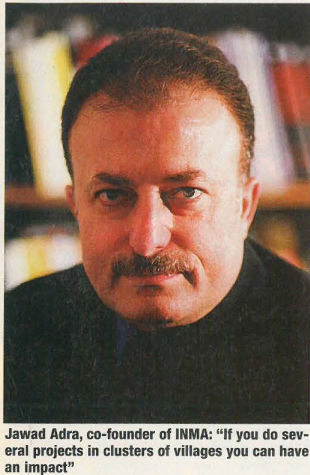
Jawad Adra is an entrepreneur who left Lebanon in 1972
to pursue a career in Saudi Arabia as an executive for a
major contracting firm. After a 22-year absence, he relocated
to Lebanon and established a research firm, Information
International, with Zeina Akar. The two were eventually married.
What Adra didn’t anticipate was the identity crisis for
“having not lived through the war”. The experience proved
a turning point in his life.
“We say we are proud to be Lebanese,” says Adra. “If we
all like this country, why is so much going wrong with it?” Adra
saw three alternatives: join the system, become isolated from
society or emigrate. “I believe we have a bad system,” says
Adra. “It needs to be overhauled, totally restructured.”
Finding solutions to Lebanon’s problems would require
taking a different course, albeit a less traveled one. Adra
believes that advancement is achievable through “a slow,
determined and consistent change in society and in the values
of people**.** It’s a very long road.” Together they established
INMA Social and Cultural Development Association, which
administers community development projects in Koura.
In its first 18 months, the projects were funded entirely by
Adra’s research firm. The first was a public library in Kefraya
, Adra’s hometown. Other projects include a computer training
center and a health clinic. INMA has also planted 5,000
trees in Koura. “We have discovered that if you do several projects
in clusters of villages you can have an impact,” says Adra.
They eventually decided to solicit donors. But, to remain
independent and politically unaffiliated, they applied to
international agencies. USAID gave a $46,000 grant for a
medical laboratory and three computers. The Japanese
embassy gave $30,000 for a dental clinic. The Canadian
embassy gave two $30,000 grants for agro-industry projects.
Adra’s research firm still subsidizes INMA for about $2,000
a month. The couple balks at the suggestion that they
should stop putting money into the NGO. “If you are spending $2,000 to help communities, why not?” says Zeina.
