
As a new millennium dawns,
ancient remedies are back in fashion
in Lebanon. For centuries,
herbal remedies were used to treat illnesses,
prescribed by the village aatar, purveyor
of herbs, who learned his expertise
from his father and village elders.
“Prescribed medicines are good for a
short time to solve a problem, but when
used for too long they often have bad side
effects. Now there’s a trend towards using
herbs and natural remedies instead,” says
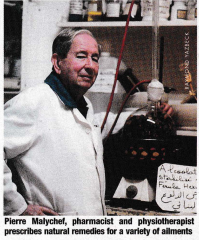
pharmacist and physiotherapist Pierre
Malychef, who has been in the herbal
business for 52 years.
There are 7,000 varieties of herbs in
Lebanon, 400 of which can be used for
medicinal purposes. “Lebanon is a land that
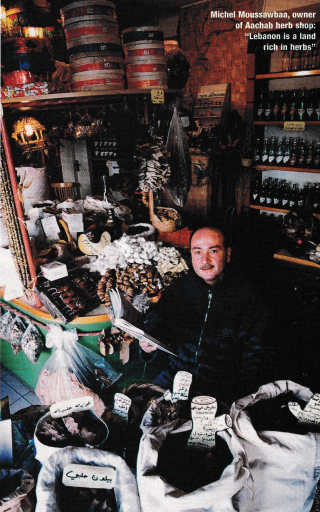
is rich in herbs,” says Michel Moussawbaa,
who owns Aachab herb shop with his
brother George. He comes from a long
line of aatars and supplements the wisdom
of his ancestors by studying books on
herbs and plants.
Moussawbaa maintains that from the time
he seriously began studying herbs 17
years ago, he has never taken any pharmaceutical
medication and has relied fully
on herbs. However, he and Malychef both
caution that when someone’s health is in
serious danger, antibiotics or appropriate
medications cannot be ignored.
Malychef says that he healed his arteriosclerosis
(hardening of the arteries)
with herbs five years ago. Though he was
scheduled for open-heart surgery, a friend
from the Japanese embassy urged him to
wait. “After six days he brought me a box
of ginkgo leaves, commonly used in
China and Japan,” says Malychef. Along
with a ginkgo tincture, he prepared drops of horse chestnut, which is good for the veins and vascular system,
and horsetail plant, which is known as a diuretic. “I rid my body
of the arterial plaque which was hardening my arteries, without any
operation,” says Malychef. He now continues to take drops of ginkgo
tincture, which also helps his memory.
When I arrived at El Saha! Pharmacy in Jal-el-Dib, Malychef was
preparing a distillation of aloe vera. He explained that a local doctor
prescribes the extract for skin cancer and leukemia.
If a healthier lifestyle and weight loss are on your list of New Year’s resolutions, you may want to consider tea made from fennel seeds, similar to anise used for
yansoun tea. It is good for digestion,
gas problems and an upset stomach.
Moussawbaa recommends green sana
leaves, which resemble olive tree
leaves, as a way of ridding the system
of second-hand ingestion of cortisone
from livestock and poultry that have
been plumped up with steroids. Need
to lower your cholesterol level after too
much holiday overeating? Moussawbaa
suggests a tablespoon of cider
vinegar mixed with a cup of water,
morning and evening after a meal. He
says that in one week, this regimen can
reduce one’s cholesterol level by 50
mg, in two weeks by 150 mg, and by
300 mg in four weeks. “But you need
the proper diet to keep the cholesterol
down,” he adds.
Malychef swears by the African
gougoulan plant taken with soy oil to reduce cholesterol levels and
salmon oil to reduce the blood levels of triglycerides, which, like
cholesterol, are related to heart disease.
Part of Moussawbaa’s daily regimen is a tincture of the seeds of kourrass,
a green-leafed plant that grows between lemon trees, added to
tea steeped from tilleul leaves. Tilleul is thought to be good for the
heart, blood pressure and circulation. Kourrass is good for the health
of the prostate and pancreas; it contains iron and calcium and can be
used for treating diabetes. He also claims that if a man has a low sperm
count, his mixture of kourrass seeds and honey will increase the count in two months.
There’s a price to be
paid for the stress-filled
era we are living
in. According to
Malychef, 90% of all
medicines prescribed
now are for nervous
illnesses, ranging
from stress and anxiety
to depression and
memory loss. The tendency
today is to use plants to treat the nervous system. For example, Valerian roots and passionflower
leaves are good for stress, nervousness and insomnia. In
his lab in the back room of his pharmacy, Malychef makes an
extract of St. John’s Wort, which is recommended for depression and
fatigue. “In America, this herb has become so popular that it’s
called ‘the natural Prozac,'” he says. Whether your stress is caused
by too much work or getting stuck in traffic, an infusion of tilleul
leaves, rosemary and chamomile flowers helps relax the nerves and
relieve insomnia, according to Moussawbaa. For headaches and muscular
pain relief, Malychef suggests meadowsweet and white willow
leaves, both rich in salicylate, from
which aspirin is derived.
Because of poor eating habits and exposure
to pollution, Malychef says it’s
important to renew the body’s resistance
to the elements, and ginseng is an
important plant for this purpose. Advocates
of ginseng say it enhances the
immune system, physical stamina and
memory and minimizes the ravages of
stress, aging, radiation and alcohol.
If baldness seems to be your fate in life,
it may be interesting to know that 60% of
the world’s population experiences hair
loss. That includes women. Malychef
says baldness is a modern malady that
was less common in earlier civilizations
and attributes it to a number of factors including pollution, stress and previous illnesses. Malychef claims to have developed a lotion to help halt a receding
hairline. The rubbing lotion includes cirecia, ginkgo, ground ivy and
lavender. Typical for a man his age, Malychef began losing hair two
years ago. After using his treatment, he says that small gray hairs began
appearing in the bald area, many of them later turning blond. “The
quality of these new hairs is even healthier than the other areas of my
head,” he says.
On the subject of outward appearances, Malychef’s repertoire
includes an acne solution, creams for ridding the skin of brown spots
and those thin, red blood vessels that appear on the face. For aging skin,
he has an ointment prepared with ginkgo leaves, which is the same
ingredient used in one of Elizabeth Arden’s night creams. And for dry
skin, Malychef has a preparation made from chestnut extract that also
offers UV protection.
At Aachab, there are a number of homemade skin preparations available
as well that contain chunks of earth from a location in Syria. Mix
the dried mud into a paste for a skin masque to clear up acne and rid
the skin of impurities. “Here, take this,” he says, giving me a small
bag of what looked like tubes of cork. “It’s conditioner for your hair.”
I followed his easy directions at home, and sure enough, the result was
softer, fuller hair. And I have my own health tip to add: After reading
in St. Hildegard’s manual about the benefits of myrrh for dental care,
I ground some of the myrrh “pebbles” I bought at Aachab and discovered
a great tooth-cleansing powder.
