
The first few days of February are probably not
a time finance minister George Corm would like
to relive. Before his 2000 budget could be
passed through an unruly parliament, Corm
was the target of three sessions of scathing
attacks. With some of the nastiest remarks
struck from the record, Corm was accused of
hallucinating and his policies called failures. The
“Cormic genius” was blamed for slowing economic
growth, increasing unemployment and
precipitating the brain drain.
By Peter Willems and Kirsten Vance
But were these accusations fair? EXECUTIVE spoke with the
finance minister, analysts and economists to discuss the
issues. “It doesn’t matter if the budget deficit comes in a little
above or below the target. It’s still way too high. There’s no reason
to rejoice,” says Nassib Ghobril, an analyst at Lebanon Invest.
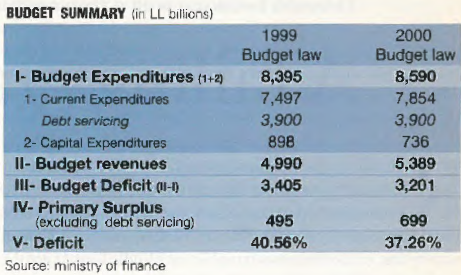
Within the 2000 budget, the deficit is targeted at 37%. Last year the
government aimed for the budget deficit to be reduced to 40% and beat
it by hitting 38%. (The government also beat its total deficit expectations
of 44%, coming out with 42%.) “The target this year is still
high, which means they will most likely meet it,” says Ghobril.
Why didn’t the budget come out with a lower target? “On the
expenditure side in 1999, we were able to cut heavily on a lot of allocations,”
says Corm. “This year, knowing that we have had a social
crisis over eight or nine years, we increased allocations for education,
social services and health services sharply. With this we have
only a 37% budget deficit.”
By speculating if the government will hit its target this year, one
has to first look at the revenue side. The government’s plan to bring
in $3.57 billion (an 8% increase compared to last year) was based on
a GDP growth rate of 1.8%. “We know that economic growth was
practically zero in 1999, and what we expect for this year is not any
better,” says economist Elie Yachoui. He may not be far off.
According to The Economist Intelligence Unit’s (EIU) first-quarter
report on Lebanon, the GDP growth rate is forecast at 0.5% for 2000.
Not so, says Corm. “It’s impossible to calculate
the growth rate in Lebanon. Anybody
who says ‘I can calculate it’ is a charlatan. I
will not believe in any growth rate. I have
published the estimates of the IMF that
spent three weeks here in June, and they
know Lebanon. They are specialized in this
country, and they said 2% last year.”
More
specifically, the minister pointed out that
there is no link between economic growth
and tax receipts in Lebanon for now. The tax
system concentrates on the productive sector,
“which is highly concentrated on a few large
taxpayers. The tax system is not diversified.”
An improvement in tax collection, even
with a low growth rate, would have a greater
impact on increasing revenues than strong
economic growth alone, Corm argues.
That leads to another sore point. Freddie
Baz, the advisor to the chairman at Banque
Audi, stresses several important paths that the
government must follow to bring down the
deficit. One is improving tax collection,
instead of raising taxes in a recessionary
environment. It has been estimated that there
is a 70% tax evasion rate. “When I feel that my
tax administration is behaving well for taxpayers, and the taxpayers continue to evade
us by under-reporting profits, then I will take
measures,” says Corm. “But there is corruption
with tax officials; it’s very well known.
I’m moving forward. I’ve taken measures
against four people. But in this country,
progress has to be incremental unless you go
to a military dictatorship, a Pinochet of some
kind, which I’m not a part of.”
Getting tax collectors in line is essential. But
some think that enforcing tax collection is just
as important. “All taxpayers must be equal
in front of the law. We have an army. We have
internal security forces. We can turn to them
to increase collection,” says Yachoui.
Even though improving tax collection
is a slow mover, tax reform is on the cards for
2000, including taxing properties built illegally
on the coast and a turnover-based tax on
corporations. Also to come around in 2001 is
the introduction of VAT, designed to bring in
the sharpest rise in overall tax revenues and
allow the government to reduce customs.
Several economists argue that there is not
enough transparency in Lebanon for VAT to
be effective. “The international experience is that it induces people to become more transparent, especially those
who invest,” says Corm.
There are complaints about the government’s slow pace in privatizing
state enterprises. Some argue that speed is of the essence in order to
take a bite out of the debt. “There are two ways to privatize: Either you
do it the Russian way – selling to the mafia – which our government
won’t do, or we do it according to the best practice,” says Corm. “A
lot of progress has been made. There is the law that has been finished.
It should be approved by the parliament within the next two months.
It took ten years for privatization to be completed in Morocco.”
Privatization should generate between $4 billion and $5 billion by the
end of 2003. But according to Yachoui, if that’s broken down to $1.25
billion between 2000 and 2003, and debt servicing continues at $2.5
billion annually, privatization will not even cover debt servicing, which
devours 45% of government expenditures.
Yachoui stresses that privatization
is not nearly as important as changing the government’s monetary
policy. He believes that because the monetary policy is too tight,
interest rates are too high. If interest rates were reduced, that would help
relieve debt servicing and increase liquidity in the market. Corm also
sees the importance of loosening up the monetary policy.
Also on the side of expenditures, public sector wages account for
33% of expenditures. According to one report, the government has
up to 60,000 redundant employees. The general consensus is that the
bloated public sector must be trimmed, and better now than later. But
Corm argues that reducing staff is a misconception and is not on the
government’s agenda. “The 33% includes the army and those on pensions
who are not active in service. If you reduce the number of civil
servants, they will soon be on a pension. So the impact in terms of
saving on the budget is nil. There’s a lot of talk about this issue, but
it’s told by people who don’t know what they’re talking about.”
But don’t forget: This year’s budget is only one part of the five-year
plan. The government’s objective is to reduce the budget deficit from
11% to 4.5% of GDP and the debt from 130% to 96.3% of GDP, along
with reaching an annual economic growth rate of 5% by 2003. “It’s
a good budget,” says Baz, “but it won’t be a speedy way to reach the
final objective. To reach the final objective in a short period of time,
this is not the way.”

