
Devaluation. Is it a dirty word? These
days you can find doomsayers on
what will happen to the Lebanese
pound – but they don’t want to get
caught on what they say. “I believe that
devaluation is inevitable,” says one analyst,
“but don’t quote me on that.” Hiding
behind reports, graphs and charts, they say
the topic is ”too sensitive,” or, as one economist
says, “I’ll be blamed for the fall; I’ll be
seen as the catalyst if the pound drops.”
B ut it’s not only the fatalists that have kept a tight lid on
things. The central bank won’t reveal how much it intervenes
to keep the pound stable, and the total amount of net
reserves is always in safe storage. It’s as though the best thing to
do is to keep quiet about what might happen to the pound and any
danger will vanish.
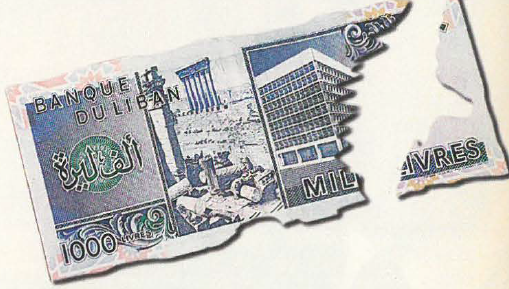
But warning signals have been coming from abroad. In Merrill
Lynch’s latest report on Lebanon’s debt instruments, it states clearly
that the risk of local currency plummeting next year is real. ”The
country has reached the point that if steps aren’t taken right away,
the debt will get so high that it will be impossible to control,” says
Eric Lindenbaum, vice president of the emerging market fixed
income research department at Merrill Lynch. Merrill Lynch has recommended
avoiding eurobonds and holding T-bills only through
maturity in the first quarter of200 l. And it’s not the only foreign institution
showing lack of faith in Lebanon’s future. BNP Paribas has
said flat out to stay clear of investing in Lebanese debt altogether.
In September, Standard & Poor’s downgraded the country’s sovereign
debt and Moody’s put Lebanon on credit watch.
Up to now fiscal imbalances have been out on the loose. The government’s
deficit target at the end of the year – 37% – will be
missed by a long shot, while the gross public debt at the end of August
reached $23.7 billion (see graphs). “Lebanon is caught in a vicious
circle,” says Lindenbaum. ”There is hardly any growth while the debt
keeps on climbing.” According to Banque Audi, at the end of the third
quarter debt to GDP hit 142%. Audi also estimates that the economy
contracted by 0.5% in the first half of 2000.
On top of the fiscal fiasco, worries have been amplifying, putting
significant pressure on the pound. Even though strife between
Palestinians and Israelis sent ripples across the Middle East, most of
the uncertainties have been homegrown. Some believe that Rafic
Hariri could save the day, but the delay in appointing him prime minister created uncertainty.
And for many his image as savior is wearing off. While trying to rebuild the country during his first term,
he was the one who created a pile of debt. His plans are also vague:
No platform was presented during or after the elections. “There is
more confidence in Hariri than the previous government, but I recommend
caution,” says Lindenbaum. “He raised the debt and is now
in a very different situation. He can’t spend his way out of it.”
Analysts estimate that during the month and a half following the
elections, the central bank dished out an average of $150 million
per week to meet demand for foreign currency. That adds up to about
$1 billion. ”That’s a lot of pressure on the pound,” says Habib
Haddad, head of treasury at Beirut Riyad Bank. Most believe that
the motive behind the government issuing the last two eurobonds
was to help shore up reserves. ”That’s no solution,” says Tony
Hchaime, financial analyst at Arab Finance Corporation. “It’s
adding water to a bucket that has a leak.”
On the upside, solutions are clear and simple. Analysts are adamant
that the economy needs a kick-start, which will increase revenues for
the government to balance its budget and lower the debt. ”The government’s
main objective in the last two years was to decrease the debt
as much as possible. But as they concentrated on that – and failed
they also killed the economy,” argues Hchaime. ”We’re in a recession
and we have to get out of it. We have to concentrate on reviving the
economy, using the proceeds from the revival to reduce the debt.” An
attempt can be made without increasing government spending. The
initial step is to sell licenses to the two mobile phone operators,
LibanCell and Cellis, followed by selling another to a third operator.
Privatizing state assets – something that has been talked about for the
last two years but hasn’t been implemented- is another must, especially
the telecom. Not only would these actions bring in billions of
dollars in debt relief, but they would also generate confidence here and
abroad. ”There would be a positive reaction on the markets that would
allow interest rates to drop,” says Marwan Barakat, head of Audi’s
research department. With interest rates heading south and investments
coming in again, the economy would show signs of recovery.

The government has the tools it can use to disprove analysts expecting the worst-case scenario for this
country’s currency. But will the government
grab those tools and use them?
“There has not been any political will,”
says analyst Philip Khoury, ex-vice
president in the emerging markets equity
research department at Merrill Lynch .
“In the last two years the government talked about action, but there was no action on the ground. They agreed on
problems but never discussed solutions.”
The fate of the Lebanese pound
now depends on the new government to act. “Unless the government
takes drastic measures soon, it won’t be a question on if devaluation
will happen,” says Khoury. “It will only be a question of when.”
