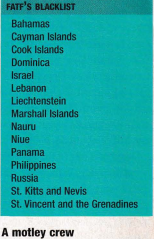
Most people in the financial community believe it’s unlikely. What scares legitimate foreign investors from doing business in Lebanon is also likely to discourage criminals: unfamiliarity with the country as well as political and economic uncertainty. “A big cheese in Russia would go to the Cayman Islands or the Bahamas rather than Lebanon,” says one banker.
The consistent balance of payments and the size of the deposits do not indicate that major money laundering transactions occur here, and, according to the central bank, there have only been three international money laundering inquiries in the last seven years. But that misses the point. FATF’s grudge with Lebanon is not over whether it is a money laundering hub, but rather its lack of cooperation in combating the flow of dirty money around the world. Lebanon had better listen up or it runs the risk of losing its credibility within the international financial community.
Soon after the FATF report was issued, the US Treasury Department’s Financial Crimes Enforcement Network sent out a warning to US banks to exercise increased scrutiny over transactions involving Lebanon. The country’s banking secrecy law is also a concern. An account holder’s identity nonetheless remains anonymous, except in the event of death or bankruptcy.
The prospect of lifting Lebanon’s banking secrecy law is greeted with scorn from most within the financial community, many of whom regard it to be a sacred covenant. “Banking secrecy protects customers from abuse of power by the state,” says Makram Sader, president of the Association of Banks. A businessman adds: “Banking secrecy is one of the last good things in this country. Take it away and it would be a pity.”
But abolishing the law will probably not be necessary. Austria and Switzerland have been able to avoid the FATF blacklist by simply modifying their own secrecy laws. Since Switzerland passed a new law in 1998, the number of questionable transactions reported to Swiss authorities increased from 30 in 1998 to 370 so far this year.
What’s more, some feel that Lebanon’s banking secrecy law has become obsolete and irrelevant. It was created in 1956 as a way of attracting Arab customers who liked their financial dealings to remain private and were distrustful of Western institutions. But today a Saudi prince wouldn’t think twice about putting his money in a German bank, and, closer to home, Bahrain has a thriving banking sector without a secrecy law.
“Banking secrecy is not the only factor that attracts clients and funds to a bank,” says Nassib Ghobril, assistant manager of Lebanon Invest. Banks are more likely to win customers with their products and services than by protecting an account holder’s identity.
Lebanon might hold on to its banking secrecy law for a while, but without changes, not forever.