• Donate
  • Our Purpose
  • Contact Us
Executive Magazine
  • ISSUES
    • Current Issue
    • Past issues
  • BUSINESS
  • ECONOMICS & POLICY
  • OPINION
  • SPECIAL REPORTS
  • EXECUTIVE TALKS
  • MOVEMENTS
    • Change the image
    • Cannes lions
    • Transparency & accountability
    • ECONOMIC ROADMAP
    • Say No to Corruption
    • The Lebanon media development initiative
    • LPSN Policy Asks
    • Advocating the preservation of deposits
  • JOIN US
    • Join our movement
    • Attend our events
    • Receive updates
    • Connect with us
  • DONATE
Entrepreneurship

Outside of the Silicon Valley bubble

by Matt Nash August 29, 2017
written by Matt Nash

In the sweltering July heat, entrepreneurs from around the world were in Beirut pitching to join the Endeavor network. Founded in 1997 as a non-profit support network for entrepreneurs (focused on Argentina and Chile), Endeavor is now assisting founders of young companies in 27 countries around the world (including Lebanon since 2011). In 2012, the non-profit adjusted its model by raising investment funds to co-invest in its entrepreneurs alongside lead investors. Executive sat down with Endeavor CEO and Co-founder Linda Rottenberg to discuss the state of global entrepreneurship.

E   Earlier this year, Amazon bought the Saudi-based e-commerce platform Souq.com. Souq had previously raised a finance round, pushing its valuation past the $1 billion mark, and earning it the moniker “unicorn.” The woman who first used this term found 39 unicorns born between 2003 and 2013. In the four years since, there are more than 200, depending on which lists you look at. Are you worried there’s a bubble inflating here?

The problems in Silicon Valley are different than what we see around the world. In Silicon Valley, the valuations got too high. You have [venture capitalists] getting lazy and all fighting for the same deals, and you have people trying to build unicorn companies. And if you’re trying to build a unicorn company, you’re not building a unicorn company. What I see outside the US is amazing talent; still actually low valuations. If anything the entrepreneurs need more equity. We see the capitalization tables are a real problem, where investors are taking way too much equity. The more competition from funds the better, because it will be more entrepreneur-friendly. [Also, outside the US], we’re now seeing serial entrepreneurs who’ve had experience, we’re seeing this c-suite level talent that we didn’t have, and we’re seeing access to markets where you can actually create a multi-country company that is global in nature from the get-go. I believe that going forward, that’s going to become a huge advantage. So I’m really bullish on entrepreneurship outside of the US. So they’re the ones at risk of a bubble [in Silicon Valley], whereas I don’t think we’ve even been able to scratch the surface of the talent-to-capital efficiency here.

E   In the markets you’re involved in around the world, to what extent do you see people simply trying to adapt a successful model to a local/regional market?

First, I do think that these adaptations, the tropicalization of US models, make sense to some extent. Where you don’t have the capital market efficiencies, one potential exit down the road is to have these US companies [buy their local versions].

E   True, but that isn’t a very sustainable model.

Exactly, you have to start somewhere, but we’re seeing two other things. The second thing we’re seeing is some local innovation starting outside the US. I think this is going to happen more and more. I have long had a theory, outside the US, mobile technology is used for everything. Inside the US, it’s still a nice add-on, but people don’t use it for everything. So I actually believe mobile applications are going to be first-generation innovations outside the US and carry over. We’ll see.

Third, what we’re seeing [outside the US], is the opposite of ‘I want to build a unicorn.’ I see, ‘I’m solving a pain point, and I’m using technology to do something that used to be more traditional or family-based, and actually create something that’s more innovative and more scalable.’ So we’re seeing a lot of tech-enabled, rather than tech-centric, businesses in [agricultural technology] in health-tech, [education technology], food-tech. So taking what used to be more traditional industries, and modernizing, creating a layer of innovation. But it’s not just an app, it creates better lives for people at the base of the pyramid or the middle of the pyramid, because they’re closing gaps.

E   You talk about impact a lot on Endeavor’s website. What do you mean by that?

We’re not impact investors, but we’re about high-impact, which for us is also about this growth and the ecosystem multiplier effect [where entrepreneurs give back to the ecosystem by supporting, mentoring, or even investing in younger ecosystem companies]. What I’ve seen around the world is sometimes what people call “impact” investing; they mean there’s trade-offs between growth and the social impact. We at Endeavor don’t believe that. We believe that if you want to achieve high-quality jobs and improve things, you have to scale. What we’re looking at is the entrepreneurs who – rather than seeing everything as a trade-off between investing in the business and achieving the social mission – have to achieve the growth first if they want to improve things. [One of the companies in our network] is training more engineers than any university in Latin America. So even the companies you wouldn’t define as “impact” understand that you can’t build world-class companies in failed societies, and they have a responsibility in their communities to create the best employment.

E   Do you have a set criteria to define what impact companies in your network must demonstrate?

[We don’t have rigid criteria], but what we say to high-growth entrepreneurs and high-impact entrepreneurs is that you can’t check your values at the door. It’s not good enough to create a profitable business that’s good for your investors. If you’re not creating a culture that’s good for employees, if you’re not caring about your customers, if you’re not caring about the people in your communities, eventually it is going to come home to roost, so it all starts with the DNA and the values you instill in your company.

E   Do you see sexism, sexual harassment, and sexual assault as a problem in the global entrepreneurship scene?

We’re seeing marked improvement. About 20 percent [of companies in the Endeavor network are] run or co-run by women, compared to the US, where only around 8 percent of venture-backed companies are run by women. The women in our network are running companies that are incredibly high-impact. We need to tell stories of women that are not micro-credit, but are these high-impact, high-growth companies to inspire others. You need the role-model effect, which is what Endeavor is after.

August 29, 2017 0 comments
0 FacebookTwitterPinterestEmail
CommentEconomics & PolicyOil and gas

The oil & gas waiting game

by Mona Sukkarieh August 28, 2017
written by Mona Sukkarieh

On June 22, Israel’s energy ministry announced that the deadline to place bids in the country’s first offshore licensing round would be pushed back until November 2017. This is the second time the bid round, which opened in November 2016, saw its end date postponed.

With the second extension, it became harder to believe the Israeli energy ministry’s repeated claims that the decision was motivated by an outpouring of interest from international companies and the need to provide them with more time to prepare their bids. A few companies appear to be interested, notably Italy’s Edison and Greece’s Energean, in addition, it seems, to Indian companies, as reported by the Israeli media after a meeting between Yuval Steinitz, Israel’s energy minister and India’s Minister of State for Petroleum and Natural Gas Dharmendra Pradhan, on the sidelines of the 22nd World Petroleum Congress in Istanbul on July 12.

This is in stark contrast with Cyprus’ most recent licensing round, which closed in July 2016 and attracted interest from some of the largest international oil and gas companies, including bids from Italy’s Eni, France’s Total, Norway’s Statoil, and America’s ExxonMobil with partner Qatar Petroleum. This interest is no doubt owed to the “Zohr effect.” The 2015 discovery in Egyptian waters of the largest gas field yet found in the Eastern Mediterranean, dubbed “Zohr” by Eni, has revived interest for exploration in the region. A combination of factors, including location, stability, and regulatory certainty, put Cyprus at the forefront of East Med countries that could benefit from this renewed interest.

Choppy waters

Israeli authorities were hoping that the discovery of Zohr, in addition to the resolution of local anti-trust issues that had hobbled the sector for more than a year, would encourage companies to take part in the first offshore licensing round. But it looks like companies’ interest in the tender was below expectations, prompting a second extension of the deadline to place bids. They hope that this latest four-month extension will change that. We will know more in November, provided the tender is not postponed again.

Lebanon is also currently holding its first offshore licensing round. Over 50 companies qualified for the tender, which will close on September 15. Authorities here are also banking on the “Zohr effect” but might end up attracting an interest that is, in this case as well, below their declared expectations.

That is because companies have not entirely recovered their appetite for offshore exploration yet. Although some of the factors that have contributed to temper international companies’ interest in Israel’s bid round are country specific (regulatory hurdles, a certain apprehension to invest in a country that could impact their activities elsewhere in the region, etc.), others are common to both Israel and Lebanon (global market conditions and difficulties monetizing discoveries).

In a previous article, published in February 2017 after Lebanon announced a new roadmap for the first licensing round, Executive signaled that future interest will depend on two things: global market conditions, and what we offer investors. There isn’t much we can do to affect the first, but there are some things we can do to attract investors — finalize our legal and regulatory framework, offer a competitive fiscal regime, and actively and aggressively promote our energy potential where it matters.

We have yet to finalize our legal framework and adopt the petroleum tax law. And, although the Parliament might adopt it before the bids are due, we are already several months late. It is true we can proceed with the tender through the legislation already in place, but authorities have insisted for years that a new tax law applicable to petroleum activities is in the works; failing to follow through sends the wrong signal. Besides the inadequacy of launching a tender under one set of legislation and completing it with another set, it confirms high-level decision making vis-a-vis Lebanon’s oil and gas sector moves at a slow and erratic pace. This is a risk companies are aware of, but which authorities have yet to fully consider and attempt to mitigate.

Hopeful horizons

On the marketing front, the strategy to promote the tender appears to be more confident than aggressive, relying on the availability of an extensive set of seismic data, which is hoped to de-risk investments. The focus on seismic data, while reasonable, ignores that there are a multitude of other types of risks that may discourage foreign companies.

Furthermore, we took a risk by modifying the blocks on offer, which might affect some companies’ interest in the bid round. Lebanon launched the tender back in 2013 with blocks 1, 4, 5, 6, and 9 open for bid, yet will be completing the round (hopefully on time) with another set of blocks (1, 4, 8, 9, and 10) on offer, mirroring the uncertainties we have seen with the legal framework governing the tender. Not only did this change confuse companies in their preparations (some allegedly gave up after the alteration), but, in a surprising move, four out of the five blocks picked for the auction include areas, of various sizes, that are disputed by neighboring countries (one in the north and three in the south).

Still, authorities appear to be confident that at least two or three operators, out of the 13 operators that pre-qualified for the tender, will be placing bids, including, it seems, India’s ONGC, according to a tweet posted by Minister Pradhan, on July 10, following his meeting with Energy and Water Minister Cesar Abou Khalil at the same conference in Istanbul. If their hunch is confirmed, the tender will indeed be a success, especially as this is Lebanon’s first licensing round, and even more so if we take into consideration the unpredictability, repeated delays, and political deadlock the entire process has experienced. If interest is below expectations, Lebanese authorities and decision-makers must more seriously devise and implement a strategy for the second licensing round.

August 28, 2017 0 comments
0 FacebookTwitterPinterestEmail
CommentEconomics & Policy

Missed opportunities in Lebanon’s industrial sector

by Sami Atallah & Nancy Ezzeddine August 24, 2017
written by Sami Atallah & Nancy Ezzeddine

Lebanon’s productive sectors have been undermined since the end of the civil war in 1990. Like other marginalized sectors, the industrial sector has weakened, becoming a smaller proportion of the economy due in no small part to a history of missed development opportunities. To put this in perspective, the share of the industrial sector out of total GDP has decreased steadily from 24 percent  in 1997 to 14 percent in 2016.

Not unrelated to this, Lebanon continues to register the worst trade deficit in the region, primarily due to its dependency on imports and weak export channels. The trade deficit, $15.65 billion by December 2016, has recorded a 3.56 percent yearly increase (according to BLOMINVEST Bank figures). Exports have also fluctuated in recent years from $4.49 billion in 2008, up to $5.11 billion in 2012, and then down to $2.44 billion in 2015. Development in the industrial sector has been restricted by limited development in industrial policy, limited electricity coverage, and the high cost of production, as well as the effects stemming from the conflict in Syria. The latter has had a clear effect, reducing investments in the country and making exports more expensive by curtailing Lebanon’s sole land export route to the region.

Lebanon’s Product
Space 2000

Potential for sophistication

Despite this seemingly pessimistic picture, looking at microdata through product space mapping suggests that the situation has not been so dismal. Between 2000 and 2008, the Lebanese industrial sector managed to recover, with exports increasing of industrial products from $742 million in 2000 to $2.58 billion in 2008. This steady increase has been accompanied with an increased level of export sophistication, made clear by observing Lebanon’s improved position on the product space. The total number of exported products increased from 898 in 2000 to 978 in 2008. Equally importantly, comparing the distribution of these products, the number of core products increased by 21 percent (from 307 in 2000 to 370 in 2008), while the number of periphery products increased by only 3 percent (from 591 products in 2000 to 608 in 2008), reflecting an increase in the sophistication of Lebanese exports.

Lebanon’s Product
Space 2008

Most stark, however, is that 40 out of the 52 newly produced products in 2008 were a result of “long jumps.” Among these are ceramics, glass pigments, opacifiers, colors, and enamels (HS: 3207), shavers and hair clippers (HS: 8510), and base metal fittings for furniture, doors, and cars (HS: 8302). A long jump suggests that new items were produced despite the lack of prerequisite knowledge or capabilities, given data gathered from the existing export basket. Literature suggests that such phenomena are observed in countries that have undergone structural economic changes. In this respect, Lebanon presents an anomaly to the theory. Despite the absence of a government-led strategy to support industrial growth, the sector managed to improve its industrial standing by producing highly sophisticated products between 2000 and 2008.

Lebanon’s favorable demand shocks

To better understand export diversification in Lebanon, while taking into account highly sophisticated domains of production and an absence of a policy-driven structural change, the literature has attributed changes in sophistication levels in different countries to two key causes: A productivity shock or a demand shock. As Lebanese firms continue to suffer burdensome costs of production and a lack of adequate skills, the increase in Lebanese export sophistication has been largely driven by demand shocks, i.e. the discovery of new markets. The fact that local market capacity is small and saturated impels producers who are aspiring to expand and diversify their production to be outward looking. Lebanese firms, therefore, benefit from their experience, entrepreneurial skills, and connections with foreign markets to overcome demand uncertainties. From 2000 to 2008, for example, several free trade agreements were signed between Lebanon and foreign countries or trade associations such as GAFTA (Greater Arab Free Trade Area). This agreement has instigated a spike in the volume of exports, as exporters were responsive to increased demand opportunities in Arab States. 

Sustaining a positive sophistication surge?

Despite the optimistic period from 2000 to 2008 that signaled a positive wave of industrialization in Lebanon, the lack of government support and the absence of a productivity shock to supplement the demand shock made it difficult for industrialists to sustain a comparative advantage. Additionally, Lebanon’s position on the product space worsened with a drop in total products exported from 978 in 2008 to 896 in 2015. From 2008 to 2015, Lebanon discontinued the production of 82 products previously conquered in 2008. These are interpreted as missed opportunities that warrant special attention, as they might hint to the presence of market failures.

The surge in sophistication from 2000 to 2008 is comparable to the status of the sector pre-war period. In the 1960s and 1970s, the industry faced a similar boom, but had also failed to further develop, namely due to a lack of adequate supportive policies. For example, in 1975, the Lebanese industrial sector had conquered five out of the ten densest products. Accordingly, the level of capabilities in the economy, measured by the Economic Complexity Index (ECI), was highest in 1968. Lebanon’s rank peaked in 1975, when it was ranked 21st in the world. After that, the country’s economic complexity followed an overall declining trend, where it reached a low level of 44th in the world in 1998. By 2008, the country’s rank again improved to 31st worldwide.

Sector-specific industrial strategy

With a history of missed development opportunities, Lebanon needs a supportive industrial policy that is capable of optimizing on industrialization opportunities. This strategy is key to the development of the country in order to produce highly sophisticated jobs and avoid brain drain. Using the product space as a compass, policy makers should tailor specific initiatives that usher in the production of sophisticated products where Lebanon has a clear comparative advantage. One avenue to formulate and implement such policies is through a sustainable mechanism of public-private dialogue (PPD) that increases accountability and transparency of those efforts and processes aimed at enhancing Lebanese industry.

To this end, the Lebanese Center for Policy Studies (LCPS) is convening roundtables to facilitate public-private dialogue between the Ministry of Industry and the Association of Lebanese Industrialists (ALI). LCPS uses evidence-based research to encourage industrialists and policy makers to move beyond narrow transactional concerns to broader issues and opportunities for policy change, export-oriented growth, and institutional reform. This has and continues to allow dialogue participants to better understand which and what mix of specific legal frameworks, regulatory rules, labor training services, market access rules, and infrastructure can significantly promote economic diversification within highly sophistication domains of production.

August 24, 2017 0 comments
0 FacebookTwitterPinterestEmail
DesignSpecial Report

When two passions merge

by Nabila Rahhal August 23, 2017
written by Nabila Rahhal

While it is often said that design talent in Lebanon is plentiful, a substantial percentage of this talent could be going to waste because of the lack of free design education in Lebanon. Enter Sarah Hermez, a Parsons School of Design graduate, and her former Parsons professor Caroline Simonelli, who together founded Creative Space Beirut (CSB). CSB describes itself on its website as “a free school in fashion design providing quality creative design education to talented individuals who lack the resources to pursue a degree at increasingly costly institutions of higher learning.”

An idea is born

Hermez says that she has always been passionate about both creativity and social justice. This led her to move to New York (after growing up mainly in Kuwait) to pursue a double major in fashion design at Parsons and Arts in Context at Eugene Lang College. When she came to live in Lebanon, she hoped to find a way to combine the two passions into one career. “I decided to move to Lebanon because I’m Lebanese and had never lived here before. I wanted to understand what it was to be Lebanese, and also there’s so much work to be done here in Lebanon,” she explains. 

Hermez finally found a way to merge her interests after a conversation she was having with Simonelli, who suggested that she start a free school for fashion design, an idea which made perfect sense to Hermez. “What happens when you go to a tuition based school, like Parsons, is that the tuition is so expensive, it stops becoming about how talented you are and starts becoming about how much you can pay. Most of the talented people can’t afford such universities, and the people that graduate don’t necessarily have to be that talented,” says Hermez.

The beginnings

In 2011 at the age of 24, Hermez set out to establish Creative Space Beirut. She visited refugee camps, community centers, and NGOs in order to convince people to join the free design school. “People were intrigued because I wasn’t attached to an organization. I was just a girl with an idea, although I had Caroline to give me credibility,” she recounts, adding that despite the interest, many parents didn’t want their children to leave their area to come to Beirut, so it took her a while to find five people — which is the average number of students CSB takes per class in order to provide an intimate learning experience — who could commit to the school.

[pullquote]What happens when you go to a tuition based school, like Parsons, is that the tuition is so expensive, it stops becoming about how talented you are and starts becoming about how much you can pay[/pullquote]

How it works

Although the program is fluid in that it is not tied down to a curriculum, it is still very rigorous, with students attending daily classes on weekdays for three years. “It’s a very intense program, but it really gives them an idea of how the fashion industry works and shows them how difficult it is and how hardworking you have to be. It’s a very realistic education in that they are working but also learning at the same time. When you’re not limited to curriculums and bureaucracy, you have more leeway to experiment,” she says.

To give first hand experience and to help sustain costs, the school started a brand called CSB Ready-to-Wear. “The idea with this brand is we produce things, and then we sell them, and the money goes to the school so that we can sustain the program,” explains Hermez, adding that as the label grows they will be hiring more of their graduates to work for it.

Other means through which funds are raised for CSB, which is a non-profit, are donations, individual sponsors who give scholarships to students, fundraising parties, and exhibitions at the end of the year, in which students’ designs are sold. “We’re in survival mode all the time. Having a non-profit is the hardest thing you can do because you are constantly trying to raise funds,” says Hermez.

After graduation

Six years since its creation, CSB has already graduated one class and will graduate another in November 2017.

Aside from an education, CSB also helps ensure their graduates have access to the network needed to develop a good career. “What we offer our students is not only education, we also provide them with the networks that we have to be able to get job interviews because these are students that otherwise wouldn’t have the connections. Our job also is to provide them with the right network to enter the fashion industry, which is very exclusive,” says Hermez, explaining that graduates can work for a CSB brand, start their own label, or work for a designer. 

Looking ahead, and once the fashion design program is comfortably sustained, CSB hopes to be able to build other programs within the design industry, also for free. “This should be offered for free by the government, but we don’t have a functional government,” concludes Hermez. 

August 23, 2017 0 comments
0 FacebookTwitterPinterestEmail
DesignSpecial Report

Hussain Bazaza

by Nabila Rahhal August 22, 2017
written by Nabila Rahhal

Hussein Bazaza did not grow up wanting to be a fashion designer, although he has loved sketching dresses since he was a child. “Everyone who knew me thought I would be a great fashion designer, but I never wanted to be one,” he recalls, noting instead his interest in interior design or filmmaking.

After finishing high school, however, and with his mother’s encouragement, he joined ESMOD Beirut. Although the first year was a struggle for Bazaza — he felt out of place because he was not as well versed in the fashion world as his peers — he ended up learning a lot and loving fashion design.

Upon graduating at the top of his class in 2011, he won internships with both Rabih Keyrouz in Paris, and Elie Saab in Beirut (both of whom are well-known Lebanese designers and creators of internationally acclaimed fashion houses). Three days into his internship with Elie Saab, he was offered a full time job at the company, which helped him learn the practical aspects of fashion design.

Eight months into that job, Bazaza left to join Starch, a non-profit organization that helps launch Lebanese emerging designers. According to its site, “ Starch is an annual program and a rotation of debut collections where four to six young designers are selected each year.” It was there that he started working on developing himself as a brand. “I had already planned on starting my own label when Starch was over and was saving the money I was making from selling my collection in Starch toward opening my own showroom and atelier,” explains Bazaza.

[pullquote]Lebanese don’t have confidence in their own designers, which is ironic because they are highly valued internationally[/pullquote]

At Starch, Bazaza learned a lot about how clients think and what they were looking for in their clothing, which helped him in his designs. During his time at Starch, he and the other designers were invited to participate in Fashion Forward Dubai for the first time through a free fashion show with Rabih Keyrouz (co-founder of Starch). 

“There was a lot of exposure in terms of press and buyers, and that helped us a lot especially in expanding our client base in the Gulf and making sales,” says Bazaza.

After completing the fashion incubator’s yearlong program in 2014, Bazaza set out to achieve his goal of establishing his own space and atelier, having already launched his own label and garnered clients through Starch.

As a young designer just starting out, Bazaza says he ran into some challenges. To begin with, he did not have any experience running a business (while today fashion design schools do offer classes in business, ESMOD Beirut did not when he was a student there).

He also started out alone and was basically a one-man team, largely because of his limited budget. “I had no employees at the beginning, so I had to do everything by myself. Later on, I hired one employee, and the rest of the team developed six months later (today Bazaza has six employees). This was determined by the brand’s growth, but also by how much I was able to afford to pay salaries,” he explains.

This was overwhelming for Bazaza, especially since the brand’s reputation, through unsolicited media coverage, was growing at a fast rate. “I had to be everything myself, and I felt pressured because people thought the brand was much bigger than it was. I had more requests than I could cope with,” he recounts.

Limited startup funds posed another challenge for Bazaza because, as a fashion designer, he had to produce a new collection for every season. “I didn’t have any investors, and there are very few investors in fashion in Lebanon anyway, so I had to pay for everything related to a new collection from my profits,” he says, explaining that his revenues had to be divided between salaries, rents, expenses, materials, and photoshoots for the collection.

Three years into his business, and as the Hussein Bazaza brand grows, Bazaza says things have become a lot easier. “With time, this got better because my number of clients increased. I also started doing bridal wear and this brings in significant revenue. Before, we also didn’t have a lot of boutiques ordering [the ready to wear line], while today we have boutique orders from Kuwait, Saudi Arabia, and Qatar, which also helps in revenue increase,” he explains.

Bazaza says that his focus is on developing his brand as a product and not his name as a designer. “I want to be a brand found in major department stores more than I want to be a fashion designer who does couture for clients,” he says, explaining that he does couture because it rakes in revenue, but he prefers working on his ready-to-wear line, which is available in his showroom in Lebanon and in boutiques in the Gulf.

Bazaza sees some advantages to being a designer working out of Lebanon, the most important being the positive image of Lebanese designers in the region and internationally. However, he has not forgotten the difficulties he faced at the beginning and believes more could be done at the governmental level to encourage and facilitate the work of fashion design startups like his own. “One of the simple things the government can support this sector with is making the official procedures and bureaucratic paperwork related to establishing a company simpler or clearer for young designers like me,” he says. 

He also wishes that the Lebanese exhibited more pride in their country’s local designers, recounting how many local boutiques refuse to carry clothes made by young Lebanese designers. “Lebanese don’t have confidence in their own designers, which is ironic because they are highly valued internationally,” he muses.

August 22, 2017 0 comments
0 FacebookTwitterPinterestEmail
DesignSpecial Report

Rami Kadi

by Nabila Rahhal August 21, 2017
written by Nabila Rahhal

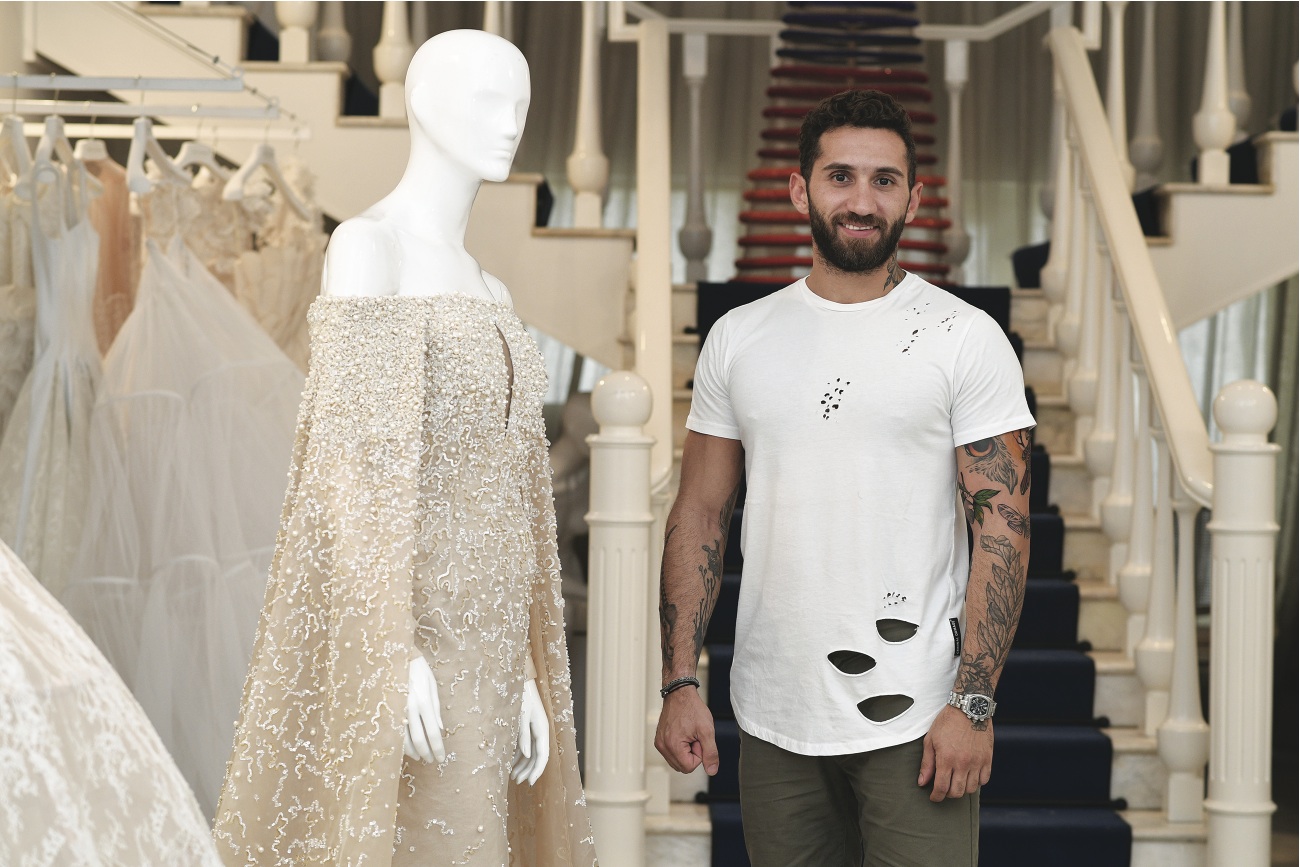
From as far back as he can remember, Rami Kadi has been passionate about the art of embroidery and other traditional craft skills. This passion ultimately led him to choose fashion design as a career path and so he enrolled at ESMOD Beirut, graduating in 2008.

Following his graduation, Kadi worked with Rabih Kayrouz and was soon after selected to showcase his first collection at Starch Foundation. He recalls the experience as being extremely successful, resulting in lots of appreciative clientele.

Speaking of the value of his education in ESMOD versus his experience with Kayrouz and Starch, Kadi evokes the talent versus education debate and says: “It’s obviously very important and crucial to have an education and learn all the appropriate techniques when you’re planning to practice any job. When it comes to fashion, learning all the techniques is even more important and amounts to 50 percent of your experience: How can you design, choose the fabrics, and oversee the sewing if you haven’t learnt the basics? However, I also think that you’re born with a passion for fashion, a natural skill that engulfs your whole creativity, mind, and life. It’s called ‘mawhabe’ [talent] in Arabic,” he says.

Kadi, who launched his own brand in 2011 at the age of 25, says he has chosen to focus only on his couture or made-to-wear line for now. As with the other designers Executive interviewed, his main clients come from the Gulf. “Currently the Gulf is my biggest market, I guess it’s the case for all couture designers generally speaking. Women of the Gulf are very much ahead in terms of fashion; they know exactly what they want, they have a strong expertise in this field, and they love to dress up. Weddings in the Gulf are like red carpet events, you can see all the latest trends and couture dresses!” enthuses Kadi.

Since his focus is on couture alone, the only international platform available to him is Paris Couture Week. The young designer held his first fashion show there in 2014 and says the most important part of the experience was getting to meet the international fashion press and experts in the field. “It definitely gives more credibility to my brand,” says Kadi.

Kadi today has an atelier of 40 tailors and ten other employees across three main departments, from operations to marketing to sales. According to him, Lebanon has highly skilled tailors and craftspeople. “We definitely have a high level of craftspeople, they’re qualified and have a strong savoir-faire. I’m always impressed by what they can achieve in every collection, and the amount of hours they spend on each dress. Each dress takes about 1,200 hours of craftsmanship, and this really needs experts in the field,” he explains.

Kadi says he does not feel he will relocate out of Lebanon, but would consider opening a showroom in Paris, as it would make him more accessible to the international influencers and the celebrities that he dresses. “The hardest part [about working out of Lebanon] is getting to reach the international influencers and fitting them for special events,” says Kadi, explaining that celebrity endorsements are a must for brand awareness and adds “glamour to their image.”

The advantage of having an atelier in Lebanon, other than the talent, is having the freedom to experiment. “Lebanon is my hometown, what is better than operating from your own country and speaking the same language of your co-workers? Lebanon is also a laboratoire in fashion, you have so many different types of women; it’s stimulating!” concludes Kadi.

August 21, 2017 0 comments
0 FacebookTwitterPinterestEmail
DesignSpecial Report

Jean Louis Sabaji

by Nabila Rahhal August 21, 2017
written by Nabila Rahhal

Jean Louis’s father, Jean Sabaji, was a fashion designer who was most known for being the personal designer of the Saudi royal family.

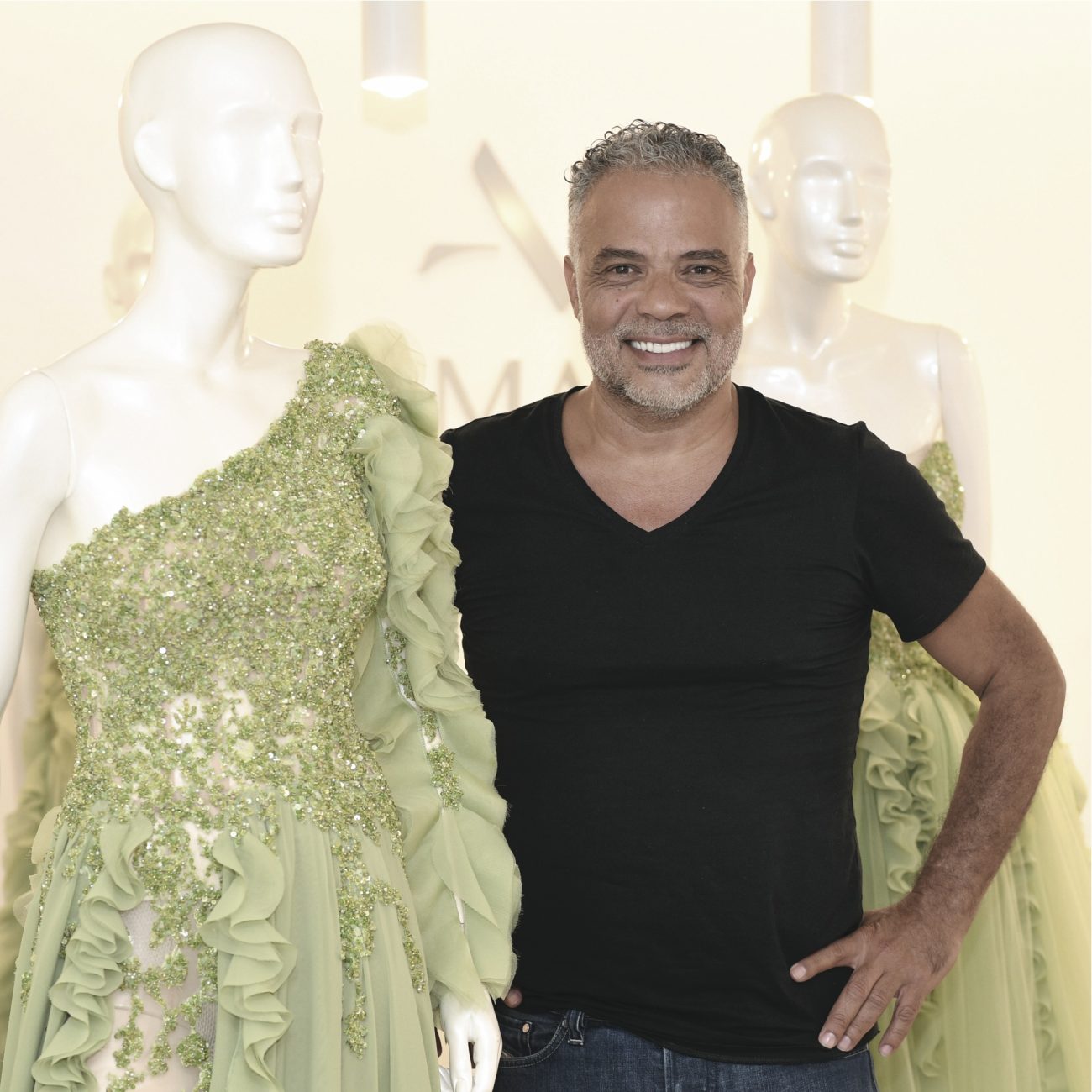
As such, Sabaji’s earliest memories were of being in his father’s atelier (which is his now that his father has passed) surrounded by fabrics and mannequins. “From when I was a child, it was as if I was on a mission to be a designer. This was my destiny, and I’m very happy I took this path because it’s in my blood,” recounts Sabaji.

After finishing his high school education, Sabaji enrolled at Lebanese American University to study graphic design, graduating in 2009. He then attended the Milan Domus Academy for his master’s degree in fashion design. Recalling his experience in Milan, Sabaji says that his childhood background in fashion design gave him an advantage over his peers,  since he was already familiar with many technical aspects and terms in fashion design.

However, Sabaji does not overlook the value of his education in shaping him as a designer. “I could’ve learned here in my father’s atelier [through training alone], but what a formal education adds to your experience is a way of thinking,” he says.

Sabaji explains that his education also helped him develop his own style, which was purely Eastern before he went to Milan. “When I went there, they helped me refine that [Eastern] direction and add a European touch to it, so now my direction is more a fusion of both,” says Sabaji, wondering if it is that mix of European and Eastern tastes that many Lebanese designers have, which makes them such successful designers internationally.

After completing his degree, Sabaji came back to Lebanon to start his own couture label. He set up camp in his father’s atelier with his team of 40 employees, this was the main reason he chose to work out of Lebanon. “What’s nice about couture is that it’s based on the old school seamstresses that bead the dresses by hand. For me, that is the advantage of being in Lebanon because I already have this team/family which I inherited from my father and continued with,” he says.

Yet, Sabaji’s skilled team is reaching retirement age and replacing them will be challenging. “During my father’s generation, almost everybody was a seamstress, while today there are a lot fewer [of them]. If you look for them, you can find them, but it’s like searching for precious stones,” says Sabaji. To ensure the continuity of his business, he is having his current team train younger hires, who he says do not need to be skilled in atelier work, but must have the desire to learn.

Despite the advantage of having a good team, Sabaji says that there are challenges to operating in Lebanon, including having to import almost all of the raw material he needs.

The economic situation is also a challenge in that many Lebanese cannot afford Sabaji’s designs. “The economic situation in Lebanon has affected the purchasing power of Lebanese women. I would love to have more Lebanese women as clients, but the majority of my couture clients are from the Gulf,” he says.

Sabaji’s first international fashion show was Fashion Forward Dubai four years ago, an experience he says opened up the Gulf market to him. “Before my participation in FFD, my market was basically in Saudi Arabia because of my father, but afterwards I got many clients from Qatar, UAE, and Kuwait,” says Sabaji.

Internationally, Sabaji also has clients from Russia and Greece, garnered following the social media recognition he received after dressing celebrities for the red carpet.

Thus far, Sabaji’s focus has been on couture and bridal lines, but he says that he will be launching his ready-to-wear line in December and opening his own boutique. “I didn’t start ready-to-wear earlier because we were taught that fashion is top bottom so you start with couture and build your name that way. So when you do the ready-to-wear line, you already have a name for yourself, and those that couldn’t afford your couture line now find you accessible,” explains Sabaji, adding that financially he finds ready-to-wear more viable than couture since he can sell more of the former due to its affordability.

Sabaji believes that internationally famous Lebanese designers have made it easier for young designers like himself to penetrate the international markets owing to the strong reputation they have built for themselves and the country.

Yet, Sabaji warns his fellow young designers against becoming “copy/paste” versions of those famous designers. “As young designers, and to keep the good name of the country which was built by the likes of Elie and Zuhair, we should revolutionize and modernize the fashion industry. We have to carve our own path,” he says, explaining that in his own designs he is daring and unique, and has thereby established a niche market for himself — which will hopefully continue for years to come. 

August 21, 2017 0 comments
0 FacebookTwitterPinterestEmail
DesignSpecial Report

Sandra Mansour

by Nabila Rahhal August 18, 2017
written by Nabila Rahhal

Sandra Mansour says she has always been drawn to art and creation. So after completing her BA in business, she decided to go for a master’s degree in fashion design in Paris, and she has not looked back since.

After completing her master’s degree, Mansour worked for Elie Saab before launching her own brand. She believes that both her education and her experience with Saab shaped the process of her becoming a designer. “It gave me the platform and ability to create pieces stemming from an artistic background — that brings together my love for drawing with my love for creating and designing,” says Mansour, explaining that she now takes on summer interns, as she believes this hands-on experience gained at an atelier is essential for budding designers.

Mansour had her first international appearance in 2010 at Paris Fashion Week. She explains that such a high visibility platform gave her brand more exposure and created brand awareness.

Mansour designs a ready-to-wear line of evening dresses and makes made-to-order wedding gowns. While she says the bridal gowns are more financially viable than ready-to-wear, she explains that having the ability to provide both services allows clients the flexibility to purchase dresses for any occasion, therefore developing a loyal clientele.

Today, Mansour works from an atelier in Lebanon with a team of 20, including 12 tailors whom she describes as “highly skilled.”

Mansour sees the quality of craftsmanship in Lebanon as an advantage to working in the country. “Our atelier and workshop are located in Beirut with a Lebanese workforce of highly qualified craftsmen, which is a vital selling point for our international affiliates. Lebanese tailors are some of the best in the world, they have a skill passed down from generation to generation, and therefore they excel in the craft,” she states.

While Mansour says that she might consider expanding her presence, depending on their growth and strategy, she would not relocate from Lebanon. “Beirut is my hometown, and at this point I don’t see any reason to relocate,” she says.

Mansour says her biggest markets are the US, Middle East, and GCC. “These markets respond very well toward our designs, and most of our recurrent clientele come from them,” explains Mansour. She believes that designers like Elie Saab and others have paved the way for the industry in Lebanon, giving credibility to the potential and craftsmanship of Lebanese designers. 

August 18, 2017 0 comments
0 FacebookTwitterPinterestEmail
DesignSpecial Report

Abed Mahfouz

by Nabila Rahhal August 18, 2017
written by Nabila Rahhal

In 1982, Abed Mahfouz starting working with his sister designing evening gowns and got his first taste of creating his own designs that way. In 1995, he decided to branch out with his own brand.

While Mahfouz initially showcased his collections locally through fashions shows at venues such as the Al Bustan Hotel in Broummana, or the Phoenicia Hotel Beirut, his first international appearance was in Milan in 2000.

Following the fashion show in Milan, Mahfouz approached the then president of AltaRoma, Fashion Week Rome, to display his collection with them. “I went alone with no appointment or support from anyone, but I convinced him with my passion and promise of commitment to AltaRoma,” recalls Mahfouz, explaining that before him it was not very common for Lebanese fashion designers to participate in AltaRoma, so the then president was reluctant at first.

However, Mahfouz quickly proved himself in Rome and developed a strong presence in the eternal city. “I chose Rome because I felt valued there, and I built a name for myself. I did the best fashion shows of my career there,” he says.

After 15 years of shows in Rome, and two years in Paris afterwards, Mahfouz pulled out of AltaRoma and decided to concentrate his efforts on Lebanon and the region, returning to Beirut in 2015.

Even while showcasing his work in Rome, Mahfouz’s atelier has always been in Lebanon, which he says is perceived as a prestigious location for fashion production by the Gulf, where the majority of his clients hail from. “Our clients brag among their friends when they have their dresses done in Lebanon. Lebanese designers are dressing celebrities and influencers, and this has a big effect on the way they are perceived regionally and internationally,” Mahfouz says.

In trying to explain this allure of Lebanese designers, especially in the region, Mahfouz starts with what he calls their good taste and creativity. “In the region, and because of this boom in Lebanese fashion designers, they are now the trendsetters, and we can see their influence on the fashion industry in general. This is because of their good taste, but also because of the quality of their work and their creativity in developing modern designs, which the region appreciates,” he says.

The region is indeed appreciative of Lebanese designers, while European designers have only recently woke up to the lucrative potential of clients from the Gulf and begun catering their designs to their tastes, according to Mahfouz. “Previously, Europeans were not very strong in embroidery and the style of design preferred by the Gulf. But if you look at the world today those that buy the most luxury products are from the Gulf, China, or Russia. So the European designers are now catering to the Gulf market; for example Dolce & Gabbana is making abayas and Valentino is designing higher necklines to serve this part of the world which has a high purchasing power. Meanwhile, the Lebanese designers already have a touch of that style in their designs,” he elaborates.

Another aspect which differentiates Lebanese fashion designers from their European counterparts, according to Mahfouz, is the quality of service they provide to couture clients. “When you go to an atelier of a fashion designer in Lebanon, it’s unlike the service you get anywhere else in the world. When a woman pays a large amount for a couture dress, she’s also buying the service of dressmaking, and she wants to feel pampered and catered to as an individual,” elaborates Mahfouz.

Despite the advantages Mahfouz cites for working in Lebanon, and the level of comfort and familiarity he enjoys in his home country, he believes the political instabilities of the past five years have negatively impacted his business.

Since his workshop is in Downtown Beirut, it was in close proximity to the 2013 Starco bombing, in addition to numerous demonstrations and sit-ins. This not only hindered Mahfouz’s access to his work; his atelier also suffered from material damage when the 2013 assassination of ex-finance minister Mohamad Chatah occurred directly below it.

[pullquote]Lebanese fashion designers, they are now the trendsetters, and we can see their influence on the fashion industry in general[/pullquote]

The decrease in touristic activity during the last six years also put a strain on Mahfouz’s availability to his clients from the Gulf. “When the Arabs used to come here it was much easier and faster to design for them. Instead of the three days it takes to finish a dress when they are here, it takes me three weeks when I go visit them as there is a lot of back and forth, not to mention additional expenses,” says Mahfouz, explaining that demand for couture dresses decreased by 80 percent because of this.

As a result, Mahfouz has downsized his team of 120 employees to 45 and says he is taking over a large number of tasks himself. He continues to focus on his couture and bridal lines, but says that his ready-to-wear line is more financially accessible and widespread (being available in points of sale in the United States and Europe), and therefore brings in more revenues and helps him stay afloat during this period.

August 18, 2017 0 comments
0 FacebookTwitterPinterestEmail
DesignSpecial Report

Georges Chakra

by Nabila Rahhal August 16, 2017
written by Nabila Rahhal

Georges Chakra initially began his studies in interior design during the Lebanese Civil War, but decided to switch to fashion design because, he says, he wanted to do something “out of the ordinary.” Studying fashion design was uncommon at the time, and Chakra says even his parents were not very accepting of his choice. It was so uncommon that there were no fashion design programs in the country back then, and Chakra moved to Toronto to continue his education, returning to Lebanon in 1985 to begin working on his brand.

Chakra says that operating during that period  stretched the limits of his creativity. “You had to make do with what was present in Lebanon in terms of material and equipment because the airport was closed. But this led to designers being more innovative in their work. They had to figure out how to use the found materials in a way to make it appealing enough to sell. But we succeeded,” he recalls.

And succeed he did. In a time when social media did not exist, and traditional broadcast media (TV/radio) was unreliable due to power cuts, word of mouth was king. Chakra’s creative designs swiftly made their mark, eliciting a positive reception. “Because I studied abroad, I acquired a European style of design that appealed to the Lebanese, who also have a bit of European taste,” he says. “There was an almost instant appreciation for my work.”

While at first most of his clients were Lebanese, Chakra says he also acquired many clients from the Gulf through word of mouth from Lebanese women who would be wearing his designs while traveling through the region.

Following the war, Chakra’s business continued to grow, and he held multiple fashion shows in Lebanon. His international fame began when he participated in Paris Couture Week for the first time with his 2001-2002 collection after encouragement from his clients.

Chakra has been showcasing his collections at Paris Couture Week twice a year ever since, and made his first appearance at the Mercedes Benz Pret a Porter Week in New York in 2009 (continuing for five seasons until 2011). “Being present in such platforms benefits everything from sales to marketing because of the exposure we get from them. You’re among colleagues. You can’t be a competitor on the international scene if you’re not in these shows,” explains Chakra.

Chakra’s main atelier is in Beirut, in addition to a showroom for appointments and fittings in Paris. While he worked in Toronto as a fashion designer for two and a half years, he prefers working out of Lebanon for several reasons.

“We have convenience of services here that we don’t have abroad. It’s the little things,” he says, such as the building’s concierge carrying bags up or postal services being accommodating of the unpredictable delivery hours his atelier keeps. Chakra also enjoys the stable and mild weather in Lebanon, as well as its proximity to Europe, which makes commuting between his two work spaces easier.

While Chakra experiences some difficulties working out of Lebanon, he says he has largely learned to work around these issues. “I created my own world and [chose] the people I work with, so there aren’t too many challenges. But, for example, customs at the airport is always a hassle. They stop the crates of material we want to bring into the country and take time to process their entry, which delays our work. It’s chaotic and there are no set procedures to follow, which is a challenge as well,” he laments.

Chakra has a team of a 100 employees, around 80 of whom are tailors, and many have been with him for 20 years, that includes skilled seamstresses and embroiderers, though Chakra is saddened by the fact that nothing is being done to preserve their skills. “We have employees who have been with us for 20 years and have a lot of experience. But the challenge we and many designers are facing is that those people — who largely gained their experience through training and have no formal education — haven’t passed their skills onto their children or the younger generation,” he says.

This is because being a seamstress is not viewed as a prestigious job in Lebanon, and those who do work in this domain today envision a better future for their children, and so do not pass their skills on to them, Chakra says.   

This poses a real challenge for Lebanese designers who today are hiring foreign workers to keep their work running. Chakra believes more should be done to raise awareness among underprivileged youth about this career option. “This industry should be promoted by training unemployed workers to do these jobs and make a living. There should be more awareness raised on the different jobs in an atelier and more incentives for people to take them up, but I don’t know if this should be the work of NGOs or the government,” concludes Chakra.

August 16, 2017 0 comments
0 FacebookTwitterPinterestEmail
  • 1
  • …
  • 100
  • 101
  • 102
  • 103
  • 104
  • …
  • 691

Latest Cover

About us

Since its first edition emerged on the newsstands in 1999, Executive Magazine has been dedicated to providing its readers with the most up-to-date local and regional business news. Executive is a monthly business magazine that offers readers in-depth analyses on the Lebanese world of commerce, covering all the major sectors – from banking, finance, and insurance to technology, tourism, hospitality, media, and retail.

  • Donate
  • Our Purpose
  • Contact Us

Sign up for our newsletter

    • Facebook
    • Twitter
    • Instagram
    • Linkedin
    • Youtube
    Executive Magazine
    • ISSUES
      • Current Issue
      • Past issues
    • BUSINESS
    • ECONOMICS & POLICY
    • OPINION
    • SPECIAL REPORTS
    • EXECUTIVE TALKS
    • MOVEMENTS
      • Change the image
      • Cannes lions
      • Transparency & accountability
      • ECONOMIC ROADMAP
      • Say No to Corruption
      • The Lebanon media development initiative
      • LPSN Policy Asks
      • Advocating the preservation of deposits
    • JOIN US
      • Join our movement
      • Attend our events
      • Receive updates
      • Connect with us
    • DONATE