• Donate
  • Our Purpose
  • Contact Us
Executive Magazine
  • ISSUES
    • Current Issue
    • Past issues
  • BUSINESS
  • ECONOMICS & POLICY
  • OPINION
  • SPECIAL REPORTS
  • EXECUTIVE TALKS
  • MOVEMENTS
    • Change the image
    • Cannes lions
    • Transparency & accountability
    • ECONOMIC ROADMAP
    • Say No to Corruption
    • The Lebanon media development initiative
    • LPSN Policy Asks
    • Advocating the preservation of deposits
  • JOIN US
    • Join our movement
    • Attend our events
    • Receive updates
    • Connect with us
  • DONATE
AnalysisDisaster Risk ManagementEconomics & Policy

Coordinating relief: Support Lebanon’s urgent humanitarian needs

by Maureen Philippon November 8, 2024
written by Maureen Philippon

Lebanon is in the midst of an unprecedented displacement crisis as Israeli attacks continue unabated. I say unprecedented not only because of the sheer number of people forced from their home – more than 872,000 displaced inside Lebanon as of this writing, including 400,000 children, and a further 400,000 people who have fled to Syria – but also because of the scale of destruction, loss and suffering that have come with this displacement.

The fact that this humanitarian calamity takes place in a relatively small country against the backdrop of a major economic crisis is hardly fathomable. The struggles of Lebanon’s displaced are not limited to physical displacement but extend to loss of livelihood, separation from family, and the scarcity of basic resources. People I have spoken with reported feeling alienated and treated as second-class citizens within their own country, adding to the emotional toll of their experiences.

“It is hard for us to live in these conditions. In my hometown, I used to regularly gather clothes for donations. Now, we are the ones receiving the country’s central region of Mount Lebanon, told me.

Challenges faced by affected communities

Safety concerns and trauma weigh heavily on these communities. For families forced into overcrowded emergency shelters, safety and privacy are often compromised. About 22 percent of displaced people are in the thousand designated emergency shelters, made available by the Government. These are mostly schools, which were never meant to accommodate families round the clock.

Many displaced people are forced to live in cramped, makeshift conditions without basic amenities such as clean water, proper sanitation, or consistent heating. In makeshift shelters – such as abandoned buildings, public parks, or even tents, and also to a lesser extent in the designated shelters maintaining good hygiene is a challenge, which can have serious health consequences.

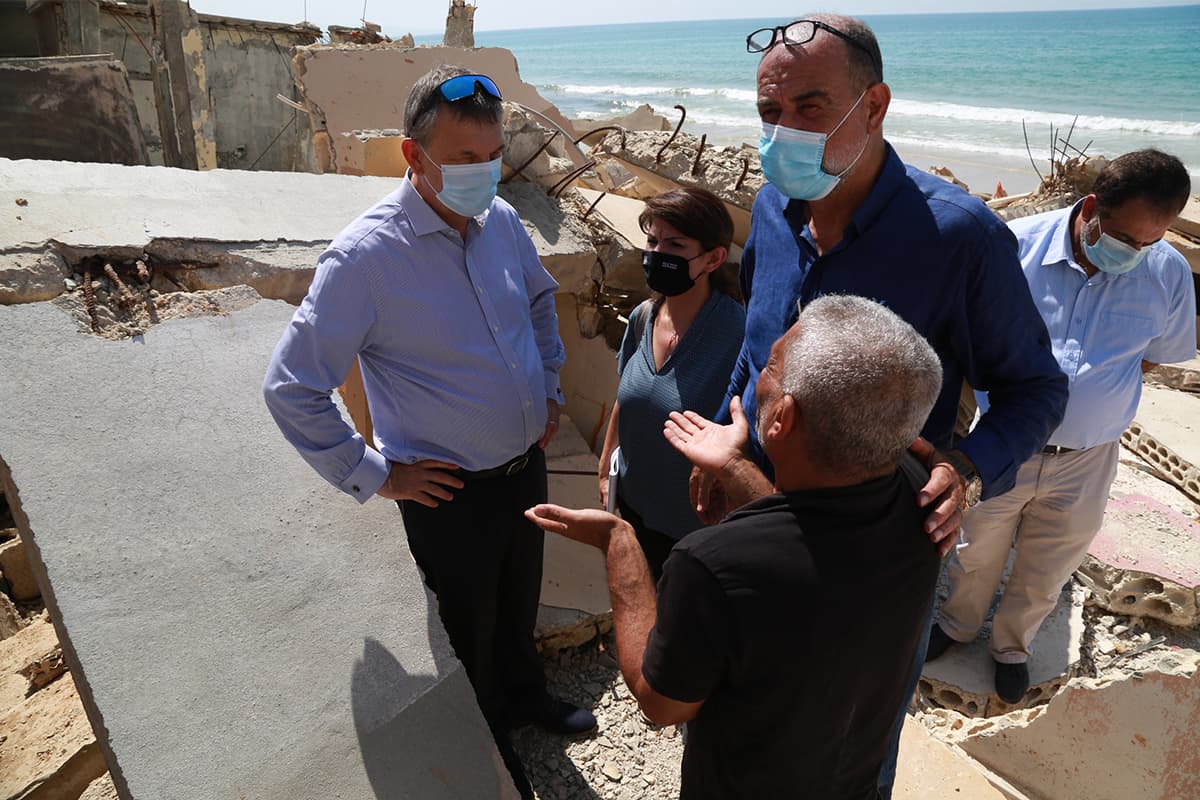
The Norwegian Refugee Council (NRC) supports more than 80 of these schools which have been designated as emergency shelters, adding bathrooms, portable showers and partitions in classrooms-cum-bedrooms. We are providing soap, shampoo and cleaning products in the distribution to the shelter. Families like Nahida’s, a 38-year-old Lebanese mother of three children, recounted the loss of routine and dignity in temporary accommodations, far from the comfort and security of her home.

One quarter of those displaced have moved into rented homes or are staying in hotels, others rely on the generosity of friends and relatives, often in overcrowded homes. However, some people have taken advantage of the situation – in many cities, rent prices have soared. In Saida, a small flat that would go for 150 USD is now rented for 450 USD. The proportion is about the same in Beirut, where a studio that could be found for 300 USD is now 800 USD.

For those without these options, makeshift shelters like unfinished buildings, tents, and even parks have become temporary homes, especially for non-Lebanese people facing added challenges in accessing official shelters. I met Samer, 15, at one of the schools in Chouf district who says: “Our humble home feels like a castle compared to our situation here. We are about 24 people living in one room, and my aunt with a disability struggles to adapt.”

With winter around the corner here, displaced people have started to wonder how they will keep themselves warm. It is a concern for everyone, but more acutely for people who found refuge in higher altitude, and for people who live in derelict buildings. NRC plans to improve insulation and distribute warm blankets for people in shelters. NRC has also provided cash to vulnerable families so that they can address the priorities they identified to improve their living conditions.

The impact on children is also significant. The sounds of explosions, sonic booms, and warplanes overhead have become an unsettling new normal, leaving many struggling to sleep and make sense of why they had to leave their homes. Their daily routines have been disrupted – they are no longer able to see their friends, play in familiar streets, or attend school – leaving them feeling isolated and disoriented.  “Children are resilient; they play and make new friends, but they still ask me if our home is safe and if we can go back,” a displaced parents told our team.

Ensuring access to education for all children, be they displaced or attending schools that have become shelters, is another high priority. Many organisations, including NRC, are working closely with the Ministry of Education to plan ahead. Especially after the recent traumatic events that displaced children have been through, it is vital for their well-being to make sure they can do what children are meant to do –drawing and singing. They should not, like the children I saw in Saida, be covering their ears with their hands when a plane hovers above their head.

The role of humanitarian organisations in crisis response

The joint flash appeal of the UN and Lebanese government for 426 million USD for three months to scale up the humanitarian response is only 17 percent funded at the time of this writing. Each humanitarian sector has developed plans and priorities in close coordination with the Minister of Environment, which leads the Crisis Response on behalf of the government and the relevant line ministries. Several tools have been developed to map out needs across the country and allow a prioritisation of the most urgent ones.

Access to many areas in Lebanon remains challenging due to security risks, particularly in southern Lebanon and regions like Baalbek, a city in the Beqaa valley east of the Litani river that hosts some of the world’s largest Roman temples and Hermel, a district in northern Lebanon that borders Syria. NRC was forced to postpone sending several trucks to Baalbek and Ersal last week as it was planned after the intense attacks, and that visit was no longer deemed safe. We cannot put our teams at risk. Delays in aid delivery to conflict zones leave vulnerable groups – including children, the elderly, and those with medical needs – at a greater risk amid worsening conditions.

Displaced communities should receive equal care and opportunities regardless of nationality. Yet, for many vulnerable groups – particularly non-Lebanese residents, refugees, and marginalised communities – barriers persist. NRC have spoken with Syrian families turned away from collective shelters designated for displaced individuals, as some local authorities or host communities restricted access based on nationality. This exclusion has forced many Syrians to seek refuge in informal, often unsafe, shelters like unfurnished buildings, parks, or open spaces, exposing them to harsh conditions and greater health risks. Some had to stay put under the bombardment.

Strengthening the institutional capabilities of local authorities and central ministries will enable them to better manage and respond to this crisis, ensuring displaced communities have uninterrupted access to essential services like shelter, education, and livelihood. This should be part of a joint effort, where resources are met with an actual plan and intention to deliver the most efficient response. While everybody has been shocked by the scale of the crisis, it is time to carefully arbitrage resources and best placed systems to respond. Accountability to donors, be they States or generous individuals is paramount, just like we also owe accountability to people who suffer, making sure we prioritise the most vulnerable with the support they find the most suited.

Our goal is to support the displaced in reclaiming their lives and accessing dignified shelter and basic services. Donors, humanitarian organizations, and the Lebanese government must work together to maintain a response grounded in compassion and efficiency.

November 8, 2024 0 comments
0 FacebookTwitterPinterestEmail
Q&A

Q&A with Philippe Lazzarini

by Thomas Schellen October 30, 2024
written by Thomas Schellen

In light of Israel’s decision to ban UNRWA when Palestinians are most in need of the organization’s support and are subjected to increasingly catastrophic violations, we invite you to revisit our 2020 Q&A with UNRWA Commissioner-General Philippe Lazzarini

Human catastrophes are inextricably interconnected to each other through the basic sharing of suffering and human compassion. The Palestinian
catastrophe in this sense can neither be ignored nor excised from the intensity of the Lebanese experience. To gain a perspective on the Palestinian dimension of the crisis in Lebanon, and on the magnitude of the suffering of the Palestinian population in the Near East this year, Executive sat down with Philippe Lazzarini, the commissioner-general of the United Nations Relief and Works Agency for Palestine Refugees in the Near East (UNRWA).

You have just completed your first official visit to Lebanon since you were appointed to the post of UNRWA commissioner-general. I understand that your schedule in Beirut was overwhelming.

It indeed was overwhelming because I did not come only as the new [commissioner general] but also as a former [national resident], knowing a lot of people in Beirut. With all what has happened, there was obviously a need to meet as many people as possible.

As perhaps the highest-profile practitioner of development aid with experience in Lebanon in the past six years, my first question is in this context of poverty and the need for development. Given your recent visit in this September of 2020, are we in hell, are we heading to hell, or will we be able to redeem something?

I feel that [you in Lebanon] will be the only ones able to answer this larger question. But it is true that I left Lebanon six months ago and I was shocked to see how people have changed, how their optimism has disappeared [and] how people were more in disbelief and in despair. I have not met anyone who expressed a glimpse of optimism for the near future. This is not the Lebanon that I have experienced over the last five years. Indeed, if you look at all the events that have taken place in the last year, from the financial collapse to the economic crisis and the political stalling, and after that the blast, which seems to be the outcome of a criminal negligence and criminal corruption at every level, this has been the [straw breaking] the camel’s back.

Most of the people who I met during my stay, were talking about leaving the country if they can or could, and also talking with some colleagues from embassies, it seems that today you have an important brain drain which has been accelerated. It was already the case when I was in the country because of the difficulties of graduates to find jobs in the country, but it seems that even those who were in the country and had a job, are now looking to leave Beirut, so it was not the same soul or spirit anymore. Something was broken. I was very shocked to find that I did not have any professional or private meeting that ended with the belief that things in the near future will or can improve. Despite this, I have witnessed extraordinary individual initiative of solidarity among the people. This is among the people, but what I could feel is the total absence of any expectation on what the state could deliver to the people. This has certainly contributed to the moroseness of the mood in Beirut.

Indeed, it seems that nobody is expecting anything positive in terms of either the leadership or in terms of revising the system. But still, could one say that the people here have a human capacity that might translate into something positive and surprising?

A general observation: the notion of “social contract” in Lebanon has been extremely loose over several decades, I would say, definitely since the beginning of the civil war. This has gone as far as that everything has been privatized in the country and nothing has been expected from the state in terms of services. Education has been privatized, health has been privatized, water and electricity, everything has at a given point been privatized in the country. Thus, there were very low expectations from the state in the country. If you look also at Lebanese everywhere in the world, they brilliantly succeed elsewhere. But in the context of Lebanon, they are not the same anymore. I would agree with you that the entrepreneurial spirit of the Lebanese is very well alive but the problem is that the context of Lebanon is not conducive for this to fully succeed. This is the reason why successful Lebanese are tempted to make their careers outside of the country.

Some years ago you authored a piece where you said that if this country collapses, the only model of tolerant coexistence in the Middle East would be lost. What do you see today as the outcome if Lebanon, as a state, were no longer viable?

This is a difficult geopolitical question, but as the country is now celebrating its 100th anniversary, and more than ever, 100 years [after its founding], you have a very deep communal divide which is completely paralyzing the country. This is the reason why there is a political stalemate, why it is all so difficult to form a government today. Because of the sectarian way of doing business in the country. What will the country look like if the Lebanese fail today? I think it will go through even more difficulties and more despair.

Time today is of the essence, the country is on its knees, there are almost no economic opportunities anymore, and it requires a government focusing on and prioritizing socioeconomic issues, but for that, you need to reform the system. For the time that I have been in Lebanon, in almost all my meetings, I was asking the decision makers: where is the sense of urgency? While we see month after month and year after year, the debt increasing and the country nearing the financial and economic collapse, why is there not more of a sense of urgency to reform? To reform the public sector and improve the perception of corruption as the country ranks very badly on the Corruption Perception Index, if I remember well in 137th place, at the time.

There were a number of low-hanging fruits, such as electricity reform where everybody knew exactly what needs to be undertaken and which would have saved the state billions of dollar and despite that, nothing has been undertaken. Also one would have believed that after the blast – the worst-ever blast besides an atomic blast in an urban setting – this would finally [result in change] but now we are one-and-a-half months later, and we are back to the same way of doing business which prevailed in the country [previously]. [If] with all these external shocks, reform does not happen, I do not see how the country can bounce [back] for the time being. It might have to dive deeper before it will really bounce [back].

Turning to the situation of the Palestinian population in Lebanon and the Palestinians in general, the economic shortfall in the UNRWA budget was mentioned by you in one interview during your visit. A message that has been iterated several times since earlier in 2020 by the organization’s representatives on various levels. It seems that
institutionally, you are almost in the position of a precariat
in an informal economic setting that lives from one month to the next, but despite that, you are functioning as an institution that gives aid and keeps people in their livelihoods. What is your expectation for UNRWA funding and for the impact of Covid-19 on the Palestinian economy?

Let me make a few comments before I comment on the financial situation of UNRWA. What I met in the camps [during the visit to Beirut in September 2020] was a very high level of despair, a high level of hopelessness. Basically, when we talk about the increase of poverty in Lebanon, this is amplified in the Palestinian camps. So when we hear that by World Bank estimation 50 percent of the Lebanese population is living below the poverty line, this percentage goes up to 90 percent in the Palestinian camp, and as you know, the Palestinians in Lebanon also do not have equal access to the job market, to land and property and hence have socioeconomically been discriminated. Clearly, what happened over the last year in the economic and financial collapse is complicated by the impact of Covid-19 – which by the way goes beyond the health hazard into triggering an additional level of misery. I keep saying that what we should fear the most in our days with the Covid-19 is a pandemic of abject poverty. Abject poverty has now become a reality in the camps to the extent that if you talk to people in the camp, most of the time they will tell you, “I prefer to take the risk of getting Covid-19 over taking the daily risk of not having food for my children.” This has become the reality in the camp.

As UNRWA we are providing quasi-state services to the Palestinians. Our mandate is to provide education to the Palestinian refugees, to provide access to health services, and also provide relief to the poorest among the poor as minimum social safety net. With all that happened in the country, expectations are rising that UNRWA delivers even more, especially more when it comes to social safety net. Those people just do not have income anymore – the majority of people in the camp are daily workers and they do not have the minimum income they used to have. So they turn to UNRWA, like the Lebanese challenge their governments. This is taking place at a time when UNRWA experienced a financial crisis which is not new, it started five years ago and takes place at a time when people expect UNRWA to deliver more. And, the countries supporting UNRWA are also experiencing their own financial crises. Most of the countries supporting us are entering into economic recessions, which makes the environment much more difficult to deal with.

Having said that, as you were referencing the month-to-month financial situation, this is because UNRWA has two problems. The first is a constant cash flow crisis – we are constantly on the edge of a cash crash – because of the lack of liquidities. We are an organization of about 30,000 staff between Lebanon, Syria, Jordan, West-Bank and Gaza; we are an organization that has a budget of more than 1 billion dollars because of all the services that we are providing. But in terms of cash flow, we never have more than a few weeks. This is highly unnerving and this is the reason why you might have heard many times already in the past that we are always on the edge of ceasing payment of salaries or ceasing services. This needs to be addressed and is an issue that I brought to the table with [UN] member states, telling them, “You gave us a multi-year mandate and we are highly predictable in the services we are delivering – we know already today what our budget will be next year and the year after, so you should be also more predictable in your contributions so that we can manage the cash flow better”. That is number one.

On September 14 2020, Mr. Philippe Lazzarini, accompanied by the Director of UNRWA Affairs in Lebanon, Mr. Claudio Cordone, visited the isolation center and the UNRWA clinic in El Buss camp, where he was briefed on the health services that Palestine refugees continued to receive under new measures and procedures because of the COVID-19 pandemic. © 2020 UNRWA Photo by Abeer Nouf

Number two is that we have a discrepancy between yearly contributions for our mandated activities and the resources that are made available. We have also a mismatch between the political mandate and the expectation of what we have to deliver with the resources that are made available. This is an issue that I am also trying to address with the member states, to make sure that they walk the talk if they ask us to deliver education to half a million Palestinian refugee girls and boys, and that we need the necessary resources for this. That is where we are today. I am very worried about the level of despair in the Palestinian camps and this is also why I have asked donors and member states to make sure that we continue to remain a source of predictability and stability in a highly unstable and unpredictable region.

In a discussion held a few years ago at the American University of Beirut (AUB), a comment of yours on longer term humanitarian emergencies was that ,“the more protracted the situation is, and the less jobs are… available from the market, the more human assistance becomes a social safety net of people”. Then, you remarked that to make humanitarian assistance sustainable in the longterm from short-term money, was a challenge that you did not see the answer to yet. Now, you are dealing with the same sort of challenge on a much bigger level than at the time. Were you able to make progress towards finding a formula of solving this quagmire?

My comment at the time was on the Syrian refugees in the country, where we are basically now dealing with a more protracted situation, and the assistance to the population was being provided through a limited resource, and the more protracted [the situation was], the less was made available as there were competing emergencies elsewhere in the world. The question was, if these people are not economically integrated and go back to their country of origin, who will be in charge in the longer term to provide the assistance, which is comparable to a social safety net for a vulnerable population? I don’t think we have found the answer yet today. It is always a struggle within this humanitarian-government nexus.

But if I look today at how to ensure sustainable livelihood for the refugees, that can be done by helping them access the job market. If they cannot [access a labor market], then one of the important tools at their disposal today is micro-credit. Within UNRWA we do have a micro-credit fund which I have asked to be reinforced in order to better deal with the economic impact of Covid-19… Having said that, there is still no mechanism substituting for the short-term humanitarian funding to ensure welfare and assistance in the long-term for this kind of population, especially refugee population.

Would this micro-credit fund be instituted here and be accessible from Lebanon, given the central bank’s prerogatives in managing and licensing micro-credit and micro-finance institutions (MFIs)?

We are looking at bringing back micro-credit in Lebanon, so we have indeed discussions with the central bank regulatory authority. We have already micro-credit activity in Palestine, the West-Bank, East Jerusalem, Jordan, and we had it also in Syria. It is true that Lebanon was lagging behind but we are looking today at how we can resume or initiate micro-credit also in Lebanon to make sure that Palestinian refugees also have access to this additional tool.

As some see it, poverty can be defined as a choice that society makes; but it seems not to be the right choice. In the Palestinian scenario, could the wrong choices that have entrenched poverty among Palestinian groups be turned into productive power via humanitarianism? Research into international responses to war, disaster and other humanitarian emergencies, has shown tremendous growth of the humanitarian market, highlighted a few years ago as
“humanitarian economics” by Swiss economist Gilles Carbonnier.
Do you think that this rise of humanitarian economics could offer a way forward for better management of the Palestinian issue and poverty in this group?

I was a student together with Gilles Carbonnier in university and I heard him talk about [his] book [at AUB’s Issam Fares Institute], but I have not read the book, so I know of the book but not in all detail. Is poverty the outcome of the choice of society? You do not decide to have poverty, but
depending on the nature of the society that you decide to have, the social contract you decide to have, you will have a level of poverty, this is the way he wanted to frame it. Today, the new framework that is being put in
place to address poverty is the agenda 2030 and the [social development goals], which is today the most ambitious anti-poverty agenda ever adopted by member states. The question is what kind of additional avenue these SDGs are providing and the real questions is not what are the additional avenues, but what will in the future be the funding model to ensure that we are reaching these goals – because we are talking about trillions of dollars to be invested on quasi a yearly basis. This can only be addressed if you have a combination of macroeconomic policies and financial instruments that are accessible to the most vulnerable. This must be complemented also by access to socioeconomic rights starting with education. I don’t know what Gilles had in mind at the time, [seeing that] the protracted poverty situation cannot be addressed just through the humanitarian lens, so shall we talk about humanitarian economy? There is a humanitarian industry, but is there an economy? I don’t know. This is something which could be debated. These are my thoughts in rough terms but I have not read the book precisely.

If I may cite one chapter title in Carbonnier’s book, this chapter deals with “the transformative power of humanitarian crises”. Its underlying question seems especially timely for Lebanon, given that we recently had a humanitarian crisis that can be defined as nothing other than an entirely man-made disaster, and the result of an unnatural hazard that was amplified by human stupidity and irresponsibility. In which way could, as Carbonnier is saying, humanitarian crises be “junctures that radically alter long-term economic trajectories”? Could, in other words, 2020 in context of the overall crisis in Lebanon or the global crisis impact on UNRWA, still be a pivotal point for creating a better economy?

For the time being, I do not yet see anything positive arising on the horizon. Right now we are dealing with a very difficult situation with despair and hopelessness, where the country does not seem to be in a position to offer any alternative right now because the trend is more for people towards looking to leave rather than at creating opportunities in the country. There is still no signal about a proper consensual political desire to reform the country. We are stuck for the time being. I think that the model for us, and I come back to that, is one to bridge our cash flow crisis between now and the end of the year and offer after that, a social contract to the member states and donors to have an agreed, forward-looking UNRWA, where we know in advance what services will be delivered to the Palestinian refugees
so that the Palestinian refugees can expect these services to be delivered without having to dive into the anxiety over a “yes” or “no” if these services will still be made available tomorrow or not. I think what we are trying to do here is to match the very strong political support provided to UNRWA with resources.

This region does not have efficient social safety nets. Are you the most capacious institution for health and education to be found in the Mashreq and Maghreb regions, in comparison to country-level institution of the same type? And by virtue of having functioned for 70 years in the region against all obstacles, are you a role model that other national institutions in the region could emulate?

I talk about Lebanon now because there have been many discussions about the NPTP (National Poverty Targeting Program) of the Ministry of Social Affairs in this country, and what the criterion should be to be eligible for this additional layer of a social safety net policy. Very difficult discussions have been going on, on who should be eligible, not eligible, and how should such a fund be funded. I think, indeed, that when it comes to assessing the level of vulnerabilities for people to decide on different levels to be accessible, UNRWA certainly has a lot to offer. I agree also that when it comes to social safety nets in general, this is a concept that has not been strongly developed in the region. Most of the time government responses or policies are [to provide social support] through subsidies for critical products in the daily basket.

While it most certainly can be doubted that online knowledge resources such as Wikipedia are free from agendas, distortions, and biases, I was still surprised to recently see that the online encyclopedia’s entry on UNRWA was over 20 times more verbose in the category of “criticism and controversies” than in the category of “assessment and praise”. How do you comment on this extreme discrepancy in the online perception of the work that the agency has been engaged in for seven decades?

I give you another example. If lawmakers anywhere ask a question to their government about contributions to UN agencies, there is a high likelihood that the question is on UNRWA and not any other UN agency. So the majority of questions on UN agencies will be on UNRWA and all the other agencies together will have fewer questions [asked about them] than UNRWA.

This shows that UNRWA is an organization which I would say is under political scrutiny. We are easily judged through the lens of relevancy, but not relevancy of the services that we are providing to the people, more about the fact that we are providing services to Palestinian refugees in the region. We are certainly the humanitarian agency which is most perceived through a political lens.

You thus have a lot of criticism of this nature, and after that, we should not completely underestimate the level of frustration that our beneficiaries might also have. We are providing the basics, but you know, when you live in Lebanon [as a Palestinian], and do not have access to the job market, you are discriminated [against] – where do you want to express your level of frustration?

You express it toward the organization which as a mandate to promote your rights and the rights of the Palestinian refugees. This dissatisfaction and frustration easily turns also against the organization because of the high expectation that we do deliver more. So I would say you have two types of criticisms, those coming from the detractors and also those coming from those who benefit from our assistance and would expect much more.

UNRWA’s mandate at the end of last year has been confirmed with a strong majority in the UN General Assembly until 2023. However, given that much criticism comes with an ideological angle, and that realities in the Middle East have recently been subjected to impulses of change, such as initiatives for rapprochement between Israel and some Arab countries, and new political alignments in the region and beyond, do you believe that UNRWA will still see a 75th or 80th anniversary of the organization?

Two or three comments. First, it is not a goal in itself of UNRWA to celebrate the 80th or 100th anniversary. The ultimate goal is to have a fair and lasting peace whereby Palestinian refugees can have a state that they can live in and do not rely on UNRWA anymore. That is the ultimate goal. Meanwhile, I do believe that with all the ongoing developments in the region, we more than ever need an organization like UNRWA, which continues to focus on investing into the human development of the Palestinian refugees and on promoting their socioeconomic rights in the region. I do believe that this is one of the best investments we can have when it comes to investing into future stability in the region. Will UNRWA go to the 80th anniversary?

I don’t know how things will develop in the region, but I do believe that UNRWA’s role will be critical until such a day that there is a fair and durable peace agreement, which would also benefit the Palestinian refugees.


October 30, 2024 0 comments
0 FacebookTwitterPinterestEmail
Economics & PolicyIndustryIndustry

Crisis or Opportunity?

by Sherine Najdi & Thomas Schellen October 25, 2024
written by Sherine Najdi & Thomas Schellen

Villages in turmoil, devastating damages to urban neighborhoods, and people forced into mass displacement: images you see as you peek over the obliterated half of Lebanon. Yet one month into the intense escalation–and subsequent invasion– following 11 months of cross-border assaults and aerial attacks against populated target areas across Lebanon, representatives of Lebanese industry tell Executive that they are staying the course of production and remain dedicated to location Lebanon.

“You wouldn’t find any company in Lebanon, if not for the illogical decision to stay here,” says Salim Zeenni, the president of the Association of Lebanese Industrialists. According to him, it is not only the latest Israeli aggression but rather the long chain of systemic obstacles and economic crises that forced industrialists to weigh their options of moving factories to other jurisdictions.

Middle East Airlines Air Liban (MEA) Airbus A321 line up at Rafic Hariri Beirut International Airport on April 11, 2012. AFP PHOTO / PATRICK BAZ

Yet against conventional business rationales, the companies that are here have taken their decision for Lebanon. “We took the challenge to stay and continue producing in Lebanon. And again, as long as the port and roads are still open, we are still moving [ahead],” he insists. He further points out that, unlike the destruction seen in 2006, there has been only minor collateral damages to industrial properties during the current conflict.

It cannot be denied, however, that the country’s manufacturing industries struggle severely under the uncertainty of war. Although some industries are working at capacity and one high-tech manufacturer even observes a week-over-week increase in productivity in mid-October, heads of industry on the level of both associations and companies are faced with potentially crippling supply chain disruptions of both imports and exports because of risks of destruction of critical infrastructures such as the Rafic Hariri International Airport (RHIA), Beirut Port, and connecting roads.

Resilience amid conflict

The industry’s export-oriented companies seem to be coping well regardless of the dire situation — a notion highlighted by Fadi Daou, founder and CEO of high-tech infrastructure component manufacturer Multilane Inc.

“We are still operating in the same way as before,” Daou says, asserting the company’s determination to function as it always does despite the war.  “We do see a minor slowdown in logistics,” he adds, commenting that logistics departments are having to function with reduced staff.

Zeenni likewise maintains that the industrial sector has not yet struggled with large-scale interruptions in operations. He says that despite the war, the sector is “still holding, still going on,” while many other industries are also adapting to new trends or realities.

Whereas Multilane’s business model of high-tech exports in the global B2B space makes access to aerial transport of goods a key potential disruption point, which according to Daou was partially addressed by increasing imports of raw materials and buildup of stock in the past six months before the escalation, Zeenni emphasizes that companies in sectors such as food production and personal care products are working at full capacity in order to meet local market needs as well as obtaining crucial revenues from exports. “For us, the most important market is not the Lebanese market. The most important is exports. Believe it or not, we barely do any profit out of the Lebanese market,” he notes.  

Supply chains at risk and extremely feeble state support

The main risk imposed on the industrial sector is the disruption of the supply chains, the foundation of the sector. Both Daou and Zeenni express the importance of the supply channels, the airport, and ports to the survival of the industrial sector—their closure would cause an acute disruption to the country’s imports and exports, “The biggest worry is a stoppage of the supply line and [potential] closure of the airport. If these routes remain open, we will still be able to provide jobs,” Daou says.

Zeenni acknowledges that industries relying on products or raw materials from afflicted areas such as the South and Bekaa—mainly the agricultural and agro-industrial sectors that have been dealing with losses and destruction, are unlikely to recover anytime soon. Zeenni mentions that these companies are trying to adapt by sourcing raw materials from other regions, or in some cases relocating production to safer areas. According to him, critical inputs of concern to industries include, on top of raw materials, access to energy and the flow of packaging materials.

Both industrialists also flag the need for redressing legal weaknesses and implementation problems in the collection and reimbursement of importation duties for materials that enter exported products. “What is needed from a long-term point of view to seize the opportunity and have impact on economy of Lebanon, is adoption of laws that make it viable for [high-tech] companies to come and manufacture such products in Lebanon,” says Daou.

Admonishing delays in handling of repayment of import duties and the trend of tax increases that push increasing numbers of economically active people into informal – or, in his description, “illegal” – behavior, Zeenni says: “Concerning taxes, the industrial sector has been the milking cow of the whole governmental institutions. We are working legally, so we do pay [our taxes]. This is against any understanding of any economic situation.” He notes, however, that current efforts are being made in collaboration with ministries for enacting programs aimed at modernization and renewal of industrial machine parks and for attracting investments into new industries.

Employee safety and productivity

In addition to the concerns regarding the supply chain, the safety of the workforce is a big priority in a time of war. At Multilane, Daou says he took several measures to mitigate the risk to his employees, especially those living in targeted or risky areas, and those needing to take dangerous roads to reach the workplace. “Employee safety is a very big concern. We’ve provided housing to certain employees so they can stay close by and avoid dangerous commutes,” he explains, adding that the company also incorporated a work-from-home policy.

Nonetheless, these efforts are still not enough to maintain employee productivity at the same rate—especially for people who are product developers and need lab access to do their jobs efficiently. “Productivity drops by 50 per cent when they work from home,” Daou says, “while the production team continues working to full capacity”. This flagrant contrast underlines the varying effects of war across different segments of the workforce.

Moreover, one of the reasons behind this drop in productivity is the mental strain that the employees are facing. “The morale of the team is the biggest challenge. People are on edge; every time there’s a loud sound, they jump to the windows,” Daou says. He resorts to encouraging his employees by sharing stories of resilience, hoping to inspire and bring back motivation.

Global implications and market pressures

When asked if the ongoing war will affect international demand for their products due to fears that Lebanese companies might become unable to honor contracts and meet delivery targets, Daou concedes the existence of such concerns in his global market. “We are spending a lot of time dealing with this specific issue,” he says. To hedge this risk, he is building contingency plans. “We have updated our business continuation plan (BCP) and are exploring partnerships in other countries like China, Turkey, and the Gulf.”

As for their long-term plans for growth, most were stunted. Daou notes that their business could have expanded by 20% in 2024 had the regional situation been stable. This depicts a macro-image of the Lebanese industrial market’s suffering, where they lose growth potential because of socio-political instability in the region in which they function.

Zeenni’s response toward this issue is the same, while also noting the rise of transportation costs that can impair viability of long-term contracts. Moreover, Zeenni points out the struggle to change prices and relays their efforts to “hold prices constrained” to maintain their presence in the market.

Hope for the future: post-war opportunities and long-term vision

Both Daou and Zeenni see hope for Lebanon’s future, especially its economy. Daou sees Lebanon becoming a hub for high-tech manufacturing, inspired by the current AI and semiconductors surge—all intended to happen after the war ends. “Lebanon stands a very good chance for some of the global high-tech manufacturers to build in the Middle East once the bombs stop,” he said. He sees a lower unemployment rate and better utilization of Lebanon’s competent and qualified workforce.

Part of Daou’s long-term vision is investing in Lebanon’s youth and human capital: “Our mission is to provide jobs to our young people so they stay in Lebanon,” he says, adding his intention, after returning to Lebanon in 2006, to be a part of the tech sector’s growth and the creation of high-value job opportunities for the Lebanese youth. Using Multilane’s academy, Doau’s company ensures the advancement of young talent, keeping them updated on tech trends and integration into the sectors while merging theory and practical technical work.

Daou is committed to keeping his company on the rise, along with personal morale, regardless of all new strikes in the industry. “At least in this week [the third week of attacks], the productivity index has improved significantly compared to last week,” he said proudly.

Zeenni says that he believes in Lebanon’s potential since it has risen again and again after each war and crisis throughout the years. In addition, he believes that Lebanon will always remain attractive to investors. “Just give us peace of mind, and you will be amazed what will happen,” Zeenni remarks. Easier said than done, but a sentiment that certainly reflects the forced adaptability and hardiness of Lebanon’s industries despite major repeated adversities.

October 25, 2024 0 comments
0 FacebookTwitterPinterestEmail
Real estateReal Estate

Inescapable: A more just realty

by Thomas Schellen October 23, 2024
written by Thomas Schellen

An exploration of mortgage finance opportunities at a time of daily bombings and property destruction seems to be an anything but natural thing to do. Investing into a new home at a moment while the enemy bombs, blows up, and bulldozes dwellings in nearby neighborhoods with impunity but no true predictability, is at its most optimistic an act of calculating risk and opportunity in an extremely contrarian and reckless environment. At worst it is perilous and could destroy one’s own life.
In this and every other sense, the market for real estate development and property transactions in Lebanon must be assumed to be in a state of acute shock and extreme uncertainty. But markets are survivors. Their ability to adapt is the very principle of their existence.
 Moreover, it cannot be overlooked that even under the assault of war’s most malevolent forces and insidious lies, the needs of the Lebanese people do not change. The right to dignified shelter is the response to a fundamental human need. This need does persist and will resurge after the madness and evil of invasion under a fake pretext of defense has run its course – or if in an unlikely but far better alternative, the armed confrontations were stopped by global comprehension and multilateral repulsion and subjugation of this evil.  

In the meanwhile, three issues are on the real estate agenda: the supply of living quarters in socially and economically productive ways, the avoidance of haphazard construction activity that serves short-term needs but damages the urban and rural quality and violates long-term “green” development objectives, and the restitution of damages to the lives and properties of all people who are victimized by the war.   

Needs of planning the future amidst the morally valid dream of restitution

Of course, as long as the aerial and ground invasions last and wreak havoc on mental health and civilian livelihoods in Lebanon, it is not possible to map the property damages conclusively. Nor is it realistic to either plan for reconstruction and betterment of living quarters or assess claims for eventual reparations against the aggressors.
But both issues need attention already today. First is the practical aspect of people who are in need of shelter over the long term, and specifically a national need for shelter that is environmentally, socially, and economically sustainable. In this regard, it is a lesson of the internal conflicts of the past century that in times of armed confrontations and protracted violence, building activity in the country did not cease but was undertaken in ways that inflicted damages on urban fabrics and integrity of communities.
And then there is the moral elephant hidden in the mist of international discourses over human rights and victims of gross violations of those rights in countries like Lebanon. An even greater need than dignified shelter for the currently displaced Lebanese people is the need of safeguarding the rights of people living in the land without the specter of recurrent conflict. Part of satisfying this need could be for Lebanon to insist in front of the global community on reparations for unjust aggression by a belligerent neighbor. 
According to concepts declared by the United Nations in 2005, not just the losers in a war (as seen in previous conflicts such as the two world wars and severe reparations imposed on aggressor Germany in post-war negotiations) but generally victims of “gross violations of international human rights law and serious violations of international humanitarian law” have rights to “restitution, compensation, rehabilitation, satisfaction and guarantees of non-repetition”, through mechanisms of reparation “in a systematic and thorough way at the national and international levels.”

Imperative to define and settle reparations

In any civilized court and international order of justice among peoples, these reparations have to be towering on the balance of real inflicted damages by one party to the other. Note: Israel some years ago claimed to be owed $250 billion in reparation for the victimization of Jews in different countries around the region.
Lebanon’s 20th century past is not void of historic failings such as discrimination against the country’s Jewish citizens and pogroms in the 1950s, 60s, and 70s, acts that marred both the human rights record and the country’s philosophy as home to minorities without discrimination. Big however: Even if Lebanon assumes the responsibility for all property damages south of the border that have been inflicted from its territory, plus shoulders the investigation and eventual reparation burden from the anti-Jewish actions of the 20th century’s second half, the infliction of harm on Lebanese people in the various Israeli invasions and occupation periods of the 20th and 21st century up to the current war crimes enacted with determination and fake justifications against civilians, will push the burden of reparations 100 or even a thousand to one on the scale of justice in favor of Lebanese victims.
This summer, an opinion by the International Court of Justice found that Palestinian people deserve reparations for 57 years of Israeli occupation. However strong the pro-Israel political gale force is in so-called high-developed countries with moral compasses anchored in EU and UN declarations of the past 75 years, and however weak the actual moral authority of the UN has been revealed to be in the past year, it is necessary to start thinking about a universal damage registry for the purpose of reparation demands and accountability.    
Standing as a civilian in the bombed-out remnants of one’s home must count as one of the most tangible symbols of unjust victimization through the type of precision destruction that is by all evidence of September-October 2024 falsely described as minimizing civilian damages and despair.
While restitution and reconciliation over the incalculable cruelty meted out against Lebanese people by regional aerial superpower Israel must be assessed as a problem of future generations, real estate in this sense is literally more real and concrete as an argument for reparations, however politically uncertain and viciously opposed they are by culprits. But even if this cause of claiming reparations were to be taken up by global civil advocates and legal luminaries in the very hour of this writing, any recovery of physical compensation will be years and years away.    

Getting real quickly

In the short and real realm of housing needs, however, the attention is on the financing of affordable homes. This is the segment of the real estate market that had been kept somewhat buoyant – but artificially and perilously so – in the 2010s by the Banque du Liban (BDL)-issued “incentive packages” for the Lebanese economy.

The economic perilousness of the unsustainable interventions into the housing market brought supply of subsidized lending crashing down five years ago at the threshold of the current decade, after it had been driven up over roughly one-and-a-half decades by a combination of speculative demand and genuine need for starter homes.

Expressed in numbers of housing finance, mortgages reached $13 billion, serving 12,000 beneficiaries just prior to 2019. A significant portion of housing finance contracts included subsidized loans, including $1 billion for members of the Lebanese armed forces (LAF), $265 million for members of the Internal Security Forces, $95 million for members of the General Security, and $25 million for the judiciary.

Although housing needs of and finance arrangements available to young couples and growing families were faced with the shocking freeze of banking and crash of currency values in 2020 and the two years thereafter, the real estate story of the past four years has not been a simple one. 

According to Nassib Ghobril, the head of economic research at Byblos Bank Group, real estate was the first sector that benefited from the crisis because when the depositors discovered that they can’t transfer their deposits abroad, they transferred them out of the banks to the real estate sector in form of checks. “Companies and individuals were able to repay their dollar loans at a much lower value than they originally borrowed. This was a loss for both depositors and banks, as it contributed to the financial crisis.”

 But this opportunity did mean neither that genuine demand in the organically growing and socially value-adding market segment for working people’s home was met, nor that the man-made, minor catastrophe called urban planning was addressed.   

Whereas the void in urban planning has to be addressed in a broad societal development with insistence on sustainable real estate and communal coexistence paradigms (cf. comment piece), the collapse of the in the 2010’s thriving mortgage sector mandates a return of banking.

Ghobril emphasizes that the banking sector desperately needs to resume lending activities, “as loans have traditionally been a primary source of income for banks.” This revenue stream has been effectively cut off since 2019, severely impacting the sector’s financial health.

“The size of the loan portfolio was 58 billion dollars at the end of 2018 and today it is about 7 billion dollars or a little less,” Ghobril says. The decline is even more in foreign currency loans, with Ghobril noting that “loan portfolio in foreign currencies declined by $34.5 billion from the beginning of 2019 till the end of June this year.”

“Today, we hear companies saying they need banks to resume lending,” Ghobril says. However, he outlines three conditions for banks to restart this practice. First, banks must have sufficient liquidity to lend, which primarily comes from deposits and shareholder contributions. “Companies shouldn’t complain about banks not lending them money while also keeping their profits in safe boxes or foreign bank accounts. They should contribute to the economy by depositing their funds in Lebanese banks.”

Secondly, Ghobril argues, a law is necessary to guarantee that loans are repaid in the same currency they were originally given. “For example, if a bank lends fresh dollars, it should receive fresh dollars in return, not Lebanese pounds at the exchange rate or devalued checks.” Third, the importance of addressing a crucial question for Lebanon’s economic future: “What identity do we want for the Lebanese economy?”

In his view, one option is a liberal, free-market economy that is open to the world, particularly the Arab world. This model would prioritize the private sector and individual entrepreneurs, while the public sector would play a supportive role by creating a favorable investment climate and modernizing laws and institutions. The other option is an economy dominated by the public sector, characterized by efficient public services, tax evasion, open borders, and a large informal economy.

The return of housing loans

After a five-year hiatus, housing loans are making a comeback in Lebanon, offering a ray of hope to Lebanese youth who had almost abandoned their dreams of homeownership amidst the country’s economic crisis. On June 3, the Banque de l’Habitat began accepting applications for subsidized housing loans.

The new application process has moved online, replacing the old system of physical submissions at bank branches. Antoine Habib, CEO of the Banque de l’Habitat tells Executive in mid-September. “The enthusiasm is clearly there. Applications have exceeded our expectations. So far (September 19), 24,300 people have visited the platform,” he says while not specifying how many of these visitors submitted applications.

Habib states that this online platform aims to ensure a fair and transparent loan distribution process. “To prevent favoritism, this website is the answer. Anyone who meets the requirements will receive a loan. If someone wants to support specific individuals, they should do so with their own money, as the bank is not responsible for personal endorsements,” he elaborates.

Under the new scheme, households earning between $1,200 and $1,500 per month can apply for loans up to $40,000, while those with “average incomes” ($1,500 to $2,000) are eligible for up to $50,000. These loans come with a 20-year repayment term and a 6 percent interest rate.

The eligibility criteria are specific: the property must not exceed 150 square meters, applicants must not own another residence in Lebanon, and they should not have previously received a subsidized loan. The bank is also relaunching loans for improvements and restoration of old homes, with caps of $40,000 to $50,000.

Funding for these loans comes from a credit line of 50 million Kuwaiti dinars (approximately $163 million) obtained from the Arab Fund for Economic and Social Development. This agreement, signed in March 2019, but it faced delays due to the economic crisis and its aftermath.

Addressing concerns about the adequacy of the loan amounts, Habib acknowledges the limitations but emphasizes their potential impact: “If a Lebanese wants to buy a house in downtown Beirut, or in Tripoli Square, or in Bardouni in Zahle, the loan amount is certainly not enough, but if he wants to buy a house in the suburbs of Akkar, Sidon, or Zahle, the amount will be enough.”

You can’t buy a peace of land

Lebanon’s real estate sector defies predictions, with trends of growth and decline that do not always mimic the country’s broader economic and security shocks. While the market is heavily influenced by local and regional uncertainties, it also follows its own internal logic, driven by unique investor behaviors, foreign interest, and a historically durable expatriate demand.

While there are signs of resilience, such as the return of housing loans and the reopening of commercial centers, the sector faces significant obstacles. A comprehensive urban planning strategy is essential to guide development.

Real estate lending needs to resume more broadly, whether in form of purely commercial housing loans or through mortgage lending with support of subsidies and strict eligibility controls. Long-standing reform needs are still piling up, but now with the addition of war and disintegrating physical security as the most pressing challenge that impedes real estate and the right to shelter along with every aspect of civilian life – a challenge that stimulates Lebanese resilience and determination but can only be mitigated on the global stage.

Reporting by Rouba Bou Khzam was integral to this story.

October 23, 2024 0 comments
0 FacebookTwitterPinterestEmail
Real Estate

Inside Perspectives: Experts unpack Lebanon’s dynamic real estate market

by Rouba Bou Khzam October 23, 2024
written by Rouba Bou Khzam

Israel’s long-prepared revenge strike against their arch-enemy Hezbollah under a pretext of securing the return of their internally displaced population to the northern holy land, long ago a peaceful area of coexistence of different Semite peoples, has violently intruded on Lebanon – and displaced multitudes – at a time when the country was emerging into new, people-led efforts of recouping the quality and dignity of life that had been eroded by the multi-tiered crises of 2019 to 2023. One aspect of this fervently thought recovery was the resurrection of the urban spaces and affordable housing. Here is what Executive learned about the prospects and developments in those livelihood markets just before the country was assaulted with the anti-peace, genocidal stamp of approval by Israel’s international supply chain of advanced weapons of “precision” destruction and indiscriminate death. 

Lebanon’s real estate and development sector has faced dramatic fluctuations, mirroring the country’s political, economic, and regional experience. From the boom periods that saw Beirut’s skyline transformed by luxury towers (a first post-conflict one in the 1990s, a distinctly different one from the mid-2000s up until 2011), to the deep troughs caused by global economic shifts and regional disunity in the 2010s, the ebb and flow of the market became exceedingly volatile in the late 2010s. Pockets of opportunity arose amidst stagnation. Starting with 2019, the property scene became even more complex, due to currency collapse and mass waves of both in and out migration.

And at time of this writing, the country is cursed with an intrusion of violence and war after a year of expanding conflict. While it is neither viable nor in the least predictable how the war economy will change the property market and real estate development sector in Lebanon, a wistful assessment of the nuanced forces that were shaping Lebanon’s real estate landscape in absence of enemy intrusions can still be obtained by looking at investor sentiment, currency shifts, and government policy in the first eight months of 2024.

Beirut’s downtown, once a center of commercial activity, entered the year with an overburden of obstacles to its economic vitality. “Downtown and all of Lebanon are oppressed. Those responsible have been busy for many years with political disputes and have not developed a new vision for the real estate market or urban planning,” says Walid Moussa, head of the syndicate of real estate brokers and consultants.

In the opinion of George Nour, founder and managing director of property consultancy Estate Solutions, the country’s political climate has indeed hindered development of high-profile areas in the urban core of Beirut, impacting both the capital and the nation.  “We were facing a stagnation situation in the real estate market even before the crisis in 2019,” Nour tells Executive. He points to two primary factors contributing to this long-standing stagnation: the chaotic urban development in Lebanon and the precarious financial situation.

Despite these challenges, the real estate professionals point to signs of potential change in both the commercial and residential markets with the emergence of new businesses and the recent reopening of housing loan applications, which signal a returning access to the financing of property purchases and development. This change may encourage both homeownership and new construction projects, potentially contributing to urban renewal in certain areas.

Going by the evidence of numbers

The real estate market in Lebanon has experienced a significant decline, with transaction numbers plummeting by 84.96 percent in 2023 compared to the previous year. Only 11,639 real estate purchase and sale transactions were recorded last year, versus 77,380 in 2022. However, these figures are not quite as devastating as they appear to be, mainly because public sector strikes led to the closure of the General Directorate of Land Registry and Cadastre, which caused a delay in registration of real estate transactions. Some of this backlog seemed to get addressed in the current year. However, the 16,390 real estate transactions registered in the first six months of 2024 according to the Ministry of Finance, was a number still significantly lower than the 39,921 transactions from the same period in 2022. Rather than bureaucratic bottlenecks, the waning of buyer interest in recent months was driven externally. “The summer of 2024 was particularly challenging, marked by fear and uncertainty. This atmosphere of instability significantly dampened investor enthusiasm for purchasing property,” Moussa emphasizes.

This downturn in the real estate sector is symptomatic of the broader challenges facing Lebanon’s economy. The country’s ongoing political crisis—the ongoing and escalating Israeli-Hezbollah conflict, delayed government formation, presidential vacuum, interim rulings, and public utility strikes—has greatly affected confidence in the real estate market. In particular, the ongoing war in southern Lebanon, now expanding into Beirut and beyond, creates an increasingly hostile security environment that discourages investments, especially in high-profile real estate projects.

Furthermore, although the real estate market has had periods of growth since the 2019 financial crisis, the protracted economic struggle still negatively impacts purchasing power, while housing loans are still edging back into the market. “Development for sale does not exist today because developers do not have the capital to build; [also] the buyer does not have enough money to buy, which indicates that financing is suspended from all sides,” says Moussa. In addition, “closing the doors of their loans and financing prevents [people] from obtaining prior approvals to develop their investments or buy an apartment.”

The inconsistent availability of real estate registration services, with the closure of real estate departments in Mount Lebanon and the intermittent opening of others, creates a bottleneck for potential buyers and sellers in the property market. This uncertainty prompts concerns about the security of property transactions and the ability to transfer ownership. “How can people confidently purchase a property if they cannot even register it or transfer ownership?” Moussa points out.

Urban development’s broken backbone

Lebanon’s urban development has long been characterized by a lack of comprehensive national planning. According to a 2018 UN-Habitat report, only 14 percent of Lebanese territory was covered by urban plans, leading to uncontrolled construction in some areas and underdevelopment in others. According to property consultant Nour, “all developers without any market survey, market research, nor market analysis, were jumping into doing new projects just because they saw that real estate in that time is the favorable business.”

According to him, the precarious state of Lebanon’s financial institutions is the second major hurdle for the real estate market. “The financial institutions were always ready to finance as much as the developer wanted in terms of providing cash, and also the buyer at that time had the chance to borrow from the bank,” Nour explains. This easy access to credit fueled a boom in real estate development, with Lebanon’s construction sector contributing significantly to the country’s GDP – reaching 13.1 percent in 2018, according to the World Bank. However, this growth came at a cost.

“The market was interactive, yet insufficient because at that time the banks were not really looking at how the developers were spending the money. There was no compliance, no anti-money laundering control, and nobody was asking about ‘know your client’,” claims Nour. A lack of due diligence and oversight created a perilous environment where financial risks could accumulate unchecked.

The absence of robust regulatory controls is particularly concerning given the scale of lending to the real estate sector. As of 2019, before the onset of the current crisis, real estate loans accounted for approximately 36 percent of total loans in Lebanon, as reported by the Association of Banks in Lebanon. This high concentration of lending in a single sector, combined with lax oversight, left the banking system vulnerable to shocks in the real estate market.

Rotten roots

Nassib Ghobril, the chief economist at Byblos Bank Group, tells Executive that “even before the crisis, there were significant issues with the investment climate and business environment in Lebanon,” echoing Nour’s sentiment that problems have been brewing for some time.

The severity of these issues was already before the financial crisis of 2019 underscored by the country’s dismal rankings on the quality of its business environment. Ghobril adds, “According to the last business environment index issued by the World Bank in 2018, it was found that 75 percent of the world’s countries and 65 percent of Arab countries have a better business environment than Lebanon.”

The Lebanese economy has been hindered by the absence of comprehensive reforms, a lack of action that has damaged investor confidence and economic stability. The shortage of reliable economic data has long been a stumbling block for Lebanon’s economic progress. This persistent issue has made it challenging to accurately gauge the country’s economic health and has deterred potential investors from making informed decisions. Ghobril says that “more data” is needed, and notes that “the recent Fitch Ratings update and S&P report highlight the continuing struggle with data availability and transparency, issues that have long affected Lebanon’s standing with international rating agencies.”

Commercial comebacks and residential roadblocks

While new real estate development projects in downtown Beirut have been at a standstill, the area is experiencing a surprising surge in commercial activity. “There are no new real estate projects in downtown this year,” says Moussa, “however, we’re observing a lot of commercial movement and increased pressure in commercial real estate.” The prices, as Moussa indicates, are approaching levels seen before the crisis.

A cornerstone of this commercial resurgence is the reopening of Beirut Souks, a key shopping center in downtown Beirut, which announced on a June 26th Instagram post that more than 100 stores will soon be open, including Nike, Zara, Bershka, Stradivarius, Virgin, Etam, L’Occitane en Provence, Mouftah El Chark, among others. “The Azadea Group, a leading lifestyle regional retail company that owns some of the brands, will take off in Beirut Souks at the end of this year,” knows Moussa.

Beirut Souks, managed by Solidere, first opened in 2009 after a 10-year delay and $100 million expenditure. The massive complex, which sits on the site of Beirut’s original traditional souks, has been plagued by the same series of unfortunate events over the past years, including the 2019 economic crisis, the Covid pandemic, and the port explosion, which heavily damaged its stores and led it to fall into disarray.

Outside of the luxury retail niche and the commercial sector, the residential real estate market tells a different story. “The real estate sector is still in intensive care, in the absence of financial funding for real estate projects, which is the main nerve for developing the sector. While the majority of projects that are being implemented are self-financed to meet a personal need,” says Nour.

Despite these challenges, demand for real estate persists, particularly in Greater Beirut and coastal areas. Nour points out, “To meet the needs of natural population growth (Lebanese only), we must have an annual increase of 4 percent in residential apartments.” This demand has been further intensified by the displacement of over 100,000 citizens from southern Lebanon due to the ongoing Israel-Hezbollah conflict, leading to increased rental prices in some areas.

In the residential segment, rentals dominate the market as many Lebanese struggle to afford property purchases. Commercial real estate also sees merchants favoring rental arrangements over property ownership. Nour explains, “The merchant prefers to rent instead of buying because he considers the rent as part of the operating cost that provides him with the return on the sale.” This flexibility allows businesses to adapt quickly to changing market conditions.

Price trends vary across regions, with apartments in areas like Baabda, Hazmieh, and Beirut’s suburbs ranging from $150,000 to $300,000. Investor expectations have adjusted, with acceptable profit margins now around 6 percent, a significant drop from pre-crisis levels.

Expatriates and foreign citizens are finding opportunities in the current market. Nour observes, “Expatriates have a good opportunity to buy real estate, especially those who have cash, as they can buy real estate at reduced prices.” In the land market, sellers are often motivated by immediate financial needs and buyers looking to convert cash into tangible assets.

Unsettled ground

While the health of Lebanon’s real estate market has not always mimicked larger economic trends in the country, developers and stakeholders are now besieged with the upheaval of war. The country is in many ways, shaken and turned on its head, with large segments of the population displaced from the south, the Bekaa, and Beirut, and pushed into Mount, Lebanon, Metn, Kesserwan, and elsewhere. In the short term, stagnation or contraction in the market can be expected, with recovery dependent on broader political and security improvements.

October 23, 2024 0 comments
0 FacebookTwitterPinterestEmail
Q&AQ&AQ&A

Food security in times of war

by Thomas Schellen & Sherine Najdi October 18, 2024
written by Thomas Schellen & Sherine Najdi

In this interview with Atef Idriss, CEO of MENA Food Safety Associates (MEFOSA), the Executive Magazine addresses issues related to food security in Lebanon given the current ongoing war.  Moreover, several topics are explored: shortages in supply, the effect on the supply chain, the quality of the produce, the price change in available produce, and the availability of products in general. As such, On October 9.2024, Mr Idriss gives some insights regarding this matter, tapping into some core issues in the agriculture and industrial sectors in Lebanon.

Executive: What can you tell us about the current struggles of producers, such as farmers, and suppliers in the food chain? How is Lebanon’s food security situation in the context of the ongoing war against the country and also the border conflicts of the year October 2023?

Idriss: Food security is a complicated issue because it needs to define not only availability but also quality and related issues about nutritious content. When you take the broader definition of food security, the extent of disruption [by the war and preceding conflict] hit not only the supply chain but also the value chain. The value chain is disrupted when you cannot feed an infant the right infant formula, or when you cannot provide the right fortified food to an elderly person.

But of course, we realize that [the problem of food security] has been growing. Ultimately, we have reached a stage where even availability is sometimes amiss. People are displaced. They can’t find what they want from the place they used to buy. But Lebanon has a free economy. Our imports have been sustained despite all the unrest. The infrastructure is availing. And the supply chains, even the industrial supply chains, have been maintained. And because of the economic conditions, many new companies, and new producers entered the market. And they’re keeping up with the right support and delivery.

Executive: Did you observe that the retail outlets had bottlenecks?

Idriss: Yes, We couldn’t find several of the items that were imported or even that were produced regularly. At one point, we couldn’t even find our bread. The retail outlet [in this building in Hamra] has doubled or tripled its daily sales because of the people that flocked to Ras Beirut.

Executive: Is this shortage only because the supermarket operators did not anticipate this high demand? So would they be able to supply enough for the demand at some point?

Idriss: Consumption changes at times of war. So sometimes you need to better ascertain your client needs and the ability to avail. That is not easily done. [For example] many people are consuming much more bread, staple foods, and canned foods because of the conditions [they have to live under]. The retailers are trying to better ascertain what is needed.

Executive: Will this shortage be covered by more imports or will the local supply be enough?

Idriss: Producers can supply [for the changing demand] but they require raw material, and also other things such as packaging. If the required [inputs] are available, the adjustments are usually taking place. But the supply chain acts with a delay. So it’s very good that supplies are coming in from donor countries. These support the requirements of the Lebanese people and supply rations that are integrated and well-needed.

Executive: Do you see the prices being affected?

Idriss: Some of the prices are indeed affected. The effect may be related to longer supply chains or more costly supply chains because of the war. [Other impacts arise] because [agro-food manufacturers] are not able to run efficiently because of shorter operating times and production cycles in the industry. Or longer delays in the port. The syndicate of importers has recently been engaging the Ministry of Economy and the Ministry of Finance to speed up testing so that more supplies are delivered in time.

Executive: From a producer or farmer’s point of view, will they be able to satisfy this demand or will we be relying heavily on imports?

Idriss: The agriculture in the country should be able to address market needs. But tremendous shortages are resulting from what you are witnessing in the south [of Lebanon] where the hostilities are cutting production out of the agricultural supply chain. On top of that, [the Israeli aggressors] are using different corrosive chemicals that are very bad for agriculture, for the land and even for the farmers and rural inhabitants. 

Executive: If the war ends tomorrow, how long will it take the industry to recover from all aspects, price, quality, and security?

Idriss: The agricultural exporters are facing all kinds of problems even from the times before the war. Many of our markets have been lost because of different issues. The Gulf states have been demanding much more quality focus and better compliance with international standards. We opened markets such as Iraq but then roads have been bombed again. Our exports to the EU have been also challenged because of the inability of some of the labs to deliver on the specifics of sanitary and phytosanitary requirements and issues known as technical barriers to trade (TBT).

Such requirements need to be addressed, many involving [standards] and laboratory testing. We’ve claimed this on the Ministry of Agriculture repeatedly even before the current hostilities started. We just came yesterday from Tripoli and alhamdulillah at least the Chamber of Commerce of Tripoli laboratory is still operating. Several tests that have not been conducted in Beirut labs are being transferred to the lab in Tripoli and this facilitated many of the requirements.

Executive: From what you say, the systemic problems and structural problems of our agri-food value and supply chain are still the same but now the conflict element adds another dimension to that. Correct?

Idriss: Yes. The creation of the Kfarshima Lab was very important to help the producers, the agricultural producers better contain the testing and better address their testing. In our visit to Tripoli yesterday, the lab at the Chamber of Commerce has doubled and tripled its services.

They’re providing other new services for testing GMOs. They’re providing new services for testing pesticide residues. So there are advances at different levels, not only in certifying imports but also in developing a culture conducive to production and to meeting the demands of the market that are changing as a result of war or as a result of problems related to the port of Beirut [explosion of 2020 and the destruction of grain storage silos at the port]. There is a big facility in the Bekaa where they’re storing 50,000 tons of wheat.

Executive: So they are now stored in the Bekaa? And this will still happen even if the war continues?

Idriss: Taking possession of the grains from the farmers on time is very important. Storing it in dry, good places is also important.

But if the war will affect the storage capacity or the storage security, the different current partners [involved in grain storage in the Bekaa] are not addressing strategic stocks. [However],there are several ways to store the pulses or the wheat with the farmers themselves. And there are different ways where you can make land silos at the farm level. But the important thing is to take possession of the wheat and to get the farmer paid.

Executive: We are in the middle of October. So far, we are facing food security challenges, but the Lebanese are adjusting. But what if the war continues?

Idriss: If the war lingers on another two months or four months, disruptions will not only continue.  Disruptions will exacerbate because it’s not only the availability of raw materials or ingredients but also the availability of packaging material.

If the ports are open, then you could supply imported products.  But if the ports close, the supply chain is not conducive anymore.

Executive: Are there any ongoing initiatives by MEFOSA regarding any of the issues that you mentioned?

Idriss: Yes. We have several initiatives particularly due to the conditions, currently, we’re supporting all the displaced people and better addressing the hygiene of the food supply chain and particularly of the makeshift catering facilities. Some of the people who are servicing there need support, need a better understanding of what it takes and how it takes to cook daily meals. There are problems with hygiene in the shelters. So we’re supporting these localities with our technologies and our team is going down helping them ascertain the hygiene of the water and the quality of the water.

October 18, 2024 0 comments
0 FacebookTwitterPinterestEmail
Economic rescueEconomics & PolicyRefugee CrisisRefugees

Coastal Complicity and Tides of Resistance:

by Roula el khoury & Leyla el sayed hussein October 16, 2024
written by Roula el khoury & Leyla el sayed hussein

Authors’ disclaimer: Executive issued the invitation for this expert contribution on the publicness of coastal spaces one month before the expansion of the Israeli war on Lebanon in September 2024. We, the authors, completed the contribution at the highly troubled time when a maritime blockade by Israeli warships became a threat against Lebanese coast from the southern shoreline to points in Beirut and further north. In this sense, we are now confronted with the new, conflicted image of the sea – the hostile staging ground for Israeli battleships – and the coast that serves as refuge for thousands of people who are sheltering on the scarce public space of Beirut’s urban shore after they have fled from their homes.   

As one of the last bastions of public space along Beirut’s coastline, the corniche of Ein el Mrayseh stands as a vital outlet for diverse communities in a city increasingly defined by economic speculation, political polarization and sectarian divides. The shoreline underwent several interventions beginning from the visioning of the infrastructural work of the avenue des francais to the more recent and ongoing private businesses and resorts (refer to figure 1 for details about the dates disrupting the continuous shoreline promenade and creating portions of exclusivity). These hegemonic violations of the public space, whether by urban policies, private resorts or infrastructural expansions, triggered individual and collective interventions among the users.

Users interventions on public spaces is part of a common practice of appropriating the city. Our recent observations of such interventions on Corniche Ein el Mraysseh are in line with these   practices aiming towards more accessibility to the sea, or creating more collective spaces. In some examples, static urban furniture is intervened on – such as removing one section of the balustrade to allow easy access to the sea rocks, becoming more transformable and accessible to the public. We reflect on these observations, shedding light on some stories currently happening at the corniche, under a complex relation between the users, the Beirut municipality, the reality of the space itself, and unfortunately, the ongoing Israel war on Lebanon.

Extending on a level stretch of urban seashore over nearly four kilometres from the Saint George Hotel, at the edge of Solidere on the east, to the Sporting beach club on the west, this coastal promenade is more than just a walkway; it is a vibrant tapestry reflecting the multiple spatial layers and modifications that the area underwent. Four distinguishable elements constitute the essence of this stretch: first and foremost, the Mediterranean Sea, what remains of the rocky landscape, the continuous sidewalk overlooking the water and finally, the coastal vehicular road that was built over several phases. Yet, the encroachment of high-end resorts and private developments threatens the natural unity of this rocky shoreline and accessibility to the water. The original essence of the Corniche as a public outlet for all residents, has long been struggling with punctual interventions and private interests. The Beirut shoreline, once a continuous and seamless public domain, grapples with fragmentation that challenges its’ essence.

The recurrent violations of the public domain along the shoreline have systematically divided the stretch into distinct sections connected by the pedestrian walkway, each with its own characteristics and particularities. Resorts equipped with jetties and private marinas, cafes and restaurants create isolated, separated environments that seem to turn their backs to the public promenade of the Corniche. This segmentation perpetuates a divide between affluent clientele and the general public, imposing entrance fees that cultivate an atmosphere of exclusivity. As private entities stake their claims, the public’s right to the coastline is increasingly challenged, leading to a loss of the shared experience that has historically defined the Corniche.

A reclaiming of public water


Amidst this encroachment, a quiet revolution unfolds. The Corniche remains a crucial site for collective expression and connection, where individuals reclaim their innate relationship with the water, which has been written and philosophized about for nearly all of human existence. In the liminal spaces between resorts, spontaneous gatherings and impromptu performances emerge. Balustrades and shading devices have in some cases become pathways to the sea, as people remove segments of railing or tie ropes around them to gain access. These acts of defiance transform static modules into dynamic forms of soft modularity, reflecting a collective desire to meld the constructed environment with the natural landscape.

These interventions are not merely physical alterations; they embody a deeper yearning for connection and inclusivity. Each gesture—whether removing a balustrade segment or creating makeshift pathways—speaks to a communal aspiration to reclaim the coastline. As users adapt the space to their needs, they breathe new life into the Corniche, allowing it to evolve alongside the city’s changing rhythms.

At the heart of this reclaiming spirit is a dedicated group of early morning swimmers led by Abu Reda, a daily visitor, who cares for the stretch between the Riviera and the fisherman port.

Figure 1 _ Evolution of violations into the sea. Source of diagrams: Authors. Google Earth 2011.

Rising with the sun, they swim in the Mediterranean waters, clean the beach, and construct makeshift seating areas from pebbles and driftwood. These soft interventions enhance a feeling of responsibility and informal ownership. Their daily routines set a welcoming tone for others to engage with the shoreline. The beach transforms into a lively gathering point, where individuals come together to share stories, laughter, and a sense of belonging. The act of cleaning has become a collective ritual, fostering a growing sense of informal ownership and pride among users. The playful interactions of these early birds breathe life into the space, as they craft seating areas and temporary structures that encourage lingering. The shoreline, once dominated by rigid structures, becomes a canvas for human expression. Children splash in the shallows, couples find quiet corners for intimate conversations, and the beach buzzes with activity, a testament to the resilience of community spirit in the face of privatization. In these moments, the Corniche emerges not just as a physical space but as a rich mosaic of collective memories.

Despite sporadic governmental attempts to exert controlover these practices,  such as wiping out the temporary seating places and flattening the pebbled beach, the relationship between community efforts and authorities remains complex. While Abu Reda and his friends strive to create an inviting atmosphere, they occasionally encounter confrontation from municipal authorities concerned about the informal nature of their activities. This dynamic underscores a broader narrative of governance in Beirut, where local actors assert their rights to public space while navigating the challenges of a city crippled by an economic crisis that has eroded the livelihoods of its citizens and where public spaces that should serve as gathering points are de-prioritized and fall into neglect.

But daily users like Abu Reda are now joined by much larger groups. The city, still reeling from the aftermath of the economic crisis, now grapples with the heavy weight of displacement and despair. As hundreds of thousands of Lebanese families flee the Israeli hostilities, many find themselves seeking refuge in public spaces that were once meant for communal enjoyment. As of this writing, the Ein el Mrayseh Corniche is now one of the most crucial public spaces in the city, as it has become a makeshift home for the displaced.

A new microcosm of precarity, fears, solidarity, determined normalcy, and hope

Over a span of two weeks, the Corniche and waterfront area have filled with families who cannot afford rent or find accommodation elsewhere. Some spend the nights in their cars, roaming the city in search of safe parking spots, while others sleep on the ground or in tents.


Despite the compassion shown by fellow citizens, various associations, and political groups attempting to offer support, a climate of fear and prejudice has also emerged. oncerns that the growing tension over property and resources may escalate into community conflict.

Yet, amid this precarity, Corniche Ein el Mrayseh has become a fragile sanctuary for the displaced, where the weight of grief and fear hangs heavy in the air. Families fleeing the bombs, many having lost loved ones, gather along this coastal stretch, seeking refuge by the sea, a space that feels conceptually accessible yet starkly distant from the homes they’ve been forced to abandon. The Corniche, marked by the presence of vendors catering to urgent needs – offering food and supplies for children – mirrors the desperation of a community in crisis. Amid this sombre atmosphere, colorful balloons lit at night provide children with fleeting moments of distraction.

Also at night, the threat of bombings has given way to a new routine. As midnight approaches, the spokesperson of the Israel Defence Forces addresses Lebanese residents in the form of a videos or statements that circulate on social media, telling them that their neighborhoods will soon be bombed—sometimes in as little as fifteen minutes after these statements are released—causing residents to flee quickly en masse. They gather at the Corniche for late-night commisserations, exchanging coffee, notes, and stories of loss and fear. During every night since the start of Israel’s violent aggression against Lebanon without any sincere concerns for basic human civility, a new wave of forced migration thus substantiates the new utility of the Corniche as a refuge, where people connect and find solace amid uncertainty. After the raids subside, those who are able return home to assess the damage and try to catch some sleep before facing the next day. This phenomenon highlights the evolving nature of life along the Corniche, where the nightlife has become a response to the ongoing conflict, reflecting both fear and a collective effort to reclaim a sense of normalcy.

This public space, while devoid of a true sense of belonging offer a semblance of safety. As such the Corniche stands today as a testament to solidarity, a place where countless stories of journeys from all over the country intertwine. As we navigate the complexities of this evolving crisis, we are struck by the forced resilience of the people of Beirut.  In this evolving crisis, the heart-wrenching reality remains: our citizens are being bombarded by circumstances beyond their control, forced to confront the harsh reality of homelessness in the very spaces meant for connection and belonging. The struggle for dignity and the fight for public space continue, even as the city grapples with the weight of its new reality.

The Corniche stands today as a poignant reminder of the struggle for public space in a city long captured by elite interests and profit seeking. It remains a space where the spirit of the people rises against the tide, reclaiming a fundamental right to the water that transcends the boundaries imposed by towering developments.


 Looking ahead, the community-led initiatives along the Corniche should not be viewed as mere temporary fixes. They represent a vision for a more inclusive and vibrant public space capable of thriving amidst the city’s challenges. Proposing formal urban policies that recognize and encourage these informal partnerships can facilitate a more harmonious coexistence between private developments and public access.

Such policies could empower residents, allowing them to actively participate in the planning processes that shape their environment. By integrating community efforts into comprehensive urban policies, Beirut can transform its public spaces into dynamic areas that reflect the active participation of its citizens in shaping the city’s future.

In a time of escalating tensions and ongoing displacement, the Corniche Ein el Mrayseh emerges not only as a physical space but as a vital symbol of resilience and resistance. It illustrates how, against all odds, communities can reclaim their right to public spaces and create a more equitable urban future in Beirut. Maybe, an urban future that can draw lessons from public interventions that defy top-down hegemonic policies. Observing such soft interventions by users, who found a safe scape next to the sea, is a crucial step towards a more participatory urban approach.


[1] For more details about this topic, please refer to the article by the Authors “Rigid and Soft modularity: the case of a Beiruti shoreline” published in June 2024 in Vitruvio International Journal of Architectural Technology and Sustainability

[2] Solidere, is a private company responsible for reconstructing the Beirut Central District following the end of the Lebanese Civil War, 1990. As a convention, Solidere’s nomenclature now refers to an area covering Downtown Beirut where the company intervened.

October 16, 2024 0 comments
0 FacebookTwitterPinterestEmail
AnalysisHospitality & TourismTourism Lebanon

Lebanon’s hospitality sector: resilience amid uncertainty

by Rouba Bou Khzam August 30, 2024
written by Rouba Bou Khzam

Problems of overtourism this year have shaken several high-profile destinations around the Mediterranean basin – long the world’s most tourism-intense area. Protests against urban overcrowding with under-regulated short-term accommodation models in Barcelona have made global headlines. In Spain, Italy, (two of the top ten global rankers by international tourist arrivals) and other Mediterranean countries that attract holiday makers by the mega-millions, administrations have been introducing laws and regulations attempting to control the so-called Airbnb market as well as daily visitor flows to tourism hotspots more effectively.

In this fine summer, however, overtourism and protests against it, makes for one problem that Lebanon doesn’t have. Instead, the summer of ‘24 appears ripe for the record books as having witnessed the most twisted tourism sector fortunes and shakeups during a single key season. The reason for the hospitality sector’s economically harmful rollercoaster is the changing perceptions of war risk and outbursts of panic fueled by belligerent posturing and recent deeds of infamy.

Cross-border conflict in the south and parts of the Bekaa has been heating up and slowly expanding after somewhat controlled (by “rules of engagement”) but not nationally controllable altercations between Hezbollah and Israeli forces erupted in October of last year. For several months, however, well into the spring of 2024, local tourism appeared relatively unfazed by this conflict risk and waves of hasty travel warnings by, supposedly friendly, international powers.

Whereas the first quarter of 2024 according to the Ministry of Tourism saw a very significant 13.52 percent year-on-year decline to 237,633 visitor arrivals, down from 274,787 in the same period of 2023, many leaders in the hospitality sector were not all too worried. The size of the drop was sharp but not catastrophic. Furthermore, low hotel visitor numbers are not unusual during the January to March or even April period (in 2023 against 2022 Jan-Apr hotel occupancy rates, for example) and can still be followed by a very good summer.

Cynthia Flouty, the Director of Sales and Marketing at the Phoenicia Intercontinental Hotel in Beirut says that first-quarter data is not necessarily a strong indicator of annual tourism performance. “While the Q1 numbers are concerning, they don’t tell the whole story,” she explains. “Lebanon’s tourism sector is heavily seasonal, with the summer months typically drawing a significant majority of the annual visitors. First-quarter figures, therefore, often paint an incomplete picture of the year’s overall performance.”

However, Flouty acknowledges the obvious problem. The shockwaves from the ongoing war in Gaza and the subsequent conflict between Israel and Hezbollah did eventually reach the hospitality industry. “Many countries urge their citizens not to travel to Lebanon due to high risks of armed conflict,” she notes, referencing travel warnings issued by numerous foreign embassies.

As summer arrived with its swell of visitors, numbers rose to 411,320 in July 2024. However, these numbers, combined with the previous months and based on a dwindling outlook for the rest of the year, don’t appear to be on track of matching 2023’s recorded total of 4,109,962 visitors. “This summer compared to 2023 is not good,” says Flouty. “All these numbers are Lebanese expatriates who have their homes and families here, not foreigners and Arab tourists.” And even Lebanese expats are less inclined to come at all, or choose to curtail a lengthier stay due to both safety concerns and security-related flight cancellations.

The volatility of developments in Lebanon and the region have also created moments of panic linked to cancelled flights. For example, during one particularly tense week marked by attempted ceasefire negotiations and an anticipated retaliation from Hezbollah and Iran after Israel’s assassination of Fouad Shukur in Beirut and Ismail Haniyeh in Tehran, LBCI reported a decrease in arriving passengers at Rafik Hariri International Airport from 12,964 on August 15, 2023, to 8,136 on the same day in 2024.

“This summer has been particularly difficult for us compared to 2023. We’ve seen a dramatic 50 percent drop in reservations year-over-year. Traditionally, our clientele has been quite diverse, drawing tourists from Europe, Latin America, and Arab countries like Qatar, Kuwait, Egypt, and Iraq. However, recent geopolitical events have severely disrupted this pattern,” says Flouty, adding that the hotel experienced an immediate double blow to bookings as travelers from Europe and North America “scrapped their trips due to the situation in Gaza, while many of our Arab guests were forced to cancel because of airline suspensions.”

Perils of an inhospitable political and security climate

The summer of ’24 may be the wildest rodeo in the history of inbound tourism, but it is by far not the first time that the sector has suffered disruption. Constituting a vital sector in Lebanon’s services economy, tourism has experienced dramatic ups and downs over the past two decades, mirroring both the international as well as regional political climate and the country’s unstable economy.

In the early 2000s, tourism struggled to gain traction following the civil war years, underperforming compared to other economic sectors, contributing around 10 percent to GDP. However, the industry saw a remarkable turnaround between 2005 and 2008, with tourist arrivals increasing from 1.14 million in 2005 to 1.33 million in 2008, a 16.7 percent rise. During this period, tourism outpaced overall economic growth, becoming a significant contributor to the country’s GDP, reaching up to 20 percent by 2008. The influx of tourists, particularly from Gulf countries, drove up prices in restaurants, hotels, and real estate, making tourism an inflation driver.

Broader economic challenges, however, emerged between 2009 and 2011. The sector then faced a dramatic downturn with the onset of the Arab Spring in 2011, as regional instability deterred visitors and disrupted travel patterns. Tourist arrivals plummeted by 23.7 percent in 2011 compared to the previous year, dropping from 2.17 million in 2010 to 1.66 million in 2011.

Since then, Lebanon’s tourism industry has struggled to regain its footing, buffeted by ongoing regional conflicts, domestic political instability, and global economic uncertainties. Despite occasional rebounds, such as the 11 percent increase in arrivals in 2017, reaching 1.86 million visitors, the sector has struggled to regain its pre-crisis levels. By 2019, however, tourism accounted for approximately 18 percent of Lebanon’s GDP. This performance helped elevating Lebanon’s international tourism revenue as percent of GDP to 7.47 percent over the entire 1995-2020 period, representing a very respectable 13th rank of in an analysis of the World Tourism Organization.

This performance, however, was followed by the crash induced by the COVID-19 pandemic, which saw hotels lay off people by the thousands and restaurants close their doors by the hundreds. Despite the trough of 2020 and 21, the years 2022 and 23 saw new initiatives in niches like guesthouses with personal-professional flair and expansion of the Lebanese Airbnb market. Still, the data of the current year suggest that the challenges for the tourism and hospitality sector will persist until the regional situation takes a massive turn to the better.

Short-term rentals and long-term problems

The short-term vacation rental market was a hospitality segment that had seen significant growth up to this summer. According to some reports from the middle of this year, the number of rental offerings grew by 3,000, over 55 percent of the then existing supply, between May 2022 and May 2024.

Platforms like Airbnb have gained traction, offering visitors more diverse and often more affordable accommodation options compared to traditional hotels. Samer Helou, an Airbnb host and property manager tells Executive about his trajectory on the popular platform. “I started in summer 2020 when my cousin gave me the opportunity to manage his apartment in Beirut on Airbnb. Now, I have my own page on Instagram and Facebook, where I promote a portfolio of 25 to 30 properties.” These include apartments in various Lebanese locations such as Beirut, Jbeil, Batroun, Faqra, and Bikfaiya, as well as international offerings like a private villa in Greece and an apartment in Cyprus.

However, he notes that the Airbnb model, which has been under fire from locals of various cities around the world, faces its own unique cultural and practical hurdles in Lebanon.

According to Helou, “the Airbnb platform works better abroad than in Lebanon.” He says that “Lebanese customers have a different mindset. They prefer to communicate directly with the owner or manager rather than booking online.” This preference for personal interaction extends to financial considerations as well. Helou points out that many local clients are reluctant to pay the additional 15 percent guest service charge imposed by Airbnb.

Moreover, he highlights a crucial practical obstacle: “Not all Lebanese have fresh dollar cards to pay online; many prefer cash transactions.” This lack of access to international payment methods, a direct consequence of the country’s ongoing economic crisis and banking restrictions, further complicates the use of global booking platforms like Airbnb in the Lebanese market.

Some Lebanese opportunists are seeking to capitalize on Lebanese guests’ preference for personal interaction and cash payments. Nagi El Husseini launched LBnB in June 2021, a platform specifically tailored to the Lebanese market. LBnB is not licensed by the Ministry of Tourism but is registered as a company and trademark at the Federation of Chambers of Commerce, Industry and Agriculture since 2001. The venture is personally funded by El Husseini. “Because of the financial crisis, people couldn’t use Airbnb anymore, so we created a Lebanese Airbnb where everything is in Lebanese pounds.” According to him, “We’re not competing with Airbnb. We’re complementing it and trying to fill the gaps in the market.”

El Husseini’s initiative aimed to promote domestic travel and bypass foreign currency restrictions imposed by banks, bypassing stringent foreign currency controls by allowing users to book accommodations and experiences using the rapidly depreciating Lebanese Pound. In its initial two months, LBnB garnered significant attention, attracting 10,000 users. However, technical shortcomings hindered LBnB’s ability to handle the demand. “We rushed the module, and it couldn’t handle the massive influx of users,” El Husseini tells Executive. Consequently, the platform was forced to shut down by the end of summer 2022.

Misfortunes never come singly

As Lebanon’s economic crisis deepened and the country transitioned to a dollarized economy, the initial impetus for LBnB waned. “The shift to a dollarized economy changed the game,” says El Husseini. “The original problem we were trying to solve was no longer as pressing, everyone is paying in dollar without any problem so we realized we needed to evolve LBnB’s concept.” LBnB is now poised for a global relaunch in 2025, offering a wider range of services to compete on an international stage.

Besides the financial calamities and economic woes that were turned by the ever-enterprising Lebanese minds into innovative business concepts, the short-term rental market has not been impervious to the conflict-induced drop in visitor confidence. As one example, Helou recounts that “a Lebanese lady living abroad had planned to rent a furnished Beirut apartment from January 2024 till January 2025 for a project she wanted to work on in Lebanon. But on the third week of October, after the war in Gaza started, she sent me an email canceling her reservation.”

Trip cancellations and hesitation among potential visitors, particularly from abroad, worsened in July and August following embassy warnings. The impact extends beyond Beirut to other popular tourist areas. Maguy Ghorayeb, owner of Beit El Deir, a private villa in Deir el Qamar in the Chouf region, notes that “in October, there weren’t many bookings because people were afraid to come from the Damour road due to what’s happening in the South. They preferred renting places in the Keserwan district instead.”

The suffering of MICE

While Airbnb operators glean profitability from high sensitivity to cost-benefit ratios, the impact of the latest crisis on the market for meetings, incentives, conferences, and events (MICE) is severe. The hotels catering to business travelers, face crippling challenges.

 “For Phoenicia Hotel, our core market is business, not tourism. There are only three or four months for tourism, and the other eight to nine months are for business. This year, we didn’t have conferences, congresses, or exhibitions. They were all moved to other countries due to instability in Lebanon,” Flouty explains. “Rebuilding MICE tourism will require not only an improvement in the regional security situation but also a concerted effort to rebrand Lebanon as a safe and attractive destination for business events.”

On the whole, the troubles of 2024 appear set to write forth a demographic trend wherein the majority of visitors to the country are Lebanese expats.  For the past three decades, Lebanese expatriates have consistently formed a significant portion of inbound tourists and there is no end in sight to the diaspora’s love and affection for Lebanon.  Many expatriates actually appear to be actively increasing connections with their homeland, regularly visiting to nurture familial ties and cultural roots despite the ongoing difficulties that deter international and regional visitors.

Flouty notes that “While they [visiting Lebanese from abroad] do contribute to the local economy, they don’t necessarily book hotel rooms. Many stay with family or in their own properties, directly impacting our occupancy rates.” It seems then that the attachment to family, rather than the growth in the number of short-term vacation rentals, is a major shaper of visitor behavior. Moreover, regardless of their disruptive impact on economic models and the inflationary pressures that accompany all tourism, the vital direct diaspora inputs to national GDP look like some of the most bankable and reliable variables for the hospitality sector in coming years.

Established patterns and emerging trends in the sector

While hotels may suffer, innovative guest houses and individual operators, especially those located away from conflict-threatened areas, are benefitting a clientele base composed primarily of both Lebanese expats and locals. “While we’ve definitely seen a drop in international bookings, we’ve noticed an uptick in local Lebanese seeking staycations,” Ghorayeb says. “Our villa is even hosting families from Beirut looking for a temporary escape from the city.”

Since around 2020, a new trend has emerged in Lebanon’s real estate market, spanning from the bustling streets of Beirut to serene mountain towns. Property owners are capitalizing on the country’s vibrant social scene and the growing demand for unique event spaces by repurposing their homes, terraces, and private pools to host weddings, engagements, and birthday celebrations.

“Over the past two years, we’ve witnessed a 50 percent surge in requests for unique, intimate venues,” Helou reports. “Interestingly, the demand is almost equally split between urban and rural settings. In Beirut, clients are drawn to the urban chic aesthetic, while mountain locations appeal to those seeking the allure of nature and traditional Lebanese architecture.”

Ghorayeb has sought to use her villa to capitalize on this new demand. “Last summer, we could accommodate small weddings of up to 120 guests. With our recent expansions, including a new pool and additional space, we were able this summer to host events for up to 180 people,” she says. “We’re also exploring the possibility of hosting concerts,” she adds, “as part of our strategy to position the villa as a premier entertainment destination in the region.”

As the landscape of Lebanese hospitality offerings is becoming crowded with new entrants, new spaces for collaboration are opening up. Hotels are increasingly recognizing the potential benefits of partnering with online platforms, causing El Husseini to take note. “Our platform will have a section for hotels who are interested to be on such platforms where they receive more bookings,” he says.

Although the potential for these mutually beneficial partnerships does exist in an industry that continues to adapt to changing market dynamics, Flouty sees limitations related to the need of Lebanon’s hospitality industry of adopting global brand standards as well as local market demands. She notes that local and non-chain hotels are the most likely to engage with domestic platforms. “As an international chain hotel, Phoenicia Intercontinental operates under specific guidelines and booking systems,” she says.

Innovative responses in the F&B Sector

President of the Syndicate of Restaurants, Cafes, Night-clubs, and Pastries, Tony Ramy, speaking at the HORECA Expo in Beirut—a networking platform for professionals in the hospitality industry—in April 2024, announced that approximately 330 new restaurants opened in Lebanon during 2023.

Odette’s Mexican Taqueria in Achrafieh, founded by Ziad Ghorly, is an example of how certain venues are flourishing despite the country’s volatility. “I opened my restaurant in June 2023 and although there is a lack of the government infrastructure, it is a personal initiative,” Ghorly says. “In this country we must take risks and not wait for the perfect time because there is no perfect time. I see F&B as one of the sectors that are working in Lebanon. Lebanese people love to go out to eat and try new things; for them, this is a way of stress relief.”

Since opening, Ghorly has already expanded to include an upper floor in 2024. He notes a significant shift in his customer base over the past year: “Last summer was better than this summer, where we received foreign customers who used to rent Airbnbs in Achrafieh or nearby. But this summer there were only local Lebanese or expatriates.”

Despite this change, business remains steady. “It was a busy summer for our restaurant, we are fully booked each day,” Ghorly reports. Lebanon is known for its ability to hold contradictions: even when war dominates the headlines, the atmosphere in Beirut can feel relatively normal, if interspersed sporadically by the disturbing sounds of sonic booms from Israeli warplanes above. “The situation in the south didn’t affect the flow of customers,” Ghorly says, adding, “When Israel hit Dahieh, two tables canceled their reservation, but the day after I was fully booked. This is an example that Lebanese people want to live no matter what.”

While international visitors bring in much-needed foreign currency, the rise in domestic tourism and creative repurposing of spaces for events showcase the industry’s adaptability and potential for growth. The tourism sector, which has long catered to a mix of international and diaspora visitors, must now adapt its strategies to address the evolving needs and expectations of this loyal but distinct customer base.

Looking ahead, the sector’s recovery will hinge on its capacity to balance short-term adaptations with long-term planning. And, of course, the best way to rebuild Lebanon’s hospitable image is by ensuring that the country is, indeed, welcoming and secure—an onus that falls on actors well beyond the scope of the tourism and hospitality industry.


August 30, 2024 0 comments
0 FacebookTwitterPinterestEmail
Brand Voice

Sun, sea and going smoke-free

by Philip Morris Management Services August 23, 2024
written by Philip Morris Management Services

Imagine the feeling of warmth on your face, the sound of waves gently lapping, sunlight hours that stretch long into the evening, and a sense of complete and utter contentment.

Perhaps you envision yourself wandering through the cobbled streets of a picturesque town, admiring colourfully painted shutters and lavender-filled window boxes as birdsong plays peacefully in the distance. Or maybe your idyll is one rife with adventure, where verdant green hikes lead to dusky sunsets of orange, pink and red.

We all want that sweet serendipity of being somewhere else from time to time. Travel can be the circuit-breaker we all need and for those with a sense of wanderlust, there’s plenty to love about taking time away. The anticipation we feel when we have something to look forward to, the emotional connections we make when we experience new things together, the novelty of being somewhere different, discovering new cultures and cuisines, a break from monotony or even just feeling a heightened appreciation of home. Travel really can enrich your life.  

But for the vast majority of us, travel is something that requires forward planning, time away from work, and a budget that accommodates it. Although there are plenty of small steps you can take to make frequent travel a reality, for adult smokers, the cost of cigarettes can place an added burden on budgeting.

Adult smokers consuming a pack of cigarettes a day at the price of the UK national average could be spending as much as £300 a month. That equates to roughly £3650 a year spent on smoking.

The best choice for any adult smoker is to quit tobacco and nicotine products entirely and there are plenty of resources available to help people quit for good. Not just for the sake of their travel budget, but for their health.  

It’s a well-known fact that smoking causes harm, but you may be interested to learn why it’s so detrimental to our health. There are more than 6000 chemicals in cigarette smoke, around 100 of which have been identified by public health authorities as harmful or potentially harmful. Many believe nicotine presents the greatest health risk, but while it is addictive, it is not the primary cause of smoking-related diseases. Smoke as a result of combustion is.  

Whether your motivations are health-related or to help fund goals of exploration, quitting leads to a richer life in more ways than one. With the right support, you can steer a course for new horizons by going smoke-free today and planning for tomorrow.

Brought to you by Philip Morris Management Services – Lebanon.

August 23, 2024 0 comments
0 FacebookTwitterPinterestEmail
Banking & FinanceCommentEconomics & PolicyFiscal policy

The paradox of the Lebanese pound’s recent stability

by Layal Mansour July 30, 2024
written by Layal Mansour

Lebanon’s central bank Banque du Liban has achieved 12 months of exchange rate stability. Foreign currency reserves have recently clawed back above $10 billion. At the one-year mark of Wassim Mansouri’s reign as acting governor, economist Layal Mansour lauds his disciplined implementation of a quasi-currency board solution but urges this solution’s full and formal adoption.  

The Lebanese aptitudes for international trade and money dealings have been developed since Phoenician times. Today, however, it borders on delusion to defend the Lebanese pound as a national currency with strong exchange value. As a matter of fact, in recent rankings of 180 fiat currencies in the world, the Lebanese pound (LBP) was the least valued in terms of how many units of a currency it takes to obtain one US dollar (USD). 

As everyone living in our country experiences on daily basis throughout the past year, it requires more than 89,500 LBP to buy a single USD. But Lebanon’s residents also remembers that the pound had passed through several months of even lower value against the USD. 

The strength of a currency is not solely determined by its numerical value, but by a range of economic variables. For instance, in the same report that raps the LBP as the world’s weakest currency in 2024, the Kuwaiti dinar is cited as the world’s strongest currency, with one Kuwaiti dinar equaling 3.25 USD. However, the USD remains the most widely traded currency globally and is universally recognized as the world’s reserve currency.

Inherent to every currency, even the strongest, are risks that affect its acceptance, tradability, and demand. Currencies weaken due to factors such as the effectiveness of central bank interventions, monetary policies aimed at stabilizing prices and inflation, the confidence of international and domestic economic actors in holding a currency, and expectations regarding its future value depreciation.

The above risks and expectations, allowed to compile over decades, have proven devastating for Lebanon. Lebanon’s residents are painfully aware that although the once stable LBP has undergone massive depreciations, devaluation, and the turmoil of multiple officially applied exchange rates due to poor monetary and fiscal policies, no serious actions have been taken against those responsible. Additionally, there have been no significant legal measures to restore confidence in the Lebanese pound or to restructure the banking sector, which is meant to play a crucial role in boosting the economic activity through creating money from granting loans. 

Mansouri’s method

However, since Wassim Mansouri assumed the role of acting governor at the helm of Lebanon’s central bank, Banque du Liban (BDL), at the end of July 2023, the rapid deterioration of the Lebanese pound on a daily or hourly basis has abruptly halted. Mansouri, known for his vigilant legal approach, chose not to intervene in central bank monetary policy and opted to maintain a cautious stance. He refused to lend funds to the government for any expenses, including salary increases, infrastructure maintenance, or loans.

As an economist specialized in monetary policy issues in dollarized countries, who has published in academic journals and proposed (with MP Paula Yaacoubian) the Currency Board draft law No.967/2020 very early in the country’s economic crisis, I have over the past year commended Mansouri several times in newspaper articles and radio interviews for this decision. By adopting an “incomplete” or “fake” currency board arrangement system, Mansouri demonstrated immediate success with exchange rate stability.

It is remarkable but also concerning that this exchange rate stability of the past 12 months, albeit with the above noted detriment of the LBP being the world’s least valuable currency, has been achieved with a monetary solution that is incomplete. In two sentences, a currency board is a monetary system where a country’s new currency is pegged to a foreign currency at a fixed exchange rate, and the domestic currency is fully backed by foreign reserves in a strict 1:1 ratio. The key feature of a currency board is the removal of central bank’s monetary policy including the role of being the lender of last resort or the discretionary power of issuing credit to the government. The country gives up the central bank and replaces it with a currency board. This sacrifice imposes immediate trust nationally and even internationally on the new currency because of the impossibility of future devaluation or the impossibility of having discretionary inefficient monetary policy. 

An “incomplete” currency board approach

In my analysis over the past months, I have referred to Mansouri’s approach as an “incomplete” currency board. While he adopted some elements of a currency board system, such as maintaining a fixed exchange rate and restricting lending, it was not a strict implementation according to legal definitions, which require a currency board to be adopted as a law or set of laws.  parliament.   

Nonetheless, Mansouri’s approach forced the government, particularly the Ministry of Finance (MoF), to enhance revenue collection through VAT and customs adjustments, such as aligning the customs dollar rate with market exchange rates. These measures helped reduce the estimated fiscal deficit for 2023 to nearly zero. Additionally, collaborative efforts between BDL and MoF contributed to the accumulation of foreign reserves. These achievements were acknowledged during an IMF visit to Lebanon in May 2024.

The term “incomplete” or “fake” is also made in reference to another risk factor.  The policy taken by Mansouri (not to lend the government) was taken on the Lebanese pound and not a new currency. According to many research studies on economic behaviors, in a system of continued use of a discredited old currency, people will will still prefer saving, earning, and spending using the US dollar. 

This effect of clinging to the US dollar as the preferred currency is known in economics as dollarization hysteresis. This means that when a country used to foreign currency suffers from severe hyperinflation and currency crash several times and for years and becomes dollarized (either unofficially or partially), it will continue demanding dollars even if the inflation rate and the exchange rate stabilize. That is why, in this unique situation, economists recommend replacing the local currency with a new one: either by fully adopting the foreign currency such as the dollar, or by imposing a new currency under a Currency Board Arrangement (CBA).

Officially, Lebanon is adopting a pegged exchange rate regime (although with an official rate six times smaller than the market rate), with Mansouri attempting to mimic a currency board arrangement on its own. However, maintaining a pegged exchange rate regime in a dollarized country is generally unsustainable and inevitably leads to a crisis sooner or later. This is why economists propose extreme solutions in such scenarios: either full dollarization/CBA, or alternatively, allowing the currency to float in a free float or managed float (see my previous article).

The latter option, a floating exchange rate regime, is not feasible in countries lacking transparency, trust, good governance, and democratic institutions and diversified local production. Even the Gulf countries, among the wealthiest globally, have refrained from adopting a floating exchange rate regime due to the stringent legal/economic frameworks required.

Turning temporary measures into long-term progress

In Lebanon, where transactions are predominantly conducted in dollars, Mansouri’s individual success with his vigilant decision has to be seen as temporary. Despite the exchange rate stability witnessed in the past 12 months, the Lebanese pound remains precarious, as Mansouri’s cautious approach is personal and not officially endorsed. The widespread rejection of the Lebanese pound is evidenced by its high dollarization rate, indicating that about 90% of transactions are conducted in dollars by Lebanese nationals. In another indication of risks associated with the current situation, Lebanon heavily relies on an often untraceable cash economy that facilitates money laundering, predominantly denominated in foreign currencies.

Should the country implement measures to discourage the cash economy, tighten transaction controls, or face international sanctions or oversight, Lebanon would likely face a shortage of circulating dollars, resulting in significant economic strain. 

Lebanon’s heavy reliance on foreign currencies is such that its sovereign political decisions remain constrained. The country cannot afford any disruptions from powerful nations that could restrict or sanction money transfers. This dependency on foreign currencies undermines Lebanon’s ability to assert independent political decisions and makes it vulnerable to external pressures and influences.

The paradox of the Lebanese pound lies in its stability despite lacking hope, trust, or demand. Economic agents routinely substitute the Lebanese pound with the dollar for daily transactions such as salaries, utilities, healthcare, education, shopping, and fuel. Consequently, people have grown indifferent to the stability or instability of the Lebanese pound. They only pay attention and react with panic, as seen in 2020, when they are forced to use Lebanese pounds and must convert them to dollars through platforms or exchange offices.

As long as economic agents continue to avoid using the Lebanese pound, the exchange market appears stable and successful. However, beneath this facade, the Lebanese pound is effectively obsolete and was immediately replaced with a better alternative. 

Since Mansouri demonstrated courage in effectively imposing an incomplete currency board and confronting the government by refusing to finance it, I strongly urge him to continue this initiative and formalize it into law, or alternatively, consider the currency board Law proposal No. 967/2020 from June 2020. He possesses the power and skills necessary to negotiate with the IMF for a well-implemented currency board—a softer version of full dollarization that preserves sovereignty and seigniorage. 

Completing his vision requires sacrificing a central bank monetary policy and introducing a new currency to replace the Lebanese pound. For instance, if the central bank’s foreign reserves to base money (M0, not M2) currently total USD/LBP 90,000, each 1 USD under the CBA would equate to 1 unit of the new currency, which could be designed with an allusion to the trusted national symbol, the cedar. 

The currency board would oversee the conversion of USD to the new currency and vice versa. Like last year’s enhancements in the Ministry of Finance’s performance and deficit reduction, a currency board is widely acknowledged as the most disciplined program a government can adopt. It would promptly improve the fiscal performance of the MoF and enhance international trust in the currency, ensuring no future devaluation, lower interest rates, absence of discretionary monetary policy, independence from political interference, and ultimately attracting foreign investments. Additionally, it would foster competition among private banks, operating free from central bank or political interventions.

I will refrain from concluding with “it is now or never,” because as long as the Lebanese Pound is dead, there is no expiration date for Lebanon to adopt a CBA or even full dollarization. What we need is the will, alongside the courage.

July 30, 2024 0 comments
25 FacebookTwitterPinterestEmail
  • 1
  • …
  • 8
  • 9
  • 10
  • 11
  • 12
  • …
  • 685

Latest Cover

About us

Since its first edition emerged on the newsstands in 1999, Executive Magazine has been dedicated to providing its readers with the most up-to-date local and regional business news. Executive is a monthly business magazine that offers readers in-depth analyses on the Lebanese world of commerce, covering all the major sectors – from banking, finance, and insurance to technology, tourism, hospitality, media, and retail.

  • Donate
  • Our Purpose
  • Contact Us

Sign up for our newsletter

[contact-form-7 id=”27812″ title=”FooterSubscription”]

  • Facebook
  • Twitter
  • Instagram
  • Linkedin
  • Youtube
Executive Magazine
  • ISSUES
    • Current Issue
    • Past issues
  • BUSINESS
  • ECONOMICS & POLICY
  • OPINION
  • SPECIAL REPORTS
  • EXECUTIVE TALKS
  • MOVEMENTS
    • Change the image
    • Cannes lions
    • Transparency & accountability
    • ECONOMIC ROADMAP
    • Say No to Corruption
    • The Lebanon media development initiative
    • LPSN Policy Asks
    • Advocating the preservation of deposits
  • JOIN US
    • Join our movement
    • Attend our events
    • Receive updates
    • Connect with us
  • DONATE