• Donate
  • Our Purpose
  • Contact Us
Executive Magazine
  • ISSUES
    • Current Issue
    • Past issues
  • BUSINESS
  • ECONOMICS & POLICY
  • OPINION
  • SPECIAL REPORTS
  • EXECUTIVE TALKS
  • MOVEMENTS
    • Change the image
    • Cannes lions
    • Transparency & accountability
    • ECONOMIC ROADMAP
    • Say No to Corruption
    • The Lebanon media development initiative
    • LPSN Policy Asks
    • Advocating the preservation of deposits
  • JOIN US
    • Join our movement
    • Attend our events
    • Receive updates
    • Connect with us
  • DONATE
Editorial

When Winds Change…

by Yasser Akkaoui January 15, 2025
written by Yasser Akkaoui

The year 2025 is off to the most promising start. At long last we got the leaders that we have always wished for. Their declarations are coherent, their statements clear and frank about Lebanon’s sovereign rights and the critical imperatives of sovereignty, from the inviolable rule of law to the state monopoly on the legal use of force. And in accordance with their words, I fully expect our new President and Prime Minister (as of yet designate) to understand and support the crucial role of the private sector and the freedom of the press.

As a committed optimist on Lebanon, I wish that our country is finally, albeit after four ambiguous presidential terms and many political vacuums desperately, welcoming democratic leaders who will be moral and convincing throughout and who will carry the torch of our sovereignty in a way that makes me forget the leadership disappointments of the past.

But blind optimism is a luxury that we cannot afford. Giving the benefit of the doubt and offering our taxes and professional support to the state and government is the most rational thing to do. But trust I do not at this point. The litmus test of our internal and external sovereignty will be if Lebanon, despite our new leaders best intentions, remains at the mercy of militia leaders turned politicians—products of the Taef Accord— who have consistently failed to uphold the fundamental principles of sovereignty, independence, and national unity.

Shall we continue to bear with leaders who after five years of the port explosion, the de-facto bankruptcy of the state and the banking sector still deny the people the right to live in dignity?

The 14th presidency is time to call out and hold criminally accountable all corrupt and self-serving officials who have plundered lives and wealth during and after the civil war. One thing must be clear: the people will not forget who is responsible for the desperate state we find ourselves in today.

With the winds of change reshaping the region, Lebanon today finds itself in a moment of calm and hope. We are in the eye of the storm. As the buzz of the MK drones continues to torture us with their humming, lets not forget our vulnerability and sovereign weakness. Yet this time, the distress caused by the invasive drones compels us to face our demons and collectively demand true independence, reclaiming the sovereignty that we have for so long denied ourselves.

January 15, 2025 0 comments
0 FacebookTwitterPinterestEmail
JournalismMedia

Weaponized words: an appeal for integrity in journalism

by Marie Murray January 11, 2025
written by Marie Murray

Over the course of the last several weeks, I’ve been compiling war data to take stock of the past year and observe how conflict has coincided with and shaped the experiences covered in our end of year issue. Included in this compilation of data is a month-by-month list of all casualties and injuries in both Palestine and Lebanon, as well as Israeli casualties from the terrorist revolts on October 7th, 2023. Watching a spreadsheet of human numbers rise month by month and then grow to include massacres of children (well over 13,000 in Gaza, over 170 in the West Bank, and at least 240 in Lebanon), and children who have lost one or more parents (over 35,000 in Gaza) is an experience that renders global commitments to human rights and international law to nothing more than smoke and mirrors.

As I sifted through media reports to draw up a timeline of horror, patterns of language became increasingly evident and often contrasted quite dramatically with the real lived experience of the events they covered. The past year has made it clear that the language of aggression dresses in the sheepskin of righteous justification. Of course, many in this region, and Palestinians in particular, have known this to be true for decades.

September 17th, 2024 was the day that Israel drastically ramped up the back-and-forth conflict that had been playing out over the past year, with Hezbollah sending up to hundreds of near-daily rockets toward—and occasionally into—northern Israel “in solidarity” with Hamas and Palestine (though many would argue that this show of support did little to nothing to actually assist Palestinians), and Israel destroying lives and infrastructure—often civilian—in south Lebanon in return.

I had decided that afternoon to pick up my two younger daughters from our neighborhood school and bring them to collect the oldest from her school in Beirut. Since I was coming from home, I took a different road than I usually take when driving from work, and I parked on a different street. After dismissal, I let them play in the open outdoor play area of the school.

Above the noises of the city, I began to hear the near constant sirens of ambulances. At first I thought it was only unusual, but when the rush of ambulances increased and when one flew up in the wrong direction on the narrow one-way street where I usually park, a false-calm state of action took over: checking my phone to figure out what was going on (no answers yet), taking the girls to the car, driving purposefully to our house in the quieter mountains above Beirut while sirens were still incessant.

Once home I learned what was happening. Pagers used by Hezbollah members—civilian as well as combatant— had detonated throughout the country where their owners were going about their days. In living rooms and kitchens and bedrooms and bathrooms, in grocery stores, in cars and on motorcycles, in small elevators, on busy roads, on streets full of pedestrians. These communication devices had been covertly planted with explosives in an attack that was  over a decade in the making, triggered into action by a distant hand. It happened again the next day with walkie-talkies: detonations, panic, ambulances, hospitals filling and filling, everywhere the dread of confirmation that no part of our lives here in this country is unviolated by an omniscient and malevolent eye that watches all our movements, always calculating and preparing.

In the following weeks, walking past the hospital where all three of my children were born, I passed men—but also women and children—with bandages on their faces, hands, and hips. The area outside the hospital was full of families standing together. All in all, there were over 3,000 injuries and 35 deaths including the killing of two children. In the news I read words that would come to be sickeningly familiar: “targeted,” “sophisticated.”

The 1999 International Convention for the Suppression of the Financing of Terrorism defined terrorism as “any . . . act intended to cause death or serious bodily injury to a civilian, or to any other person not taking an active part in the hostilities in a situation of armed conflict, when the purpose of such act, by its nature or context, is to intimidate a population, or to compel a government or an international organization to do or to abstain from doing any act.” The majority of those injured and killed by the pager attacks, including those who may have been combatants, were not “taking active part in the hostilities in a situation of armed conflict” on September 17th and 18th, and on the many days that followed. But the Lebanese population was terrorized.

The language of the aggressor is always neat, sanitary and self-validating: “targeted strike on terrorist operatives,” “successful operation,” “limited ground incursion.” Words conveniently and dutifully serve the aims of war; language itself becomes a weapon with the purpose of minimizing imagined impact and creating such a distance between the audience and the victim, that the victim ceases to exist. Afterall, is a “terrorist” a victim? Is a “Hezbollah stronghold” not a legitimate war target?

On the flipside, the experience of aggression is not cerebral but visceral; language becomes cheap and grossly inadequate. The following are unpunctuated messages and voice notes—a few have been translated from Arabic—from chat groups I’m part of, and from friends during the war, none of whom are combatants:

“My house is shaking”

“My kids are hiding under the table”

“The building next to ours came down”

“My parents’ home is gone. After living their whole lives they have nothing now.”

“I can’t feel my legs”

“I can’t breathe”

“Ya Allah make this stop”

“I don’t know how I will go on without him. We were together every day.”

“People are stuck in traffic and can’t get out

That’s why we didn’t escape

People are screaming”

“My god did you hear that”

“They bombed the last homes in my village. The whole village is gone.”

These are the choked and terror-filled words of war. They are inherently scant to convey the depth of loss of life and livelihood. There is a particularly unspeakable evil in the destruction of places that hold layers and layers of history, often land that has been passed down through family lineages for centuries.

The language of aggression—which is also the language of power—masks as the language of peace, and uses false, unwanted assurances to deceive and divide. “We are liberating you.” “We are destroying Hezbollah strongholds.” One woman on a chat group explained that her daughter had been in one such “Hezbollah stronghold” when it was bombed for the first time in January 2024. She recalled insisting that it was just the local area where they spent every afternoon, that the label must be a mistake. The language of strongholds justifies every aggression. But these “strongholds” are neighborhoods belonging to families, friends, shops, sports clubs.

“Haret Hreik [a heavily hit neighborhood in Dahieh] is my crafting stronghold,” joked one woman.

“Hadath [another heavily bombed Dahieh neighborhood] is where my OBGYN’s office is,” I responded. “My baby gestation stronghold.”

Bir Hassan is my running stronghold, etcetera, etcetera, etcetera. These are places where I can spend time—but what of the thousands of families who live there? A friend showed me photos of her home, which she and her husband had just renovated last year. The building is still standing, though it may no longer be structurally sound. The windows and doors are blown in and glass is shattered all over the floor. I saw shards of it sticking out of her son’s teddy bear. Right outside is a gargantuan pile of the rubble from twelve buildings—most belonging to families on her street.

What of the medical workers, hospitals, and civil defense centers that became deliberate targets during the war? What of the journalists who were killed and UNIFIL workers who experienced repeated attacks meant to intimidate?

Those of us whose work involves language and the manipulation and construction of words for story, can quite easily become complicit in the justification of evil by parroting instead of unmasking the narrative of the aggressor that perpetuates the types of sanctioned and funded brutality that international law and declarations of human rights claim to categorically oppose. Israel recently announced a $150 million dollar increase to their “Hasbara,” or propaganda budget. A war of unctuous words can smooth over genocide, starvation, land theft and war crimes. But regardless of the propped-up narrative of the day, violence is violence, violations are violations. Globally agreed upon principles still exist, regardless of whether they are adhered to, conveniently forgotten, or unapologetically stamped underfoot. Journalists in these cases are the message bearers who can choose either to protect the powerful or elevate the voices of the vulnerable.

January 11, 2025 0 comments
0 FacebookTwitterPinterestEmail
Economics & PolicyEducation plan

Against every barrier: building future platforms of education

by Thomas Schellen January 11, 2025
written by Thomas Schellen

In spite of undeniable realities of human capital erosion and structural weakening as well as moral and financial bankruptcy of the increasingly unequal education sector, the narrow but extremely important education segment of Lebanon’s top universities represents a counterfactual to the defeatist sentiment that local education is desolate and degraded beyond short or medium term perspectives of recovery.

Moreover, examples of resilience in crisis, such as the example of the American University of Beirut (AUB) – one of the region’s highest reputed academic institutions, validate the notion that Lebanon cannot be fully comprehended when approached as a naturally diverse but tiny territory (0.002 percent of the world’s surface) with a socially diverse but micro-sized population (estimated 0.07 percent of world population), 90 percent dysfunctional institutions, and an organizationally 99 percent deficient polity.

Rather, with the studious Lebanon of ardent learning and the literary Lebanon of prophets and poets at the forefront, the cultural refresher course and civilizational lesson of the year 2024 is that there are multiple variations of the Lebanon of minds. This intangible and yet historically remarkable iteration of the national polity is one that cannot be bombed into submission and stripped of dignity by invasion.

The events of the past few months, while the Lebanese polity was still deeply enmeshed in the throes of war, show how the spatial and operational advantages of AUB, an educational institution that like its home country was tested time and again by adversity, played out under pressure.

According to AUB Provost Zaher Dawy, the university entered 2024 while still in the process of recovering from the shocks of previous years, namely the economic crisis, Covid, and the Beirut Port blast. Actively recovering from those disruptions, AUB continued to advance in its projects and initiatives throughout the first half of last year, including a very strong student recruitment cycle, despite the uncertainty and safety concerns created by the Gaza conflict escalations and altercations involving Israel. 

“Student and faculty recruitment last year were promising. Very interestingly, [something] which I cannot explain fully, our student recruitment cycle was at a record high in terms of number of applications for students who would join this September,” Dawy tells Executive in an interview at the end of October.

Enrollment by new undergraduate students who were accepted by AUB and confirmed their attendance for the fall 2024 term, rose to about 2050 to 2100, a significant departure from the first year of the economic crisis and aftermath of the Beirut Port Explosion when enrollment regressed by some 25 percent over a single year, from about 1,850 in 2019 to 1,400 who newly entered the university in the fall semester of 2020.

Enrollments into the fall semester of 2024 showed similar trends for graduate and undergraduate programs, signaling a U-shaped recovery from the trough of recruitment seen during the acute economic crisis phase. Forward looking optimism last year also translated into very active faculty recruitment of over 70 new local and international faculty members.

“The new students started classes on August 26 and the total student population, which was around 8200 in the 23-24 [academic] year, rose to close to 8600,” Dawy notes, adding that the total student body size, being composed of newly and previously enrolled cohorts of active learners, was still below the immediate pre-crisis phase.

Both student and faculty recruitment for the 2024-25 academic year were not only so abundant that it surprised even the university’s administration but also astonishingly impervious to immediate brain drain pressures. The resilience of enrollment numbers in the face of the war was to a large part because students had been attending classes and settling in before the middle of September. “When you are four weeks into your fall term, it is not easy to move anywhere,” Dawy opines.

According to him, AUB from the first escalation of Israeli hostilities was immediately responsive to the disrupted living conditions and safety concerns of students and faculty. The administration made provisions for internal displacement and external travels but also undertook efforts to make studies on campus reconvene quickly. “The main focus [of AUB’s support] was on academic wellbeing, mental health, and accommodation,” he says, additionally highlighting that AUB has a much-tested academic continuity framework which defines how the institution works in times of crisis.

In the middle of the fall semester, student body resilience was reflected in the rapidity of students returning to campus life. As daily rates of student presence on the main campus rushed from 900 in the first week of in-person return in the middle of October to 1,500 in the second week and around 2,100 towards the end of the month.   

Irrespective of this testimony to the importance and value that AUB students place on their attendance and campus experiences, there are indications that the painful wartime traumas will not be without impact on overall number of students in the coming terms. As Dawy concedes, starting from the spring term of 2025, some students may review their choice of university based on worsening influences of either safety fears or further deteriorated economic circumstances, or both.

Rethinking future human capital

Whereas AUB is an intrinsic component of today’s socially stratified and historically fragmented field of education made in Lebanon, no observer can overlook the university’s importance for the real and financial economy, as a place where many noted bankers, entrepreneurs, medical practitioners, engineers, designers and marketers have acquired their education.

During an informal meeting in a Beirut jazz garden before Israel’s unleashing of open war, a veteran Lebanese practitioner in international development finance institutions told Executive that the Gaza conflict was indeed a portend of educational alarm. “During conflicts, the poor are the worst off in terms of education attainment, but unless policy makers are sensitized to this and want to make a difference, I don’t think much will happen in terms of education reform,” said the expert on condition of not being cited by name. He added, with a sigh of exasperation, “The political system here needs to understand that one of the most precious [economic] values is human capital of the Lebanese.”

With dire needs for a new generation of female and male economic leaders and pioneers visible on the horizons of country and region, universities such as AUB are necessary platforms from which to work towards successes in developing a sustainable future economy that can be anchored on a just social contract. Provost Dawy says the university is fully embracing this mission, and doing so ever more after witnessing the pain of economic crises and conflicts that the country has suffered since 2019. “At AUB and AUBMC (formerly known as AUB hospital, ed.), we are everyday about building human capital and at the same time caring and healing. To our mind, these are the two prerequisites for any good future and this is why we feel that our role is so central to the future of Lebanon,” he emphasizes.

From this perspective, it is also very noteworthy how the long episode of national liquidity drains and socioeconomic turbulences has impacted AUB’s structure of financing the studies of current student cohorts. According to Dawy, close to 25 percent of students in the 2023-24 academic year were in situations of receiving full tuition support by either an external fund or the institution and paying zero tuition themselves. Another 40 percent of students enjoyed partial tuition support. That left only a, although sizeable, minority of remaining students to pay AUB’s full and by local standards very considerable tuition fees. Having a large proportion of the student body receive full funding under a merit-based system has become a very significant target for AUB, Dawy says: “This is essential for the overall fabric of the university that you want to have”.

Fundraising efforts and the building of networks with partner organizations are prominent on the minds of the university’s leadership, as shown in many examples during the term of current AUB President Fadlo Khoury, the latest of which was a 40-day tour across several continents that he embarked on while Lebanon was still witnessing daily warfare.

Needed: good policies, good examples, and new icons

Leading by example is a mark of distinction on all tiers of education systems. Following AUB’s example of investments in its academic quality and in its credo of raising global citizens of their country, region, and world might be a way forward for providers of education on all tiers of Lebanese private and public education systems toward generating human capital more equitably.

Yet despite AUB’s commendable efforts at expanding their social scope, no single university in Lebanon can impose national policy for reshaping the fragmented national education systems and achieve greater epistemic equality against the strong currents of under-funding and institutional deficiencies. What impresses as a testimony to the resilience of made-in-Lebanon education approaches, is rather how AUB has recently been crafting a new gem of education – that is still somewhat hidden from public attention – among the vistas of a renowned vacation island. 

The Cypriot town of Paphos sports a dense village core that is equipped with touristy trappings from seniors-friendly cafes to a hip handicrafts market. The old town overlooks an appealing string of sandy beaches. At first impression, it is a typical Eastern Mediterranean beach vacation destination with a bonus feature of antique sites, a place that has been sustaining itself for decades on its appeal to, mainly European, sun, sea, and culture seekers. But when AUB identified Paphos as the location best suited among several options for its first campus outside of Lebanon, it found a most welcoming host.

AUB Mediterraneo first opened in September 2023 but inaugurated its permanent home, on a converged picturesque and hyper-smart campus with 14,000 square-meter (sqm) built-up space and additional 9,000 sqm of parking, with apparently well-deserved pomp and circumstance in the first week of September 2024.

The campus, which hosts 25 research laboratories, has been completed last summer and is fully operational and complete, except for a sports facility that is under construction. The university moved to the new location after one year of operations in a temporary abode, a highly functional facility built a few years ago as an innovation center and provided by the city of Paphos to AUB Mediterraneo for a nominal fee, explains AUB Mediterraneo Rector Wassim El Hajj.

At its important milestone of inaugurating the permanent campus, AUB Mediterraneo could welcome almost 100 new students from 26 different countries (with Lebanese students accounting for approximately 40 percent), almost twice its entire population of 53 students from 12 countries in the 23-24 academic year. Notably, the first student cohort in 2023 had included Lebanese coming from Lebanon as well as the Gulf region alongside seven Jordanian and five Cypriot students, thus comprising numerous students from AUB’s historic clientele who would not have enrolled in Beirut due to reported episodes of unrest in Lebanon during the 2010s and early 2020s.

Another measurable number denoting the interest of prospective students and their families was the receipt of 1,199 applications for the 2024-2025 academic year, consisting of 944 undergraduate and 255 graduate applications, with an acceptance rate of approximately 60 percent. The number of received applications approximately doubled between the first and second years of AUB Mediterraneo operations.

Diligence, serendipity, hurdles

According to Hajj, the development of the top-ranked Lebanese university’s first overseas campus is not just the fulfillment of a strategic dream but also the fruit of a serendipitous merging of visions of the Lebanese academic institution and the municipality of Paphos, which equipped the coastal town with the trappings of a smart city. “It has in recent years moved from a village to a city with good infrastructure, that is clean and has beautiful resorts, [but also a city] where innovation is happening. We like to be here in this environment and grow together,” Hajj tells Executive while still situated in the temporary campus during my curiosity-driven exploratory visit in late spring of 2024.

The strategic ambition to expand AUB into an international satellite location goes back to 2016 when incoming president Fadlo Khoury (see interview with Executive here) put the plan on the agenda. But it was the impetus of early concerns over Lebanon’s economic health in 2019 that motivated AUB leadership to move the overseas campus to the top of the project queue and commission a well-known international consultancy to actively seek a suitable location by evaluating education destinations in the Arabian Gulf and five countries around the Mediterranean.

“The idea was not to go far away but have another source where students can go,” Hajj explains. While AUB’s due diligence process was still under way, the mayor of Paphos reached out to AUB under his vision for developing the city, and the successful match was made. “We connected in this way, which was not really planned. We were thinking in this way, he was thinking in this way, and we connected,” he adds. 

The two partners of municipality and academic institution agreed that the former’s contribution would be in the form of a 100-year low-cost land lease and the latter’s contribution would be in bringing its manpower and expertise to the city. Project details were discussed in 2021 and Hajj relocated to Paphos as project director in August of that year, at a time when no other facet of the academic dream was yet materially in place.

From the moment of reaching the agreement with the municipality of Paphos and Hajj’s move into the city, AUB Mediterraneo’s structures had to be adjusted in order to meet Cypriot and EU legal and academic requirements and thus come to a confluence of academic cultures between the liberal and legal traditions of American universities and the European public university-themed path to scholarly excellence.

According to Haji, hurdles soon emerged due to legal stipulations for establishing a private university. The US-practices based operating model of AUB is outside of the for-profit model practiced by other private universities in Cyprus. Having a mode of operations more akin to a public university than a private one, the AUB team needed to acquire much administrative knowledge on the requirements and process of opening in Cyprus.

Substantial legal and massive advocacy efforts were also needed to gain acceptance of the university’s system of governance – under Cypriot law, university officials are elected instead of appointed and AUB Mediterraneo can be owned by AUB but has to be self-governed – and succeed in adjustments of laws with regard to the status of tuition receipts and the applied tax regulations.

On the side of offered courses, AUB Mediterraneo and its academic programs (initially five undergraduate and two graduate programs) had to achieve Cypriot accreditation from Cypriot and EU-level evaluators on a very tight schedule. The institution got evaluated on 14 different applications. On the side of all this, there was the construction of a campus to oversee, nitty-gritty of a new operation to solve, and awareness of a to European perceptions newly minted university to build.  

When the first moment of successful creation arrived in September 2023, it was rewarding for Hajj to know that AUB Mediterraneo started on time, fulfilled the wishes of the AUB board, and had crossed many hurdles. “We overcame big challenges. There are many difficulties ahead of us but we achieved the first major milestone and [many things] that we had to do,” he reflects.

Indeed, it is heartening for the future of Lebanese education to speculate that this culture’s love of education is resilient since times of antiquity and at present remains a strong focus of belief in the human potential. As AUB’s Dawy comments, “When we look at Paphos, [contemplating] when and under what conditions did the project start, how fast it was implemented, and how it is growing today, it is a bright example of how institutions can be antifragile in the sense that you do not break under pressure but under pressure you create and reinvent yourself.”

Long list of new challenges to epistemic systems

While all of us beneficiaries of globalization and technique are assumed to love the dream of education as win-win-win ladder of growth and opportunity, we average humans have nonetheless to admit, under universal consideration of what education has achieved for humanity up to the year of 2025, that all schooling from kindergarten to executive MBA courses is also a battleground. Seen through the lens of institutional power, education systems anywhere are constantly at risk of becoming nodes of epistemic injustice in the moment that distorted social contracts, deliberately or intrinsically, are cast under the strategies and tactics of unequal “zero sumness”.

Saying today against the documented background of last year’s increasing belligerence and incidents of violence, not only in the conflicted Middle East region, that education is safe and on a stable path to greater equality and human enlightenment is as smart as pretending that stupidity is not a universal force and that people with PhDs in fields such as computer engineering and material sciences will never allow themselves to be involved in cybercrime or the construction of landmines. 

Economically, against a global background where the World Development Report of 2024 notes a) the total population of the 34 middle-income economies that transitioned to high-income status since 1990 is less than 250 million; b) that prospects of advancement to high income have worsened for middle-income societies during the last decade; and c) that the outlook for advancement of middle-income countries within in one or two generations is “dismal”, egalitarian education remains a perhaps viable but far from certain dream.

Also, in terms of longing for peaceful communities from the smallest town to the community of nations, the world continues to witness how education attainment does not translate organically into non-violence, let alone positive peace. We are forced to acknowledge how being educated contributes to endeavors of engineering new weapons of mass destruction, new tools of oppression and control against the freedom of thought, AI-augmented propaganda of belligerent regimes, etcetera. In worst case scenarios of 21st century early education, young pupils learn not merely to compete academically and socially in their school environments but have by necessity to be taught how to dive under tables in a school-shooting lockdown situation.

January 11, 2025 0 comments
0 FacebookTwitterPinterestEmail
BusinessEconomic potentialEconomics & PolicyEconomyInvestment Roundup

What is in a date?

by Thomas Schellen January 11, 2025
written by Thomas Schellen

The beginning of the year can symbolize many things. In general, this date signifies a social ritual of togetherness and hope for improvement. It may indicate belief in the fortuitous course of one’s nation but also convey a more diffuse sentiment of broad optimism in the future of the world, something which the date “January 1” has begun to represent in the global tradition of the common era.

In the context of a law-based polity, a specific date also may denote the validity of a contractual agreement or the moment when a trusted economic promise is either validated or becomes disproven and meaningless. It may stand for a celebration of life or mark a gravestone.

In the language of post-Christian, and perennially fleeting, globalized-populist culture a la Americaine, “dates” even have taken on a divergent meaning as conjoined hallmarks of sex and sports. In contemporary Hollywood-infused imagery, these “dates” are narratives of “reaching the first, second, and third bases” of courtship and intercourse. In the best case, dates with this cultural insinuation embody ritualistic-romantic targets; commonly they are less-than-skin-deep markers in a vacuous cultural environment of cinematic and online-streamed imaginary.

As a less superficial and longer-term valid social construct, however, a “historic date” of collective or individual record commonly either stands as a positive identity totem emblematic of its sovereign’s will and purpose, or, to the sharp opposite, as a symbol of infamy and reminder of devastating violation. Neutrally defined, a historic date is a memorable inflection point loaded with high, negative or positive, emotive value.

On the level of this nation and its sovereignty, the nine or ten most recent January 1 inflection points have been imbued with downcast sentiments and as annual starting dates were increasingly challenging for Lebanon. Inversely, and seeking to make the best out of the national situation by representing the perspective of hope for improving the nation’s fortunes, the Executive covers of the years 2018 to 2023 carried bold and urgent messages of rebuilding, rebooting, and defiance of previously missed opportunities of sovereignty and nationhood.

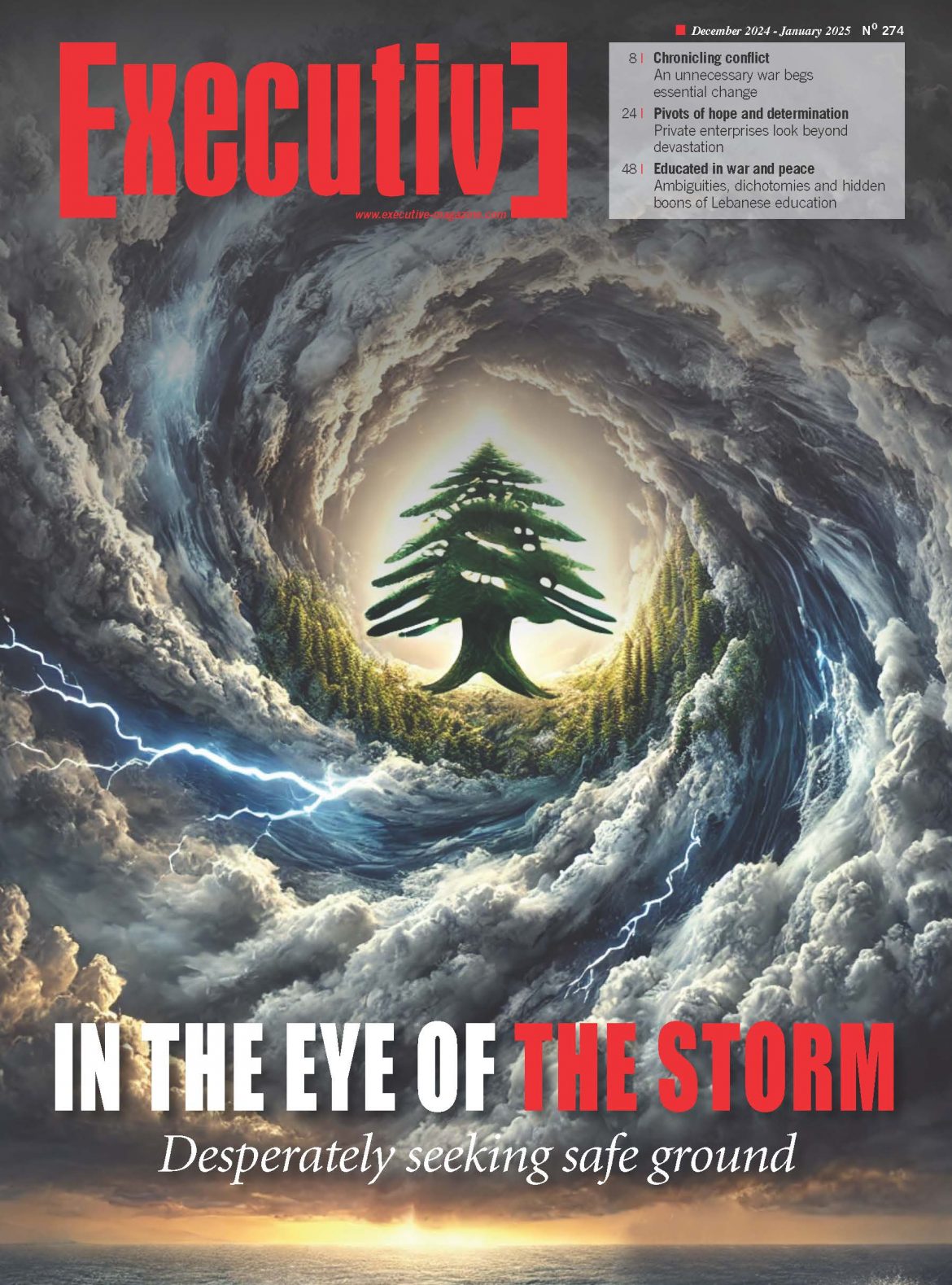
This year, the cover message is taking a step beyond the previous years’ context of “last hope”. Our first-ever cover constructed with use of an AI machine agent approaches the outlook at the turn of 2025 from a perception of momentary respite and calm – but with an implicit expectation of several more years of challenge, unpredictability, and risk accumulation. This perspective of resilient but bounded determination and hope is informed by our 2024 coverage focuses of the country’s two defining problems of the past year that, not by coincidence, also count among the top global challenges of the decade: war and migration. 

Historic context

In the national and regional arena, Executive magazine’s assessment of the coming period, spanning an unknown number of months and years but hopefully not lasting deep into the 2030s, is to be seen in a historic context of the post-(1992)-conflict decades. This multi-year perspective is reflective of complex and conflicted development phases that started with the region’s balance-altering turbulences of the early 2000s.

This particular phase of Middle Eastern troubles was marked by the American adventures of trying to achieve regional democratization under their imperial and hegemonic agenda as well as by fake local pledges of political reform and economic democracy, which were both inherently disingenuous and badly disrupted by the 2006 war between Israel and Hezbollah.

The unachieved ambitions and promises of the 2000s subsequently morphed into regional power competitions, arms races, and diplomatic conflicts, along with emergent social attitudes and new mentalities that nurtured the Arab winds of change of the 2010s.

Thenceforth, the region witnessed state ambitions of seeking regional hegemony (in which the paralyzed Lebanese state plays no part) and societal movements (in which Lebanese civil society played a late and very noteworthy, peaceful role) of accumulating but unsated hunger for change.

After the pandemic and corona panic disruptions of 2020/21, the unmet change impulses of the three previous decades, to put things in a very simplistic summation, have coalesced into a regional vortex of power shifts and uncertainty that affects every country in the MENA region, from the richest to the poorest.

Expecting this Middle Eastern vortex to calm this year or next into a peaceful and prosperous new status quo is like expecting the most ambitious global climate goals to be met and climate risk mitigation in small island nations to be financed by the incoming US administration.

Multiplicity of old and new factors that feed the whirlwinds

Dedicated stakeholders in Lebanese recovery, who are invested mentally and practically into the future of this region, have to be cognizant of the old historic blunders, colonial sins, ideological entanglements, and the entire fateful 20th century trajectory of the Middle East’s troubles that have no single originator and guilty party behind them – which by the way requires disregarding how most of the region’s narratives in books and entire libraries are imbued with biases. Additionally, forward looking stakeholders have to be even more highly aware that the region is witnessing a likely to be short episode of calm in a calamitous period.

Drivers of intense challenges over the coming decade or more include the real and divergent perceptions of the region’s arrested economic development; of its social inequity and upheavals; of identity seeking and religious searching; of tribal and quasi-feudal conflicts; of political and militia-driven confrontations on national and subnational levels; and, decisively, of hegemonic interests of firstly the US and Israel but also including ambitions of regional overlord dynasties and Asia’s rising geopolitical powers. 

As Lebanon suffered the inhumanity of war in a new installment during 2024, the past year indisputably carries an overburden of days of infamy. Recording their timeline from an unbiased and impartial but impassioned national perspective was one of the duties that this magazine felt honor-bound to fulfill in our turn-of-the-year issue. By Executive’s reckoning (see timeline of open war page xxx), this regional arc of conflict-boosting dates spans from October 7 and 8, 2023 over April 1 and 13-14, July 30 and 31, September 17-18, 23, and 27, October 1 and October 26 to the date of a partial ceasefire under a – from the perspective of sovereignty and genuine peace, fake and disingenuous – coercive agreement on November 26, 2024.

Given this most recent and so far worst-in-century episode of the country’s victimization, all stakeholders in the Lebanese economy, including this magazine, have to be excused for wishing the turn of the year 2025, and if not now then every year thereafter, to become the best-ever inflection point towards constructive peace (see our special report covering the positions of members in the Lebanese Private Sector Network and the policy asks of LPSN).

Wish one can. Hope one must.

However, an expectation of seeing world powers or the international community or some undefined law of history solve all of the structural and imported problems of Lebanon’s economy plus achieve a radical and lasting departure from regional war to non-war, would just shoot another annual star into a growing firmament of aspirations for a better Lebanon that has already been wished upon with unfulfilled hopes.

The real power behind a wish

Historians may debate whether the unrequited currents of change of the Arab Spring or the terrorist revolt of a faction among the Palestinian people against their slow suffocation actually were the key headwaters feeding new whirlpools of regional conflict. What has been revealed in the course of the past six months, however, is that immense human energy and destructive ingenuity has been poured into preparations of mercilessly attacking and killing Israel’s declared and presumed enemies over the course of the past 20 years.

What then is the chance of stopping the violence of regional warmongers, or the maiming by foreign bombs, or the mental health trauma inflicted by dehumanizing enemy propaganda? Wouldn’t it be a perilous dream to believe that an endless litany of reiterative declarations by international institutions and individual global figures,  that has in the past 15 months been unable to stop genocide in Gaza, could suddenly work on regional level ?
If you spectate into 2025 from any capital in the region between Tunis and Tehran, migration is a peril and war is a risk you face. Genocide is a reality, not a useful word in civil society campaigns seeking for new UN declarations with high appeal to the intellectual elites of governance globalizers and cultural colonizers. The recurrence of war and all the inhumanity that goes with it, is counterfactual to the idea of a linear progression towards an enlightened liberal market economy as the ultima ratio of history. It is Samuel Huntington’s The Clash of Civilizations and the Remaking of World Order, more than Francis Fukuyama’s The End of History and the Last Man. 
Through the peculiar Lebanese lens, the image of rebirth from fire and ashes is not an empty myth for this small country with its unloving neighbors but a potent allegory for what a few good people constructively working together in a polity, can do. The raging storms of human fear and aggression and stupidity will not magically cease thanks to a Parousia of paradisaical, top-down, global governance. This reality is only a signal for Lebanon’s determined stakeholders to undertake all the more investments into local networks and solidarity, education, coexistence, political reason, and autochthon economic development and formalization.  
Hope and revelry, aspects of humanity that time and again irrepressibly emerge from our depths, are the heralds of every new start. But if one hopes for peace to triumph in the Arab Middle East, one must also consider the myriad forces working against that peace; resolving to face reality with courage might be a more achievable aspiration.

January 11, 2025 0 comments
0 FacebookTwitterPinterestEmail
LebanonLebanon UprisingTimeline

Chronicling conflict: An unnecessary war begs essential change

by Marie Murray & Aline Nassar January 8, 2025
written by Marie Murray & Aline Nassar

Click here to view the timeline

The writing of our forthcoming issue, which began during the second phase of this timeline and ended during the fourth phase, has been chronicling the experiences of the real estate sector, the hospitality sector, industry leaders, humanitarian responders, agro-food entrepreneurs and representatives from the agricultural sector, the transport sector, and leaders in the private sector at large. Over a year of war—including nine months of intensifying, mostly cross-border exchanges that led to an Israeli escalation into open war lasting nearly three months—has wreaked havoc on Lebanon and its economy. There is a tendency to compare the 33-day July war of 2006 to this latest conflict, but the context and scope of these two wars are vastly different.

The July war of 2006 began after the kidnapping of five Israeli soldiers by Hezbollah, an alleged attempt to secure a prisoner exchange. The very next day, Israel bombed the Beirut Airport, and widespread destruction of civilian infrastructure ensued, including the bombing of bridges, power plants, the enactment of a Naval blockade, and the widespread use of cluster munitions that took years of demining work to remove.  Hezbollah emerged politically stronger after 2006, with much of the country unified against Israeli aggression. The direct damages from the 2006 war totaled $5 billion according to a 2007 Lebanese government report, with the destruction of 30,000 housing units and extensive damage to infrastructure. Key sectors like tourism and agriculture were devastated, setting back Lebanon’s economic growth by years.

On October 8th, 2023, Hezbollah took the unilateral decision to fire rockets into northern Israel after Hamas’ October 7th, 2023 terrorist attack, a response that deeply divided the Lebanese population. Hezbollah Secretary General later referred to the rocket attacks as a “support front” aimed at supporting Hamas and Palestine by forcing the IDF to fight on two fronts. The parallel war on Gaza, that quickly turned into a genocide with the killing of thousands of civilians, continuous withholding of aid by Israel, and mass, repeated displacements increasing exponentially over the months following October 2023, elicited anger and popular protests from the Arab world and from Israel’s neighbor, Lebanon. However, much of the Lebanese population regarded Hezbollah’s support front as more of a threat to Lebanon than a means of stopping the Israeli Defense Force (IDF)’s brutal revenge campaign on Gaza and the West Bank. After repeated United Nations Security Council ceasefire resolution vetoes by the United States, Israel’s primary and indefatigable funder, and after Prime Minister Netanyahu received a three-minute standing ovation from the United States congress before his address, the message couldn’t be clearer: the IDF would continue its mass devastation in Palestine, and not only would they be permitted to continue human rights violations on a mass scale, they would also be supplied with all the weapons needed to do so.

Those loyal to Hezbollah championed the Axis of Resistance, while those disillusioned with Iranian foreign policy dictating decision-making for Lebanon felt dragged into yet another war for which there would be no winner. Over a decade of Israeli violations of Lebanese sovereignty enabled the kind of illegal information-gathering and covert schemes that made the pager and walkie talkie attacks of September 17-18th possible, and then dictated the direction and scope of the following months of all-out war.

In this post-ceasefire phase, which ends on December 9th in the timeline but is still ongoing in reality, much remains uncertain. Syria’s fate, closely linked to Lebanon’s, has taken a colossal, yet still developing, change of course. Israel continues its attacks in southern Lebanon and its drone surveillance of Lebanon at large. Hezbollah has emerged politically and economically weaker. Lebanon’s economic losses remain unquantified, but the destruction has compounded Lebanon’s pre-existing economic collapse, with little fiscal capacity to recover. Southern Lebanon, a critical agricultural region, has been heavily bombarded and attacked with white phosphorous. According to the Lebanese government, at least 37 villages have been flattened. And Israel continues its rampage on Gaza and the West Bank. Lebanon’s best hope at this point in its long and storied history, is to take ownership of this moment as a chance to reclaim its broken governance and free itself from the dictates of external foreign policies and repeated violations of sovereignty.

click here to view the timeline.

January 8, 2025 0 comments
0 FacebookTwitterPinterestEmail
Economics & Policy

Collective solidarity: An overlooked marker of economic health

by Marie Murray & Aline Nassar January 7, 2025
written by Marie Murray & Aline Nassar

A hard look at Lebanon through an economist’s lens would reveal that the national outlook is dismal, the damages accrued during the latest war are staggering, and the political future of the country is fragile and indeterminate. Thankfully, there are plenty of other lenses through which to view a country and its people, and these various angles can illuminate even economic truths that may be overlooked by global economic assessors such as the World Bank or International Monetary Fund.  If economics can be boiled down to people’s behavior around material wealth, production, and consumption, Lebanon shows high levels of strength and a remarkable capacity for collective economic support.

Amid the devastation wrought by the past year of war, Lebanon has demonstrated—once again, as after the Beirut blast and in other periods of catastrophe—its singular capacity for a nearly nation-wide mustering of support and show of solidarity. Despite facing relentless attacks on its infrastructure, the country’s citizens, organizations, and private and public sector institutions mobilized to address the escalating crisis in a collective humanitarian response.

Lebanese healthcare workers have continued their lifesaving efforts despite being under direct threat. Hospitals and clinics have been targeted in multiple airstrikes, forcing medical staff to operate in perilous conditions. Field hospitals have been established in makeshift locations to ensure emergency care reaches the injured, even in areas where former medical facilities have been destroyed.

Ambulance crews and first responders have risked their lives to rescue civilians trapped under the rubble, often venturing into areas still under attack while knowing that medical personnel and facilities became deliberate targets during the war. Reports detail instances of paramedics working without pause despite the bombing of ambulances, medical centers, and civil defense centers. The Lebanese Red Cross and other humanitarian organizations, of diverse secular, religious, and sectarian backgrounds, have played a critical role, coordinating these rescue missions and providing essential medical supplies amid shortages. In total, at least 241 medical workers were killed while on duty during the conflict.

Lebanon’s food aid response has been prodigious, with local organizations, municipalities, and international aid groups mobilizing to deliver over 50,000 tons of food supplies to displaced families, as reported by the Lebanese Food Bank in December 2024. According to Caritas Lebanon, a Catholic aid organization, volunteer-run kitchens in Beirut, Sidon and Tripoli prepared 20,000 meals on a daily basis for displaced families. The scale of both the need and the response has been so immense that figures are difficult to quantify. In the private sector, local farmers and industry operators have contributed to nationwide efforts and created networks of support and resource-sharing platforms, pooling and lending resources to ensure basic needs are met and to keep economic activity afloat.

With upwards of a million people displaced during the height of the conflict, Lebanon transformed around 1200 of its public schools into shelters to provide immediate refuge, turning classrooms, playgrounds and public halls into havens from violence. According to UNHCR, shelters in Beirut alone housed over 10,000 people, with churches and mosques opening their doors and serving as focal points for aid distribution. Many local NGOs appealed to the Lebanese diaspora for donations, and in some cases, Lebanese expats organized fundraising channels.

Lebanon’s strong interdependent network of formal organizations and informal familial or community structures that serve as a safety net in lieu of public sector support does not factor into economic assessments conducted by organizations such as the World Bank. It is, however, Lebanon’s surprisingly sturdy lifeboat that steers the country through repeated storms. But lifeboats, however dependable, are not meant to do all the heavy lifting; it is imperative that Lebanon get its proverbial ship in order if the country is to have any chance at making it through future storms alive.

January 7, 2025 0 comments
0 FacebookTwitterPinterestEmail
Economics & PolicyEducationEducation plan

Educated in War and Peace

by Thomas Schellen January 3, 2025
written by Thomas Schellen

It is self-explanatory that the war on Lebanon has affected extant education systems badly. For different providers in the country’s fragmented educational landscape – one that has long been flagged for “co-existence of multiple systems with sharply different quality levels” (2015 World Bank Lebanon systematic country diagnostic), the 2024-25 academic year was disrupted just as it was about to start or had barely begun.

Under the initial conflict shock, institutions at all levels of formal education were mandated by the Ministry of Education and Higher Education (MEHE) to temporarily suspend operations from the first day of intensification of enemy attacks on September 23. An emergency response plan with a projected funding need of $25 million was devised by the ministry with UNESCO collaboration and presented on October 15 to international donors. The plan determined November 4 as the revised start of the academic year. Depending on circumstances, however, the closures of educational institutions extended for varying periods; for a few and privileged learners, schools opened in mid October but for many, access to education was periled deep into November.

With official estimates of affected students and teachers across Lebanon in the middle of the conflict exceeding 500,000 and 45,000, respectively, private primary and secondary schools from the first day saw irredeemable impacts of teachers being displaced and students being traumatized; public schools additionally were turned into shelters. Pupils were divided among the few with calm and relative safe remote learning environments and the technical means – devices and connectivity – to utilize online learning versus all the others who were displaced and/or disrupted on multiple vectors in their learning journey. 

Tertiary education institutions, at least those in the top tier of private universities, fared not totally as bad as other schools. Remote access to classes was easier to manage for universities than for schools. However, universities were in no way spared the traumas of losing students to war. Consequently, some lecturers were traveling and so were some students.

Care for the mental stability and health of students, lecturers, and staff became top priorities. Mental health support and provision of psycho-social services were entwined with material aid deliveries in a flood of volunteer aid that involved school managers and staff, nonprofit organizations, educators and learners on all levels. 

A critical assessment of the education emergency response mechanism by think tank The Lebanese Center for Policy Studies notes that previous experiences of education shocks, including wars, have not led to adoption of a law for education management in times of crisis. For analyst Carlos Naffah, the shock of the latest war underscores that this failing needs urgently to be remedied. He writes that “a draft law on education in emergencies” must be developed by the Ministry of Education and Higher Education and other stakeholders.  

Known and unknown quantities

Estimates of the conflict’s economic cost and recovery cost dimensions in education are far more elusive than those of sectors in economic life where impacts are immediate and visible or can be projected over months and years instead of having to be calculated in decades. A material war impact analysis in the World Bank Interim Damage and Loss Assessment (DaLA), published in mid-November, apportioned to the education sector economic losses of $215 million from October 7, 2023 to Sep 27, 2024.

These losses were described as tuition losses at private schools (92 percent of assumed losses, mainly in the first term of the current academic year) and cost of temporary schooling arrangements, a ballpark estimate of $75 per learner for roughly half of the report’s estimated 450,000 displaced students during the fall term of 2024. Irrespective of the fragility of estimates constructed under duress of an at the time unended conflict, the combined amount of tuition and operational losses is a paltry projection equivalent to 4 percent of the World Bank’s entire (also by definition incomplete) economic loss estimates for Lebanon that according to DaLA stood at $5.1 billion for the assessed period  (in addition to $3.4 billion in estimated damages, which is the immediate and blatant visible impact).

Notably, DaLA provided no estimate on damages to schools during the war because of few such reports having been received. But even with the caveats of covering only the first week of full Israeli aggression and not imagining future losses of earning power, the $215 million economic losses estimate for education appears at best rudimentary. This is not only because losses were estimated at a time when the end of the open war was not yet is sight but also in the sense that the estimate does neither hint at the dimensions of long-term impacts on the provision of more egalitarian education and creation of vital human capital (which in some other World Bank papers had been described as the country’s greatest asset when human capital is contextualized with natural, financial, and physical or constructed capital) nor addresses with a single word the value, quantity, and quality of the contributions which educational entities make to Lebanese GDP. 

Lastly, notwithstanding the DaLA’s cautionary statement that economic losses are to be expected over many coming years in the education sector due to lost future earnings and development impact but are outside of its scope of war impact assessment, the paltry $215 million partial estimate of economic losses in education pales possibly even more when compared to 12-month economic losses in agriculture and commerce ($1.13 billion to Sep 27 and $1.67 billion to Oct 27, respectively) and damages in the property realm (82 percent of the total damages estimate as of Oct 27).

Towering contradictions cast their shadows over future education

The challenge of valuing Lebanese education economically is juxtaposed with the high value that society attributes to education, as shown in private households’ strong funding allocation to their children’s education despite a comparatively low return on human capital in the Lebanese economy. The contradictions that are embedded into the private financing environment of schooling are moreover exacerbated by the weakness of local research into the sector’s economic importance.

Paucity of data on the direct, indirect, and induced GDP contributions of Lebanon’s primary, secondary, and tertiary education providers is endemic. Some promising but isolated studies, such as the Lebanese American University’s 2017 investigation of LAU’s economic contributions at Beirut and Byblos campuses, have yet to be followed and widened. Plus, the shock of becoming victims of asymmetrical conflict escalations has not been conducive for researching far-flung implications of war on Lebanese education.

Still, preliminary analyses or “rapid assessment” exercises were attempted already during the time of high conflicts and displacement. For example, a stakeholder survey of 18 local nonprofit organizations in the education field was conducted by humanitarian and development sector-focused consultancy 360 Consulting, and commissioned by NGO Lebanese International Financial Executives (LIFE). 360 Consulting found, to no sentient stakeholder’s shock, that “the Ministry of Education and Higher Education faces challenges in ensuring quality education for all students, especially displaced ones.”

The stakeholder consultations further revealed that “a wide range of initiatives” had emerged within a few weeks from the start of open warfare and sought to reach displaced students through flexible learning approaches and offer psycho-social support but were handicapped by operational barriers and absence of stakeholder trust in the Lebanese government. According to the consultants, urgent needs and long-term needs have to be addressed in equal measure, from short-term financing, technical and mental health support to ramping up the involvement of communities in education and the ongoing investment in capacity building of teachers. 

Beginning with a comment in the World Bank DaLa and a reference in the above cited paper by 360 Consulting, it is widely recognized that the war shock has disrupted Lebanese education stakeholders, recipients and providers, at a time of historic fragility.

Economic restraints had already been weighing on public schools and teacher salaries in the early 2010s when spatial crowding of classrooms and challenges of addressing the schooling needs of refugee children were reflected in diverging school achievements as described in international assessments.

Farther along the same worrying trend of widening inequalities, the just published 2024 World Bank systematic country diagnostic – an analytical exercise that is a prerequisite for a presentation of a country partnership framework (CPF) to the World Bank board – cites PISA outcomes of 2018 and 19 for documenting the juxtaposition of a few high-performing schools with many low-performing schools, as well as huge downside gaps equal to more than six years of education attainment in reading scores between highest and lowest scoring schools.

All indications since point to further weakening equality in an already unequal system. Pandemic lockdowns and then the economic meltdown’s cost pressures culminated in the war of 2024 as the peak of problems that forced schools to hike tuition and parents to switch schools or even forego enrolling their children in schools that were acceptable.

Historically, Lebanese annual state expenditure on education has been eclipsed by private tuition spending, which was strongly reflected in knowledge attainment advantages in private schools. However, the onset of the economic crisis years in 2019-20 saw the ratio of private school attendance drop five percentage points and losses in effective years of learning per student have mounted in the two following years.

Combined with the deterioration of governmental financing and institutional guidance capacities due to erosion of fiscal revenues and public sector human capital, the pre-crisis inequality in the education sector is by many indicators on the increase. The World Bank’s latest Systematic Country Diagnostic (SCD) warns for example that the human capital index ranking of Lebanon has fallen below world average and suboptimal human capital generation of Lebanon today could cost the country hundreds of millions of dollars annually “in the coming decades”.

Shattered hopes for the current academic year

When Executive started inquiring about expectations for the coming academic year in the summer, educators and school administrators were just beginning to hope that the 2024-25 academic year would bring a gradual recovery of lost quality and peaceful learning after a period of intense pressures. This hope was shattered at least in the short term and pushed aside by the prospect of further losses in effective learning years by students of all cohorts.

Nonetheless, the war shock of victimization felt all across society’s multiple education systems enforces the realization that the stretched fabric of the Lebanese education sector is woven not so much in the way of an organized system of state-funded institutions with government-designed curricula and uniform pedagogic aims but rather comprised of a myriad of aspirations of diverse stakeholders.

On the upside of the dismal lens of education goals related to social justice, the response to the war shock suffered by all strata in society has thus inversely become a renewed testimony to educational aspirations even as the public sector constraints appear more severe than ever.

Defying defeatism

Like the education institutions that exist in Lebanon in large diversity, the societal investments into the next generation span from profoundly religious to convinced secular. They entail voluntary and non-tax based financial support efforts consisting of remittances to extended family members as well as fundraising contributions.

The human energy behind people-power efforts to keep the torches of education burning brightly is all the more visible against the darkness of the war, albeit with the strong caveat that no amount of private interest and volunteer giving can substitute for state capacity and public policy. As such, the citizen-driven education support is neither conducive to quantitative analysis nor appears geared toward a universal education model of egalitarian dreams. What makes it important, is the intensity and quality of grass-roots familial support efforts, the determination of civil networks that are mostly away from the limelight, and positive views on Lebanese education held by stakeholders. 

When asked about the value that they attribute to and have personally derived from their education journeys in periods that were never entirely unscathed by external disruptions, leading members of non-governmental network Lebanese International Financial Executives  – archetypal members of the successful Lebanese diaspora – respond unequivocally that the secrets that made them succeed as entrepreneurs in foreign economic environments were to a large part comprised of the education and values they had been imbued with in their home country.

“When you are [living in] the diaspora, you feel that this is really what made you,” says Zeina Farhat, managing director of LIFE, attributing the successes of Lebanese like herself to a combination of personal upbringing, and a large contribution of their families’ investments into their higher education. “That is key to who we have become,” she says and affirms, “We who are supporting education in Lebanon have a very positive perception of the level of education that we have in the country.”

Not at all a statistic

The truth of the Lebanese education sector, as far as one can claim for truth to be a valid human construct, is in a huge diversity of stories that in many instances show the polar opposites of being faced with extreme circumstances caused by both systemic and unforeseeable issues on one hand and celebrating a uniquely human aspiration and love for knowledge on the other. These are stories that journalism can only capture in the tiniest dosages of serendipitous encounter.

Hala and Wajdi are middle-aged educators and colleagues to one another. I meet them by coincidence in an urban intermediate school in Beirut. As teachers, they are the first people you expect to meet in a school, and I am glad to learn that they work as education professionals imparting on their early-teen pupils knowledge in the oft-lauded STEM realm, biology and physics. Their names can be interpreted as the Arabic terms standing for beauty and passion.

But the encounter with Hala and Wajdi today, a Thursday in the first half of November, in a narrow hallway set up as makeshift teachers’ lounge, comes with two incredible twists.

Firstly, their students are not in their classrooms but attend remotely and the two teachers say that they have recently started conducting virtual lessons. About one week after the – by war and displacement deferred – beginning of the academic year 2024-25 on November 4, both science teachers started conducting online lessons. Neither has access to laptop computers – Wajdi’s machine was destroyed in an airstrike – and so they teach from their mobile phones.

Their students are attending class from home, or from refugee shelters where they have been forced to live as internally displaced people (IDPs) after their hometowns and villages have been targeted by aerial destruction. Many students at best have access only to low-end smartphones, or not even those. As many of her pupils lack devices or connectivity to such a large degree, she has resorted to sending them pdf images of lesson materials, not files, Hala tells Executive.

In the second twist of vicious fate forced upon them by Israel’s war on Lebanon, both teachers have no choice but to conduct virtual classes despite the evident paucity of online classrooms under such circumstances. That is because it is not only their students who are unable to come to class. The two teachers, and their families, are refugees themselves, forced to shelter as displaced people in their own workplace. Their own high school and university-age children have taken refuge in their textbooks but having no laptop computers, they cannot follow classes themselves, even online.

Still, they consider themselves comparatively lucky and would not want to be moved to the uncertain environment of another shelter, such as a container village. During their stay at the school and counting among the 20 percent of internally displaced refugees who were quickly registered with the UNHCR, the school’s director, supported by Hala, Wajdi, and others, succeeded in keeping order among the 37 families with a total of 125 members who were sheltering in the facility. All were well provided with essentials such as meals, water, and electricity, but deprived of specific supplies for individual medical needs and elements that are bare necessities for a normal life of dignity. And yet they self-organize their existence in a shelter of the greatest order, mutual support, good cheer, and with moments of laughter. 

Built upon such excellent personal experiences, it seems that education support is woven into the organizational DNA of LIFE. Although or perhaps exactly because it presents a larger spectrum of financial experience and business minds than some other advocacy-for-change agents in Lebanese civil society, LIFE from inception in 2009, “was born with the willingness of investing in education,” Farhat elaborates.

According to her, the NGO was conceived 15 years ago in the realm of financial expertise, where Lebanese born achievers are dispersed all over the world. The founding idea was seeking to bring structure into the Lebanese diaspora through its professional network but from the moment of its formation, LIFE began engaging in education grants for deserving students and employment support of grantees as the organization’s first fundraising focus and “other mission” than strengthening its own network. “Prosperity and social mobility are at the core of what we are doing. [Our currently] 1,400 members around the world are contributing to education of human capital as the only asset that we have in Lebanon,” Farhat says.

Lara Koro, the organization’s director of Nurture, adds that the LIFE scholarship program is distinguished by “the way that we want to nurture and empower the future generation and provide them with access to education and employability.” Farhat and Koro explain that the worsening condition of the Lebanese economic fabric motivated LIFE in 2019 to redirect its scholarship focus away from students who enrolled in post-graduate programs at prestigious international universities and henceforth allocate 80 percent of its education budget to students based in Lebanon.

Since its inception, the scholarship program has invested $16.5 million in education. It supported more than 1100 individuals and the pool of supported students has grown from a mere two students in the first iteration to several hundred in each academic year, Koro says, adding how the ethos of the LIFE network extends into its scholarship program: “by supporting students, we will have them support other students in the future.”

“We have grown seven-fold in the last three to four years and have a pool of over 400 students for this [academic] year of 2024-25, of whom 75 percent are based in Lebanon“, she adds. According to Koro, the program has resulted in ca 200 new graduates annually, in Lebanon and abroad, in each of the past few years. “Seventy-five percent of the students who are graduating [locally] with support by LIFE are finding opportunities in Lebanon,” Farhat emphasizes. According to a media statement, the fundraising efforts of 2024 yielded $2.1 million for education, with 432 beneficiaries. Additionally, a Lebanese Education Emergency Fund was launched in partnership with US-based NGO LebNet.

While a prominent one, the example of LIFE’s dedication to education made in Lebanon is only one image in the multi-faceted picture of civil society support for education and this picture in turn is only one stone in the mosaic of a society that is deeply attached to their identities, to which education is a historic value-added. In the people’s show of resilience through solidarity and their open defiance of the inhumane victimization of normal villages, which hundreds of thousands have demonstrated through immediate mass returns to their battered hometowns and villages after November 26 of this year, the ten weeks of war and invasion have reinforced the mental idea or utopia of Lebanon.

The astounding scope and width of the solidary efforts made during the open war cannot be adequately captured through anecdotal journalism or a bird’s eye analytical lens. Macroeconomic and political contexts in the region, under assumptions of which the viability of scenarios for Lebanon has been circumscribed, have been thrown into the grinder of conflict politics. The 2024 SCD paper acknowledged the two overarching constraints, the second and constant of which was the “turbulent regional and international environment” (the other was “institutional paralysis” – in 2015, this constraint was fashionably labeled “elite capture”).

This fundamentally external constraint of regional conflicts has become a black hole for any planning and modeling of realistic regional futures, let alone Lebanese ones, which means that this country is once again exiled into a wasteland of merely imagined economic opportunities and reforms. Neither a “muddling through” nor a “recovery” scenario – the two options envisioned in the production of the 2024 World Bank systematic country diagnostic – is a plausible recipe for addressing the confluence of new challenges that will determine the framework of Lebanese needs and development priorities over the coming five years.

As a sector whose constraints are co-determined by the region’s proneness for conflict, the evidence of the past in conjunction with a look at the state’s financial and human resources suggests that the fiscal and operational obstacles to education reform in Lebanon will be enlarged beyond their already overpowering intensity of the past five years. However, at the same time education will be further heightened in importance for private households and stakeholders in almost all productive sectors.

On the bottom line of the equation, advantages of those with a top-level education will be at least as impressive as they were in the decades of reconstruction and development after 1990, yet egalitarian education ideals may be pushed back farther versus human capital generation that, in a Middle Eastern post-conflict environment, might effectively be empowering a reliable regional development elite that is rooted in Lebanon.

January 3, 2025 0 comments
0 FacebookTwitterPinterestEmail
Brand VoiceLife

by Philip Morris Management Services December 30, 2024
written by Philip Morris Management Services

Many find the smell of cigarette smoke unpleasant as it lingers in the air or sticks to clothing and hair. It can be off-putting for the ones we love, but switching to a smoke-free product can make a big difference.

If you want to keep those you care about close, surround them with love – not cigarette smoke.

Quitting tobacco and nicotine altogether is the best choice a smoker can make, but many don’t. Products like nicotine pouches, snus, heated tobacco, and e-cigarettes deliver nicotine in different ways, without burning. When there’s no burning, there’s no smoke for you or those around you.

But as well as being the more considerate choice, smoke-free alternatives are designed to give smokers a better alternative than continuing to smoke.

Kiss Cigarettes Goodbye

Harmful chemicals are released at high levels when tobacco is burnt. These are known to be the main cause of smoking-related diseases like lung cancer. But smoke-free products are free of smoke, which means they can produce considerably lower levels of harmful chemicals.

Of course, they’re not risk-free and contain nicotine, which is addictive, but the reduction in harmful chemicals makes them a far better choice for adults than continuing to smoke.

Smoke-free products exist to give smokers who don’t quit a better choice. If you want to make a positive change for yourself and those around you, learn more about smoke-free alternatives.

Brought to you by Philip Morris Management Services – Lebanon.

December 30, 2024 0 comments
0 FacebookTwitterPinterestEmail
BankingBanking & FinanceBusiness

Banking on reform: Amending our banks to support reconstruction

by Mounir Rached December 27, 2024
written by Mounir Rached

In the aftermath of Lebanon’s devastating financial and socio-economic crisis, the reconstruction of the banking sector and restoration of macroeconomic stability demand urgent and sophisticated interventions. This crisis, characterized by the collapse of depositor confidence, war-induced infrastructural devastation, and institutional dysfunction, requires a systematic resolution of the deposit crisis as the cornerstone of a broader recovery framework.

Efforts by Banque du Liban, the central bank of Lebanon, have provided limited liquidity through initiatives such as Circulars 158 and 166, the first issued in June 2021 / updated in November 2023, the second issued in February 2024 and amended in October. This is an approach grossly insufficient to meet the urgent economic and social needs of the population. The government’s handling of dollar-denominated deposits has exacerbated the situation through measures that are legally and ethically indefensible. These include writing off up to 90 percent of deposits by transferring them to phantom entities, converting them into non-performing sovereign bonds, or exchanging them for Lebanese pounds at egregiously undervalued rates. Such mechanisms have irrevocably damaged public trust in the financial sector and further eroded confidence in state institutions. Despite objections from Lebanon’s state legislative council, key parliamentary blocs, and depositors themselves, these measures persist, highlighting the government’s reluctance to confront the structural dimensions of the crisis.

A sustainable resolution necessitates the comprehensive restructuring of the relationship between the central bank, banks, and the government at large. The integrity of deposits must be preserved on commercial banks’ balance sheets alongside corresponding liabilities, namely, the deposits held by commercial banks on behalf of their clients at the central bank. The outright cancellation of these deposits not only lacks legal justification but also risks compounding the central bank’s fiscal and operational challenges. Retaining these obligations within the central bank’s balance sheet ensures transparency and aligns with the broader framework for crisis resolution. Moreover, arguments positing that these liabilities obstruct monetary policy are unsubstantiated; on the contrary, the annulment of these obligations would expose the institution to further legal scrutiny without yielding any operational advantage.

One pragmatic intervention to address liquidity constraints is reducing the excessive unjustifiable reserve requirements on foreign currency holdings imposed on Lebanese banks. At present, these reserves total $10.7 billion—a figure among the highest globally. Reducing the reserve ratio to the international average of 2 percent would unlock approximately $9 billion in liquidity, which could be distributed to depositors as an initial repayment of 10 percent of their frozen accounts. This measure would provide immediate relief and constitute a pivotal step toward restoring confidence in the banking system.

In addition to releasing mandatory reserves, the central bank holds approximately $25 billion in gold reserves, a critical asset accumulated through decades of depositor contributions. Allocating half of this reserve—approximately $12.5 billion—to provide supplementary liquidity for banks could further alleviate the deposit crisis. Together, these actions could return approximately 24 percent of frozen deposits to account holders. This dual approach is supported by Lebanon’s legal framework; Article 75 of the Code of Money and Credit explicitly permits the central bank to leverage gold reserves to stabilize liquidity, contingent on coordination with the Ministry of Finance.

The reluctance to utilize gold reserves reflects a misinterpretation of their role within monetary policy. Gold, as a universally liquid asset, can be readily traded in global financial markets. Contrary to conventional objections, deploying a portion of these reserves is not only legally permissible but also economically prudent, particularly in the context of Lebanon’s acute financial crisis.

However, technical solutions alone cannot restore depositor confidence. Fundamental reforms to monetary governance are imperative to address the systemic issues underlying the crisis. A critical step is the abolition of Lebanon’s outdated dual multiple exchange rate system, which perpetuates economic distortions. The adoption of a fully liberalized exchange rate is essential to fostering market equilibrium and avoiding the recurrence of monetary instability. While the current exchange rate stability is attributable to fiscal discipline, it remains tenuous in the absence of structural reforms.

Another priority is addressing Lebanon’s placement on international “grey lists” for financial compliance deficiencies. Restrictions on capital outflows have curtailed the immediate risk of systemic flight, but long-term credibility hinges on transparent reforms that align with global financial standards. Encouragingly, a significant proportion of newly injected liquidity is likely to circulate domestically, addressing pressing consumer needs rather than exacerbating external imbalances.

The central bank’s primary mandate must be reoriented toward managing domestic liquidity, enforcing stringent regulatory oversight, and promoting macroeconomic stability. Its role is not to generate high returns but to safeguard public welfare and rebuild trust in the financial system. Current practices, such as the limited withdrawals allowed under Circulars 158 and 166, are grossly inadequate and contravene legal and ethical standards. The ongoing freeze of deposits without interest violates fundamental principles and the Code of Money and Credit.

Lebanon’s recovery depends on decisive actions to resolve the banking crisis and reestablish public confidence. These include returning liquidity to depositors, reforming exchange rate mechanisms, and responsibly leveraging gold reserves. Such measures, when combined with robust regulatory oversight and a commitment to institutional transparency, can set the stage for comprehensive economic recovery. The banking sector’s stabilization is not merely a technical challenge but a moral and strategic imperative for Lebanon’s broader reconstruction and sustainable development.

December 27, 2024 0 comments
0 FacebookTwitterPinterestEmail
Economics & PolicyTransport

A sector in motion

by Thomas Schellen December 23, 2024
written by Thomas Schellen

Transport leaders aspire to transform vital sector

The formal economic sector of transportation and logistics in Lebanon presents itself to the observer with two vividly contrasting faces. One face of Lebanese transport is the sad face of a sorely under-achieving economic sector hindered by high prevalence of informality and poor regulations. At the same time, the sector presents a hopeful and smiling face, with the character of a fascinatingly simple, easy to access, very low-tech mobility behavior app, that could quickly be accelerated into a vital engine of national economic enablement and growth.

Fundamentally, however, the baseline of all modes of transport in the country are overdue for change. It is not for no reason that the last 20 years have seen multiple civil society organizations advocate for better and safer streets (examples 1996-founded YASA and 2006-founded Kunhadi) and that international funders and donors repeatedly offered assisting in urban transport plans and bus programs (despite such schemes, also repeatedly, being aborted), or that the Executive economic road map for a better Lebanon already years ago compiled 16 (today still mostly outstanding) expert recommendations for strategizing transport. Even the country’s lawmakers over a decade ago saw reason to adopt a new national (and in some regions partially adhered to) traffic law.

Although no runways at Rafik Hariri International Airport and no major bridges or roadways were destroyed in the recent severe episode of Israeli military aggressions, it cannot surprise that transport and logistics enterprises suffered massively during the war, as the managing directors of two leading companies in the sector, express shipper Aramex and ground transport operator Ahdab Commuting and Trading Company (ACTC), tell Executive.

But true to the adage that an opportunity is hidden even in the worst crisis, Assaad Sebaaly, general manager of Aramex Lebanon, and Aoni Ahdab, general manager of ACTC, are optimistic. Being both members of the Lebanese Private Sector Network (LPSN) but active in distinct areas of mobility,they share the view that the current inflection point at the (hopefully definitive) tail-end of the war of 2024 accentuates the sector’s innovation potential for a profitable and equitable transformation.

“I have presented two budgets for 2025 to our board, a good and a worst-case scenario. I am fully confident that we will be able to go to the normal scenario and move with our budget as we used to do,” says Sebaaly.

“I have always been a realist but as Assaad says, this is the first time that we actually feel that something is changing,” chimes in Ahdab. He qualifies the positive scenario as simply the only one that can be worked towards because the sole other, non-positive alternative would signify complete disintegration of the nation’s fabric, something that is counterintuitive and in contradiction to the historic record of Lebanon’s ability to withstand recurring winds of ill fortune.  

Accounting for high and unrecoverable economic losses

Given how the strategies of the recent Israeli intrusions were focused on deeply destroying narrow targets, the broad area of transport was among the sectors in the Lebanese economy that were impacted economically but not hit as horribly by physical war damages in the September to November 2024 period.

This notably was in contrast to the 2006 conflict between Israel and Hezbollah where Beirut airport and essential road infrastructure were targeted from the first day of IDF air attacks under the devastatingly prevalent (and still threatening) “bomb Lebanon into the stone age” Israeli mentalities.

Both sides of the sector, interurban and intra-urban passenger transport on one hand and express shipping and package deliveries of commercial goods on the other hand, have been greatly harmed by direct economic losses and foregone revenues. 

Damages from destruction of transportation infrastructure and facilities, “were not too heavy but the impact was extremely heavy,” says Sebaaly. New bottlenecks in air freight due to the sudden pausing of Beirut services by 16 of 17 airlines made MEA stand out as the one operator that withstood the pressure.

At the same time, however, this thrust into a monopolistic situation translated into shocks of higher air freight cost and lower capacity – two very dangerous poisons for an express shipper and freight forwarder competing with tight margins in the globally integrated realm of running supply chains. This meant that from one day to the next “we had a serious problem as to availability of space for shipping necessary items to traders in Lebanon; the consumers were suffering, [and] we were suffering,” Sebaaly adds.

On the domestic side of Aramex’ business, which according to him generates the Lebanon operation’s main economic sustenance, the economic shock could be quantified in percentage-wise contraction of the high-growth, business line of e-commerce deliveries. “We were growing 20 to 25 percent year over year. If I compare August 2024 to August 2023, we had growth of 25 percent. If I compare September 2024 to August 2024, I had a drop of 70 percent,” Sebaaly says. And although the end-of-year holiday season is the high time of giving, and nowadays e-commerce, it will not suffice for balancing the months of being victimized. “I have more than half a million dollars in losses in two months. There is no way you can recover them as the losses are huge,” he adds.

At ACTC, the impact on business according to Ahdab was not as easy to quantify but assuredly heavy. Economic impacts were largely because of overheads, given that the war hit the company shortly after assumption of new bus operations when there was no expectation of profits yet. “We launched a bus project in July, with a plan to have all new bus lines operational by end of September to mid October 2024. The project entails 93 buses operating across 11 lines ”, Ahdab says, adding that seven of these eleven lines were forcibly delayed by the war.

Moreover, because of the war holding customer attention in its grip and because of ACTC’s almost 70 percent reduced presence of buses on the streets and highways, marketing campaigns had to be postponed. “Our overheads today are the overheads required to run all 90 buses but actual operation is currently about 25 buses,” he adds while declining to provide financial investment details and further expectations related to the bus project’s business plan.

Besides the need to maintain overheads and forced delay in implementing key components in ACTC business plan, the already operating lines were confronted with sudden spikes in traffic and expensive road congestions due to displacement of people onto roads that were already difficult to navigate for larger vehicles. 

Assembly and delivery of food aid packages under contracts with aid organizations and UN agencies is another ACTC activity where war-induced security protocols and increased costs of transport to villages in areas under threat were felt as doubling or tripling of each dollar consumed by transportation. Ahdab notes that the cost for a typical aid package could under the conflict impact balloon from $50 to about $75 due to a combination of increases in cost in imported foods, some price  gouging by dealers in locally sourced commodity foods, and cost increases in shipping and delivery.   

Economics of transport:
A people-driven and chronically dichotomous sector


Successful couriers are practically invisible individuals. They ideally make both their scheduled and sudden appointments on time and are in and out of an assigned client site with electronically signed delivery and pickup statements while the manager in charge calmly sips her coffee.

Yet these background actors or better stagehands of economic performance are the people that remain most essential even in the day of digitizing transport and futuristic delivery modes. However, since the age-old activity of transporting things to market and people to destinations started to grow into vast and sophisticated industries of logistics and transport in the early 20th century (the world’s number one logistics provider was founded in 1907, other giants of today have joined the global flock in the sixties and seventies), this all-encompassing services sector’s human agents are not always – but all too often – faced with humble career and development options, and/or lack of financial and professional appreciation.

This truth was thrown into sharp relief a few years ago, at time of the global coronavirus surge and panic. Frontline workers, including bus drivers and delivery drivers, were suddenly noticed, by politicians from New Zealand to Bavaria, as “heroes.” In Lebanon, the impact of Covid 19 on transport and logistics was strong enough to kick e-commerce, a forward looking but in local culture hitherto much rejected segment of trade, into high-growth mode.

The Covid 19 impact on frontline work did not come with the effect that those customer-facing and essential employees were no longer overworked and under-payed. But at least Big Tech companies, management and human resource consulting companies and tech startups began rolling out specialized apps and programs for the strengthening of frontline workers’ – some call them deskless workers under a cognitively negative definition of what they do not sit at – workplace integration, role,  recognition and rewards.

Just as the individual people in transport are essential but often unnoticed cogs in the economic machine, successful logistics providers are companies that often quietly solve transportation issues before they become costly business disruptions. On the passenger transit side of the sector, successful modes and operators of public transport attract little attention in smooth day-to-day provision of vital mobility services, making headlines only at time of fee increases, operational disruptions, or strikes.

Logistics costs by some estimates make up around 13 percent of a country’s economy on average but can vary between 8 and 25 percent, indicating that the necessary element of logistics produces jobs and incomes for direct stakeholders and is foundational to economic growth.

Inversely, in absence of constant efficiency monitoring and improvements, the economic activity of transportation creates huge and wasteful economic losses and blinding environmental costs. Insufficiency and breakdown of transport, whether because of absent modes and missed development or because of wasteful and excessive expansion, can ruin a commercial civilization.

This notwithstanding, the logistics and transport sector is often badly underestimated in its importance for the functioning of the globalized and increasingly digitized economies of nations. In Lebanon, the transport and logistics industry was described by the Central Administration of Statistics as contributing less than three percent to national GDP in 2019, with data for the sector apparently not reported since.

Hidden dimensions of transport

From a more macro-oriented perspective, no estimates on the dimension of economic losses in transportation have been offered in reports such as the World Bank’s mid-November preliminary damage and loss assessment paper. This DaLA report, however, notes that supply chain disruptions contributed to the 12-month economic loss estimates in “commerce”, which are $1.67 billion (22 percent of estimated losses across the entire economy) in the period from Oct 8, 2023 to Oct 27, 2024.

Both interviewees tell Executive that they have no knowledge of any recent assessment of the contribution brought by transportation and logistics to the national GDP tally. Dating from a near-mythical past six years ago, when the per capita GDP was widely cited as above $9,650 in nominal terms, a fact sheet on the investment promotion site IDAL attributes 2.9 percent GDP share to “transport”. This is a very low value for a normal, functioning economy and might in the Lebanese case be correlated to vague sector definitions and imperfect data acquisition from market actors.

Yet another crucial market determinant appears to be the prevalence of informality in this economic activity. It is at best guesswork how heavily the detriments of inefficiency, informality, illegality, or even criminal activity – Sebaaly points to the existence of fraudulent competitors who after a short period of operations abscond with revenues from delivery work they had won by underbidding legitimate operators with cut-throat prices – constrain the economic contribution of transport to the formal economy and hinder adoption of cleaner and more efficient modes of transport.

In a very quick calculation of informality impact on Aramex top line revenue, Sebaaly says, “I am losing 3.6 million dollars per year due to informality.” This is on basis of 200,000 delivered packages per month (according to him accounting for almost half of the Lebanese express shipment market) for which the company was forced by illicit competition to undercharge $1.5/package. Versus a fair price of $4.5 in the Lebanese market, selling at $3 “is a complete loss to us,” he sighs.

Uncertain but bright future

In spite of entrenched systemic barriers that have been accentuated by the recent war but also have other roots, the two interviewees speak emphatically about the value that their sector has added and can further add to the Lebanese economy.  

According to Sebaaly, the importance of logistics operations and specifically regional player Aramex was highlighted by the pre-war crises of the past five years. During the combination crisis of anemic banking and coronavirus pandemic, it was express shippers who delivered essential medications to hospitals, secured the circulation of goods between stores and consumers, and facilitated access to money for small and medium enterprises, he reckons. 

“The whole economy was up and running due to us,” he says, and warns, “if we, all the logistics companies, were to go on strike now and stopped importing and distributing, you would have no economy.” Growth of express shipping in the years that followed upon the Covid 19 panic, was exceptional. Specifically, e-commerce deliveries were kick-started by the pandemic lockdowns in Lebanon, he notes, with immense benefits to the digitized economy.

During the years from 2019 – universally known in the Lebanese economy as one-of-a-kind disaster experience – Aramex “grew from 180 employees five years ago to 330 employees today. We used to deliver 30,000 packages per month and now we deliver 200,000 packages per month,” Sebaaly boasts with the professional pride and natural marketer bite of an advanced-through-the -ranks executive, which actually is a sort of hallmark of globally successful courier enterprises.

The increase in logistics activity was sector-wide, he points out: “From 2019 until August 2024, the [shipment] numbers all over the market have doubled, or more. What is today 420,000  to 440,000 package deliveries [in the Lebanese market] each month, used a few years ago to be 150,000,” he adds.   

For Ahdab, whose contribution to the innovator ranks in Lebanese transport apparently testifies to the DNA of a 21st century tech entrepreneur, the path forward will have to be defined by technology and rule of law. In the latter respect, this begins with the basics of legal compliance such as making sure that drivers have licenses but no criminal record and their vehicles operate legally. Emphasizing the virtues of LAF veterans in disciplined operational environments, he evidently sees ACTC’s future in the best possible hues. All the while he also concedes that profit is not expected in the first stage of the venture but says revenue is increasing steadily.

According to him ACTC won its public bus line contract inclusive of being given a diesel-powered and somewhat aged vehicle fleet but has gone beyond what is required under their operator contract with the Lebanese state in terms of investing in technology for the monitoring, passenger safety, and traceability of the buses. “What we are trying to do is offer a modernized version of the model that you find when you travel to any city in Europe or developed country,” Ahdab says.

In the long term, he aims for 70 percent of profits to come from ticket sales and 30 percent from selling non-digital advertising space on and in the vehicles. The work force is to grow with time from nearly 80 today to 350 employees when all bus lines are in full operation. The buses are supposed to as soon as possible run on clearly defined lines with designated bus stops, tracked by an app that shows commuters in real time where their bus is, and a bouquet of numerous ticketing options. Ahdab expresses confidence that “once all of this is implemented, people will start relying on the bus and this will start increasing footfall on the bus.”

Well over a century of urban rapid transit systems in Europe shows that getting buses right and making individual mobility addicts switch to sharing is not an easy endeavor and behavior change. Improving urban productivity and the environment by reducing commuter logjams and turning SUV lovers into bus seat huggers is nonetheless a no brainer. According to international public transport strategists, five elements form the matrix of usefulness and popular acceptance of urban transit systems: affordability, ease of access, frequency, reliability, and safety.

The interplay of factors is crucial and, one believes, personal. Affordability, while important, was not the sole decisive factor in satisfaction of urbanites with public transport in 83 cities, including national capitals, across Europe and Turkey in a EU commissioned and recently published “Survey on the Quality of Life in European Cities, 2023”.

Urban mobility was a major point of inquiry in the survey, which, perhaps instructively, showed that the world’s (by several surveys) supposedly most livable urban locale is also the European capital with the highest rate of satisfaction with public transport (Vienna, 91 percent), although the study’s highest rate of daily public transport users (70 percent) is found in Prague, which ranks fourth in the urban transport satisfaction list but in some urbanity tables is a mid-ranked European capital for liveability.

Satisfaction and use rate seen in other Mediterranean cities such as Nicosia (44 percent satisfaction rate but only 16 percent daily use rate), or perhaps the EU survey’s spatial extremes Istanbul (16 million inhabitants) and La Valletta (6,000) might be more realistic examples of satisfactory public transport for Beirut urbanites. In any case, “as the perception of public transport being ‘safe’, ‘easy to get on’, ‘reliable’ and ‘frequent’ increases, overall satisfaction rises significantly”, noted a Euronews Next analysis of the EU urban living study.

For Lebanon – once Beiruti and Tripolitan naysayers are proven wrong by the new bus lines’ consistent operation and clean rides – Ahdab says, “we will ideally be able to trade buses in and shift gradually to either fully electrical or at least hybrid buses, in order to have less consumption and more green public transport. This is the next big step for me.”

From Sebaaly’s perspective on the logistics path to the near future, rule of law is just as crucial as for Ahdab, and has also to be flanked by permitting the deployment of new technologies that have not yet been accepted for corporate use. However, tech innovation and deployment for Sebaaly have to go hand in hand with clear application of laws securing market justice. “Drone deliveries are very important for us to scale up and will make things much cheaper and easier for consumers. At the same time, I cannot keep competing with companies that use Syrian drivers who are not registered, not paying taxes, and not paying NSSF, while I find myself having huge overheads and making huge tax payments to the government,” he insists. “It is paramount to regulate the market and every company that is working in his or my business,” he repeats.

As to the current difference between open war and absence of such, he saw the numbers change instantaneously after the ceasefire. “It is very simple to see the number of packages that [Aramex Lebanon] delivers every day. Two days ago [on Nov 26], it was one number, yesterday it was a different number, and today another one. And the increase was more than 40 or 50 percent,” he tells Executive in our interview about 63 hours into the official ceasefire period. “If we feel that stability over the next 60 days or the coming period is for real, then yes, I have a lot of projects and investments that we are working on and I can be sure that the business is going to grow,” he enthuses.

No fear, nor viable room for ambiguity 

The world may or may not be nearing the end of the era of the automobile and fossil fuel dependency. But what, absent of a geo-civilizational demise, is not in sight – is an end to the epoch of consumer choice and mobility. It to the contrary is likely to expand further not only in the coming five years. In plain terms, the epoch that relies on transport and logistics will by all historic trendlines continue to accumulate performance data on an upwards trajectory, under the incredibly resilient “more” paradigms of human wants and satisfaction of desires.

The trade and logistics enablers of “more” are people, economic logic, proven technology, tech innovation, and regulations / policies. Economic logic is closely correlated with financing and overheads of logistics. Regulations open or close windows to improved supply chain efficiency. New technology leads to both the path of creative destruction where old leaders are challenged by innovators, and the avenue to higher competitiveness.

Traffic needs to digitize. From the smallest taxi artist to the largest fleet managers, operators need to accept safer and cleaner technologies; all individual traffic participants need to embrace responsible conduct and help implement change to the long unanswered realities of a country with a low-grade public transport system, undisciplined and counterproductive traffic standards and behaviors.

While all of these and more mobility insights are of great consequence for the next phase of economic democracy in this country, it probably cannot be helped even with strong long-term planning and strenuous mid-term efforts that Lebanon will continue for quite some time to suffer countless mobility bottlenecks due to geography and road conditions. But what can be changed – and would be ludicrous not to change asap – is that Lebanon is a realm with very narrow social mobility spheres and behaviorally impaired physical mobility space whose population is drowning in its infatuation with showy, loud, wasteful and inefficient vehicles that are either environmental hazards, or irresponsibly operated, or dangerously ill-maintained, or all of the above.

Lastly, the fortune of the whole region remains shrouded in uncertainty and neither the damage count nor the political consequences and staying power of new economic democratization are clear. However, it is undeniable that, just as the future economy of Lebanon is currently being filtered by the latest war, it will be further and more deeply redefined by the region’s sure-to-arrive fundamental changes. By current perspectives, transport could become one of the sectors that emerge better from this brutal inflection period.

December 23, 2024 0 comments
0 FacebookTwitterPinterestEmail
  • 1
  • …
  • 6
  • 7
  • 8
  • 9
  • 10
  • …
  • 685

Latest Cover

About us

Since its first edition emerged on the newsstands in 1999, Executive Magazine has been dedicated to providing its readers with the most up-to-date local and regional business news. Executive is a monthly business magazine that offers readers in-depth analyses on the Lebanese world of commerce, covering all the major sectors – from banking, finance, and insurance to technology, tourism, hospitality, media, and retail.

  • Donate
  • Our Purpose
  • Contact Us

Sign up for our newsletter

[contact-form-7 id=”27812″ title=”FooterSubscription”]

  • Facebook
  • Twitter
  • Instagram
  • Linkedin
  • Youtube
Executive Magazine
  • ISSUES
    • Current Issue
    • Past issues
  • BUSINESS
  • ECONOMICS & POLICY
  • OPINION
  • SPECIAL REPORTS
  • EXECUTIVE TALKS
  • MOVEMENTS
    • Change the image
    • Cannes lions
    • Transparency & accountability
    • ECONOMIC ROADMAP
    • Say No to Corruption
    • The Lebanon media development initiative
    • LPSN Policy Asks
    • Advocating the preservation of deposits
  • JOIN US
    • Join our movement
    • Attend our events
    • Receive updates
    • Connect with us
  • DONATE