• Donate
  • Our Purpose
  • Contact Us
Executive Magazine
  • ISSUES
    • Current Issue
    • Past issues
  • BUSINESS
  • ECONOMICS & POLICY
  • OPINION
  • SPECIAL REPORTS
  • EXECUTIVE TALKS
  • MOVEMENTS
    • Change the image
    • Cannes lions
    • Transparency & accountability
    • ECONOMIC ROADMAP
    • Say No to Corruption
    • The Lebanon media development initiative
    • LPSN Policy Asks
    • Advocating the preservation of deposits
  • JOIN US
    • Join our movement
    • Attend our events
    • Receive updates
    • Connect with us
  • DONATE
CommentRefugeesSpecial Report

The Case of Lebanon

by Haneen Sayed July 4, 2024
written by Haneen Sayed

The brutal war in Syria has had a devastating effect on the country and significant spillover into Lebanon and other neighboring countries, most intensely between 2012 and 15. Entering the 2000s with a new president and hopeful new laws on investment, banking, and business ownership, Syria had been fast-growing country whose population increased from about 16 million at the turn of the century to more than 21 million ten years later. Then, however, brutal oppression of protests and minor unrest unleashed an internal war.

Compared to similar situations across the world of internal conflicts impacting neighboring countries, the economic impact of the Syrian conflict on Lebanon has been disproportionately high. This is attributed to three major reasons: (a) the sheer scale and duration of the Syrian conflict, and the size of displacement into Lebanon; (b) the high exposure of Lebanon to the fallout of the Syrian conflict, specifically its dependence on transit trade through Syria, and sensitivity to regional instability; and (c) the low institutional resilience and capacity in the country.

To date, the Syrian conflict ranks second in duration in recent history, with only the Afghan civil wars lasting longer. More than 400,000 battle-related deaths are directly attributed to the conflict and more than half of the country’s pre-conflict population have been displaced internally and externally into Turkey, Lebanon, Jordan, Iraq, Egypt and Europe – considered the largest displacement since World War II. Entering its 13th year, the scale of economic collapse in Syria has been much larger than the average of other conflicts. By 2021, Syria’s GDP had shrunk by 54 percent from 2010. Over two-thirds of households today report being insufficiently or completely unable to meet basic needs.

Lebanon has felt the fallout of the Syrian conflict through multiple channels. First and foremost, Lebanon received between 1.5 and 2 million Syrians fleeing fighting and seeking better economic opportunities – making Lebanon the country with the largest number of refugees per capita in the world (between 25-30 percent of it population).

Second, in terms of economic losses, Lebanon has suffered relatively larger losses than its neighbors. From 2011-2019, the Syrian conflict reduced GDP growth rates in Lebanon by two to three percentage points each year, with a cumulative cost estimated at approximately $90 billion from the period 2011 to 2021 (World Bank 2024 unpublished report). Trade disruptions had a significant dampening effect on GDP. Excluding the impact of the Lebanese financial crisis, the World Bank estimates that between 2011 and 2021, Lebanese exports declined by 46 percent and imports by 33 percent on average.

Public deficiency replaces public services

With most of the country’s GDP comprising financial, trade, and tourism services, the Syrian conflict-led trade disruptions, reductions in Foreign Direct Investments (FDI), and slowdown in service sectors in Lebanon have overshadowed what little GDP impact was generated by the increased demand and labor supply involving displaced Syrians (estimated to have boosted GDP by 0.9 percentage points between 2011 and 2017).

All these impacts have been larger in Lebanon than in other Syria conflict-affected countries, including Jordan and Iraq. Without the conflict’s negative impacts, neither would the county’s public debt ratio have built up to the level of more than 172.3 percent of nominal GDP in 2019 nor would Lebanon’s gross public debt have approached $102.5 billion in 2023 – although the debt and debt ratio would under even the best economic development scenario have been wholly unsustainable, given its high levels for more than two decades.

From the economic perspective on refugee scenarios, it is expected that a hosting country’s GDP and household incomes will grow as aid comes in and consumption increases due to the arrival of the refugee population. This is a statistical outcome resulting from the fact that inflows of more people (refugees and aid workers) and more money (international aid and government spending) into a particular geographical area will lead to increases of incomes and consumption. 

Conventional economic wisdom suggests furthermore that, over time, the increased consumption could lead to a boost in local production and sales of good and services. As refugees enter the local labor market, this could possibly reduce labor costs for employers which ultimately would benefit households as prices decrease.

On the other hand, refugees exert pressure on public services which strains resources and increases environmental degradation. Water and electricity shortages, overcrowding of services such as health and education, increased traffic and pollution, and competition for jobs and housing are common problems. Unemployment may increase especially among the most vulnerable including women, youth, low-skilled and informal workers as competition typically involves these communities.

On the social level, the Syrian conflict itself increased poverty in Lebanon by 7 percentage points, at least as estimated for the period from 2012 to 2019. Survey data from 2022 indicate that more than 87 percent of Syrian refugees live in poverty – a trend that worsened over time. According to the refugee agency UNHCR, 90 percent of this group need humanitarian assistance in early 2024. By 2022, however, and largely as a result of the economic/financial crisis that erupted in 2019, the number of Lebanese living under the poverty line in absolute terms exceeded that of non-Lebanese: of the 3.9 million people in need in the country, 2.1 million – 54 percent – are Lebanese. As the World Bank says in a new 2024 poverty and equity assessment for Lebanon (which among other data relies on the 2022/23 Lebanese Household Survey to whose design I could contribute), poverty has more than tripled from over a decade ago from 12 percent in 2012 to 44 percent in 2022, with the share of poor Lebanese increasing.

Labor market conditions for Lebanese, especially women, have deteriorated since the onset of the conflict in 2011 although mostly this is due to the overall economic slowdown. The official unemployment rates in 2019 stood at almost 30 percent for Lebanese and increased for both Lebanese and Syrians.

Recent reports show that between 2019 and 2023, the occupations which had rising shares in the economy were mostly low-skilled occupations and increasingly, Lebanese are taking up these jobs, creating tensions between the two communities. In agricultural labor, for example, the share of Lebanese employed doubled (albeit from a low baseline) between 2012 and 2019 and in 2023. Similarly, the proportion of Lebanese in elementary occupations has almost doubled from 5 percent in 2019 to about 9 percent in 2023.

Public services are not typically designed to suddenly absorb a 25 to 30 percent increase in demand. The demand will either be met through increased supply of services or a sharing of existing levels of services which means a decrease in the host community access. In Lebanon, the influx of displaced Syrians has put significant pressure on public services, in particular, education, health care, water and sanitation, energy and transport.

Already, prior to the influx, public services were stretched both in terms of supply and quality due to lack of long-standing investments and reforms. Donor funding, which is estimated at $1.5 billion per year over the past six years, has been mostly committed to poverty alleviation in the form of food and cash assistance (43 percent), followed by education and healthcare with 20 and 13 percent, respectively. Allocations of 10 percent each went to livelihood and water, leaving a small percentage to energy.

This distribution indicates that the funding for public services has not been sufficient to compensate for the increased level of usage and need for maintenance and expansion. According to most recent World Bank estimates, the total recurring cost of providing for needs of 1.5 million Syrian refugees in the education, healthcare, water, energy and transport sectors was $1.7 billion in 2022/23, much higher than the level of donor funding for these sectors.

In addition, while aid has helped expand healthcare and education services to accommodate the refugee needs, quality of services has been severely impacted. Earlier studies by the World Bank estimated a $2.5 billion funding requirement for stabilize access and quality of public services to pre-conflict levels. In an environment where international assistance is stretched across competing needs (Gaza, Sudan, Ukraine, etc), the declining percentage of funding of Lebanon’s refugee needs from 54 percent in 2015 and again 2020 to 35 percent (the highest level of funding percentage-wise) in 2022 is alarming (source: 2023 Lebanon Crisis Response Plan).

Besides the cost impacts on public services that I outlined above and which have been significantly under-compensated for in the case of Lebanon, the state’s capacity to mitigate such shocks greatly affects the size of the impacts. State capacity can be described in broad terms as: its capacity to collect taxes for the delivery of public services; the ability to conduct budgeting and public investment management within a medium-term vision; the ability to effectively perform budget execution and deliver public services while complying with audit standards and demonstrating public accountability.

On all these fronts, Lebanon performed far below MENA averages prior to 2011 and its performance worsened after the 2019 economic/financial crisis. We are today still witnessing the deep deficiency of state capacity after an almost total collapse of the public sector under the weight of the economic crisis. In analytical reflection of the years before the acute crisis, it has to be admitted that the Lebanese state and its institutions were first not ready to respond to the refugee influx in 2011 and in the following years to 2019 missed opportunities to strengthen their systems and build resilience.

Where to go from here?

Looking ahead, with the lack of resolution of the Syrian conflict on the horizon, and absent an economic recovery in Syria in the medium-term, the conflict-driven spillovers into Lebanon have become protracted and will continue. Voluntary return of the refugees to Syria in significant numbers is highly dependent upon provision of security and protection in Syria, availability of basic infrastructure and services, and creation of economic opportunities. But while these challenges appear open-ended and far exceed Lebanon’s abilities to manage alone, the question posed is: how can Lebanon most effectively manage and mitigate the impact of the Syrian conflict and refugee presence? 

Hosting refugees contributes to a global public good in that countries hosting refugees are bearing a responsibility on behalf of the international community. The challenge for the international community is to ensure adequate responsibility-sharing (referred to as burden sharing in other contributions to this report. Ed.) because refugee protection is a global responsibility. Hence, all countries should help absorb the costs of hosting refugees.

Globally, three donors provide almost two-thirds of bilateral financing for assistance to refugees, and four countries account for almost three-quarters of all resettlements. Many more countries should provide financial support to refugee-hosting countries and Lebanon should continue to receive sustained higher levels of support. More donors should provide multi-year commitments as this would allow the government to plan its response. In addition, after 13 years of programming and implementation of the international community’s support for Syria refugees in Lebanon, there is need for a critical evaluation of aid strategy and its mechanisms. Fragmentation, lack of effective coordination and high overheads of aid need to be reviewed.

At the same time, Lebanon must address the basic reforms needed in the country specifically reforming its state institutions and building capacity. Investing in state institutions – including in automation and digitization of services – which will bring better service delivery and reduce state capture is a critical pillar of building resilience and enabling a better response to the impact of the Syrian conflict and refugee presence. The presence of international organizations and active civil society groups provides an opportunity for a more effective outcome.

The Lebanese state on its part should build an updated database, allowing it to better understand and distinguish between the different statuses of Syrians residing in Lebanon, and tailor responses, including return strategies, accordingly. Registration should be initiated at three levels: residency, marriages and births including for Syrians with no identity papers. This helps avoid a generation of ‘stateless’ Syrians, especially since registration rates of refugee births did not exceed 36 percent in 2022.

Lastly, Lebanon can also learn from what other countries are doing to mitigate impact of the refugee influx on the labor market such as the Jordan Compact – a program adopted by Jordan in 2016 whereby it provided work permits to Syrian refugees in specified sectors in exchange for support by the international community with multi-year financing and easing of Jordanian exports to Europe. Such innovative schemes can be adapted to the Lebanese reality. Regulating the labor market – through identifying labor market needs and issuing work permits to Syrian refugees where needed – would help increase the share of formal jobs in the country, as well as state revenue. Regulatory reforms, better labor market information and enforcement of labor standards are necessary in Lebanon not just to help reduce the impact of refugees, but also for the labor market as a whole.
July 4, 2024 0 comments
0 FacebookTwitterPinterestEmail
Editorial

Migration: A Lebanese love-hate story

by Yasser Akkaoui July 4, 2024
written by Yasser Akkaoui

In breaching the subject of migration, allow me to regale you with a tale as old as time, one that involves the ceaseless flow of humanity across borders and seas and the forging of new destinies. Millennia before the first scripts were pressed into clay tablets, our distant ancestors moved out from Africa throughout Europe and Asia. Their successful tribal survival embedded a migratory spirit into our endlessly diversifying DNA, which until today is shaping the civilizations that we are part of. 

Every era in known history is shaped by the story of migration as a search for a better life. This search itself, in all its forms, is a universal good that produces wellbeing in societies where migrants are able and allowed to adapt, integrate, find belonging, and add value to their destinations through their work and by sharing their cultural capital. 

A small but very important chapter in this enthralling epic comes from a seafaring people whose identity is firmly ingrained in a modern state—Lebanon.  On account of emigrants venturing out from Lebanon to countries of opportunity, but also on account of welcoming and integrating foreigners, our history is built on the back of migration.

This Lebanese migratory heritage shaped our society deeply, long before we emerged in 1920 as a new nation and found ourselves in an area and period where everyone seemed fated to be a migrant, a refugee, or a host. Until today, with every dollar in remittances and every expatriate summer vacationer arriving at Beirut airport, we are reminded that these historic migration patterns have shaped our national identity as country of trade, hospitality and communication. 

Reviewing the experience of regional and national crises starting in 2011, we see the same patterns, only multiplied. For more than 10 years, Lebanon has been hosting the world’s largest number of refugees per capita. But we need to be honest and mindfully reconcile this displacement burden with the paradoxical truth that for the better part of a century, Lebanon’s 14 million-strong diaspora is a multiple of our resident population and spread out across the globe in pursuit of more promising futures than they can find at home. 

Today more than ever, there is no denying the value of our diaspora. This irony points to the very crux of our problem. Whatever we feel about the displaced communities within our borders, they have been sold the same lies that we Lebanese have been sold: the deception of a state that acts responsibly and has the will to take care of its wards. In reality, we live in a failed state. 

The disposition of our government towards the refugee community should have been first, to recognize that these people are human beings and deserve dignified treatment, and second, that they are a force whose productivity benefits them and benefits our economy. What could have been an economic and social opportunity has become a crisis, and refugees have become the scapegoats.

Let’s not follow the failed path and accusatory rhetoric of our incompetent political leaders. 

July 4, 2024 0 comments
0 FacebookTwitterPinterestEmail
Leaders

“We are the champions, my friends”

by Executive Editors July 4, 2024
written by Executive Editors

There is nothing wrong with your mind if you inadvertently start humming this tune while watching your team of choice playing at a large sports spectacle such as the Euro Cup 2024. Its writing was inspired by a sports crowd in the UK. But note that the world-shaking performance of the song in Wembley Stadium in 1985, at the Live Aid concert which reportedly reached a global audience of 1.5 billion people, had nothing to do with sports. It was about facing a challenge for the human race and going on despite setbacks, thereby winning over adversity.

On the other hand, you also don’t need to consult your doctor about an onset of cognitive dissonance if you do not feel a chill in your sensory nerve endings when remembering Queen rock out We are the Champions or USA for Africa intone We are the World, twin anthems of the 16-hour multi-continental Live Aid benefit concert at which rock and pop brought together people and cultures. While these electrifying expressions of compassion changed humanitarian fundraising and influenced mindsets by the millions, they did not trigger a global transformation into a perfectly compassionate and inclusive world.    

But you may be deeply mistaken if you believe that counterculture hymns of solidarity and universal humanity are old stuff only suited for septuagenarians jamming on stairways to heaven or that migrant/DP Freddie Mercury’s performance of We are the Champions was an inconsequential event in the prehistory of digital natives. It was in actuality a peak event in a long history of expressing the human quality of care for the stranger.

One facet to remember from such a musing about altruism is that the cultivation of unselfish passion is a versatile tonic of internal rejuvenation. It even acts as healing draught and mental health elixir when we are confronted – as one is on daily basis thrice and more often in Lebanon – with the poisoned flavors of 21st century life in a country under constant and vicious mental assault.

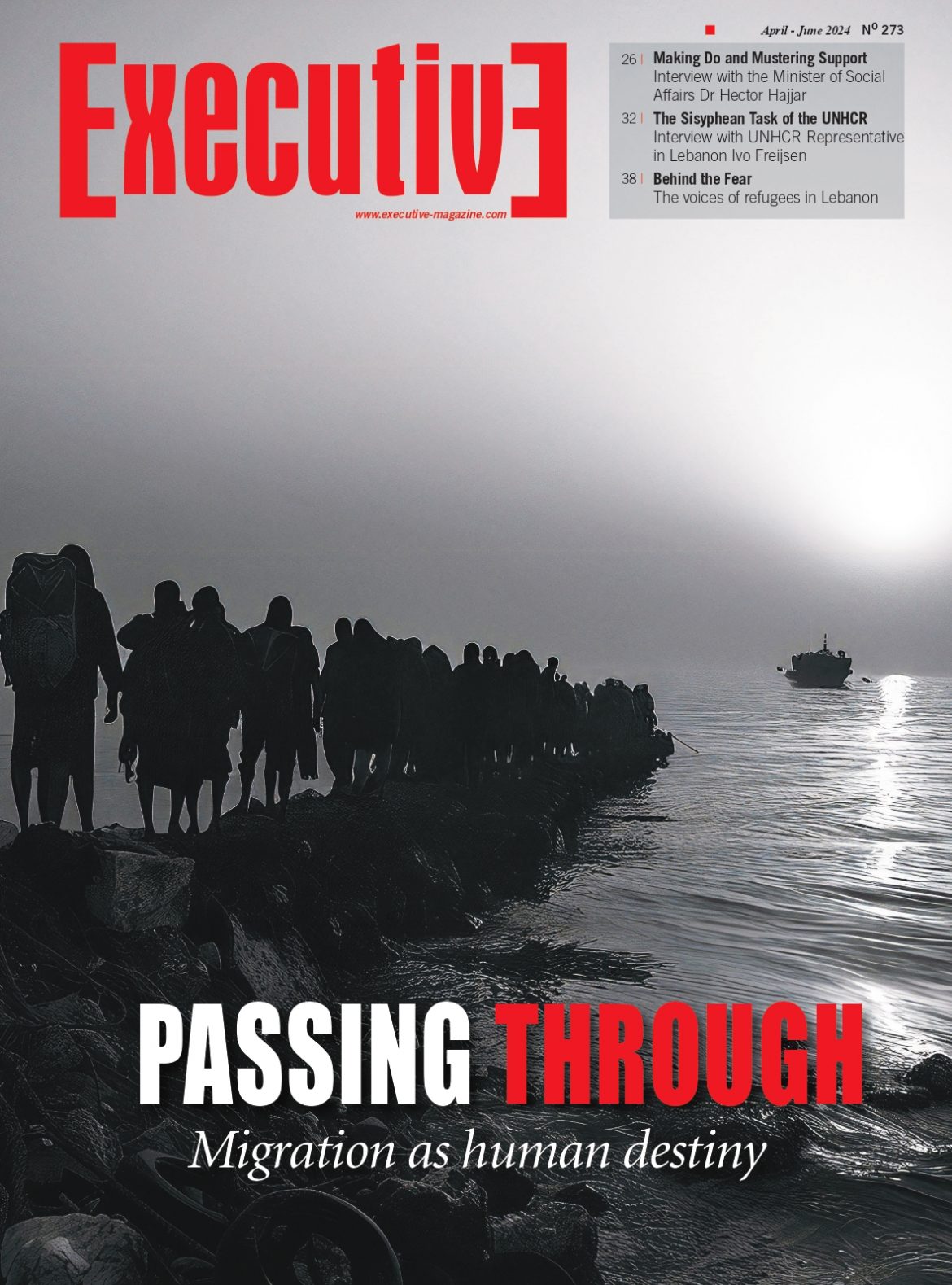
The first message of Executive’s foray into migration and displacement in our June 2024 special report is that migration has always been a part of human history, migrants have long brought value to their places of destination, and those who care for the displaced have long been favorably memorialized. The second message is that the story of migration and migrants, when analyzed in the aggregate, is a bit like the story of entrepreneurship. Many who embark on this journey of seeking opportunity irrespective of the resources at their command will experience entrepreneurial life as a nice but unremarkable episode, some will fail badly or even criminally, but a few will have stellar success and become change makers and catalysts of societal development that countless others are inspired by and will seek to emulate.

In truth, a truth that is today being passionately ignored in all political and nearly all popular migration debates, world literature is full of immortal stories of respect and care for the sojourner and refugee, as well as stories of migrant success and positive impact on their culture of refuge. Stories celebrating both groups, those who give refuge and those who need it, have over eons been woven into narratives of heroic migration that shape the history of civilizations.

Shifting to the geo-social picture

Refugee narratives with associations of inner nobility, prevailing against impossible odds, and non-kin altruistic compassion are encouraging and may propose solutions at a time when migration troubles are piling up globally.

But also, the counter-narratives are genuine and must not be overlooked: neither the individual or collective human trauma of war and disaster, nor the human drama of rejecting migrants and refugees out of the fear of losing one’s own safety and livelihood because those others have lost theirs.

Both the pro and the contra stories of human migration are anything but new. Emphasizing one and discounting the other because of personal views or prevailing group bias can be universally devastating for a people or a civilization.

In the nondescript steppes of the human mind, somewhere in between the hills of the heroic and the swamps of the traumatic, lies an emotionally desertified but safe realm where numbers and ratios play the lead role. In this space, the economics of migration can perhaps be the ramp that bridges the immense political and social distance between migrants and those who fear them.

If thus developed, migrant economics – or migrantonomics for the fleeting moment of this special report – reveals itself a trilemma. The first aspect of migrantonomics is political economy, which comprises both humanitarian and colonial traits. The second aspect consists of orthodox economics, with DNA strands of classical, neo-classical, Austrian, anarcho-libertarian, Keynesian, post-Keynesian, and other economic schools. The third aspect of migrantonomics is the elemental subsistence refugee economy of informal survival.

They behave as trilemma, each aspect contradictory to one another and irreconcilable, simply because the refugee’s interests of survival, the economic actor’s interest in profit, and the political actor’s interest in extension of her power, do not ever achieve stable balance.

When projecting this unbalanced socioeconomic mix forward into the digital globalized age of universal human obligations, however, a mission-impossible-type quadrupole looms. This higher-order challenge is a product of the wider cultural environment in which the migrantonomics trilemma is playing out today. Because there are more people, more technology, and more of practically everything that fuels human aspiration, in conjunction with more physical and labor mobility, plus an explosion of diversity of mindsets and approaches.

In this emergent context (which in the 2010s was described as “the 3M revolution” by Venezuelan author Moises Naim in a book about fundamentally changing power dynamics in our political and social systems), migration is an inescapable societal trend that is progressing on a gradual but inescapable scale that opens new dimensions of globalization and social obligations. Ergo, the migrantonomics trilemma looks set to evolve into a quadrupole that is shaped by interrelations of subsistence economy, orthodox economy, political economy, and a globally unfulfilled social economy promise.

To fulfill its promise of unifying migrants and those who fear them, migrantonomics in the digital age would eventually require portable, person-centric and equitable human balance sheets – of care received in early age, of education, human capital investments and certifications, of adult and advanced-age health care and livelihood, of intangible and tangible individual assets, inalienable rights, and commitments to public goods. Any aims of enacting global economic justice and sustainable equity, whether under SDG or any other programmatic frameworks, will make it imperative to create order in the primordial jungle of economic behaviors and societal values.

But the economical insight from Executive’s analysis of migration from, through, and into countries of the region (and elsewhere) is that economic data will not be the deciding factor on attitudes and policies when it comes to refugees and migrants.

By all historic and current observations on human behaviors, the imperative of global social justice is about as unlikely to be fulfilled in the digital future as will be a decisive reduction of harmful emissions in a world of growing populations and growing economic needs, wants, and expectations of the disenfranchised 70 to 80 percent.

The GDP numbers of immigration countries prove the economic benefits of migration. The historic numbers prove that migration is not something that can be decreed away. Rational humans make rational decisions. Well, sort of. So why are so many discussions about migration out of the realm of the rational?

The perilous and ultimately self-defeating dynamics of human power is one reason why an economic solution to the macro-prudential needs and geo-social challenges of migrantonomics is as improbable as an immediate enactment of cohesive global policies in a universally adopted UN migration compact. A contributing factor to the improbability of an economic solution to the global social justice challenge is selective victimology, the biased human tendency to side with victims at the expense of sustainable justice.

But perhaps the strongest and most notable reason why an economic solution to the existential force of migration is far from likely, is human reason.  

Let’s examine rational decisions made by humans who do not involuntarily outsource most of their mental processes to machines. For one thing, we make decisions of bounded rationality. That means we look for the optimal achievable outcome on basis of the situation we are in, based on the information we have.

Next, we have filters in the mind. Filters such as the anchoring bias that overvalues the latest information we have stored in our internal hard disk, or brain; framing bias, which makes us perceptible to charmed products of social constructionism such as ethnic identity; and circular confirmation bias, which makes our mental search functions look for precisely the memory and information that we want to find.

Another filter is cognitive dissonance, in which we also excel. It provides us with the counterweight to affirmation biases: comfortable blind spots against inconvenient facts and experiences. Finally, and most interestingly for this skeptic of his own rational existence, is the thought that we do not program our desires based on our rational functions. No, we subject our ratio to the governance of our desires.

The rational numbers and trajectories on migration and displacement leave no doubt that the issues need to be addressed much better in terms of both remedial action – in response to predictable emergencies – and of root treatments that work and are not just decoys of romantic delusions. The problem has to be addressed in the interest of humanity, peace (whether as management/reduction of conflict, non-violence, or positive peace), and sustainable economy in real and digital terms.  

Nothing short of an algorithmic substitution of the human pleasure centers and pathways of consciousness and conscience will change the polarity pattern of migratory and territorial behaviors that confound our species. Numbers and economic planning will not change the human contradiction, but they will make it less haphazard. Evidence-based migrantonomics can and need to be developed with aspects of global social rights, global portability of skills and recognized, certified intangible assets, equitable entitlements with limits, and capitalization on mobility entitlement and the mindset of the can-do spirit.

July 4, 2024 0 comments
0 FacebookTwitterPinterestEmail
RefugeesSpecial ReportTimeline

Displaced in history  

by Marie Murray & Aline Nassar July 4, 2024
written by Marie Murray & Aline Nassar

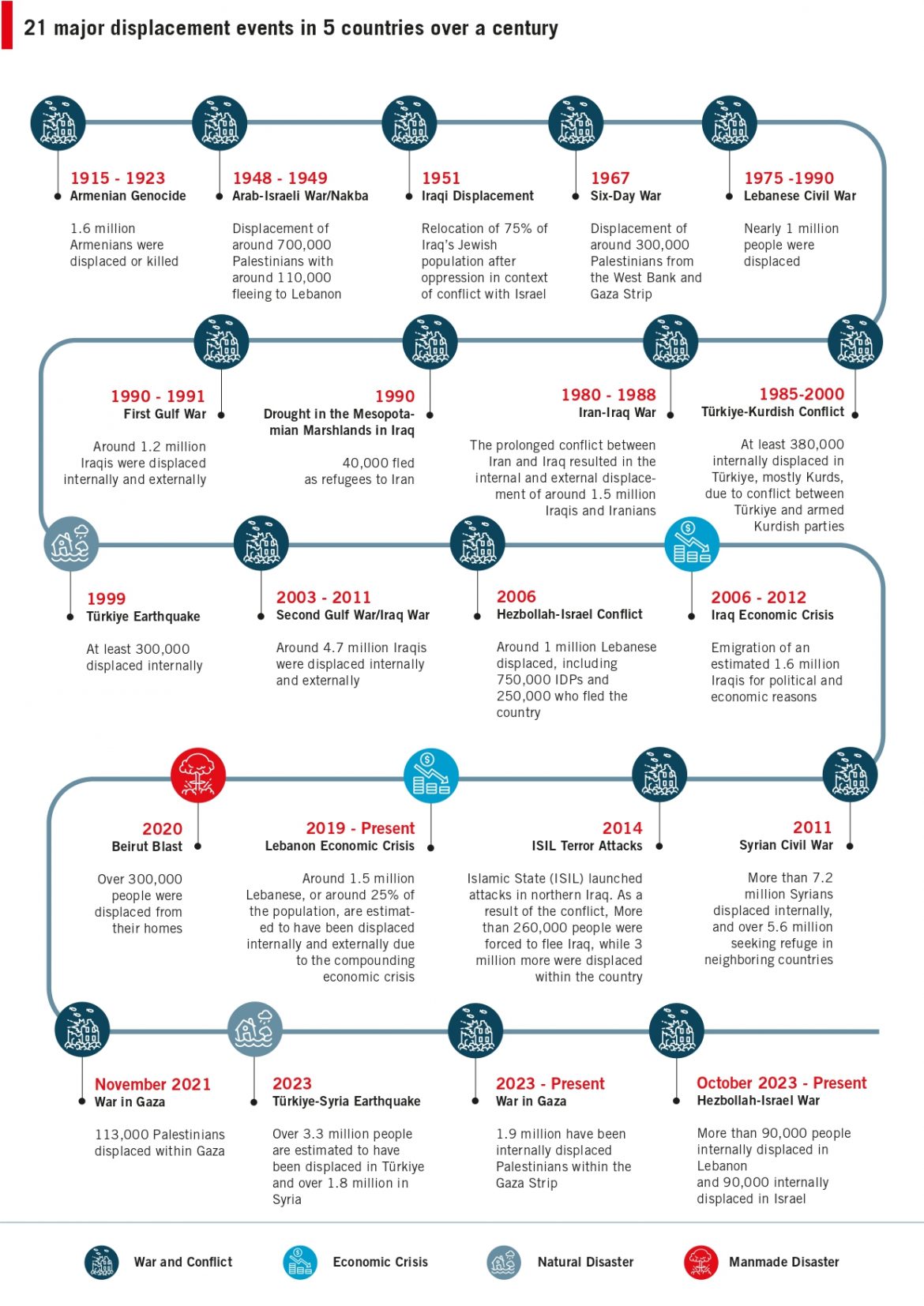
If a timeline were to present a full picture of displacement and migration trigger events in the Arab world, it would necessarily fill many pages and span many centuries. Understanding the role of the refugee in the region’s diverse cultures actually has to start with taking note of the refugee narratives – and mandates to respect the displaced and sojourners – that are foundational elements in the religions of Islam (with the exile of its founder in Medina), Christianity (with the first family’s flight to Egypt) and Judaism (with the pivotal role of the exodus in the creation of a people). 

As Executive cannot but illustrate only a small slice of this millennia-lasting narrative, what we present in above infographics is a selective snapshot. The aim of a timeline of 20 major events in five countries over the course of—roughly—a century is not to give a comprehensive picture, but to illustrate the upheavals caused primarily by the conflicting push and pull of efforts to shape the region according to internal and external interests. 

The domino effect

At the start of this timeline, these five countries—none yet declared as such according to our modern understanding of nation-states—were mapping out their sovereignty, or, in most cases, having it mapped out for them. The brief, post-WWI mandate period after the dismantling of the Ottoman Empire coincided with the establishment of the Turkish republic in 1923 and was followed by declarations of independence of the Hashemite Kingdom of Iraq from the British in 1932, and Lebanon and Syria from the French in 1943 and 1946 respectively. But the most noteworthy chain of events impacting migration and displacement during this time was the movement of Jewish refugees from Europe (facilitated by the British) and Arab countries, and the establishment of the state of Israel on the territory of Palestine. The repercussions of this chain of events across the region and globally have a well-documented ripple effect of conflicts and migration triggers.

The forced displacements of the subsequent Arab-Israeli conflicts would require a different examination. It can only be noted in passing here, as must be conflicts between autocratic regimes and disasters that drive forced displacement from African and Western Asian countries into the MENA region. Also not captured, though certainly contributing to some of the events specified on the timeline is the Arab Spring, a period of revolutionary uprisings and protests across the region that began in 2010 in Tunisia and spread outward assisted in large part by social media. It led not only to the toppling of governments in Tunisia, Egypt, Libya and Yemen, but also spurred the anti-authoritarian protests in Syria at onset of the civil war in 2011. 

In Lebanon, a similar revolutionary, pro-democratic movement occurred later in 2019—against a corrupt rather than an authoritarian regime. It unified much of the country and brought about a newly prescient alertness to the precarious status quo caused largely by the corruption of Lebanon’s political leaders. The thawra became a national wake-up call directly preceding Lebanon’s major economic crisis years.

It is of note that while some of these timeline events caused serious, mostly internal displacement, such as the Hezbollah-Israel July war of 2006 and the Beirut Blast of August 2020, the displacement was short-lived and did not trigger any significant international migration. In contrast, it is disingenuous to describe the ongoing Syrian conflict as one displacement trigger event, since during its course, there were numerous occurrences causing major migratory waves out of Syria as well as multiple internal displacements. The current genocide in Gaza, while not yet triggering substantial out-migration, has caused such grave and destructive incidents of repeated internal displacement, that it is certain to have weighty and long-lasting consequences as one of the most critical refugee challenges of the era.

July 4, 2024 0 comments
0 FacebookTwitterPinterestEmail
Last Word

Virtues learned from wandering balls

by Thomas Schellen July 3, 2024
written by Thomas Schellen

When averaged over the year, the migration 2024 topic is even hotter than this summer’s peak temperature. In a year hyper-charged with political elections, the past few months have cast immigration challenges and migration fears to the forefront of many electoral races.

However, what was not proven to be fulfilled were expectations of fundamental migration policy shifts in any direction at any national or supra-national elections. By time of this writing near mid-summer, the voting tide of the past six months has already crested in mega contests in India, Mexico, and the EU, and already what’s left of pre-election rhetoric filled with common fears and varying toxicity is not much more than the usual rubble of old promises in minorly changed realities of power.

It must nonetheless be expected that until the end of the year, vitriolic migration debates will continue to haunt voters in developed and emerging economies alike and will especially leave their mark on the most consequential of all national elections, the 60th presidential election in the United States. This globally influential US power contest and grandfather of unfortunate personality choices has to date been heating up most vexingly, seeing logically inconsistent anti-illegal-migration measures, courting of migration-background voters, and the liberal meting out of xenophobic campaigning in political doses with suspected long-term mental health detriments.

Lebanon differs from the global populist theater in that it has no election schedule that one would be tempted to call worth campaigning under. This notwithstanding, the country’s political debates over refugees and displaced people are raging. Several times this spring, real crimes and manipulative disinformation have brought social tempers to the brink.

Public displays of passion

There have been reiterative and uncontrolled verbal outbursts of violence, and sometimes momentarily more serious disruptions of social calm, at a time when the country badly needs to fortify itself to withstand old and new problems. But sadly, despite all the passions invested into debating displacement, there have been no solutions or traces of solutions, political, populist, or otherwise.

That months of desperate opinion making resulted in nothing other than the complete lack of viable migration strategy leads me to suggest that everyone should take a step back, after having listened to more propaganda about the refugee and migration crisis from all sides than can be good for any mind. 2024, beyond election charades, is a year of grand sports spectacles. The Olympic Games, the ICC Men’s T20 World Cup, CONMEBOL Copa América, and the UEFA European Football Championship. We can mine popular sports behaviors for viable insights on migration, given that people’s attention to these sports events is indisputably higher than to electoral debates. 

Thus, let’s try viewing the logic and the vicissitudes of migration through the lens of football. Curiously, if one examines the history of the game’s top players, it seems that, for whatever reasons, having a history of migration appears to be an enabling factor in developing a talent for football excellence. 

Foreign-born, naturalized players, in other words migrants, were playing in national teams ever since the first World Cup was set up as European gentlemen’s agreement a century ago. German statistics for example tells us that over the past seven World and Euro Cups the percentage of players with “Migrationshintergrund” in the “Nationalmannschaft” have ranged anywhere between 25 and almost 50 percent (in the 2024, the “migration background” label applies to 35 percent of the Nationalmannschaft, or nine out of 26 players). Higher than the share of migrants in the country?

On a more ambiguous note, football unmasks the disequilibrium between the potential of migration and the perception of migration in host communities. The cross-link between attitude on football and migration is fandom. The overwhelming majority of us are football spectators who would need the luck of the draw to score a hattrick even when standing on the penalty spot in front of an empty goal. But we can easily become enthusiastic fans. As we cherish the team of our allegiance, either because it represents our home country or city (or was selected as the object of our personal allegiance for other reasons), watching football is a testing ground for balancing our partisanship and sense of belonging with our ability to coexist and achieve inclusion.

The results of this character test are ambiguous in the sense of entailing behaviors that are polar opposites. The vast majority of images from massive outdoor “fan zones” for public viewing at the Euro Cup, for example, are more than peaceful. Video clips, still pictures and selfies are consistent with a rising tradition of non-exclusionary emotional allegiances and identification with the football game’s purpose of connecting cultures.

Yet there is a consistent and not insignificant share of football fandom that speaks to the exact opposite, whether or not helped along by liquid courage and liquefaction of individuals’ cultural programming. Violence and destruction of property, not infrequently by purposely exclusionary groups who deliberately seek conflict and confrontation with the hated other, is something that may shock but cannot surprise in an international, competitive sports spectacle.

In short, football as spectator sport confirms the presence of partly overt, partly latent xenophobic and anti-migrant attitudes. In media reports and talk shows about political sentiments across population groups and nationalism among young voters, these same attitudes are ineffectually chastised.  

Allegiance to what?

The national allegiance scores in Lebanon are interesting from another perspective. In the late 1990s yours truly once wrote an op-ed contribution – on occasion of the first FIBA Asia Basketball championship win by a Lebanese team – that internationally successful Lebanese sports teams could energize the creation of shared identity and pride in being Lebanese, helping to overcome the trauma of the Lebanese conflict. 

That idea of team sports helping to shape united allegiance to this country, did not carry. Instead, the Lebanese continue to individually choose their football belonging to national teams and famous clubs. Moreover, individually competitive sports – from bicycling and mountaineering to the Beirut Marathon – have brought people together and fostered sentiments of belonging and openness. If this were read as a message on choosing free individual versus fated group allegiance, what are the implications for building an inclusive society? 

Watching a spectacle like Euro Cup gives the leisurely mind freedom to muse about some of the inconsistencies behind having national football teams. Why, for example, do Scotland and England have their national teams, but not sub-national regions with growing yearnings for independence, such as Flanders and Catalonia? Why is there no team running up with the Bavarian royal crest on their jersey? And why has virtually every position in the German national team already been held successfully by a player with migration affiliation, but not the position of Bundestrainer, or coach (who coincidentally is the sole role model and shaper of the country’s team who does not have to be a national)?

Taken to the extreme, thinking about societal perceptions of migration and the success of migrants in national teams can generate a serious ethical dilemma. What is the morally correct position if, in a hypothetical example, I imagine myself to be an upstanding pro-independence Catalan MEP and Barca fan. Do I resent the Spanish national team’s participation in the Euro? Who do I see when a 16-year old from a poor district of Barcelona participates in the Euro Cup as the youngest player in the tournament’s history? Do I think of this youth with African and Arab parentage as someone who wants to steal Catalan jobs or do I regard him as a super-talent who brings back memories of Pele in 1958?

Towards a winning goal

Football is a competitive game that has seen many changes. As the Euro Cup 2024 shows, football has acquired many new rules, much new tech, huge commercial interests, and plenty of garnishes and gimmicks. However, it will never do to overthink football. Winning the game still hinges on group magic: controlled, fast ball migrations with stakeholders working in best possible coordination and taking risks for the common purpose. Is this something that the Lebanese polity can champion?

Looking through the migration lens will transform football from an escapist global economic enterprise with appallingly corrupt structures into a complicated trans-societal totem of belonging and openness – but this perspective on football also revels challenges to our concepts of migration and the structures of our belonging as they have been orchestrated through history.

If there is a message to deduce from the ritual play of football and the role of migrants in winning, it is that Lebanon cannot win by turning more exclusionary. Lebanon needs a unifying factor. Be it the spiritual message, the notion of an agile mercantile society situated at the roots of international trade, the legendary hospitality of the people, the concept of an intercultural hub and center for communication of civilizations, the recent resilience in the face of impossible challenges – be it whatever, but the unifying factor cannot be something forced from either without or within, it must be something freely conceived and born by the people.

July 3, 2024 0 comments
0 FacebookTwitterPinterestEmail
CommentEconomics & PolicyEconomy & Finance

The case for full dollarization once and for all

by Layal Mansour March 26, 2024
written by Layal Mansour

In November 2023, four years after the start of Lebanon’s severe financial crisis, Harvard Growth Lab suggested that Lebanon consider adopting full dollarization among other economic and financial restructuring and reforms. In practice, a full dollarization consists of renouncing both the Lebanese central bank, Banque du Liban, and its monetary policy, and replacing the local currency—Lebanese pounds—with a foreign one, namely the US dollar. Such a suggestion has always been criticized and rejected by the public, the media, activists and non-experts who argue that dollarization would undermine the sovereignty of the state. 

Indeed, it was not the first time that this subject was raised. Since 2019, I have proposed shutting down the central bank and burying the Lebanese pound. In June 2020, I coordinated with Member of Parliament Paula Yaacoubian to propose a law (N° 697/2020) urging the Lebanese parliament to vote in favor of a currency board system, that is, a softer version of full dollarization that would protect the state’s sovereignty. A very highly dollarized country such as Lebanon, must sacrifice its central bank and exclusively adopt either full dollarization or currency board. The argument for full dollarization can be traced back as far as October of 1994, when an IMF working paper analyzed the usefulness of the Lebanese pound as well as the likelihood of restoring trust in the local currency and suggested considering full dollarization for Lebanon.

I have argued that the roots of Lebanon’s financial crisis began four decades ago with the introduction of unofficial dollarization. Accordingly, the current phenomena of exorbitant and unabating inflation, a high poverty rate, the banking sector solvency problem, the depletion of foreign reserves, and the multiple currency rates are not the main economic problems but rather the expected and unavoidable consequences of partial dollarization.  

Dollarization: the root of economic evil

The rate of dollarization expresses the extent of the economic agents’ preferences to hold foreign currency (cash and/or deposit) instead of local currency, because it provides trust, confidence about future purchasing power, and stability. In other words, the rate of dollarization is equal to the rate of local currency rejection by economic agents. Unfortunately, there is economic proof that dollarization doesn’t exist in isolation but travels in tandem with its inseparable siblings: corruption and weak financial institutions. Moreover, empirical studies show that dollarization affects all sectors. Not only does it pose a challenge to the pursuit of a coherent and independent monetary policy, but it also leads to downgrades from credit rating agencies and exposes a country’s banking sector to an asset/liability currency mismatch. Dollarization consequences are so deleterious that economists have referred to it as the original sin.  

Rather than prescribing temporary relief in the form of loans or grants to extend its expiry date, Lebanon is in dire need of addressing its economic problems at the epicenter, which begins with de-dollarizing. 

If dollarization refers to the simultaneous use of at least two currencies, de-dollarization is simply the use of one currency: either the local one or the foreign one. In other words, the two ways to de-dollarize Lebanon are by forcing the exclusive use of either the local Lebanese pound or the foreign US dollar, or full dollarization.  

Addressing “fear of floating” with a managed float?

The fear of floating is a phenomenon that refers to averseness towards floating exchange rate regimes and their high fluctuations. Many Lebanese economists, to avoid the fear of floating, suggest the managed float regime, also coined the “dirty float.”  In a managed float, the exchange rate is not totally pegged, not entirely based on free capital mobility, and not entirely monetarily independent. Put simply, it involves frequent central bank interventions that are only possible when those central banks hoard excessive foreign reserves (from trade surplus rather than debt or required reserves), to hedge against future shocks. The smallest exchange rate fluctuations under a managed float translate to severe balance sheet problems for borrowers with liabilities in foreign currency and income in the local currency. Accordingly, banks suffer from exchange rate distortions under a dirty float, even if their portfolio has a nationally matched currency position. Moreover, it has been verified by economists and admitted by several IMF studies that there is a strong positive correlation between fear of floating and an increased dollarization rate. The higher the dollarization rate, the more the fear of floating is expressed. Consequently, fluctuations of exchange rate are less tolerated under the managed float.

Increased rates of dollarization translate to decreased acceptance of the local currency, especially regarding one’s dollarized holdings. The fear of floating, which manifests strongly in dollarized economies, has been proven to have severe negative effects in all studied cases. Since the 1980s, Lebanon has been ranked amongst the most highly dollarized countries in the world with a dollarization rate of 70 percent and above, along with Nicaragua, Zambia, Mozambique, Cambodia, Guinea Bissau, Angola, Congo Dr, Ecuador, Bolivia, Bulgaria, Estonia, EL Salvador, Hong Kong and others. None of these countries could escape severe financial crisis. None of these countries succeeded in de-dollarizing by stabilizing or strengthening their local currencies. The only very highly dollarized countries that found a second chance toward a new economic recovery plan were those who shifted toward full dollarization or a currency board arrangement such as Ecuador, Bolivia, Bulgaria, Estonia, EL Salvador, Hong Kong. In fact, at a certain level, dollarization seems irreversible. 

Why the dollar over the pound?

Economic research studies have shown that when a country becomes accustomed to a foreign currency like the US dollar over decades, it leads to an irreversible dependence. In economics, the “hysteresis effect” or “dollarization hysteresis,” refers to the addiction-like phenomenon that affects people who become greatly inured to use of dollars (or other foreign currencies) to protect themselves against possible future inflation. Hence, it becomes difficult and even impossible for the authorities to force people to give up dollars and use their local currency even if inflation drops and economic conditions improve. In worst-case scenarios wherein “addicted to dollar” countries are forced not to use the dollar, mass hysteria, strikes, and bank attacks occur. Lebanon saw such events in early 2020 when residents were forced to earn, withdraw and spend exclusively LBP. Many studies have assessed the hysteresis effect in Lebanon and found that the high dollarization has even persisted after successful stabilization periods and multi-year economic growth. Econometric proof of the hysteresis effect is one of the most important arguments in support of giving up the central bank of Lebanon.

Restoring trust in local currency in a very highly dollarized country such as Lebanon seems extremely challenging if not impossible. Accordingly, it would be better to regulate and officialize the use of the dollar, which many economists consider to be the next step to economic recovery.

Addressing the issue of sovereignty

The higher the demand on the dollar as a means of payment, the lower the central bank monetary policy efficiency, and the higher the exchange rate risk and banking sector instability. In fact, the central bank is not able to manage or manipulate a money supply composed primarily of dollars through monetary policy (interest rate). In sum, the central bank monetary policy in a very highly dollarized country is ineffective and thus giving up the central bank in Lebanon would not cost a fortune. It would, however, affect the country’s sovereign image. To salvage that image, there is a second option: the currency board arrangement.

Currency Board Arrangement (CBA) and full dollarization are largely equivalent. The two main differences are in the name of the currency itself and the seigniorage. Under a full dollarization system, the domestic legal tender is the foreign currency. For Lebanon or any Middle Eastern country, obvious challenges arise with any attempt to associate the US dollar with the country’s sovereign image. This is the main argument against full dollarization by Lebanese authorities and public. Under the currency board regime, the country adopts its own new currency—the Lebanese dollar or Cedar dollar or Middle East Dollar—which mirrors the foreign anchor currency. While entering a CBA absolutely requires giving up monetary policy independence and fully backing liabilities with reserves in the anchor currency, the new currency name could protect the country’s sovereignty.

On the other hand, under the full dollarization where the local currency is totally replaced by the foreign one, the government gives up seigniorage, which is the profit derived from the difference between freshly printed banknotes and their production costs. As the sole authority controlling the printing of US dollars, the United States collects all seigniorage income on the US dollar. Seigniorage is thus the most visible and quantifiable element in the cost-benefit calculus of full dollarization.

No single currency regime is right for all countries or all times (Frankel 1999)

A full dollarization or a currency board is never appropriate for a systemically transparent country with a developed economy. Such a country can rely on the market power to adjust any economic disequilibrium and its central bank can also adjust the interest rate up or down to manage the inflation rate, help accelerate economic growth or decelerate worrying economic trends. These solutions are rather an inevitable last resort for  highly dollarized countries that lack governance and strong and independent legal frameworks. It appears inescapable for those all too familiar cases where countries whose citizens are deprived of their democratic participation in day-to-day governance by politicians who always promise and never deliver, face institutions that have lost any sense of responsibility, and have rulers who evade accountability and have zero will of ever enacting structural economic reforms.

In choosing the exchange rate regime, the main economic factors to consider are dollarization, government temptation to inflate, and exposure to exchange rate risks. Considering the implications of Lebanon’s extreme dollarization, which not only exceeds 80 percent today, but has also been deeply rooted for decades, full dollarization is of utmost importance. Any exit strategy that seeks resolution of Lebanon’s economic crisis through a soft pegged arrangement or flexible exchange rate regime will indubitably lead to a more severe financial crisis that could last forever. 

Choosing full dollarization, once and for all, conceptually represents a radical, extremely credible, and more importantly, irreversible arrangement. This is simply because reversing dollarization is much more difficult than modifying or unilaterally abandoning a CBA. Lebanon needs a currency system that eliminates the risk of a sudden sharp devaluation of the country’s exchange rate. Yet, because of the serious constraints that application of full dollarization is bound to face in Lebanon, I advise taking recourse in its twin, the currency board arrangement.

March 26, 2024 0 comments
0 FacebookTwitterPinterestEmail
AnalysisFood security

Harvesting Reforms: Lebanon’s Food Security and Sovereignty

by Carol Farah March 26, 2024
written by Carol Farah

Food security is a prerequisite for any people’s sovereignty. The need for food’s physical and mental sustenance affects every human being with an existential might. It consequently ranks in import perhaps second only after the need for a planetary home with breathable air and stable gravity. This foundational necessity, however, has only at the end of the 20th century been accentuated into a universal imperative for the world’s societies. 

The global age’s second gathering dedicated to this imperative, the 1996 World Food Summit produced pledges by 185 nations that they would strive to eradicate hunger. In their Rome Declaration on World Food Security, those nations’ authorized representatives explicitly affirmed “the right of everyone to have access to safe and nutritious food, consistent with the right to adequate food and the fundamental right of everyone to be free from hunger”.

Even though the hunger eradication promises of nations have remained as dubitable in the intervening 27 years as at time of their adoption, recognition of the importance of satisfying the right to food security has only increased for the legions of civil society activists and a host of global institutions alike. Thus, an incessant stream of projections and warnings over acute food insecurities in different parts of the world has been sharply juxtaposed with the unwavering assurance that all people, at all times, are supposed to have physical and economic access to sufficient, safe and nutritious food. 

Just one example of these dire forecasts is the most recent (September 2023) food security update by the World Bank with its warning that as many as 670 million people will confront hunger by the year 2030 due to factors that include climate change, a global water crisis, and loss of biodiversity. As always with such catastrophic predictions that might prompt cynical or hysterical responses, solutions arise from asking—at the national or local level: Who is most affected? Why? What might be done about it? 

Surveying a fertile but economically exhausted land 

In the context of Lebanon, a small yet geographically varied Mediterranean country historically renowned for its arable land and water resources, improving food security is inextricably linked to achieving greater food sovereignty, the latter of which is defined by the United Nations Economic and Social Commission for Western Asia (UNESWA) as the right of people to their own culturally appropriate and sustainable food policies and management systems for natural resources. Improving both food security and food sovereignty will require an uphill climb as the nation faces protracted economic challenges, an on-going refugee crisis, and new regional conflicts currently causing major disruptions and damage or overall halts to agricultural endeavors in much of south Lebanon and urging questions of national sovereignty.

The Integrated Food Security Phase Classification (IPC)—a “multi-partner initiative” of UN institutions, governments, and other actors dedicated to analysis and decision making on food security —conducted two successive analyses in Lebanon in 2022 and 23. The second IPC Acute Food Insecurity Analysis estimated in 2023 that, induced by the country’s economic meltdown, food insecurity in Lebanon has reached crisis level, known as IPC Phase 3 or above, for 21 percent of Lebanese residents, 30 percent of Syrian refugees, and around 30 to 35 percent of Palestinian refugees, including those who have lived here for generations, as well as Palestinian refugees from Syria. 

According to the IPC statement, these numbers in great part reflect the last five years of compounded hardships that Lebanese can now recite off hand: the economic crisis that began in 2019, the exacerbating effects of the COVID-19 pandemic, and the devastating port explosion of August 2020 that, in addition to taking over 200 lives and demolishing infrastructure, also destroyed Lebanon’s main grain silos which took the brunt of the explosion’s impact. 

In anticipation of continued deterioration in secure access to food in the country, the IPC projects for the coming summer that “between April and September 2024, about 1.14 million people are expected to face high levels of food insecurity and are likely to be in IPC Phase 3 or above.” Of the five phases in the IPC nomenclature, phase three to five are designated as “critical”, “emergency”, and “famine”, with the respective values for Lebanon residents in the October 2023 to end of March being 18 percent, one percent, and zero percent.   

One impact of the economic crisis on Lebanon’s food security is the inability of the local market to generate hard-currency income for producers has prompted both farmers and agro-industrialists to pivot towards export markets. Still, Executive found that “for every dollar earned from export markets, over four dollars are spent on import of foodstuffs and agricultural inputs.” In meeting the demands of international markets—where quality, reliability, branding, and regulation are paramount—producers have shifted their focus away from the local market. The consequence is a discernible gap in Lebanon, with high-quality produce earmarked for export, leaving domestically consumed products of lower quality. 

During 2022 and 2023, Executive spoke with food and agriculture stakeholders from around the country about issues of agriculture, food security, and food sovereignty to gain insights on the specific obstacles the country faces on these fronts. 

Agriculture in Lebanon needs a makeover

Many stakeholders in the agricultural sector identified the absence of a unified vision for growth both legislatively at the public policy level as well as amongst producers, wholesalers and importers. Rima Franjieh from the Lebanese Private Sector Network compared the absence to a company with no vision statement. Legislation concerning agriculture is outdated with Mounir Bissat of the Syndicate of Food Industrialists citing the food safety law that not only took 18 years to ratify but underwent fundamental changes that weakened the original draft version. 

In the realm of education, the sector grapples with a widening gap between training programs and the evolving needs of the industry. The disconnect between academia and practical application leaves organizations and NGOs struggling to secure expertise aligned with the sector’s demands. Simultaneously, societal perceptions and stigmas surrounding farm work may discourage interest in agriculture as a viable career choice. During a 2023 roundtable hosted by Executive, Dr. Nuhad Dahger from the American University of Beirut’s agricultural department noted that, for example, there are few PhDs in horticulture even though Lebanon is a horticulture environment. Maha Nehme from the Lebanese Reforestation Initiative stated that there is only one forestry-related masters course in Lebanon. 

The informality of agricultural labor, coupled with a lack of legislative support for agricultural rights, dissuades youth engagement, highlighting a need for a comprehensive rebranding effort to reshape these ingrained stereotypes. Adding to the complexity is the enduring legacy of the regional conflict of 1948 and its aftermath which has given rise to a pattern of identity-based hiring practices, particularly evident in the employment of lower-paid, non-Lebanese workers. Addressing these historical dynamics—the challenges of which are being revived in new and horrifying ways since October of 2023—through equitable labor relations is imperative for crafting equitable long-term strategies to revitalize Lebanon’s agricultural sector.

Another glaring issue is a lack of data from the understaffed Ministry of Water and Energy (MoWE) on, for example, rainfall or groundwater levels make it difficult for farmers to know what to plant and when. 

Water, land and stewardship

Lebanon’s water resources are comparatively high within the region, and include surface water, ground water and spring water. Still, many households do not receive public tap water and rely solely on water trucks to fill their cisterns. In 2023, transportation costs increased due to the continued escalation of fuel prices hampering water distribution efforts.  Additionally, underdeveloped irrigation networks and the use of polluted water underscores Executive’s Economic Roadmap measure to create a Water Master Plan building off the 2010 National Water Sector Strategy. 

For anyone seeking further evidence of poor water management, a roadside glance at a Lebanese dam would likely show a structure still under construction or unfilled even during the heaviest months of rainfall as most of the nation’s 12 are not operational. Though the dams offer benefits including hydropower generation, improved irrigation and water supply for domestic use, poor planning has caused inefficiency where water is lost to leaks or Lebanon’s karst terrain, severe damage to local environments, and blocked rivers. 

Though systemic and management challenges are on display, equally present are examples of indominable Lebanese entrepreneurship and creativity amongst stakeholders in the agro-food industry. Organic farmers and farming operators in Lebanon are optimizing water use and rainwater collection and combatting soil degradation from overuse of chemicals and genetically modified seeds by employing various planting techniques to keep the soil rich.  The growing shift to renewable energy in the agriculture sector has been notable in 2023 as farmers seek to reduce fuel costs. Support for collaboration and unification here is paramount, as Pierre Khoury from the Lebanese Center for Energy Conservation (LCEC) notes that RE is a huge job-creation opportunity. Although farming and agricultural cooperatives have market-savvy expertise and a decades-long presence in Lebanon, many are dysfunctional and lack collective bargaining power. Marie-Louise Hayek from the Food and Agriculture Organization recommends aggregating small farms, while Rami Lakkis of the NGO LOST says that businesses need aggregating agents to support collaboration. 

Towards a unified national scheme

Lebanon’s food sector needs a committed focus on essential legal reforms and collaborative efforts with private enterprises, civil society, and government entities. The country’s small size and the variance in political, ethnical, religious, and socio-economic backgrounds of agro-food stakeholders across the value chain present advantages due to, for example, the deep and close ties within communities. These same benefits often become hurdles to networking attempts and the formation of a unified strategy for food security. Therefore, prioritizing active engagement and coordination while maintaining equidistance to all local stakeholders from the private and public sector, civil society, religious institutions, and international organizations as well as traditional familial stakeholders can build cohesion. 

The vested interest of sects in Lebanon in protecting their interests and political positions have created a problem of lack of data across all sectors. Agricultural data is crucial for increasing productivity, mitigating food loss, and, most importantly, improving social equity. Missing information from the public sector can be supplied by international organizations, civil society and private sector stakeholders, although this creates challenges to aggregating objective figures. Ultimately, however, Executive recommends an “improved data and information framework with non-politicized and non-ideologized, pragmatic and transparent data acquisition, analysis, and delivery are the potential reduction of food loss because of producers’ improved visibility into demand and supply beyond the ultra-short-term view afforded by market data at the start of the planting and breeding seasons.”

Efforts to strengthen the water-energy-soil nexus for food security involve strategic collaborations and the deployment of solar photovoltaic (PV) technology. Partnering with organizations like the LCEC and the Ministry of Environment, in conjunction with engaging the private sector, can play a vital role in reducing energy costs for agricultural producers. The continued integration of properly installed solar PV systems reduces electricity expenses and presents an opportunity to power irrigation pumps, contributing to a more sustainable water-energy-food (WEF) nexus. It is crucial, however, to carefully monitor and coordinate these initiatives, acknowledging potential risks and the temporary nature of job creation associated with solar PV projects. On this front, Executive recommends that “the leverage points along the technical innovation and WEF vector should be actively sequenced, monitored, and pragmatically adjusted rather than programmatic in their approach.” Simultaneously, a greater emphasis on heritage preservation is needed to safeguard traditional agricultural practices, preserve cultural identity, and ensure the long-term sustainability of Lebanon’s food sources. 

Despite Lebanon’s fertile (if deteriorating) soil and sufficient (if polluted) water resources, the agricultural sector in Lebanon still grapples with the absence of national origin schemes and robust quality supervision for its diverse products. Lebanon’s pursuit of food security and sovereignty is not just a local concern but also contributes to regional stability.

March 26, 2024 0 comments
0 FacebookTwitterPinterestEmail
AnalysisEnergy

Energy security at a crossroads

by Rouba Bou Khzam March 26, 2024
written by Rouba Bou Khzam

Across the globe, access to reliable and affordable energy underpins the very fabric of society. The International Energy Agency (IEA), a leading intergovernmental organization on energy, defines energy security as the “uninterrupted availability of energy sources at an affordable price.” For Lebanon, however, with its long-plagued energy sector, continuous and financially accessible energy remains a distant dream. For years, the nation has grappled with rolling blackouts, crippling infrastructure, and a dependence on volatile import markets, leaving its citizens and businesses in the perpetual twilight of energy insecurity.

IEA frequently emphasizes three pillars of energy security in its publications and reports – availability, affordability, and accessibility. All three are far from sturdy in the Lebanese context marked by political dysfunction, economic volatility, and a glaring lack of long-term planning. Considering Lebanon’s energy morass, which is further complicated by a new and bloody regional conflict, it remains a critical question if Lebanon can truly achieve a secure and sustainable energy future.

The triad of availability, affordability, and accessibility

As of March 2023, Lebanese households endured an average of 12 hours of daily blackouts, with some areas experiencing total blackouts for up to 24 hours. This unstable power supply significantly disrupts daily life, hampering businesses, hindering work-from-home options, and jeopardizing access to vital services like healthcare and education. While not as disastrously bad as during the first months after forced total withdrawal of energy subsidies in 2021, public electricity supply has not matched political promises for more extensive electricity provision by state utility Electricité du Liban (EDL) in exchange for higher usage fees. The broken promises of the government to solidify “consistent energy availability” became glaringly apparent as inadequate infrastructure, financial mismanagement, and overdependence on volatile fuel imports left citizens grappling in the dark.

The introduction of the new EDL tariff in November 2022, involves the second and third pillars of energy security, namely affordability and accessibility. Testimonies collected by Executive from electricity consumers, however, suggest that with regard to either the second or third pillar, the situation of Lebanese private households has not improved and often is perceived as worse when comparing 2023 to 2021/2. 

Lebanon’s economic struggles, marked by dwindling foreign reserves and an overwhelming annual fuel expense of $1.5 billion, according to the World Bank 2022 report, have thwarted efforts to ensure a steady supply of fuel. According to the latest Energy Security report from Executive, one analysis entitled False promises of improvement takes a behind-the-scenes look at several stalled regional agreements that would have offered Lebanon an energy lifeline via fuel transports from Jordan and Egypt via Syria. The failure of these agreements has contributed to the deterioration of domestic energy infrastructure, difficulties in securing more economical fuel alternatives, and consequently a notable escalation in electricity expenses for households and businesses alike.

Designed with the intention of achieving greater fairness, the new tariff structure introduced a tiered system based on electricity consumption. However, the overarching impact was an overall increase in rates, ranging from 20 to 50 percent or even higher, depending on consumption levels and geographical location. This significant rise in electricity costs exacerbated the financial burden on already struggling households and businesses, amplifying the challenges posed by Lebanon’s ongoing economic crisis.

EDL’s new billing system, linked to the volatile parallel market dollar, has caused monthly electricity bills to soar above 1,000,000 LL, a significant increase from the previous range of 50,000 LL to 300,000 LL.

This surge was due to hiking of taxes and assorted fees, and directives from the central bank compelling the EDL to convert its revenues from pounds to dollars. As a result, subscribers bore the brunt. The disparity between electricity supply hours and costs pushed bills higher than those from private generators. Faced with this fiscal dilemma, consumers responded by removing meters or suspending operations for two years, reflecting widespread dissatisfaction.

In a statement issued on January 11, 2024, EDL announced a cautious step towards brightening Lebanon’s electricity landscape. The state-owned provider revealed a “gradual increase” in power supply, bringing one gas unit back online and pushing production capacity to 400 megawatts. While this news offers a welcome respite from chronic blackouts, it’s essential to recognize the fragile nature of this progress.

EDL emphasizes the need to maintain this “up to 400 megawatts” limit to avoid regulatory hurdles in mid-February. This cautious approach reflects the uncertainties surrounding future fuel shipments. While a recent tender promises additional fuel by February 27th, delays can quickly plunge the country back into darkness. Furthermore, the expected “additional quantities” from the Iraqi swap agreement were stalled by bureaucratic roadblocks, highlighting the precariousness of relying on external agreements.

Despite these mixed signals, the increased power supply provides a much-needed reprieve for basic facilities like airports, ports, and hospitals, and translates to fewer blackouts for households. However, it’s crucial to remember this is a temporary win, not a permanent solution. Lebanon’s electricity saga requires more than a quick fuel fix.

Lebanon’s solar revolution in focus

Lebanon’s energy landscape in 2023-2024 is a tale of rooftop solar panels blazing with promise and the ever-present shadow of the dysfunctional national grid. Crippling blackouts and skyrocketing bills have fomented a rushed, citizen-led pursuit of alternative solutions, mainly solar photovoltaic (PV). 

In addition to the increased energy self-sufficiency that accompanies the switch to solar, financial relief is an equally compelling motivation as public electricity costs soar. Estimates by the Lebanese Center for Energy Conservation (LCEC) in their 2023 report suggest homeowners can expect average returns on investment (ROI) of 15 percent to 20 percent per year over the system’s life. While not directly comparable to cost savings, this impressive ROI translates to significant long-term financial benefits, with some calculations even pointing to potential savings of up to 25 percent annually. This financial allure, coupled with the promise of escaping unreliable grids and soaring bills, is making solar a compelling and increasingly viable option for many Lebanese households and businesses.

While a growing environmental consciousness may be an earnest secondary or tertiary motivation fueling Lebanon’s solar surge with its promise of reduced carbon emissions, the picture isn’t entirely rosy. One concern lies in the e-waste disposal. While solar panels typically have long lifespans of 25 to 30 years, their ultimate disposal raises questions. Lebanon, currently lacking a robust e-waste (or general waste) infrastructure, faces the risk of these discarded panels and their accompanying components – including inverters and batteries with significantly shorter lifespans – contaminating the environment. Lead, arsenic, and other harmful elements could leach from improperly disposed-of equipment, negating the environmental benefits solar energy was meant to deliver.

Furthermore, the integration of solar energy into our grids demands meticulous planning and strategic upgrades. The surge in solar adoption necessitates a forward-thinking approach to grid management, involving not only infrastructure enhancements but also the implementation of smart systems to ensure stability and efficient energy distribution. Overlooking these critical aspects could indeed undermine the overall effectiveness of the solar surge. It’s also crucial to underscore the significance of safe installations in this context, as ensuring the safety of solar setups is an integral part of fostering a sustainable and reliable energy landscape. 

Ultimately, embracing solar energy in Lebanon demands a holistic approach that balances its undeniable environmental benefits with potential downsides. Investing in e-waste recycling infrastructure, promoting responsible manufacturing practices, and prioritizing grid integration will be crucial to ensuring a truly sustainable and successful solar revolution in the country.

DRE law to save the day?

Enter the Distributed Renewable Energy (DRE) Law, passed in December 2023. It purportedly has the potential to revolutionize the country’s energy sector by legalizing net metering and peer-to-peer trading of renewable energy. This could significantly increase Lebanon’s reliance on clean energy sources and decrease its dependence on expensive and polluting fossil fuels. The DRE law would allow renewable energy producers from the private sector to connect their systems to the central EDL grid and sell electricity. Increased renewable energy installations would create jobs across the spectrum, from panel manufacturing and installation to maintenance, injecting much-needed dynamism into the Lebanese economy and attracting green investments. 

However, as the history of several nationally beneficial laws and imposition of supposedly independent regulatory authorities has demonstrated in the past twenty years, political changes to the original draft of the DRE law have become grounds for deep skepticism about the new law’s timely implementation. Some argue that hurdles preventing the application of the DRE law are nearly insurmountable. In what critics see as the biggest hurdle, the ratified DRE law is linked to the establishment of an Electricity Regulatory Authority (ERA), which is still pending in Lebanon despite Law 262 of 2002 which meant to create an independent ERA. Setting tariffs, issuing licenses, and enforcing regulations are all crucial functions the ERA should perform, but as of now it has yet to be created despite a December 2022 paper produced by the Ministry of Energy and Water detailing the roles and functions of the pending ERA.

Another challenge is that Lebanon’s unreliable electricity grid, prone to frequent blackouts and disruptions, poses a threat to renewable energy infrastructure such as solar panels. Although the government has expressed commitment to enhancing the grid, as outlined in the EDL statement issued on January 11, 2024, substantial time and investment are required to fortify it sufficiently for large-scale renewable energy expansion.

Despite these barriers, the DRE Law heralds a positive trajectory for Lebanon’s energy sector. It has the potential to foster job creation, stimulate economic development, and diminish reliance on fossil fuels. If it reaches execution, the DRE Law could propel Lebanon toward achieving its ambitious target of generating 30 percent of its electricity from renewable sources by 2030, as indicated in a report by the International Renewable Energy Agency (IRENA).

Governance: the missing measure

Ultimately, the obstacles barring the way to implementation of the DRE law—and most of the country’s energy issues—come down to a lack of governance, the Lebanon’s oft-repeated stumbling block. Despite having considerable hydrocarbon reserves, the corruption and lack of transparency that the energy sector has become notorious for in addition to general political deadlock serves as a hindrance, impeding the country from developing these resources, exploring offshore gas reserves, and achieving energy self-sufficiency. Lack of accountability within the energy sector and public sector corrodes public trust and investor confidence. 

Renewable energy advocate and policy expert Christina Abi Haidar emphasizes – see “Oil Wealth: One Last Chance for Lebanon” comment in the October/November 2023 issue of Executive Magazine – the urgency of exploiting these gas reserves as a vital economic lifeline. While acknowledging the environmental risks involved, there is the importance of pursuing responsible development strategies centered on sustainability and equitable distribution of benefits. Echoing a recurring theme, she advocates strongly for robust governance, highlighting the necessity of transparent institutions, anti-corruption measures, and streamlined processes to effectively manage this potential wealth.

Lebanon’s energy security remains precariously balanced. While challenges seem daunting, glimmers of hope emerge through citizen and private sector-led initiatives and the newly ratified DRE law, which, if implemented—a big if—would have significant positive implications for Lebanon’s energy future. Ultimately, addressing the crucial missing element – robust governance – and implementing responsible development strategies are keys to unlocking the potential for a secure, affordable, and sustainable energy future. It’s a challenging tightrope walk, but one Lebanon cannot afford to ignore.

March 26, 2024 0 comments
0 FacebookTwitterPinterestEmail
Overview

To be a state and economy for the 21st century

by Thomas Schellen March 26, 2024
written by Thomas Schellen

There is no denying that Lebanon’s territorial sovereignty has especially in recent months been heavily violated. Not a dozen or a hundred times, mind you; it has been transgressed against to the point where numbers have become so routine as to be meaningless. Lebanese finds itself again as the playing field of international powers at the expense of its own sovereignty. 

Yet, not only have the daily violations of this country’s territory, carried out with no regard for human lives and material damages, climbed to their highest peaks in decades. In facing the transgressions against its sovereignty, Lebanon seems to be left to fend for itself, without international diplomatic or moral support of its territorial integrity while aerial attacks against the country continue being perpetrated with scandalous impunity. 

Moreover, recent threats of foreign intrusions and escalation against Lebanon went from a ground invasion to as far as burning down Beirut. The physical and mental assaults against this polity have insidiously entered a dimension of harm and disrespect that is a magnitude or two above the self-inflicted weakening of the Lebanese state that has arisen in the past four years from damages to the country’s monetary sovereignty, economic stability, and social equity. 

The outcome for Lebanon, in terms of the country’s standing vis-à-vis the community of nations and the managing partners in the global order, appears to be singular: a tortuous weakness of the Lebanese state’s supreme authority in its territory (the currently dominant definition of sovereignty) that is almost beyond repair. How can a state position itself for commanding new international respect and negotiating strong development potentials when its acute impotence of shielding its borders further exacerbates a staggering economic and social meltdown that has been causally entwined with failures in the institutional backbone of its democracy? 

However, far and above the territorial and national security challenges of Lebanon, there are serious global implications of the Palestine crisis of which the Lebanese people are but one, and not the most suffering, group of victims. Along with war crimes and genocide wherever it occurs around the world today, the blatant disregard for a country’s sovereignty as shown against Lebanon has to be counted as facet to an ongoing wider mockery of the global order. 

When judged in combination with failures revealed in information wars, meaningless elections, and hapless genocide debates in the global realpolitik of 2023/24, an event such as the disregard for a small state’s sovereignty counts toward an involuntary declaration of moral and legal bankruptcy by the system of ordered relations between states. This acute weakness of the global system is unmistakable when examined against the United Nations’ founding ideals. The system’s weakness actually appears to be on the verge of becoming critical when contextualized with the many moves that the UN and related institutions have made toward a more interventionist role in the universal enforcement of human and social rights, determination of digital sovereignty and monetary sovereignty in context of a borderless virtual world, and trans-national management of global climate, health, and environmental risks.  

From this general observation and the experience of Lebanon as a state enmeshed in the region’s most concentrated and destructive conflict in at least 50 years, three or more lines of questions arise with regard to a global system based on sovereign nations as the constituent elements. Questions such as: what is the validity of sovereignty from a conceptual perspective and historical examination? What are reasonable and rational remedies for the Lebanese weakness in sovereignty? What are the best aims for this country, other small states, and the community of nations in seeking to face the challenges that are outlined in the introductions to practically every global meeting on future policy needs? And what role can sovereignty play in producing solutions?

The origin of state and sovereignty 

The fact that the baseline of international political relations today is the sovereign state, is the fruit of the 17th century European invention of indivisible state authority. Under this paradigmatic combination of state and sovereignty, much crime and damage has been dealt to groups and individuals within states and, between states, to neighboring populations over more than four centuries. 

But the state-sovereignty combo stands also as a paradigm that from its very inception during the years of negotiating the Westphalian treaty to end the pan-European 30-year war has facilitated the ending of indiscriminate violence and in the long run contributed to outlawing what since the 20th century is known as genocide. In views held over years and years by many political theorists, the “power to command and control everything inside a physical space”, as American scholar Joan Cocks describes the supreme authority defined as sovereignty, was even a method of liberating polities from patterns of universal warfare of all against all that made their ordered existence and coexistence impossible. Sovereign states created order and shaped the world. 

This position of political orthodoxy, however, is juxtaposed with the notion, expressed as introductory argument to numerous current treatises on the topic, that sovereignty is a “highly ambiguous and contested concept” and, as, for example, Cocks argues in a 2014 book, “has emerged in our time as a highly complex and often incongruous knot of problems.” According to her, sovereignty has engendered problems stretching from foundational violence of settlers (with the US the prime example of the phenomenon) and groups seeking to ascertain their delusional sovereign freedom at the cost of others to problems of global interconnections that have rendered sovereignty into the category of concepts in need of rethinking for the global age.

Moreover, the linkage of state and sovereignty is being tested also by a fact check of assumptions over the origin of the state and expressions of sovereignty by noted author team of anthropologist David Graeber and archaeologist David Wengrow. This particular background check spans a few millennia, long before myth had one young lady migrate on the back of a steer from Tyrian shores to become a queen on the peculiar continent named after her. 

Graeber and Wengrow’s examination of not old myths but new archaeological and anthropological evidence finds that throughout human prehistory and history the sovereign was perceived as an individual of divine ancestry who at the same time stood above the law and was law giver but whose supreme, extralegal authority was in many cases circumscribed to his personal, physical reach. Graeber and Wenggrow thus surmise that modern states are “an amalgam of elements that have come together at a certain point in human history” and that even recent arguments about the origin of the state by historians, philosophers or political scientists have been “projecting that rather unusual constellation of elements backwards”. 

In summary, contrary to long held positions of Western political and social theorists, glimpses into processes of societal organization from before the dawning of recorded history have lately suggested that there is no clear origin of the state or single type of sovereignty which would justify taking a 17th century European construct and its conceptual descendants as universal blueprint for contemporary state organization or sovereignty.     

The Lebanese and their state – lasting romance or bad crush?

As important for the redesign of normative ideas on state and sovereignty as such findings are, the sorry state of Lebanese sovereignty needs a practical solution. Assessing the case of Lebanon begs the question if the population’s sense of popular belonging has recently weakened. How has the identification of people with their country reached such a low point that the term “sovereignty” appears quite regularly in 2024 speeches of government officials and political elites but rings mostly as empty tokens of insincere political phraseology that is deployed exclusively by elites pursuing their partisan agendas?

This particular question is warranted by the observation of how sharply the polity’s immense current deficit of national self-assuredness contrasts with the groundswell of popular will that in the past 20 years expressed itself in growing demands for Lebanon’s self-determination. It is, moreover, a question that needs answering because of its implications for the sovereign of this country, the Lebanese people (preamble of the constitution: “The people are the source of authority and sovereignty”). 

The groundswell of popular will for change and national authority is not a widely discussed story in debates over methods to rescue the Lebanese economy. But it is pertinent for discussions on the economy under a needed new social contract. This rich narrative arc spans from the “liberation of the south” ending the partial Israeli occupation in May 2000 over the popular uprising against overbearing Syrian presence in 2005, but also the 2011 civil society demands linked to the Arab Spring and the “garbage protests” of 2014 and 2015, to the call “all means all” demanding fundamental systemic change in 2019. 

As a memorable highlight of this historic arc of confident popular events, the two dichotomous demonstrations that took place 19 years ago at time of this writing on March 8 and March 14, which were triggered by the nationally traumatic blow of the assassination of Rafiq Hariri but at the same time revealed the strong factional disagreements over the country’s identity and allegiances, peaked in thundering calls for freedom, sovereignty, and independence (Hurriyyeh, Siyedeh, Istiqlel). 

Equally historic as in the March 14, 2005 largest-ever demonstration on Martyrs’ Square, the same central public space in downtown Beirut was flooded in October 2019 with the expression of massive popular demand for change and removal of the political establishment (kellon ya`ani kellon). 

The civil thawra, lasting throughout the fourth quarter of 2019 and into the first months of 2020, in itself included many admirable highlights, such as the day when an online mobilization succeeded, on October 17, 2019, to have people of all ages and identities link up for a human chain stretching from north to south. Thus, in an important departure from the status quo of the preceding three post-conflict decades, the thawra was united in rejecting corruption and the political establishment. The young-at-heart demonstrators of all physical ages and backgrounds in late 2019 transcended, if only for a brief but cosmic moment, the resident population’s partisan fears and the country’s notorious divisions of allegiance to a few fiefdom lords. 

Additional factors of note in the 2000s and 2010s, factors that earned Lebanon a few international accolades, were the Lebanese economic and financial system’s resilience to the Great Recession of 2007 – 2009 and many citizens’ exemplary readiness for dealing open-mindedly with a deluge of social emergencies and refugee inflows when a neighboring country was thrown into systemic convulsions in 2011 – 12.   

A devastating local devaluation of sovereignty? 

So why, against all these signs of positive change in the 2000s and 2010s, did the centennial of the Lebanese state’s creation in 2020 not carry over into a continued increase in the achievement of civil rights and civic duties, or even spark, after the fashion of demagoguery seen elsewhere in those years, a rousing nationalist narrative of pretend greatness – a “Lebanon First” populist tale? 

Looking beyond the obvious factors – immense distrust in state institutions, explosive loss of trust in the banks, the Covid 19 pandemic, and the collapse of the economy in 2020 – there are powerful hidden drivers of this sovereign devaluation in the national narrative. 

It has to be considered as one such factor how the polity has over the past 30 years been deluded into fake assumptions about key attributes to its own sovereign existence – meaning assumptions that territorial, monetary and popular sovereignty were cherished and upheld by the state and ruling secto-political elites. 

Moreover, as the past four years have proven, the country was living too long under assumptions of stability in the real and services economy and deceiving itself with success stories in important but narrow economic sectors such as real estate, finance, entrepreneurship and ICT. 

In hindsight reflection from today’s perspective, the calls for sovereignty – or self-determination in an alternative reading of the Arabic term – that were so forceful in 2005, serve mainly to highlight that even the best slogans are hollow when used as a mass rallying call without having the strength of an idea that appears as self-evident to a qualified majority (or very determined minority with overwhelming popular appeal). 

This insight rings even truer when political slogans originate from old concepts whose power is fading. According to the above cited scholarly discourses and a growing number of policy makers around the world, even popular sovereignty falls far short from being a gold standard in political relations and the validity of any particular slogan of sovereignty or demand for sovereign freedom needs to be carefully assessed today as the underlying political concept has to be rewritten for the global age. 

The pertinence or impertinence of a political theorem  

In the Lebanese specificity, the validity of the term sovereignty can be questioned from several angles, one being that the realization of a sovereign state has over centuries not been pursued as the kind of desperate – and violent – search for territorial and ethnic boundaries that marked – and marred – the history of other modern states. 

Obsessing over delineation of “natural borders” against their neighbors in form of mountain ranges, rivers, oceans, etcetera, was a hallmark of European history in the formative epoch of modern nation states. In the following centuries of the worldwide nation state narrative, nationalist movements and ideological fighters answered with great amounts of violence to colonizing European powers who had been imposing sovereignties within state borders drawn up by them throughout the “New World” of the Americas, and also throughout Africa and Asia. 

In the Middle East, the arbitrary drawing of borders with rulers at a (by colonial timescales late point and waning moment in the history of European imperialism) was no less of an act of foreign interference and void of a moral justification than in other parts of the world. However, at least in the case of Lebanon, the intrusive act of sovereign delineation after the erasure of the Ottoman empire provoked less of a bloody response in the short term even as this state construct for the following 100 years had limited normative power as far as creating a sense of national belonging. 

Defining a state in terms of ethnicity, dominant language, uniform culture, or religious belonging, another fateful Enlightenment era predilection of Western civilization that persisted deep into the 20th century, was in the genesis of the Lebanese state replaced with the idea of a polity of minorities. This perhaps more sensible but certainly more ambiguous foundation of constitutional existence was promulgated in the debates and struggles over this state’s formation and independence in the early 20th century. It was followed by submersion into the global confrontation of East and West.

In what posed another, supremely powerful practical barrier to ascertaining its own sovereign state, Lebanon was during the middle years of the 20th century confronted by the emergence of an ethno-national state as its direct neighbor. In scholarly analysis, the formation of settler states on a quest for their sovereign freedom is today often viewed as a process that is inescapably tied with the occurrence of “foundational violence”: sovereign states dispel a double dose of this violence as they firstly form through erasure of old authority systems that existed in the same physical space they have claimed (American indigenous nations in the case of the US), and secondly assert themselves by searching domination and win-lose competition against, not win-win coexistence with, other states. 

When Lebanon emerged from its period of being a battlefield of competing superpower interests in the 1990s, it came back onto a global stage of sovereign nation states in widely varying alignment with or contradictions to the Westphalian system’s concept of sovereignty. The international system was since the end of the Cold War undergoing geopolitical shifts where ardent debates over sovereignty were raging and circumscription of state sovereignty were enacted through widening of rights and dignity-based compacts and obligations. All the while Lebanon vainly tried to emulate popular sovereignty with mostly illusory notions of supreme and indivisible authority over its own affairs. 

A real Lebanese solution versus a new ivory tower myth

Political theory debates in ivory towers happen in great academic distance from popular will and collective emotions of the groups – the states and the immense groups of political stakeholders – that are being talked about. The debate on the concepts of state and sovereignty is such a debate with little immediate impact on practical statecraft and political behaviors. However, instead of merely affirming the nuisance value of intellectuals, long-term normative effects of the ongoing sovereignty debates are already taking shape in international governance institutions. This implies on one hand that sovereignty debates are effective shakers of old certainties yet on the other hand that supreme scrutiny of the shift in sovereignty paradigms is in order. 

Signs of this shift’s potential for controversy can be found in intellectual push backs and also in form of assurances that are not actually self-evident. In a virtual demonstration of the latter, the UN Office for Prevention of Genocide and the Responsibility to Protect claims on its website very counter-intuitively that the implementation of supra-national Responsibility to Protect (R2P) principle – which dictates to states what they must do – is “ultimately” reinforcing “sovereignty by helping states to meet their existing responsibilities.” 

Before having been adopted by the UN in 2005 and dressed up as fashionable abbreviation, the R2P principle, known since antiquity as jus gentium, was in 16th century Iberian scholastics and by 17th century English philosopher Thomas Hobbes assumed to be reason and justification for the formation of the state. In modern UN phrasing, R2P actually won praises early on by leaders such as Pope Benedikt for its ambition of requiring all international leaders to act jointly in “questions of security, development goals, reduction of local and global inequalities, protection of the environment, of resources and of the climate”. 

Yet today, given that both the first and second paragraphs in the nearly 20 years old R2P declaration explicitly demand for states and the international community “to protect populations from genocide”, it seems harder than ever to have much enthusiasm over a moral and political imperative such as R2P. 

From the opposite angle of pushback against circumscription of national prerogatives in yet another multilateral UN declaration, the influential Heritage Foundation in the United States warned already last year against pillage of the country’s sovereignty if UN plans for a Pact for the Future are adopted at its Summit for the Future that is scheduled for September of 2024. 

The zero draft of this pact, which has been released in February, advocates in lofty phrases for “meaningful changes to global governance to address new and emerging challenges” and for a “new beginning in international cooperation with a new approach” by developing “a multilateral system that is fit for the future, ready to address the political, economic, environmental and technological changes in the world, and with the agility to adapt to an uncertain future”. 

An innocent sounding proposal elaborated on near the end of the draft suggests for “the Secretary-General to develop a set of protocols and convene and operationalize an Emergency Platform” to deal with shocks impacting multiple regions of the world and requiring “a coherent, coordinated and multidimensional response.” The Heritage Foundation took umbrage with the idea that such an Emergency Platform operation could be decided upon without prior consent in order to bypass eventual reluctance of governments “to heed the dictates of the UN”.

Analyzed together, the exuberant language advocating for the Pact for the Future – which in its content by UN admission can be found in declarations issued between 1948 and 2015 – as well as the pushback against it validates the proverbial insight that massive risks and unintended outcomes more often than not loom behind the best-laid human plans. Concretely, there is no denying the immense discrepancy between the realpolitik that ruled the global system from day one of the Palestine crisis and the precepts and promises of UN declarations on principles such the responsibility to protect. When reviewing those principles or the first official drafts for the Pact for the Future people, peoples, and nation states may have to consider this contradiction of institutional word and deed to still be a gigantic warning beacon also in the 2020s: a reminder to reread Huxley’s dystopian narrative of a brave new world where happiness is the supreme good administered (with the massive help of biological and chemical manipulations) by World Controller Mustapha Mond. 

It is easy to wonder if a small country with weak sovereignty needs to bother itself with defining its own view on a contentious global issue which the strongest political wales, bulls, tigers, or perhaps Velociraptors must be expected to seek domination of. In the context of being a sovereign state and member of the extant global order that governs international relations and which changing will take an indeterminate amount of time, it is nonetheless important for Lebanon to discover if sovereignty of the state is a future-proof political theorem in answering the fundamental human want for security and responsibility or if the better answer might be sovereignty that is not tied to the idea of the state. 

Under the second perspective, it seems reasonable that sovereignty without a state, that is to say supreme but decentralized normative authority that is not entrusted to a single, elected or appointed, supranational organization that faces constant temptation of turning into a Hobbesian Leviathan of a quasi-world government, can best, meaning with more convincing equity than in the recent past, be advanced by small states’ determined assumption of the universal responsibility to protect natural rights, including human rights, in a global framework defined by not independence but circumscribed interdependence. 

Even without such far-reaching aspiration, however, it stands to reason that Lebanon will want to carve out its proprietary mental sphere of sovereignty in a realm of international relations where the maneuvering space of national interests is likely to be increasingly circumscribed. In anticipating such scenarios it could be opportune to prepare national positions in fields such as food and energy security under a concept of interdependent sovereignty that have good prospects to become categorical under imperatives of individual sustenance, group sustainability, and planetary stewardship, all indicating countries’ need for networked assumption of responsibility for the living space that the human species is privileged to call home together with all other fauna and flora and non-animated, natural treasures. 

In connection with developing networked and interdependent sovereignty, it even might work to the advantage of Lebanon that sovereignty in this country has never been fully realized under the concept of an indivisible state with clear and inviolable borders. And on a side note, neither could any state, friend or adversary, present any evidence that Lebanon is in actual command of a highly developed apparatus of bureaucracy and administration, which is commonly seen as a precondition of states in search of domination over other states. 

Thus, without displaying these two historical hallmarks of aggressive states, a new path to networked, non-threatening sovereignty could be paved by adopting a bottom-up approach for development of priorities such as food security and energy security. That Lebanon’s private sector and civil society stakeholders would be posed to champion the implementation of such a path is documented in the economic roadmap for the salvation of Lebanon (link to RM 7) and its new digital edition (link to ERMI) which private and civil stakeholders have developed under Executive Magazine’s consultative methodology. 

Building a networked and interdependent sovereignty under utilization of the Executive Economic Roadmap will require popular will and governmental determination in the selection and implementation of measures and policy priorities. Achieving this, for which reforming the public sector and institutions has to be the starting point, will make Lebanon positively stand out. It will shine twice as bright against the backdrop of its past fake state, through achieving financial and social security by activation of its fiscal and investment capacities, contributing more than its minimum share to climate and environmental security, and ascertaining its genuine national security and cybersecurity interests. These social and economic building blocks of security that no member state in the community of nations could reasonably perceive as threats or attempts of domination over them can in turn become aspects of sovereignty that are not vying to overpower sovereign rights of any other polity but rather to facilitate more effective coexistence.

Seen through this lens, implementing the sovereignty, or self-determination, of the Lebanese polity and state is not something that should be waited with. Actually, if she does not want to risk vanishing as a sovereign state or becoming a mere vassal entity of foreign interests that is a state in name only but instead wants to command the dignity and international respect due a sovereign state under any definition, Lebanon has no choice but to implement, out of its own societal strength and determined private and public sector efforts, the economic and social and national security aspects of a sovereignty that transcends historical barriers of state interests. 

Additionally, presuming boldly that the UN will one day transform away from the path of a quasi-state being dominated by a small bureaucratic elite with pretenses of inclusiveness to become an organization genuinely representative of prevalent interests and identities in the world community according to their actual numbers,  Lebanon’s bottom-up achievements of societal security and networked and interdependent sovereignty could serve the world community as example of a transcendent sovereignty with a state as not the owner but the competent agent of circumscribed supreme authority.    

March 26, 2024 0 comments
0 FacebookTwitterPinterestEmail
Editorial

The purpose of the game

by Yasser Akkaoui March 26, 2024
written by Yasser Akkaoui

There’s nothing quite like sitting down with friends on a sunny winter afternoon for rounds of backgammon. Anyone passing by tables of competitors would likely hear good-humored curses and raucous shouting. During one such Sunday afternoon, after watching a streak of wins and observing different playing strategies, I began to notice exactly what differentiated a winning tactic from a losing one.

In the game of backgammon, players maneuver their pieces across the board, each move carefully calculated to advance their position while simultaneously thwarting their opponents’ progress. The winner is able to advance their own pieces quickly while dodging their opponent’s attempts to slow their progress. Yet, there exists a subtle balance between strategic disruption and focused advancement.  A player fixated solely on disrupting their opponent’s strategy often loses sight of their own objectives, squandering valuable time and resources in a futile pursuit. While some of my friends tried to gain ground by impeding each other, the winners were too busy trying to win their game to waste time needlessly obstructing others’. This strategy works. 

I can’t help but apply the metaphor to our country. It’s clear: leaders embroiled in petty disputes and power struggles are derailing the collective agenda for the sake of short-term gains. Lebanon has no time for this. Just as in backgammon, where victory lies not in the destruction of the opponent’s pieces but in skillful navigation towards one’s goal, so too must our leaders prioritize the advancement of a secure and sovereign Lebanon. 

The essence of backgammon is strategic focus and adaptability, not brute force or coercion. In the playing field of Lebanon, which happens to be a country full of backgammon experts, anyone with vested interest in the country’s sovereign future should realize that success hinges not on the capacity to dominate or hinder others, but to navigate complex situations with integrity and a spirit of cooperation.

There are lessons to be learned –whether in backgammon or on the national playing field—about strategic balance and focused purpose. Both require transcending immediate and exclusive self-interest for the overarching purpose of achieving a more lasting and meaningful “win.”

March 26, 2024 0 comments
0 FacebookTwitterPinterestEmail
  • 1
  • …
  • 10
  • 11
  • 12
  • 13
  • 14
  • …
  • 685

Latest Cover

About us

Since its first edition emerged on the newsstands in 1999, Executive Magazine has been dedicated to providing its readers with the most up-to-date local and regional business news. Executive is a monthly business magazine that offers readers in-depth analyses on the Lebanese world of commerce, covering all the major sectors – from banking, finance, and insurance to technology, tourism, hospitality, media, and retail.

  • Donate
  • Our Purpose
  • Contact Us

Sign up for our newsletter

[contact-form-7 id=”27812″ title=”FooterSubscription”]

  • Facebook
  • Twitter
  • Instagram
  • Linkedin
  • Youtube
Executive Magazine
  • ISSUES
    • Current Issue
    • Past issues
  • BUSINESS
  • ECONOMICS & POLICY
  • OPINION
  • SPECIAL REPORTS
  • EXECUTIVE TALKS
  • MOVEMENTS
    • Change the image
    • Cannes lions
    • Transparency & accountability
    • ECONOMIC ROADMAP
    • Say No to Corruption
    • The Lebanon media development initiative
    • LPSN Policy Asks
    • Advocating the preservation of deposits
  • JOIN US
    • Join our movement
    • Attend our events
    • Receive updates
    • Connect with us
  • DONATE