• Donate
  • Our Purpose
  • Contact Us
Executive Magazine
  • ISSUES
    • Current Issue
    • Past issues
  • BUSINESS
  • ECONOMICS & POLICY
  • OPINION
  • SPECIAL REPORTS
  • EXECUTIVE TALKS
  • MOVEMENTS
    • Change the image
    • Cannes lions
    • Transparency & accountability
    • ECONOMIC ROADMAP
    • Say No to Corruption
    • The Lebanon media development initiative
    • LPSN Policy Asks
    • Advocating the preservation of deposits
  • JOIN US
    • Join our movement
    • Attend our events
    • Receive updates
    • Connect with us
  • DONATE
Industry & Agriculture

Italy hopes to expand strategically

by Jeremy Arbid January 17, 2017
written by Jeremy Arbid

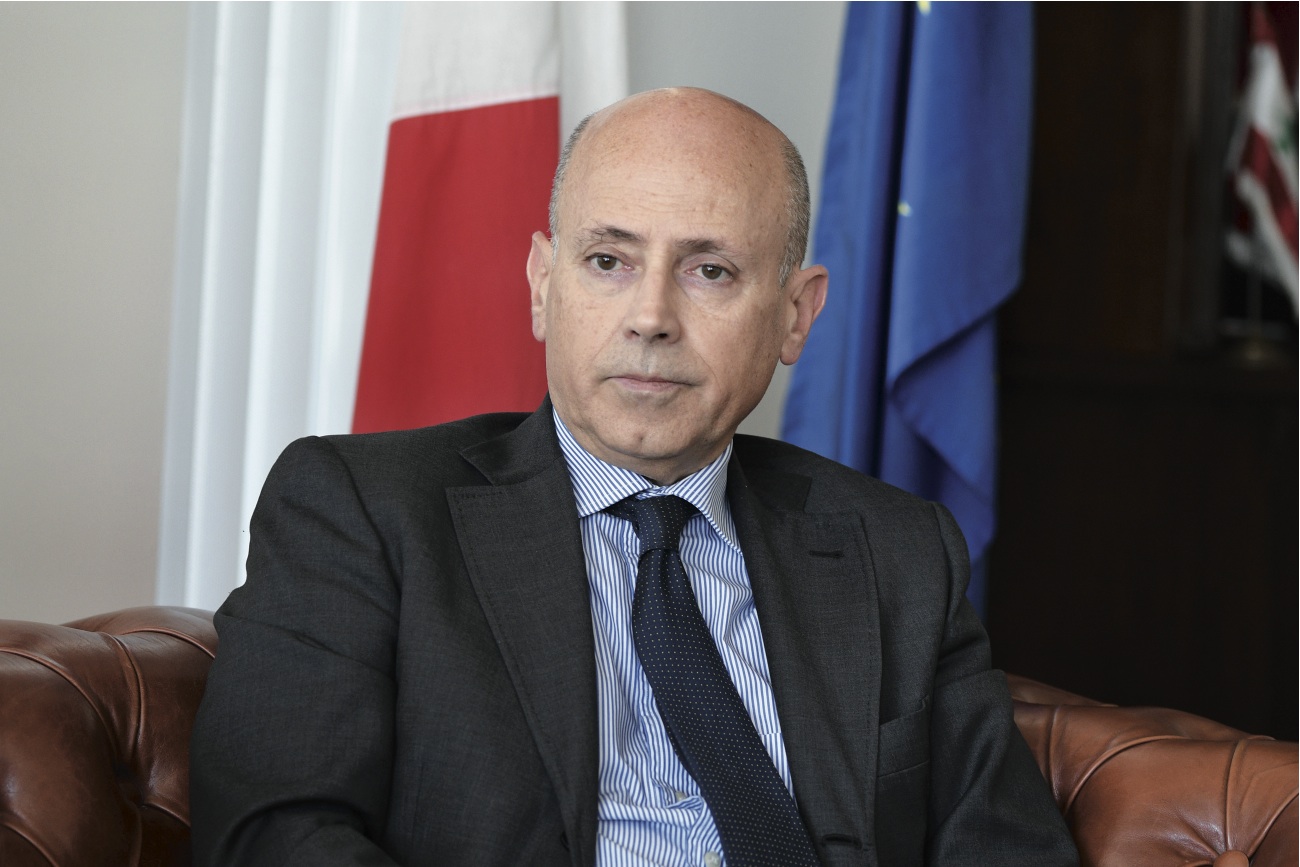
For the Italian government, supporting Lebanese manufacturing has long been seen as a key to economic stability and growth. In the last year, Italy financed a feasibility study for the creation of new industrial zones and agreed to fund new infrastructure upgrades supporting the sector. Executive visited the embassy to find out more.

E   With Lebanon electing a new president, how do you view 2017 in terms of the country’s economic prospects?

In the next year there might be, with a new government, an indication on economic policies that would show the international community which direction the country wants to go. The private sector will require some assistance and international partnership to seize new opportunities. In view also of regional evolution, there again will be a larger market for Lebanese exports. Hopefully with peace in Syria there will be conditions for the economy of Lebanon to grow. But the most important factor would be the indication from the government of where the country’s resources will go – renewing infrastructures, incentives for the private sector and for small and medium-sized companies. Depending on the priorities that the government will define, Lebanon’s international partners will better direct their foreign assistance programs to the country.

E   Has the Italian government identified projects or priorities moving forward?

Based on what Italian cooperation has done so far, we have had some positive returns. For example, on urban development, we started several years ago with a feasibility study and subsequently invested $10 million on a program to develop initiatives in five urban areas. The World Bank, based on our assessment, added $60 million more, contributing to the creation of new companies and jobs. That was a dual-donor, multi-year program which contributed to creating new opportunities, developing Lebanese enterprises and improving quality of life. Similarly, programs to protect cultural heritage became a factor in improving tourism.

In 2017, we envisage support for the industrial sector, implementing programs more or less the same way. We are aware that the Ministry of Industry intends to create new industrial parks to facilitate local and foreign investment. Italy financed a UNIDO (United Nations Industrial Development Organization) feasibility study for the creation of three industrial parks and [on November 17, 2016] we signed an agreement with the government of Lebanon, assigning part of an $80 million soft loan to realize the initial infrastructure in these industrial zones. Of course, the project needs more donors to be implemented, and we hope others will join us, similar to what happened in previous programs. We will also consider expanding our assistance programs in order to finance key infrastructure serving the industrial area in Tripoli. There will probably be other donors involved, as it is critical to support a larger manufacturing role for Lebanese enterprises.

[pullquote]

Depending on the priorities that the government will define, Lebanon’s international partners will better direct their foreign assistance programs to the country

[/pullquote]

E   Italy has a larger role in and connection to Lebanon perhaps than other countries in terms of trade and history.

Our cooperation system with Lebanon is a comprehensive one. For Italy, assistance to Lebanon is strategic, which is why it encompasses: security, including our 10-year long participation in UNIFIL and the program of assistance to the Lebanese Armed Forces; cultural heritage; and aid programs to build infrastructure, develop small and medium-sized companies, enhance social programs and improve the environment. We are also trying to expand the lifespan of valuable projects once their first phase is implemented, such as the study on the Orontes River Basin, by trying to attract other donors. That’s why it is key for us to work side by side with the government. Another example is the 1 million euro renovation program of the National Museum’s basement. Italy financed the work, adding valuable expertise that contributed to [expanding] the museum, which will be a worldwide landmark in archaeology and a new point of attraction for tourism that can help generate income. For the next year, we are considering ideas to support small and medium-sized companies, if and when the Lebanese government gives an indication they want to move in that direction.

E   In mentioning an economic vision, hoping that Lebanon comes up with one when it forms a new government, do you think the investments Italy is making are maximized and reaching its targeted beneficiaries?

We saw the recently launched central bank programs as one of the signs that the private sector, [with several] newly born companies, is very active. Lebanon has all the means to promote innovation and adapt the production of goods and services to the evolving market, relying on very skilled individuals present in the workforce and on a very active private sector able to extend their foreign business partnerships. What the private sector sometimes calls for, as we’ve heard, is better services that can reduce production costs. Industrial parks are one solution that might help the private sector. Others, of course, are a regular supply of energy, water management and new infrastructure. Italy, the EU and other European donors will keep on supporting the efforts of the government in that direction.

E    Can you say a little bit about the intensity of trade in 2016 between Lebanese and Italian imports and how bilateral relations are developing?

We have increased our exports to Lebanon, while imports remained stagnant. In order to sell more to Italy, Lebanon has to work with European institutions. We are assisting Lebanon in the processes to bring the quality of certain export products to standards that can facilitate export to the European Union. For example, to export agricultural products, like olive oil, where Lebanon has an advantage, it would be important to target the high control standard required to enter the European food market.

[pullquote]

We are assisting Lebanon in the processes to bring the quality of certain export products to standards that can facilitate export to the European Union

[/pullquote]

E   Was there any increase in the number of Lebanese exports to Italy in 2016, or was it stable?

Estimated figures for 2016 do not show an increase. I think it reflected the general stagnation of the economy. The reduction of exports due to the war in Syria was not compensated by an immediate reorientation of exports to other markets.

E   So for 2017, do you still see more of the same or do you anticipate that there will be more trade intensity in terms of Lebanese exports to Italy?

I don’t see a significant increase. The latest figures show that there was no increase. Reorienting exports will require a bit more time. So unless there are some surprising factors, maybe toward the end of 2017 we might see some better signs for Lebanese exports.

E    From the initiative with the creative cluster (supporting the production of furniture in Tripoli and jewelry in Bourj Hammoud) did you see any measurable results in the last 6 months after helping to open the shop in Gemmayzeh?

We haven’t received any data so far. However, we considered that project [to be] an important capacity building program. It is an opportunity for certain producers to see their businesses in a different way. We do not expect immediate results, but certainly the new approach that has been spreading among the producers will revitalize the sector.

E    Are you not worried that Lebanon might rise up to be a competitor to Italy if we learn everything that Italy – industrial or design wise, in arts and crafts – can teach the Lebanese. Are you breeding your own competitor?

Well, the world is an open competitive market. Certainly there is no interest in keeping a market like Lebanon depressed. We believe that by disseminating capacities we create the conditions to work more and to work together. Elevating the standard of competitors might create new market opportunities for mutual advantage and better terms for new business partnerships. By helping to improve the standards or the production capacity of competitors of a different size, it would be possible to generate partnerships that can work for the benefit of both.

January 17, 2017 0 comments
0 FacebookTwitterPinterestEmail
CommentEconomics & Policy

It is all possible

by Annalisa Fedelino January 16, 2017
written by Annalisa Fedelino

Beirut, December 2026.

For the second year in a row, the number of tourists visiting Lebanon has topped 3 million. They are lured by the country’s historical sites, great food and social scene, as well as by their curiosity to experience the multicultural milieu that makes Lebanon such a unique place, not only for the Middle East, but the entire world.

As of last June, tourists can move around more easily, taking advantage of the new city transit system that has helped make Beirut one of the most accessible and livable cities on the Mediterranean.

Traffic jams and piles of trash, so common only a decade ago, are now long gone. The country has been doing well politically and economically, growing by an average of 5 percent per year in the last five years alone. Elections are taking place within constitutional deadlines and under modern electoral laws. More and more jobs are being created every year, especially for new university graduates who now increasingly prefer to remain in Lebanon rather than emigrate abroad. Opportunities abound in the ever growing service sector (tourism and health care are just two examples), the technology sector and agribusiness.

Lebanon has climbed up the rankings of countries defined by their openness, ease of doing business and innovation. The government has passed a range of groundbreaking legislation that has modernized public administration and created a proper pension system and post-retirement health service for all its citizens. A series of infrastructure projects – a rehabilitated railway system, new bridges and overpasses, a new road network to better connect Lebanon to the rest of the Arab region (and beyond), as well as waste treatment facilities and electricity power plants – have successfully matched the private sector’s ingenuity and managerial skills with the public sector’s vision for improved service delivery.

Progress is perhaps most tangible in the major cities, yet the scope and benefits of Lebanon’s new projects have spread throughout the country, empowering local governments along the way. Internet speed and costs are among the most competitive regionally, and electricity is efficiently produced and now partly exported to neighboring countries. The offshore gas and oil sector, after an unsteady start, is now properly regulated and transparently managed. And after years of investment, proceeds from Lebanon’s natural resources have now started to flow into the government’s coffers. They will partly be used to fund additional capital projects, and partly to reduce the government’s public debt – creating a virtual circle of lower budget deficits, lower debt and interest rates, and more fiscal space to strengthen public services and create an environment where the private sector can flourish, boosting growth and job creation.

It all started about a decade ago…

After a long political impasse, significant changes and reforms were implemented starting in early 2017. The first step was a government of national unity – one that, although short-lived in the run-up to long overdue parliamentary elections – paved the way for progress that subsequent governments embraced and expanded upon.

The first budget in over a decade was discussed and approved in 2017 – and since then, annual budgets have become the norm once again. The government also took some courageous steps. As public debt moved toward 150 percent of Gross Domestic Product (GDP), a package of measures was implemented – starting with fuel taxation that capitalized on low domestic oil prices. This fiscal adjustment came at a cost, particularly as the economy had been weakened after years of political uncertainty and major regional shocks – chief among all, the Syrian crisis and associated refugee flows. At the same time, however, the renewed policy effort also helped revamp confidence, as the Ministry of Finance – supported by the whole government – clearly communicated its strategy and committed to providing better services to taxpayers.

Regulatory authorities were finally activated and empowered – starting in the telecommunication and electricity sectors. A new Public-Private Partnership Law, in line with international standards, was approved after languishing in parliament for many years, creating a modern legal and regulatory framework for the public and private sectors to work together in planning, executing and managing projects. And in a positive nod to the future, Lebanon also became a member of the Extractive Industries Transparency Initiative, underscoring its commitment to transparency and accountability in managing Lebanon’s then nascent offshore wealth. 

As change became visible and gained momentum, confidence started to recover. And the international community – perhaps heartened by the resolve of Lebanon’s revitalized policy-making framework – added to its ongoing support by providing large and reliable multi-year funding to cover the long-term costs of hosting the refugees.


Beirut, December 2016

We will only know in a decade’s time whether the story above is a snapshot of reality or mere fiction. But it is all possible. Lebanon has the potential and the capacity to become a beacon of progress and prosperity. The moment is now, starting by setting aside divisions and embracing a sustainable future that will benefit all. 

January 16, 2017 0 comments
0 FacebookTwitterPinterestEmail
Industry & AgricultureWine

Grapes of success

by Nabila Rahhal January 16, 2017
written by Nabila Rahhal

Lebanese wine has been filling many a glass both locally and globally as the country’s winemakers continue their efforts to grow their market share and as new boutique wineries are launched.

Coming out of the Lebanese Civil War with just eight wineries, the wine industry in Lebanon has grown to over five times that number, with 42 wineries registered with the Ministry of Agriculture in 2016.

Of this total number, 23 wineries are members of the Union Vinicole du Liban (UVL) and account for 95 percent of Lebanon’s total wine production, which is around nine million bottles per year, according to Zafer Chaoui, current head of the UVL and chairman and chief executive officer of Château Ksara.

And yet, Lebanon’s production numbers remain a drop in the ocean in comparison to neighboring wine-producing countries. “Growth is needed. We produce nine million bottles, while Cyprus produces 27 million bottles and it doesn’t have the wine we have because our climate is better,” says Chaoui, explaining that while Lebanon might never be able to compete internationally in terms of volume of production, and therefore in prices, it does produce quality wine and should compete in that category.   

All that glitters

Locally, wine consumption has been on the rise for the past four years, following a global trend due to it being perceived as “healthier” than other types of alcohol, according to Paul Choueiry, general manager of Les Caves De Taillevent.

Unfortunately, there are quite a few Lebanese who assume that imported wine is of better quality and taste than the local variety, although the country’s wine producers insist that this is often not the case. “Lebanon has incredibly good wine, and sommeliers and wine specialists who visit Lebanon are really flabbergasted by this. Lebanese have to know this because we have this kind of snobbery that we should only drink foreign wine. It is not wrong to enjoy foreign wine, but if you do a blind test, the Lebanese wine tastes just as good,” says Hady Kahale, general manager of Ixsir.

The perception of foreign wine being better than local wine is not helped by the many restaurants in Lebanon that boast an extensive imported wine list with only a few local varieties – often at almost the same price as the imported ones – according to the winemakers Executive spoke to. “This is very dangerous because you don’t see it anywhere else in the world, and what also happens is that when customers pay $60 for a bottle of French wine in a restaurant, they think, ‘Why should I pay almost the same amount for Lebanese wine?’” says Kahale, explaining that for a foreign wine to be priced at a high-end restaurant for $60, it would have left the winery at $1.50, making it very unlikely to be high quality.

Although consumption of wine is increasing in Lebanon, many wineries feel more could be done to promote local wine. “Unfortunately, we still find some restaurants that offer more imported wines than Lebanese wines. We should work more on promoting Lebanese wines in Lebanon together with the UVL,” says Joe Assaad Touma, winemaker and co-owner of Château St. Thomas.

It starts at home

Wine producers have indeed been working to improve the perception of local wines among their fellow citizens with the goal of increasing its consumption, which is still relatively low. “If you look at the consumption of Lebanese wine per capita, it’s two to three bottles per year compared to French wine which is 60,” explains Edouard Kosremelli, director general of Château Kefraya. 

Their efforts are slowly but surely bearing fruit with an increasing number of Lebanese feeling pride in their local wine.

The rise in the number of boutique and small wineries also added a much needed dynamism to the sector. “Many small and medium-sized wineries are being established, and they are most welcome because healthy competition improves quality and pushes us to do better, both locally and internationally,” says Chaoui.

Having more wineries also increases the chances of people becoming aware of Lebanon as a wine-producing country, thereby increasing consumption. “With more wineries, consumers have become more curious about their wine and want to try new wines,” says Kosremelli.

Despite struggling to find distribution channels and to make a name for their wine, boutique winery owners have managed to create a niche market where those curious about wine can find a lot to be occupied with. “When you become known, established distributors will ask for the product. But if you want to build a brand, they will never help you out or push it unless you give them incentive; so you do your own marketing and hope that people will ask for it,” explains Jennifer Massoud, co-owner and communications manager at Atibaia, adding that they have seen sales of Atibaia pick up the most in outlets where managers put in the effort to educate consumers on boutique wineries.

A wine tour

The growing trend of enotourism (visiting wineries) has also helped Lebanese discover their country’s wineries and wines.

Château Ksara, with its well-known caves which sheltered those escaping the Ottoman army during World War I, received 27,000 visitors in summer 2016 alone and expects the total number of visitors for 2016 to be around 60,000, according to George Sara, Château Ksara’s Chief Commercial Officer and board member. 

Meanwhile, Château Kefraya reports an increase in visitors to its winery when compared to 2015. Ixsir, too, has done well, having welcomed more than 30,000 visitors in 2016 to its winery and its accompanying Nicolas Audi catered restaurant in the hills of Batroun.

Not only does enotourism help consumers understand how wine is made, it also makes them associate the wine label with the good time they had at the winery, making them more likely to select it next time they go wine shopping, explains Kahale.

Wine selling

Promoting wine locally does not stop with potential customers lunching at wineries, but also involves engaging the consumer with wine production. As such, some wineries have been inviting consumers to help out with the grape picking and to celebrations at the end of harvest season. “Château St. Thomas has been hosting an annual harvest event since 1999, and the idea is to live the experience of harvesting grapes and making wine. It’s very important to have this experience and meet the people who produce the wines,” explains Touma.

Participation in local wine festivals such as the annual Vinifest, which takes place at the Beirut Hippodrome, or others held during the Christmas season also help to increase local consumers’ awareness regarding the quality and variety of Lebanese wine. “It’s important to maintain market presence and grow the consumption per capita level in Lebanon, and Vinifest is typically an event that helps in this direction,” explains Kosremelli.

Kahale thinks that marketing efforts at the local level should be directed at making Lebanese wine trendy in the eyes of consumers, especially when it comes to marketing and advertising. “Exporting is very important, but it is the Lebanese market which is extremely important for us all. Local consumption is very small in Lebanon, but this is the market we have to work with. We need sexy ideas; we need to up our marketing as this will increase the market,” enthuses Kahale, giving the example of Ixsir’s collaboration with young Lebanese artists to design the bottle of their entry range wine brand, Altitude – the first time this was done in Lebanon – and the positive response it drew from consumers. Château Kefraya also mentions their collaboration with local artists to design their labels as a marketing activity, citing Lara Khoury’s label design of the Les Breteches limited edition in 2016 as an example. Meanwhile, Château Marsyas collaborated with designer Nada Debs for their 2017 gift pack.

Sara also speaks of the importance of finding fresh ways of marketing Château Ksara, but says they have to balance that with their long history of winemaking. “We want to bring generations together around our wines, and social media is a great tool to cultivate a following among younger wine lovers. Moving forward, we have to tread a fine line between constantly reminding consumers that we are still here – through our new interactive website and seasonal billboard and radio ads that reflect the Lebanese lifestyle of wining and dining and fun in the sun at the beach – and maintaining our position as Lebanon’s most venerable winery with a history steeped in tradition going back to the Jesuits in the mid-19th century,” explains Sara.

Going global

Lebanese wine first went global with the late Serge Hochar, winemaker and founder of Château Musar. He took Château Musar to the UK amidst the Lebanese Civil War – and garnered a lot of recognition both for Lebanon as winemaking country and for his label as “the wine of the war.” Ever since – and especially now that they are spurred by the challenges brought forth by local and regional instabilities – Lebanon’s wine producers have been seeking greener markets across the globe.

In doing so, wine producers understood that by working together under a common umbrella, they would have a bigger impact than if they marketed their wine individually. “I always say to my colleagues that with exporting we have to overcome small competition. When people talk about Chilean wine, or South African wine, who talks about individual wineries? We all have the same climate, same quality of grapes and we are professionals,” says Chaoui.

In this case the umbrella is the UVL, which for the past few years has concentrated all its efforts in making a name for Lebanese wine abroad. Their efforts caught the attention of the Ministry of Agriculture and the Chamber of Commerce, who have both given the industry their support. “The new dimension that UVL has been taking for two to three years is marketing. Everything that is being done out of Lebanon is being done through UVL, with the support of the Ministry of Agriculture and [the] Chamber of Commerce,” says Kahale.

Recounting the UVL’s activities in 2016, Chaoui speaks highly of the Wines of Lebanon event that took place in New York in November 2016, under the patronage and financial support of the Ministry of Agriculture, and organized by Hospitality Services. “[The organizers] hired a PR company which succeeded in getting local wine professionals to attend this event. For us, this is the key to success because the Lebanese already know our wine. All those who attended were extremely satisfied,” says Chaoui.

The second major event for the UVL, and hence Lebanese wine abroad, was being the guest of honor at Megavino, the biggest wine fair for professionals in Europe which takes place in Brussels. “Megavino was a great event for us because we had the chance to be a guest of honor. The exposure was huge, and many people who have followed the news in the region didn’t even know that Lebanon produces wine,” says Chaoui with a quiet pride, explaining that the 80 percent of the budget for Megavino came out of the annual sum which the Chamber of Commerce gives the UVL, with the wineries covering the remaining balance (including airfare, transport costs for wine and accommodation).

These efforts, coupled with the individual marketing initiatives and follow-ups by individual wineries, has led to Lebanese wines being served at tables as far flung as China, which Château St Thomas cites as a market, or Mexico, where Ixsir recently sent a shipment.

Whether locally or abroad, Lebanese wine is certainly carving a name for the country’s grapes and producers. That’s something we can all toast to.

January 16, 2017 2 comments
0 FacebookTwitterPinterestEmail
Banking & Finance

A promise of wealth

by Thomas Schellen January 13, 2017
written by Thomas Schellen

Oussama Kaissi is the chief executive officer of the Islamic Corporation for the Insurance of Investment and Export Credit (ICEIC), the insurance arm of the Islamic Development Bank (IDB). The IDB is a Saudi Arabia-based multilateral organization which comprises a group of Islamic institutions in the realm of finance. Executive sat down with Kaissi to discuss the role of Islamic banking in Lebanon and the potential of issuing Islamic debt instruments (known as sukuk) for the country.

E   If we talk about the state of the Islamic finance industry in Lebanon, Islamic banks do not seem to have developed strongly here in the past when compared with the conventional finance offers, which local corporate customers have responded to. How do you see this?

There are two Islamic banks here in Beirut. One of them is an offshoot of [GCC-based] Baraka Group, and the other is an Islamic entity of Credit Libanais. They were created to answer the market’s call for a niche product, and I don’t think they have been developing the market much. These banks have not failed – as they are in existence and their offering is normal – but they have not grown. Islamic finance has proven globally that it is a viable product. Any time you have a viable product, the minute that you see that it has failed to grow [you can surmise] this is because of lack of knowledge on the potential of Islamic finance and the lack of knowledge on the part of the consumer. Islamic finance and conventional finance play very important roles on the horizons in the economies where they both coexist. I know there is a huge base here [in Lebanon] of potential customers for Islamic finance and this group ranges from individuals to businesses. It is one of the most vibrant financial sectors in the region. That is why I tell you that the market here is ready. I believe that Islamic finance is an extremely important window for the banks here and for the government to go to the market to procure more debt instruments, finance the debt that they have and even pump some liquidity into the market.

E   When Islamic finance first rose to prominence some years ago, the cost of an Islamic loan used to be higher than the cost of a conventional loan. Is it correct to say that this has changed?

Yes, that is correct.

E   You see cities like London aspiring today to become international hubs for Islamic finance. Where do you see Lebanon fit in with the centers of Islamic finance?

London has taken center stage in terms of being a worldwide hub for Islamic finance, and Dubai is trying to become the regional hub in the Middle East. South Africa is trying to become the regional hub in Africa, and Malaysia and Singapore are important players as well. Thus, on every continent you have somebody who is well-situated to be the regional hub for Islamic finance. With respect to banking in Lebanon and how you view it going forward, and on how to link Islamic finance with the conventional system, Islamic and conventional finance have to be seen as collaborators. There should be a balance, where people still go to the conventional markets for debt and where people can proceed to explore Islamic finance. But [as an Islamic banker] one has to be critical of oneself in the sense that the growth of Islamic finance has not reached its full potential yet, even though the numbers are healthy.

E   What has to be done?

In my opinion, Islamic finance has to be brought to the market in a simplified manner. One of our main mandates as the IDB Group is the promotion of Islamic finance. We have to do more, and we have to be more active in helping Islamic banks to manage their day-to-day activities, go to market and issue sukuk. Sukuk are now an integral part of finance, where you can issue sukuk like bonds and create liquidity. If you go to the markets and see a liquidity squeeze, this does not mean that there is no cash that can be tapped into. The market is flooded with cash, but you need programs for sukuk specifically that can go to these markets and tap into that cash. These programs should be supported with highly rated institutions so that the costs are low and returns are matching what is the going rate. The markets are open for us in all Islamic hubs, whether in London, Dubai, South Africa, Singapore or Malaysia. As far as legislation, we are operating in all legislative environments. Another issue that in my opinion is a positive, not a negative factor, is the diversity of Sharia boards.

E   Is it true that there are no united perspectives from Sharia boards?

To be united is not the issue. There is diversity. From diversity, you can either create conflict or something that is positive and harmonious. I believe that a lot of groundwork has been done and we should not negate the fact that there has been tremendous success. But the challenges are great and there is a big need going forward for us to address liquidity needs, as we are now facing economies that are heavily interacting with major economies in terms of funding and so forth. Countries are retracting now, specifically oil-producing-countries, and they are looking to raise funds in capital markets and are having to go to sukuk markets. For us to raise the capital that is needed to reach what we want, collaboration is needed from London or South Africa or from wherever. A hub can bring together the cash or liquidity that can help economies in our member countries to progress and prosper.

[pullquote]

The sectors of the

Lebanese economy, with the help of the central bank, are capable of pulling the economy out of the slump it is in

[/pullquote]

E   The Lebanese economy going forward has needs, and there has already been talk of a Paris 4 donor conference to finance gaps in the Lebanese fiscal situation. With regards to the possibility of tapping into financial tools from the Islamic side, how realistic in your view would it be to have sukuk issued on behalf of the government?

Lebanon has always had great friendships globally, starting with Europe and the Gulf. Great support for this country has been coming from the Gulf, specifically Saudi Arabia and Kuwait. They spent a lot of money to support Lebanon; specifically through multi-billion dollar support packages and aid given to Lebanon after the Israeli invasion. [Having said this], Lebanon has resilience in its banking sector. This sector is capable and it has the necessary knowhow, relationships and liquidity. The sectors of the Lebanese economy, with the help of the central bank, are capable of pulling the economy out of the slump it is in. It definitely needs to have legislation and you need political stability. Sukuk are the way to go, and I think there are plenty of Islamic banks that will be happy to talk to the government here and see how they can issue sukuk to support the economy.

E   Lebanon is, according to most perceptions, dominated by debt markets with conventional banks playing a very large role. How would sukuk figure in that equation?

It depends what you are raising sukuk for. When issuing sukuk, first we need to get an understanding of the purpose that they are being created for. If the government here wants to raise sukuk, this sukuk should be issued to service the debt or to finance infrastructure projects. In my opinion, Lebanon will hopefully have a government very soon, and it needs to set priorities on where they need to begin jump-starting the economy. If there is a clear understanding of what the purpose behind raising the sukuk is, then sukuk are definitely a viable solution for the Lebanese government.

E   Islamic finance is known for placing emphasis on its ethical dimension. But is it true that the personal integrity of people working in Islamic finance is particularly important, even more so than the ethics of people when they are in conventional finance?

Sukuk are issued by Islamic financial institutions, and I take it at face value that these institutions are well-managed by reputable people and each has a Sharia committee that is supervising their business. On top of all this, you also have the central bank or other regulatory bodies that are supervising such transactions. There should be close scrutiny [of debt issuances], whether Islamic or non-Islamic, to safeguard the interest of the people. When you issue sukuk, you create debt for the people in a country, and therefore regulators and legislators need to look very carefully to protect the interest of their people.

E   From the viewpoint of the IDB, is the Lebanese risk today higher or lower than before?

Lebanon has always been a member country for us, in hard times and in good times. We are there to offer support, and we have an appetite where some other multilateral or conventional entities do not. After all, [Lebanon as a country] are shareholders in the bank and in ICEIC, and we are always here to help.

January 13, 2017 0 comments
0 FacebookTwitterPinterestEmail
Banking & FinanceOverview

A retrospective

by Thomas Schellen January 12, 2017
written by Thomas Schellen

It is understandable that Freddie Baz, the chief strategist of Lebanon’s largest bank, Bank Audi, presented a divergent view from the central bank’s narrative explaining the latter’s financial engineering (see story and infographic). Whereas the analysis picture drawn by Banque du Liban (BDL) focused on the very positive impacts of this quantitative easing measure, Baz emphasizes that there was no crisis that could explain the size of the operation. (He suspects mundane pragmatism to be involved in the operation and to account for the large size to which it has grown.) “It is very opportunistic. If I have to be candid, no central bank will miss the opportunity to beef up foreign reserves when they are available. Because once it needs the reserves, it might not find them,” he says, reasoning that the boosting of reserves is in line with a central bank’s raison d’être.

Although noting that no one is privy to what the strategies of Lebanon’s central bank governor are, Baz speculates, “he [might have] said, ‘as long as there is appetite, let’s do a little bit more [of the reserves-boosting transactions] and since I don’t have any more Eurobonds, [commercial banks] will get certificates of deposits (CD) from the central bank’.”

This perspective appears very logical when seen against the performance of the largest banking group in Lebanon. Bank Audi’s results in 2016 were impressive even before the (not yet audited) income from the bank’s participation in the financial engineering was recognized in the third quarter financial report.

For a view on the bank, it is instructive to revisit what the equity research team of FFA Private Bank wrote about Bank Audi’s half-year results. “Bank Audi posted net profits at USD 115 million (+5 percent QoQ, +13 percent YoY) with diluted EPS at USD 0.27 (+12 percent QoQ, +16 percent YoY), both above our respective $111 million and $0.25 FFA estimates,” the bank observed. The analysts further said that the bank’s results exceeded their expectations in terms of total operating income, and also by “significantly higher” trading & investment income, and, to a lesser extent, in terms of net interest income. Net fees & commissions income, on the other hand, were below FFA mid-year estimates by about 10 percent.

Three months later, FFA acknowledged that Audi’s net profits and operating income still were higher than the analysts’ expectations by a significant margin. FFA also noted a leap in “exceptional fees and commission income,” which stood at $689.9 million and thus greatly exceeded the FFA estimate of $69.3 million, which according to FFA was “resulting from BDL debt swap transactions.”

Making the most

According to Bank Audi’s publicly disclosed numbers, total assets at the end of September 2016 stood at $45.3 billion, up from $42.3 billion at the end of last year. Net-interest income improved 11.4 percent year-on-year to $739.1 million; non-interest income was reported at slightly over $1 billion, which compares to $335.1 million during the first nine months of 2015 (a 201 percent jump); 9 million profits after tax were $541.5 million, versus $280.5 million in the same period of last year; the net profits were $350.3 million, up 15.2 percent year on year – but that must be taken with the knowledge that the bank wrote off $191.2 million in regard to its operations in Syria and Sudan from its after-tax profit. At a 15 percent rate of increase, if this rate or even a few percentage points less in profit growth were to be achieved by year-end, Bank Audi’s net earnings for 2016 currently look like they are going to be the highest in the past five years (2012 was hitherto the year with the highest net, at $384 million) and thus set a new record.

As far as the impacts of the financial engineering in the income statement, the bank identified $642.9 million of its non-interest income as having been generated by BDL exchange transactions and $86.8 million in exceptional tax expenses from the same operation. Overall income tax expenses jumped 111 percent to $164.6 million. In the field of operating expenses, the bank reported a 50 percent increase to $814.7 million, of which it attributed $217.9 million to “exceptional expenses related to good-will expenses and one-offs.”

Whether in presentations of its own main indicators (assets, loans, deposits, earnings and earnings per common share), of other ratios per share, or in comparison of stock market ratios with averages for MENA, emerging markets and the world, Bank Audi looks healthy, solvent and attractive. In Baz’s words, “We have been showing the same magnitude of increases in terms of results. We had increases by two digits in our profits in Q1 and H1 with respect to the corresponding period of last year. I believe that the full year results will be along the same lines of improvement.”

He emphasized that financial engineering was “by definition” forbidden – by way of a central bank circular – to affect the bank’s bottom line. Nonetheless, it seems unmistakable that Lebanon’s largest bank made great use of the central bank’s financial engineering offer, which Baz acknowledges by comparing the banking sector to a family with children of different levels of intelligence, of which Bank Audi was “among the wisest kids.”

Christmas bells may be ringing at Bank Audi in light of these performance results, even if they are not going to be distributed as dividends. What will not be ringing, however, would be alarm bells either at Bank Audi or the other top banks in Lebanon. Both other listed banks covered by FFA, BLOM and Byblos, achieved higher than expected profits according to the Q2 and Q3 reports. In the case of Byblos, the bottom line was helped by a reversal in provisions and in case of BLOM, profit improvements were mainly linked to “higher-than-expected trading and investment income,” which in turn was based on capital gains from BDL debt swap transactions, FFA said.

Affected by the economy’s pains

However, this does not mean that the banking sector was decoupled from the sluggishness seen all over the economy. Whereas financial performance of leading banks in 2016 to date “maintained its good standards,” according to the sector review by Dany Baz (see comment), it was also noted that assets and deposits by the end of June had registered only slow growth (in the low single digits), even as the third quarter saw an acceleration in domestic activity.

This side of the year’s banking picture – that is dominated by subdued performance outside of the exceptional financial engineering environment – is confirmed by Walid Raphael, chairman and general manager of Banque Libano-Française (BLF), which uniformly ranked eighth in the sector by indicators such as assets, deposits, loans and profits, as well as by Tarek Khalife, chairman of Creditbank, ranked 14th in the sector by assets and deposits, but 10th in terms of loans.

[pullquote]With a view to the wellbeing of the Lebanese economy…bankers have their eyes focused on positive elements and potential[/pullquote]

As Raphael tells Executive, 2016 was in line with BLF’s budget and results were in line with the previous year, or slightly better. “It has been a very challenging year in terms of business because of the slowdown of the economy in general and because of the situation across the region, but also worldwide,” he explains. This difficult environment is something that Raphael moreover expects to carry on for another one or two years, even as he credits the central bank’s financial engineering to have been done in a very clever way and to have created a very strong position for BDL.

“The results of 2016 are not yet on the books, but it was a difficult year for all banks in Lebanon. Banking had a slowdown and this affected most financials. Growth in lending portfolios stagnated and this growth is the real indicator of health,” says Khalife, adding that results of the banking sector are only looking better this year because “makeup was slapped on.”

He reasons that banks are not achieving a high rate of return, considering the risk that they have to carry, when compared with other sectors such as the real estate sector. Khalife also says that non-recurrent incomes like those originating from the central bank’s financial engineering are very helpful as a short-term boost, but one should analyze the health of the banking sector without taking non-recurrent incomes into account. “I don’t see a disaster on the horizon in 2017, but we cannot count on non-recurrent events such as financial engineering to boost our results. I hope people in banking won’t depend on it,” he cautions.

Evidently neither the sector’s overall subdued growth nor the exceptional outcomes produced by financial engineering provide the full picture of the sector in 2016, which saw some banks withdraw from the market, while others claimed to have achieved a turning point towards improving their position. One such lender was Banque Misr Liban (BML), whose executive general manager, Fadi Daoud, tells Executive that they have reached exactly this state. “We performed very well with the swaps, [in which] we did well compared to our peer group. In our regular business, we also did well. We will close the year with 25 to 30 percent more profit than last year,” he enthuses.

Daoud acknowledges that BML is still in the second tier, or beta group, in terms of the bank’s size by deposits, but says it has embarked on a steady path of growth with developments of new products, upgrades to its information technology – already having inaugurated a new core banking system in 2016 – and its human capital (including creation of a new communications department and corporate social responsibility program), plus plans to regularly roll out new branches. “We are opening two new branches in 2016. We are continuing our growth by opening two branches per year, so we will be 20 this year and 22 next year,” he says.

Political consensus as hope factor

With a view to the wellbeing of the Lebanese economy, or rather the chance for its improvement in the next year and further into the decade, bankers have their eyes focused on positive elements and potential.

“Political normalization is essential. We always say in Lebanon that we can live with a political vacuum but it is much better without [one]. The fact that the presidential election happened, and now political life is being restored, with the functioning of constitutional bodies, this is definitely a positive development,” Baz exclaims and adds that he does not believe the country’s political, social, and economic environment to be suited for the political gamesmanship of earlier times. “I don’t believe that the environment is supportive for continuing the same political games of the old days. There is something new that happened in the fact that [different political forces and leaders] were all together agreeing on something,” he opines.

“I see two signs that are very important: one is the renewal of the mandate of the central bank governor, which will provide stability, and [secondly] a budget. We expect that we finally will have a budget, and this will definitely help the investors and all players to be more confident. We have been without a [state] budget for over 10 years now and I think this will be the first move to show that there is really awareness and a commitment for change,” declares Raphael.

He adds that banks, in his opinion, will be ready to contribute to solve Lebanon’s economic problems. “We know very well what the problems of our economy are and we also know what the solutions to our problems are. Also, if there is the political will, we have the means to solve the problems and find the right financing,” he adds.

Khalife concurs that all banks are hoping for a positive turn in the Lebanese economy. If there are even just signs of a turnaround, he believes the banking sector will be heartened and gain new courage as it is able to sustain another one or two years until an actual improvement materializes in government finances, due to revenue outlooks from the oil & gas sector and from achievement of structural reforms that will help lowering corruption and improving fiscal incomes.

According to Khalife, banks are lending to the Lebanese state at prevailing rates simply because they have no other choice. Since there is no bank that would refuse deposits, they have to give to the state what they cannot lend. The state’s need for finance in his analysis is a consequence of many factors that are not brought on by the banking sector. “I don’t see why Lebanon has a constant deficit. The Lebanese model is a productive model and there will be a better tomorrow if corruption is cleared out,” he says.

Optimism by bankers about the political turnaround and reconstruction in the country is no wonder, of course. In some sense, the country at the brink of 2017 exudes a profound tiredness with political stalemates and brinkmanship of power cliques and entrenched groups that may have aimed for zero-sum outcomes in their favor (scenarios where they come out as winners of power), but only produced no-win situations for the nation and economy. A continuation of the status quo of 2015 and 2016 is not what any sentient stakeholder in the Lebanese economy wants.

January 12, 2017 0 comments
0 FacebookTwitterPinterestEmail
Business

Big money

by Ahmad Barclay & Thomas Schellen January 12, 2017
written by Ahmad Barclay & Thomas Schellen

In May 2016, Banque du Liban (BDL), Lebanon’s central bank, completed the first phase of a swap operation with the Ministry of Finance (MoF). Following that, BDL pulled the financial engineering tool out of its bag. It proceeded to banks with an offer to enter into a transaction in which they would have to bring in money against fresh US dollars inflows. With their existing or new funds, banks could opt to purchase any of three tranches of Eurobonds held by the central bank since their interaction with the MoF, and/or CDs issued by the central bank at the same maturities and same coupon rates as the Eurobonds. 

The precise total of Eurobonds and CDs which the central sold to banks is not yet compiled but it is generally assumed to be above $10 billion. Also not known is the ratio between money that banks pulled in from correspondent accounts and fresh funds that they could attract from investors. An indication for the latter, however, is the growth rate of deposits. Before the financial engineering this rate stood at 3.7 to 3.8 percent; after the engineering the growth rate was reported at 5 percent, meaning that growth has increased due to the financial engineering.

Incentives and rewards

It is important to understand that the central bank did not entice commercial banks to buy Eurobonds by selling them at a discount or awarding banks with higher coupon rates on Eurobonds. The tool used by the central bank to encourage banks’ participation in the operation was to offer voluntary discounting of LBP T-bills and CDs with maturities of 12 years or less at 0 percent with a haircut of 50 percent. If banks sold LBP denominated T-bills (or T-bonds) with remaining maturities of eight years and less or CDs, the central bank would buy these papers at no discount (zero percent) but with a reduction in their coupons (haircut) of 50 percent.    

In discounting at zero percent, the central bank offered to the commercial banks to provide them ad hoc with the total accumulated amount that they would normally earn over time in annual coupon payments. In applying a 50 percent reduction on the amount that is due from the discount date to the maturity date of the respective T-bill, the central bank at the same time wanted the banks to settle for a “haircut” equal to 50 percent of the amount that they would have gained when holding the T-bills to their maturities. What looked at first sight like a non-recurrent windfall gain in the billions of dollars for the commercial banks was in actuality a non-zero sum (win-win) interaction with the commercial banks by the central bank on one hand and a boost of BDL’s foreign currency reserves on the other.

Instead of having to service coupon payments twice every year until maturity, the central bank provided commercial banks with these amounts upfront (the premium), but minus 50 percent of nominal value. The central bank as the new holder of the treasury bills was of course entitled to collect the annual coupon payments to 100 percent, so that by time of maturity the BDL would have recouped the full amount given to the commercial banks as premium, plus the other income (50 percent of the coupons) that was due from the T-bills.

[pullquote]It is important to understand that the central bank did not entice commerical banks to buy Eurobonds by selling them at a discount or awarding banks with higher coupon rates on Eurobonds[/pullquote]

On the side of the commercial banks, money-now was clearly preferable to money-in-future, even at a 50 percent reduction compared with what they would have earned over years in future. Given the magnitude of involved amounts – dollar billions – some banks could report non-recurrent, not interest-based incomes to have shot up by several hundred percent in Q3 of 2016 when compared with the same quarter in 2015. This was truly a rare opportunity for any large bank, or even a small one.

To safeguard the intended usage of their advance premiums by the commercial banks, the central bank issued directives that this income was not to be included in their Profit & Loss statement and potentially allocated to distribution (as dividend for shareholders) but should be added to Tier-2 capital.

Background and context

The background against which this financial engineering played out is not a crisis or recession as the events that triggered quantitative easing measures by the Federal Reserve System after 2008 or by the European Central Bank during the current decade in the course of various national crises in euro-zone countries. The context of BDL’s action was a threefold scenario of past indicators in combination with a future outlook mixing elements of uncertainty and predictable events on the side of upcoming rules and regulations – a drama but not a crisis.

The three unfriendly past developments were a slide in foreign currency reserves at the central bank (in 1H 2016), a deterioration in Lebanon’s balance of payments (ongoing since 2010), and a slowing in the growth rate of deposits. The elements on uncertainty specifically entailed prospects for remittances for Lebanese diaspora. According to World Bank data, remittance inflows remained strong at over $7.5 billion and are projected to be 1.6 percent higher in 2016 when compared with 2015. However, the dependence or forced reliance on inflows coming from the Lebanese diaspora is a perennial source of concern in financial planning, which is exacerbated by observations of oil price weaknesses and liquidity squeezes in the Gulf.

The predictable regulatory events in global finance and their impacts on Lebanon first involve future requirements under the IFRS 9 accounting standards. These new standards mandate that provisions for loans are made in the capital of banks at the moment of issuing a loan, not, as previously only when a loan turns sour. A second predictable event will be implementation of new solvency requirements under the Basle III framework (15 percent capital adequacy ratio instead of 12 percent today); also on the horizon is a requirement for two percent in general reserves on any bank’s loan portfolio.   

[pullquote]Senior BDL staff spent hours on phone calls either answering financial engineering-related questions from banks or even calling banks that had not responded to the offer[/pullquote]

With the financial engineering, Lebanon preemptively positioned its banks to have higher capital bases (cumulative increase estimated at $2.5 billion) as they transferred non-recurrent income from the financial engineering operation to Tier-2 capital. Other measurable outcomes are a jump to central bank forex reserves to a historic high (around $41 billion, not counting gold reserves at the end of October 2016), a turnaround of the balance of payments from a deficit of roughly $2 billion before the financial engineering to a surplus of $555 million, and the aforementioned widening in the growth rate of deposits.

Timelines

In terms of central bank activities, one can divide 2016 into three phases. First was the swap phase involving BDL and MOF. This was wrapped up tight within one month, May 2016. Next came what could be called a negotiation or subscription phase, during which BDL opened its channels to commercial banks for enrolling in the transaction process involving the discount of LBP-denominated T-bills and CDs by banks to BDL and the banks’ simultaneous purchase of foreign currency denominated paper from BDL.

During this phase, which lasted for about ten weeks from early June until mid-August, all banks participated in the financial engineering exercise, even as it was acknowledged by market insiders that certain banks acted faster and smarter than others.

Following upon the close of the offer in mid-August was then an execution phase that lasted until late October, at which time the positive outcomes of the financial engineering were highlighted by central bank Governor Riad Salameh in a number of speeches and addresses at events such as BDL Accelerate. One month later, at the end of November, not all details have been computed by BDL but overall dimensions of moved amounts are estimated in the market at $11 or 12 billion, in equal parts benefiting the central bank (through reserves) and the commercial banks (through boosts to Tier-2 capital and some revenue gains). The harvested benefits and their allocations to capital and other uses differ from bank to bank and are not proportional to each bank’s size or ranking by assets. In addition, there are the macro-economically relevant numbers relating to the shift in the balance of payments and increased deposits growth rate.

The announcement of the financial engineering’s outcomes and huge dimensions led to a flood of questions and comments, including both conspiracy allegations and legitimate queries. What may have also contributed to confusion, besides the inherent complexity of unconventional central bank measures in general, is that the operation involved many details, sidebars and deceptively low interest rate benefits. For example, viewing the 1 percentage point increase in the growth rate of deposits in context of the total size of deposits, which is in the dimension of $160 billion, makes it clear that the gain is substantial in absolute terms, and would be equivalent to the immigration of one to two billionaires with all their assets. In another example of an effect with actual implications that are not directly meeting the eye, central bank sources told Executive that BDL is granting banks the opportunity to place long-term deposits in LBP with the central bank if they commit to five-year deposit terms at 5 percent interest. At this cost, BDL will have funds available that it can use when the Lebanese Republic issues paper – normally issued with a 6.74 percent interest rate – thus reducing the burden on the sovereign.

Motivations, objectives and effects

Cognizant of the notion that one encounters three expert assessments in any assembly involving two economists, Executive notes that an infinite number of interpretations of this BDL financial engineering is possible. World Bank assessments, as published in the fall 2016 Lebanon Economic Monitor (LEM) list several advantages and disadvantages of the exercise, such as, on the part of BDL, increased exposure to foreign-denominated sovereign debt and expansion of liabilities in foreign currency and in local currency as disadvantages versus a boost in its stock of foreign exchange reserves and enforcing of confidence in Lebanon’s exchange rate and financial system as advantages.

For commercial banks, the LEM lists as advantages their increased capital positions and increased liquidity in local currency along with a drop in their sovereign exposure in local currency and as disadvantages a decrease in their liquid foreign-currency assets placed with banks abroad as well as an increase in their sovereign exposure in foreign currency. From the macroeconomic point of view, the World Bank sees disadvantages in potential liquidity management challenges, a potential decrease in the appetite of banks for Eurobonds in the primary market and a corresponding enforcement of BDL’s role in mediating government paper, an increase in foreign exchange risk (mirrored in a disadvantage for the Ministry of Finance in form of increased sovereign exposure to exchange rate risk) and a transfer of rent – money not worked for – from the public sector to the private sector. The sole advantage listed by the World Bank economists for the macro economy is a (weakly formulated) prospect for increased private lending in LBP.    

[pullquote]The central bank’s own list of impacts and objectives behind the financial engineering is all benefits and mentions no risks[/pullquote]

From BDL’s perspective, many of the disadvantages outlined in the LEM have been and are seen simply as normal effects that come with its operations in a country with Lebanon’s profile. The central bank’s own list of impacts and objectives behind the financial engineering is all benefits and mentions no risks.

As for the seven benefits detailed on its web site, they are (1) strengthening of its forex assets, (2) a beefing up of commercial banks’ capital bases, (3) increasing liquidity in local currency and undertaking quantitative easing to provide public and private sectors with financing at optimal costs, (4) improving the government debt profile, (5) increasing the balance of payments status, (6) nudging inflation (previously around zero percent) upwards to BDL’s 2 percent inflation goal, and (7) improving Lebanon’s outlook and ratings with international ratings agencies.

The central objective and “golden term” in BDL’s thinking was indubitably an enhancement of confidence in the Lebanese system, without which the central bank rightly sees it as not possible to attract deposits from abroad, either by institutions and professional asset managers or by Lebanese expats – noting that the Lebanese diaspora is important as source of inflows and that future inflows might be affected by factors such as troubles in international economies, for example in Latin America, on top of the aforementioned effects of oil price weakening and liquidity squeezes on Gulf Cooperation Council (GCC) economies. This squeeze showed effects not only in issuance of sovereign bonds by countries in the GCC but also in the financial markets where banks have begun to aggressively hunt for deposits and thus are hiking deposit interests to rates comparable to those offered in Lebanon. 

In the end, some of these objectives and impacts might be viewed differently by economists depending on their various ideological or socio-political persuasions and some impacts might be related to causal factors that are not in the purview of the Lebanese central bank. There is new confidence and more time for Lebanon, but reasonable minds know that a price will be due. Into one direction, the Lebanese Republic can press down the road of structural reforms. Going down any other road will bring the country closer to ruin. It is worth repeating: for this improved appearance of the Lebanese economy to turn into a permanent advantage, the country needs to embark on a rigorous regime of structural reforms on the fiscal side and has to activate political decision making processes that have lain dormant for far too long.

Infographic by Ahmad Barclay

January 12, 2017 0 comments
1 FacebookTwitterPinterestEmail
Industry & Agriculture

Agriculture overload

by Maurice Saade January 11, 2017
written by Maurice Saade

Following more than two years of political inertia and stagnation, a spirit of optimism is gripping Lebanon after the election of a new president on October 31, 2016, and the imminent formation of a new national unity government. There are great expectations that this optimism will be translated into a more conducive environment for higher economic growth in 2017. While it is premature to predict the magnitude and sustainability of such growth, most analysts anticipate significant improvement compared to the sluggish growth witnessed during 2015 and 2016.

As with other sectors, agriculture is expected to benefit positively from any improvement in the overall political and economic climate in Lebanon. If 2017 witnesses higher economic growth rates and improved per capita income, then consumers’ spending on food products would also increase. However, since Lebanon imports more than 80 percent of its food needs, the impact of higher economic growth on domestic agricultural production and farmers’ incomes will not be very significant. Instead, I would argue that the most critical factor for the performance of the agriculture sector in 2017 will be the ability of Lebanese farmers and exporters to maintain and improve their access to export markets.

Lebanese agriculture depends heavily on exports, particularly to the Middle East market, which represents more than 85 percent of Lebanon’s total agricultural exports. In 2015, fruits (mainly apples, citrus, bananas and grapes) accounted for 46 percent of total agricultural exports compared to 42 percent for vegetables (mainly potatoes and leafy greens). Syria has traditionally been Lebanon’s largest trading partner for agricultural products, with the Syrian market accounting for 16 percent of Lebanese agricultural exports in 2012. With the sharp decline in the purchasing power of Syrian consumers as a result of several years of protracted conflict, Lebanon’s agricultural exports to Syria have sharply declined and, by 2015, they were down by more than 32 percent compared to their 2012 levels. Agricultural imports from Syria also witnessed a sharp contraction as a result of the Syrian conflict, dropping by about 29 percent between 2012 and 2014. However, with the rapid devaluation of the Syrian pound during 2015, agricultural imports from Syria started rising again, with a 14 percent increase in 2015. In 2016, Syrian agricultural imports have continued to grow, prompting the Lebanese government to threaten to ban imports from Syria and the Syrian government retaliating with threats of countervailing measures on Lebanese agricultural exports to Syria. Lebanon grows some 125,000 tons of bananas per year and previously exported around 50 percent of total production to Syria, as of 2012. This figure declined to about 30 percent in 2015, which represents an almost $2 million loss in export value ($10.8 million in 2012 compared to $8.9 million through September 2016). In 2017, it is anticipated that the new national unity government will try to improve its agricultural trade relationship with Syria, thus reducing the threat of a potential ban on the import of some Lebanese produce, particularly bananas, given that the Syrian market accounts for more than 85 percent of Lebanon’s banana exports.

[pullquote]

It is safe to assume that the border crossings are unlikely to reopen in 2017 and, as a result, Lebanese  agricultural exports are expected to stagnate

[/pullquote]

In addition to Syria, five other Arab countries represent Lebanon’s main export markets, with about 74 percent of the share in 2015: Saudi Arabia (18 percent), Egypt (18 percent), Kuwait (13 percent), UAE (12 percent) and Jordan (12 percent). Lebanon’s agricultural exports have been increasing steadily over the past ten years and witnessed an impressive surge of more than 25 percent in 2013 alone, with total agricultural exports amounting to $249 million, equivalent to about 12 percent of the agricultural GDP and representing 5 percent of total exports. However, the closure of the last border crossing between Syria and Jordan in May 2015 made it impossible for Lebanese exporters to reach their markets in the Gulf by land. In response, the government introduced temporary subsidies for sea shipments of agricultural produce to the Gulf in September 2015. These subsidies were extended for another year in October 2016. In spite of the subsidies, agricultural exports contracted by about 5.2 percent in 2015 and by another 4.5 percent during the first six months of 2016.

The reopening of the border crossings between Syria and Jordan remains unlikely anytime soon, and will largely depend on security and political developments within Syria. However, it is conceivable that an agreement on reopening the crossings could come about as part of any possible ceasefire agreements that might be reached in southern Syria, given that all concerned parties have a vested interest in resuming trade. Nonetheless, it is safe to assume that the border crossings are unlikely to reopen in 2017 and, as a result, Lebanese agricultural exports are expected to continue to stagnate. However, the fact that the decline in agricultural exports since May 2015 has not been larger should be viewed as a somewhat positive sign about the resilience and entrepreneurship of Lebanese exporters and their ability to find alternative export routes and markets. There are increasing reports of exporters partnering with shipping companies to bring in refrigerated trucks and containers as more cost-effective methods for sea shipment, instead of using ferries to transport trucks and their drivers to the Gulf ports. Though it is not clear yet if these measures will allow Lebanese agricultural exporters to maintain their market share in key Middle East markets. Moreover, there are also indications that Lebanese agricultural exports to new markets such as Turkey, the European Union, the United States, Canada and Russia are gradually increasing. Although exports to these new markets remain relatively small compared to Lebanon’s traditional trade partners in the Middle East, the potential for growth in the medium-term remains very promising.

It should also be noted that the foreign exchange crisis in Egypt in 2016 had a particularly negative impact on the exports of Lebanese apples, since Egypt has traditionally been the single largest importer of apples from Lebanon, accounting for an average of 75 percent of total apple exports. Apple exports to Egypt in 2012 were about 88,000 tons, representing $12.9 million by value. This fell to 57,000 tons in 2015, resulting in an export value decrease to $8.83 million. With the recent Egyptian government decision to remove its previous restrictions on the transfer of foreign currency out of the country, apple exports in 2016 are expected to pick up and could be equal or slightly below their 2015 levels.

Although access to export markets will be the key determinant of the performance of the agricultural sector in Lebanon in 2017, unfavorable weather conditions could also play a significant dampening role. Agriculture is by far the most dependant sector on weather: rainfall patterns, snowfall, hail, temperature, frost, wind and other weather events are extremely unpredictable and yet can make or break the agricultural season. In 2014, Lebanon witnessed its worst drought in forty years, resulting in a major drop in plant and animal production levels. Although 2015 and 2016 witnessed average-to-favorable rainfall levels, agricultural production was badly affected in several parts of Lebanon by damages caused by snow, hail, frost and wind, while other areas were affected by particularly high temperatures in the winter and the spring. Furthermore, the rainfall levels in 2015 and 2016 were not sufficient to replenish the groundwater levels following the extreme drought of 2014. Therefore, we continue to witness rapidly declining groundwater levels, which will further exacerbate the availability of irrigation water, especially during the peak irrigation season from May to September. Rainfall levels for the current 2016/17 growing season do not look promising so far; by mid-November, accumulated rainfall levels in most parts of Lebanon were drastically low, ranging from 60 to 80 percent below their long-term averages.

If rainfall levels stay low during the remainder of the season, Lebanese farmers may face a difficult year in 2017. The delay in autumn rains have already forced wheat and barley growers to postpone the sowing of their crops. Further delays in the planting of cereal crops could result in a substantial decline in yields. Moreover, the lack of rainfall, accompanied by very warm temperatures, has already resulted in more frequent forest fires during October and November 2016.

January 11, 2017 0 comments
0 FacebookTwitterPinterestEmail
Industry & AgricultureRenewables

The Lebanese solar revolution

by Jil Amine January 10, 2017
written by Jil Amine

Over the last five years, Lebanon has been in the midst of a solar energy revolution. Solar Photovoltaic (PV) technology, once considered to be expensive to install and operate, has become increasingly cost-competitive in a relatively short period of time. In late September 2016, the United Nations Development Programme’s (UNDP) Decentralized Renewable Energy Generation Project published Lebanon’s first Solar PV Status Report, which detailed the year-over-year market growth at 149 percent for 2015, with a total installed capacity of 9.45 mega-watt and a total investment amount of $30.5 million. To further understand the dynamics of the market and anticipate its future outlook, the report examined the cost, financing, growth and sector share of Solar PV. One of the report’s key findings is blatant: the industrial sector has a lot of potential to unlock through investment in Solar PV.

The cost of solar

The cost of installing and operating Solar PV systems has been steadily declining in Lebanon, in line with the rest of the world. Since 2010, the average cost of installing Solar PV has dropped from $7.2 per watt of electricity power generation in 2010 to $2.7 per watt in 2015, a reduction of 63 percent in a span of six years. More precisely, the average cost of installing the bigger hybrid or on-grid batteryless Solar PV systems, which are mainly used in factories and commercial facilities, has dropped from $5.3 per watt in 2010 to $1.7 per watt in 2015, a whopping decline of 68 percent in six years. This in turn has enabled the technology to be cost-competitive while simultaneously filling the supply-demand gap for electricity in the country, which reaches upwards of 1,500 megawatts during the summer and has plagued Lebanon for decades.

The estimated monetary savings from all the Solar PV projects in Lebanon grew from $191,000 per year in 2010 to $2 million per year in 2015, for a total cumulative of $7.3 million saved through 2015. These are the savings reaped by the operators of Solar PV systems in Lebanon by deferring a portion of their electricity consumption from the grid and diesel gensets to Solar PV electricity generation. On the other hand, the estimated reduction in CO2 emissions from all the Solar PV projects in Lebanon increased from 351 tons of CO2 in 2010 to 18,000 tons of CO2 in 2015.

To further quantify and gauge the performance of Solar PV systems and their resulting savings, a numerical analysis was conducted for batteryless Solar PV systems implemented in 2015. These systems were built with the lowest average cost the market has seen yet, which is indicative of a continuing drop in cost for the future. The total capital investment for these systems was $7.5 million, the operation and maintenance cost was assumed at 2 percent per year of the total capital investment, the yearly energy yield degradation for the panels was taken to be 0.8 percent per year, the discount rate was set at 5 percent, and finally, the lifecycle for these systems was assumed to be 25 years. The findings of this study reveal that the levelized cost of energy for these systems is 13.7 cents per kilowatt hour, whereas the cost for saving one ton of CO2 emissions is $198. While $198 might sound expensive to save a single ton of CO2 emissions, this number comes from relatively small, decentralized systems where economies of scale do not apply as effectively. If Lebanon scales up its Solar PV sector by venturing into utility-scale projects – upwards of 20 megawatts – the cost for emissions savings will drop significantly.

[pullquote] Business survivability in this sector hinges heavily on the energy bill, and, by investing in solar PV, there are big savings to be reaped [/pullquote]

Financing

The growth of the sector, although positive, did not exceed the 100 percent year-over-year mark until 2013, which is when the National Energy Efficiency and Renewable Energy Action (NEEREA) came into effect. NEEREA is a successful and ongoing financial soft loan program initiated by Banque du Liban, Lebanon’s central bank, with the support of the Ministry of Energy and Water, UNDP and the Lebanese Center for Energy Conservation. Cumulative investments in Solar PV totaled $2.3 million in 2010, grew to $9.4 million in 2013 and skyrocketed to $30.5 million by the end of 2015.

Growth

Driven by falling costs, increased savings, and proven reliability, Solar PV installations surged in 2015 with 5.65 megawatts of new capacity added. In 2010, the total installed capacity for Solar PV in Lebanon was 320 kilowatts. By the end of 2015, this capacity grew to 9.45 megawatts. This constitutes an average yearly growth rate of 100 percent. Furthermore, the year-over-year growth rate for capacity increased from 41 percent in 2011 to 149 percent in 2015, while the year-over-year growth rate for the number of new Solar PV projects increased from 27 percent to 72 percent during the same time period. This indicates that the average size of a system increased from five kilowatts to 21 kilowatts. This means that trust in the technology and in local engineering companies to support bigger size systems has increased, and, in turn, led to more investor comfort in making larger investments in Solar PV.

Sector Share

The top four sectors leading the Solar PV market in Lebanon are the commercial sector with two megawatts at 22 percent, the residential sector and the agricultural sector with 1.7 megawatts at 18 percent each, and the industrial sector with 1.6 megawatts at 17 percent. It is paramount to shed light on the fact that the share of the industrial sector needs to increase. Business survivability in this sector hinges heavily on the energy bill, and, by investing in solar PV, there are big savings to be reaped.

By investing in Solar PV technologies and deferring a portion of their electricity consumption from the grid and diesel gensets, local industries and businesses will have the comfort of knowing exactly how much a portion of their electricity needs is going to cost them for the next 25 years. This kind of risk hedging is worth money.

In other words, these industries and businesses will be able to produce energy at prices equal to or less than local energy rates, and at the same time ensure price certainty for a percentage of their facilities’ electricity consumption against the volatility of energy prices. This will set a clear example in Lebanon that other industries and businesses can follow, demonstrating that solar power can reduce pollution and lower operational costs at the same time. The sun is always shining. Its energy should not go to waste.

January 10, 2017 2 comments
0 FacebookTwitterPinterestEmail
Industry & AgricultureOverview

Regional instability harms Lebanese exports

by Jeremy Arbid January 9, 2017
written by Jeremy Arbid

The year 2016 was a difficult one for Lebanon’s manufacturing and agriculture sectors. Exports have been one of the clearest indicators of the challenges the sectors have faced and, in general, of Lebanon’s depressed economy – largely due to the war in neighboring Syria, a conflict that has cut Lebanon off from its larger trading markets.

However, a new government negotiating access to, or expansion of, existing trade deals could help local producers recoup lost market share in the coming year. The hope moving forward in 2017 is to reorient exports to new markets with new investments, spurring local capacity production and absorption of Lebanese products in country. On the latter, foreign assistance will partly look to boost production capacity and new job creation by supporting the establishment of several industrial zones.

Industry Minister Hussein Hajj Hassan said in early November that there was a contraction of the manufacturing sector’s contribution to GDP (gross domestic product), projected to decline from the World Bank estimate of 9.1 percent in 2015. The decline can be attributed to a slowdown in local manufacturing output and a fall in industrial exports – a downward trend perpetuated by the Syrian conflict. The depressed market, combined with the closure of land routes across Syria to Gulf markets such as Saudi Arabia and Iraq, has hurt Lebanese exports overall.

[pullquote] While the Syrian crisis has had its share of negative impact on the Lebanese economy, it has allowed for increased demand  for Lebanese products to compensate for the decrease of Syrian exports [/pullquote]

Refined food products and raw produce exports have suffered in the same period. For refined food products 2014 was the peak year, with exports totalling close to $357 million to the top 10 importing countries, led by Saudi Arabia at $76.9 million. However, in 2015 the value of Lebanese exports to top importing countries fell some $20 million, and the trend points to continued decline in 2016.

As for exports of raw produce, its high came in 2013 when Lebanon shipped $177 million in fruits and vegetables to the top 10 countries (importing 82 percent of all Lebanese produce exports) – with Syria leading the way at almost $39 million. Two years later, those countries imported only $144 million worth of fruits and vegetables (77 percent of total produce exports), with Syria falling to number two on the list at $20.7 million, behind Saudi Arabia. While we don’t yet have data for all of 2016, the trend looks to have continued. By September 2016, Syria had imported only $12.9 million in Lebanese fruits and vegetables.

In an interview last year, Hajj Hassan attributed the decline of all Lebanese exports, and particularly those from the agriculture sector, to the slowdown of regional economies exacerbated by wars in Syria, Iraq and Yemen, and the closure of land routes to the Gulf.

To alleviate the burden on Lebanese farmers last year, the government agreed to subsidize produce exports by sea routes. The allocation of some $20 million to subsidize these exports from August 2015 to August 2016, the minister said at the time, may have helped limit losses to raw produce exports, which fell year-on-year by about $11 million compared to the same period the year before. Clearer data on the effect of covering the increased costs of exporting by sea is not available.

Maurice Saade, Lebanon’s country representative to the Food and Agriculture Organization of the United Nations, told Executive last December that the subsidies would at least soften losses to profit and allow produce exporters to maintain client relations (like supermarkets and food processors) in the Gulf countries. “If you don’t deliver, the client will move on to somebody else … [these subsidies] at least ensured that the Gulf and Iraqi markets were not lost,” Saade told Executive. As a whole, the agriculture sector’s contribution to Lebanon’s GDP fell nearly 2 percent in 2015 from the previous year and is likely to have declined further in 2016, but the calculation is not yet available.

The bright spot for both sectors, says Dany Gedeon, the director general of the ministry of industry, is improved internal consumption of local production. “Our internal market improved, increasing by about 25 percent. It decreased externally and increased internally, so we can say it’s a stable environment,” Gedeon told Executive in November. Gedeon didn’t explain how the ministry calculated the figure, nor did he offer an answer as to what might explain any such increase in domestic consumption of local production.

Higher domestic demand

The increase likely comes from the output of Lebanon’s agro-factories. Local food industrialists probably filled some of the void of food products from neighboring countries whose manufacturing and agricultural production were disrupted by conflict. In Lebanon there has also been an increase in consumption for Lebanese food products that can be attributed both to the sizeable Syrian population seeking refuge in Lebanon, and to the decline of that country’s output because of its civil war. “While the Syrian crisis has had its share of negative impact on the Lebanese economy, it has allowed for increased demand for Lebanese products to compensate for the decrease of Syrian exports,” according to a facts and figures sheet published in 2016 by the Investment and Development Authority of Lebanon (IDAL), the country’s national investment promotion agency.

Lebanese consumption patterns, particularly for food products, may also be changing as consumers’ purchasing power decreases because of the economic knock-on effects of the neighboring civil war. Local consumers have a penchant for more expensive imports of Western brands and products – a look at the year-on-year imports of food products shows a slight uptick this year over 2015, but one that is about $20 million less than in 2014. In the end, there is no clear explanation for the ministry’s claim of a 25 percent improvement of local consumption of industrial output.

[pullquote]It all hinges on  the outlook of a new Lebanese government and a hoped-for peaceful resolution to Syria’s civil war[/pullquote]

“For sure,” Gideon affirms when asked whether there will be positive growth for the industrialists and the sector as a whole in 2017. Lebanese agro-food industrialists could be the source of positive growth for both the manufacturing and agriculture sectors. According to a 2016 IDAL presentation, agro-food is Lebanon’s largest industrial subsector, contributing some 20 percent of the sector’s value to GDP in 2013, as the latest data available shows. In 2013 the entire manufacturing sector contributed 8.6 percent to national GDP, or nearly $3.5 billion of an estimated $44.3 billion, according to figures from the World Bank. According to Blom Bank, overall agro-food output in 2014 was valued at $1.13 billion.

Last year, IDAL chairman Nabil Itani announced the agro-food subsector had witnessed some $70 million in investments, according to a report in The Daily Star. However, it is not exactly clear where all of the money was invested, but some $30 million did go into a new factory in the Bekaa Valley for Master Chips – a local manufacturer of potato chips. Through the first three quarters of 2016, IDAL reviewed project proposals worth nearly $260 million, 60 percent of which the body says qualifies for IDAL incentives (100 percent exemption from corporate income and project dividends tax for up to 10 years), creating almost 2,200 jobs when the investments are realized. While the investment body did not clarify exactly where the number of projects or investment dollars were directed, it did say that $12.4 million went toward an expansion of Algorithm Pharmaceutical’s facility in the Chouf, and that the industrial and agro-food sub-sectors were the largest beneficiaries of the investment activity.

The overall investment potential in the industrial sector, IDAL explains in its November 2016 newsletter, “may be partially due to the Syrian crisis. Many industrial companies in Syria have shut down their operations, resulting in Arab countries switching to high quality Lebanese products.”

Moving forward

Expanding the domestic market is the top objective of the ministry’s 2025 vision. While the document doesn’t spell out how it plans to enlarge the local market, it does list the creation of industrial zones and the support of small and medium-sized enterprises (SMEs) as priorities in order to do so. Both priorities have and will continue to receive foreign assistance.

In early November, Executive attended the announcement of the launch of three planned industrial zones, the feasibility studies of which should be completed early next year. Supported by the Italian government, the plan is to develop a competitive manufacturing sector to act as a stabilizer in underdeveloped parts of Lebanon, and to help the country to develop capacity and competitiveness in its infrastructure and industrial sectors to meet the demands of international markets, according to Cristiano Pasini, the United Nations Industrial Development Organization (UNIDO) representative in Lebanon, who spoke to Executive on the sidelines of the event.

The project calls for three industrial zones – two in the Bekaa Valley at Baalbek and Tourbol-Qusaya, and one at Deir el Moukhalles-Jleilye in the Chouf – affecting some 32,000 jobs (up to half of which will be new jobs) at a total investment of $85 million. “The aim of the zones is to relaunch manufacturing competitiveness, create new jobs and improve labor productivity, enhance country resilience to internal and external shocks, and promote regional and local development,” says Ygor Scarcia, international project coordinator for UNIDO.

In terms of support for Lebanon’s niche creative industries, like jewelry in Bourj Hammoud and furniture in Tripoli, it is still too soon to know the impact of Italian foreign assistance. Last year, Pasini told Executive that the creative industries, taken as a whole, contributed 5 percent to the country’s GDP in 2010 and accounted for four percent of the national workforce that year, which is the latest comparison available. The creative cluster initiatives that the Italian government is supporting – visibly through a new shop in Beirut’s Gemmayze district cleverly named Creative Lebanon – is meant to elevate the quality standards of the products produced to compete in international markets, the Italian ambassador to Lebanon, Massimo Marotti, told Executive (see interview with the Italian Ambassador, page 126).

In the end, 2016 was yet another year of struggle for the industrial and agriculture sectors, though it seems likely that next year will be better. Marotti suggests it all hinges on the outlook of a new Lebanese government and a hoped-for peaceful resolution to Syria’s civil war.

“Hopefully with peace in Syria there will be conditions for the economy of Lebanon to grow. But basically the most important factor would be the indication from the government of where the country’s resources will go – renewing infrastructures, incentives for the private sector and for SMEs.”

January 9, 2017 0 comments
0 FacebookTwitterPinterestEmail
Economics & PolicyForeign Perspective

Limited reset

by Matt Nash & Thomas Schellen January 7, 2017
written by Matt Nash & Thomas Schellen

For relations between the UK and the European Union, 2016 was a year of total reboot. Half a year after the historic Brexit vote, details of what the actual Brexit deal will be are still unclear. However, with little impact on the relations between the UK and Lebanon, Her Majesty Queen Elizabeth II’s ambassador is envisioning big opportunities here. Executive visited the embassy to conduct an interview with Hugo Shorter, appointed to the post in September 2015.

E   Did the Brexit decision have any discernable impact on Lebanese-British relations throughout the past six months?

None, I would say. For a couple of good reasons. One is that practically everything we do in Lebanon and with the Lebanese is done bilaterally, whether it is with the Lebanese Armed Forces (LAF) and with the Internal Security Forces (ISF) or with the whole refugee file, and of course in the economic sphere. The second reason is that we are still members of the European Union and what the EU does here is partly on our behalf and is partly funded by us as well.

E   So in terms of imports from the UK, such as cars or pharmaceuticals, everything has been progressing in line with normal numbers?

It has been progressing in line with the economic situation in Lebanon, which has been relatively stagnant this year and last. Our best export numbers were in 2014, which reached a level of 500 million pounds. In 2015, we saw a decline down to 400 million pounds, and there will be a further decline this year because the economy remains flat. I don’t have figures on the effect of the Sterling’s change in the exchange rate after the Brexit vote. I would guess that this would have affected things positively but it is too early to tell.

E    One more question about trade in the past year: how were Lebanese exports to the UK?

You are talking about 40 million pounds in exports from Lebanon to the UK, which are mostly canned foods, ready-made garments and wine.

E   There was no significant increase in 2016 in these numbers, as far as one can see until now?

No.

E   Would you update us on the amounts that the UK has committed in humanitarian aid and development aid to Lebanon and to Syrian refugees in Lebanon?

Our support to Lebanon in the humanitarian file goes back several years and is not something that we started to boost after last year’s migration crisis in Europe. Over several years, we have also been the second largest bilateral donor to Lebanon, after the US. I am very proud of that because it shows that we are not just in this because we are trying to fix an immediate problem. We are in it because we think it is important to help protect Lebanese stability. To protect Lebanese stability, we need to help it cope with this huge number of refugees. To start with our financial year 2016/17 (our financial year runs from April 1 to March 31), we will allocate and spend 114 million pounds for this year. This is money that we are committing in order to implement the results of the London Conference and the agreement with the Lebanese government set out in a statement of intent.

E   How have you allocated this amount, which translates to more than $140 million at current exchange rates?

It is very hard to give exact figures on the breakdown of how this money was allocated, but it is roughly one third humanitarian. [This is] because the humanitarian situation does remain acute and we have to continue to make sure that people have the means to feed themselves, be sheltered and have minimum humanitarian standards. A very important part of what we do is on the education side, where we have been building our support for Lebanon over the past few years. We are going to spend about 40 million pounds this year on education, and we have already committed 40 million pounds every year for the next three years. This illustrates one of the things we think is important: there needs to be more predictability of which support Lebanon is going to get, and so we try to give multi-year commitments so that the Ministry of Education can plan ahead. There is also a set of actions that we do around job creation and around helping the most affected communities in Lebanon cope with stresses and strains of having a large influx of refugees. The United Nations Development Programme (UNDP) has established a system to identify the communities that are under the greatest stress. There are over 200 on their list and of these 200, we are supporting 49 this year with a series of programs to provide basic services, maintain infrastructure, etc.

E   This is bilateral or part of the EU funding for Lebanon?

All the numbers that I am giving are bilateral.

E   Is there any mechanism to account for currency fluctuations, given that the Lebanese lira is pegged to the US dollar against which the pound has dropped significantly following the Brexit vote?

There isn’t an automatic mechanism. We of course need to keep monitoring whether we are achieving the impact that we set out to achieve with the budgets that we have allocated.

E   Besides education, humanitarian aid and job creation, what other programs are you involved in?

We have a very important program on the stability and security side. We essentially have spent about 60 million pounds on equipping the army since 2011, and we have committed to continue this program until 2019. We will have trained over 10,000 soldiers by [its completion] and will have set up four land border regiments. For the first time, the LAF will control their border with Syria properly.

E   One often sees that media coverage puts emphasis on aid to Syrian refugees. But, from what you are saying, you are seeking to strike a balance between humanitarian support of Syrian refugees and support for Lebanon?

Yes, we are striking a balance both in our program with the LAF and the ISF. We have a big program with the ISF that is worth 13 million pounds over three years [starting in 2016], as we announced in March. Also, when it comes to refugees, we ensure that our programs, whether in education or in economic opportunities, are nationality blind in the sense that we are not saying “this is only for Syrians” or “this is only for Lebanese.”

E   Any comments on the thought that it would be beneficial, with view to the reconstruction of Syria one day, to train Syrians now while they are still outside of their country, as one British expert suggested at a recent event at the Issam Fares Institute?

Well, I think the thing to remember is that Lebanese law already allows Syrians to work in certain sectors such as construction, agriculture, cleaning and so on. In those areas, there is no need to change the law or even to provide work permits. Those are important areas for reconstruction in Syria in the future. Sure, there has been some ambiguity on the Lebanese side over where and in what sectors Syrians are allowed to work. We would certainly like to see some understanding of the value for Lebanon, as well as Syria, of Syrians being able to work rather than being idle and not able to supplement their family incomes, having all the risks of people whose position in society is undermined by their inability to work. But we are not asking the Lebanese to change their laws as to which sectors Syrians are allowed to work in.

E   Any other policy expectations that you have from the Lebanese side?

We are not making our assistance for refugees conditional on anything. There never is a position where we would say “if you don’t do this, we will stop doing that.” Lebanon is coping with a huge refugee crisis and is doing a fantastic job in many respects. We owe Lebanon the support that it needs and it is also in our interest to support Lebanon. There are of course areas where we think Lebanon can do more for both Lebanon’s benefit and for the benefit of handling the crisis. To give a couple of examples, one is when donor countries decide where to put their money, they want to find programs that will deliver results which they can then explain to their parliaments saying, “this is what our money has achieved.” The educational field is a good example where the [concerned ministry] has delivered education to thousands of Syrian children, and this is a success story which donors are happy to finance. The other thing that we talk to the Lebanese about is the question of refugees being registered and having residence permits. This is not about refugees being told they can stay forever, but about registering every person over the age of fourteen at a cost of $200 per person, which they are finding very expensive.

E    Are you encouraging the Lebanese government to address this issue?

At the London Conference the Lebanese government agreed to look at ways to address this issue. The other important aspect of this, which illustrates how addressing this is in Lebanon’s own interest, is that a lot of refugees are not fully documented either by the UNHCR or by the Lebanese and have fallen off the radar. To do something about their ability to have residency permits would bring them back on the radar, and it is in everyone’s interest to know who these people are and what their situation is. The day will come when refugees can return to Syria, and having the full number documented ensures that Lebanon will get all the support it needs and that we are able to plan for the right numbers to return and make their return easier, because you can bet that the Syrian state will ask for their documentation.

E   Are there any ideal scenarios under which you would envision companies from the UK to be more enticed to invest in Lebanon in 2017?

That scenario includes the Lebanese economy picking up. An ideal scenario would see growth rates that are a lot better than in the last 18 months. The second aspect concerns the regulatory environment around the ease of doing business here, the cost of doing business here and internet [speed], all things where Lebanon is rated very low if you look at the World Economic Forum ratings. I think a new government should be working to move Lebanon up in these rankings. Another thing is, maybe not for 2017, the prospect of Syrian reconstruction. It is a major economic opportunity for Lebanon, but one for which the government needs to make some preparations on things such as [removing] infrastructure bottlenecks and [implementing] some regulatory issues like the ease of moving goods across the border.   

E   Are you having this conversation already with the Lebanese government?

It is not an organized conversation yet because we are in a transition period. But it is something that I mentioned to the prime minister designate and to others. Also to be mentioned is the oil and gas sector, where we hope for the legislative framework to finally be unblocked. That will represent an opportunity for both Lebanese and foreigners.

[pullquote]Over several years, we have also been the second largest bilateral donor to Lebanon, after the US[/pullquote]

E   Do you have a strategic vision to build something that will last a little bit longer? What are some of the areas where you hope to make a lasting impact beyond assisting in times of the Syrian crisis?

There are three areas to mention. First, in education, we have not just been doing numbers. We have been doing quality in a big way and that of course is something we want to see last beyond the refugee crisis and benefit Lebanese children today and tomorrow. [Second], infrastructure is designed to last, so that local infrastructure around water and so on will leave a long-term positive legacy for the Lebanese. [Third], there is the question of national level infrastructure. One of the perhaps less noticed breakthroughs this year around the London Conference was that we managed to change the rules about concessional finance for middle income countries. Lebanon, which previously didn’t benefit from concessional finance, thus became eligible for concessional finance, effectively meaning finance where donors pay a large chunk of the interest.

This means Lebanon can get very low-interest loans, and we have set up a concessional finance fund that is managed by the World Bank to build new infrastructure in Lebanon and in Jordan. This spring, Lebanon developed a strategy with a prioritized list of projects and by July the [Lebanese] government agreed on three top priority projects. Those projects are now going through the pipeline of decision making in the concessional finance facility. That is, in my view, the beginning of a big opportunity for Lebanon. We will now want to see these projects start quickly and start delivering jobs in the first instance, as they will require a lot of work to deliver better infrastructure in the end.

E   What are these projects?

The three projects at the top of the list [include a project for building] secondary roads across the country, which are very important in local transport, getting goods to markets, etc. The other two projects are centered around Tripoli: the Tripoli port and building a railway line into Syria. That is very interesting from a lot of perspectives, not least from the Syria reconstruction perspective and also because Tripoli is underinvested in. There are big opportunities.

E   Is this about investment into expanding port capacity or merely about upgrading of existing facilities?

I don’t know all the details, but the project is about enabling Tripoli port to handle bigger volumes. This shows that the international community wants to do projects that will have a lasting effect on Lebanon’s economic prospects, but we need the Lebanese side to show that it can deliver those projects in an effective and timely way.

E   Is corruption an obstacle to that?

Corruption is a concern, but we designed these projects in such a way to ensure that we have all the guarantees we need on how the money is spent. The international community spends a lot of money in Lebanon, over a billion dollars a year. I am not saying that there is zero corruption, but the main donors – who are held very strictly to account on these issues – are confident about the way that our money is being spent here.

E   The UK supported the UK-Lebanon Tech Hub. Are you are going to do more in entrepreneurship going forward and will the Tech Hub actually help create jobs, given that entrepreneurship is generally thought to have low job creation?

We are going to do more with the Tech Hub and are going to put more money into it. We have not announced the amount, but we will do more. For entrepreneurship this is the main vehicle. It is very attractive because it is an arrangement model with mutual benefits and one of the reasons that we do want to support it is that the Tech Hub has a plan to generate a considerable number of jobs between now and 2025; they are talking of 25,000 jobs, but this will be dependent on the amount of investment that they can generate and how much we can support it. Each of those jobs, according to research, generates four other jobs in the economy at large. So we are not talking about insignificant numbers at all.

E    How do you judge the efficacy of most of what you do, given that there is no direct research on the impact of the amount of funding and no real data on the Lebanese economy?

As you know there is no data and it’s hard to judge the impact on the Lebanese economy. But, if you think of the actual money that is being spent here, it’s got to have an economic effect. We are spending over a billion dollars a year and that’s upwards of two percent of Lebanese GDP and that has to have an effect as it is largely being spent in the country.

E   Are there other projects besides entrepreneurship that the embassy wants to focus on in the economic direction?

Not directly. We have a few other ideas in the pipeline. We will tender a pilot project in social enterprise, in which Lebanon is pretty strong, and in which the UK is a world leader. But these are early days. 

E   Is it correct to say that you are overall not pessimistic about Lebanon’s future?

I think Lebanon has an ability to exceed expectations. I hope we are at a turning point with a president and a new government. If the new leaders are able to seize the opportunities that present themselves, then I am very optimistic.

January 7, 2017 0 comments
0 FacebookTwitterPinterestEmail
  • 1
  • …
  • 112
  • 113
  • 114
  • 115
  • 116
  • …
  • 685

Latest Cover

About us

Since its first edition emerged on the newsstands in 1999, Executive Magazine has been dedicated to providing its readers with the most up-to-date local and regional business news. Executive is a monthly business magazine that offers readers in-depth analyses on the Lebanese world of commerce, covering all the major sectors – from banking, finance, and insurance to technology, tourism, hospitality, media, and retail.

  • Donate
  • Our Purpose
  • Contact Us

Sign up for our newsletter

[contact-form-7 id=”27812″ title=”FooterSubscription”]

  • Facebook
  • Twitter
  • Instagram
  • Linkedin
  • Youtube
Executive Magazine
  • ISSUES
    • Current Issue
    • Past issues
  • BUSINESS
  • ECONOMICS & POLICY
  • OPINION
  • SPECIAL REPORTS
  • EXECUTIVE TALKS
  • MOVEMENTS
    • Change the image
    • Cannes lions
    • Transparency & accountability
    • ECONOMIC ROADMAP
    • Say No to Corruption
    • The Lebanon media development initiative
    • LPSN Policy Asks
    • Advocating the preservation of deposits
  • JOIN US
    • Join our movement
    • Attend our events
    • Receive updates
    • Connect with us
  • DONATE