• Donate
  • Our Purpose
  • Contact Us
Executive Magazine
  • ISSUES
    • Current Issue
    • Past issues
  • BUSINESS
  • ECONOMICS & POLICY
  • OPINION
  • SPECIAL REPORTS
  • EXECUTIVE TALKS
  • MOVEMENTS
    • Change the image
    • Cannes lions
    • Transparency & accountability
    • ECONOMIC ROADMAP
    • Say No to Corruption
    • The Lebanon media development initiative
    • LPSN Policy Asks
    • Advocating the preservation of deposits
  • JOIN US
    • Join our movement
    • Attend our events
    • Receive updates
    • Connect with us
  • DONATE
Editorial

Wanted: risk takers

by Yasser Akkaoui May 11, 2015
written by Yasser Akkaoui

Our financial system needs to wake up. Once the dynamic driver of our nation’s economy, it’s long slumbered at the wheel, abandoning industry and entrepreneurial activity in favor of cozy deals on government debt. The result? Stagnant industry, few exports, a huge current account deficit and a morbidly high brain drain as our young people seek out decent employment abroad.

It wasn’t always like this. Forty years ago, young urban professionals — fresh products of the finest public education system in the region — were able to make a decent wage. They made it into the middle class because at that time, hard work was all that was required: keep your nose to the grindstone and you can afford a house, education for your children, even vacations.

At that time — just before the Civil War began — local manufacturers were internationally competitive. A dollar bought 2.25 Lebanese pounds, not 1,500 — and the pound was set to become an international forex and reserve currency. It would take nine long years of conflict and uncertainty to erode the power of the currency and push it into a death spiral.

But the Civil War didn’t just ruin the country’s purchasing power. It also pushed the banks into a deep hypnosis. After 17 years enjoying the spoils of a war economy, they became entranced by easy, risk-free government debt instruments — and in the process, they abandoned the private sector. This is an ongoing tragedy. Banks are a necessary component of any modern nation building exercise, yet today’s general managers and regulators are unwilling to take part in the risk — and reward — of new economic activities. They shy away from funding businesses unless supplicants offer up their personal assets as collateral. This deprives enterprising people with bold, innovative ideas the capacity to realize their ambitions and robs the economy of the benefits of the most important invention in capitalism: the limited liability company. Let’s not forget that without J.P. Morgan, Thomas Edison’s bright new world would never have happened with such lightning speed.

After 25 years of less than stellar rebuilding, it is time for banks to wake up and once again begin to bet on private initiative. Reconstructing a truly dynamic economy will take time, but it is the only way to drive exports, balance trade, increase jobs, raise our purchasing power and keep our youth here.

We have the human capital. All we need is the money — and the daring — to unleash this talent.

May 11, 2015 0 comments
0 FacebookTwitterPinterestEmail
Banking 2015Finance

The brave new world of banking

by Livia Murray May 11, 2015
written by Livia Murray

Banking is on the move. Today, the sector has turned into something that couldn’t have been pictured some 20 to 30 years ago. New regulatory frameworks such as Basel III have placed more pressure on banks to regulate and mitigate risks. Their internal structures have been reshuffled by creating whole new teams and compliance departments, putting strain on the banks’ bottom line. But it is not just international standards pushed by central banks that are driving change in the banking sector. There is an onslaught from another side: the newcomer.

Between PayPal, Google Wallet and most recently Facebook, which just announced its forthcoming free payment service through its messaging application, an increasing amount of nontraditional players are getting into the world of financial transactions. These have entered the market and have presented a very clear message to the traditional guardians of payments: adapt or die.

Whether it is an opportunity disguised as a challenge, or the dystopian end of the banking sector, one thing that is certain is that banks globally are taking the call seriously. As the specter of new and unusual competitors in financial transactions rises, banking is seeing an overhaul globally with big banks increasingly thirsting for technologies that will help them remain dynamic.

Some of these, rather than wait, have even sought an active role in funding the development of these technologies. In 2014, giant Barclays and startup accelerator Techstars launched a startup accelerator to develop financial technology — dubbed “fintech” — companies. All in all, global investment in fintech companies has tripled from $4.05 billion in 2013 to $12.2 billion in 2014, according to a 2015 report by consulting giant Accenture.

[pullquote]“Technology is going to hit the sector whether we like it, understand it, or not”[/pullquote]

Fintech in Lebanon

Transformation is also making its way into Lebanon’s banking sector. “Technology is going to hit the sector whether we like it, understand it, or not,” says Tarek Khalife, chair of Creditbank. While it is impossible to predict exactly what the ‘bank of the future’ will look like, there is an understanding among some Lebanese bankers that it is important to start investing in technology for the future. Khalife explains that as of yet, Lebanese banks are just seeing the tip of the iceberg in terms of customer demands. “But that being said, you can’t push a button and have the technology ready, so you have to prepare for it, forecasting demand,” he says. “Early adopters do have an edge. We believe in adopting that edge.”

But while the impact of the transformation has yet to be seen in full, not all bankers in Lebanon share the same degree of concern or preparedness. While some banks are working behind the scenes on upgrading their online presence and IT systems, other banks still brag about technology that was novel in much of the world some 20 years ago, such as ATMs that accept checks, or the myth that their systems are unhackable.

With a glance at the alpha and beta banks in Lebanon, some banks appear to be outliers in their approach to technology investments, while some look like laggers.

Tip of the iceberg

While customers may for the most part only notice the new interface offerings on their mobile applications and e-banking, or pay some attention to security features, this is only the tip of the technological iceberg. Many other systems in banking rely on technology for internal communications, networking infrastructure, core banking systems, trading tools and algorithms. Some of these have been around much longer than trendy web and mobile interfaces. That is to say that banks have always had a strong footing in technology — from ATMs replacing some functions of the teller, to separate networking infrastructure systems.

Technological change at the level of core banking systems is perhaps more important than customer window dressing, but also a lot more difficult to implement. A transformation at this level is as messy as it is costly, to the point that large banks around the globe have delayed this type of change — opting to continue to run on legacy core banking systems that, had the banks been established again from scratch, they would have scrapped altogether in favor of newer software.

[pullquote]Chief information officers drool at the prospect of startup banks with no legacy issues[/pullquote]

So much so as to make chief information officers drool at the prospect of startup banks with no legacy issues to cope with. Such was the case with Bank Audi’s venture Odeabank in Turkey. “When we launched Odea, we did not worry about legacy apps,” says Danny Dagher, group chief information officer at Bank Audi. “Now, if we get a software, we have to worry about integration with the existing systems and how it happens.”

Four years ago, the same year they put in place their new tech strategy, Bank Audi introduced middleware as part of their service oriented architecture, according to Dagher. Middleware is a layer of software that connects the core operating system to software applications, moving away from point to point architecture and making the entire system more fluid. For this job, they are using Oracle as a software vendor in partnership with local technology company PrimeWare, which is part of the ICT solutions provider ITG Holding, according to Dagher.

In addition to the middleware, Dagher claims that they are now currently in the process of switching their core banking software from IBM’s BankMate to Oracle’s FLEXCUBE, which is no small feat.

While Dagher was not able to disclose Audi’s budget on technology investments, he said it was close to, but not above, international benchmarks in spending across network infrastructure, core banking and consumer facing infrastructure. That is, they are spending most of their capital expenditures on technology geared investments, he specifies.

Customer-employee relationships could change drastically

[/media-credit] Customer-employee relationships could change drastically

“At the bank we had and we still have a strong belief that technology is at the core of financial services of the future,” says Dagher. “That’s why we’re spending very sizeable amounts of money in Lebanon, in Egypt, in Turkey. And across the group.”

While they are enforcing certain group standards in terms of technology such as middleware and the Cloud, Dagher says that in some cases the software differs across branches. When speaking on the software at Odeabank, Dagher ventures “I wouldn’t say it’s more advanced, but it’s different.” After launching and setting up the bank, the Turkish management they left in command adopted a strong technology strategy in attempts to differentiate themselves in the Turkish market. “Banks in Turkey are more advanced than banks in Lebanon,” says Dagher. “More importantly, the technology ecosystem is more complex in Turkey in general. In Turkey, any application you want to develop, you have the manpower. Microsoft is there, Oracle is there. In an engineering capacity, not just in a sales capacity.”

Upgrade or overhaul?

Not all banks are making the same leap into new technology investments. For some who are treading more cautiously, software updates are just fine. While Byblos has also been running an IBM middleware since 2013, they have been a loyal customer of financial service software company Temenos since at least 1998, when their current core banking system was installed. While Semaan Bassil, vice chair of Byblos Bank, admits that they are not doing anything major in terms of technological revamping, he claims they are taking part in a continuous process of improvement such as implementing new software releases.

According to Bassil, Byblos strives to strike “the right balance” when it comes to technology investments at the bank. Though he admits that investment levels are low by international standards, he claims that “it’s not so much how much you spend; it’s how much you are optimizing what you already have.” When the bank looks at a request for a technology investment, he adds, it “make[s] sure it’s based on a strong business case before it’s developed and money is spent on it.”

Networking infrastructure — the hardware and software that pass along the data of the network — is another point where banks differ spending wise. While some Lebanese banks have not updated their infrastructure in over a decade, others are a little more bullish in their networking infrastructure updates. Creditbank changed networking infrastructure three times in the past 10 years, with Khalife claiming this was the norm and that they usually replace everything every three or four years. Their most recent switch among vendors, occurring less than a year ago, was from HP servers supplied by CIS to their current IBM machines supplied by Quantech, according to Khalife.

Creditbank’s total investment in IT in 2014 amounted to $7 million, according to Khalife. He explains that this was due to a major restructuring of the main server systems, among other things — and that average yearly investment in IT is closer to $3 million.

Creditbank is also in the process of an overhaul, in which they are redesigning the configuration of all of their branches, drawing from the concept of a ‘branch of the future’. They have a ‘larger electronic wall’ and more ATMs which Khalife describes as “new generation” — ATMs that can give and take deposits and cash cheques. One of their gleaming new star branches has already been set up in Sodeco. The customer–employee relationship has also shifted in these new branches — which are counterless, in a move to push customers into electronic servicing, and employees into focusing on sales oriented rather than processing tasks. They have so far opened three branches with the new look, and plan to have half the network refurbished by end of year and the rest of their 24 branches by the end of 2016.

On the slightly more futuristic side, Audi is in the process of introducing software from VMware, a Californian Cloud and virtualization software company, to virtualize parts of their network, according to Dagher. “So you virtualize whatever it is and have the software run it instead of relying on expensive hardware,” he says.

With an eye to better service customers as well as to improve decisionmaking, Dagher explains that Audi is also making investments on the data side. The bank is working with Microsoft as well as using data analysis product Implify developed by Lebanese technology company Roxana. “The major initiative is to virtualize the data. Wherever it resides, the plan is to invest millions of dollars to make sure it is all in one data warehouse.” This technology would ideally improve the bank’s ability to know what products to offer what customers at the right time. 

Return on investment

Technology — in all its shapes, sizes and dimensions — is certainly a large investment whose full impact has yet to be seen. For the banks, increases in productivity, making processes more efficient and improving cost income ratio were high on the list of reasons why they invest in technology.

But they are also measures the banks have to take to adapt to the modern world, to make sure the institutions don’t crumble from within. Particularly in issues such as security, constant change is crucial. Dagher indicated his pride that their head of security is only 27 — perhaps age being an emblem of modernity and freshness. But even the most stringent advances and investments in security will never be foolproof in the changing world.

“I cannot, and anybody who says otherwise is a liar, I cannot guarantee that the bank will not get hacked. I can guarantee that if we get hacked, hopefully we will know in time. And I’m saying hopefully.” Indeed, with hackers on the prowl and large international banks being hacked by unknown sources, it would be a little much for a Lebanese bank to claim that having their system hacked is an impossibility, though many do. The likelihood and severity of potential attacks only depends on the quality of hackers and attackers, says Dagher. “They put the Mossad to shame, they put the NSA to shame. They can put Bank Audi to shame if they want to.”

[pullquote]“I’m always afraid we’re going to die … Are we changing quickly enough?”[/pullquote]

Security is perhaps the most tangible of the tech investments: if you don’t invest, the bank is at high risk. But some bankers were of the opinion that though the full impact of more experimental technologies such as the Cloud or data were yet to be seen, adopting these technologies would, in a couple of years, be just as crucial.

“You can’t see it today. Today is the time to invest,” says Dagher. When asked about the risk of not investing in technology for banks, he retorts, “You die … Even us, us as a bank, we’re investing in technology and I’m always afraid we’re going to die … Are we changing quickly enough? Will we be capable of maintaining the assault and defending ourselves against the assault of the newcomers? It’s always tough.”

May 11, 2015 0 comments
0 FacebookTwitterPinterestEmail
Leaders

Resilient or resistant?

by Executive Editors May 8, 2015
written by Executive Editors

Change is a universal constant. For philosophical fineries adorning the ‘change is eternal’ concept and for musings on the durability of change, see classical works, beginning with the fragments that remain of writings by eastern Mediterranean thinker Heraclitus.

In the real life experience of pressure for change, the global banking industry has been flooded with existential challenges related to the Great Recession, which was to a significant extent triggered by bankers’ reckless risk taking and their own hubris in the engineering of incomprehensible securitization instruments. 

The global recession resulted in sweeping changes that were forced upon the financial game over the past seven to eight years: measures ranging from Dodd–Frank and Basel III reforms and the stress testing of systemic banks, to the hyper scrutiny of banks’ compliance with cross border taxation rules and politically determined behavior standards. Change, in summary of the contemporary global banking industry experience, thus was recently intense, multi tiered and intrusive.

For Lebanese banks, the experience was more nuanced. Different from the upheavals elsewhere that swallowed entire banking groups, the sector’s conservative culture and intense guidance by Banque du Liban insulated Lebanese banking from the global risk swamp to such a degree that many local bankers or economists would emphasize that banking in so called developed economies could take lessons in prudence from Lebanon.

In total, no Lebanese bank was swallowed by the subprime bog or any other sinkhole of the global financial crisis. Even in the country’s one large financial mess of the past several years — the indictment and dissolution of Lebanese Canadian Bank — the final settlement was regarded by the Lebanese shareholders and the former bank’s management as an absolution from culpability.

In more recent experience, a fine levied against Bank of Beirut’s UK subsidiary read much like an admonition against handing the teacher a poor excuse for not doing a class assignment, not comparable in any way to the multi billion dollar severe violations and deceits which institutions the likes of Barclays, UBS, Citi, Deutsche and HSBC — to mention but a few — were party to in London interbank offered rate (Libor) manipulations or assistance to criminal, big ticket tax cheats.

This is of course not to paint any undeserved halos around the heads of Lebanese bankers. Governance in the sector and its public transparency are both still mostly amiss, and the best and brightest local bankers utilize disinformation in their communication as well, and as avidly, as the next person. But when seen in the context of a global financial industry that is as far from perfect as the lord of La Mancha is from his unreachable star, the Lebanese banking province represents a surprisingly bright spot — and not only because of its vital role for financing the country’s public and private sector needs.

It must further be noted that the Lebanese bankers recently have had a lot on their plates. Firstly, requiring substantial investments and organizational adjustments, the internationally imposed new compliance regime was a major disruption. Banks and the Association of Banks in Lebanon (ABL) thus in the past three or four years were greatly preoccupied with training for and implementing the new rules.

This important exercise was secondly not helped by the regional and internal pressures on the Lebanese economy, which effectively constituted real life stress testing that the banking industry had to withstand. And, as shown in the results for each of the past three years — perhaps especially in the profits achieved in 2014 — the sector has so far passed the tests every year.

Banking for change

On the other hand, the Lebanese banking system is exhibiting sclerosis. The industry’s structures appear to have hardened in several respects that imply a new need for multi tiered change. One such indicator of structural sclerosis is related to the immense importance of Lebanese banks in keeping the economy above water. Top decisionmakers at several alpha banks, along with central bank chief Riad Salameh, regard no individual bank — but rather the entire sector — as systemically important. This correctly reflects the national situation, diagnosed time and again by multilateral financial institutions and countless analysts, whereby the Lebanese structural dependency on capital inflows for financing the current account deficit correlates with the domestic banking sector’s crucial importance as an investor in public debt — and its high exposure to sovereign risk.

This collective systemic importance of Lebanese banks is grounds for concern, because it causes resistance to change. No single bank could be allowed to fail and banks need to stick together, sector members argue, because even a minor and badly managed bank’s commercial failure would scratch the vitally important confidence in the sector. The assumption has not been tested in the past decade by allowing a bank to crash, and while it may be true, the codependency of banking and sovereign needs remains as concerning as it was when ratings agencies started evaluating the first few Lebanese banks in the mid 1990s.

Banks, as we all know, have profited quite handsomely from lending to the sovereign. Notwithstanding continuous attempts at diversification and growth into new markets, the sector still derives most of its profits from Lebanon, and no one seriously expects that T-bill transactions will cease to be the sector’s main profit engine anytime soon.

The codependency has worked, but it came at a huge economic cost to the people of Lebanon. Banks on the whole, on the other hand, had no sector engulfing incentive to change their profitable reliance on the existing system and the underlying monetary regime. But believing the system to be infallible is an unending gamble and, unless preparations for a transitioning into a real monetary policy are tackled, a deep disruption of the current national financing mode would be fatal for the Lebanese economy.

Some suggest that the transition into a real and independent Lebanese monetary policy should happen after fully achieving national security, implementing fundamental reforms under the constitution and advancing to a well measured political situation. To make something of life one does well to aim for ideals but, given the probability of achieving any of these preconditions, the question arises if that would mean a postponement of a needed transition or a flight into utopianism.

It bears repeating that Lebanese banks have proven abilities to deal with and implement change. Current demands for change are not imposed by regulators but by technology innovations and customer demographics (see “The banking turnover“). These market demands speak to the need for fundamental transformations of banking cultures in a similar intensity as we experienced last time in the new economy days around the turn of the millennium.

Some banks are acting faster and smarter than others in aligning their cultures with these market needs, reminding us that while change is based on necessity, it also requires passion and insight. Passion for smart and valuable change is an attitude that Lebanese banking sector stakeholders, from the policy leaders and the ABL, to individual bankers, are not only well advised to focus on. It is a need for being sustainable as an industry and as institutions.

It may very well be true that people — more specifically us 90 plus percent who are non bankers in Lebanon and a vast majority of the world’s ‘99 percent’ in general — are “not sufficiently aware of the importance of the role of bankers in promoting economic development and creating jobs by converting savings into investments.”

This perception of the chief strategist of our country’s by far largest lender means that Lebanese banking — to be understood for being worth more than just money, on top of all other change needs — also has to adjust to the task of building a new global framework for sustainable development through 2030 that the International Monetary Fund last month highlighted in the closing communiqué of the 2015 Spring Meeting. In a nutshell, banking for profit must be banking for inclusion.

A dose of utopia is part of having the strength to aspire for great and meaningful changes in anything. And utopian as this may be, this means not just change in banking, but banking for change.

May 8, 2015 0 comments
0 FacebookTwitterPinterestEmail
Banking 2015Finance

The banking turnover

by Livia Murray May 7, 2015
written by Livia Murray

What BankMed is to the Hariris, BLOM Bank to the Azharis, BLC and SGBL to the different lines of Sehnaouis, Bank Audi to the Audis and Creditbank to the Khalifes is perhaps not as clear as a bell when it comes to determining ownership percentages to the decimal. The shareholdings become particularly blurred when banks are owned not only by individual family members, but also by family owned companies. However, while most Lebanese banks have a dynastic history and are still at least partly owned and managed by the families that founded them, management and decisionmaking has been forced into the open.

That is, behind these family owned machines stand layers of decisionmaking and management: boards, group executive committees and mid to senior management.

As the reins of the company are transferred from one generation of bankers to the next, the processes behind the transition are put under pressure to give way to a new, adaptive and capable generation of bankers that will drive the bank forward. Banks cannot remain a bastion of immoveable tradition, particularly when faced with the demands of a new generation of customers.

New bankers for new customers

The banks that are still managed by the old guard have a harder time adapting to the new generation, according to Tarek Khalife, Creditbank’s chair. “Banks have not changed significantly because they have not perceived a dramatic demand for change, because of the management that is from Generation X. So many banks, if you take the top six banks which constitute around 50 percent of the market, they have Generation X on the navigational front,” he says.

With a tricky new generation of customers whose needs and demands are changing — forcing banks to evolve whether or not their decisionmakers change — the banking business is becoming increasingly challenging. According to a European Financial Marketing Association and Oracle Financial Services 2010 report, banks need to start refining their engagement with Generation Y, which have different demands from the previous generation. As baby boomers approach retirement and start drawing more on their savings, the report says, Generation Y will constitute the new majority of customers who are still accumulating wealth.

In Lebanon, Generation Y prefers an ATM over a teller, and would rather not interact with anyone at all, according to banking executives. This is in particularly sharp contrast to the customer of the past, who would require coffee with the branch manager before he or she placed their precious riches into the bank’s coffers. Now banks are trying to cut down on these prolonged meetings as they are concomitantly decreasing in demand.

Beyond customer change, the banking sector is witnessing a second turnover — one of the internal workings of the banks. Though this has been happening for some time and will continue to develop slowly, some banks are witnessing a dynastic change, others are seeing an institutional turnover in management, while others are still managed by the old guard. As these large, slow moving economic vessels move on to the next generation of management — with yesterday’s interns becoming the top guns — these decisions are crucial to ensuring the right choices are made to retain talent.

A positive note is that out of the banks that Executive spoke with, a certain amount of them have high shares of young and qualified employees. Khalife boasted that during the time of the 2008 financial crisis, 100 percent of top management at Creditbank were already under 40, 80 percent of which were under 30. “They identify with Generation Y more than the old guard. If you want to ask them who they are, they say they’re early Generation Ys. That helped us on some level be receptive to this change or these requests from the younger generation.”

Similarly, Freddie Baz, chief financial officer at Bank Audi, claims that 38 percent of staff are under the age of 30, and that many middle to senior managers came in less than a decade ago. Bank Audi invested a lot in middle managers, having handpicked many of them as young talents with impressive backgrounds who were hired, trained and placed in management roles throughout the bank, he says, replacing an older generation of managers. “Now [with] the youth coming, they are being managed not by old fashioned managers, but by new style management,” he says.

Old style management is not only being replaced in favor of new style, but according to Semaan Bassil, vice chairman and general manager of Byblos Bank, they are also leaving on their own initiative. “Most branch managers are becoming younger, because the older ones are leaving or being relocated [since] they are no longer able to handle the stress or the requirements of compliance, of how to receive the client, or how to talk to the client,” he says.

[pullquote]“I’ve seen many international, family owned banks that have been run for generations as well governed institutions”[/pullquote]

Keeping it in the family

But it is not only young blood that makes for the success of a bank. By and large, especially in large banks, governance is king. This is important both in family owned and non family owned banks. And as the Lebanese banks are all too happy to point out, there is nothing inherently wrong with family owned banks as long as they are properly governed. “I’ve seen many international, family owned banks that have been run for generations as well governed institutions,” says Khalife.

In Bassil’s view, well managed family businesses often yield better results than listed companies. “But we forget that and people don’t want to talk about that,” he says.

This is perhaps not a surprising argument considering many banks still have important family components. Baz points out that at Audi — while the Audi family owns a 7 percent stake in the bank and family decisionmaking is represented by one family member on the group executive committee and two members on the board of directors — the group executive committee, which is the ultimate power within the group, is chaired by a non family member who is also the group CEO.

While no family owns a majority stake in a bank, family members are instead represented in management and decisionmaking. Byblos Bank has three family members in top management positions, acting as chair–general manager, vice chair–general manager and deputy general manager. Creditbank’s Khalife claims ownership of 50 percent of the bank, in addition to one other Khalife listed as a shareholder. The same two Khalifes are on the board of directors and in senior management positions. This pattern repeats itself throughout most of the banking sector.

There is some positive value to a brand which has a family name association. Freddie Baz explains that the Audi name has been linked to financial services for the past 200 years, starting in Sidon as a discount and foreign exchange business before it turned into a banking operation. “We’re talking about two centuries of tradition, experience and reputation. Of course the Audi family is a huge added value to the brand, with respect to its historic background,” he says.

But institutionalization is important if there are still family members running and managing the bank. With family owned businesses, there is always the concern that the selection process of management positions are biased towards family members. This is a concern for many reasons. First, putting underqualified talent at the top that has just been promoted because they were the second cousin twice removed will reflect poorly on a bank and can compromise their strategy. Of course Lebanese banks will be the first to defend their family bankers — and there are many great respectable bankers of family descent. But if the strategy of the bank is more concerned with the survival of family lineage than the bank as an institution, they will weaken the business. While Lebanese banks are very highly regulated in terms of corporate governance standards, rules set by the central bank and the rules set by being listed in local or foreign stock exchanges, they are perhaps more family ‘friendly’ than many of the bankers Executive has spoken with would like to admit.

Yet there is a lot of pressure on banks — at least compared to other sectors in Lebanon — to have high corporate governance standards. “Today banks are highly regulated,” says Bassil. Besides having to follow the central bank’s regulations, the handful of banks that are listed have to follow even more stringent transparency and governance requirements — all the more for those listed on foreign exchanges.

There are, however, certain internal governance policies that bankers give importance to in terms of institutionalizing the business. Khalife explains that it is not so much the number of family members in management positions as it is the overall concentration of decisionmaking power. In banks with a heavy family ownership component, family member shareholders will opt for representation, he says. And often, board representation is not enough — they will opt for management roles. “This is completely normal. Now, heading and steering and navigating a bank is not about concentration [of] family ownership; it’s about any concentration, per se,” he says.

“What really adds value is decentralizing decisionmaking and [forming] collegial bodies that take scientific decisions. If you have a human resources committee, it’s a committee, and it’s not somebody who decides who to move to which department … If you have risk management, if you have governance, if you have compliance, it’s all in committees. And when you have that, then you are institutional — whether you have a concentration in ownership or not,” adds Khalife.

He says that while sometimes family members are qualified, sometimes they aren’t. But this has little to do with being family owned or not — rather with the way the bank is run. “When your HR and recruitment processes are twisted, then they are twisted. If they are the right measuring instrument, [you] can’t break it for one rule, [even in the case of a] son or daughter,” says Khalife.

Banking a financially starved generation

While many banks are engaging with customers at an early age and some even proudly mention that they were among the first in Lebanon to accept customers under 18, the next generation of wealth accumulation in Lebanon may not live up to other global comparisons. Bankers’ hopes that Generation Y in Lebanon will be as prosperous as the generation was in economic hubs such as Silicon Valley may be a little bit wishful. Aside from the dynastic wealth inheritance of the 0.1 percent, young Lebanese adults have not been offered the same economic opportunities or basic financial resources to accumulate wealth at the same pace as young adults in more prosperous economies.

[pullquote]“Generation Y in our region has been deprived. It’s not the Generation Y of the West, where they have been enabled”[/pullquote]

“Generation Y in our region has been deprived. It’s not the Generation Y of the West, where they have been enabled and they’ve created value and you’ve got millionaires at 30,” says Khalife. “Until now … there have been few choices or access to finance besides commercial lending by banks. There is an array of interesting possibilities that are just completely absent. There are no angel investors; there has not been venture capitalism; there have not been real institutions of private equity; and until recently there have been no funds … There is nothing in between.” Though he acknowledges that these are starting to show up, compared to other economies of the globe, young Lebanese have been deprived.

Correction: A previous version of this article mistakenly claimed that lines of the Sehnaoui family are major shareholders in SGBL and Fransabank; they instead are major shareholders in SGBL and BLC, the latter of which is majority owned by Fransabank. Apologies.

May 7, 2015 0 comments
0 FacebookTwitterPinterestEmail
Leaders

Finally, teeth

by Executive Editors May 6, 2015
written by Executive Editors

Navigating Lebanon’s streets during the height of rush hour traffic is certainly simpler than cutting through uncharted jungle territory, yet the dangers are just as great. Drivers not observing road safety rules, because the police look the other way, have turned the roads of this country into backwater territory where anything goes. It is chaos, and the risk of vehicular fatality runs greater than that of being eaten by a large, predatory jungle feline.

What is happening on this country’s roads amounts to a public health crisis. In 2014, road accidents claimed the lives of 657 people, according to figures from the Internal Security Forces. This is an unacceptably high figure. The death of actor Issam Breidy last month was another tragic reminder of the ongoing debacle of Lebanese motor safety.

The solution seems quite obvious: punish offenders. To this end, implementation of the new road safety law is to be applauded — and actively supported. Whether a driver has received thorough instruction or opted to subvert the formality of the licensing process, developing good driving habits — and discouraging the bad — is the most effective way to minimize vehicle accidents that damage property, or worse, cause injury or death. Drinking and driving, speeding, not wearing a seatbelt and texting while driving are among the worst habits of Lebanese drivers, and celebrating a victim’s life while ignoring the cause of their death is irresponsible to the public. As if accident victims’ families needed a reminder, a hefty fine for violating a rule of the road pales in comparison to the ultimate price one could pay.

Doling out tickets when rules are violated is now, and must remain, essential because penalties serve as a deterrent and as an effective teaching tool towards respecting the law, but secondary incentives should also be established. Settling an unpaid parking ticket is a prerequisite for passing the biennial motor vehicle inspection and the same should be so for moving vehicle violations. Drivers’ records should automatically be tallied in an electronic system that notifies insurance companies to adjust policy prices that reward good driving records and penalize bad ones.

The government’s implementation of road safety rules is a positive measure, though more support to municipal police forces will be needed to bolster enforcement. The newly introduced law must not be allowed to go the way of the ban on smoking, another big risk to public health. Institutionalizing enforcement must be the next step. The alternative is preparing for more funerals for those senselessly killed on our roads.

May 6, 2015 0 comments
0 FacebookTwitterPinterestEmail
Banking 2015Finance

On a charm offensive

by Thomas Schellen May 6, 2015
written by Thomas Schellen

The ‘Open Sesame’ for unlocking what made BankMed, one of Lebanon’s top five banks by both assets and deposits, move into Dubai this spring is ‘opportunity.’ This is no coincidence. This term and the art of seeking out opportunities were the key words by which Mohamed Ali Beyhum, BankMed’s executive general manager, describes the bank’s strategy in an exhaustive interview with Executive.

[pullquote]”We do not define ourselves as an international, regional or local bank”[/pullquote]

“In our expansion strategy, we move into opportunities. We do not define ourselves as an international, regional or local bank. We are a commercial bank with different activities, including investment banking activities, but what we do is look for opportunities to grow our business,” Beyhum says.

Sustainable opportunities have a habit of being sequential and interconnected — meaning one good opportunity tends to lead to the next. This is what attracted BankMed to not venture this time into a new territorial market but instead set up a twofold presence in the Dubai International Financial Center (DIFC) with BankMed (Dubai) and with its fully owned subsidiary MedSecurities Investment.

The DIFC financial free zone, which officially opened in 2004 and is in a number of ways insulated from the domestic markets of the United Arab Emirates, provides the group with a platform to interlink and grow activities in the same geography where it has been increasingly focused over the past decade, Beyhum explains. “We have operations in different regions, in the GCC, in Africa — we are not on the ground but we have a lot of clients in Africa — we have Iraq, we have Turkey. The DIFC specifically, like the [United Arab] Emirates in general, is like a platform, and if you think about it just in terms of trade, it is a major hub for all the regions that I just mentioned, where we already have some activities.”

According to Beyhum, BankMed established a unit in Turkey by acquiring a local bank jointly with Arab Bank in 2006. In the second expansion move, “we opened up a company in Saudi Arabia in 2008 and we started looking into Iraq in 2011,” he adds. “We started operations there in 2012 and we looked at DIFC back in 2013 and have been working on it for about a year and a half.”

While the group could have established a DIFC presence as a financial intermediary under what is called a category three license by the free zone’s dedicated regulator Dubai Financial Services Authority (DFSA), BankMed acquired both this license for MedSecurities and a more demanding category one license, which is required for accepting deposits, for BankMed (Dubai). “One could send people from Lebanon to deal with the different markets, but what we are trying to grow is not only a banking business but a large book volume. This can only happen if you have the right people on the ground, with good operations and good controls. Thus we needed a bank and this is a major opportunity for us,” Beyhum tells Executive.

The BankMed group reported $15.4 billion in assets and $12.1 billion in deposits at year end 2014, making it Lebanon’s fifth largest bank on both criteria. In terms of profits, the bank ranked seventh, with $133 million. The bank is, in Lebanon, often perceived primarily for its strong association with the name of slain Lebanese Prime Minister Rafik Hariri and the Hariri Group of companies owned by his family heirs. As a privately held organization, BankMed is not present on the Beirut Stock Exchange and no research on the bank is published by local or regional equity analysts.

Given the general past lack of outside views into BankMed’s strategies and the limits of insights that a publication like Bankdata’s Bilanbanques can offer with reporting financial data and ratios on the bank, Beyhum’s elaborations offer a fascinating view of the bank.

As BankMed was in the professional media’s perception not much associated with retail, it may seem surprising that its total lending portfolio exceeded $4.7 billion at year end 2014 and put it into fourth place by loans and advances, ahead of the third largest group, Byblos. This was in spite of BankMed’s annual growth rate in loans and advances at 6 percent being modest when compared with most alpha group banks.

Part of the explanation for the bank’s overall strong lending position is that the lending portfolio’s composition is skewed in favor of corporate and commercial business, where the bank in 2014 lent out $4.4 for each dollar in retail finance. Thus the corporate realm, where construction related loans traditionally play an outsized role in BankMed’s portfolio, is where the bank has its power base and Beyhum acknowledges that retail is where the bank still has to do its homework on growth in Lebanon. 

“On the retail side, our market share is too small compared to the size of our balance sheet. We have been growing the retail side at double digit percents, and we have been growing it at a much higher pace than the market in the past three years. It takes a bit of time to catch up because we are starting from a very low base,” he says.

Growing the retail business includes the time honored usage of the branch. Beyhum confirms, “We have embarked on adding more retail branches in Lebanon; given our size, we definitely can sustain adding more branches, and there are areas of the country where we feel we need to beef up our presence — locations outside of Beirut and in different regions.”

[pullquote]”In terms of pricing we are neither on the high side nor on the low side, but close to the average offered in the market”[/pullquote]

He goes on to say that the bank this year aims to grow the retail portfolio further and targets an increase “by around 20 percent, plus or minus,” but clarifies immediately that it will pursue this goal by “deploying more people into the network” and will not loosen any lending conditions. “The criteria did not change, for example, for debt payment ratios or down payments for an apartment purchase. We did not relax these criteria, and in terms of pricing we are neither on the high side nor on the low side, but close to the average offered in the market,” he elaborates.

Besides retail, small and medium enterprise (SME) banking is an activity where BankMed is focusing many new efforts that are pushed from the head office and from SME specialized units in major secondary cities. According to Beyhum, the SME lending portfolio has been increasing at double digit rates “for the past few years,” and likewise the bank’s micro lending subsidiary, which generally offers business loans in the range of $500 to $5,000, has been able to expand at double digit rates.

BankMed’s new focus on retail and SME banking is a very logical move considering that the bank’s market share in Lebanon contracted by a few percentage points in the past three years; Beyhum puts it in the total domestic market’s percentage range of “seven-ish or eight-ish”, down from about 10 percent stated in a 2011 Financial Times profile.

Outside of Lebanon, and specifically in the DIFC bank that will serve the geographic region for which Dubai offers hub functions, “the branch will essentially target the low to the middle end of the corporate segment, specifically companies in the trading and manufacturing sectors. In this context, the Bank aims to attract clients from the Levant Region including Lebanon, Iraq, Turkey, Africa and all GCC countries,” BankMed communicated to Executive in a written response statement to questions sent in before the actual interview with the executive general manager.

In the same statement the bank said with respect to its Turkish subsidiary, T-bank, that this unit “has also been laying a specific focus on the SME sector, especially [because] the vast majority of companies in Turkey are classified as SMEs. T-bank has been steadily growing its SME portfolio, extending further financial solutions to its widening client base. In addition, the bank has been expanding into economically vibrant regions within Turkey, where most of these businesses exist.”

Organic expansions

Reporting $2 billion in assets at T-bank, BankMed group’s speed of growth in Turkey has been significantly slower than the express rollout of Odeabank by Lebanese rivals Audi Group, whose greenfield unit raced to double digit billion dollar assets in less than three years from being licensed. 

According to Beyhum it would have been possible to grow T-bank faster, but they followed a different approach. “We have grown above the average of the banking system in Turkey with about 30 percent annual growth of the balance sheet. Yes, we could have grown this much faster; we had the capability. [But] we are not under pressure. Our strategy was that we wanted to grow at a certain pace, and we believe that 30 percent growth in the balance sheet is a good pace. At the end of the day, the number one priority for us is sustainable returns and asset quality,” he explains.

When the group designed its expansion strategy in the previous decade, the strategy was not conceived with specific percentages of geographic growth targets in mind, Beyhum adds, and cites Iraq as another example of BankMed’s approach. As the country was hit by unexpected unrest after the start of activities three years ago, the bank revised its plans. “Our Iraq expansion moved to a slower pace and different activities, so we increased some activities and decreased others. Since opening our Basra branch [in 2014], for example, we are now pushing Basra more. We of course offer corporate, commercial and retail lending [in Iraq], so we started shifting the lending portfolio to focus on where the opportunities and the risk rewards are,” Beyhum elaborates.

[pullquote]“Moving from $15 billion to $25 billion in five years, you need to grow double digit year on year”[/pullquote]

In more recent contemplations on expansion, a slightly more forceful note may have entered the thinking. However, Beyhum confirms that BankMed Chairman Mohammed Hariri told Reuters, on the sidelines of opening the branch in the DIFC, that the group harbors ambitions to grow its assets to $25 billion within five years and is looking at Egypt for a coming expansion. “Moving from $15 billion to $25 billion in five years, you need to grow double digit year on year. It is doable if pursued organically, but it might be a bit too aggressive. It makes more sense if it involves an acquisition. This [acquisition] could be local or, as the chairman mentioned, in Egypt. It is a country we have been looking at for more than the past five years, [examining] different opportunities,” Beyhum says.

At its home base in Beirut, the bank meanwhile is setting new accents emphasizing both its anchored position in Lebanon and its determination to be more visible. A new head office building is being constructed and its concrete foundations are being poured right next to the existing BankMed tower that overlooks the Phoenicia Hotel. The new head office will provide three times the built up area of the current tower and both will function in tandem as the group’s brain after the new building’s planned delivery in 2018.

Beyhum assures, however, that Beirutis and visitors do not have to be wary about getting another uber structure of more than 40 or 50 floors rammed into the city’s skyline. The new building will reach only a few floors above the existing head office, he exclaims, “it is not going to be one of those arrows pointing up into the sky.”

At the time of writing, the bank is formulating additional new accents of cementing its willingness to communicate ever more engagingly with the public and observers of the Lebanese banking biosphere.  After the top of the BankMed tower was concealed for some time last month by plastic coverings, the group lifted this shroud on April 20 and simultaneously blanketed the country with presentations of the new logo that places the bank’s notable wave motif directly above the streamlined BankMed name, whose font has been softened to send a less edgy identity message.

As Beyhum tells Executive, the bank is also fully overhauling its online presence and moving into a different model of a website that he calls “extremely modern,” and transmitting less of a banking and more of a retail vision. As such it will provide the public with information seeking to ensure that the organization is transparent while carrying forward the bank’s emphasis on things BankMed understands as being most important to clients, Beyhum concludes. “The idea is not to talk about the bank itself but to make sure that the client needs are there — more of a selling of services and products point than a talking point about the bank itself.”

May 6, 2015 0 comments
0 FacebookTwitterPinterestEmail
Banking 2015Finance

Central anchor

by Livia Murray & Benjamin Redd May 5, 2015
written by Livia Murray & Benjamin Redd

In the staid world of central bankers, changes are often slow and measured. That is not the case in 2015. In the first four months of the year, the euro slid 10 percent against the dollar. In a single day in January, the euro fell 30 percent against the Swiss franc after Swiss authorities ended their currency’s floor. International bond markets are at or near record lows, with yields on German 2 and 5 year bonds slipping into negative territory. Fears of negative price movements — deflation — are also on the minds of central bankers from Europe to India. Both the Bank of Japan and the European Central Bank are aggressively pushing monetary stimulus, just as the US Federal Reserve threatens to tighten monetary policy.

Considering the high levels of trade with Europe and the Lebanese lira’s dollar peg, such global dynamics will have implications for Lebanon. And in addition to international issues, domestically, the country is finally getting some breathing room with the collapse in fossil fuel prices. Bankers are happy too, with profit growth at the largest banks skyrocketing to more than 9 percent in 2014. Things are so good, the World Bank’s forecasts for Lebanon have finally begun to grow more optimistic, most recently edging up from 2 to 2.5 percent in real GDP growth for 2015.

Executive sat down with Riad Salameh, perennial governor of Banque du Liban (BDL), to get his perspective on both domestic and international developments, and how they bode for Lebanon’s banking sector and economy. This interview has been edited for length and clarity.


Has this year’s substantial growth in banking profits compromised the quality of the banks’ balance sheets?

The balance sheets of the banks are sound. We had asked them to meet, according to the Basel III criteria, a solvency ratio of 12 percent by the end of 2015. Most of the banks are already at least 12 percent. The profit growth was moderate due to the fact that there is a slowdown in the Lebanese economy and there are general provisions they had to take, either for their exposure regionally or because of our circulars that have imposed certain provisioning on consumer loans. The banks are now lending to the private sector more than they are lending to the government. And therefore, it is normal that their profits now, contrary to what is usually thought, come more from their operations in the private sector than their operations with the public sector.


The banks have typically had enough money to lend out to satisfy the lending needs of the public and private sector. With deposit growth slowing in 2015, would a further slowing of the annual growth rate of deposits in any way impact banks’ ability to continue funding public and private sector needs?

As we speak, the banks have excess liquidity, that is free liquidity of around $19 billion, which is sufficient to fund the private and public sector, not only for this year but over a longer period of time. The growth in deposits should not be regarded with a percentage approach because the base on which we are calculating is growing; so we look at the amounts coming into the sector more than the ratio of growth. When you are calculating on a base of $140 billion, when you make a growth of 7 percent, it’s $9 billion. So it is normal that you see these ratios of percentage growth go down as the base of the deposits is growing. So far this year we’re still on a pace in terms of growth in deposits that in terms of amounts would be equivalent to last year. But maybe the ratio would show 6 percent because the base is larger.


So do you see deposit growth stabilizing going forward?

Growth is going to stabilize because the growth in deposits is mainly due to expatriates sending money to Lebanon and, as there is no growth in the Arab countries especially with the decline of the price of oil, we expect steady transfers but we do not see a reason for larger transfers than we saw last year.


One leading bank economist said that Lebanon’s banking sector was not resilient, it was just coping. What is your view on this?

I think the history of the banking sector, given the events that happened in Lebanon at least since I was nominated governor in 1993, is the best answer to this economist because the banking sector — and if you look at the figures, which show growth in terms of equity, in terms of deposits — has grown more than tenfold from what it was in 1993, during which Lebanon witnessed many wars, serious security events and street fights. We coped with the international financial crisis in 2008 and we have also coped with the crisis that happened in Europe around the Mediterranean, and with the Arab unrest. So the answer to that comes from these facts.


BDL recently made banks require a minimum down payment on their loans of 25 percent. Likewise, banks were also recently required to start building collective provisions for their performing loans portfolio. What is the intended effect of these measures and to what degree have they been effective?

We have a prudential approach to the credit markets and we want to prevent bubbles and too much indebtedness for the Lebanese. The ratio of repayment of debts in a Lebanese household represent today 50 percent of the income of that household. It includes the housing loan, of course. We believe this ratio, given the situation in Lebanon, is a ratio that should motivate us to take certain preemptive measures so as not to have a crisis later on in the consumer loan market. We did that. It didn’t have much of an impact on demand, because on the other side we have also put in place incentives for the banks such as incentives for housing loans.


How crucial are the macroprudential measures which go above and beyond the ones suggested by Basel III, given that BDL has already ruled out a lot of risky financial products that the Basel III regulations were essentially created for?

We look at our market and its particularities. And as you know, given the political unrest in Lebanon, the threats due to the security situation, we are dealing with a volatile market. Our aim is to keep confidence in the banking sector and in the currency. And for that, the market should feel that we are taking anticipatory measures that can diffuse any disruption in our market later on. The situation in the exchange market, which is one indicator for us, proves that despite this difficult period in Lebanon the markets kept their confidence in the Lebanese pound, and therefore our policies are welcomed by the markets. This is our main criteria.


Moving very specifically to one set of measures, you’ve stated in the past that BDL has been conducting stress tests for Lebanese banks — what are the results of those tests over the past several years, and have they been published or will they be published?

We conducted stress tests a few years ago, in 2011, and they were positive. But we haven’t recently done that exercise. We always do stress tests on the banks on a regular basis and we have created a Financial Stability Unit at the central bank that is monitoring all the data of the banks and the impact of their capital.


If you go to the Fed’s website, if you go to the European Banking Authority’s website, they have very specific numbers for specific banks’ stress tests. Is there any plan to do that here in Lebanon?

I have to look into it because we have to cope also with the Lebanese legislation — what the central bank can publish or cannot publish. We have no issue with transparency, and as you know we want more transparency, even between the banks and the customers, and for that purpose we have created a Consumer Protection Unit that is going to look into the behavior of the banks: the way they calculate their interest rates, the margins, the quality of service they give and also to make sure that everyone is treated fairly and suitably. This effort [has already begun] — there was a circular issued a few months ago and it’s the banking control commission that is going to handle the follow up on this.


The G20 has decided that globally systemic banks — very large banks — should create ‘resolution plans’ in case of failure. Are there any plans to introduce similar requirements here in Lebanon?

No. Lebanon has a particularity that is that any bank, whatever its size, if it has problems or defaults, will impact negatively [on] the whole market. Therefore we are strict with all the banks. And we believe that there is certainly motivation for the largest bank to increase their capital so they can increase their business and keep growing their earnings. But we have put strict requirements on all banks. Big or small. Our policy will remain not to default banks and to use the merger law for banks to exit, those who cannot continue, because we are a small country and people, and markets are affected by any problem in any bank whatever its size. To give you a practical example, the world has forgotten about Lehman Brothers, who bankrupted the whole world in 2008. In Lebanon, they did not forget the problems of Intra Bank 50 years ago or Al-Madina 10 or 12 years ago.


When you have an expansionary monetary policy with the current stimulus, but then also have these greater macroprudential policies and requirements, that’s a fine line to walk. How do you see that going forward?

The approach is how you manage liquidity. And so far the central bank has been successful in that because there is available liquidity for the markets and interest rates have been declining. But at the same time we didn’t create inflation. There is stability in prices. Our priority remains the stability of the monetary sector. But as long as we have this stability and we have the necessary resources, we will continue taking initiatives that could profit the economic activity in the country.


In the past, you’ve delineated two forms of stability that BDL aims for. One of them is price stability and the other is interest rate stability. With the impending normalization of US monetary policy, perhaps as early as June of this year, what is going to happen if these come into conflict with each other? How will you prioritize one over the other?

Well I think we’ll maintain the same objectives. I don’t believe that interest rates in the United States will go up quickly. I don’t know if they will go up in June — this is a matter that is not really certain, but in case they do go up it’s not going to create a major change in the global interest rates’ structure because they’re talking about an increase that would be between a quarter percent and half percent, which is still far from what is happening in our local markets.


It doesn’t look like oil prices are going to go back up to $100 per barrel anytime soon. You’ve mentioned in the past that this could actually be negative for the Lebanese economy due to a decrease in remittances from the Gulf. However, there’s the other side of the coin, which is that oil and gas are so much cheaper now, which is a major relief to the Ministry of Finance’s accounts. On balance, is this a good thing or a bad thing for the Lebanese economy?

I believe it has increased the purchasing power in the country because consumers have saved on their bills on energy. It will affect the economic activity in the oil producing countries and therefore will have an impact on the remittances coming to Lebanon. But what we are feeling today is that the decline in oil prices so far is more positive for Lebanon than negative.

We’ll see how things will develop because the major source of funds in Lebanon is coming from the Gulf region, and therefore we have to see what will happen there. If they keep their economic growth, then it will not affect us negatively.

May 5, 2015 0 comments
0 FacebookTwitterPinterestEmail
Banking 2015Finance

Profits ‘Я’ Us

by Thomas Schellen May 4, 2015
written by Thomas Schellen

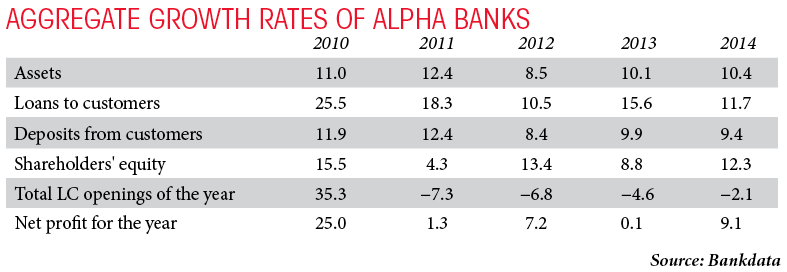
The alpha bankers had a good year. Profits for 2014 showed surprising strength by growing 9.13 percent year on year to LBP 2.8 trillion ($1.9 billion) for the 14 banks with deposits of over $2 billion each. Individual profit champions were BLOM Bank, at $29 billion the sector’s number two by assets, with $365 million, and sector leader Bank Audi, whose profits amounted to $350 million on assets of $42 billion.

In terms of their shares in total alpha group profits, the two largest banks look like a tag team that is set apart from the other 12 alpha banks — just as they constitute a category of their own in terms of assets, deposits and lending power. According to sector monitor Bankdata, BLOM and Audi between the two booked a tad over 38 percent of profits in the alpha group, which on its part represents well over 80 percent of Lebanese banking activity. While the top two drew closer together in reported profits — in terms of their individual shares in group profits, the gap between them narrowed from 2.8 percent in 2013 to 0.8 percent in 2014 — the two, more noteworthily, have in common that their profit growth was mainly derived from units abroad. 

According to Freddie Baz, chief financial officer at Bank Audi, the banking group’s year on year increase in consolidated profits in 2014 amounted to 15 percent, but this was not because of the bank’s domestic profits performance, which Baz characterized as “more or less stagnant.”

“We have [a] 15 percent increase in earnings and 16 percent increase in [consolidated] assets and this is due to the good diversification that we have put in place, where Egypt and Turkey are contributing more and more to the assets and earnings growth,” Baz tells Executive. 

In cold, hard alpha group numbers, the growth rates of 2014 profits were 2.8 percent domestically in Lebanon versus a thundering 64 percent abroad, says Marwan Mikhael, chief economist at BLOMInvest. “While the increase in domestic net profits at alpha banks came [in] at about $33 million, from $1.53 billion to $1.56 billion, these banks realized a much larger increase at their foreign entities, from $192 million to $315 million.” 

Alpha banks expanded their contribution of foreign units to consolidated profits by six percentage points, from 11 percent in 2013 to 17 percent in 2014, according to Mikhael. As for BLOM group, he adds, “We realized about 22 percent of our total profit from foreign entities in 2014, compared to 17 percent in 2013.”

A third bank with a fast growing franchise in a foreign market, Bank of Beirut, tells Executive that its “foreign entities have greatly contributed to the increase in consolidated profits during 2014” to the point that “our revenue from ‘foreign related operations’ stands now at around 38 percent of the total sum.”

[pullquote]Domestic activity is still responsible for about 85 percent of all Lebanese banking profits[/pullquote]

Profiting from the treasury

This encouraging picture also means that domestic activity is still responsible for about 85 percent of all Lebanese banking profits. Semaan Bassil, general manager of Byblos Bank, confirms that reality. He explains, “The major driver of profits [overall] in the banking industry, besides private sector lending which has been stagnant, is lending to the Lebanese government. If you look at the loan to asset ratio in our case, for example, the loans amount to a small portion of assets and the rest is placed either with the central bank, correspondent banks or the treasury. It is the treasury portfolio and the deposits with the central bank that are the major sources of income for the banking sector, whether for Byblos or for other banks. This is very clear and transparent.”

The chair of Lebanon’s most recent riser into alpha group ranks, Creditbank’s Tarek Khalife, concurs that the sphere of T-bills, certificates of deposit and eurobonds remains the main engine of banking profits. “The economy is not moving up and I can’t believe that banks can grow their profit lines when the economy is not budging; any new profit is going to be either irregular or based on some sort of subsidized exercise such as T-bills.” 

According to him, profits moreover can be a different consideration and priority for a big bank that is comparatively sated and mainly wants to satisfy shareholder interest, versus a bank that is hungrier for growth under a domestic expansion strategy. “You have to take into account [whether] you are a bank that is moving and acquiring market share faster than others around you. For us at Creditbank, there was no significant change in profitability [in 2014], but because of the bank’s growth momentum we don’t look at profitability alone,” Khalife tells Executive. 

Overall, the rise in collective net profits at the top of the banking sector in 2014 was a very positive surprise for a sector that has been exposed for three years running to a national economy advancing below its needs, to security concerns in the immediate region, to various political and economic disruptions in other countries with cross border presence and, to a lesser extent, a global economic environment where the International Monetary Fund characterized growth in various World Economic Outlooks with descriptors ranging from “sluggish” and “low gear” to “uneven” and beset with “downside risks” and “imbalances”. 

This positive picture is reinforced by comparing profit developments in 2014 with those from 2013. Total alpha group profits in 2013 were clocked at $1.72 billion, and had been flat from the previous year. According to Bankdata’s annual publication Bilanbanques, year on year growth of profits for the alpha group in 2013 was 0.1 percent and growth for the entire sector was 0.5 percent. This uninspiring performance was part of a series of uneven results that had seen profits swing from strong double digit growth experiences between 2008 and 2010 to a 4.7 percent contraction in 2011 and smallish growth in the next two years. 

[pullquote]”The alpha group’s 9.1 percent surge in profits in 2014 … appears to have been fueled by a variety of strategies and factors”[/pullquote]

Roads to profits differ…

The alpha group’s 9.1 percent surge in profits in 2014, however, represented no uniform upward movement but rather appears to have been fueled by a variety of strategies and factors. 

In terms of the main revenue streams, net interest income on the one hand and fee and commission income on the other, Bank Audi recorded gains on both with $142 million in additional interest income in 2014, according to Baz. These originated mainly from the operations in Lebanon, Turkey and Egypt, as well as $110 million in additional fees and commissions generated also mainly in these three countries, plus in the private banking unit. 

Baz explains, “Most of those fees and commissions are recurrent revenues generated by core businesses, as witnessed by 21 percent growth in fees and commissions related to commercial and corporate banking, a 34 percent increase in fees and commissions related to private banking, and a 23 percent fees and commissions increase related to retail and personal banking. We are seeing important growth in fees and commissions relating to core businesses because of the startup profile of Odeabank, our unit in Turkey, and because of the growth strategy in Egypt. You cannot achieve those growth levels in Lebanon as a mature market.” 

Bank Audi Group is working in parallel efforts on increased generation of fee based income, on improving operating conditions, spreads and cutting costs in relative terms. “In absolute terms, our cost base in Lebanon in 2015 shows a slight decrease with respect to 2014. Some inefficient expenses have been replaced by more productive expenses. We think in marginal terms, meaning we expect a return for each dollar of additional expense. This return should be higher than the outstanding cost to income ratio,” Baz elaborates.

Fees and commissions income at Byblos Bank fell in relative terms because of profit growth concentration on sovereign issues, highlights Bassil. “Although [the bank’s income from fees and commissions] has gone down slightly in absolute terms, in relative terms, it has gone much lower because if you do well in Lebanese treasury transaction activities, the percentage [contribution of fee based income] goes down,” he says. 

At Bank of Beirut, whose profit growth of 21 percent to $176 million in 2014 was one of the strongest in the alpha group, chair Salim Sfeir points to what he describes as “quality growth across all main financial indicators” as the backbone of the bank’s achievement. “The main driver of the outstanding growth was the increase in operating income of around $55 million, coupled with efficient cost control and low credit risk cost,” he specifies, and adds that Bank of Beirut’s higher asset quality and income stream diversification was greatly helped by the group’s choice of expanding into investment grade countries, such as Australia. 

[pullquote]For the BLOM and Audi groups, the diversification in growth markets abroad is where they see most potential[/pullquote]

…And so do the maps aiming for further profit growth

For the BLOM and Audi groups, the diversification in growth markets abroad is where they see most potential in 2015. “I think our growth of profits outside of Lebanon is sustainable because the countries where we are realizing these double digit profit increases are under banked. Egypt for example is an under banked country,” says BLOM’s Mikhael. 

He assesses profit growth prospects in Lebanon as more subdued, primarily because of the economy. “If there is an upswing in the economy, then there will be an improvement. [However,] we are looking at different regional markets where we can grow, because in the end the Lebanese market is small and over banked, first, and second, the domestic situation is not always conducive to growth,” Mikhael explains.

Audi will seek to push further advantages in the Lebanese lending market by exploiting its differential of holding the banking sector’s largest foreign currency deposit base and also wants to continue conquering market shares in Turkey and Egypt. In Egypt, Baz says, “We have been able to slightly outperform the industry. This has allowed us to increase our market share, supporting our new three year business plan that aims at doubling the size of [Bank Audi Egypt] organically in terms of assets and earnings, add new products and services, and expand the network by some 18 branches.” 

Creditbank, which has been pursuing the domestic lending road with vigor, and consistently has the highest loans to deposits ratio (2014: 57 percent) in the alpha group, will continue with this strategy. “It is a deliberate policy that we are more productive than other banks. We are concentrated on the private sector and we believe this will serve us well when [interest] rates go up, because your relationships and assets are linked to Libor,” Khalife says. The bank has an additional growth prospect on the backburner, which is its unit in Armenia. This subsidiary has been fully imbued with the bank’s culture and is being developed as Creditbank’s stepping stone into the markets of the Caucasus region, which according to Khalife is “very rich and underserved with banking.”

According to Bank of Beirut’s Sfeir, the bank will focus on expanding its business on the virtues of a conservative risk management approach and high level of capitalization. “The conservation of liquidity via a diversified and stable funding base has been the bank’s sound policy. Net non performing loans over total assets registered 0.22 percent, earning us the top spot in loan quality ratios among peers,” he says. In further pursuit of diversification, the bank is aiming for the medium term to increase its share of revenue from foreign operations to 50 percent and in the short term has identified opportunities in Africa which it intends to explore. 

BankMed, the fifth strongest player in the Lebanese banking scene, has growth plans that range from expanding its lending in the retail, SME and microfinance fields in Lebanon to growing into more markets abroad, possibly in Egypt. 

Byblos Bank also has set its sights on diversified growth abroad and in Lebanon. In thinking far across borders, the bank has scrutinized a number of opportunities during recent years, even though no optimal opportunity has popped up for a while. “We are already present in very difficult and remote markets,” says Byblos’ Bassil. “We are equipped for [new opportunities] and even if we have not acquired any business assets or banks since 2010, this doesn’t mean that we have not looked at different opportunities. We did study several cases, but if you are not convinced of the risk, you do not go.”

[pullquote]“We are therefore preparing ourselves to be leaner and much more customer services oriented and efficient when the economy picks up”[/pullquote]

In the domestic market, the bank aims at lending. “This helps the bank make a profit, build provisions, increase its capital, and invest in training and process improvement. This is important to us, and Byblos is going after real lending to SMEs and consumers,” Bassil says, adding that this aspiration for increased lending to SMEs and consumers is impeded by the current economic environment in Lebanon and the region. “We are therefore preparing ourselves to be leaner and much more customer services oriented and efficient when the economy picks up,” he concludes.

Looking beyond profits

Irrespective of the varied strategies for diversification and growth that several alpha group banks shared with Executive, these top lenders — and presumably the entire ranks of the Lebanese banking industry — face a hefty number of challenges and risks, jointly as well as individually. 

Adverse developments in local interest rate spreads vis-à-vis Libor and negative carry, the cost of having to fund lending at higher interest rates than the banks could generate from the activity, have weighed on profitability for several years. According to Audi’s Baz, spreads have moved against Lebanese banks to the tune of rising from twice the reference rate to much higher multiples, i.e. banks that used to offer 5.5 or 6 percent or twice the interest of what depositors could get at a US bank, now pay 3 percent while benchmarks are 30 to 35 basis points. “I do not consider it wise and healthy for banks to pay close to 10 times the benchmark. This development was correlated with drops in reference rates after 2008 and the negative carry for Lebanese banks has been amounting to hundreds of millions of dollars every year,” he says.

In Byblos Bank’s experience, the pressure has been mounting as the Lebanese government lowered borrowing costs. “Today, if you are paying 6 percent on the Lebanese pound and receive 5 percent on T-bills, you have a problem. It is normal that the client who is borrowing in Lebanese pounds wants to pay a lower interest rate, and the deposit client wants a higher rate. The bank cannot satisfy both and has to do something. Lowering the cost of operations [as we are doing] is not enough. Most of our income is still being made from treasury bills and bonds — and thus banks are pressured to reduce the cost of deposits to make up for the drop in lending to the government,” Bassil explains.

Having an extensive rural retail network, which when compared with dollar deposits rates in the sector has generated a comparatively high inflow of Lebanese pound deposits to Byblos Bank, has motivated the bank to try and draw in more dollar clients even at the cost of eventually losing some Lebanese pound clients, Bassil says, but concedes that this is a challenge. “This is not easy in the very competitive environment we are in, because to attract dollar deposits from other banks is very difficult.” 

Being able to lend out more funds in the — higher interest generating — Lebanese pound loans provides a partial release from the pressure and has been aided by the central bank’s economic stimulus packages of 2013 and 2014, says Nassib Ghobril, Byblos Bank’s chief economist. “But this notwithstanding, large LBP deposits are still sitting in the banks and remain unused,” he notes.

Offering lower interest rates on deposits is another remedy and has been recommended earlier this year by the Association of Banks in Lebanon. In Baz’s view, that would be a prudent recommendation for banks to implement. “I am not saying that we have to kill the depositors, but there is definitely room to reduce the USD interest [paid on deposits] by a minimum of 50 basis points,” he argues. “If depositors want high interest, they can convert to local currency. I understand that there is some risk of volatility and this explains why the interest rate on local currency represents two times the interest rate on the US dollar. [But the] interest rate on local currency is today at 6 percent, so there is room to decrease by one percentage point. If it is 2.5 percent on deposits in US dollars and 5 percent on local currency, that would be a reasonable representation of volatility risk.”

BLOM’s Mikhael says that banks would like to lower deposit rates but find this difficult because of the intense competition they operate under in the currently sluggish economy. Any attempts to lower interest rates on deposits will also be made harder by the anticipated hike in interest rates by the Federal Reserve in the United States. “It will be difficult to lower deposit rates when the US rates are increasing, especially given the dollar peg of the Lebanese pound. But I also don’t expect Lebanese banks to increase deposit rates when the US will hike interest rates,” he says. 

According to Ghobril no big developments with positive impacts on Lebanese banks are currently on the horizon. “What is to be noticed is that dollar deposit rates have not declined, and I don’t see that happening as interest rates on the US dollar are expected to rise in the third quarter. Beyond that, the increasing borrowing needs of our government are dictating interest rates. As long as there is a wide fiscal deficit, the government will continue to have high borrowing needs and will continue to rely on banks to finance the deficit; therefore interest rates will continue to be high.”

A concern that was high on the agenda of banks in 2014, the issue of double taxation of bank incomes, is currently not as high on the scare lists of most bankers, apparently because of the stagnation of all things political. However, the stagnation of politics is itself the headache. With a broad consensus, bankers tell Executive that they do not expect a quick solution to the presidential paralysis and are even less trusting in the outlook for substantial political reforms which would be needed for giving the economy a true confidence boost.

[pullquote]“As things stand, we have stability without resilience and borrowing without reforms”[/pullquote]

While politics and the economy remain in the doldrums, the outlook for the sustainability of banking profits is unclear. As Ghobril says, even the profit gains of 2014 did not translate into improvements in the returns on average assets and average equity. “You cannot look at the dollar figures and profits alone. You have to look at the ratios, at the return on average assets and at the return on average equity. These have stagnated and the return on assets is less than 1 percent for the first time in I don’t know how many years, at 0.97 percent for the sector and the return on equity in 2014 was also slightly lower than in 2013,” he says.

In angling for profits in 2015, banks according to Ghobril can rely on the government needs, given that the Ministry of Finance did not only issue $2.2 billion worth of eurobonds already, but aims to issue another $2 billion. The dilemma is, of course, that this form of the state’s money hunger is a negative indicator for ratings agencies and not a positive signal at all except for the comfort of knowing that the system is stable and the government can obtain that much money at very favorable interest rates, Ghobril says. “If they were implementing reforms, they would not need to borrow so much. As things stand, we have stability without resilience and borrowing without reforms.”

May 4, 2015 0 comments
0 FacebookTwitterPinterestEmail
Economics & Policy

An ignored but active union

by Marie Kostrz April 30, 2015
written by Marie Kostrz

On January 25, 2015, the creation of a union for domestic workers was announced in Beirut. In an atmosphere teeming with excitement, more than 200 women who work in Lebanese homes — including nationals of Sri Lanka, the Philippines and Ethiopia — called for their basic rights to be respected. This union gives rise to huge hopes. “We are going to have more power to negotiate our working and living conditions,” says Rosa, a community leader for Nepalese domestic workers. (Rosa, like several other domestic workers interviewed for this article, requested that only her first name be used.) This determined and cheerful woman who has been in Lebanon for 11 years has a lot to tell about the way domestic workers are treated: she considers herself one of the “lucky ones,” despite the fact that she was locked in her employer’s house throughout her first two years in the country. “My boss was afraid that I would not come back,” she says. “I could only go out with her.”

The media coverage of the creation of the union highlighted the debate that exists around domestic workers’ living and working conditions. Hiring live in migrant housemaids has become a trend in Lebanon since the end of the Civil War. “The ‘demand’ for these workers, to live in [the home] with Lebanese families and perform most of the household duties, had always existed among the middle and upper classes. The difference of the 1990s, however, was the supplanting of Arab domestic workers with non Arab women, mostly from Asia and principally from Sri Lanka and the Philippines,” explains a report published in the European Review of International Migration in 2003 by Ray Jureidini, a professor of sociology who joined the Institute for Migration Studies at the Lebanese American University (LAU) in 2011.

[pullquote]“There isn’t much awareness of issues concerning domestic workers in our society”[/pullquote]

Lack of data

In 2014, according to the Ministry of Labor’s data, 43,284 domestic workers arrived in Lebanon and 155,161 others renewed their contracts. Most of these workers were from Ethiopia and Bangladesh, but other countries in Africa and South Asia also served as a source for the workforce. Yet this total figure of 198,445 domestic workers is not completely accurate: many domestic workers do not have legal status. There are thought to be around 250,000 migrant domestic workers in total, according to various NGOs supporting them that Executive spoke with. “Typically, the source countries are characterized by difficult socio-economic conditions where opportunities for women are limited and where gender roles are traditional. Many are caught between the option of watching one’s family starve and earning money in return for exploitation,” writes Jureidini.

A small number of studies have nonetheless been carried out on the subject by institutes and universities. “It is a very taboo subject in Lebanese society,” explains Kamal Hamdan, head of the Consultation and Research Institute (CRI). “There isn’t much awareness of issues concerning domestic workers in our society, so it is not a very dynamic field of research,” he adds. CRI has conducted a quantitative research study on migrant domestic workers for the International Labor Organization (ILO), which will be released in May 2015. “There is no relevant data about domestic workers in Lebanon, even the figures of the Central Administration of Statistics are not right because [some] households hide the presence of domestic workers at their home from investigators,” according to Hamdan. Researchers, he adds, can’t reach domestic workers easily. “Households often refuse to allow domestic workers to speak [to investigators], or they don’t talk freely, so we have to go to places on the weekend that these workers commonly visit. But in such a context, it is difficult to have a complete overview.” 

CRI interviewed 1,400 women, working mostly in Beirut and its surroundings. “We were surprised to see that sexual violence — often reported in media — isn’t such a widespread phenomenon, even if it does exist,” says Hamdan. The demands of these women, who “often work in infuriating conditions,” mostly concern “work conditions, acquiring vacation and the complicated relationship with the female member of the household.”

The above assessment is similar to the observation made by Human Rights Watch (HRW) in a March 2015 news release. “The most common complaints documented by the embassies of labor-sending countries and nongovernmental groups include mistreatment by recruiters, non payment or delayed payment of wages, forced confinement to the workplace, a refusal to provide any time off, forced labor, and verbal and physical abuse,” wrote HRW. Furthermore, according to a report the organization published in 2010, the most common demand is unpaid wages, which 75 percent of Filipinos and 60 percent of Sri Lankans voiced complaints about. According to the report “Trafficking of Migrant Domestic Workers in Lebanon: A Legal Analysis” published by the NGO KAFA in 2011, monthly average incomes are very low. Whereas Sri Lankans are paid $180, Filipinos earn between $200 and $250, and Ethiopians get from $150 to $200. The Ministry of Labor told Executive that it does not have any data on domestic workers’ income.

“Domestic work is a form of work and it contributes to Lebanon’s growth,” says Rose, who has been a domestic worker in Beirut for 17 years and joined the new union. “I enable the wife of the household to go to work, because I do everything in her place: cooking, cleaning and taking care of kids. This is why we are asking for more protection and recognition.” The economic impact of domestic workers on Lebanese society has never been calculated in any report. Nonetheless, a study led by the Center for Urban Economic Development at the University of Illinois at Chicago published in 2012 underlines the link between better treatment of domestic workers and public good. Despite the different cultural and economic contexts, domestic workers in the United States face similar issues to those working in Lebanon, among them working hours, average wage and treatment. The exclusion of domestic workers from the United States’ 1970 Occupational Safety and Health Act and the 1935 National Labor Relations Act, which gives workers the right to form unions and bargain collectively, places them in a situation similar to domestic workers in Lebanon in some respects. According to the report, improving the work and living conditions of domestic workers would be beneficial for society: “Domestic work, though conducted in private homes, contributes substantially to the public good. Household labor is a lynchpin connecting the economics of the home and the economics of the workplace. By committing to improving domestic workers’ conditions of work, policy makers and employers — and indeed society as a whole — commit to building an economy based on dignity and care.”

[pullquote]With the kafala system, the domestic worker is indeed entirely dependent on her employer[/pullquote]

Vulnerability and dependence 

All reports agree that domestic workers are vulnerable to exploitation. “Although they may be voluntary economic migrants, they are often caught up in employment conditions that are mostly slavery like arrangements,” Jureidini says. With the kafala system existing in Lebanon, the domestic worker is indeed entirely dependent on her employer. This sponsorship system binds the worker’s residency exclusively to the employer, who is legally responsible for the employee. The employer has to pay $200 to obtain a residency permit for the worker from General Security and $160 for their work permit at the Ministry of Labor, according to the ministry. If the domestic worker leaves the employer’s home, for whatever reason, the worker becomes illegal. This arrangement is not written in the Lebanese law but belongs to a system of practices. “A decree published in 1964 says that a foreign worker cannot change their type of work without having the employer’s authorization; it has been interpreted to mean that the employer’s authorization is needed for change of employer too,” says Nizar Saghieh from The Legal Agenda, a NGO specializing in legal activism and reform. 

In such a context, which automatically places the employee in a situation of inferiority, workers have few choices but to accept the decisions of the employer. This is something that Clarence, a Madagascan domestic worker who has been working in Lebanon for 18 years, knows all too well. She still can’t have a day off every week: “According to the contract that I signed, I am supposed to have 24 consecutive hours off every week but my employer often invites friends for lunch on Sundays so I never have a whole day to rest,” she says, adding that for 14 years she did not receive as much money as the contract stipulated: “I was paid $110 instead of $125; my boss kept saying that she did not agree on this amount with the recruitment agency.” 

Recruitment agencies, a big business

The number of recruitment agencies has skyrocketed. According to Minister of Labor Sejaan Azzi, there are 627 such agencies spread all over the country. Amid the boom in domestic worker agencies, the president of the Syndicate of the Owners of the Workers Recruitment Agencies in Lebanon, Hicham Al Borji, told Executive that there are 200 illegal agencies in the country.

These recruitment agencies, contacted by Lebanese families, are in charge of finding a maid for their clients. In countries of origin, the recruitment process involves local intermediaries who arrange the trip with the recruitment agencies in Lebanon. Most of them are not transparent about the work and living conditions the women will have once they arrive in Lebanon. This economy is lucrative, especially when the employee is from a country which has banned its citizens from working in Lebanon as house workers because of the risks of bad treatment. “Families pay us around $4,000 for a Filipino maid and $1,700 for an Ethiopian one,” Borji says. “Bans issued by these countries have made prices increase; intermediaries want more money.” According to KAFA’s report quoted earlier, recruitment agencies pocket commissions going from $300 to $600, depending on the maid’s nationality. The large discrepancy between KAFA’s figures and those provided by Borji show just how expensive intermediary fees can be. No figures on wages were provided by the Ministry of Labor when requested by Executive.

There is no exhaustive regulation of recruitment agencies in Lebanon. The order issued by the Ministry of Labor on January 3, 2011 on the activity of agencies recruiting foreign workers is the only text that defines rules for private recruitment companies hiring domestic workers. “With a total of only 20 inspectors to cover all of Lebanon, it is hard to plan a control of information or field audits, which gives private recruitment companies an important decision-making power on the migrant domestic workers’ fate,” says the report “Access to Justice for Migrant Domestic Workers in Lebanon” published by the Caritas Lebanon Migrant Center (CLMC) and ILO. Azzi assures Executive that he has closed 35 recruitment agencies for bad practices since he became minister in February 2014.

Obstacles

The lack of legislation is not just limited to recruitment agencies. Domestic workers also suffer from a vast legal void. “Article 7 of the labor code excludes domestic workers,” says Abdel-Salam Cheaib, an attorney specialized in labor law. “They are only under the code of contract and obligations, it does not protect them as much as the labor code because there isn’t any mandatory article on income, working hours or against abusive dismissal.” 

“We need to have protection,” says Gemma Justo. This Filipino woman, who has been a domestic worker in Lebanon for 22 years, is part of the executive committee of the new union. “The law needs to be changed,” she adds. The union is demanding that Lebanon ratify ILO Convention No. 189 on Domestic Workers, which was signed in 2011 and sets labor standards for them.

[pullquote]“At the end they found out that they face the same issues irrespective of their nationality”[/pullquote]

Although announced with great pomp in January 2015, the union isn’t something new. It is the result of a long process that started in 2011 with the launch of the Action Program for Protecting the Rights of Women Migrant Domestic Workers in Lebanon (PROWD). In 2012, the Participative Action Research (PAR) was a step towards the union. “We invited the community leaders of the various nationalities of domestic workers who are present in Lebanon and built their capacity to mobilize participants to take part in the research and to facilitate the focus,” says Zeina Mezher, who was the manager of the PROWD project at ILO. “Every group shared its experience about their relationships with employers, the work and living conditions, recruitment and so on. At the end they found out that they face the same issues irrespective of their nationality.” PAR was led in collaboration with the National Federation of Employees and Workers Unions in Lebanon (FENASOL). Selected NGOs such as KAFA, Insan and the Anti-Racism Movement also took part in the process. “The objective of the research was to raise worker consciousness among women domestic migrant workers in Lebanon, building synergies between them, unions and NGOs; provide worker education to these workers; and increase their representation in the activities of the ILO and in the advocacy campaigns of NGOs and unions in Lebanon,” adds Mezher. The need to help create a union for domestic workers was something evident for ILO. “The work of ILO is to support workers and employers to have a voice for the matters which affect them, in order to have a structure for a tripartite dialogue,” explains Mezher. “In Lebanon, migrant domestic workers are in very vulnerable positions and their voice is completely absent.” In March 2014, the founding committee of the union was announced in the presence of Mounir Al Deek, an adviser at the Ministry of Labor, during an event co-organized by FENASOL and ILO. “Another layer of activity started after this date. The ILO provided capacity building training sessions empowering the members to act in solidarity and organize themselves and FENASOL brought its experience,” she explains. 

While the union has elected a president, Mariam al-Masri, and has an executive committee composed of 12 members and a general assembly with 20, it is still not registered by the Ministry of Labor. According to the Lebanese Labor Code, the registration of any union has to be approved by the minister. “We sent a request to register it,” says Castro Abdallah, head of FENASOL. A side of the story that the Minister of Labor Sejaan Azzi refutes. “No request has been filed. They just invited me to their party on January 25.” Yet, Executive has consulted the request written and sent by FENASOL to register the domestic workers union. According to the ministry’s stamp, it had been recorded on December 29, 2014. At the Ministry of Labor, the head of the control of foreign workers’ labor department Marlène Atallah said the request had been rejected. “We never had any answer as to why. If he does not agree, he should tell us frankly,” says Abdallah. 

This complex situation conveys Azzi’s opposition to the idea of a union for domestic workers. “The issue of domestic workers does not have to be solved by a union. They work with families which is a private issue. Imagine that you are with your boyfriend at home and an inspector rings your bell; we are not in a bank,” says Azzi. At ILO, Mezher hopes that the Ministry of Labor will come to see the union as an additional tool to get fair legislation that respects the rights of employers and workers.

To justify his opposition, Azzi invokes Lebanese law: “Foreigners are forbidden to create a union in Lebanon.” Indeed, in addition to article 7, article 92 of the labor code allows foreigners to join a union, but denies them the right to elect or be elected as representatives of a union. A law which the domestic workers’ union tries to circumvent. The president of the union is indeed Lebanese. Moreover, the union request which has been sent to the Ministry of Labor does not concern foreign workers only, as evidenced by its name: the General Union of Cleaning Workers and Social Care. However, other texts, higher according to the hierarchy of laws than the labor code, exist in Lebanon. “A commitment to respect the Universal Declaration of Human Rights was integrated into the Lebanese constitution in 1990. Since the declaration stipulates everyone’s right to form and join trade unions, it is a right for any person on the Lebanese land,” lawyer Cheaib explains. “FENASOL could go to the State Council to break the minister’s refusal.”

[pullquote]“The more we are, the stronger we will be to gain more rights”[/pullquote]

Efficient without being legal?

“Even if we are not registered, the union is real. We will not give up,” shouts Rose, a member of the union and leader of the Cameroonian expatriate community. Without being registered, can the union be efficient in improving domestic workers’ rights? “We have around 350 domestic workers who are members of the union. Our aim is to have 700 members by the end of 2015,” declared Justo in a meeting on the occasion of International Women’s Day on March 8. “The more we are, the stronger we will be to gain more rights.” 

The union’s role is also to support workers. “In its current state, the union can empower members, educating them about their rights and providing conflict resolution tools in order for them to have more skills to solve the issues they have with their employers,” says the ILO’s Mezher. “We will soon start organizing trips around Lebanon to meet women who work in houses outside of Beirut,” says Rose. “It will take time, but we’ll do it step by step.” According to FENASOL’s Abdallah, the union already has seven lawyers who are providing legal support to members who have troubles with their employers. However, the biggest challenge seems to be money. “They help the union on a voluntary basis to advise domestic workers, but the union doesn’t have a real budget to expand its activities,” says Abdallah, noting that the union applied for EU grants to cover its expenses.

A devastated union landscape

Another question raised is whether unions have enough power to actually change things in Lebanon. “The union movement in Lebanon is very weak,” says Samir Farah, researcher at the German Friedrich Ebert Foundation in Beirut. “After the Civil War, ministers of labor gave lots of permissions to people to create unions. This strategy was aimed at strengthening allies of Syria who had a large control over Lebanon until 2005, it destroyed the union movement.” According to Farah, the General Confederation of Lebanese Workers (GCLW) gathers more than 600 unions, but is not representative of workers: “Only 7.5 percent of workers are members of unions, the leaders have been the same for decades, the democratic process does not work in these unions and they are not very active in fighting for people’s rights.” Unions today are more a tool of control for political parties. “They are more a way for them to establish their authority and put pressure on the legal system. For instance, a political party will bargain the vote of a law against the promise that a union that is affiliated to it will give up its demands,” says Michele Scala, PhD student at the Institut Français du Proche-Orient (IFPO) and author of the article “Clientelism and contestation: The example of the mobilization of Spinney’s workers in Lebanon”. 

In such a context, being an independent union is very hard. “The Minister of Labor has a two month period from the date he receives the request to approve or reject the union. During this time everything is done to discourage the workers. In the case of Spinneys, workers experienced transfers, threats and various sorts of pressure in order to [push] them to withdraw from the union,” says Scala — a situation close to that of the domestic workers’ union. While no threats have been reported, FENASOL, which fosters the new union, is known to be a quite independent union, with an effective democratic process. “[FENASOL head] Castro Abdallah is the only leader who is trying to change the status of the union in order to not be reelected [through limiting leadership terms],” Scala says. Without having any political support, it will be hard to be heard by the government. Even if their struggle is made harder by the Lebanese context, Scala thinks it is a positive trend to observe the creation of new unions outside of the GCLW’s influence. “It can be the emergence of a new union movement in Lebanon.”

Cheaib is more skeptical. “The 1946 and 1964 laws give some rights to union members, like the right to strike for 15 days, negotiation and protection against dismissal for representatives, but there is nothing in the Lebanese law which forces the government to initiate a dialogue with the unions,” the lawyer says. “In practice, it is much harder to gain rights for workers.”

[pullquote]“Politicians always say they have more important issues to solve and then the government resigns and we have to start again”[/pullquote]

Changing the law

According to Cheaib, changing the law is the only solution to improve domestic workers’ rights. At the Ministry of Labor, Atallah explains that initiatives are taken to protect the rights of domestic workers. “Social workers who have to deal with complaints of domestic workers are trained,” she says. “We also are working on memoranda of understanding between Lebanon and Ethiopia, the Philippines and Madagascar, where there are currently bans [against workers coming to Lebanon]. It will define a mandatory minimum income for workers of these countries coming to Lebanon.”

According to Joseph Aoun, lawyer at the CLMC, a law dedicated to the regulation of domestic work would be a great tool to move forward. The CLMC — which brings together several NGOs, representatives of various ministries, General Security and the Syndicate of the Owners of the Workers Recruitment Agencies in Lebanon — is part of the steering committee that worked on the draft law presented by then Minister of Labor Boutros Harb in 2012. The law was sent to the Council of Ministers but has never been referred to the Parliament. “Because of instability and lack of safety, politicians always say they have more important issues to solve and then the government resigns and we have to start again,” Aoun notes. Instability and political deadlock is not the only reason improvements have yet to be made. In 2011, then Minister of Labor Charbel Nahas tried to remove Article 7 and suggested a process aiming at canceling the kafala system. “A ministerial decree had to be voted on by the Council of Ministers, but they always refused to put it on the agenda in order to vote on it,” he says.

In December 2014, a new draft law inspired by the 2012 one was sent to the Council of Ministers by Azzi, without any consultation from the steering committee. Azzi summoned the committee to meet for the first time since he became Minister of Labor in February 2015, a few weeks after the announcement of the union. This draft law does not cancel the kafala system. The ministry is now passing the buck to NGOs which, according to Atallah, “have to do their work of lobbying in order for Parliament to vote on the law.” 

For the union, as for the law, domestic workers have still a long way before getting decent protection of their rights. But their members have not given up. In 2013 in South Africa, where domestic workers are also excluded from the labor law too, the national domestic workers union succeeded in getting the enforcement of the 2011 ILO Convention No. 189. An example that gives much hope to workers in Lebanon.

Editor’s note: As a direct result of the author’s interview with Labor Minister Sejaan Azzi, the ministry opened an inquiry into the labor practices of NewsMedia sal, Executive’s publisher.

April 30, 2015 0 comments
0 FacebookTwitterPinterestEmail
Business

Something for everyone

by Nabila Rahhal April 29, 2015
written by Nabila Rahhal

Mention Hamra Street in front of anyone familiar with Lebanon and they will surely have an opinion or story to share about one of Beirut’s most well known and cosmopolitan areas. Referred to as the “Champs Élysées” of the Middle East in the 1960s and early 1970s, this street has played a role in influencing Beirut’s culture and hospitality life and continues to do so today, despite the ups and downs the country, and the street itself, have been through.

Hamra back in the day 

Once a calm residential area with a few villas and vast lands for planting owned by Beiruti families (such as the Itanis, Chatilas, Bikhazis, Rubiez’s), Hamra Street emerged on Lebanon’s social map with the establishment of Cinema Hamra in the late 1950s, which was followed by a quick succession of other cinemas and theaters such as Eldorado, Strand, Saroulla and Élysée in the 1960s. In parallel to this influx of theaters, there was a surge of sidewalk cafes or café trottoirs (Wimpy, Café De Paris, Negresco) in the late 1950s and early 1960s following the opening of Horseshoe Cafe. 

At the same time that Hamra was undergoing this boom, the regime overthrow in Iraq in 1958 and the unification of Syria and Egypt in 1958 until 1961, brought many of these countries’ intellectuals to Lebanon and mainly to Hamra Street which, because of its proximity to the American University of Beirut (AUB), provided an intellectual ambiance for them to share their thoughts. 

[pullquote]“At the time in the 1960s, Hamra was the ‘in’ place of Beirut or the brand new image of Beirut with its café trottoirs and theaters”[/pullquote]

Hamra rapidly became a destination in Beirut, attracting Lebanese, Arab and international tourists alike. “At the time in the 1960s, Hamra was the ‘in’  place of Beirut or the brand new image of Beirut with its café trottoirs and theaters, such as the famous Piccadilly Theater. We were the first coffee roasters on Hamra Street with a stand up bar where people would enjoy coffee on the go or buy roasted and ground coffee to use at home,” says Amin Younes, CEO at Café Younes, speaking of when his father opened the original Café Younes coffee roaster shop which today is still located next to the first Café Younes outlet near the Commodore Hotel.

Hamra Street’s “glory days” in terms of its hospitality appeal were in the 1960s and early 1970s. But, as the Civil War took its toll, activity in Hamra’s hospitality venues decreased and was restricted to the brave Beirutis who remained in the area and to the foreign journalists who were hungry for some conversation and a bite to eat. 

Picking up after the war

After the war, focus on the development of hospitality outlets in the country was low, and while Hamra’s existing F&B outlets were still somewhat active, the pre Civil War buzz which dominated the street hadn’t been revived yet, and by nighttime the street was almost deserted. 

In 1994,  Malek El Batata (which translates to King of Fries) moved from its then location on Baalbek Street near the Commodore Hotel to its current outlet towards the end of main road Hamra, which offered a more financially lucrative location according to its owner Georges Moujaes. “We had a big opening which was attended by the Minister of Tourism at that time and many guests. People were surprised that a minister would come to the opening of a snack shop, but investment in Hamra Street was low during that period and anyone willing to invest in the street was highly encouraged,” he recalls. He adds that while the first few months in the new location were tough, business rapidly picked up due to home delivery services and increasing footfall in Hamra.

[pullquote]“This café will never have the same feel as Horseshoe or Modca, but at least I can still read my newspaper while enjoying the sunshine”[/pullquote]

Out with the old

The 2000s were a bittersweet decade for the eateries on Hamra’s main street, with the closure of some well known restaurant-cafes such as Wimpy, Modca, Café De Paris and Horseshoe Cafe, which had survived the Civil War only to find that the number of their customers had dwindled and it was no longer financially viable to stay open.

At the same time, new hospitality venues were popping up on Hamra and its neighboring alleys, especially after 2005. Despite initial protests from the old loyal customers of Hamra cafe, the new cafes on the street were not short of clientele. As one elderly gentleman who was reading a newspaper while sipping coffee at one of the international coffee houses on Hamra Street said, “This café will never have the same feel as Horseshoe or Modca, but at least I can still read my newspaper while enjoying the sunshine.”

In with the new

The period between 2012 and 2014 was that of regional turmoil and internal instability, which affected the hospitality and tourism sector as a whole as previously reported in Executive. Although Hamra’s hospitality venues were also affected by this situation, Hadi Fadel, corporate marketing manager of Boubess Group which operates four venues on Hamra Street (Kaiten, Napoletana, Café Hamra and Laziz), says that the effect was less drastic than in other areas of the country. 

“Our venues on Hamra saw a drop, although not drastic, between 2011 and 2014, which was also seen across the country in our venues. Interestingly though, our venues in Hamra were performing comparatively better than our venues in other areas of Lebanon during those years. Fortunately, according to our numbers for the first quarter of 2015, there is positive growth versus last year in our four venues on Hamra Street in terms of revenue or covers,” says Fadel, declining to give actual percentage growth figures. 

A sign of the challenging period Fadel was talking about is the closure of restaurants in the area towards the end of Hamra Street in the past two to three years — including Applebees, El Battal Snack and others — although this is more related to the oversupply of restaurants in that area than to footfall. “There was an economic rush for people to open a restaurant or a bar in Hamra, but many opened and closed. It was a bit rough because it was too big of a rush and it cannot last,” says Abdul Rahman Zahzah, partner in T-Marbouta.

The universities’ effect on Hamra’s eateries 

Hamra has been through a series of ups and downs when it comes to the hospitality sector, but several factors ensured that the food and beverage outlets in Hamra would always have a supply of customers with a variety of tastes and preferences likely to be met in one or another of these outlets. 

All of the hospitality venue owners interviewed for this article believe that the presence of major universities — such as AUB, the Lebanese American University or Haigazian — and schools — International College or Saint Mary’s Orthodox College for example — create a steady flow of day time customers to many venues on Hamra Street and the vicinity. 

Speaking about Dunkin’ Donuts, which has a big outlet with a terrace and a study lounge in the basement, the cafe’s marketing manager Martha Zarazir says that 60 percent of their sales in the afternoon shift are from high school or university students who gather with their friends at the venue to study or socialize.

The schools and universities in the area hire a high percentage of foreign professors or staff and their presence in the area is felt by the hospitality venue operators on Hamra, with Fadel saying Napoletana has a good number of Europeans as regular customers that they have not noticed as much in their other venues in Lebanon.

[pullquote]“Ras Beirut is one of the only areas in Beirut where both Christians and Muslims coexist happily and this will never change in Hamra.”[/pullquote]

Hamra’s leftist crowd 

Another customer type that is generated by the presence of AUB and LAU in the area is a more secular or leftist clientele who tend to favor local, organically developed and authentic venues of which quite a few are to be found on Hamra Street. T-Marbouta’s Zahzah believes Hamra Street is varied with its clientele having many identities, one of which is the cultural identity he attributes to the the presence of the universities in the area. The universities  historically have played a role in developing this identity, according to him, and also to the leftist Syrian/Lebanese/Iraqi intellectual movement that was most active in Hamra during the 1960s and 1970s. 

In line with Zahzah, Younes says: “The presence of major universities which host cultured or leftist thinking, in the cultural and social sense, is very well represented in Hamra Street. Ras Beirut is one of the only areas in Beirut where both Christians and Muslims coexist happily and this will never change in Hamra.”

In addition to the universities, explains Zahzah, publishing houses, newspaper offices, bookstores and theaters in the vicinity create the right environment for outlets catering to the leftist crowd. 

This clientele tends to favor authentic venues reminiscent to a certain degree of the cafes of the 1960s and as one of the partners in Mezyan recounts, in addition to his passion for food, he first thought of developing Mezyan around 2008 when Hamra’s old restaurants and cafes, which he used to frequent, were closing down and he felt that there were no real restaurants in Hamra (which are not part of a chain) anymore. Zahzah likes to believe they, along with similar venues on Hamra, are a modest extension of these cafes. 

The operators of such venues — Café Younes, Mezyan and T-Marbouta interviewed for this article — say they are a part and product of the Hamra community and believe they practice leftist or liberal principles, not only by the layout and design of their venues, but by applying equal employment and fair wages to all nationalities, by giving back to the community through social initiatives and by hosting cultural activities or musical events in their venues. 

Businesses and banks

Universities aside, Hamra Street is also a major commercial hub with the Central Bank at its beginning and most of Lebanon’s major banks having a branch on the main street or in its vicinity. In addition to the banks, several businesses have their offices in Hamra. All of these factors combined create a vibrant daytime crowd.

“Because we have a lot of banks around our shop, we have a lot of bank employees who come for takeout coffee in the morning, making 60 percent of our sales in the morning from takeaway. The average age of customers during this shift is between 25 and 44 years old,” says Dunkin’ Donuts’ Zarazir. 

[pullquote]“Now we feel that Hamra is going back to its normal setting”[/pullquote]

After working hours 

While such an environment creates volume during weekdays, Fadel says Hamra is getting busy during weekends as well, after a recent slump. “During weekdays, securing volume is easy because of Hamra being a hub, but we felt the decrease in footfall in Hamra when things were calm on the weekend and people were scared to go out [from 2012 to 2014]. Now we feel that Hamra is going back to its normal setting with the Lebanese coming to Hamra again during the weekends which is resulting in the growth we saw,” he explains.

Night time is also busy on Hamra street, as any traffic congested evening drive or peek into one the pubs in Estral Center or restaurants on the street will prove. Fadel says their venues get more footfall during the night shift and Mezyan, although a restaurant, is always busier at night with people enjoying themselves over drinks. Parallel to Hamra Street, Makdessi Street is also booming with pub crawlers. 

Non Lebanese on Hamra street

Although the number of tourists from the Gulf region has declined across the board, Hamra included, the volume of the Iraqi and Syrian nationals in Hamra has somewhat made up for this, despite their comparatively lower purchasing power, explains Fadel. “This gap that was created by the absence of the Gulf tourists has been somehow filled by the local Lebanese and the Syrians and Iraqis who are spending, albeit less than the tourists from the Gulf, and creating volume in the market, especially around Hamra. They are outgoing and they are restaurant goers who we see mostly in Café Hamra and Laziz where they like to hang out in the afternoons and smoke argeeleh,” says Fadel. Mezyan and T-Marbouta both say they have a lot of Syrian customers, while Mezyan adds that they serve many Iraqis, especially at night.

Iraqi nationals are often in Hamra for medical treatment at AUBMC while the abundance of furnished apartments in Hamra has made it easy for Syrians escaping the war in their country to find a temporary home in Beirut. “There are a lot more Syrians around Hamra, especially artists and people who work in theater which has enriched Hamra. Also you have Iraqis who were already refugees in Syria and moved here, and these are again often the artists or writers in their community,” says one of the partners in Mezyan. 

The presence of these two nationalities in Hamra is so significant that they have developed hospitality venues featuring their local cuisines on Hamra Street. One such venue is Beit Halab which was developed by Syrian Musaab el Hadri, who says that 80 percent of his clients are Syrian or Iraqi, while another is Iraq el Kheir, developed by Iraqi Mahmoud Amin, catering to “mainly Iraqis but also a lot of Syrian customers.”

The Hamra spirit 

One late evening in Mezyan, there was a table with Iraqis, Palestinian–Syrians, Palestinian–Lebanese, Lebanese and a few Europeans all sitting together as an Iraqi was singing a melancholic song impromptu. This is Hamra, where almost everyone can find the environment and the crowd to suit their taste and feel at home.

April 29, 2015 0 comments
0 FacebookTwitterPinterestEmail
  • 1
  • …
  • 159
  • 160
  • 161
  • 162
  • 163
  • …
  • 696

Latest Cover

About us

Since its first edition emerged on the newsstands in 1999, Executive Magazine has been dedicated to providing its readers with the most up-to-date local and regional business news. Executive is a monthly business magazine that offers readers in-depth analyses on the Lebanese world of commerce, covering all the major sectors – from banking, finance, and insurance to technology, tourism, hospitality, media, and retail.

  • Donate
  • Our Purpose
  • Contact Us

Sign up for our newsletter

    • Facebook
    • Twitter
    • Instagram
    • Linkedin
    • Youtube
    Executive Magazine
    • ISSUES
      • Current Issue
      • Past issues
    • BUSINESS
    • ECONOMICS & POLICY
    • OPINION
    • SPECIAL REPORTS
    • EXECUTIVE TALKS
    • MOVEMENTS
      • Change the image
      • Cannes lions
      • Transparency & accountability
      • ECONOMIC ROADMAP
      • Say No to Corruption
      • The Lebanon media development initiative
      • LPSN Policy Asks
      • Advocating the preservation of deposits
    • JOIN US
      • Join our movement
      • Attend our events
      • Receive updates
      • Connect with us
    • DONATE