• Donate
  • Our Purpose
  • Contact Us
Executive Magazine
  • ISSUES
    • Current Issue
    • Past issues
  • BUSINESS
  • ECONOMICS & POLICY
  • OPINION
  • SPECIAL REPORTS
  • EXECUTIVE TALKS
  • MOVEMENTS
    • Change the image
    • Cannes lions
    • Transparency & accountability
    • ECONOMIC ROADMAP
    • Say No to Corruption
    • The Lebanon media development initiative
    • LPSN Policy Asks
    • Advocating the preservation of deposits
  • JOIN US
    • Join our movement
    • Attend our events
    • Receive updates
    • Connect with us
  • DONATE
Society

Syrian artists revitalize Lebanon’s creative scene

by Nathalie Rosa Bucher October 10, 2013
written by Nathalie Rosa Bucher

The presence of Syrian artists in Beirut is far from new, due to the city’s international connections, and the higher prices artworks fetch. “Syrian artists have always been part of the Lebanese art scene for as long as I can remember,” gallery owner Joanna Seikaly says.
However, currently more work by Syrian artists is being showcased in Beirut than ever before, as Damascene gallerists and artists have shut up shop and relocated to avoid war in their homeland. Seikaly has featured five Syrian artists over the past year.

Of all the Syrian creatives now in Beirut, it is visual artists who have found their place in the city’s art galleries and on the stage of international culture, as well as its open and internationally recognized cultural scene, which affords creative minds more opportunities and liberties than elsewhere in the Arab world. 

Syrian art has long been held in high regard by collectors and galleries in the region and further afield. Prompted by his connections to the Syrian art world, coupled with a shortage of space for the art he had acquired over the last 20 years, collector Antoine Haddad opened Artlab in late 2012. For the first nine months, the gallery only featured Syrian artists. “Syrian artists have given the local art scene a boost,” he says.

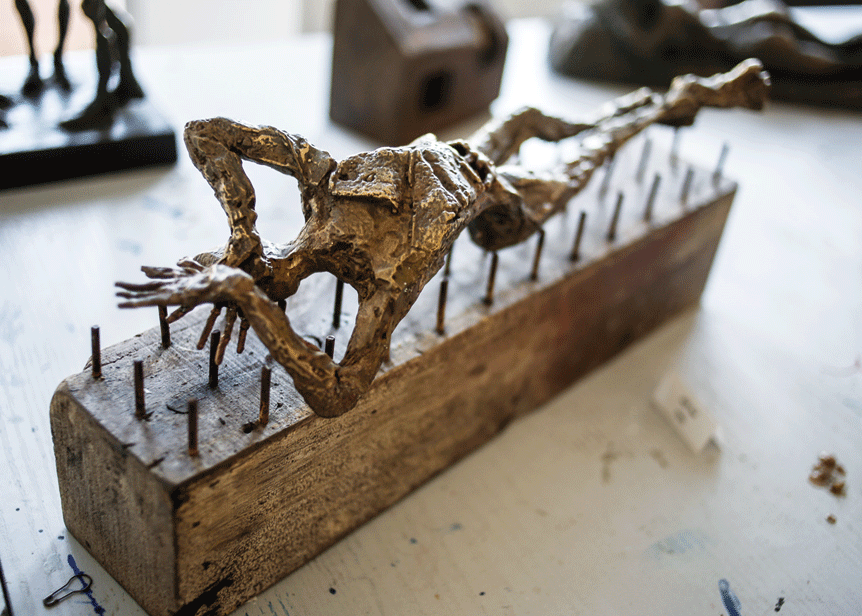
According to the sculptor Mustafa Ali, Syrian art has become more open. The volume and focus of the artistic output since the uprising, itself marked and driven by a widespread use of creative media, has indeed fundamentally changed. Before the uprising, art that consistently challenged the regime, such as the cartoons of now-exiled Ali Ferzat, were the exception rather than the rule. But the mold is changing.

In late 2012 Houmam al-Sayed expressed his rejection of violence against children in his “From Damascus to Beirut” exhibition at the Mark Hachem Gallery in Minet el-Hosn. Tackling injustice, confronting the status quo and condemning violence on a wider scale are adding new dimensions to Syrian art in an unequivocal manner.

Focusing on work with the war raging close by can be painful and challenging. “You’re thinking about people, how they live, how they take this. You feel guilty,” says Fadi al-Hamwi, who painted a large portrait of a friend who had been arrested. “It’s not a quiet situation in which we find ourselves.”

“Before things got messy, before they started to use guns and threaten us, my only way to express my opinion freely was through my art,” Heba al-Akkad says. “[Now] it is my duty to talk about it [the war] in my art.”

Akkad's work is infused with the artists memories of the war in her homeland


Akkad’s show of mixed media work, “Things are still the same,” shown at Galerie Tanit this summer, is a powerful message of hopes dashed. Her colorful yet macabre, naïve yet highly symbolic and evocative body of work turns out to be an obituary to a still-born infant: the revolution. Some of Akkad’s recent work was produced during a month’s stay at Raghad Martini’s Artist Residence in Aley (ARA), a creative hub established to help Syrian artists connect with local galleries and collectors.

On the terrace of his home studio, painter, videographer and installation artist Hamwi points to works similarly influenced by current events in Syria. For a 2012 installation  in Damascus titled “4am”,  Hamwi painted the walls of the 5x5m gallery room black, put grass on the ground and placed his bed in it, with bricks aligned to look like a mattress. “People would enter my dream. I was not telling a story but putting you in a situation,” he says.

Symbols of hardship

This year, Hamwi painted dinosaurs, each wearing a gas mask while holding a single flower, and human skulls and machine guns in X-ray vision. “A Bone In The Head”, the first in the ‘transparent’ series, features a pistol inside a brain, as the artist tries to get inside the heads of killers and tormentors.

Hamwi's installations and paintings invoke the mindsets of both tormentors and the tormented


“This is the change that came to my work when I was in Syria. How do they think when they shoot a human being? When they cut a body part? Many people are prepared to do these kinds of things,” he says.

Akkad gave birth to her first child in Lebanon last year. Already pregnant, and with her husband facing the draft, leaving Damascus became inevitable. Her 10-month-old son has no birth certificate, a consequence of her husband’s refusal to join the Syrian army.

Without papers to prove her son’s identity, Akkad used her art to provide him with one: “Black & Yellow and vice versa” is dominated by a large male head at the center symbolizing her son. It also bears witness to friends and family she has lost, featuring in one corner a beautiful sketch of a woman sitting cross-legged, drawn by her teenage brother. Akkad recently found out that he’d been killed in tragic circumstances.

With her husband studying, Akkad became the sole breadwinner. Syrian artists can make up to three times what they would in Damascus for their work, in line with prices for other goods, but they have to contend with much higher living expenses and renew their visas every six months. Though she has sold art in both Lebanon and Jordan, Akkad has also been forced to take on low paid casual work.

While some Syrian artists struggle to get by in Lebanon, others are making the city work for them. 

Artist and musician Samer Saem el-Dahr lives and works with Waraq, an artists’ collective located in a traditional house painted bright yellow and turquoise in Ras el-Nabaa.
Last year, he contributed to a collective exhibition and managed to sell two paintings. He subsequently approached Seikaly who encouraged him to put together his first solo exhibition: “This is not politics!” — which included 26 new expressionist paintings — was held in early 2013.
The 23-year old artist left Aleppo in September 2012. “The plan was to stay here for one month but then things got worse,” he says. “I’m comfortable here now, because I’m producing a lot. For now Lebanon is good for me, for another couple of months. There is the stress though of what’s coming up next, what if Lebanon doesn’t want us? Where will we go? All over the world, we’re not wanted.”

“For sure I feel homesick,” says Hamwi, who left much of his art behind. “I left the old memories as well. All the small details, my whole life — it’s there.”

Nostalgia infuses some of the personal projects the artists undertake, notably Hamwi’s painting of the logo of Derby — a Syrian chips brand — which created a buzz on his Facebook page, or Dahr’s Hello Psychaleppo, an electronic-classical Arabic music collaboration with Lebanese music producer Nabil Saliba.

Visions of home

Dahr’s career took off in Beirut but he sees his future in Syria. “I will be going back to the country, [but now] it’s a war zone. There will be nothing. Then there will be a lot. We’re the youth. If it’s not us, nobody will do it.”  For Mustafa Ali, who was born in 1956 in Latakia, relocating to Beirut was fairly easy. Dividing his time between Paris, Damascus, and Beirut where he took an apartment in early 2013, he is among those who still regularly enter Syria, but has sent his small children to school in Paris.  Working primarily as a wood and metal sculptor, based in Damascus since 1974, he has exhibited widely and received prestigious commissions, notably from the Institut du Monde Arabe in Paris.

While he has moved work to Dubai, Paris and Beirut, Ali still has his main studio and most of his art in Damascus; his large sculptures are simply too heavy to be moved. His cellphone is filled with images of his work, of openings or events at his Damascus gallery that used to attract a thousand people. Besides his gallery in the old city, he has three workshops; the largest in Al Ghouta, which he has been told has been partially destroyed.

Though better connected in Beirut than younger Syrian artists, Ali heads to Damascus to work. Dahr on the other hand, consciously refrains from drawing inspiration from his surroundings. “That way I’m not dependent on it or on being in Syria.”

“I don’t like to take advantage of what’s happening,” Dahr says. He refers to a sketch he did of the artist Youssef Abdelke who was held captive for a month between July and August 2013. “For this one I did it…He came twice to my studio; I’ve known him since I was very young. When I heard he was arrested, to spread the word, in favor to someone I know personally, I did this sketch.”  Syrian artists are aware that their work has now become fashionable and generates considerable media interest, a fact that is not without its complications. “People want to buy the story,” Hamwi commented. “We have the story. We’re now the ‘world victims’. This is very clear to us. Some artists play into that, but it shows. To do archiving of this era you need to be super sane and stay objective.”

October 10, 2013 0 comments
0 FacebookTwitterPinterestEmail
The Buzz

Business briefing: 9 Oct 2013

by Executive Staff October 9, 2013
written by Executive Staff

Economics and Policy

A leading company has said that international oil firms were not willing to explore for gas in the disputed territorial waters with Israel until the demarcation of this area was completed and voiced support for auctioning off all of Lebanon’s 10 blocks to the bidding companies.

More from The Daily Star

Turkey has lifted a ban on women wearing the Islamic head scarf in state institutions, ending a decades-old restriction as part of a package of reforms meant to bolster democracy.

More from Reuters


Companies and Business

Samba Financial Group, Saudi Arabia's second-largest listed bank, posted a flat third-quarter net profit on Tuesday, coming in slightly below the average forecast of analysts.

More from Reuters


Qatar National Bank (QNB), the largest listed lender in the Gulf Arab region, posted an 14.3 per cent jump in third-quarter net profit on Tuesday.

More from Reuters


The Lebanese government officially signed a contract Monday with Emirati port management firm Gulftainer to rehabilitate and operate the Tripoli port.

More from The Daily Star


Saudi Arabian Mining Co (Ma'aden) has announced its third-quarter net profit more than trebled on the back of contract receipts from a phosphate joint venture.

More from Reuters


October 9, 2013 0 comments
0 FacebookTwitterPinterestEmail
Society

‘Our films are more honest’

by Jeremy Arbid October 9, 2013
written by Jeremy Arbid

The film “Conflict 1949 – 1979” tells the story of director Josef Kalüf’s bid to discover his father’s role in the Lebanese civil war and was screened this weekend at the Beirut International Film Festival. Executive caught up with the film’s producer Bahaa Khaddaj to discuss the film and the Lebanese movie industry.


Your film screened at the Beirut International Film Festival this weekend. How did it evolve?

I met [director Josef Kalüf] once at Screen Institute Beirut and we became friends right away. He wanted to make a documentary about his father and link it to the Lebanese civil war. In Josef’s opinion, the fact that his dad was a fighter ruined his childhood and the regrets Josef has in his life, or his decisions, his personality or his character – he links that all to his dad. The moment I saw this film is [very] personal I wanted to be part of it and we’re lucky to have a festival in Lebanon to motivate young filmmakers. It’s a good film community.

What is your background in filmmaking?

I studied at University of Southern California’s School of Cinematic Arts and there I met Malek Akkad, who is also a USC graduate. I interned at his production company in the story department reading around three scripts per day and writing coverage. Reading scripts was a good way to learn about different narrative styles and to recognize the technicalities of storytelling.

After that I worked for a post-production house in Los Angeles, I started as an assistant editor and became an editor after 6 months. Around 2007 I started freelancing for National Geography and Lifetime TV. I also wrote and directed a couple of short films. At that time, Malek was getting ready to start his production on Halloween, he contacted me and I joined him in making the movie.

Khaddaj thinks a new generation of filmmakers are changing the Lebanese industry


What was your experience with funding for “Conflict 1949 – 1979”?

For “Conflict”, we didn’t have a lot of money. We applied to Screen Institute Beirut at that time and they accepted. We pitched the story, we got the checks, and we started working. It was a two-year process of shooting and editing.

Is there a certain genre of film, or style of director, that is more likely to get funding?

The market in Lebanon is split into two things: either cheap Lebanese movies and TV shows or sophisticated documentaries. There is not much in between. Nadine Labaki is in between and I think partly it’s why she gets her scripts funded. She is a famous director/actress, she made a good name for herself, and people like her so if she makes a movie it will make money. I’m not saying she’s a genius, I think she should work more on creating a new style.

What does that say about Lebanon’s artistic style?

I think we don’t have a Lebanese style. You have Lebanese filmmakers who are so obsessed with European cinema or with the Hollywood style and they just copy. But you don’t have a clean Lebanese mind that tells you a Lebanese story in a Lebanese way. Not even one. The moment I have an interesting script I know how to make it in a Lebanese way.

How do the business aspects of filmmaking in Lebanon affect content?

In Lebanon [filmmaking] is a cheap business. The market is not big, so if you want to make a Lebanese movie and make a profit it needs to be made cheaply. For soap operas the problem is psychological. Screenwriters who write most Lebanese soap operas have this weird phobia of showing things the way they are; their stories are uncommon to our society, which makes them untruthful. Syrian and Turkish shows are more truthful which makes them more popular. We have a lot of important things to talk about. Once your main concept is based on something solid and truthful it’s interesting. But it will change, now there is a new platform.

You’re referring to Internet viewership and on-demand content?

Yes, now you can just go online and watch whatever you want. Smart production companies [in Lebanon] are starting to invest in that. They look for young filmmakers and fresh content. Those people created their own market and their market is honest.

What do you mean by honest market?

What is good will stay and what is bad will lose funding. So if what you make is appealing, you’ll have a lot of viewers; meaning you’ll get paid through advertisement. Once on-demand television is introduced, everything will change.

How can young filmmakers adapt to this emerging platform?

The question is how will the old filmmakers adapt? [laughs]. This is a tough, specific market. The old way is easy; if you knew someone you were in. Now, if the masses like you you’re in, you’re successful.

October 9, 2013 0 comments
0 FacebookTwitterPinterestEmail
Comment

A date with the great Satan

by Gareth Smith October 8, 2013
written by Gareth Smith

The phone call between Barack Obama and Hassan Rouhani at the United Nations, the first direct contact between presidents of Iran and the United States in three decades, signals the seizing of a chance to advance relations between the two countries and potentially open up debate over Iran’s nuclear program and US sanctions.

The earlier agreement between the US and Russia over Syria’s chemical arsenal had given Obama the opportunity to reach out to Iran while making it clear Washington regards Iran’s nuclear program as a far more serious potential threat.

The arrival of Hassan Rouhani as president has brought a shift in Iran’s policy towards Syria as well as the US. New foreign minister Mohammad Javad Zarif spoke last month of “grave mistakes” made by the Assad regime that had “unfortunately, paved the way for the situation in the country to be abused.” Former president Akbar Hashemi Rafsanjani directly accused Assad’s forces of using chemical weapons.

Dialogue between Washington and Tehran has two related tracks, the search for a settlement ending the war in Syria, and Iran’s nuclear program. Each needs face-to-face bilateral contact as well as respectively the Geneva-2 conference, scheduled for July and postponed by the US, and the P5+1, the permanent members of the Security Council plus Germany, which has been in nuclear talks with Iran for seven years without significant progress.

The hope for Syria is that both sides realize war is less in their interests than calming the regional Shia-Sunni tension it is enflaming. Wiser counsels in Washington know the road to 9-11 began in the US-Saudi intelligence co-operation and support for militants in Afghanistan in the 1980s.

In Iran, pragmatists argued within months of Mahmoud Ahmadinejad’s arrival in office in 2005 that his assertive Shi’ism would alarm the Sunni Arab establishment just as surely as his questioning of the Holocaust would alienate the US and Europe. Neither, they said, served Iran’s national interests.

Shortly after his election, Rouhani said diplomacy with Saudi Arabia was an urgent priority but the sheer speed of his reaching out to Washington is a surprise.

Improving US-Iranian relations faces a challenge in reviewing grievances. Americans still resent the 1979 embassy seizure and the 1983 bombing that killed 241 in the Beirut airport marine barracks, possibly the work of an Iranian national. A BBC poll earlier this year found 87 percent of Americans viewed Iranian influence negatively, the highest percentage in the world.

Iranian state television often shows images of the floating wreckage of Iran Air flight 655, shot down in 1988 over the Straits of Hormuz by USS Vincennes, with the loss of 290 lives. Rallies regularly evoke Ayatollah Ruhollah Khomeini’s denigration of the US as the ‘Great Satan’.

Rouhani is buoyed by his election victory but knows his fundamentalist critics in Tehran are waiting to pounce. His leeway to reach a compromise is real, but limited. In describing talks with the US Ayatollah Ali Khamenei, the rahbar (leader), expressed the balance between backing negotiations while remaining skeptical of Washington’s motives and intentions.

Arguably the outlines of agreements on both Syria and Iran’s nuclear program have long been evident. A former senior western diplomat told me earlier in the year that world and regional powers should agree that while the Shia would lead Iraq, with minority rights, the Sunni would lead Syria, also with minority rights.

Western desire for ‘objective guarantees’ over the peaceful nature of Iran’s nuclear program might be satisfied by a deal under which Iran would accept intrusive UN inspections and limit the program in scale and in the level of uranium enrichment. The quid pro quo would be easing sanctions that have, among other things, halved Iran’s oil exports and prevented development of its vast gas reserves. Iran has a vaguer requirement: that the US accepts its regional influence as natural and legitimate.

The obstacles are political. As Sayegh Kharrazi, Iran’s former ambassador, put it to me seven years ago: “On both sides, neoconservatives are strong. But neoconservatives cannot make decisions for everyone.”

As ever, the devil is in the details, but the details are discussed only if there is a broader will for agreement. That is the responsibility of leaders.
Gareth Smyth is the former chief Tehran correspondent of the Financial Times

October 8, 2013 0 comments
0 FacebookTwitterPinterestEmail
Economics & Policy

Behind Lebanon’s newest film

by Maya Sioufi October 8, 2013
written by Maya Sioufi

"Ghadi”, the soon-to-be-released Lebanese movie, is not about the civil war, nor about sectarian tensions; it is about accepting someone who is different. A story with a fantasy twist, it’s a tale of tolerance and of hope; a timely message for the Lebanese in these challenging times. Local movies of its caliber are unfortunately rare, largely due to a lack of financial backers willing to bet on the country’s fragile movie industry. But Ghadi is a story that the producers were determined to bring to the screen with or without significant financial backing.

An unlikely protagonist

The film revolves around the eponymous Ghadi, a young boy with Down syndrome. The specifics of his disorder, also known as trisomy 21, are not as important to the plot as what they represent: difference. The movie is about “accepting people that are different” says Gabriel Chamoun, the film’s producer and CEO of Lebanon based production company The Talkies.

“He was born like this. If we don’t accept him, how can we accept the other differences in life?” asks lead actor and scriptwriter Georges Khabbaz.

Behind a window in a small town

Set in a timeless Christian village, the movie tells the story of music instructor Leba, played by Khabbaz, who marries his high school sweetheart and becomes the father of two girls and Ghadi. Sitting by a window, Ghadi screams day and night, which bothers the local villagers; unable to bear the noise any longer, they demand that Leba send his son out of the village to an institute for children with special needs. For Leba, this is out of the question. Armed with knowledge of sins committed by his fellow villagers, Leba decides to teach the locals a lesson of tolerance. From here the tale takes on a fairy tale twist, as he convinces the villagers that his son is an angel and only makes noise when one of them — a corrupt butcher, a bad-mouthed barber, a thieving policeman, a prostitute, some gossip hungry women among others — commits a sin. Rumors spread that the angel is also capable of fulfilling dreams. Suddenly, the window through which Ghadi looks down on them brings the village’s sinful behavior into check and becomes a window of hope for villagers praying for the fulfillment of their dreams.

Is Lebanon in need of Ghadi today? “Of course,” Khabbaz says. “Lebanon needs hope.”

Inspired by experience

The idea for the script came to Khabbaz out of his experience in the past five years as a theater professor for the children of Lebanese civil association Acsauvel, which provides care for mentally challenged children and adults. Eleven-year-old Emmanuel Kheirallah was handpicked by the film’s director Amin Dora, from Lebanon’s Sesobel association for disabled children, to play the role of Ghadi. Khabbaz wanted them all to play the role.

The villagers of the town believe Ghadi is an angel


After extensive casting, Dora kept going back to the pictures of Kheirallah. “I felt this boy needs to be the main character, he looks like an angel” says Dora. The cast also features prominent names such as Antoine Moultaka, founder in 1965 of the Lebanese University’s dramatic art department, scriptwriter Mona Tayeh and actor Camille Salameh, whose theater career began in 1972. Choosing the cast was not the hardest bit for Dora. “To treat the script in a fantasy way without losing its essence” was the most challenging aspect. It’s an endeavor in which he succeeded, bringing home the film’s powerful message while maintaining its fairy tale character.

A risky venture

This is the first time Khabbaz, a renowned theater director and actor in Lebanon, has acted in a film he wrote himself. His previous film experience is minimal, but includes the 2006 movie “Under the Bombs”, which was shown at the 2008 Sundance film festival. When The Talkies’ Chamoun reached out to Khabbaz at the end of 2011 with the offer of producing a feature film, he seized the opportunity. Within two months, he had the script — which had been running for years in his head — laid down on paper. Khabbaz and Chamoun quickly agreed on who would direct the movie: Dora, director and winner of the International Digital Emmy Award for the world’s first Arab web drama series “Shankaboot”. Dora is also behind the Beirut Duty Free’s flashmob commercials, which have over 4 million YouTube hits.

Ghadi's appearances become a major event in the town


Production company The Talkies are also new to the movie industry, having never produced a feature film before. Since 1998 they have specialized in television commercials, with clients including Samsung, McDonald’s and Qatar National Bank, while its movie experience has been limited to two short films. After failed attempts at producing feature films due to financing issues, Chamoun was determined to go through with the project, even if that meant — as it ultimately did — bearing the bulk of the not-so-little $1.5 million cost himself.

A costly gamble

With investors squeamish about taking a share of the movie partly because of their reluctance to invest in the Lebanese cinema industry and partly because of the fact that the company was a newbie in the production of movies, The Talkies ended up with a 70 percent stake, compared to an ideal target of 30 percent. The remaining share was taken up by friends of Chamoun: Anthony and Celia Sakkal, and construction company J. Matta Holding represented by Fadi Matta and Samer Dadanian.

“I knew it would be a struggle to fund this movie because it’s our first and there are not many successful [Lebanese] movies other than the ones of [actor and director] Nadine Labaki”, he says. One financial institution that has been venturing into the movie business of late is Lebanon’s FFA private bank, which recently co-financed the Hollywood action movie “Two Guns”, but when Chamoun approached them, they turned down the investment opportunity because of the “high budget for a Lebanese movie,” he says. The Talkies also struggled when it came to sponsors, only managing to get Societe Generale de Banque au Liban on board.

Beyond Lebanon, they secured a grant from Qatari cultural organization the Doha Film Institute, which will be assisting with the marketing of the movie for an international audience. Given that the message of the movie is universal and not specific to Lebanon, Chamoun is convinced the film could do well in countries abroad “especially South America because of its large Christian following”, he says. This is key since to break even Chamoun needs to sell tickets beyond Lebanon. Even if “Ghadi” ticket sales match Labaki’s “Where Do We Go Now?” 325,000 entries record in Lebanon — or just under $1 million in revenues — they will still fall short of covering the movie’s cost. Chamoun is hopeful that 50 percent of the return will come from Lebanon ticket sales, with the remaining from sales of international distribution as well as additional items such as DVDs and Video on Demand, all within 12 to 18 months from its launch date set for October 31.

It remains to be seen whether “Ghadi” will prove profitable for its backers. With a lack of public funding supporting homegrown movies, its financial success could be critical to entice investors and advertisers alike to back the country’s struggling cinema industry. It would be a shame to see the floundering of a Lebanese industry that has been around since 1929, beginning with the silent movie “The Adventures of Elias Mabrouk” followed by the first sound film, “In the Ruins of Baalbeck” in 1936. In the sixties Lebanon’s film industry even competed with Egyptian cinema, the Arab world’s center of filmmaking.

A traditional Lebanese setting with high quality acting and a touching script makes this movie one not to miss. It is all the more essential given its message of tolerance, whether for physical, mental or religious differences. Without crucial support, efforts of this sort — which should be seen not just in Lebanon but throughout the world — will not hit the screens nor be able to give our homegrown talent the audience they deserve. 

October 8, 2013 0 comments
0 FacebookTwitterPinterestEmail
The Buzz

Business briefing: 8 Oct 2013

by Executive Staff October 8, 2013
written by Executive Staff

Economics and Policy

Cairo is hoping to start announcing details of its investment programme for this fiscal year later this month and Gulf Arab countries have agreed to provide additional financial support, a senior minister said.

More from Reuters


Lebanon's automotive sector is doing surprisingly well in the current economic environment, up 4.33 percent in the first eight months of the year on 2012, and in comparative terms, above the GDP forecast of 1.6 percent for 2013.

More from The Daily Star


GCC markets are expected to show robust economic growth over the medium term due to economic diversification of their local economies, according to an Ernst and Young (EY) forecast.

More from Gulf Business


Companies and Business

Nakheel World LLC, a subsidiary of Dubai World, today agreed to repay almost AED95m ($25.8m) to a private developer which bought a piece of land from it in Dubai in 2008.

More from Arabian Business

October 8, 2013 0 comments
0 FacebookTwitterPinterestEmail
The Buzz

Business briefing: 7 Oct 2013

by Executive Staff October 7, 2013
written by Executive Staff

Economics and Policy

The International Monetary Fund (IMF) has increased its forecast economic growth for the GCC to 4.4 percent in 2014.

More from Arabian Business


Some 2,000 jobless Moroccans have marched through the capital demanding the government sort out the nation's unemployment.

More from Associated Press
 

Kuwait believes an oil price of $100-$110 a barrel is fair for producers and consumers, the Gulf OPEC state's oil minister has said.

More from Reuters


Syrian President Bashar al-Assad's regime deserves credit for complying with a chemical weapons deal, US Secretary of State John Kerry has said.

More from BBC


Companies and Business

Saudi Arabia's Almarai reported a 5.7 percent rise in third-quarter net profit on Sunday, missing analysts' estimates despite what the company described as "the strong performance of core dairy and juice categories".

More from Reuters


Riyad Bank, Saudi Arabia’s third-largest lender by market value, posted a 18.8 per cent rise in its third-quarter net profit on Monday due to higher operating income and lower expenses.

More from Reuters

October 7, 2013 0 comments
0 FacebookTwitterPinterestEmail
Business

Reimagining global journalism

by Livia Murray October 7, 2013
written by Livia Murray

Company: Transterra Media

Country: Lebanon

Industry: News

Founders: Jonathan Giesen, Eli Andrews

Ages: 41, 39

Established in: Sept 2012

Number of Employees: 17

Revenues: ½ million

Capital raised: 1.3 million

Awards: Red Herring Top 100 Asia 2013


“Two years ago it was like journalism was killed,” says Transterra Media CEO and co-founder Jonathan Giesen, referring to the flood of citizen journalism with the rise of social media that shadowed the Arab Spring. This appeared, Giesen says, as the final deadly blow to the media industry, which had been struggling since the 2008 recession slashed advertising prices, its main form of revenue.

But citizen journalism has not replaced old school reporting. Without a screening process to make sense of the world of online content, it has become at times chaotic. Transterra Media recognized this with the launch of their Beta website in Cairo, three days before the Egyptian revolution. The platform created a network where journalists could upload content that would be reviewed and purchased by broadcasters. “It was completely flooded with citizen journalism, activists, and it was really difficult to sort through the entire morass of content,” says Giesen. “We learned that the open-place market where you just load up photos, load up videos, load up stories, and or pitch stories doesn’t really work,” he says Giesen. Despite the supply of citizen journalism, he explains, the media industry is still driven by the broadcaster’s demand for quality coverage.

Giesen has won a number of awards


“The journalism world is still trying to find cheaper ways of getting better and better content from the ends of the earth,” says Giesen. “It’s too expensive to send your correspondent to Syria. It’s too dangerous. If you pick up the wires you’re going to get the exact same coverage that everybody is getting because they’re just sending out one major stream. So the idea is to get custom or tailored footage specific to your broadcasting.”

Transterra Media has since re-vamped and launched as a Lebanese company in September 2012. They have switched to an ‘on-demand’ model, where the broadcaster’s demand drive content specifications. “So for instance CNN or al Arabiyya or al-Jazeera – any one of the main international newspapers will say 'listen, we need footage from Syria. We need a 4 minute news package to broadcast on Saturday from Syria on X topic.” They currently have 236 news companies on their website, with premium buyers purchasing fifteen to twenty five stories per month. The company has so far made half a million in revenues, through a commission of thirty percent off each article.

Journalists must go through a screening or “vetting” process to be plugged into the network. This is a two-step process. “First, we have to get all your information in terms of your skypes, your emails, your twitters, we need to know if you’re a photo journalist, if you’re a video journalist, can you do piece-to-camera, can you get in front of a camera and actually put together a live broadcast… all of the different aspects a journalist could possible do,” says Giesen.

“And then we go through what is called second-level vetting, which is looking at it from a production standpoint so if you’re a video producer what are you shooting on, how can you shoot it, who have you sold to in the past, where did you get published, can you put together a 4-minute news package, can you put together a feature story… we need to know everything about what your capabilities are as a journalist.”

So far they have a network of 1700 journalists in 123 countries, and their goal is to keep building and diversifying their contacts. “We try to get as broad of a territorial reach,” says Giesen. In Syria for instance “we’ve got guys in Aleppo, we’ve got guys in Itlib, Ar-Raqqah, Deir ez-Zor, Damascus. We’re trying to get people in Daraa.”

To speed up communication between the broadcasters and the journalists, they are building an app to be incorporated into the network. This app will enable broadcasters to track the vetted journalists, and pull up their qualifications. “If a bomb goes off and you’re in the area, we know exactly what you can do, if you can provide historical context,” says Giesen. The app would also let broadcasters pair journalists with different skill sets together. “What we’re trying to do is build a network of people that can share resources, share stories, take assignments, change assignments as they are, pitch stories from the field, and then one of the big things is to go piece-and-camera or the liveshot,” he says.

Transterra media is growing with 75 new journalists joining the network every week, according to Giesen. But there are limits to the global news industry. “The conundrum in the industry is that there are only – let’s say there are only 800 really top-level buyers, news outlets that can use our material. There’s a limit. Even if you’re talking about professional journalists there’s only about between five and ten thousand,” says Giesen. “In order to expand our content base we’re gonna have to start finding new ways… either working with social media in a better way, or doing a lot of training to get people up to scratch.”

October 7, 2013 0 comments
0 FacebookTwitterPinterestEmail
The Buzz

Business briefing: 4 Oct 2013

by Executive Staff October 4, 2013
written by Executive Staff

Economics and Policy

A prolonged US federal government shutdown could delay military assistance to Israel and other American allies, the State Department has said.

More from Reuters


Saudi Arabia has cancelled its annual address at the UN General Assembly in an unprecedented move in protest against its handling of major issues in the Muslim world.

More from Arabian Business


Most Gulf bourses retreated Thursday in cautious investor sentiment ahead of an extended public holiday in mid-October, while strong retail activity lifted Egypt’s bourse.

More from Reuters


Companies and Business

Middle East Airlines chairman Mohammad Hout has announced that the profits of the national carrier in the first nine months were slightly less than last year but promised to boost productivity and increase working hours to maintain revenues.

More from The Daily Star


Petroleum, the world’s largest liquefied natural gas (LNG) exporter and main source of Qatar’s huge wealth, plans to expand internationally.

More from Reuters

October 4, 2013 0 comments
0 FacebookTwitterPinterestEmail
The Buzz

Business briefing: 3 Oct 2013

by Executive Staff October 3, 2013
written by Executive Staff

Economics and Policy

The first phase of the onshore oil and gas survey started Tuesday in the Batroun region amid expectations that Lebanon might be sitting on considerable gas wealth in some areas.

More from Daily Star


Iran is preparing a politically risky increase in domestic fuel prices, trying to ease the burden of multibillion-dollar subsidies on an economy severely damaged by Western sanctions.

More from Reuters


OPEC's Secretary General says he is comfortable with the market outlook for 2014 and that a forecast drop in demand for OPEC oil is not large, indicating the group may not make big changes to output policy at a December meeting.

More from Reuters


Companies and Business

Middle East fund managers are planning to increase investments in Saudi Arabia while withdrawing funds from Dubai, owing to a concern about the latter’s market over heating, according to a Reuters survey.

More from Reuters


Qatar's response to allegations of maltreatment of migrant workers in the 2022 World Cup host nation has been "weak and disappointing," the International Trade Union Confederation (ITUC) has said.

More from Reuters


October 3, 2013 0 comments
0 FacebookTwitterPinterestEmail
  • 1
  • …
  • 232
  • 233
  • 234
  • 235
  • 236
  • …
  • 695

Latest Cover

About us

Since its first edition emerged on the newsstands in 1999, Executive Magazine has been dedicated to providing its readers with the most up-to-date local and regional business news. Executive is a monthly business magazine that offers readers in-depth analyses on the Lebanese world of commerce, covering all the major sectors – from banking, finance, and insurance to technology, tourism, hospitality, media, and retail.

  • Donate
  • Our Purpose
  • Contact Us

Sign up for our newsletter

    • Facebook
    • Twitter
    • Instagram
    • Linkedin
    • Youtube
    Executive Magazine
    • ISSUES
      • Current Issue
      • Past issues
    • BUSINESS
    • ECONOMICS & POLICY
    • OPINION
    • SPECIAL REPORTS
    • EXECUTIVE TALKS
    • MOVEMENTS
      • Change the image
      • Cannes lions
      • Transparency & accountability
      • ECONOMIC ROADMAP
      • Say No to Corruption
      • The Lebanon media development initiative
      • LPSN Policy Asks
      • Advocating the preservation of deposits
    • JOIN US
      • Join our movement
      • Attend our events
      • Receive updates
      • Connect with us
    • DONATE