• Donate
  • Our Purpose
  • Contact Us
Executive Magazine
  • ISSUES
    • Current Issue
    • Past issues
  • BUSINESS
  • ECONOMICS & POLICY
  • OPINION
  • SPECIAL REPORTS
  • EXECUTIVE TALKS
  • MOVEMENTS
    • Change the image
    • Cannes lions
    • Transparency & accountability
    • ECONOMIC ROADMAP
    • Say No to Corruption
    • The Lebanon media development initiative
    • LPSN Policy Asks
    • Advocating the preservation of deposits
  • JOIN US
    • Join our movement
    • Attend our events
    • Receive updates
    • Connect with us
  • DONATE
AnalysisBanking & FinanceSpecial Report

The legality and the perceptions of banking based in Lebanon

by Thomas Schellen September 28, 2022
written by Thomas Schellen

To the interest of anyone who is not a part of the political and banking power ensemble, an absurd theater of dance and song is being played out on the nation’s institutional public stages. But this year’s summer theater is being performed in rationality-defying ways; as if the goal was an emulation of an ancient Athenian tragedy whose protagonists’ immersion into inescapable misfortune and his aims at catharsis are available only on the basis of divine intervention.

These are some of the acts in which the legal drama has been progressing: After a staff-level agreement between the Lebanese government and the International Monetary Fund (IMF) was announced on April 7, the choirs of politicians were immediately intoning praises and hymns with promises of rapid action. Even the Association of Banks in Lebanon (ABL) congratulated the government on the staff-level agreement in a letter, calling it “a crucial first step towards the implementation of an IMF program.” But then the progress towards actually signing an IMF agreement over the following five months resembled a play of double-talk, twists and intrigues. It invited the thought of how social media, or today’s Erinyes – the epitome of vengeance for broken promises – will be busy for years. It would give any ancient Greek tragedian a run for their money.

The bewildering performance in the national theater has been commented upon by a chorus of media and civil society voices attempting to vocalize the hidden agendas and unspoken fears of the main actors to the spectator. In one example of the chorus-worthy drama, the presidential signature for the banking secrecy law was reportedly held back in August, because of pending evaluatory responses to a revised draft. In September, news agency Reuters reported that the IMF uncovered “key deficiencies” in the recent modifications by Lebanese lawmakers to the draft of the banking secrecy law. The law is one of several prerequisites for the IMF agreement.

Another such prerequisite is the capital controls law, which by September 2022 is approximately 35 months late. Local media site, Naharnet, reported on the last day of August that a joint session of involved parliament committees “agreed on finding a capital control solution that would both preserve the rights of depositors and the ‘existence’ of banks.” No decisions were reported from the joint committees’ meeting. [inlinetweet prefix=”” tweeter=”” suffix=””]Government representatives, however, have been waxing wisely that the country is at a crossroads and has to go toward reform or further collapse.[/inlinetweet] Soon after, advocacy organization Legal Agenda added its two cents by commenting: “The Government, like parliament, is still unable or refusing to take any step on the road to reform or exit from the crisis, which puts the whole country in front of risks whose limits are difficult to predict.” The group also decried that along with the failure to produce a capital controls law, a governmental economic rescue plan has been debated to no avail on three occasions during the eight-month period up to September 2022. 

And so, throughout this summer it has continued; a now three-years-long charade of conferences, plans, law discussions, expressions of absolute determination, and non-implementation of anything decisive, least of all honest reforms and laws prerequisite for an agreement with the IMF. The local audience of this charade, long mired in disbelief of political assurances, in the meanwhile is held captive to a macabre dance of depreciation of the local currency, alongside domestic, pass-through, and now global inflation, and desperate struggles for their livelihoods. A dance of a slow economic death that is separating the haves-of-a-few-real-dollars from the haves-of-near-worthless-lira by an ever-widening gulf of inequality.

A clear list of legislative and organizational needs

One perspective shared by virtually every economist and expert heard by Executive throughout this year is that Lebanon will not recover without a viable financial sector. Although, the views of these experts vary regarding important nuances; nevertheless economically relevant laws are necessary to the foundation on which to rebuild banking and the economy. Driving this point home in an interview on the legislative priorities and the legality of banks’ behaviors, lawyer and former minister Ziad Baroud leaves no doubt that the legal requirements make room for any ambiguity. “The IMF staff level agreement is very clear in envisaging a package deal of at least four laws to be voted [in]: [laws on] the budget, capital controls, bank restructuring, and banking secrecy,” he tells Executive.

Noting that laws on banking secrecy and capital controls have been initiated, while a budget is the minimum that any country should commit to and legislate in a timely manner, Baroud elaborates on the order of these laws’ importance. In his view, the bank restructuring law deserves the utmost attention. “In my reading, the number one priority is the restructuring of the banking sector because the other three laws would not create much impact unless you restructure the banking sector. And if you don’t have banks, you don’t have an economy,” he explains.

There are many contentious issues in local debates about all banking-related laws however. These debates show how crucial the legality of bank actions is for the current and future relationship between banks and their depositors, and even their imagined stakeholders. Here, uncertainties and misconceptions abound over issues such as the use of reserves at the central bank, along with the baseline liabilities and responsibilities of politicians, central bank, and commercial banks. “But before talking about reserves and the legality of their use, I want to say that deposits are protected by law. Thus, everything that has been happening since Oct 2019, is de facto not really legal,” Baroud emphasizes.

According to him, the mandatory or compulsory reserves is an instrument granted to Banque du Liban (BDL) by virtue of the Code of Money and Credit, Article 76, paragraph D, according to which the central bank can deposit with banks up to 15 percent of their respective obligations. “Such reserve is provided in order for the BDL to perform its operational tasks in terms of liquidity and – for instance – credit policy. Therefore, it cannot be regarded as deposits’ guarantee; this is a common blunder. It’s a tool in the hands of the central bank, which can consider the Treasury Bonds as part of said compulsory reserves as per the law,” Baroud clarifies.  

This seems divergent to positions expressed by ABL in 2021, under which the association blamed the central bank for submitting – when it lowered the reserve requirements by a percentage point – to pressures from “the political authorities, contrary to the Monetary and Credit Law where the purpose of the mandatory reserves is limited to the needs of the banking sector.” However, as to whether the mandatory reserves are actually fixed at an exact level of 15 percent, Baroud explains that this is a ceiling set in the Code of Money and Credit, and the central bank can lower it.

A quick headline query on the subject of reserve requirements by central banks shows that comparable steps to the one enacted by BDL in 2021 have been taken by many central banks elsewhere, or that such requirements in developed economies commonly range in the low single digits, in terms of what central banks require from commercial banks. For example, the European Central Bank (ECB) tells online visitors: “Reserve requirements are a standard monetary policy tool in central banking, but are not required by all central banks,” citing as examples of the latter Australia, Canada, and Sweden. According to the ECB, banks in the eurozone had to hold a minimum of 2 percent of relevant liabilities as reserves in accounts at national central banks until 2012, after which time the rate was halved to 1 percent.

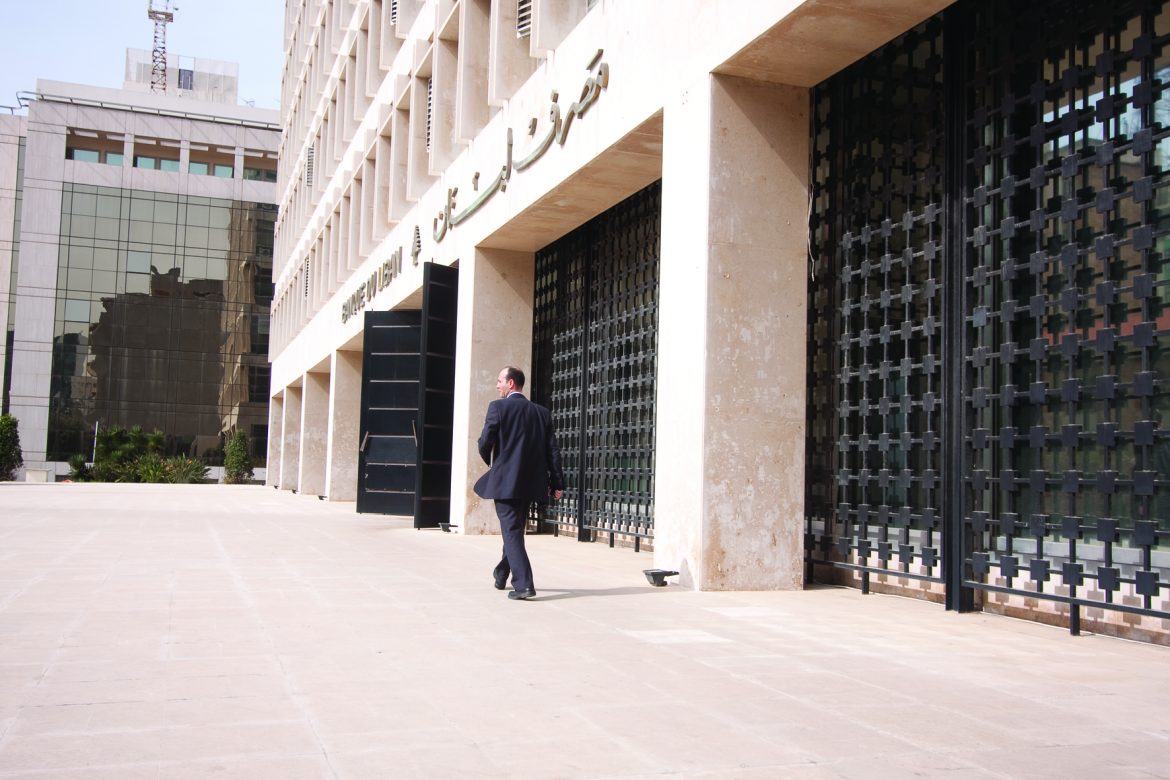
For Lebanon, dealing with the commercial bank’s unsecured deposits, the lawyer points out that as the regulator of the banking sector, the central bank has a huge supervisory obligation. Moreover, it is not some private enterprise but part of the Lebanese Republic, and therefore carries responsibility on par with those who hold political responsibility. As a combination of economic and monetary factors, together with a lack of transparency, have engendered the crisis, the problem over the use of reserves is essentially interlaced with central bank independence, discretionary power, and responsibility. “The main problem we are facing is linked in my reading to the lack of transparency in the operations pertaining to the reserves and more specifically to the undefined and open-ended boundaries between the needs of the government and the margins of maneuver of the BDL,” Baroud says. “In any case, compulsory reserves are definitely not the guarantee for deposits, at least from a legal perspective, although [they are] viewed as such by the depositors at large.”
Perceptions and self-perceptions

As Baroud further notes, banks have historically been transparent and compliant enough when interacting with correspondent banks and counterparties abroad. Yet they also went to great lengths – and successfully so – to conceal their real data from public scrutiny and local stakeholders. [inlinetweet prefix=”” tweeter=”” suffix=””]“We need more transparency in the banking sector, better monitoring by the regulator and by the shareholders and boards of directors,”[/inlinetweet] he says, adding that under a 1994 law, each bank in Lebanon should appoint at least one independent, non-executive board member.

The demand for improved governance and transparency at Lebanese banks is well known to the readers of Executive magazine. Today, it resonates even larger, as for the past two years banks have done astoundingly little to communicate their real situations, both relating to meaningful data and staff welfare factors.

Despite conducting previous interviews with multiple leaders of ABL, like Salim Sfeir, the organization’s current president, he did not accept Executive’s invitation to be questioned for this issue. Sadly, nixing our hope to understand his current views on the resilience of banks.

In our most recent in-depth interview with him in the summer of 2019, Sfeir had acknowledged a wave of deliberate social media assaults on the banking sector which occurred in the second half of the 2010s. At the time, however, he opined dismissively about the sector’s reputation problems, “no, it is not a problem,” displaying with hindsight an unseeming confidence that banking was valued in society as the “services industry that existed to best serve the interests of its customers.” 

Two mid-tier banks that responded affirmatively to our interview requests, however, provide glimpses into the mindsets of bankers who are battered by the furies of public opinion. Marwan Kheireddine, the chairman of AM Bank confesses that he has gathered overflowing experience in being misunderstood, and much of that on purpose.

“Because I am visible in the media, I constantly get attacked,” Kheireddine says as he meets Executive in his office in Hamra. An hour earlier, further down the street, a chaotic scene had been unfolding involving protestors, a bank, and one shotgun-wielding depositor demanding access to his money. “In reality, I am defending the free market economy,” he says.

“Bankers in general feel bullied, feel threatened, and feel that they are [made to bear] responsibility for something that they did not do. [Bankers] find it very hard to have an educated conversation with society overall as they have been under attack for two and a half years,” Kheireddine says of the experiences of his peers. Though, he admonishes that on their part, banks failed to create a lobby to defend against attacks in the media or on social media, which have morphed from unpredictable moments into much more harmful incidents.

“My message to banks is that they should be more courageous,” agrees Riad Obegi, chairman and general manager of Banque BEMO. For him, the role of banks in society is not limited to financial markets, and not even limited to their contribution to the economy. “Banks are like a symbiotic virus. If our host dies, we die as well. If we are becoming too strong, our hosts become too weak. There must be an equilibrium. We need to help our hosts become stronger so that we become stronger,” he tells Executive.

Quarrels over the liability of banks between depositors and banks as their debtors have been playing out in cycles of varying intensity over the past three years, with emotive peaks of distress and litigious energy. There are no improvements to date as far as restoration of trust between the Lebanese people and their government or their banks. 

Irrespective of the depressing short- and medium-term pecuniary realities that are prevailing in the country, alongside the backdrop of evading accountability attempts by actors responsible for the ongoing tragedy, there may be no reason to expect that banks will be resolved lastingly of their moral and legal obligations in the ultra-long-term.

Today’s examinations bring to mind how the realms of long-delayed accountability for past misdeeds across the globe have lately been expanding in time. We have been seeing judicial reckonings of corporate crimes involving apologies and financial payouts by religious and civil organizations to victims of abuse, national governments scrambling to restitute art treasures to former colonies, inner-European legal conflicts over claims for reparations 70 years after World War II, and struggles of ethnic groups for compensations from their ancestors’ slave masters. Accountability may be coming late, but its arm is proverbially long and getting longer. Moreover, in the even longer run, the unknown does rule and other challenges will beckon, raising questions that are as likely to remain unsolved as all big questions of humanity but these questions will render today’s worries and preoccupations of bankers and depositors, as ever, absurd.
September 28, 2022 0 comments
0 FacebookTwitterPinterestEmail
Last Word

Thinking financial inclusion

by Alexander Reviakin September 28, 2022
written by Alexander Reviakin

Financial inclusion is a cornerstone of sustainable development. The basic premise being that zero or poor access to financial services makes life a lot more complicated for people trying to grow a business, take care of a family and access the services they need in day-to-day life. By improving the quality of financial services and connections for underserved populations, we can help reduce poverty, improve economic resilience, encourage innovation and close equity gaps. As a start, financial inclusion creates access to a transaction account, allowing money storage and to send and receive payments. But it also covers a whole range of client-facing services, like savings, insurance, lending, as well as broader issues such as financial literacy, digital identity and financial technology. 

There are various industries that are pushing the needle forward on financial inclusion. In the Lebanese context, the microfinance sector has been a powerful driver; providing financial services to micro and small businesses, and low-income populations unable to access traditional banking services. Key to the success of the industry has been the networks of agents and committed loan officers who build strong relationships with end-beneficiaries. This often comes along with a suite of non-financial services that microfinance institutions (MFIs) provide, such as technical training on household income management or agronomic support for smallholder farmers. Before the onset of Lebanon’s multiple crises towards the end of 2019, the Lebanese microfinance sector had consistently proven itself capable of performing on par with or better than global benchmarks, demonstrating strong opportunities for growth while maintaining its commitments to its end clients and international partners. According to the Lebanese Micro-Finance Association, the sector reached a portfolio of $220 million in 2018 while serving 153,000 clients.

However, the economic crisis has crippled the industry; and today it operates at a fraction of its capacity. This is first and foremost because the unfolding crisis, compounded by the COVID-19 pandemic, has put microfinance clients – a large number of whom are women – under severe financial stress. A study on the direct impact of Lebanon’s economic and COVID-19 crises on microfinance clients by CGAP, a think tank housed at the World Bank, indicated that turnovers of 90 percent of microfinance clients has decreased and that 40 percent of businesses have closed. Moreover, 40 percent of microfinance clients are unable to meet their basic needs, with 60 percent cutting back on essential foods in 2020. Since these figures relate to two years ago, we can make a safe bet that these percentages would be far greater now.

A Shrinking picture?

As a result of the downturn, the asset quality of MFIs has deteriorated and the number of non-performing loans has significantly increased. In addition, MFIs are facing severe liquidity shortages and large mismatches of their assets and liabilities in foreign exchange, particularly as the economy becomes dependent on dollars. Many MFIs are not deposit taking and depend solely on resources and borrowing in US dollars from foreign lenders. This is posing serious risks to the sustainability of the microfinance sector and its operations, with some MFIs already facing insolvency. 

However, in that same CGAP survey, 93 percent of microfinance borrowers said that they would resume borrowing once economic conditions allowed. This is remarkable in these unstable times. The MFIs still in operation are leveraging their relationships with development organizations to explore new channels to bolster economic resilience, despite the challenging conditions of a financial meltdown. 

Stakeholders from the international donor and lender community such as the World Bank, European Bank for Research and Development, USAID, and others are doing their best to support the sector in the face of political and regulatory intransigence. The technical assistance and grant funding they continue to provide is vital to buoying the sector. However, it does not solve the existential issue of liquidity. MFIs must find a way to unlock new funding and capital for the sector, which at present is being financially excluded.

This will require reform and new regulations, but microfinance stakeholders can also actively help their partners in-country by exploring alternative sources of funding, beyond traditional debt financing. For example, financial technologies, bond initiatives and crowdfunding across the private and public sector could provide liquidity solutions that could even grow into new development finance models for countries in crisis. Such innovative thinking and crowding of expertise is necessary to ensure that the sector is able to regain its position and once again provide tangible, realistic economic opportunities to large swathes of the population.

September 28, 2022 0 comments
0 FacebookTwitterPinterestEmail
Banking & FinanceCommentSpecial Report

One path to survival with no forks in the road

by Marwan Marshi & Samer Marchi September 28, 2022
written by Marwan Marshi & Samer Marchi

Lebanon’s socio-political-economic cancer has metastasized through critical levels of political corruption and nepotism, with flagrant economic and social exploitations, from politicians, their institutions, and the elitists who surround them. The country’s fiscal and monetary platforms need a thorough overhaul, which stand as the formal starting point to remedy the state’s inherent calamities.

Earlier this year, on June 22, Marshi & Partners (MAP) presented a comprehensive Reform Plan (RP) for Lebanon. MAP’s newly designed financial system is presented in Exhibit I (below). Its primary focus is simple – creating robust, independent divisions with the necessary knowledge, and checks and balances, legislated by a judicial infrastructure. Every successful nation across the globe employs similar processes.

The proposal provides executable solutions for the majority of the catastrophes that plagued Lebanon since its days of prosperity in the early 1970s. Lebanon’s self-inflicted problems resulted from actions and decisions bordering on deliberate and institutional fraud. They destroyed the moral identity, integrity, and dignity of the nation, disrespecting our citizens, while abandoning future generations with shameful legacies that require too long to heal.

MAP designed a restructuring of Lebanon’s financial system, consistent with best practices. The proposed new financial structure analyzes three pillars: (A) Ministry of Finance (MOF); (B) Banque du Liban (BDL); and (C) Commercial Banks. The primary emphasis is on BDL, as it is the most critical component of the system today, marred with a current convoluted and haphazard structure, compounded by irresponsible input from MOF and commercial banks (A and C). Once the state is serious about restructuring; we could see ripples of confidence and trust in nine months to a year.

Republic of Lebanon (ROL)
Bank Du Liban (BDL)
Commercial Banks

It is practically impossible to establish sustainable solutions for around 95 percent of Lebanon’s population – primarily middle-class and lower-class citizens, and those below poverty lines – unless fiscal and monetary financial discourse is fixed first. The approach must include fiscal control of governmental expenditures, efficient tax collection, along with monetary actions to inject confidence in the local currency, control inflation, lower unemployment, and expand GDP.

In developed, prosperous, and democratic countries, whenever political and financial problems collide, financial solutions usually out-trump politics towards reform. Political agendas ebb and flow and are often overly debated. What may be popular one year may become toxic in another. Alternately, the health of financial markets is always necessary, and it generates an atmosphere of productivity and efficiency.

Lebanon is a developing country, and over the past decades, our government’s political and monetary strategies grew in obstinate directions of sectarian divides, mired by exceptional fiscal embezzlement and corruptibility.[inlinetweet prefix=”” tweeter=”” suffix=””] Lebanon was robbed of its stature and wealth through domineering foreign affairs, mostly found on fraud, malfeasance, and exploitation, against a backdrop of impunity. [/inlinetweet]Decades of financial carnage resulted in the collapse of the commercial banking sector and BDL, the central bank, just before the end of 2019. The civil uprising of October 2019 was the straw that broke the camel’s back, as frustrations and inequalities of the past near decade eventually erupted, in a somewhat peaceful, yet aggressive, nationwide manner, never witnessed before in Lebanon’s modern history. 

Ironically, the savior for politicians against the government’s compounded misfortunes arrived as a result of the outbreak of the global COVID-19 pandemic in January 2020, when protesting was banned for health reasons and became legally and practically prohibited – a significant win for the government to procrastinate, especially as no solutions were agreed to let alone contemplated. 

From the onset of 2020, two of several debacles sent Lebanon reeling further downwards. The first was the announcement of the government’s first-ever international debt moratorium in March 2020 by Prime Minister Hassan Diab, the short-lived replacement after the resignation of Prime Minister Saad Hariri. The second was the heinous Beirut Port explosion in August 2020, the combination of which led to Hassan Diab’s resignation. The country’s woes continue to disintegrate, as the World Bank defined the financial crisis as one of the worst in the world since the mid-19th century.

Let us not forget that since its independence from France in 1943, Lebanon has advanced with the most highly qualified educational, social, and medical institutions in the Arab world, with one of the highest literacy rates in the Middle East. It championed robust, westernized, international banking and commercial organizations, with a cosmopolitan, multi-lingual environment, under a democratic constitution, albeit one that needs restructuring, to appease current times. Lebanon commanded tourism, with a breathtaking, fertile landscape, a complete western Mediterranean coast, countless rivers, ski-high mountains, and deep tree-lined valleys, envied by most nations in the region. The country, with all its problems, has always been a beacon of hope, with resilience under any duress.

Lebanon’s character and history provide a unique opportunity to reengage in principles of fairness and morality, so long as the government abides by its mandate for integrity and fairness. If we fail with solutions in the now, our day of reckoning is around the corner. 

Fiscal Program

In the fiscal part, MAP designed a program to reduce the Ministry of Finance’s total debt outstanding. We investigated all our indentures, covenants, and our Fiscal Agency Agreement, and designed what we termed the Switch Exchange Offer (SEO).

SEO is a unique strategy that allows for the exercise of our Collective Action Clause (CAC), in a manner that applies to all Eurodebt. It allows MOF to restructure the liabilities by extending maturity, lowering interest expenses, and reducing principal outstanding. The restructuring of local debt is not as involved, particularly because it is governed by local law, and the Lebanese pound (LBP) depreciated significantly. In our fiscal phase, we reduce our debt from close to USD 104 billion pre-crisis to around USD 20 billion post-restructuring. The entire process could be completed in less than one year. 

Monetary Program

Since 1997, post the Taif Agreement that ended the Lebanese civil war, the Lebanese pound was pegged to the US dollar (USD) at a constant rate of LBP 1,500/USD 1.00. It was not until 2019 that the Lebanese pound collapsed and by early September, 2022 reached levels as high as LBP 35,000/USD 1.00.

For any return of confidence in our currency, a change in structure is required. A significant portion of problems arose from the careless printing of the pound and irresponsible acts of financial engineering. 

With this in mind, MAP has incorporated a new “benchmark currency” into the strategy, called the Republic of Lebanon Lira (RLL). RLL is not the central theme that restores confidence, but it nevertheless represents a vital ingredient.

MAP proposes the following scenario. [inlinetweet prefix=”” tweeter=”” suffix=””]RLL becomes the new and sole legal tender, the only currency accepted for any transaction inside Lebanon.[/inlinetweet] Concurrently, LBP is confiscated in exchange for RLL. RLL bills for circulation will be newly minted, and RLL will enter the Fedwire system for electronic international transfers, post-conversion to USD, at then-prevailing exchange rates, as defined below. RLL will have two components, a pre-determined amount of USD and a Lebanese Lira-Indexed (LLI) Value. The stapled nature of RLL makes it a single unit that cannot be separated into individual elements and is “collateralized” by them. Cross-border transactions will be dealt with using RLL in local bank accounts, converted to foreign currencies, using reserves at BDL. To apply some level of consistency, RLL should be somehow related to the confiscated Lebanese pounds, and that may be accomplished, albeit at controlled levels of monitored “issuance.”

Assume the following exchange rate equation applies between RLL and USD:

• RLL [1.00] = USD [Y] + USD [1.00 – Y] * [X(0)/X(t)], where

• RLL = New Republic of Lebanon Lira

• USD = US Dollar

• Y = Pre-determined fixed USD amount, for an ‘initial parity condition,’ so RLL 1.00 = USD 1.00

• X(0) = Constant exchange rate, for the initial parity level of legacy LBP to USD 

• X(t) = “Monetary Variable” representing a Lebanon Lira-Index (LLI) to manage monetary policy, to control inflation, unemployment, and GDP. 

When RLL is introduced, at t = 0, RLL 1.00 will equal USD 1.00, by definition. X(0) will be the initial parity level of legacy LBP/USD. As an example, if Y is set at USD 0.70, which appears as a reasonable approximation of the current percentage of Lebanon’s GDP in USD; and X(0) equals legacy LBP 20,000/USD, Lebanon meets its preliminary parity objective, RLL 1.00 = USD 1.00.

If X(t) is changed to LBP 30,000/USD at a future period t, then RLL = USD 0.90. Alternately, if X(t) is changed to LBP 10,000/USD at a future period t, then RLL = USD 1.30.

It is difficult to set the equation parameters presently, without full knowledge of the existing data. Importantly, future BDL monetary changes are instituted through changes in X(t) at time intervals of t. The value of X(t) will be managed by a pre-determined percentage change by several institutions to ensure fairness and transparency. At the outset, and until Lebanon’s economic confidence is retrieved, the International Monetary Fund, the World Bank, BDL, and the MOF will be in charge of setting X(0) and the percentage range within which X(t) can alter periodically, based on extensive historical, economic, monetary, and statistical data, with appreciation of market dynamics and reactions. Eventually, after trust in BDL is achieved with the highest integrity, the value of X(t) will be determined by BDL, as shown on page XX.

Once Y, X(0), and the parameters influencing X(t) are established, RLL is produced. [inlinetweet prefix=”” tweeter=”” suffix=””]Legacy Lebanese pound, LBP, will be translated into RLL and confiscated.[/inlinetweet] All commercial banking deposits will be translated into RLL, through systematic and transparent processes, not described in this article for simplicity. Local transactions will be performed in RLL as the sole currency, while cross border activity is executed through exchanging RLL into USD at prevailing exchange rates through BDL’s FX reserves.

The advantages of replacing the Lebanese pound are numerous. Firstly, any constant peg of LBP would be gone, and with it the outlandish mispricing opportunities in parallel and black markets. The exchange shops, or “sarrafs” would be outlawed, and a limited number of nationally regulated exchange rate entities would be established with offices all around Lebanon. 

BDL would be divided into independent Divisions I and II, with various, yet complementary functions to separate the flows of USD and RLL inside Lebanon. Division II will be tasked with exchanging all USD net transfers across Lebanon (such as proceeds and payments of foreign borrowings, internal remittances and external transfers, and financing current account deficits), in exchange for RLL from Division I at prevailing RLL/USD exchange rates. Division I will be tasked with exchanging all USD net transfers within Lebanon in exchange for RLL with Division II at prevailing RLL/USD exchange rates, and is the only entity allowed to print RLL. In such a manner, all Lebanese constituents, such as merchants, suppliers, and retail bank customers perform USD transactions under the checks and balances between Divisions I and II as follows: To the extent Lebanese constituents require USD transfers outside Lebanon, Division II withdraws RLL from the Lebanese constituents RLL commercial banks accounts and exchanges them into USD from Division I for such transfers. The reverse processes apply for Lebanese constituents’ RLL commercial bank accounts receiving USD from outside Lebanon. While we use USD here to explain the flows between Divisions, any other international currency may be substituted. We use USD as the primary example because a) Lebanon has a predominantly dollarized economy and b) the USD is the reserve currency of the world.

All RLL/USD exchanges between the two Divisions are pre-approved, recorded, and monitored. Divisions I and II, within BDL, operate under different management and are accounted for and monitored separately and independently. Both Divisions jointly establish monetary policy for inflation, labor, and current account stability, and intermediate with the MOF to assess fiscal policy.

The three charts in this comment are our exhibit I, which illustrates the proposal of our new financial system, with emphasis on Part (B), BDL’s operational restructuring. Exhibit I may appear complex, because it is a full and robust description of A, B and C.  In real life, it is simple to develop, given the advances in financial system speed and technology.

There are exceptional advantages to instituting RLL as the new currency. For purposes of illustration below, we set Y at USD 0.70; X(0) at LBP 20,000/USD; and use X to denote X(t).

1. RLL cannot be separated into its individual components; namely, USD 0.70 and the remaining LLI portion of the RLL, and the issuance of RLL is fully monitored and controlled by BDL’s Divisions I and II.

2. RLL will be the sole legal tender accepted in Lebanon, with judicial penalties against any violations. Further, all commercial bank deposits will be denominated in RLL, with fluent access to transact in foreign currencies outside Lebanon, through BDL’s Divisions.

3. RLL is neither a “peg” nor a “free-float” currency; its value can be adjusted based on changes in its variables with the USD: a fixed component, Y, and a tight range-bound variable component, X. 

4. X does not change daily or independently, rather it is altered periodically by BDL and its advisory committees, as and if needed by market conditions.

5. RLL will generally be similar in currency composition to Lebanon’s GDP composition, providing for more efficient stability in Lebanon’s current account.

6. RLL’s volatility is estimated to be less than one-fourth the volatility of the defunct legacy LBP, as a result of the stabilizing impact of a constant Y value, and the tight range-bound X value, offering consumers comfort and stability in valuations and inflation. 

7. RLL’s value for X is limited in reasonably stable markets, and will generally be calibrated such that RLL remains within USD 0.80 to USD 1.20, over a long time period, unless unmitigated conditions warrant otherwise. 

8. RLL’s downside limit is USD 0.70 plus the residual USD value from X’s LLI component. 

9. Unregulated “sarrafs” will be outlawed, and a limited number of nationally regulated exchange rate entities would be established to provide RLL in exchange for USD, for tourism and other small retail transactions.

MAP’s logic is based on history, using the two extremes of currency exchangeability. At one extreme would be the ‘peg concept,’ perhaps at LBP 20,000/USD, or whichever alternate constant figure. At the other extreme, the currency is allowed to ‘float freely’ against other currencies. History has proved that neither extreme would be successful for Lebanon. Hence, MAP applied a point in between, designed to calibrate the local financial environment, by X adjustments. The country can apply specific constraints on RLL allowing it to serve as the common nucleus needed to advance and confront the most critical problem we face. Taken holistically, we believe that along with MOF’s domestic and foreign debt reduction program, RLL’s stated advantages make it an ideal monetary product for Lebanon.

If Lebanon places belief solely behind the sanctity of politics or finance, independently, we will surely fail for several more years, perhaps decades, to come. [inlinetweet prefix=”” tweeter=”” suffix=””]Citizens are exhausted from their collective miseries, observing one of history’s worst brain drains, under a mere two hours of electricity per day. [/inlinetweet]

The will of the people must prevail. With that, the only way to stabilize the nation is by first revamping our financial system, outlawing corruption, and retrieving confidence. Once those are done, political problems and standoffs, whatever their genesis, will be resolved. The Lebanon of the past must retreat from its old processes and mannerisms if we are to save the nation.

September 28, 2022 0 comments
0 FacebookTwitterPinterestEmail
AnalysisBanking & FinanceSpecial Report

The Local Bitcoin Market and the Crisis

by Sasha Matar September 28, 2022
written by Sasha Matar

Lebanon’s banking crisis is yet to offer depositors any cushion to soften the blow of capital control restrictions, a crumbling currency, and an uncertain future. As depositors become well versed at queuing outside banks and fighting for their money, some have begun looking for alternative methods to storing their money – not under the mattress, but digitally, through cryptocurrency. “My clients who buy cryptocurrencies or exchange them for fiat, are the ones who do not feel that it is safe to deal with banks anymore, not now, not ever. The banking crisis alone has created ample conditions for the interest in cryptocurrencies, namely Bitcoin,” Nader Dirany, a cryptocurrency consultant and founder of one of the first cryptocurrency exchange counters in Lebanon, tells Executive.

Linkages between cryptocurrencies and financial crises seem to be anchored in recent history. To many, the appearance of Bitcoin during the Great Recession was not a coincidence. Although the rationale of Bitcoin in the original white paper published by a person or group of persons under the Satoshi Nakamoto pseudonym, did not refer to banking crises in general or the period’s subprime problems in particular, cryptocurrency users can easily perceive the digital currency to address the failure of banks, presuming that Bitcoin will not fail the world the way the banking system and the central banks did in 2008-09. For Lebanon, the banking breakdown arrived a decade later, when a liquidity shock rippled through banks at the end of 2019, forcing them to impose tight capital controls which prohibited depositors from spending money abroad and from access to accounts, in an attempt to stem capital flight amid a widespread shortage of US dollars. The conditions sowed the seeds for the beginnings of a cryptocurrency community in Lebanon.

Fertile soil for Bitcoin

The cryptocurrency story is tied to the global financial crisis of 2007-09. Early crypto enthusiasts were thrilled by the idea of a currency that is authenticated by a foolproof chain of digital evidence on the internet, named the ‘blockchain’, which is free from the chains of central bank controls. This anarchic hope, embedded into the mysterious narrative of Bitcoin, was soon paired with interest from speculators, money launderers, black market drug sellers, and people who looked for alternatives to “fiat” money issued by central banks. [inlinetweet prefix=”” tweeter=”” suffix=””]The invention of Bitcoin in 2008 in one sense got a boost from the global crisis[/inlinetweet], and the rise of Bitcoin from the fancy of a few tech enthusiasts and monetary anarchists took shape over several waves, riding both speculative gains and immense losses.

While there were local enthusiasts who were excitedly embracing the Bitcoin concept in finance and academia, the dominant local mood about cryptocurrency during the first ten years of the story was one of disinterest and indifference. Lebanon was not really affected by the 2008 financial crisis. It was not until banks blocked depositors’ access to their funds in 2019, that Bitcoin earned widespread attention locally. Banks that were once the protectors of foreign capital inflow, including the diaspora’s money in particular, turned into exchange counters after 2019. They stopped providing financial services and were no longer allowing transfers abroad, nor providing loans, or savings premiums. Cryptocurrencies, on the other hand, are a digital and decentralized cross-border medium of payment exchange which can be used to buy regular goods and services, despite their highly volatile nature. In addition, Bitcoin is allowing Lebanese to transmit wealth abroad through electronic wallets, without the intervention of any third party.

By definition, Bitcoin is a peer-to-peer electronic cash system. It is by design intended to facilitate the transfer from point A to point B by eliminating the intervention of an institutional party. It removes bureaucratic procedures, elevating limitations on transactions, saving time, and shifting complete control to the transacting parties while disrupting traditional banking systems. To help onboard more local users, Dirany suggests supporting merchants to accept payments in crypto and stablecoins (digital tokens that declare they are backed by real-world assets), considering the difficulties surrounding bank card payments. “An announcement attributed to Banque du Liban would for instance incite merchants to explore the cryptocurrency culture,” Dirany says. “The Bitcoin community of Lebanon, that interacts in groups on messaging platforms, mainly Telegram and hosts tens of thousands of users, is ready to start lobbying for the implementations of regulations and the foundation of a syndicate for the cryptocurrencies exchange counters.”

From Switzerland of the East to Venezuela of the East

Several historical factors influenced the promotion of the banking sector to its prominent position in Lebanon. In short, the Lebanese economy became part of the famous Bretton Woods monetary system. As a result of the 1944 Bretton Woods conference, countries agreed that their central banks would maintain fixed exchange rates between their currencies and the US dollar, which was in turn pegged to the price of gold. In 1956, the Lebanese parliament enacted the Banking Secrecy Law, which kickstarted foreign capital inflow into the country.

After the 1971 Nixon Shock, when US president Richard Nixon’s new policy ended the Bretton Woods system or the Gold Standard era, the Lebanese currency remained pegged to the dollar. Banque du Liban (BDL) and bankers in the early 1970s believed that the peg was a cornerstone for stability. As a result, it attracted traders and foreign investors to a now-dollarized Lebanese economy. Foreign inflow was also generated from diaspora remittances and neighboring Arab nations like Syria, United Arab Emirates, Saudi Arabia, Kuwait, Qatar, and so forth. 

Whether they simply wanted to store their money in a trusted banking system that offered concealment from the prying eyes of tax collectors, or were attracted by the interest returns on banking deposits in the Lebanese market, or had other reasons not to entrust funds to the banks in their home countries, inflows from foreign depositors found their way to domestic banks.  From early on in the post-conflict reconstruction of the 1990s, high yields of government-issued treasury bills, certificates of deposit, and later Eurobonds, drew banks to provide funds to the government. When maturing after a few months or years, these debts were rolled over into new debts, in what was a profitable and comfortable spiral from the perspective of the lenders. But as time went on, the government stopped paying its debt to both local and foreign lenders, which resulted in mushrooming debt and a lack of liquidity. 

Cryptocurrency Status Quo

Despite the contraction of the trade balance deficit as a result of the decline in purchasing power and multiple local and international efforts to boost local exports, the imports of goods reached $14 billion at the end of 2021, according to Bank Audi’s Lebanon Economic Report for the second quarter of 2022. As a result of the recent measures taken by banks, suppliers have been seeking alternatives to banks to conduct business transactions with cross-border traders. This is particularly significant as the Lebanese economy depends largely on imports (up to 60 percent of goods as a percentage of GDP are imported). Within these circumstances, a digital currency with the characteristics of Bitcoin has allowed traders to transmit wealth abroad through electronic wallets, without the intervention of any third party. However, the current market cap in Lebanon is difficult to establish and the volume cannot be tracked since most transactions entail off-exchanges, through an underground market or motorcycle delivery exchanges, sources interviewed for this article told Executive. 

Dirany guesses there are hundreds of “ad-hoc sellers” in the crypto community in Lebanon, and says there are only two other over-the-counter markets besides his. “For this reason, it is hard to tell what is the exact exchange volume of Bitcoin,” he adds. This year traders saw extreme volatility in the price of Bitcoin, and as such the expectations of the local community vary according to their power of purchase. Large traders consider Bitcoin as a long-term investment, according to Michel Haber, crypto expert and CEO of Astrofi, a digital marketing platform. Meanwhile, small traders who are attracted by the ‘get-rich-fast scheme’ are there for the excitement, speculation, and a potential way to make a passive income when Bitcoin’s price goes up. A survey by the Dutch bank ING on the perceptions around cryptocurrencies showed that countries with lower per-capita income levels are more likely to consider using cryptocurrency as a payment medium.

Woman is checking Bitcoin price chart on digital exchange on smartphone, cryptocurrency future price action prediction.

Legal Aspects

To help curb scams and internally regulate his business, Dirany requires his customers to show a valid government-issued ID with every transaction, which is the most basic know-your-customer (KYC) step any financial institution would require, despite its contradiction with Bitcoin’s anonymous philosophy. The exchange fees at the counter vary between minus five to seven percent, depending on demand, while charges among peers could be non-existent, depending on trust. “This business is subject to supply and demand rules par excellence,” Dirany says. 

Lebanon does not yet have regulation on cryptocurrency, leaving exchange counters in a regulatory desert. Charbel Choueh, attorney and expert in blockchain and cyber law, points out that the absence of legislation puts clients at risk. Choueh suggests that BDL, along with legislators and local crypto experts, should issue regulations that would require such counters to register their business, in the same way other money exchangers are required to deposit a guarantee in an accredited renowned bank or at BDL. Such licenses should meet the international requirements of the anti-money laundering and KYC process for the founders and the clients, and be compliant with Lebanese law. This requirement would set up guidelines to eliminate the risk of fraud. 

According to Choueh, local regulations do not prohibit ownership or the use of cryptocurrencies, yet they are not accepted as payment methods. Under Lebanese law, transactions in cryptocurrencies, such as retail exchanges of goods or services against Bitcoin, are considered barter deals. In the case of fraud, users should deposit their claim at the Cybercrime Bureau, where a division revises the claims and presents them to the Public Prosecution Office at the Court of Appeal. Choueh says that this Bureau needs to be equipped with the latest technologies to be able to follow up and track users’ complaints.

Regulating the environment surrounding the trade of Bitcoin does not necessarily mean the adoption of crypto as a legal tender. There have been a few jurisdictions around the world that moved to make Bitcoin a legal tender but many internal and external reasons stand in the way of such a decision for Lebanon. The International Monetary Fund and the World Bank have issued multiple statements to El Salvador against the usage of decentralized cryptocurrencies, due to the high volatility risks. Despite these warnings, Bitcoin according to its proponents, continues to appear as a potential global unit of account – necessary to measure value and price fairly – and more specifically for countries, like Lebanon, that rely heavily on imports.

Uncertain Future

On one hand, the argument that Bitcoin trading is risky because of its volatile nature is accurate; Bitcoin is influenced by supply and demand, user feelings, and government regulations. More than once, Bitcoin’s price altered drastically following a tweet from the tech giant Elon Musk; like in 2021, when Musk announced that Tesla would stop accepting Bitcoin as a payment method. Although Tesla is expected to resume accepting Bitcoin, and it will be interesting to watch the subsequent behavior of the market. Others praise Bitcoin for its deflationary aspect, due to the halving technique which means that the supply of Bitcoins created would be cut by ‘halves’ or 50 percent every four years until the year 2140, when the limit of 21 million supply capacity of Bitcoin is expected to be reached. 

Yet, all currencies with hard supply limits, such as gold, silver, and Bitcoin, have deflationary properties. Conceptually, monetary theorists fear that the halving of new supply is only a way that might delay the moment when the supply of Bitcoin is insufficient to meet the money needs of growing economies; this has not been tested in any economy that we know. But whether risks in the future of digital currencies reside more in issues of volatility or are rooted in deflationary dangers, Lebanon is consumed with more urgent and more immediate money problems, which is reflected in the fact that most people (and many long-standing finance experts) seem far away from regarding Bitcoin as an alternative to payment transactions. The physical relation the population has established with cash has grown since the absence of banks, and the psychological distance with virtual money is riskier according to behavioral economics, especially to a society that lost a lot of physical belongings over the past couple of years. 

September 28, 2022 0 comments
0 FacebookTwitterPinterestEmail
AnalysisBanking & FinanceSpecial Report

NFTs in Lebanon: Just a craze or a promising opportunity?

by Sarah Hourany September 28, 2022
written by Sarah Hourany

In periods of economic uncertainties, people look for safe havens to preserve the value of their money and assets, and the choices of investors during the current global and local economic crisis has proven no exception. Be it cryptocurrency or Non-Fungible Tokens (NFTs), a significant number of individuals have turned to digital markets to curtail the repercussions of a crippling recession.

The picture in Lebanon, however, has been characterized by one major obstacle blocking NFTs development. This summer, Lebanese artists were banned from the world’s largest NFT market OpenSea, headquartered in New York, dealing a blow to the sector and artists like Ralph Khoury, a Lebanese NFT artist known as ‘Ginger Potter’. Following the unexplainable prohibition, Khoury said that many Lebanese artists resorted to virtual private network alterations to access OpenSea’s website. Shortly after, their accounts were deleted and their collections removed. These sudden restrictions prevented the artists from reaping revenues and harmed their relations with their collectors, as their NFTs vanished from the blockchain.

Such barriers have frustrated the growth of the young market in Lebanon, albeit globally, it also remains a novel field. Is it a sound investment? Studies and data have yet to prove it.  Nonetheless, some facts are undeniable: users across the globe spent an estimated $44.2 billion worth of NFTs in 2021, up from $106 million in 2020, according to the blockchain data company Chainalysis’ latest market report, almost amounting to the size of the global fine art market. In Lebanon, the NFT is well-adopted as per experts, although there is an absence of available concrete figures to showcase it. On the other hand, cryptocurrencies’ adoption is increasing with volume hitting $26 billion, placing the country second in the region behind Turkey ($132 billion) and ahead of the United Arab Emirates (UAE) with $25 billion, as per a recent report by PwC, the global accountancy firm. 

A primer on NFTs

NFTs are a type of cryptocurrency that can store data on blockchains, specifically Ethereum, and differ from classical cryptocurrencies, such as Bitcoin, in their fundamental features. In economics, ‘fungibility’ refers to the interchangeability of a good or asset with other specific ones of the same type. For instance, currencies, Bitcoins and commodities are fungible, which allow them to serve as a medium of exchange, facilitating global trade. Explained simply, a $10 note can be exchanged with two $5 notes or with a product worth $10 in the market.  In contrast, a non-fungible token is not intrinsically substitutable with other digital assets. This enables it to depict something or someone in a unique way. To be more specific, under NFTs, a creator can easily demonstrate the existence and ownership of digital assets including videos, photos, and audio files; itself a major step towards more robust intellectual property protection. As a matter of fact, pre-NFT, digital content was accessible either legally on free online platforms such as Google Images or YouTube, or illegally on black market streaming sites, thereby placing their authenticity in question, and making them vulnerable to replication.

According to various research papers published in renowned business journals, NFTs have three characteristics which enable them to resolve the problem of original ownership in digital markets.

Firstly, NFTs are non-interchangeable: each NFT is connected to a digital or physical asset indicating the value, proprietorship, trading rights, and other specifications. Secondly, NFTs are immutable; meaning that they cannot be changed or forged, given that they are stored on a decentralized network of computers and algorithms where they go through a specific validation and authentication process. As such, the blockchain verifies that each NFT is original and unique and once its information is recorded, ensures that it cannot be modified. Thirdly, NFTs are transparent in the sense that their properties and ownership are clearly visible to all parties.

Yet, some critics remain skeptical about the uniqueness of NFTs; there could be many similar NFTs copied from an original one, pretending to be novel. But for Mohamad Sheet, product specialist at Oasis X, a Dubai-based NFT marketplace and creator studio, these arguments are not convincing: “If you copy a Louis Vuitton bag, it doesn’t make it original. In the real market, it will cost you time and energy to verify its authenticity. In the NFT world, the issue is much simpler as blockchain technology makes it easy to verify ownership.” Indeed, traceability is a major characteristic tied to blockchains. “Smart contracts provide collectors with all the details related to the NFTs, so if someone takes a screenshot of a certain creation it would be easy to know which file came out first,” Najib Khanafer adds, Sheet’s colleague and co-founder of Oasis X.

[inlinetweet prefix=”” tweeter=”” suffix=””]Another distinguishing mark of NFTs are the royalties secured to the original creator whenever a NFT is traded or exchanged.[/inlinetweet] This is an appealing feature as artists normally do not receive future earnings after their art is first sold. “The continuous monetization of the NFTs is one of the attractive aspects for creators, especially that art appreciates with time,” Khanafer says.

For Khoury, the Lebanese NFT artist whose ‘Ginger Potter’, moniker was acquired in part from friends and in part from his round eye glasses likened to those worn by the book character Harry Potter, NFTs provided an opportunity to showcase his talent, away from traditional galleries that were either unreachable or limited when it comes to art genres. Not only did it enable him to generate money during the worst economic downturn in Lebanon’s recent history, but it also offered him a passive income from these royalties. According to Khoury, who has been creating NFTs for nearly a year, his fellow Lebanese NFT artists are generating several thousands of dollars monthly, a remarkable number given the current average income in the country.

A recent blow to the market

The recent ascendancy of interest in NFTs by Lebanese digital artists is what makes the sudden exclusion of several individuals from a well-known marketplace disappointing. “The situation with OpenSea is very unfortunate and unfair for many artists and traders that found themselves banned overnight and their accounts deleted,” explains Nagham Hassan, the founder of Bintcoin, a platform which disseminates information about Web3 in the Arab region. “It is especially disappointing that users were not given any advance notice of these measures.”

Khoury believes that the ban is political, given that users from other countries such as Cuba, Syria and Iran were subject to similar restrictions. This is a view shared by Hassan: “While blockchain is decentralized and permission-less, service providers like NFT marketplaces are still very much centralized companies subject to government oversight and political agendas.”

Several Lebanese artists reached out to the platform for clarification but received no response. Although, a statement from an OpenSea spokesperson published on Cointelegraph, a digital media dedicated to covering crypto, blockchain and Fintech issues, said that the marketplace restricts users based on the US government’s sanctions list. “Our terms of service explicitly prohibit sanctioned users or users in sanctioned territories from using our services. We have a zero-tolerance policy for the use of our services by sanctioned individuals or entities and people located in sanctioned countries. If we find individuals to be in violation of our sanctions policy, we take swift action to ban the associated accounts.” 

NFTs in Lebanon: a hidden opportunity?

Irrespective of questions over the ethical implications that politically motivated sanctions of digital artists might raise with any advocate of artistic freedom, Khanafer says that the local market for NFTs boomed despite Lebanon’s economic crisis. People were looking for alternatives to store and preserve their money and assets, in a period when trust in the banking system was completely eroded. As a matter of fact, a PwC report titled ‘The UAE Virtual Assets Market’ issued this year suggests that the key reason behind the high rate for crypto adoption in Lebanon is value preservation.

Ginger Potter’s ‘Complicated’ appears to capture Lebanese finances

Besides, the popularity of NFTs was gradually growing in early 2020 before reaching its peak the following year. [inlinetweet prefix=”” tweeter=”” suffix=””] An NFT created by the artist Pak, called ‘The Merge’ sold for a record sum of $91.8 million in December 2021.[/inlinetweet] Another piece, titled ‘Everyday: the first 5000 days’ was sold for $69.3 million at auction by Christie’s the same year.

Nonetheless, many factors still stand in the way of the sector. In addition to the political complications that reduce the possibility of establishing international cryptocurrency companies in Lebanon, given the operational difficulties they could face from a legal standpoint, the access to internet and technology is also a major drawback, Khanafer says.

The internet infrastructure of Lebanon improved during the 2010s, compared to the dial-in days of the 1990s and the underpowered and overpriced conditions of the 2000s. But arguably it is far from complete. The Economist Intelligence Unit’s Inclusive Internet Index report issued in 2022 pointed out that Lebanon’s main weakness continues to stem from its policy environment. It ranked Lebanon in 72nd place out of 100 countries, regressing from 60th place in 2020. The index is based on four criteria: availability, which evaluates the quality and range of the existing infrastructure required for access and levels of internet usage; affordability, which mainly measures the cost of access compared to income levels; relevance, which assesses the existence and extent of local language and relevant content; and readiness which studies the capacity to access the internet, including skills, cultural acceptance, and supporting policy.

Another impediment concerns the access to the type of information investors need, according to Khanafer. While experts attend conferences and events, build connections, and receive accurate information, not everyone is included in such opportunities. Another challenge, Khoury says, is access to cryptocurrencies. Lebanese banks do not permit cryptocurrencies, adding challenges and even discouraging people, at the same time creating ripe conditions for a crypto black market.

The absence of regulatory authorities and governing bodies is also one of the major obstacles at a time when nearby countries, particularly the UAE, have been fostering a welcoming environment for crypto and NFTs.  Earlier this year, the Government of Dubai enacted Law No. 4 of 2022 on the ‘Regulation of Virtual Assets’ and set up the Dubai Virtual Assets Regulatory Authority. The establishment of such a legal framework will likely set the scene for entrepreneurs and investors lured by blockchain technology.

“There is no noteworthy effort focused on creating regulatory clarity around NFTs in Lebanon at the moment,” Bintcoin’s Hassan says. “Additionally, I doubt that the regulation of digital and virtual assets is at the top of the country’s priority list.” Investors and entrepreneurs are indeed looking for countries that allow them a clear and fast framework to set up business. [inlinetweet prefix=”” tweeter=”” suffix=””]Hassan also mentions how the Lebanese are naturally technical and business savvy people, who would benefit if given the opportunity. [/inlinetweet]She recommends that Lebanese policy makers set clear definitions and laws for digital assets and cryptocurrencies by collaborating or consulting with experts in the industry, as they can give adequate guidance to set laws which can govern the space without hindering innovation.

A Promising Outlook?

According to Hassan, NFTs are viewed by many as speculative investments.  As such, they usually suffer in risk-off environments where preferences shift to assets that are perceived as safe, or exiting a market altogether. NFTs are especially vulnerable as their non-fungible nature means that they are relatively illiquid in the sense that they cannot be easily converted to cash, she adds. 

Hassan says that NFTs, as a technology, is an excellent investment as it is already disrupting the entertainment, gaming, and ticketing industries, to name a few. Some of the biggest brands are also launching loyalty programs and special collectibles in the form of NFTs. However, NFTs as a speculative asset, is a riskier investment as the performance of the asset will depend greatly on the team behind the project. She warns against projects originating from anonymous teams.

Despite all the hurdles, those interviewed by Executive believe that the outlook for NFTs in the country is promising. The Lebanese public is increasingly interested in the NFT world, with more people attending NFT club virtual or physical meetups and joining Telegram groups. OasisX is currently approaching Lebanese celebrities, news agencies and companies who according to OasisX operators, all showed interest in collaborations. Undeniably, NFTs are not limited to art but are increasingly used for business purposes. Ticketing, marketing, memberships, digital collectibles, token-gated commerce and gaming are sectors expected to witness further development. 

In a country struggling to preserve its decaying infrastructure, NFT development may seem far-fetched, but any concrete reform – when you have skilled human capital – would have a multiplier effect. After all, you only need a mobile phone and internet access to be part of the NFT world.

September 28, 2022 0 comments
0 FacebookTwitterPinterestEmail
Banking & FinanceOverviewSpecial Report

Banking for the common person

by Thomas Schellen September 28, 2022
written by Thomas Schellen

“You can take it to the bank,” is an idiomatic expression commonly uttered by someone – usually a politician or manly man with business power – to express a very high degree of confidence that their latest assertion or promise, such as winning an impending election, is going to be fulfilled. It is an example for how deeply and easily our minds can correlate the notion of trust with the concept of banking. 

The exact opposite association has been building up in Lebanon, where banking is being demonized. The animosity against banks has been festering in an environment of supercharged activism, to a point where an assault on a bank branch ignores the possibility of traumatizing customers and employees for the sake of raking in an emblematic amount of cash under a claim of “one’s right to one’s money.” 

Taken in this context of a lost societal glue, the investigation of the three-plus years-long banking crisis of Lebanon (the exact moment of its start in 2019 is arguable and can be posited a few months before the overwhelming evidence of the troubles appeared at the end of October) is much more than research into accounting for losses, attribution of blame, and attempts at however partial short-term restitution of their rightful belongings to the depositors. It is an exercise that turns into an arduous and sometimes agonizing journey of the mind. Reflecting on what is gone amiss in Lebanon with the shock of the abrupt shuttering of many banking services, the use of which previously had been almost self-evident and certainly indispensable part of daily life, requires a conscious effort that also might serve as a reminder of the importance of recovering the principle of trust that underlies finance, money, and the entire economy.   

The current status quo

[inlinetweet prefix=”” tweeter=”” suffix=””]It is frequently overlooked  that Lebanese banks have suffered along with their depositors. [/inlinetweet]The latest news is that the suffering of banks, in a manner of speaking, has eased. According to numbers cited in Bank Audi’s Lebanon Weekly Monitor (LWM) publication, the contraction of customer deposits in the banking sector has slowed when comparing the first seven months of 2022 to the same period in the previous year. Deposits are said to stand at $127.8 billion at the end of July. 

Amounting to $1.7 billion for the period, the contraction in deposits looks almost benign when compared to the rates of stricture, which stood from January 1 to July 31, respectively, at $5.89 billion and $15.57 billion in 2021 and 2020. Unsurprisingly, LBP deposits grew in 2022 while FX deposits contracted. This brought the deposit dollarization ratio down by almost three percentage points. An estimated $2 billion in dollar deposits are “fresh.” 

The slowing in contraction of deposits is a dangerously double-edged phenomenon as banks are still illicitly holding these deposits, which are their liabilities, back from the people to whom they belong. On the other hand, one can interpret the narrowing in the rate of deposit contractions as a relative indication that the overall financial situation, albeit in the perverse manner of a bank run that is frozen in time, has moved from extreme convulsions towards a glimmer of financial health. 

On the side of assets, banks’ loan portfolios contracted by $4.45 billion over the reporting period to reach $23.3 billion. This compares with contractions of $4.75 billion and $9.5 billion in the first seven months of the previous two years. Shareholder equity stood at $16.9 billion in July 2022, a reduction of $0.9 billion from December 2021, a weakening which the publication attributed to losses related to FX costs, operating expenses, inflation, and needed provisioning.

“The banks’ Eurobond portfolio contracted from $4.4 billion in December 2021 to $3.9 billion in July 2022, a contraction of $0.5 billion. The contraction in this year’s Eurobond portfolio is mainly the result of the provisioning requirements imposed by the Central Bank of Lebanon,” Bank Audi said. In terms of net foreign assets at the central bank, the contraction, attributed primarily to currency interventions, was reported as $3 billion. 

Another noteworthy set of data was related to the number and concentration of existing bank accounts. Citing the 2021 Annual Report of Association of Banks in Lebanon – which Executive did not see – the LWM noted that the banking sector’s resident depositor base at the end of last year was 2.35 million account holders, of whom more than 56 percent held deposits of less than LBP 5 million (LBP values calculated at the rate of LBP 1.507 to the dollar). 

Interestingly, the majority of these banking clients own a dismal 0.7 percent of total deposits, or LBP 1.3 trillion out of LBP 188.6 trillion at the aforementioned “official” rate of LBP/USD conversion. The holdings of depositors overwhelmingly do not exceed LBP 300 million per account, with 29 percent of cumulative deposits’ value held by 95.2 percent of depositors, whose account balances at the end of 2021 were below that threshold. According to ABL’s disclosures, some 114,000 account holders – the remaining 4.8 percent of the depositor base – call 71 percent of total deposits their own, in the nominal value of LBP 134 trillion. 

As extreme as this concentration of wealth in the hands of approximately 2 percent of Lebanese citizenry and the top 5 percent of bank account holders is, and as much as it sends strong signals for policy making in favor of better tax collection, a redistributive tax system, and perhaps even an annual wealth tax (as banker Riad Obegi proposed when talking to Executive), the reported concentration is somewhat less severe than has been rumored by some activists and in social media posts. 

Yet, the veracity of the above numbers is not easy to ascertain in an atmosphere where some bankers have been evading accountability. Moreover, reliance of data is marred by well-founded skepticism if any data on the banking sector is actually relevant in any way, given that banks have been holding depositors’ hostage for three years. 

This notwithstanding, it is a continuing reality that banks in Lebanon, despite selling international units, closing departments, downsizing branch networks, overworking tellers and reducing headcounts, have remained operational and in some counter-intuitive manner, shown resilience. In legal language, both the largest commercial banks and the sector at large are not formally bankrupt – even though insiders of the industry occasionally, and publicly, declare that they consider all of the 14 largest lenders in the country, to be de-facto bankrupt. 

This contradiction in itself makes Lebanese banking an intriguing object of study; inviting a deep dive into the situation of banks, the impact of their behavior over the past three years on society, and the changed realities of the sector in banking players’ own perception, beyond their slightly improved annual numbers (in comparison with the two previous years). Additionally, it constitutes the minimum of diligence to inquire about the longer-term outlook of Lebanese banking, and to evaluate from a wider social and economic perspective, but also considering banking sector financial signals; trends of high relevance in the economy and society that have emerged over the past three years. 

Sampling new realities and inflection points

So, what has changed in the experience of finance at banks, from a public observation point of view, and for banks in their own perspective?  The second part of the question cannot be answered comprehensively for all banks. Too many chief executives and board chairmen are covering behind veils of determined, counterproductive, and one assumes, either helpless or desperate silence. However, a sample of creative perspectives from the sector can be obtained by listening to a minority of bankers who are confident enough to talk.

One new reality is a departure from banks’ past group behavior, which until 2019 conveyed the impression of a well-controlled and mutually intertwined collective identity among all lenders. “I think that for the first time in the past 30 years, the outlook and behavior of banks is taking different routes. A bank like [AM Bank], which is a medium sized bank that has handled the crisis more efficiently than some other banks, does not see itself as necessarily aligned [with] a much larger bank that did not handle the crisis properly and is now hated by most of its clients,” Marwan Kheireddine, chairman of AM Bank, tells Executive. 

Although he describes banks as having different opinions in response to the economic crisis, he says that they are still behaving mostly as one group. “This is because no bank has gone bankrupt and the central bank has made it clear that it does not wish to bankrupt banks. Also, we are in this wait-and-see game to see what laws the government is going to enact, so that we can devise our strategies accordingly,” Kheireddine continues. 

“But for sure, you have today some banks that have a much higher exposure to government risk than others, and therefore the objectives [of banks] have to differ from one another. There is far more in common between medium and small banks than with larger banks. This does not mean that banks will fight against each other but it means that depending on government policy, some banks might establish different strategies from other banks,” he elaborates. 

Economist Jean Tawile is a board member of the Rassemblement des Dirigeants et Chefs d’entreprise Libanais (RDCL), an association of business leaders, who has in recent months authored papers discussing crony capitalism, as well as good bank, bad bank solutions for restructuring the financial sector. In his analysis, many banks are too weak to transform themselves, while others are not ready to accept that their equity will fall to zero and need to be rebuilt, while a third group have accepted the need to reset equity to the zero point and rebuild.  

“Under a good bank, bad bank model, you are structuring a banking sector on the size of the commercial portfolio of loans. There are banks that hold no commercial loan assets, so they would be completely under the bad bank side of the structure,” he says. This third group is willing to embark on ways of addressing the solvency problem over time and operating as a legitimate bank by obtaining some fresh dollar inflows, while in the meantime tackling the liquidity problem in collaboration with international financial institutions (IFIs) by way of giving loans through the banking channel.

For Riad Obegi, chairman and CEO of Banque BEMO, the situation of banks has become comparable to a person who is kept every day in uncertainty over whether they might be executed the next day. [inlinetweet prefix=”” tweeter=”” suffix=””]“The decision makers are showing very little respect for the people and they are also showing very little understanding,” [/inlinetweet]he says, in reference to not only the government of Lebanon, but also foreign governments and IFIs. “The problem is to bring back trust, and you will not bring back trust by talking every day that you will take someone’s head off.”

In searching for exit routes from the endless anticipation of what laws may be adopted, and ways to end the paralysis of banking, his thoughts do not stop at the idea of shaking the defining institutions of money and banking in Lebanon. “Society wants full dollarization – so why would you fight society?” He argues that there is no need to hold on to Banque du Liban (BDL) as the central bank for the purpose of issuing currency. In his reckoning, the central bank has not succeeded in its core functions of managing a monetary policy, supervising the banks, and printing money responsibly. He goes on to compare BDL with a railway company; keeping a nonfunctioning railroad operator may be inexpensive and worthwhile in the longer run, but the maintenance of a central bank is very dear. 

“[inlinetweet prefix=”” tweeter=”” suffix=””]The central bank has not fulfilled its role, and it costs a lot.[/inlinetweet] Is there a chance that it will do its job in the future, [with regard to] one, the currency, two, the monetary policy, and three, the integrity of banks?” he asks rhetorically. Positing that a return of reserves to commercial lenders and the handover of gold would enable banks to restart lending – providing they succeed in deferring to honor their depositors’ withdrawal demands under a clear time schedule of several years – he presents the dissolution of BDL as a step that would help banks return to a path of orderly business in service to the economy. 

Proposed taxation somersaults and debt aerobics

As well as improving state revenues towards fiscal balances, Obegi envisions an annual wealth tax as the best method. “Taxes on profits are regressive, unprogressive and in my opinion immoral. I personally believe that tax on profit is bad but tax on wealth is good.” he say, before continuing: “If the aim of the state is to create more solidarity among people, and have taxation that creates growth and does not destroy growth, taxes should not be on revenues but on wealth.” He believes that a combination of a 10 percent value-added tax as the conduit to steer consumption, in combination with a one-percent annual wealth, could replace other taxes as a flat but continual wealth tax  could bring in the equivalent of more than 10 percent of GDP per year. 

The assumption of the state’s responsibility for paying its debts is crucial for a solution. Obegi emphasizes that banks must be accountable for the mistakes they made. But he contends that analyses of the risk exposure accepted by banks are incomplete, without taking into account that banks had to operate under the law and in a small country with a highly interconnected set of economic behaviors. He refers to the zero-coupon bonds through which banks were obliged to channel funding to government needs for a limited time in the early 2000s, as an example of this. “Banks could not not abide by that,” he says, delivering a model sentence of double negation, before asserting that he also sees it as a non-negotiable red line that banks have to abide vis-à-vis to their customers. “Before the depositor gets a haircut, the bank needs to go bankrupt.”

“I think banks have to assume a level of responsibility [for the crisis] that is commensurate with the risk that each one of them has taken, as recorded on their balance sheet,” Kheireddine says. According to him, the central bank will have to bear some responsibility when it comes to providing the government with US dollars versus receiving Lebanese pounds, though he concedes: “But it was an open market at the time, and in my opinion the central bank had no choice. But the elephant in the room is the Lebanese government. Our government has run budget deficits every single year for the past 30 years,” Kheireddine says. 

Dangerous intersections 

It is a common perception that Lebanon has slid into an intersection where one road leads deeper into the abyss and the other offers uncertain and difficult improvements of the economy. While deeply political in terms of requiring a clear presidential election and a political will for reforms and sacrifices that many bankers and economists do not see as forthcoming, the intersection can be seen as also including economic and financial inflection points. 

Inflection point: dollarization 

In early discussions of the unhinged Lebanese pound back in 2020 and also in 2021, it appeared pertinent to assess the pros and cons of two opposing currency regimes – free float versus hard peg.  Deliberations at roundtables and in expert papers more closely explored currency regime variants, such as full dollarization and currency board solutions on the hard-peg side, an intermediate model such as a crawling peg and currency basket, and options such as a radical free float or managed float. 

Currency regime choices, even in theory, were not many in the spring and summer of 2020, but the number of solutions with reasonable prospects for popular acceptance, seems to have further evaporated during this year. 

The rational choice for most people is dollarization. BEMO’s Obegi compares it to a fever that helps a body recover its health. On one hand, he says “society is doing this dollarization to fight corruption: the corruption of decision makers.” Yet on the other hand, “people are moving toward dollarization because it is the way in which they can go on living.” Spinning the metaphor further, he adds that fighting against society’s choice of dollarization at the current time would be like fighting the healing process, and result in no cure for the country’s ills, except for the most radical cure: cutting off your head. “Dollarization is good. Fighting this would be fighting the healing process.”

The diagnosis, but not the treatment angle is shared by economist Tawile. “The economy is being dollarized and the local currency is only for the public sector,” he says. An ancillary journalist’s look at the dollarization phenomena on a street level of people’s economic choices – which are rational by their respective experiences – provides ample anecdotal evidence of growth in practical dollarization.  

Some local restaurants, tired of having to adjust Lebanese pound prices all the time, changed their prices this year to dollars. George T., a neighborhood hairdresser who has worked for 25 years in the same spot in Achrafieh, put up a sign pricing his standard haircut at “$10 (Sayrafa)” in June, switching a sign that had successively read “50,000”; “75,000”; “100,000” and “LL150,000” over the previous 24 months. Across the street, a chocolatier called Roger calculates his margins in the US currency before telling his clients a Lebanese pound price. He explains that he charges 20 percent less on a dollar basis when compared with 2018, despite sharp rises in the cost of imported materials and local electricity supply. Wherever one looks, [inlinetweet prefix=”” tweeter=”” suffix=””]society has been adopting the dollar not only for communicating prices of imported goods but also for pricing local services.[/inlinetweet]

Inflection point: The over-boarding informality of networks and activities

In Tawile’s analysis, the divisive economic reality is also manifesting as further escalation of an already high level of informality that has roared beyond 50 percent. “We have [a] two-speed society, one [part of which is equipped] with dollars, and all the others. Dollarization is based entirely on cash and today, the parallel economy for me is much bigger than the formal economy. This is the biggest problem in Lebanon,” he says. Operating solely on the basis of the formal economy, and dependent on fiscal management for its compliance with taxes and standards set by the government, any current budgetary planning will be handicapped by the fact that the formal half of the economy will be bearing the cost of the entire economy, he adds. 

Correlated to dollarization, economic informality, and distrust in banks is the entrenchment of unconventional financial networks that are at play; from family-level support between expatriates and their loved ones in Lebanon, to disbursements of cash support from international NGOs to needy persons in the country. Although, previously regarded as fragile and possibly temporary, in light of research of soaring inbound cash transfers directly after the Beirut Port explosion of August 4, 2020, this segment of the financial industry has been stable and growing in user numbers up to the middle of this year. This is according to data announced at the beginning of this month by BDL, and information from inbound market leader, OMT. Together with another local partner company of global money transfer operator, Western Union, OMT dominates this particular business, which on a micro-level contributes to cash in the pockets of beneficiaries, and on the macro-scale helps a bit with the current account balance.  

According to BDL data cited in the Lebanon This Week (LTW) publication of Byblos Bank, inflows of remittances stood at $6.4 billion for the full year of 2021 – a decrease of 3.6 percent from $6.63 billion in 2020. However, net remittance inflows were $4.3 billion for last year, 16.6 percent more than in 2020, an increase which LTW attributed to a significant drop in remittance outflows between 2020 and 2021. 

Although the money transfer segment of the local financial industry has to contend with numerous logistical issues and market complexity according to OMT, which can act as barriers to competitors, some new entrants say they are seeking to establish franchises with stronger digital aspects, besides promising to lower cost and work for financial inclusion. “By launching our services in Lebanon in 2021, we opened the doors for people all around the world to contribute and be more involved in the Middle East market through sending remittances and supporting those economies,” Imane Charioui, the director of francophone Africa and Middle East at money transfer Fintech WorldRemit, tells Executive. 

Taking all inflection factors and distortions into account, the picture of the Lebanese economy looks an increasingly fragmented system operating not just with two speeds, but which is subject to many centrifugal forces compelling its pieces further apart from one another and from the state as the organizational center; because of the formal and informal, dollarized and lira-based contours of pieces in the economy that comprise differing inflationary pressures and, in some cases, experience deflationary moments. And as the formal financial market, historically controlled by banking and not well-balanced between equity and debt markets, is caught in a stupor of political and banking confusion, the untenable lives of the common person, become more untenable even in the time it takes to produce a single analytical banking story.  

A visit to conduct a routine cashless transaction at a bank branch located barely a kilometer from the location of a branch assault on September 14, 2022, took five times as long as one month ago and included an hour’s wait on a stair in front of branch doors that admitted persons on individual basis, since they were not allowed to enter the branch freely, resulting from measures in place since a wave in anti-bank activism. In the following days, banks declared a three-day closure following an alarming same-day surge of hold-ups by armed depositors at banks across Lebanon, and subsequent announcements by the Depositors’ Outcry Association to conduct more heists. 

Aware of the fact that the state in Lebanon has been taken to the verge of total failure, or “hell,” the people of Lebanon have been suffering from deprivation of more than their meager financial assets. But vigilantism will not open ways to solve the financial and economic dysfunctionality that underlies the state’s failings, because of the dictum that a functional and legitimate state is dependent on its monopoly over coercive capacities. Further, at a time when vigilantism and escalations are perceived by many as alternative to investing into a viable state, the need to rebuild banking as a key to better economic performance, and thereby provision of fiscal revenue, converges with the urgency of building a stronger state. A system in which reform mandates also enforce law and justice against the powerful, who might consider themselves too rich to be held accountable. In this context, banking becomes a vital channel for the return to societal hope as it is for the economy.

September 28, 2022 0 comments
0 FacebookTwitterPinterestEmail
Banking & FinanceLeaders

Banks are in the firing line

by Executive Editors September 28, 2022
written by Executive Editors

One banker, interviewed for this issue, said it: “Bankers feel threatened, bullied, and feel that they are [made to bear] responsibility for something that they did not do.” The stewards of the former Switzerland of the Middle East, the bright stars who transported our expertise across the world for decades, have been forced to cringe under their desks. Their error? Trusting the government. The mistake has placed them in the firing line of an angry and increasingly impoverished nation, who have a waning desire to be reasoned with. From voicing anger online, the attacks on banks have boiled over into more tangible and dangerous incidents in recent months; armed depositors storming banks merely to access their money has become one of the more upsetting and surreal features of Lebanon’s relentless crisis.

Today the financial sector, once the economy’s crown jewel, is up to its neck in a homegrown calamity which has left a horizon of haze hovering over its future. The beleaguered sector, perhaps the final one to have its spoils plundered by the political class, is now at the mercy of a people trapped in a noisy room of confusion, finger pointing, anger and impunity. [inlinetweet prefix=”” tweeter=”” suffix=””]Impunity, state-level impunity specifically, and its prevalence has effectively bankrupted Lebanon.[/inlinetweet] For decades, the government borrowed and borrowed from domestic and international markets and from the central bank, and under its “unconventional finance” methods resorted to borrowing from commercial banks. Their actions piled up debt and drained the state, and the government’s failure to honor that commitment is at the heart of the country’s pitiful present state. The depth of the crisis and its decades in the making has called into question the legal aspects of the banks, the central bank, and the government’s behavior, and the story of the debt buildup at the root of it all.

A Financial Overhaul

Executive’s summer special report 2022, on banking and finance, attempts to get to the bottom of the financial crisis and the government’s actions over the years, while offering promising components that will shape the sector’s next chapter. A proposed stabilization scenario for the currency comprising a future without the Lebanese pound is explored here. On the other side of the coin, digital currency is offering investors a future absent of any fiat-based system. Although not new to the global market, cryptocurrencies, or virtual assets such as non-fungible tokens, and their innovations are beginning to make waves in Lebanon. The government’s damage to the financial sector, now etched into the minds of depositors, is sending some to seek alternative financing methods away from traditional banking. Yet without sound investment and regulation, Lebanon’s digital infrastructure will be its Achilles heel, while also placing business and individuals vulnerable to cyber- attacks.

As the political class twiddle their thumbs and scratch their heads, and policy makers remain ever absent, the need for an International Monetary Fund agreement to encourage an economic rebound grows more urgent, as financial experts and think tanks call for the radical transformation of the industry. Indeed, a deep transformation is needed; ranging from retail and consumer banking all the way to investment banking and the vestiges of central banking. The country needs banks; a credible, transparent and ethical financial sector gives a nation the legs to stand on and the lungs to breathe.

These are global challenges, which the Lebanese financial sector will have to succeed in, as well as passing the test of rebuilding from the national crisis of everything. This avalanche of challenges is also an opportunity. At a time when the numbers of refugees, the mountains of private and public debt, and the concerns over the Sustainable Development Goals’ achievements since the start of this millennium are racing from peak to peak, it behooves anyone with the least emotional or intellectual stake in the future of the world as we know it to consider the future of banking and finance from priority aspects of sustainability, inclusion and responsibility.

September 28, 2022 0 comments
0 FacebookTwitterPinterestEmail
Banking & FinanceLeaders

A deliberate mistake?

by Thomas Schellen September 28, 2022
written by Thomas Schellen

For one thing, human constants have to be considered. When Walter Bagehot, the founding editor of The Economist, reflected on the role of the “English Political Economy” shortly before his untimely passing in 1877, he emphasized first how this economic philosophy had brought unprecedented benefits to the people, writing: “The life of almost everyone in England – perhaps of everyone – is different and better in consequence of it.” His second comment, however, was that this English Political Economy was – in his day and age – an insular science, one that was neither greatly appreciated elsewhere, nor one that was broadly applied.


What Bagehot called the English Political Economy entailed a novel theory of free trade, which he classified as “more opposed to the action of government in all ways than most such theories,” and prone to not find favor among pro-state zealots (or our latter day populists). This was because, as the sharp-eyed editor observed dryly: “All governments like to interfere; it elevates their position to make out that they can cure the evils of mankind. And all zealots wish that they should interfere, for such zealots think that they can and may convert the rulers and manipulate the State control.”

The fact that financial zealotry, or in present journalese populism, has had a detrimental impact on public discourse in Lebanon over the past three years, cannot be denied. But it is more than detrimental to see that a destructive populist rant has invaded a publication affiliated with the World Bank Group. 

An op-ed in the Lebanon Public Finance Review of August 2022, posing as a “Message to the Lebanese People” stood out from the remainder of the publication in terms of writing style and content. At a prominent place in the document and text, the op-ed posited deliberation, specifically meaning malicious intent, as something that existed from the roots of the crisis and something that is “important for them to know.” 

A STRIKING WORD COMBINATION

Apart from the sloppy editing and unclear colloquial usage of the word “them” in the first paragraph of the “message” – a pattern that one often encounters when interviewing local intellectuals – a quick word use analysis shows that the word “deliberate” or “deliberately” was inserted eight times in the “message.” This is 40 percent of a total of 19 mentions in the approximately 110-page body text of the Lebanon Public Finance Review (not counting summary pages in Arabic and French where the word is cited once). In the first three analytical chapters of the body text (pages 28 to 63), the word deliberate is used once, however, with a positive connotation and not in conjunction with the term depression. 

The word combination of deliberate and depression, which is used three times in the op-ed, reappears on page 65 of the Finance Review as a reference term to a Lebanon Economic Monitor issue that was published in 2020. The same usage of deliberate as reference to the earlier publication accounts for all but two appearances of the word deliberate. In these two mentions, it is argued that failures in services delivery by the Lebanese government was intentional under a corrupt scheme to benefit private interests. 

ANONYMOUS AUTHORS

One can indeed argue that many actions of state players in Lebanon over the years have been corrupt, it is not a revelation. One can also sympathize with the view, expressed in the Lebanese Economic Monitor of Fall 2020, that in the preceding months, “Lebanese authorities countered the assailment of compounded crises with deliberately inadequate policy responses.” However, when anonymous writers offer zero evidence for their claim of deliberation, by which they imply malicious intent of some actors from the very roots of post-conflict debt accumulation by various Lebanese Councils of Ministers, there is only spin doctoring and populist opinion mongering present.

The term deliberate appears in high frequency on a single op-ed page that differs sharply in style and content from the analytical focus and dispassionate language of the rest of the Lebanon Public Finance Review. The fact that “Message to the Lebanese People” is an op-ed that is not signed by any name, although clearly written from an angle of ideological proselytization, in addition to the usage of the imprecise and illogical term “Ponzi finance,” and a cover design that reminds this European of destructive ideological pamphlets of the 1920s and 30s, compounds into the impression of a (hopefully non-deliberate on the part of the World Bank) disgrace. 

September 28, 2022 0 comments
0 FacebookTwitterPinterestEmail
Editorial

Actions matter

by Thomas Schellen September 27, 2022
written by Thomas Schellen

The dispatch from the general assembly of the United Nations (UN) was official. The officially hyphenated Secretary-General Antonio Guterres met with Mohammad Najib Azmi Mikati, President of the Council of Ministers of the Republic of Lebanon: “They discussed the situation in Lebanon, with the Secretary-General emphasizing the continued commitment of the United Nations to support the Lebanese people.”

Why would it matter if the top representative of the world’s top transnational body talks about the problems of a failed state with the nominal caretaker head of that state’s cabinet?  Why would the people of Lebanon care if the UN praise the Lebanese people for their outstanding generosity in welcoming refugees ten years ago? Why would it help that the UNIFIL mandate is still around at a time when order and security disintegrate alongside the destruction of the economic and social fabric? 

Some, usually from the safety of academic research labs and think tanks in developed countries, say that a failed state is either a state whose government has lost its legitimacy, is no longer in control of the territory, and can no longer deliver basic services. 

And so, when did Lebanon become one? Was it back in the 1990s, when one militia was not disarmed? Was it back in the 2000s, when governmental positions were determined in foreign capital cities as Lebanon was shaken by serial political assassinations? Was it in the 2010s, when the legitimacy of highest elected bodies was hollowed out? Was it when basic services failed during the garbage, electricity, water crises, and the multiple crises from 2020 onward? Was it in 2021, when the poverty rate shot up as the currency lost so much value? Or was it in recent weeks, when the state still did not deliver any progress on any reforms? 

From within Lebanon today, my diagnosis of a failed state would be of a state that cannot protect its citizens from violence and cannot protect its economy from those, who with impunity, take what they have no right to claim. The responsibility to wield the monopoly of violence comes with the dual obligation to protect the integrity of the state, while standing up for those who are too weak to ascertain their own rights. Yet, this coercive authority of the state must never succumb to the interests of either the oligarchs or the self-appointed liberators of the people’s cash. 

It does not concern me that the international jargon of sociological correctness talks no longer about failed, but about fragile states. It does not matter to me that politicians on the global stage utter polite words at the UN General Assembly. What matters to me, is that Lebanon is a state deeply in need of determined actions that do not harm those on whose behalf we claim to act; whether as activists, journalists, academics, or elected representatives and appointed authorities. Everywhere. 

September 27, 2022 0 comments
0 FacebookTwitterPinterestEmail
Leaders

The ambiguity of being wanted

by Executive Editors August 29, 2022
written by Executive Editors

Journalists can tell you a thing or three about what it can mean to be wanted – most of them either unpleasant or seriously dangerous. 

 The first common experience of being a wanted, or in-demand journalist is that of being a “useful idiot”. Almost everyone who signals their desire to talk to the media simply wants to sell something. It might be a “scientific” opinion, an individual political image, a panacea for assorted social ills, or perhaps an ideology and entire political system. If general interest media are the seller’s target, it is not an idea that is being peddled. It might be an (overblown) success story, a brand, or a “unique” and “unmissable” (neither term being quite logical) vehicle, fashion item, food concept, travel destination, smoke, drink, bargain, free lunch, or other con.  

 The second, rarer but still all too common, experience of being a wanted journalist is that of being a species at risk of extinction. Working journalists are murdered in embassies, shot on streets and in jungles, taken from airplanes, detained from street side cafes, exposed to duplicitous litigation, kidnapped, forced to recant articles, and tortured. Every exposure of a journalist to such violence is a horror story of being hunted for doing their job. 

 As a media organization operating in one of the world’s most conflicted regions, Executive is aware that the ability to report, conduct and publish journalistic work is being tested. Yet not by the unstable political and economic climate, but by its ramifications  – inadequate industry standards, protection or regulation. 

 Executive’s Business Development Special Report on the media industry published in this issue has been designed and compiled with this in mind; as a call to action for the corporate transformation of Lebanese media enterprises. Businesses need to build strategic models and attract investment; embark on innovative technological solutions, adopt codes of conduct and advisory boards, and ensure transparent behaviors.

 We may be journalists, but we need to think like business people; retain business models that can grow value and ensure the future and integrity of press freedom. Lebanon used to lay the path for media outlets in the Arab world. Today, the industry is flagging; bogged down by politically aligned news companies, absent business strategy and weak regulation, against a backdrop of unprecedented developments in global media. 

Without sustainable business models, the safety and security of journalism and journalists cannot be guaranteed, and ethical practices risk falling by the wayside. Executive editors use the issuance of our report to voice solidarity with journalists working in 28 countries who suffer “very bad” press freedom environments, according to the 2022 World Press Freedom Index by press freedom advocacy group Reporters Sans Frontiers (RSF).  

 The Index, informed by the opinions of scholars, activists and journalists, sees Lebanon as one of more than 40 countries with a “difficult” environment. Seventy countries, or nearly 40 percent of the 180 nations covered, are flagged as having very bad or difficult working environments for the media.  

We demand that governments in the Middle East and North Africa (MENA) – almost all are seriously or very seriously lacking in matters of freedom of expression – upgrade the legal protections of journalists and their working environments so that the dangers of information wars, antagonistic partisanship, and detrimental social media can be mitigated.

 This magazine reiterates its commitment to stand up for press freedom in Lebanon and the Arab world by promoting the advancing, governance and professionalism of media enterprises.  Not wanting to be satisfied with raising our voice in advocacy of press freedom, however, Executive advocates a third way in which fighters for press freedom, that is professional, fact-based journalism as personified by individuals and media enterprises in the MENA region, are “wanted.” 

 This is to say, quality journalism made in Beirut is wanted and needed for social and economic development, and this constitutes the internal driving force behind the media enterprise development project featured in this issue. In 2022, as in the previous two years, political disruptions, including escalations of autocratic rule, have been proliferating in MENA and appear to roll back developments of popular sovereignty. Economies are tumbling from one crisis to the next, not only in Lebanon.

 The positive correlation between freedom of expression, rights of the individual, and economic equity may be not as strong as journalists love to think. But unless media enterprises are built on foundations of economic growth and value, their viability and development will remain limited.

 It has been demonstrated time and again that a diverse, well informed society with a base of mutual obligations and agreed tenets of moral behavior, is better positioned for development than a society that is steeped in fear and unfreedom.  Likewise, with the same attitude, media businesses bolstered by quality skills and resources will invite journalistic and economic success.

August 29, 2022 0 comments
0 FacebookTwitterPinterestEmail
  • 1
  • …
  • 21
  • 22
  • 23
  • 24
  • 25
  • …
  • 689

Latest Cover

About us

Since its first edition emerged on the newsstands in 1999, Executive Magazine has been dedicated to providing its readers with the most up-to-date local and regional business news. Executive is a monthly business magazine that offers readers in-depth analyses on the Lebanese world of commerce, covering all the major sectors – from banking, finance, and insurance to technology, tourism, hospitality, media, and retail.

  • Donate
  • Our Purpose
  • Contact Us

Sign up for our newsletter

    • Facebook
    • Twitter
    • Instagram
    • Linkedin
    • Youtube
    Executive Magazine
    • ISSUES
      • Current Issue
      • Past issues
    • BUSINESS
    • ECONOMICS & POLICY
    • OPINION
    • SPECIAL REPORTS
    • EXECUTIVE TALKS
    • MOVEMENTS
      • Change the image
      • Cannes lions
      • Transparency & accountability
      • ECONOMIC ROADMAP
      • Say No to Corruption
      • The Lebanon media development initiative
      • LPSN Policy Asks
      • Advocating the preservation of deposits
    • JOIN US
      • Join our movement
      • Attend our events
      • Receive updates
      • Connect with us
    • DONATE